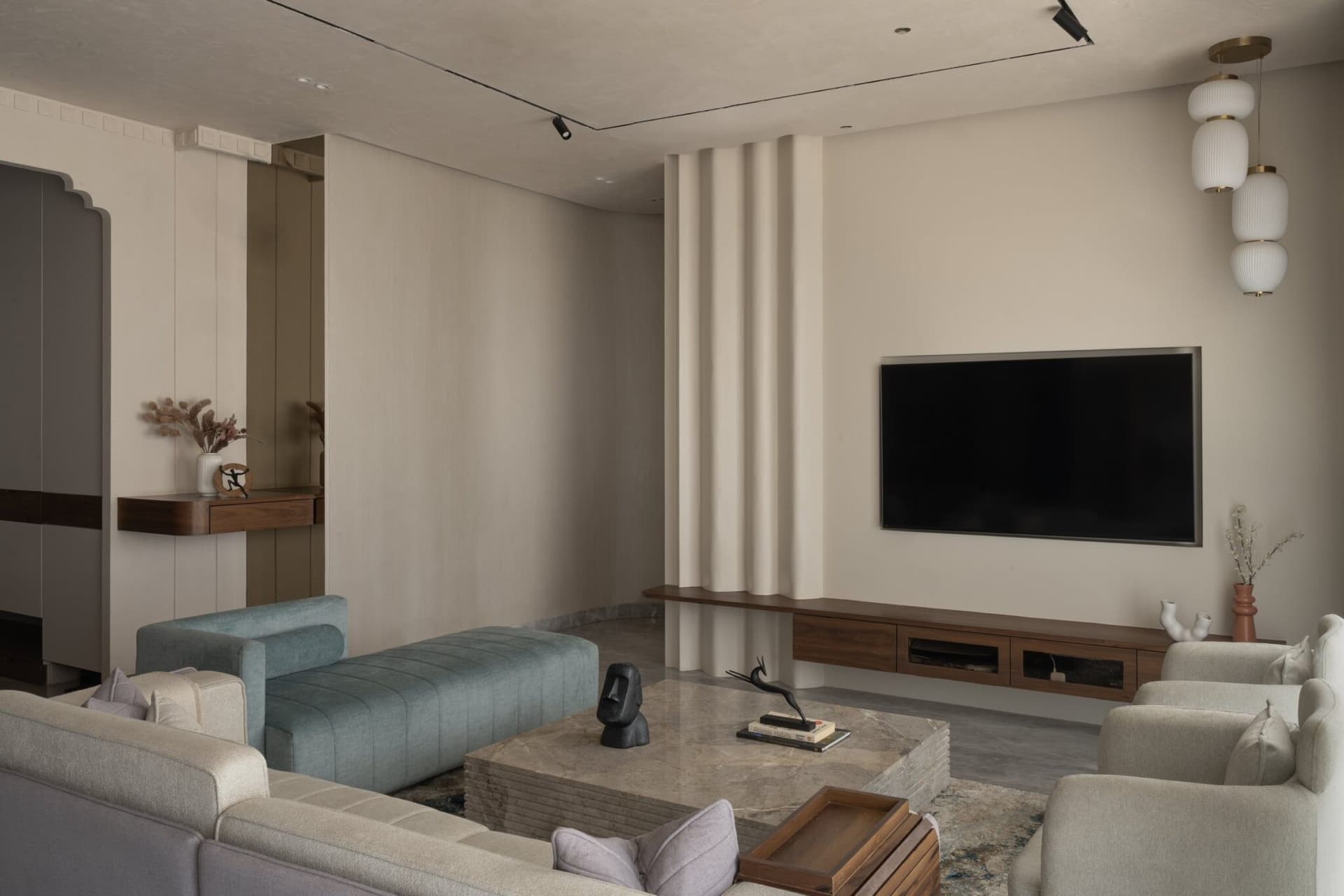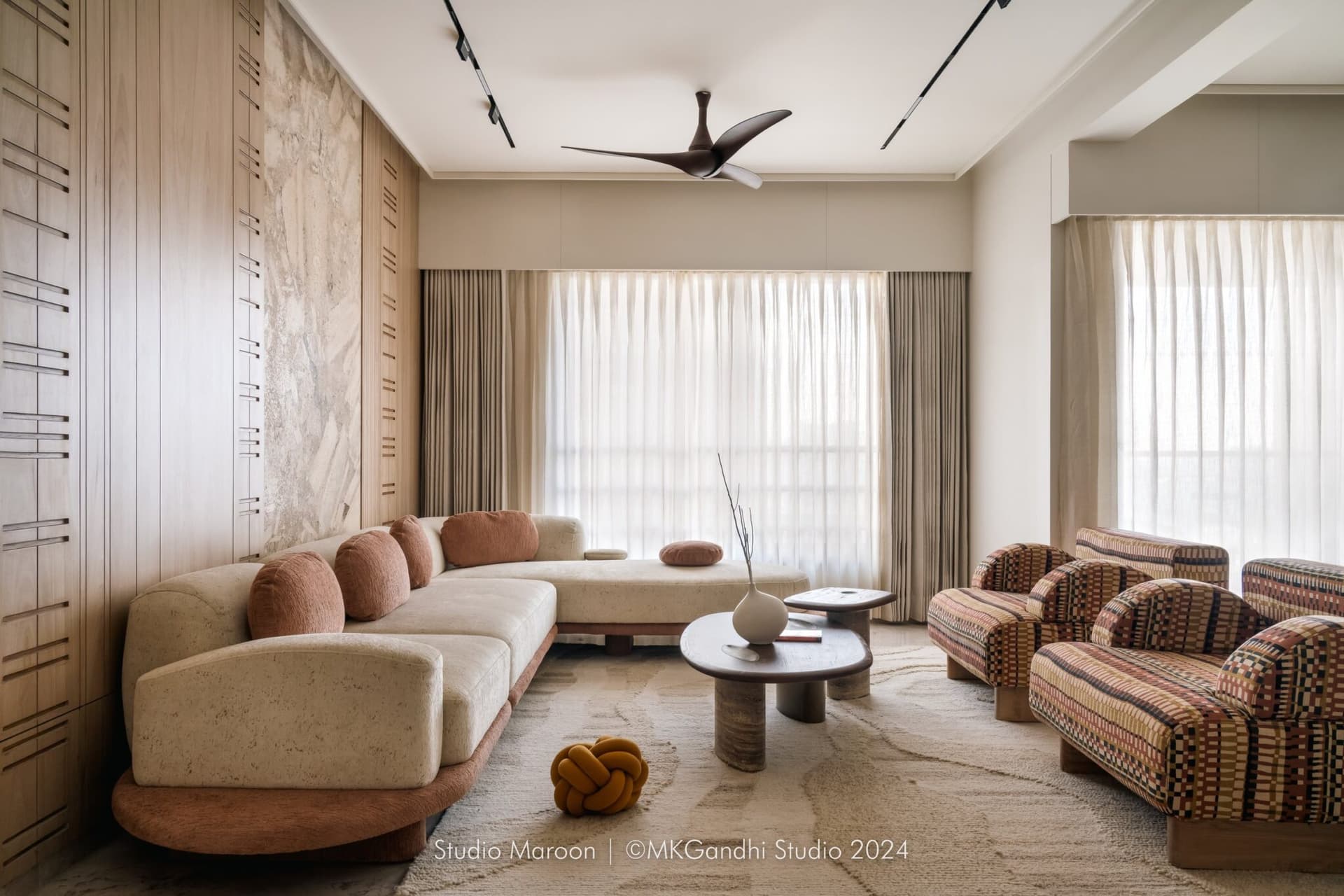
Mid-century modernism has been referenced so extensively in contemporary interiors that it often risks being reduced to a visual shorthand rather than understood as a design philosophy. The greater challenge, and perhaps the more compelling one, lies in translating its principles of clarity, proportion, and sculptural form into spaces that feel contemporary rather than nostalgic.
Designed by Lab9 Design under the direction of principal designer Sujitha Chandrasekharan, this 1,250-square-foot, three-bedroom apartment in Bangalore approaches that challenge with restraint and precision. The project began not with a stylistic brief but with a collection of iconic design pieces already owned by the clients, including the Nelson Bubble Lamp, the PH5 pendant, and the Panton Wire unit. Rather than treating these objects as decorative additions, the design positions them as anchors around which the home’s spatial narrative unfolds.
Titled Modernist Haven, the residence is not a recreation of a mid-century interior but a contemporary interpretation of its enduring ideas. Warm timber tones, disciplined geometry, and carefully calibrated proportions create an environment that acknowledges its influences without becoming beholden to them, resulting in a home that feels both timeless and unmistakably of the present.
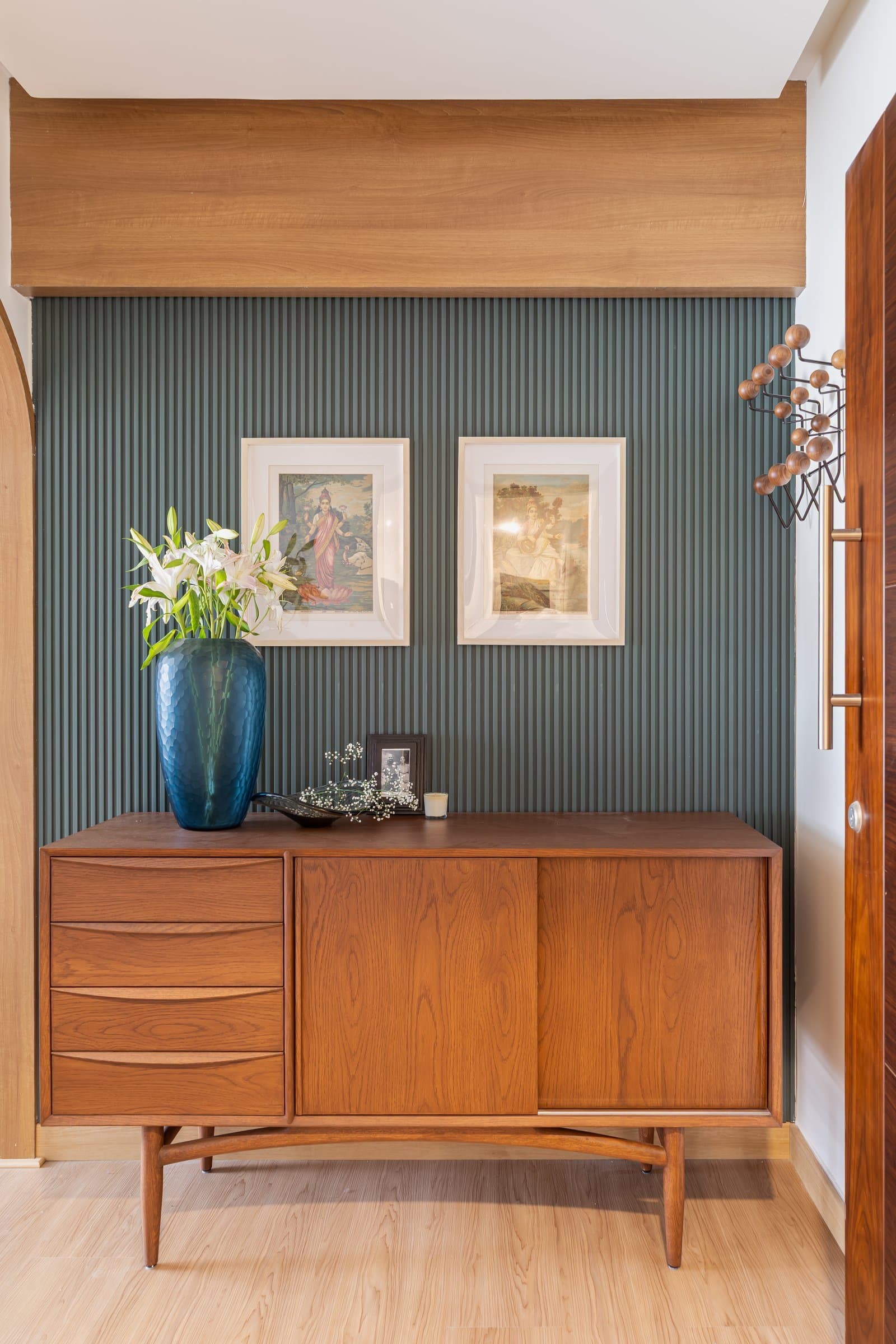
The foyer establishes the home’s design language before a single room reveals itself. A teak sideboard with sculpted legs and softly rounded drawer fronts rests against a fluted panel washed in a muted teal, its vertical rhythm introducing a motif that quietly recurs throughout the apartment. Above, a pair of Ravi Varma prints provide a measured moment of cultural grounding, inserting a distinctly Indian note into a composition otherwise informed by the restraint and clarity of Northern European modernism.
Alongside, an Eames-inspired Hang-It-All coat rack performs the dual role of utility and sculpture. The vignette resists the over-curated quality often associated with design-led interiors; a ceramic vase, a candle, and a framed photograph are arranged with an ease that suggests occupation rather than staging. It is a small but telling gesture, one that signals the home’s broader ambition to balance design pedigree with the comfort of everyday life.
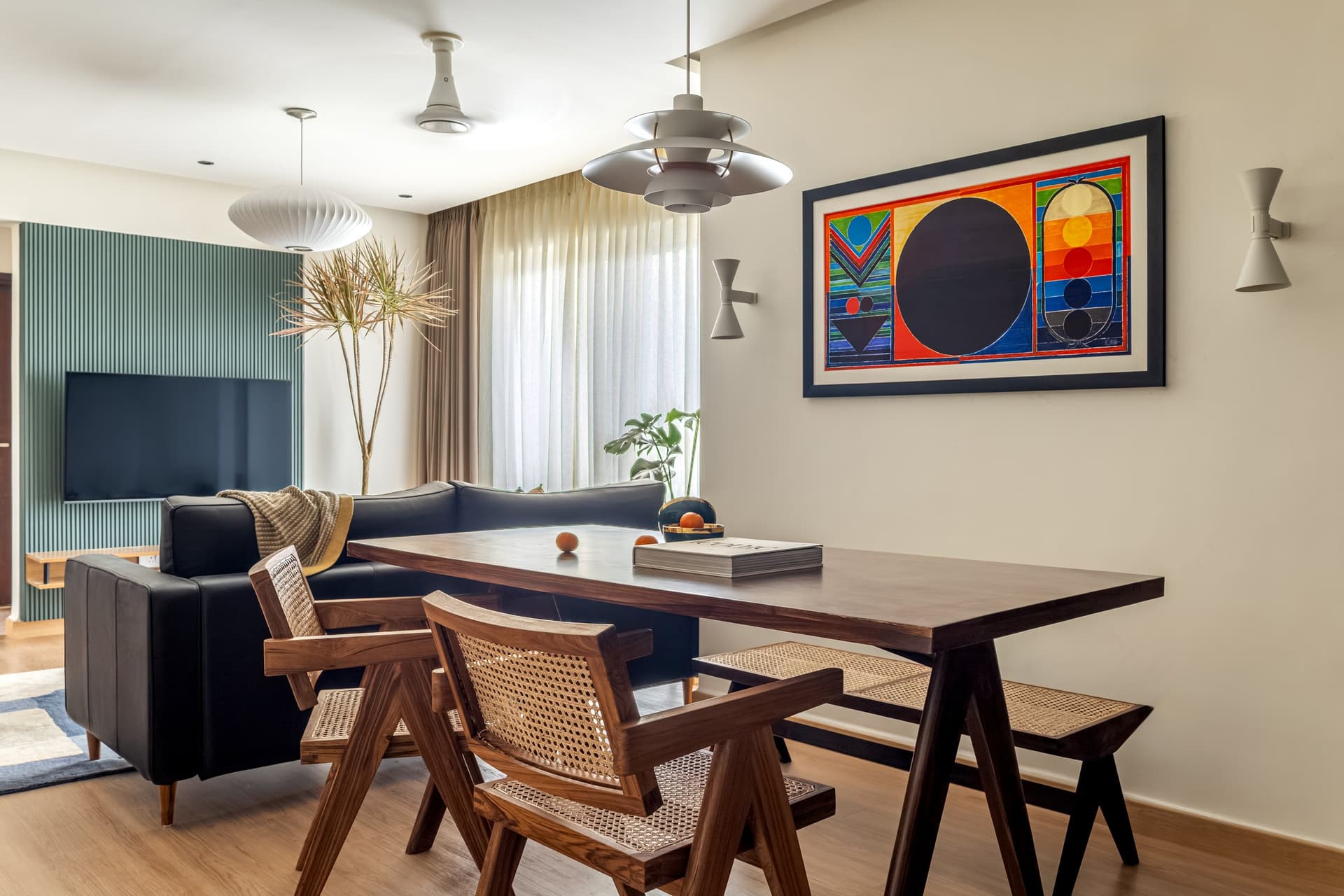
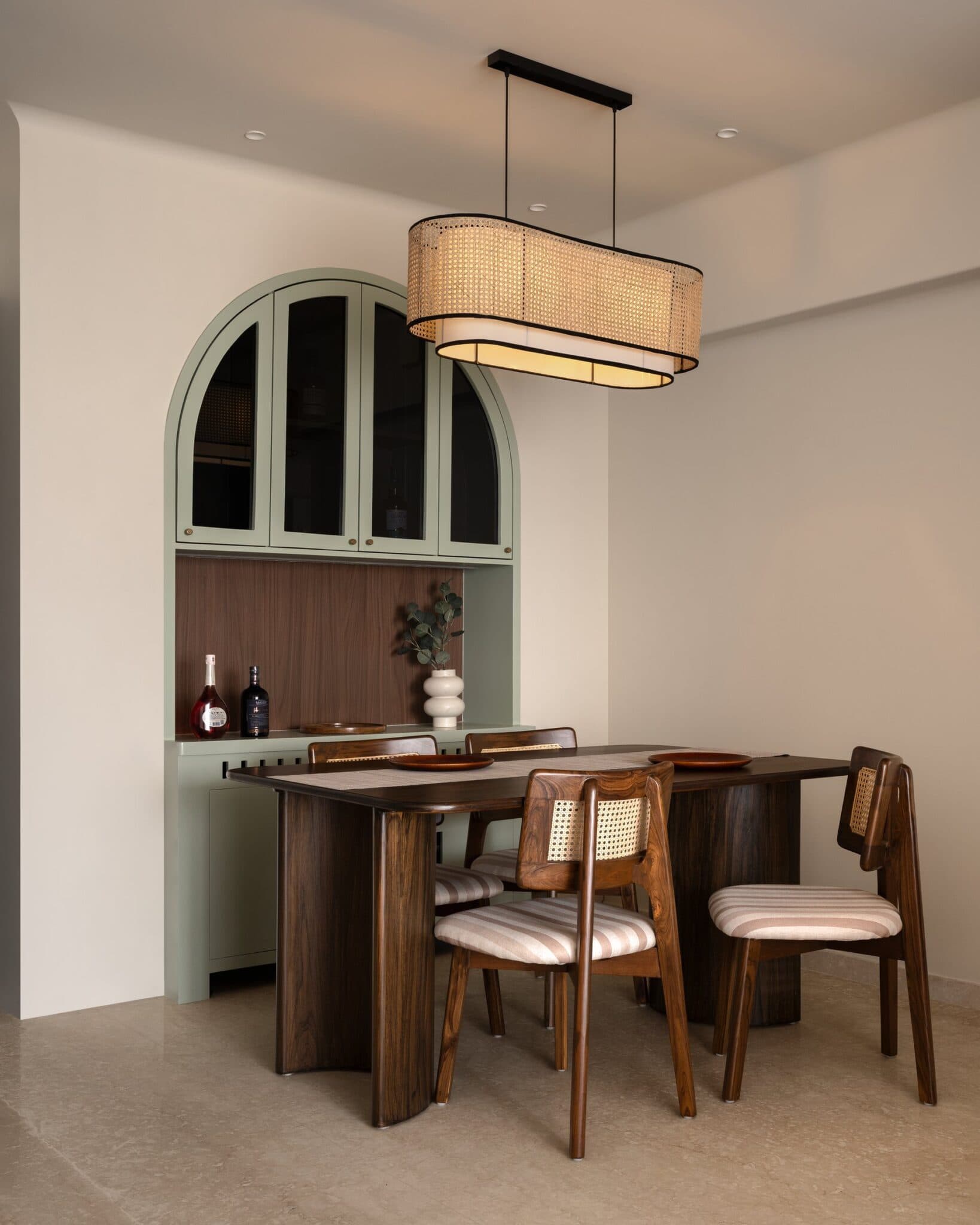
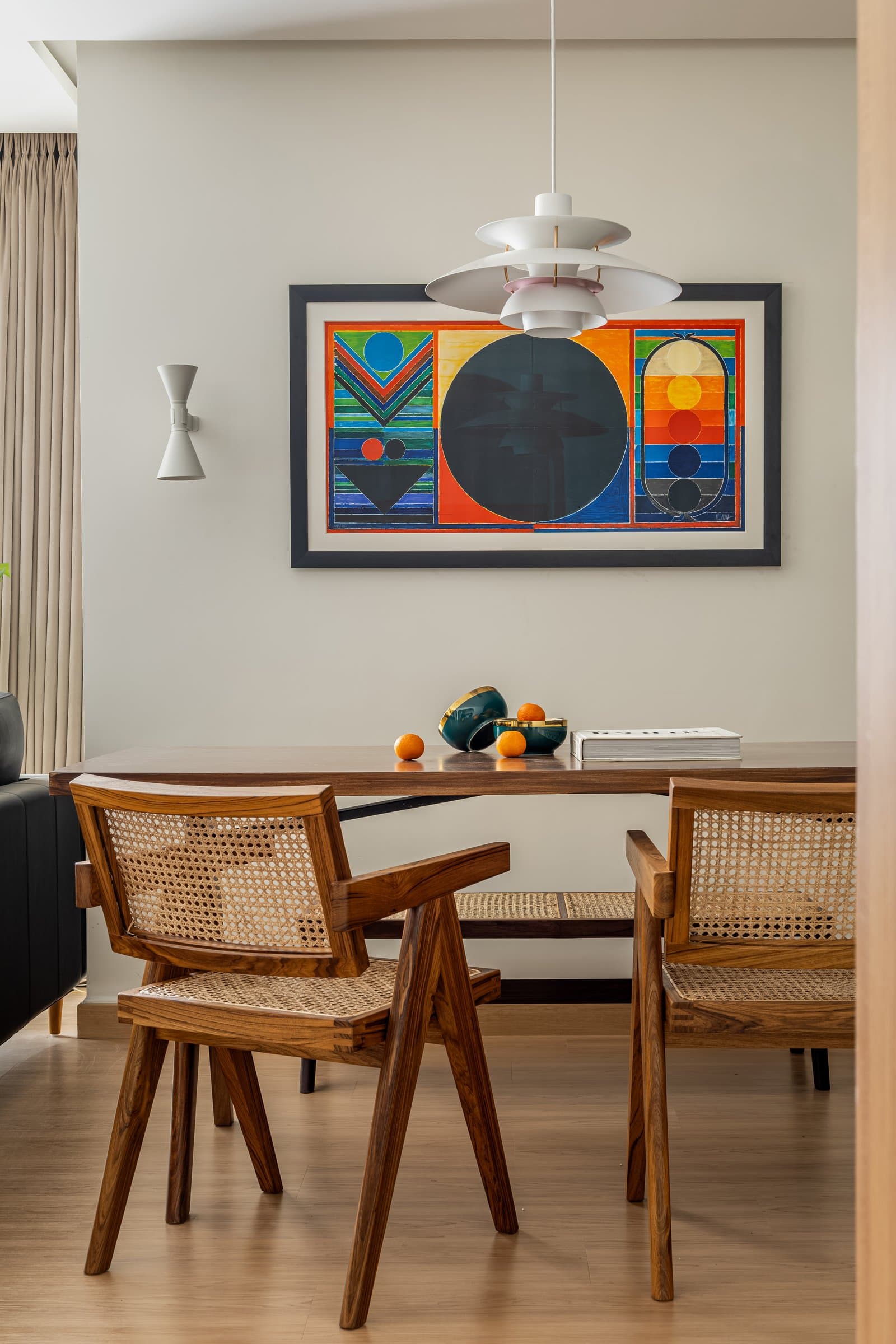
Beyond the foyer, the apartment unfolds into a generous living and dining space conceived as a single, interconnected volume. At its centre, a dark-stained timber dining table is paired with cane-and-teak chairs that draw from the Chandigarh modernist tradition, their woven surfaces introducing warmth and texture into the otherwise disciplined composition. The arrangement feels deliberate without becoming formal, encouraging both gathering and everyday use.
Suspended above, a PH5 pendant in its iconic tiered form anchors the dining setting with quiet authority. Behind it, a bold geometric artwork introduces a saturated burst of red, blue, and black, providing a counterpoint to the home’s restrained material palette. Together, the furniture, lighting, and art create a composition that reflects the project’s broader intent: balancing modernist rigour with moments of colour, craft, and cultural resonance.
““The client already owned several classic statement pieces, which became key anchors in shaping the spatial narrative of the home.””
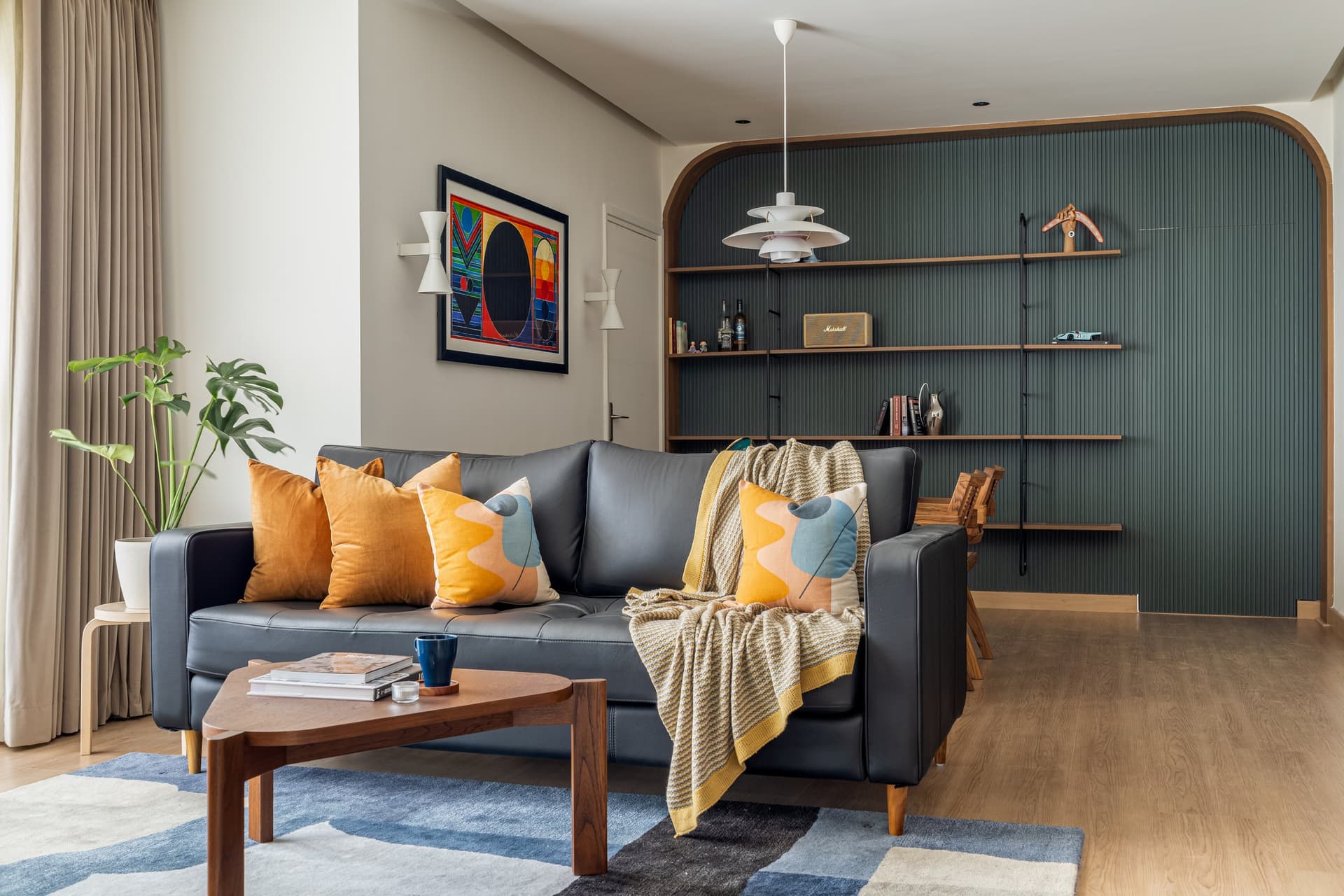
The living room is organised around a low-slung charcoal leather sofa whose generous proportions establish an immediate sense of comfort. Cushions in burnt orange and ochre punctuate the otherwise restrained palette, introducing warmth without disrupting the room’s composure. Behind it, the dark teal fluted wall first encountered in the foyer continues as a unifying architectural element, rising into a softly arched silhouette that frames a delicate wall-mounted shelving system. It is the kind of carefully considered intervention that shifts a room from merely furnished to fully resolved.
What ultimately gives the space its confidence is not the presence of iconic references but the discipline with which they are handled. The palette rarely strays beyond deep blue-greens, olive tones, and warm timber, while colour is introduced selectively through textiles and artwork rather than applied broadly across surfaces. The result is a living space that understands mid-century modernism as a lesson in proportion, restraint, and material clarity. Rather than recreating the period, the home absorbs its principles and reinterprets them through a contemporary lens.
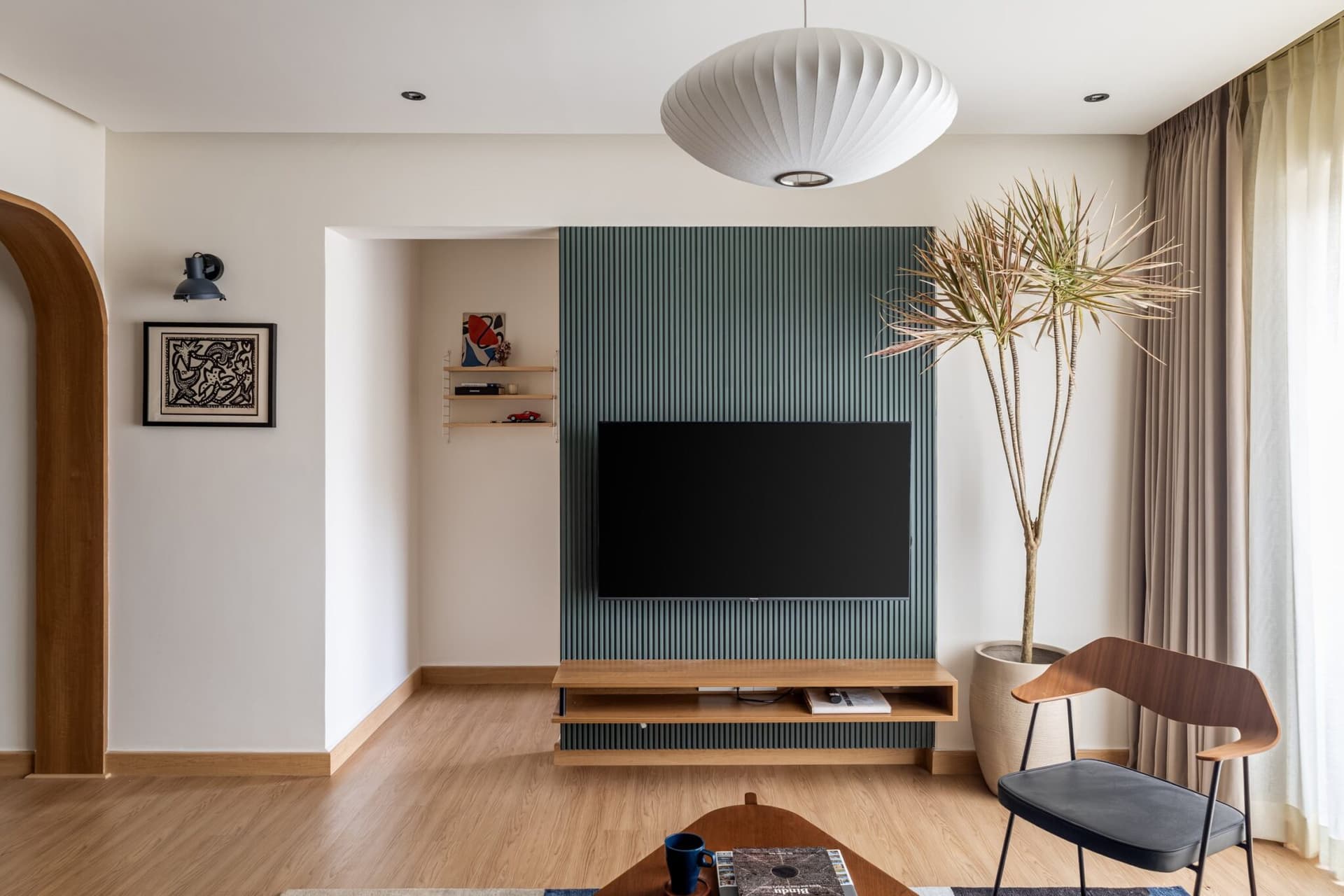
Viewed from another angle, the entertainment wall reveals the project’s most complete expression of its design language. The fluted teal panelling wraps around the television and extends into a recessed shelving niche, creating a continuous architectural surface rather than a conventional media unit. Open shelves display books and objects with restraint, while a small framed Madhubani artwork introduces a subtle regional reference, echoing the careful cultural layering seen elsewhere in the apartment. Above, a Nelson Bubble Lamp hovers almost weightlessly, its translucent form bringing softness and diffused light to the composition.
On the opposite side, a curved oak archway frames the transition into the space, reinforcing the rounded geometry that quietly threads through the home.
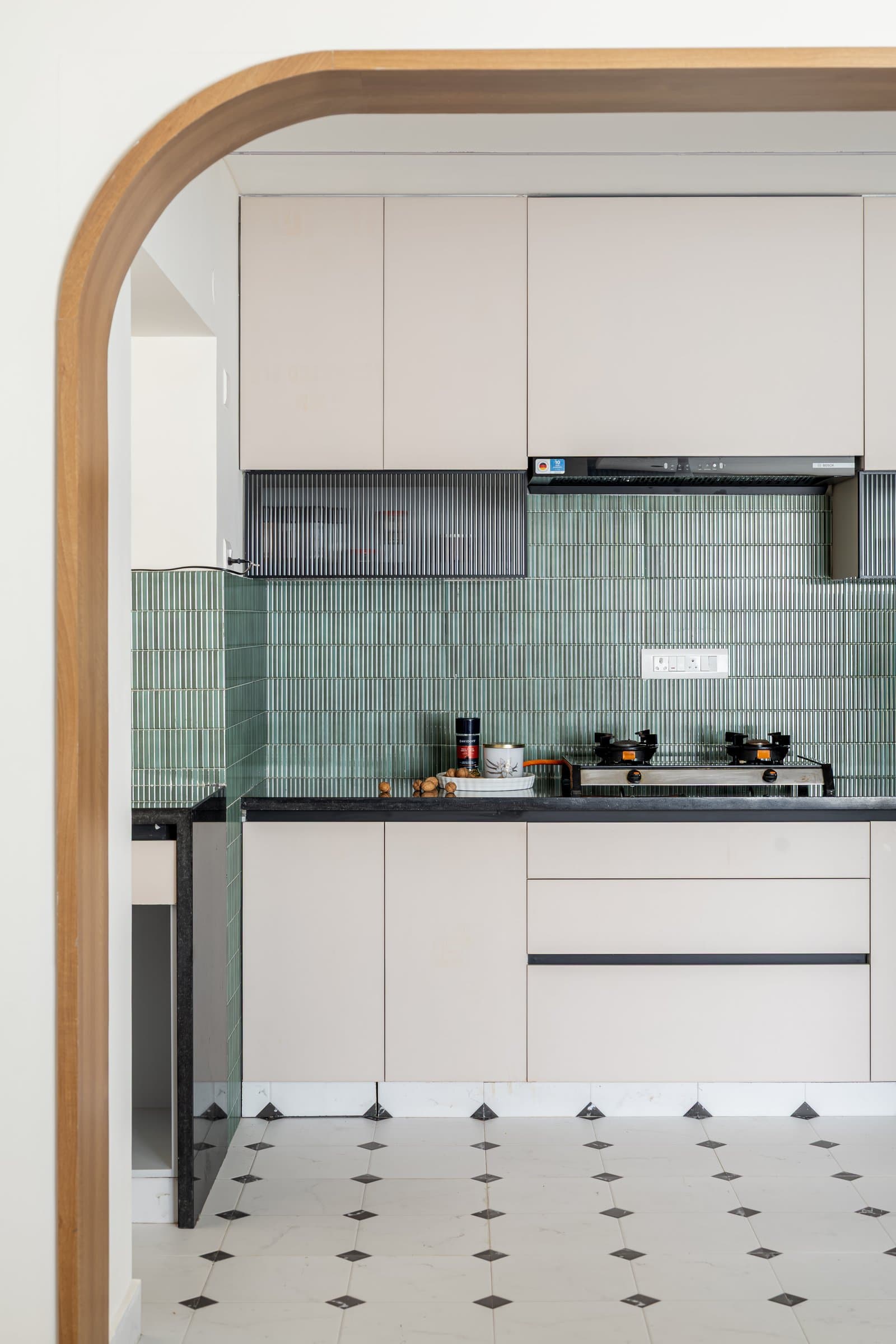
Seen through the same oak-framed archway, the kitchen adopts a more restrained and utilitarian expression while remaining firmly connected to the home’s broader material narrative. Pale blush cabinetry introduces warmth without overwhelming the compact space, while a sage-green kitkat tile backsplash provides texture and rhythm. The tiles’ slender vertical profile lends the surface an almost woven quality, reading less as a conventional splashback and more as a tactile backdrop to the room’s clean-lined composition.
A black stone countertop grounds the palette, providing contrast to the softer tones of the cabinetry and tile. The interplay of muted colour, texture, and geometry reflects the project’s broader commitment to restraint, where visual interest emerges through carefully considered material relationships rather than overt decorative gestures. Even in its most functional space, the apartment remains faithful to the principles of clarity, warmth, and measured modernism.
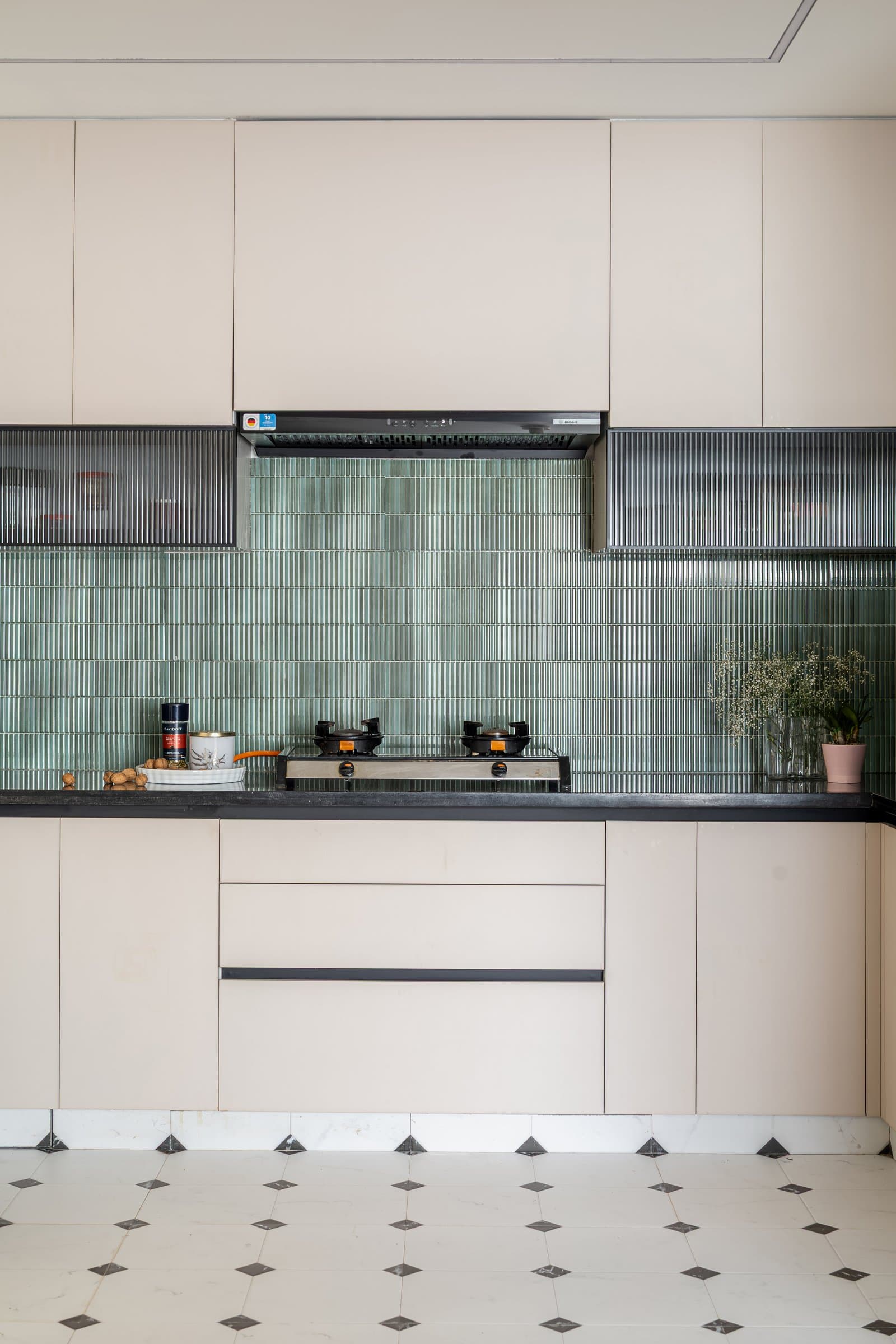
This sense of measured nostalgia continues through the reeded-glass cabinet inserts, the vertically ribbed green tile backsplash, and the soft cream cabinetry that forms the lower run. Together, these elements create a kitchen that feels collected rather than designed in a single stroke. The room balances memory and modernity with unusual ease, demonstrating the project’s broader ability to draw from established design languages while remaining firmly rooted in contemporary living.
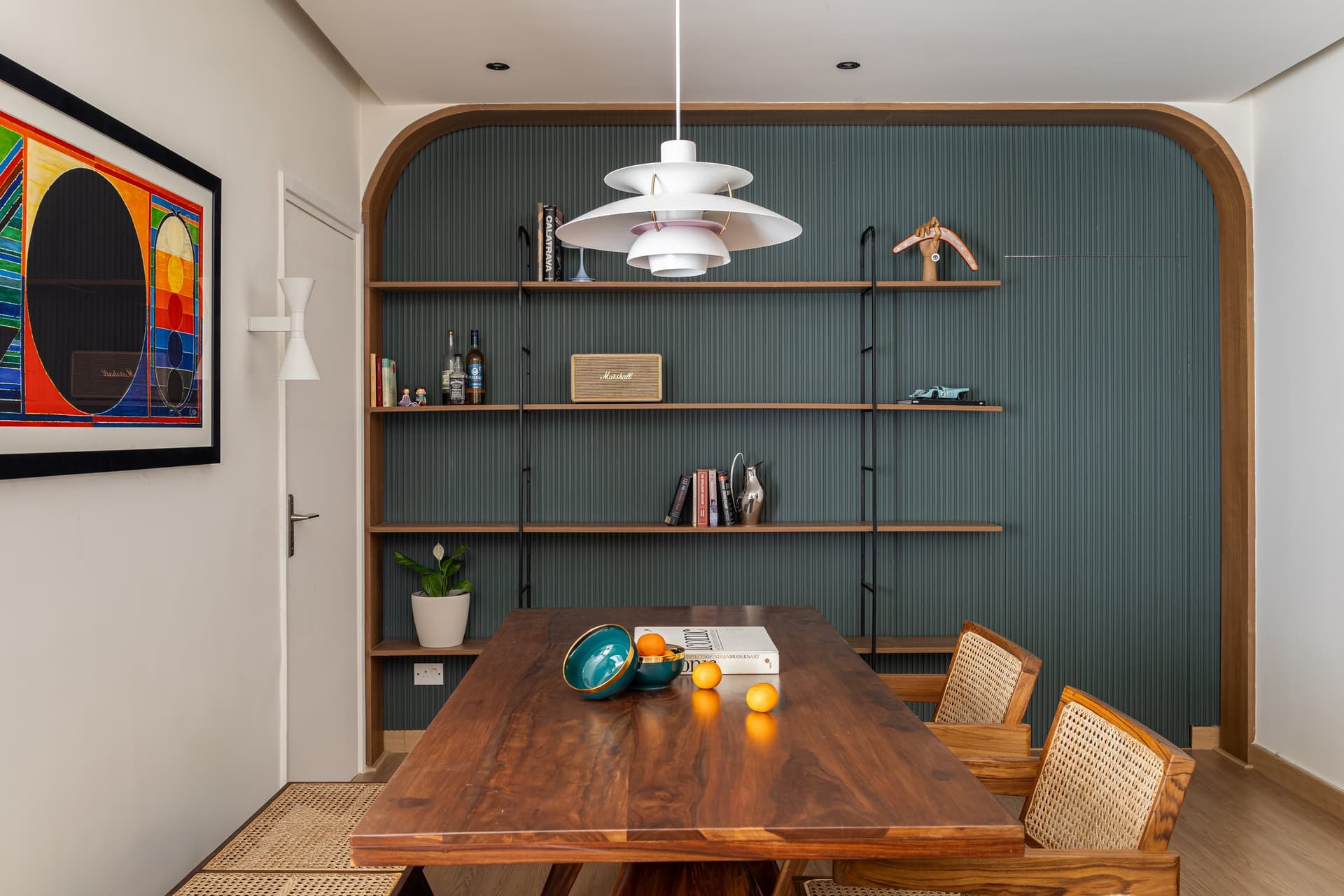
Returning to the dining area, one of the project’s most resolved architectural interventions comes into focus. The teal fluted wall reappears as a tall arched recess, its proportions lending a sense of verticality and presence to the space. Within it, a slender cantilevered shelving system in timber and blackened steel displays a carefully edited collection. The arrangement feels personal rather than decorative, revealing traces of the occupants’ interests without overwhelming the composition. Centred below, a solid walnut dining table anchors the setting, while the PH5 pendant above reinforces the room’s modernist lineage.
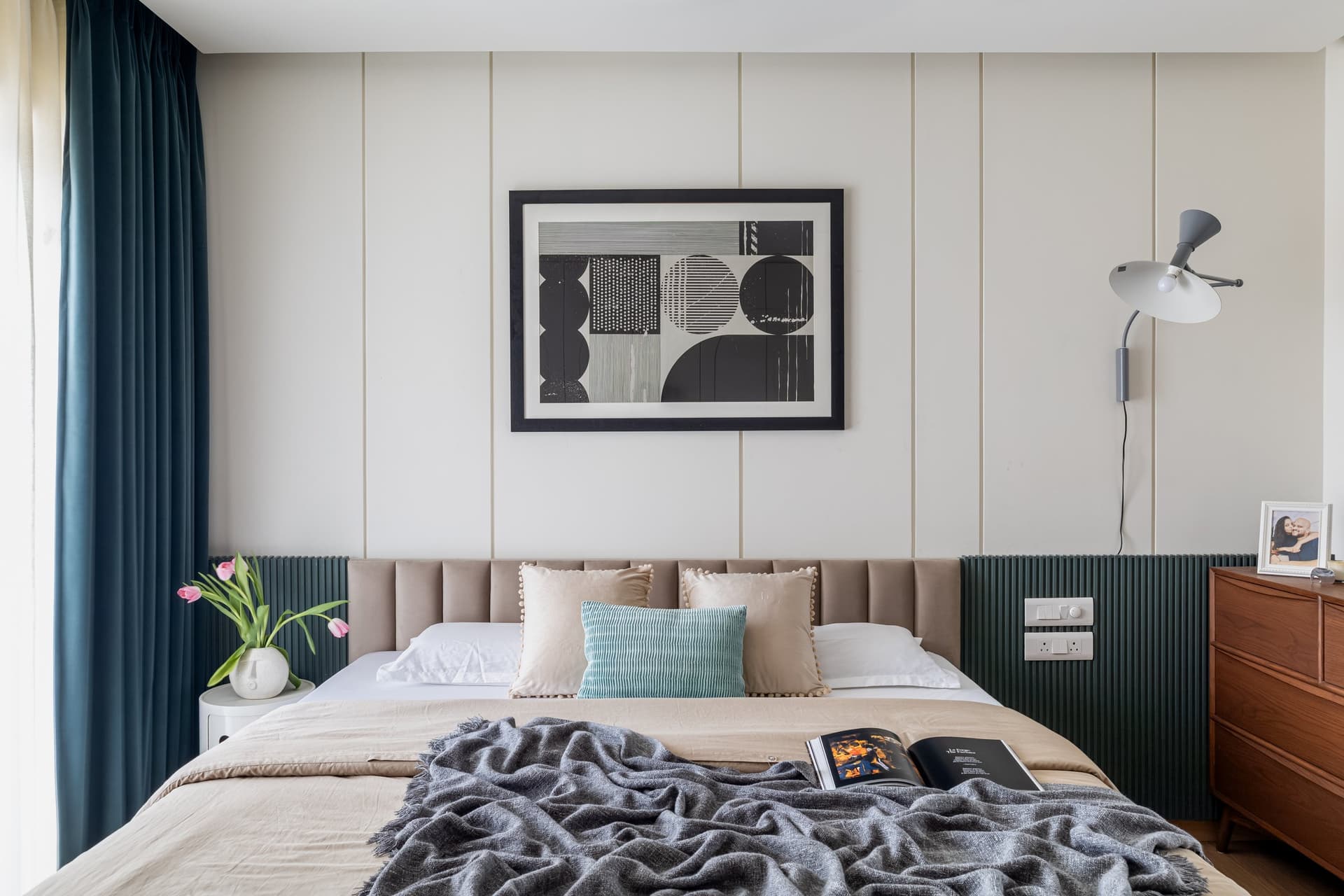
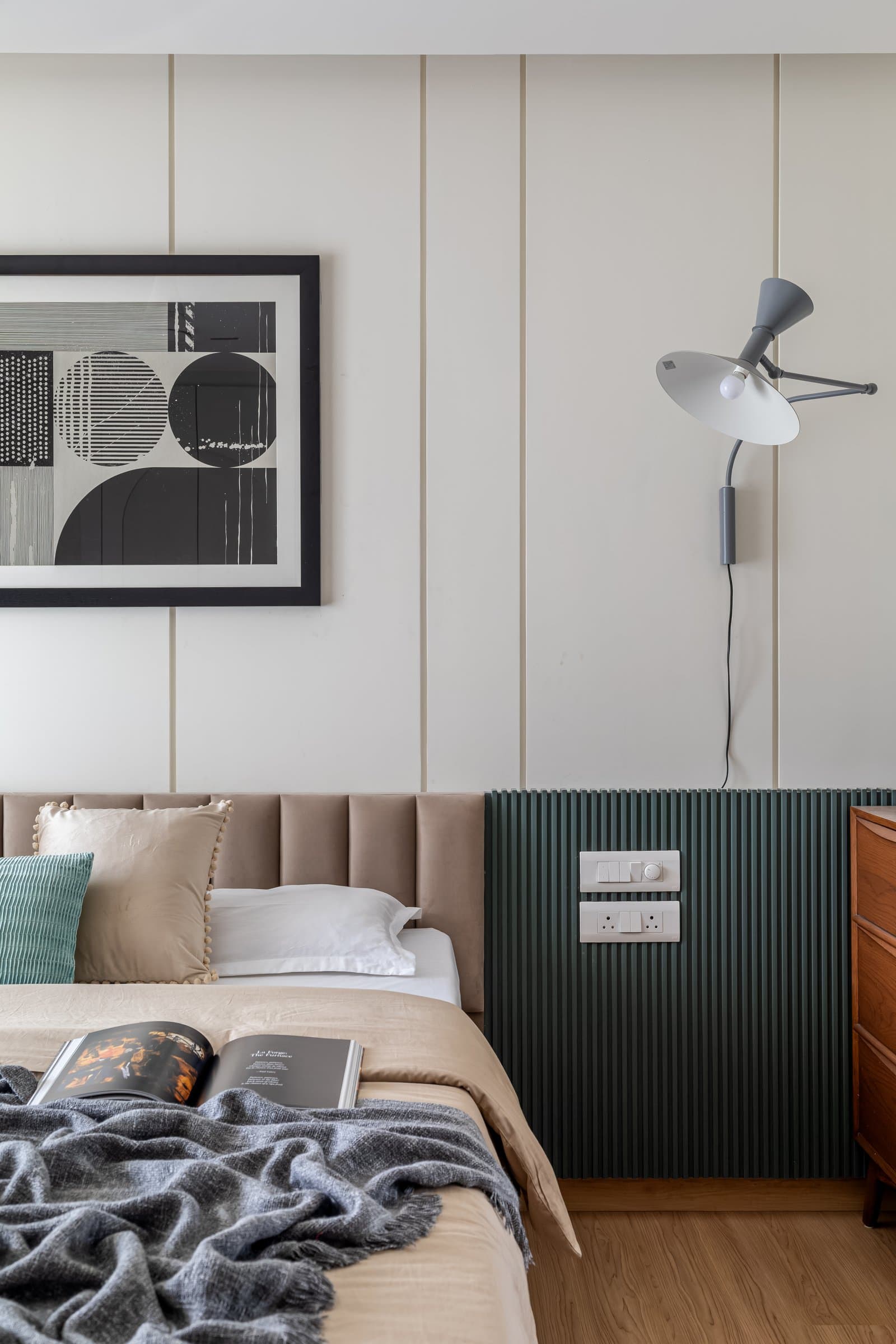
The master bedroom marks a subtle shift in atmosphere, exchanging the sociability of the public spaces for a more introspective calm. Behind the bed, the feature wall is composed of contrasting surfaces: a smooth central panel articulated with slender vertical reveals, flanked by sections of deep teal-green fluting that echo the recurring material language of the apartment. Between them, a softly upholstered taupe velvet headboard occupies the junction, introducing a tactile warmth that softens the room’s otherwise disciplined geometry.
Above, a framed geometric artwork in graphite and ivory extends the abstract visual vocabulary established in the living spaces, though here it is rendered in a quieter, more restrained register. The monochromatic composition reinforces the room’s sense of repose while maintaining continuity with the broader design narrative. Beside it, a teak chest of drawers brings a distinctly mid-century character through its sculpted pulls, tapered legs, and finely detailed craftsmanship. Mirroring the sideboard in the foyer, it acts as a subtle thread connecting the apartment’s spaces, demonstrating how the project relies on repetition and proportion rather than overt thematic gestures to create cohesion.
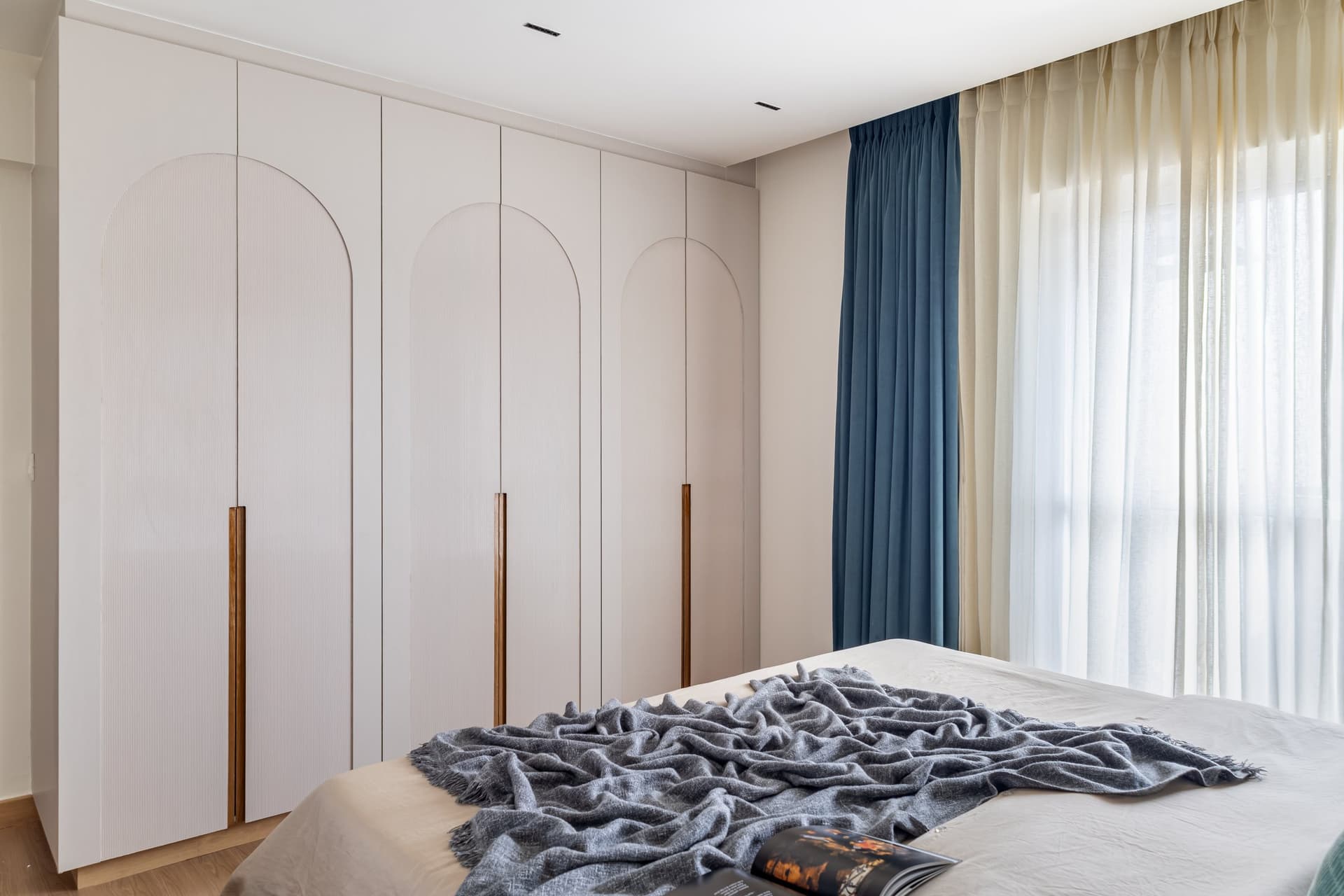
Opposite the bed, the wardrobe reveals one of the bedroom’s most understated yet effective design moves. Routed into the blush-toned cabinet fronts are three elongated arched motifs, each centred on a slim vertical timber handle. What might otherwise have been a utilitarian wall of storage is transformed through geometry alone, the arches lending depth, rhythm, and a sense of crafted permanence to the elevation.
The gesture also reinforces one of the apartment’s recurring themes. Throughout the home, arches appear not as decorative flourishes but as a unifying architectural device, shaping thresholds, framing views, and softening transitions between spaces.
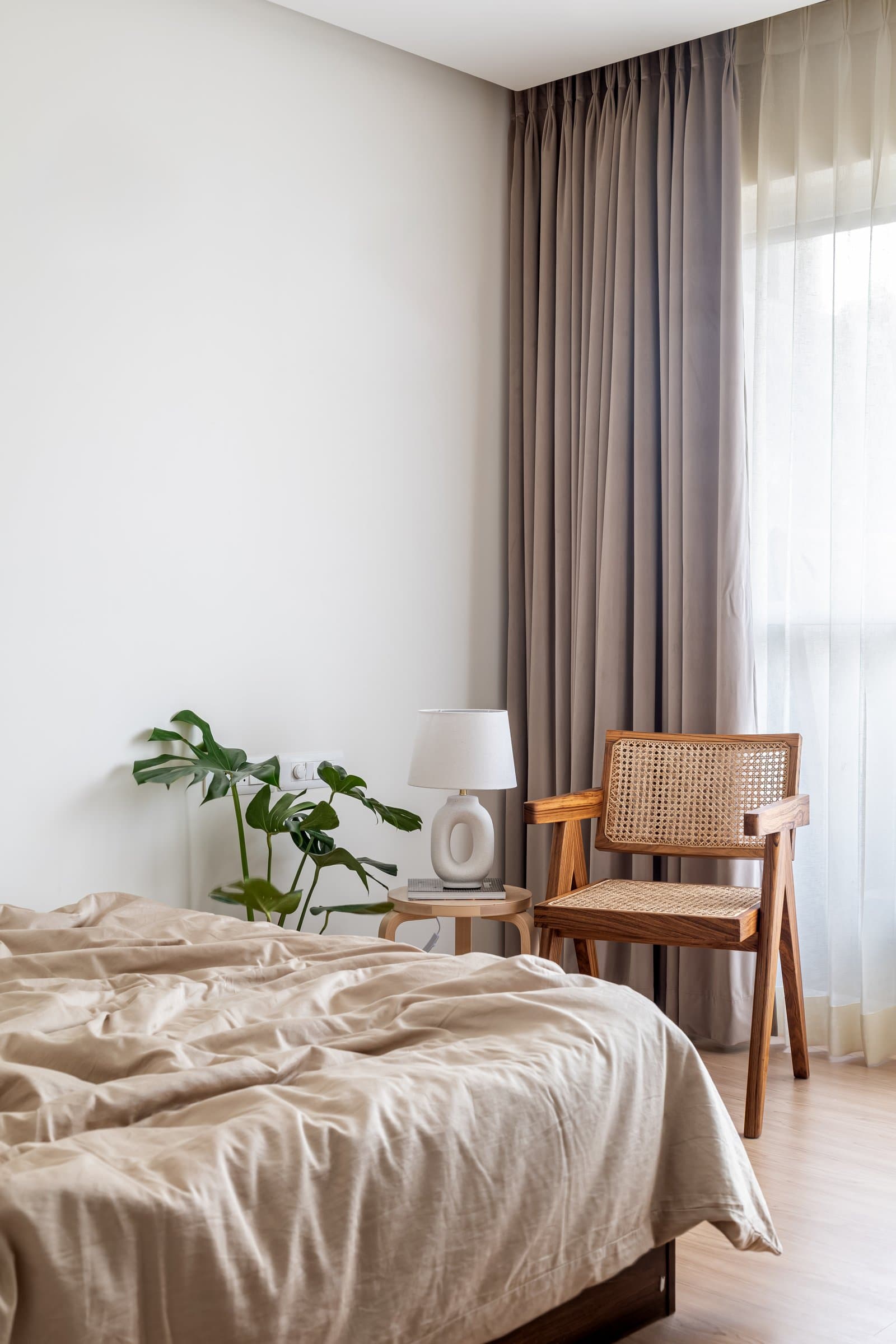
The second bedroom adopts a quieter, more restrained language, demonstrating the project’s confidence in subtraction rather than addition. A solitary Chandigarh-inspired cane-and-teak chair occupies one corner beside a simple round side table, creating a composition that feels intentionally sparse rather than incomplete. The furniture is given room to breathe, allowing form, material, and proportion to carry the visual weight.
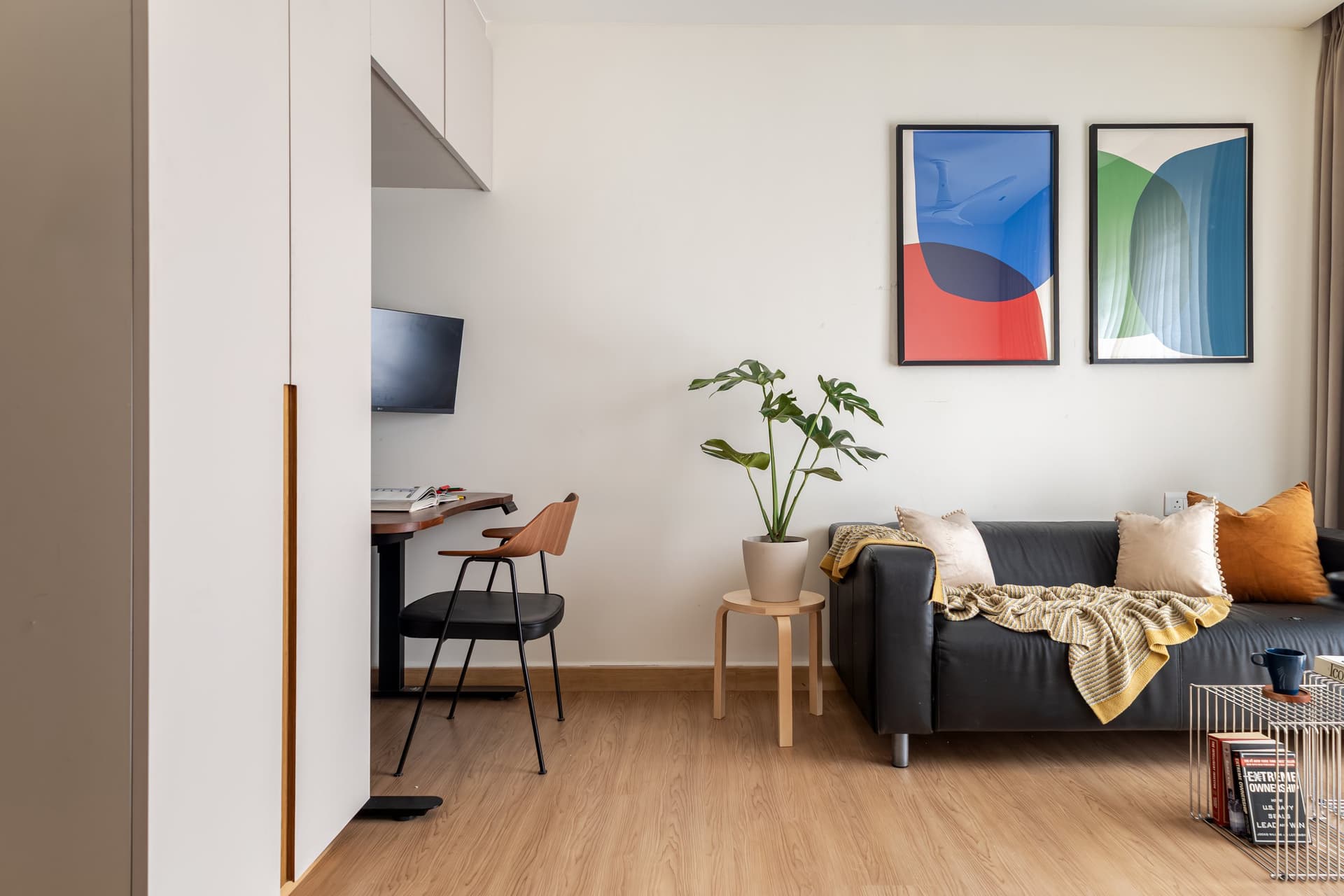
The third bedroom has been reimagined as a flexible work and guest space, reflecting the evolving demands of contemporary domestic life. A leather daybed lines one wall, offering a place for rest, reading, or occasional overnight stays, while a built-in desk along the opposite side establishes the room’s primary function as a workspace. The arrangement is straightforward and efficient, allowing the compact footprint to accommodate multiple uses without feeling compromised.
Against this restrained backdrop, a pair of abstract artworks introduces the room’s most vivid note of colour. Composed in saturated reds, blues, and greens, the prints hang above the daybed like concentrated bursts of energy within an otherwise muted palette.
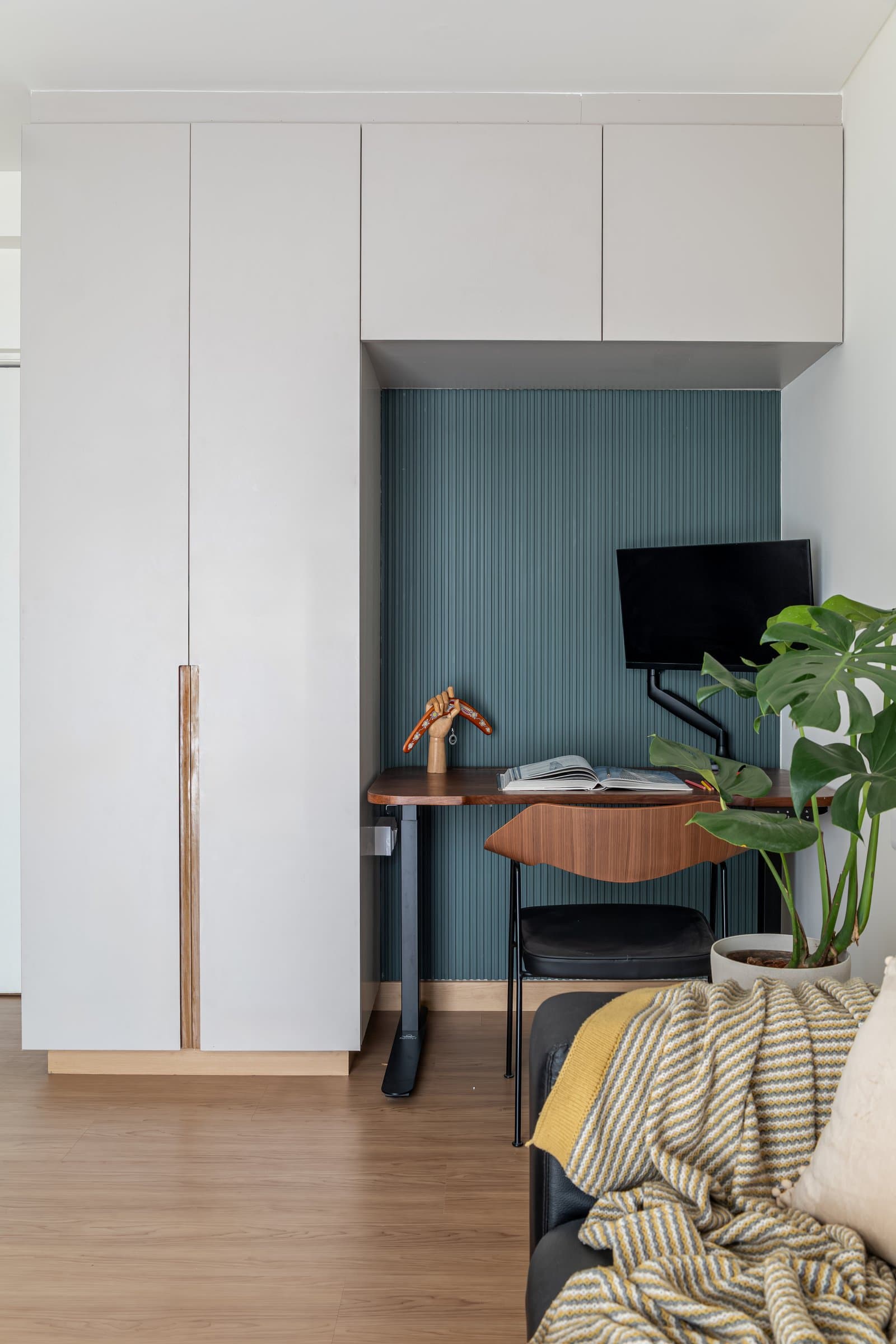
The study nook is tucked into a recessed alcove lined with the same blue-grey fluted panelling that appears throughout the apartment, reinforcing the project’s sense of continuity from room to room. Within this compact footprint, a slim walnut desktop rests on a height-adjustable frame, balancing the warmth of natural timber with the practical demands of contemporary work. The composition is deliberately restrained, allowing the materials and proportions to define the space rather than relying on decorative excess.
What Modernist Haven contributes to Bangalore’s contemporary residential landscape is a measured understanding of a design language that is often admired yet frequently reduced to a catalogue of recognisable objects. Here, mid-century modernism is approached as a set of principles rather than a stylistic costume. Its emphasis on proportion, material honesty, sculptural form, and visual clarity is absorbed into the architecture of the home, allowing the influence to be felt without ever becoming overtly performative.
The project’s distinction lies in its refusal to treat iconic furniture and collectibles as trophies. Instead, the apartment has been carefully assembled around them, allowing each piece to occupy a meaningful place within a larger spatial narrative. The design neither competes with nor fetishises the collection; it provides a calm and disciplined framework through which these objects can be appreciated as part of everyday life.
In an era when interiors are increasingly conceived for immediate visual impact, this residence offers a quieter proposition. Its success rests not on novelty but on coherence, on the patient repetition of forms, materials, and proportions that build a sense of continuity across rooms. The apartment feels considered without appearing calculated, refined without becoming precious, and above all, unmistakably lived in.