There is a particular category of residential project that resists the contemporary instinct to perform. Not minimal, not maximal, not trending in any direction that social media might reward with algorithmic favour. Instead, it proposes something more difficult: a home that feels genuinely inhabited, where every surface suggests a history of considered choices rather than a single moment of styled revelation. The House of Pause in Aundh, Pune, belongs to this quieter, more demanding category.
Designed by Oll Korrect Design, the project takes an existing bungalow and reconceives its interiors around a central atrium clad in exposed brick, a double-height volume that acts as the home’s spatial and emotional spine. Every room opens onto or borrows light from this core, and the result is a house that breathes inward rather than outward, finding its drama not in views but in the quality of light that shifts across raw masonry throughout the day.
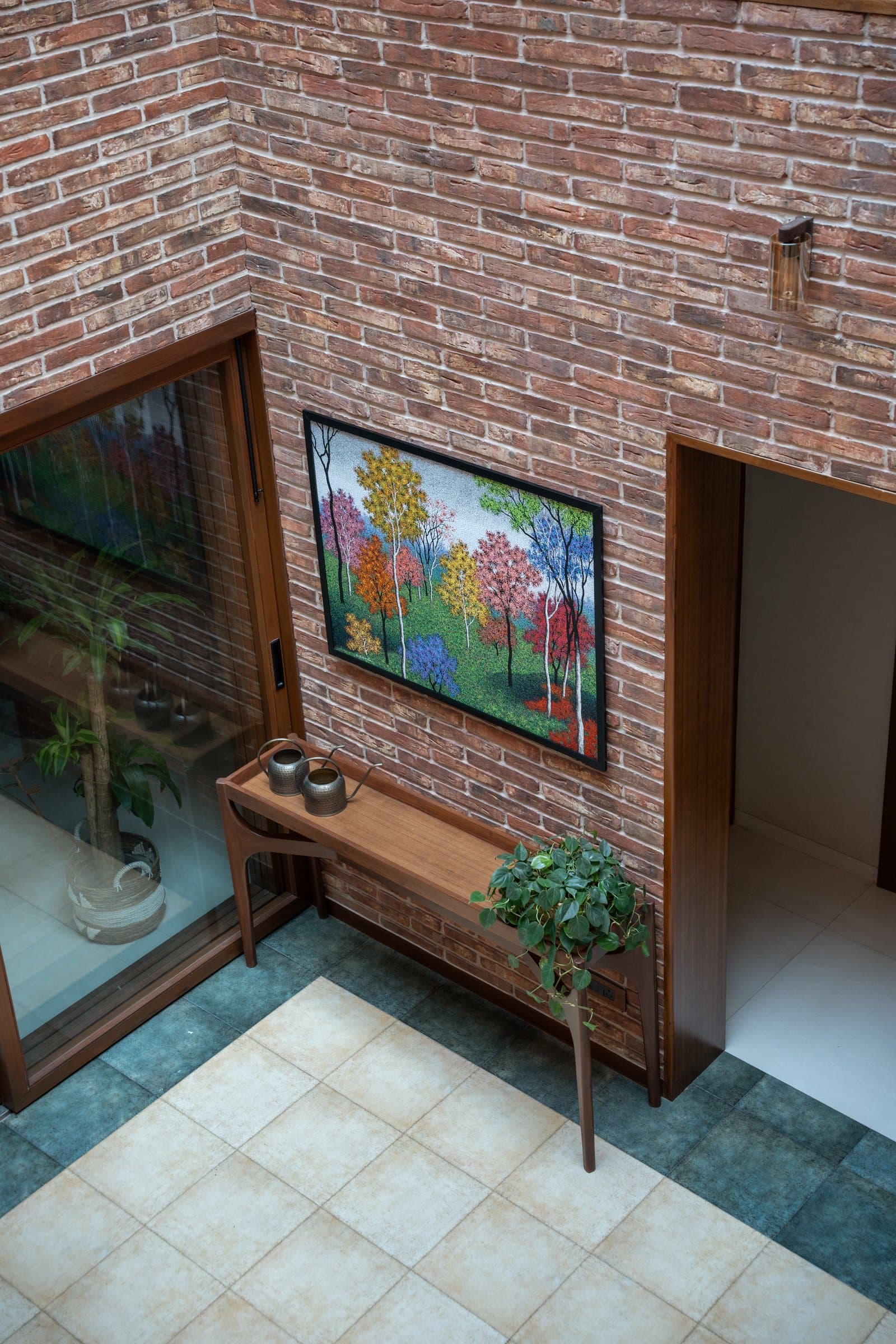
The entry sets the tone with characteristic restraint. A timber console sits against a full-height brick wall, anchored by a vivid landscape painting whose polychrome palette is the only concession to colour in an otherwise material-led composition. The foyer announces a commitment: art will be present in this home, but it will always be held by heavier, earthier surfaces.
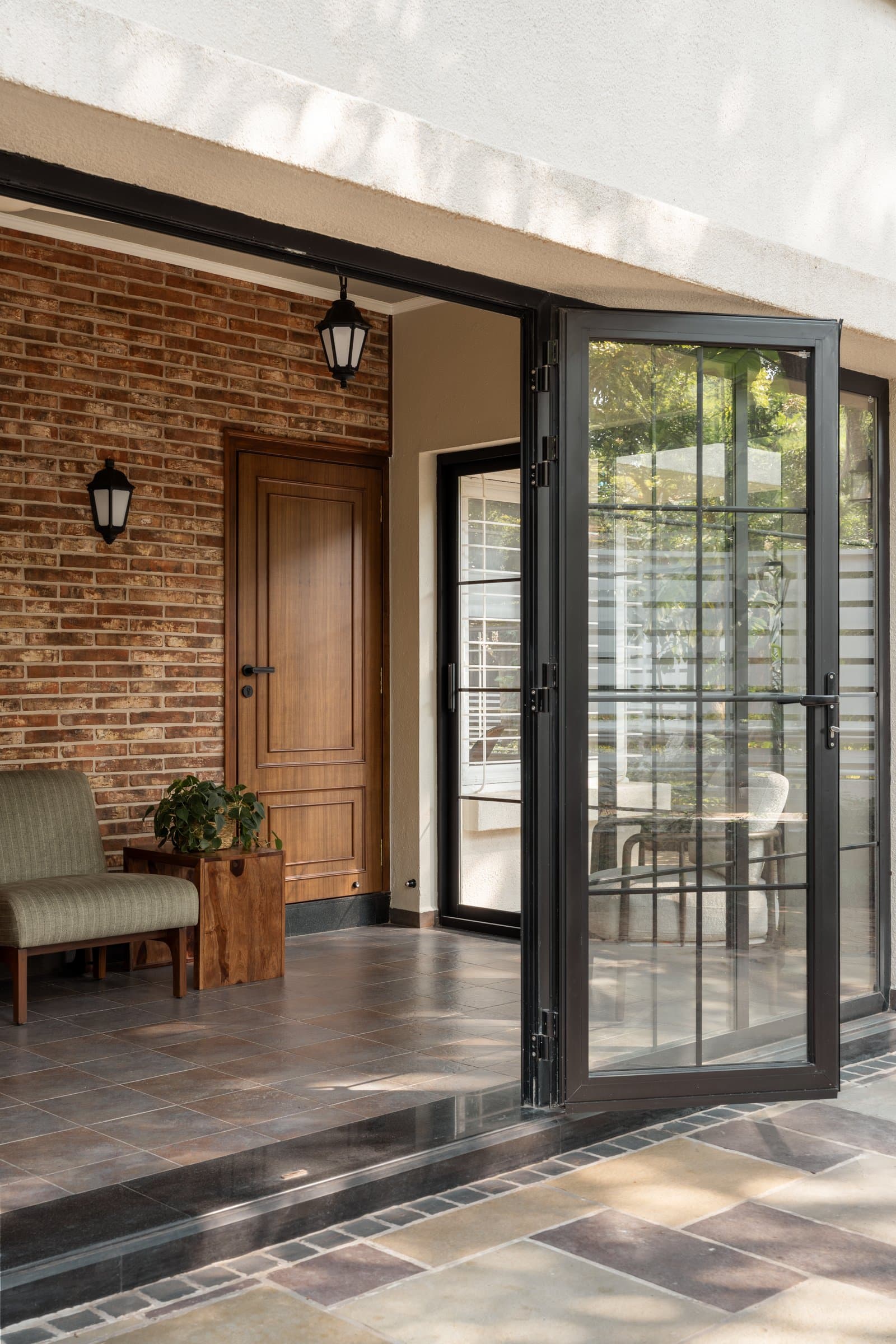
The threshold between outdoors and in is mediated through a verandah with a brick-clad wall and a solid timber door flanked by steel-framed bi-fold glazing. The transition is gradual and deliberate, a porch that insists on decompression before the interior world takes over.
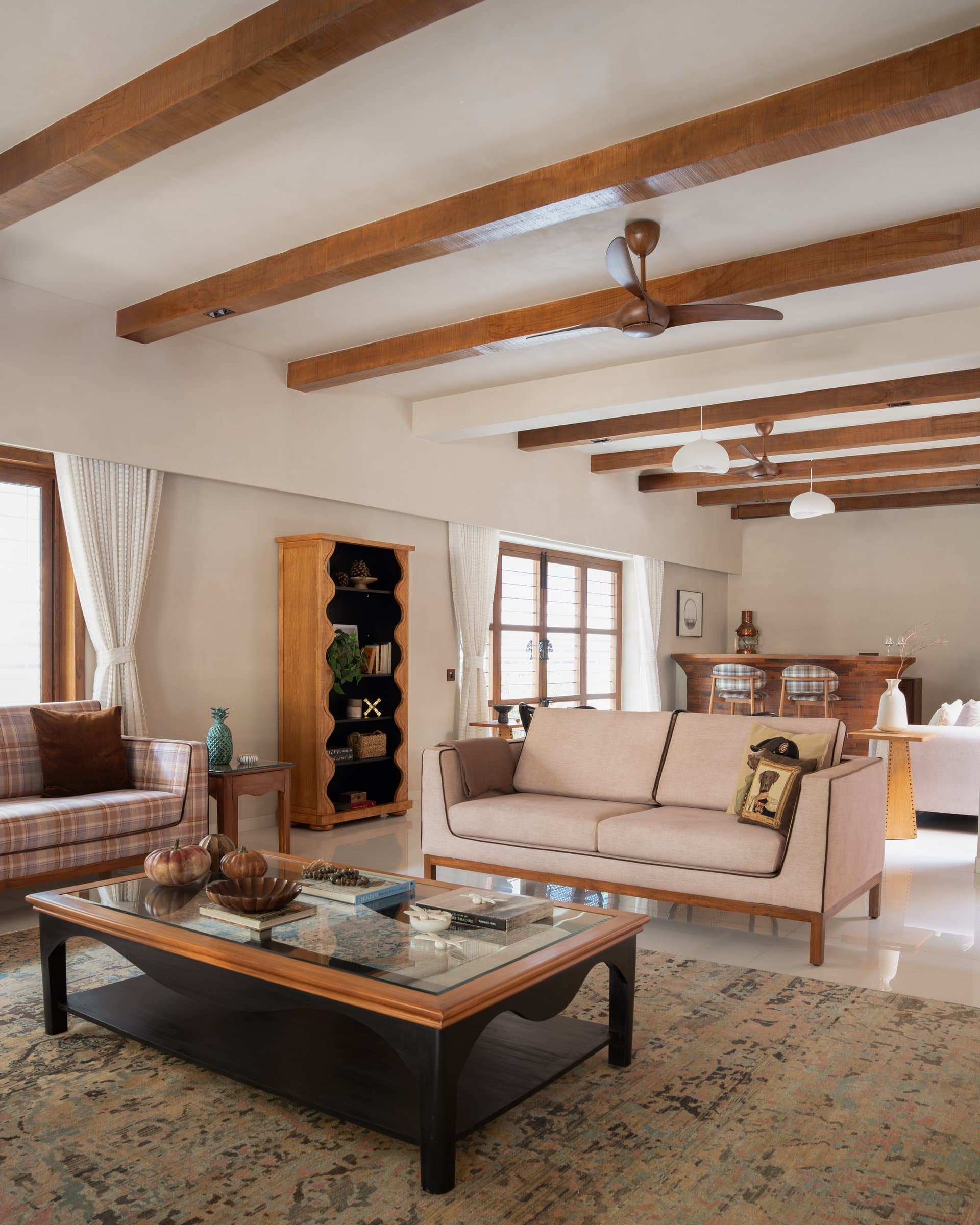
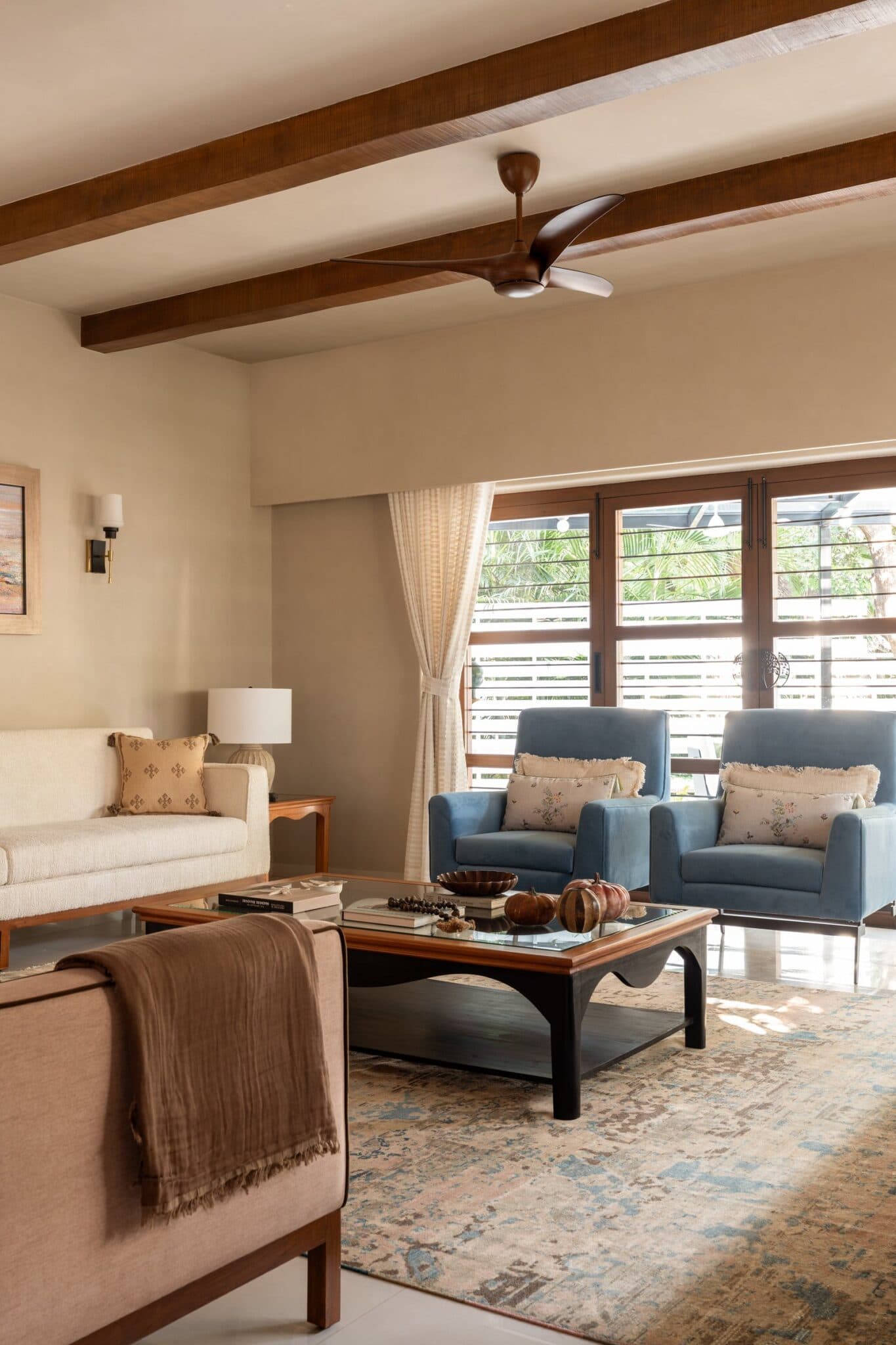
The formal living room announces itself through its ceiling. Timber beams run in parallel across a white plane, lending a vernacular warmth to a room that could otherwise read as a conventional arrangement of sofas and a coffee table. The beams do the architectural work; the furniture below is free to be comfortable rather than conceptual.
From a second angle, the living room’s colour strategy becomes clearer. Dusty blue armchairs hold their own against a palette of cream, biscuit, and aged timber, introducing just enough contrast to keep the room from tipping into monotone warmth. The rug beneath anchors the seating arrangement while quietly echoing the blue.
A quieter corner of the living area reveals how the home handles its art. A landscape painting in soft pinks, oranges, and lavender tones hangs above a white sofa, paired with a brass-and-black wall sconce with a white shade. The composition reads like a studied pause within the larger room, intimate without being precious.
The second living zone faces the atrium directly, with a deep sofa positioned against floor-to-ceiling glazing that frames the double-height brick core. This is the room where the home’s architectural argument is felt most powerfully: the interior is porous, every seated position offering a long view through glass and brick into another part of the house.
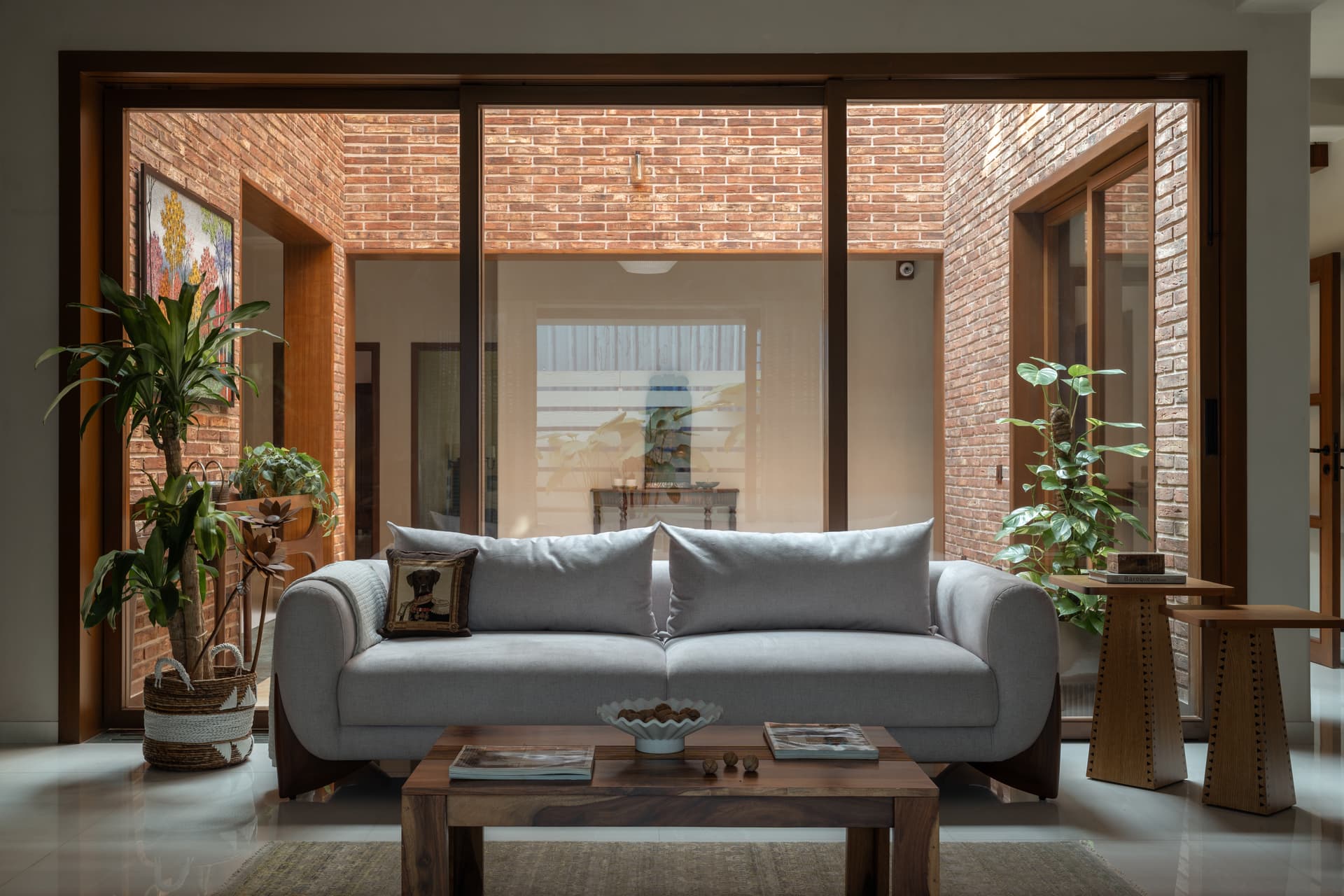
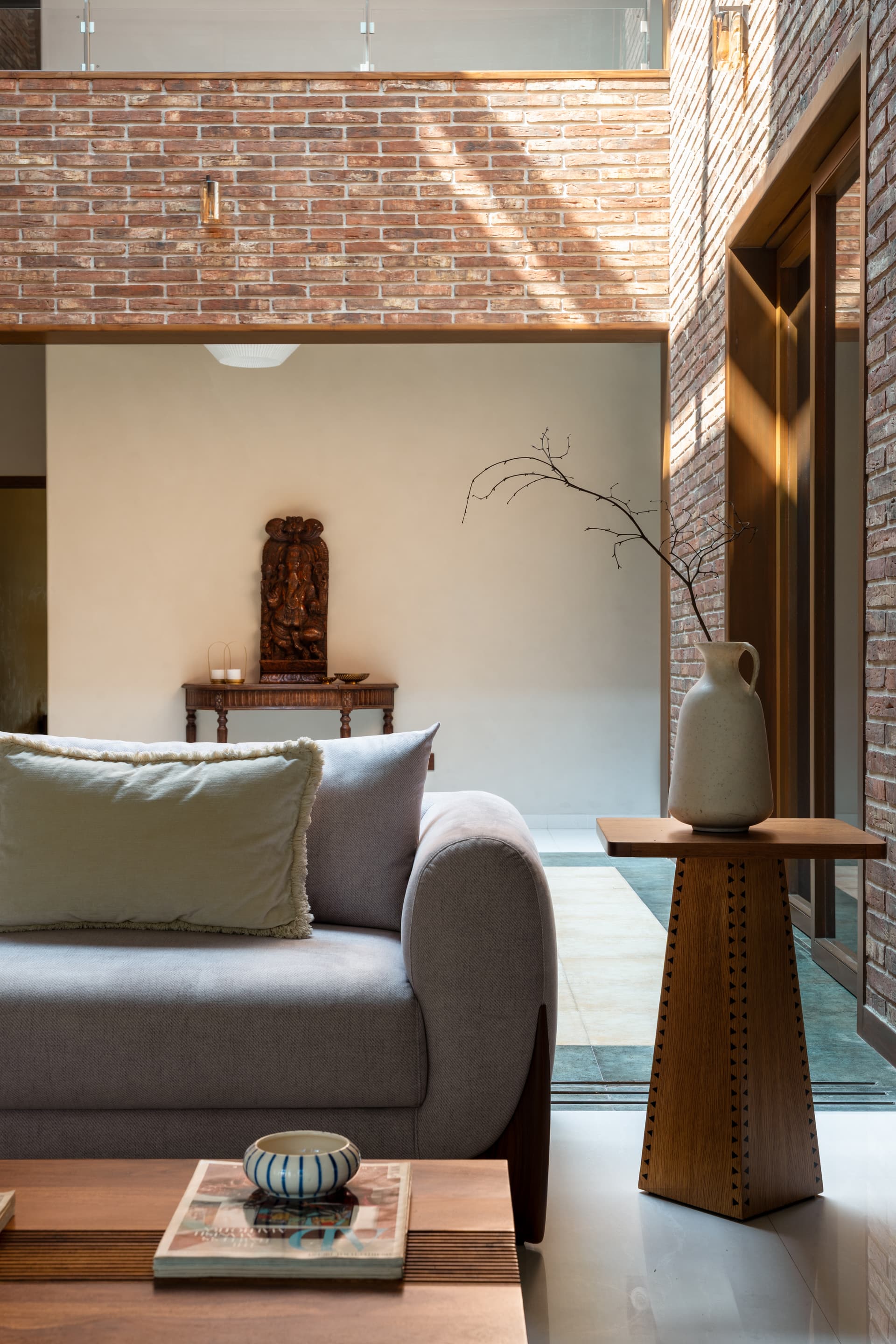

A closer view from the same zone confirms the atrium’s role as a connective device. Through the glass, a carved wooden figure sits on a traditional side table, glimpsed across the void. The layering of interior and atrium creates a depth of field that a flat plan could never achieve.
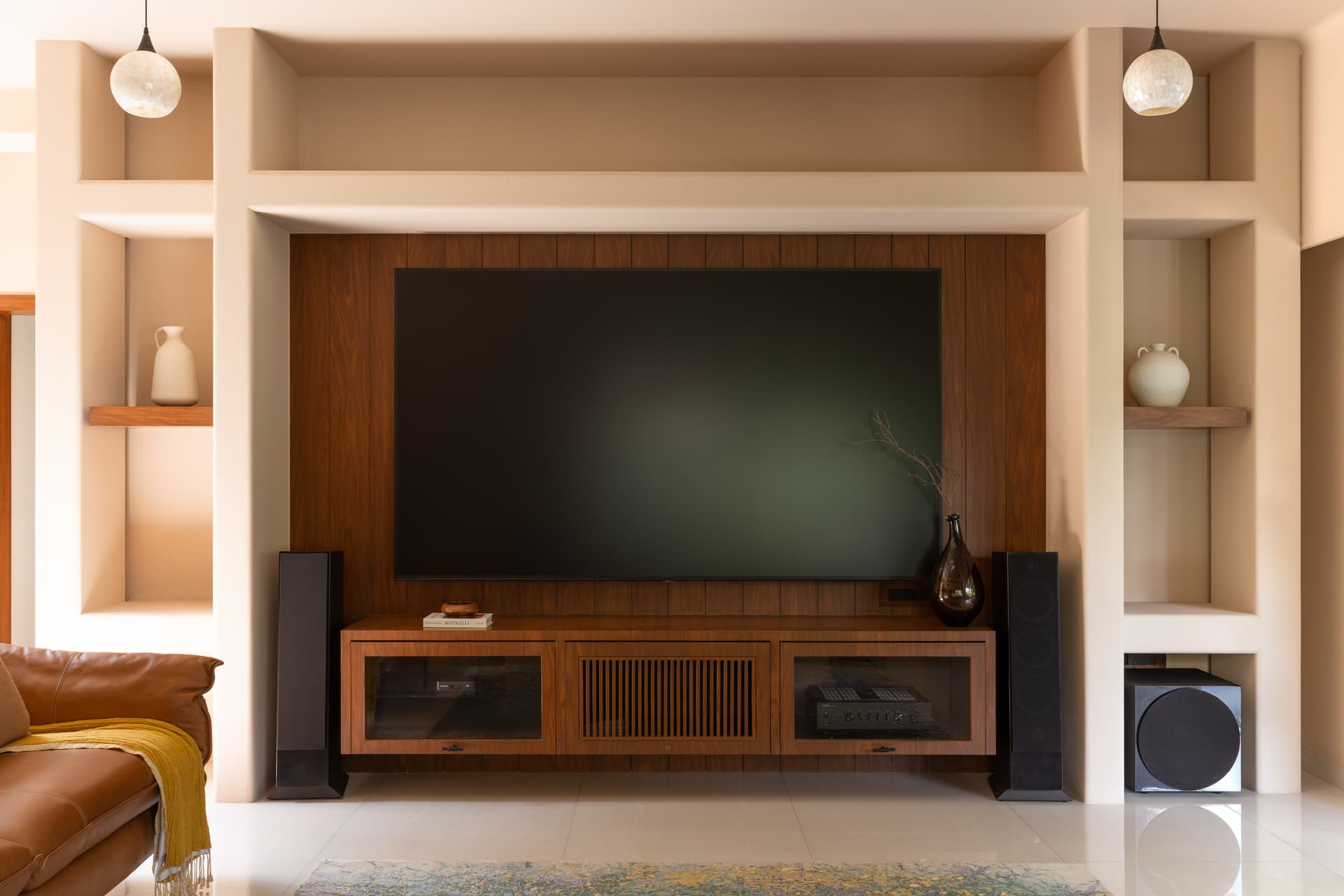
The entertainment wall resolves the perennial challenge of integrating a large screen into a considered interior. A built-in unit of niches and shelves in plaster frames a timber-backed alcove that houses the television, while the asymmetric shelving around it becomes display space. The unit reads as architecture rather than cabinetry.
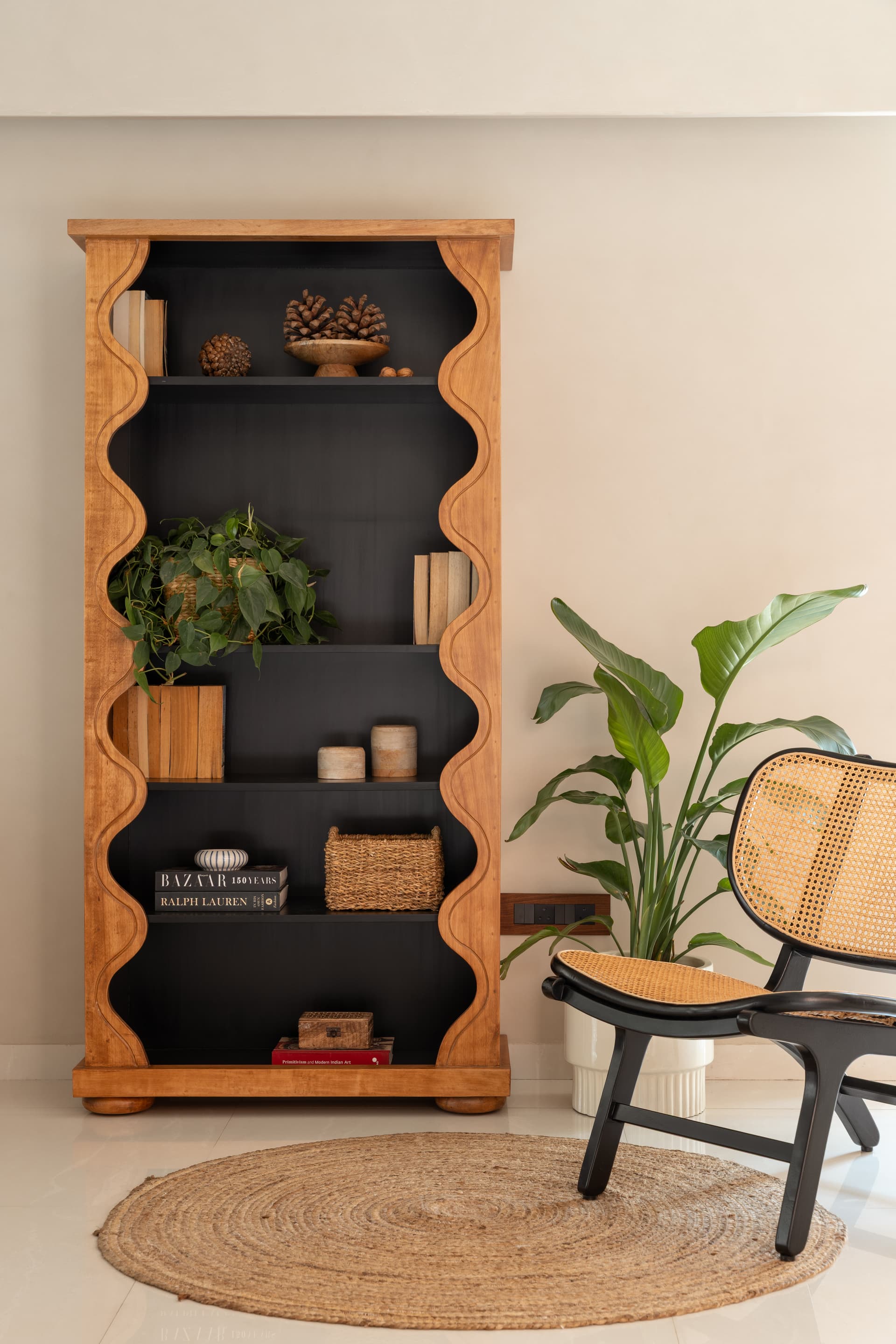
A scallop-edged timber bookshelf paired with a cane-and-black-lacquer lounge chair occupies a corner where the living area meets a circulation zone. The bookshelf’s playful silhouette introduces a note of personality, a gesture that suggests the home accommodates individual taste without losing its larger material coherence.
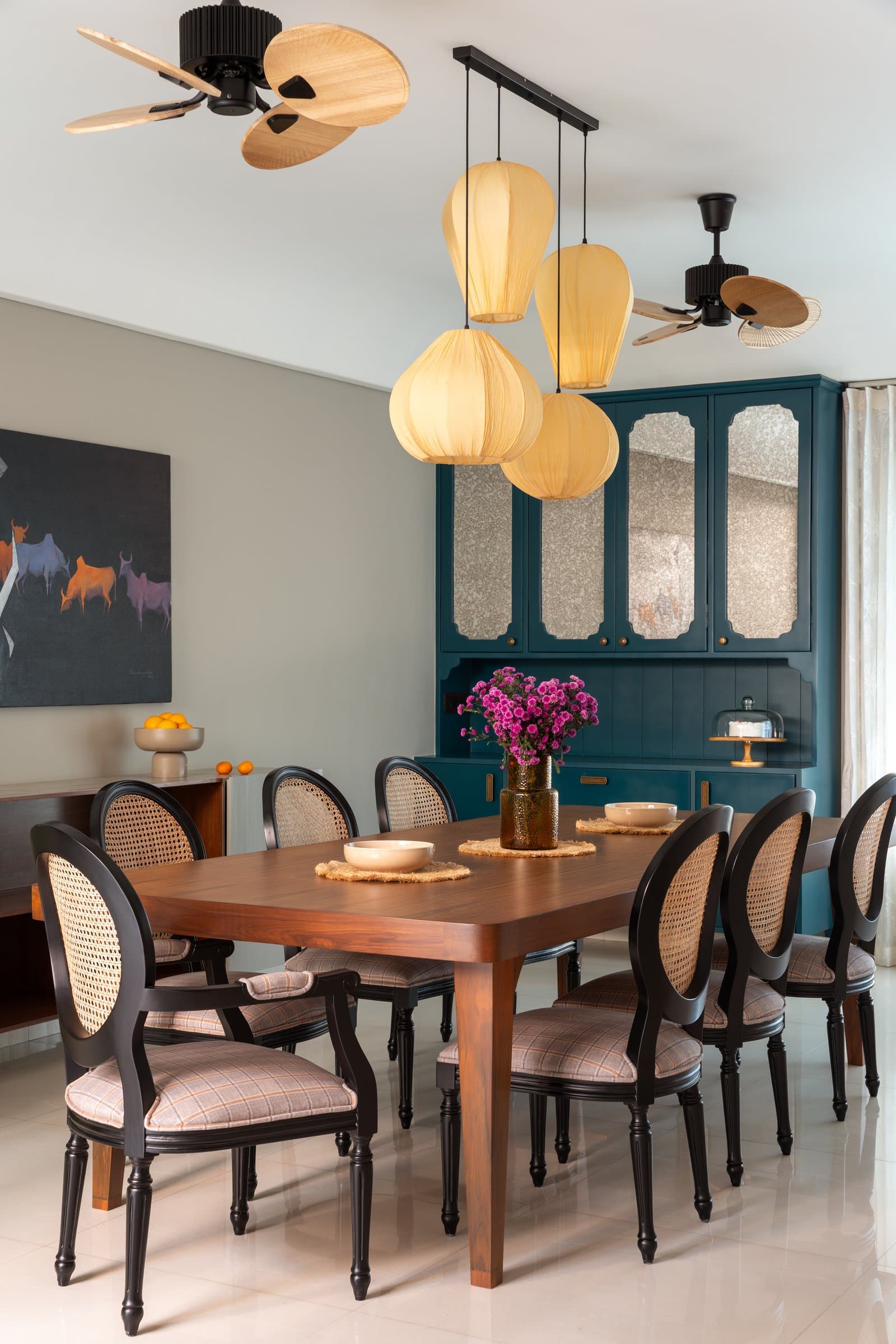
The dining room declares its independence from the living zone through colour. A tall cabinet in deep teal with antiqued glass panels commands the back wall, while a cluster of fabric pendants in warm, organic forms hangs low over a solid timber table ringed by cane-backed chairs. The room is generous, scaled for family gatherings and long meals. The chairs feature cane medallion backs, acting as a recurring motif, tying the seating to the broader language of woven texture that runs through the house.
Adjacent to the dining area, a bar-lounge occupies what might otherwise have been a transitional zone. A curved timber counter, built from stacked planks that reveal their grain and knots, sits below the same ceiling beams that run through the living room, lending spatial continuity. The stools are upholstered in a soft check fabric, a recurring textile motif across multiple rooms.
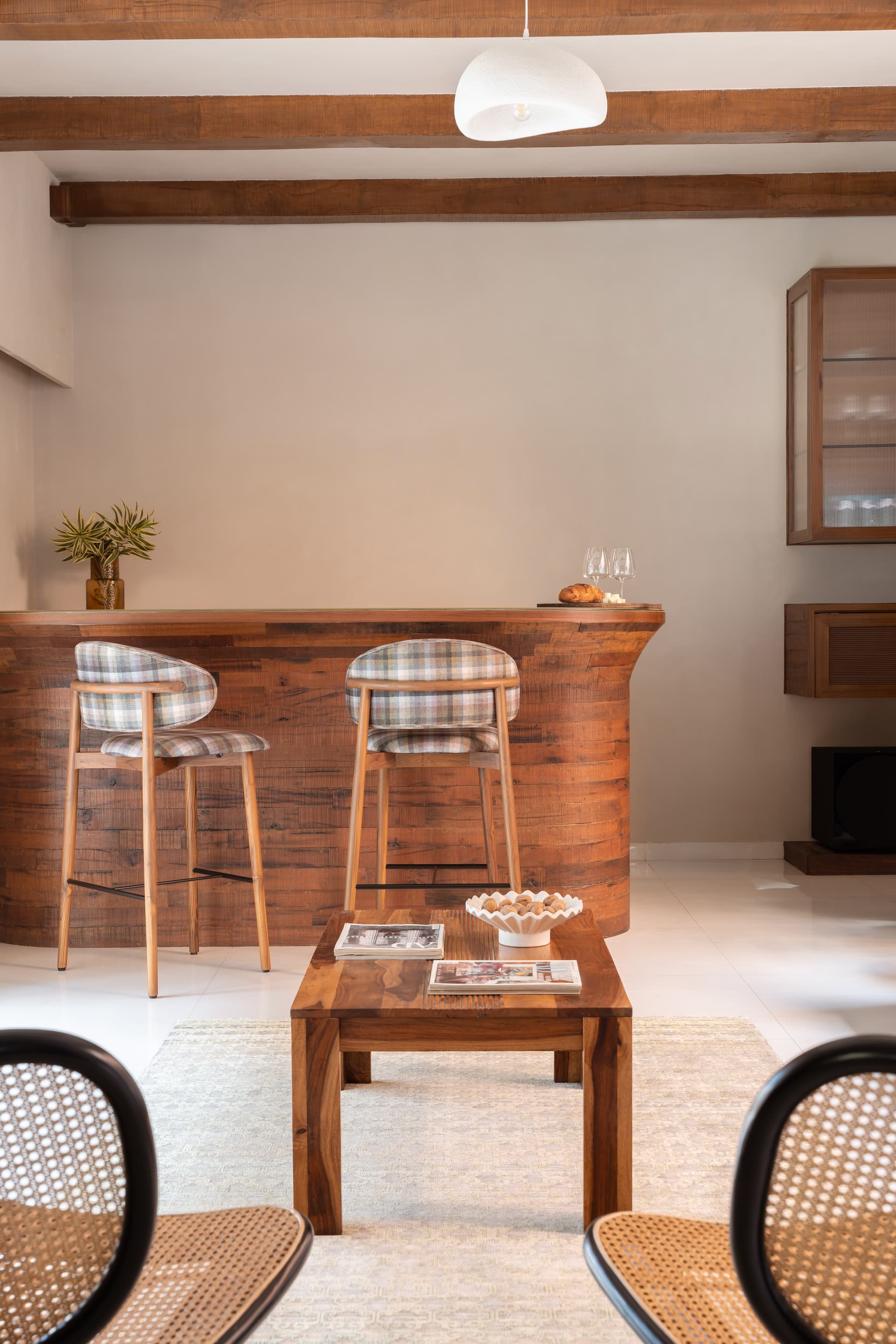
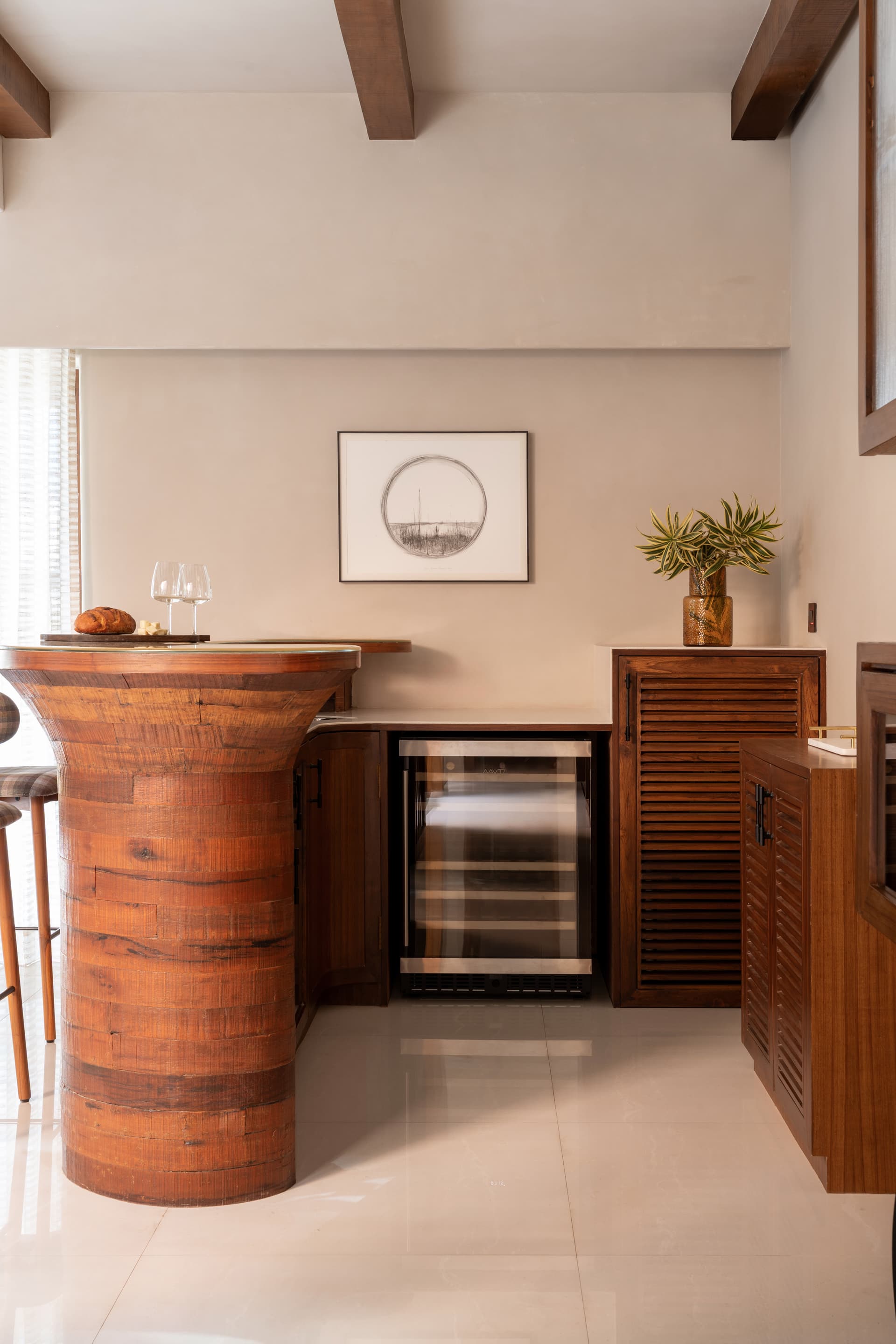
Seen from behind the counter, the bar reveals its full programme: a wine chiller tucked beneath the countertop, louvred timber storage, and a framed ink drawing on the wall above. The construction of the barrel-like counter, with its hand-stacked timber blocks widening towards the base, has a sculptural quality that elevates it beyond utility.
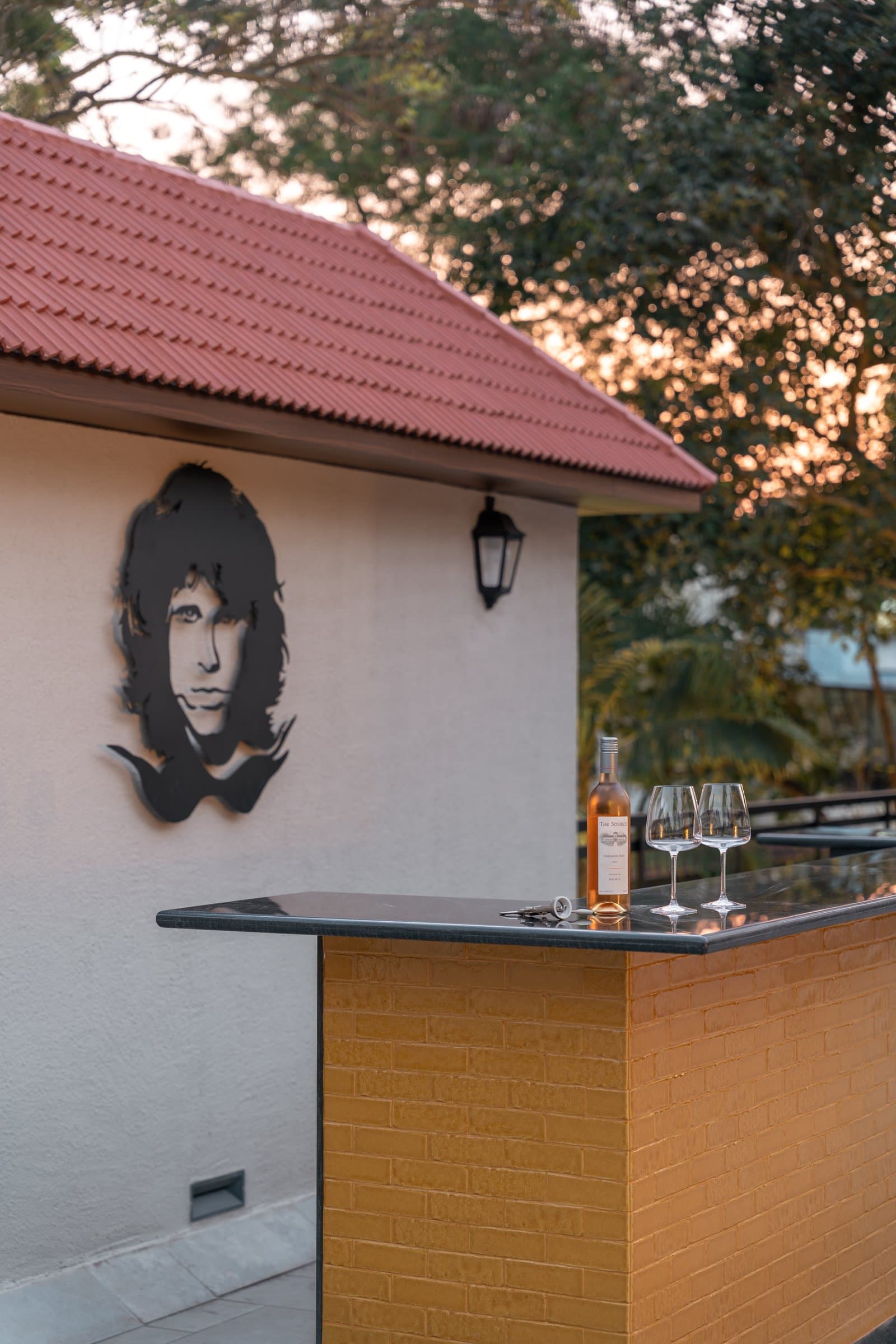
Outdoors, a compact terrace bar offers a more casual counterpoint. A brick-clad counter topped in dark stone sits under a tiled roof, accompanied by a metal silhouette wall sculpture that signals the homeowners’ musical sensibility. The terrace connects the home to its garden and mature tree canopy, extending the lived territory beyond the building envelope.
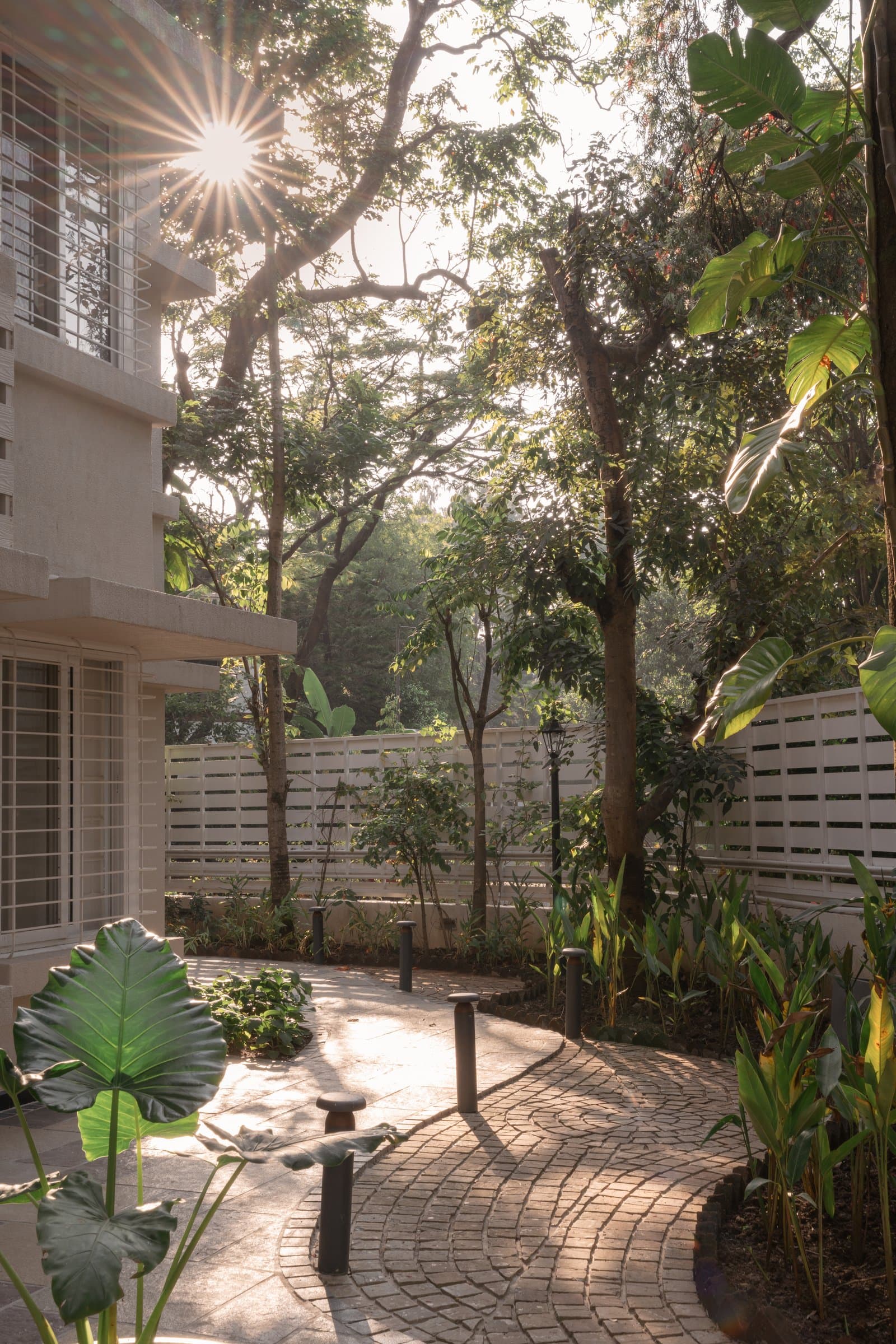
The garden itself is a substantial presence: a curved brick-paved pathway winds through mature trees and tropical planting, establishing a landscape that feels decades older than the interiors. This green surround is what gives the interiors their quality of retreat, separating the home from the density of Aundh just beyond the boundary wall.
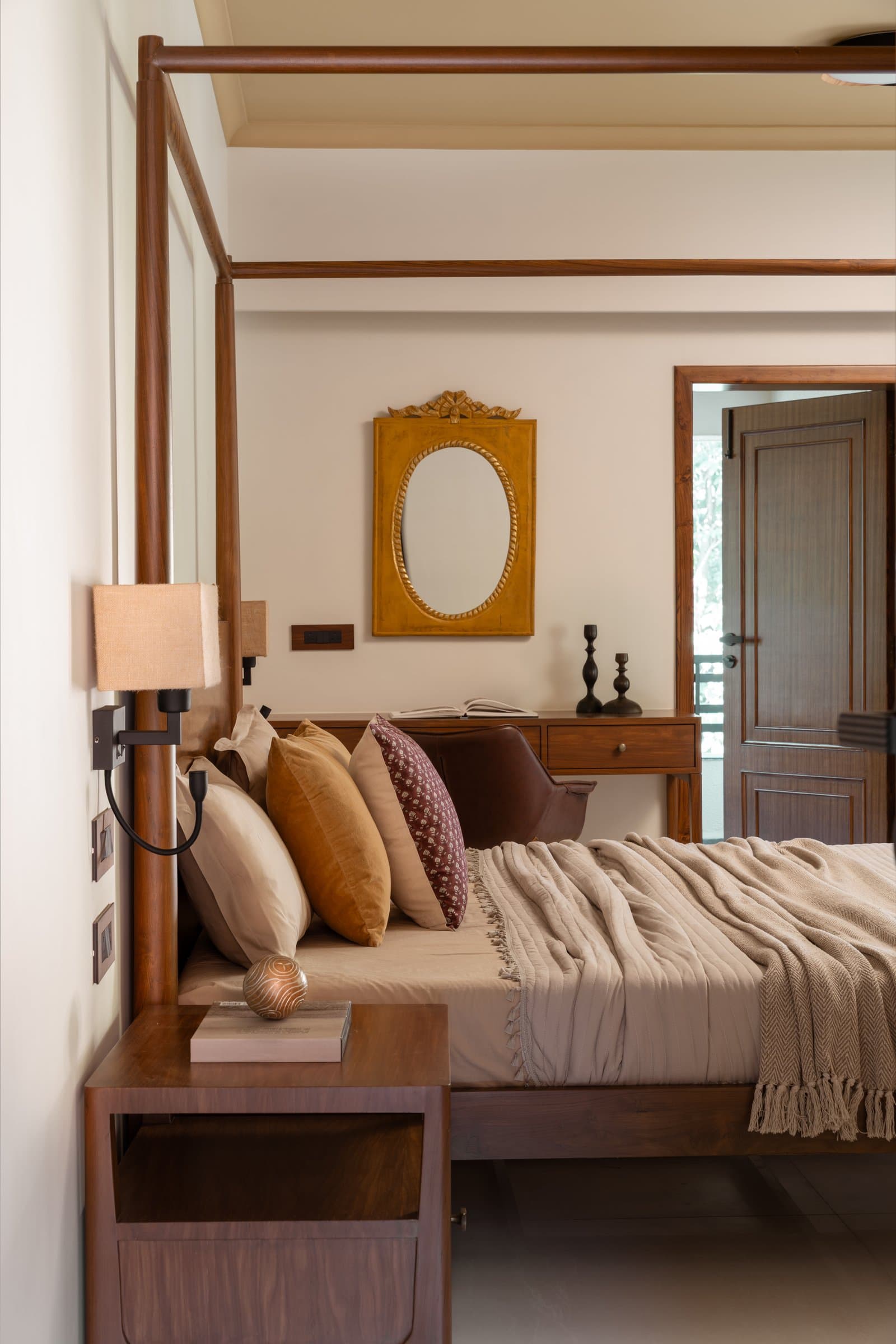
The master bedroom favours warmth over drama. A four-poster bed in solid timber anchors the room, its clean lines offset by a gilded rectangular mirror with an oval centre and carved crest, mounted on the wall behind the bed. The palette stays within the home’s range of beiges, warm tans, and weathered timber, but the room adds a layer of intimacy through softer textiles and gentle proportions.
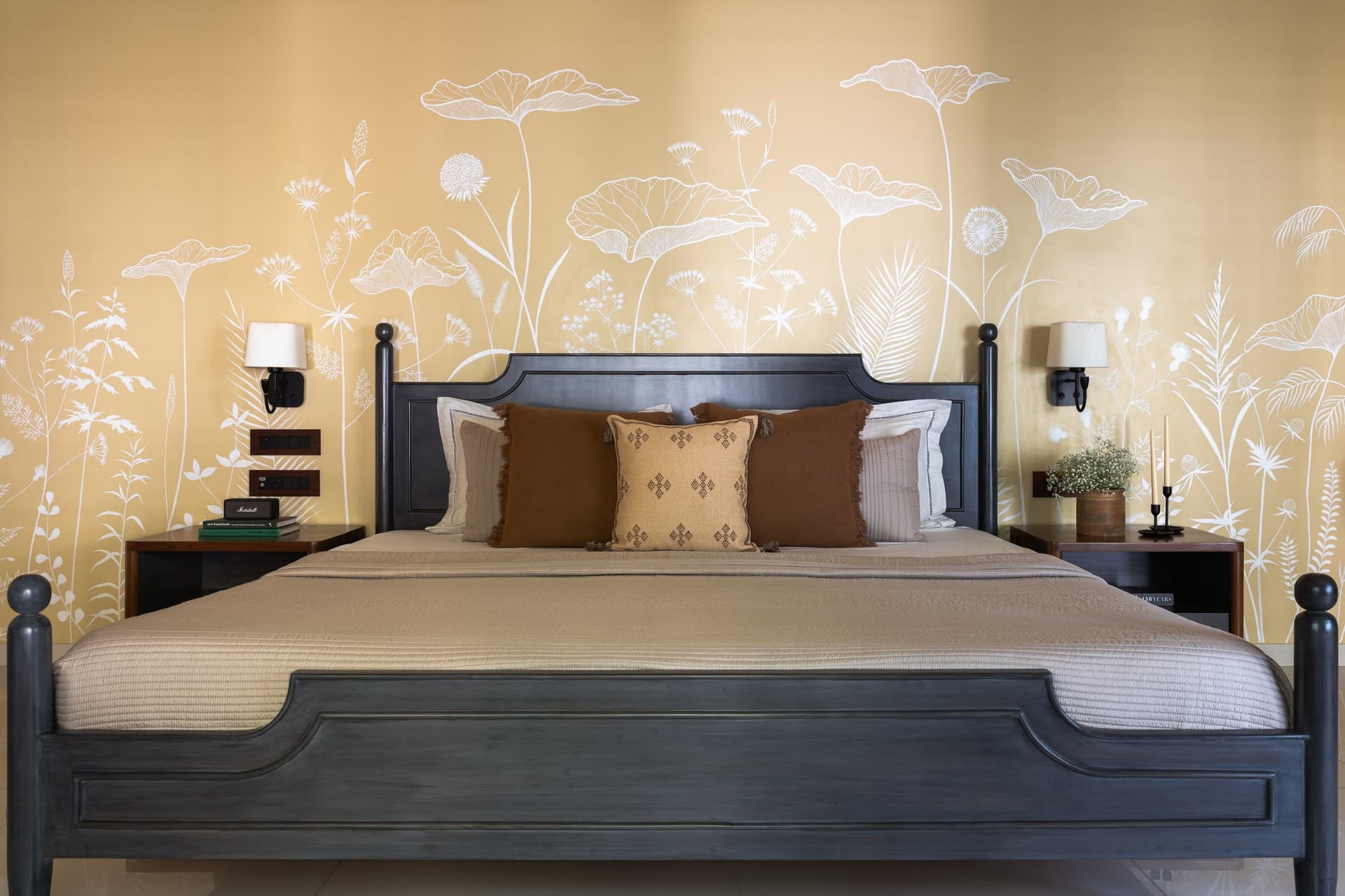
A second bedroom takes a different approach entirely. A hand-painted botanical mural in warm gold and white covers the headboard wall, wrapping the room in an illustrative, almost storybook atmosphere. A dark-finished bed with turned posts sits in front of this wall, its traditional form grounding the fantasy of the mural.
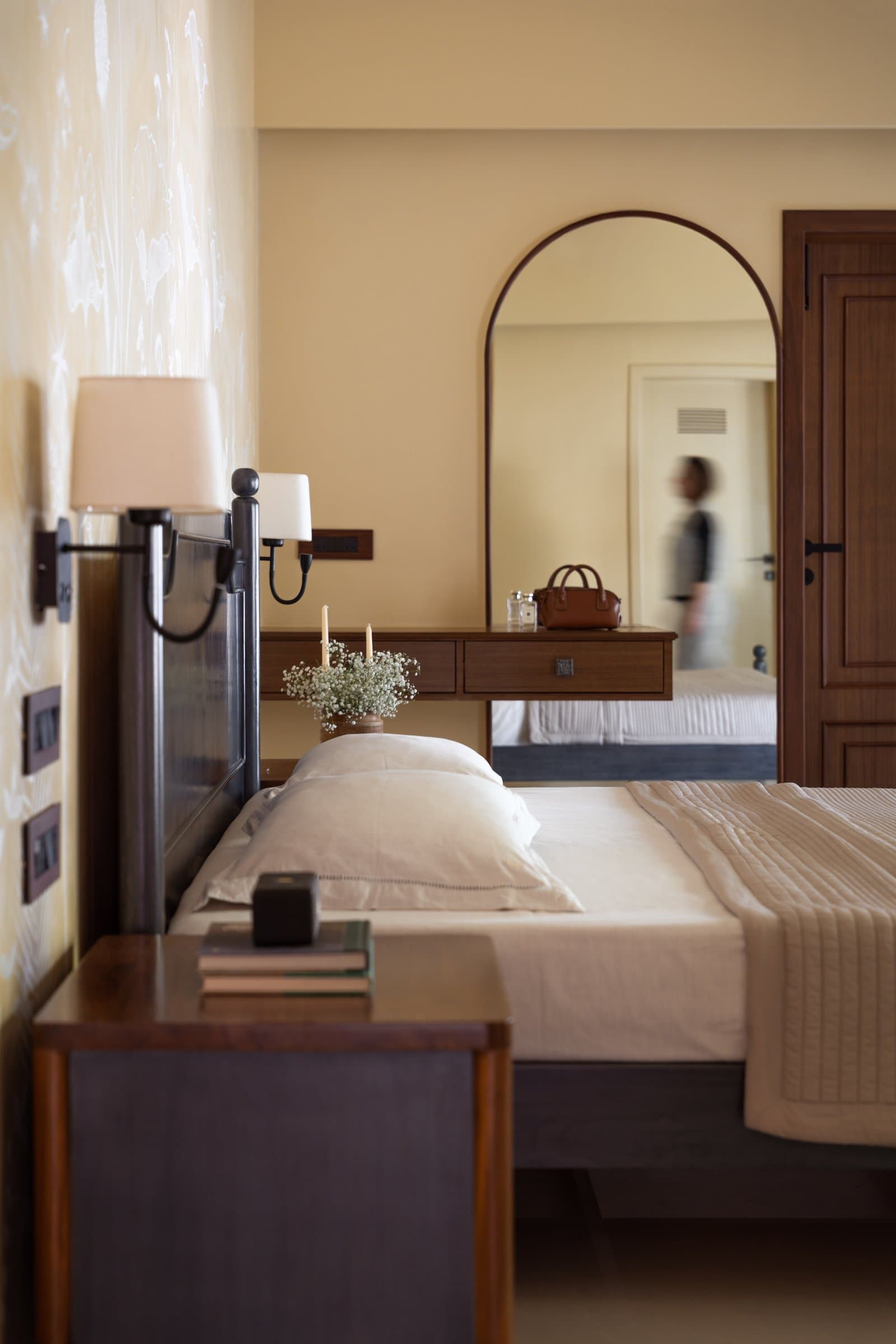
The same room, seen from the side, reveals a dressing table with an arched mirror and the subtle presence of the mural continuing behind the bed frame.
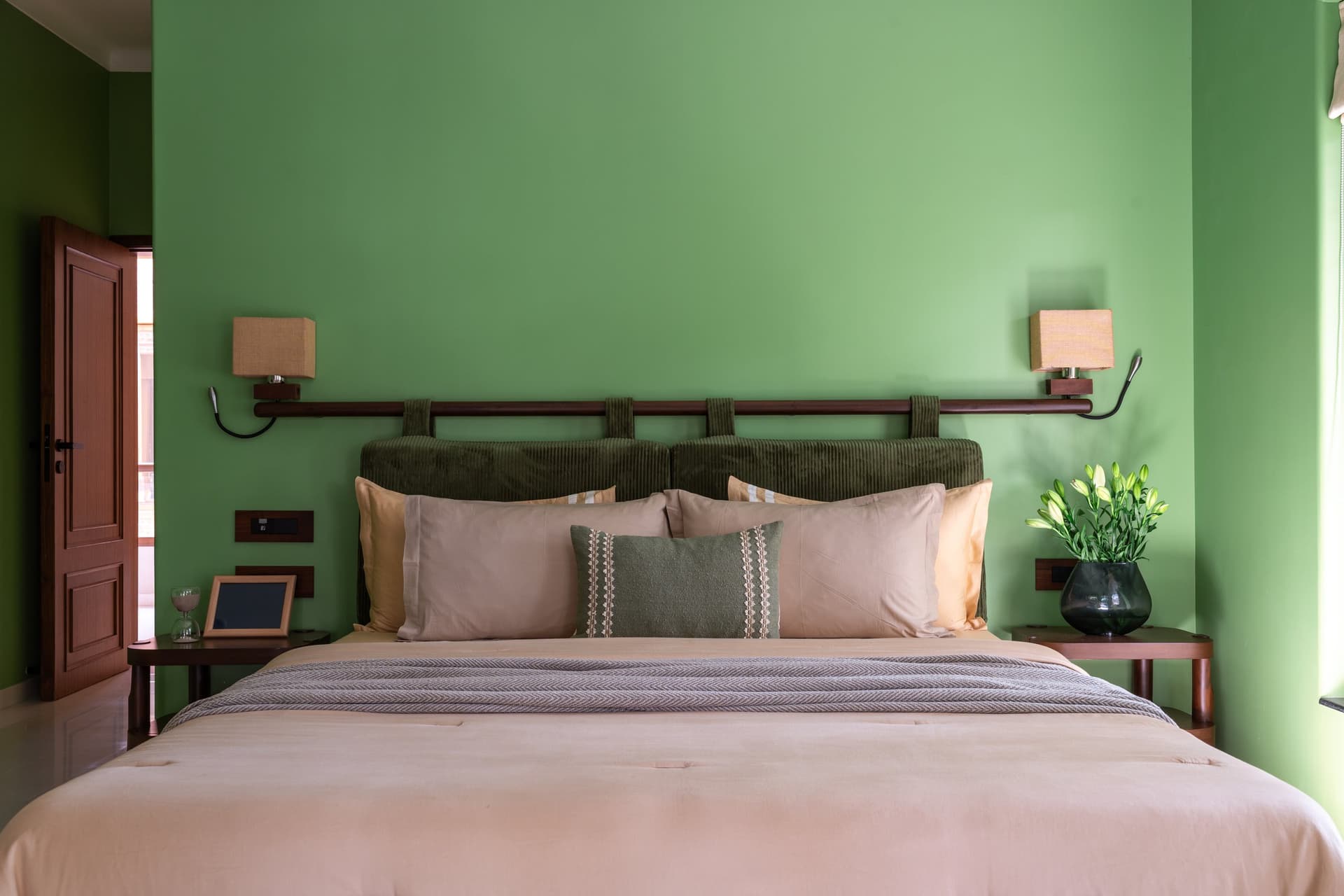
The guest bedroom deploys colour with confident restraint. A bright green wall envelops the entire room, from which a timber-railed headboard with corduroy-upholstered cushions projects. The effect is enveloping and restful, and the room reads as a deliberate tonal departure from the earth-and-cream palette of the public spaces.
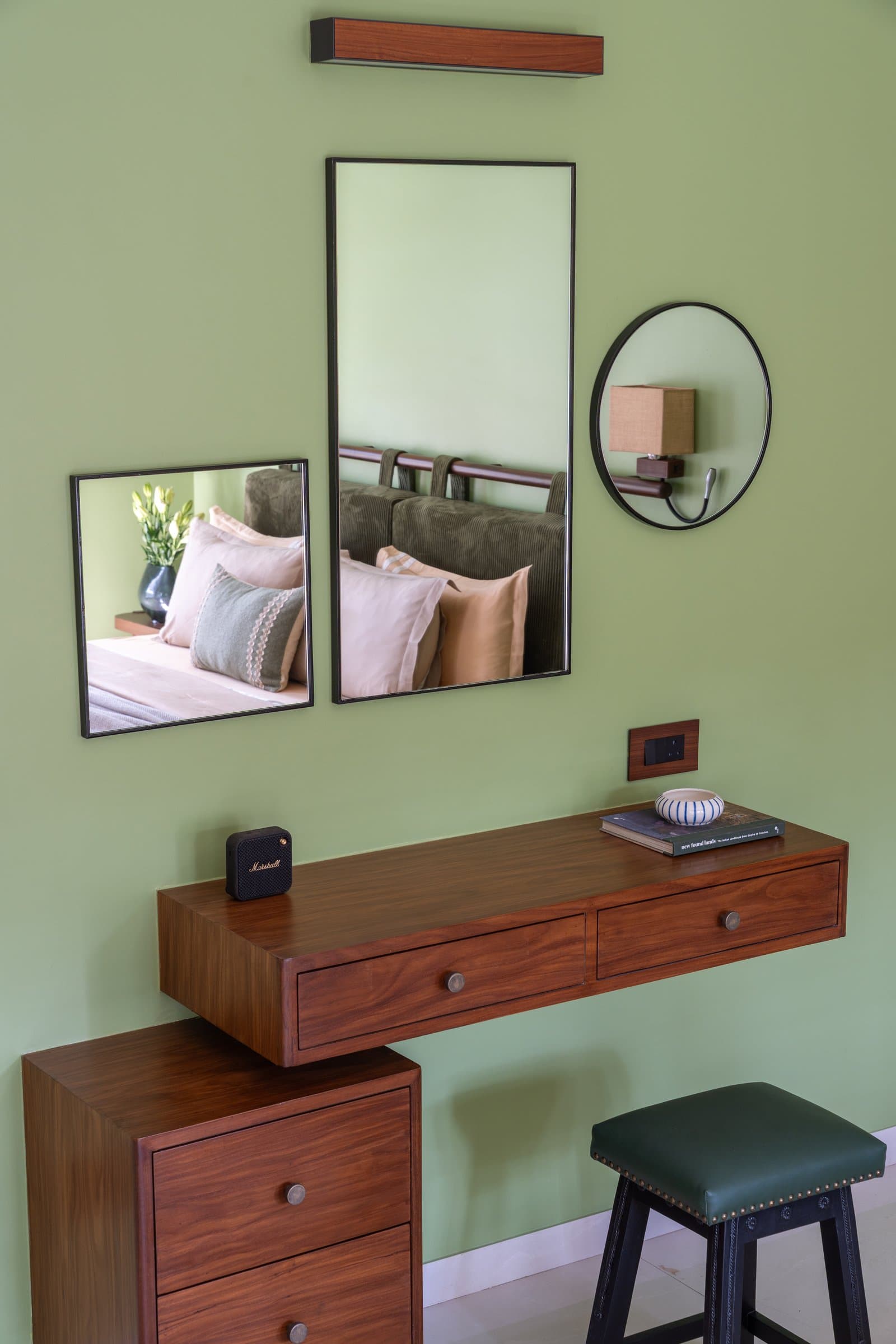
Within the same room, a wall-mounted dressing console in timber floats against the green surface, accompanied by a composition of mirrors in different sizes and shapes. The arrangement is informal and slightly irreverent, as if the mirrors accumulated over time rather than being placed in a single afternoon of styling.
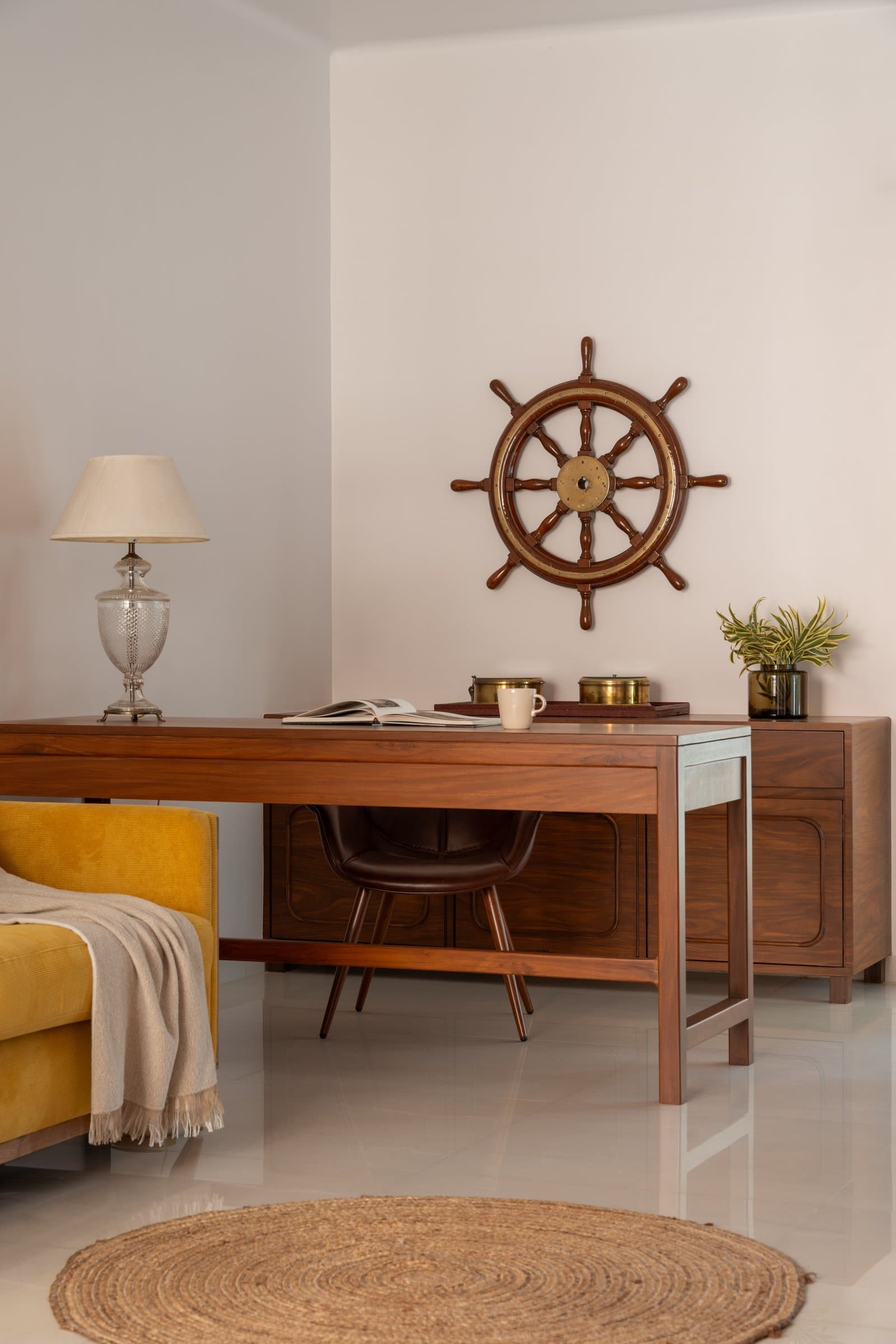
The study is unambiguously personal. A solid timber desk and credenza sit beneath a ship’s wheel mounted on the wall, declaring the homeowner’s interests without apology. A mustard sofa adds a jolt of colour that rhymes with the same fabric used elsewhere in the home.
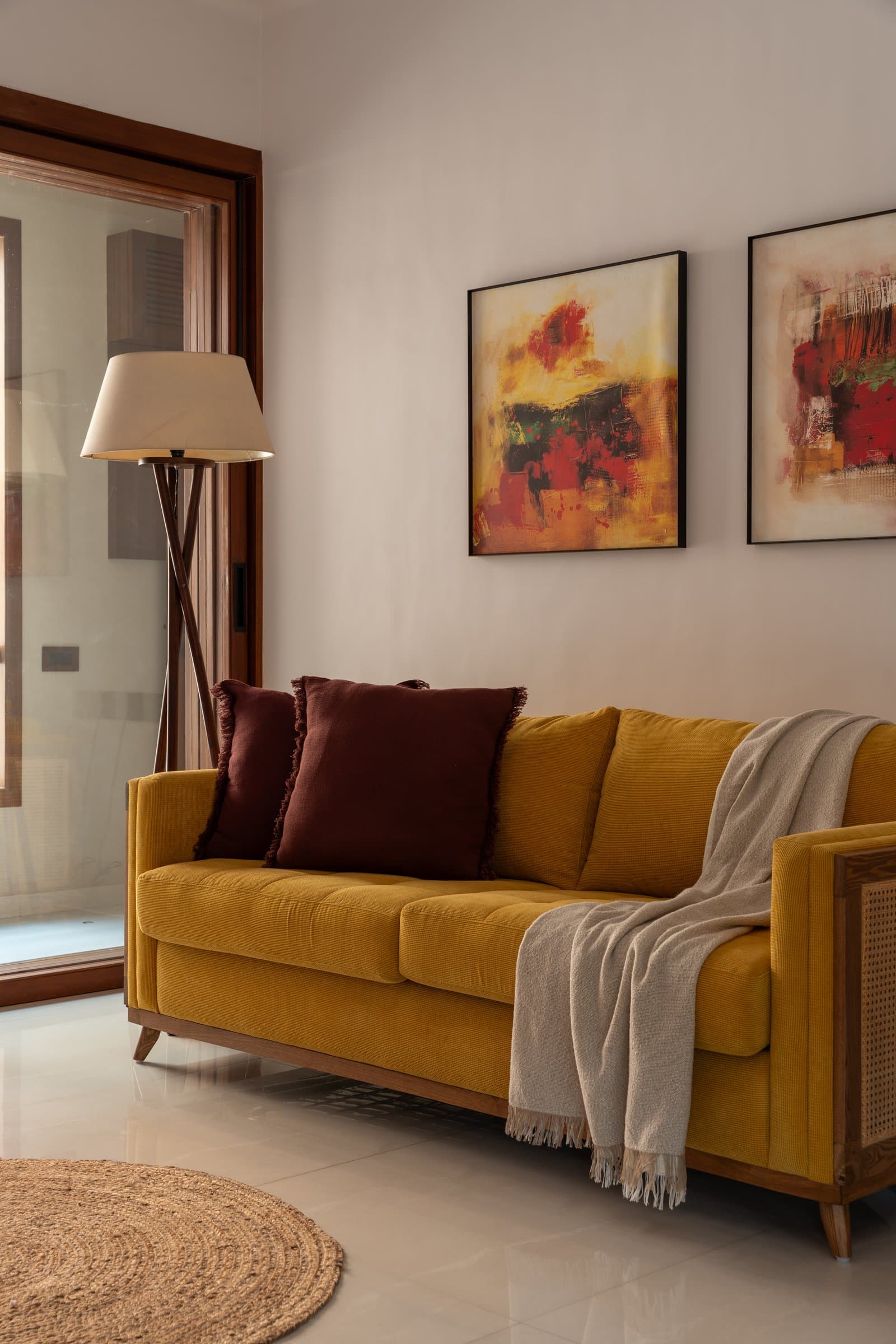
Nearby, that mustard sofa is shown in its full context, backed by abstract paintings hung on the wall above it whose red and ochre tones pick up on its warm frequency. The room functions as a private sitting area as much as a workspace, offering a space for retreat that the public rooms, generous as they are, do not quite provide.
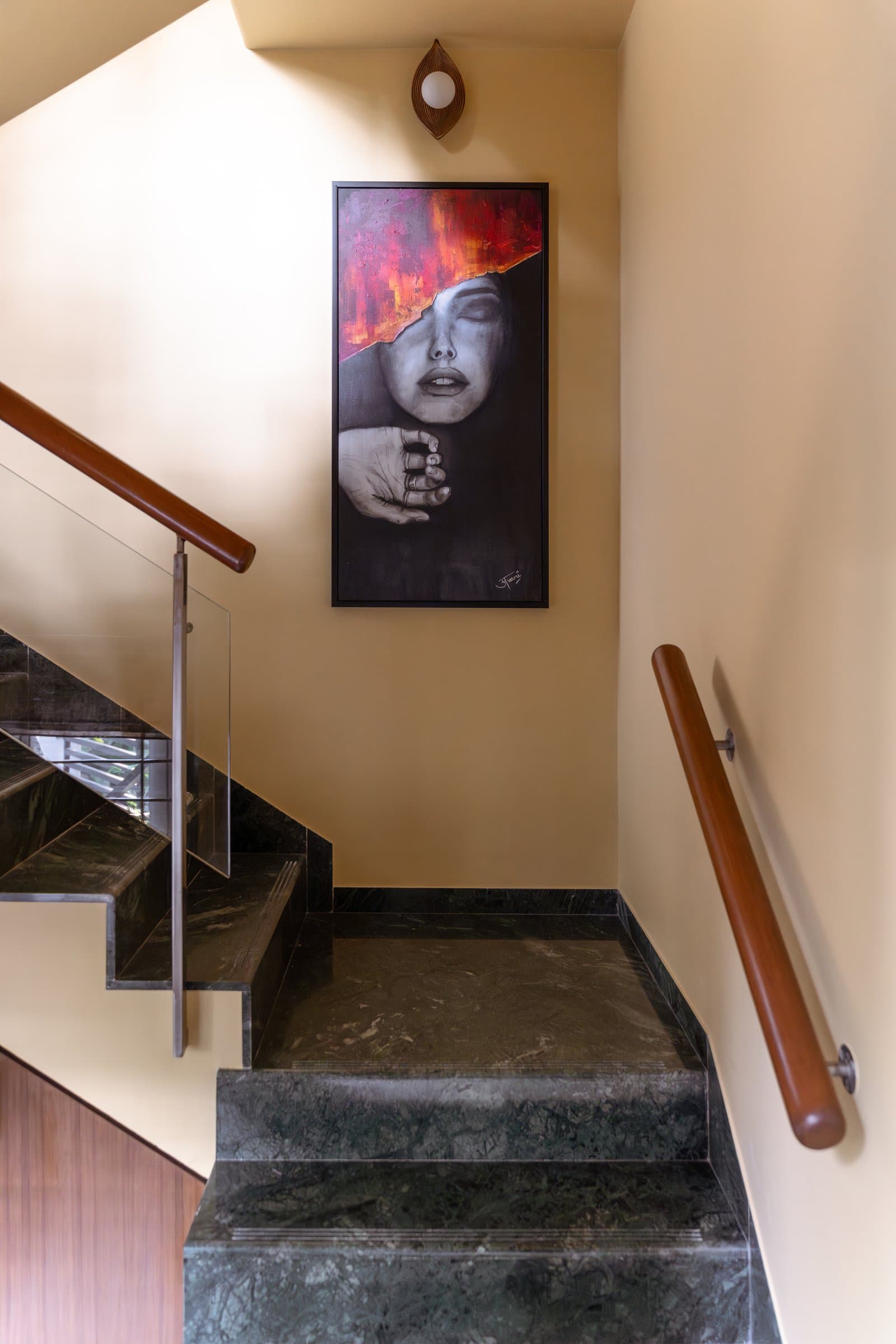
The staircase connecting the two levels is clad in dark green marble with glass balustrades and timber handrails.
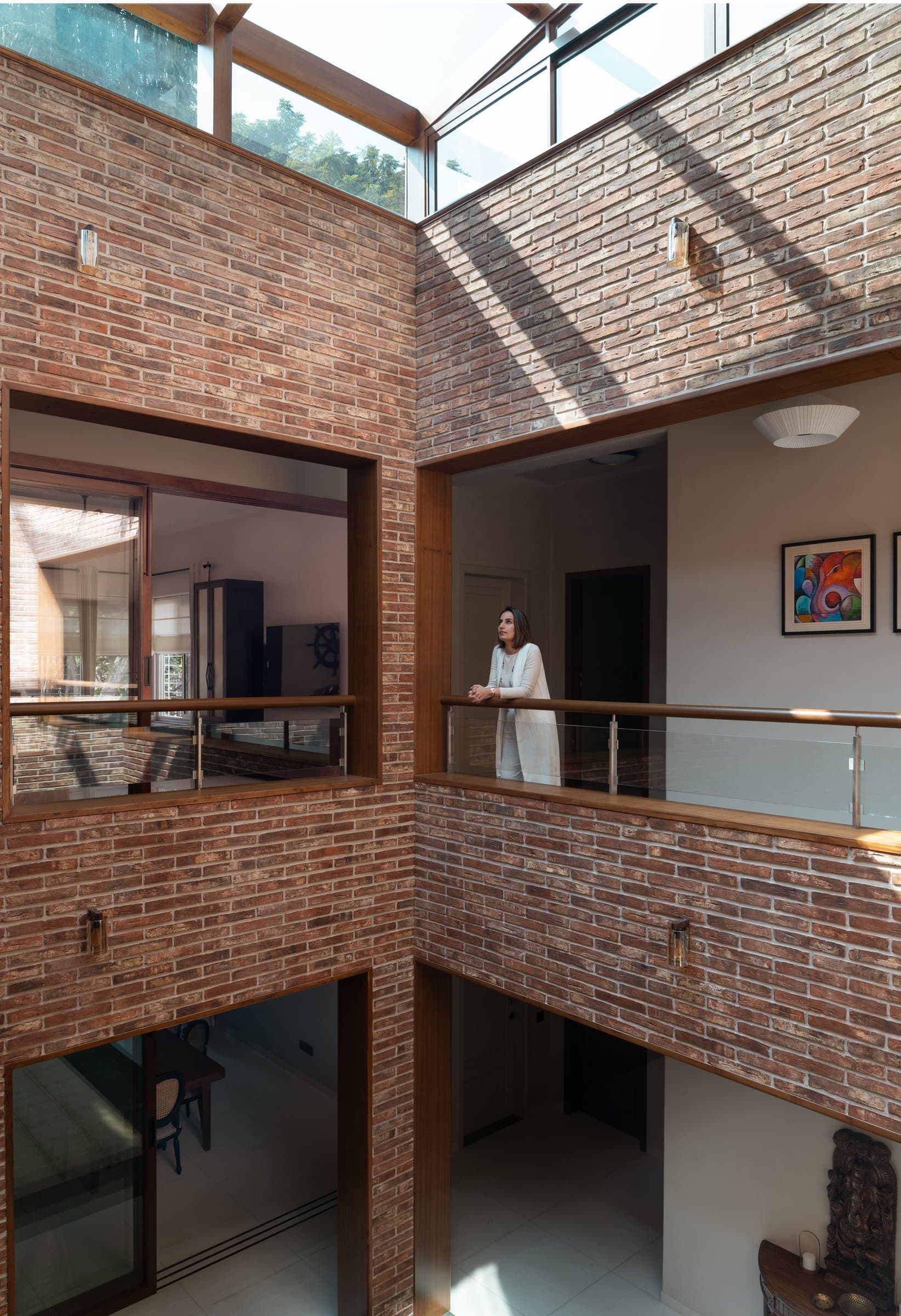
The double-height atrium, reveals its full architectural ambition. Brick walls rise on all sides, punctuated by timber-framed windows and openings that connect every room to this shared volume. The experience is one of both enclosure and expansiveness: a courtyard crowned by a glass skylight that floods the space with natural light.
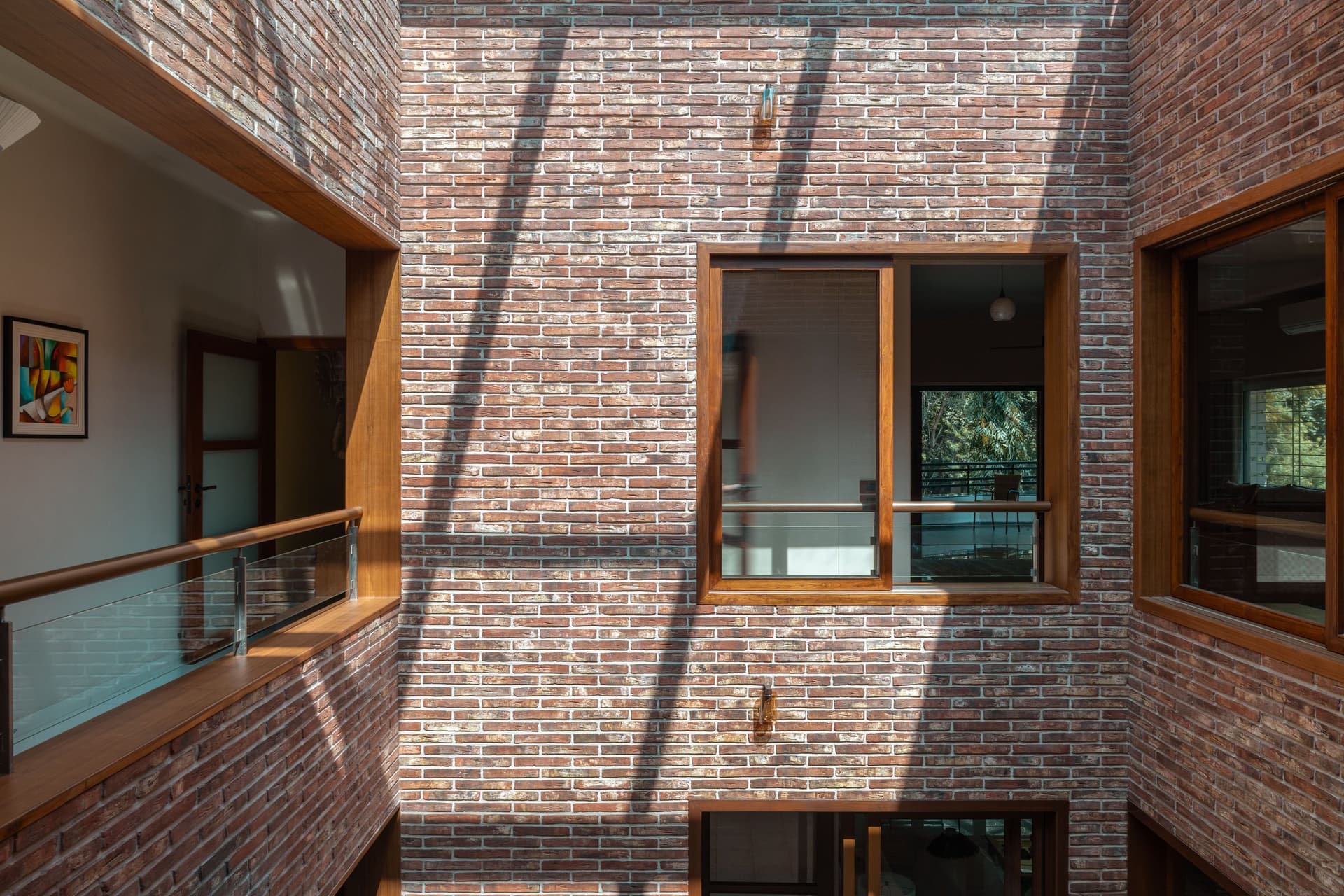
Diagonal shadows from the skylight above crawl across the brick surface, changing character throughout the day. The timber-framed openings into the study, the bedrooms, and the corridor become a composition of warm rectangles set into a rusticated field.
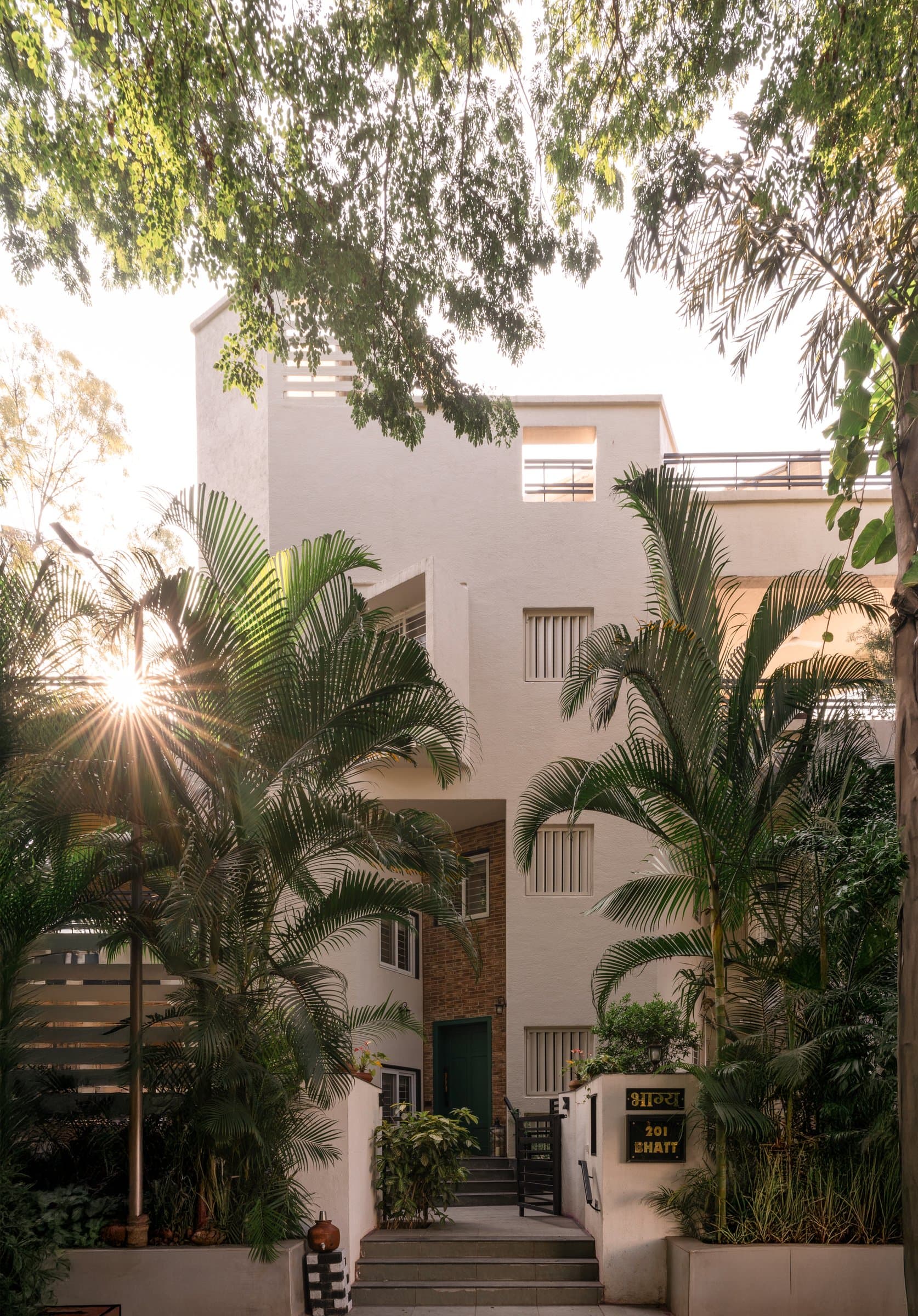
In Pune’s rapidly evolving residential landscape, where apartment towers dominate and bungalow plots increasingly give way to density, The House of Pause represents a counter-position. It argues for the value of a ground-connected home organised around an internal court, for standalone furniture over built-in millwork, for colour used in bold strokes rather than safe neutrals, and for brick as a material that can be both structural presence and decorative texture within a domestic setting.
What Oll Korrect Design has achieved here is a home that holds together despite its many distinct moods: the formal timber-beamed living room, the teal-drenched dining area, the green guest bedroom, the whimsical bathroom murals. The atrium is the binding agent, the spatial constant that gives every room permission to be itself while ensuring the home reads as a single, coherent idea about how a family might live with generosity, character, and an unhurried sense of their own taste.