Minimalism is often misunderstood as the absence of things. The more demanding version, the one this duplex commits to, is the presence of only the right things, held in proportion, and asked to do more than one job at a time.
Designed by Concepto Studio, this two-floor home unfolds across a layout that resists compartmentalisation. The clients sought a residence that read as calm and uncluttered without tipping into the clinical neutrality that minimalism so frequently produces. The answer lay not in stripping the home back, but in choosing materials and gestures that earn their place by behaving quietly.
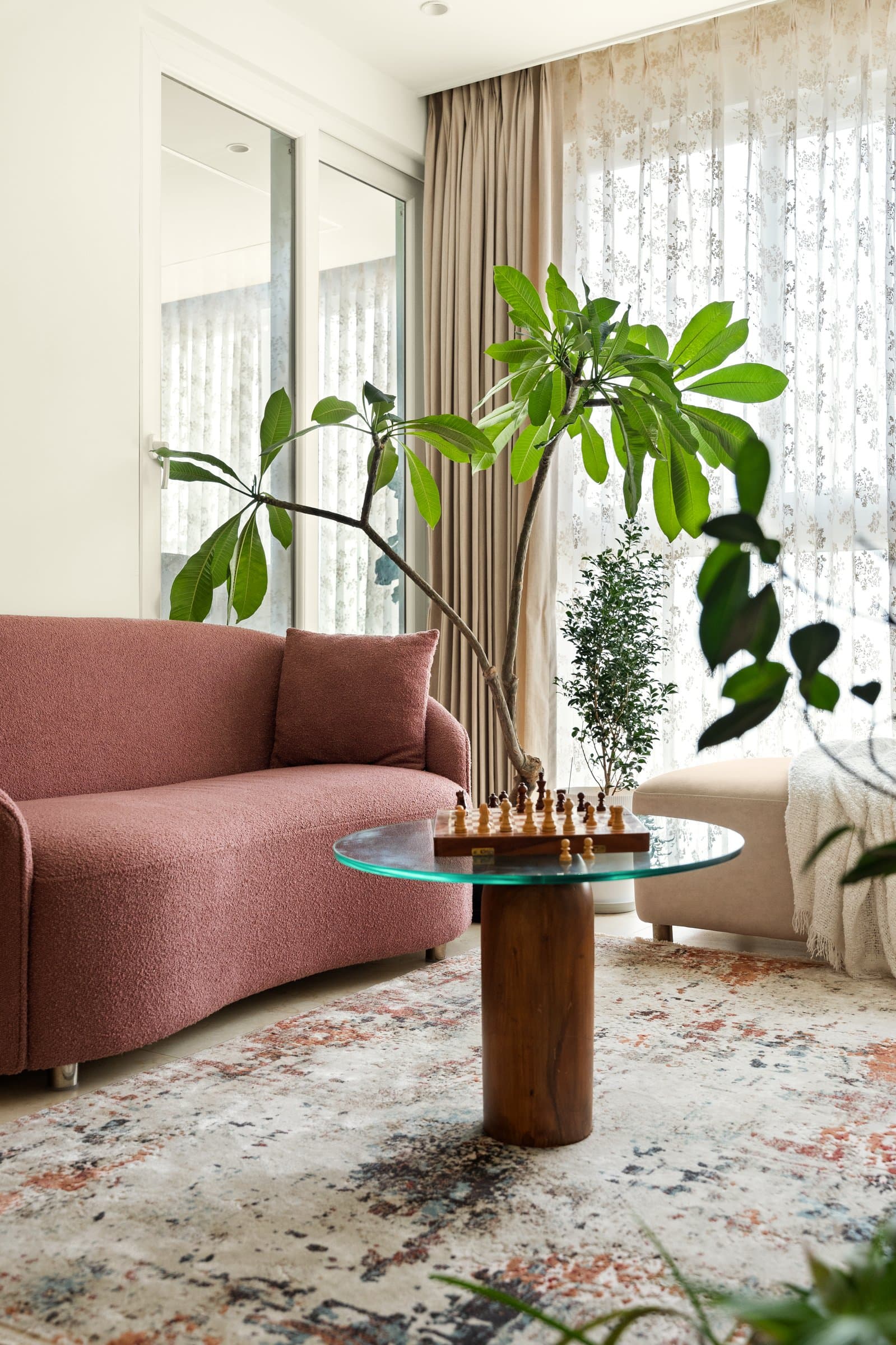
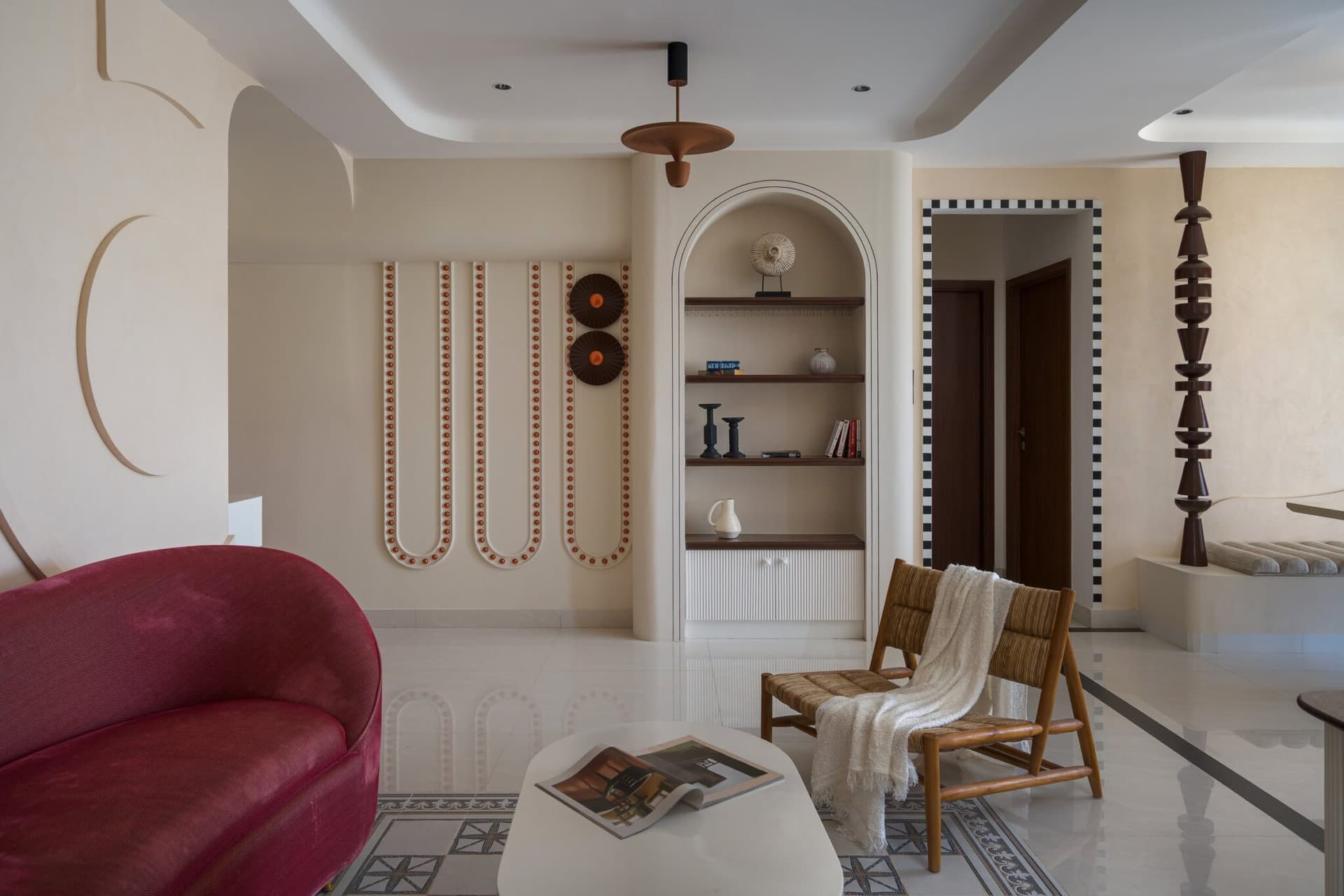
The living room opens with a curved sofa in dusty rose boucle, a glass-topped side table on a turned wood base, and a pair of indoor plants that almost grow into the room from the window line. The colour is the room’s only assertion, and because everything around it is restrained, the assertion lands.
Sheer floral curtains soften the daylight without erasing it, while the layered rug introduces a sense of age into a space that is otherwise newly built.
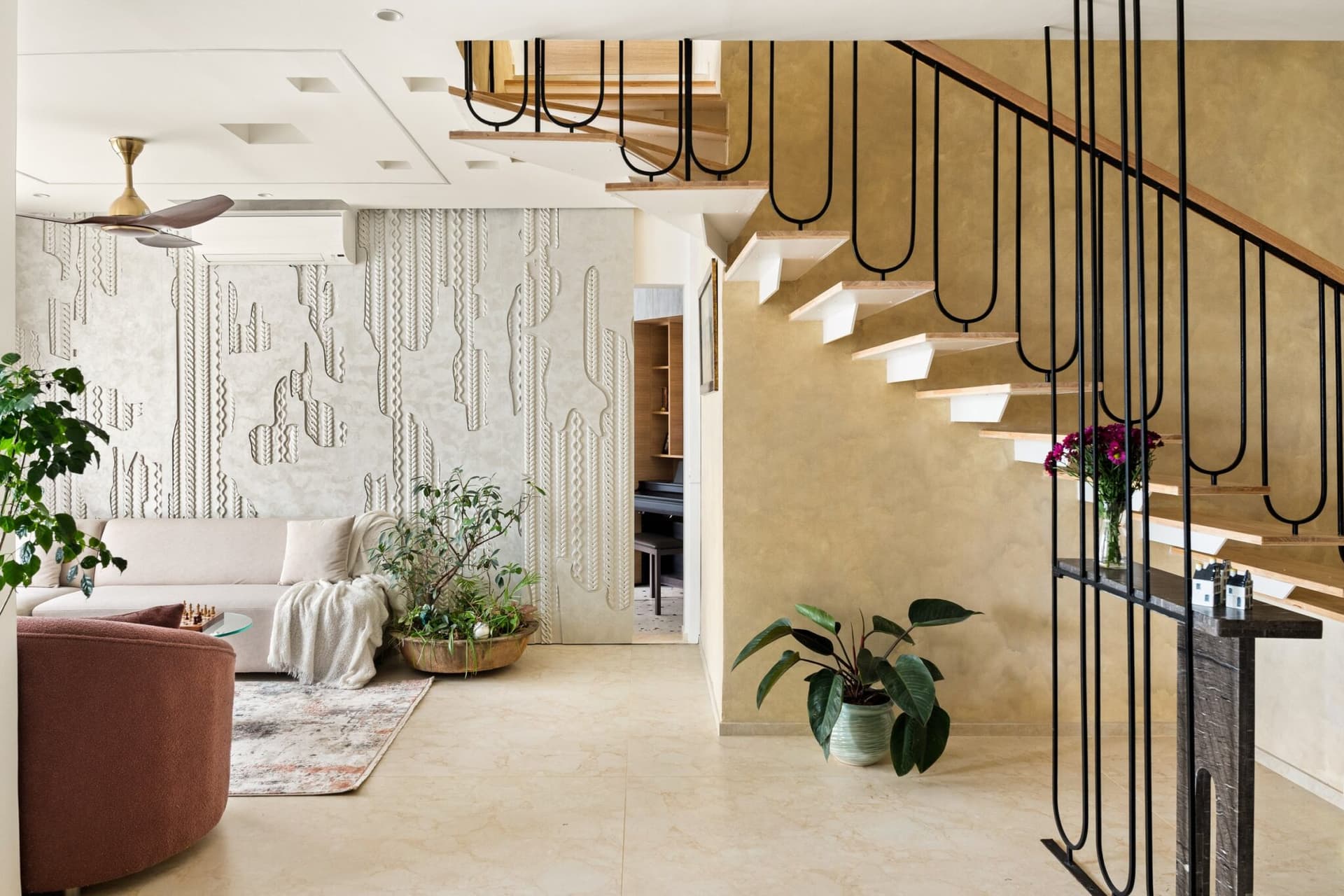
Stepping back, the architectural argument of the home becomes legible: a sculpted floating staircase with thin black metal balusters arcing in long, looping curves, set against a softly mottled ochre wall in textured plaster. This is the home’s pivot point, where the two floors negotiate their relationship.
The staircase is the project’s clearest piece of design writing. It does not announce itself with mass; it draws itself in line, leaving the volume around it intact. The textured wall behind operates as a warm counterweight to the cooler greys and beiges that dominate the lower level.
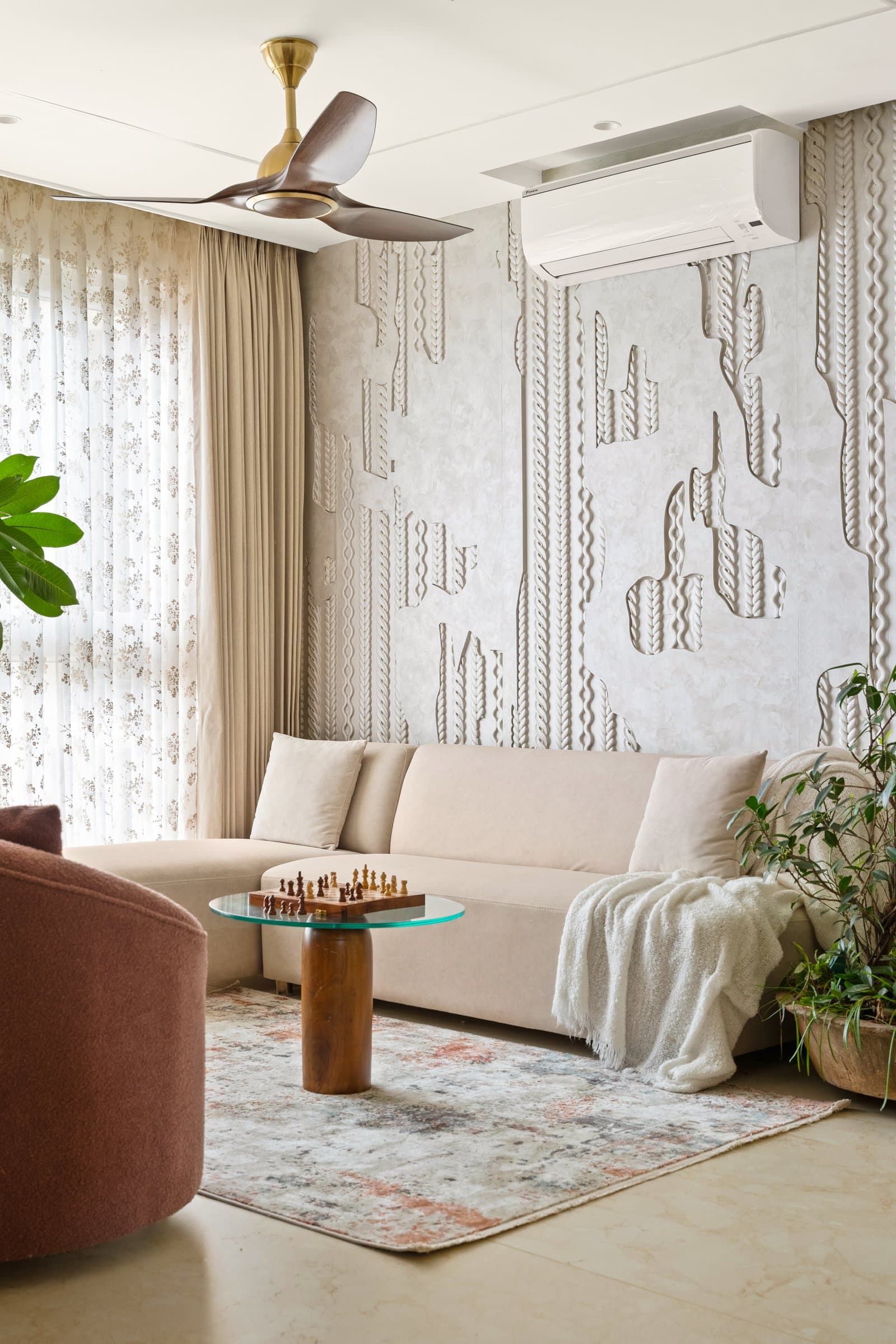
Across the living room, a textured panel works like a piece of cast plaster art, its raised motifs reading as cable-knit, ribbon, or rope depending on the angle of light. Against this, a beige sofa, an oatmeal throw, and a glass-and-wooden coffee table form a deliberately quiet foreground.
““The brief was simplicity, but the kind that has to be earned, not the kind that empties a room.””
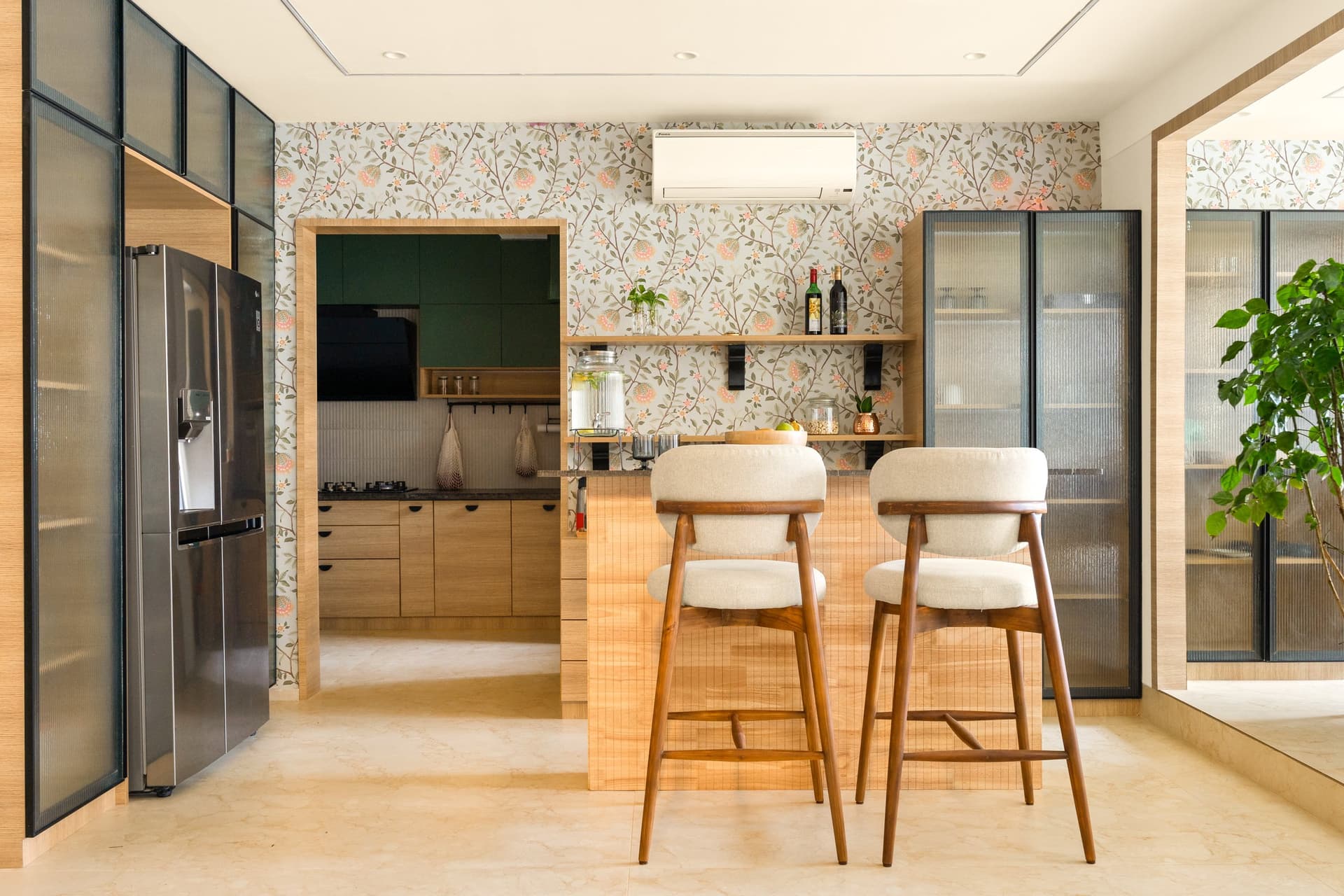
The transition into the dining and kitchen zone is handled through a pair of fluted-glass-and-black-metal storage walls that flank a bar counter. The wallpaper, a tendrilled botanical print, is the project’s most decorative gesture, and its placement here, in the most social part of the home, is precise.
Two cane-backed bar stools in solid timber face the counter, doing the work of casual seating without insisting on the formality of a dining table. Beyond, the working kitchen is glimpsed in deeper greens and timber, suggesting that the social counter and the cooking zone are choreographed as two related but distinct experiences.
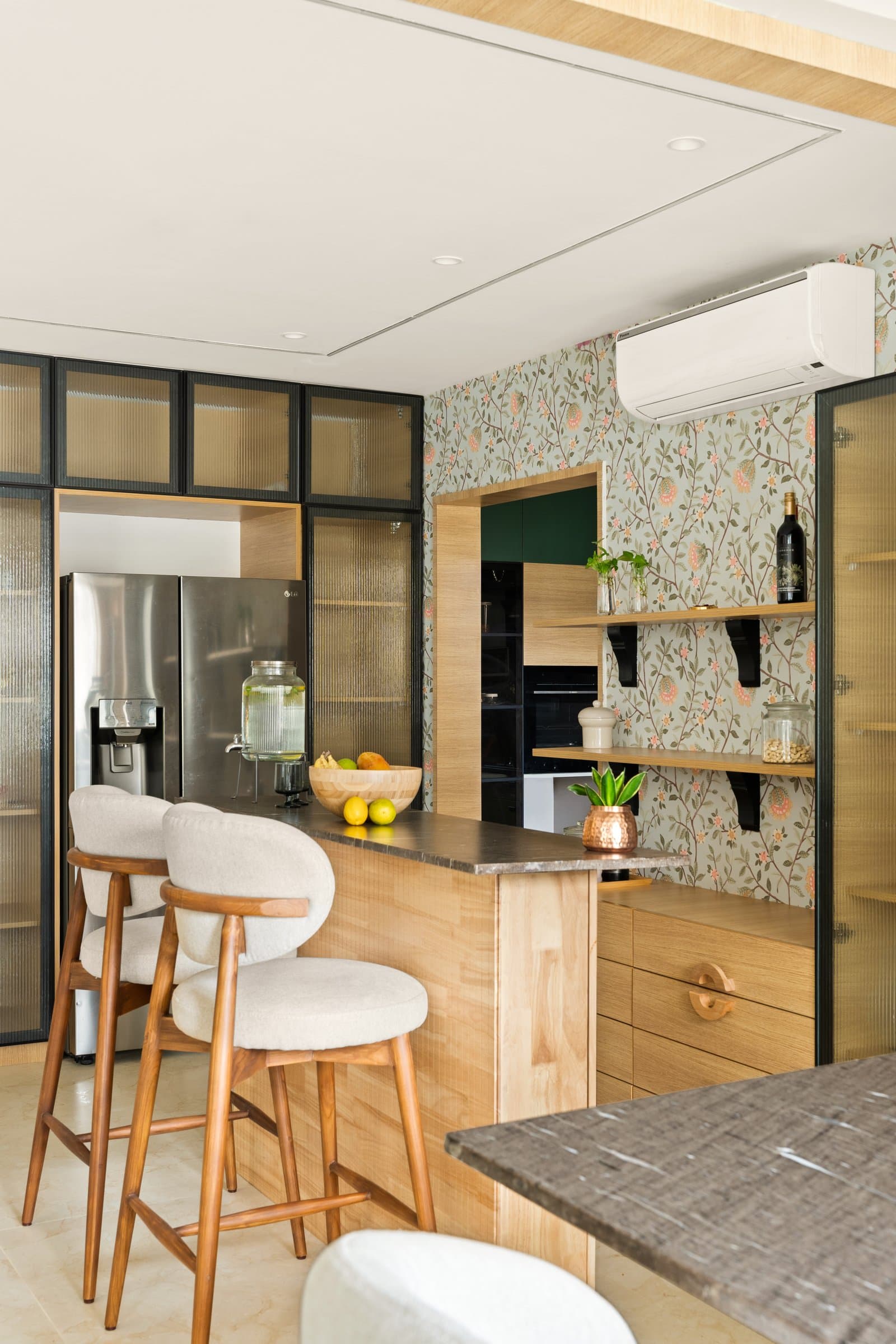
From the dining side, the kitchen reveals its layered storage logic: ribbed-glass cabinetry running floor to ceiling, a stone-topped island in pale timber, open shelves bracketed in black against the floral paper.
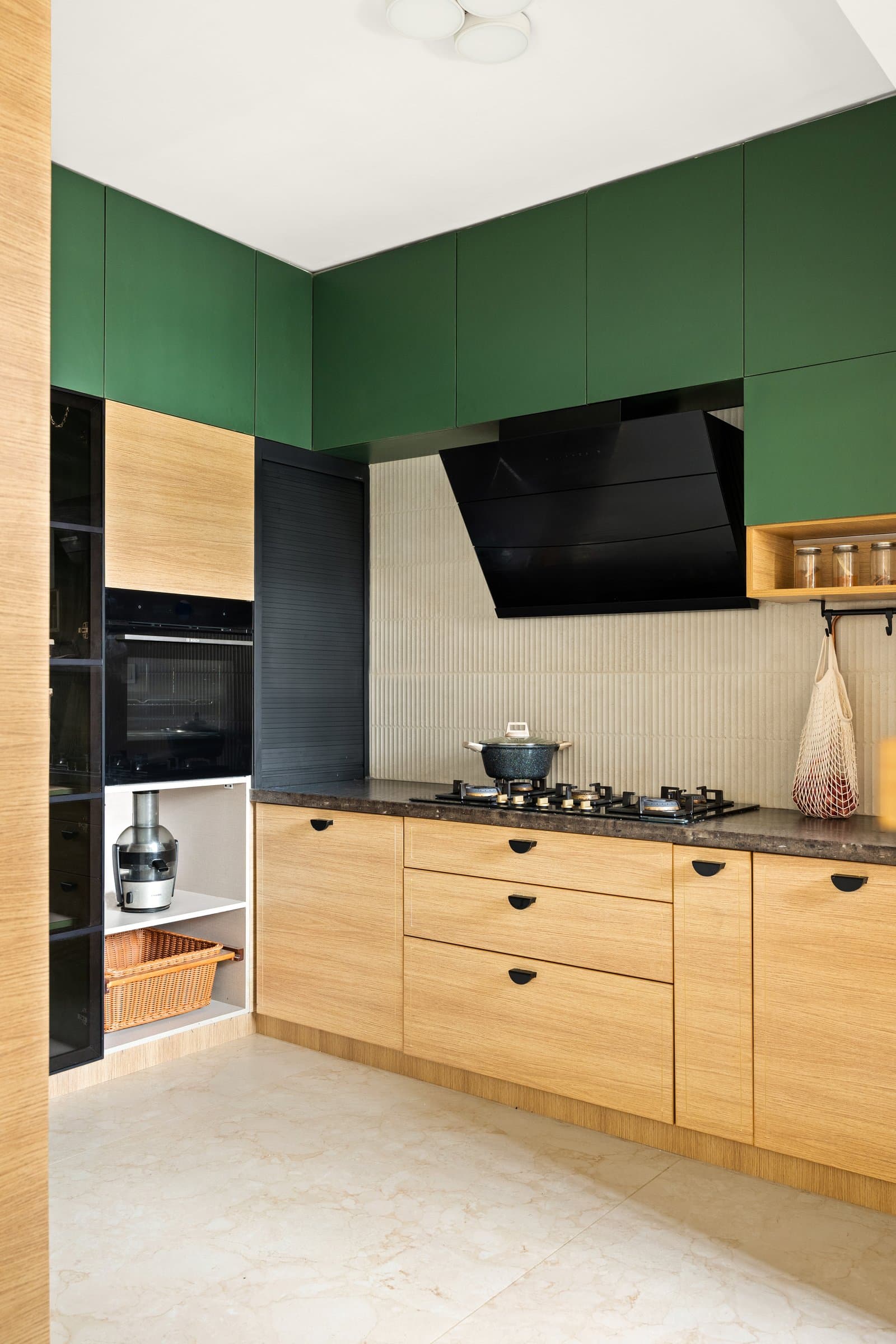
The working kitchen itself drops the floral lightness for something firmer. Forest-green upper cabinetry sits above pale timber base units, with a black hood and a fluted ceramic backsplash holding the centre. The ratio is unusual: a saturated colour overhead, a quieter one below, which keeps the room from feeling top-heavy and gives the cook a calm field of vision at counter height.
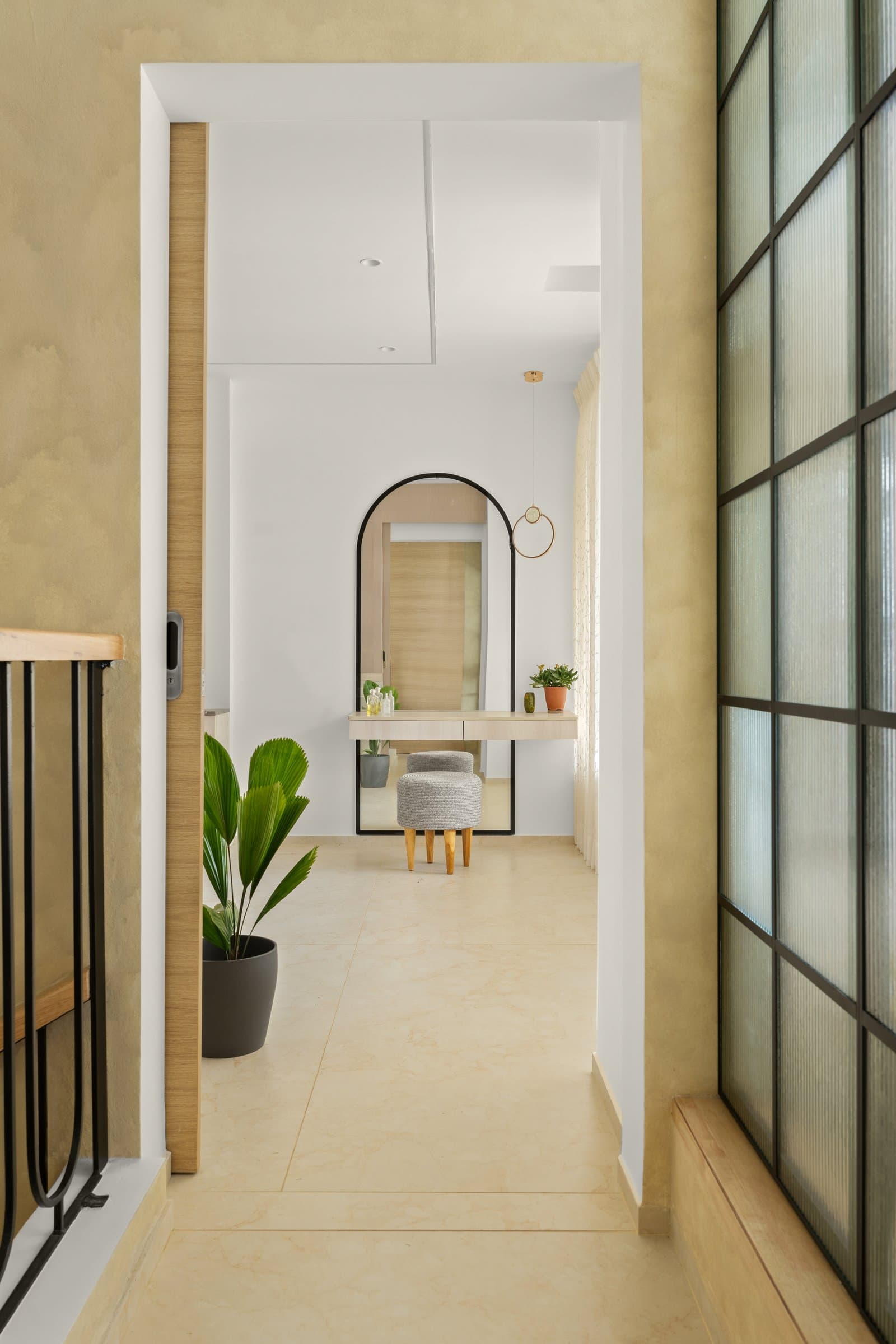
Upstairs, the circulation softens. A short passage frames an arched mirror and a slim console with a rounded stool, lit by a small ringed pendant. The plaster walls in warm ochre carry through from the staircase, threading the two floors with a single material idea.
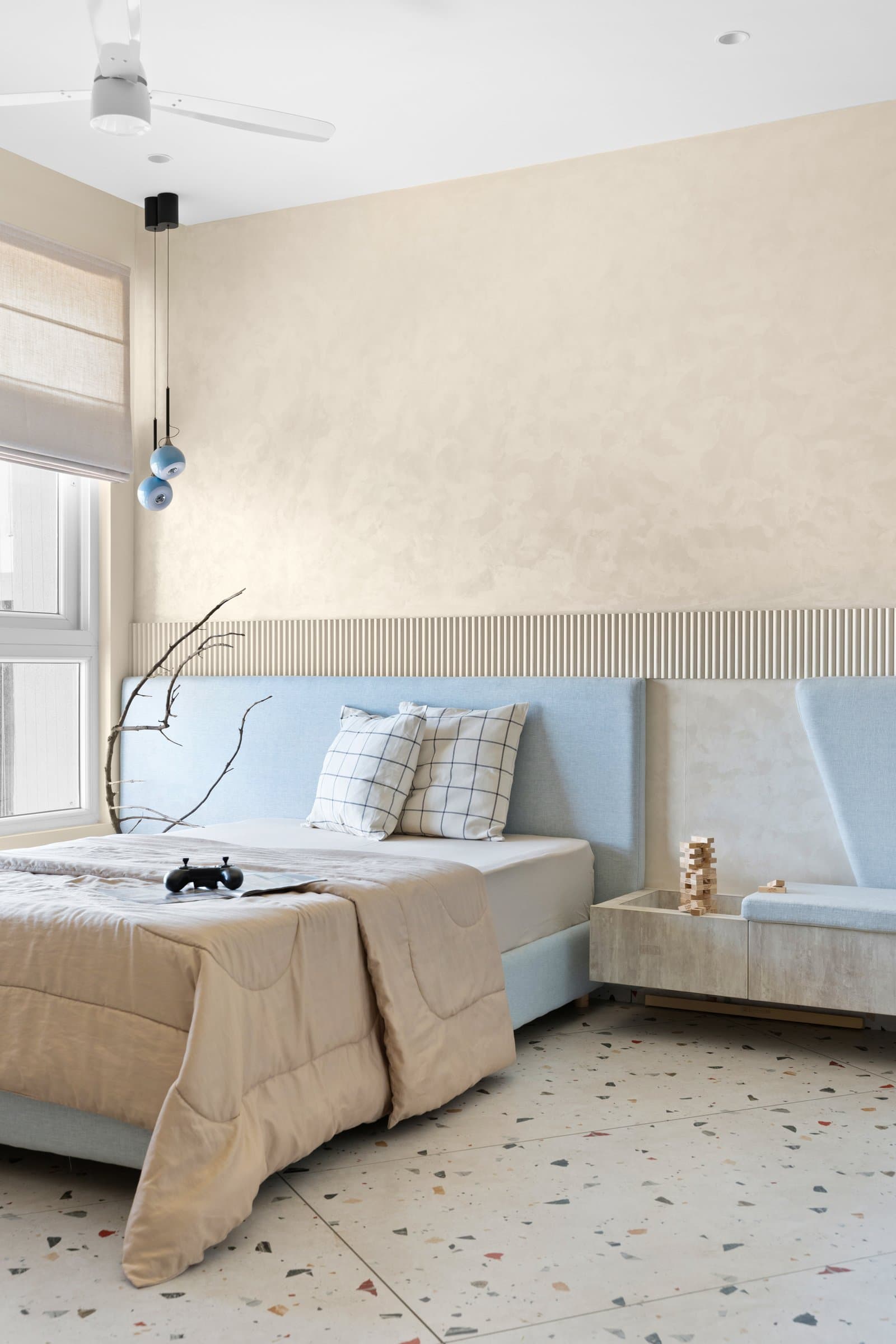
The first of the children’s bedrooms opens with a pale blue upholstered headboard that runs almost the full length of the room, set against a fluted cream wall panel running above. Terrazzo flooring with confetti chips brings a flicker of colour into a room that is otherwise held in muted plasterwork and powder blue.
The bed is generously scaled but visually weightless, hovering above the speckled floor. A bedside cube in pale cement-finish doubles as nightstand and storage, and a pair of small spherical pendants drop in beside the window, their blue glass picking up the headboard’s tone without competing with it.
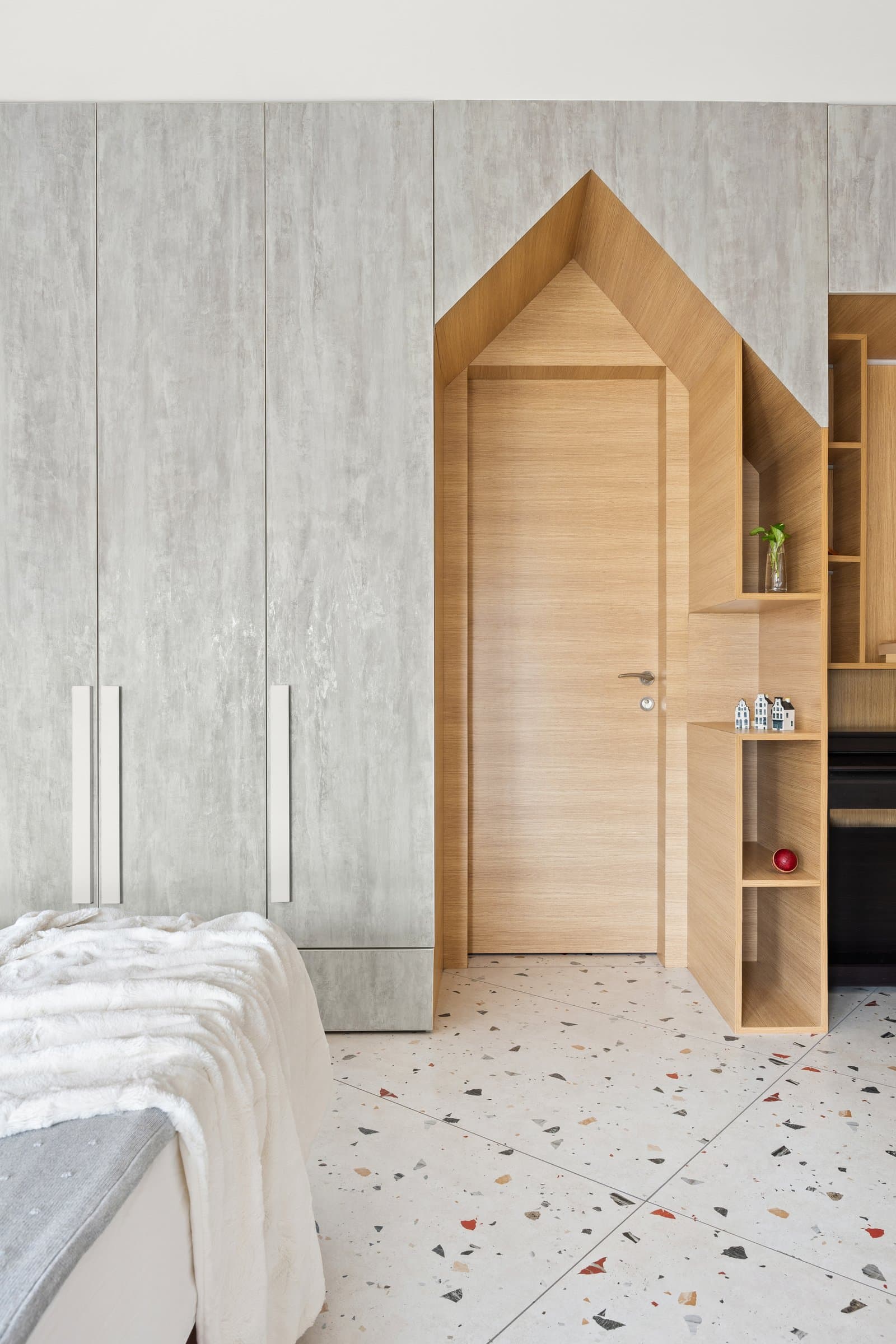
Beyond the bed, the wardrobe wall introduces the room’s most architectural gesture: a tall pitched-roof opening cut into the panelling, framing the door in the silhouette of a little house. It is a literal motif used with restraint, and it transforms a routine threshold into the room’s visual anchor.
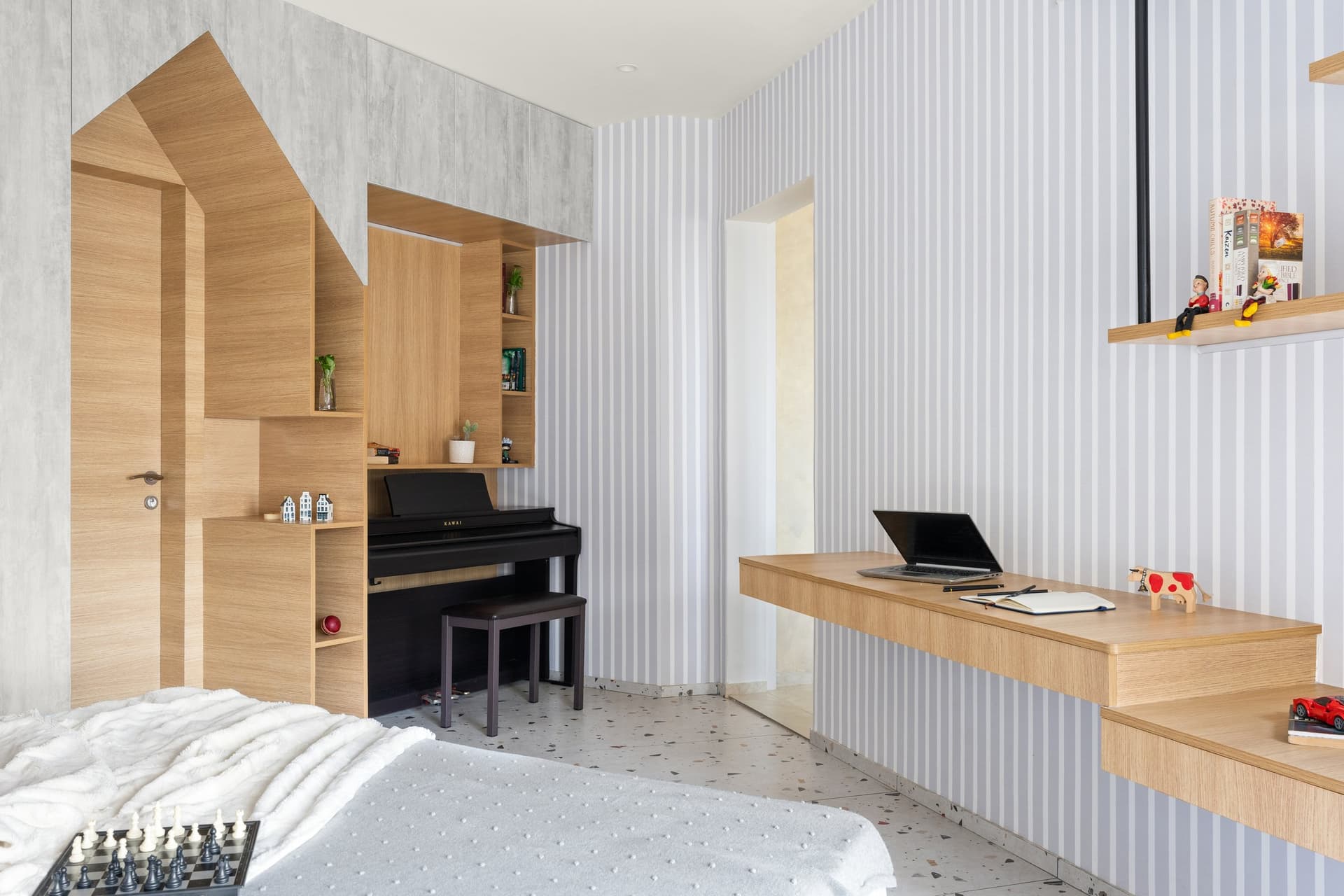
The same house-shaped frame returns to enclose a built-in piano nook, its shelves stepped to follow the gable line. A floating wooden desk runs along the opposite wall, set against soft pewter pinstripe wallpaper that grounds the room’s lighter elements without overwhelming them.
In use, the room makes its case more clearly. The piano alcove and the writing desk operate as two distinct stations within a single bedroom, allowing the occupant to move between practice, study, and rest without leaving the room or visually fragmenting it.
The window corner consolidates the room’s logic: floating wooden shelves at varying heights, a slim console for drawing and reading, and a soft Roman shade in pale linen filtering the city beyond. It is a study wall and a display wall at once, designed to evolve as its occupant does.
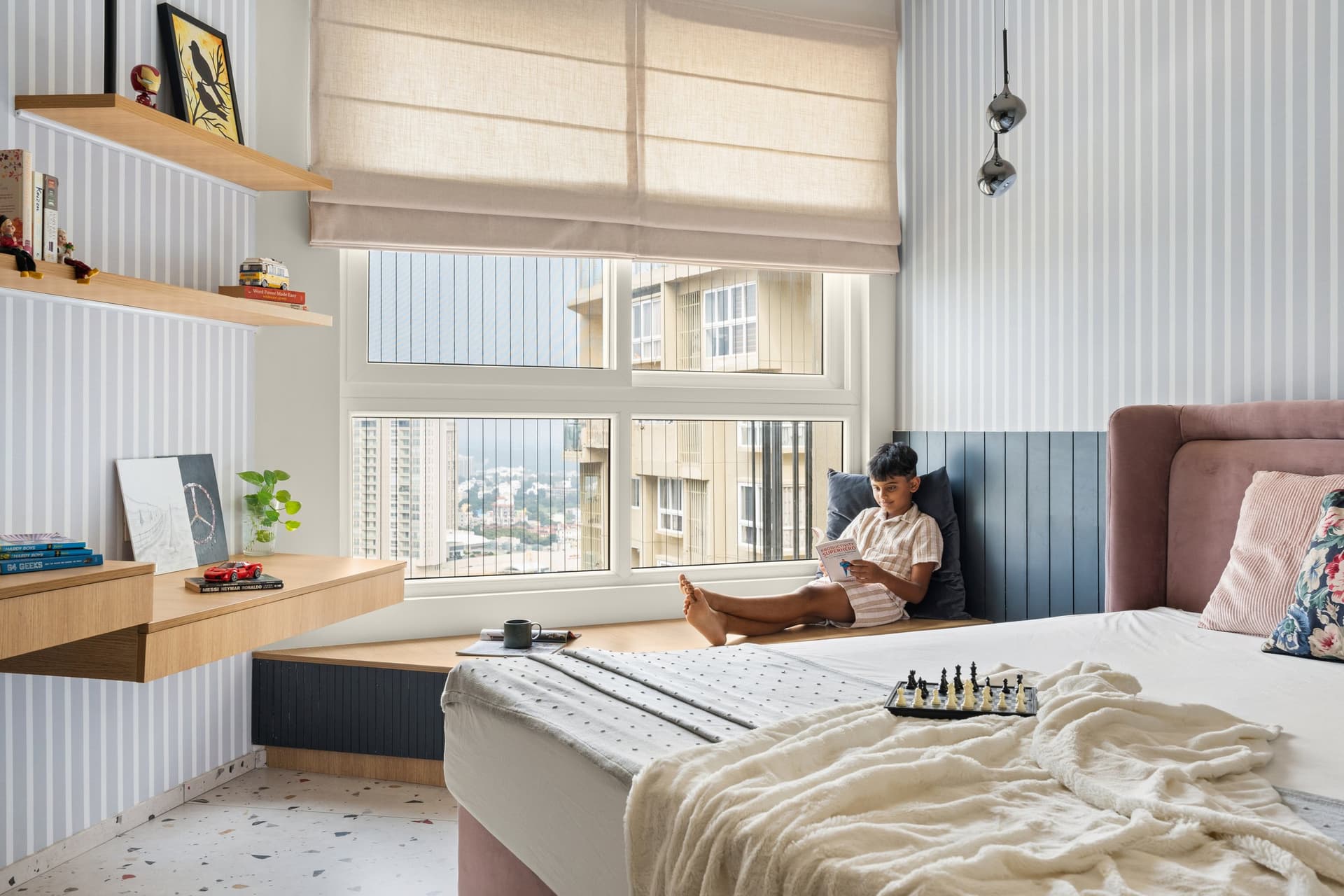
The window seat tucked beside the bed extends the room’s working surface into a place to read, a place to set down a cup of tea, a place to look out. The dusty rose velvet headboard meets the panelled ledge in a gentle exchange of soft and firm.
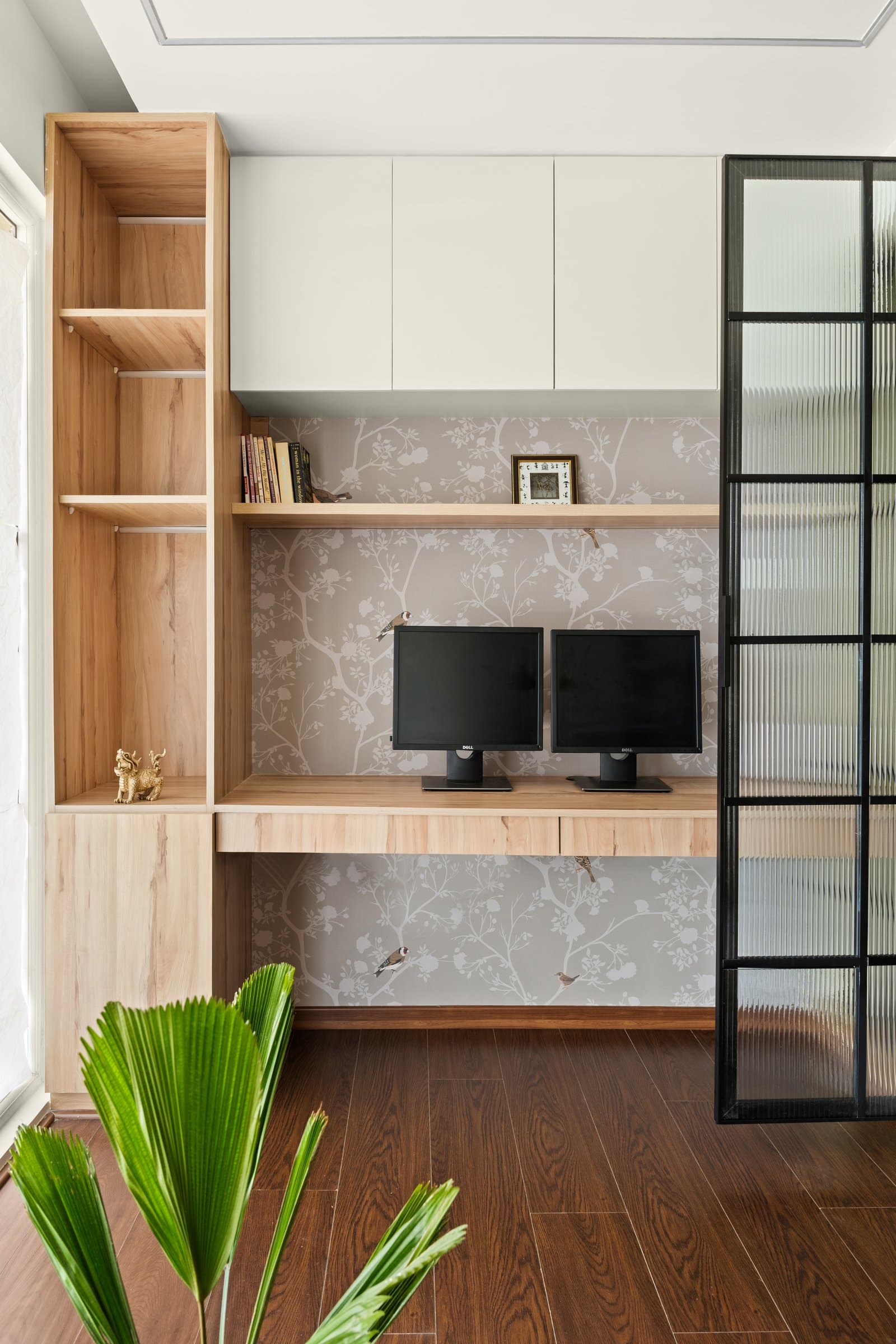
The home office, separated from the bedroom by a fluted-glass-and-black-metal partition, takes its cue from the same restrained palette. A built-in desk in pale wood holds twin monitors against a delicate bird-and-branch wallpaper, with white upper cabinetry closing the composition cleanly above.
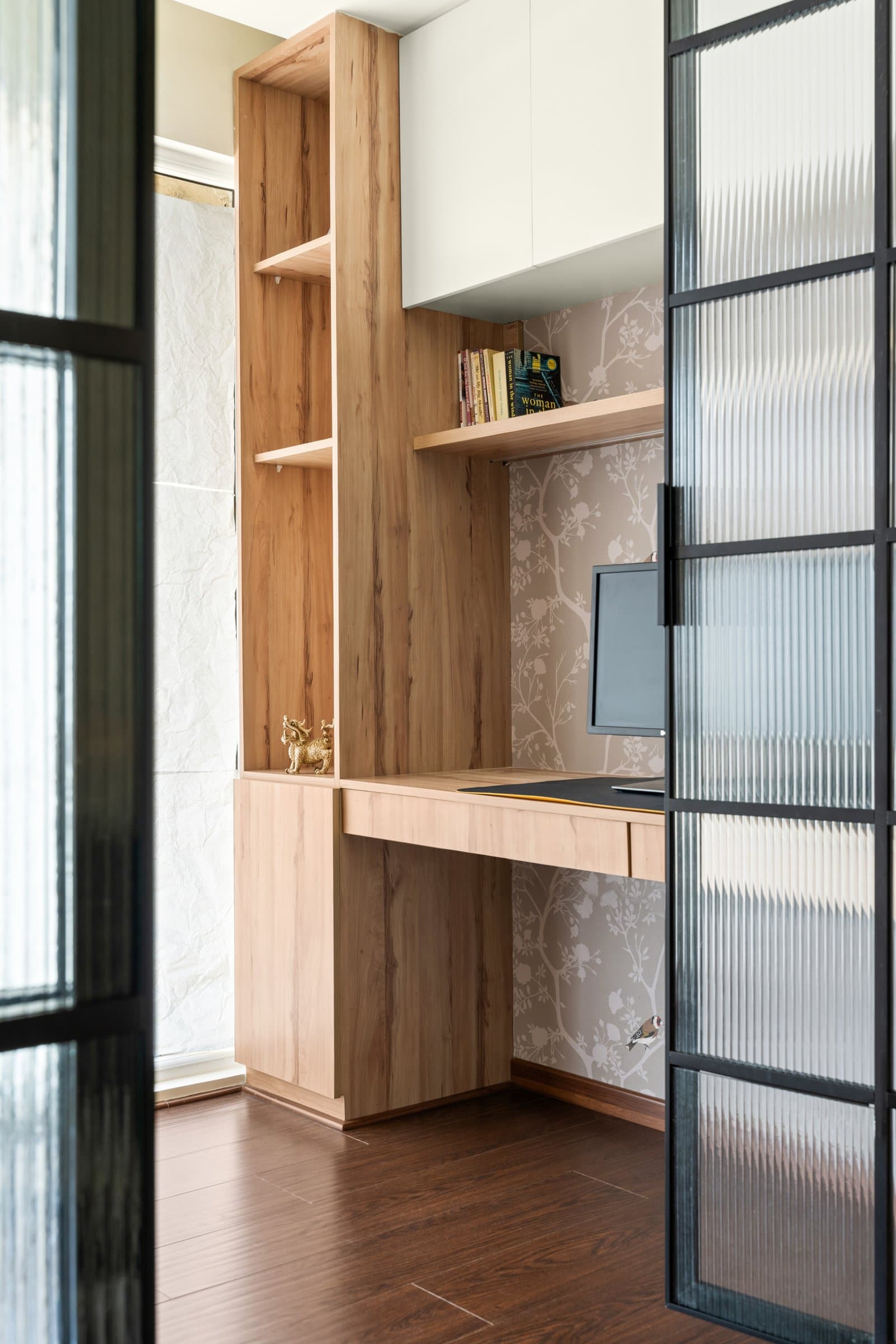
Glimpsed through the partition, the desk reads almost as a small library. Open shelving in pale timber, a botanical patterned wallpaper behind the desk, and a deep walnut floor introduce the only properly dark surface in the upper level, a deliberate counterweight to the lightness everywhere else.
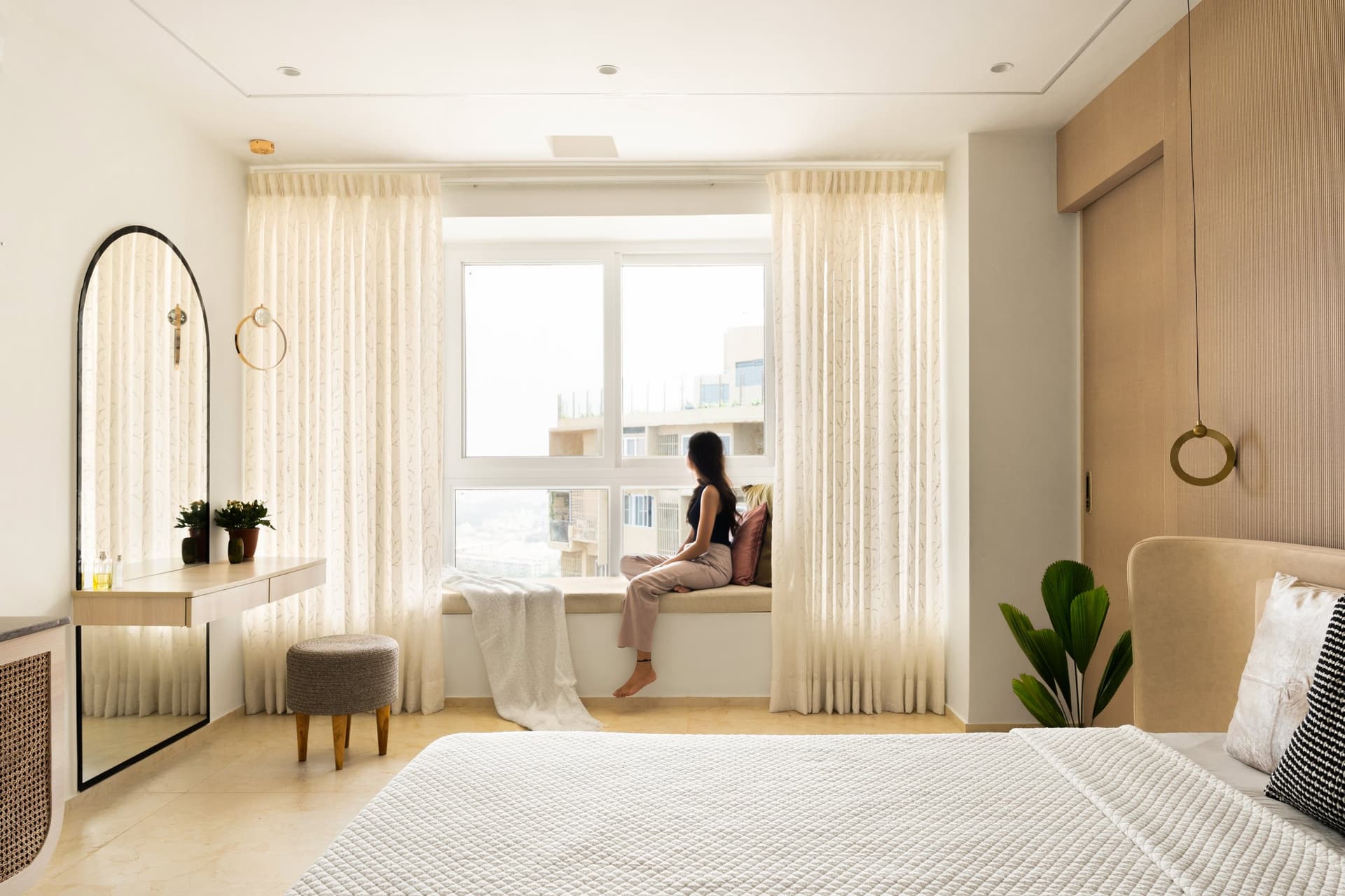
The master bedroom carries the home’s lightest hand. A generous window seat in oatmeal upholstery runs the width of the bay, flanked by sheer leaf-patterned curtains, with a slim dressing console and an arched standing mirror set against the adjacent wall. The room is calibrated for morning light.
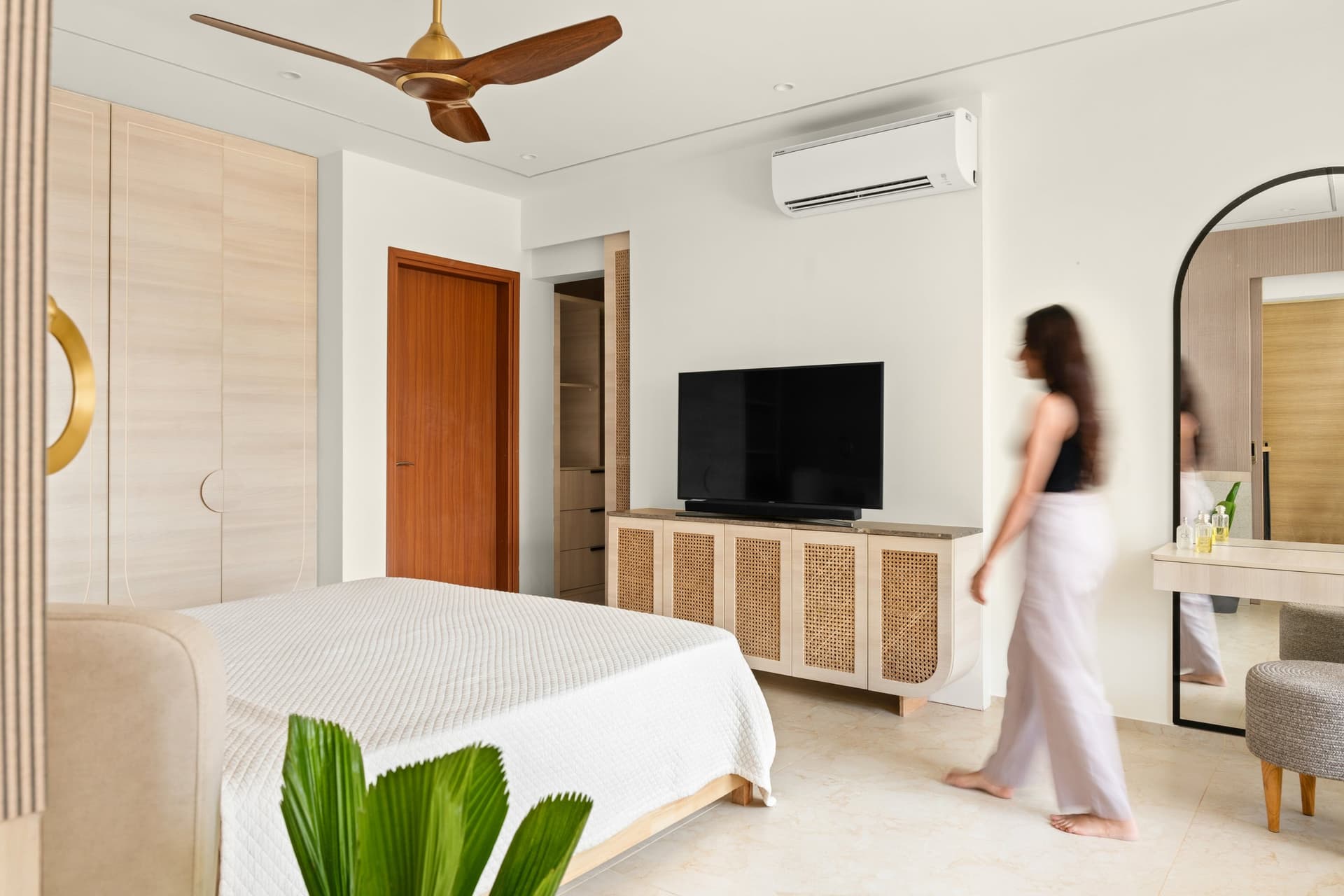
Across the room, the storage and television wall is composed in three quiet movements: a tall fluted timber wardrobe with brass detail, a teak-toned door, and a low cane-fronted media console capped in stone. The cane fronts are the room’s most tactile gesture, softening what would otherwise be a long run of cabinetry.
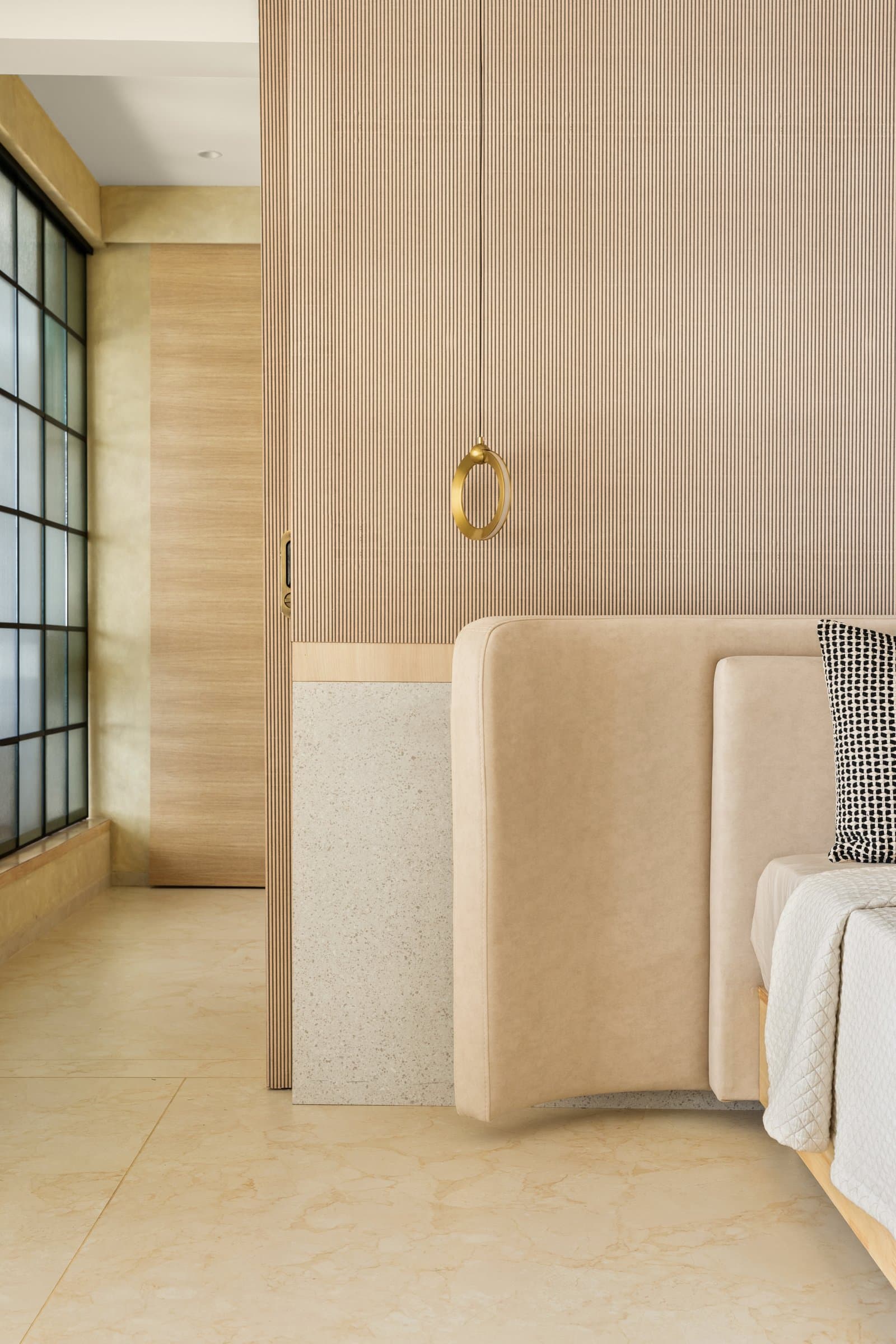
Closer in, the wall behind the bed reveals its construction: a tall fluted wooden sliding panel fitted with a brass ring pull, meeting a base of speckled terrazzo at floor level.
The bedhead itself is a low, rounded form in soft cream leatherette, set against a wall of vertical fluting in warm beige. A brass ring pendant drops on a fine cable above the bedside, its scale almost jewellery-like against the broad panel behind.
To one side of the bed, a pale wooden wardrobe with subtle inlaid arcs sits beside a slim open shelf holding a few personal objects. The brass ring reappears as a suspended pendant, confirming itself as the room’s quiet refrain rather than a one-time flourish.
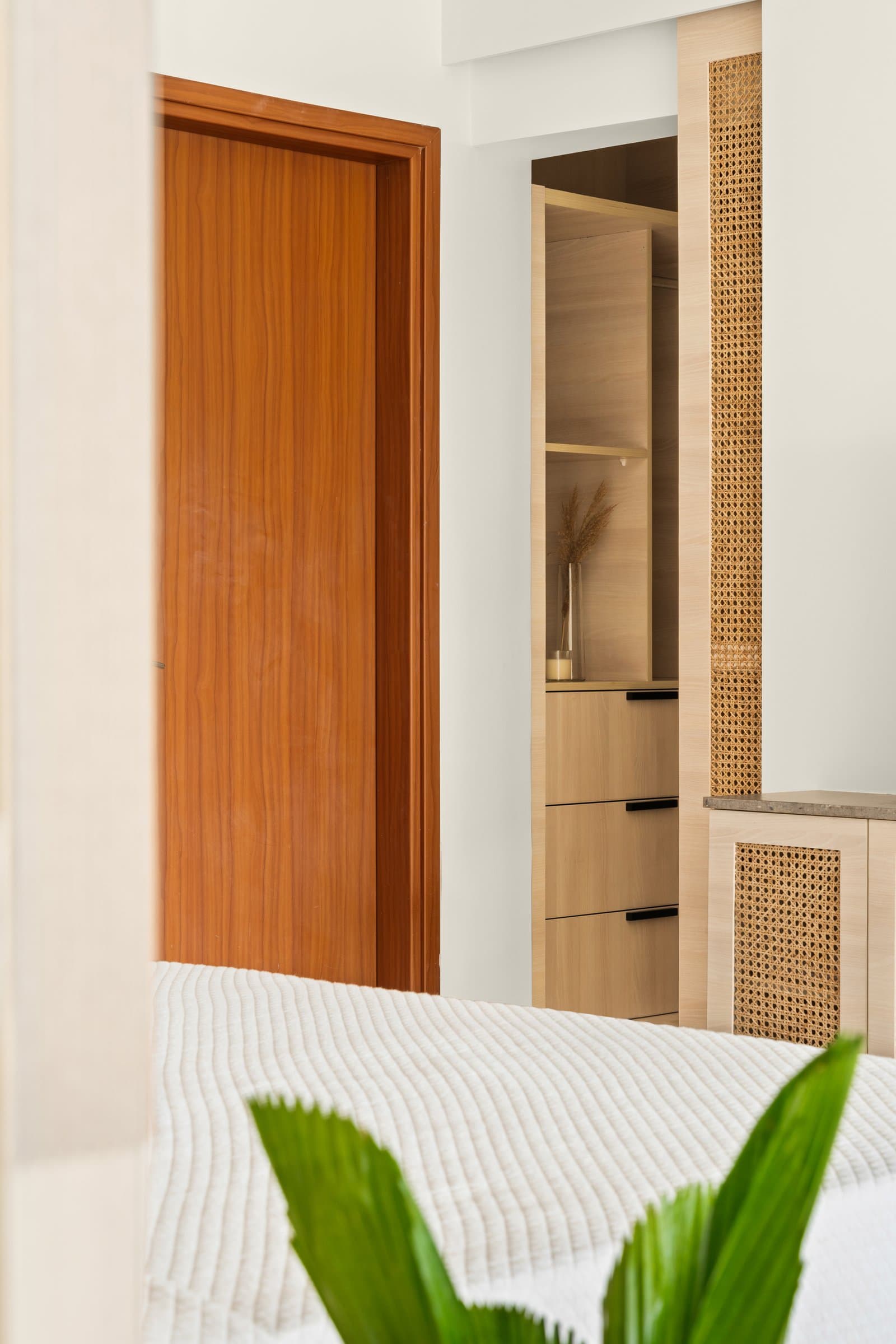
A glimpse into the dressing area shows where the room earns its discipline. Cane inserts on the wardrobe panels and a slim cane vertical strip alongside the dressing unit lighten what would otherwise be a heavy storage wall, allowing the master suite to expand into its services without losing its restraint.
What this duplex argues, in city terms, is that minimalism in Indian residential design has matured past its first phase of white walls and hard edges. The vocabulary here is softer, warmer, more willing to sit with pattern, terrazzo, and brass without losing its discipline. It belongs to the same conversation as the country’s emerging interest in textured plasterwork, considered joinery, and rooms that refuse to behave like showrooms.
In this lies the project’s distinction: not in the things it puts on display, but in the calm with which it puts them in their place. The home does not perform simplicity. It practises it, room by room, until simplicity becomes the most considered thing in the house.