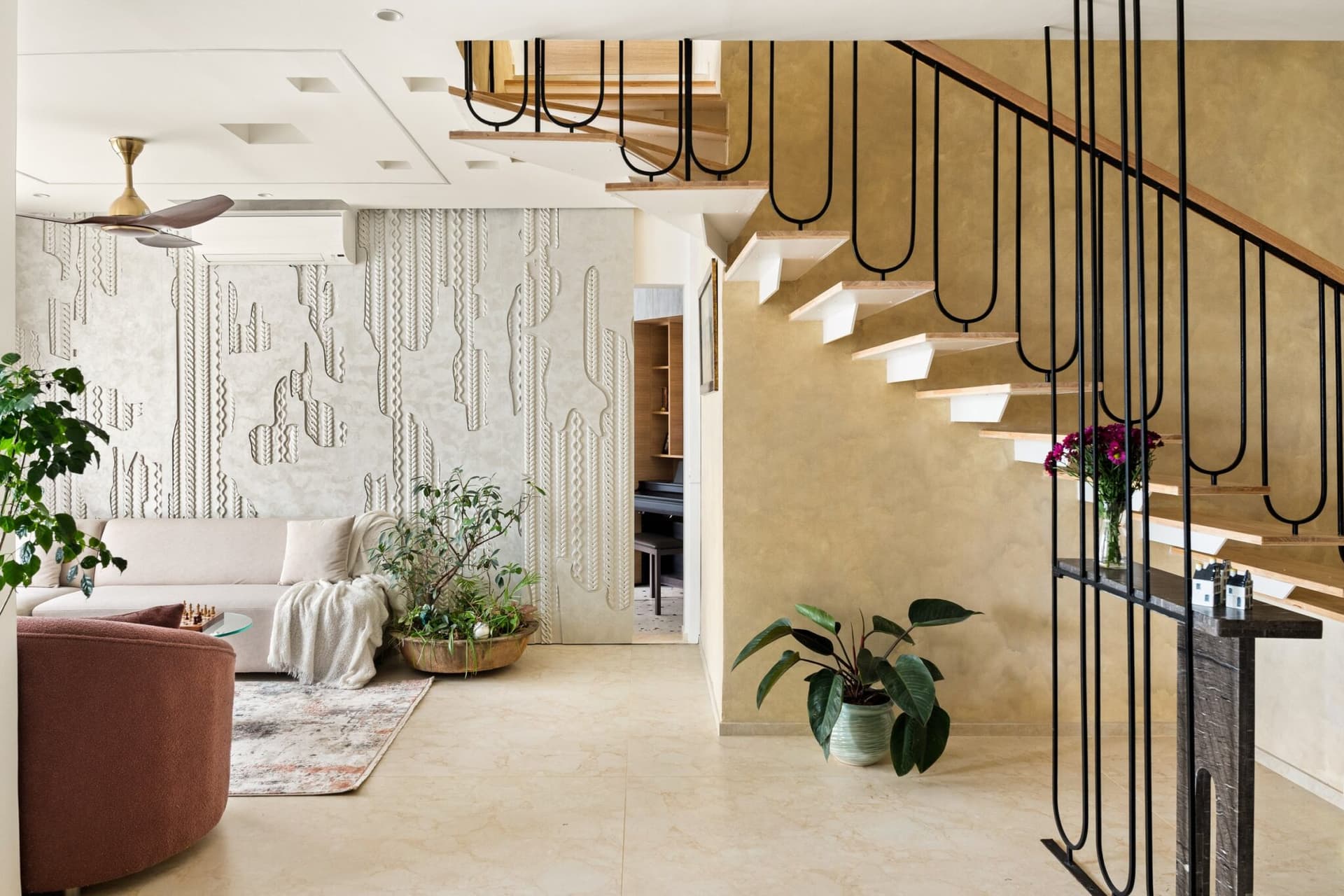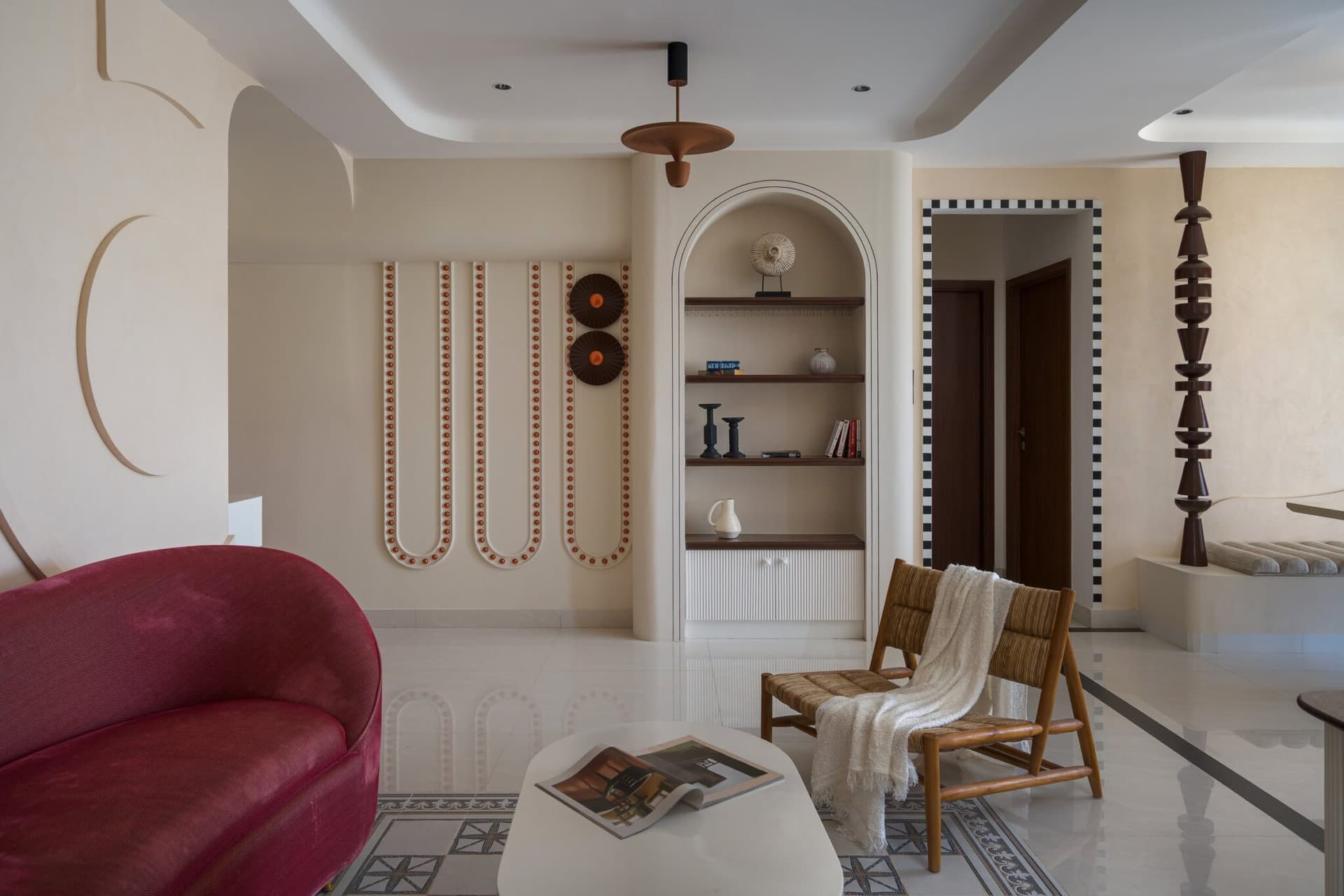
Apartments in high-rise Mumbai often arrive sealed, glassy, and impatient, asking their occupants to perform a kind of cosmopolitan stillness. Terracotta Tales proposes the opposite, a home that admits the weight of clay, the grain of salvaged wood, and the soft authority of the arch as its primary vocabulary.
Set within a residential tower in Powai, Mumbai, the apartment was designed by Ve Design Studio for a family seeking warmth without nostalgia and craft without theatre. The design holds together through a sustained material argument, where terracotta grounds the floors and surfaces, raw wood animates the furniture, and curved plaster softens the geometry of an otherwise rectilinear shell.
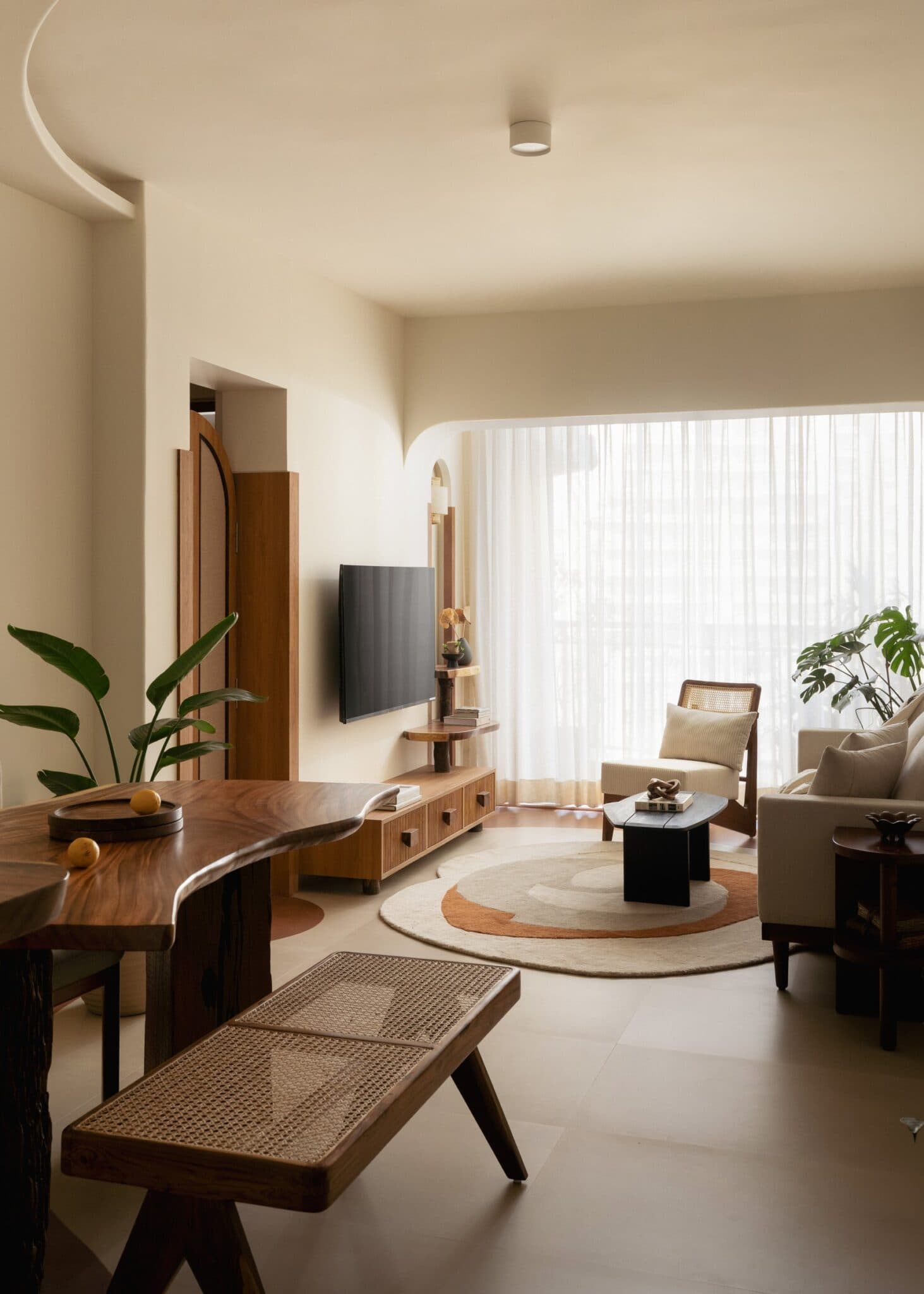
The living room reveals the home’s central proposition: that contemporary apartment living can carry the texture of an older, slower architecture. A curved soffit, a cane-backed Chandigarh-language chair, and a circular rug with terracotta arcs draw the eye in concentric, unhurried movements.
What makes the room work is its refusal to choose between modern and elemental. The live-edge console behaves like a found object, the television sits flush and unannounced, and the proportions stay calm enough that the materials, not the furniture, carry the story.
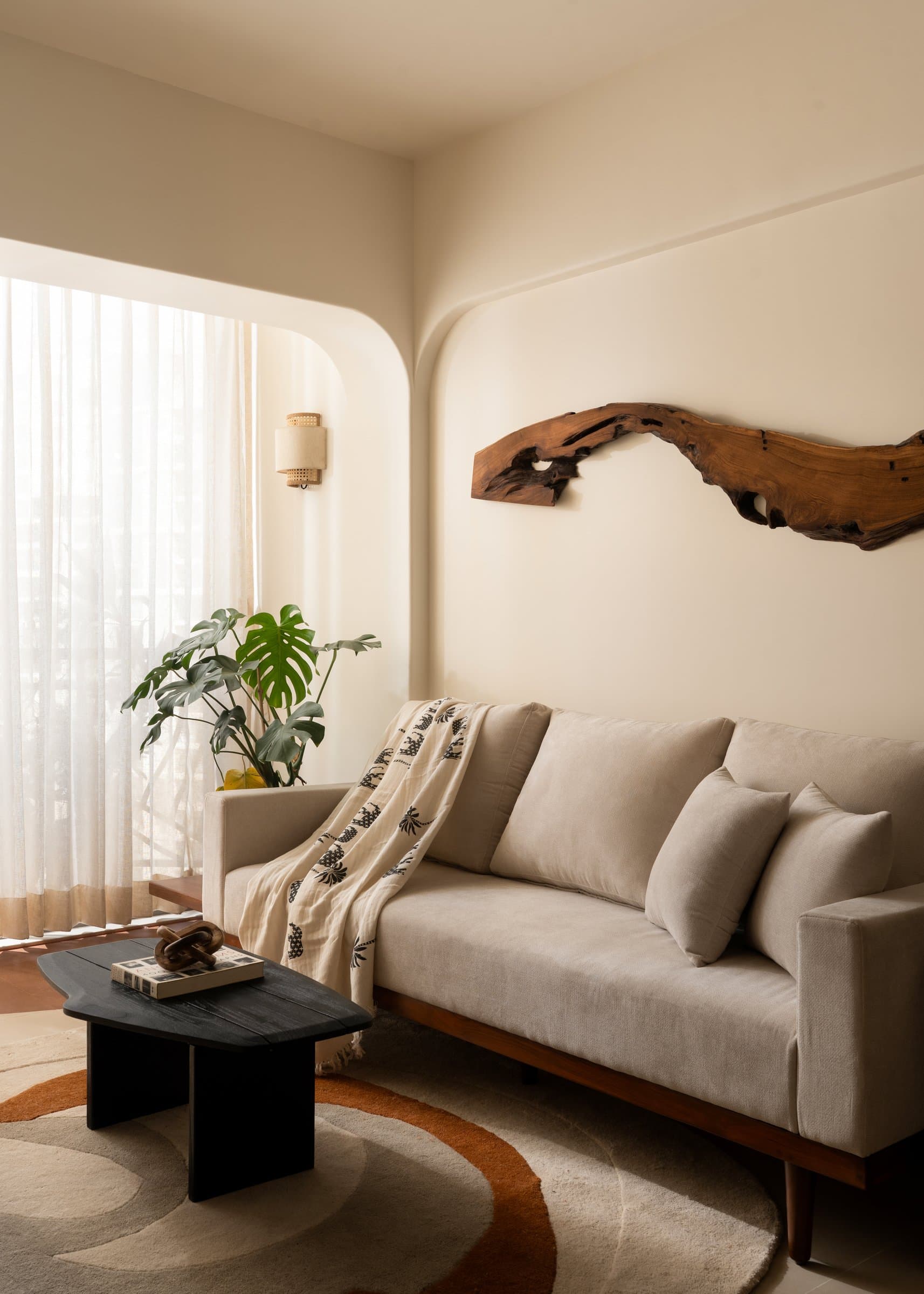
Above the sofa, a single piece of weathered driftwood is mounted as art, its silhouette doing the work that a painting would in a more conventional room. The gesture is confident and slightly unfashionable, which is precisely why it lands.
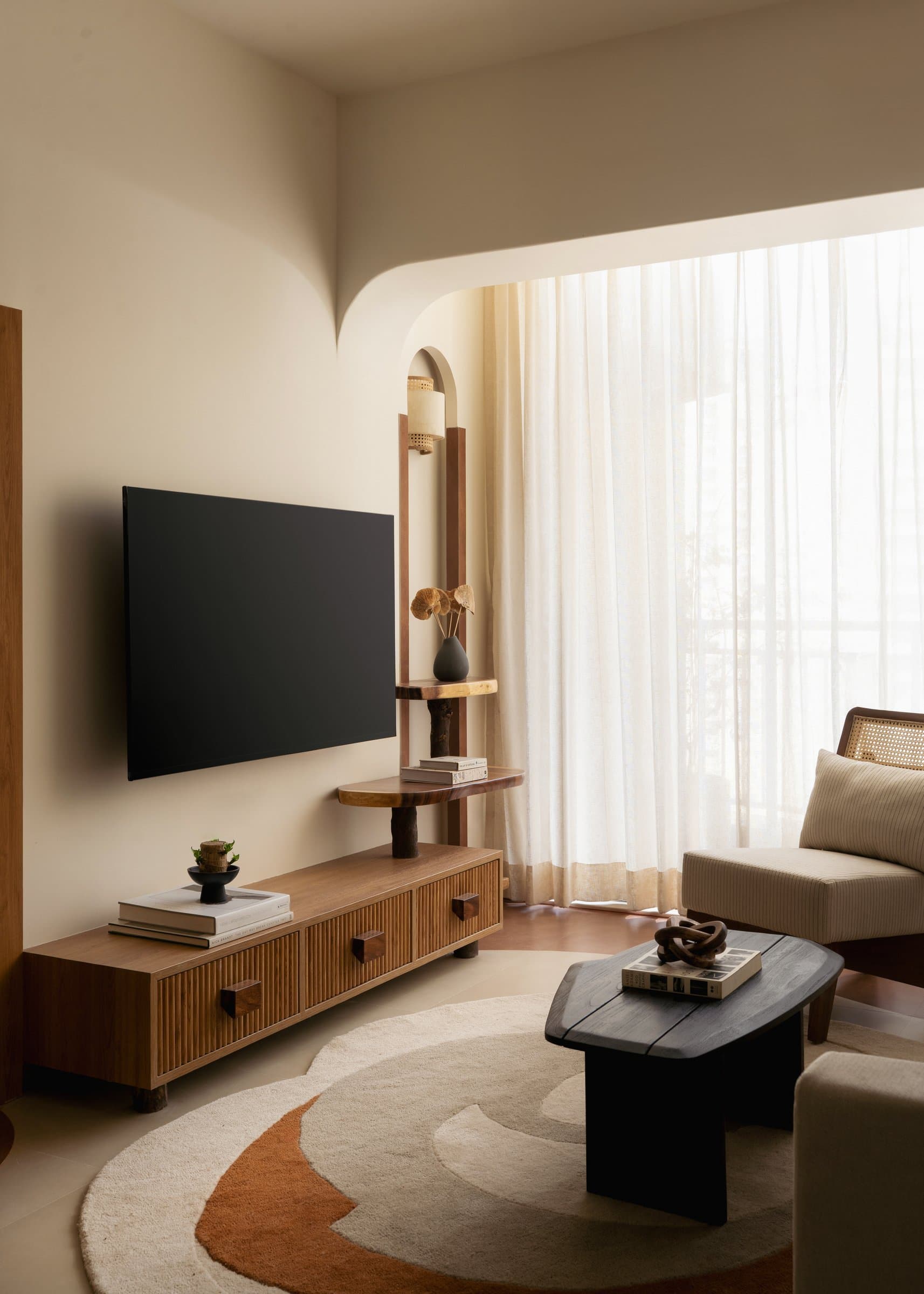
A slim timber étagère set into the corner carries the language further, holding a small ceramic vase and a stack of monographs against the soft fall of the sheer curtains. The fluted media console below is the room’s quietest piece of carpentry, content to recede while the light from the window does the visible work.
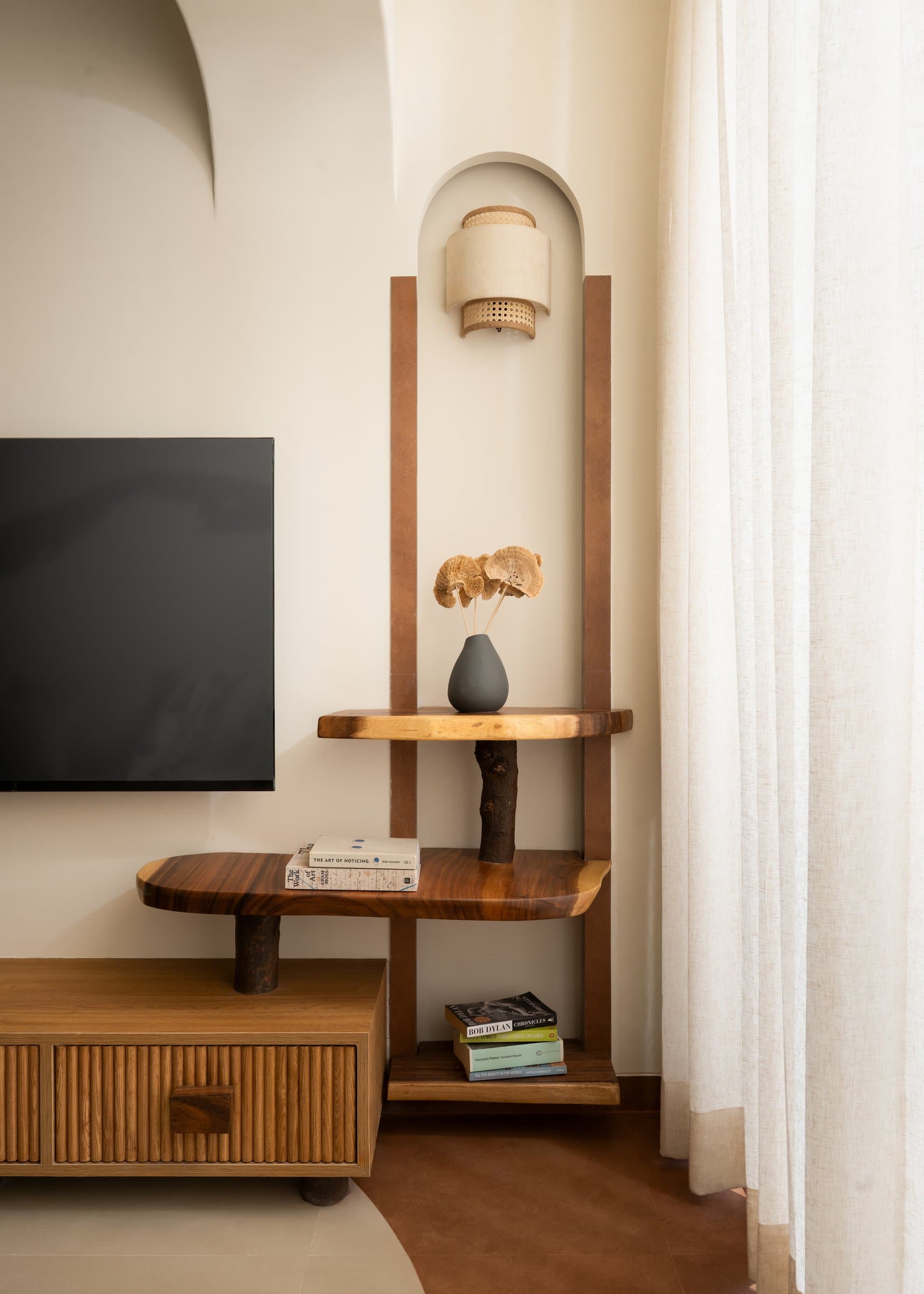
Where the room could have closed itself with a wall, the design instead opens a tall niche framed in timber, a small architectural event that holds a rattan sconce above and a live-edge shelf below. It is the kind of detail that rewards a second look, the kind that turns an apartment into a home.
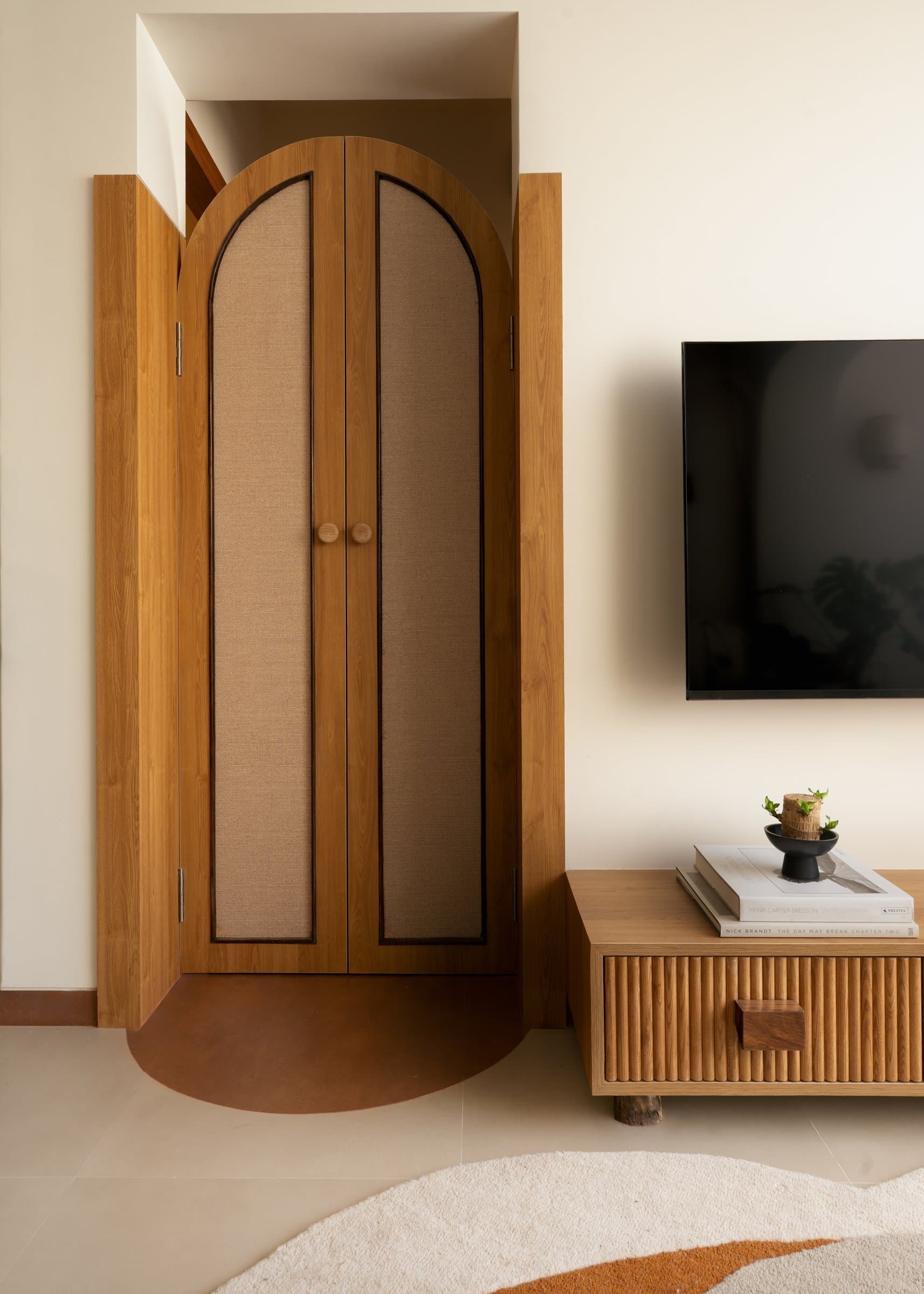
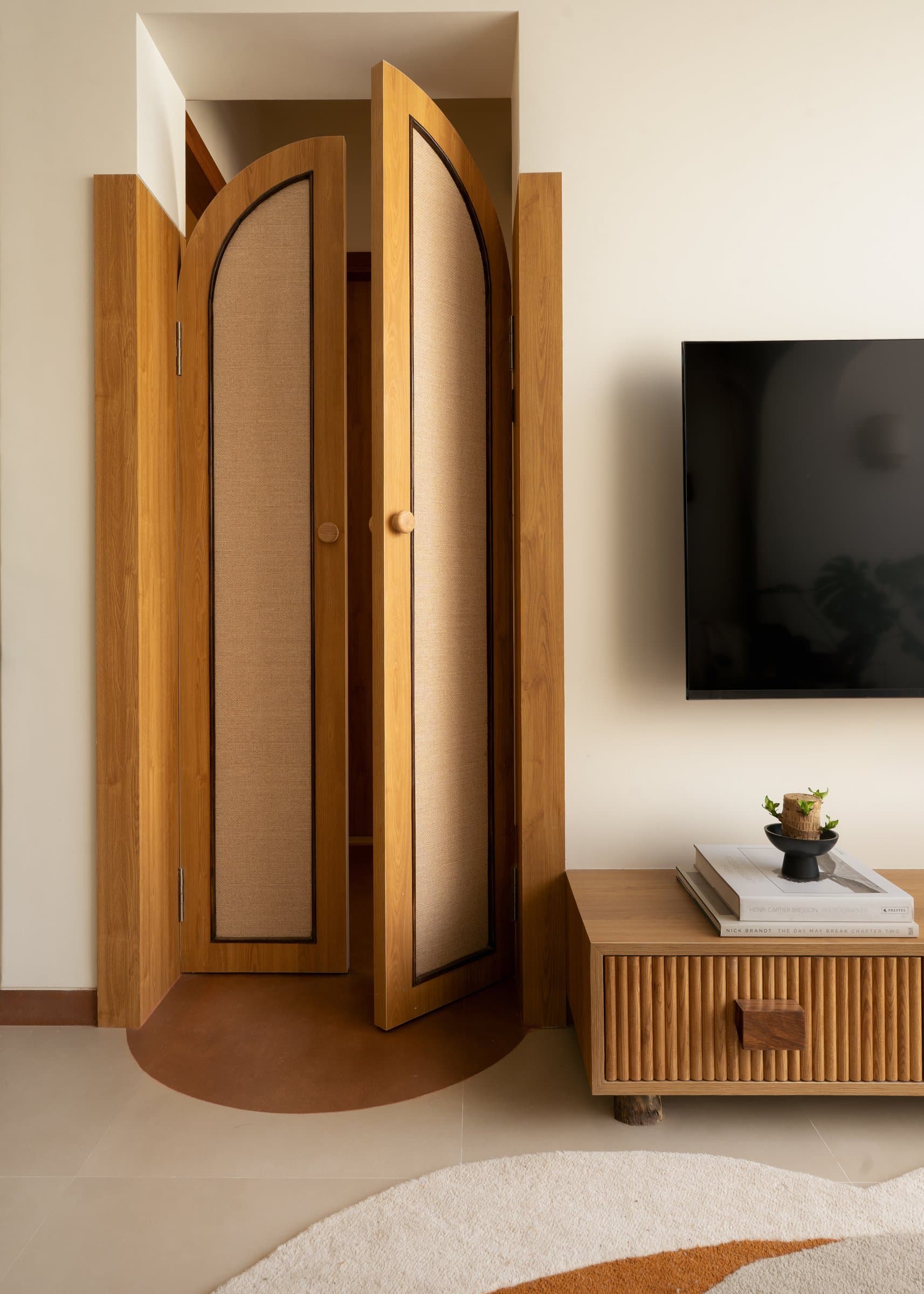
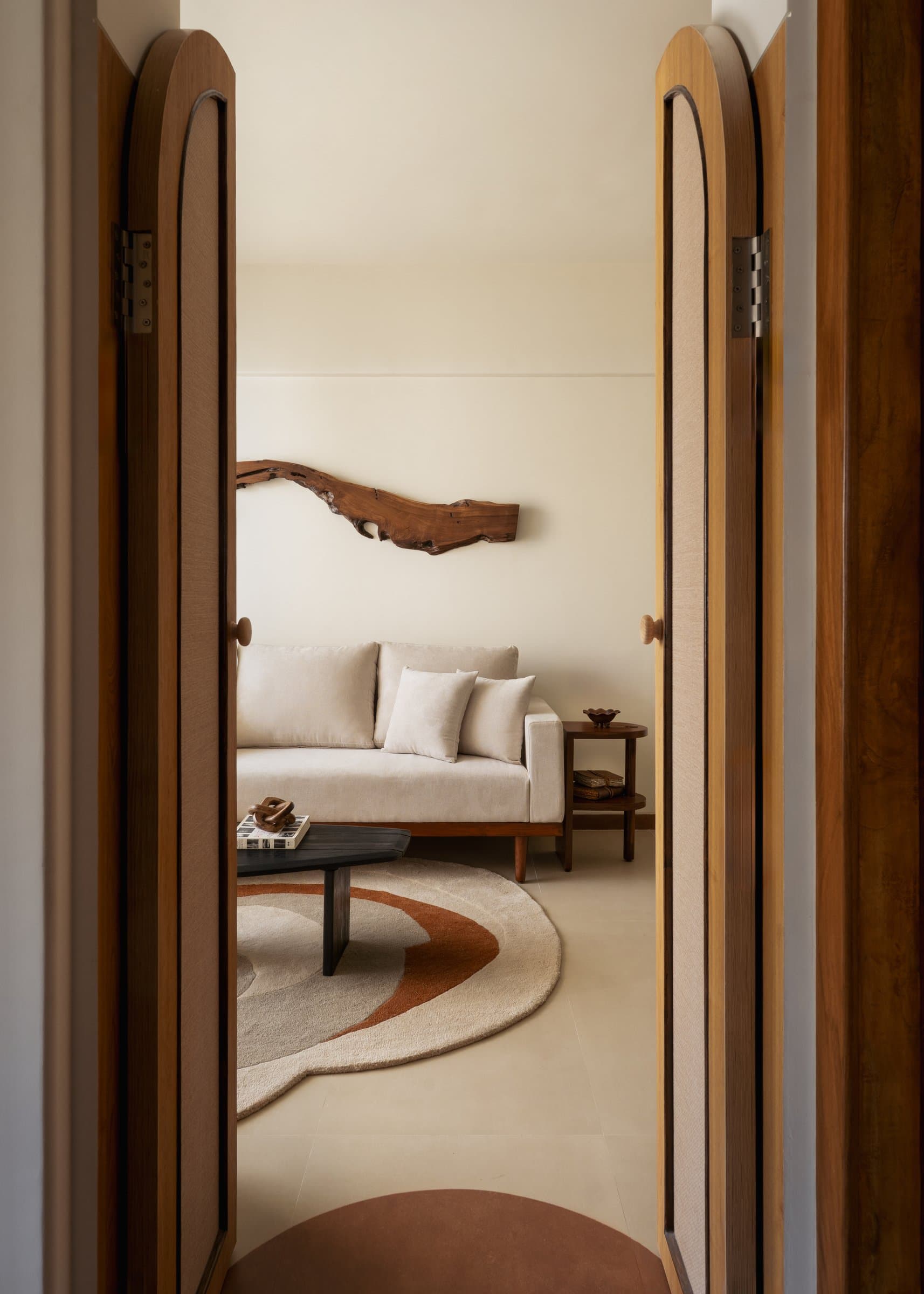
The arched cane-and-timber doorway leading off the living room is the apartment’s most photographed gesture, and rightly so. Its terracotta-coloured threshold reads almost like a stage mark on the floor, signalling the shift from public room to private corridor.
““We wanted every room to feel as though it had been touched by hand, not specified from a catalogue.””
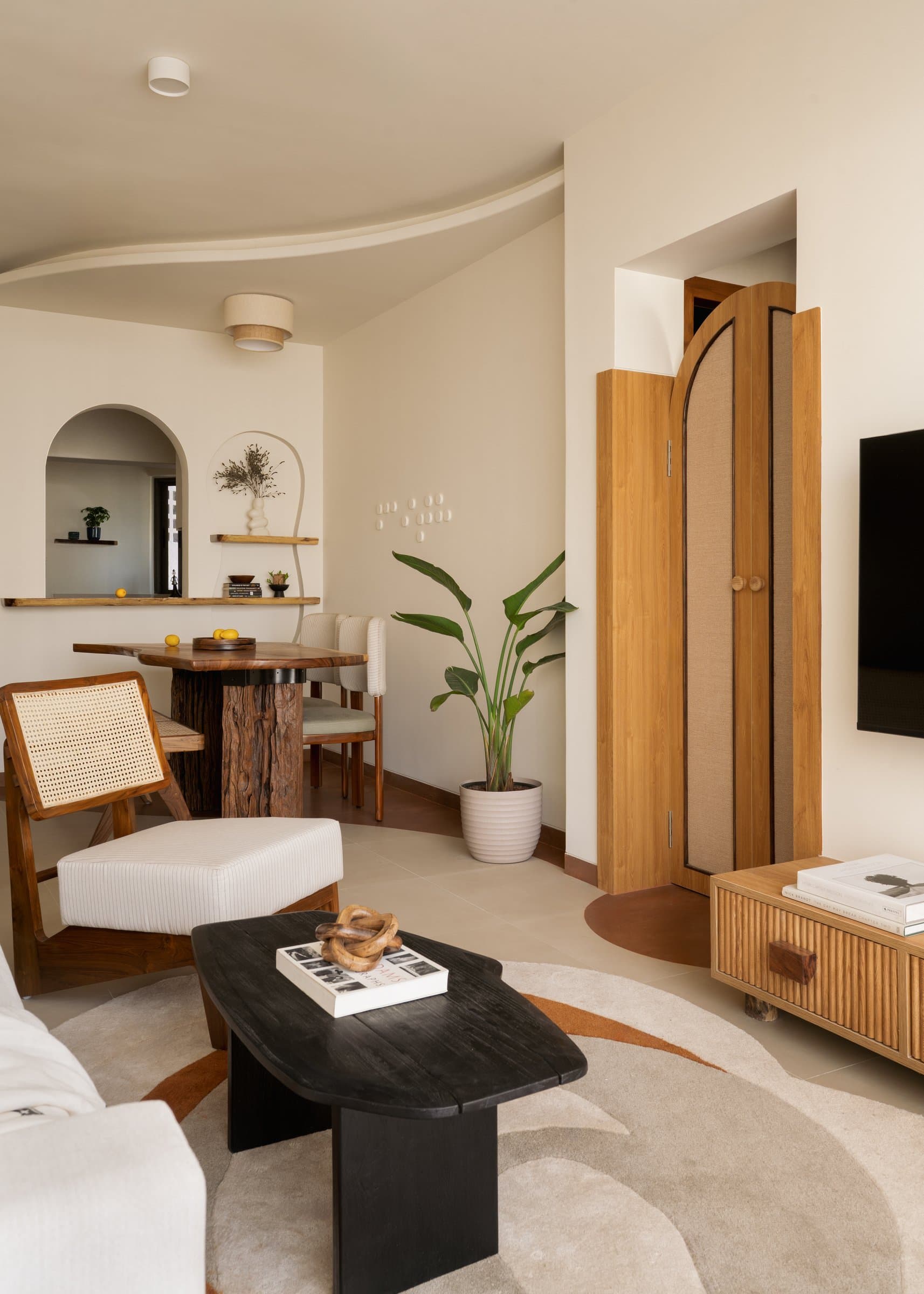
Seen from the seating area, the dining alcove sits in conversation with the living room rather than separated from it. The trunk-based dining table, with its bark-textured legs and a smooth suar wood top, anchors the space with a directness that the rest of the apartment quietly orbits.
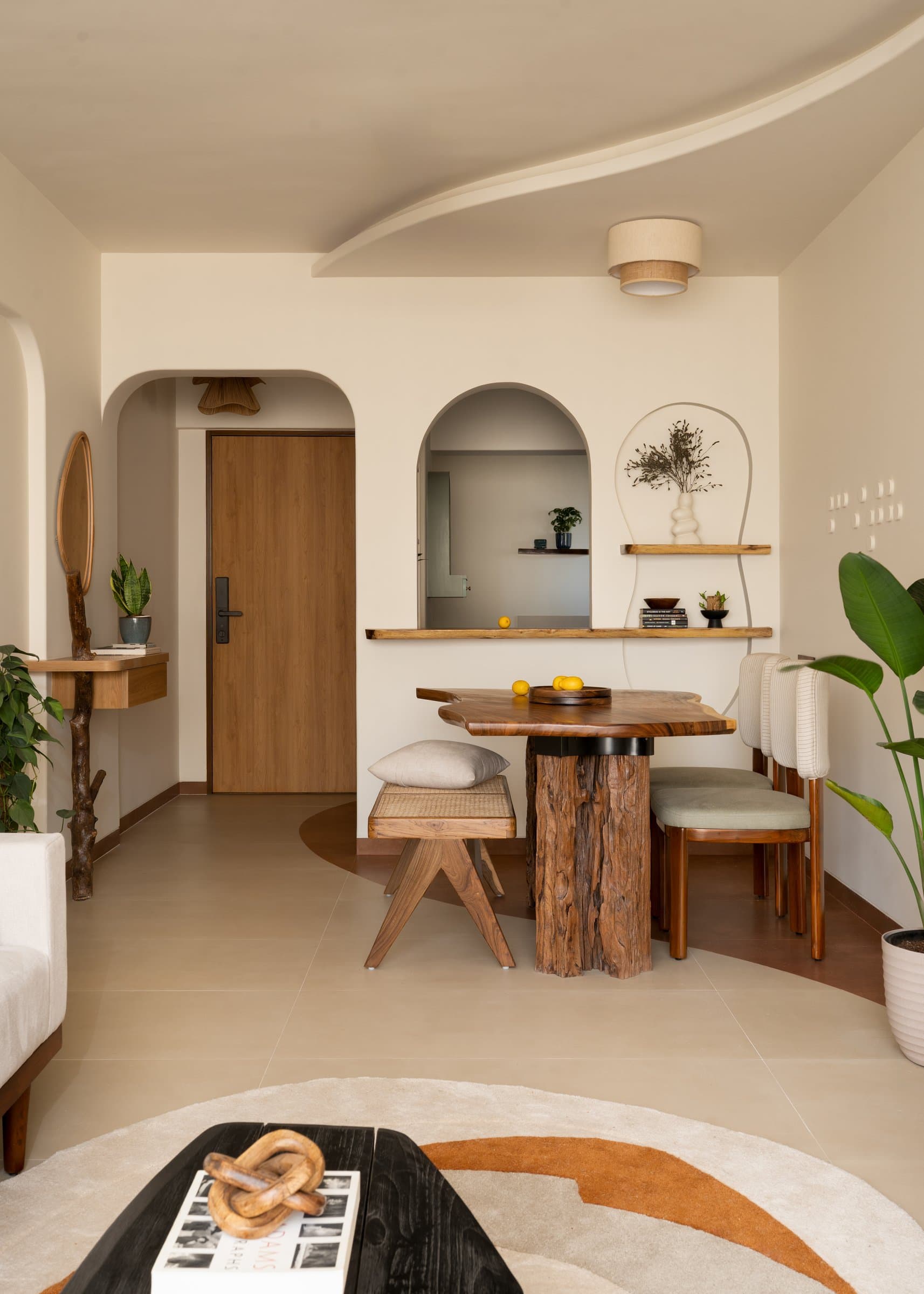
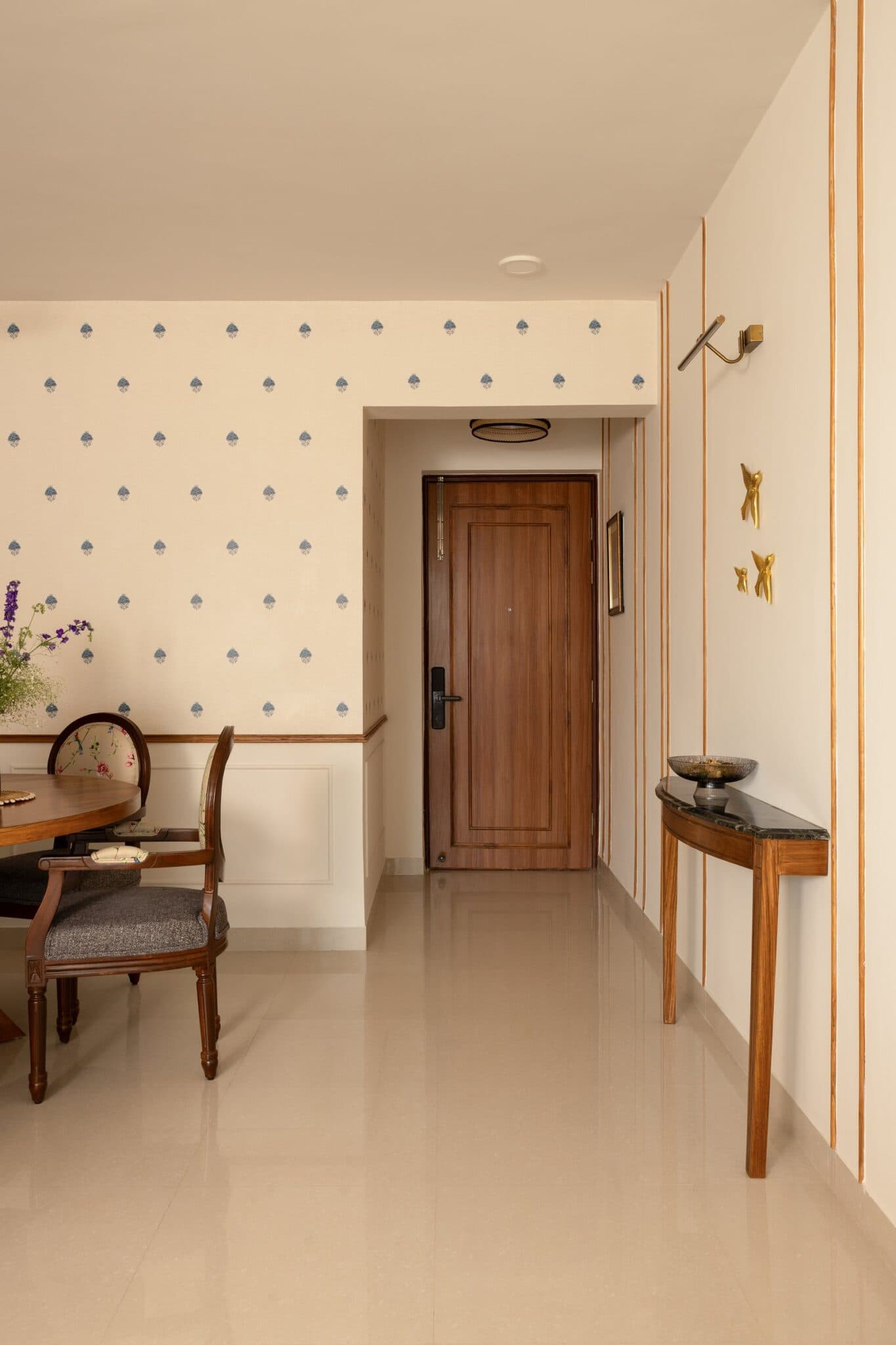
From the entry, the geometry of the home reads like a sequence of arches, each one framing the next. A slender branch, retained as an upright by the floating console, signals the home’s interest in the imperfect line, while the dining table’s trunk legs continue the argument deeper into the plan.
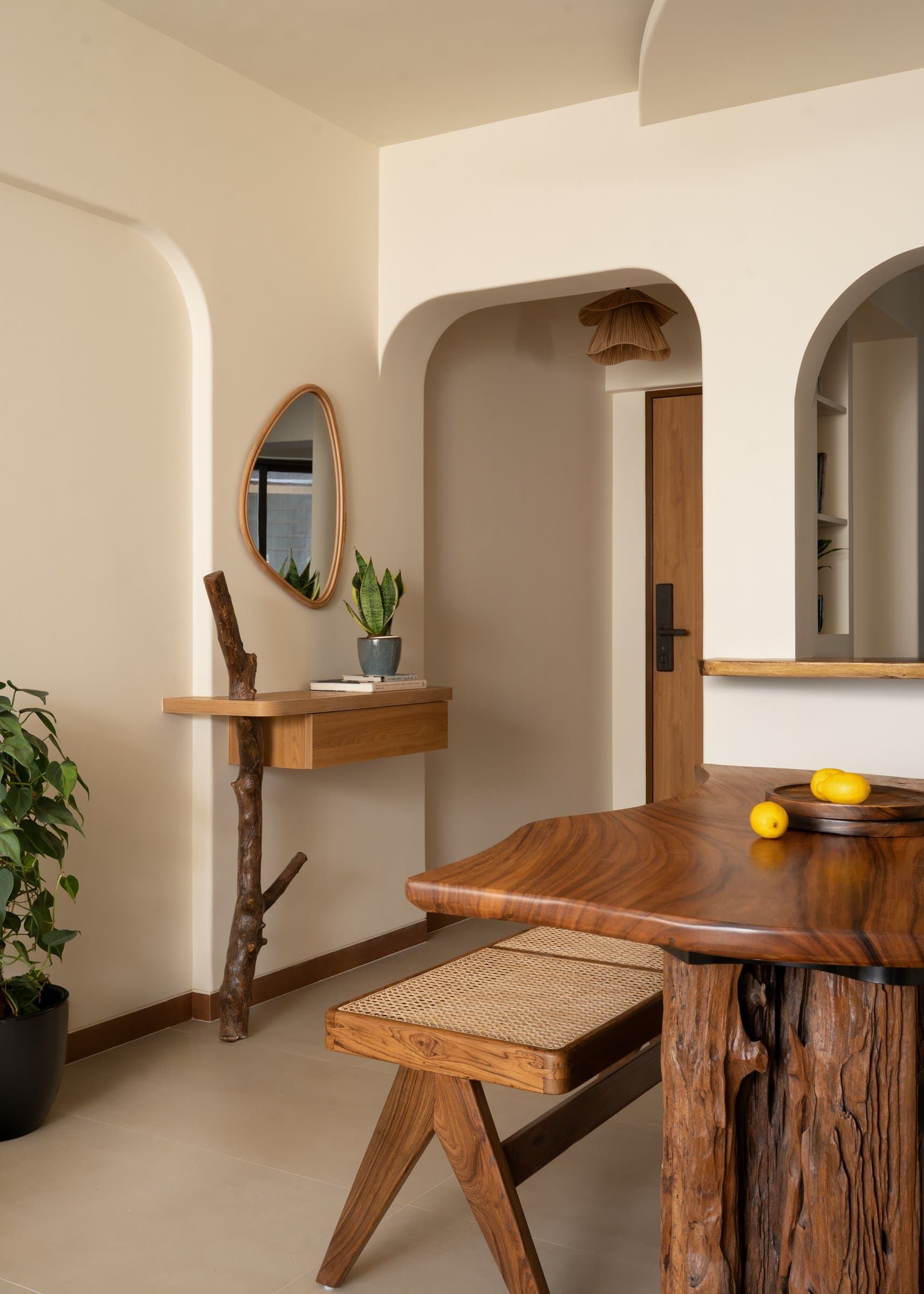
The foyer itself is a small, deliberately composed vignette. A pebble-shaped mirror floats above a wall-mounted timber console held in place by a real branch, and the result is less a piece of furniture than a tableau, a brief moment that prepares the visitor for the textural language ahead.
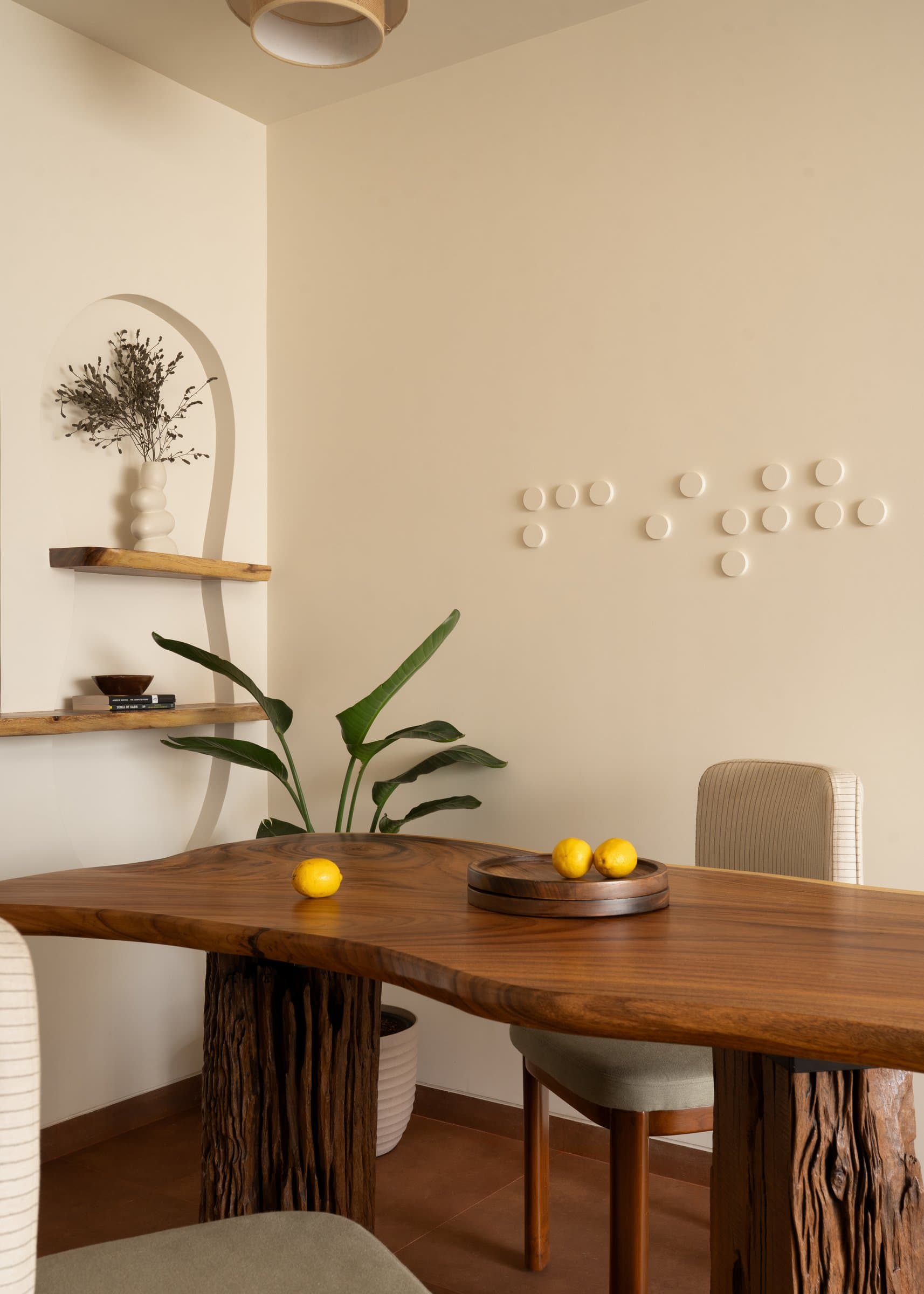
The dining table deserves to be considered on its own terms. Its top is a single sweeping plane of figured timber, supported by two unfinished trunks whose bark has been retained as evidence of origin, and the contrast between the polished surface and the raw legs is the entire ethos of the home compressed into one object.
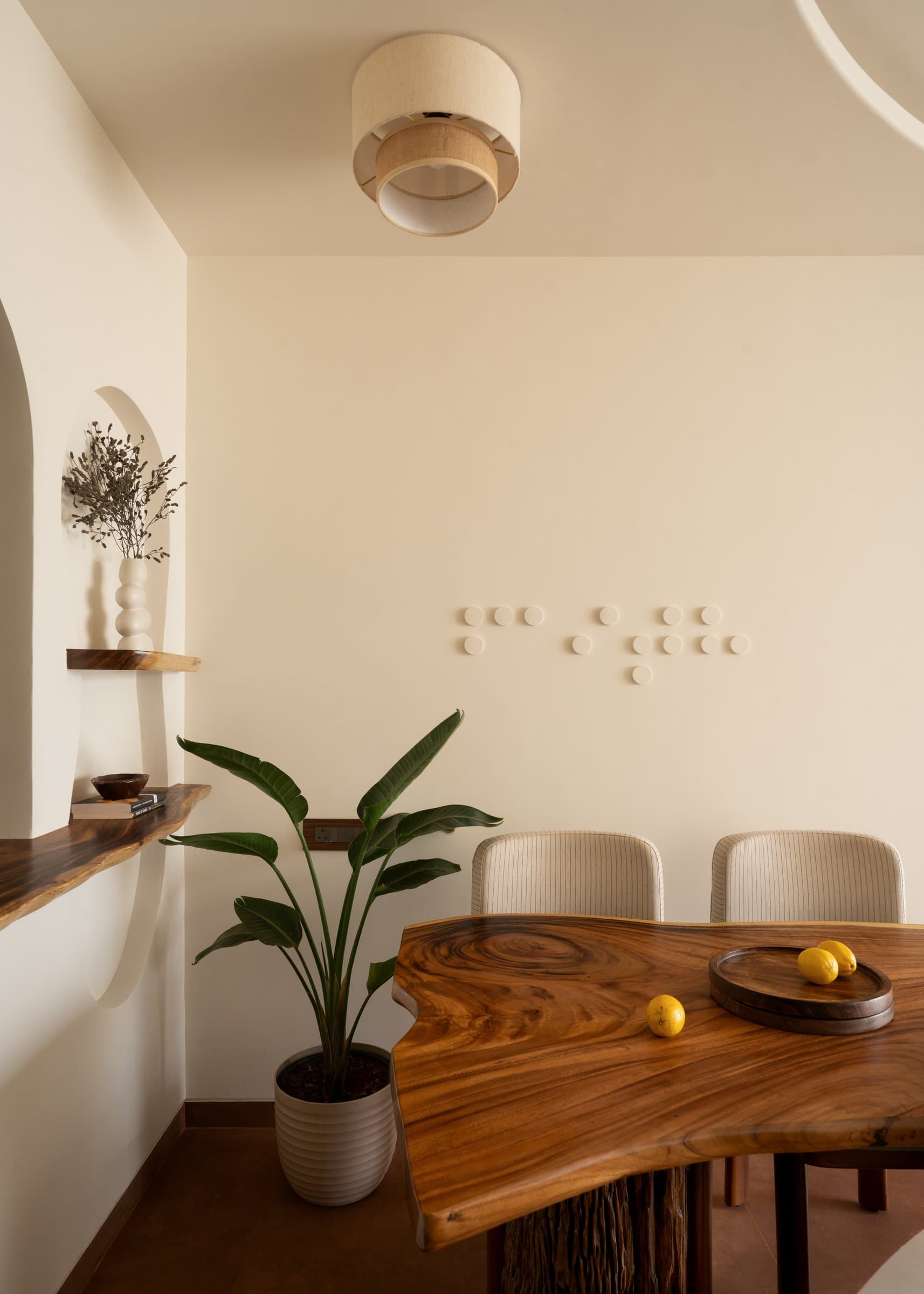
On the wall behind the table, a small constellation of ceramic discs, arranged in the cadence of braille, offers the dining area its only piece of overt wall art. It is a private signal in a room that otherwise speaks through material.
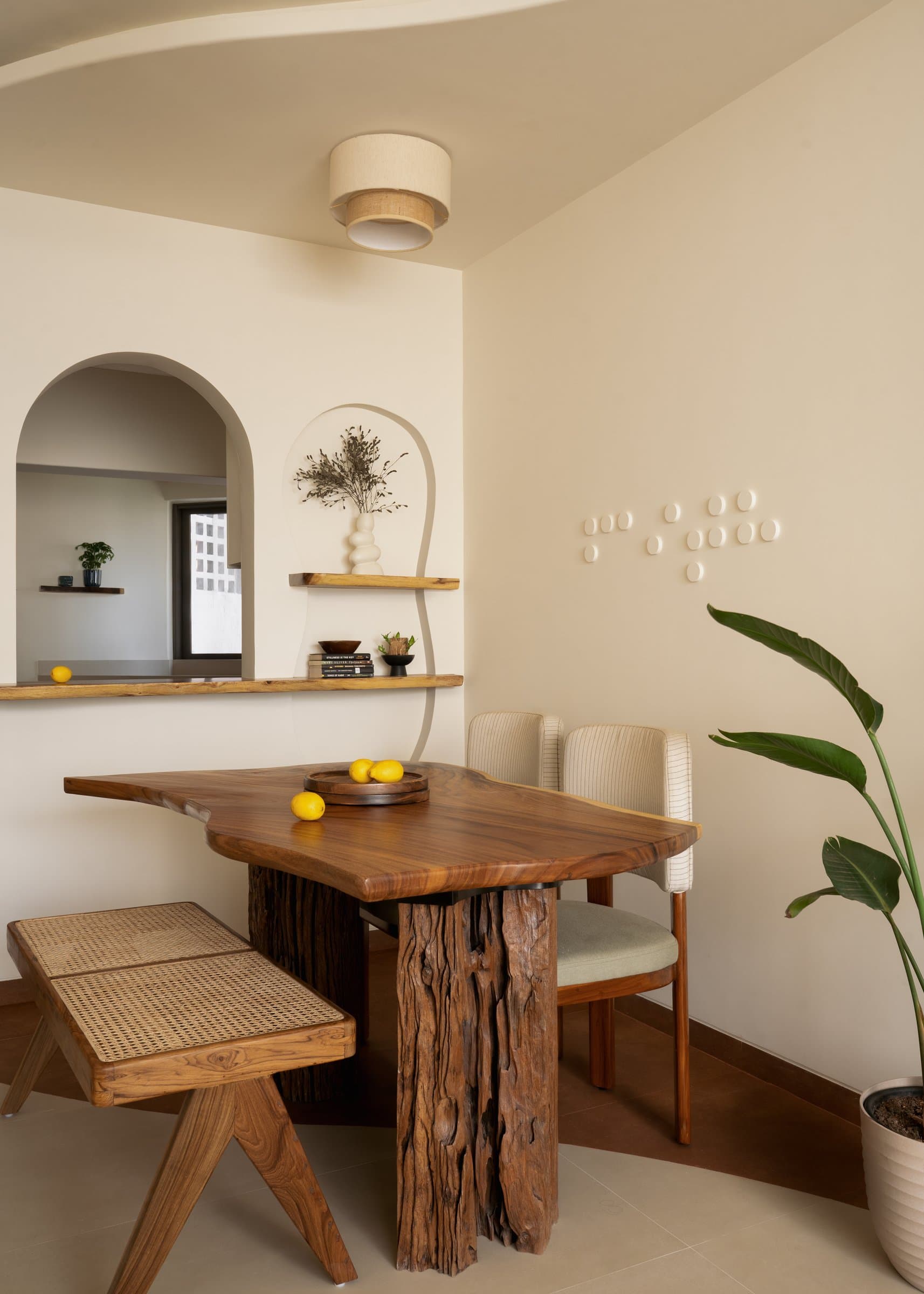
The cane bench tucked against the table is a Pierre Jeanneret-language piece, and the internal window cut into the plaster wall opens a sightline through to the kitchen beyond. Two arches, one larger and one smaller, are layered behind a floating timber shelf, and the room manages to feel like both a dining alcove and a shrine to slow assembly.
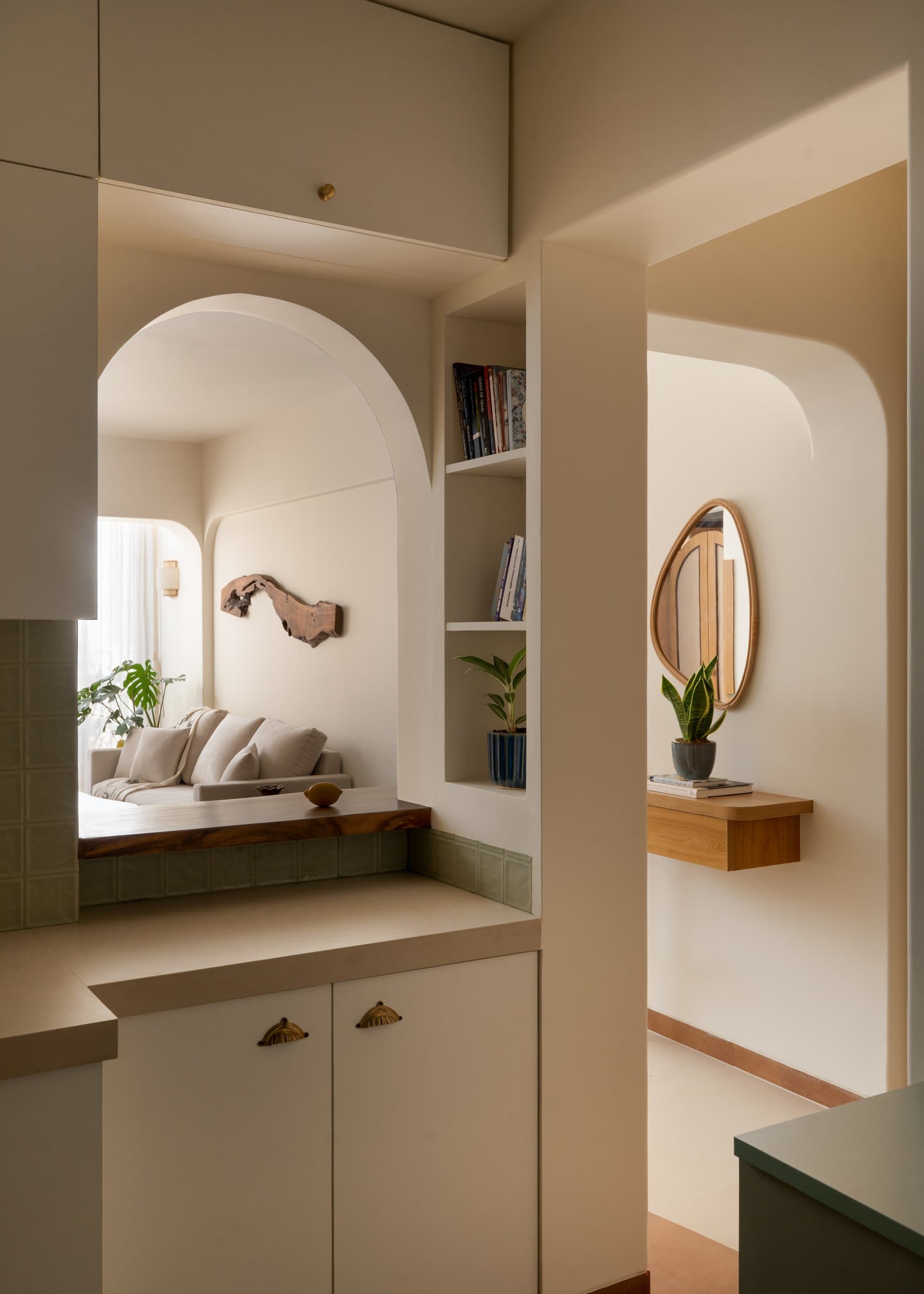
The threshold between kitchen, foyer, and living room is the apartment’s most architecturally inventive moment. A pass-through window edged in green tile, a recessed bookshelf, and an arched mirror nook all coexist in a tight square of plan, and the orchestration is precise enough that nothing feels crowded.
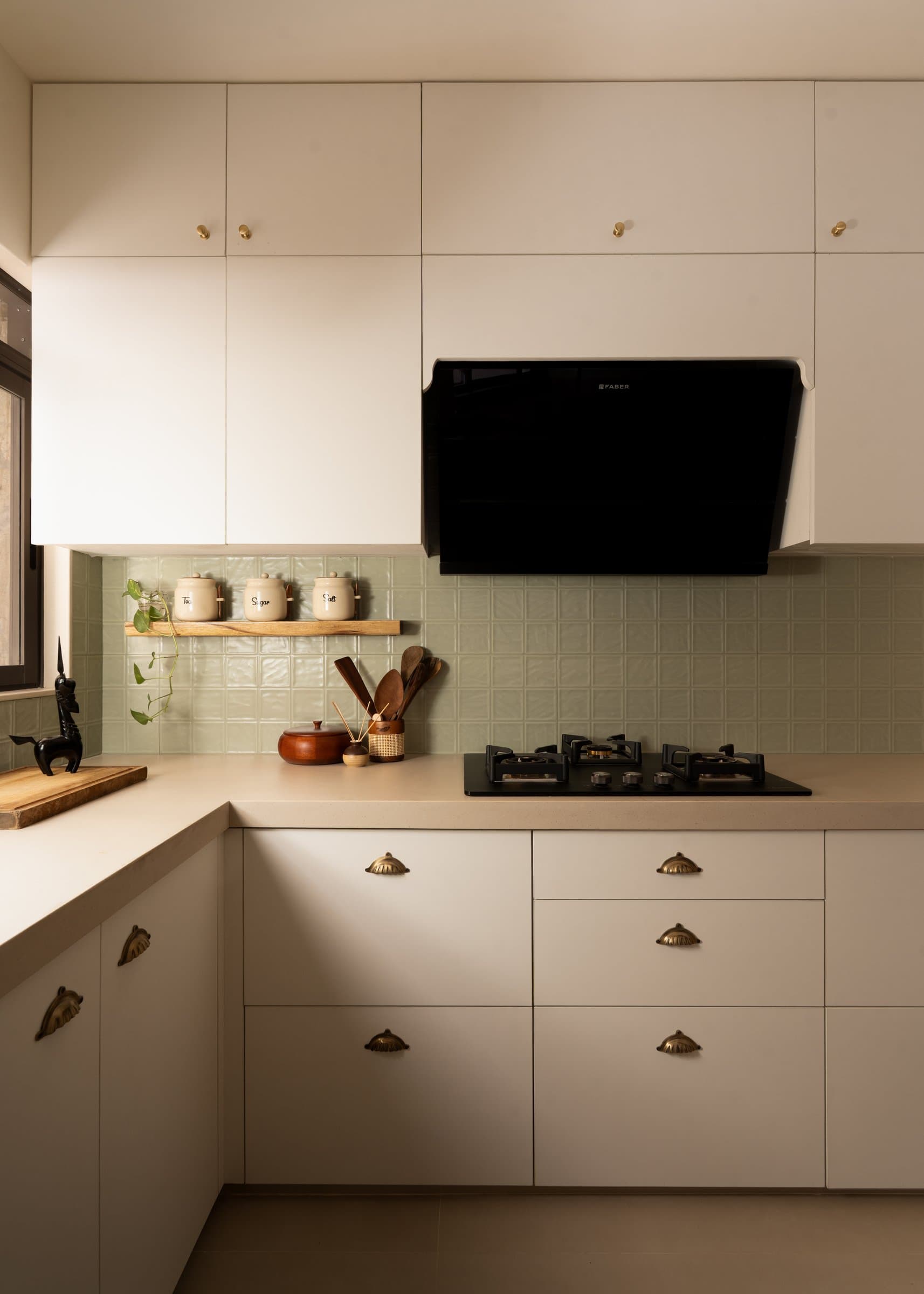
The kitchen itself is calm, almost monastic. Cream cabinetry with antique brass cup-pulls runs along an L-shaped counter, while a sage-green textured tile backsplash introduces the only chromatic departure.
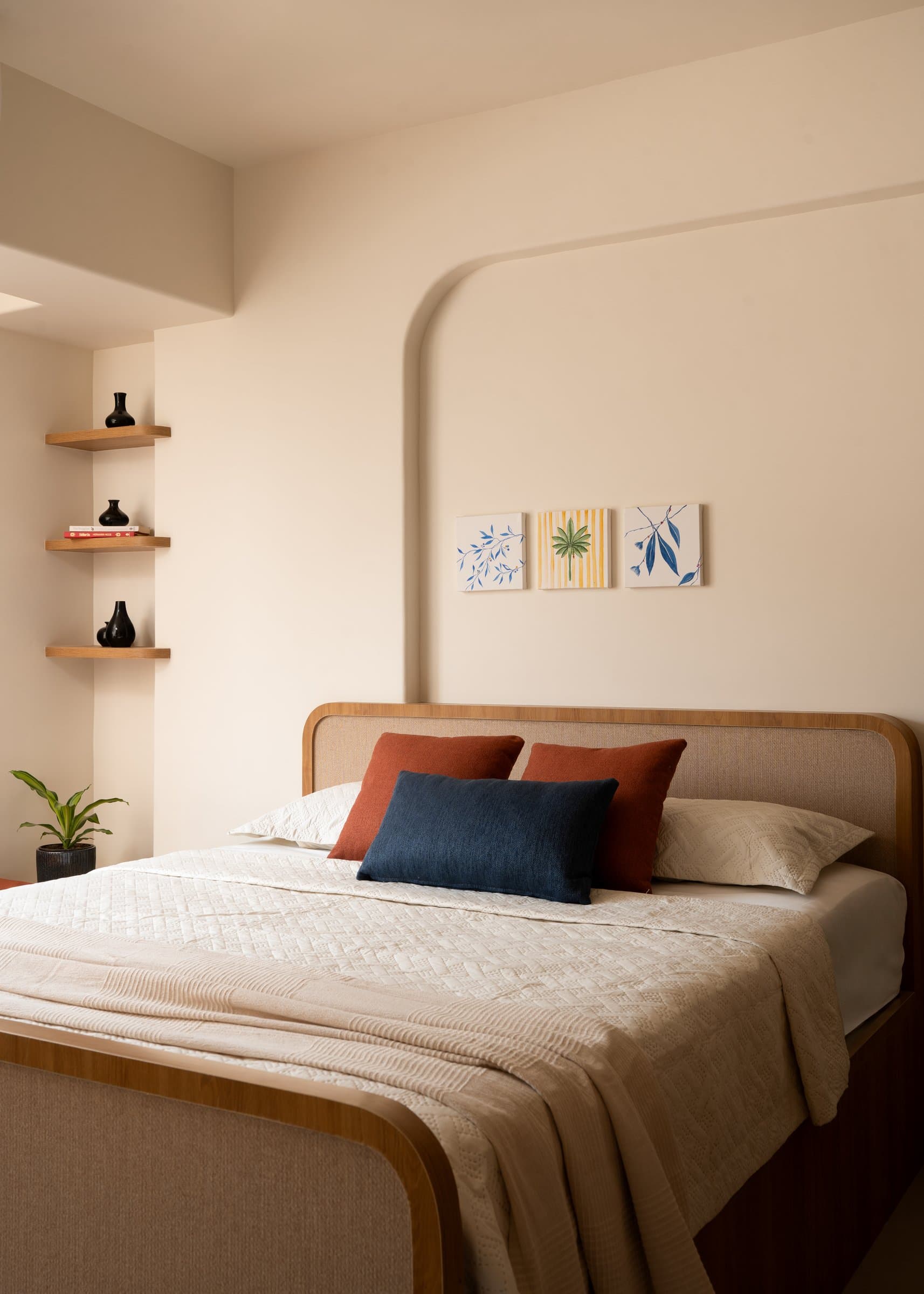
Inside the master bedroom, the upholstered bed is set against a curved plaster cartouche that rises behind the headboard, a soft architectural frame that does the work a heavy wallpaper might have done in a more conventional scheme. A trio of small botanical paintings sits at exactly the right height to feel personal rather than staged.
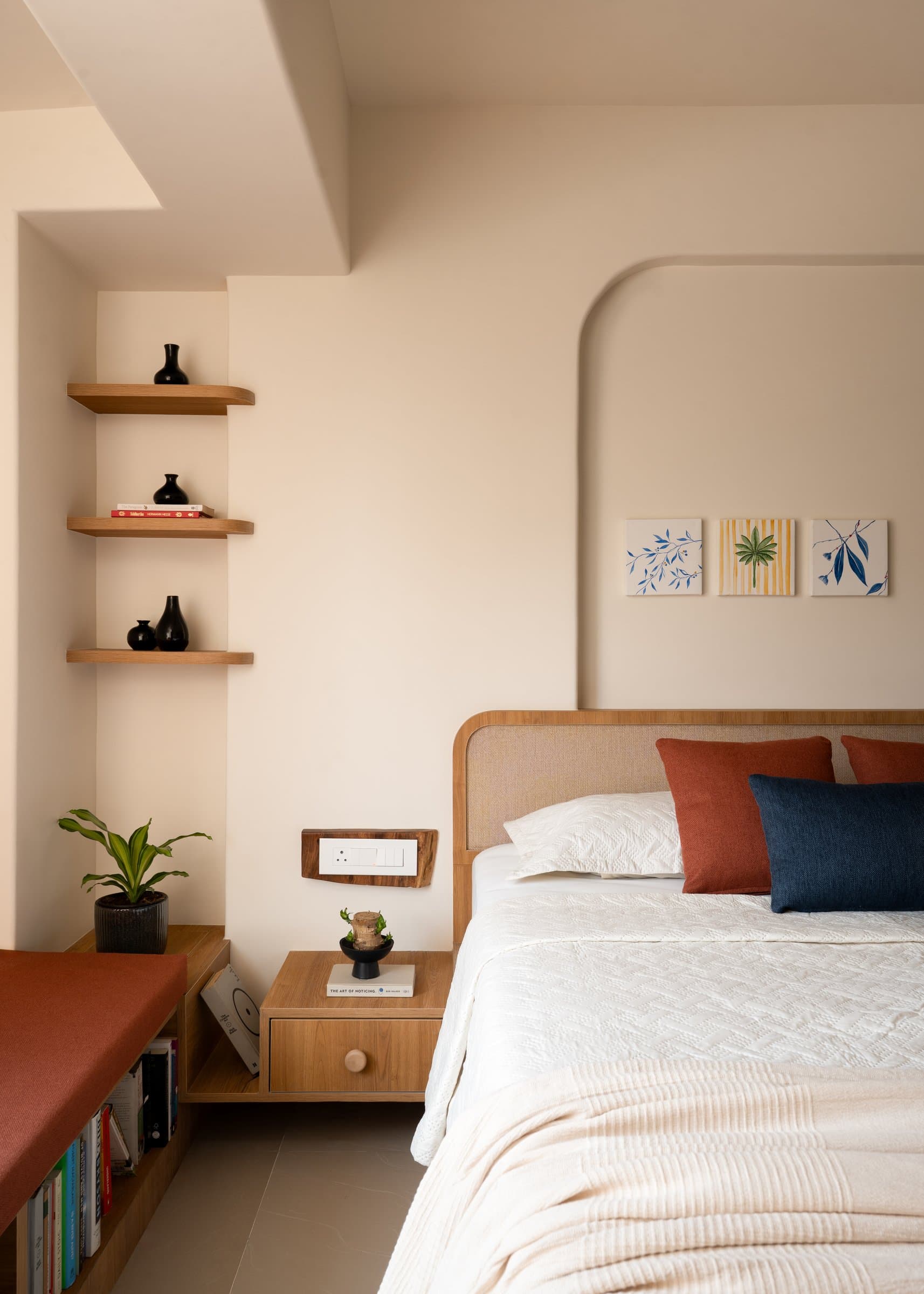
To one side, three timber shelves are recessed into a vertical niche, holding a small congregation of dark ceramic vessels. The composition is restrained almost to the point of severity, and it is this restraint that lets the curve of the headboard wall register as architecture rather than ornament.
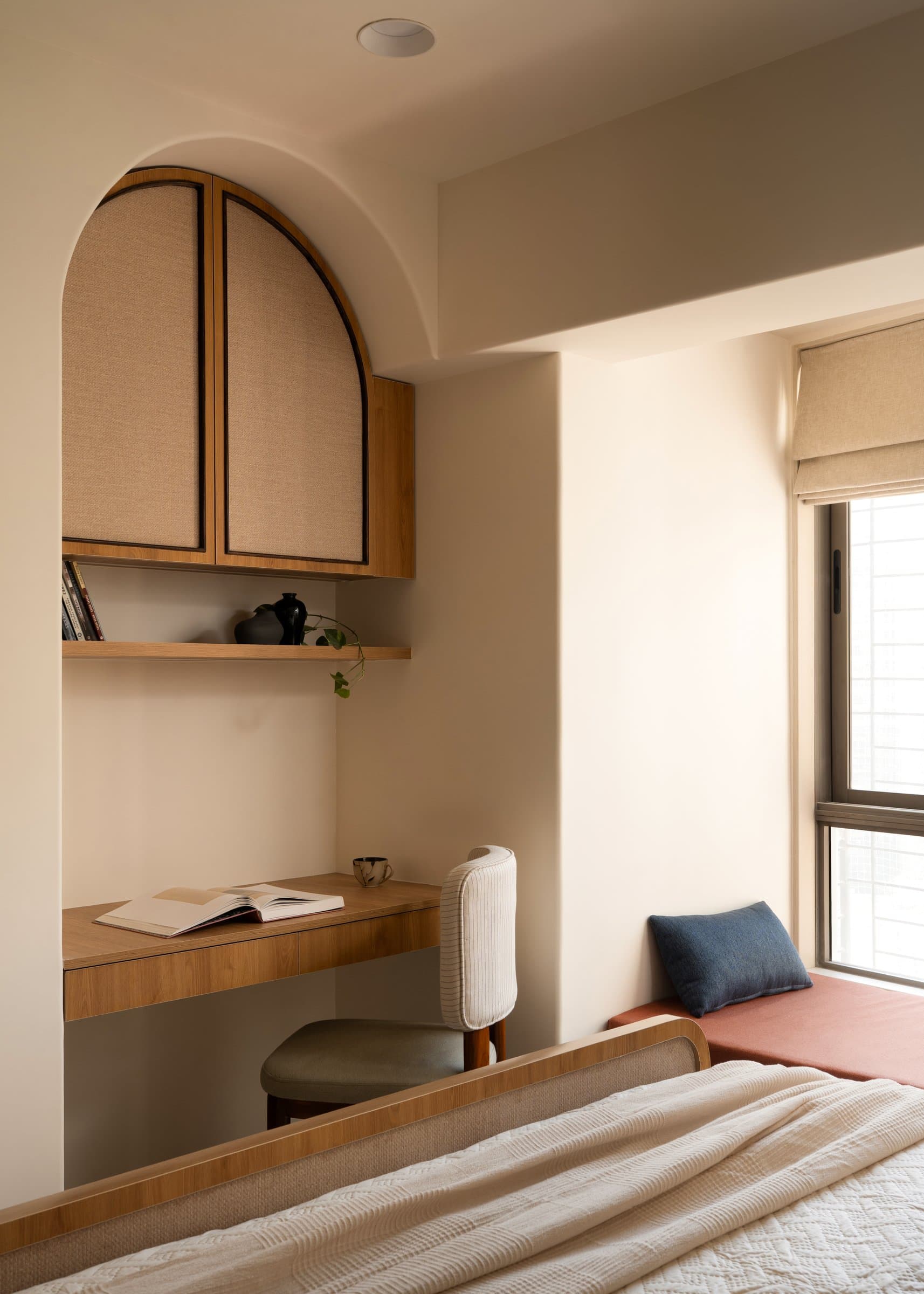
The bedroom extends into a small writing alcove crowned by an arched cabinet faced in jute-textured panels. A built-in desk runs beneath it, and a window seat upholstered in terracotta linen sits to the side, the kind of corner that exists in a plan only when someone has thought hard about how the occupants actually spend a quiet afternoon.
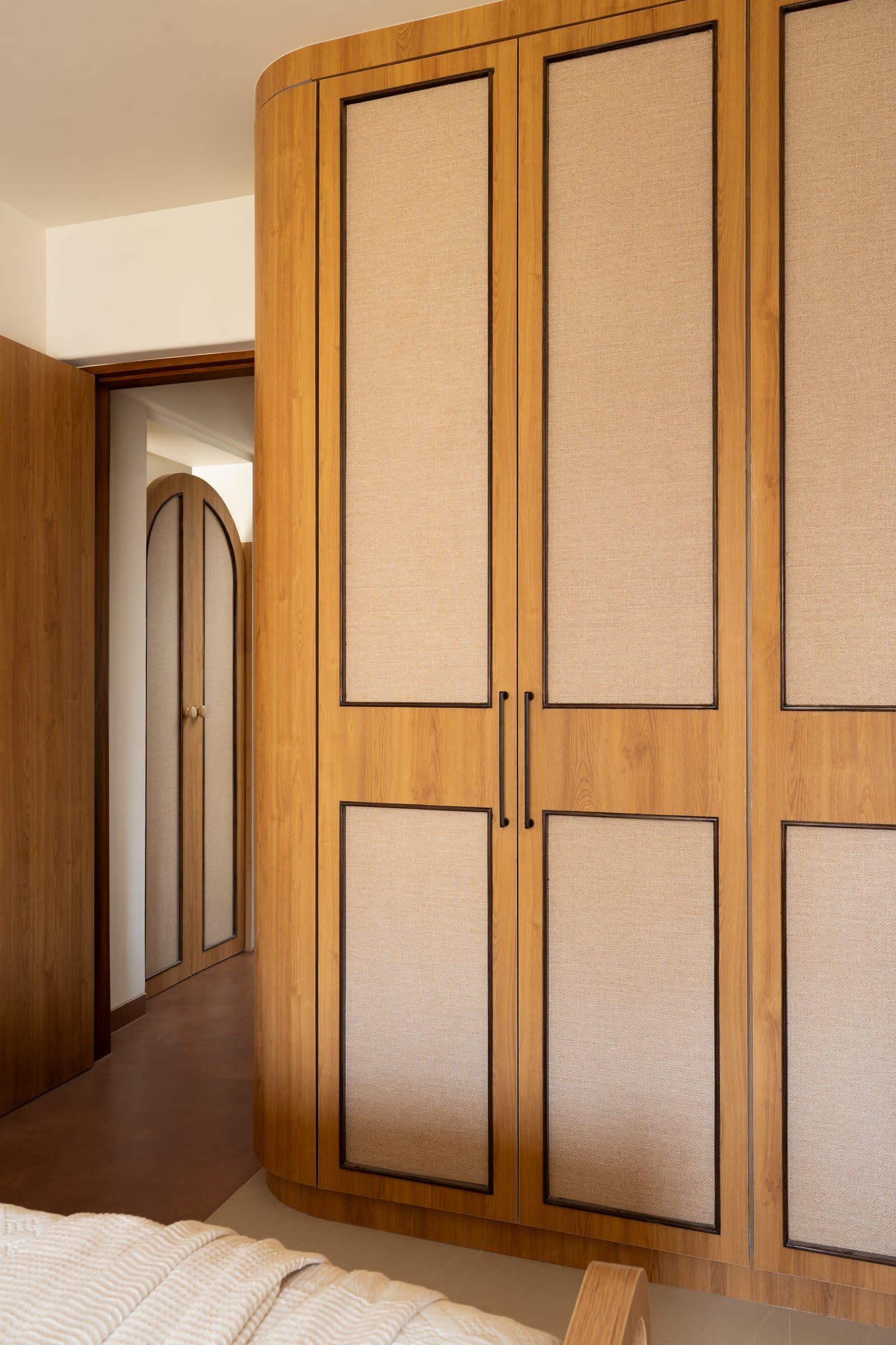
The arched wardrobe joinery is the bedroom’s quiet showpiece. Curved at the corner where most cabinetry would terminate flat, the unit softens the room’s geometry and continues the home’s commitment to the radius as a design principle.
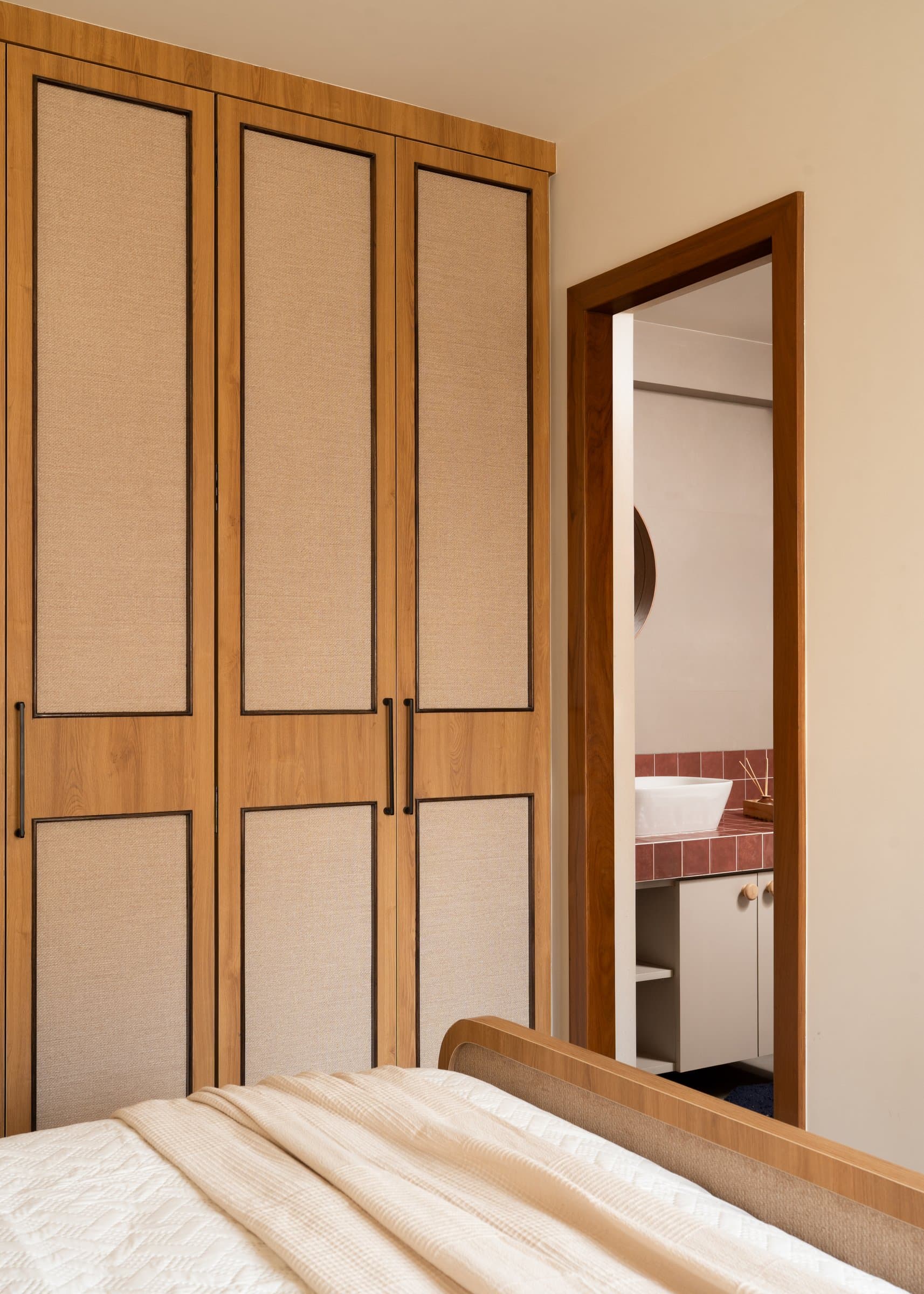
Adjacent to the wardrobes, a doorway opens to the master bath, with the terracotta tile counter visible through the frame. The detail confirms that the home’s material palette extends past the social rooms and into spaces a guest will rarely see.
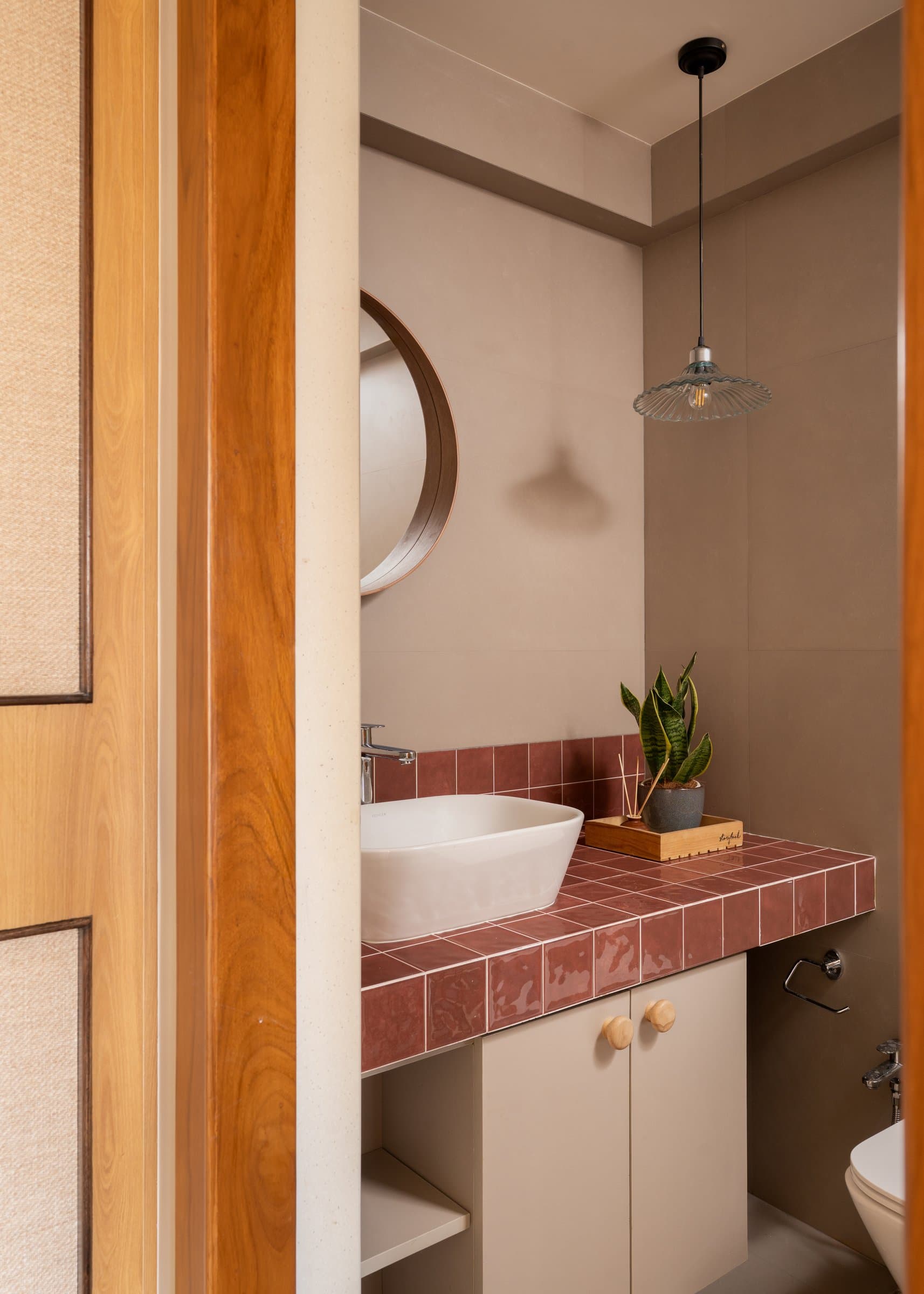
The master bath leans into colour in a way the rest of the apartment does not. A counter wrapped in glossy oxblood square tile holds a deep white basin, a circular timber-framed mirror floats above, and a fluted glass pendant introduces a small, almost industrial flourish.
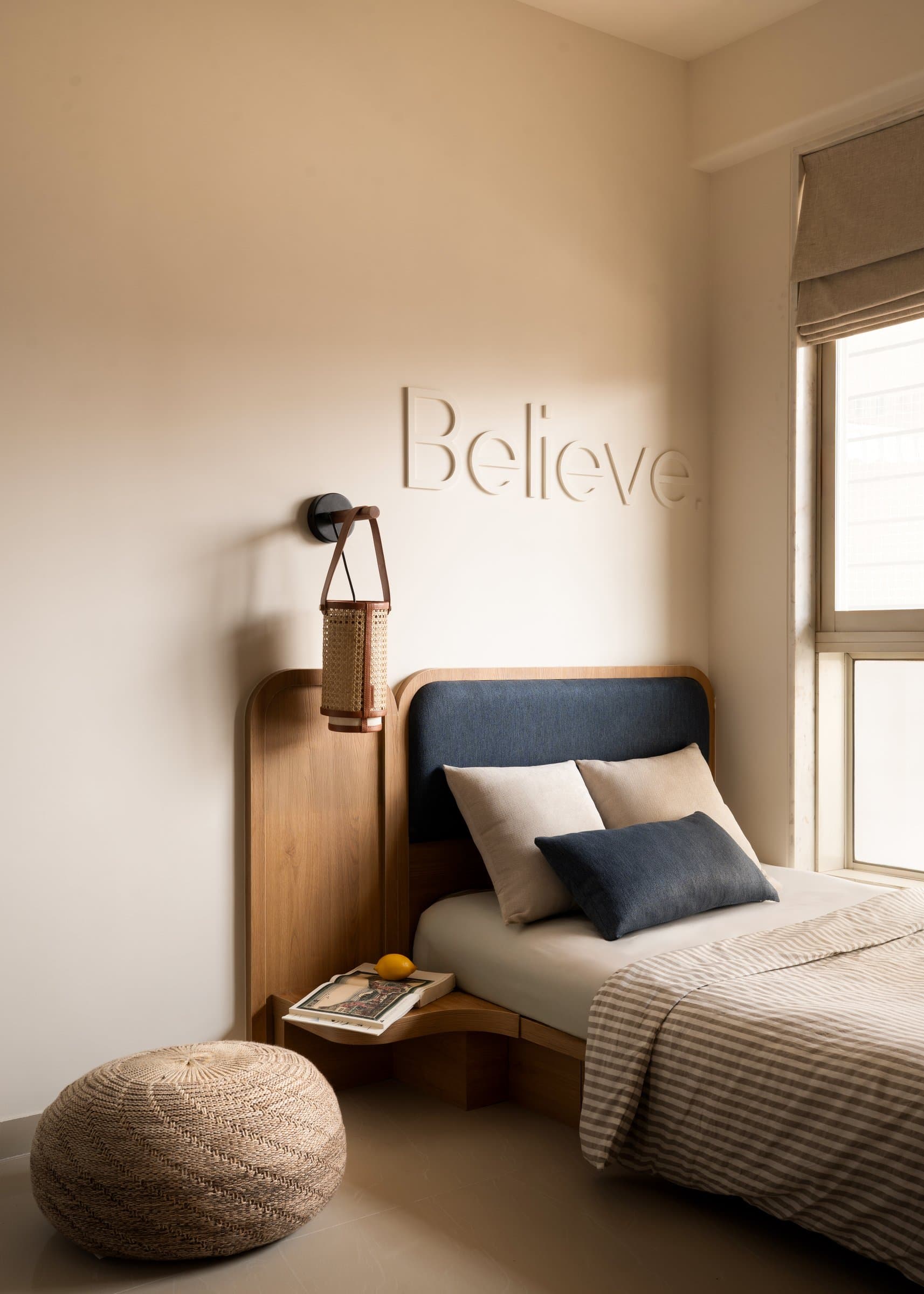
The second bedroom is more compact and more candid. A timber bed with a denim-blue upholstered headboard, a small cane lantern hung from a wall hook, and the word Believe in pale relief across the wall, and the room reads like a younger occupant’s space without resorting to the obvious vocabulary of a children’s room.
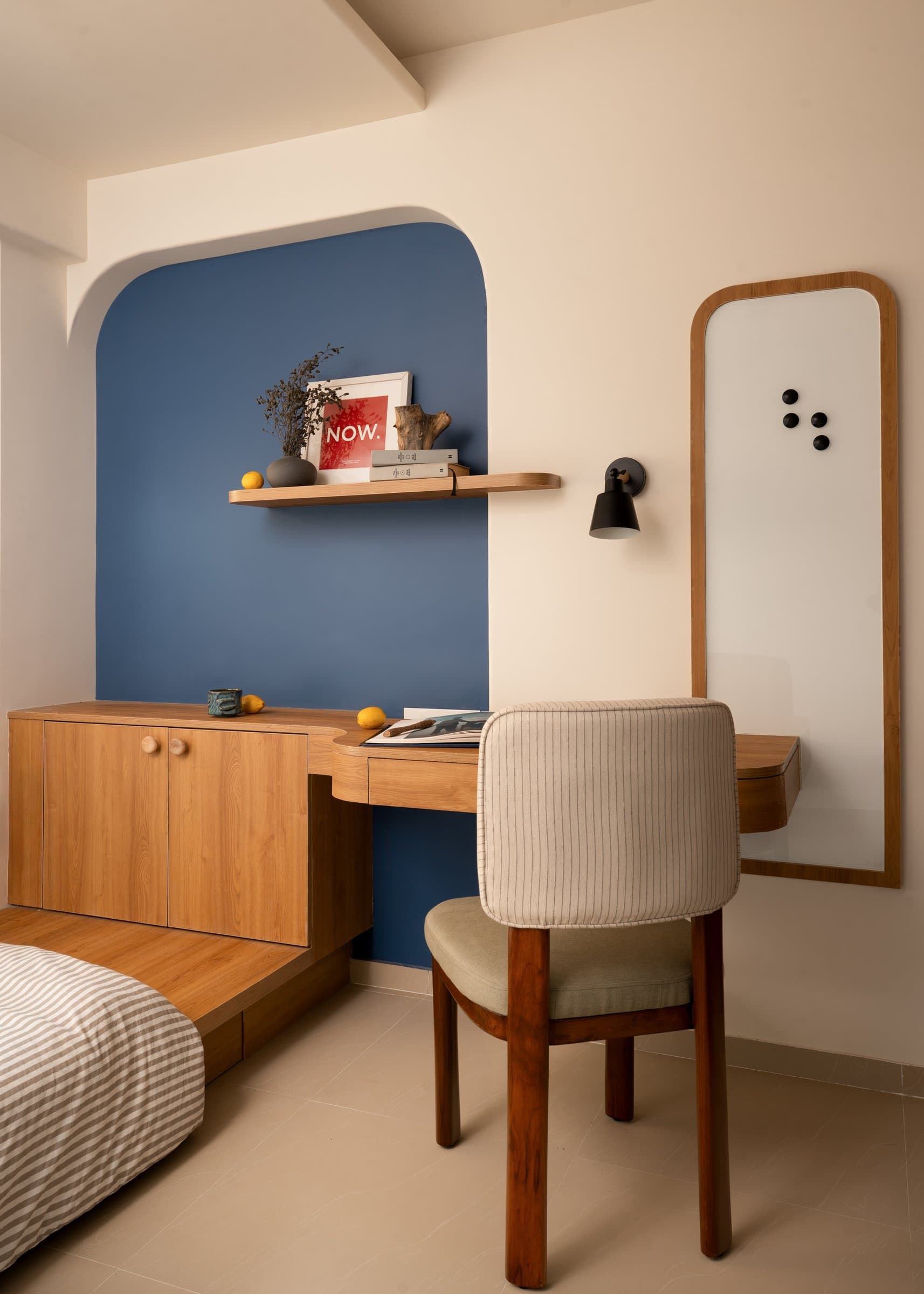
Across from the bed, a study niche painted in deep cobalt holds a curved wood desk and a floating shelf, and a full-length timber-framed mirror anchors the adjacent wall. The blue-against-cream contrast gives the room its single, deliberate piece of chromatic drama.
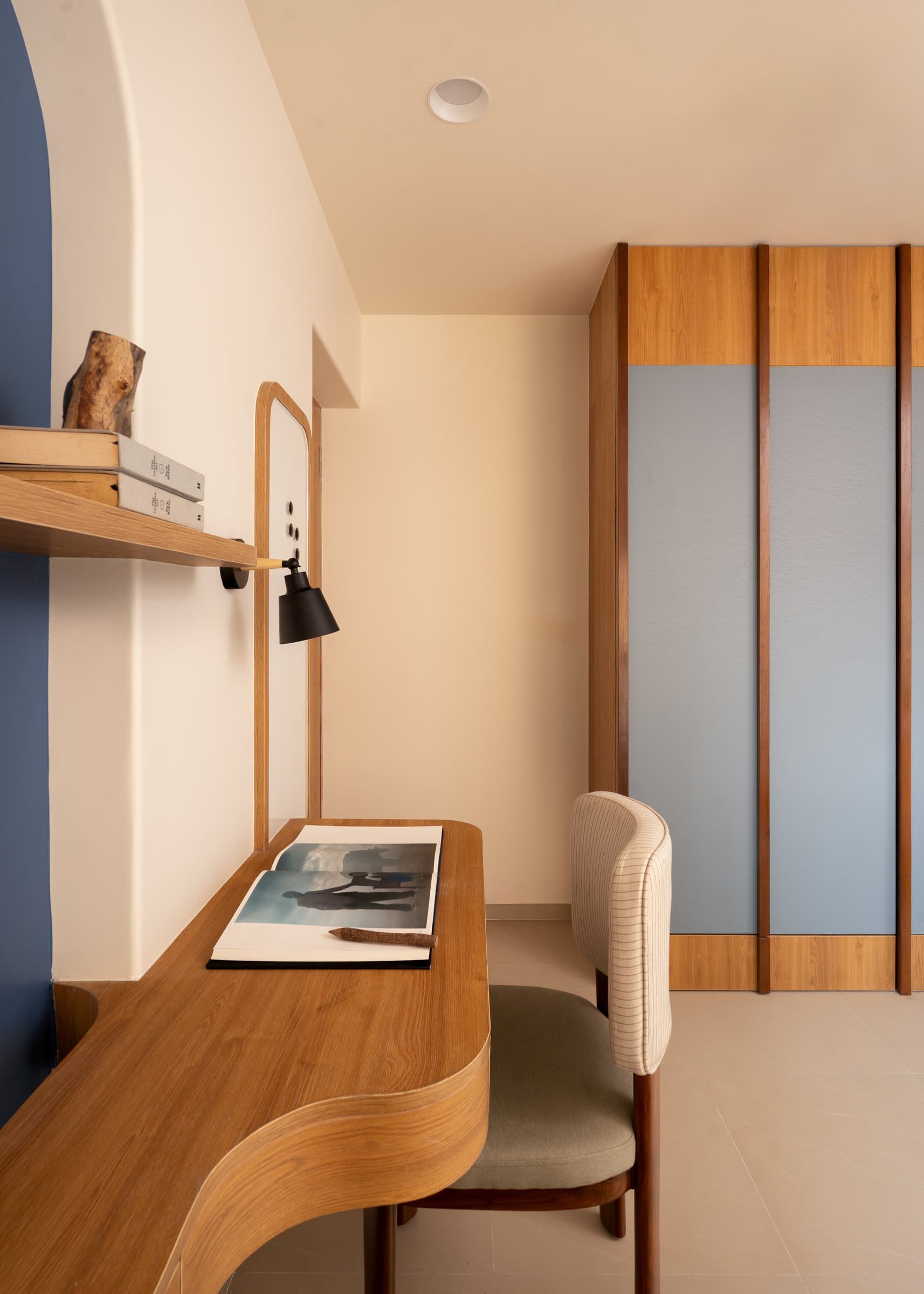
The desk extends along the wall toward a tall wardrobe faced in pale blue panels and timber stiles, the curve of the table’s edge softening what would otherwise be a hard right-angle approach. A small black sconce above the writing surface keeps the lighting personal rather than ambient.
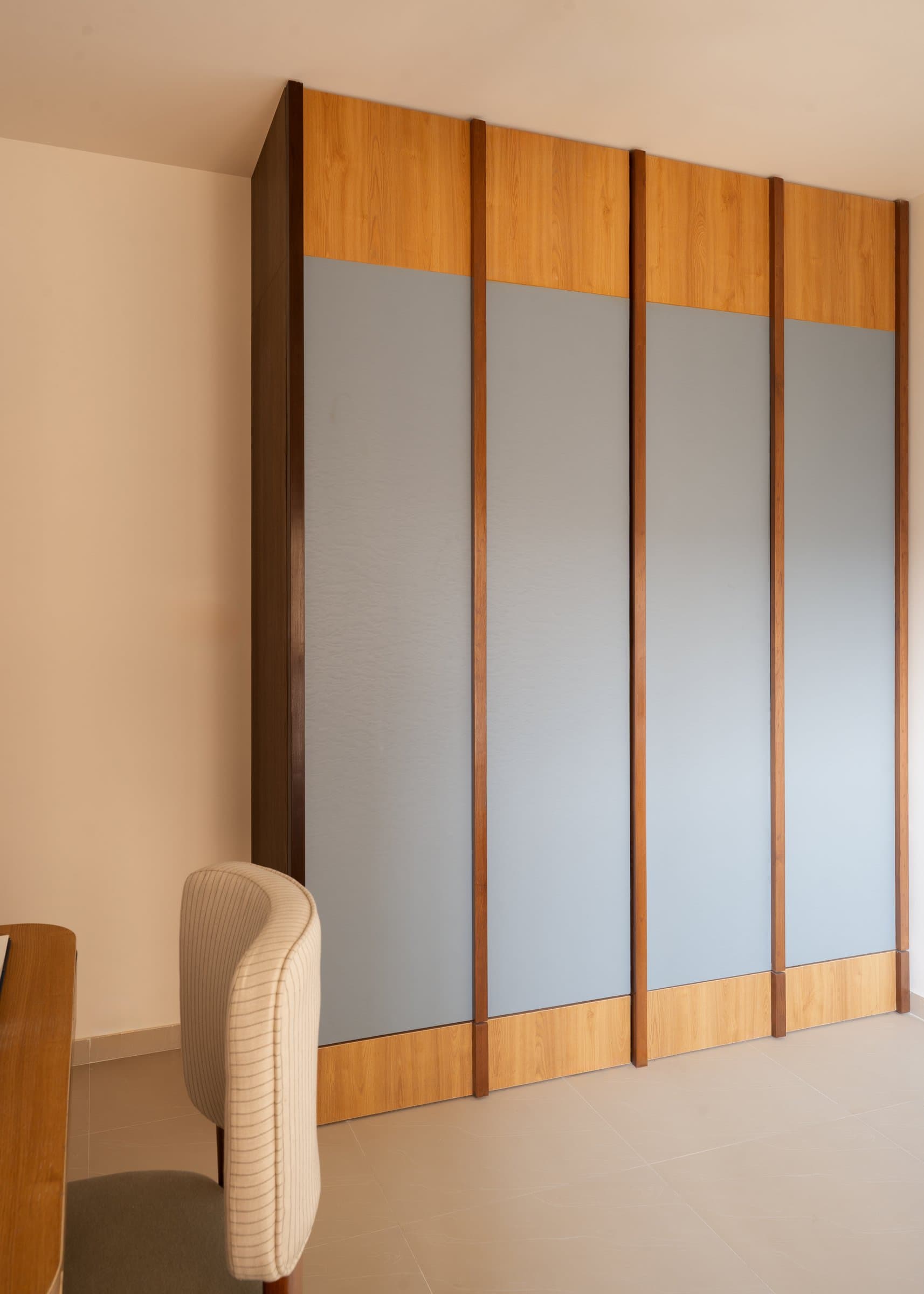
The wardrobe deserves its own frame. Four narrow blue panels separated by warm timber dividers, capped and based in the same wood, the unit reads almost as architecture, a freestanding screen that organises one entire side of the room.
What the apartment achieves, across its modest footprint, is a coherent argument about how a Mumbai home might look when it stops trying to resemble somewhere else.
The result is a home that feels assembled rather than installed, where terracotta is not a colour reference but a structural attitude, and where every arch, every trunk, every panel of cane has been chosen because it carries the weight of having been made. In this lies the project’s quiet distinction: not in the spectacle of any single room, but in the consistency of its material conviction from foyer to wardrobe.