There is a particular kind of confidence in a home that chooses to leave its concrete ceiling bare, its curves unhidden, its joinery language visible at every turn. It is the confidence of a design team that trusts its material choices enough to let them stand without embellishment, and of clients who understand that warmth does not require concealment. Curves, Concrete and Lines is built on this understanding.
Designed by Jetsons, the apartment reads as a sustained conversation between three elements announced in its name: the softened arcs of its ceilings and cabinetry, the raw cement finish that unifies its upper planes, and the rhythmic vertical lines (in fluted panels, slatted timber, cane weave) that give every surface a sense of pace. Rather than treating these as decorative themes, the studio has used them as structural grammar, a set of rules that govern how each room transitions into the next.
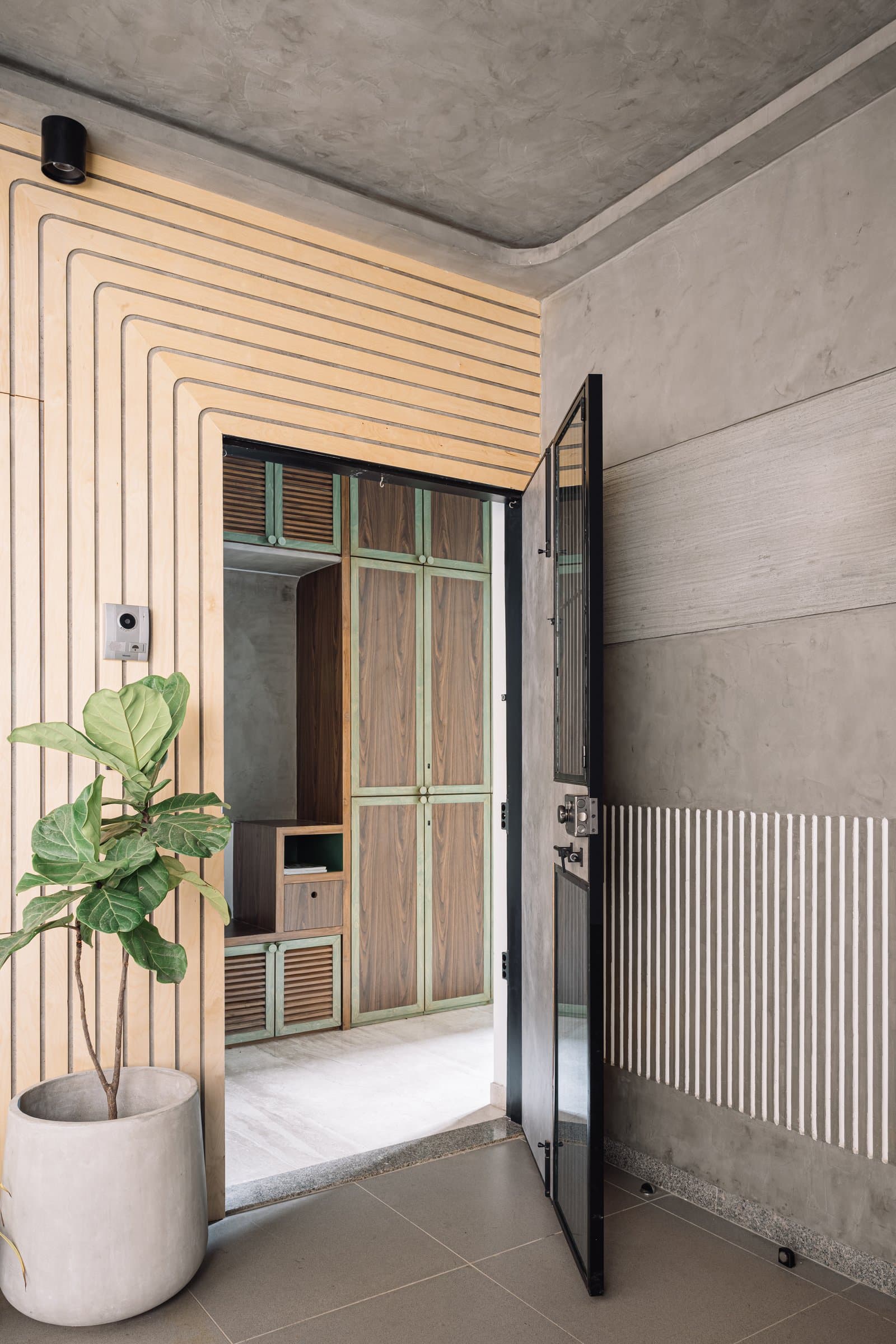
The entry sets the terms of engagement. A wall of routed timber, its parallel grooves curving upward and across the soffit, wraps the threshold in a single continuous gesture that feels both architectural and inviting. Through the open door, the foyer’s walnut-toned storage wall with its green-patinated framing is already visible, establishing the palette before the home has fully begun.
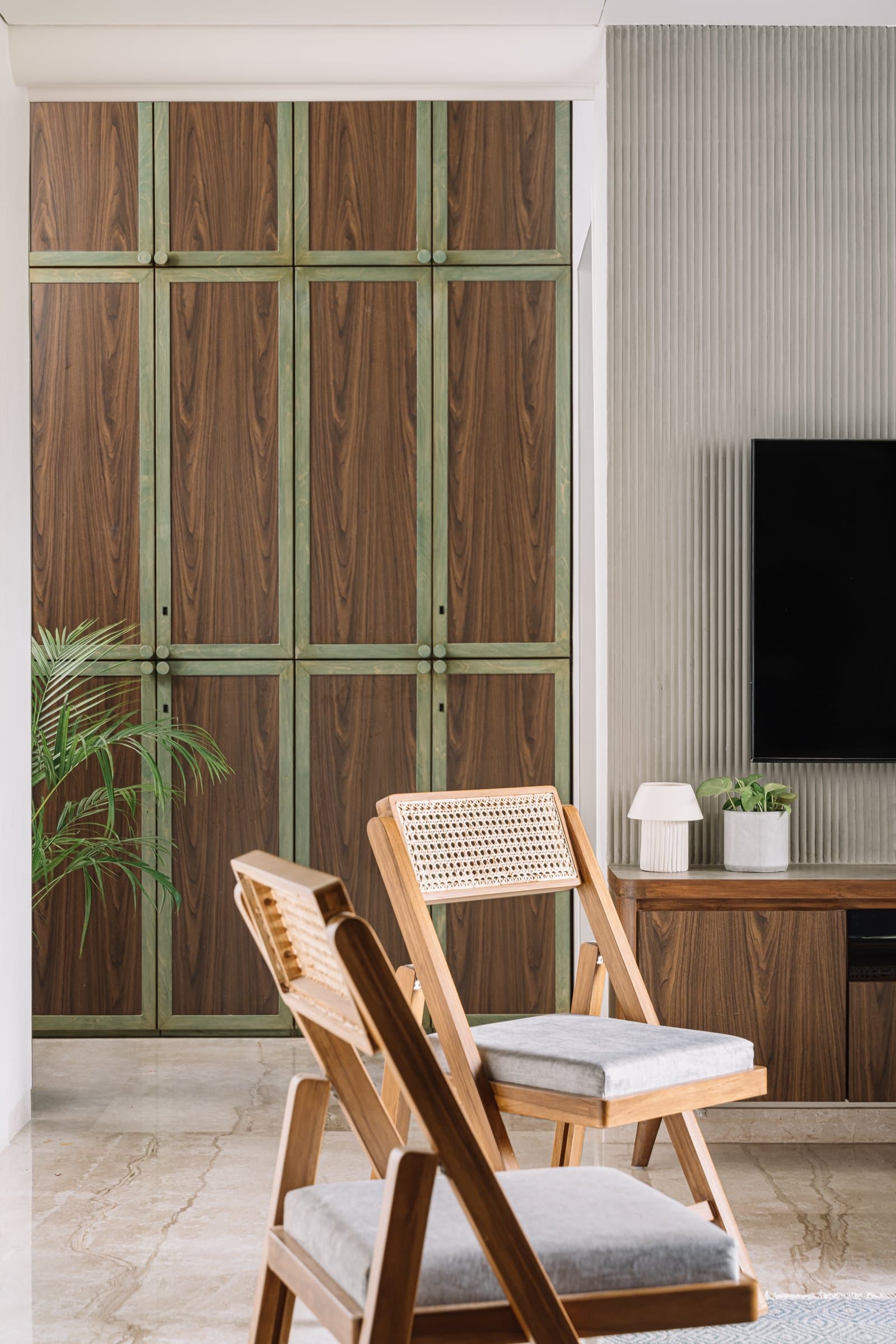
That entrance passage resolves into the living area, here, a fluted wall panel in muted grey carries the television; the effect is of two distinct material eras coexisting without friction. The cane-backed chairs complete the picture, grounding the space in a craft tradition that the rest of the home will echo in various registers.
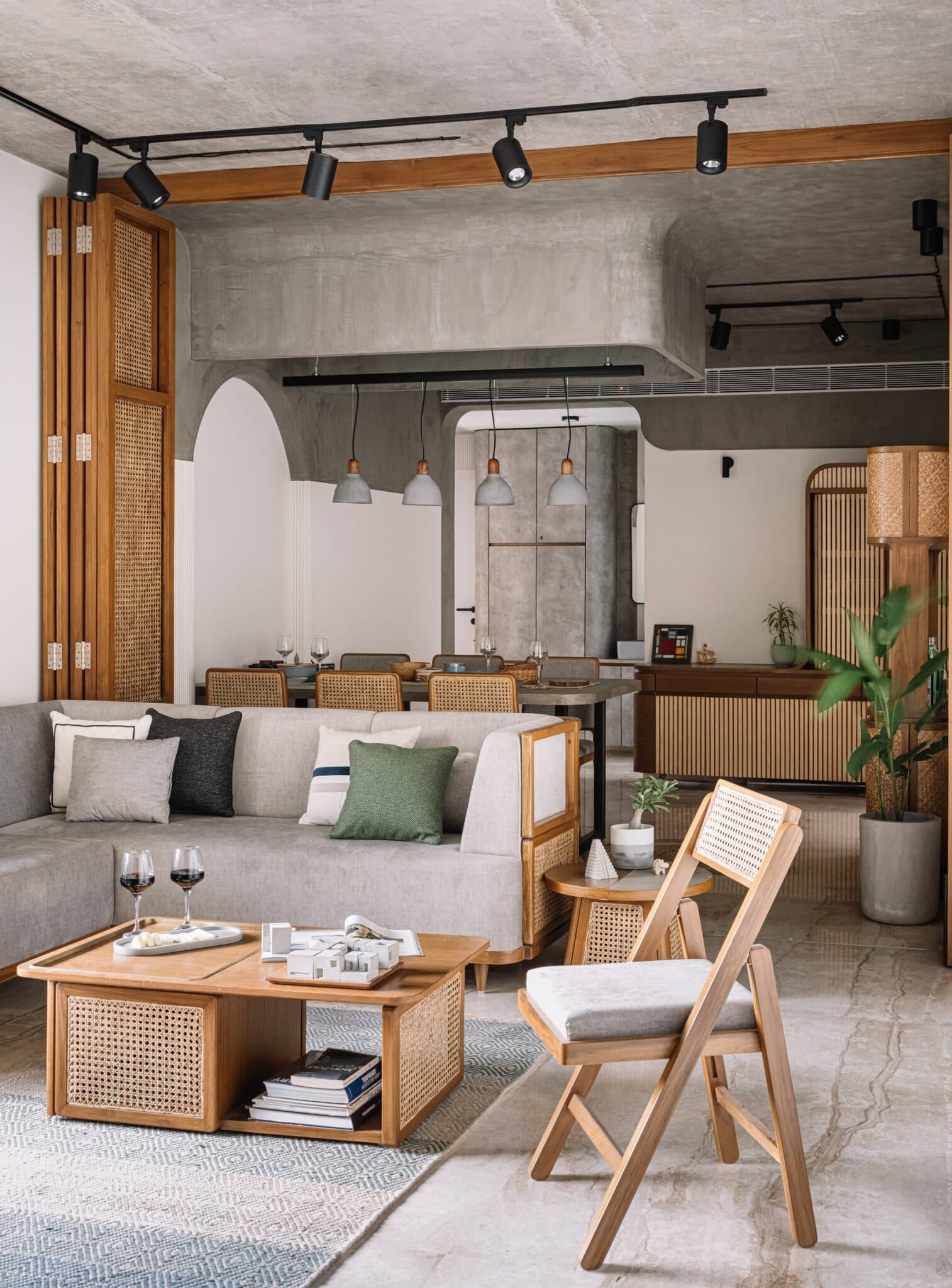
Seen from further back, the living room reveals its full spatial argument: an open-plan volume where concrete soffits form curved arches at the wall openings to define zones without the need for walls. The sofa sits with its back to the dining area beyond, and to one side, a tall folding partition in timber and cane operates as the room’s hinge, able to create privacy or dissolve it entirely.
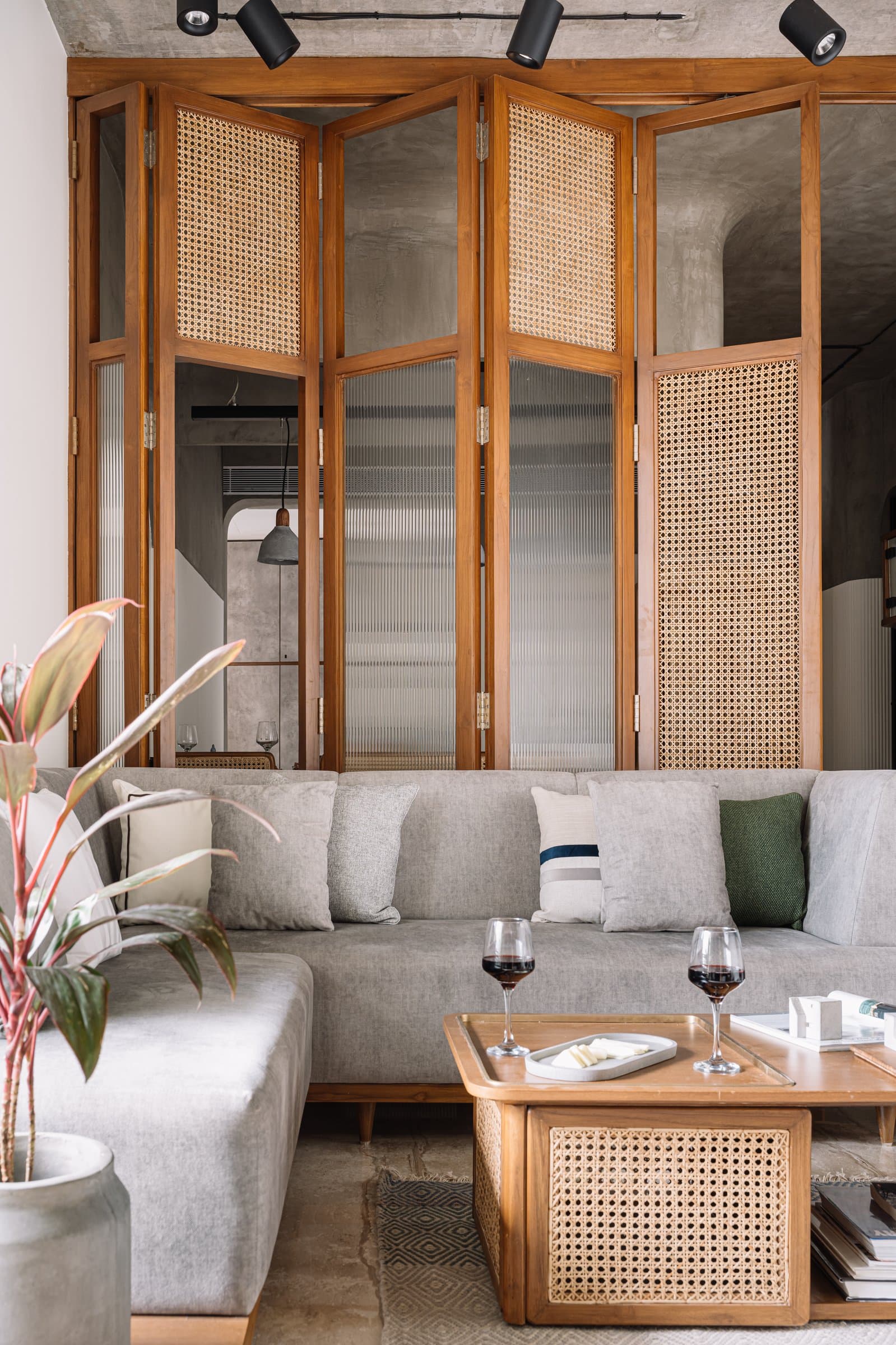
That partition deserves a closer look. Alternating panels of woven cane and fluted glass within warm timber frames allow light to filter through while maintaining a visual boundary. It is the kind of element that could easily become decorative filler; here, it reads as genuinely functional, transforming the living room from open social space to a more contained retreat depending on the hour and the mood.
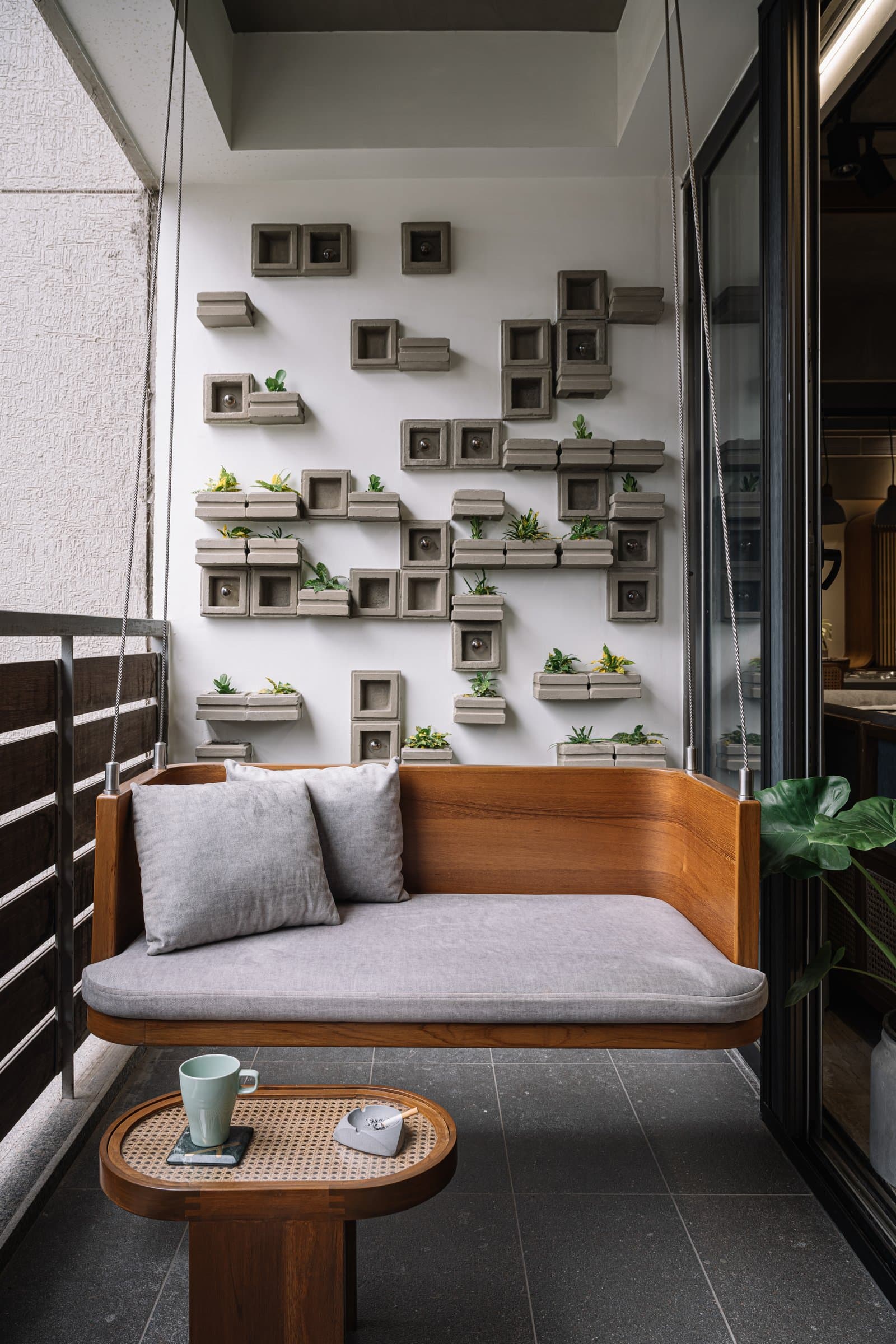
Off the living room, the balcony introduces an unexpected detail: a wall of modular concrete planters arranged in an asymmetric composition, part vertical garden, part sculptural installation. A timber swing seat below it suggests this is where the pace of the home slows most noticeably, the one space where concrete is not overhead but in front of you, holding something living.
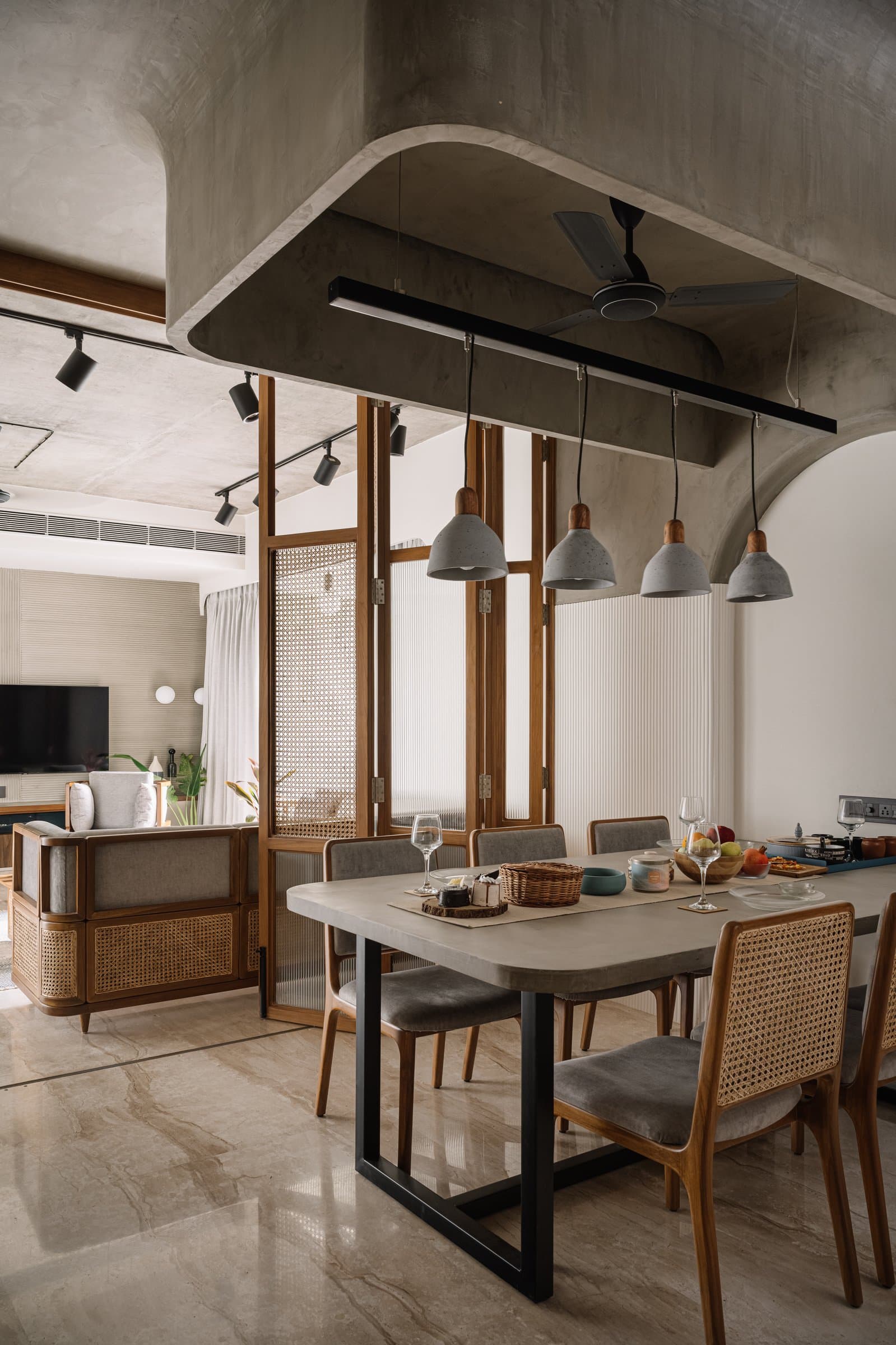
The dining area sits beneath the most dramatic ceiling gesture in the home, a concrete soffit that drops into deep, rounded bulkheads and then curves back up, creating an almost vault-like enclosure above the table. Concrete pendant lights hang from a black linear track mounted to the soffit, their grey matte shades capped with warm timber tops that distinguish them from the ceiling above. The sweeping arch at the edge of the bulkhead reinforces the sense that this is a room designed around the ritual of gathering.
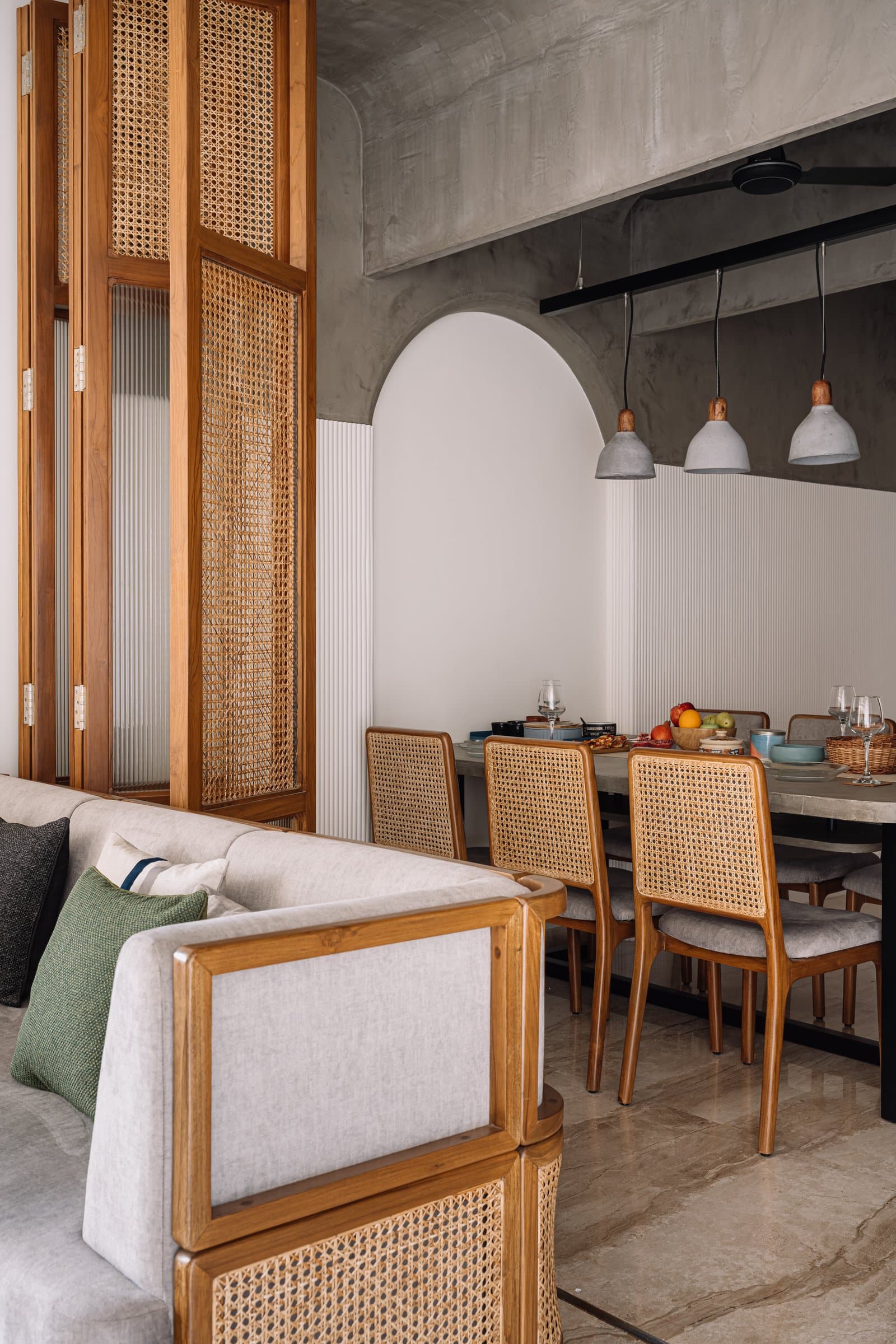
From behind the living sofa, looking toward the dining area, the layered depth of the open plan becomes clear. The cane-backed dining chairs, the timber-and-cane partition, the sofa in the foreground: every element occupies a different plane, and the eye moves through them in sequence rather than taking everything in at once. This calibration of visual depth is what keeps the apartment from feeling like a single undifferentiated volume.
Every transition between material and surface is managed through curves, never a sharp corner where a radius could serve instead.
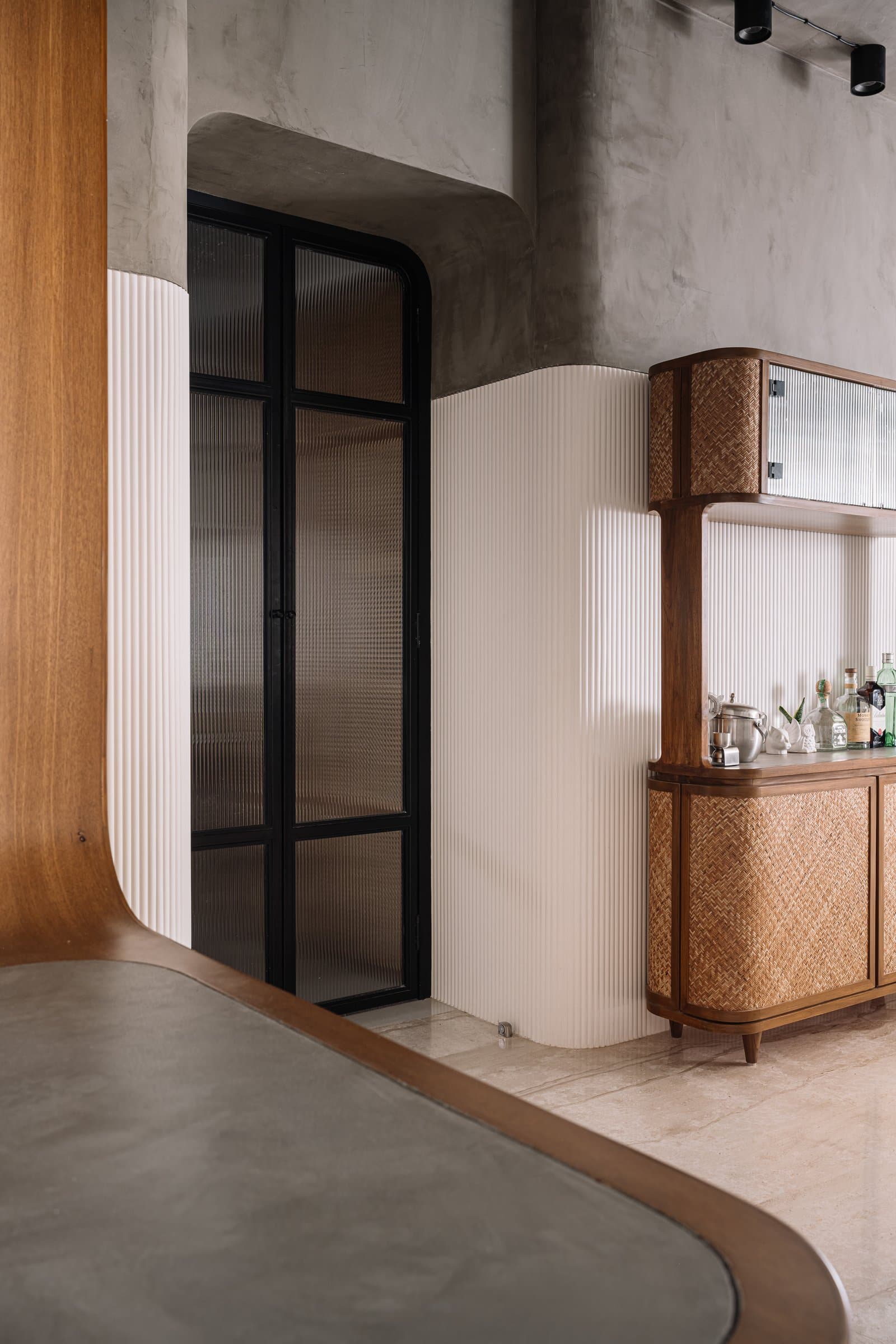
The kitchen threshold itself is worth pausing at: a black-framed fluted glass door set within a sinuous wall of white fluted panelling that curves around the corner. Beside it, a bar unit in woven cane and timber reads as a standalone piece of furniture, its rounded corners echoing the wall it leans against. The juxtaposition of industrial glass framing and handwoven surfaces is the home’s material thesis in miniature.
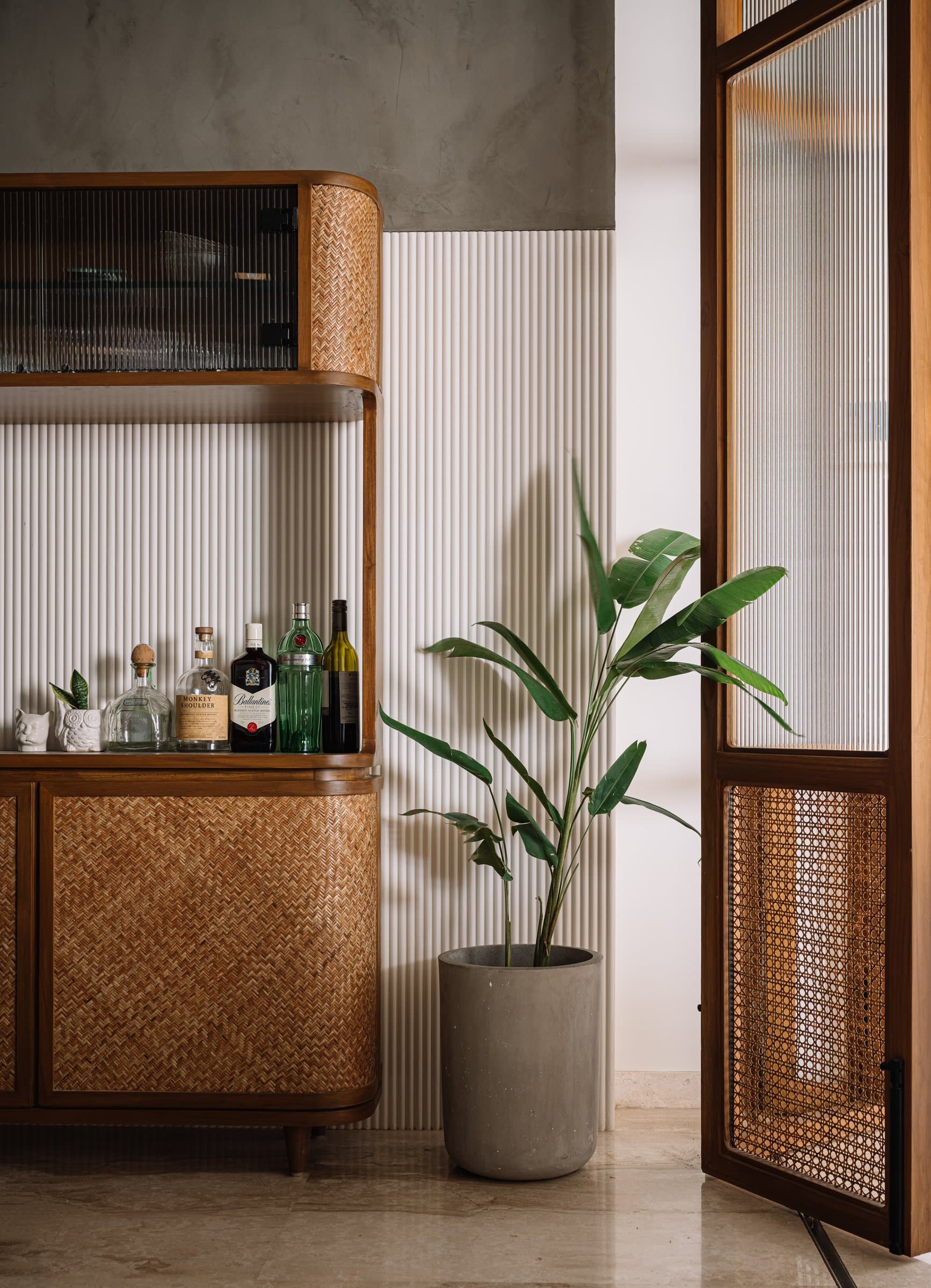
A detail of the bar and crockery unit confirms the quality of the joinery: the herringbone-weave cane panels are set within solid timber frames with rounded edges, and the fluted glass display section above lets you glimpse its contents without full transparency. The craftsmanship here is quiet but precise, the kind of work that rewards proximity.
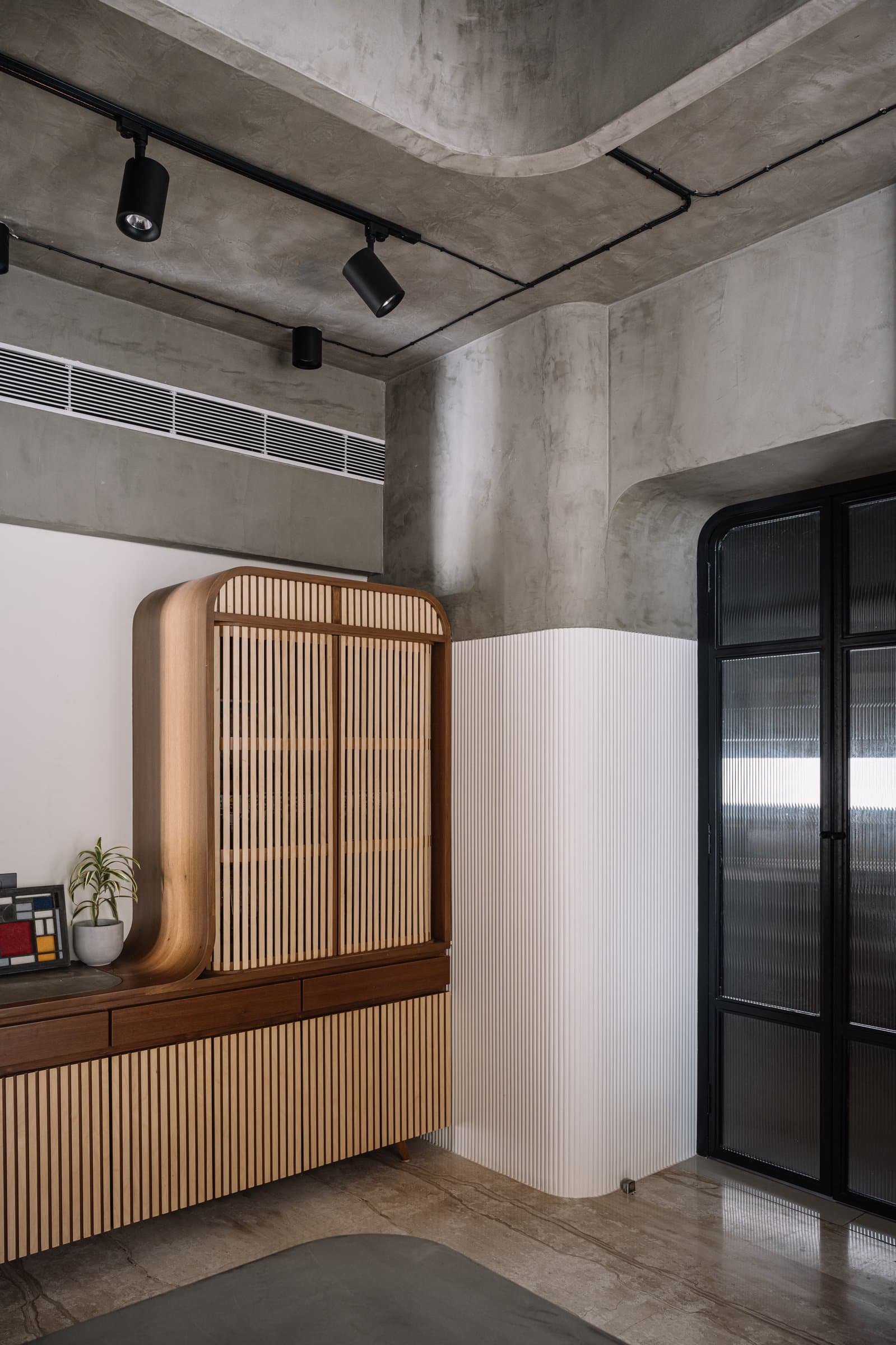
The mandir unit and kitchen-door corner, show how the concrete ceiling treatment sweeps through the room in a continuous undulation, mediating between the higher living zone and the lower kitchen volume. The slatted timber doors of the prayer unit introduce yet another linear rhythm, distinct from the fluting and the cane but held together by the shared warmth of their timber tone.
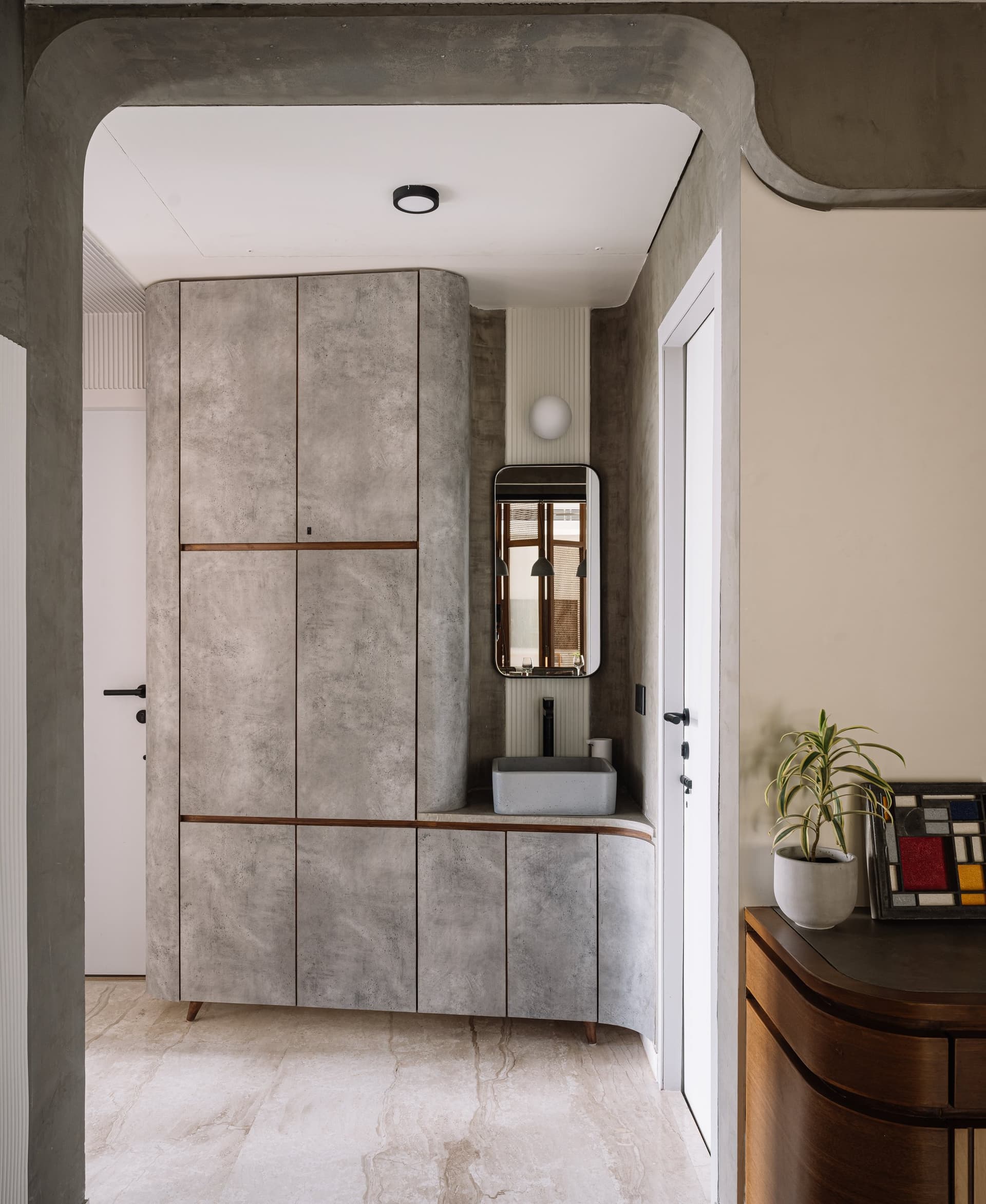
The common passage outside the bedrooms maintains the concrete language at its curved archway edges while introducing a different surface below: a tall storage and wash-basin unit finished in a textite-like cement plaster with timber trim detailing, its curved corner softening the corridor into something more generous than a mere circulation spine.
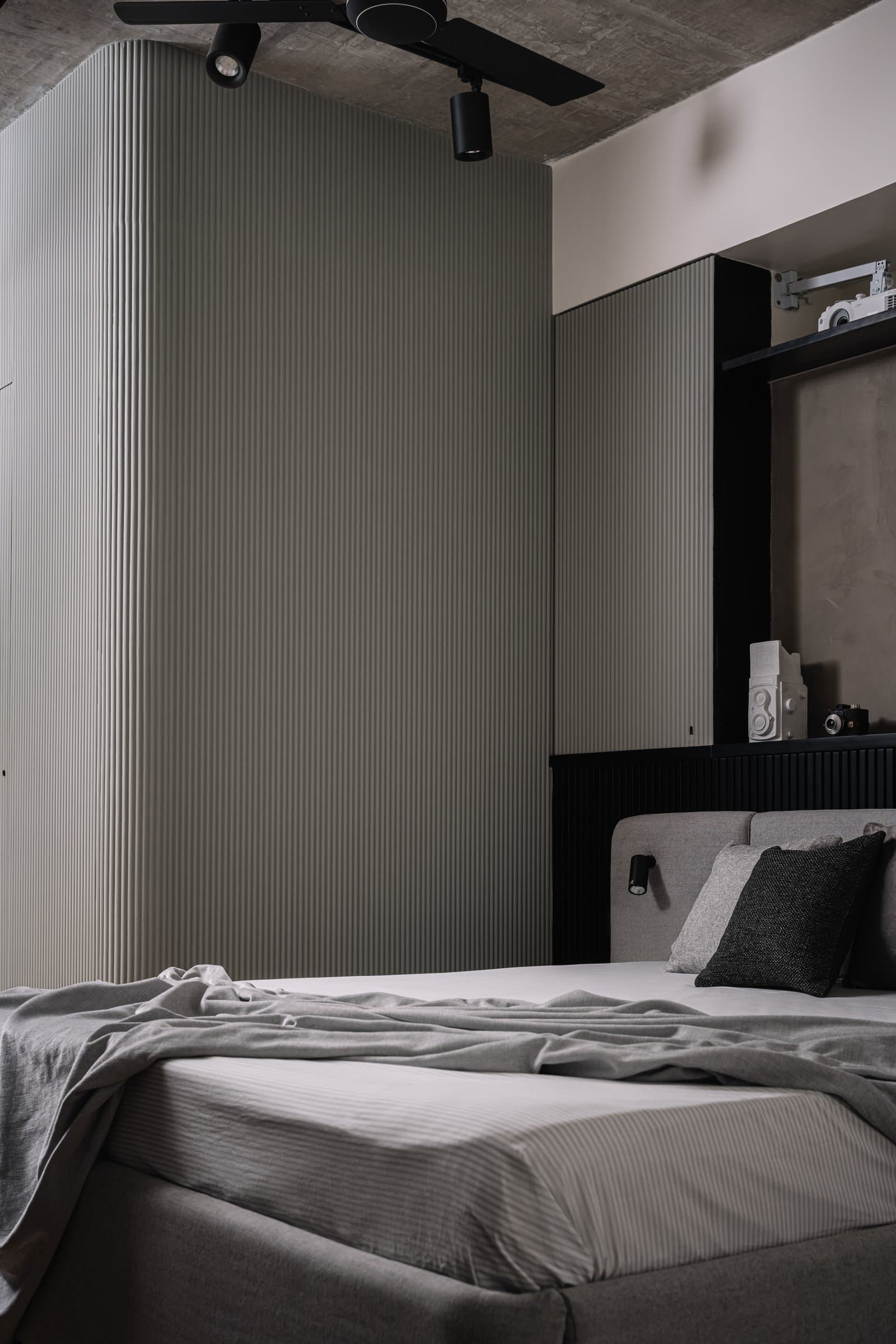
The master bedroom shifts the palette decisively. Fluted panels in a warm grey wrap the wardrobe zone beside the bed, and the ceiling returns to exposed concrete, tying the room back to the living spaces. The mood is cooler and more restrained, deliberately so; after the warmth and craft density of the public rooms, this room proposes stillness.
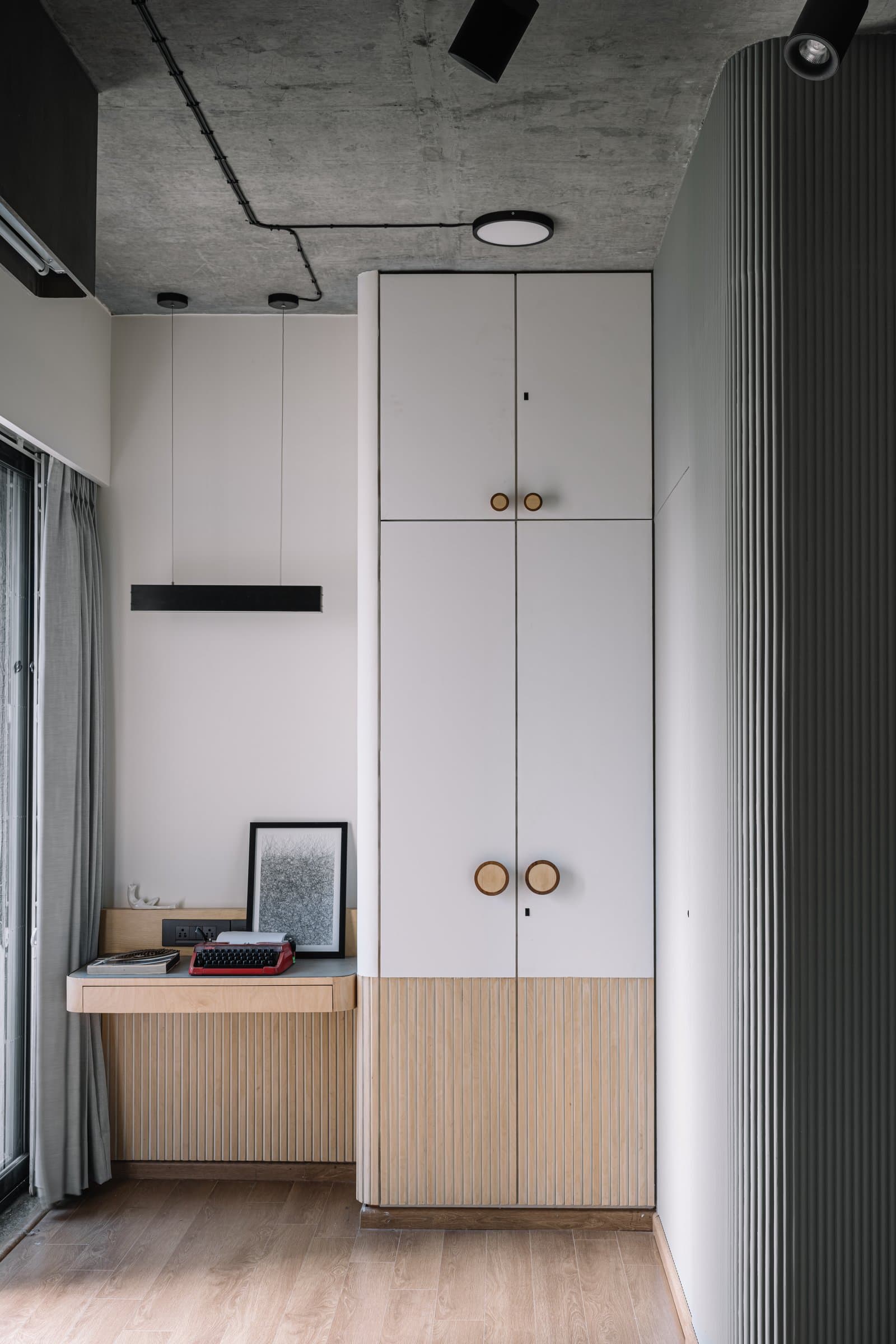
Adjacent to the bed, a study corner with a light timber desk and a tall wardrobe with fluted lower panels and circular timber handles introduces a paler, softer register. The exposed concrete ceiling and black track lights above keep the room from tipping into lightness; the tension between the two tonal zones gives the master bedroom its character.
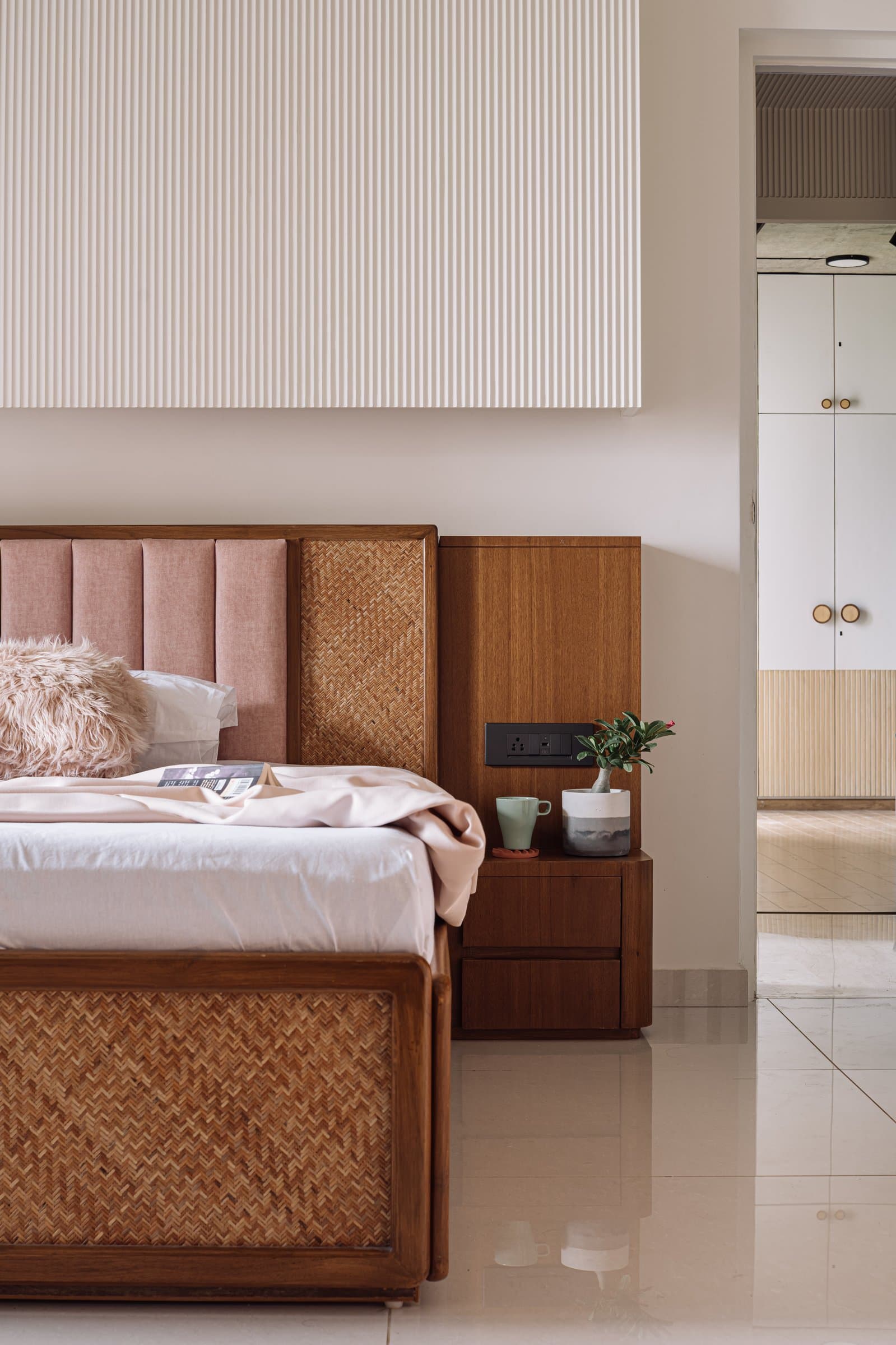
The parents’ bedroom takes a warmer direction entirely. A woven-cane bed frame with a blush upholstered headboard sits against a wall with white fluted panelling above, and the room’s overall palette of rose, timber, and cream reads as the gentlest space in the home.
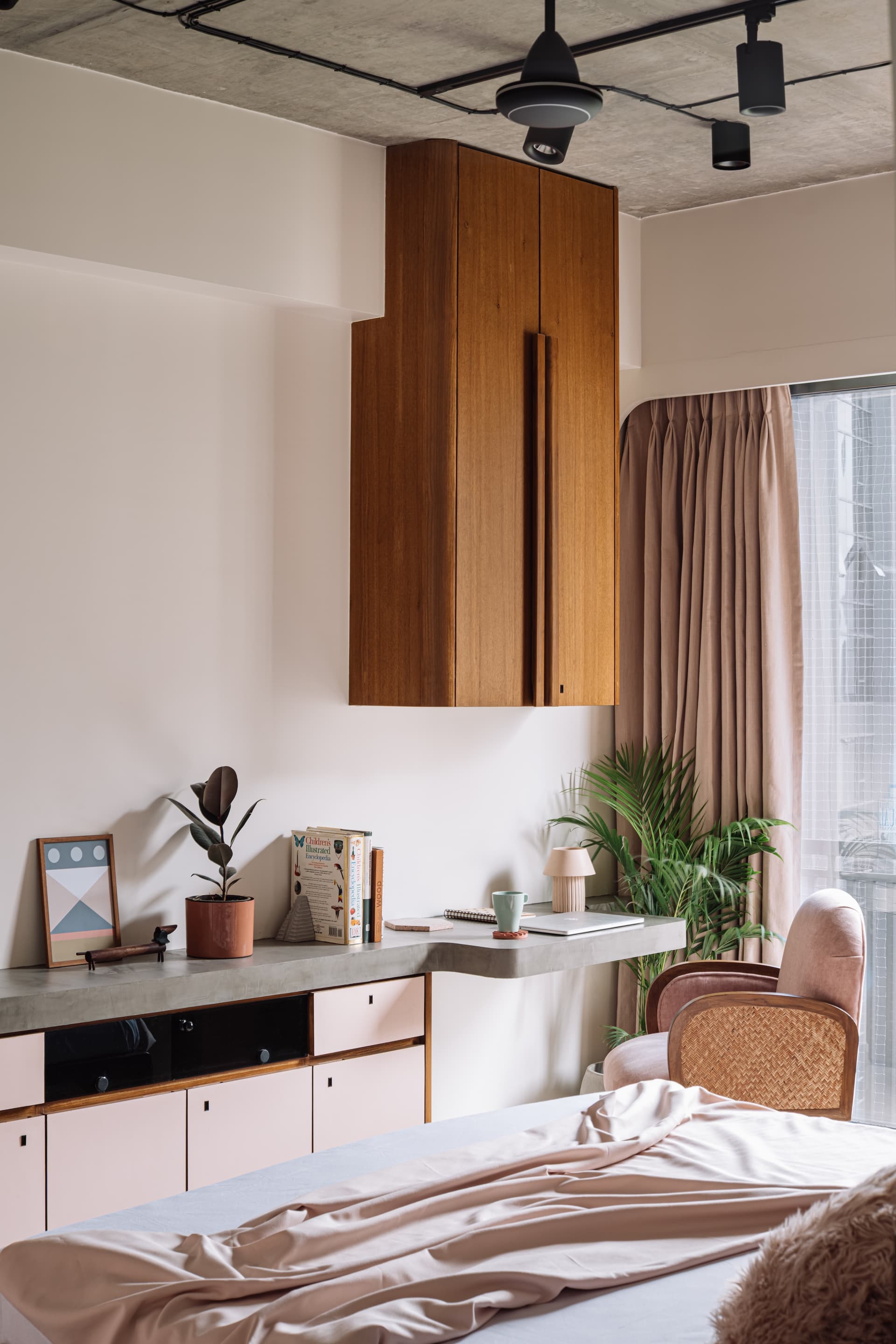
The study and storage wall in this bedroom carries a concrete-finished desk surface that anchors a run of blush-toned cabinetry, while a suspended timber unit above floats against the exposed concrete ceiling. The cane-backed chair at the desk is consistent with the home’s broader craft language, but the colour palette here is distinctly softer, suggesting a room that has been personalised around its occupants’ preferences rather than held strictly to the common material programme.
The wardrobe in the parents’ bedroom demonstrates the home’s approach to curves at the scale of furniture: a sweeping timber edge that curls outward to form a small shelf before meeting the floor-level cabinetry below. The blush lacquer panels are framed by warm timber borders, and the tall handle is a pair of slender timber bars rather than conventional hardware. Every detail reinforces the idea that curves and lines are not ornamental choices but the fundamental organising principle of the joinery throughout.
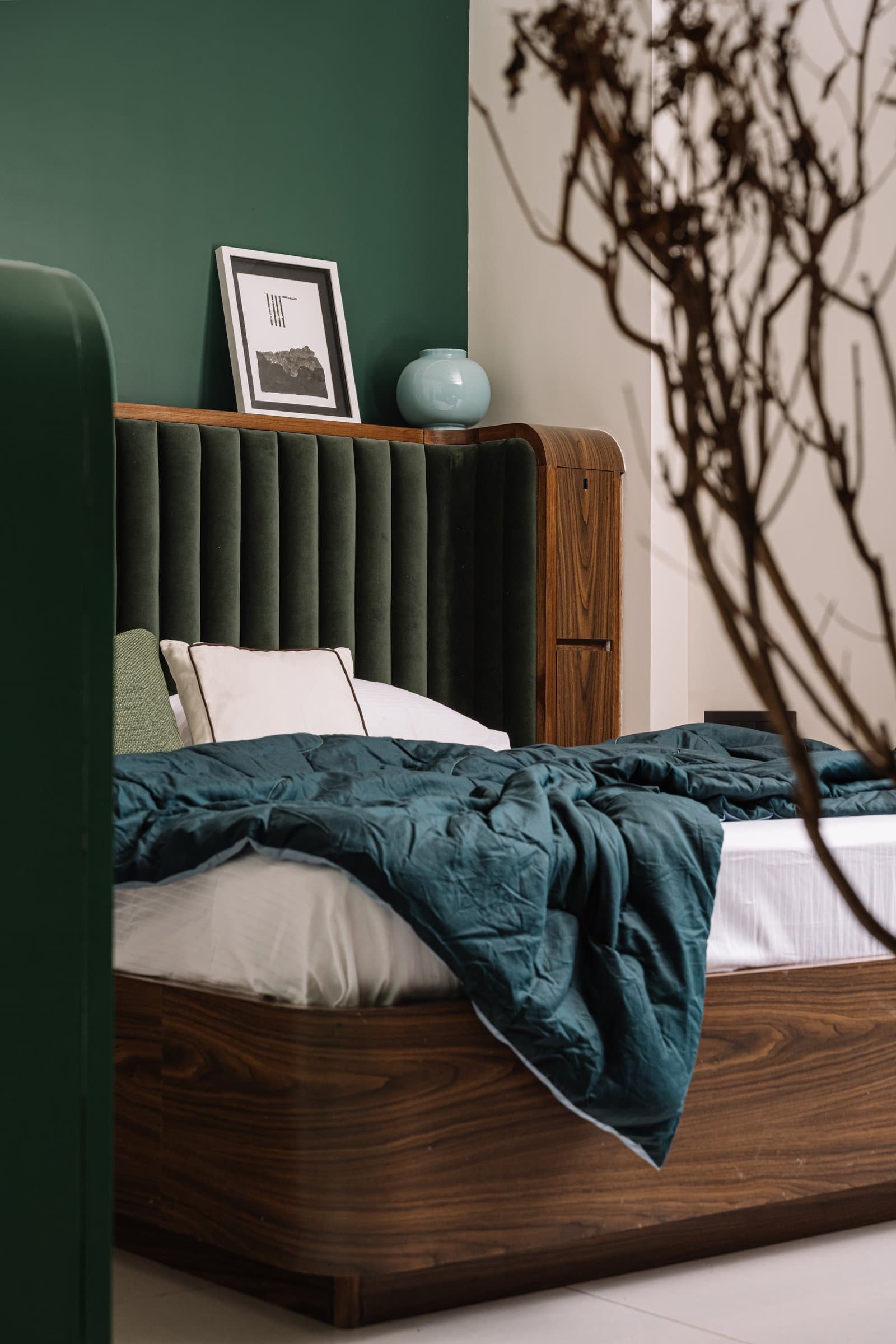
The daughter’s bedroom is the home’s boldest tonal departure: a deep forest green on the wall, a channel-tufted velvet headboard in a matching shade, and a bed frame in dark walnut that anchors the room with richness. Where the parents’ room was gentle, this one is assured, and the contrast is clearly intentional, giving the younger occupant a space that feels genuinely her own rather than a diluted version of the common areas.
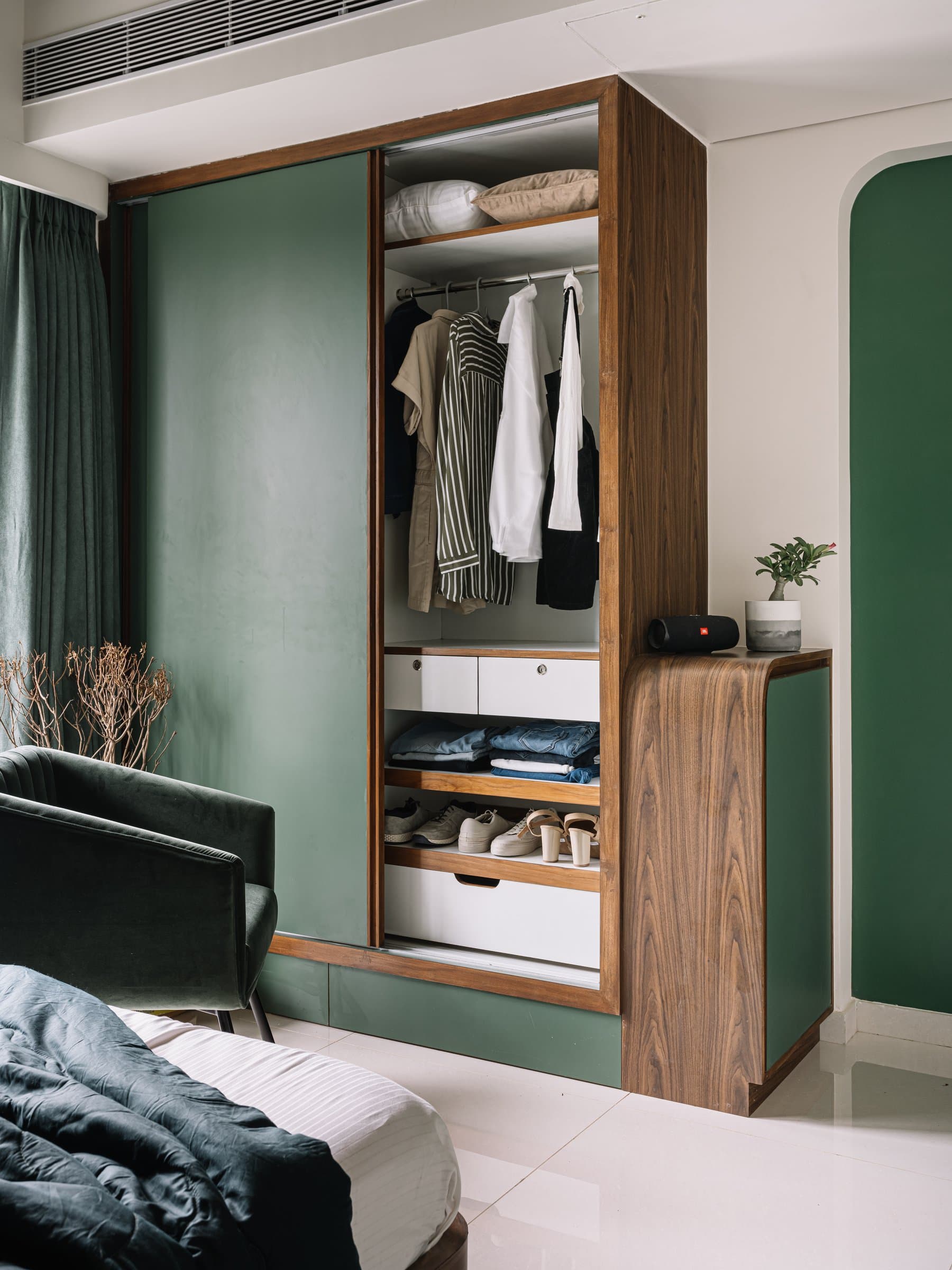
The wardrobe continues the green, its sliding doors finished in the same saturated tone and framed in walnut. Opened, it reveals a well-organised interior with white drawer fronts, and the unit steps down to a lower console at the side, its timber profile curving in a manner now familiar from every other room. The consistency of the joinery language across such varied palettes is a quiet achievement.
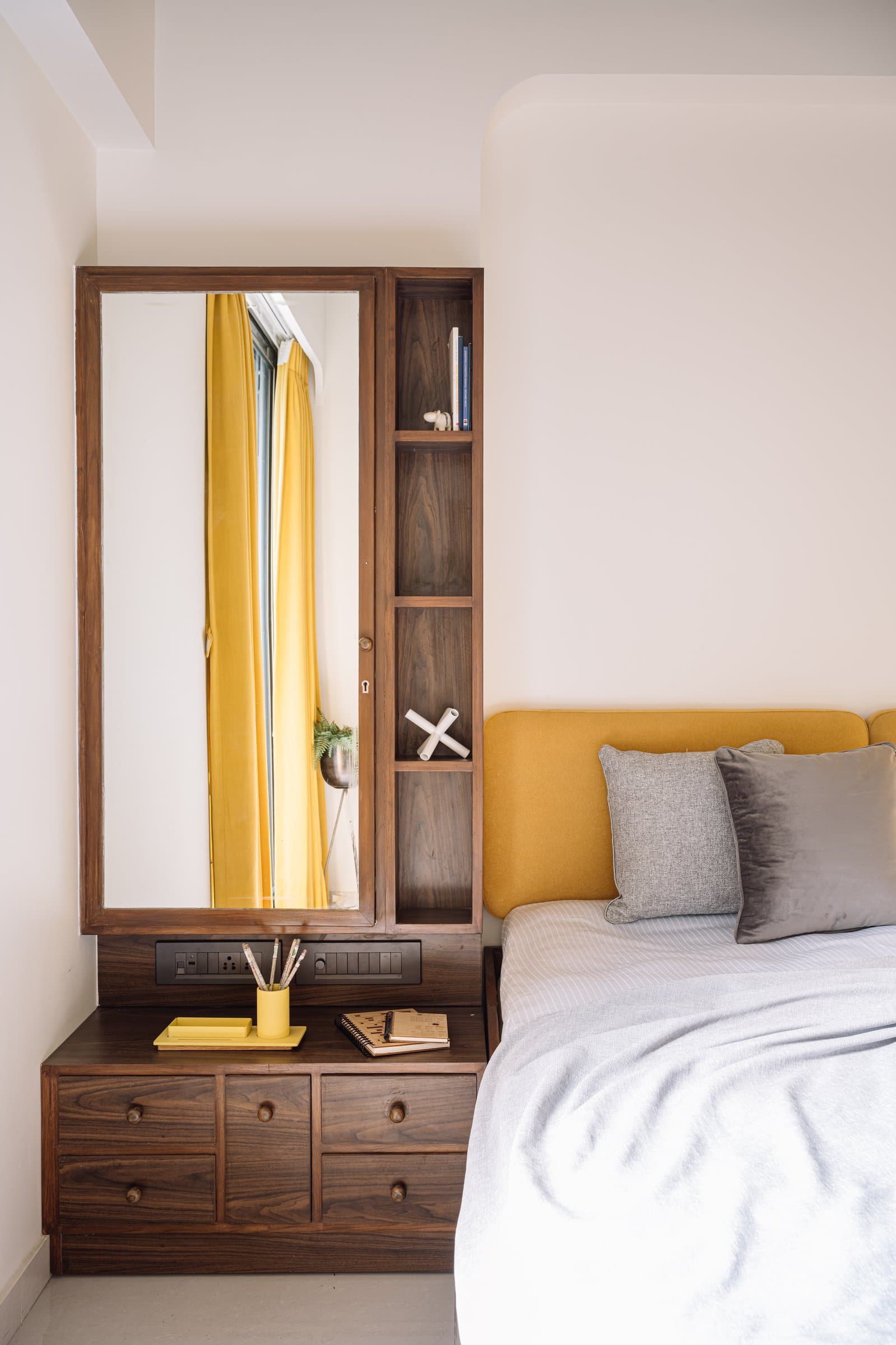
The guest bedroom opts for the simplest approach: white walls, a rounded headboard upholstered in mustard, and a bedside unit in dark walnut that doubles as a dressing table with an integrated mirror. After the density of the public rooms and the distinct personalities of the other bedrooms, this room’s restraint feels hospitable rather than sparse, a room that imposes nothing on its temporary occupant.
What Curves, Concrete and Lines achieves is an increasingly rare thing in Indian apartment design: a cohesive material identity that runs from the entry threshold to the last bedroom wardrobe without becoming monotonous. The home uses craft traditions (cane weaving, timber joinery, concrete finishing) not as stylistic references but as active spatial tools, each one doing real work in defining zones, filtering light, or softening transitions.
The result is an apartment where the design language is legible in every frame but never repetitive, where each room has its own tonal identity while remaining fluent in the shared vocabulary of curves, concrete, and lines. It is a home that rewards close looking, and one that appears to reward daily living just as well.