Tradition, when handled well, does not announce itself. It settles into the bones of a home and waits to be noticed, in the curve of an arch, the weave of a fabric panel, the way a room makes space for a temple without making the temple the only thing in the room. The clients of Saanidhya arrived with an instinct for the ancestral, an imagination filled with classical detailing and rich ornamentation. What they found, over months of conversation, was that tradition could be carried more lightly than they had assumed.
Designed by Tesor Designs within a 2,292-square-foot four-bedroom apartment at Sobha Windsor in Bangalore, the home is named for the Sanskrit word meaning nearness to God. The temple anchors the floor plan, but spirituality here is a quality of atmosphere rather than a designated zone. Across the apartment, restraint and warmth share equal billing, and the language of Indian craft is folded into a contemporary architectural vocabulary that never feels self-conscious about either inheritance.
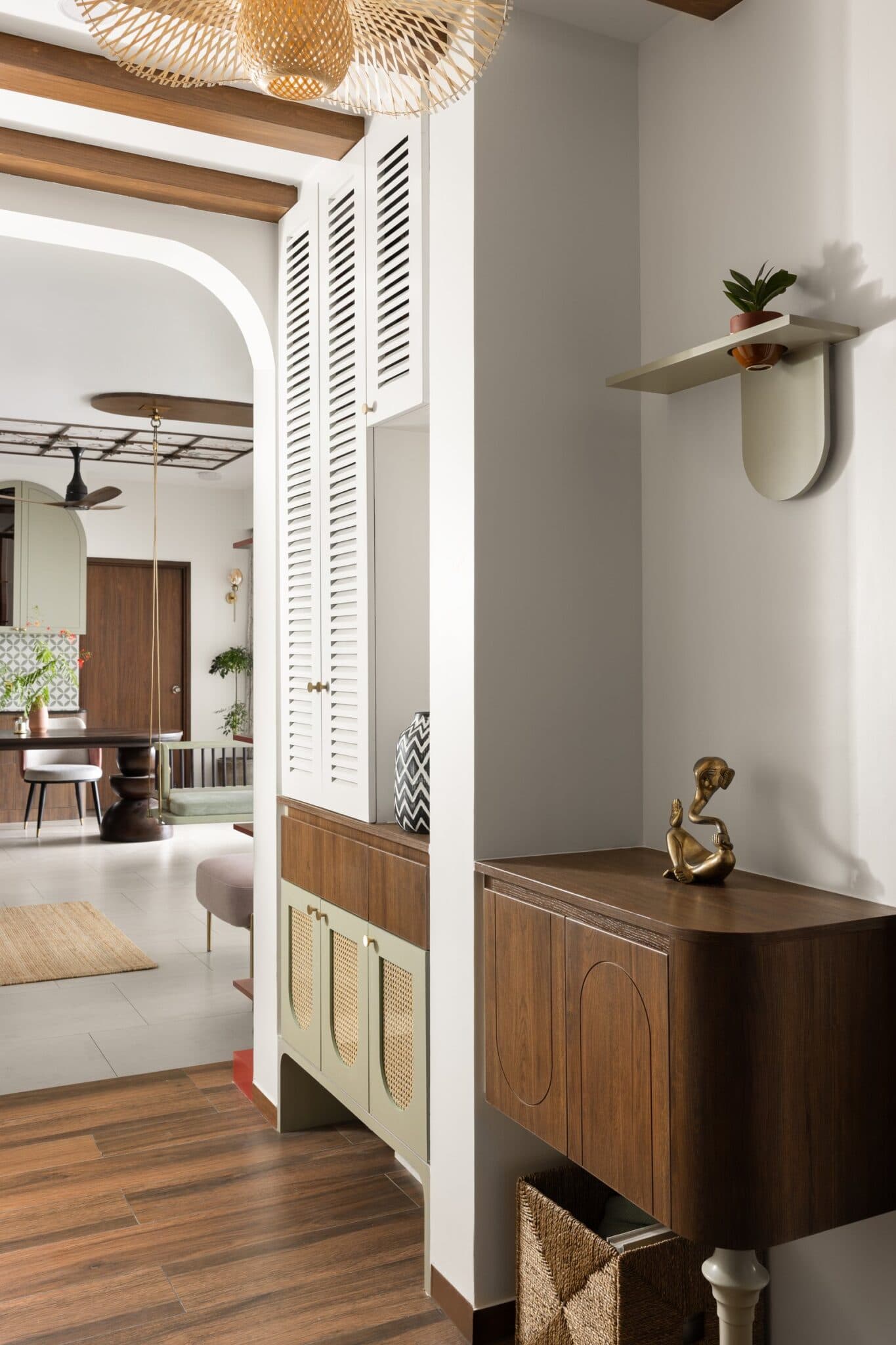
The entry establishes the rules. A louvred shutter unit in soft white sits beside a floating walnut console alongside a cabinet with cane-fronted lower doors in sage green, and a small brass figure presides quietly from the top. Through the rounded archway beyond, the living room reveals itself in fragments: a swing, a patterned floor, the pale rattan dome of a pendant. The home introduces itself slowly, which is the first sign that the designers trusted the project not to need a louder opening.
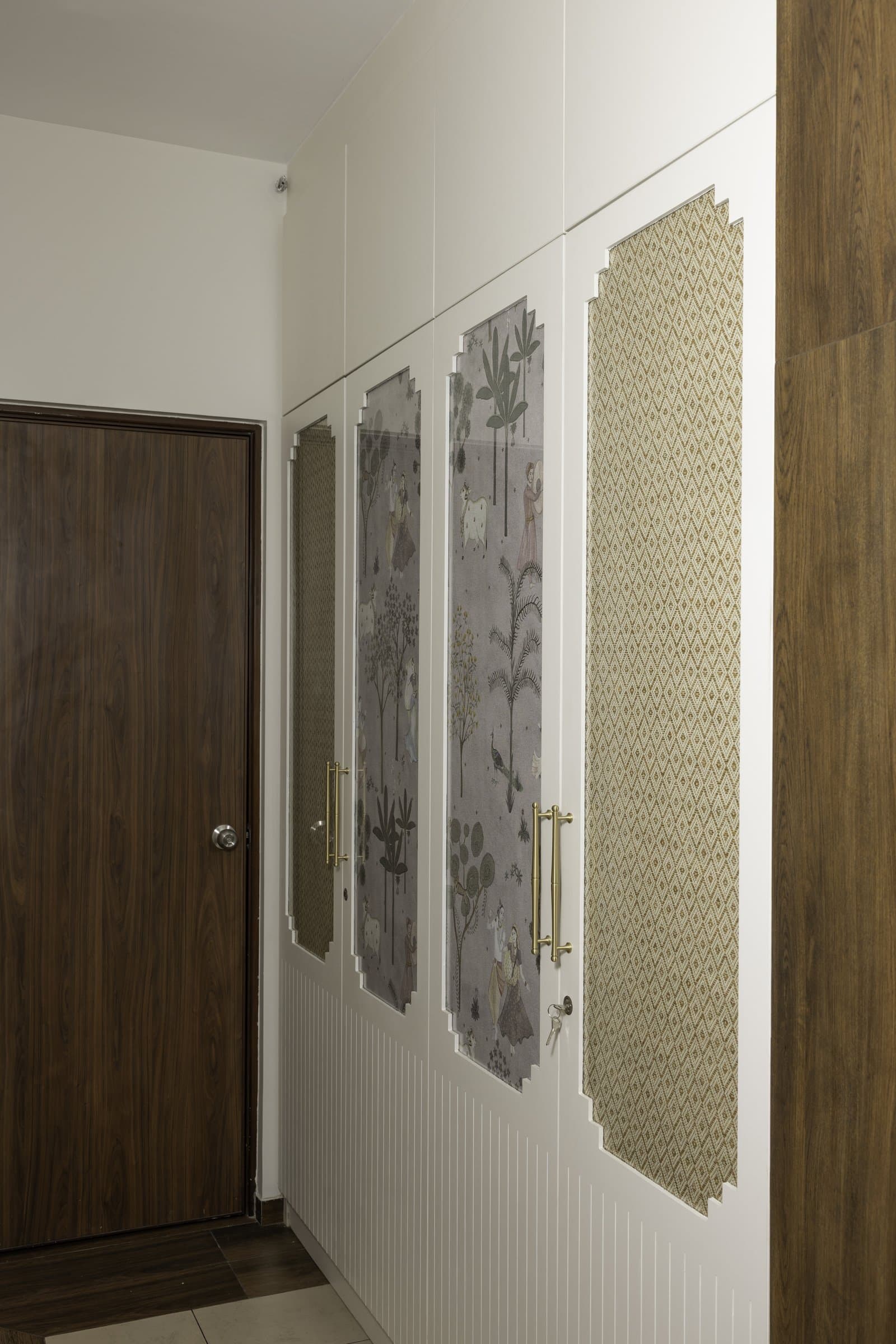
Just inside, a run of built-in storage carries Pichwai-inspired panels framed by stepped white architraves, the motifs of cattle and pastoral figures rendered in muted greys rather than the saturated palette one might expect. The decision to use the artwork as cabinetry rather than as a feature wall is the project’s quiet thesis: heritage motifs become part of the architecture’s everyday surfaces, not isolated showpieces.
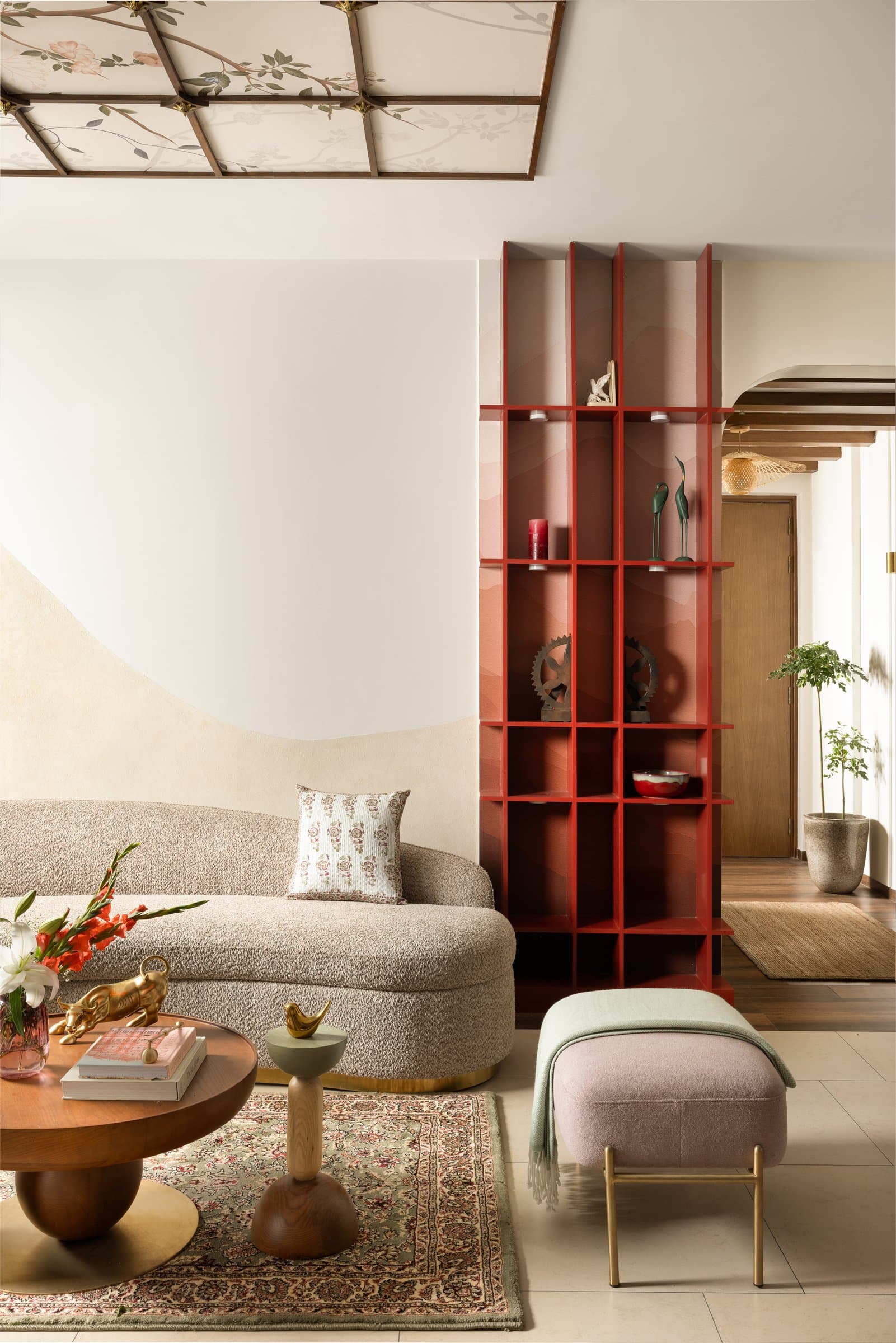
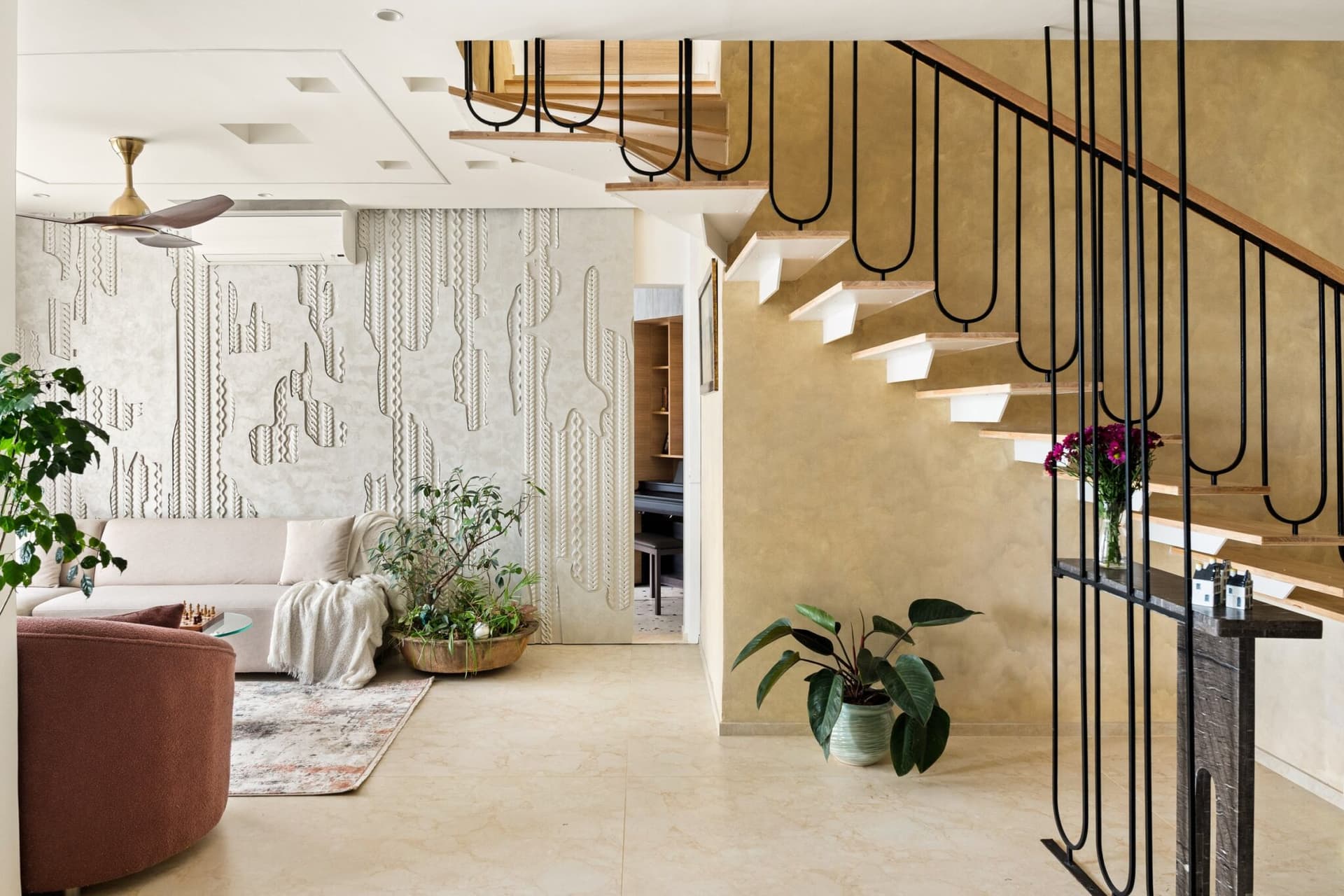
The living room makes its central argument through a single decisive gesture. A vermilion shelving unit, gridded and architectural, divides the space without enclosing it, while an ombre-toned wall behind it shifts from white through soft cream into a deeper rust. The boucle sofa, the brass bull on the coffee table, and the patterned Persian rug occupy a register that is layered without being maximalist.
““They started seeing that tradition could be celebrated without being heavy, and that modernity could slip in gently, without overpowering.””
Above, a recessed ceiling is dressed in a botanical wallpaper held within a slim metal grid, a domestic answer to the painted ceilings of older Indian homes. It is one of the project’s most deliberate flourishes, and its placement overhead means the eye finds it only on the second pass through the room.
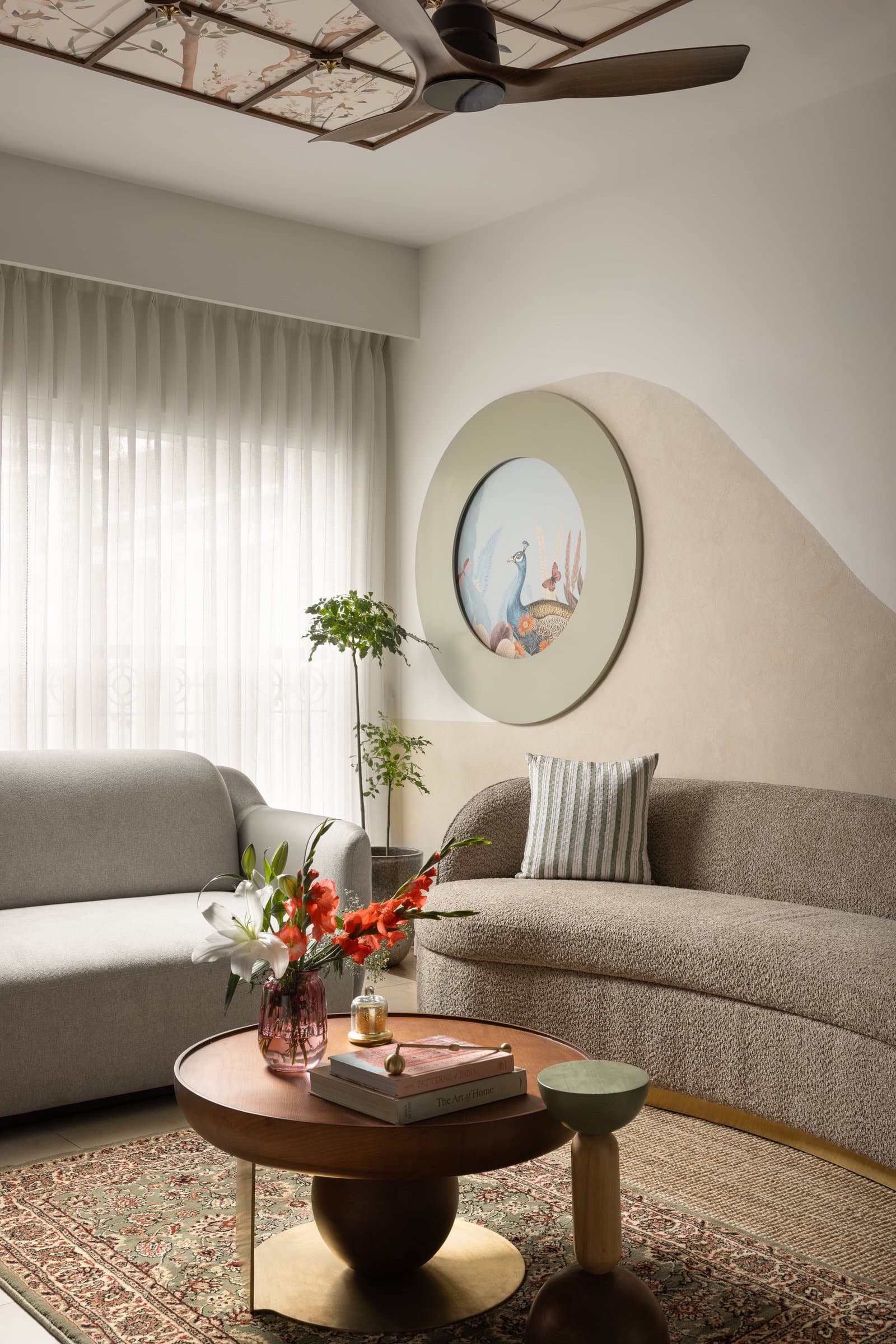
The second seating zone in the living room operates in a quieter register: a pair of curved boucle sofas in oatmeal grey arranged around a low round wooden table, with a circular Pichwai-style peacock medallion floating against a soft curved beige wall treatment. Where the first zone holds colour and conversation, this one holds stillness, and the shift between them happens without any visible architectural break.
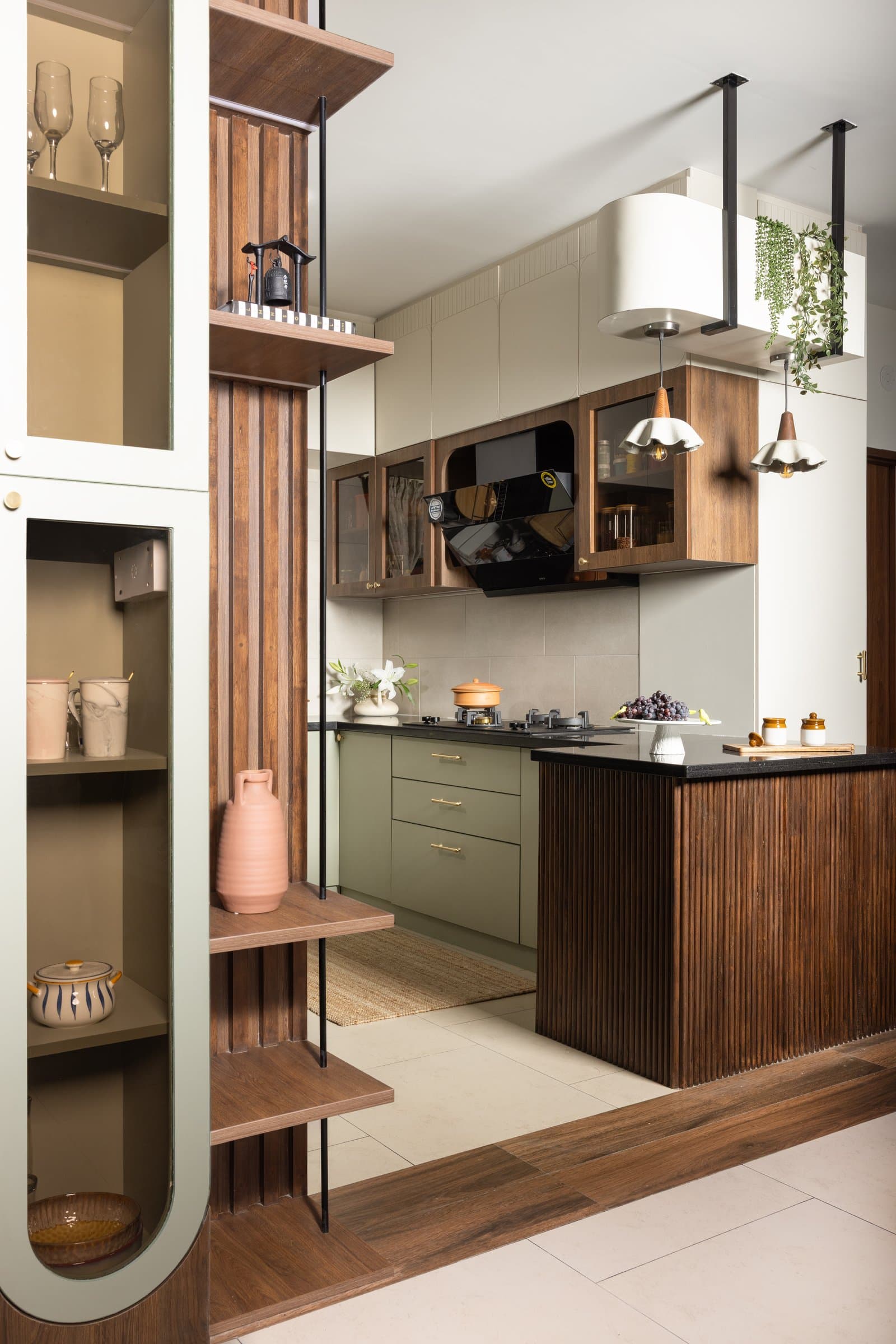
The kitchen reveals itself through a slatted wood partition that mediates rather than separates. Olive cabinetry sits below black stone counters, and a fluted island in dark walnut anchors the room with a heavier note. Two small fluted pendants in metal hang above, deliberately scaled down so they read as punctuation rather than statement.
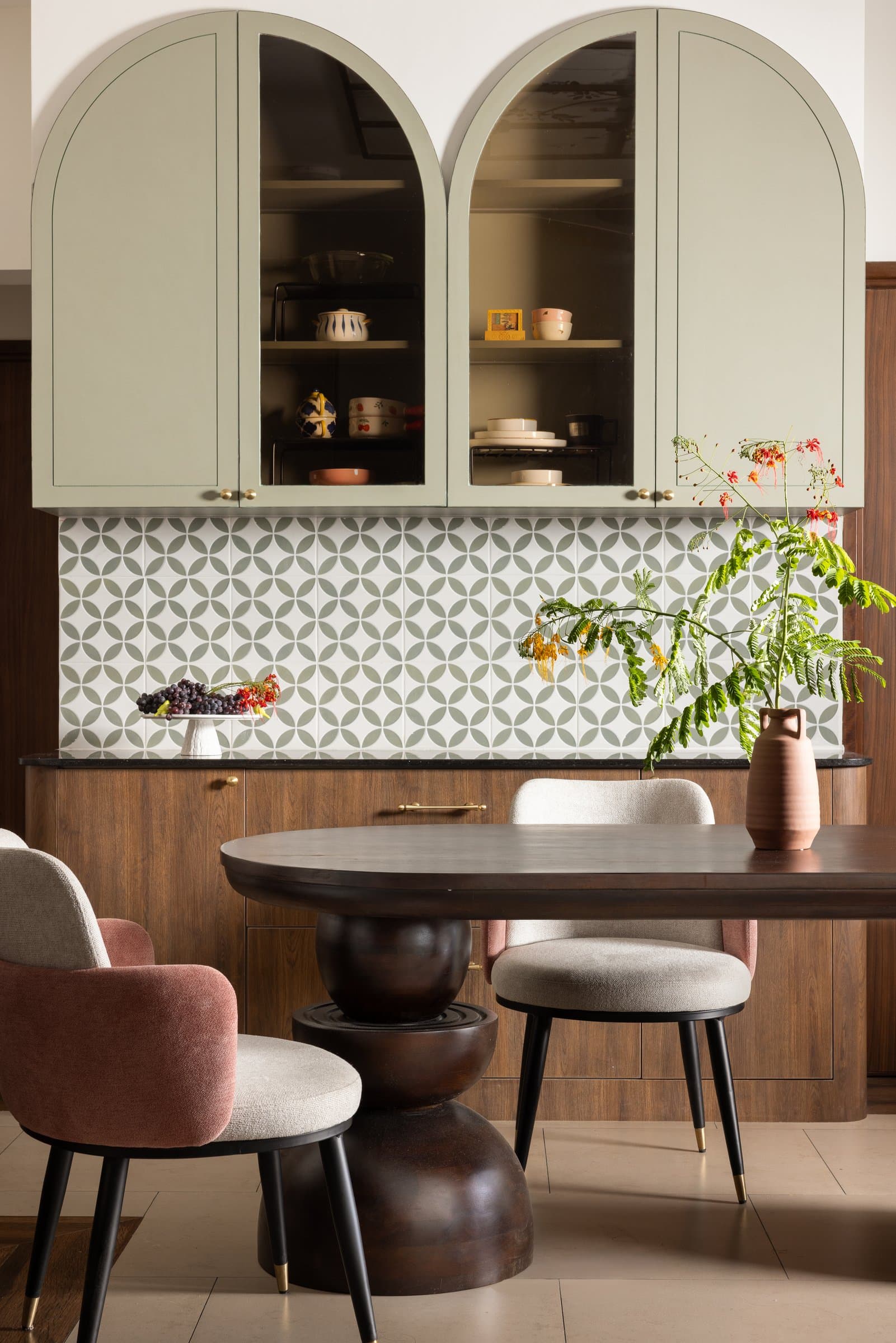
The dining area is where the home’s tonal palette comes most clearly into focus. Twin arched cabinets in sage green sit above a geometric green-and-white tiled backsplash, and below, a solid dark-wood sideboard grounds the composition. The oval dining table, sculpted from a single stained hardwood and supported on a turned pedestal, was the family’s earliest request, a piece they imagined before the rest of the home had taken shape.
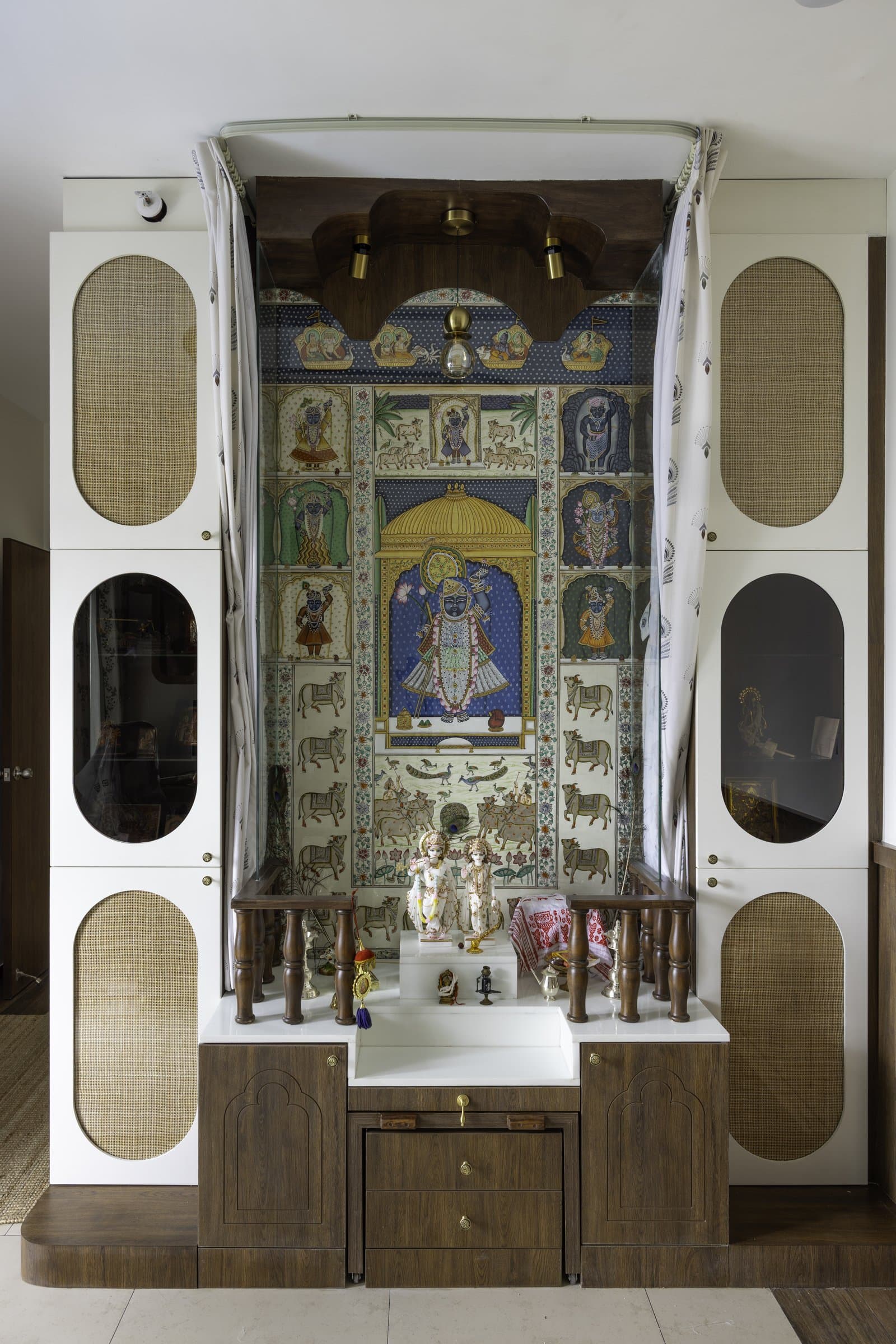
The temple is the spiritual core the project is named for, and it has been built with an intention that matches that weight. A traditional Pichwai painting fills the back panel, framed by carved walnut and flanked by tall cane-and-cream cabinetry that conceals storage on either side. The composition reads as architecture, not altar furniture, which is precisely the relationship the family wanted between ritual and daily life.
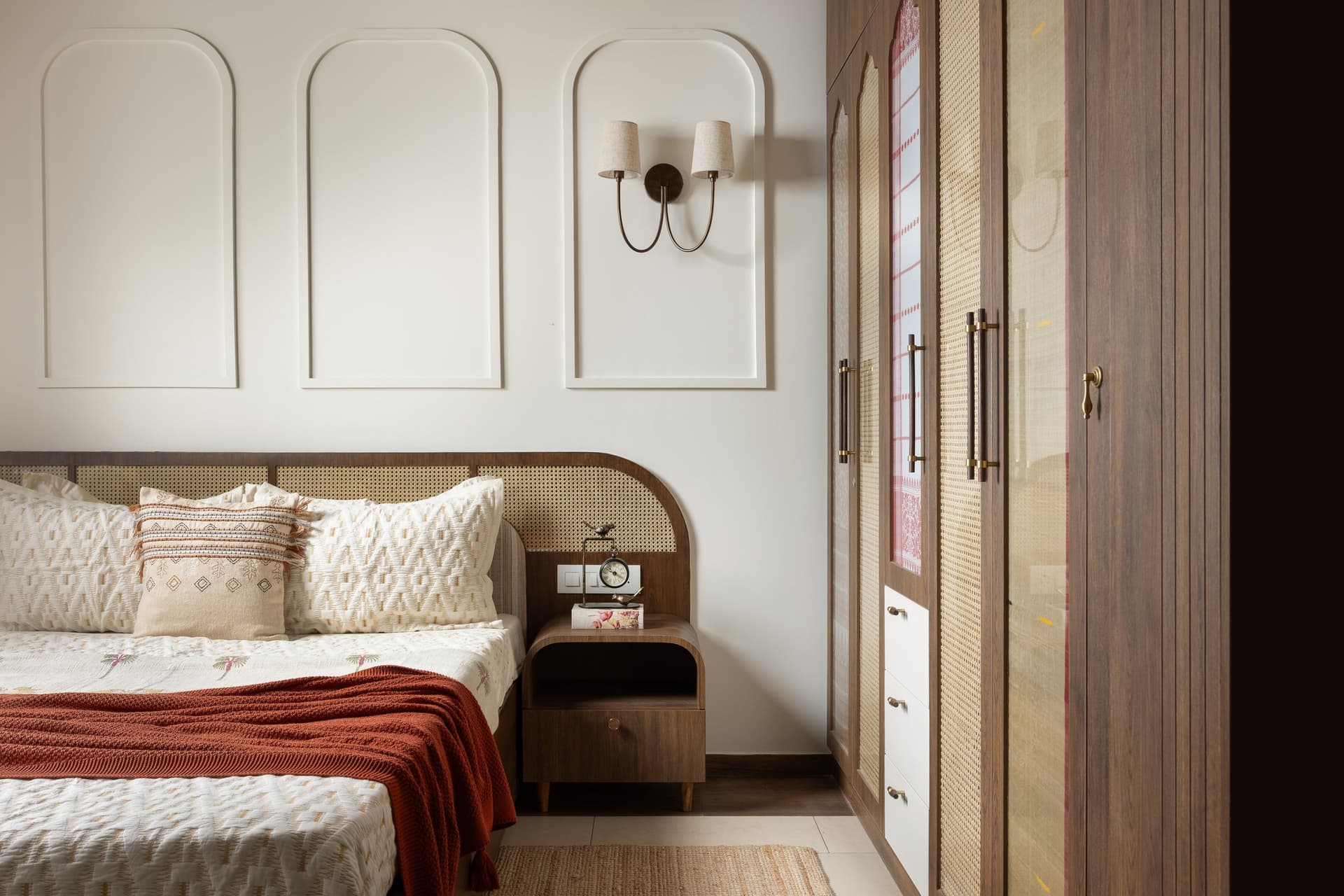
The master bedroom turns toward composure. A trio of recessed arched mouldings line the wall above the bed, and a curved cane headboard in walnut introduces the home’s recurring vocabulary of woven panels and rounded edges. A brass twin-sconce sits within the central arch, its scale modest enough that the wall reads as architecture rather than decoration.
From the foot of the bed, the room’s spatial logic becomes clear. The cane wardrobe runs the full length of one wall, integrating with the panelled niches so that storage and architecture are continuous rather than competing.
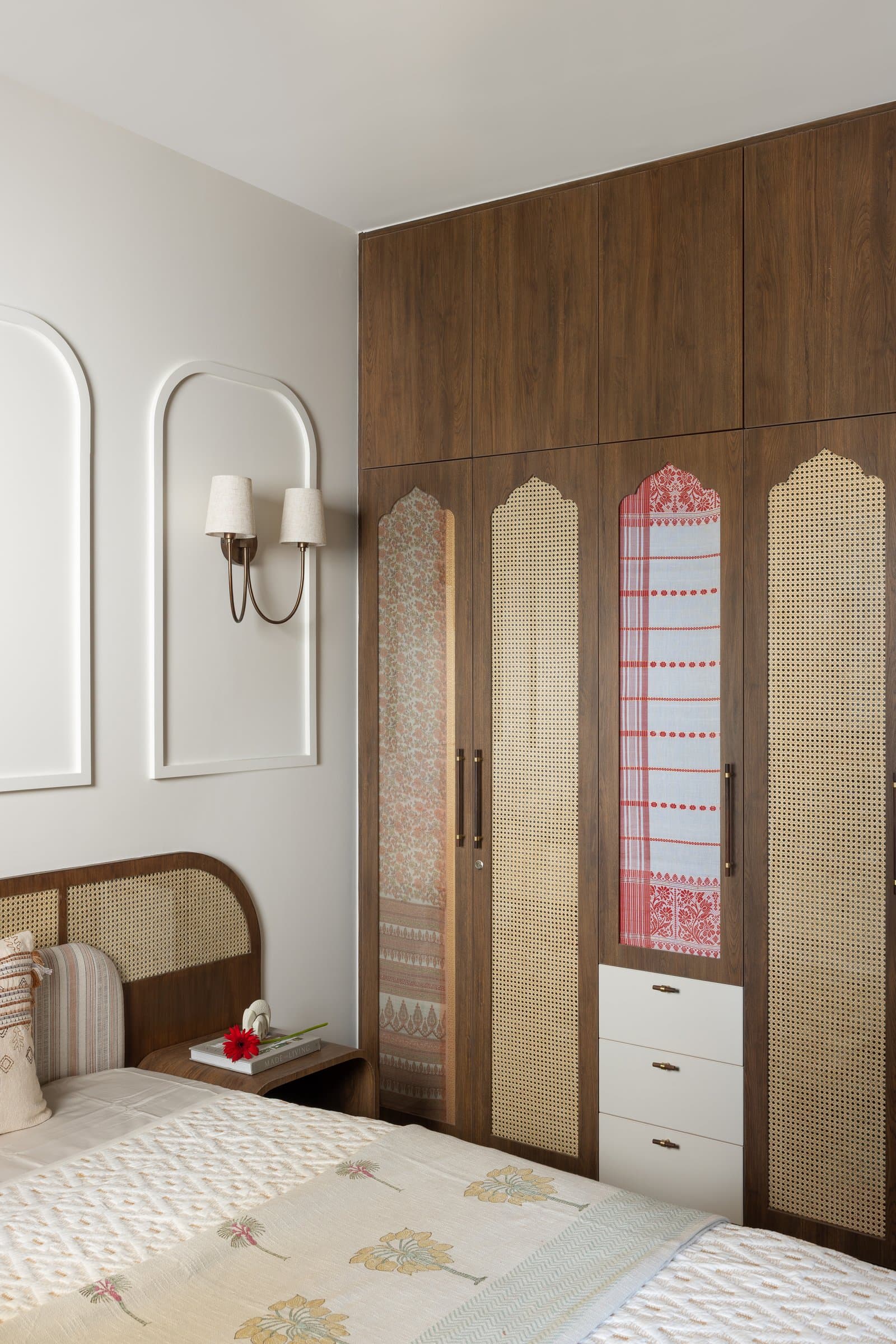
The wardrobe itself is the room’s most personal element. Its tall arched fronts are inset with fabric panels gifted by the couple’s in-laws, the red and ivory weaves visible through cane and glass. Heritage textiles, repurposed as cabinetry inserts, become a kind of structural memory, the wardrobe doing the work of an heirloom without imitating one.
Seen head-on, the wardrobe wall composes itself like a small architectural facade: arched panels alternating between cane weave and inset fabric, a central textile in red and white framed like a textile painting, white drawer fronts breaking the dark walnut at the centre. The room asks the textiles to do something more than hang; it asks them to hold the wall together.
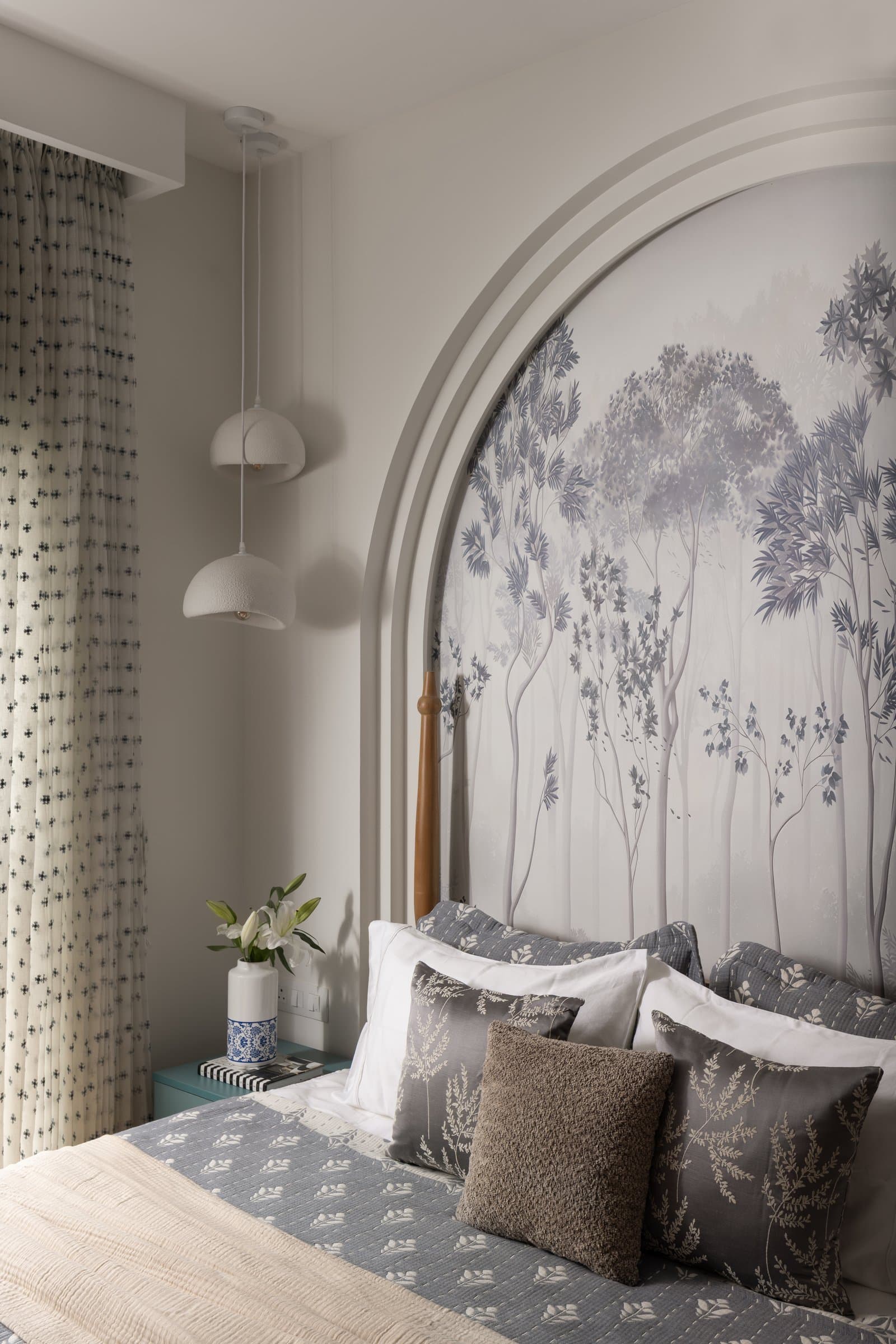
The parents’ bedroom takes a softer, more atmospheric route. A grey-toned forest mural fills a deep arched recess behind the bed, its silhouettes washed out almost to a watercolour. Two pendants in textured cream plaster drop on long cords beside it, a deliberate counterpoint to the romance of the mural.
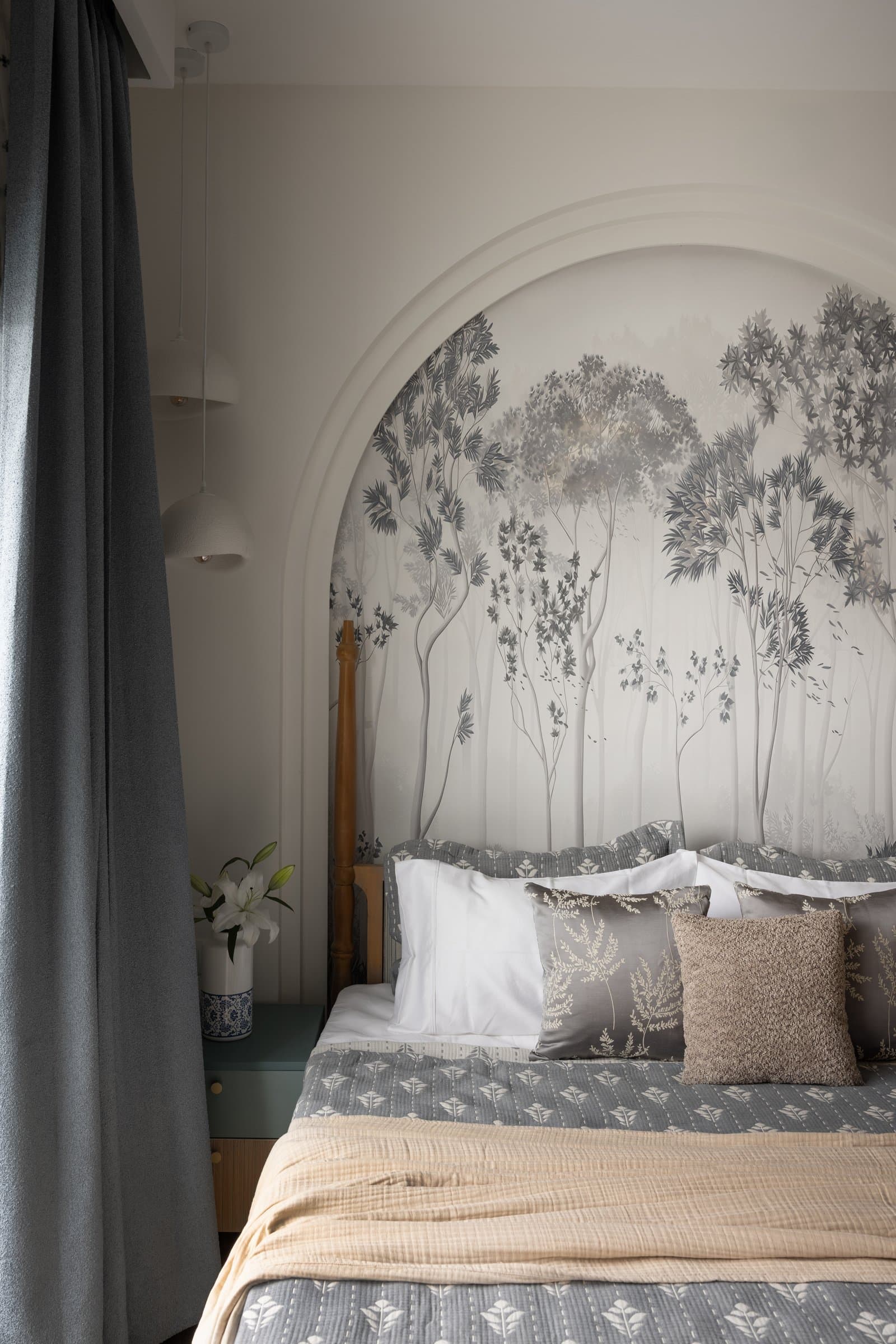
The arched mural reads differently from the side, where the depth of the recess becomes legible and the forest scene takes on the quality of a painted alcove rather than a feature wall. The bed linen, in dusty greys and warm beige, picks up the same tonal register, allowing the mural to lead without ever shouting.
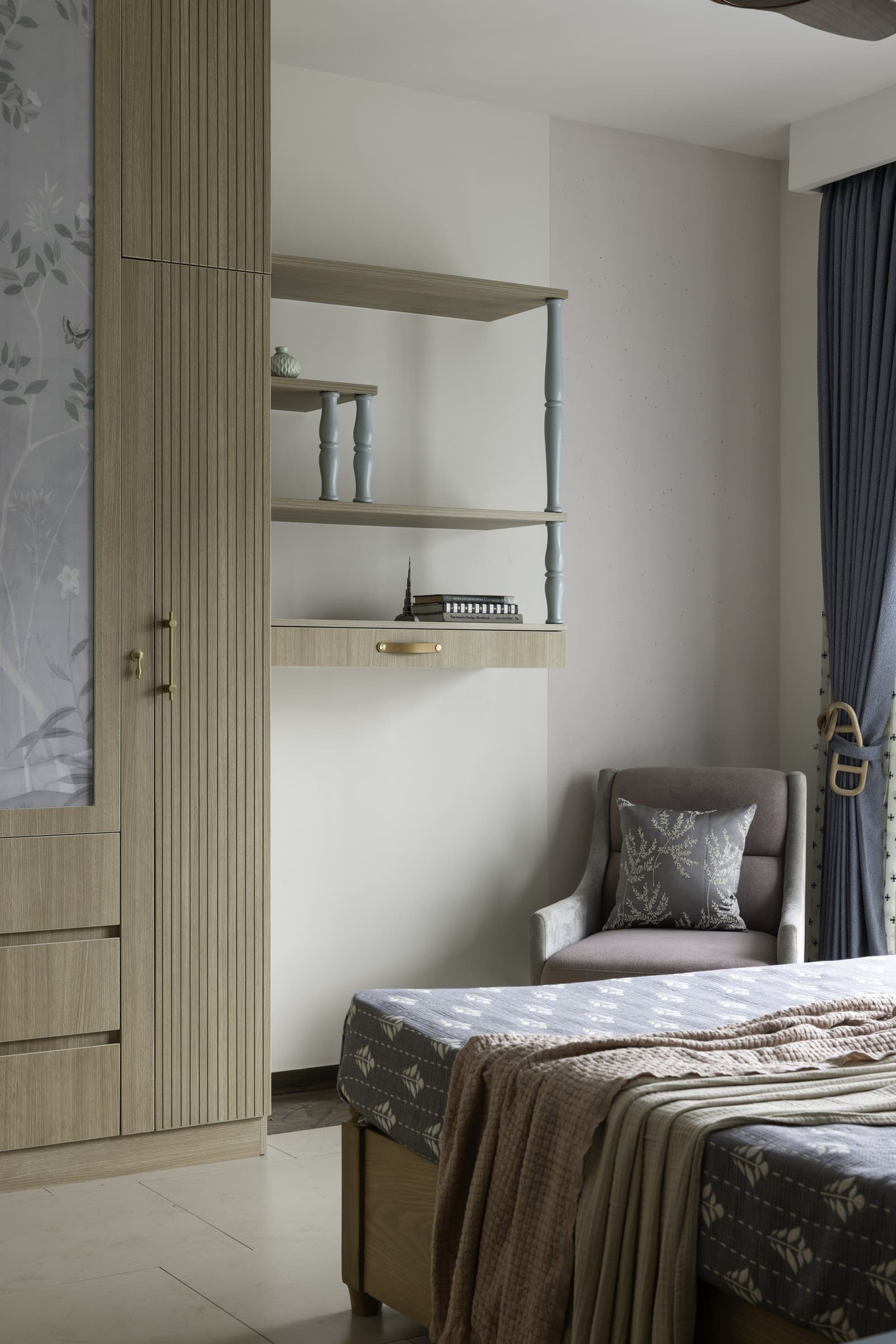
A reading corner sits at the foot of the room, where a wing chair in a muted heather grey faces a wall of fluted ash cabinetry and a slim shelving system supported on turned blue-grey spindles. The spindles are the surprise: a small piece of traditional turnery introduced into an otherwise restrained composition, the kind of detail that rewards a slow second look.
The corner wardrobe in the parents’ room is finished in a paler ash veneer, its tall doors fronted with chinoiserie-inspired panels of birds and branches printed on translucent glass. A small open shelving unit on one side holds a row of pale blue spindle ornaments, picking up the turnery thread from the reading corner and threading it through the room as a recurring motif.
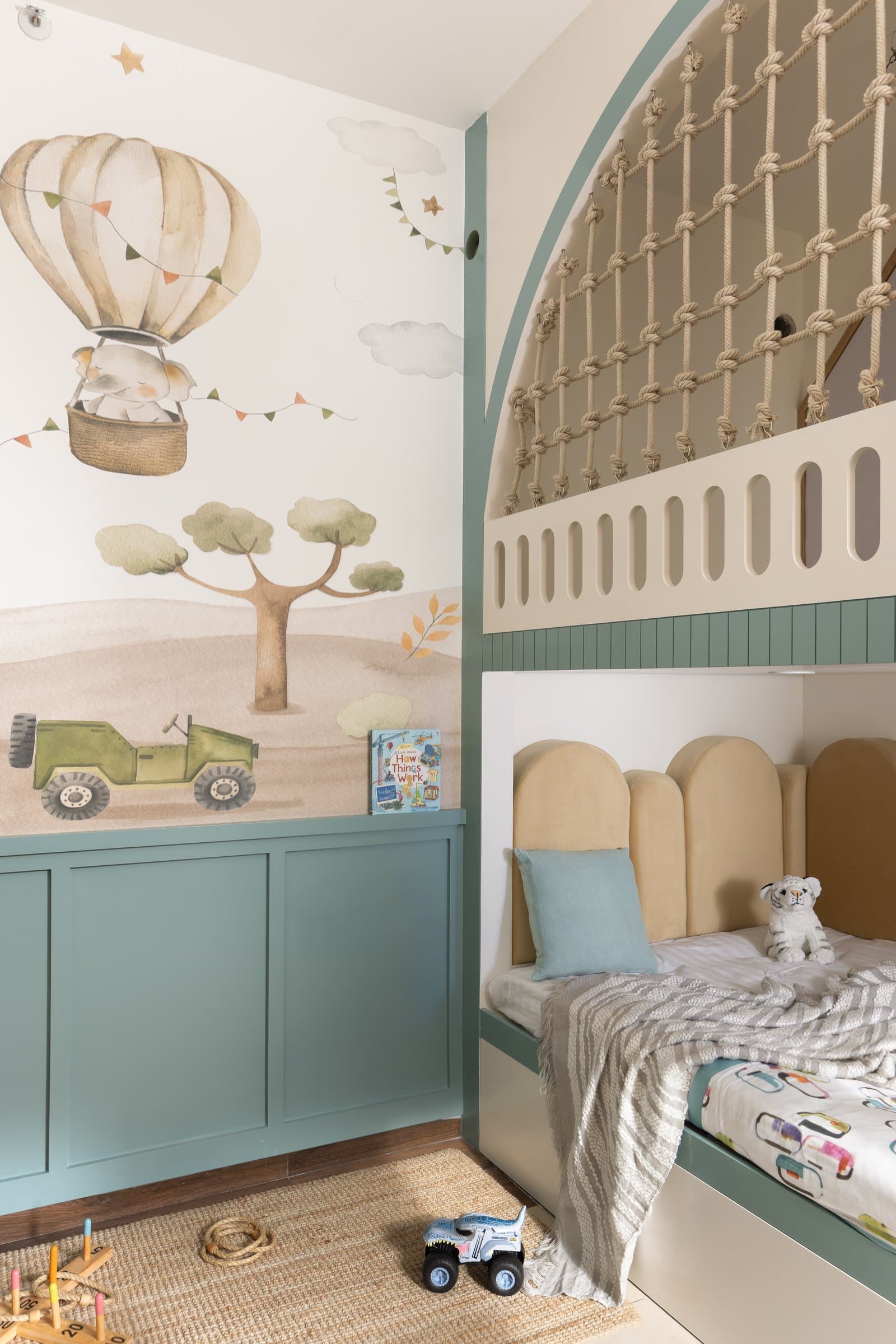
The children’s room is the project’s most exuberant space, and the one that most clearly reflects the family it was made for. A watercolour mural of a hot-air balloon, jeep and trees fills one wall, set above a wainscot of soft teal panelling. To the right, a built-in bunk bed sits within a panelled arch, its upper berth crowned by a knotted rope climbing net, the kind of structural play element that makes the room read as small architecture rather than furniture.
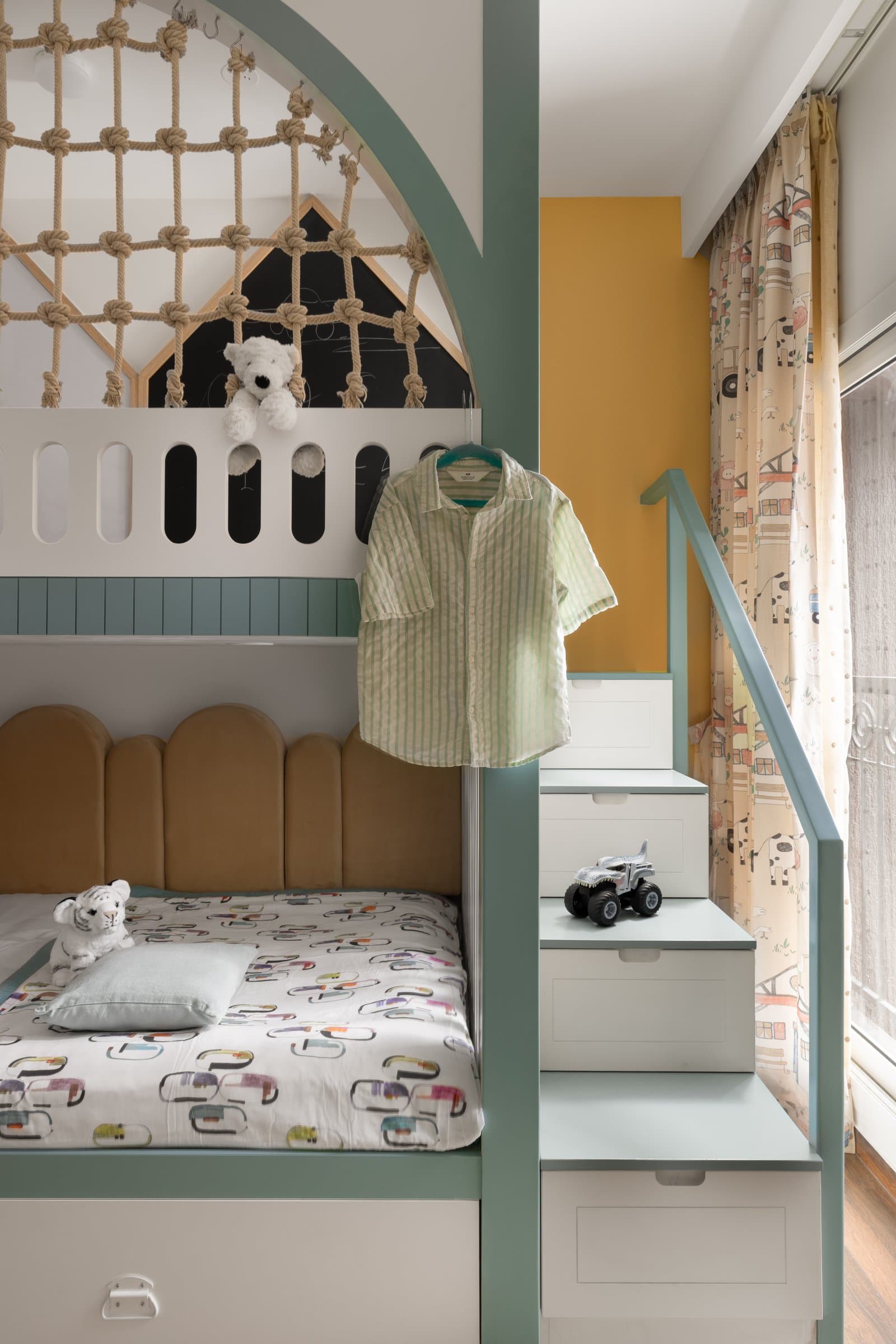
From the other side, the bunk reveals its full ingenuity: a rope-net canopy over the upper bed, a stepped staircase in pale teal with integrated drawers, and a scalloped velvet headboard in caramel for the lower berth. A buttery yellow wall and printed curtains carry the colour language outward.
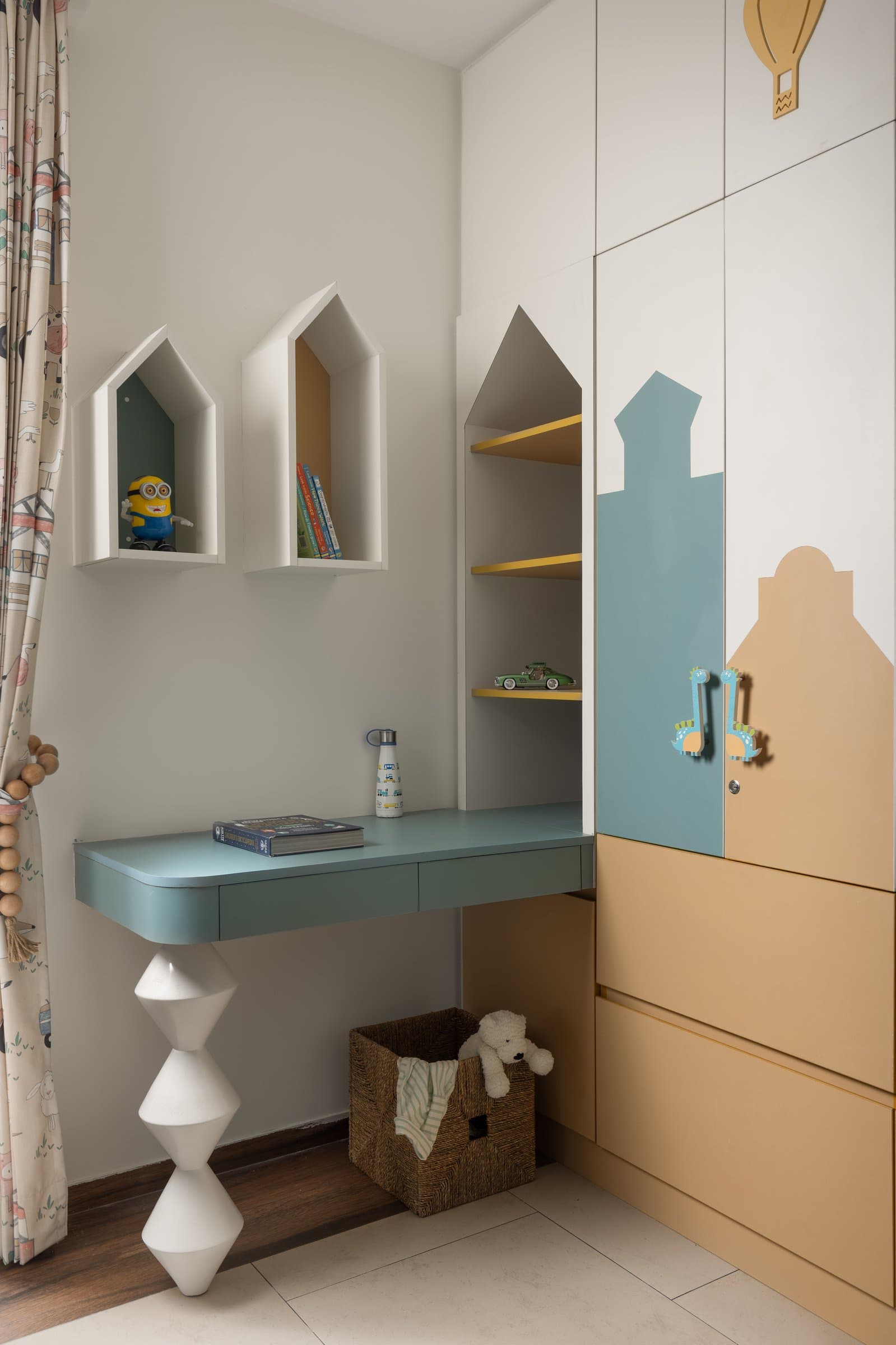
Across the room, a study and storage wall continues the architectural play. House-shaped niches in white frame books and small toys, a teal floating desk hovers above a pedestal in chalk white, and the wardrobe doors carry silhouettes of buildings and hot-air balloons in matching teal and mustard. The detailing is playful but not infantile, designed to age with the children rather than be outgrown.
Within Bangalore’s residential landscape, where homes increasingly oscillate between minimalist greige and overt heritage pastiche, Saanidhya occupies a more difficult middle. Tradition is treated as a working vocabulary rather than a costume, with Pichwai motifs, cane weaves, turned spindles, family textiles and arched mouldings all integrated into the everyday geometry of the home. The result is recognisably Indian without ever feeling like a curated set piece.
What lingers is the impression of a home that has resolved its own tensions before asking the visitor to notice them. Tradition and modernity, heirloom and new build, ritual and daily life: each pair holds its place without needing reconciliation. Saanidhya is, in the truest sense of its name, a home built around presence, the kind that does not perform itself but simply continues, room by room, in a register the family already recognised as their own.