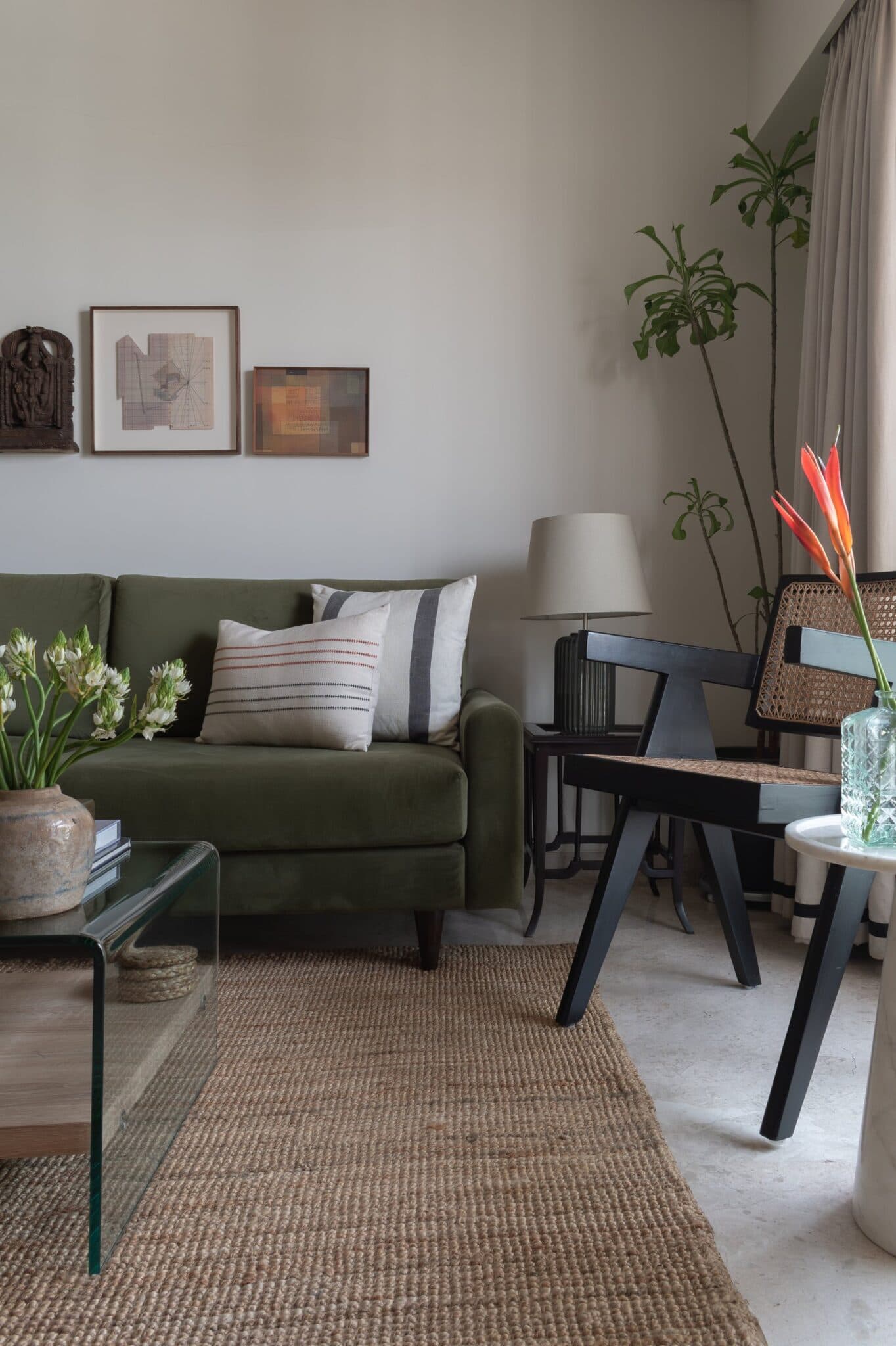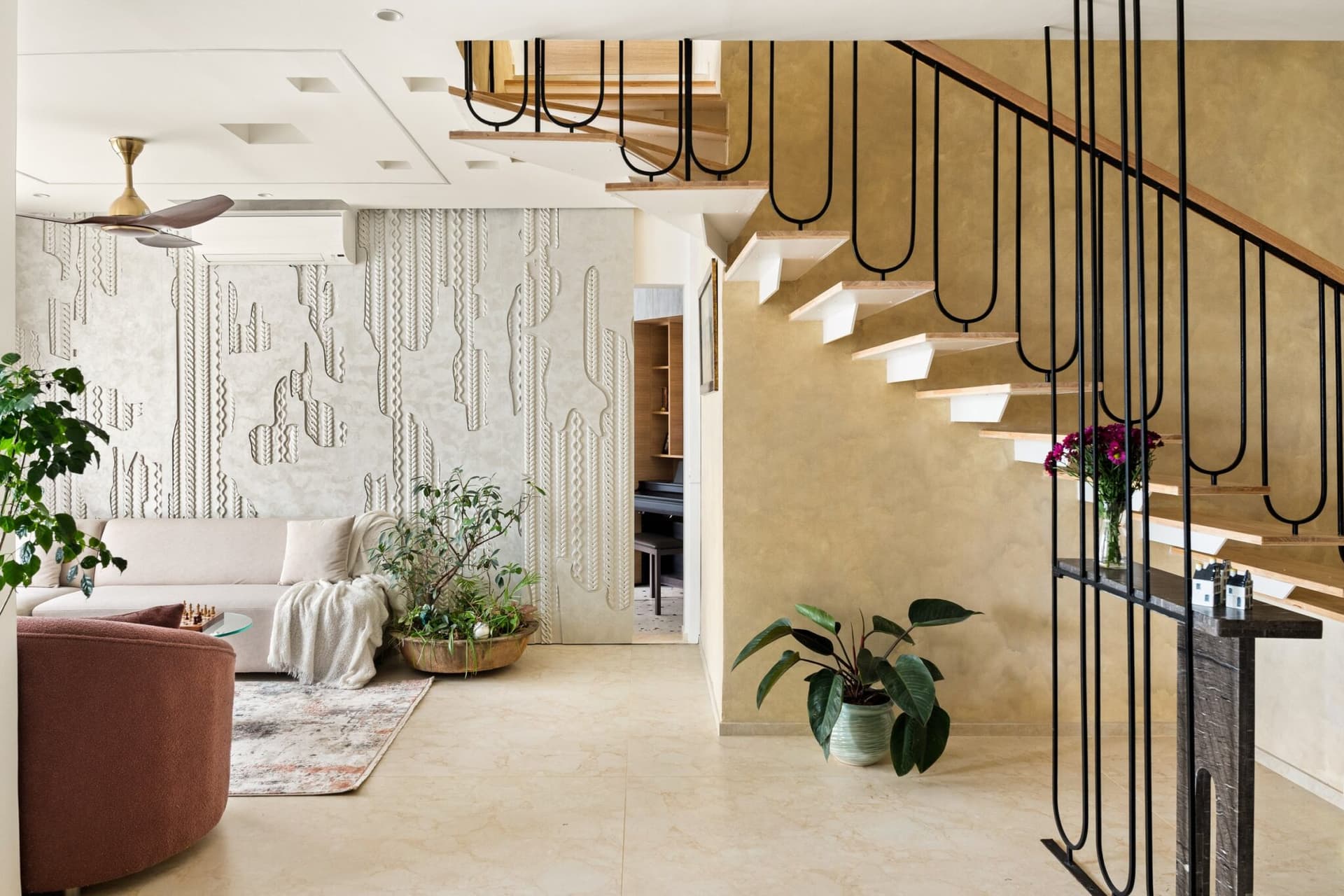
A home designed by its own architects is a particular kind of project, free of the usual negotiations, but unforgiving in a different way: every decision is yours to defend, every choice exposed to your own daily scrutiny. Stone Haven, a 1,500-square-foot apartment in Koyambedu, Chennai, was conceived under exactly this condition.
Designed by Kavya Rajendra and Deepak Sundaram of Studio One by Zero as their personal residence, the home is a study in materials chosen for the long view: stone that records its own making, wood that deepens with use, surfaces that ask nothing of the eye except occasional, sustained attention. The brief, in their own words, was a sanctuary that would feel calm after long days, warm and timeless, with materials that age beautifully.
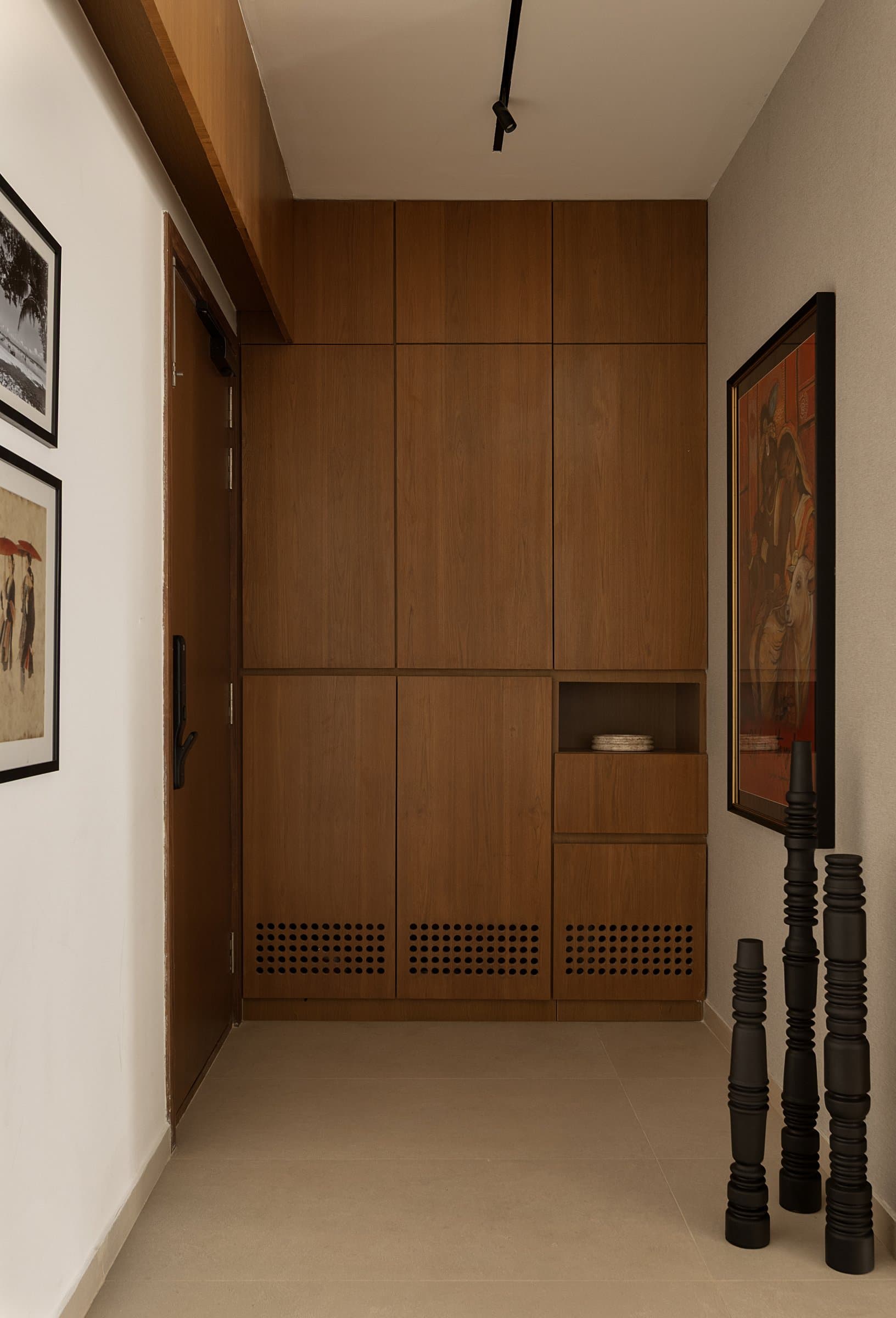
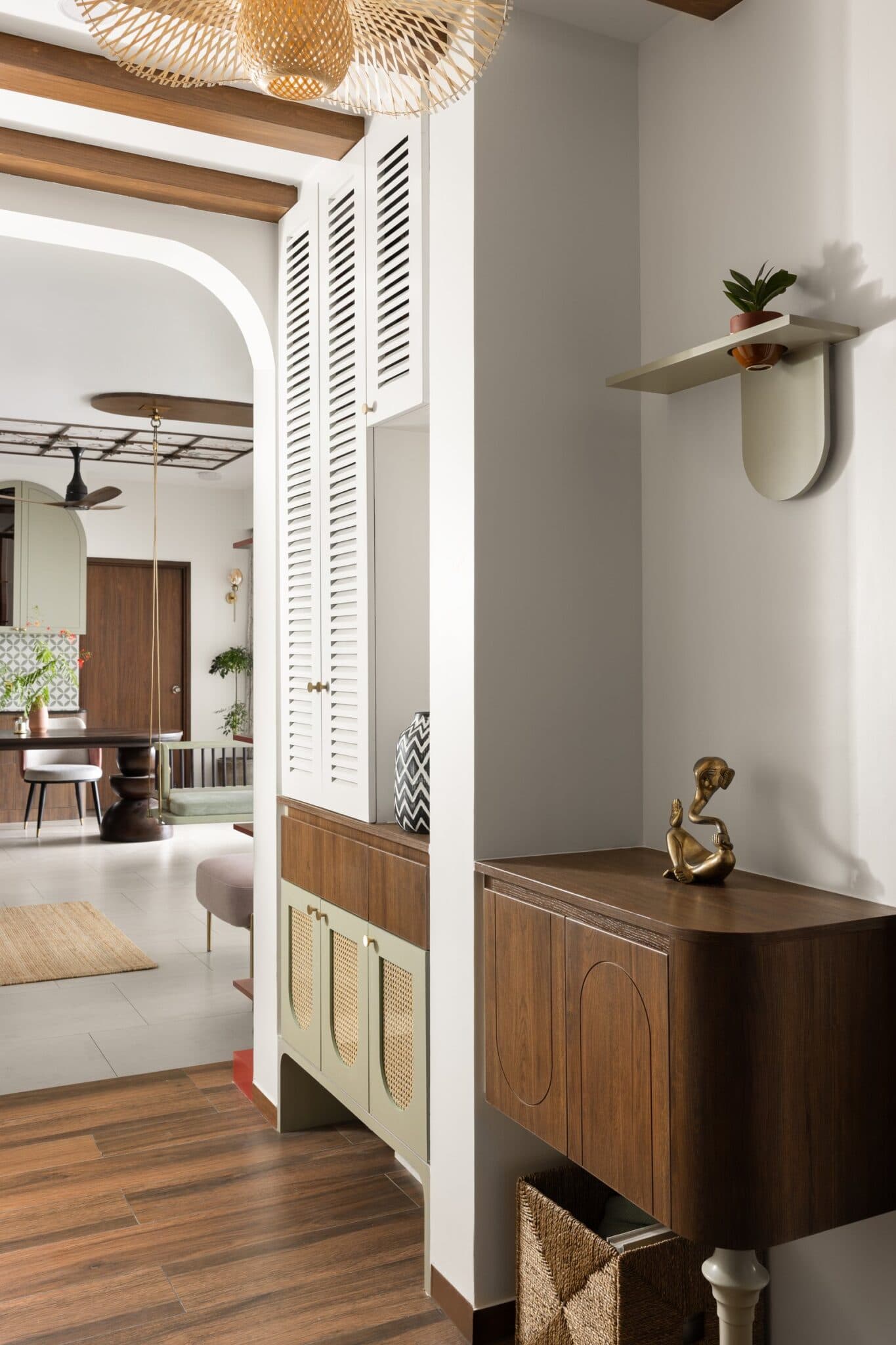
The entry sets the tone before the home properly begins. A floor-to-ceiling unit in warm veneer absorbs shoe storage, utility, and display into a single composed plane, its perforated lower panels offering ventilation as a quiet design detail rather than a service afterthought. The black turned-wood sculptures and a Krishna and Radha painting against a quiet neutral wall introduce the home’s interest in handworked surfaces, a thesis that will repeat in different registers across every room.
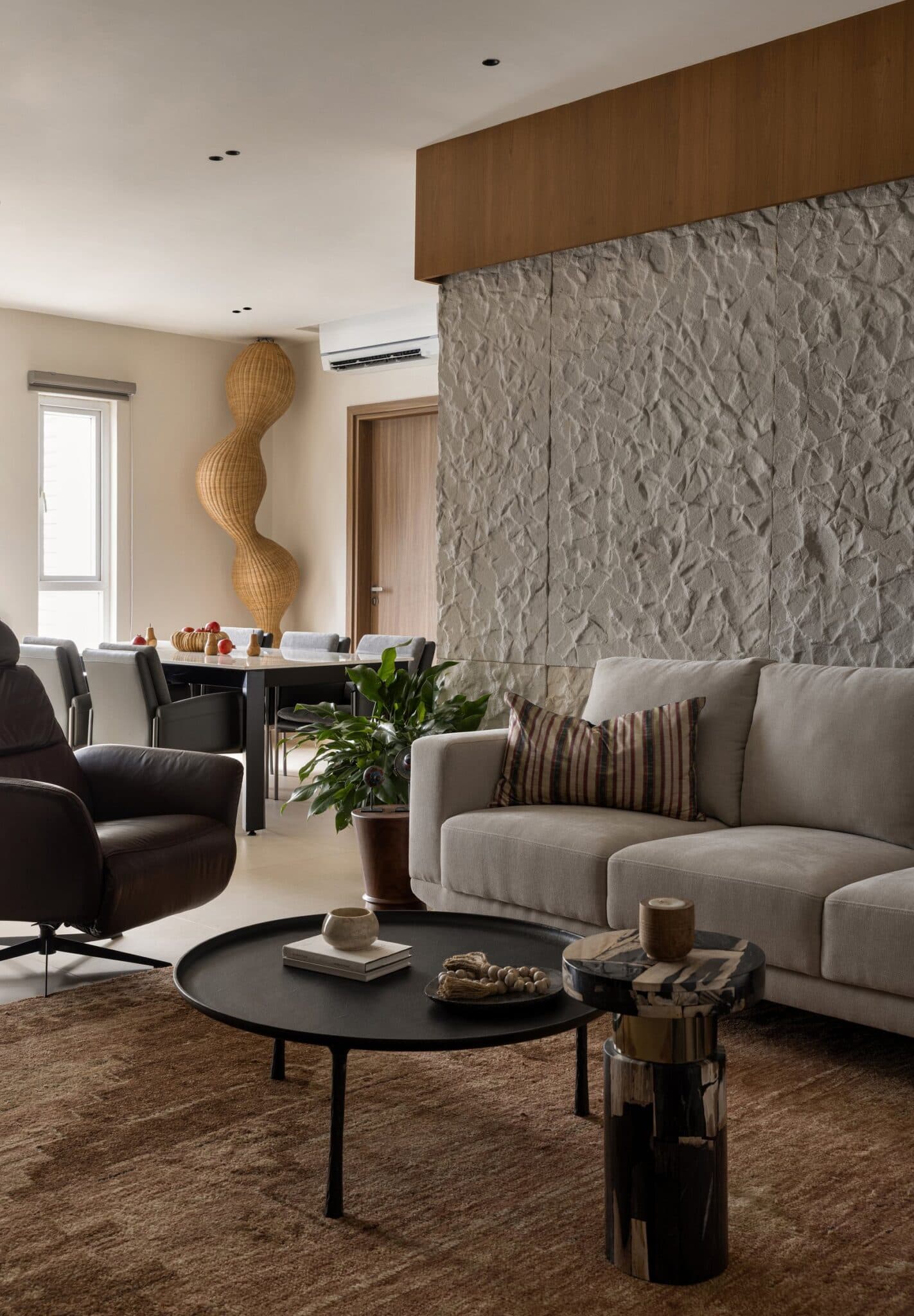
The living room opens onto its defining gesture: a wall of white sandstone from Stonelife, hand-finished to retain the irregular topography of cleaved rock. Capped above by a band of warm veneer, the wall holds the room together not through colour but through depth, the kind a flat finish could never produce. The earthy palette, a Jaipur Rugs carpet in oxidised browns, the pale linen sofa, a leather recliner, follows the wall’s lead rather than competing with it.
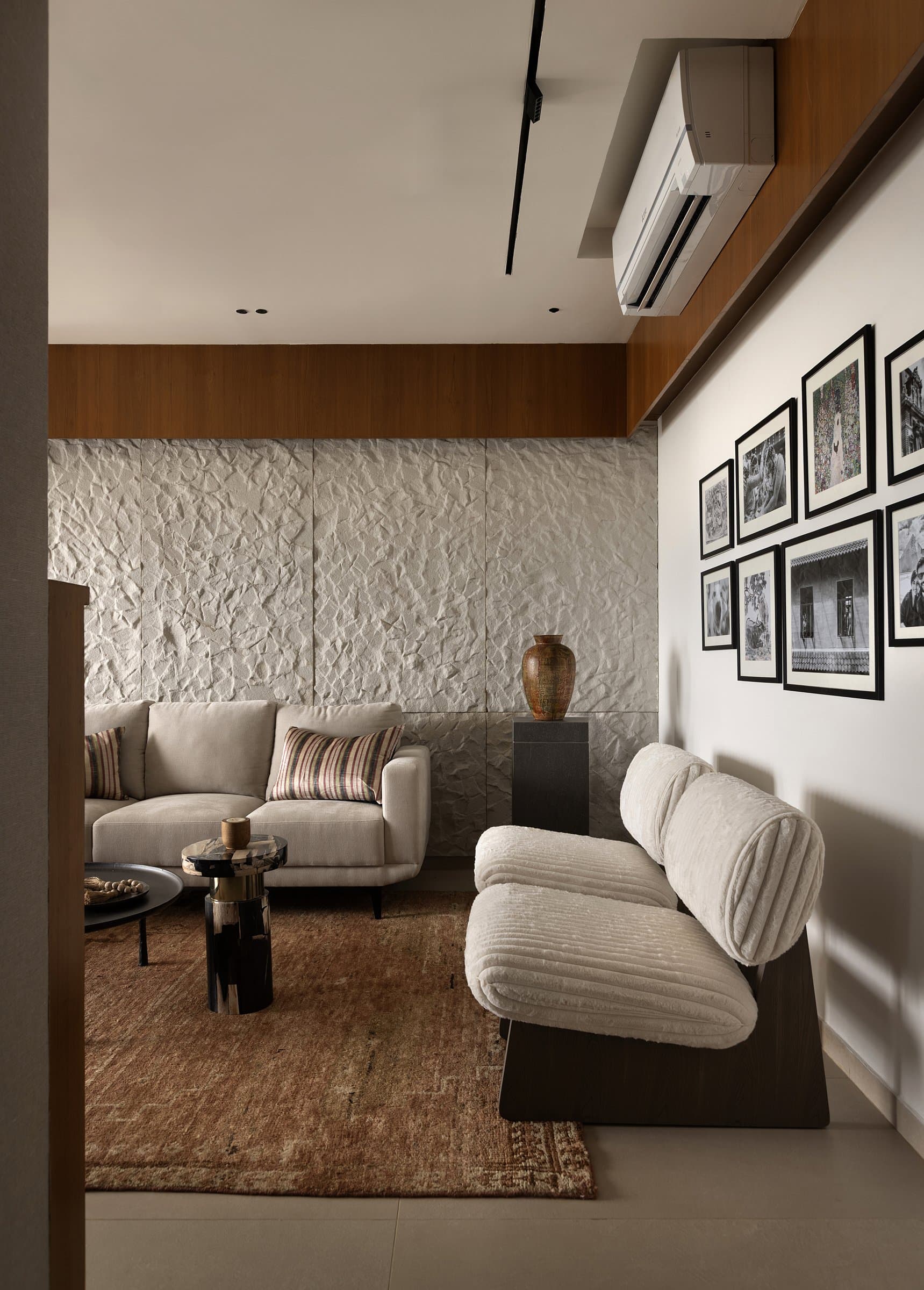
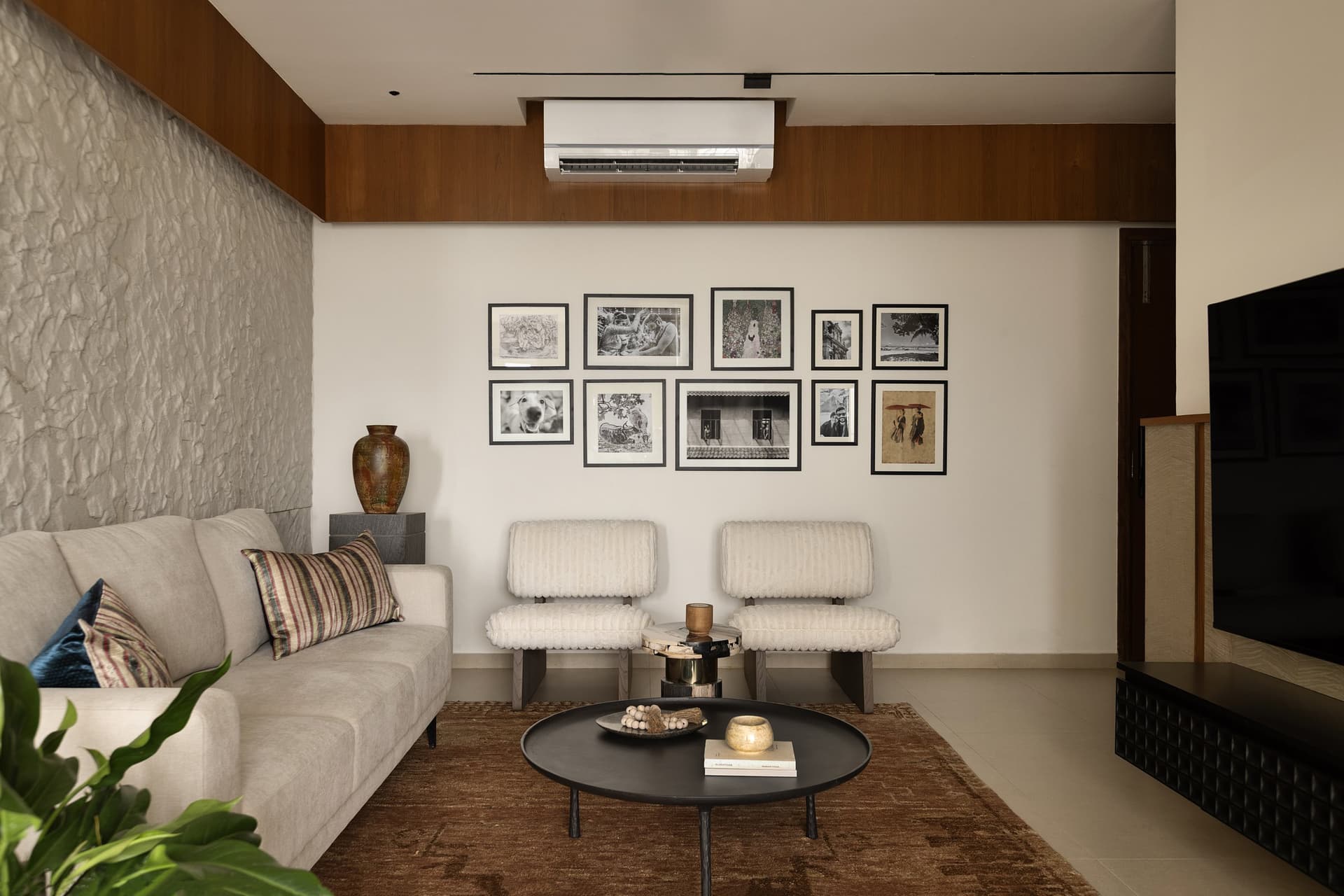
The wider view of the living room reveals how carefully the room balances its weight. The sandstone wall holds one end; the gallery of framed memories holds the other; between them, a black West Elm coffee table and a fossilised wood side table from Rare Lily mediate the space at floor level. Nothing is dramatic in isolation; the room works because every element has been calibrated against every other.
The TV unit deserves its own attention. A solid wood console with a pyramid-studded black finish reads as object rather than fixture, its surface catching light in small geometric pulses. Beside it, a textured vertical panel with a slim wood inlay softens the transition to the foyer’s veneer storage wall beyond.
In detail, the sandstone reveals what photography can only hint at: the irregular fracture lines, the way light falls into and out of each crease, the mineral pallor that holds the room’s warmth in suspension.
““In the living room, the first design choice we made, white sandstone from Stonelife, also became the heart of the space.””
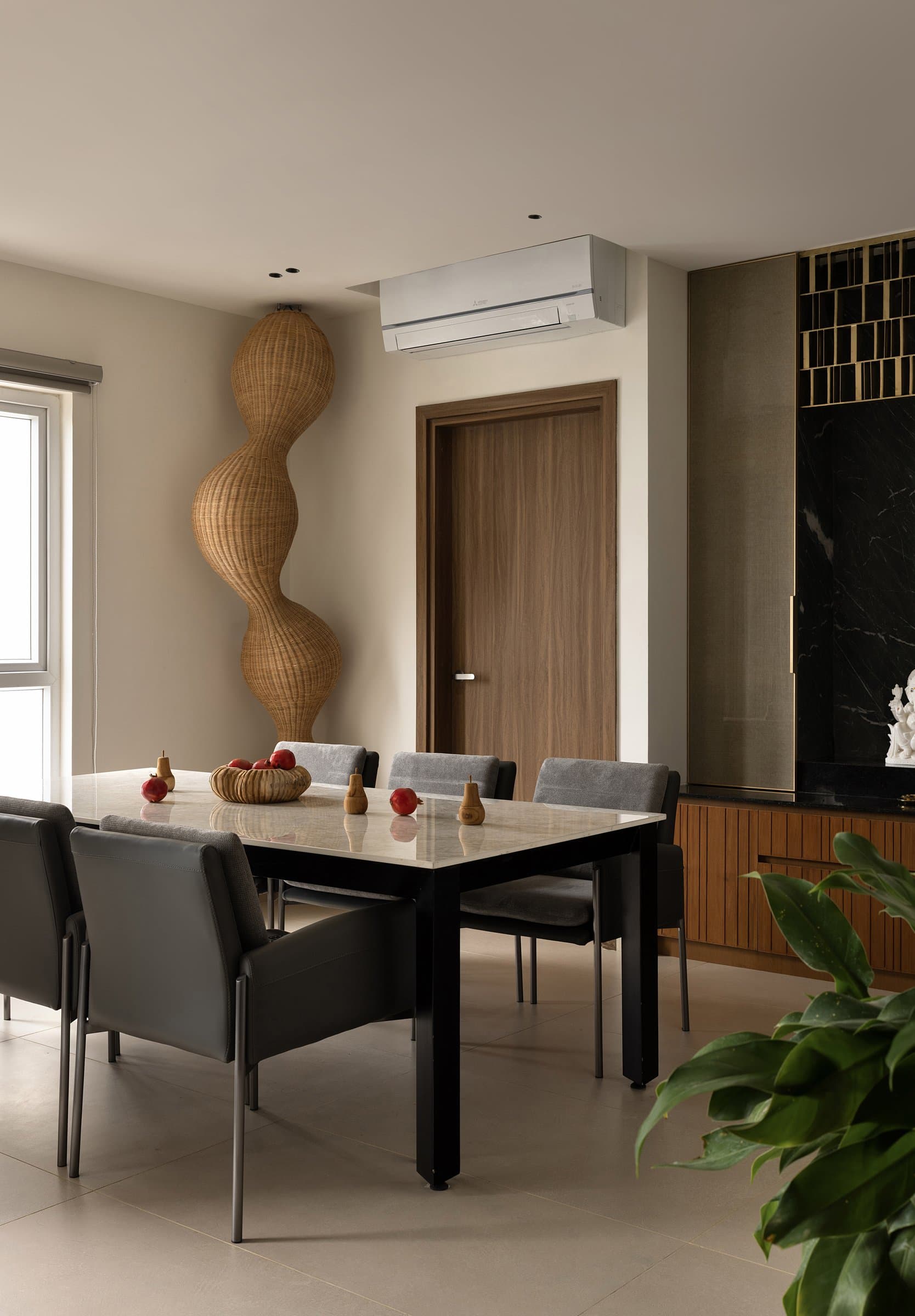
The dining area is anchored by an eight-foot-tall parametric cane installation designed in-house by the studio and built with local artisans. Its stacked, gourd-like volumes shift in profile as you move around the table, a sculptural counterweight to the room’s restrained marble-and-black-steel dining setup.
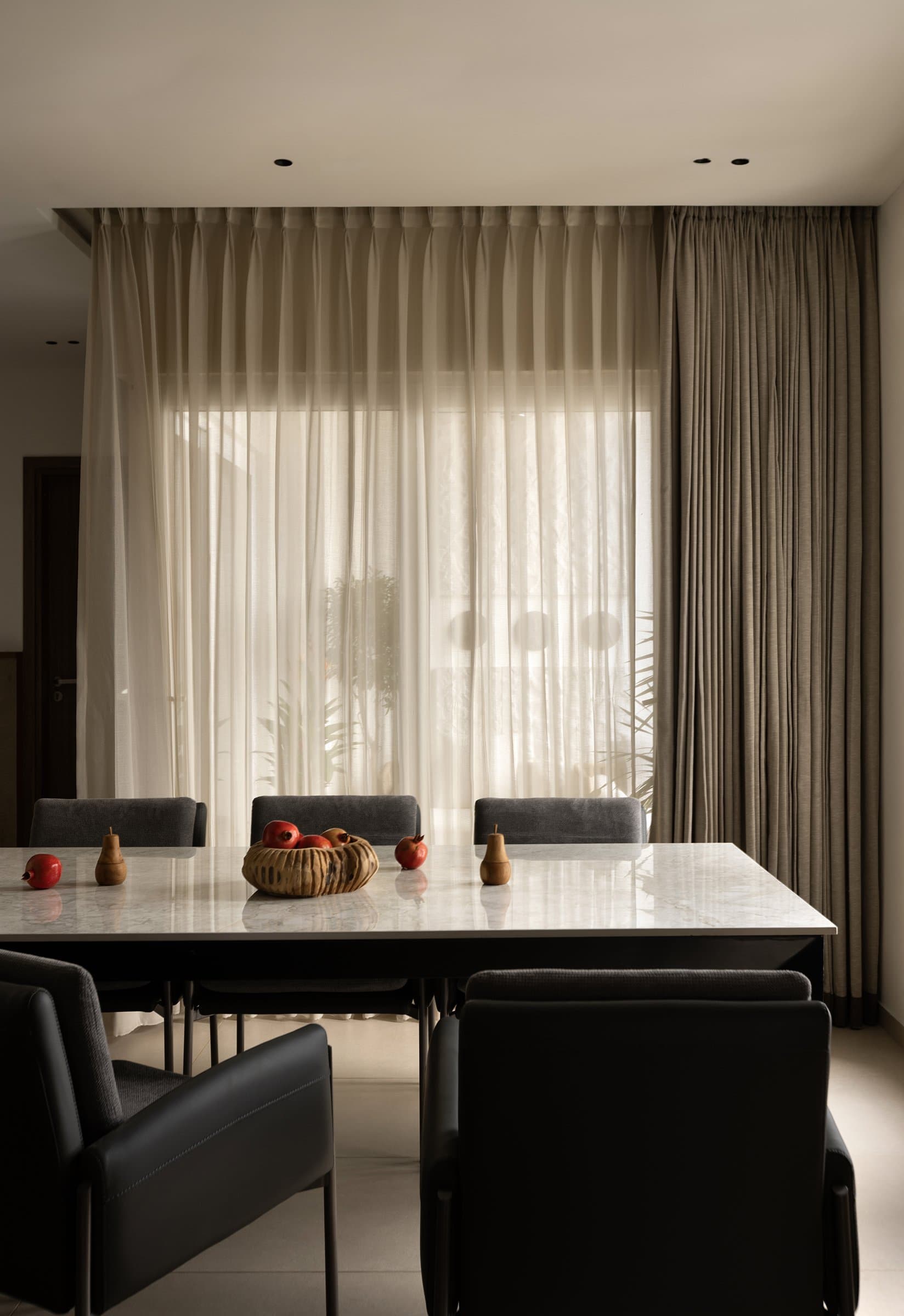
From the other side of the table, the room reveals its second register: layered curtains, a sheer ivory inner panel and a heavier taupe drape, that filter the generous Chennai light into something usable through the afternoon. The marble tabletop catches this softened glow without ever glaring.
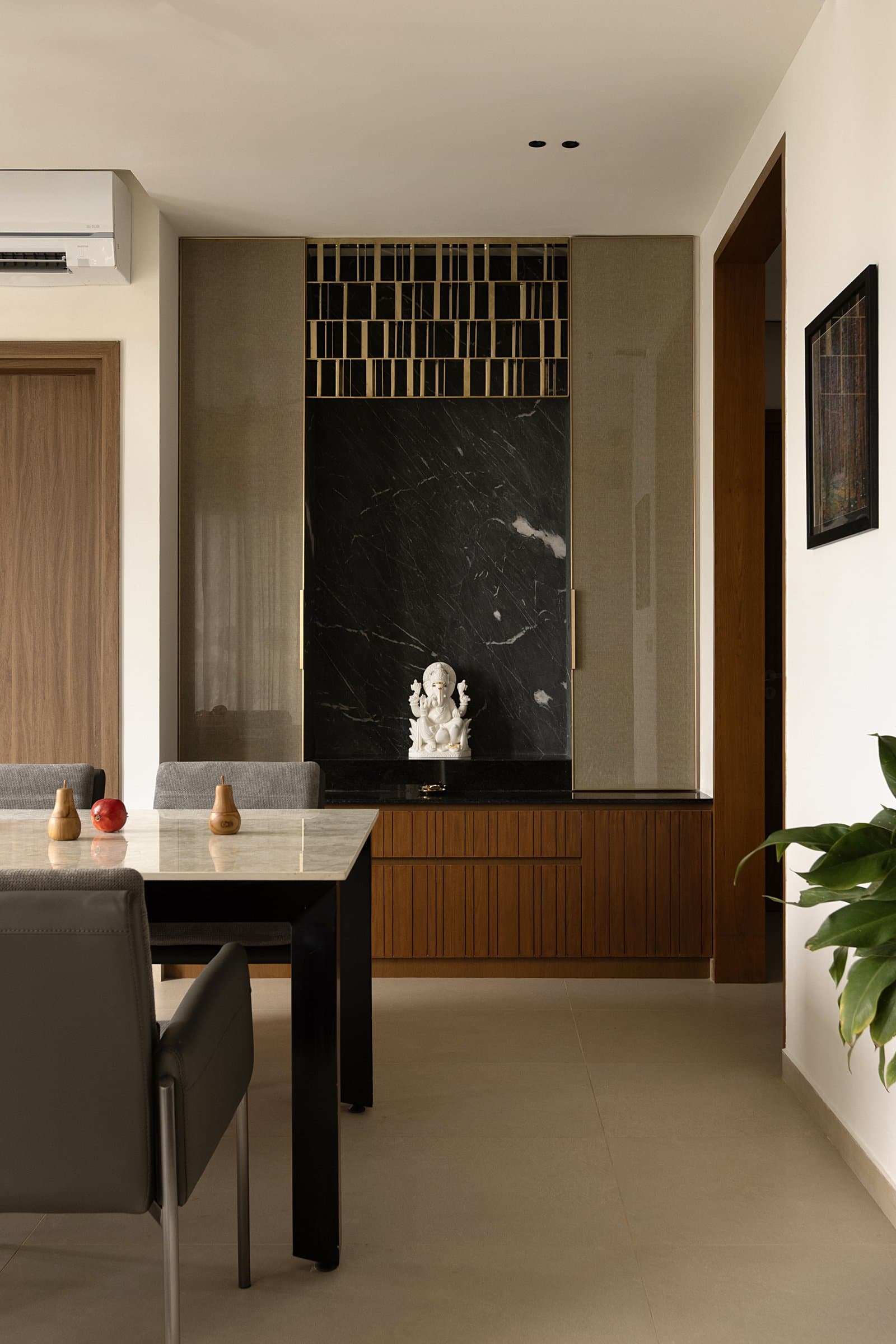
The puja room reads as a vertical composition embedded into the dining wall. A slab of river-washed green-black marble from Stonelife frames the white marble Ganesha; above, a brass jaali screen filters light into a warm, ecclesiastical pattern. Flanking shutters in fabric-sandwiched glass double as crockery storage, an intelligent piece of dual-use planning that never announces itself as such.
Seen at night with the jaali backlit, the puja niche becomes the home’s most quietly theatrical moment. The marble’s veining glows like weather; the brass grid casts a soft grid of light onto the stone behind the deity. It is the rare element in the apartment designed to shift dramatically between day and evening.
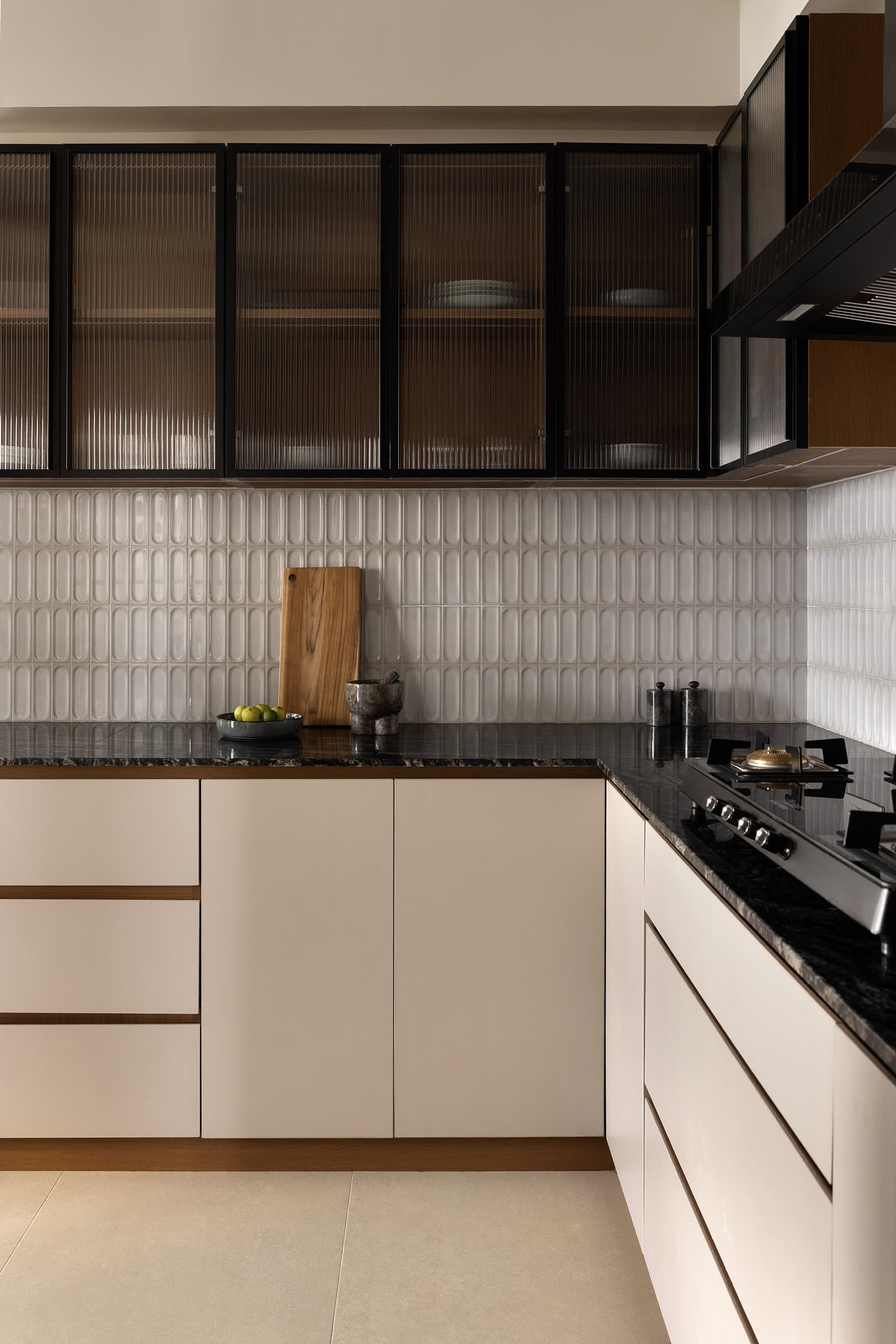
The kitchen continues the home’s argument for restraint with texture. Cream cabinetry sits below a granite counter in deep, mineral black; the backsplash, in a glazed three-dimensional white tile, introduces a subtle ribbed rhythm that picks up sidelight. Reeded glass upper cabinets framed in slim black steel close the loop on the home’s recurring vocabulary of fluted, layered surfaces.
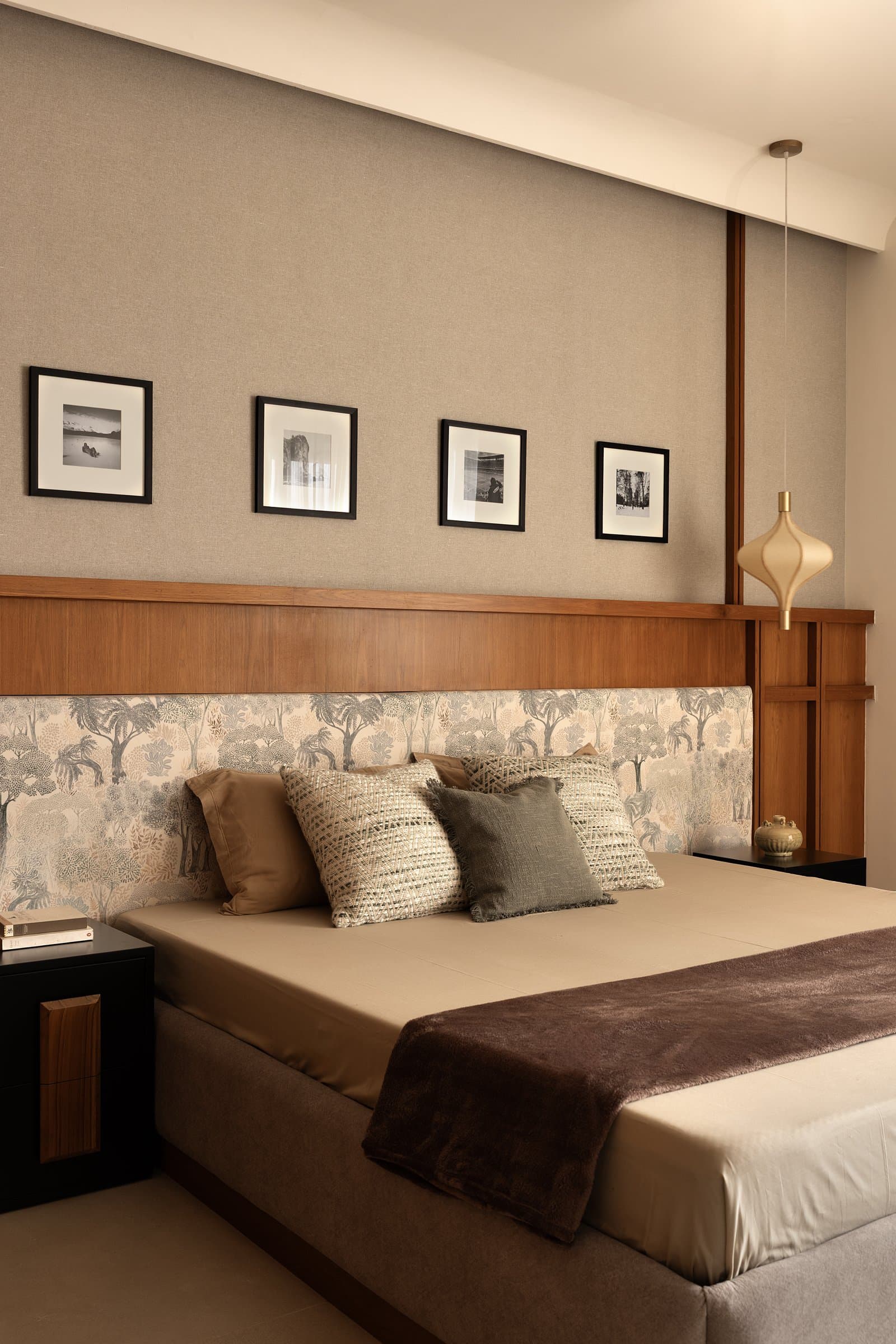
The master bedroom turns inward and warm. A horizontal panel of veneer runs the length of the headboard wall, set above a printed forest scene panel that runs behind the bed in soft, painterly landscape. Above, a fabric-finished upper wall holds four small black-and-white photographs from the couple’s travels, each given equal, unhurried space.
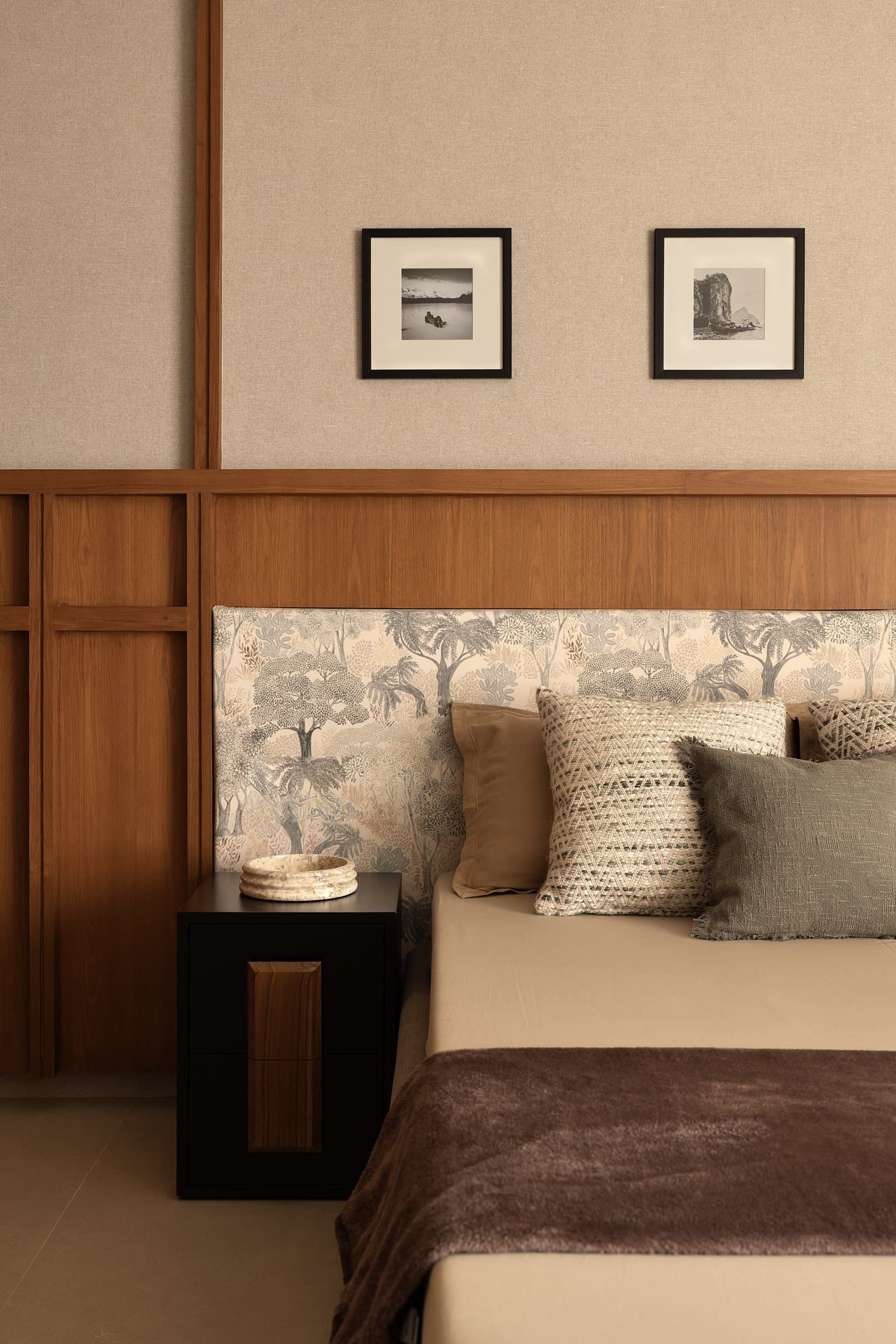
In closer view, the headboard’s craftsmanship comes forward: the way the veneer is detailed into slim mullions on the side wall, the precision with which the printed wallpaper is set within a clean wood frame. A black bedside cabinet with a single sculpted wood pull punctuates the composition.
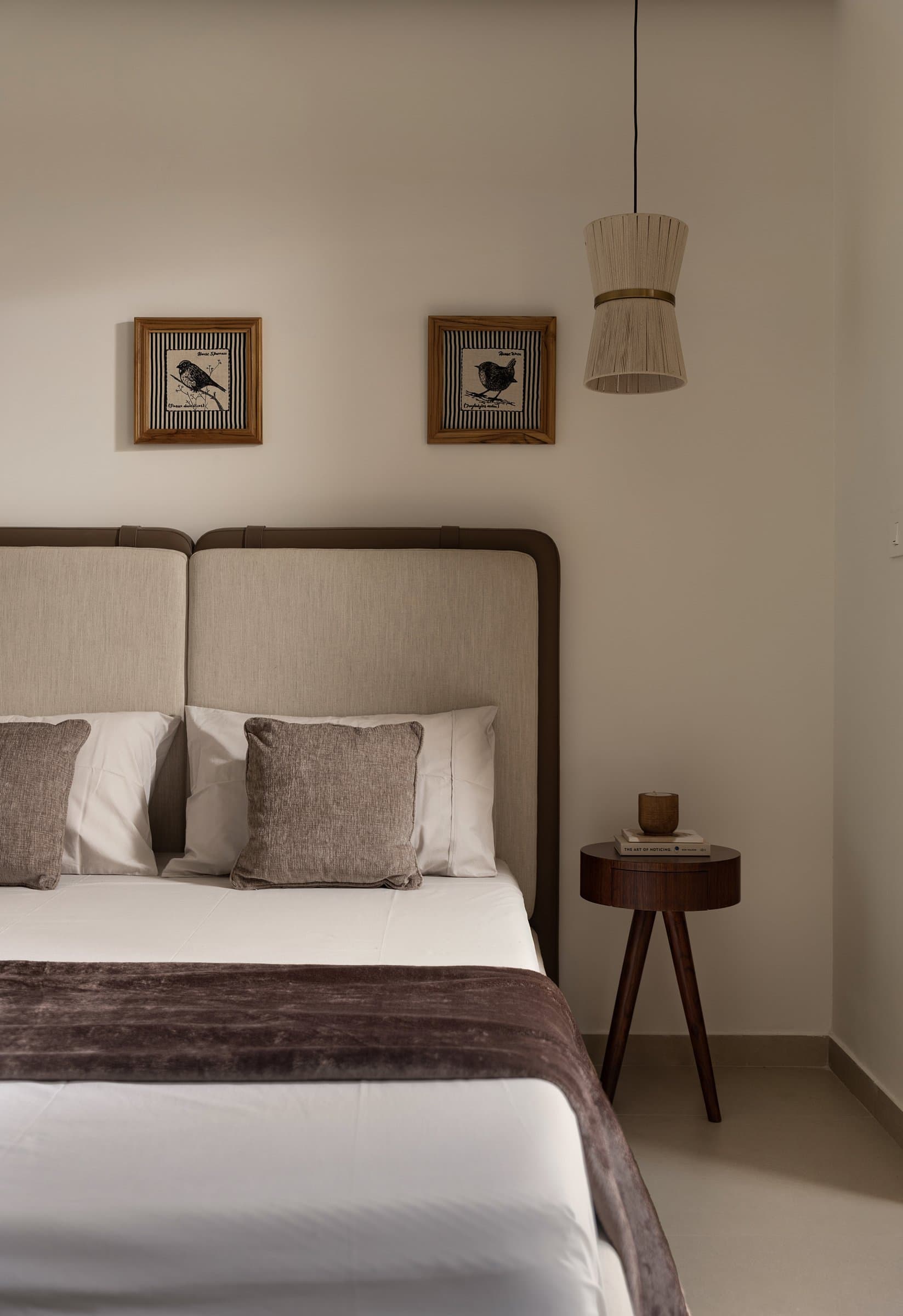
The guest bedroom is deliberately quieter. An upholstered linen headboard with rounded edges, two small bird prints in pale wood frames, and a slim three-legged walnut side table under a paper-pleated pendant: the room is small, and the design respects that, keeping the palette pale and the gestures few.
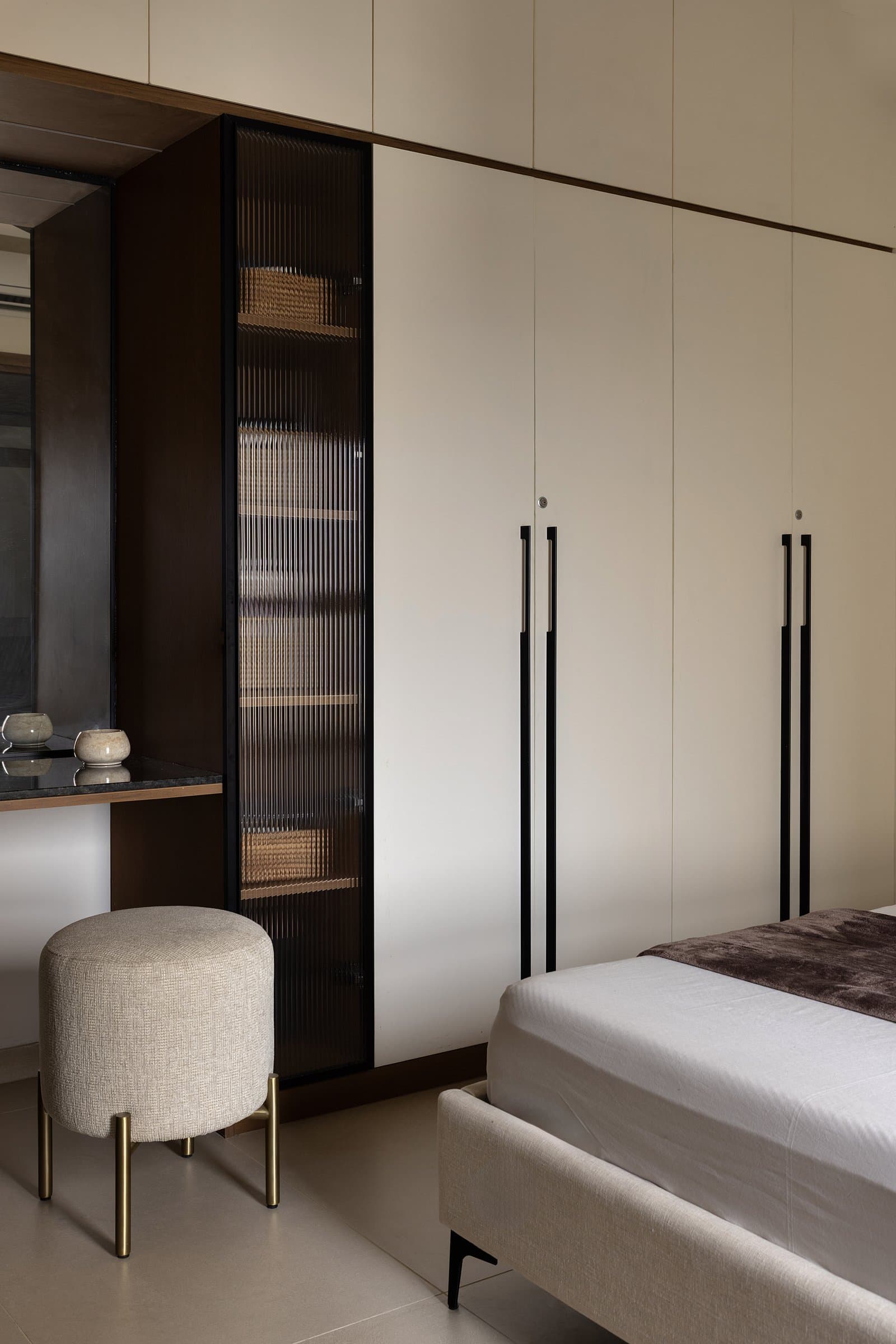
Across from the bed, a wall of cream wardrobes with elongated black-and-brass pulls handles the room’s storage without visual weight. Tucked beside it, a compact dresser with a reeded glass cabinet and a soft upholstered stool turns the corner into a small dressing moment, light, ordered, almost monastic.
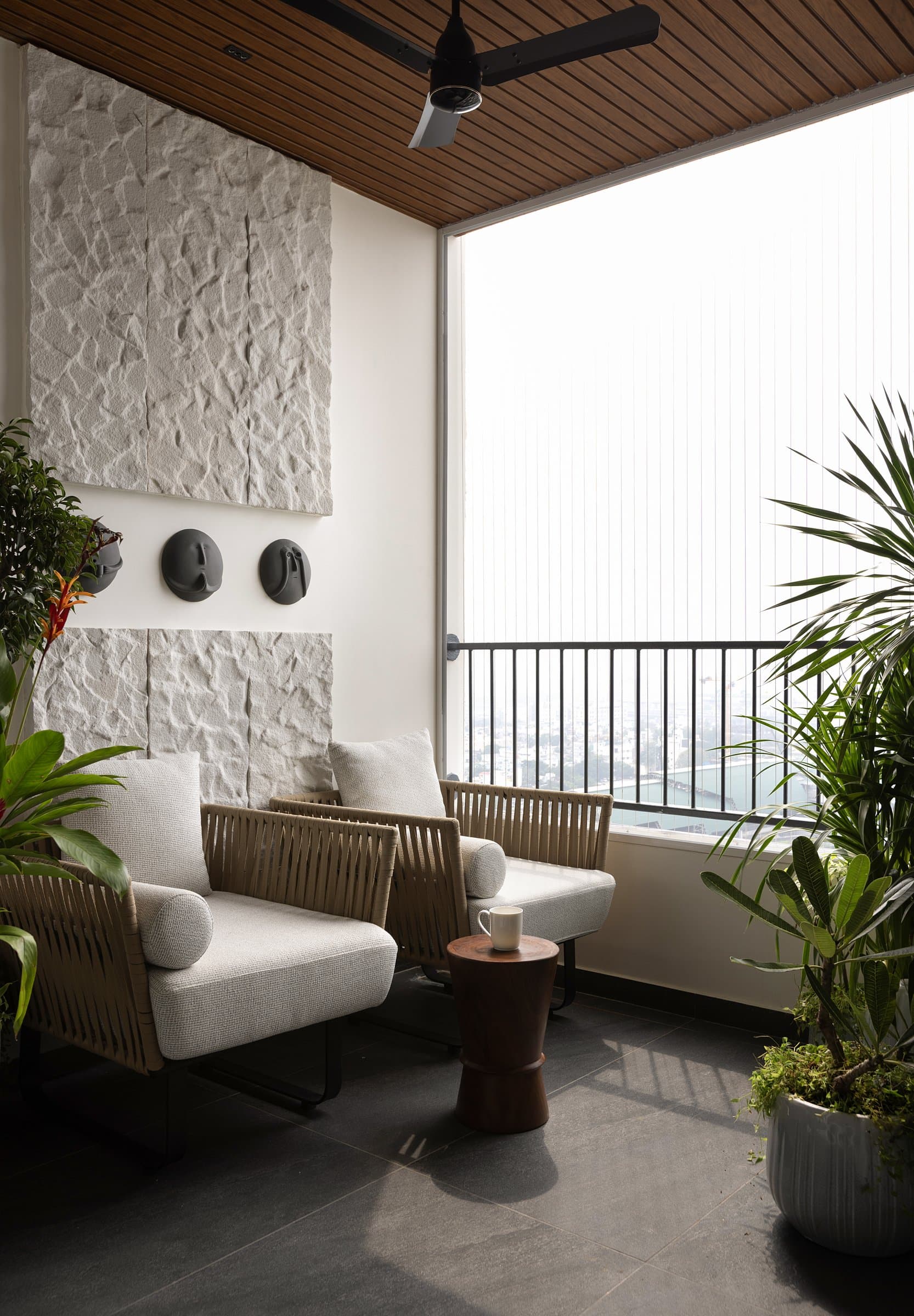
The balcony, set between living and dining, is the home’s true exhale. Off-cut sandstone from the living room wall returns here as a pair of textured panels, paired with Claymen’s matte black face plaques and a slatted wood ceiling that softens the city beyond the railing. Two woven outdoor lounge chairs and a small turned-wood side table make this a room you would actually use, not merely admire from inside.
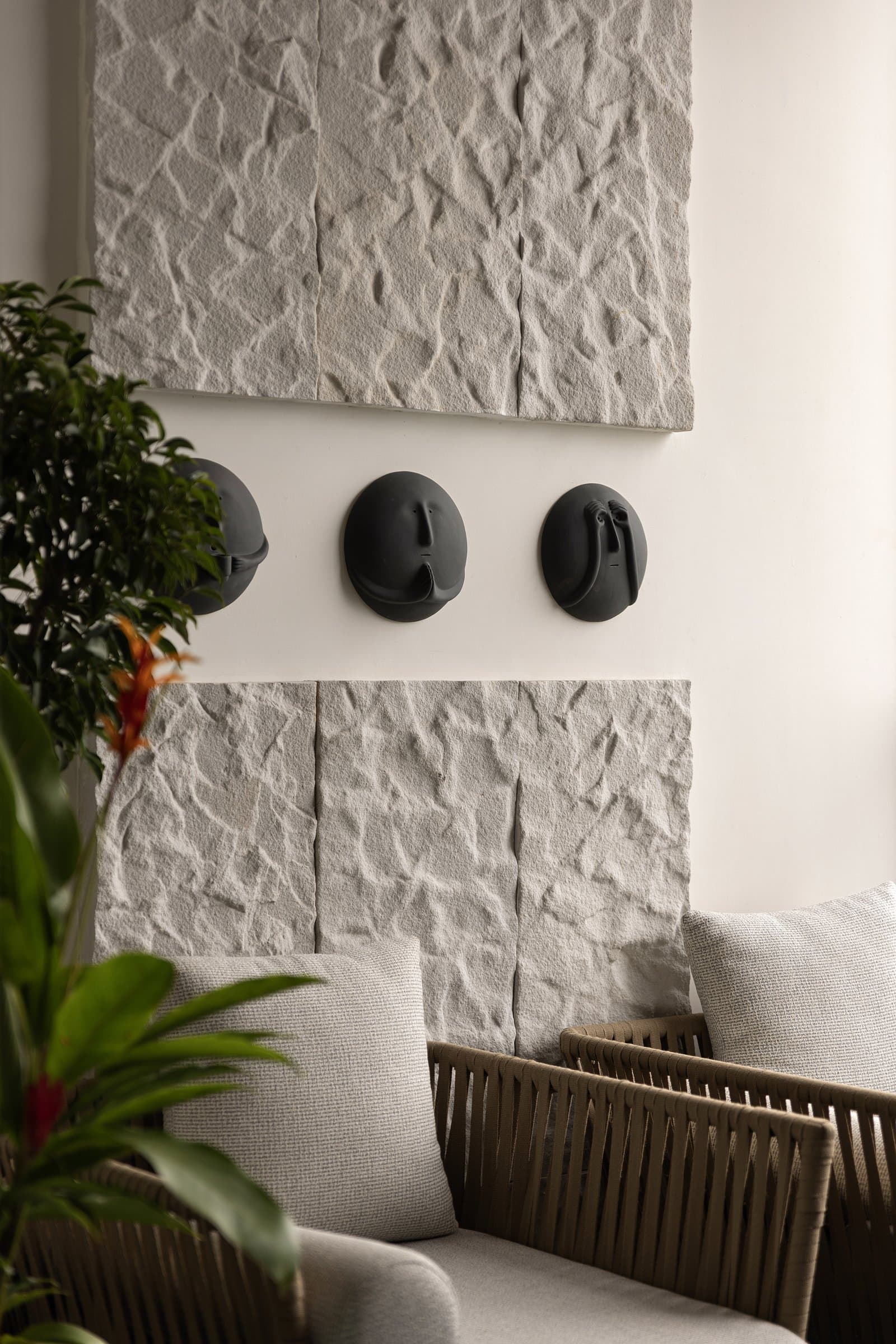
In closer view, the balcony reveals the studio’s instinct for material economy. The stone left over from one wall becomes the artwork on another; the trio of Claymen faces, set between the upper and lower stone panels, anchor the composition with just enough quietness to keep the wall from feeling like a display. The plants do the rest, returning colour and movement to a palette otherwise held in greys and whites.
What is striking about Stone Haven is how unhurriedly it argues its case. In a city where new high-rise apartments often feel pressured to demonstrate ambition through finish and gloss, this home moves in the opposite direction, toward materials that record time, light, and use rather than resist them. The references, sandstone, brass, river-washed marble, hand-built cane, sit comfortably alongside contemporary furniture without performing heritage.
For an apartment designed by its own architects, the project’s quietest achievement may also be its most personal: the home does not feel finished so much as inhabited. Stone Haven proposes that the most enduring kind of luxury is the kind that asks to be lived with, slowly.