There is a kind of decorating that confuses ornament with confidence, and another kind that knows the difference. This Mumbai apartment belongs firmly to the second tradition, where every scallop, every arch, every fluted surface is placed with the steadiness of a designer who has decided what the home should feel like before deciding what it should contain.
Designed by Inside Story Studio, the residence reads as an extended meditation on soft geometry. Arches recur as thresholds, scallops as edges, fluting as a quieting device on cabinetry and walls. The palette stays close to the ground, dusted ivories, muted blues, dusty pinks, oxblood reds and the occasional indigo punctuation, so that the architecture of curve and rhythm can do the talking.
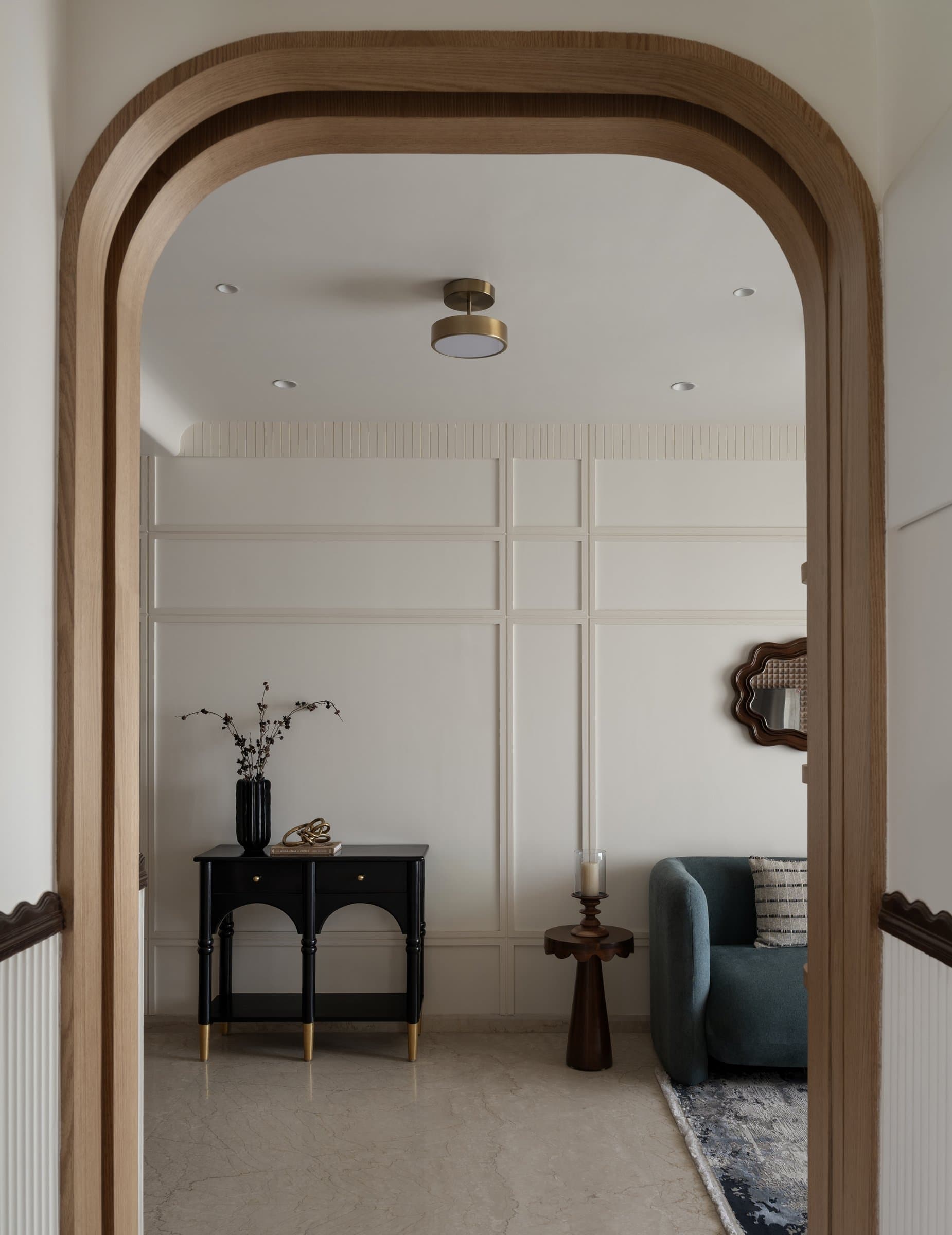
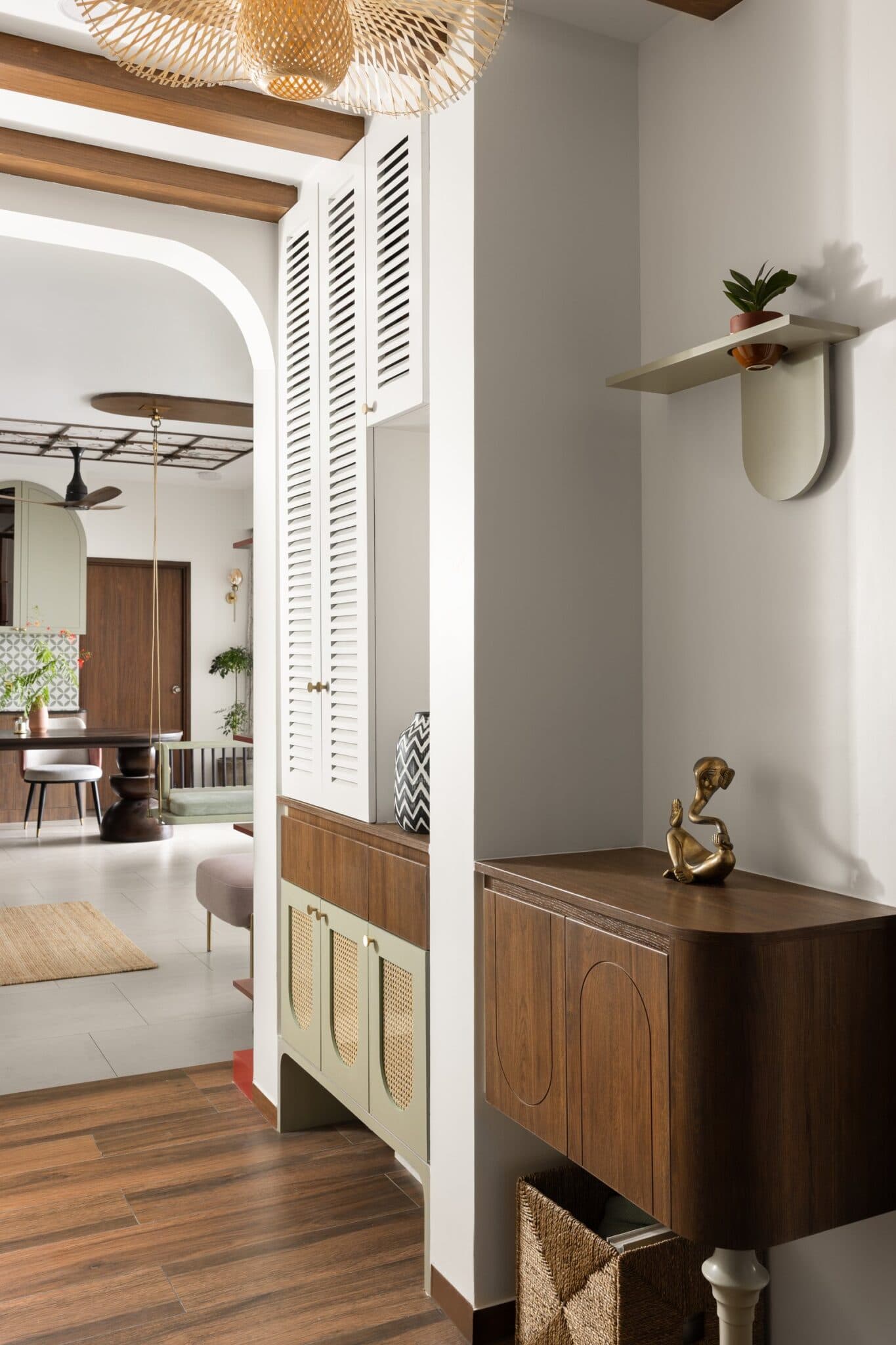
Entry into the home is staged through a generous arched portal in pale wood, framing the foyer like a proscenium. A black turned-leg console, finished with brass-tipped feet, anchors the wall against ivory wainscoting laid out in a calm grid.
The arch is not decorative shorthand here, it is a structural argument. By rounding the threshold, the studio softens the transition from corridor to home, signalling that the rooms beyond will move in curves rather than corners.
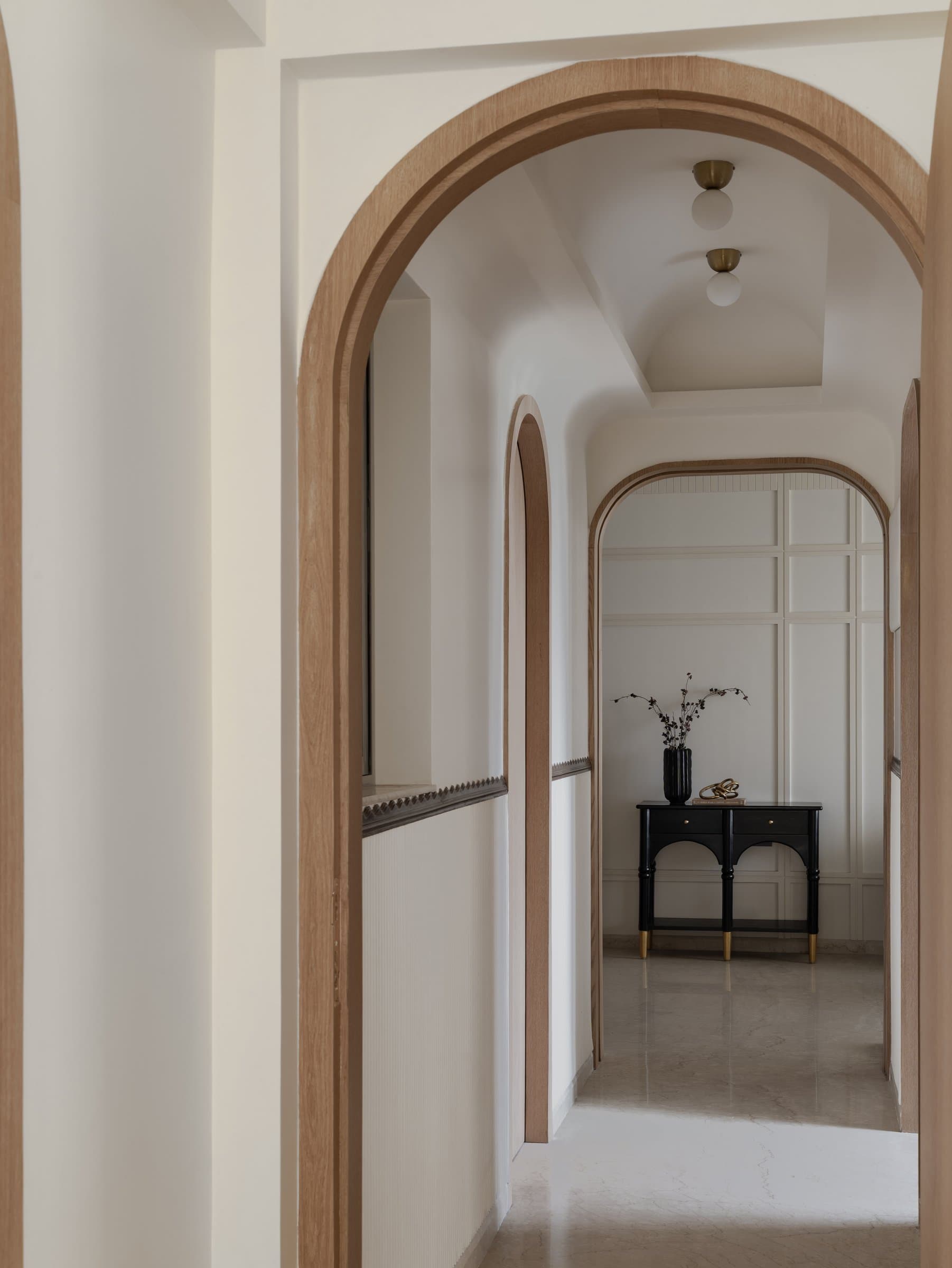
The corridor itself is treated as a sequence of arches in graduated scale, each framed in honeyed wood and stitched together by fluted dado panelling. The effect is closer to a cloister than an apartment passage, ceremonial without ever feeling solemn.
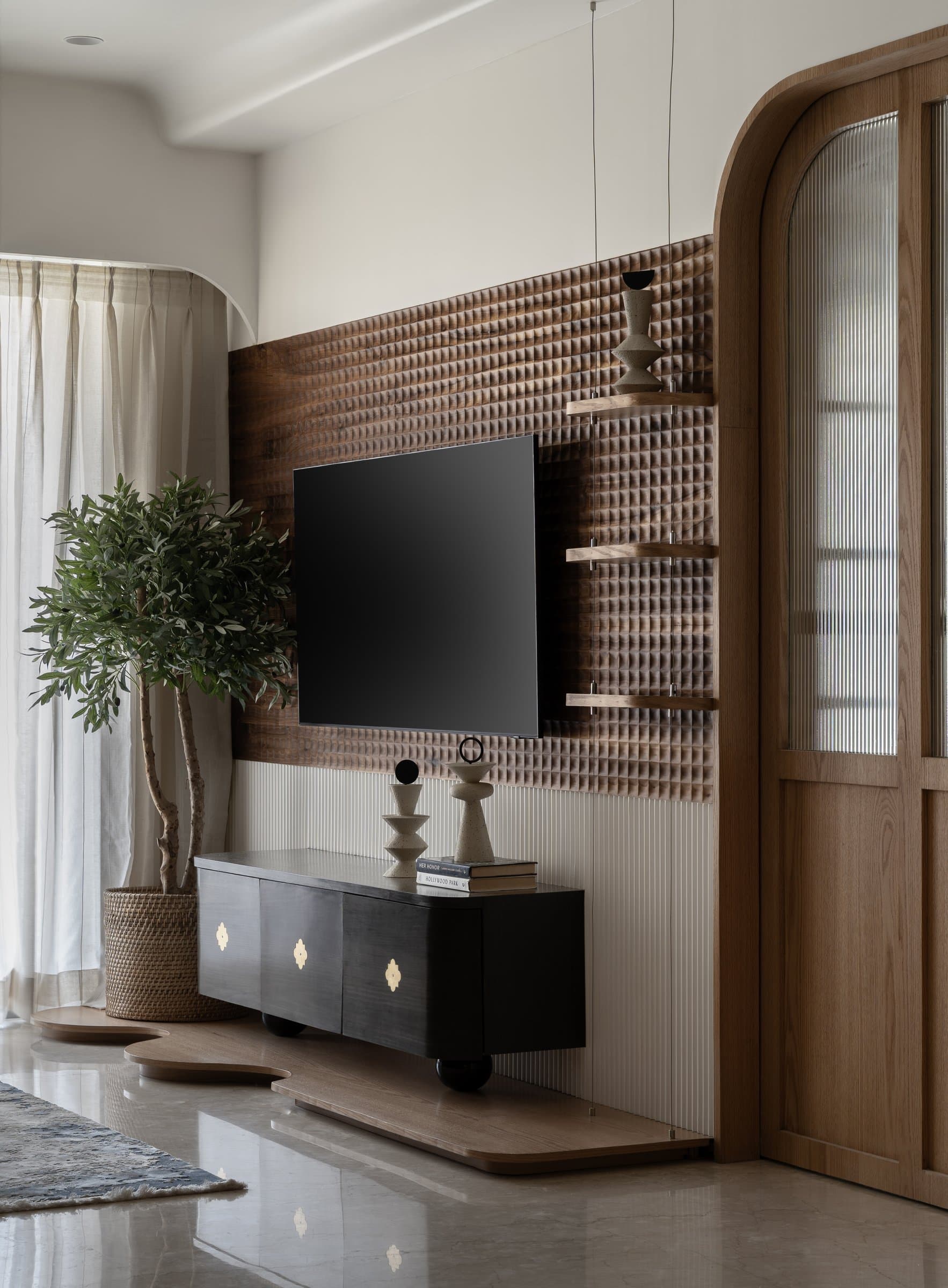
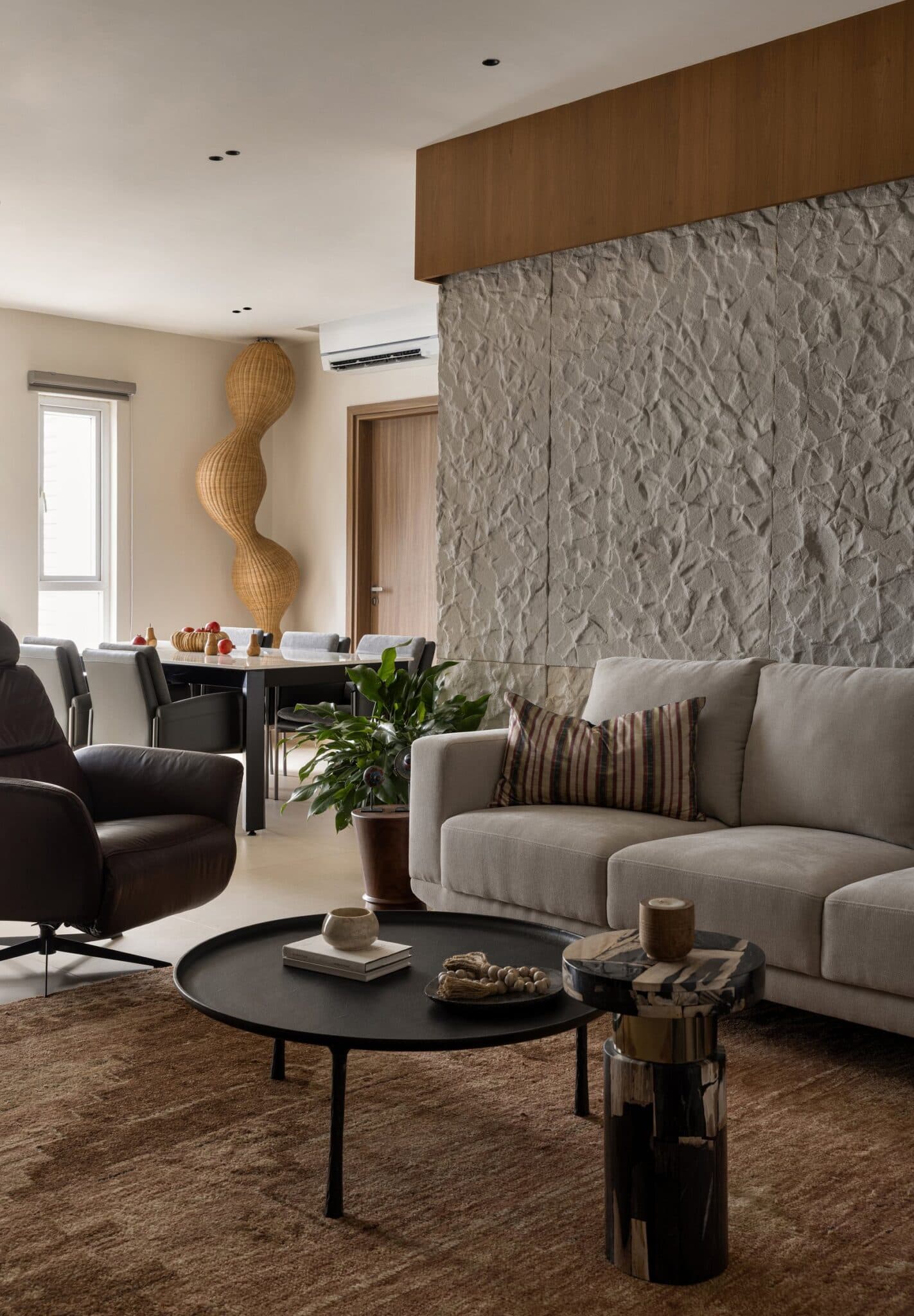
The living room opens with its most ambitious gesture: a media wall composed of a deep, hand-tooled grid in dark wood, paired below with reeded cream panelling and a blackened console punctuated by brass quatrefoil pulls. A potted olive tree on a woven base softens the geometry without diluting it.
What makes the wall succeed is restraint in pairing. The studio resists the temptation to layer further; the textured grid is allowed to be the singular voice, with the fluted band beneath acting as its quiet baseline.
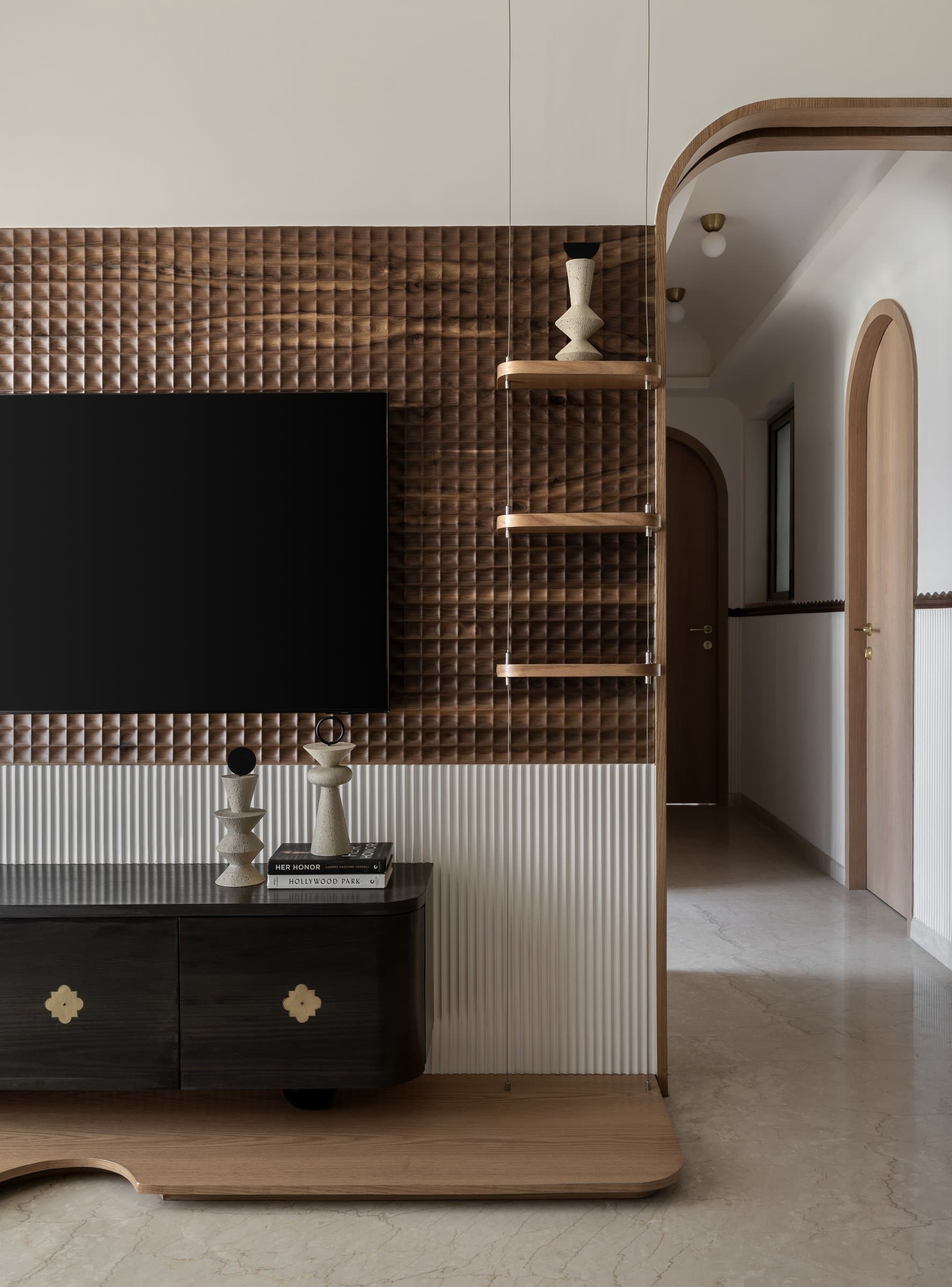
From an oblique angle, the same wall reveals its second job, that of a screen. The composition stands free of the corridor behind it, which curves away under a low barrel ceiling lit by twin brass-and-opal flush mounts. The home is being organised in plan as much as in elevation.
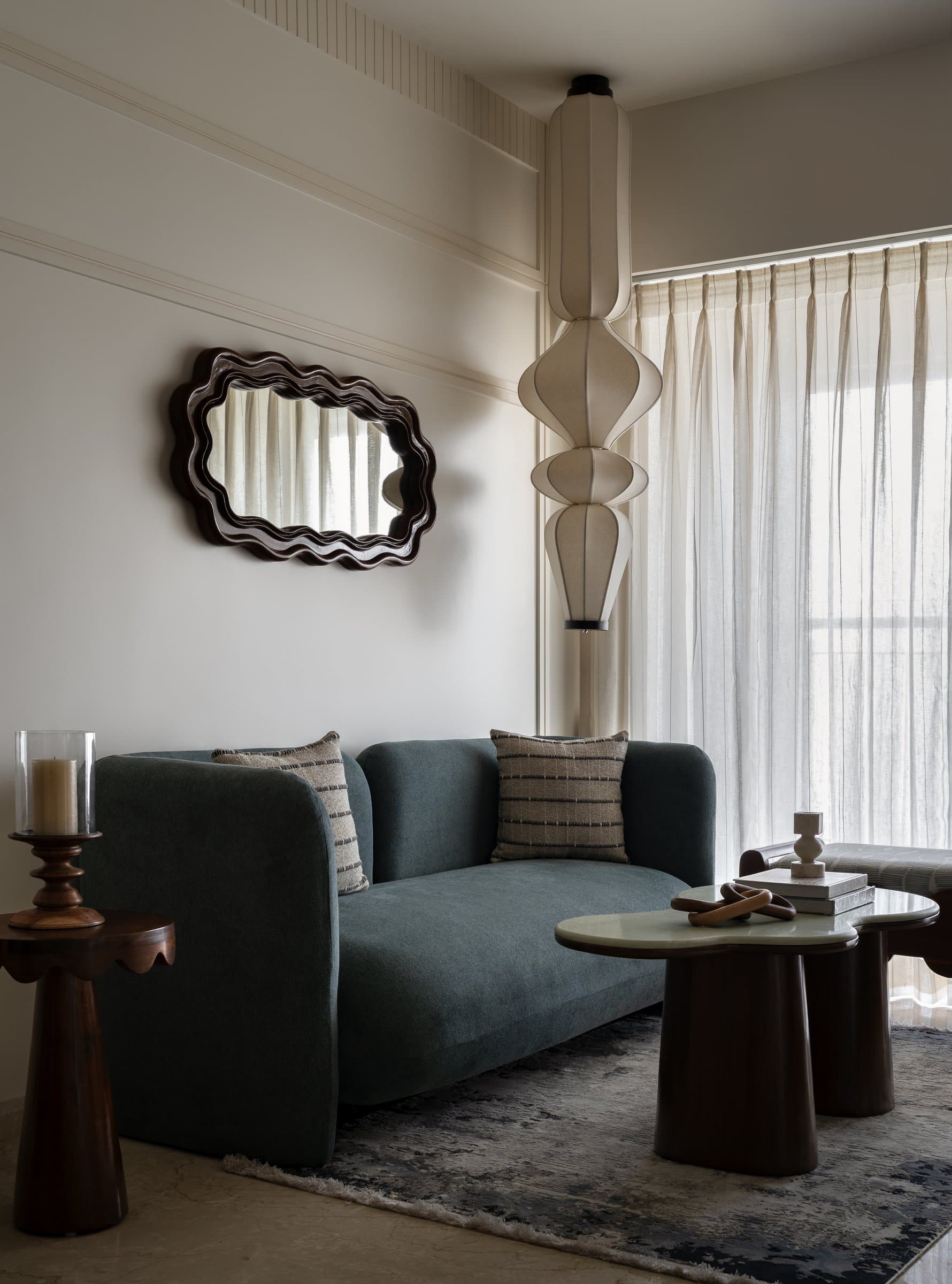
The seating area is pulled toward a tall window, anchored by a teal-blue settee with rounded arms and a pleated fabric pendant that drops in tiered lantern silhouettes. A scalloped wood-framed mirror hovers above, echoing the curves without mimicking them.
““We wanted curves to behave like punctuation, not decoration, soft enough to relax the room, deliberate enough to give it structure.””
By evening, the same corner shifts register entirely. The pendant glows with a warm interior light, the settee deepens in tone, and what reads as architectural in daylight becomes almost domestic theatre after dark. Few rooms manage this kind of dual life without feeling overdesigned for either.
A closer look reveals the discipline beneath the softness. The wall behind the settee is a quiet grid of recessed panelling, the side table a turned walnut piece carrying a single pillar candle. Nothing competes; everything supports.
At the centre of the living room sits an unmistakably contemporary object: an organic, cloud-shaped coffee table in pale celadon, perched on two dark cylindrical legs. A wooden chain-link sculpture rests on it like punctuation.
The conversation between the cloud table and the rounded teal sofa is where the room’s thesis becomes legible. Soft geometry is not a style here, it is a system, and even the side bench in carved walnut, with its scalloped apron, has been chosen to belong to that system. The home repeatedly rewards this kind of reading.
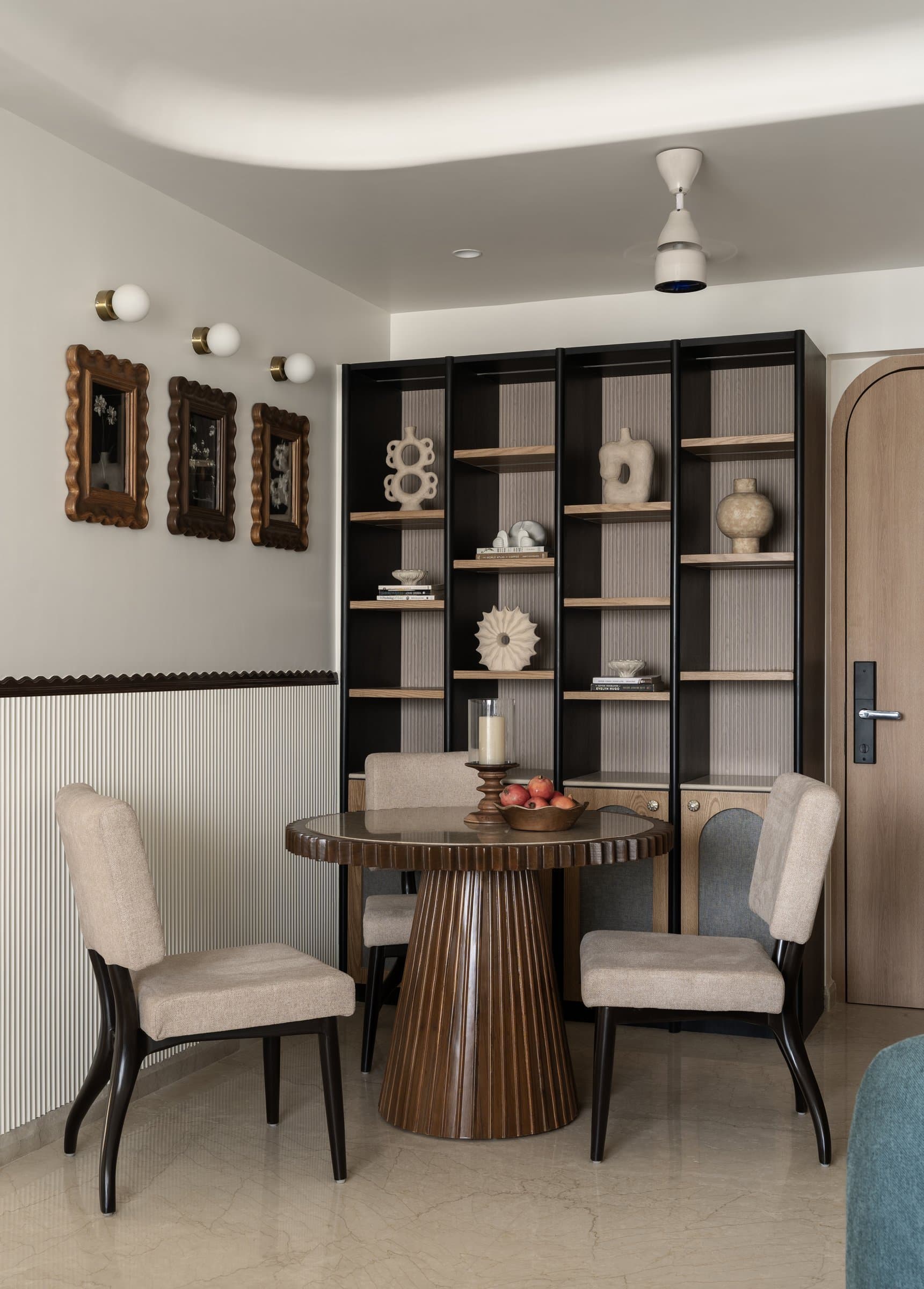
The dining alcove is set into the larger living volume, framed by a tall black-framed display unit with reeded backing that holds a curated rotation of ceramics and books. A round pedestal table with a deeply fluted base, paired with two upholstered chairs on slim black legs, completes the composition.
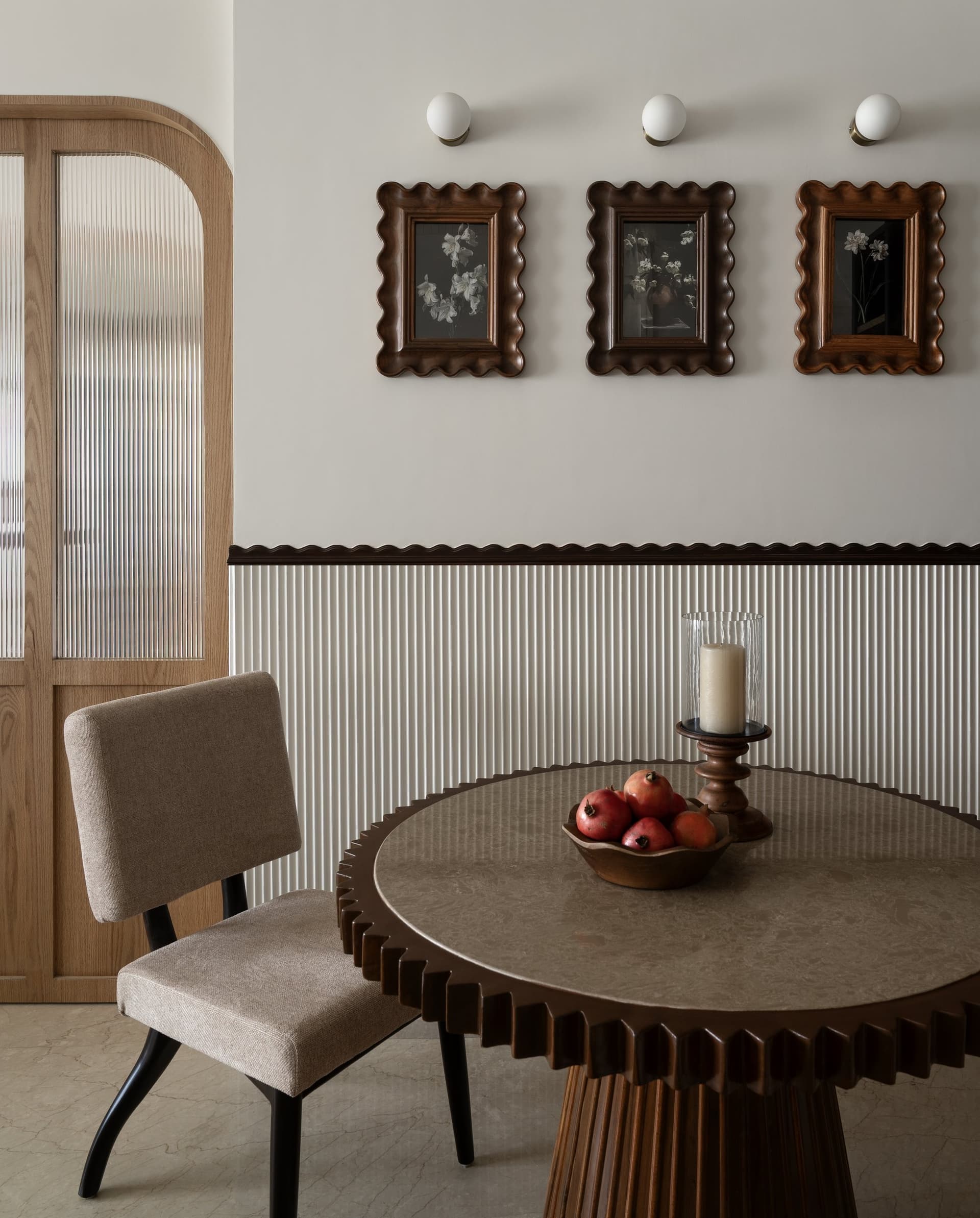
The dining table itself, a circular piece in marbled stone resting on a wood pedestal carved with sunburst flutes, behaves like a piece of sculpture in the round. It is the room’s quiet showpiece, and the fluted backdrop reads as its plinth.
Closer in, the table edge reveals its full vocabulary, a perimeter of repeating vertical chamfers that catch light as the day shifts. A timber bowl of pomegranates and a turned candleholder are all the styling the surface needs.
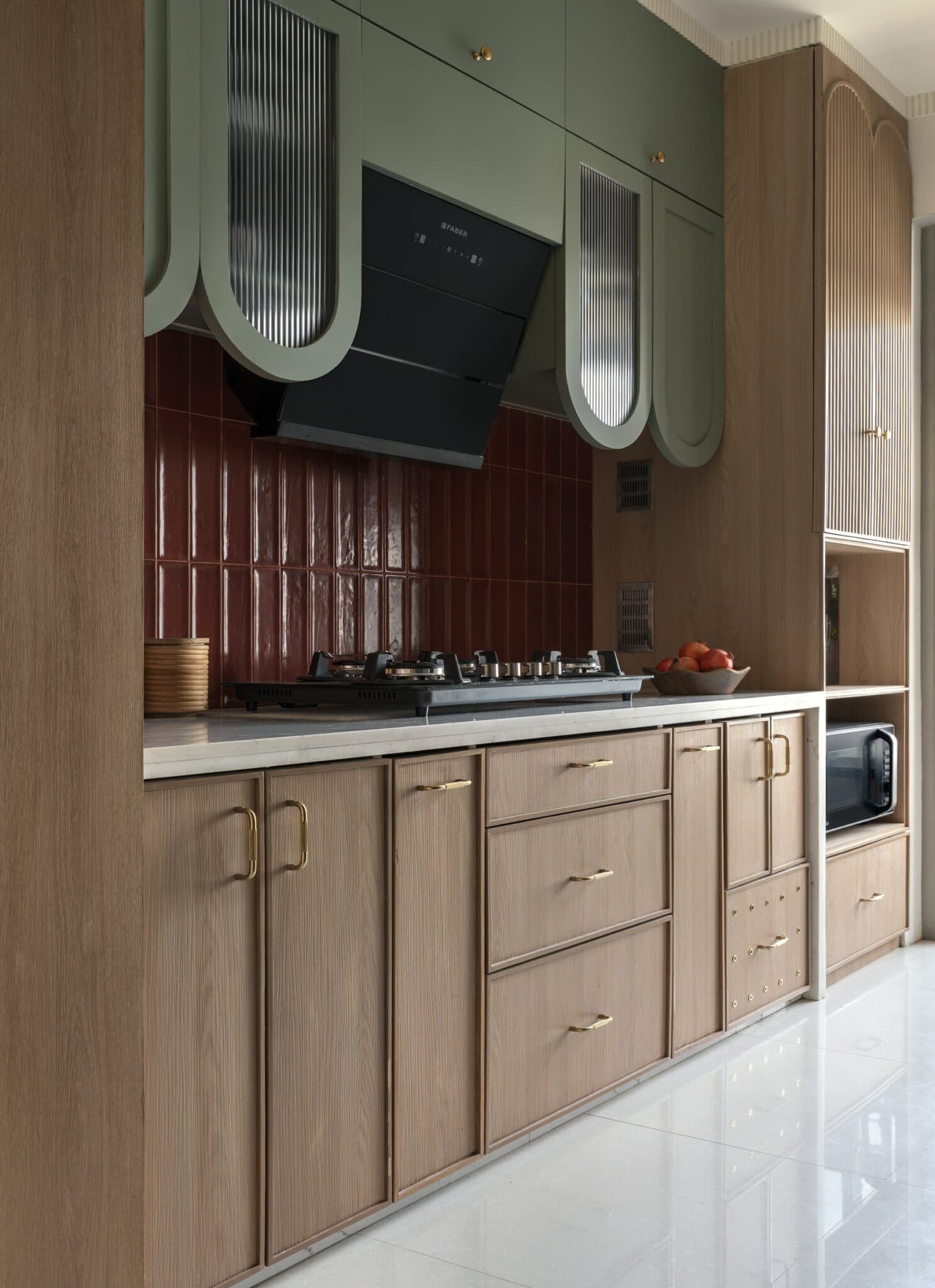
The kitchen extends the same logic in a higher key. Sage cabinetry with rounded reeded-glass arches floats above a glossy oxblood tile splashback, while the lower run shifts into pale ash with brass D-pulls and a fluted detail near the dishwasher.
It is a kitchen that refuses the default of stainless restraint. The colour pairing, sage above, oxblood behind, blond ash below, would be reckless in less disciplined hands; here it reads as confident period-referencing without slipping into pastiche.
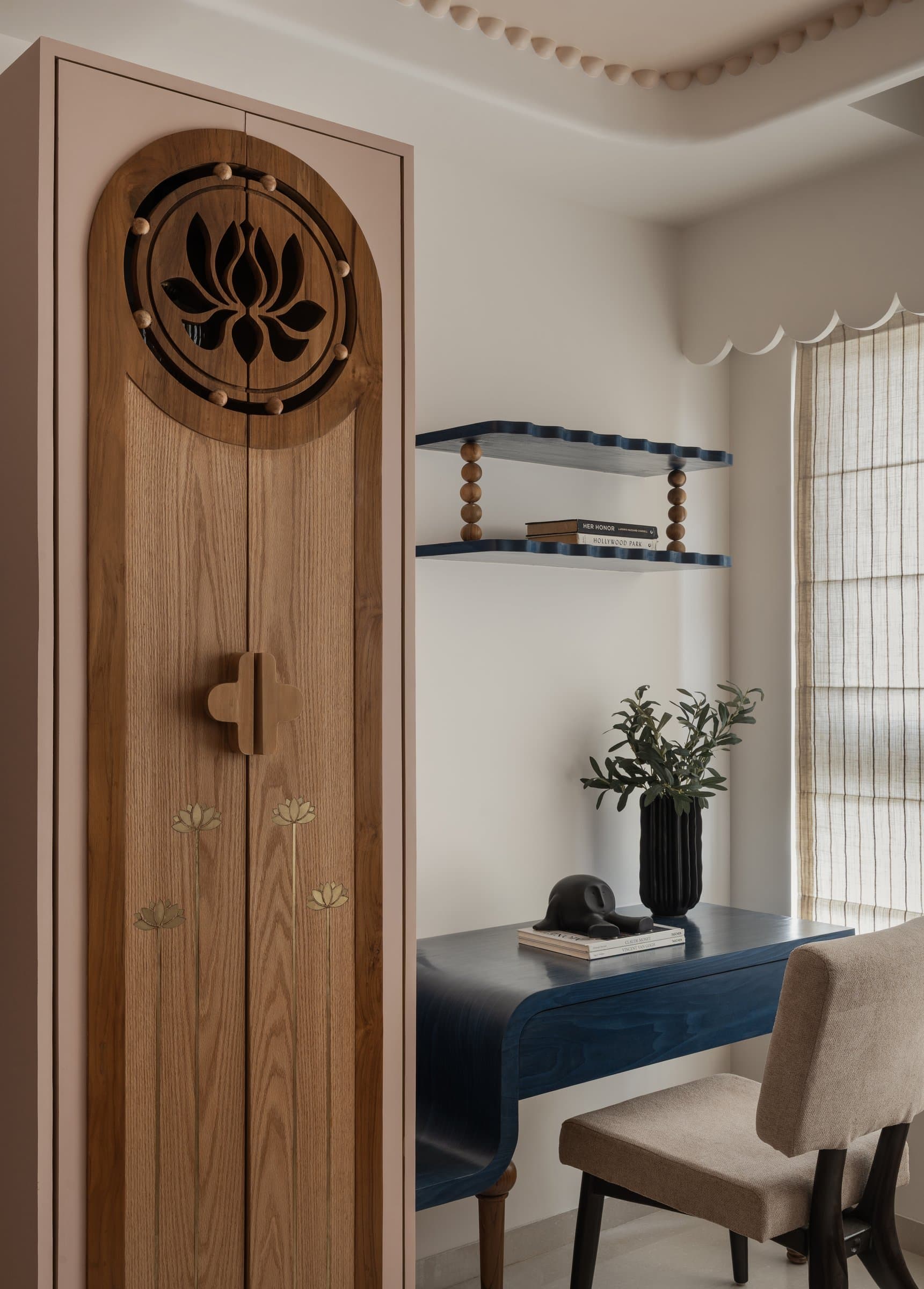
The children’s study corner introduces the home’s most spirited material moment: a tall wooden pooja-style cabinet with a carved lotus medallion and inlaid lotus motifs, set against a dusty pink wall. Beside it, a deep indigo desk with curved wooden legs, beneath bobbin-turned shelf supports, holds a black ribbed vase and a small black sculptural figurine atop a stack of books.
The pairing is unexpected, and that is the point. Devotional carving and writing desk share a wall because the studio understands that ritual and routine are not categorically separate in an Indian home.
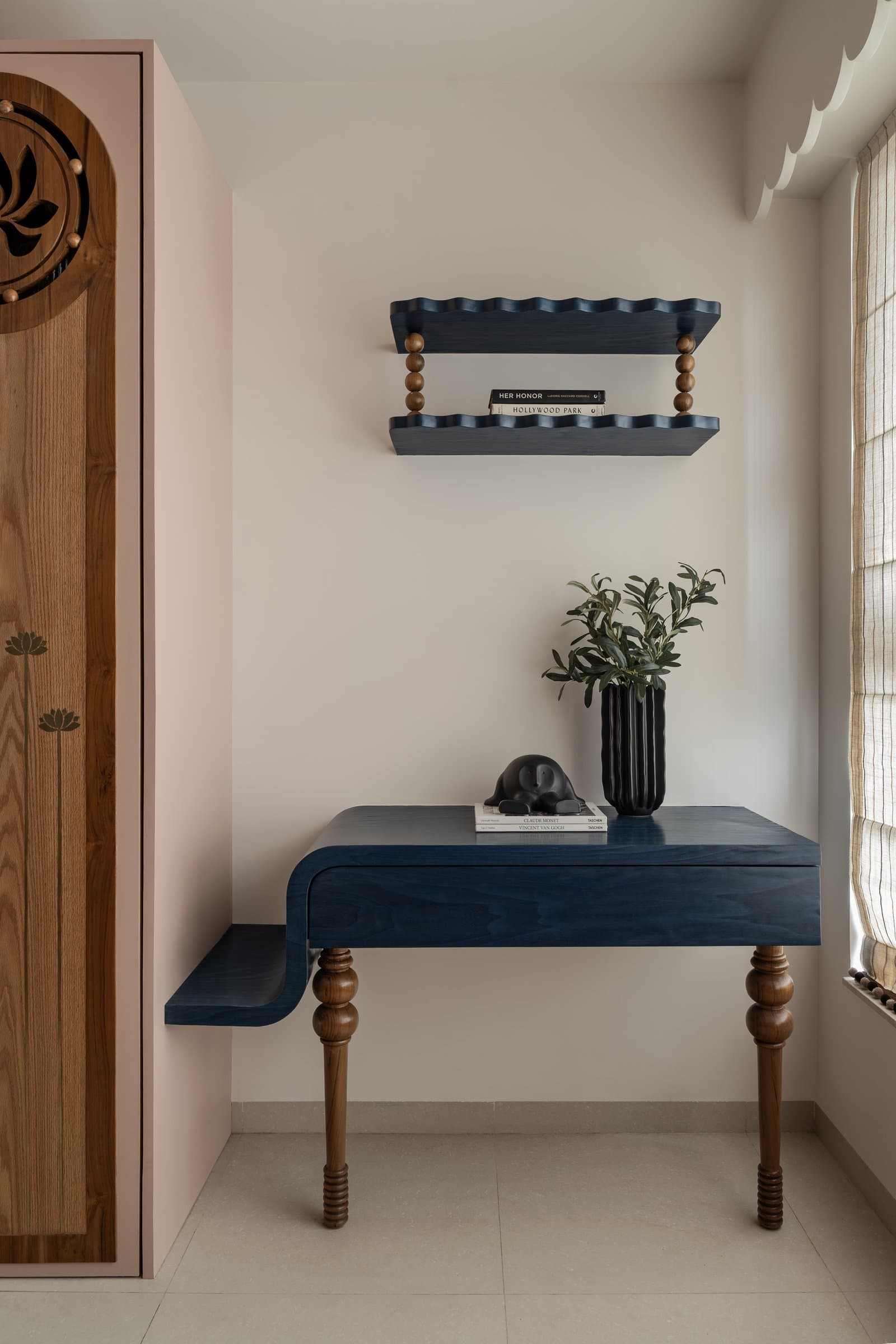
The desk itself, with its waterfall edge extending into a side ledge, supported on turned wooden legs, is one of the home’s quietest pieces of bespoke joinery. The two-tier scalloped indigo shelf above it carries the same vocabulary the rest of the apartment has been speaking, only here it is louder in colour.
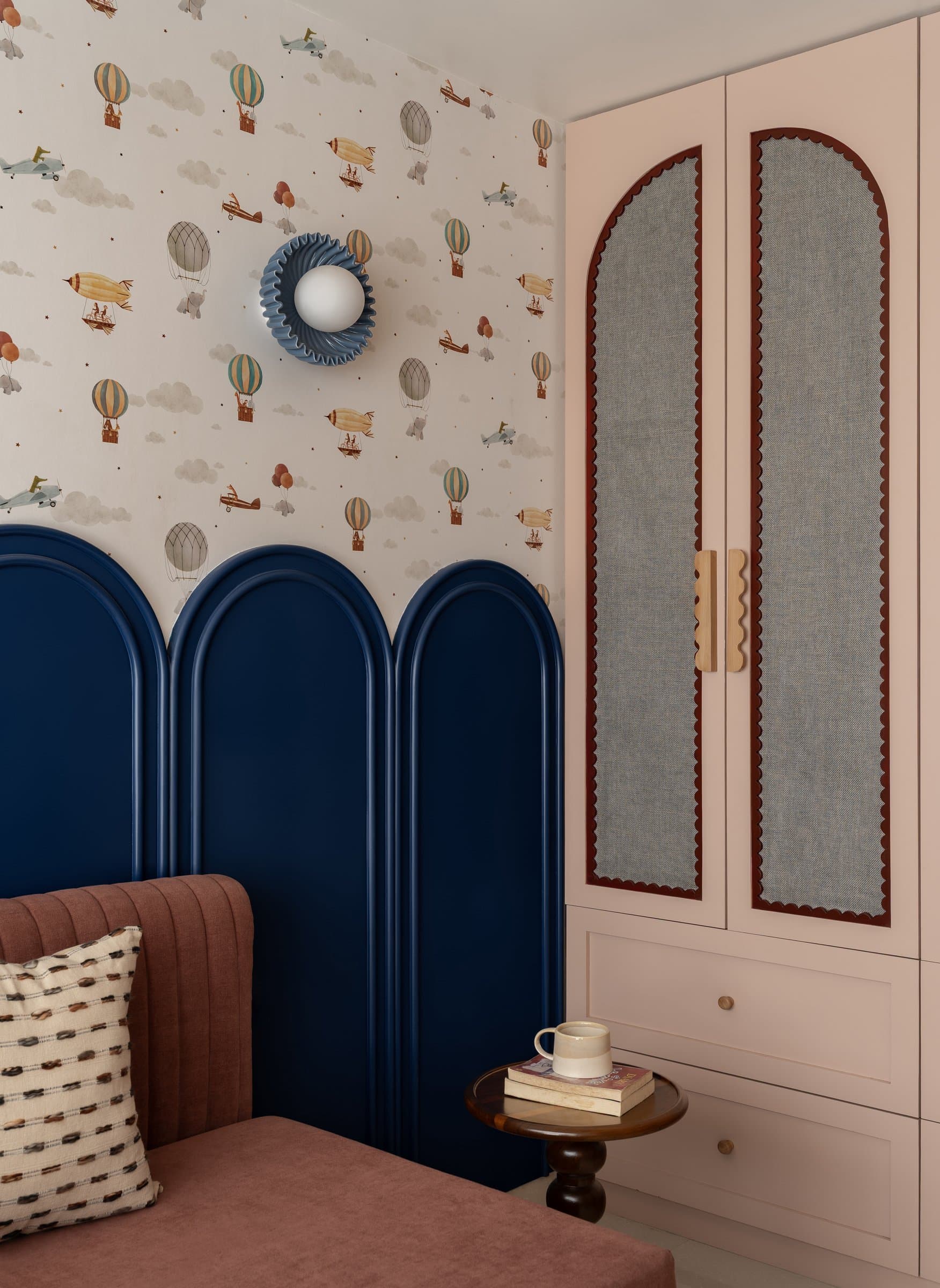
The children’s bedroom commits fully to character. A wallpaper of vintage hot-air balloons and biplanes covers the upper wall, while a deep navy panelled dado of repeating arches anchors the lower half, crowned by a blue fluted swirl-shaped sconce.
The opposite side of the room reveals a built-in daybed in dusty rose upholstery, set against navy blue arched panelling, with a tall blush-pink wardrobe whose arched doors are filled with grey scalloped-edged textile panels. A beaded plaster cornice traces the ceiling like a piped border on a cake.
From the threshold, the room’s full grammar becomes legible: blush wardrobes with scalloped textile inserts, the carved lotus pooja unit at the edge, an arched timber door leading away. Children’s rooms in this kind of project often default to whimsy at the cost of architecture; this one keeps both.
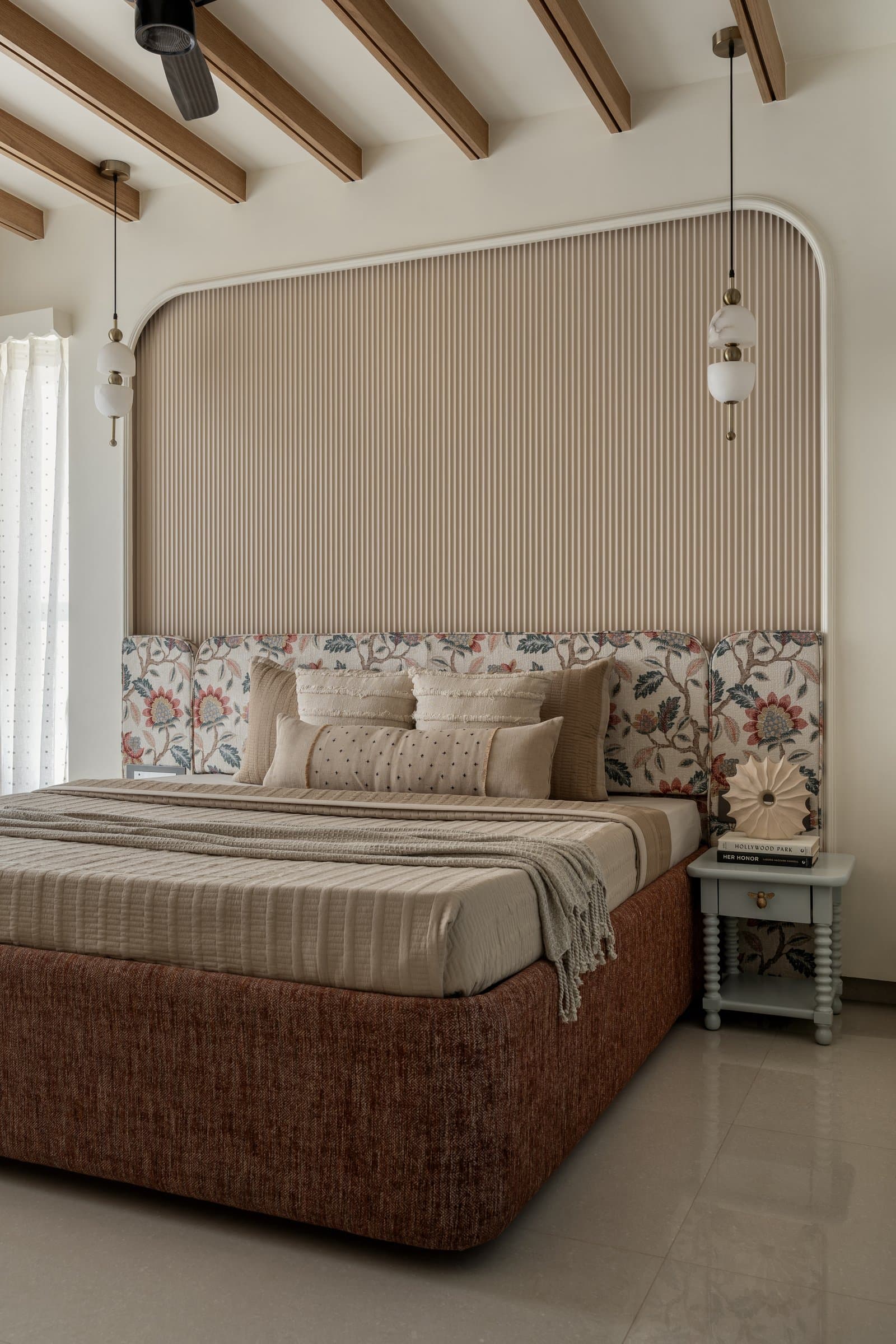
The master bedroom is the home’s quietest room and perhaps its most resolved. A tall arched headboard wall in fluted oat-toned panelling rises behind the bed, flanked by upholstered side panels in a botanical jacquard whose colours, faded reds, soft blues, antique golds, set the entire palette of the space.
The rust-toned chenille bed base grounds the composition without weight, and a pair of opal pendants on slim brass stems descend in place of conventional table lamps. The exposed wood-beam ceiling is the final note, lending the room the temperament of a converted farmhouse loft transposed into a Mumbai high-rise.
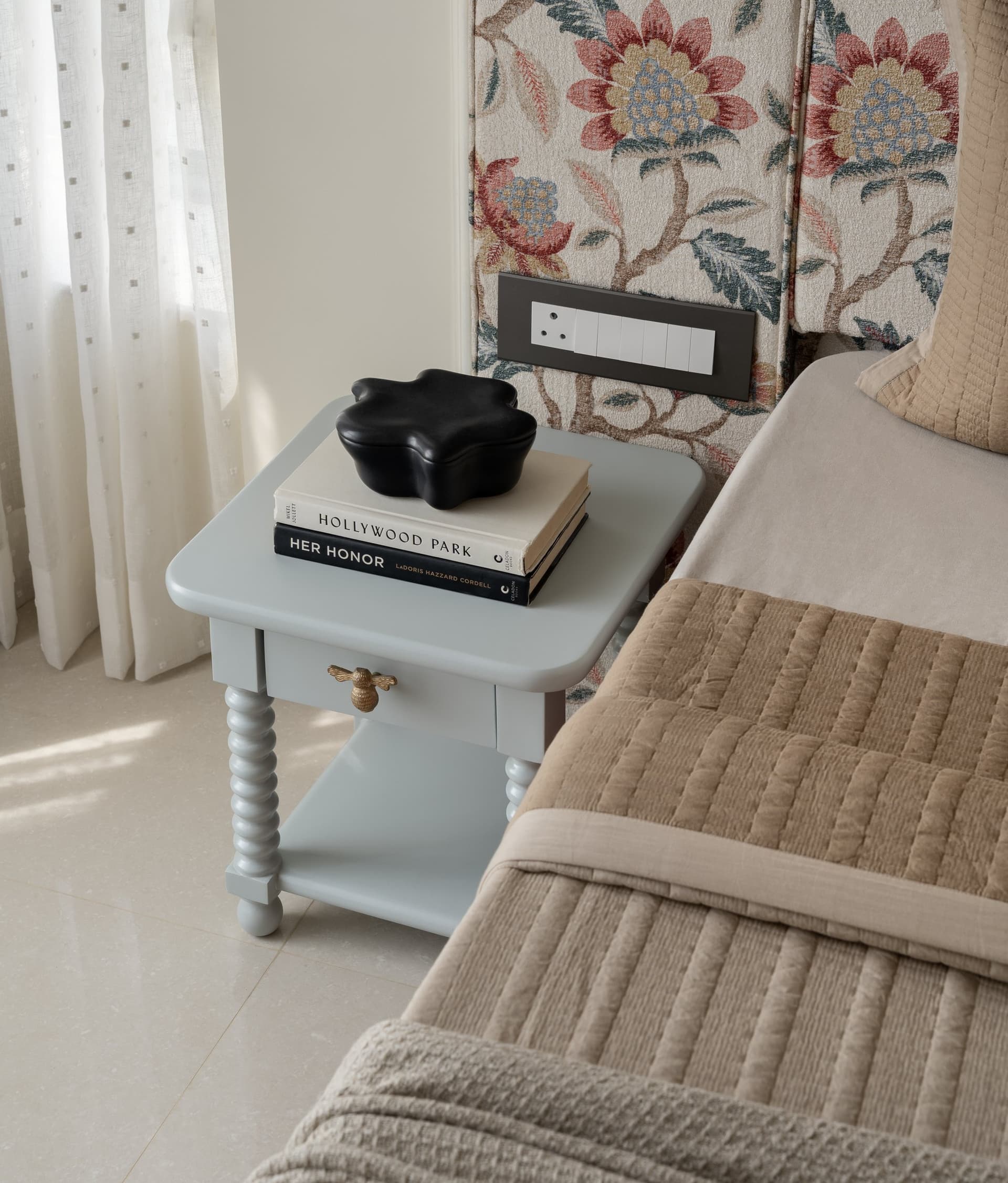
Beside the bed, a dove-blue side table on bobbin-turned legs carries a single brass bee-shaped pull, a pair of stacked novels and a small black flower-form box. The detail rewards close looking, which is what the best bedside furniture is supposed to do.
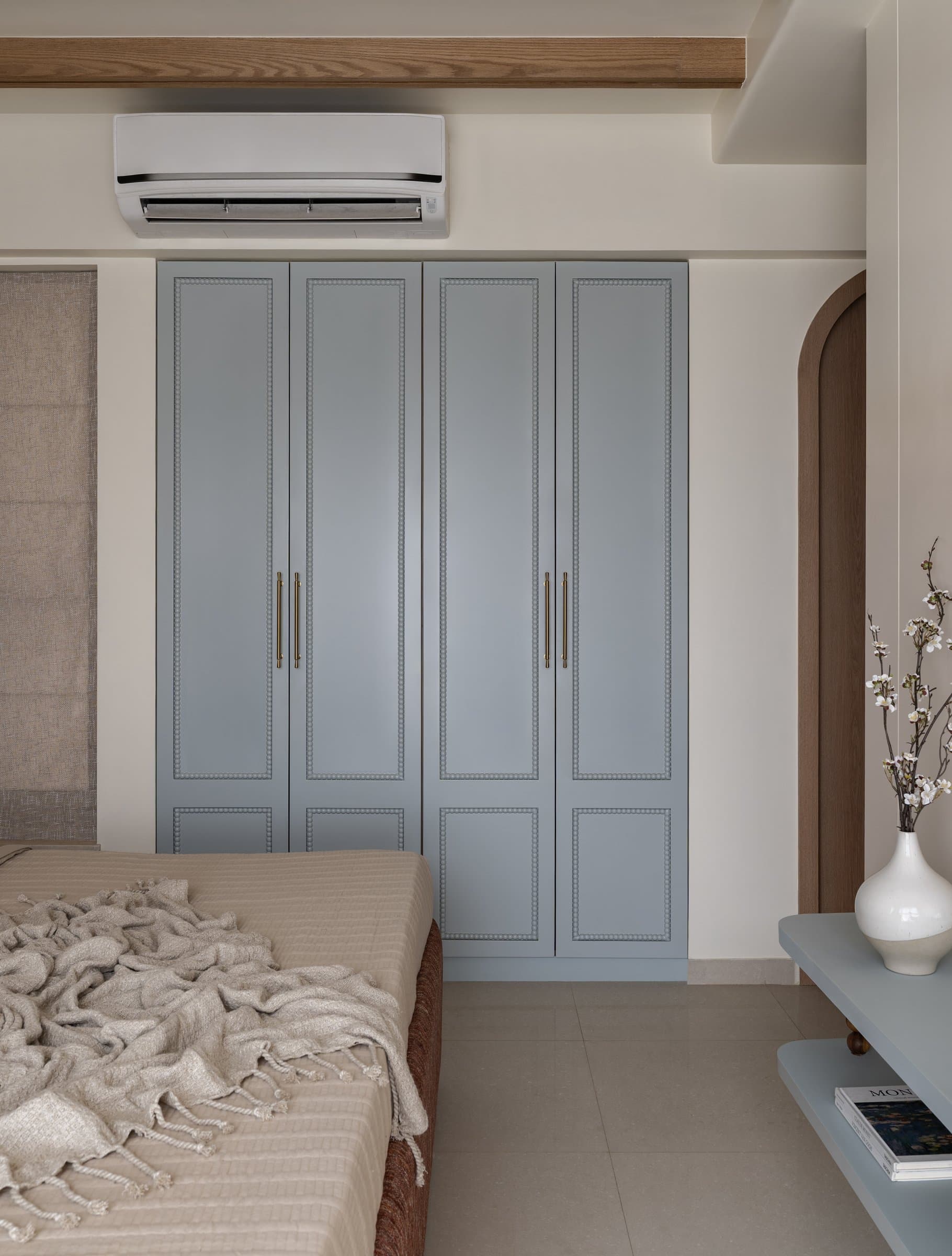
Across from the bed, a four-door wardrobe in pale powder blue is detailed with applied beaded mouldings tracing each panel, and finished with slim brass bar pulls. A wood-beam soffit drops above to mark the dressing zone, while a pale-blue wall console in the foreground holds branches of cherry blossom in a cream vessel.
Up close, the wardrobe’s joinery shows its hand. The beaded trim is not stuck-on ornament but a continuous, almost rope-like line that defines each rectangle of the door, and the brass pulls have been chosen at a scale that respects rather than dominates the panel.
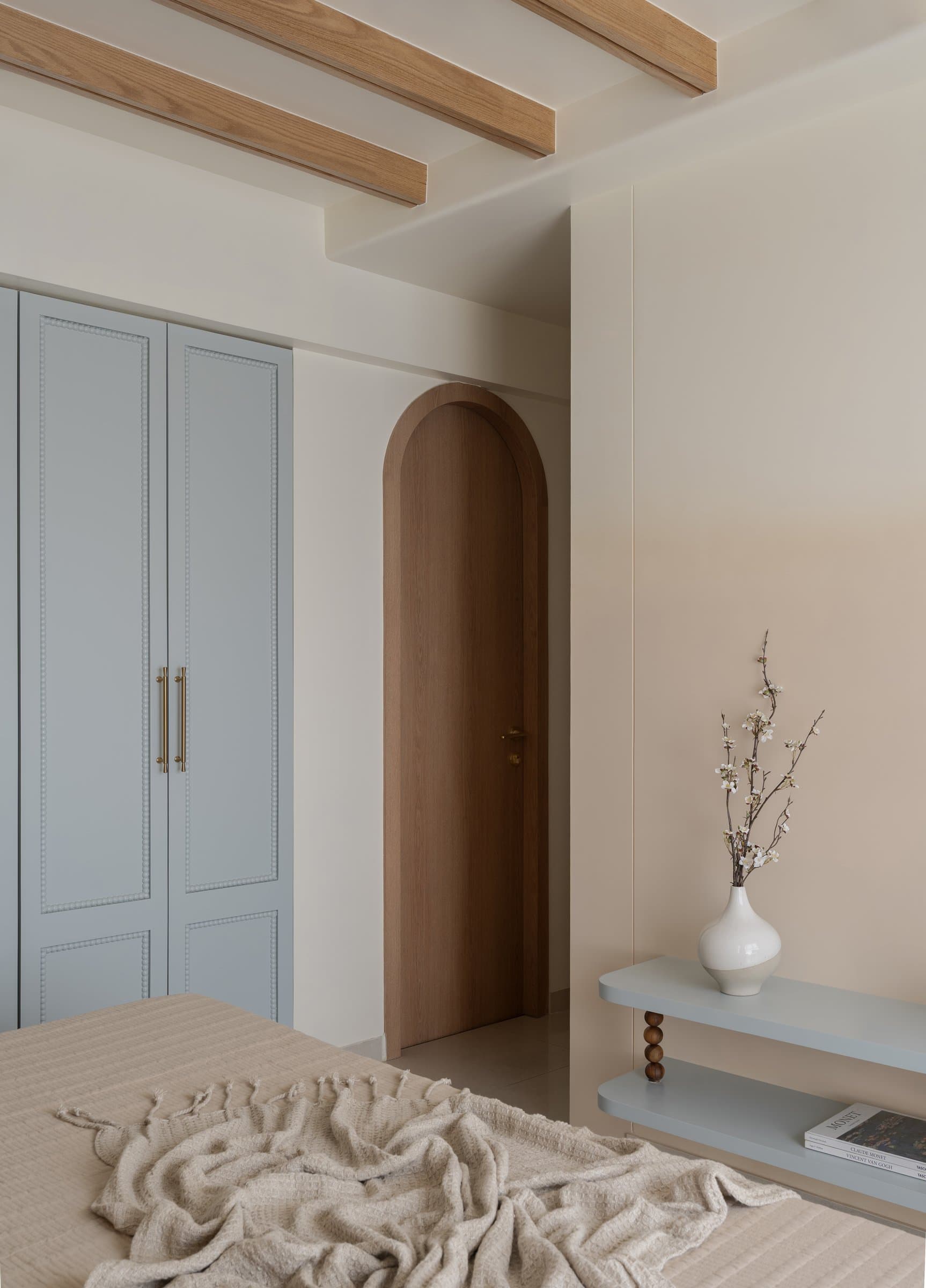
An arched timber door leads from the bedroom into the bath, framed by the same beaded wardrobes on one side and a slim pale-blue floating console on the other. The exposed beams overhead organise the ceiling into bays, lending the room a sense of spatial rhythm rather than a single flat plane.
The opposite corner of the master is given to a writing nook, where a wall-hung desk in pale ash with a fluted drawer front sits adjacent to a powder-blue floating shelf. Above it, a hanging shelf suspended on bobbin-bead rods holds a single ceramic bowl.

The desk is a study in continuity. Its waterfall edge meets the painted shelf in one unbroken line, an act of joinery that turns two pieces of furniture into one architectural gesture. The bobbin-bead suspension above repeats a motif that appears throughout the home, on side tables, on shelf brackets, on lotus cabinet doors.
What is striking about the apartment is how naturally it positions itself within a current Indian design conversation about ornament. There is a generation of Mumbai studios working through the question of what a contemporary, rooted Indian interior can look like without leaning on either heritage cliché or imported minimalism, and this home enters that conversation with its own answer: ornament as architecture, colour as restraint, craft as continuity.
The achievement of the project is its consistency of voice. From the lotus cabinet in the study to the bobbin-bead shelf brackets in the master, from the fluted dado in the dining nook to the beaded wardrobe trim in the bedroom, the same hand is at work, making the same case, in different keys.