There are homes that announce their cultural lineage loudly, and there are homes that let one painting do the talking. The Bangad residence in Nashik belongs to the second category, where contemporary restraint is treated not as the opposite of cultural expression but as its quietest, most confident vehicle.
Designed by Rathod Associates Pvt. Ltd. under the direction of Ar Sumit Rathod, the 2,255-square-foot apartment in Nashik was conceived for a family that wanted comfort without performance. The brief, in essence, was for an interior that could hold an heirloom devotional artwork at its centre without bending the entire room toward it.
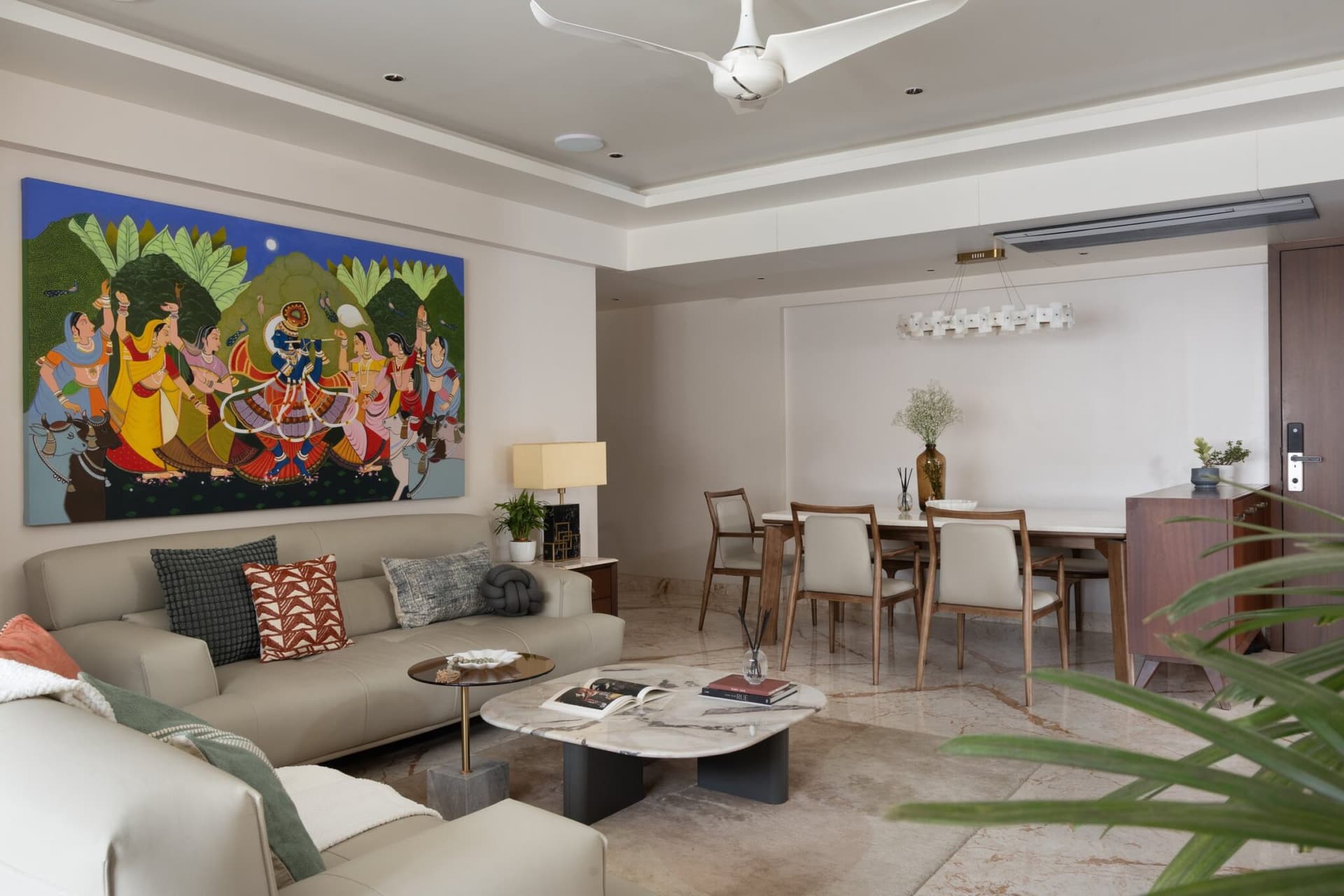
The living room establishes the home’s central narrative with remarkable clarity. A large Pichwai-inspired canvas depicting Krishna and the gopis anchors the primary wall, its rich blues and deep reds introducing the strongest colour presence in the house. Rather than competing with it, the surrounding furniture has been intentionally subdued. A putty-toned leather sectional, low tables, and restrained finishes allow the artwork to command attention, positioning it as the emotional and visual focal point of the space.
The architecture supports this hierarchy through a careful balance of openness and continuity. A linear pendant composed of alabaster-like illuminated modules hovers above the dining table beyond, introducing a contemporary counterpoint to the traditional imagery. Its soft, diffused glow reinforces the home’s sense of warmth without drawing focus away from the artwork. Underfoot, a continuous expanse of warmly veined marble extends across both living and dining areas, dissolving any rigid separation between the two zones and allowing them to read as a single, cohesive volume.
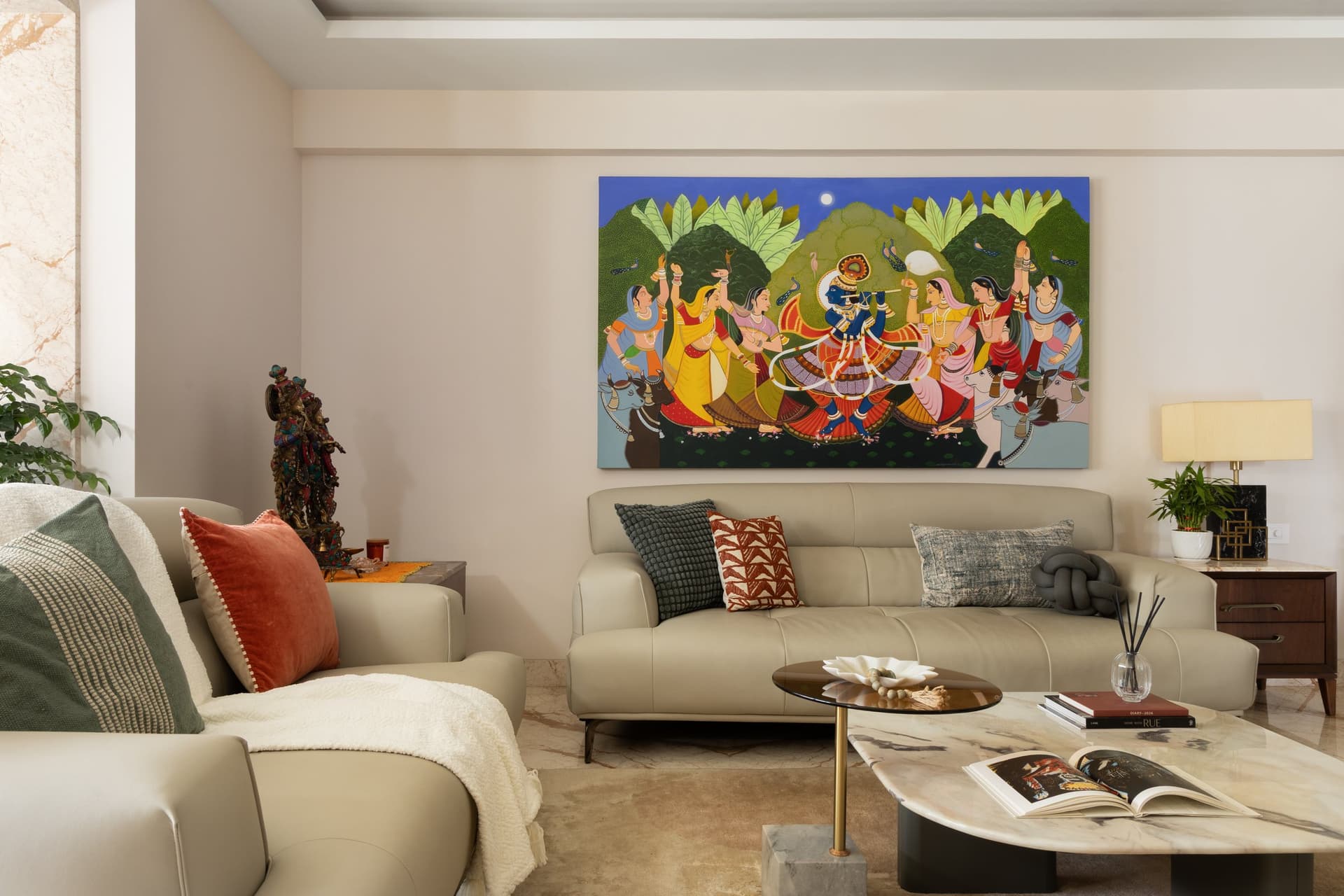
The colour story in the cushions, sage, terracotta, charcoal, picks up the painting’s palette in muted form, so the room reads as one composition rather than a sofa beneath a painting. This is the kind of styling decision that looks effortless and is not.
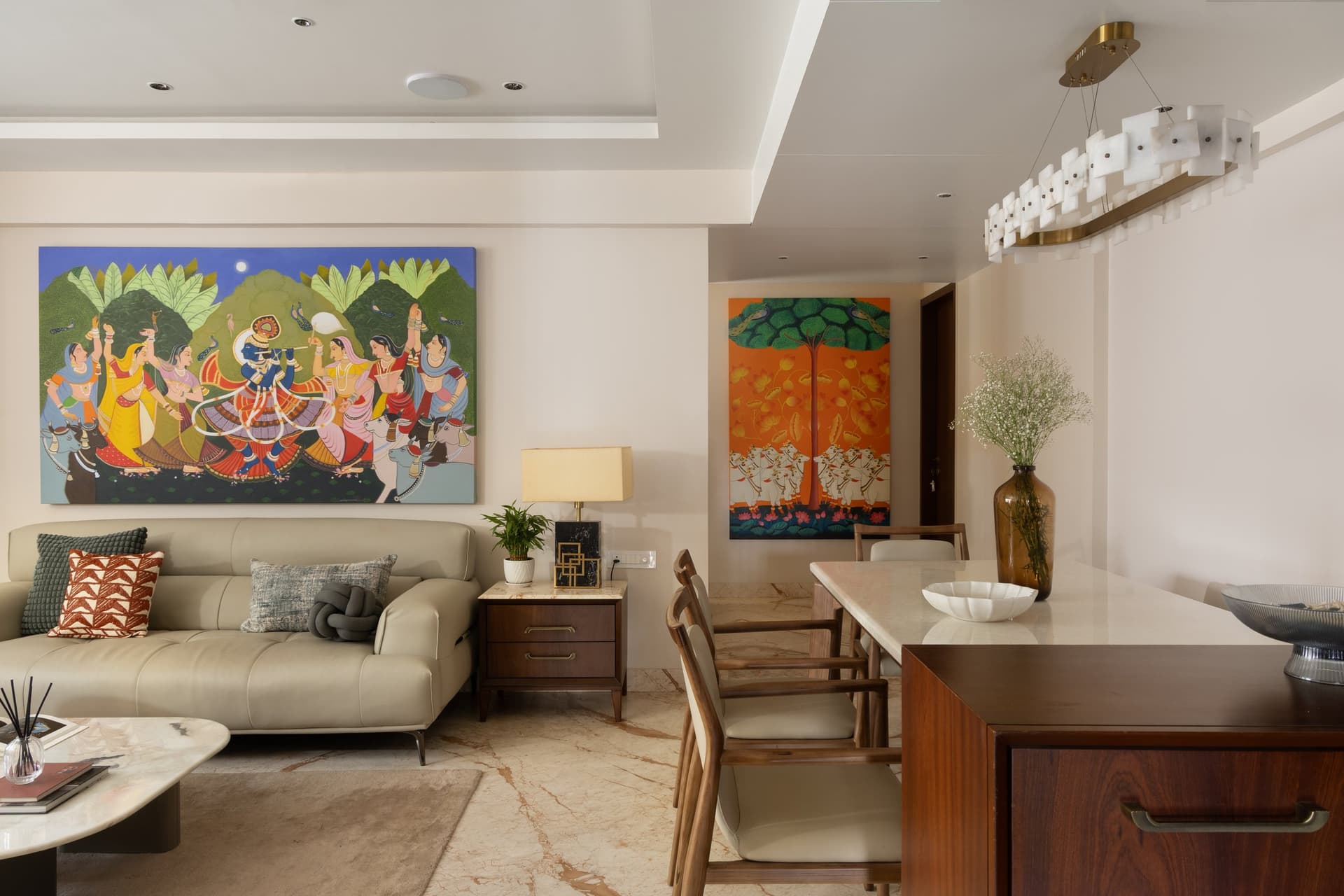
Turning toward the dining area, a second artwork comes into view: a vertical composition in burnt orange depicting cattle gathered beneath a stylised tree. Positioned on the wall anchoring the dining table, it establishes a measured dialogue with the Pichwai across the room. Rather than competing for attention, the two works create a subtle devotional narrative that runs through the home, embedded within the architecture rather than applied as ornament.
The dining setting continues this restraint. Chairs in walnut-toned timber with softly upholstered seats draw on mid-century proportions, their tapered profiles lending lightness to the arrangement. Behind them, a hardwood sideboard provides the room’s only visible storage element. Everything else has been carefully integrated into the architectural envelope, allowing the space to read as composed and uncluttered.
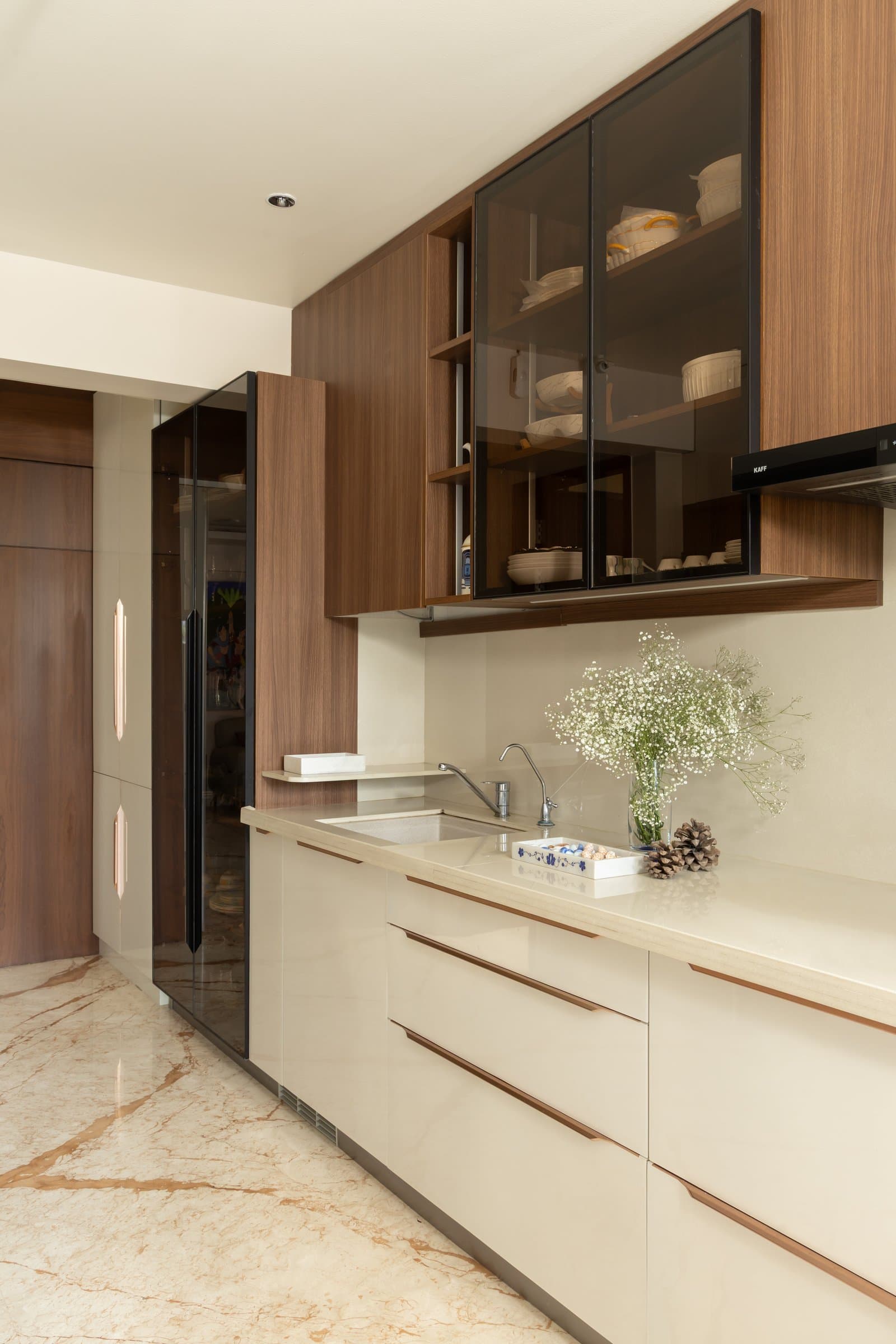
The kitchen continues the home’s restrained material language with a more compact expression. Cream-toned cabinetry forms the base, while upper units in rich walnut veneer introduce warmth and visual depth. Smoked glass fronts applied to the tall storage and overhead cabinets soften the mass of joinery, creating subtle layers of reflection that prevent the galley layout from feeling overly dense or enclosed.
A pale stone countertop with delicate natural veining runs uninterrupted along the length of the working wall, reinforcing the sense of order and continuity. Underfoot, the same warmly veined marble flooring found throughout the living and dining spaces extends into the kitchen, dissolving the conventional boundary between utility and living. Rather than being treated as a separate service area, the kitchen remains fully integrated into the home’s broader architectural composition.
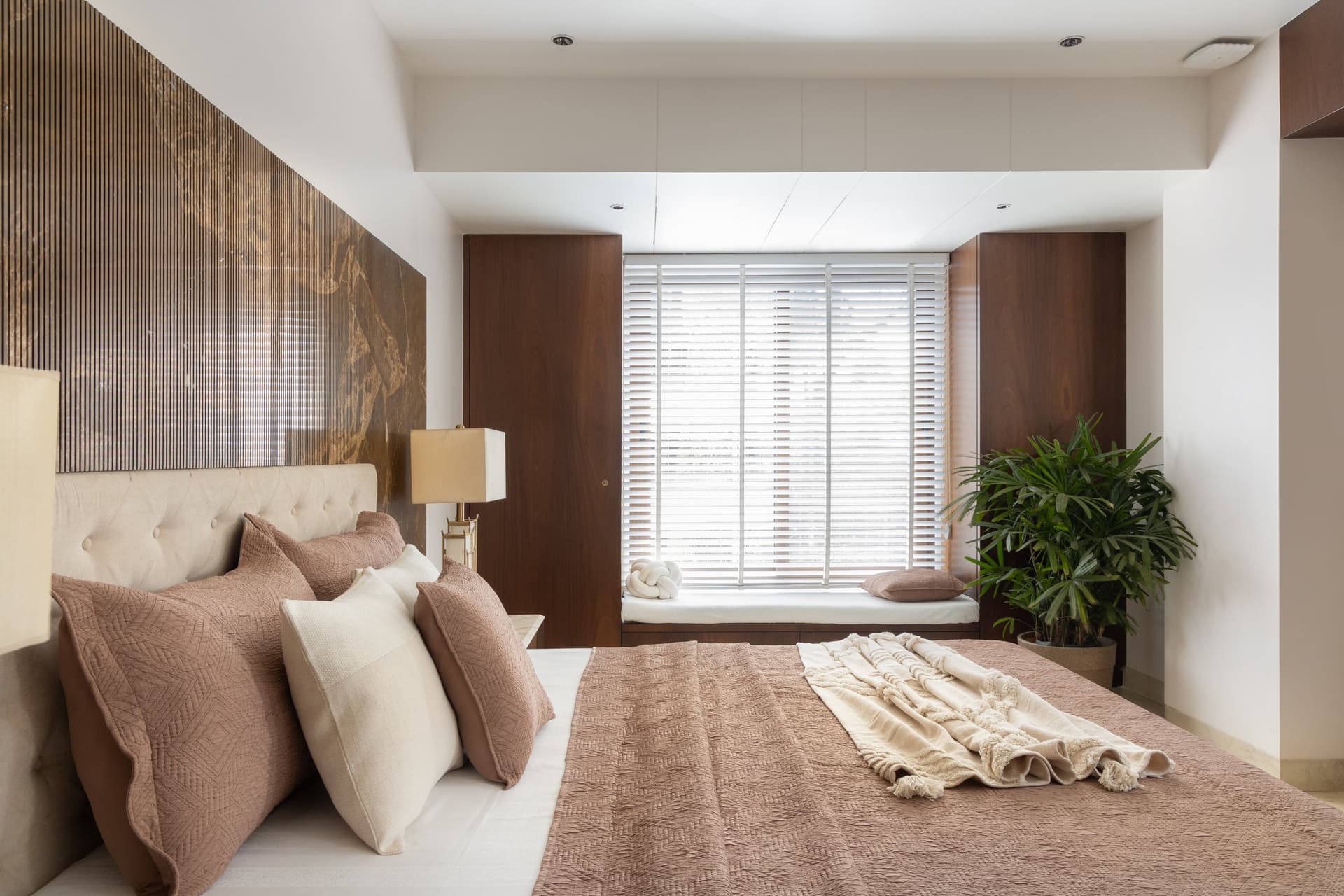
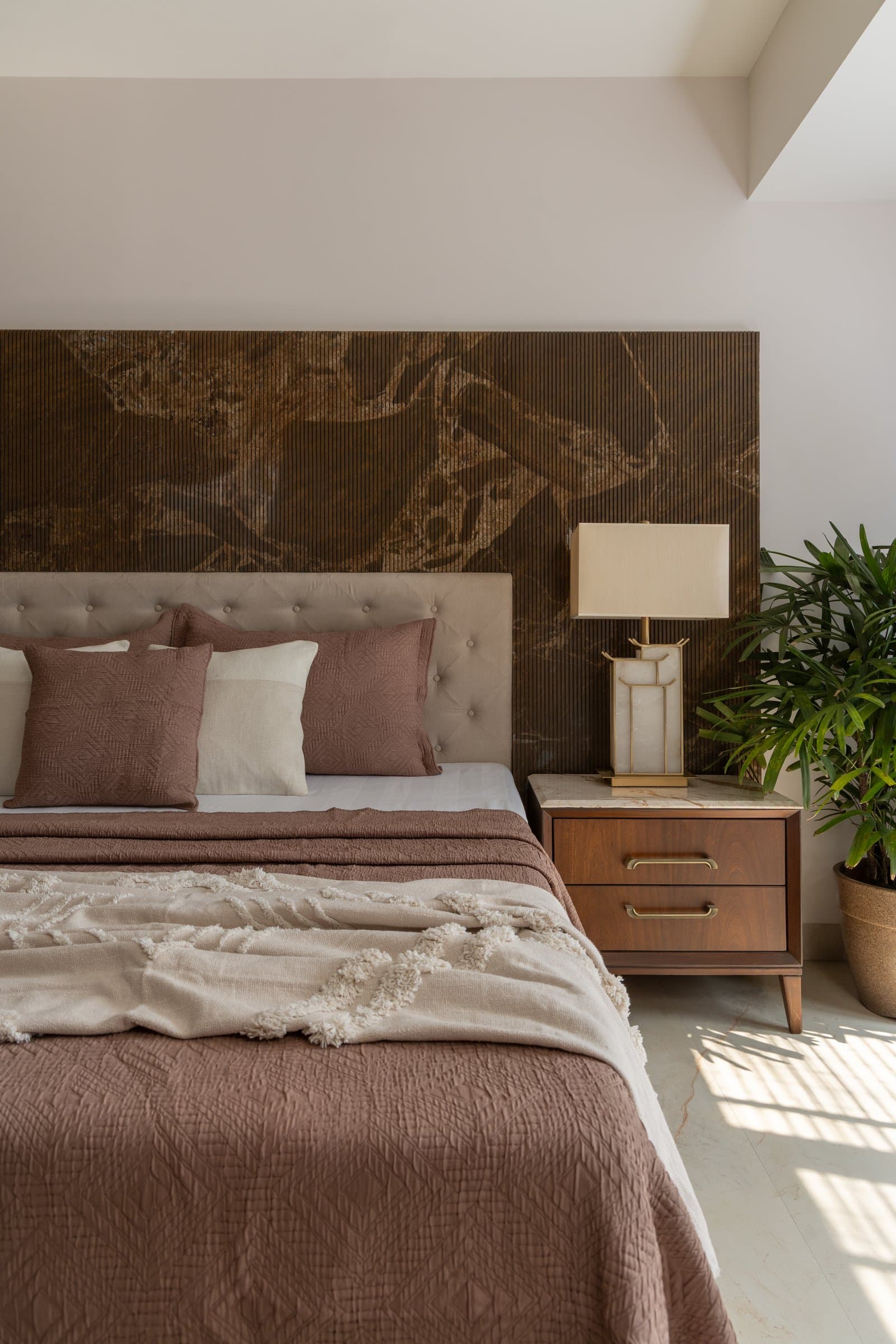
The master bedroom is where the home’s material language reaches its richest expression. Behind the bed, a full-width feature wall layers fluted timber against panels of dark patinated metal, creating a composition that reads almost like an abstract landscape. The contrast between the warm grain of the wood and the muted sheen of the metal introduces depth and texture without relying on colour, allowing the materials themselves to carry the room’s visual weight.
Anchoring this backdrop is a generously upholstered headboard in a soft oat-toned fabric, its tufted surface bringing a sense of comfort and tactility to the composition. Together, the elements strike a careful balance between richness and restraint, giving the room a quiet sense of luxury that feels considered rather than overt.
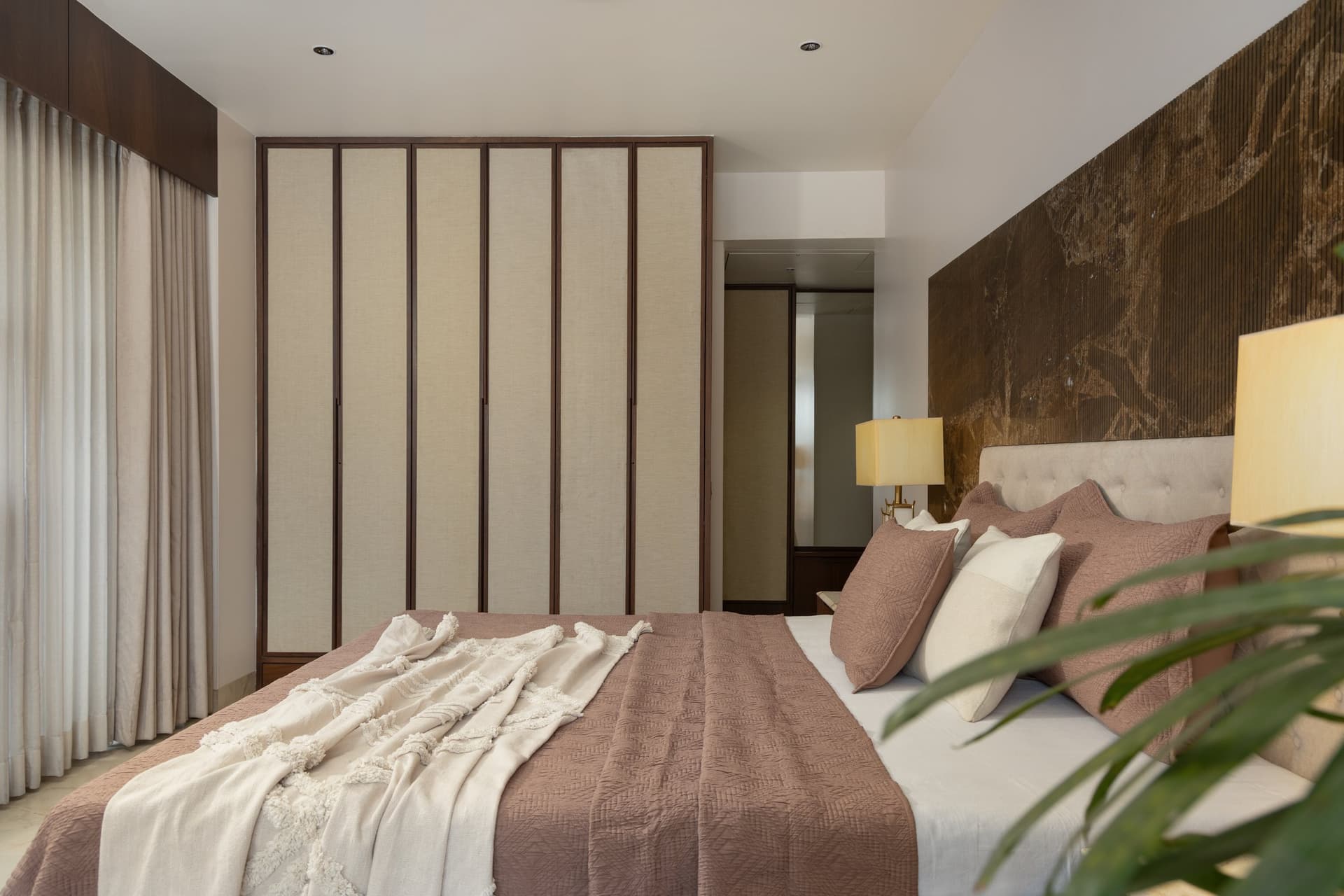
Viewed from the opposite end of the room, the bedroom’s storage strategy reveals itself as an extension of the architecture. A full-height wall of wardrobes, finished in linen-textured panels framed by dark timber, occupies the elevation opposite the window. Their detailing allows the joinery to recede into the room’s material palette, reading less as standalone furniture and more as an integrated architectural surface. Alongside, full-height curtains in a soft hemp-toned fabric filter daylight and lend a gentle softness to the composition, balancing the solidity of the timber elements without adding visual weight.
The result is a bedroom that prioritises quiet sophistication over statement gestures, where contemporary detailing, tactile materials, and carefully calibrated tones come together to create an atmosphere of ease. It is a space designed not simply for display, but for everyday living, combining comfort, functionality, and understated elegance in equal measure.
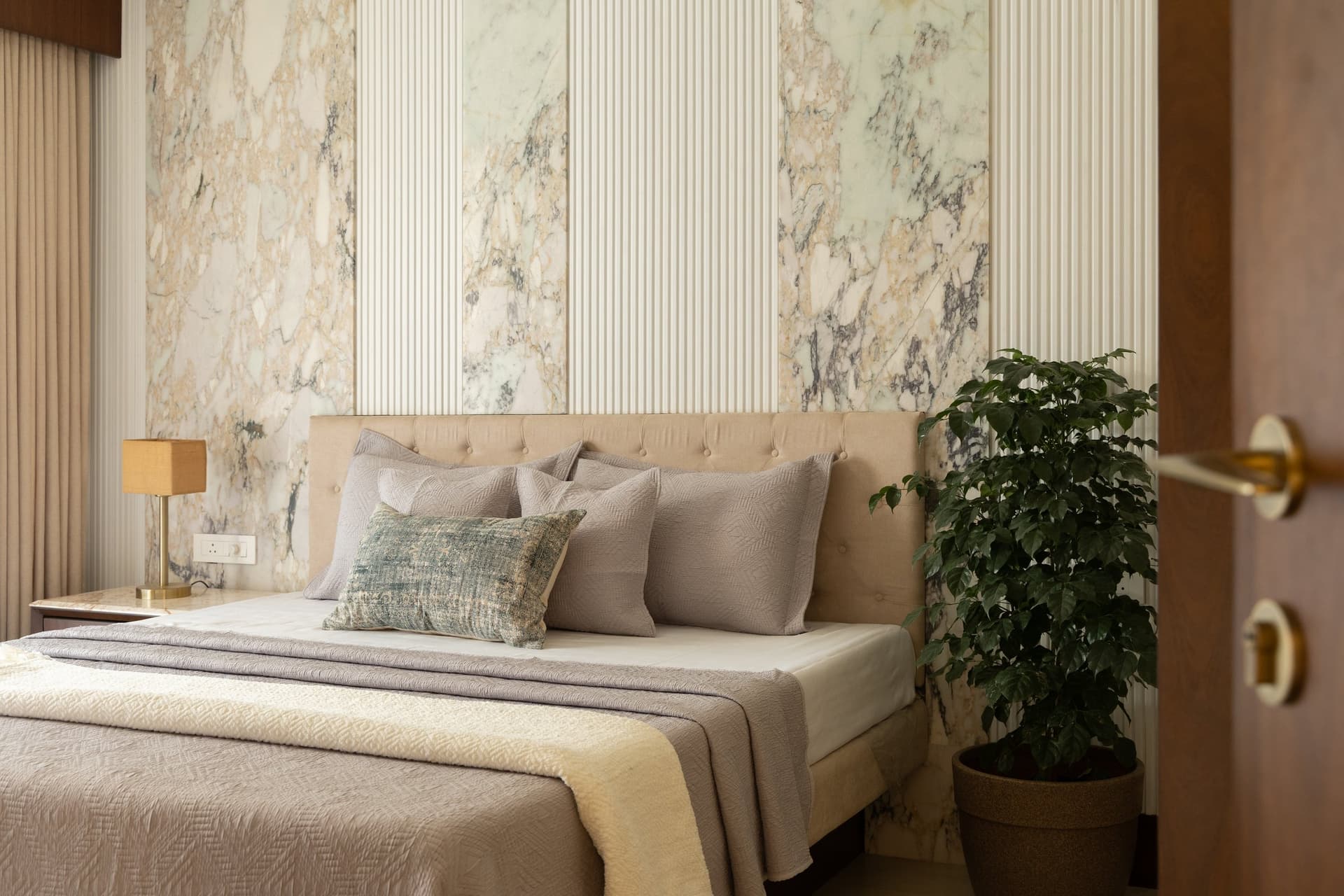
The second bedroom adopts a distinctly different material language while remaining aligned with the home’s overall sense of restraint. The headboard wall is articulated through alternating bands of book-matched marble and fluted off-white panelling, creating a strong vertical rhythm that lends the room both texture and presence. The dramatic veining of the stone introduces movement and contrast, while the fluted surfaces temper its visual intensity, allowing the composition to feel balanced rather than ornamental.
More than a backdrop, the wall functions as a carefully crafted architectural element in its own right. Its precise repetition and material interplay give the room a sense of structure and permanence, transforming a conventional headboard feature into a sculptural surface that anchors the entire space.
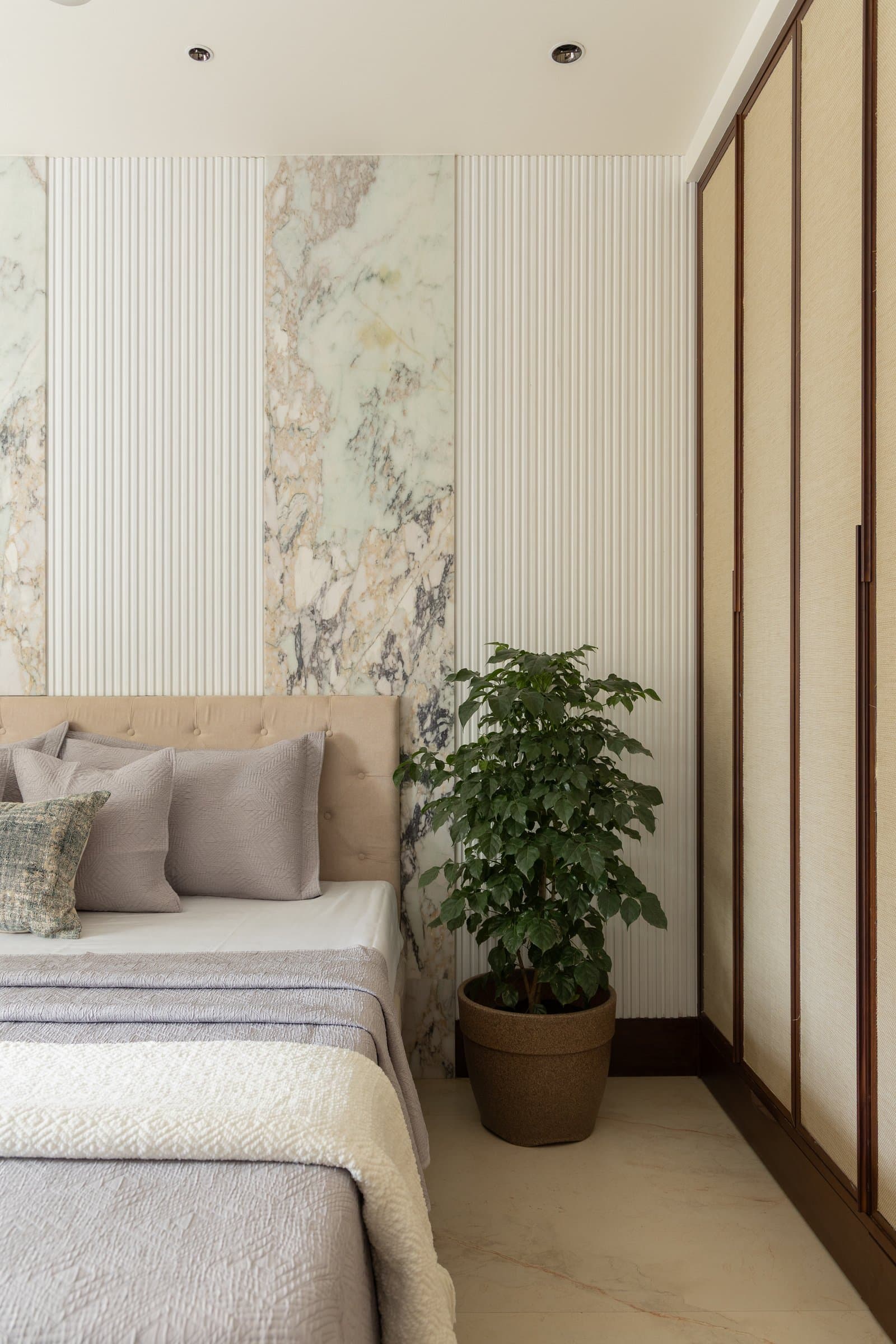
Stepping back, the composition reveals how the feature wall extends seamlessly into a run of full-height wardrobes, their fabric-inset doors framed in dark timber to maintain the room’s material continuity. The transition between wall treatment and storage is handled with such precision that the joinery reads as a single architectural gesture rather than a collection of separate elements. A solitary plant in a terracotta vessel occupies the corner, introducing a note of organic warmth against the room’s otherwise controlled palette.
The room derives its character less from decoration than from proportion and material balance.
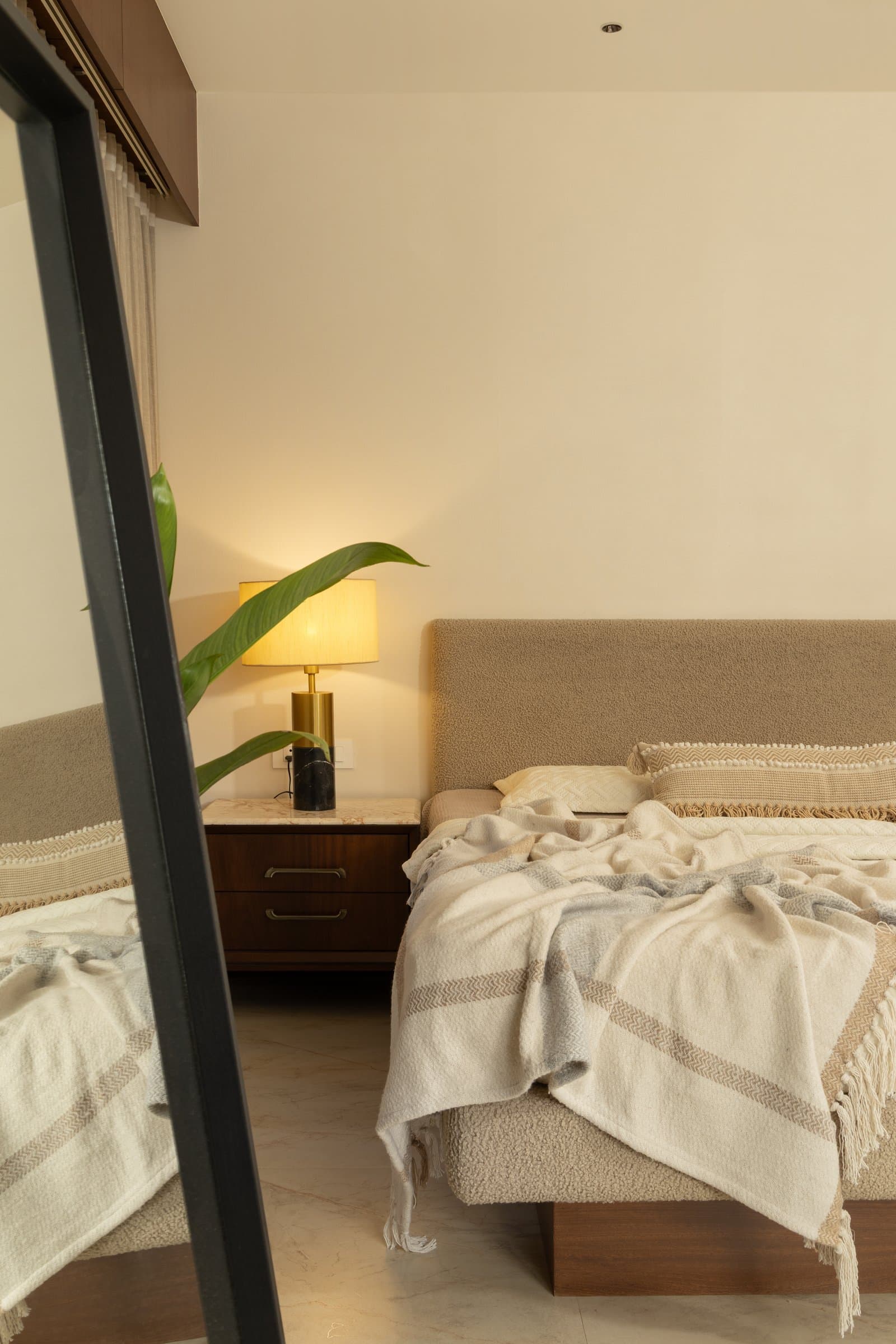
The third bedroom adopts a quieter, more intimate character. Captured in the warmth of evening light, the room is composed through a restrained palette of tactile materials: a softly upholstered boucle headboard, a walnut bedside table capped in stone, and a sculptural lamp combining brass and marble. Together, these elements create a composition that feels considered without being elaborate, allowing comfort to take precedence over display.
There is a sense of ease to the space that distinguishes it from the more expressive rooms elsewhere in the home.
In a city where residential design has often existed in the shadow of larger metropolitan influences, the Bangad Residence presents a confident and distinctly local point of view. Rather than relying on borrowed aesthetics, the home draws from cultural references that feel authentic to its context. Devotional imagery is present, but handled with restraint; contemporary materials and detailing are employed without severing ties to place. The result is an interior that feels rooted in Nashik while remaining firmly contemporary in its outlook.
What distinguishes the project most is its understanding of balance. Rich materials, crafted joinery, and carefully curated artworks are deployed with precision rather than abundance, allowing each element to carry meaning without overwhelming the whole. There is a quiet confidence in the way the home accommodates the family’s cultural identity, not through overt gestures, but through spaces that allow everyday rituals, objects, and memories to occupy the foreground.
Ultimately, the success of the residence lies in its discipline. Rathod Associates have created an interior that understands when to speak and when to step back, shaping a home that feels generous, deeply personal, and enduring. It is a project defined not by what has been added, but by what has been thoughtfully left out, proving that restraint, when exercised with conviction, can be the most luxurious gesture of all.