There is a category of luxury that announces itself before you have crossed the threshold, and another that waits, patient and self-possessed, for the eye to find it. Villa Kovera belongs decisively to the second. The home moves through its volumes with the confidence of a project that has nothing to prove and therefore proves everything, its drama held in the quality of a curtain fall, the weight of a stone edge, the deliberate slowness of a single sculptural pendant cluster suspended against double-height glass.
Designed by Noon Design Studio, the villa sits within Dubai’s residential fabric as a study in considered restraint. The brief was for a family home that could absorb daily life without losing its composure, a place where formal entertaining and quiet domesticity could share the same material vocabulary. What the studio has delivered is an interior that reads as a single, sustained idea: warmth held in tension with rigour, ornament subordinated to proportion, and every surface chosen for how it behaves in changing light.
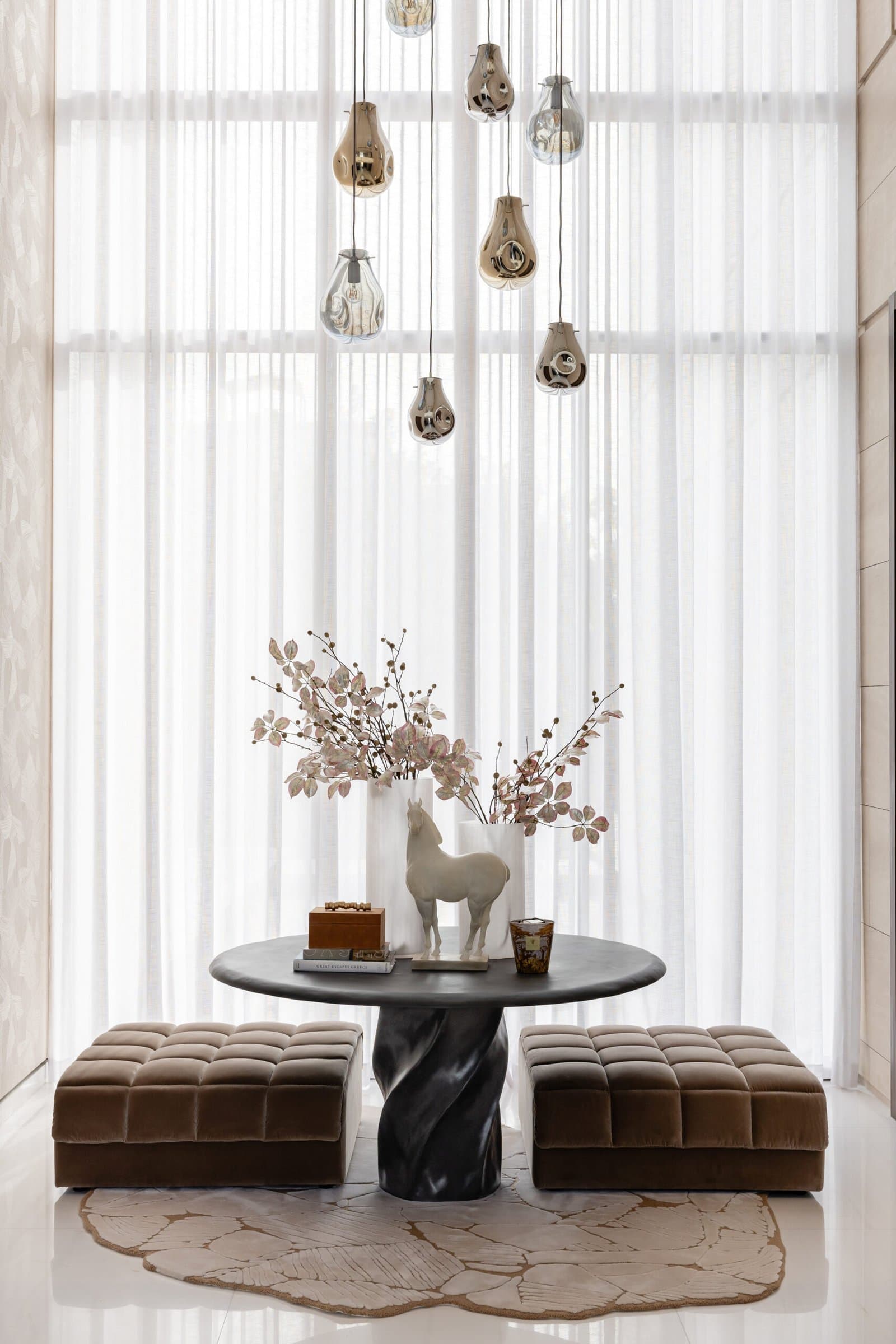
Asculptural moment proposes a different mood. A round table with a twisted, almost molten-looking dark base is flanked by two tufted ottomans in a warm cocoa velvet, the grouping anchored on a hand-cut rug whose edges read as torn paper. Above, a cascade of mirrored and clear glass pendants drops through the double-height void, catching daylight filtered through floor-to-ceiling sheers.
It is a vignette engineered to do real work. The pendants resolve the vertical scale of the volume; the ottomans give the table a reason to exist as more than ornament; the rug ties the entire composition to floor level. Three gestures, one argument about how to occupy a tall, light-filled space without crowding it.
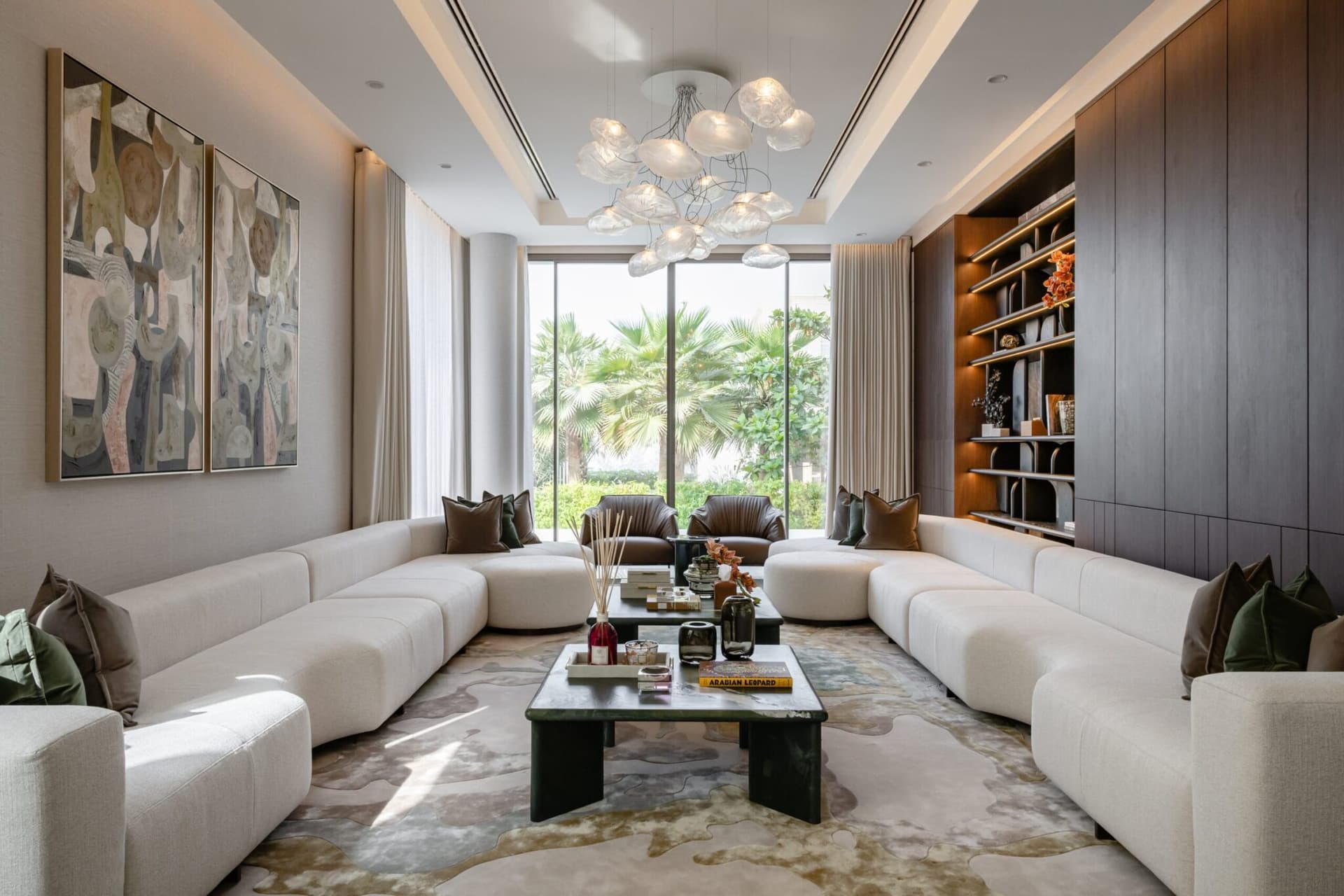
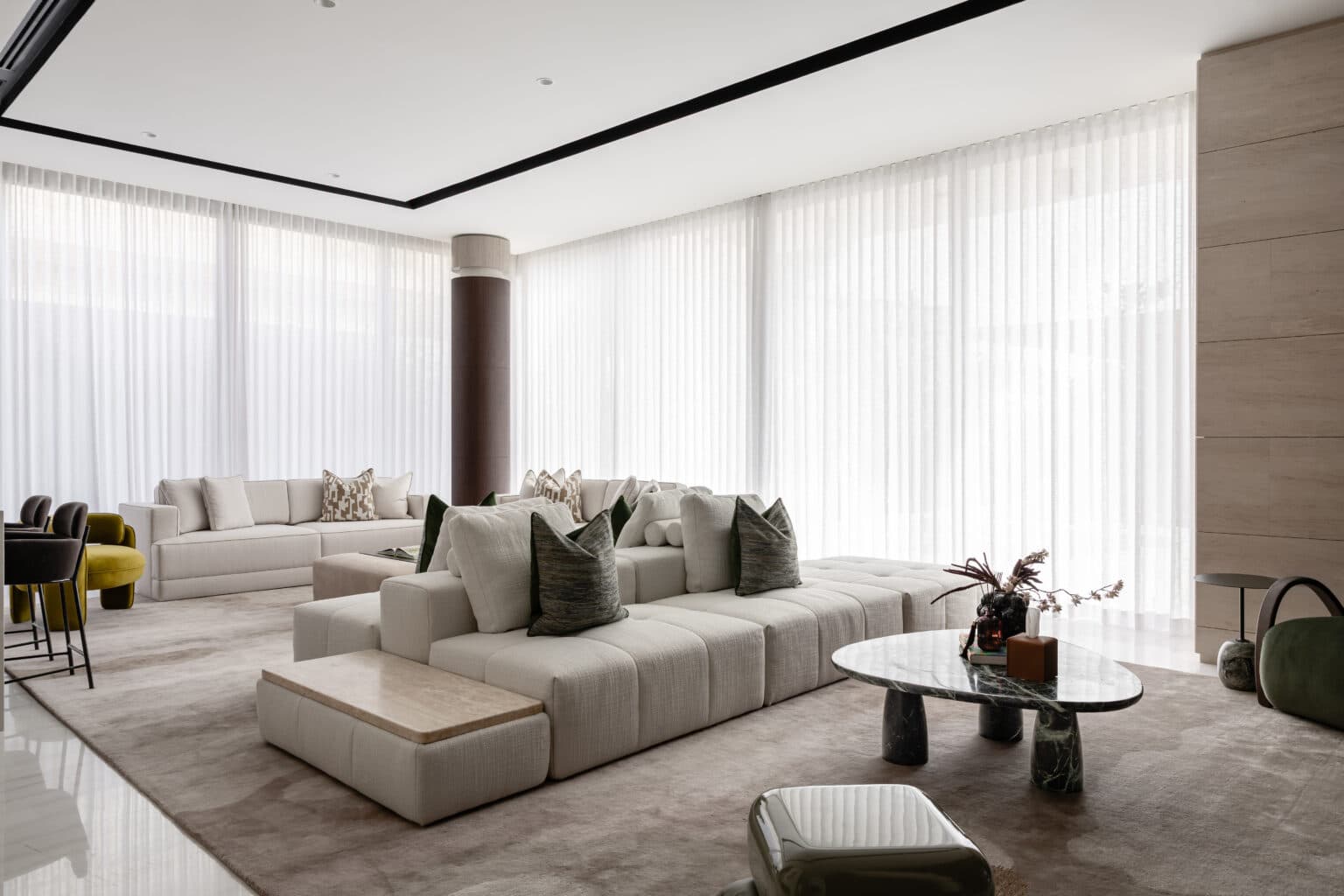
The principal living room reveals the home’s spatial ambition in full. Two long, low ivory sofas face each other across a green stone coffee table, with a pair of brown leather lounge chairs set between the sofas near the window and a tall window framing landscaped palms beyond. A large diptych canvas in muted pinks, greys and greens reads against the textured wall to one side; on the other, a deep wood-panelled library wall carries dark wood shelving with arched detailing lit from within.
The room is large but not loose. The sofas, generous and softly contoured, refuse the formality of a traditional sectional, choosing instead a posture that invites people to settle rather than perform.
““We wanted the principal spaces to feel composed without feeling staged, so the family could host twenty people or sit alone with a book and the room would behave correctly in both cases.””
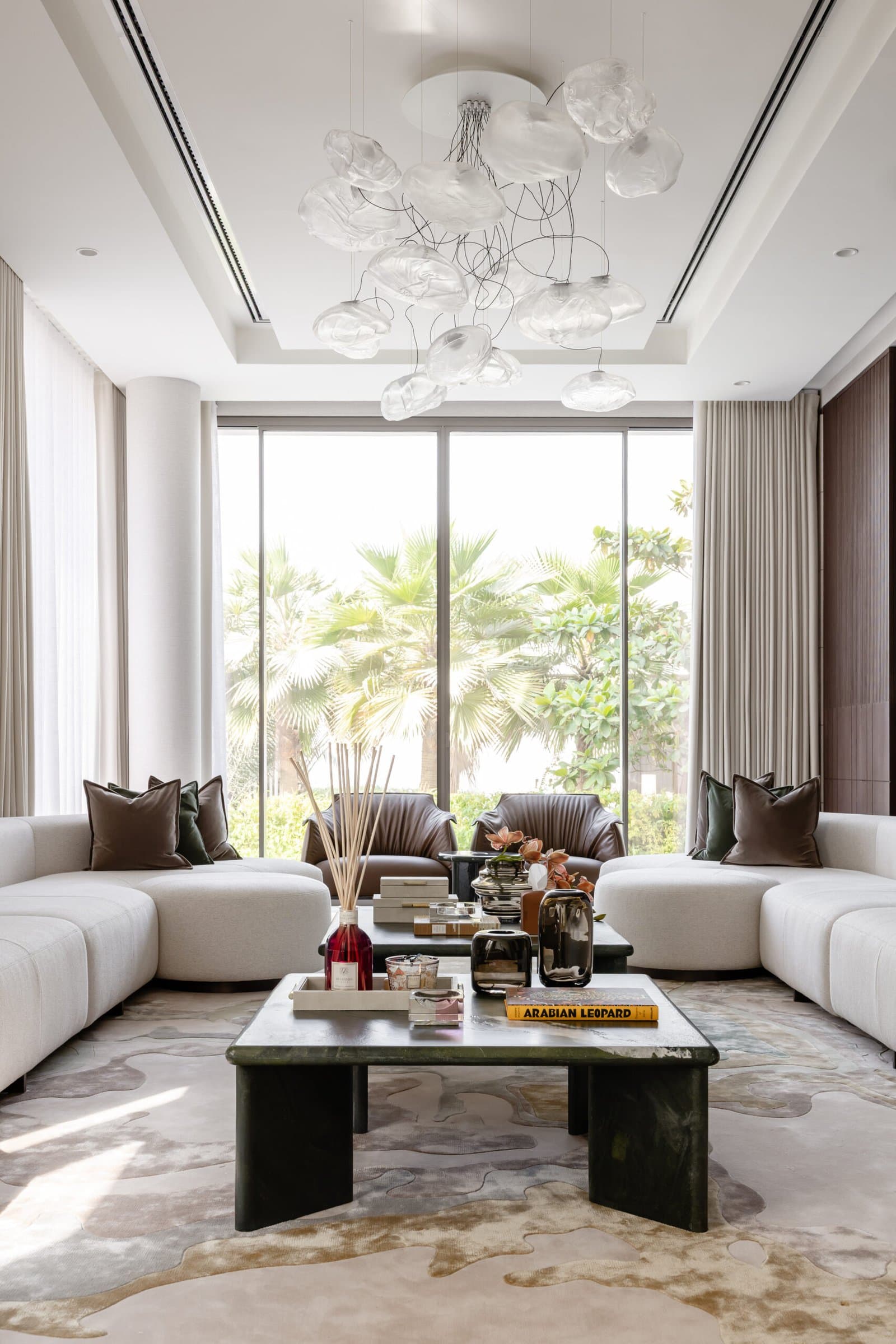
From the centre of the room, the ceiling sculpture takes over the composition. A cluster of cloud-like blown-glass forms hangs from a recessed coffer, the wires that suspend them deliberately tangled, as though the piece had been caught mid-dissolve. Against the calm of the ivory upholstery and the long sweep of stone-coloured drapery, it is the room’s single permitted extravagance.
The decision to let one element carry the drama, and to discipline everything else around it, is what separates this living room from the hotel-lobby vocabulary it could so easily have slipped into. The chandelier earns its drama because nothing else competes for it.
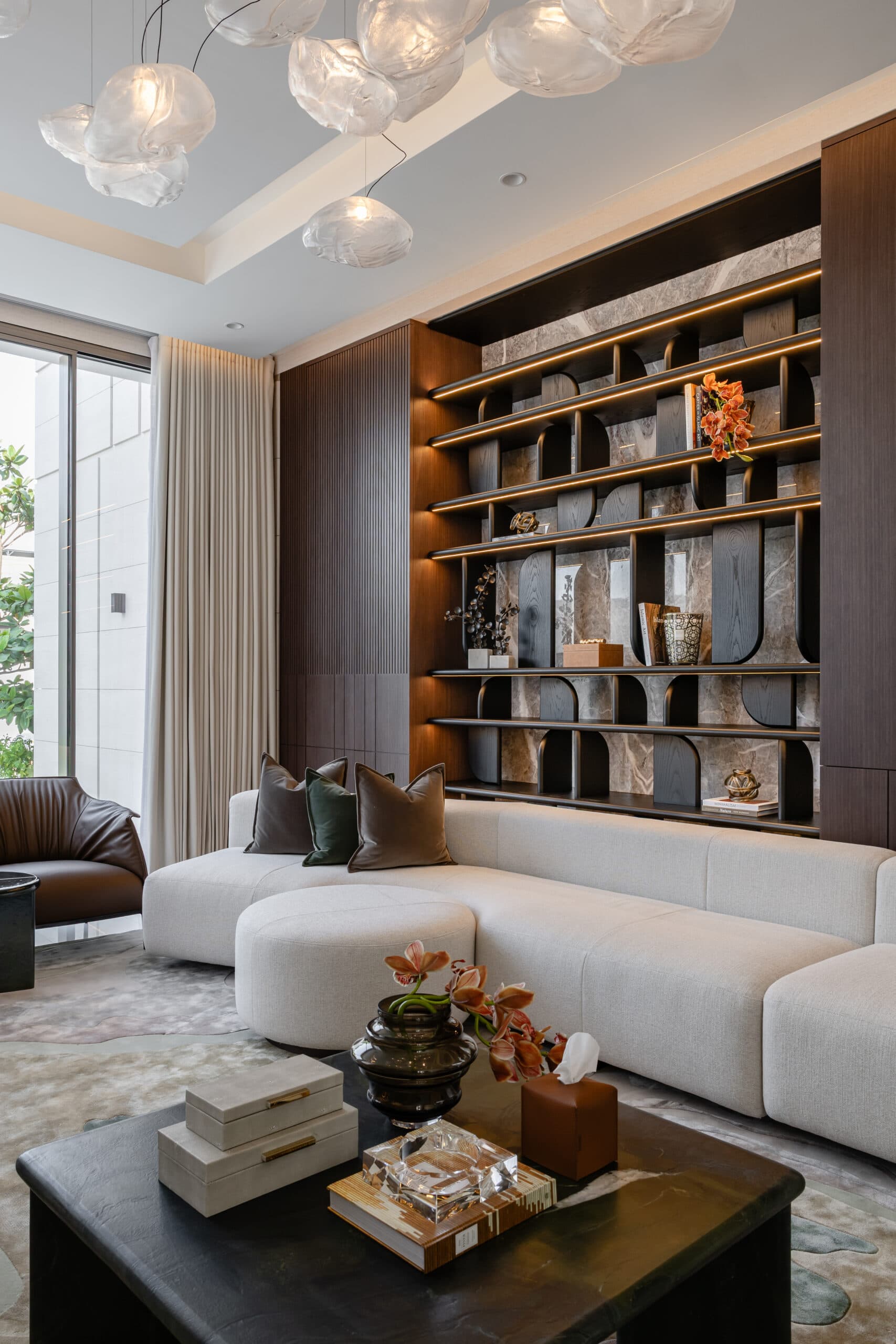
Turn toward the library wall and the room’s second argument comes forward. Dark-stained ash shelving frames arched dark ash panels set against veined grey-brown stone insets, each shelf grazed by a recessed strip of warm light.
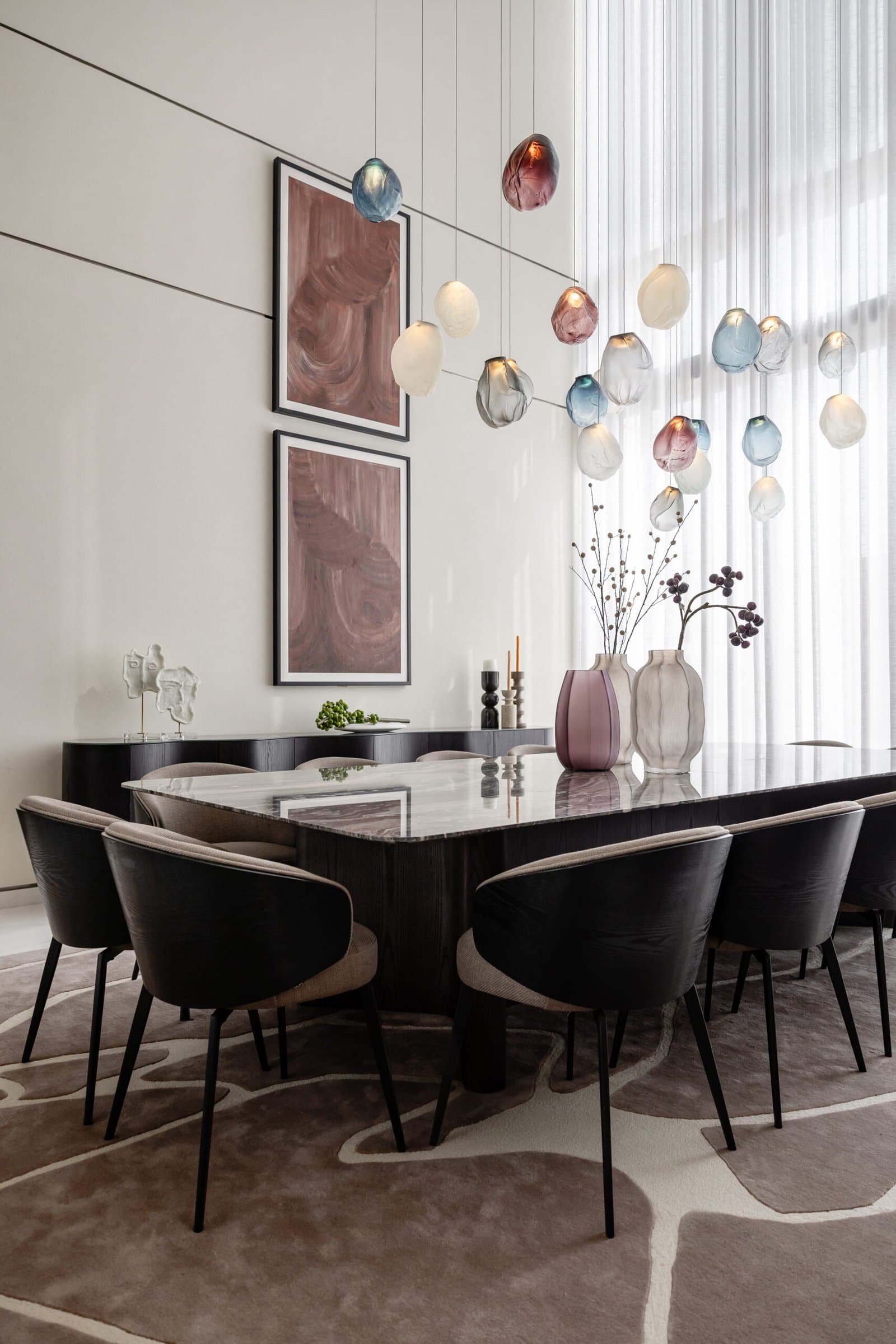
The dining room is treated as an event in its own right. A long stone-topped table sits beneath a constellation of hand-blown glass pendants in dusky pinks, blues, and milky whites, cascading from the double-height ceiling in a deliberately uneven arrangement that reads as a single sculptural gesture. A pair of vertically stacked paintings in mauve and burnt sienna anchors the wall, echoing the pendant palette in a slower register.
Chairs in dark wood with woven sand-toned upholstery line the table, their silhouettes restrained enough to let the lighting installation perform without interference. The rug below traces an organic pattern in muted browns and creams, repeating the foyer’s painterly language so the home reads as one continuous composition.
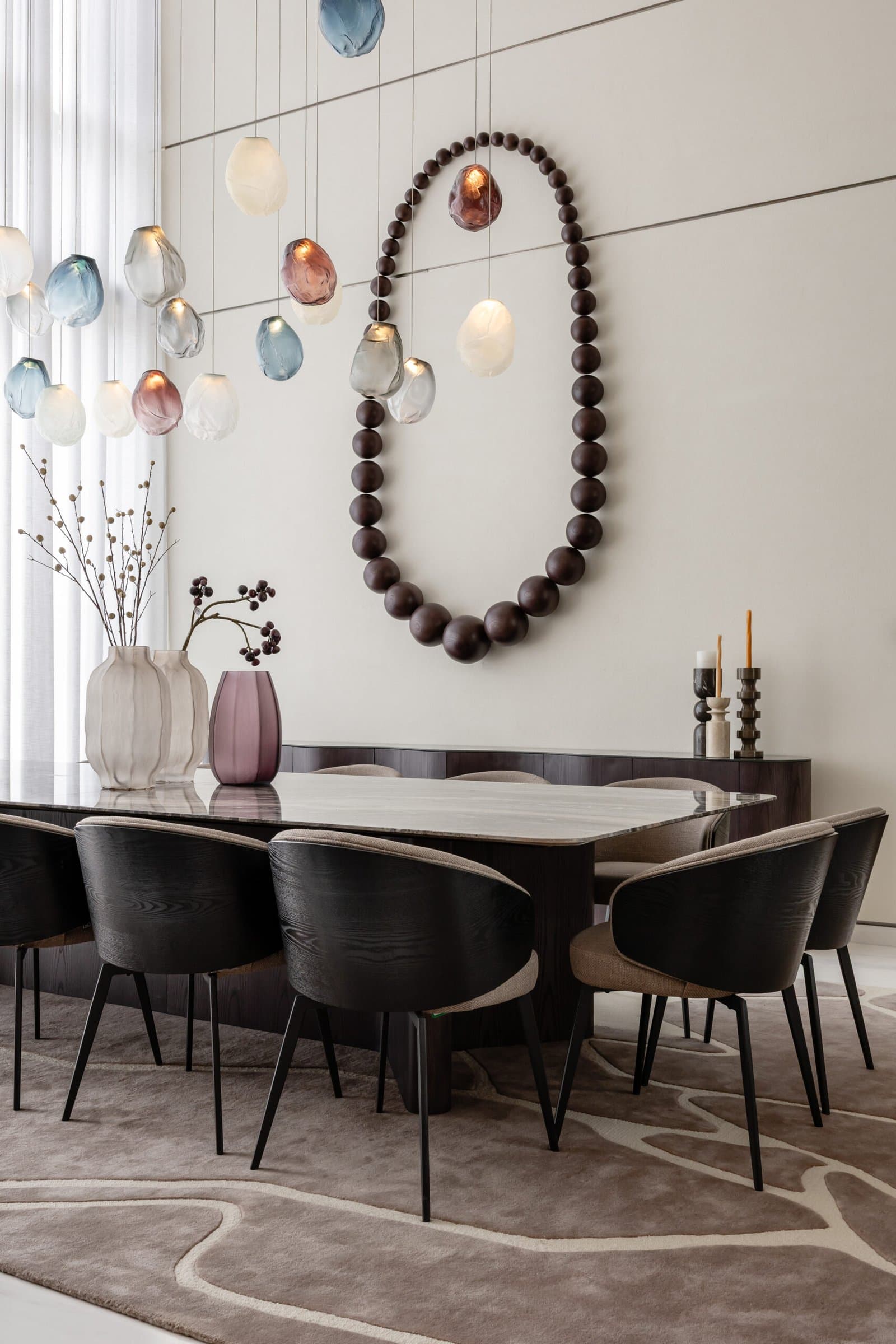
The bead piece is the room’s quietest provocation, a single craft object given the space to register at scale. Against the glass pendants, it offers a counter-argument in matte wood, and the dining room becomes a conversation between two textures of light.
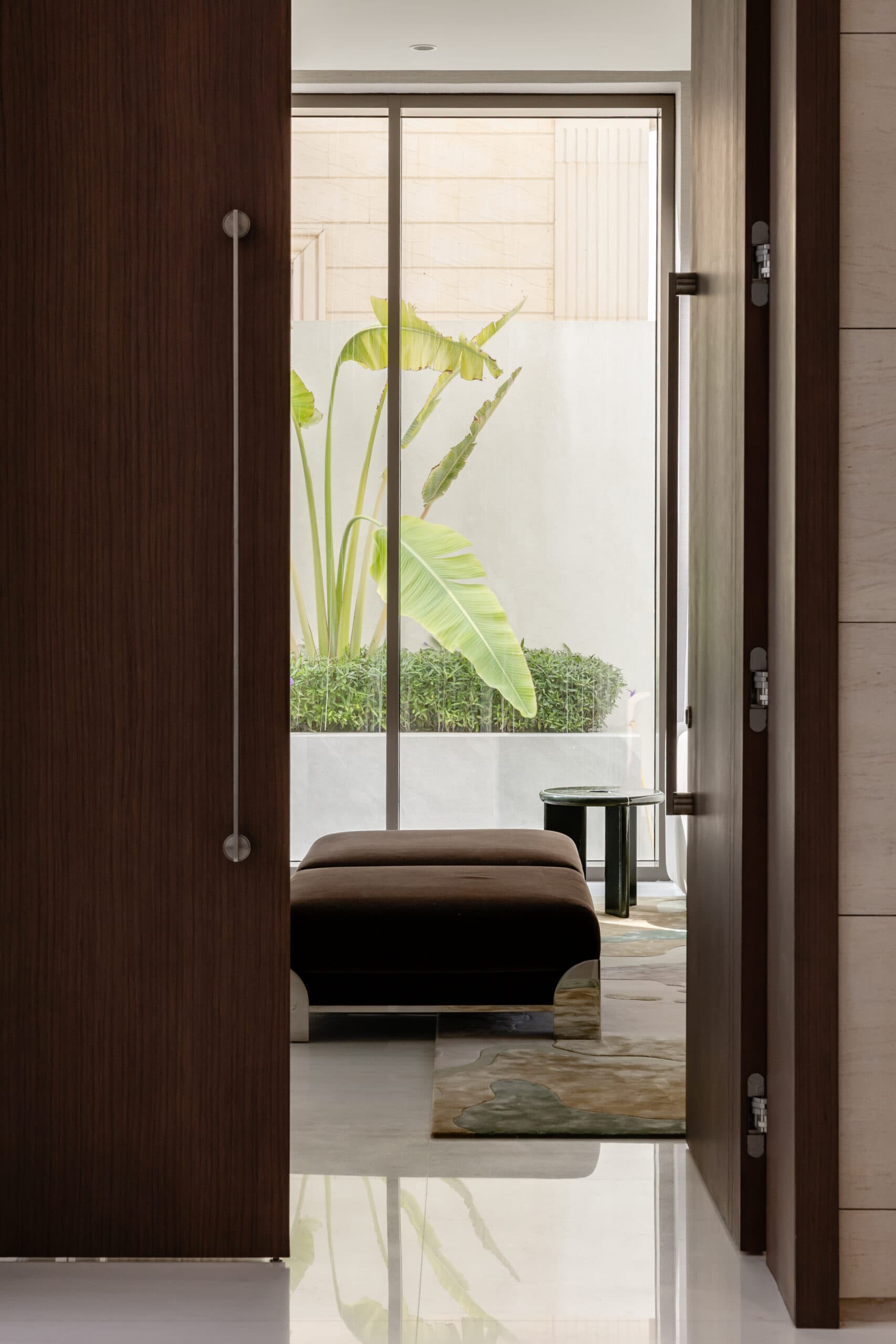
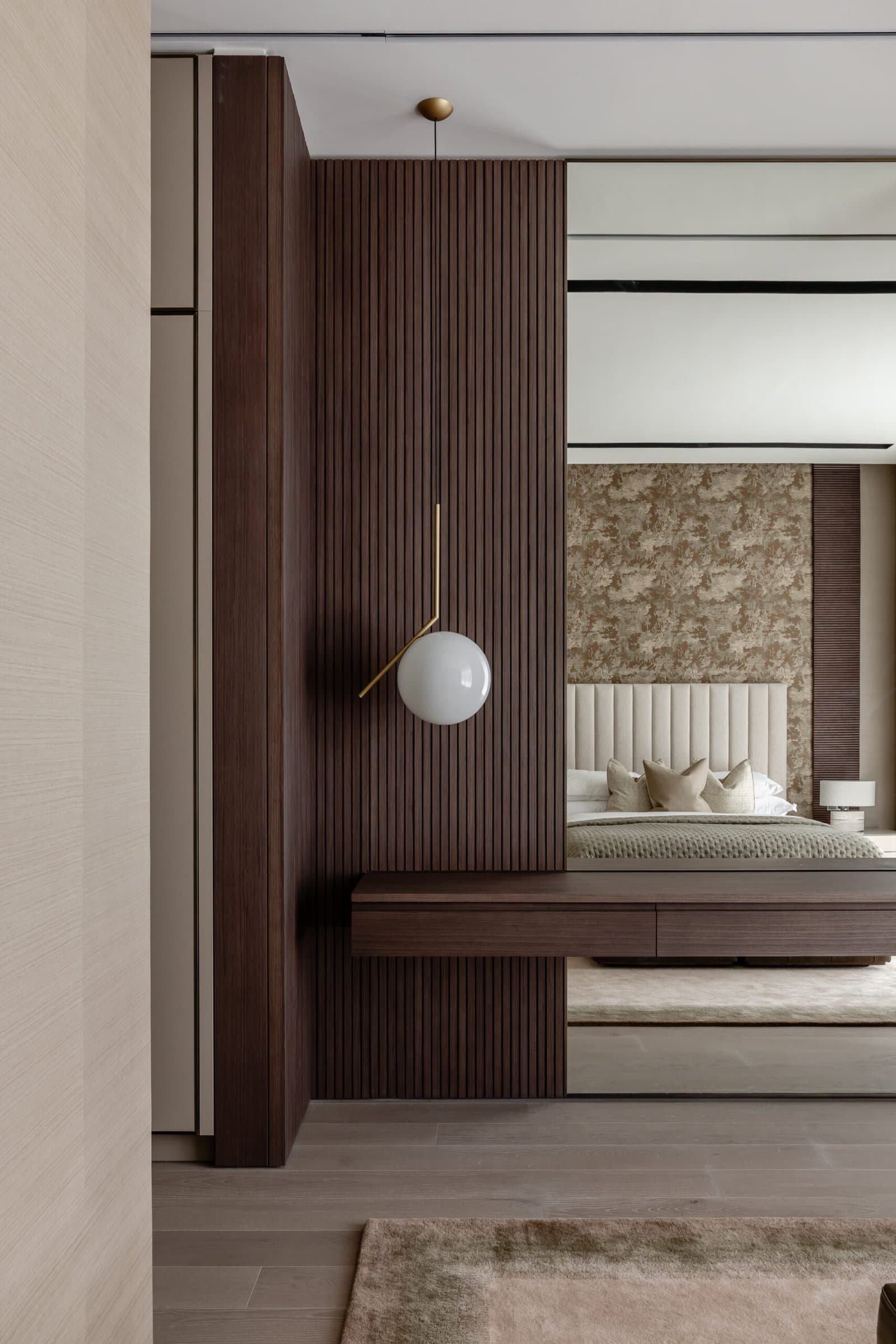
The master bedroom is approached through a transition that is almost a room in itself. A floor-to-ceiling fluted dark-wood panel carries a slim brass-stem pendant with a single milky globe, set above a floating wood console with shallow drawers. Through a mirrored or framed opening to one side, the bed is glimpsed against a softly patterned headboard wall, its upholstered headboard rising in vertical channels.
The detail is a study in how to handle a threshold. The panel slows the eye; the pendant marks the pause; the console offers a single functional gesture before the bedroom proper takes over. Nothing is wasted.
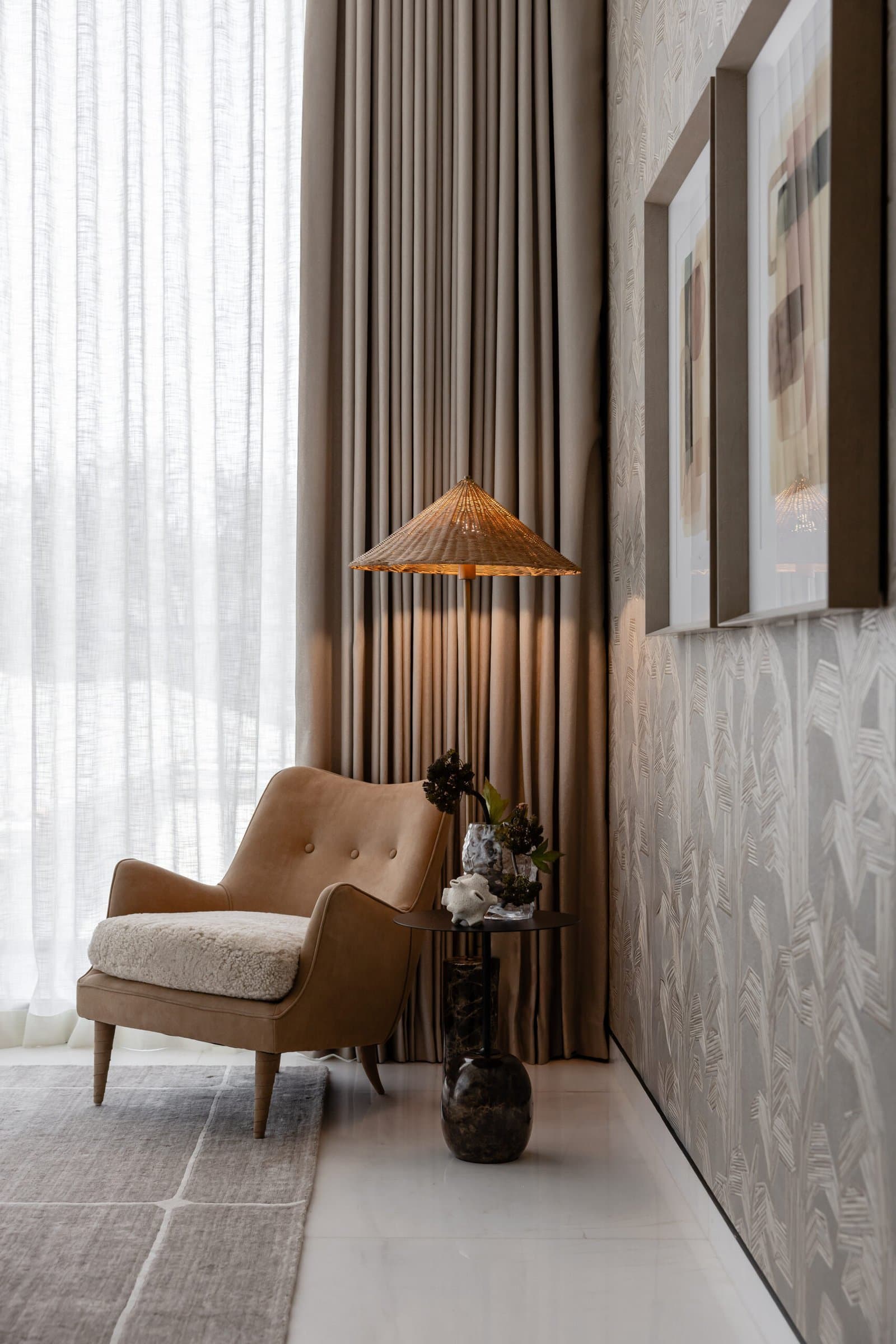
Within the bedroom, a quiet corner shows the studio’s lighter hand. A tan suede armchair with a shearling cushion sits against a wall of patterned beige wallpaper, beside a small dark side table and a tall floor lamp whose woven cane shade reads as the room’s only craft note.
Within Dubai’s residential design landscape, where luxury homes often lean on marble, gilded finishes, and overt expressions of grandeur, Villa Kovera takes a more measured approach. Its material palette is anchored in natural wood, stone, and tactile textiles, while moments of visual drama emerge through carefully considered lighting and a restrained collection of artworks. Rather than being designed for spectacle, the interiors prioritise comfort, longevity, and the rhythms of everyday living. In a city often associated with maximalism, the project reflects a growing appreciation for a quieter, more nuanced form of luxury.
What Noon Design Studio has created is a home that celebrates restraint as a mark of confidence. The architecture and interiors never compete for attention. Instead, they provide a composed backdrop that allows daily life to take centre stage. Luxury reveals itself not through excess, but through craftsmanship, proportion, and detail. It can be found in the weight of a door, the texture of natural materials, the soft fall of a curtain, or the subtle presence of a sculptural object illuminated by evening light. Villa Kovera is a reminder that true sophistication often resides in what is left unsaid.