Quiet luxury, as a phrase, has been worn thin by overuse. As an actual design discipline, it remains genuinely difficult, because it asks the designer to remove rather than add, to detail rather than decorate, and to trust that the resulting hush will register as confidence and not absence.
This is the territory The Matte House occupies. Designed by A N Design Group, the 4,000-square-foot row house in Bengaluru was conceived around a palette of deep wood veneers and soft PU Duco finishes, and around the conviction that texture, rather than ornament, would carry the home’s emotional weight. Apoorva Anand and Choppa Nikhil have built the project as an argument for surface as substance.
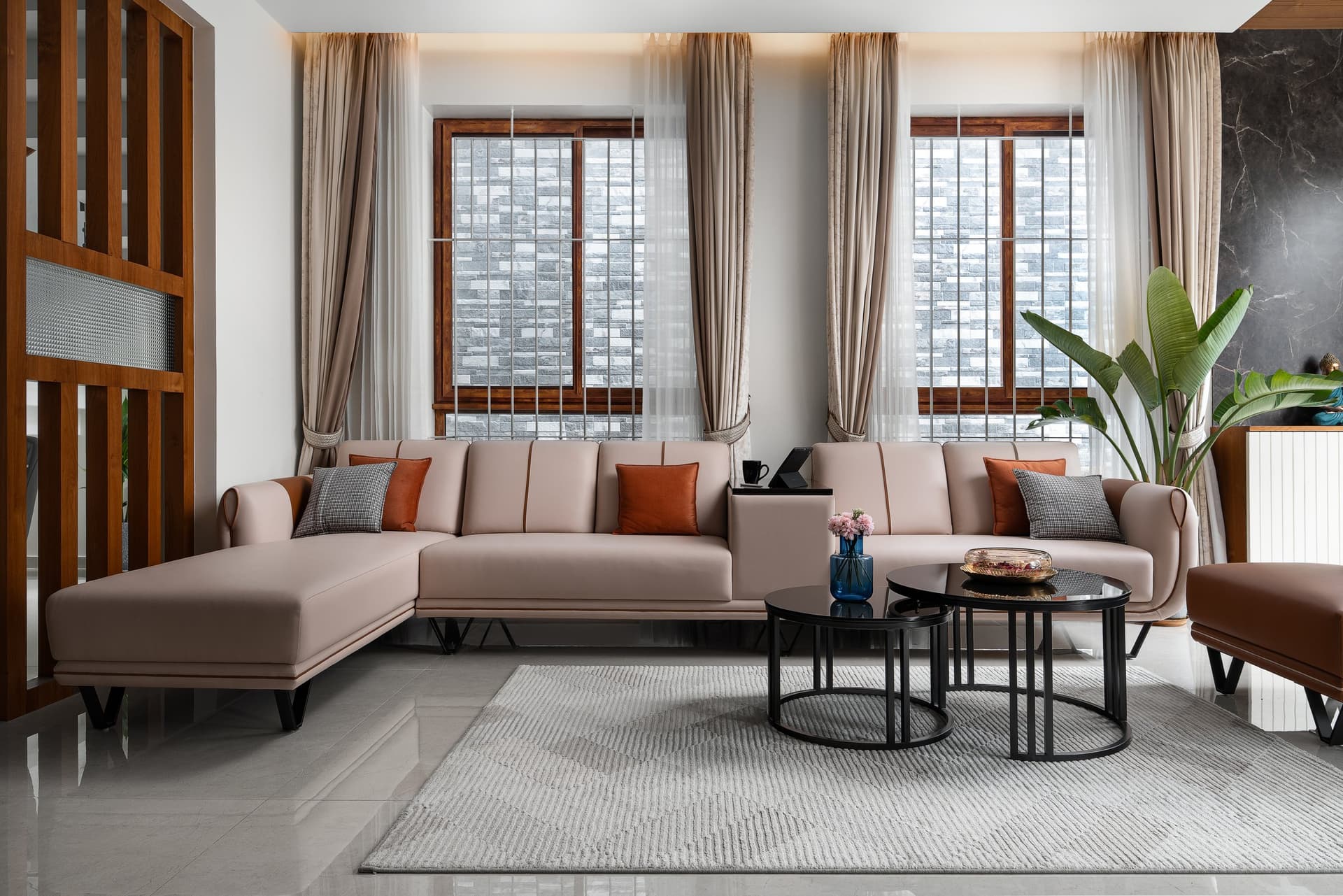
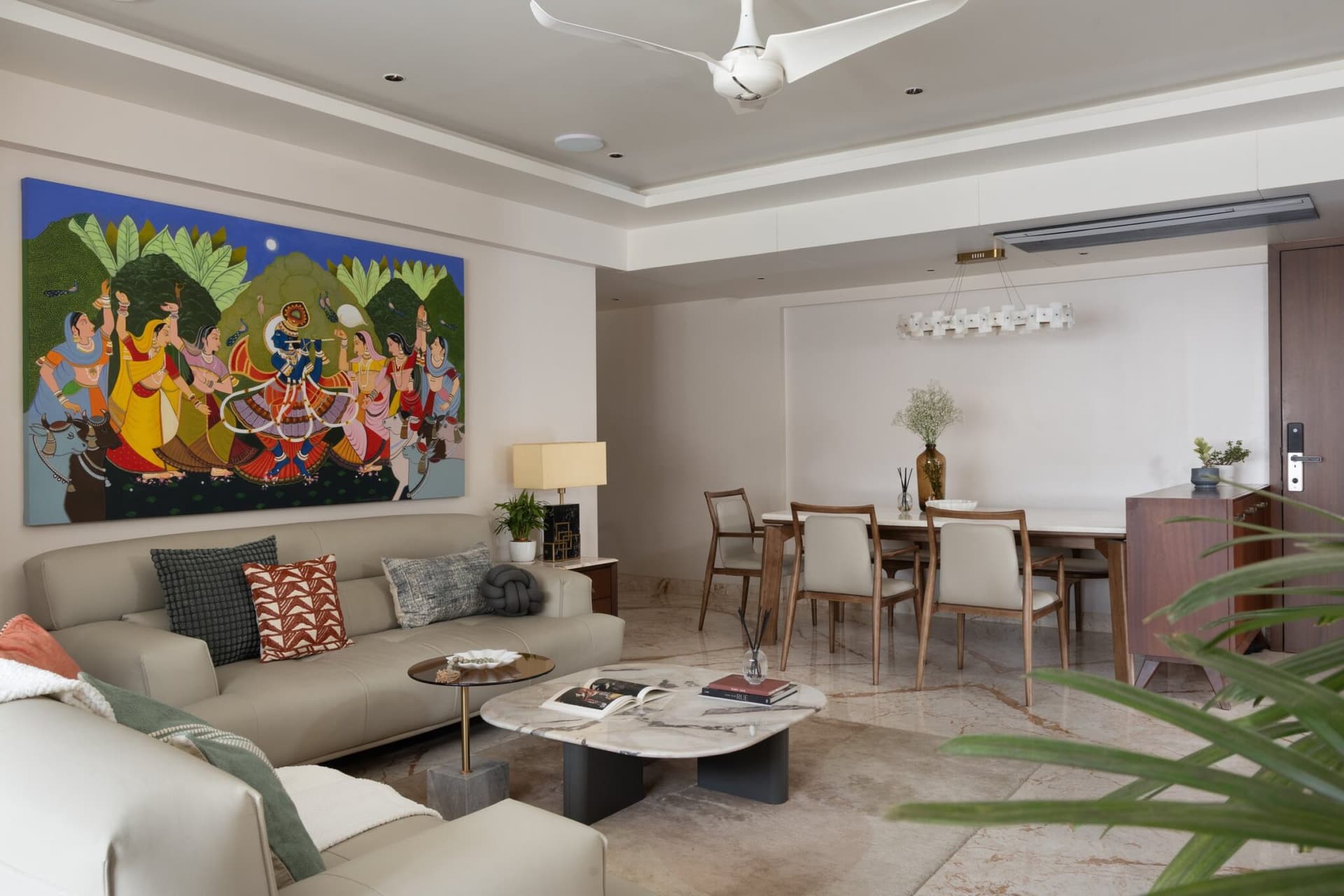
The living room sets the entire grammar of the home in a single view. A long sectional in muted blush leather sits against a quiet white envelope, punctuated by burnt-orange cushions that read less as colour and more as warmth, while the slatted wood screen at the left edge gestures toward the entry without barricading it.
What the room refuses is as instructive as what it allows.
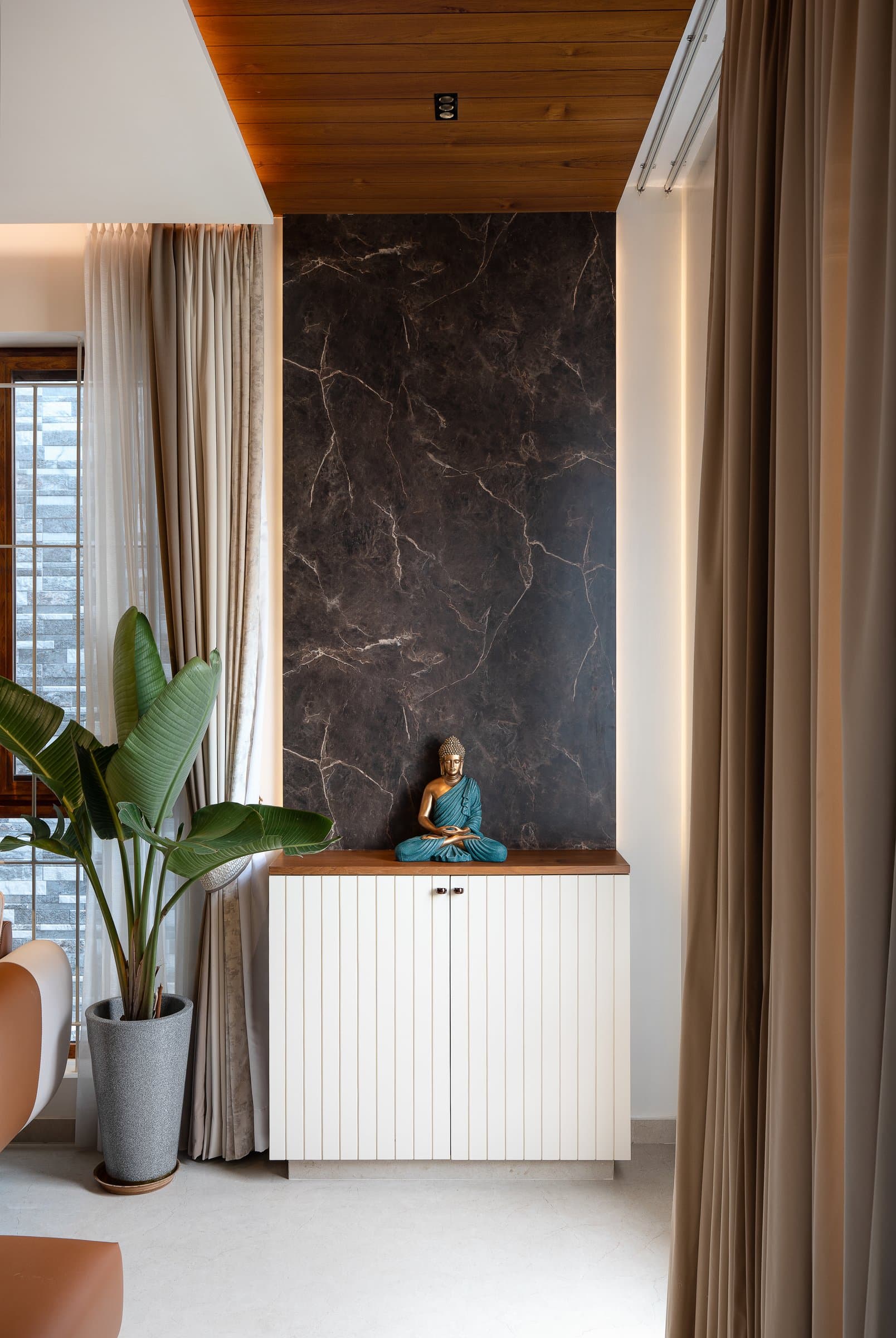
““By meticulously detailing every corner and prioritising a cohesive material palette, this row house achieves a sense of quiet luxury.””
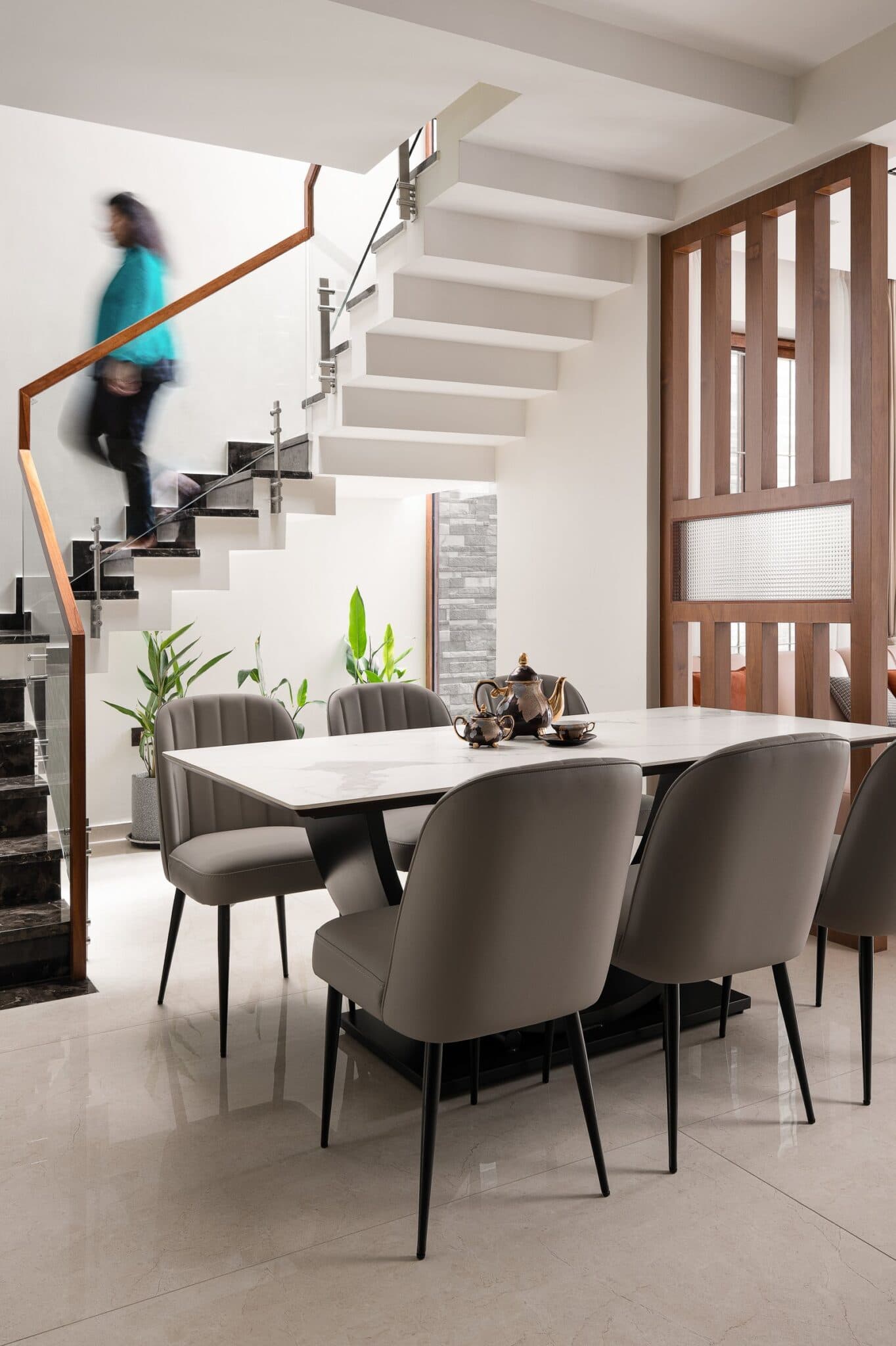
The dining area opens beneath the staircase, where a sintered-stone table on a sculpted black base anchors a cluster of grey upholstered chairs. The slatted wood partition to the right negotiates the threshold to the living room without sealing it off, and the staircase itself, rendered in dark stone treads against a white folded soffit, doubles as the room’s principal piece of sculpture.
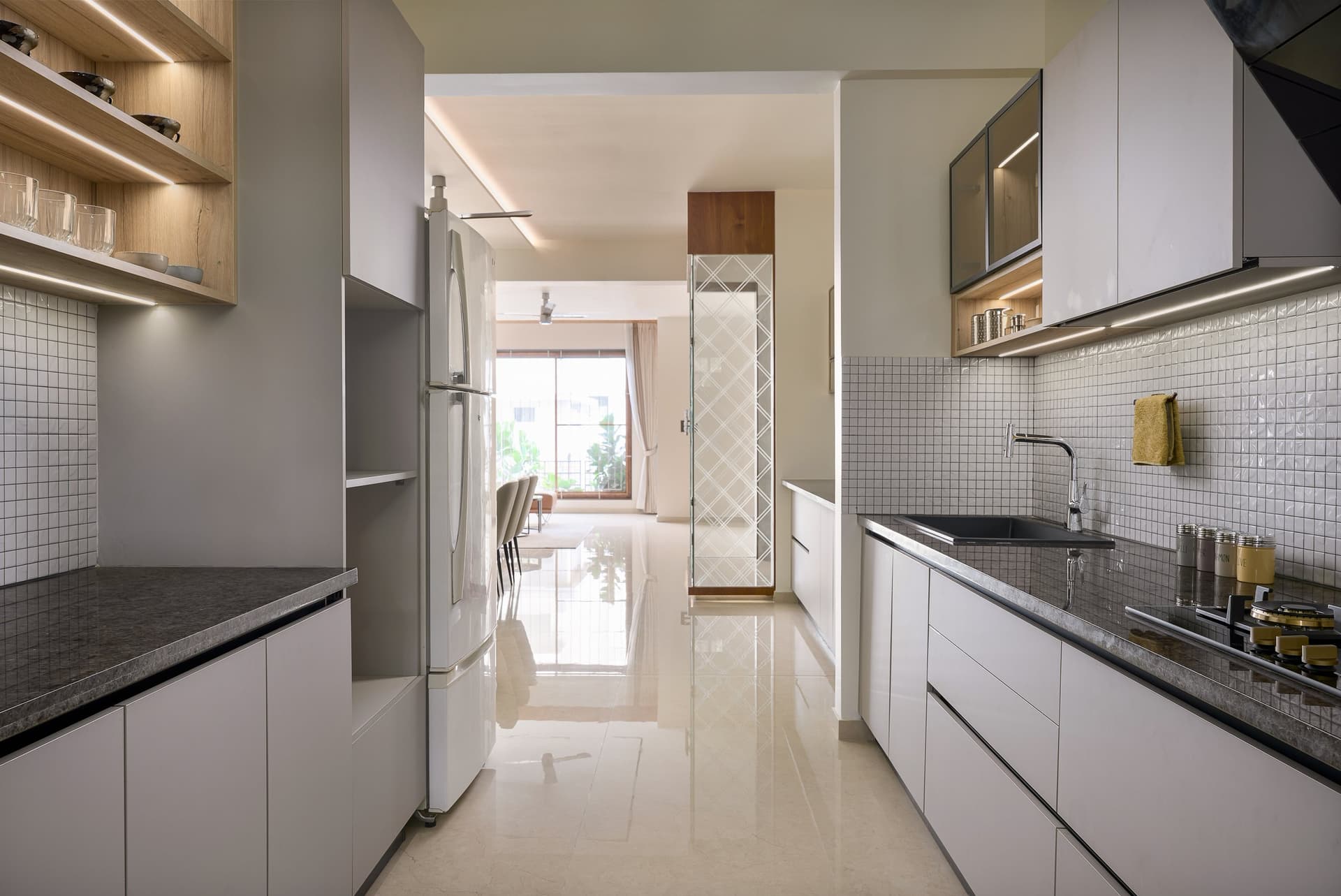
The kitchen reads as a long, disciplined corridor of work surfaces, framed at one end by the dining room and at the other by a glazed utility door etched with a diamond pattern. White mosaic tile runs the full backsplash, and the cabinetry, in crisp white, is held down by a dark stone counter that grounds the whole composition.
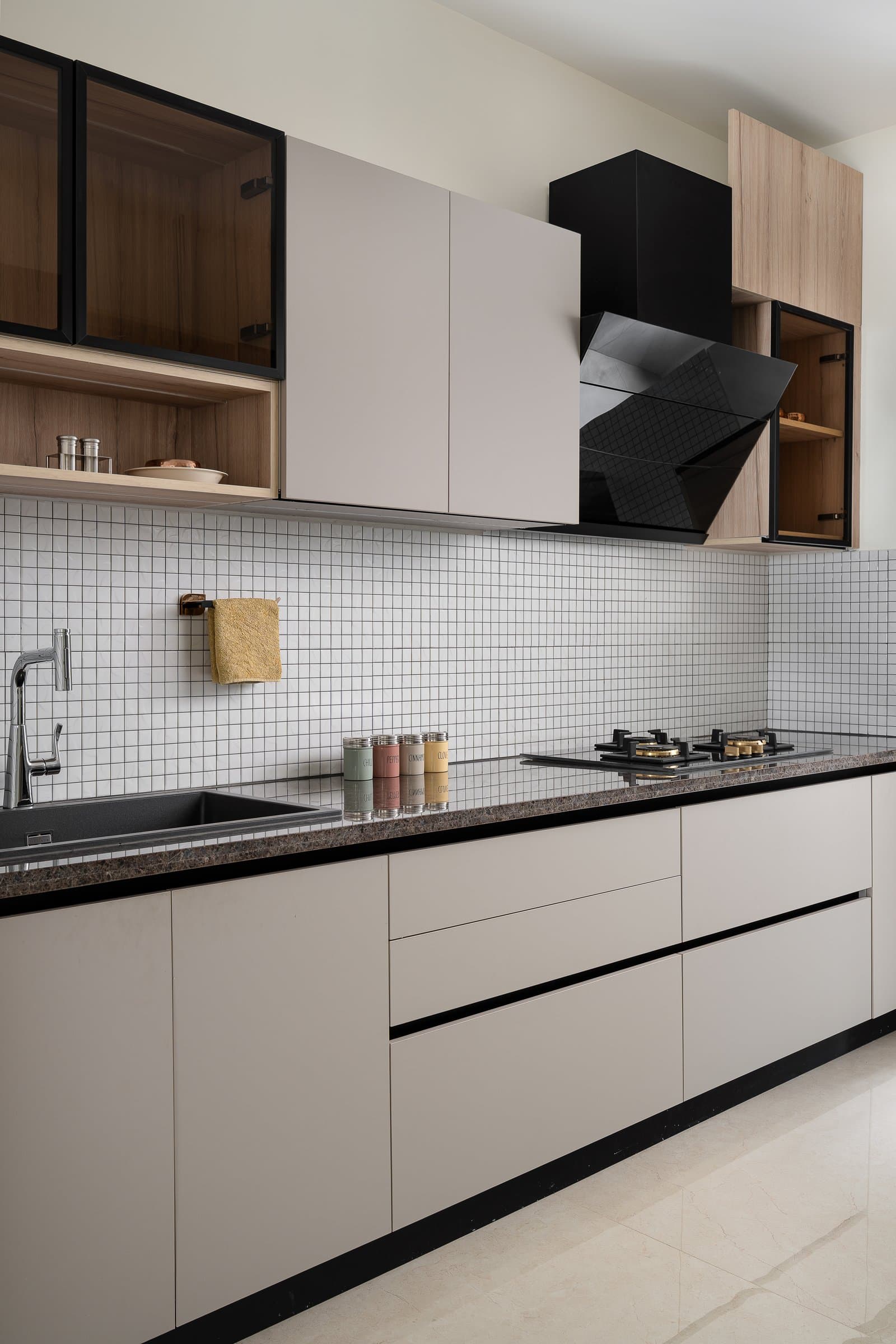
Closer in, the kitchen’s logic of contrast becomes legible. The black glossy chimney is the only object permitted to interrupt the matte field, flanked by a wood-lined open cabinet on one side and a flush handle-less upper on the other, while the small-format tile establishes a quiet rhythm that the eye reads as texture before it reads as pattern.
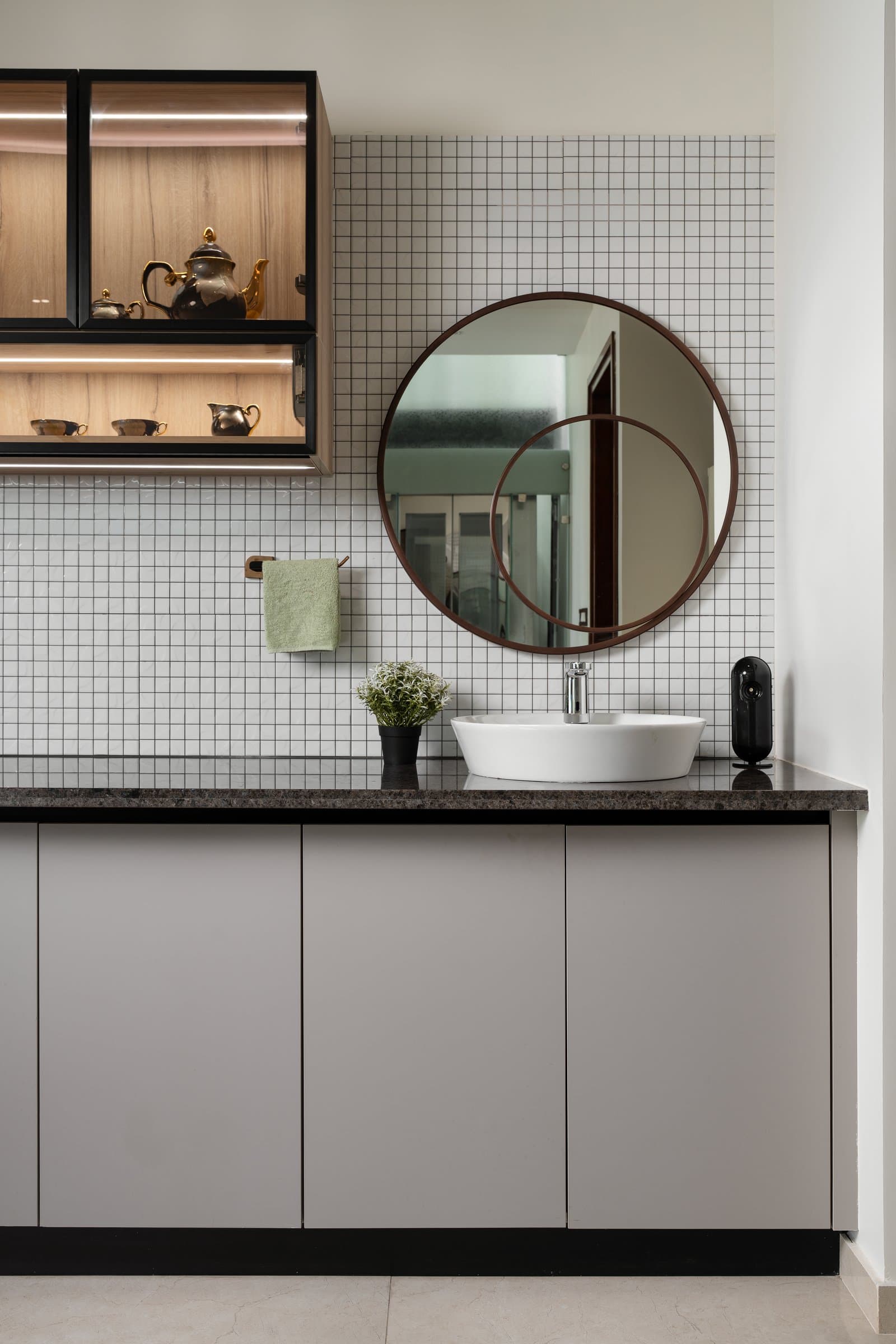
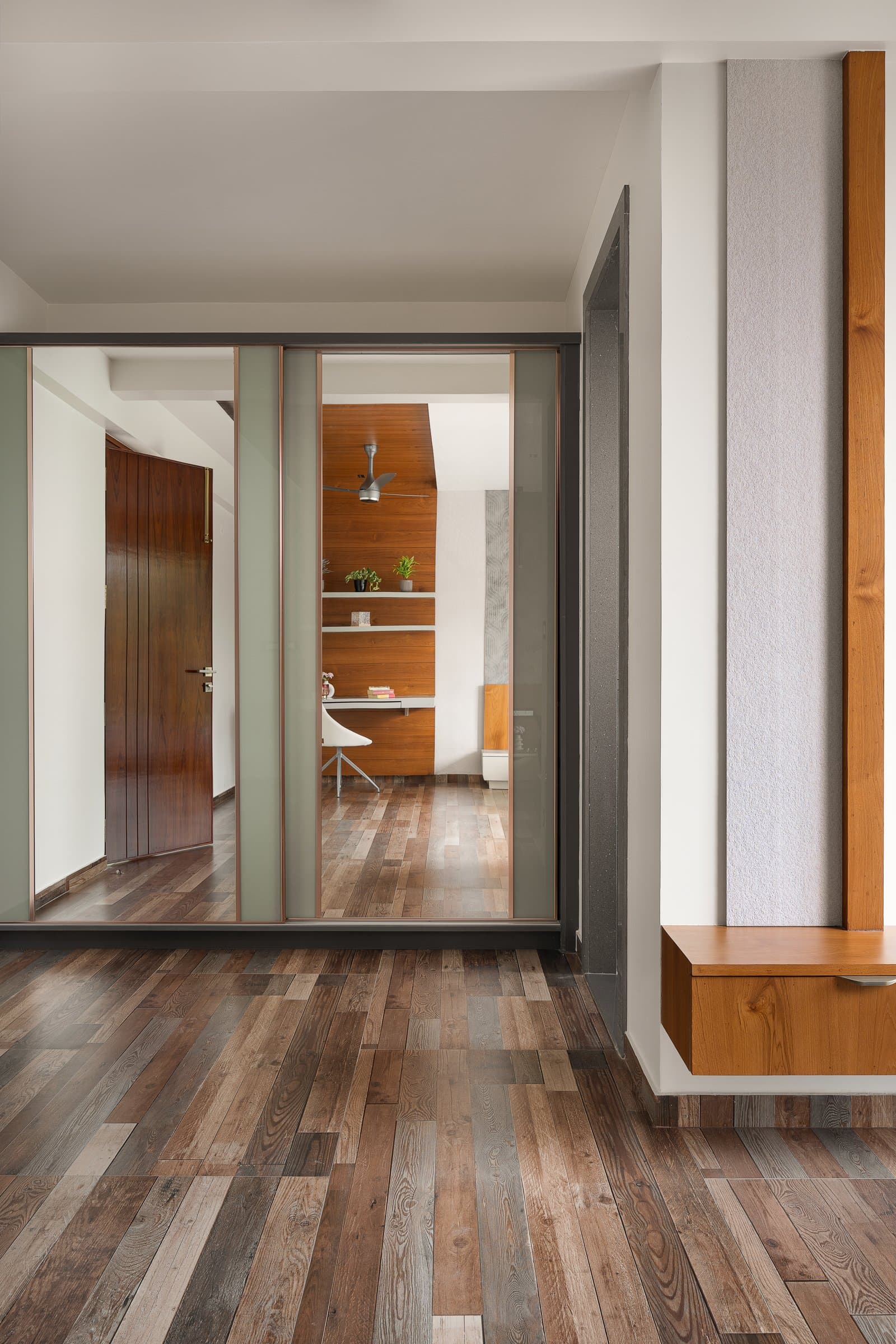
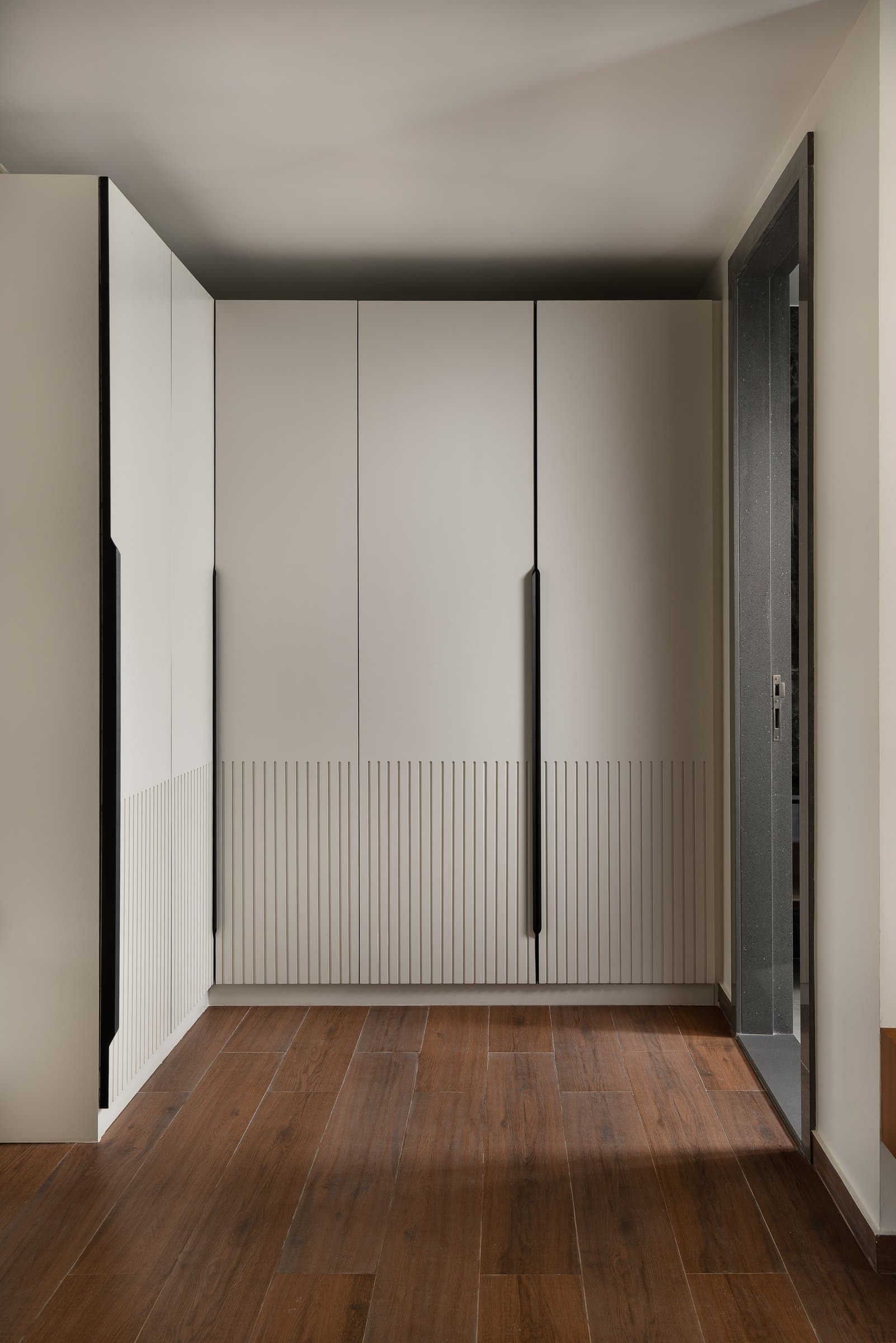
Moving toward the Master Bedroom, a vestibule of plank flooring opens between a tall mirrored wardrobe and a slim study glimpsed through frosted glass.
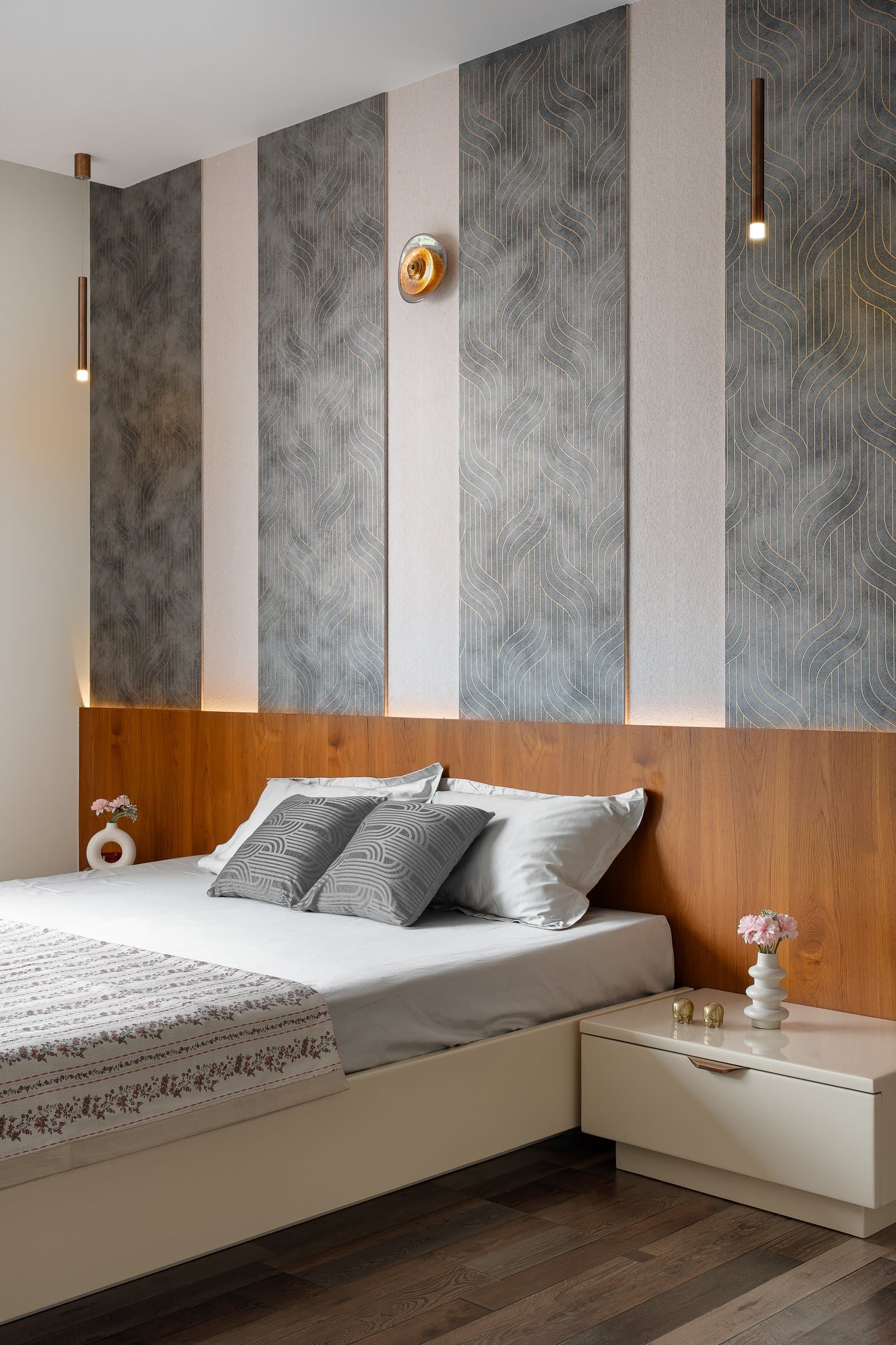
The master bedroom arrives with the home’s most expressive feature wall. Vertical panels alternate between cream linen-textured strips and a darker patterned weave threaded with metallic line work, all anchored by a broad wood headboard that runs the room’s full width. The brass wall sconce, with its single amber disc, is the room’s punctuation mark.
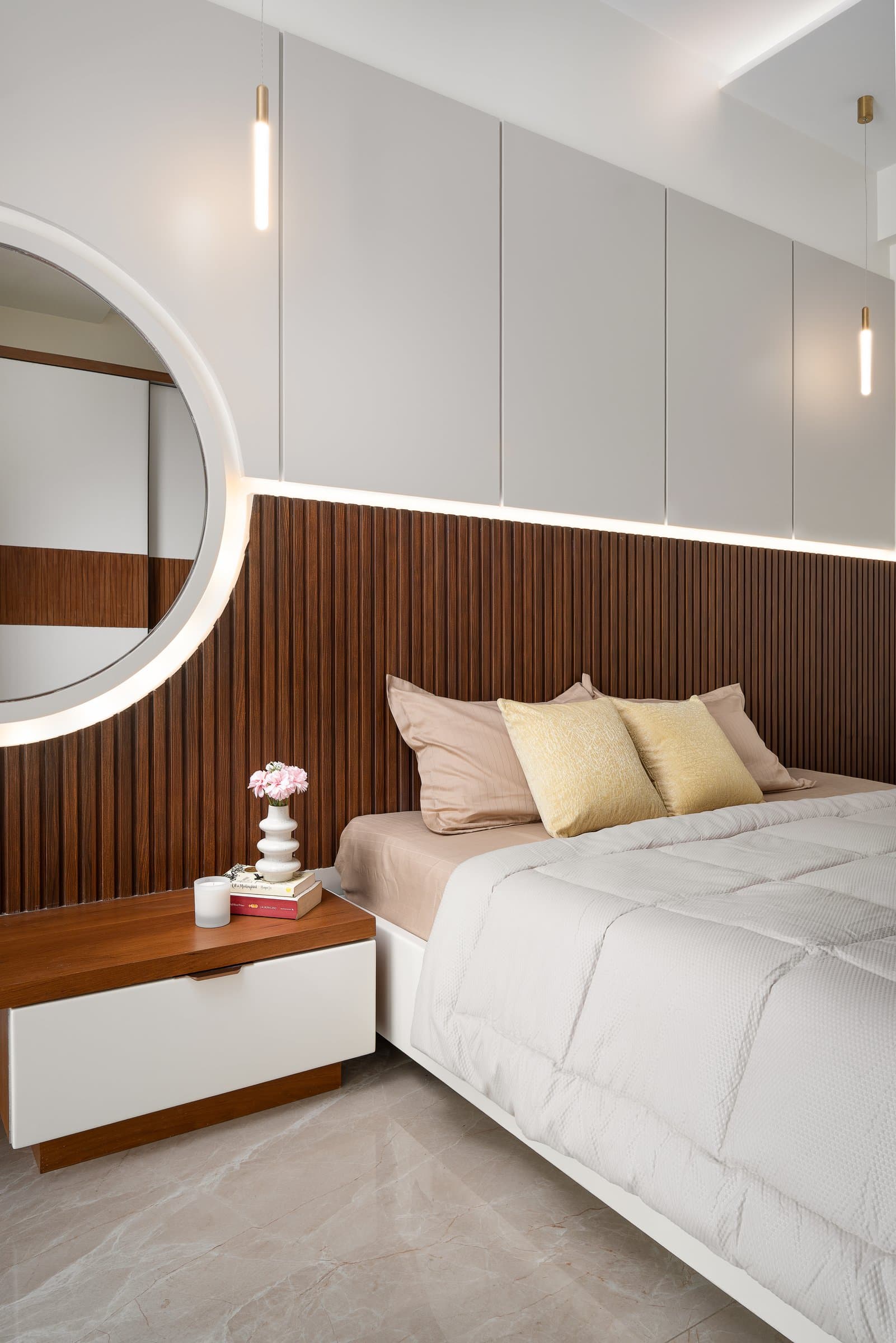
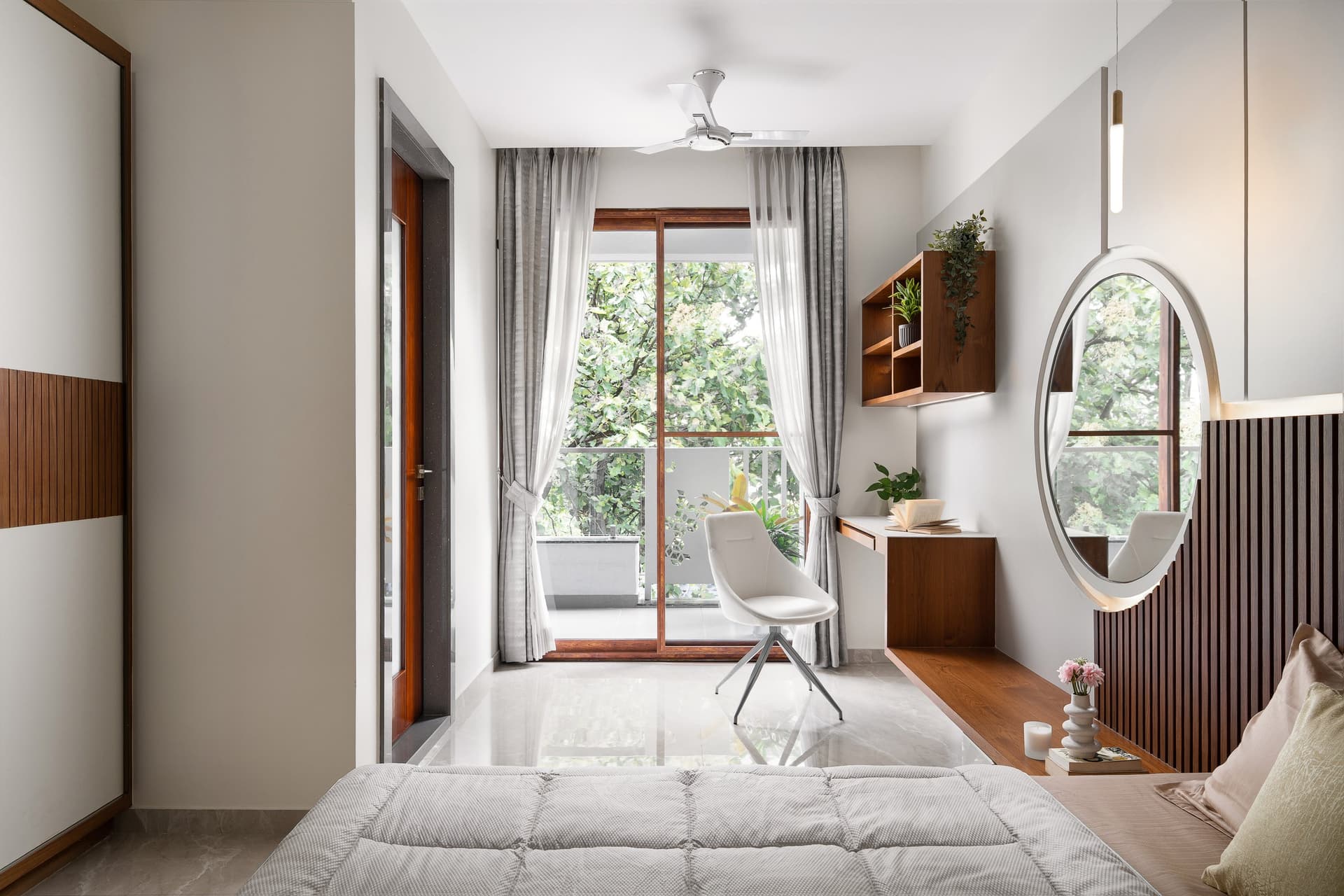
In the second bedroom a fluted wood panel runs behind a built-in nightstand, capped above by a band of indirect light and a wall of flush matte storage. The circular backlit mirror, set against the fluting, is the only curve in a room otherwise built from vertical lines, and the contrast is what gives the wall its quiet drama.
A wood-framed sliding door opens onto a balcony thick with greenery, and the room organises itself around a circular mirror with a slim white halo, mounted against a fluted wood panel that runs from floor to ceiling.
A compact wall-mounted study, in wood with a pale top, tucks neatly beside the window, and the white swivel chair is the only piece that floats freely in the room. Everything else is built-in, considered, and resolved to its plane.
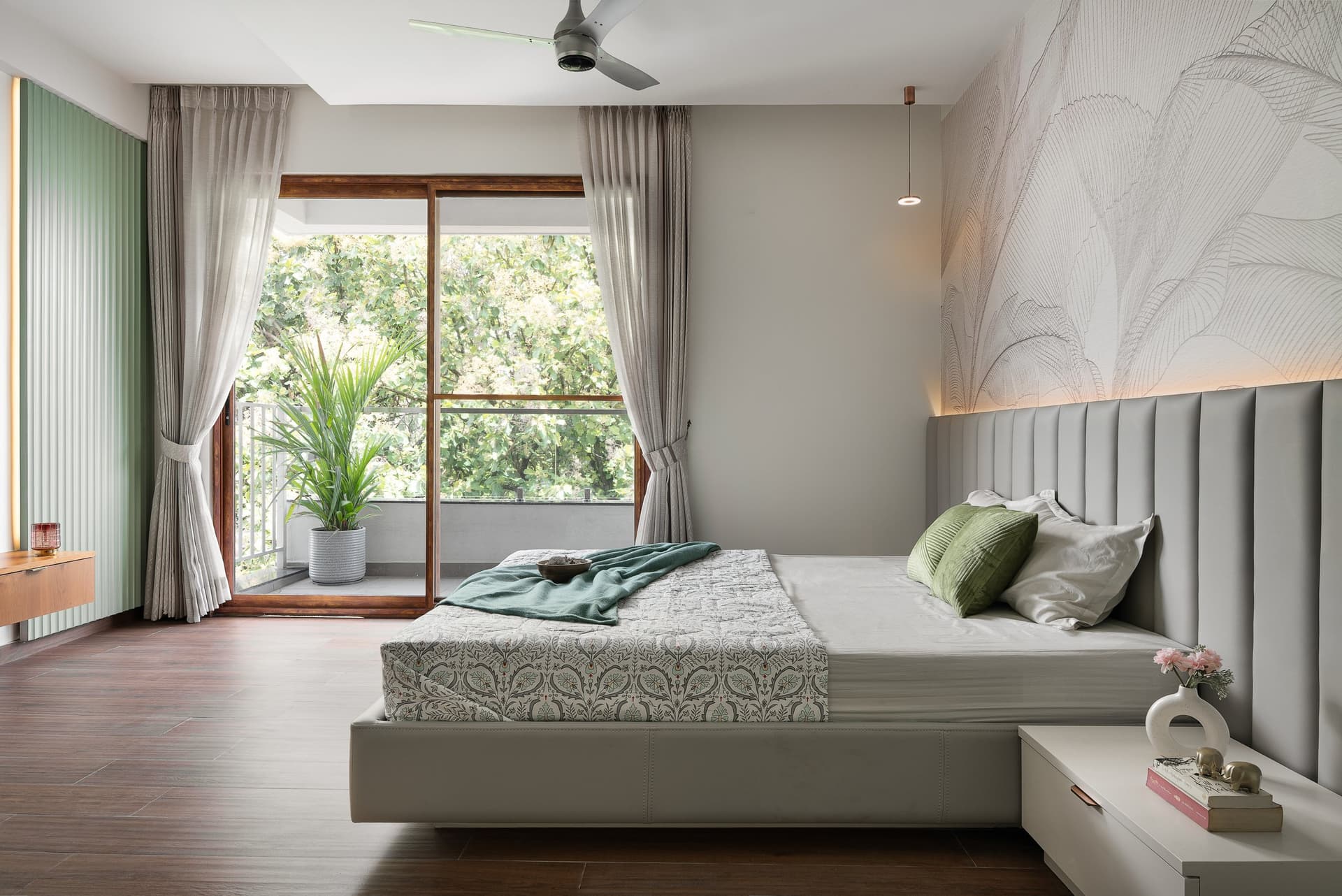
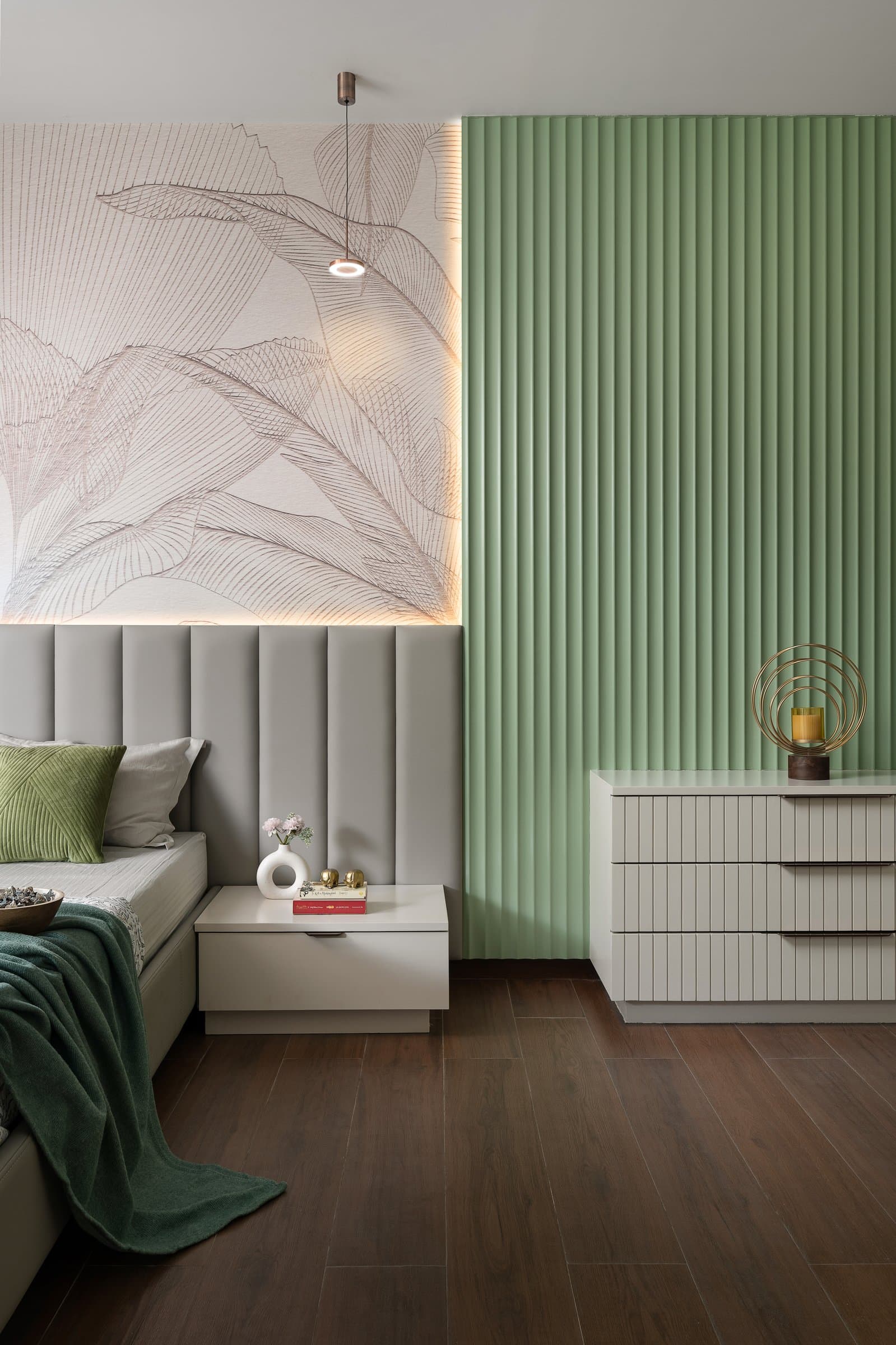
The third bedroom trades the master’s density for openness. A pale leaf-printed mural runs the length of the bed wall, paired with a channel-tufted grey headboard, while the wide sliding door opens onto a balcony framed by mature canopy. The mint-green fluted panel on the far side introduces colour as architecture rather than accessory.
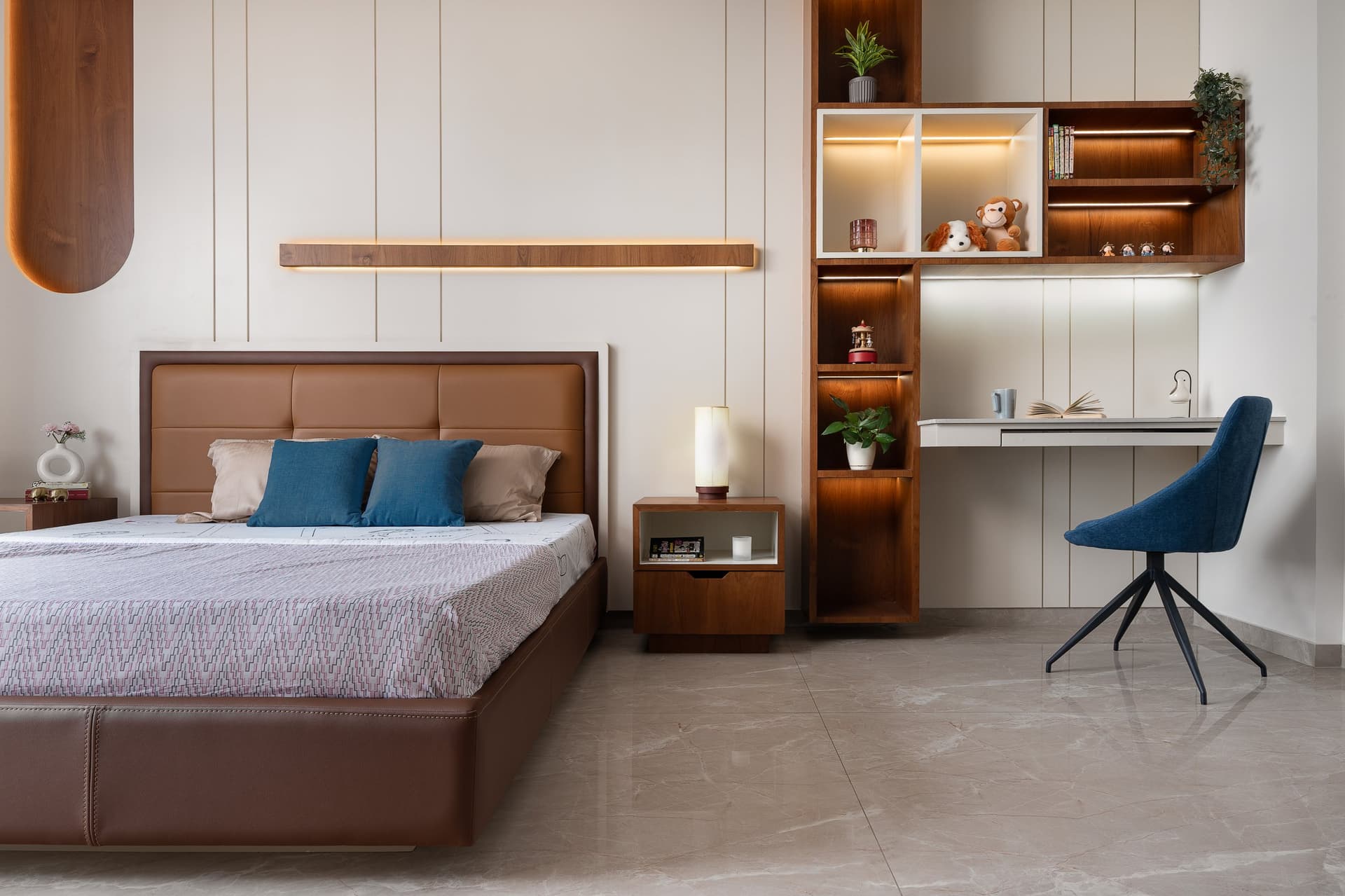
The children’s bedroom is more openly playful, though no less disciplined. A tan leather-upholstered bed anchors a wall of slim vertical reeding, with a horizontal wood-and-LED light strip cutting across at headboard height, and the asymmetrical shelving unit on the right is the home’s most expressive piece of joinery, all back-lit niches and warm wood frames around white inner faces.
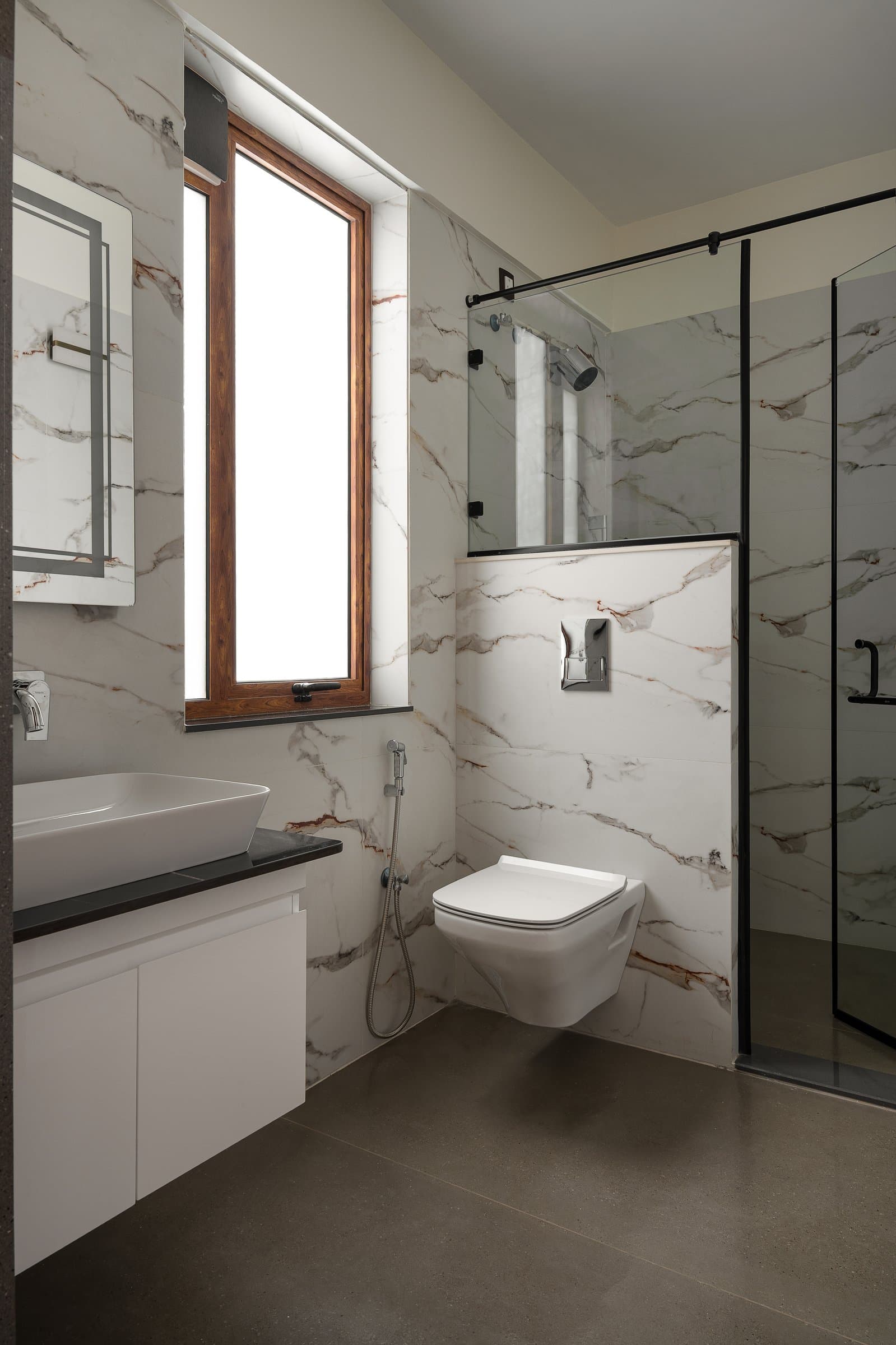
The bathrooms split into two registers. The first works in pale calacatta-veined surfaces, with a wood-framed window pulling natural light deep into the room, a black stone counter grounding the white vanity, and the shower zone screened by a frameless black-edged glass partition.
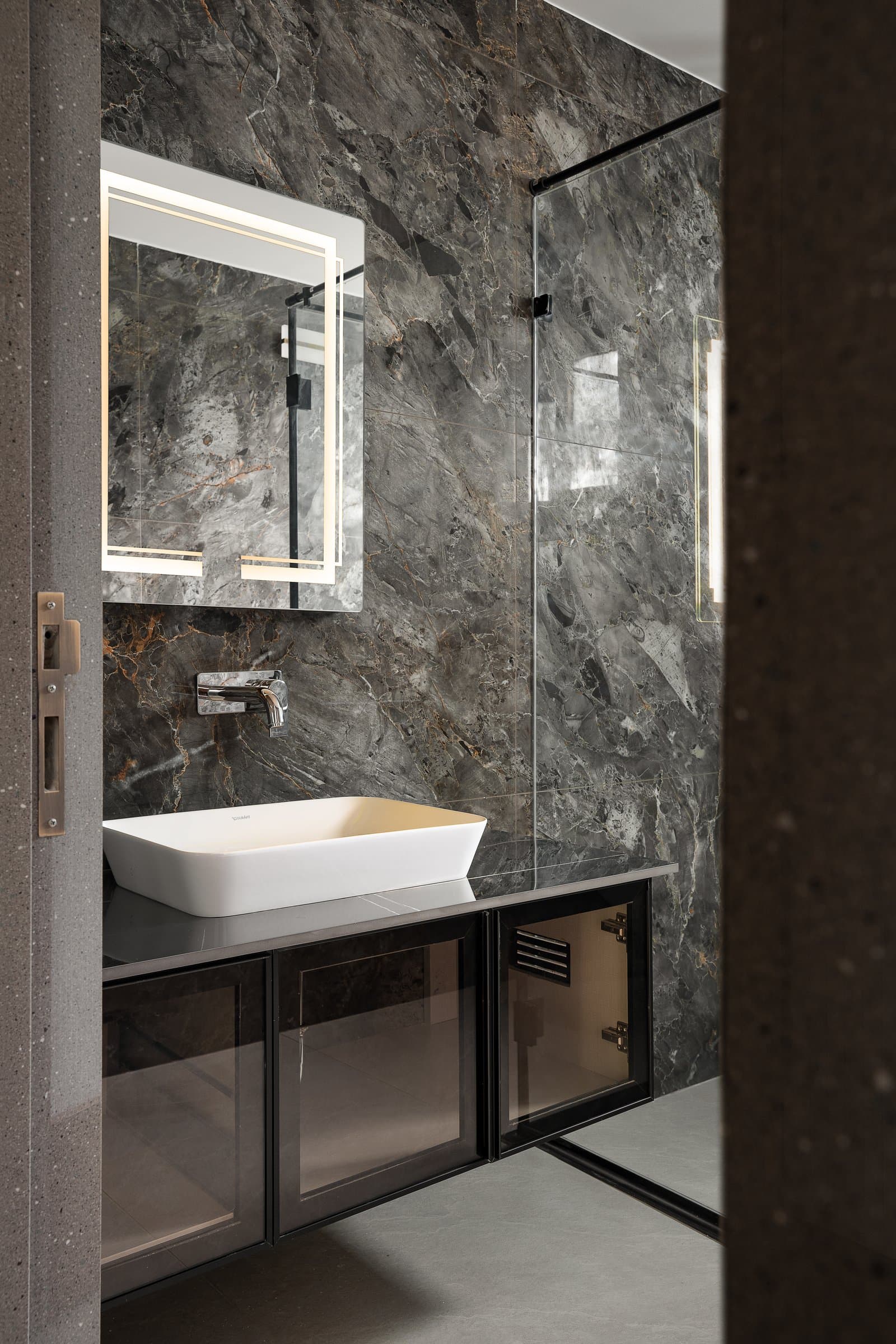
The second bathroom moves into darker territory. A wall of dramatically veined grey-and-amber stone wraps the vanity zone, met by a backlit rectangular mirror and a wall-mounted chrome spout, while the vanity below, in black-framed glass, behaves more like a piece of furniture than plumbing joinery.
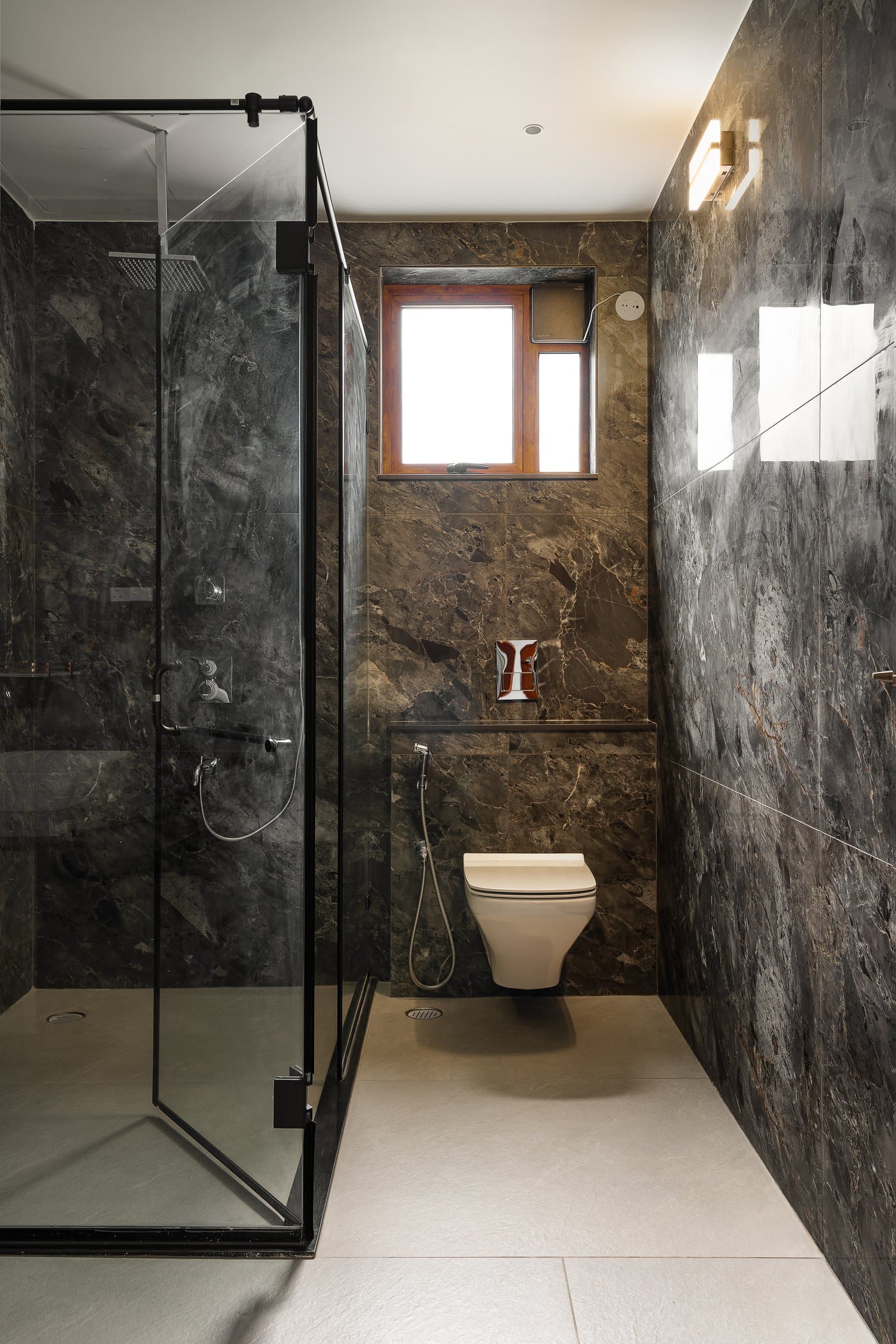
An adjacent bathroom carries the darker scheme through to a full shower enclosure. The same heavily veined stone runs floor to ceiling, broken only by a small wood-framed window and a glass partition framed in slim black, so that the room reads as a single carved volume.
Within Bengaluru’s residential landscape, where visual richness is often achieved through layers of ornament, pattern, and material contrast, The Matte House takes a more restrained approach. It demonstrates how warmth can emerge through texture rather than decoration, how colour can be introduced with precision rather than abundance, and how a home can feel deeply personal without relying on overt gestures.
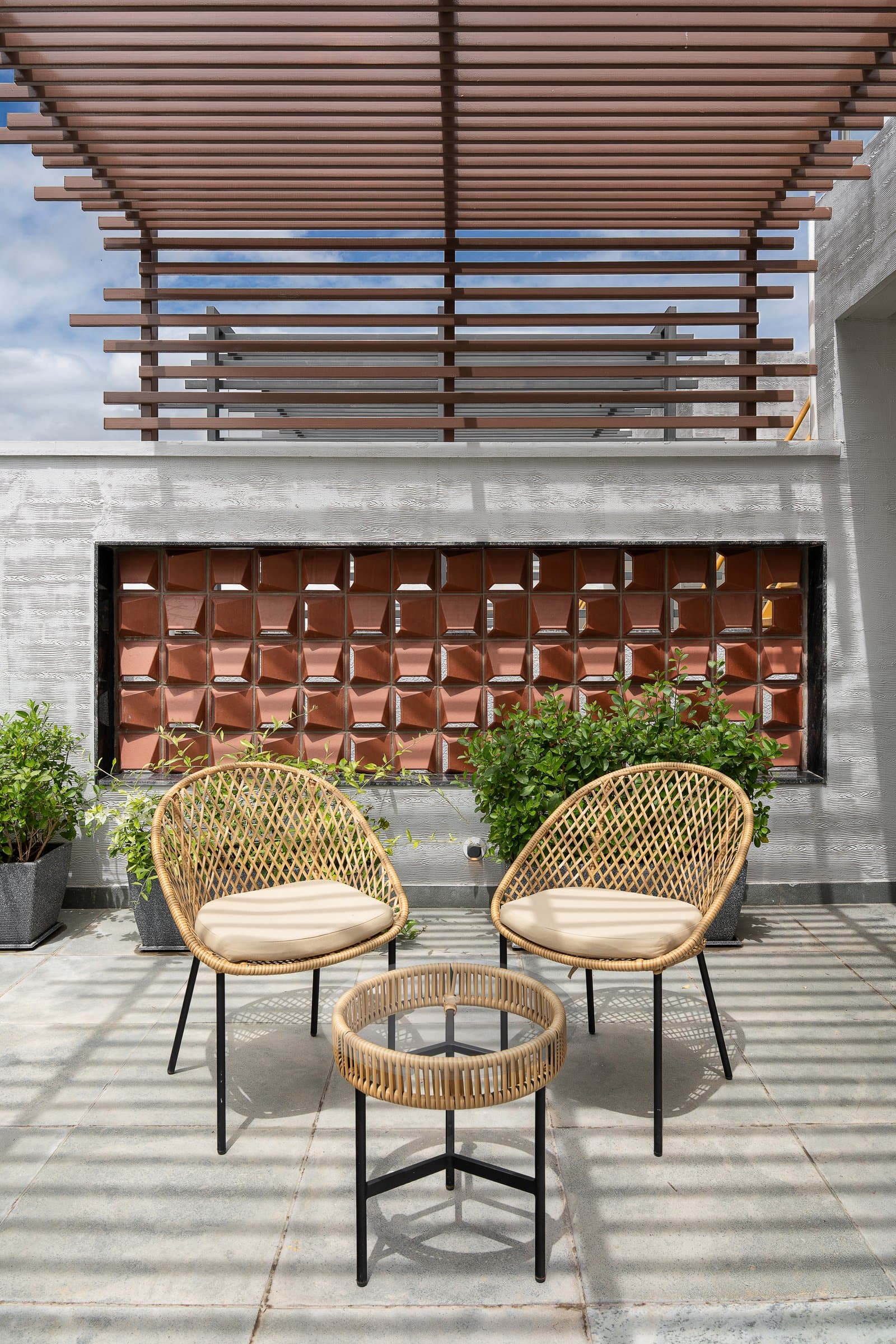
What ultimately defines the project is its consistency of intent. From the marble-clad niche that anchors the entry sequence to the terracotta jaali crowning the terrace, a carefully calibrated palette of matte finishes, dark timber, and soft, considered lighting carries through every space. Each element feels connected to the next, creating a sense of quiet continuity throughout the home.
The result is a residence that understands luxury as an experience rather than a display. Nothing feels excessive, yet every detail contributes to an atmosphere of comfort, refinement, and permanence. In a city where homes often compete for attention, The Matte House distinguishes itself through restraint, proving that the most enduring interiors are often the ones that speak the softest.