Scandinavian design, in its truest reading, is less a style than a discipline of restraint, a way of letting walls breathe and surfaces hold quiet. To translate that vocabulary into an Indian home is to negotiate two often-opposing instincts: the Nordic preference for stillness and the Indian habit of layered, lived-in warmth. Nordic Nest proposes that the two need not compromise each other.
Set within a 2,900-square-foot apartment in Hyderabad, the home was designed by Crafting Spaces, led by Anish Bhatnagar and Ashwathi Bhatnagar, for a family seeking a calm, contemporary backdrop without surrendering ritual or familiarity. The architectural premise is straightforward: a soft, neutral palette, limewash-textured walls running through the public spaces, and natural wood tones layered into furniture and joinery. What complicates and elevates that premise is the way Indian domestic life, the puja, the joint family rhythm, the casual blur between drawing and dining, has been folded into the plan rather than appended to it.
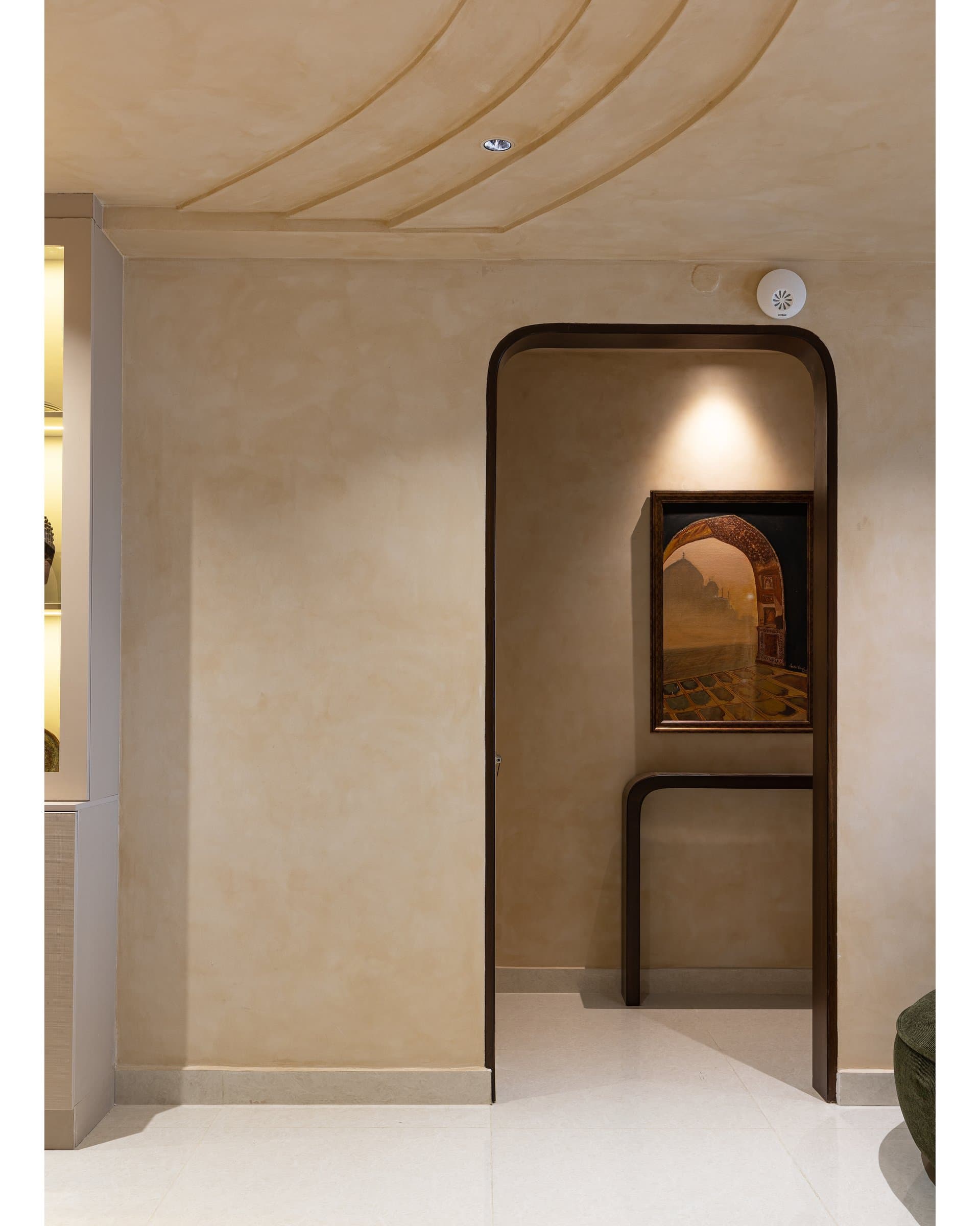
Arrival is calibrated to slow the eye. A rounded, deep-stained portal frames the view into an inner vestibule where a curved console sits beneath a small framed painting of a Mughal arch, the only overtly historical reference in the entire home. The ceiling, treated with concentric arcs in limewash, introduces the home’s defining gesture before any furniture does: walls and ceilings here are not background, they are the architecture.
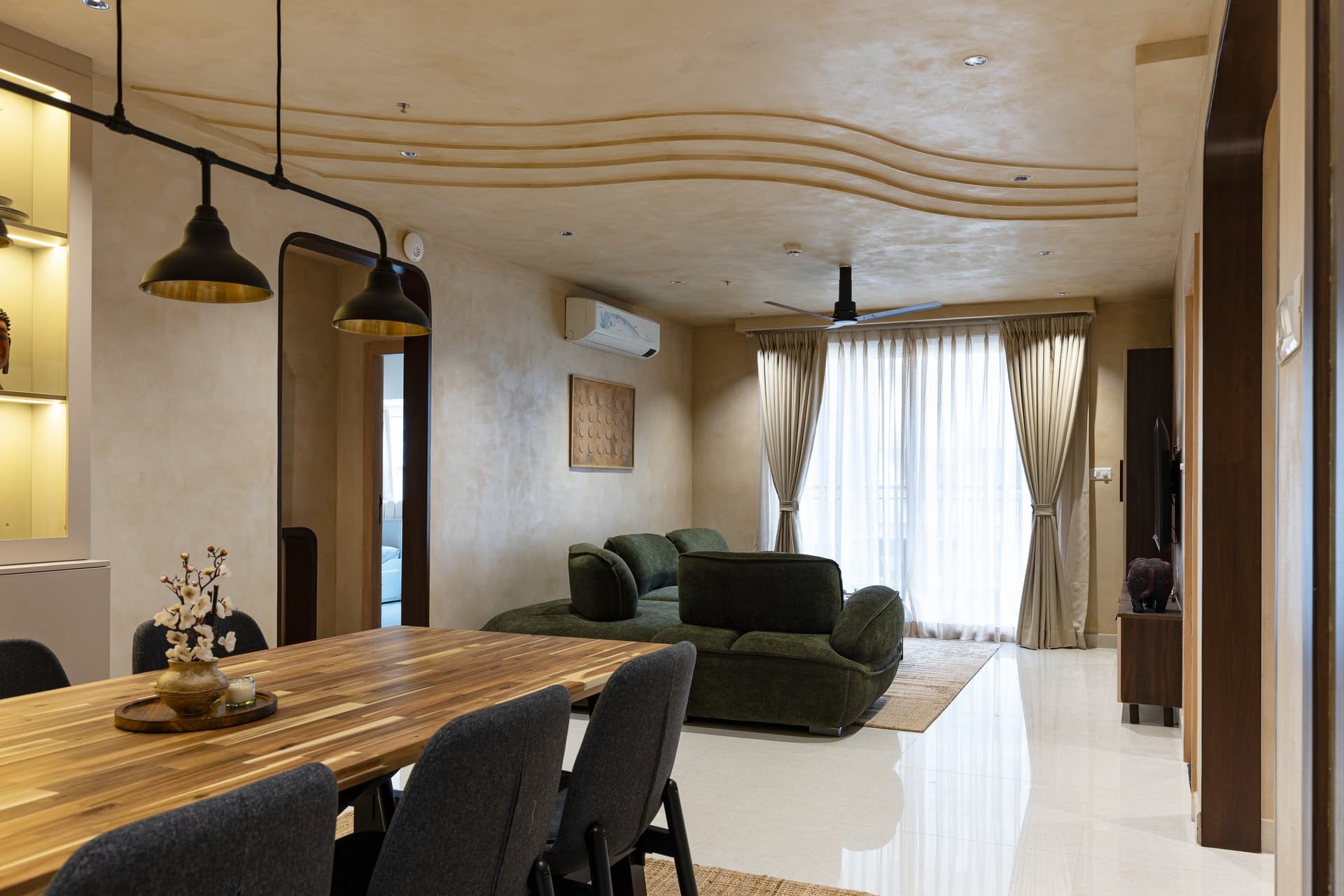
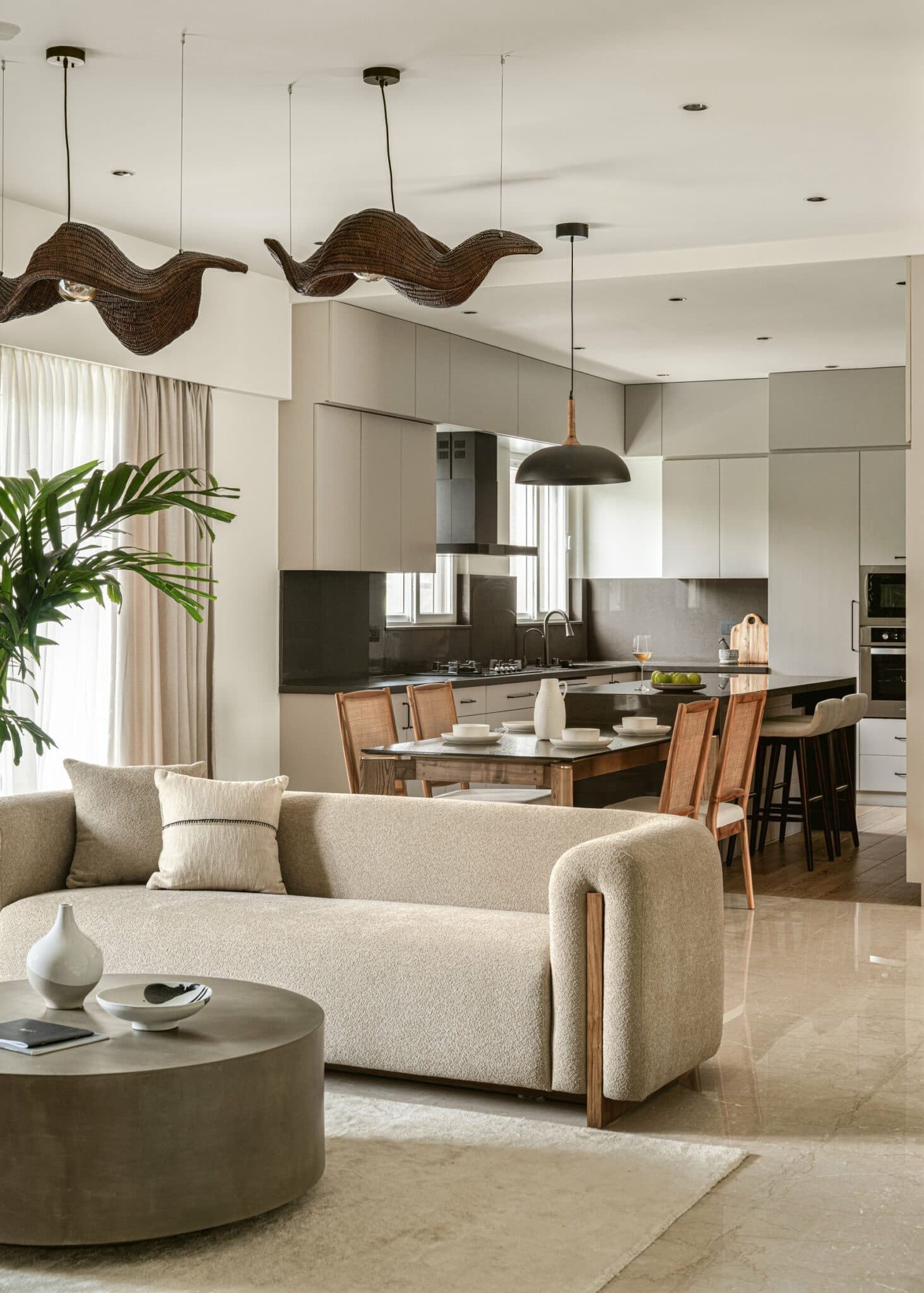
The drawing-and-dining volume reads as a single continuous room, unified by the wave-like ceiling that ripples across its full length. Beneath it, a pair of mossy-green corduroy sofas and a long acacia-plank dining table occupy opposite ends of the same axis, separated not by walls but by the rhythm of the ceiling itself.
What makes this room work is its refusal to over-decorate. The limewash walls carry tonal variation rather than pattern, the curtains pool softly at the floor, and the few decorative gestures, a tall arched mirror, a pair of black-and-brass pendant lamps, are confident enough to stand alone. The room does the Scandinavian work of editing, then permits the Indian instinct for warmth to settle into the textiles and timbers.
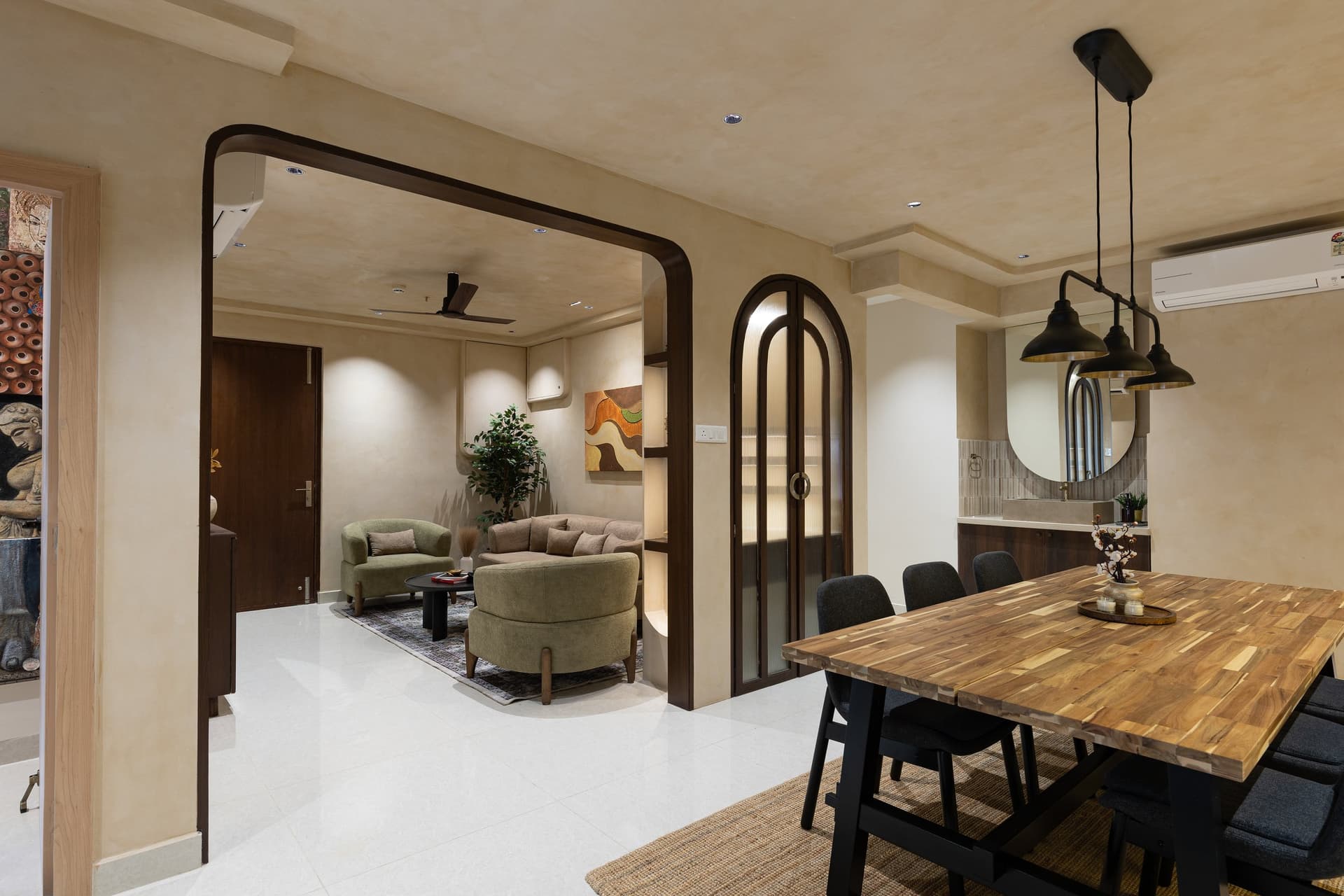
The bespoke puja unit, set into a slim arched cabinet with fluted glass doors, anchors the threshold between the two zones. It is the project’s quietest argument: ritual space need not announce itself with brass and ornament, it can hold its dignity through proportion alone.
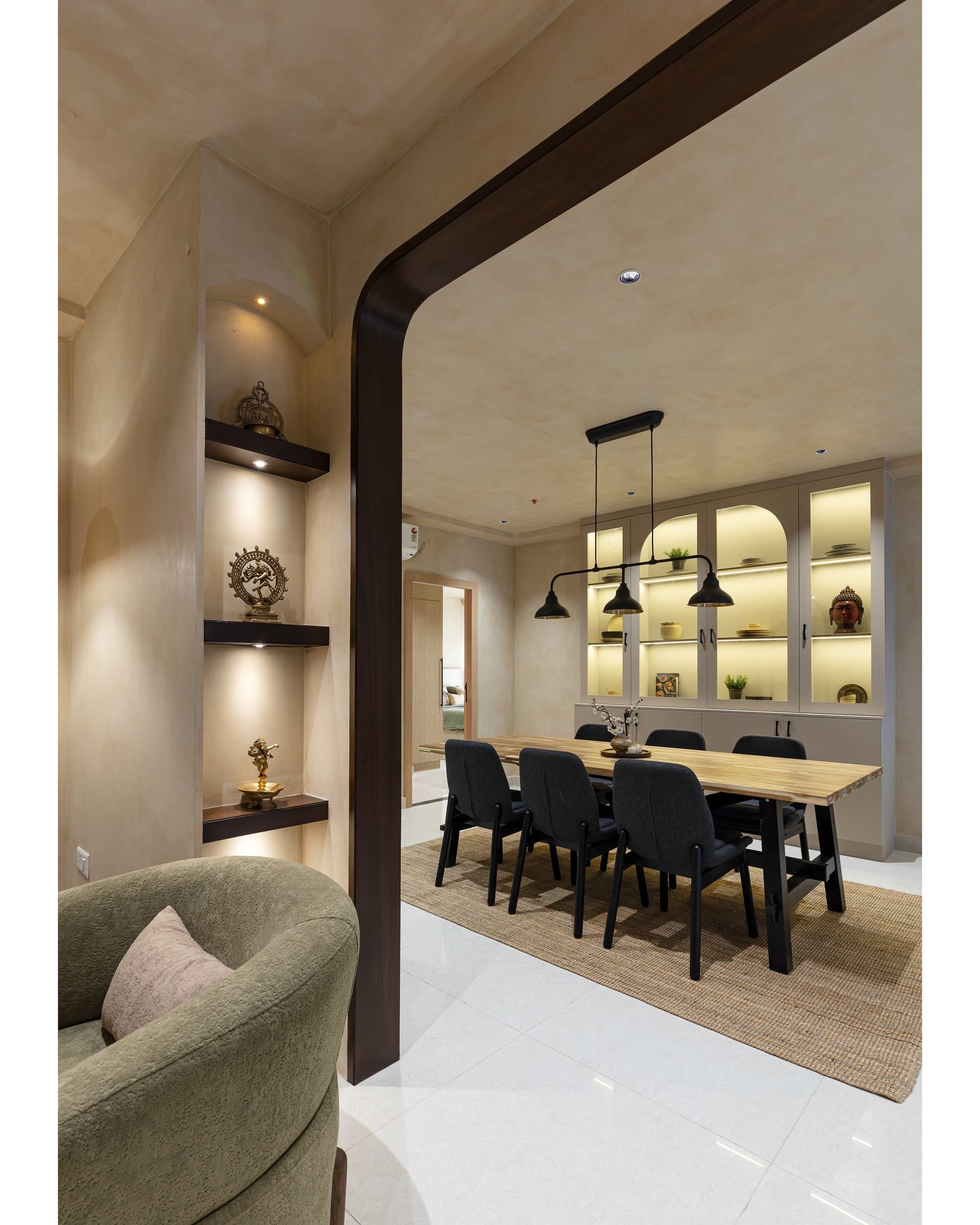
““Rather than acting as a barrier, the puja gently defines zones while preserving openness, creating a moment of pause within the everyday flow of the home.””
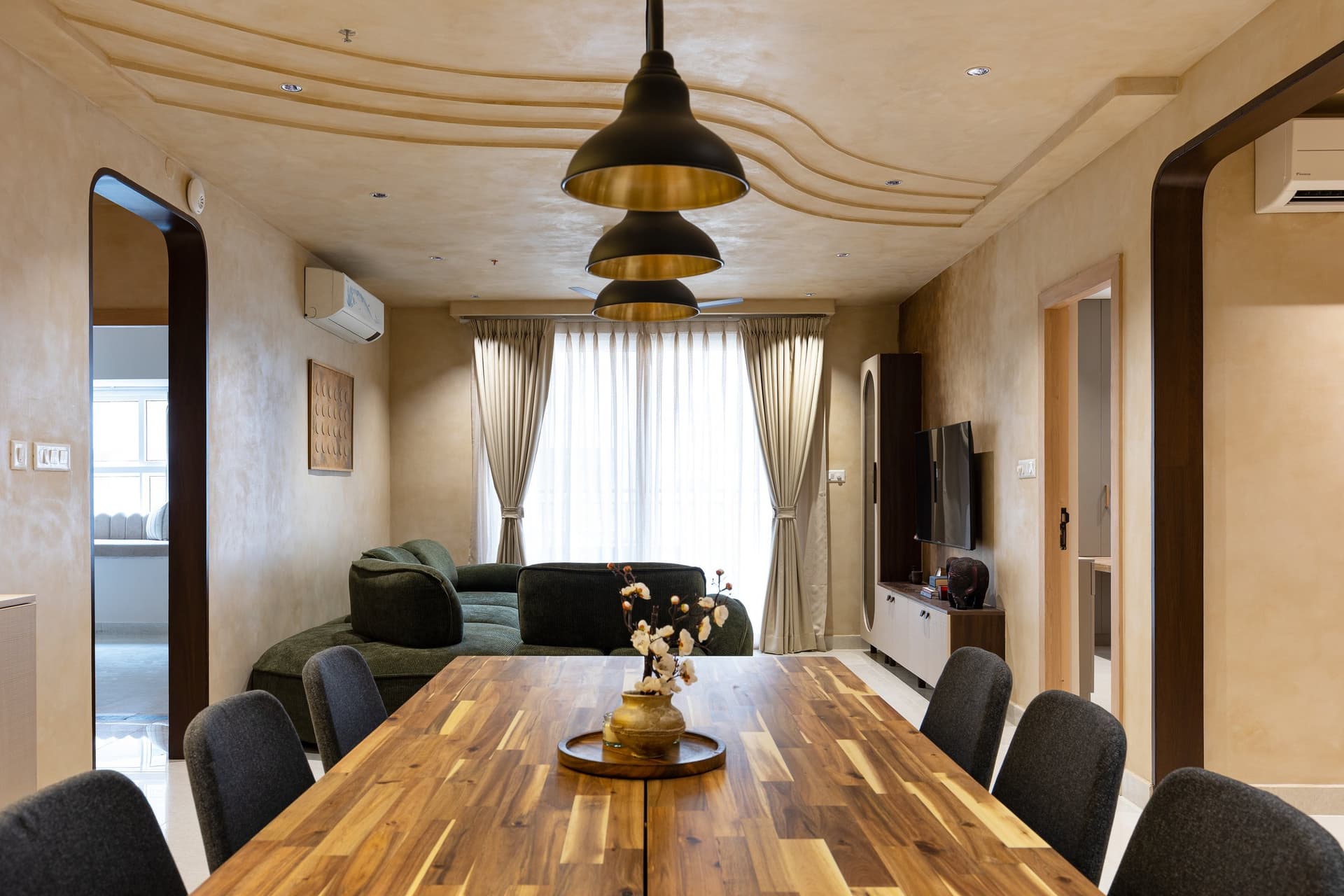
Seen from the dining end looking outward, the home reveals its spatial intelligence. The undulating ceiling carries the eye toward the balcony’s filtered light, the green sofa anchors the middle distance, and the arched portal to the formal living room punctuates the right edge.
Three black industrial pendants, lined with brass-toned interiors, hang low over the dining table, the warmest concentrated light in the apartment. They are the room’s one note of deliberate weight, holding the long, light-toned table against the softness around it.
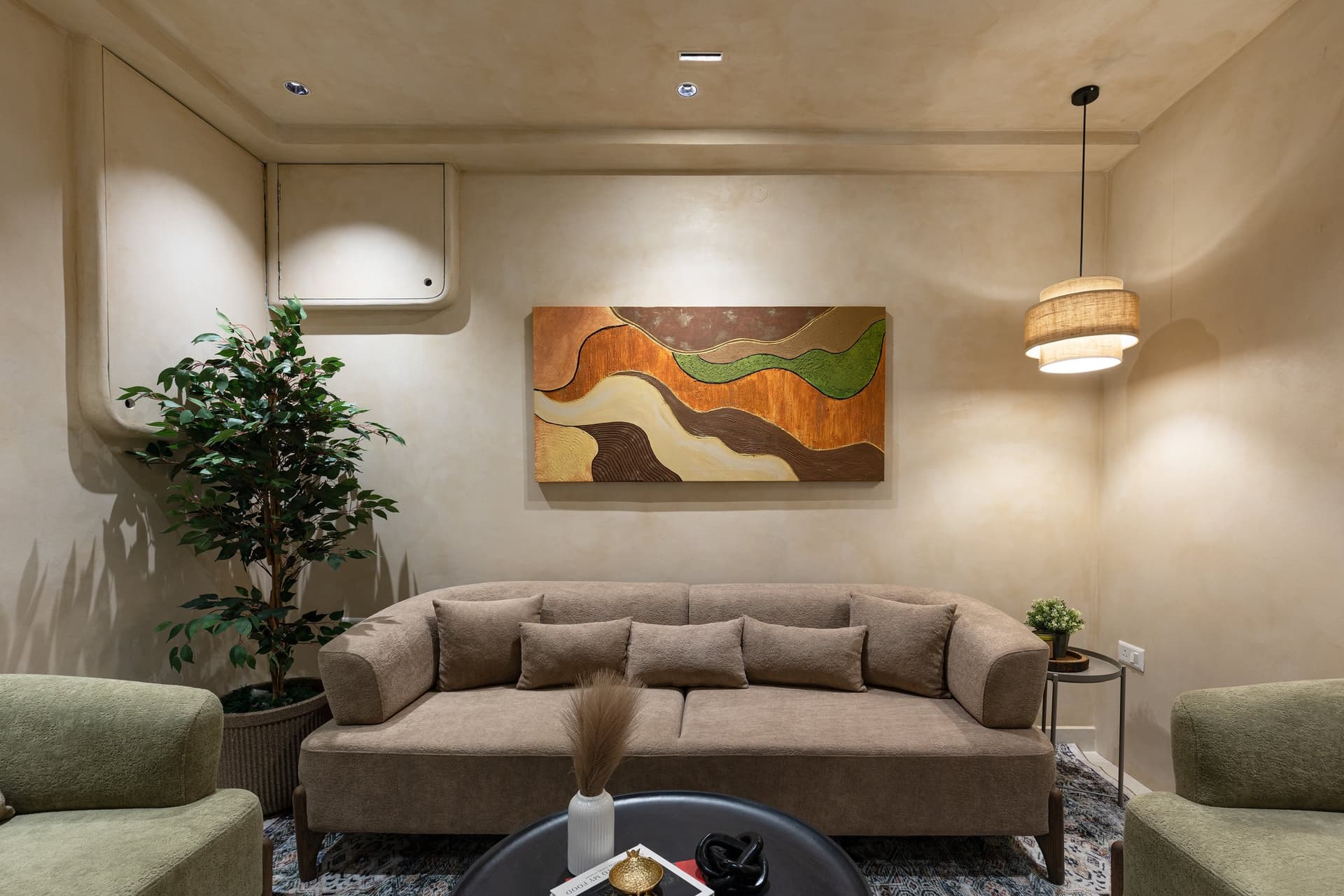
Through the arched threshold lies the formal living room, smaller and more enclosed, designed for conversation rather than congregation. A taupe sofa flanked by two olive-green tub chairs faces a low circular table; above the sofa, a tactile abstract canvas in earth tones, ochre, moss, sienna, deep brown, gathers the entire home’s palette into a single frame.
This is the room where the Scandinavian preference for hush is most evident. The limewash walls absorb light rather than reflect it, the rattan-shade pendant casts a low circle of warmth, and a tall ficus in the corner softens the architecture without performing decoration.
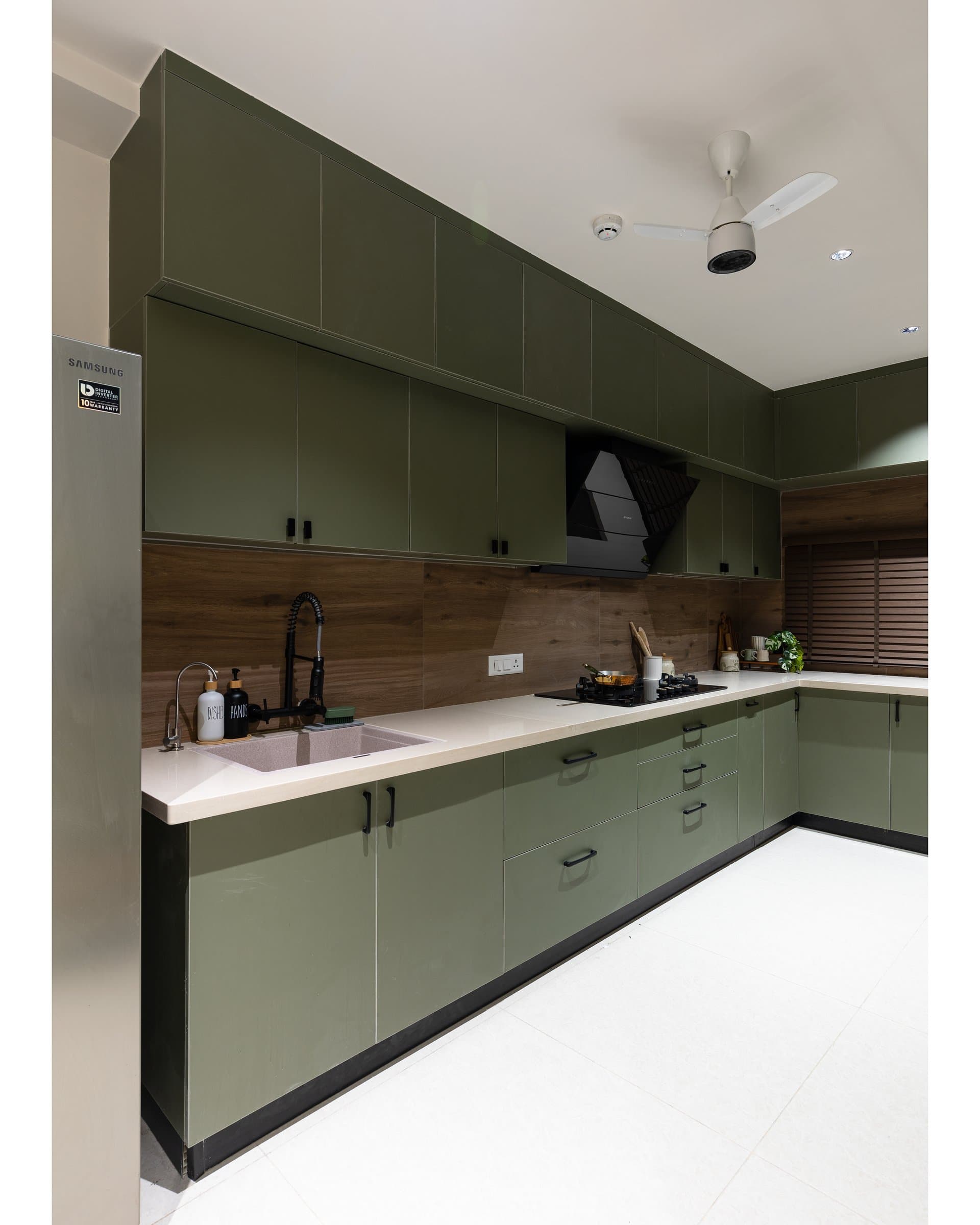
The kitchen takes the home’s softness and inverts it. Olive-green high-gloss cabinetry runs along an L-shaped layout, paired with a pale stone countertop and a wood-grain laminate backsplash that introduces grain without disrupting the colour discipline.
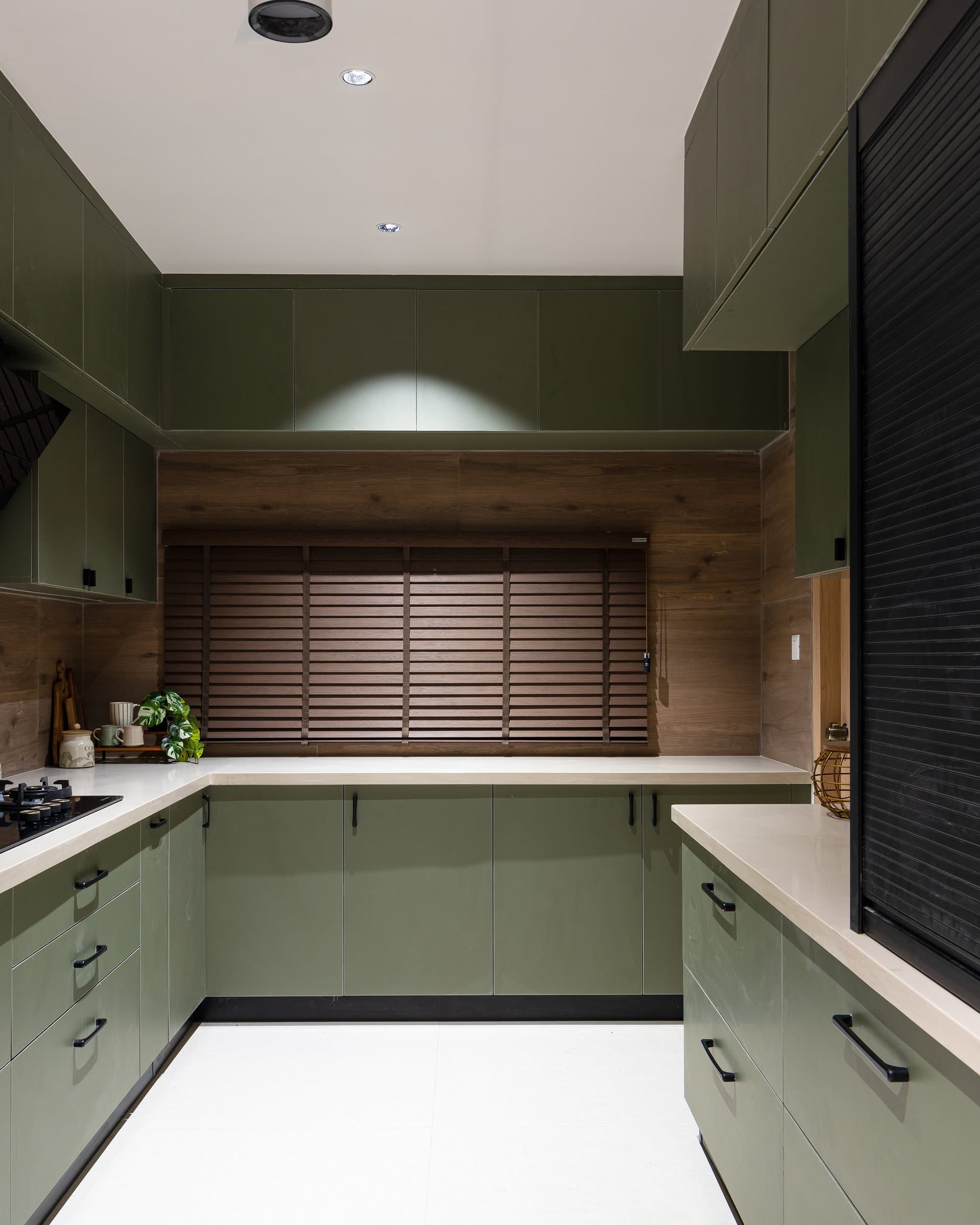
The deeper view of the kitchen reveals a louvered wood panel set into the rear wall, a small concession to texture in an otherwise streamlined room. It also acknowledges the practical reality of an Indian kitchen, where ventilation, storage volume, and the accommodation of a utility zone behind a roller shutter matter as much as aesthetics.
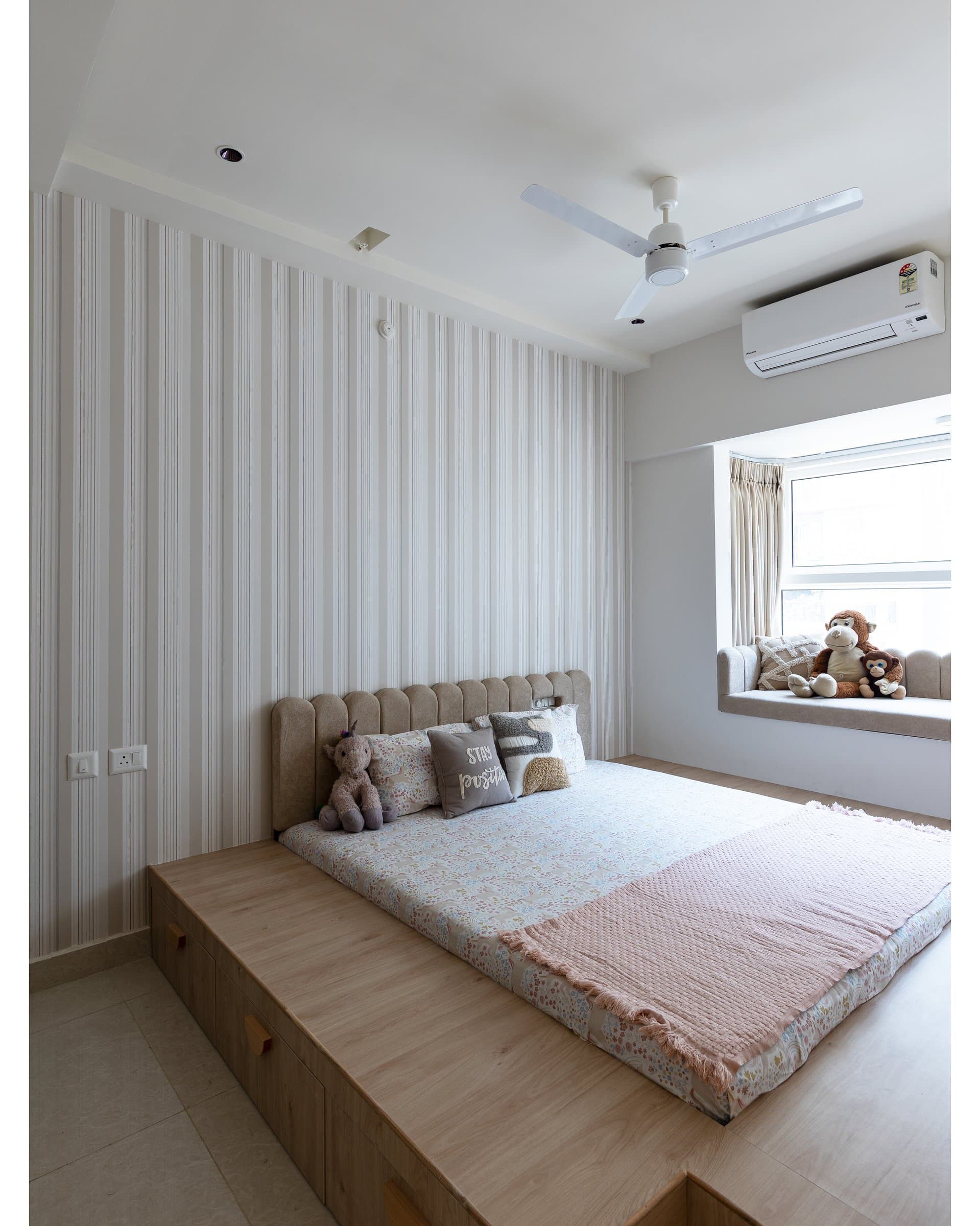
The children’s bedroom shifts the palette decisively. A platform bed in blond hardwood, integrated with drawers along its base, sits against a finely striped wallpapered wall in soft cream tones. A window seat upholstered in oat linen runs along the bay, generous enough to read in or to host an audience of soft toys.
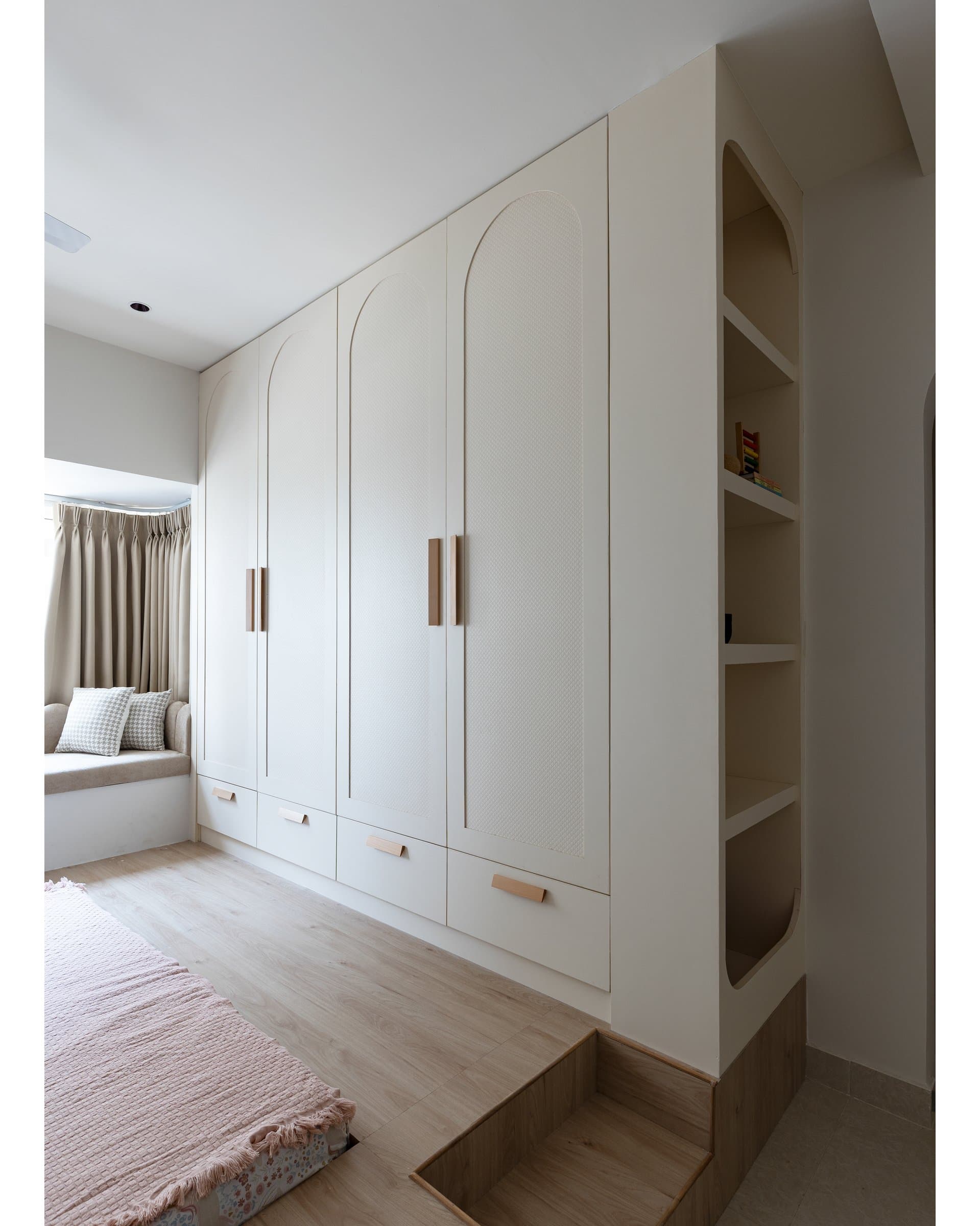
Opposite the bed, a wall of arch-detailed wardrobes in chalky off-white carries leather pull-tabs in pale tan, the only visible hardware. A slim open shelving unit at the far end, also arched, completes the elevation. The room reads as Scandinavian in the cleanest sense: every surface earns its place, nothing is decorative for its own sake, and storage is treated as architecture.
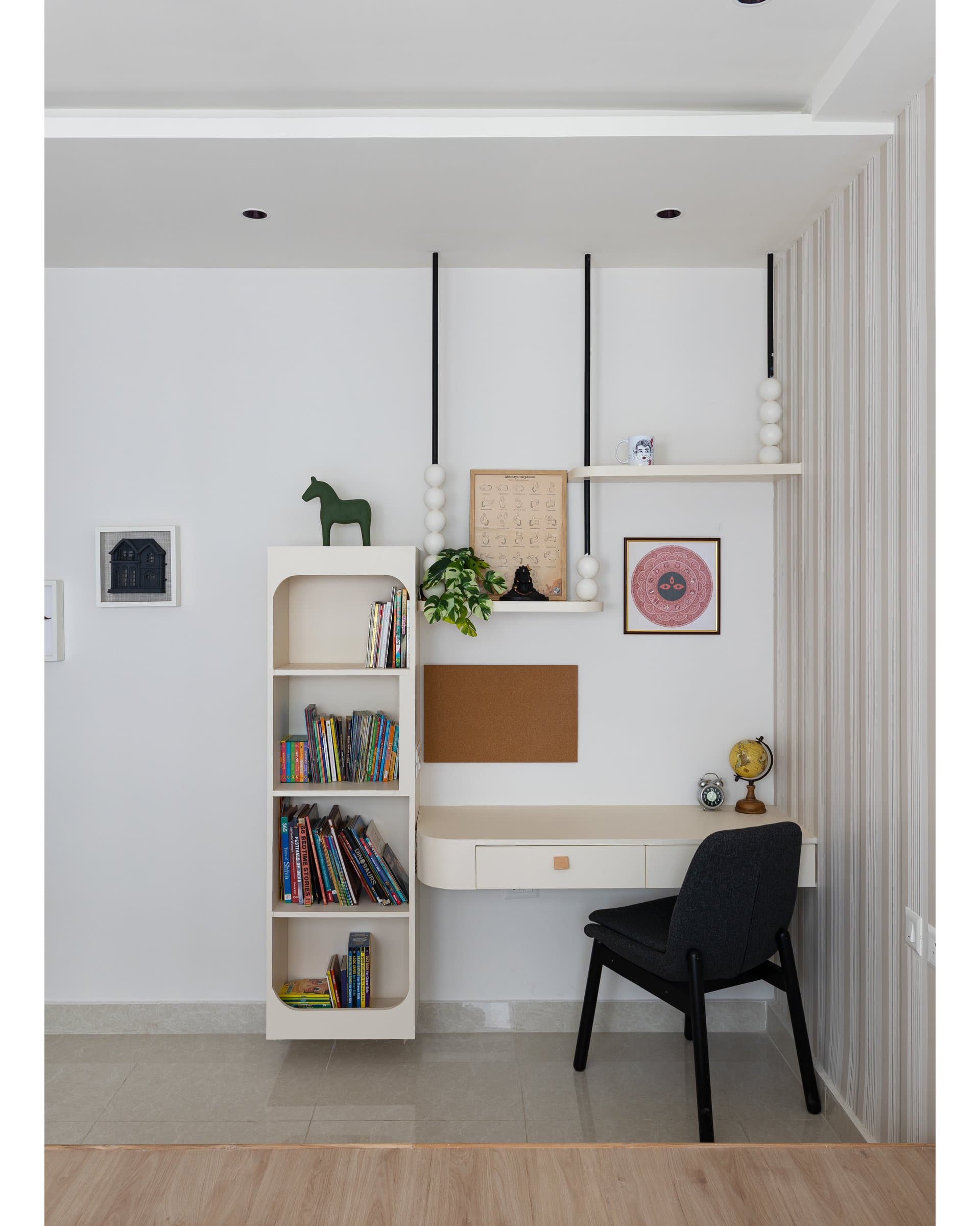
A study corner tucked into the same room demonstrates the same restraint scaled down. A wall-mounted desk in soft cream hovers above a black task chair; a slim bookshelf with a rounded top opening holds a child’s library.
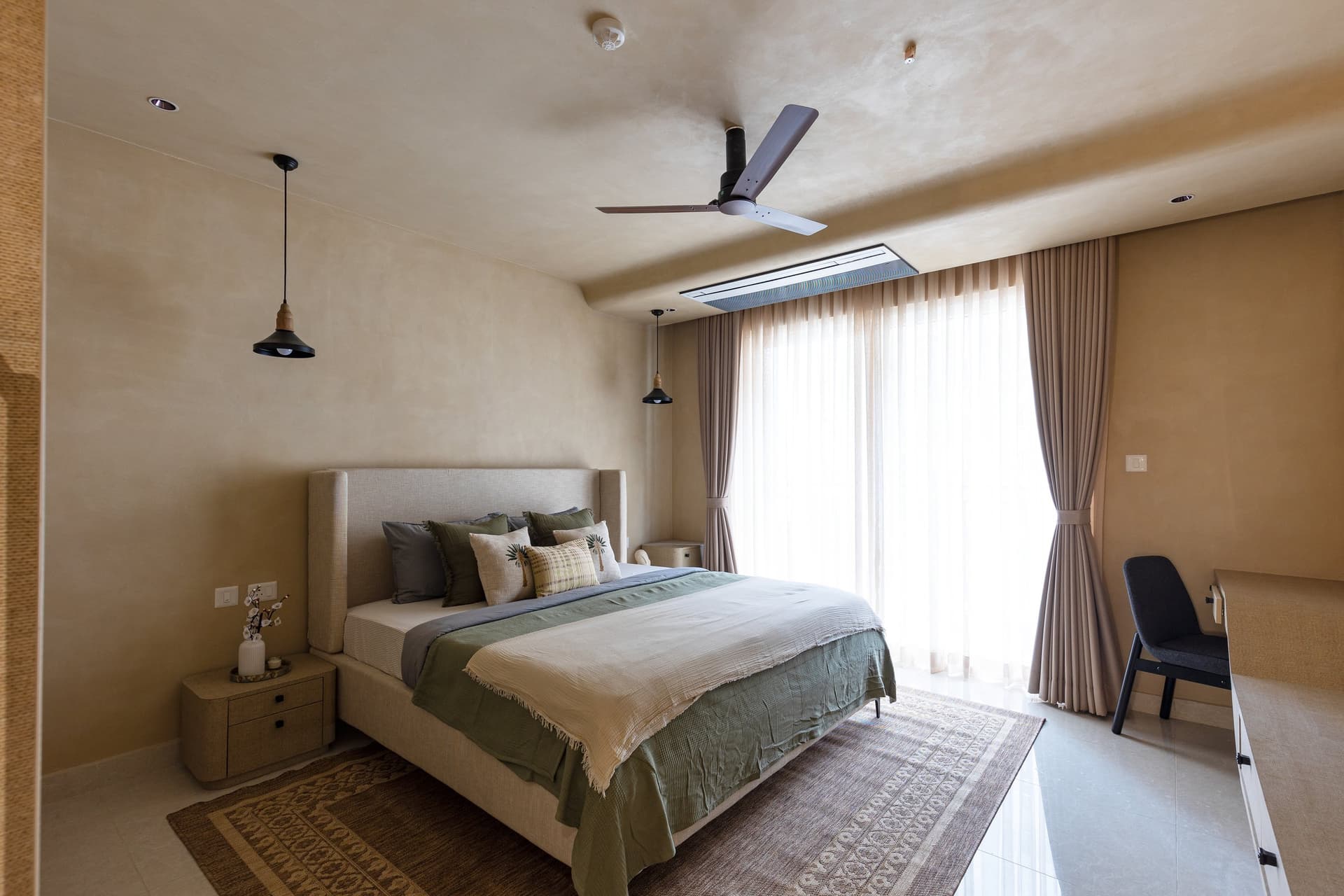
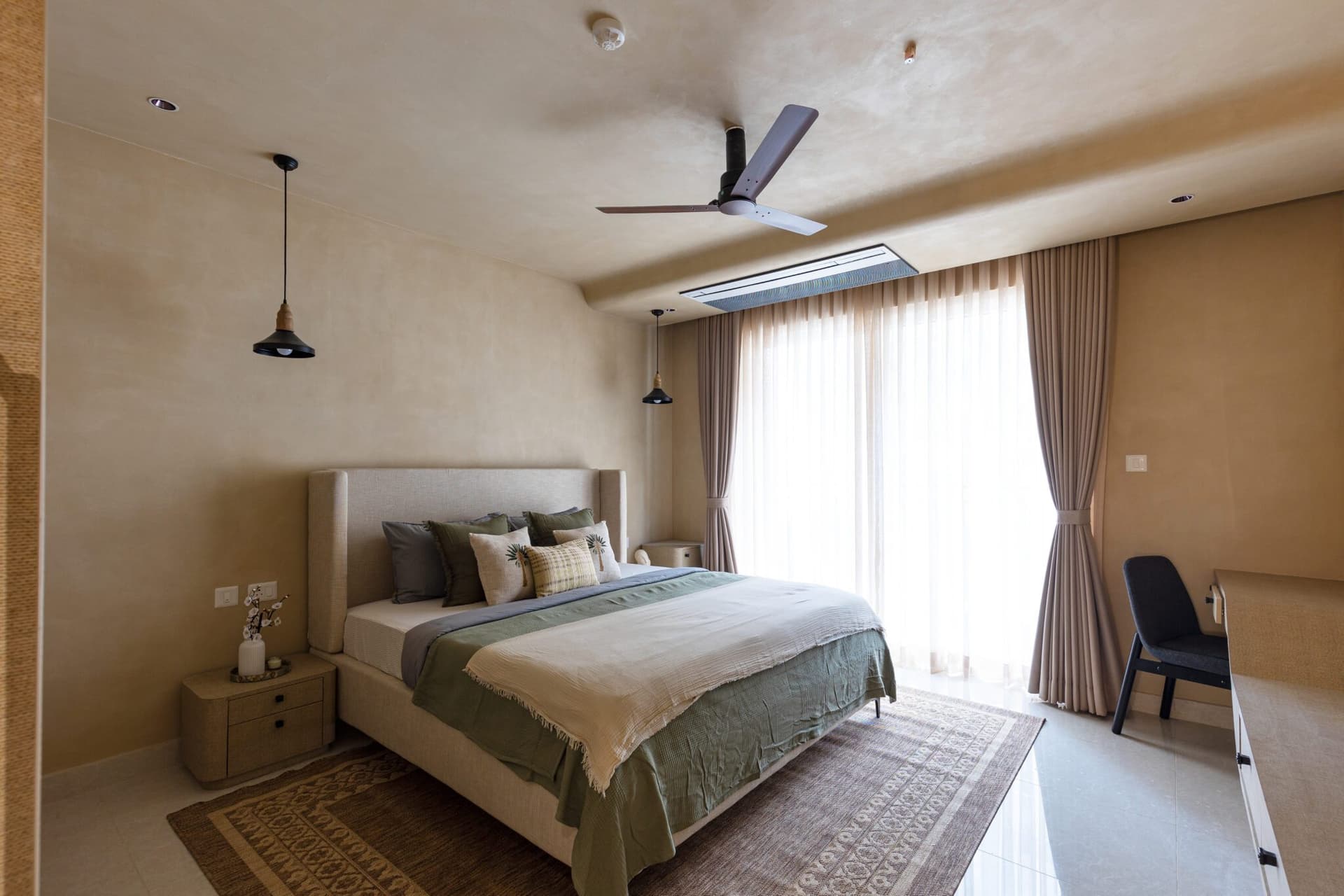
The master bedroom returns to the limewash language of the living areas, but in a deeper, sandier register. A linen-upholstered bed sits beneath a pair of low-hanging black pendants on either side, in place of conventional bedside lamps. A venner-clad bedside cabinet and a kilim-style runner introduce the room’s two textural anchors.
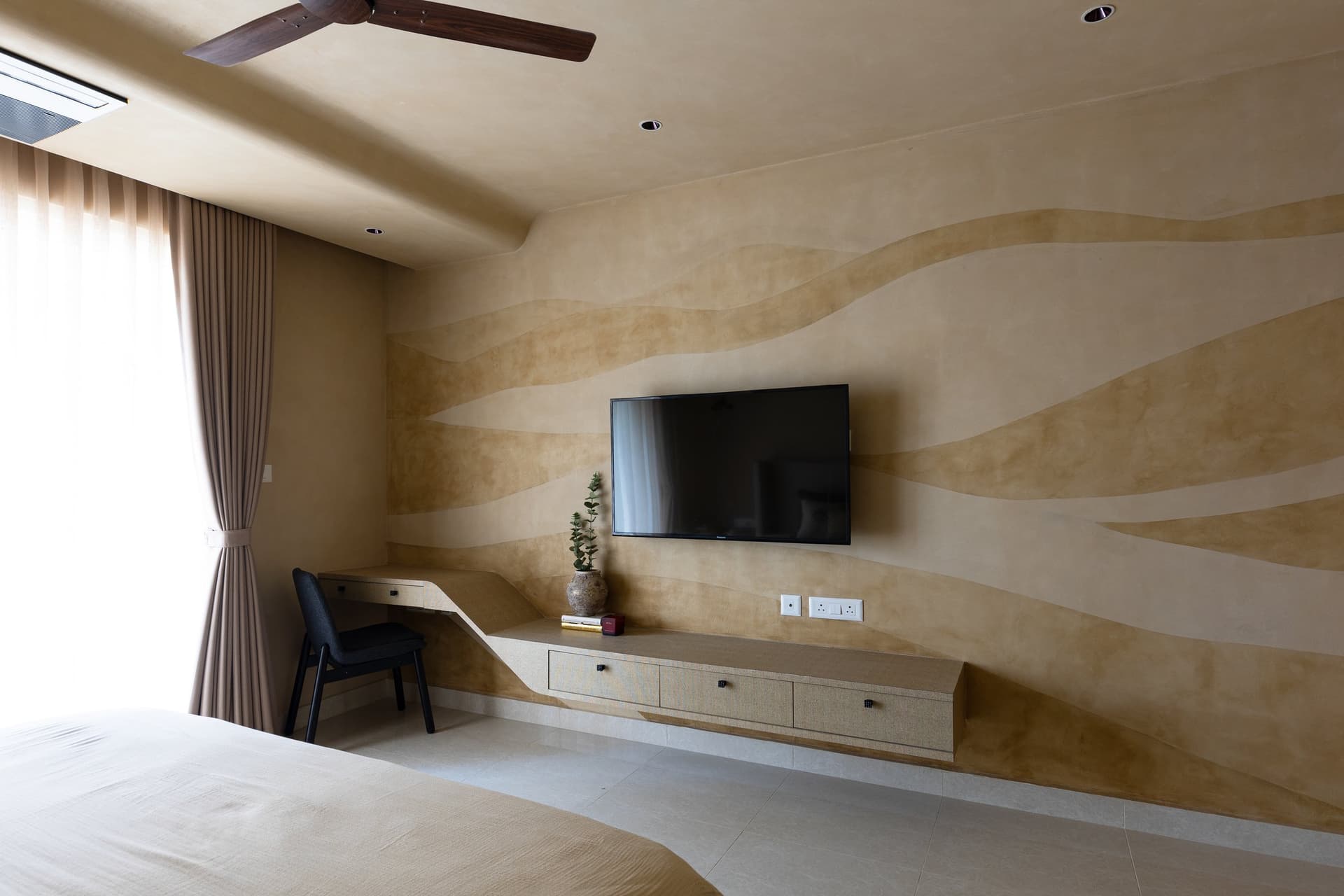
The wall opposite the bed is the room’s defining gesture, a hand-rendered limewash mural in undulating bands of cream and warm ochre, evoking dunes more than any specific landscape. A floating console in textured cane-grain finish runs the length of the wall, holding the television and a small writing desk in a single continuous line.
It is an unusually confident move for a bedroom: a wall that performs as art, joinery that defers to it, and no competing focal point. The room asks the limewash to do most of the work, and it does.
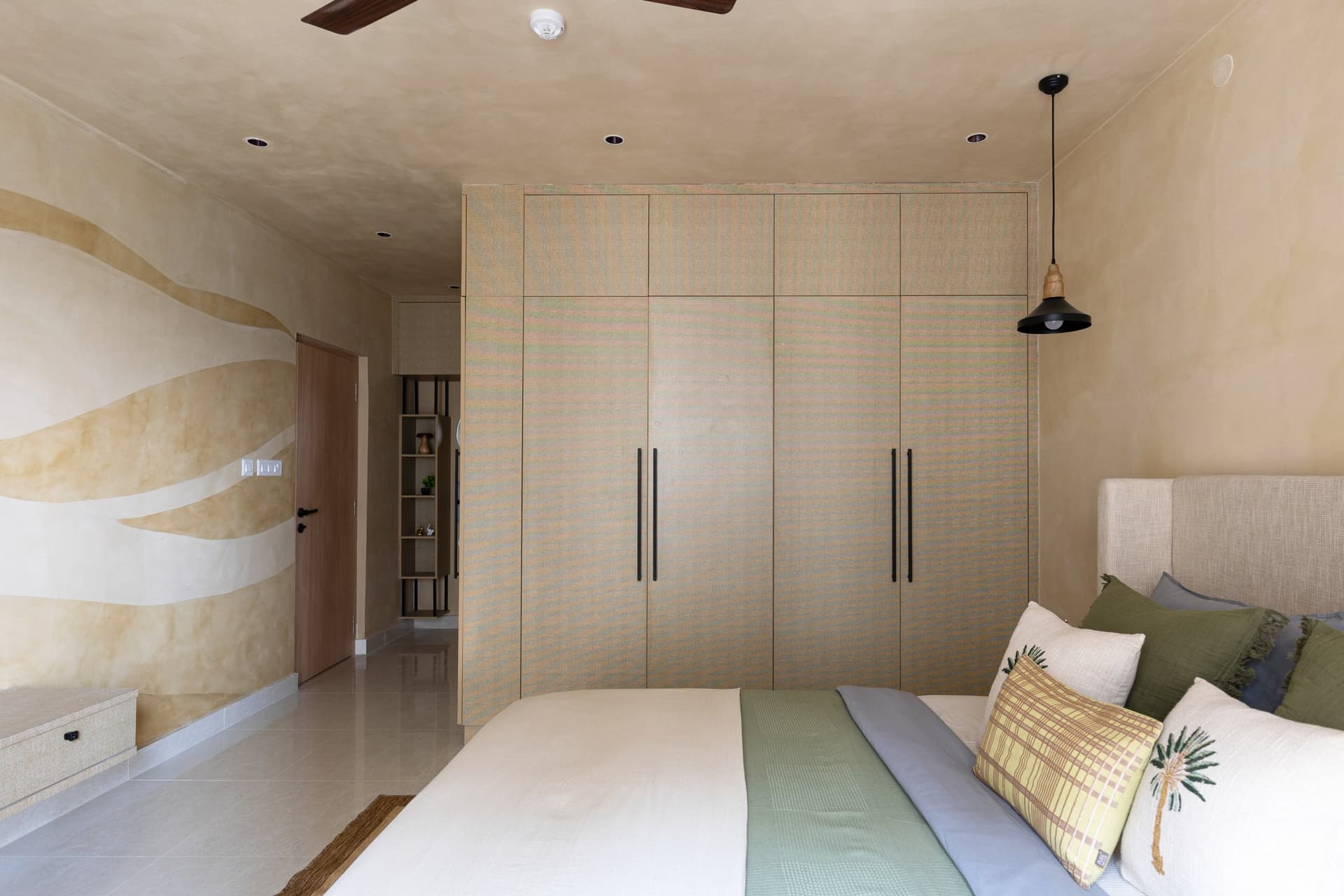
From the bed, the room reads as a quiet sequence: the mural to one side, a bank of full-height wardrobes in a softly iridescent woven-textile finish ahead, and the door beyond. The wardrobe finish, with its subtle warp of warm and cool threads, is the only ornamental flourish in the master suite, and it earns its place by holding light differently through the day.
What Nordic Nest proposes is a quieter idea of cross-cultural design, one that does not announce its hybridity through obvious signifiers but absorbs them into the grammar of the rooms. The puja sits within an arch, the limewash carries the sun, the kitchen wears olive, and the master bedroom takes its mood from the colour of dry earth. The Scandinavian framework is real, but so is the Indian household it has been built to hold.
In a city where new apartments often arrive over-finished and under-considered, Crafting Spaces has made a case for a softer, slower kind of contemporary home, one in which restraint is not austerity, and warmth is not clutter. The home does not ask its occupants to perform either Nordic or Indian; it simply lets them live.