An apartment that overlooks water in Dubai faces a particular kind of pressure. The view wants to be the protagonist, the architecture wants to perform, and the interior is left negotiating between the two. The most assured response is to refuse the contest entirely, to design a room that does not compete with the horizon but quietly receives it.
This is the position taken by Villa Number Nine in their renovation of a waterfront apartment in Dubai’s Mohammed Bin Rashid City, a home reimagined for a family who wanted neither spectacle nor the studied minimalism that often passes for restraint. The brief asked for a residence that would feel light against the canal but textured enough to hold the eye when the curtains were drawn, a balance the studio resolved through a palette of warm oak, hushed boucle, and stone in tones the colour of wet sand.
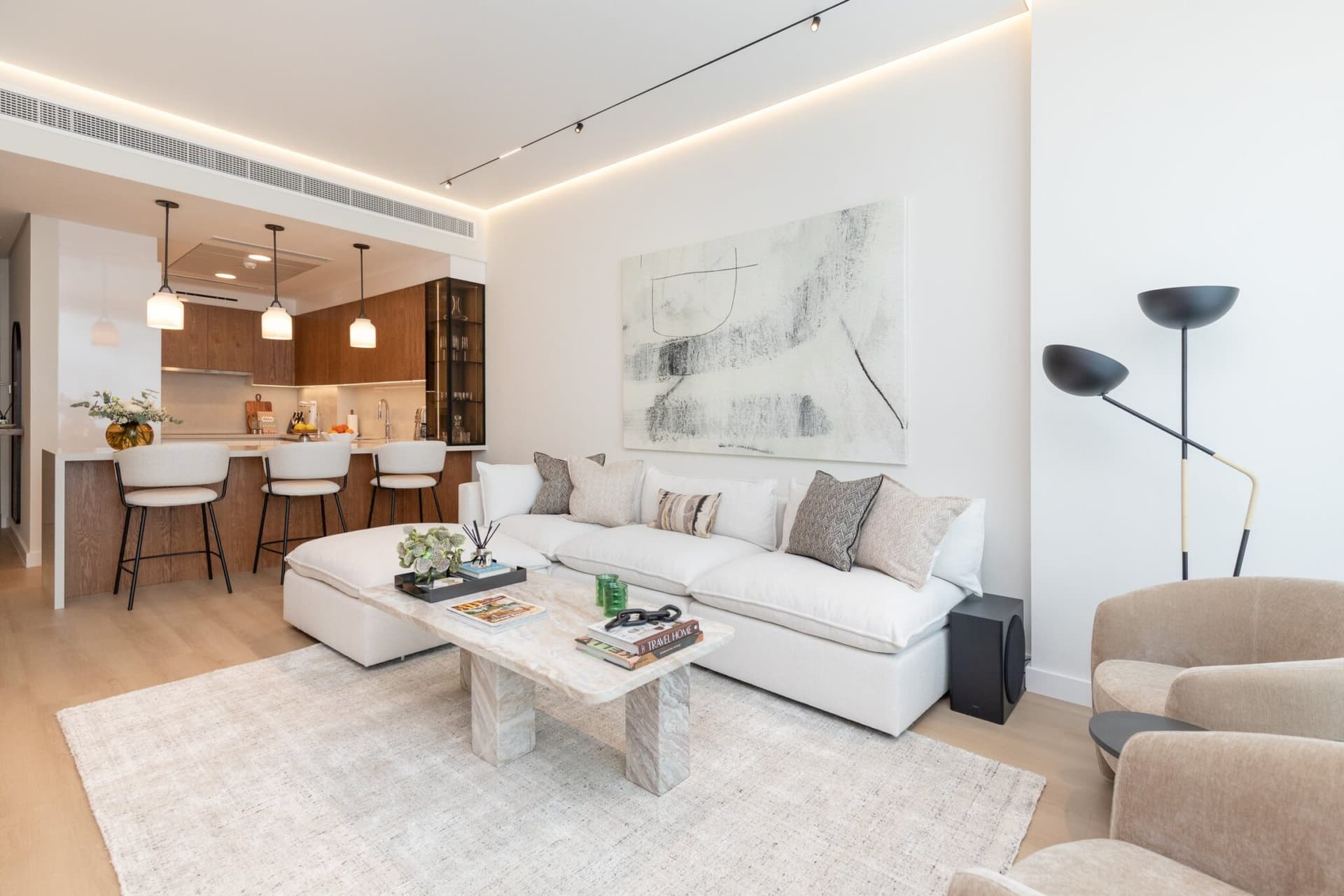
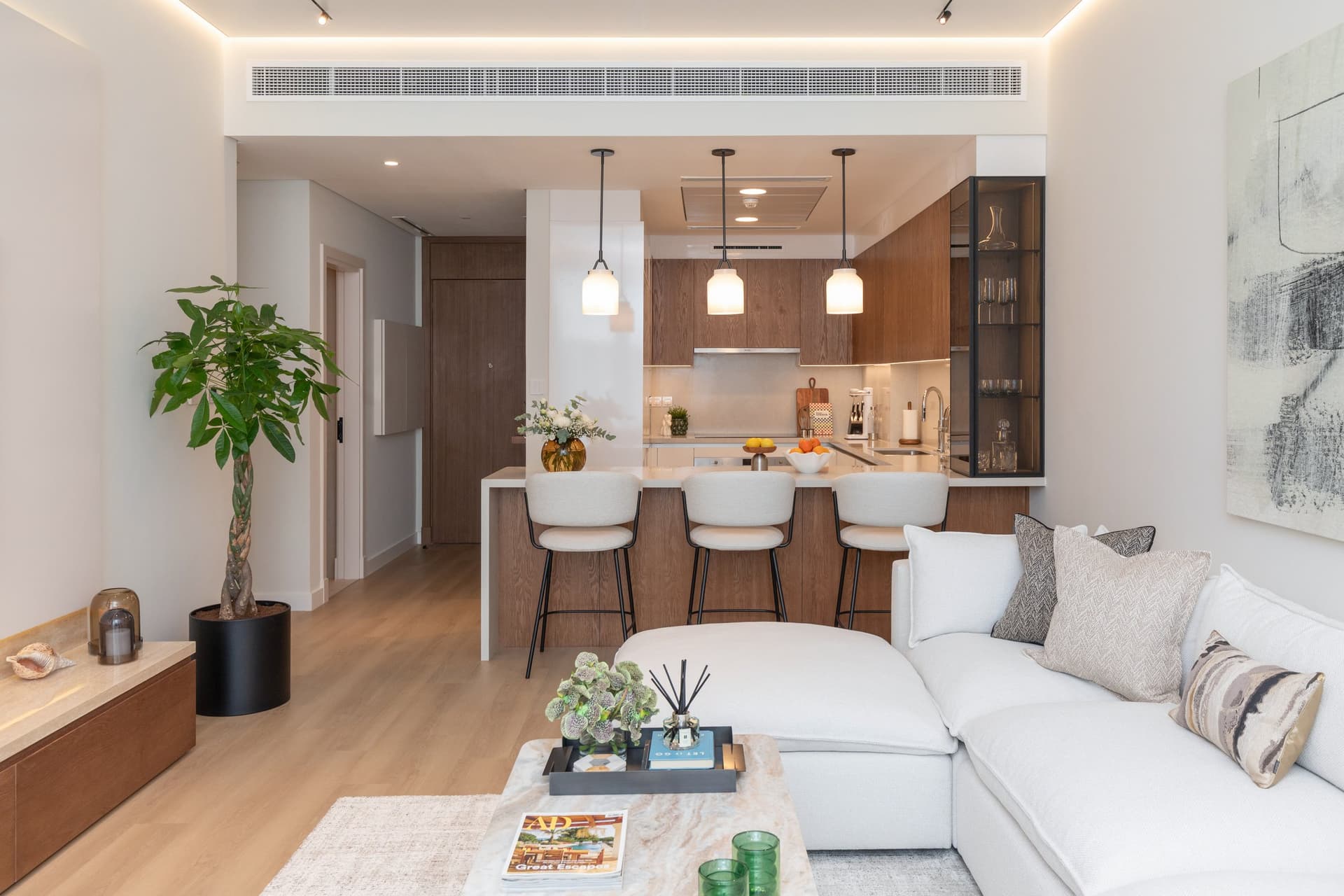
The living room opens directly onto the kitchen, and the studio has resisted the impulse to disguise this proximity. A single recessed light cove traces the perimeter of the ceiling, drawing both zones into one continuous gesture, while the warm oak of the kitchen joinery answers the soft cream upholstery of the deep sectional sofa across the floor.
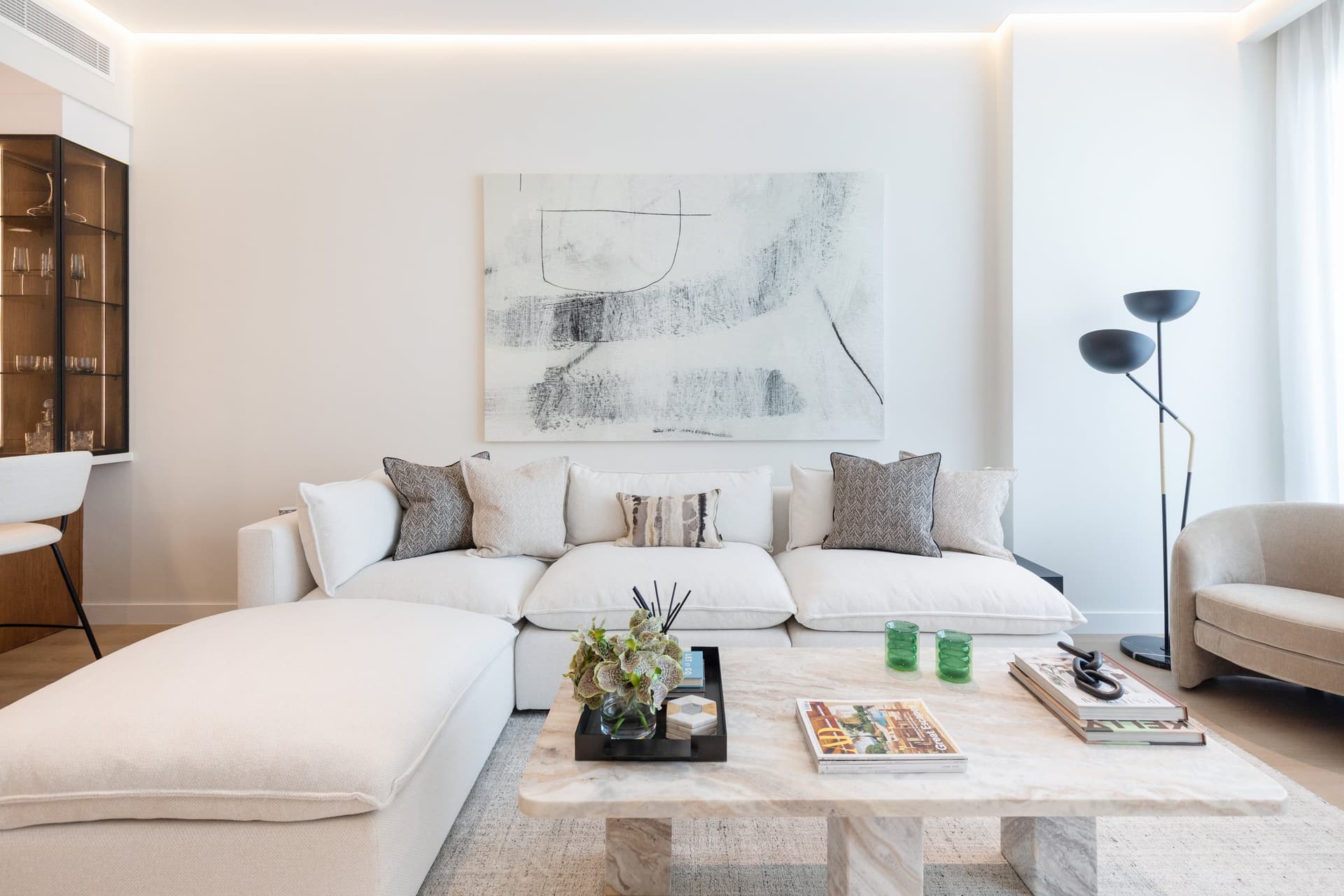
Seen closer, the seating arrangement reveals its own internal argument. The sofa is generous to the point of indulgence, but the travertine coffee table beside it is precise, almost severe in its geometry, and the pair holds the room in a productive tension between softness and weight. The abstract canvas above is the only loud voice in the composition, and it earns its volume by being the single thing that does not blend.
What the room avoids is the showroom flatness that often afflicts apartments of this scale.
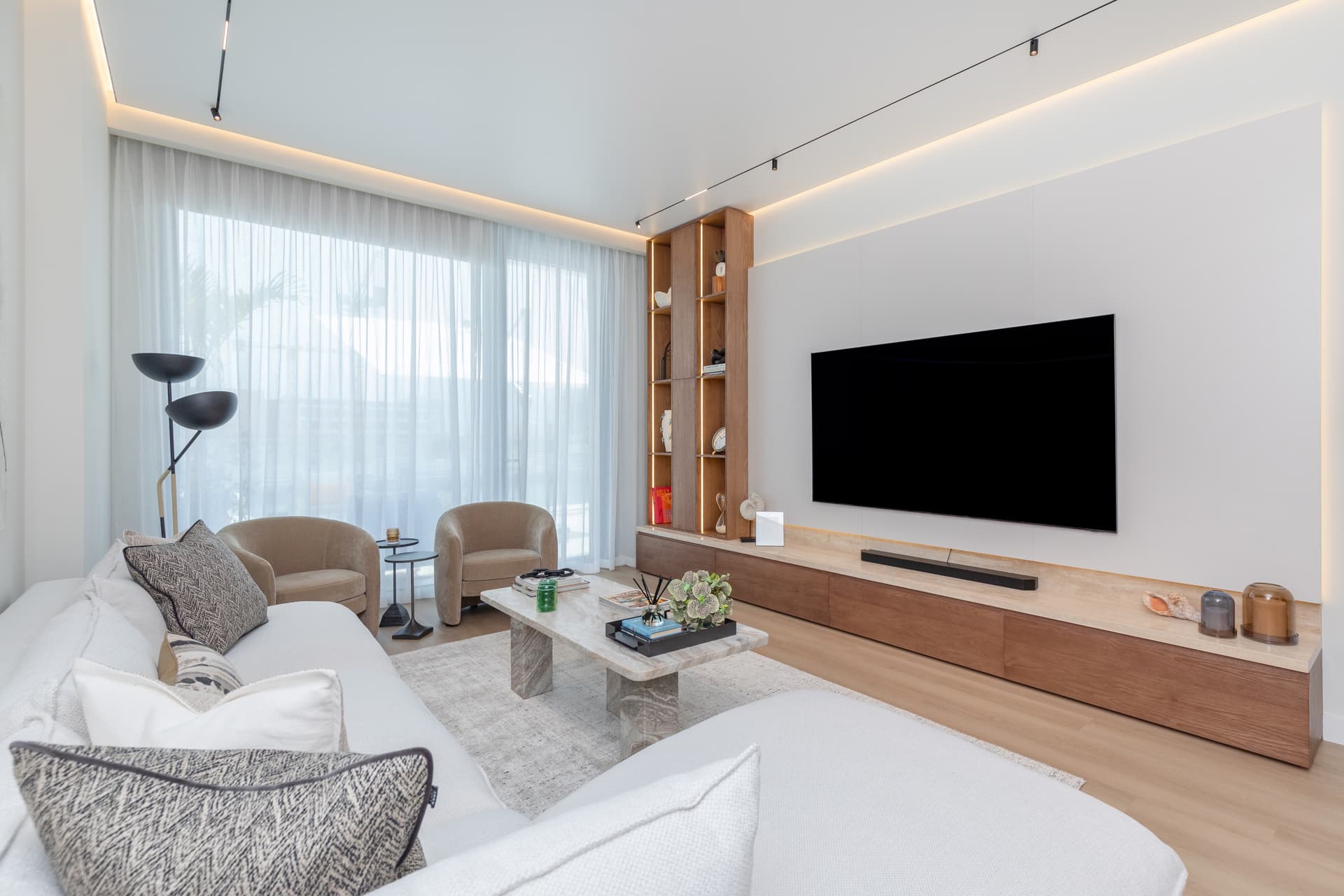
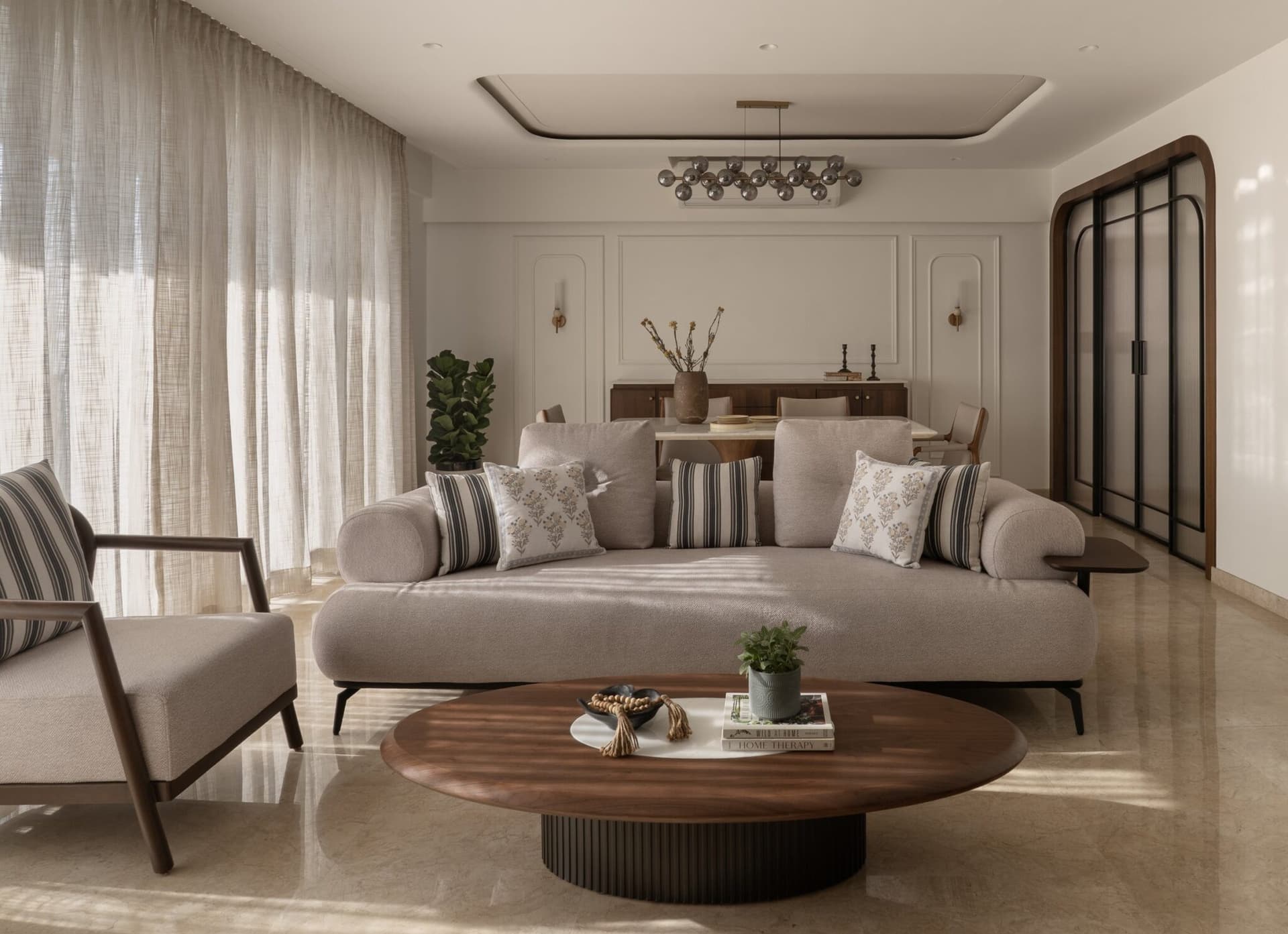
A pair of beige upholstered tub chairs anchors the far end against the sheer-curtained glazing, while the sectional with chaise and stone coffee table occupy the centre, leaving generous circulation along the wood-clad media wall. The room is read in two halves, each with its own gravity, and the result is a space that feels considered at every point of pause.
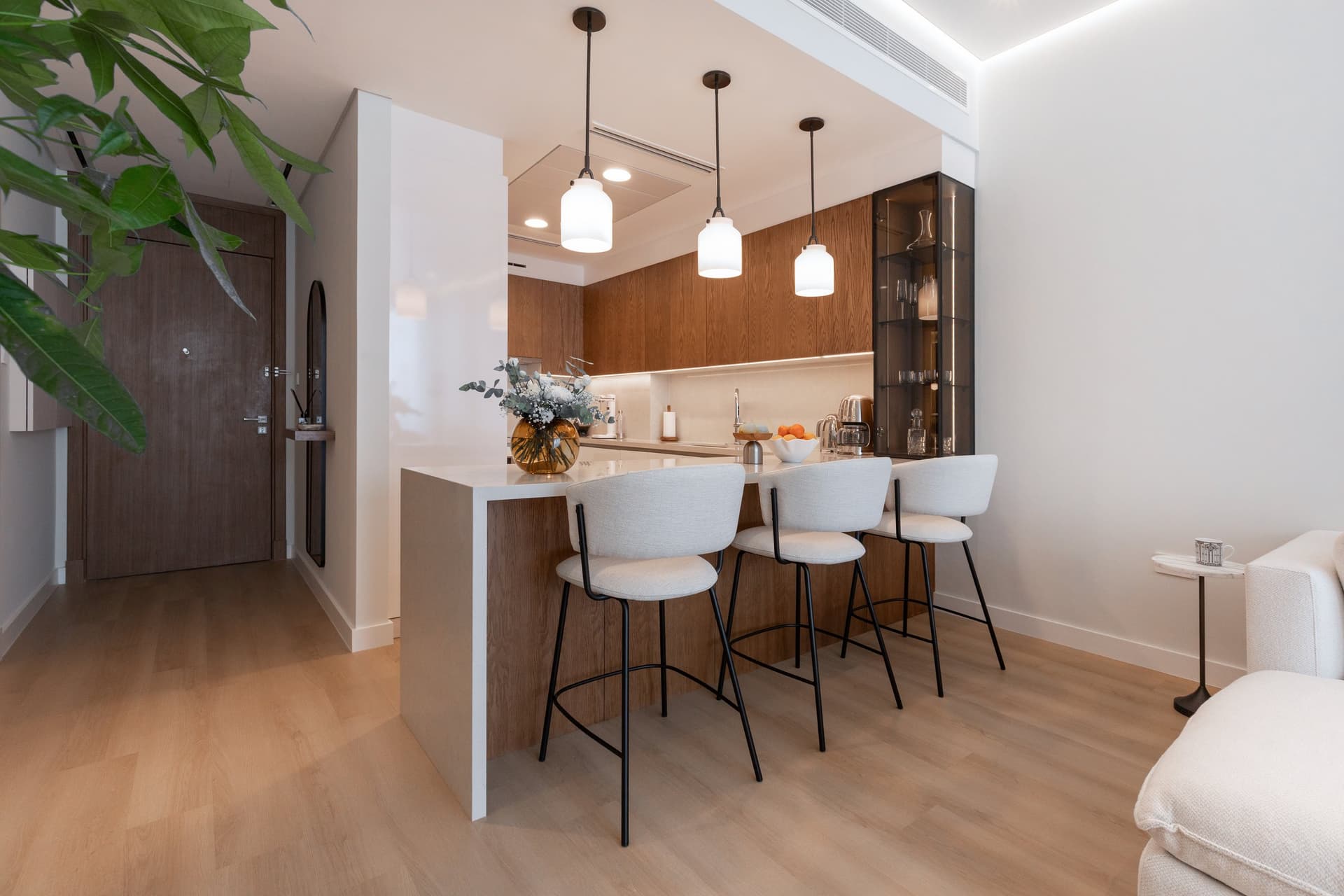
Returning to the kitchen, the apartment’s circulation logic becomes clearer. The peninsula projects into the living space like a piece of furniture rather than a service counter, its waterfall edge in pale quartz cantilevering past the oak base to soften what could have been a hard architectural break.
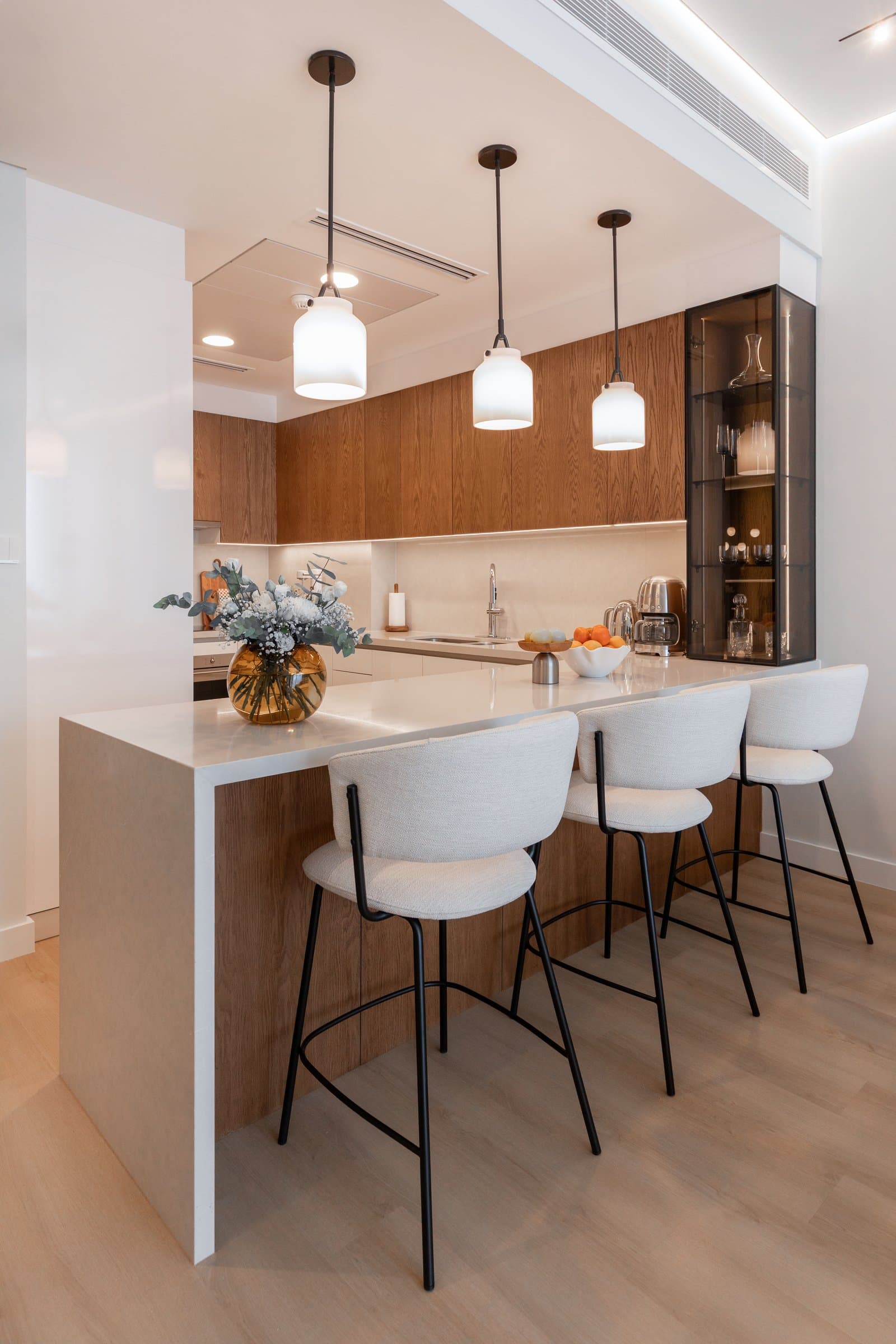
Closer in, the kitchen reveals the discipline that holds the rest of the home together. Three milk-glass pendants drop in a rhythm above the peninsula, their black cords providing the only graphic line in an otherwise rounded composition, and the slim glass-fronted vitrine at the end serves as both display and full stop. Storage and ceremony share the same wall without negotiating.
““We wanted the kitchen to belong to the living room without surrendering to it. The materials had to be rich enough to hold their own when seen from the sofa.””
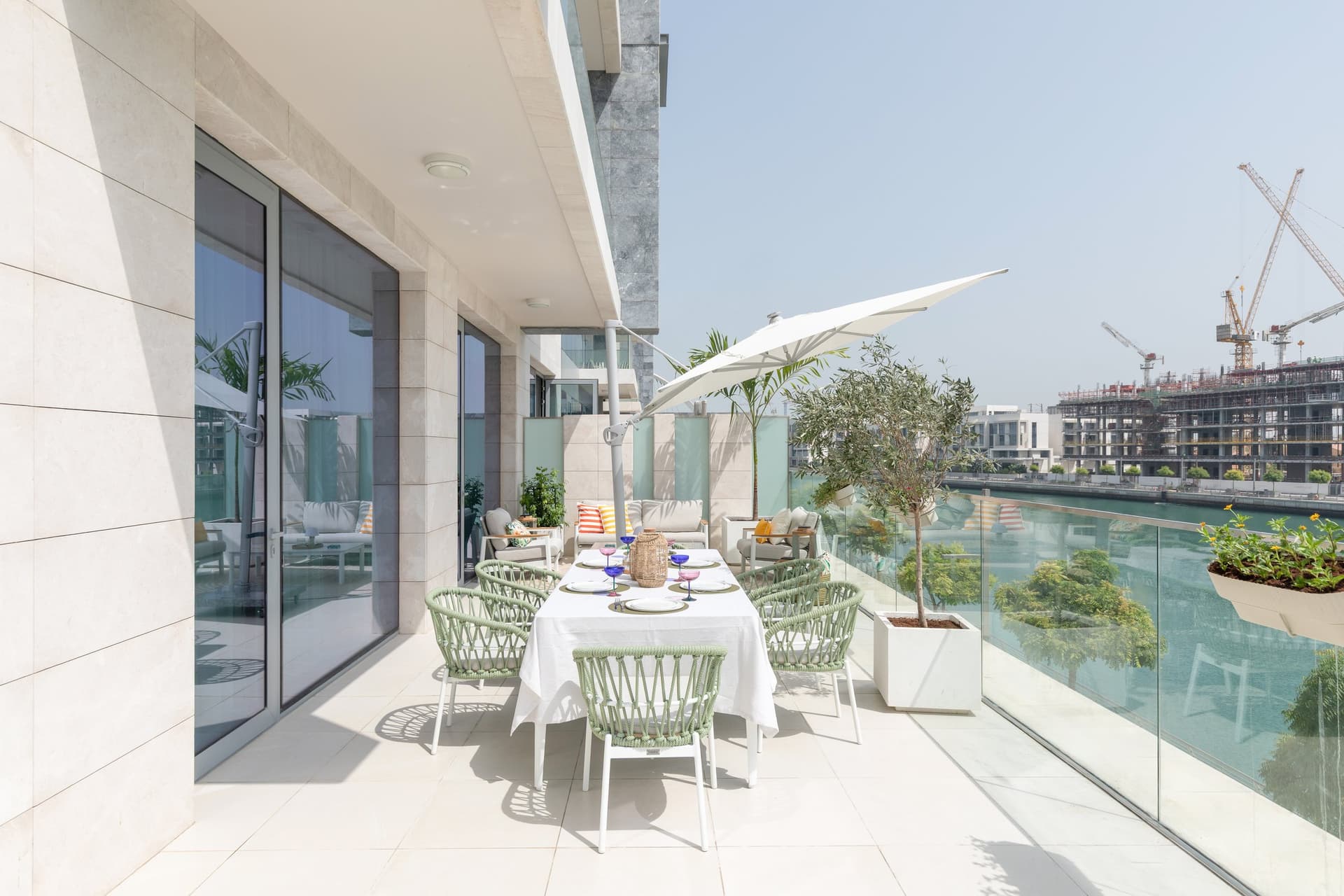
Beyond the sliding glass, the terrace extends the home’s social life into open air. A dining table set for six sits beneath a cantilever umbrella, the rope-back chairs in a soft sage that picks up the canal water below, and an olive in a square planter does the work of a small garden.
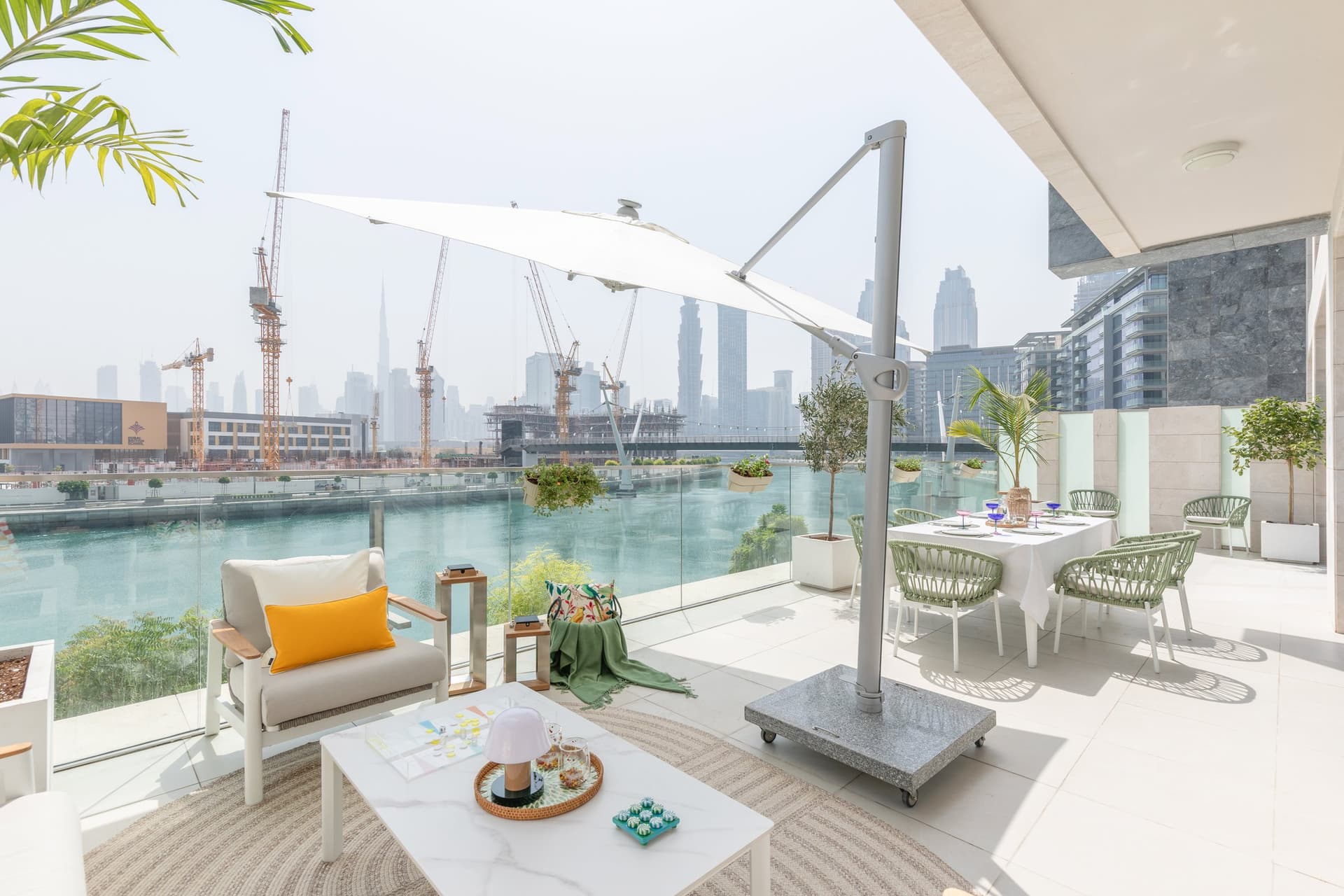
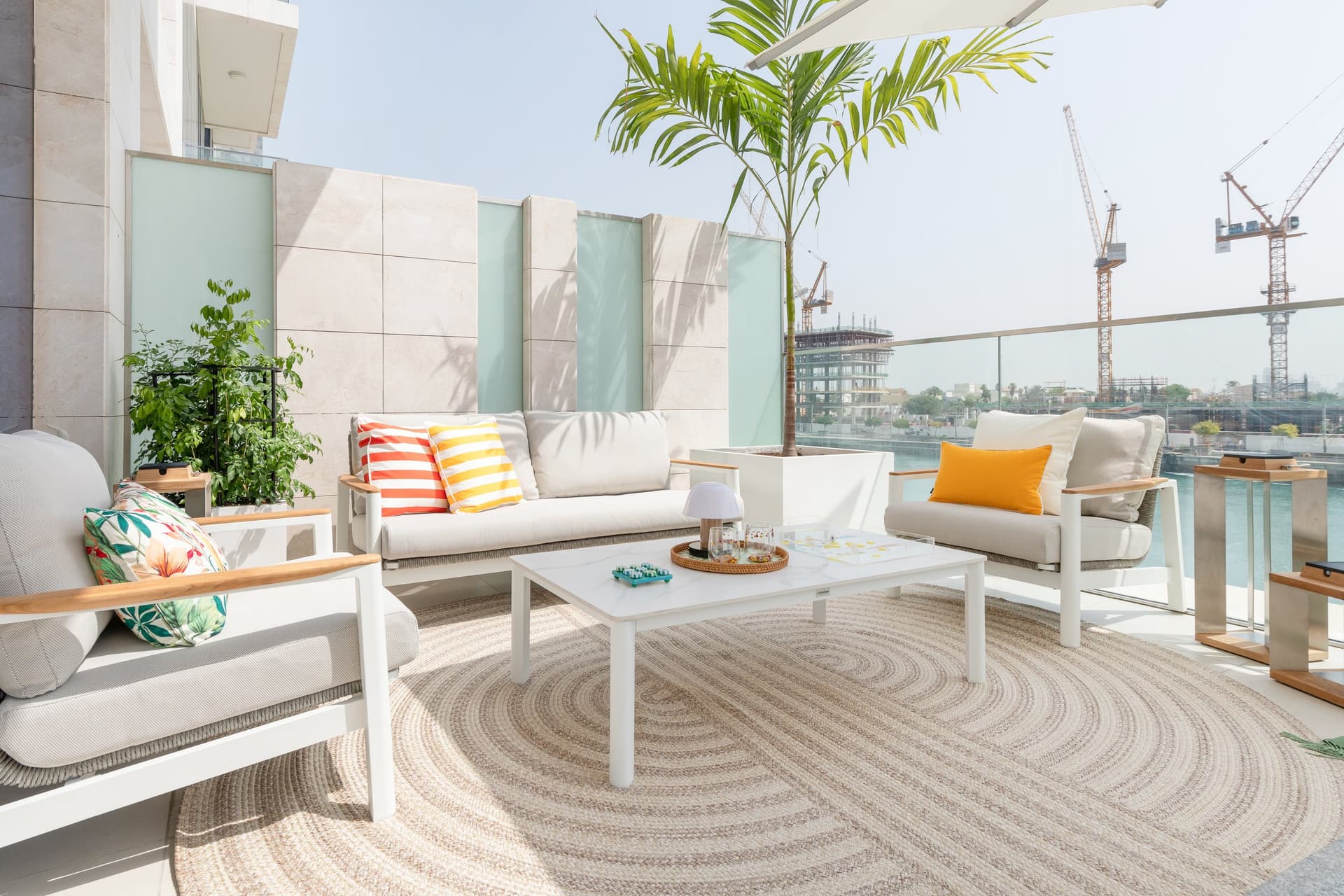
The lounge end of the terrace is more relaxed in its furnishing, with striped cushions in carnival yellow and red, alongside a solid orange and a tropical-print cushion, breaking the otherwise neutral palette. This is the only place in the home where colour is allowed to behave loosely, a deliberate concession to the fact that outdoor rooms should feel less rehearsed than indoor ones.
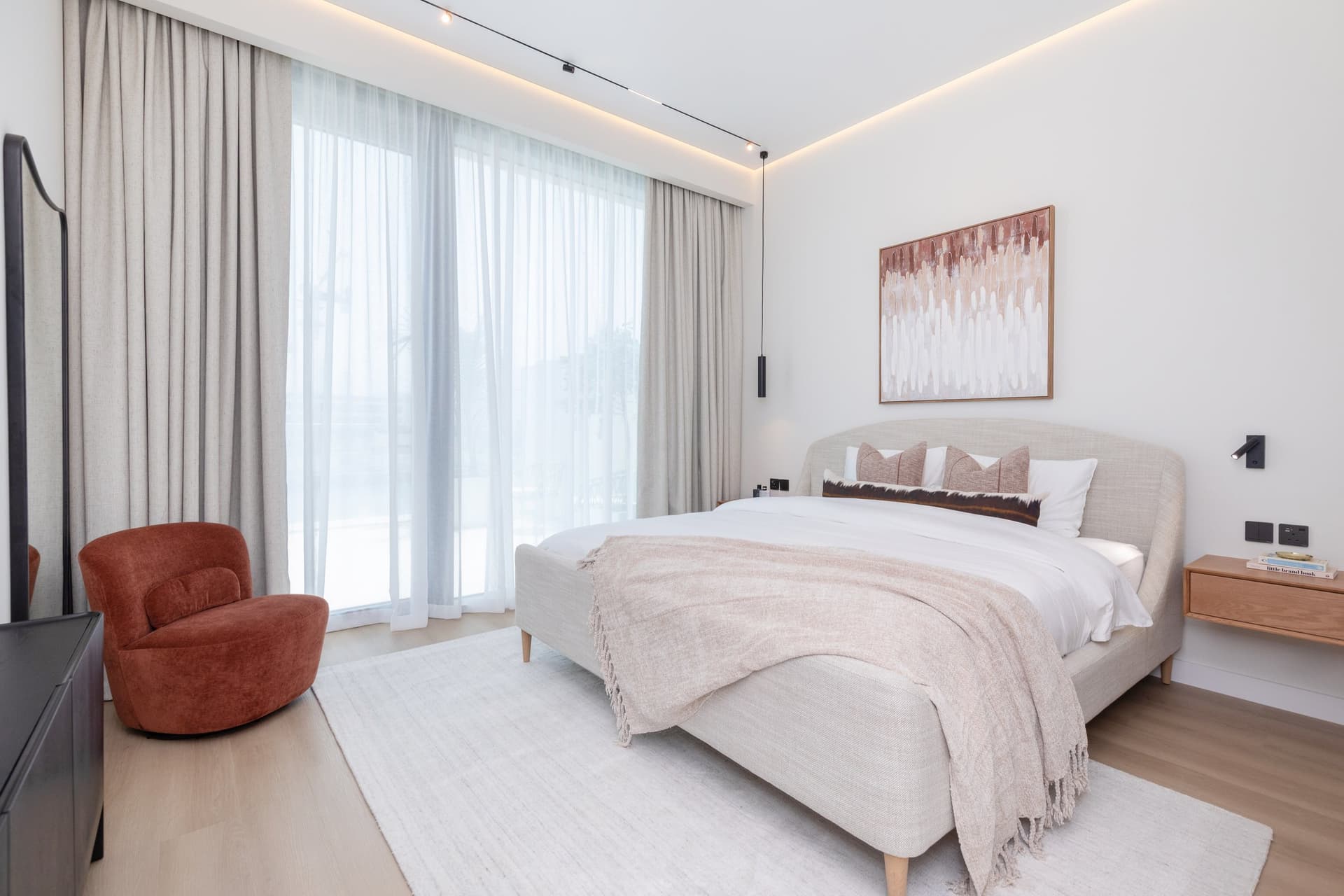
Inside the master bedroom, the palette shifts from canal cool to something warmer and more domestic. A linen-upholstered bed with a curved headboard sits against a wall holding a single canvas in burnt sienna and oyster, and a small terracotta swivel chair near the window provides a saturated counterpoint.
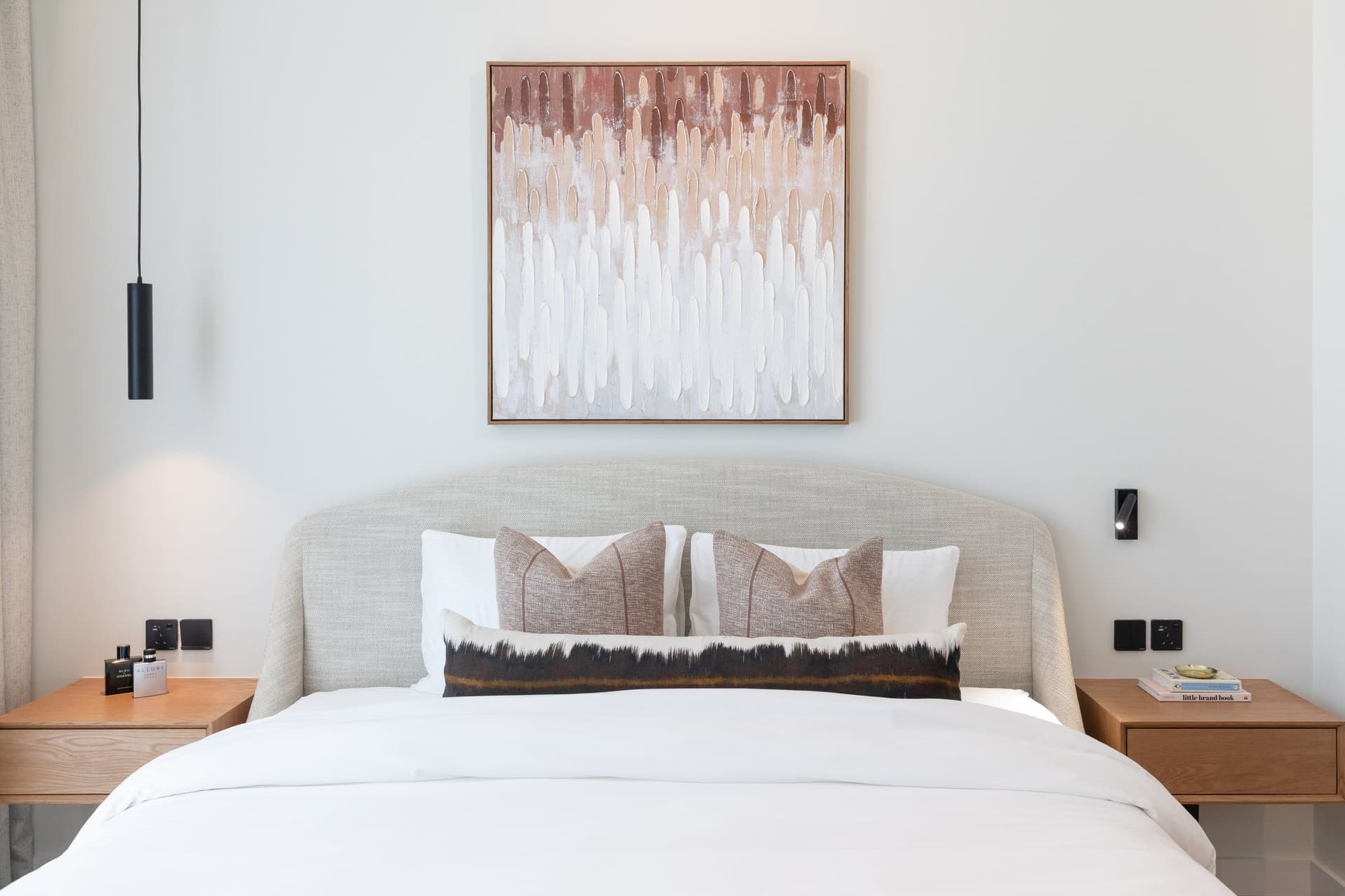
Centred on the bed, the room makes its argument plainly. The headboard is generous but not theatrical, the bedside tables in pale oak are matched and symmetrical, and a pendant on one side and a matte-black wall-mounted reading light on the other sit at heights that respect the proportions of the artwork above.
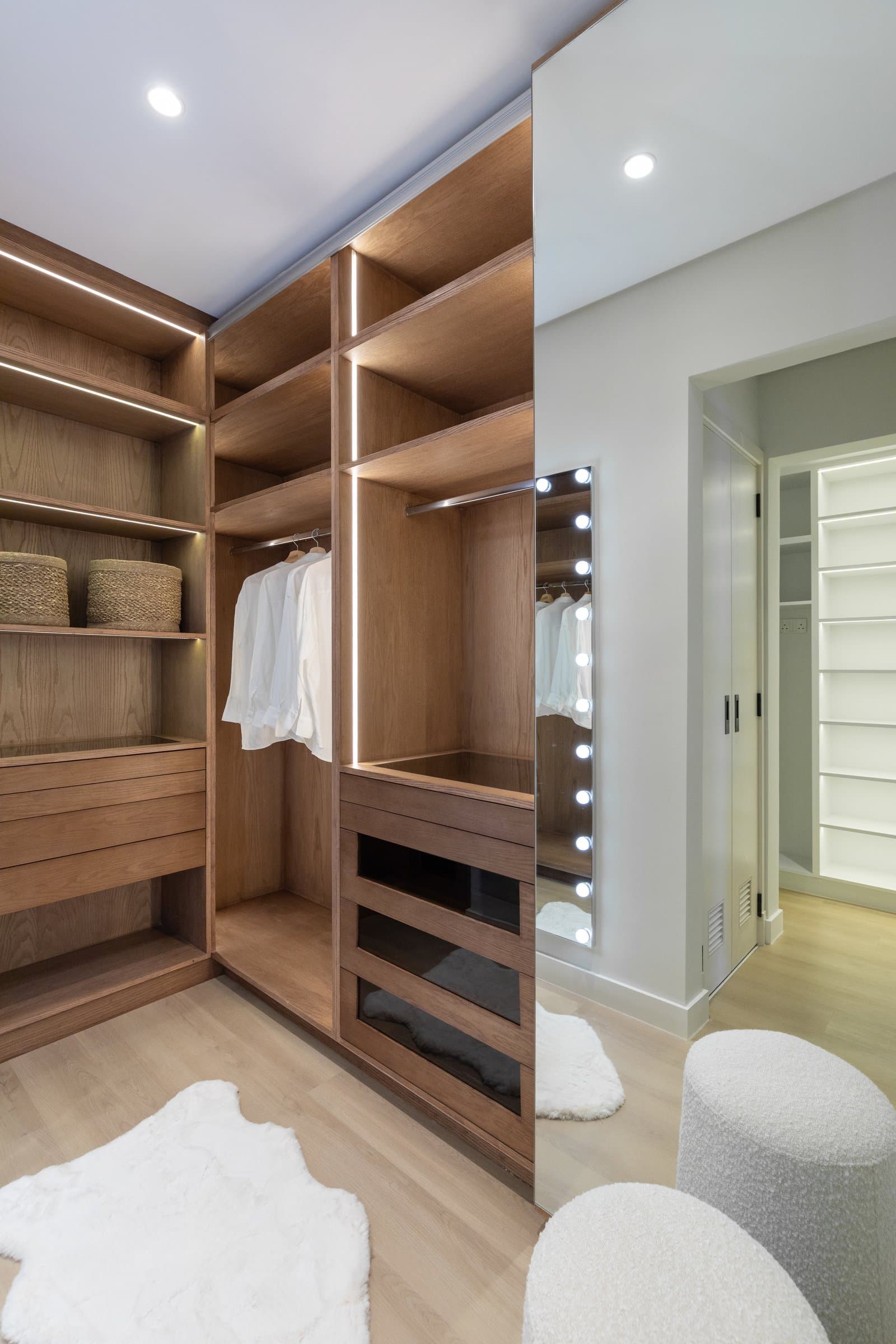
The walk-in dressing room attached to the master suite is where the apartment’s joinery work shows its full hand. Open oak shelving runs the length of two walls, with integrated LED strips lighting each tier from within, and a freestanding mirror with theatrical bulbs introduces a moment of glamour.
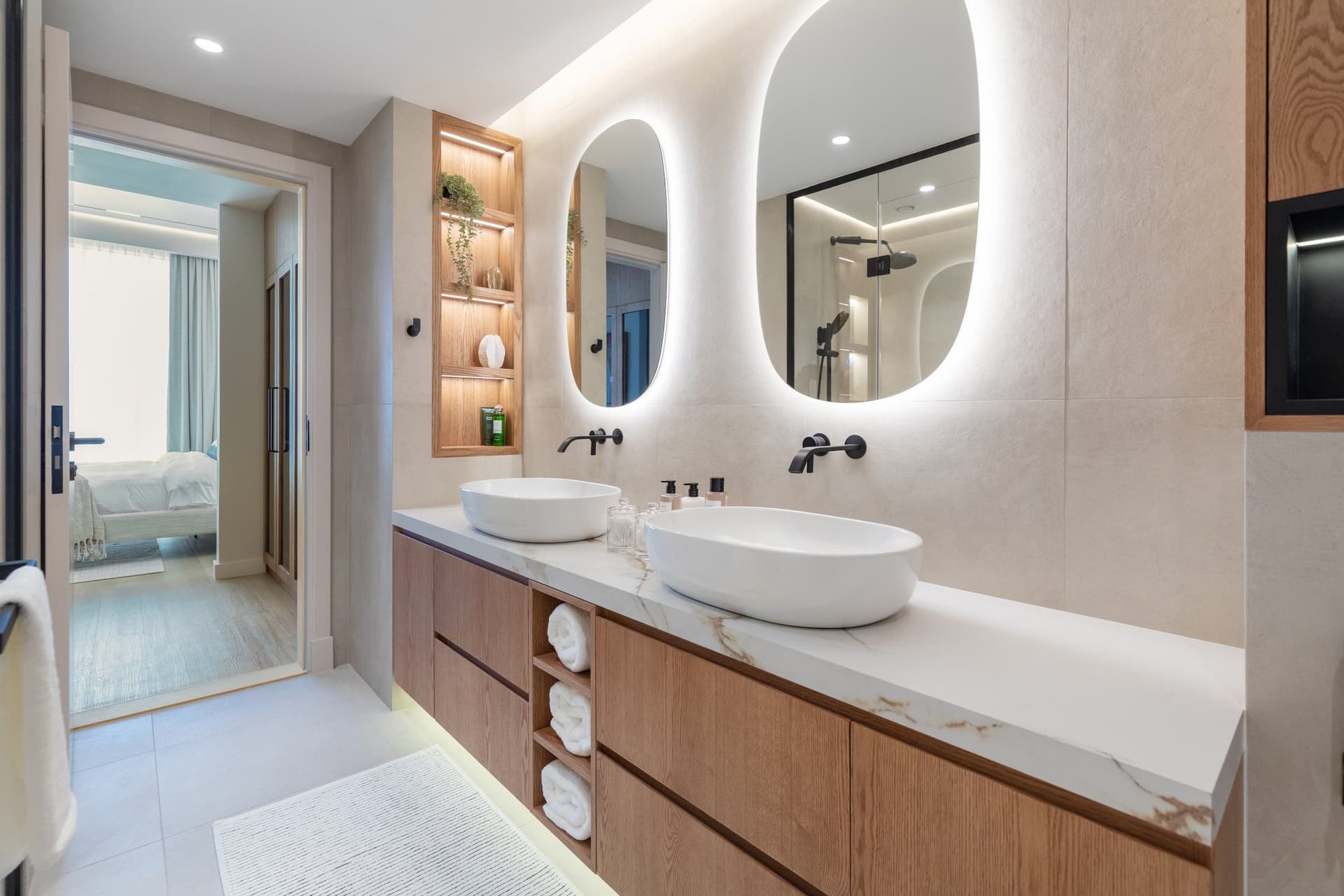
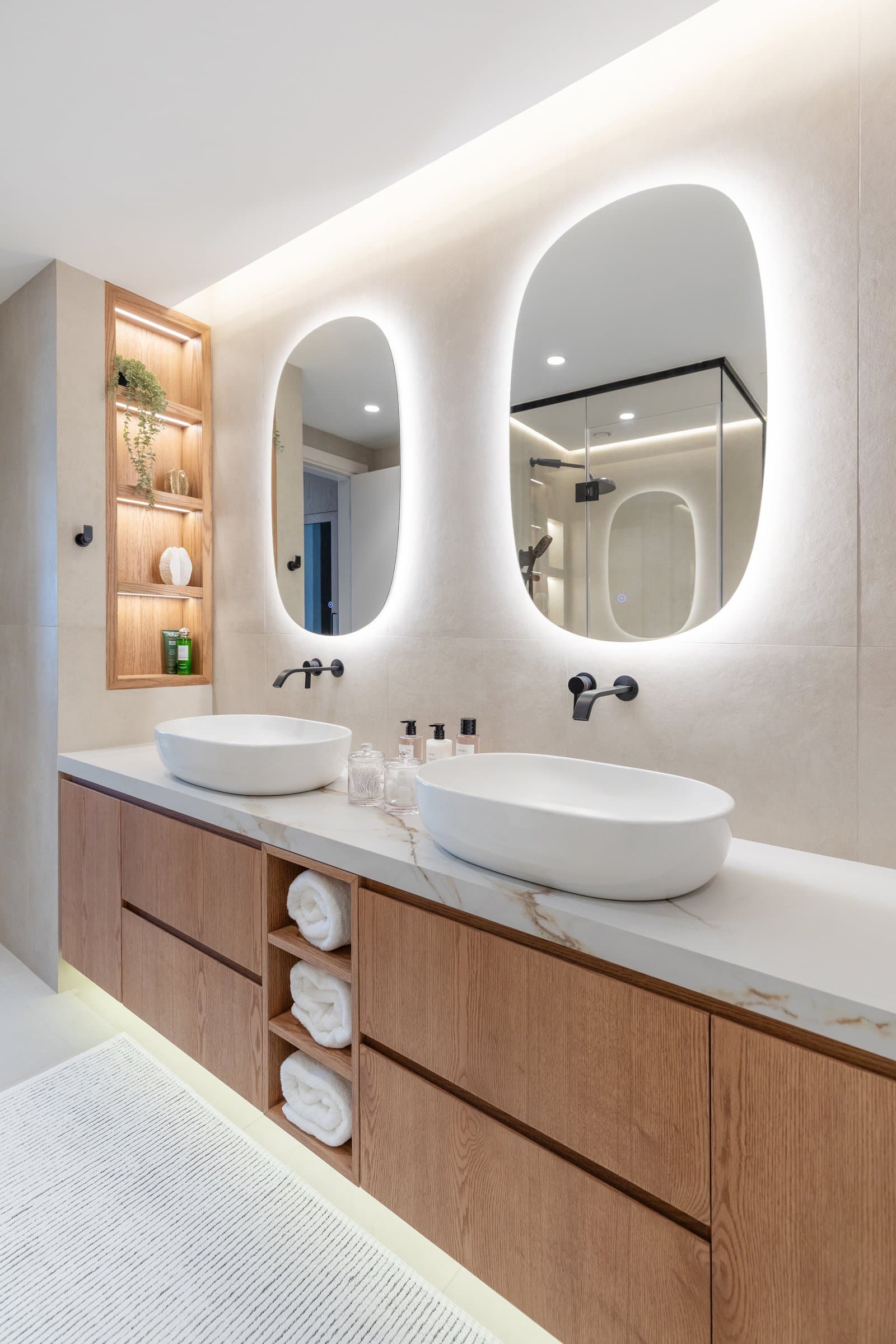
The master bathroom continues the suite’s logic of warm oak against pale stone. Twin oval mirrors with halo backlighting float above a calacatta-veined vanity, the wall-mounted matte-black fittings providing the graphic counterpoint, and an open shelving niche in oak lets the room breathe between the two basins. Through the door, the bedroom is just visible, which is the kind of detail you only design for if you understand how the room will actually be used.
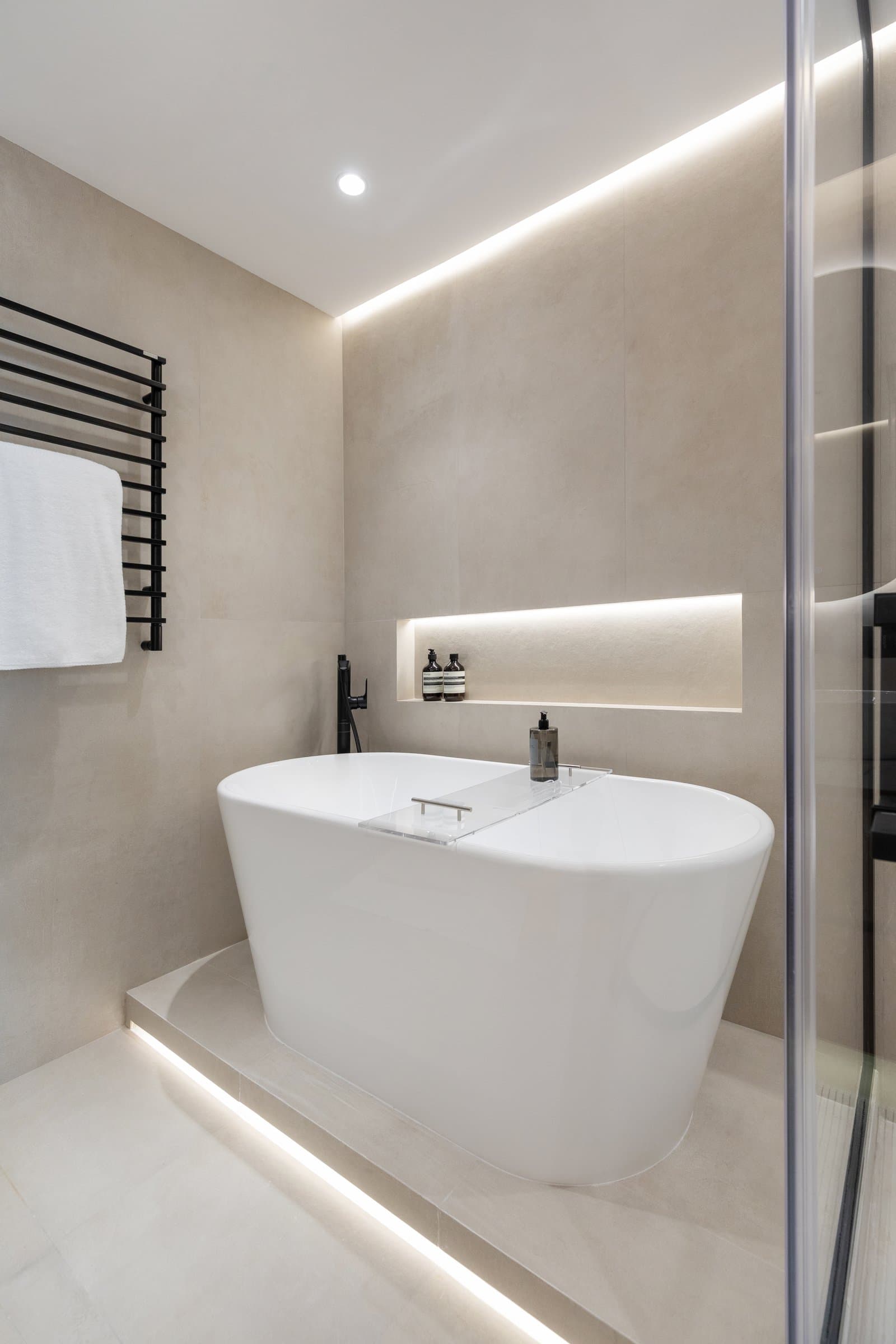
Adjacent, the bath sits in a small alcove of its own, raised on a tiled plinth and backlit from below so the tub appears to hover.
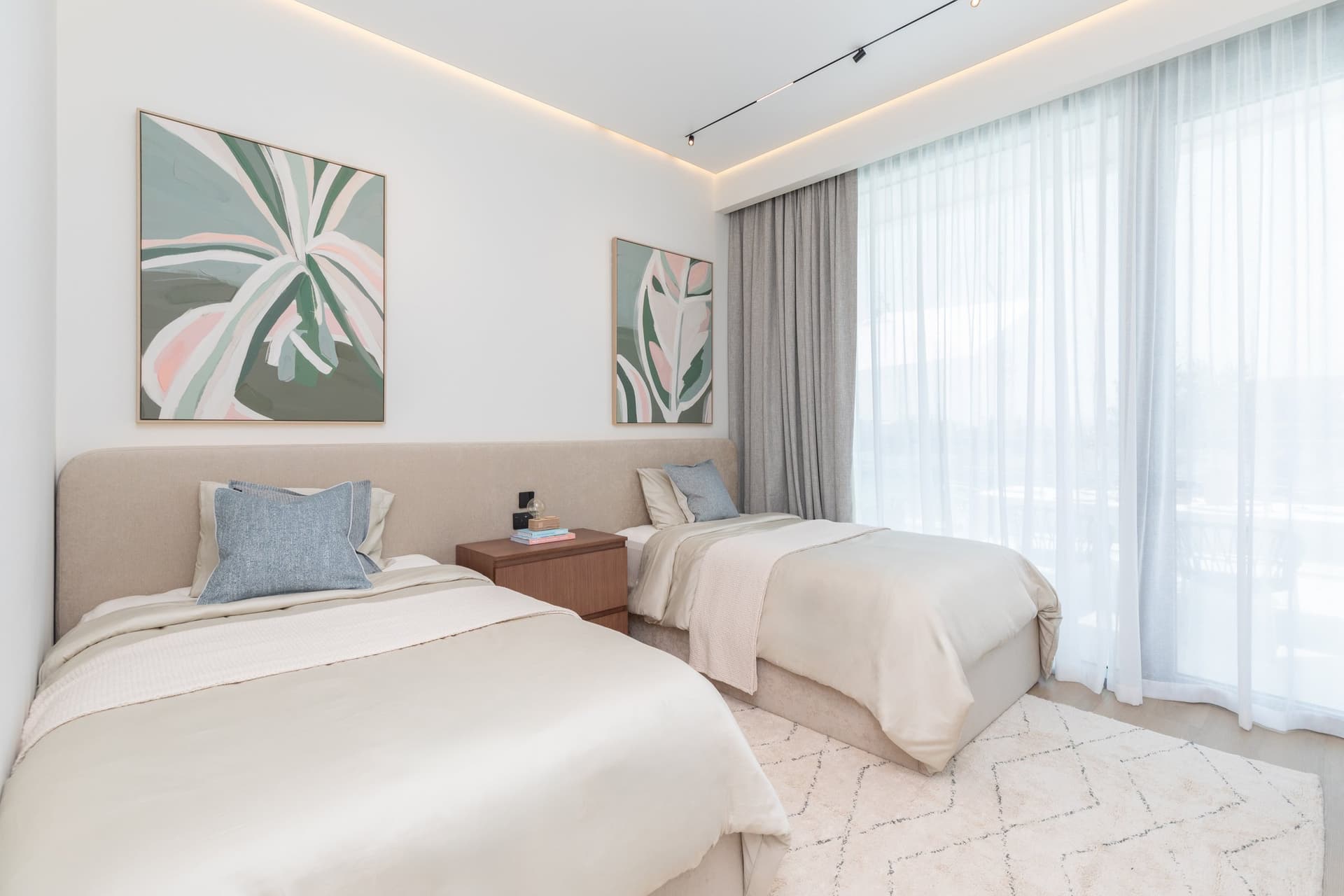
The second bedroom, configured for two, takes a softer line. Twin upholstered beds in oatmeal sit beneath a pair of botanical canvases in muted greens and pinks, and a small oak nightstand bridges the gap between them. The colour palette is the only place in the apartment where the studio has allowed something like sweetness, and even here it is held in check.
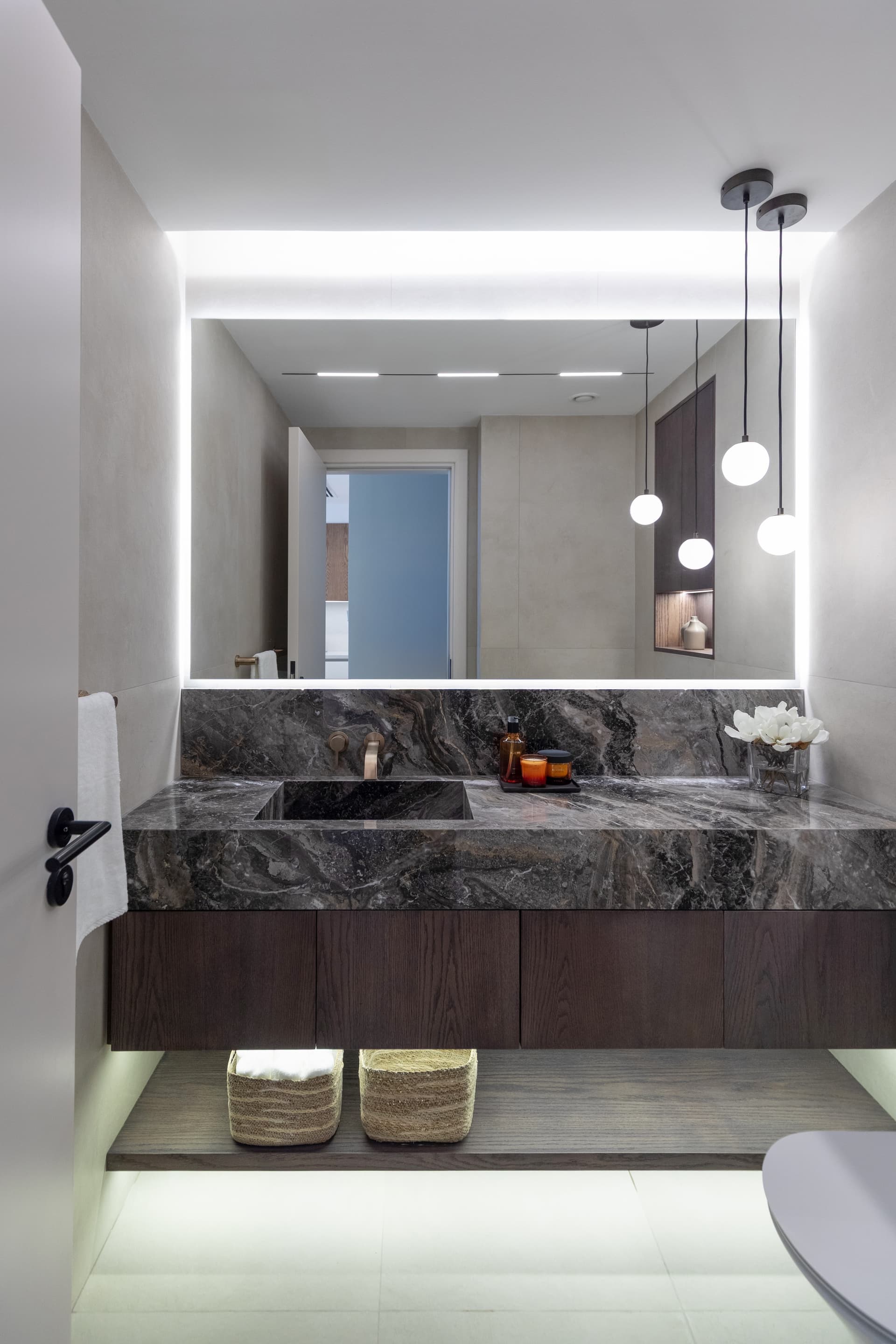
The guest powder room is the home’s one moment of theatre. A heavily veined dark stone runs across the vanity and up as a backsplash, paired with a mirror lit on three sides and a cluster of glass-globe pendants suspended at varying heights.
The strength of the project lies not in singular moments, but in the discipline of its continuity. Materials are revisited with intent, proportions remain consistent, and the spatial language holds steady across the home. There is no fragmentation, no shift in tone – only a quiet, assured rhythm that binds each room into a cohesive whole. The result is a space that reads as one complete thought, rather than a series of layered decisions.
In a city where scale is often mistaken for ambition, this project proposes something more enduring. It is a study in restraint, where luxury is not announced but felt – through balance, clarity, and a confidence that does not rely on excess.
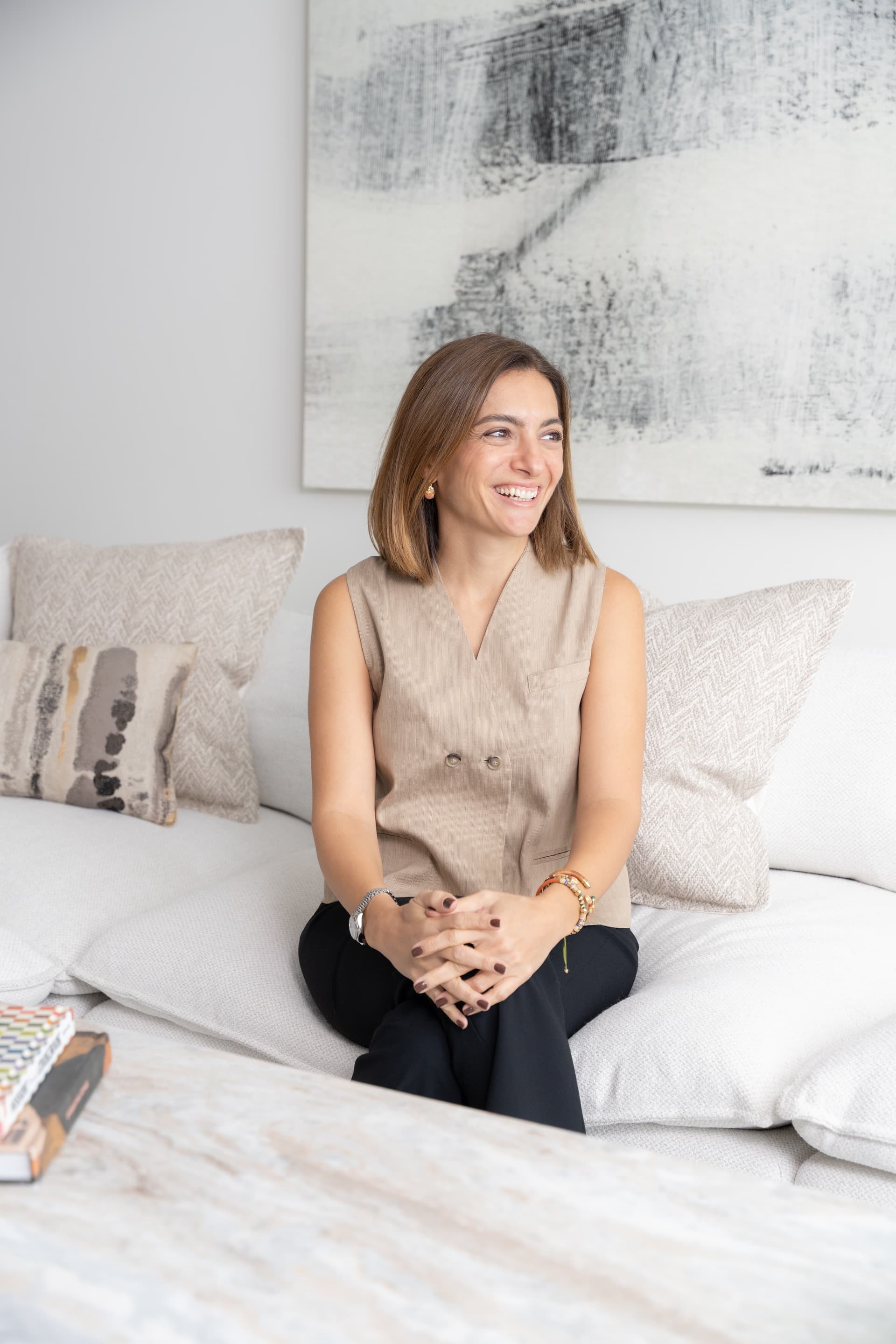
Seher Tansel Karaca, Founder and Principal Designer – Villa Number 9