There is a quiet ambition in homes that refuse a single design idiom. Most projects choose a vocabulary and stay loyal to it; this one moves through registers, room by room, allowing each space to articulate something distinct without losing the through-line of a family’s life.
Set across two levels in Bengaluru, The Rowhouse by Studio Kaarigars was conceived for a multi-generational family who wanted their home to hold many moods at once: the formality of an entry foyer, the hush of a parents’ bedroom, the unguarded delight of a child’s room, the soft theatre of a dining table. Rather than impose visual continuity through repetition, the studio chose a more difficult path, letting each room arrive at its own conclusion while the architecture and the family’s rhythms held everything in place.
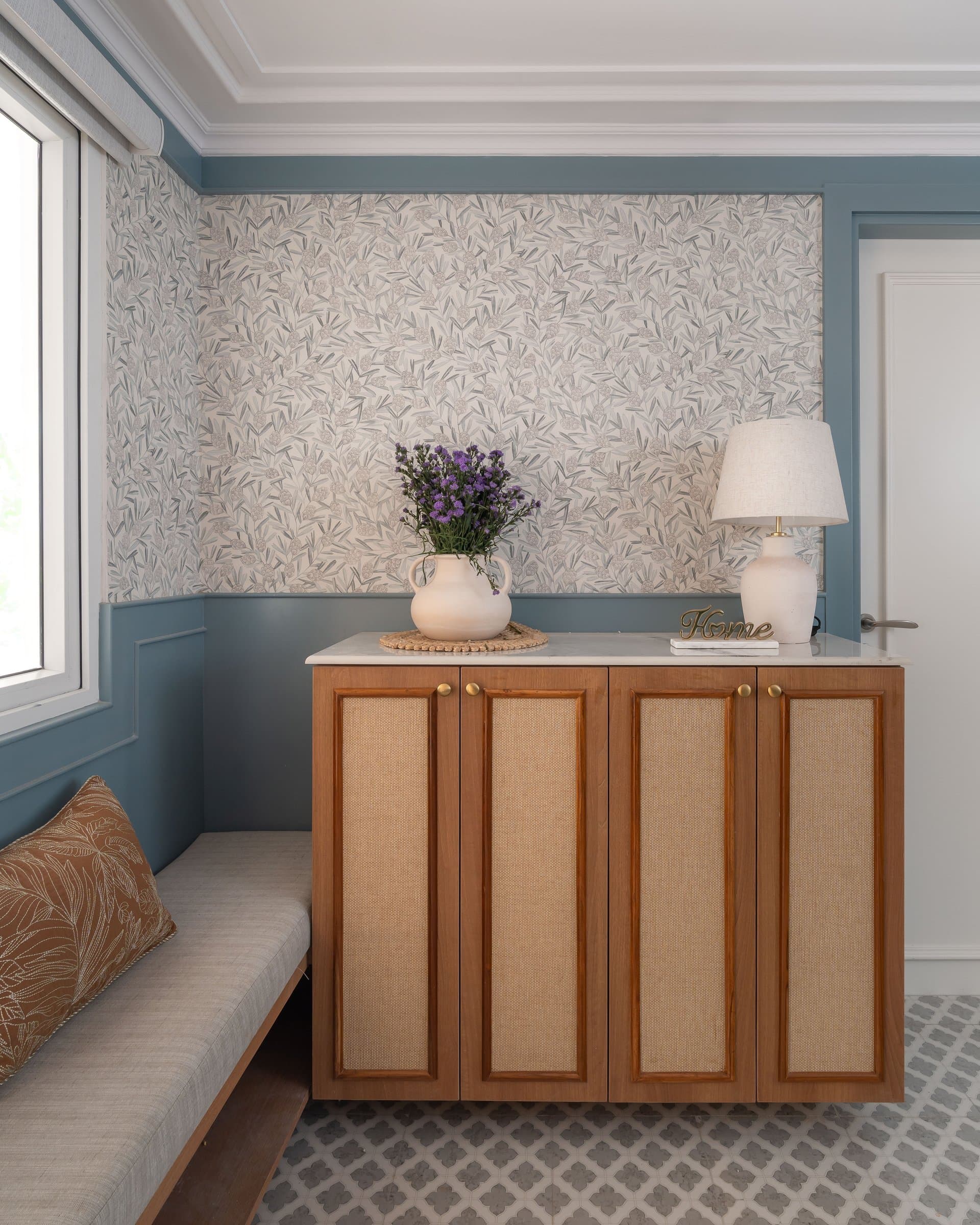
The foyer makes its argument before a single other room is seen. A dusty blue wainscoting meets a botanical wallpaper above, and a cane-fronted console grounds the composition in something closer to old-world calm than contemporary minimalism. The geometric cement tile underfoot is the giveaway: this is a home that will not be afraid of pattern.
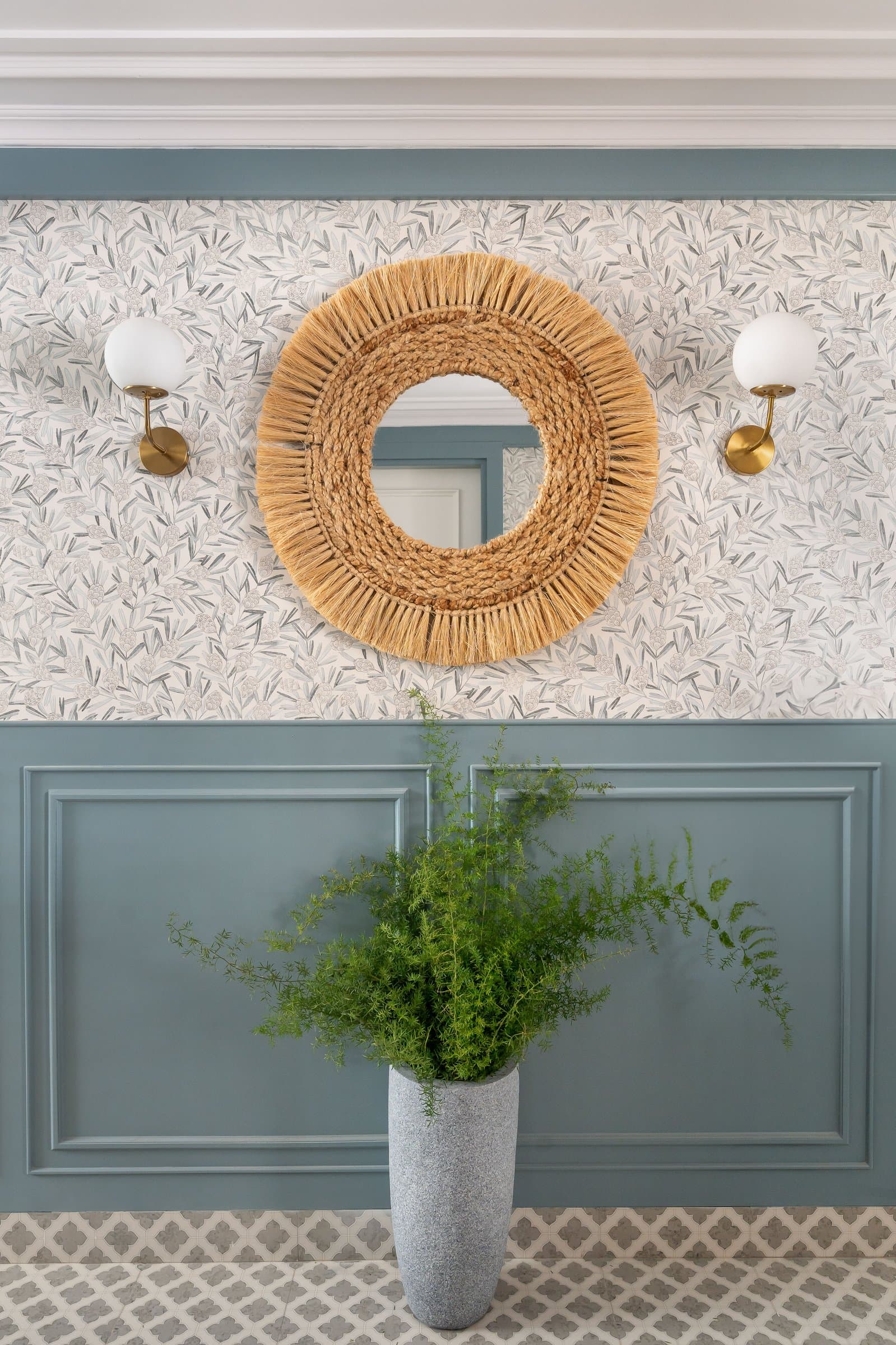
A jute-fringed mirror flanked by twin brass-and-glass sconces completes the foyer’s still life. The detail rewards a second look, the woven texture against the printed wallpaper, the painted panelling against the patterned floor, three textures arguing softly with one another and resolving in a single quiet wall.
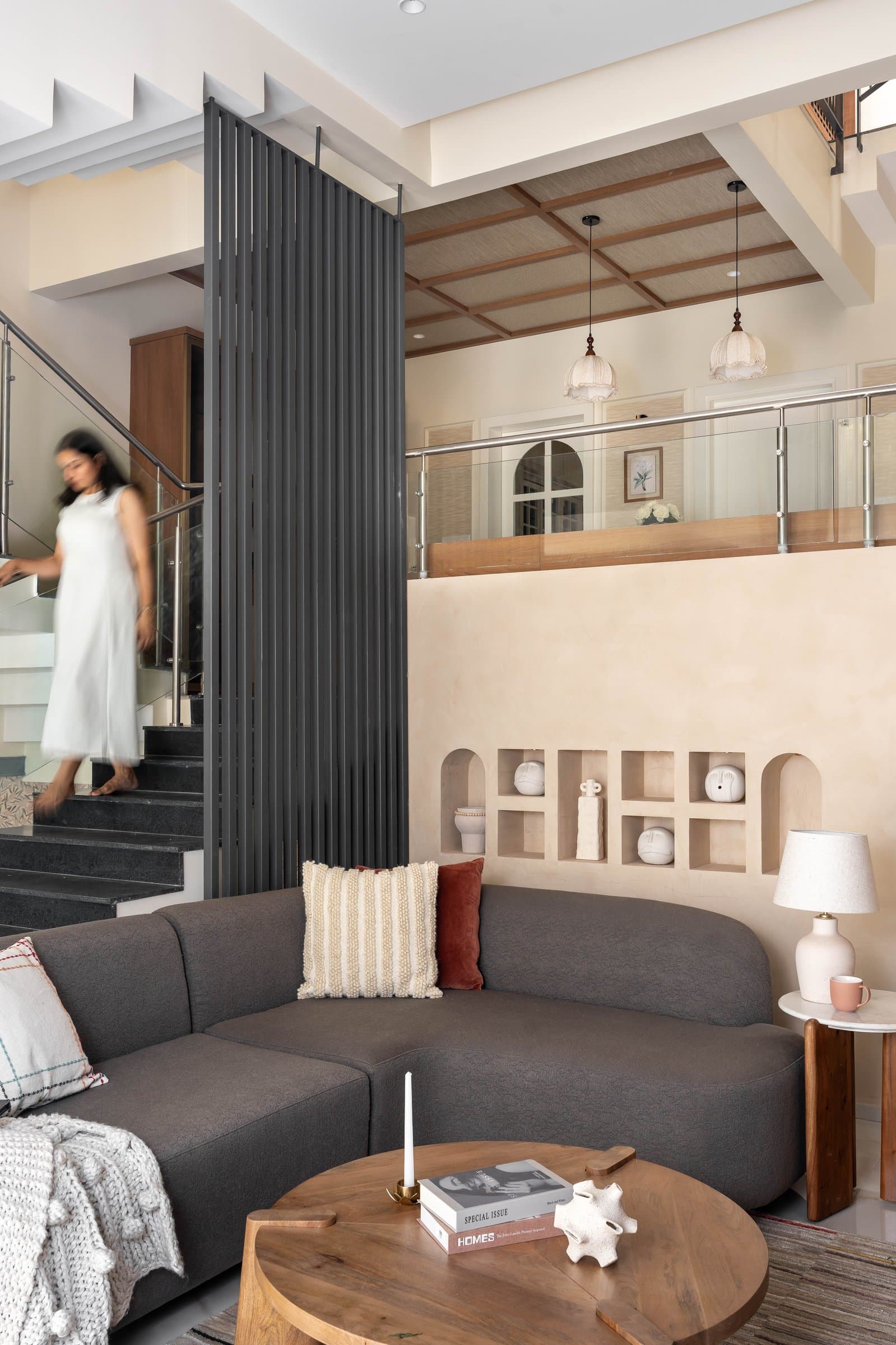
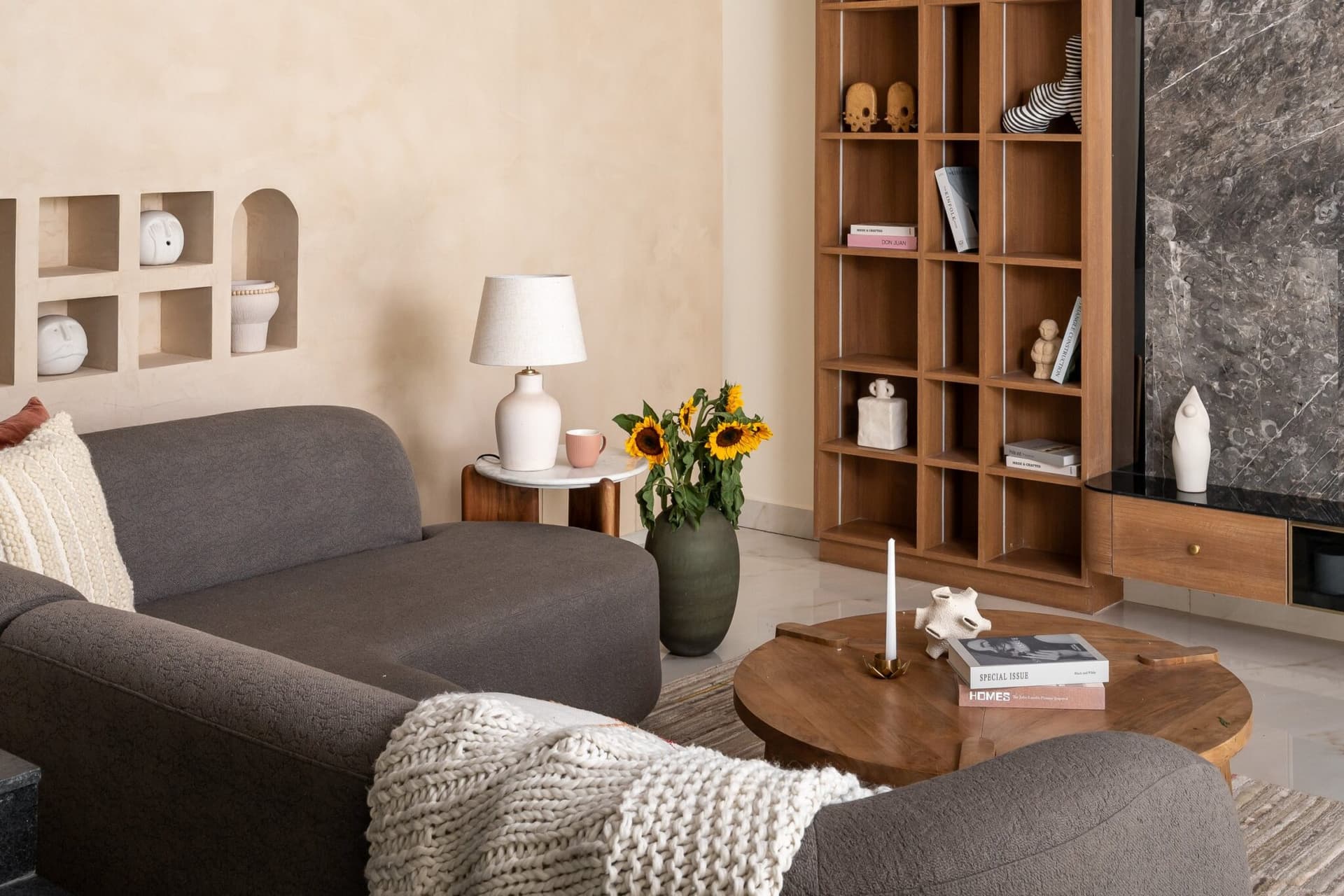
The living room arrives as a release of volume. A double-height ceiling opens above a curved boucle sofa, and a slatted screen filters the staircase descent without sealing it off, so movement through the home remains visible from the seating below.
Behind the sofa, a grid of recessed niches in tinted plaster holds a collection of pale ceramic objects, each lit from above with the precision of a small gallery. The wall is the room’s quiet thesis: ornament that has been earned, not applied.
Opposite the sofa, a tall walnut shelving system frames a marble-clad television wall, the dark veining acting almost as a painting in its own right. The room layers warm plaster, dark stone, and grained wood without strain, holding the kind of composure that only comes from editing.
““We wanted each room to have its own personality, but for the home to still feel like one continuous thought.””
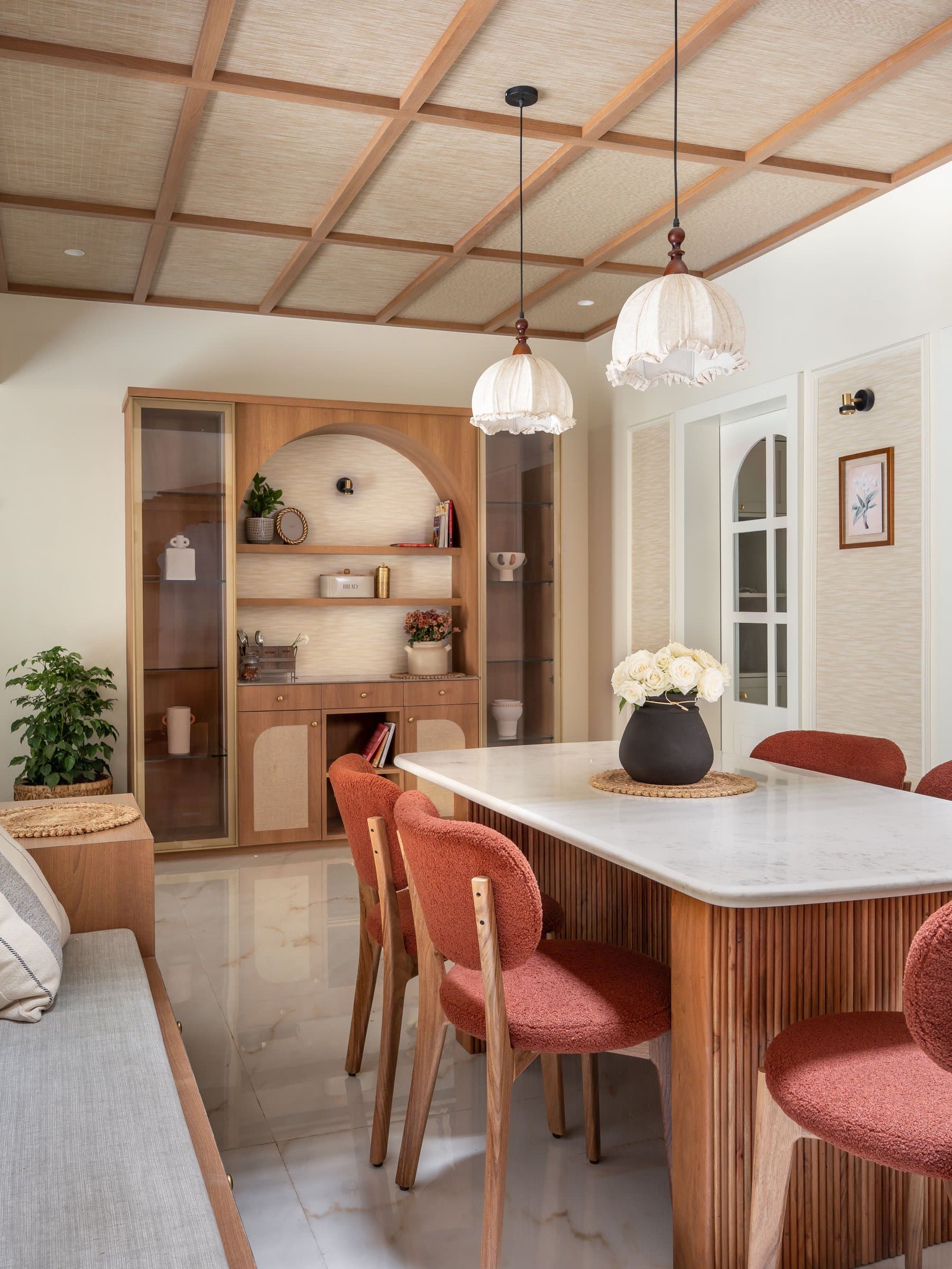
The dining area shifts the register entirely. A coffered ceiling in cane and wooden beams hovers above a fluted-base table topped in white marble, and a pair of frilled fabric pendants offer a soft theatricality the living room had refused. Terracotta-toned bouclé chairs cluster around the table with the warmth of a colour decision made for joy, not restraint.
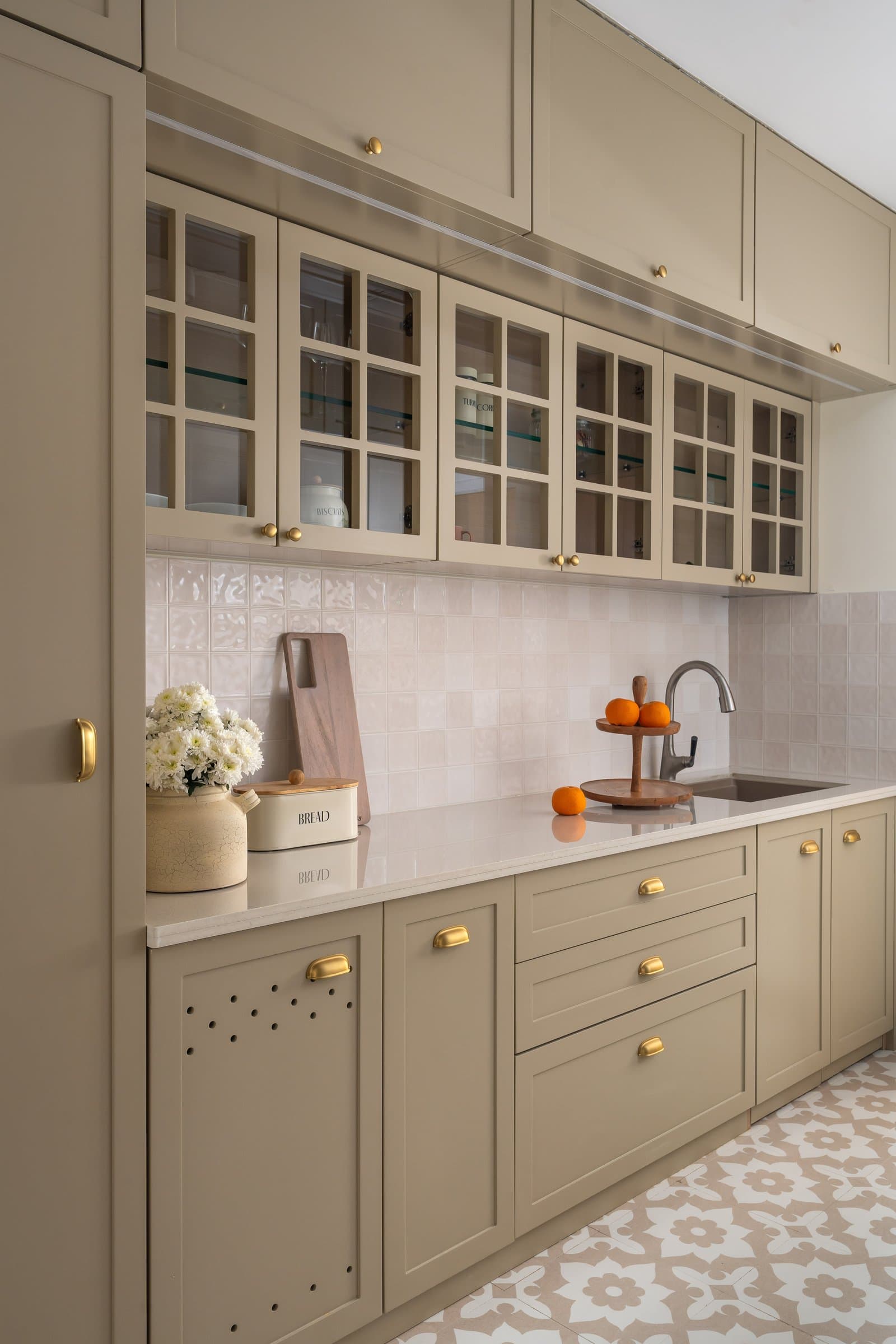
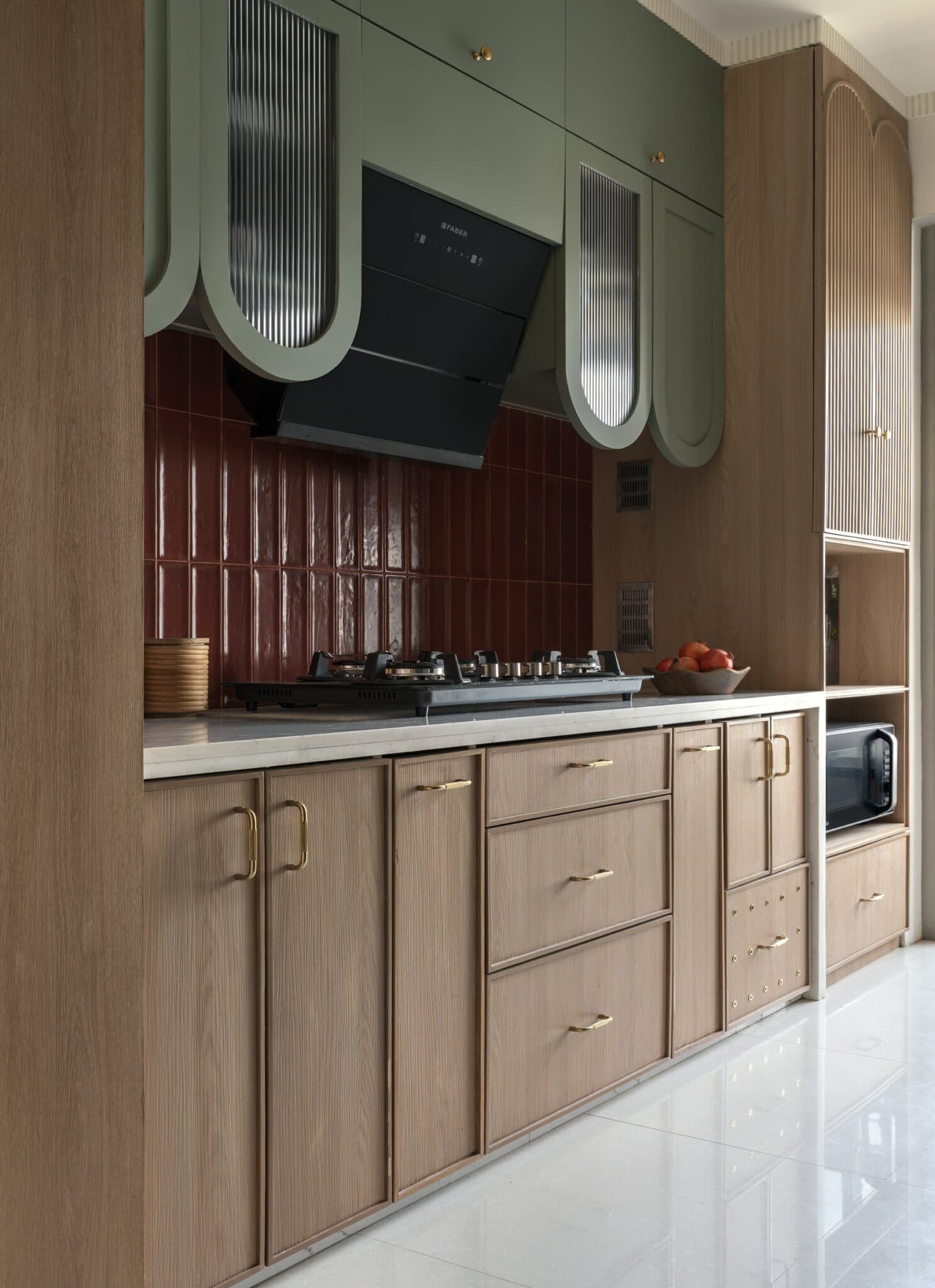
The kitchen turns toward a quieter, more domestic luxury. Shaker-fronted cabinetry in a muted putty tone meets brass cup pulls and a glazed square-tile backsplash, while a patterned encaustic floor anchors the room in a tradition older than the cabinetry itself.
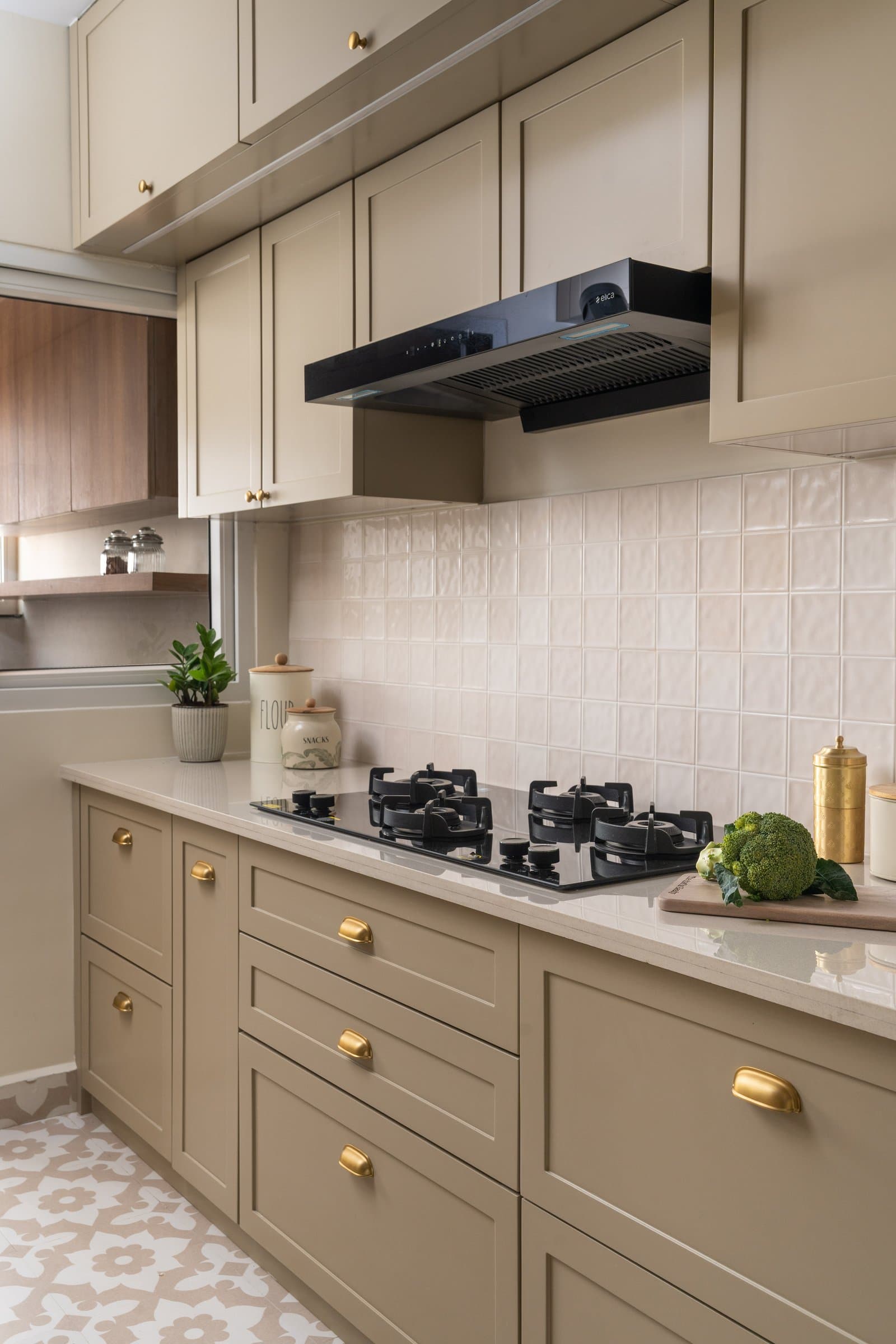
Along the cooking wall, the same vocabulary continues, with brass hardware catching light against the soft-toned cabinetry and an Elica hood breaking the rhythm with a graphite punctuation. The kitchen reads as a working room that has been treated with the same seriousness as the living spaces.
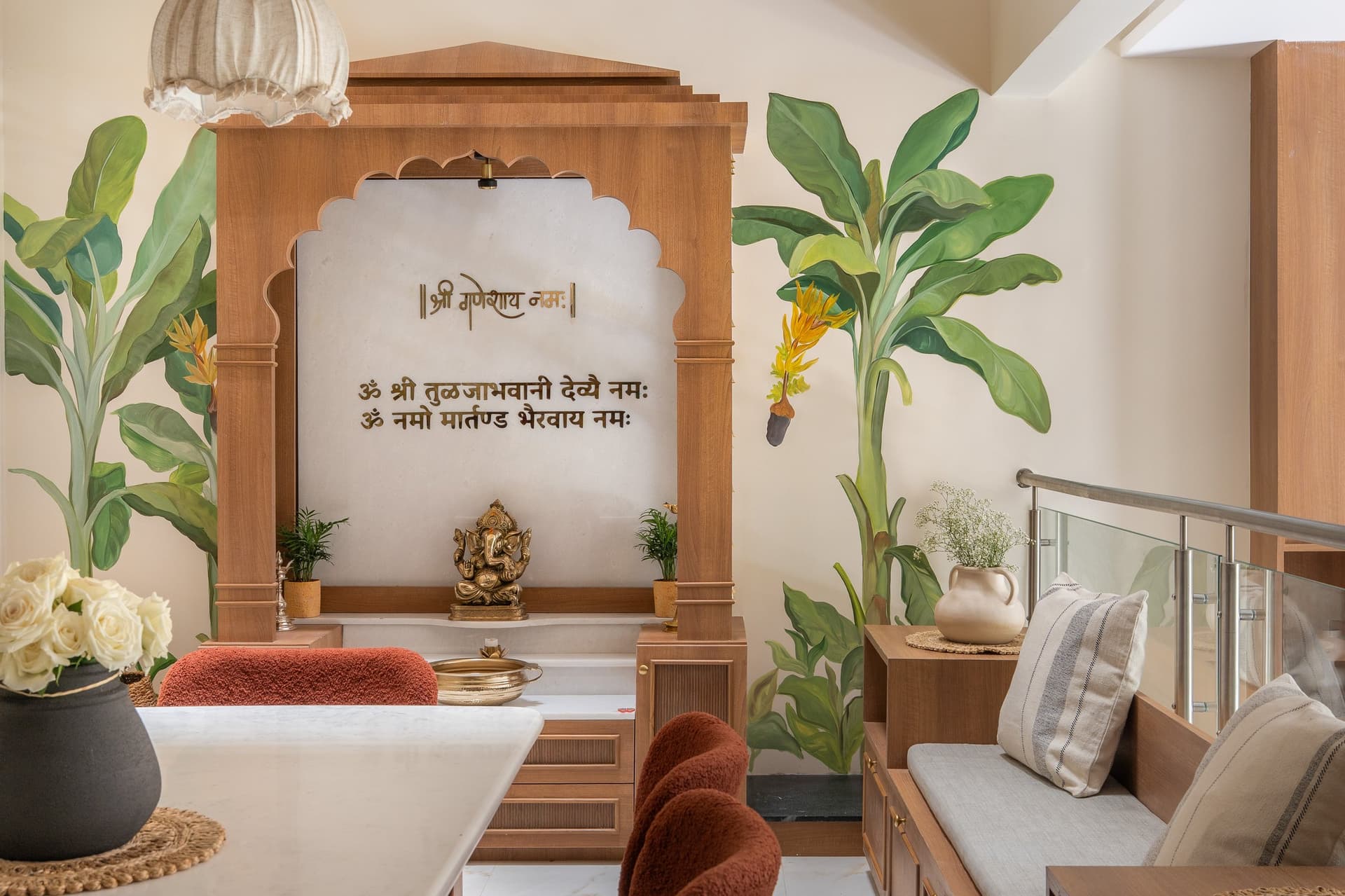
Between the public rooms, the family’s puja space holds its own ground. A carved wooden temple frame surrounds an inscribed marble panel, and hand-painted banana leaves climb the flanking walls, lending the alcove a quality closer to a courtyard shrine than a built-in niche.
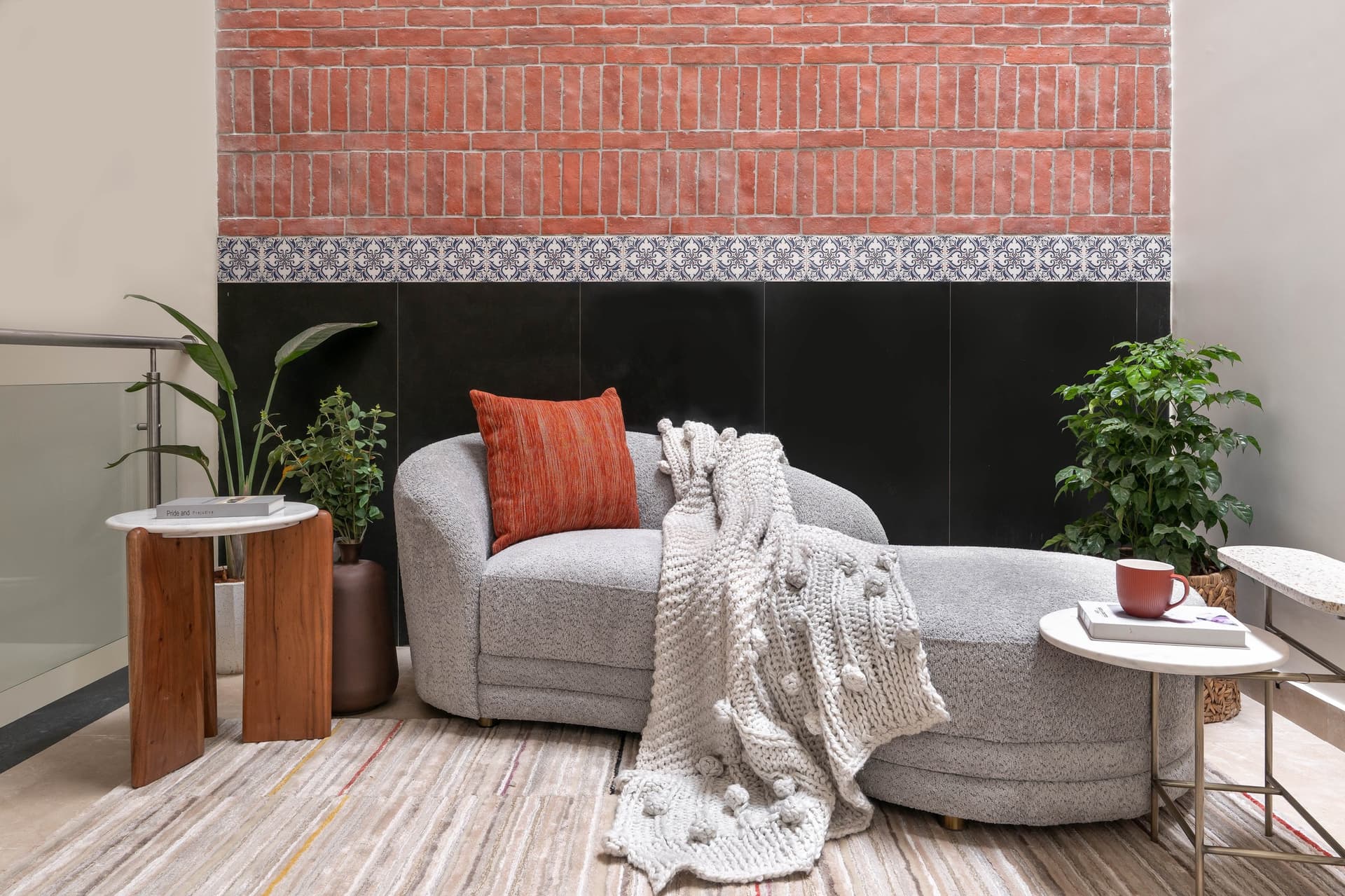
A landing midway through the home turns into a small reading retreat. Exposed terracotta brick meets a band of blue-and-white patterned tile and a panel of dark stone beneath, the three materials stacked like geological layers behind a curved grey bouclé daybed. The composition is the most unguardedly eclectic moment in the home, and arguably its most affectionate.
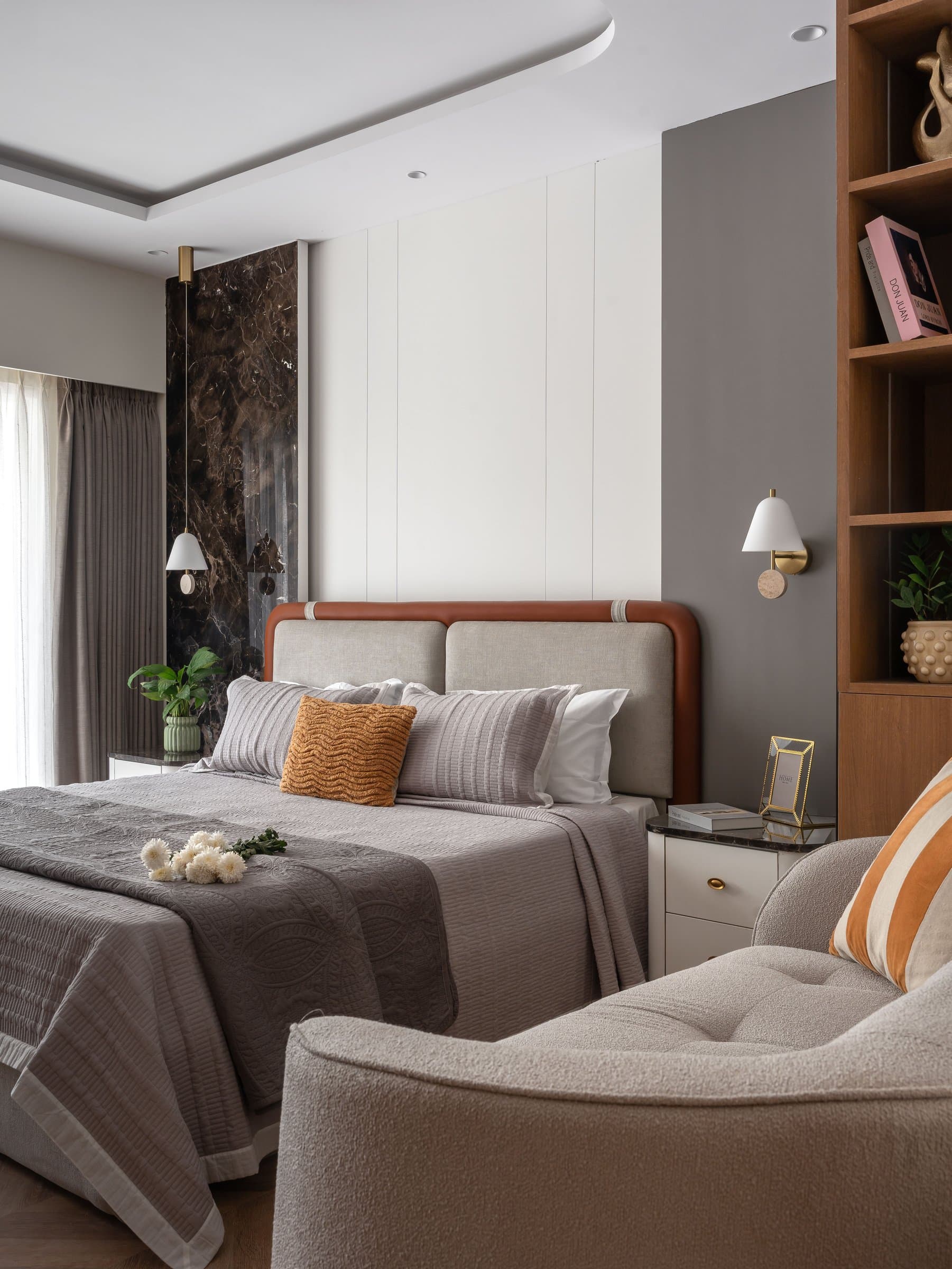
The master bedroom recovers a more contained mood. A dark marble slab rises behind one side of the upholstered headboard, balanced by a panel of soft grey and a column of warm wood shelving, the palette weighted but never heavy. A boucle armchair at the foot of the bed signals that this is a room for slow mornings rather than performance.
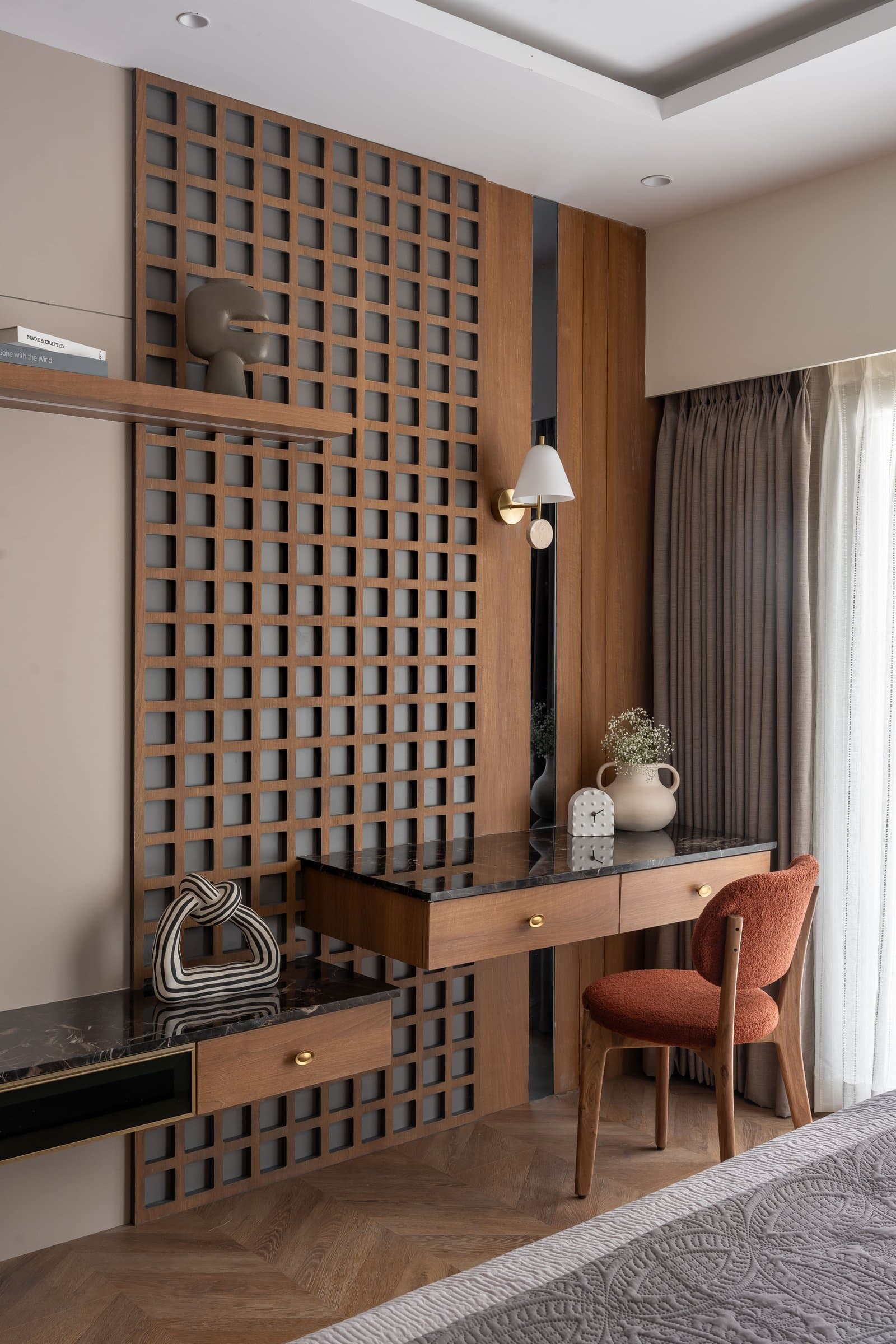
Along the adjoining wall, a wooden lattice screen runs floor to ceiling, framing a vanity in dark stone with a single terracotta chair tucked in. The herringbone floor and slim brass detailing tip the room toward something quietly mid-century, an accent the rest of the home does not repeat.
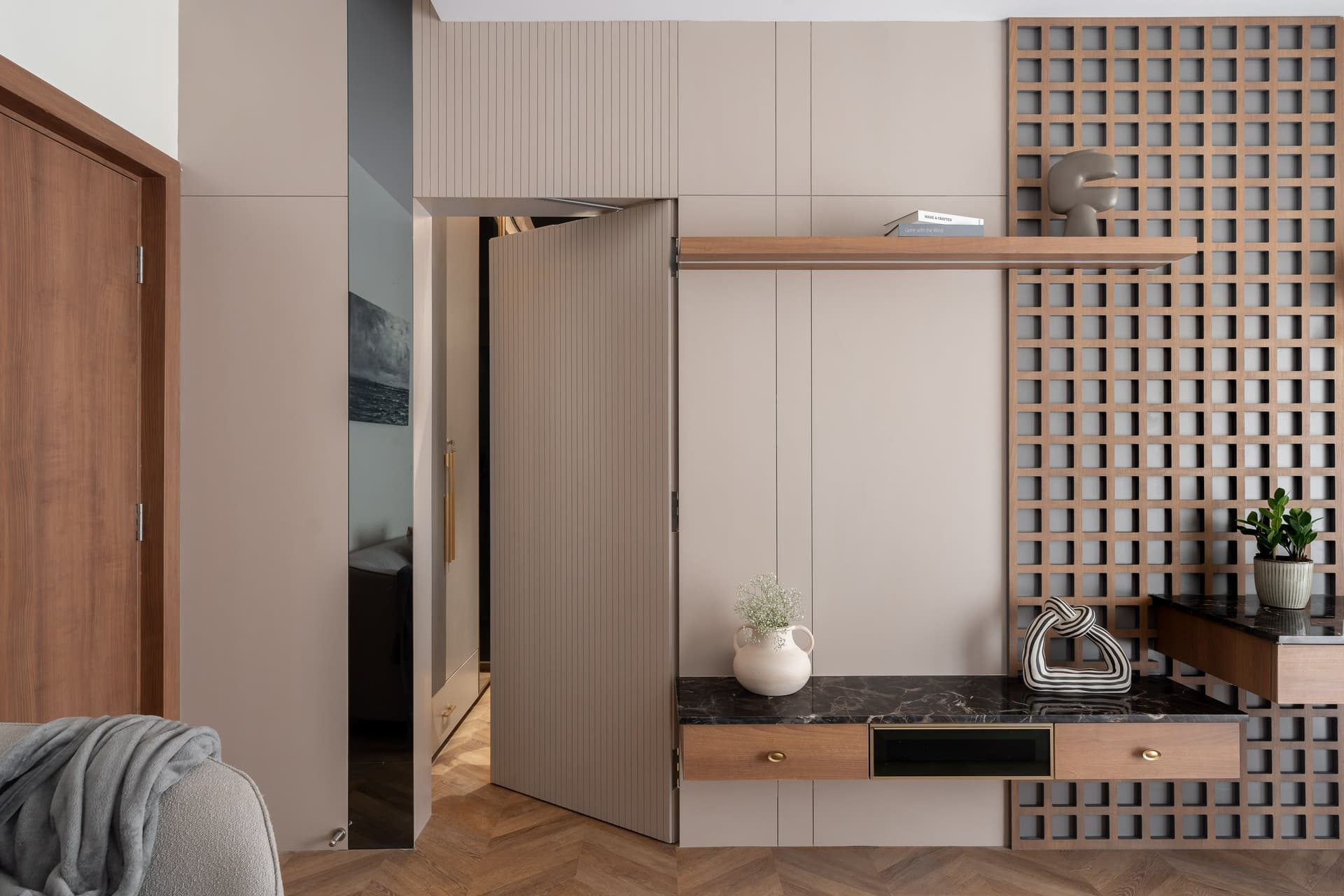
A second bedroom corridor reveals the studio’s interest in the threshold itself. A reeded pivoting door, fronted in the same muted putty as the cabinetry, opens onto a lattice-wrapped console with a dark stone top, the wooden grid extending the master suite’s vocabulary into the passage without imitation.
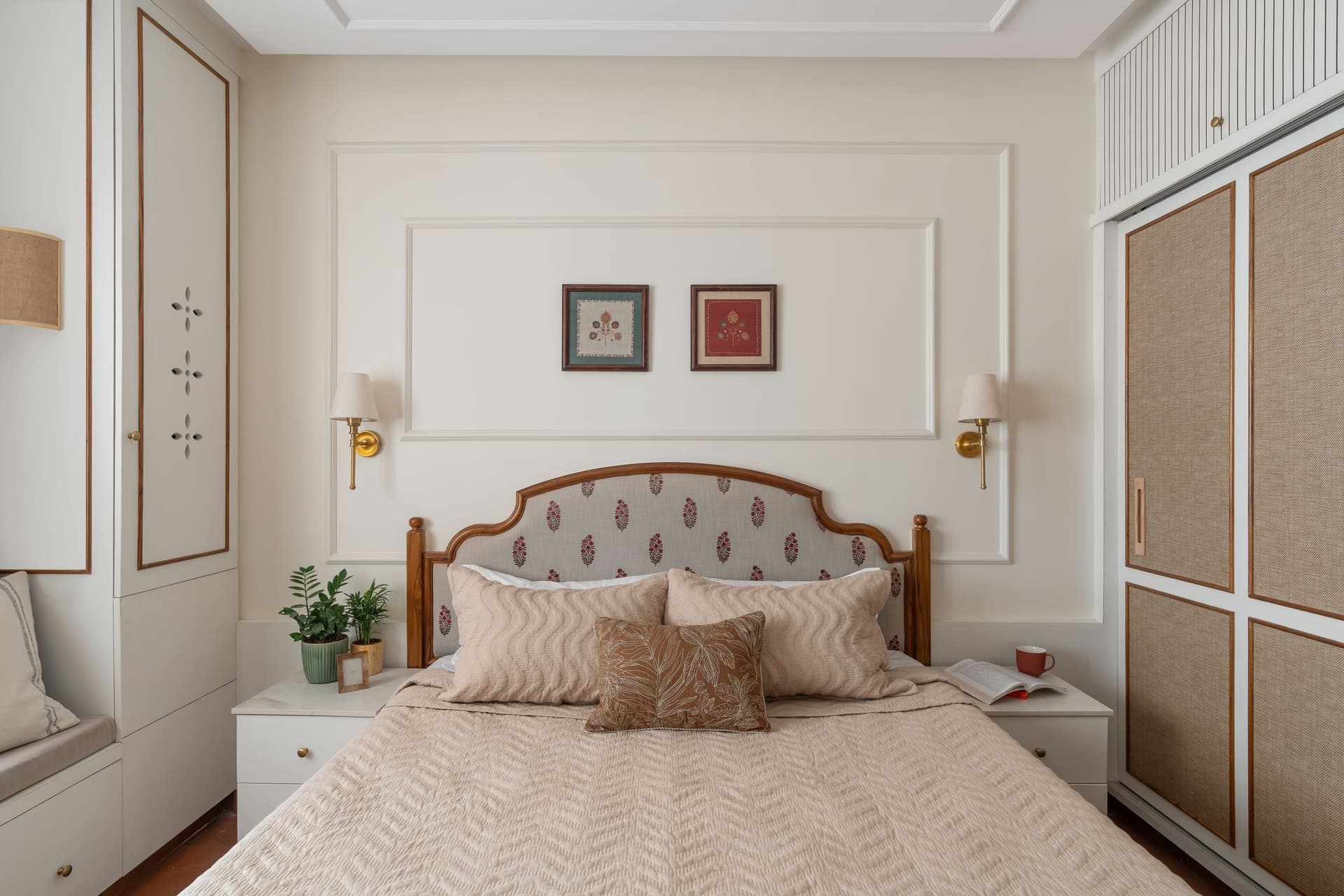
The parents’ bedroom takes the home in yet another direction. An arched, fabric-upholstered headboard in a small-block floral print is flanked by classical wall mouldings and a pair of brass sconces, while a cane-fronted wardrobe to the right and a slatted upper cabinet establish a kind of restrained traditionalism. The room is the most explicitly Indian in tone, and reads as a deliberate gesture toward the older generation it houses.
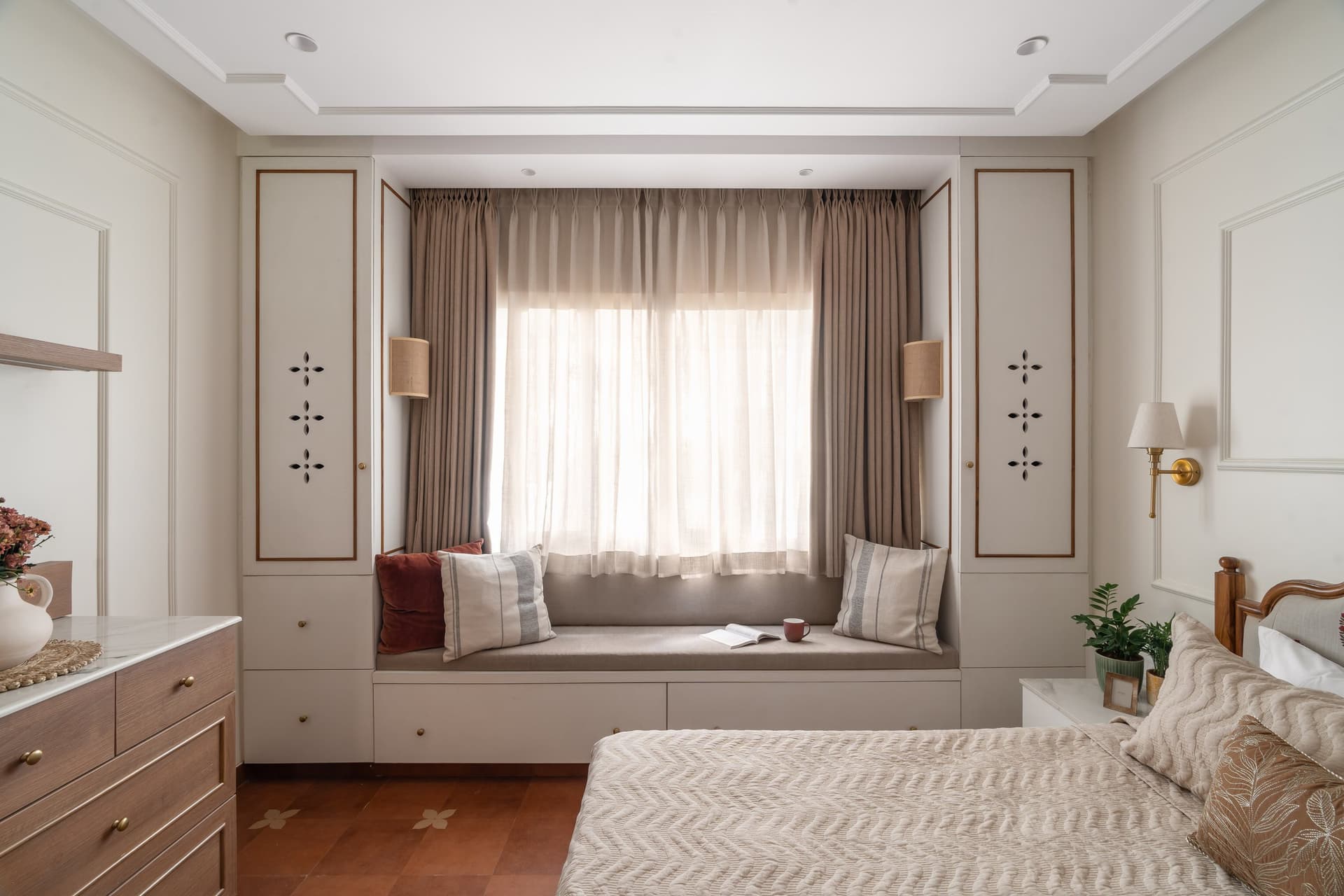
A window seat anchors the far wall, framed by tall cabinets with brass-trimmed cut-out detailing. The terracotta floor with inlaid floral motifs is the unmistakable register of a slower South Indian domesticity, brought into a room that is otherwise built for rest.
Across the same room, a chest of drawers in warm wood sits beneath a floating shelf and a framed devotional print. The detailing, brass knobs, marble top, and framed drawer fronts, alongside the adjacent tall cabinet with cut-out medallion panels, points to a sensibility that values continuity with tradition over visual novelty.
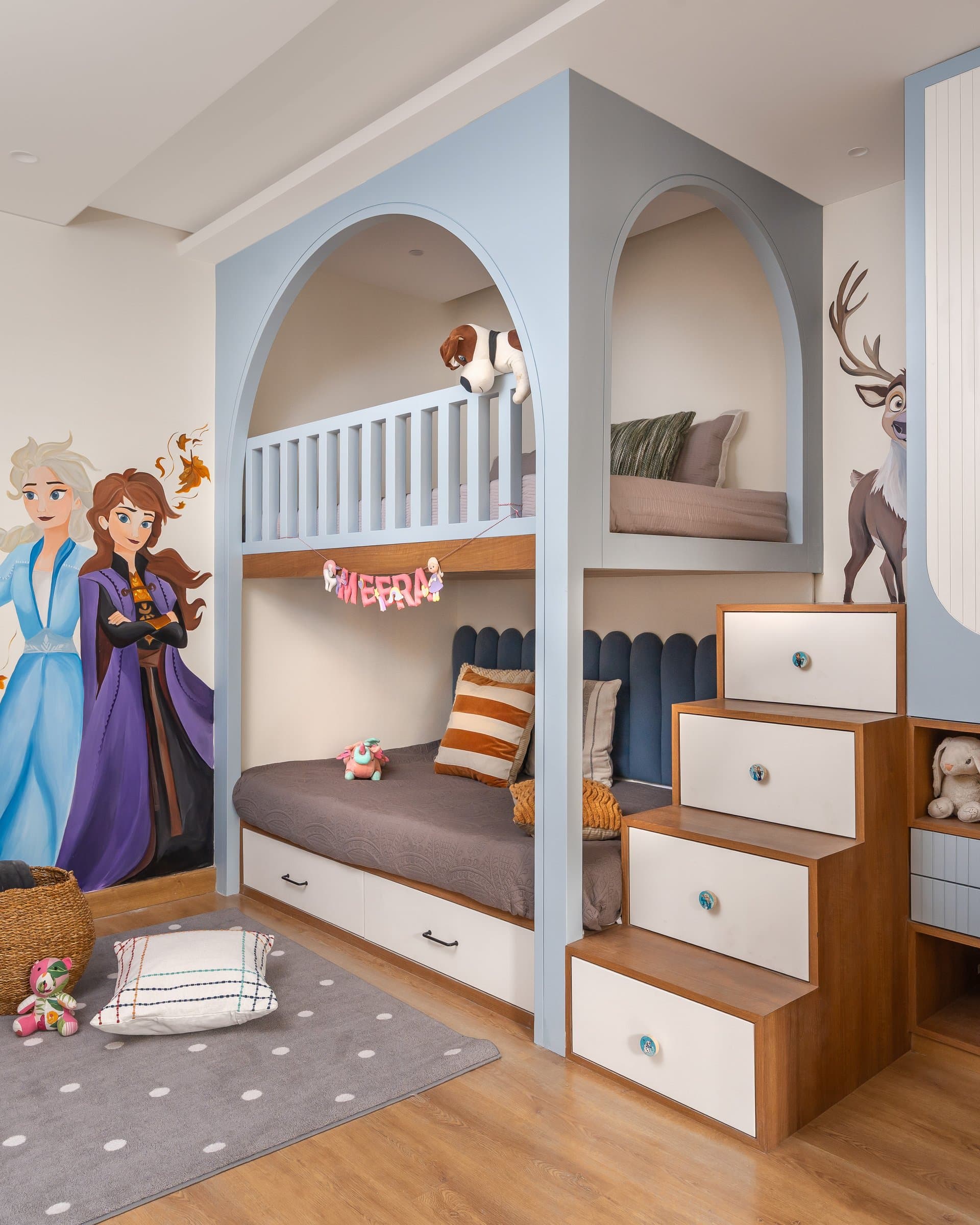
The children’s room is, characteristically, where the studio loosens its grip and lets imagination lead. A built-in bunk is framed by twin powder-blue arches, a stepped storage stair climbs to the upper berth, and a hand-painted Frozen mural runs along the flanking walls.
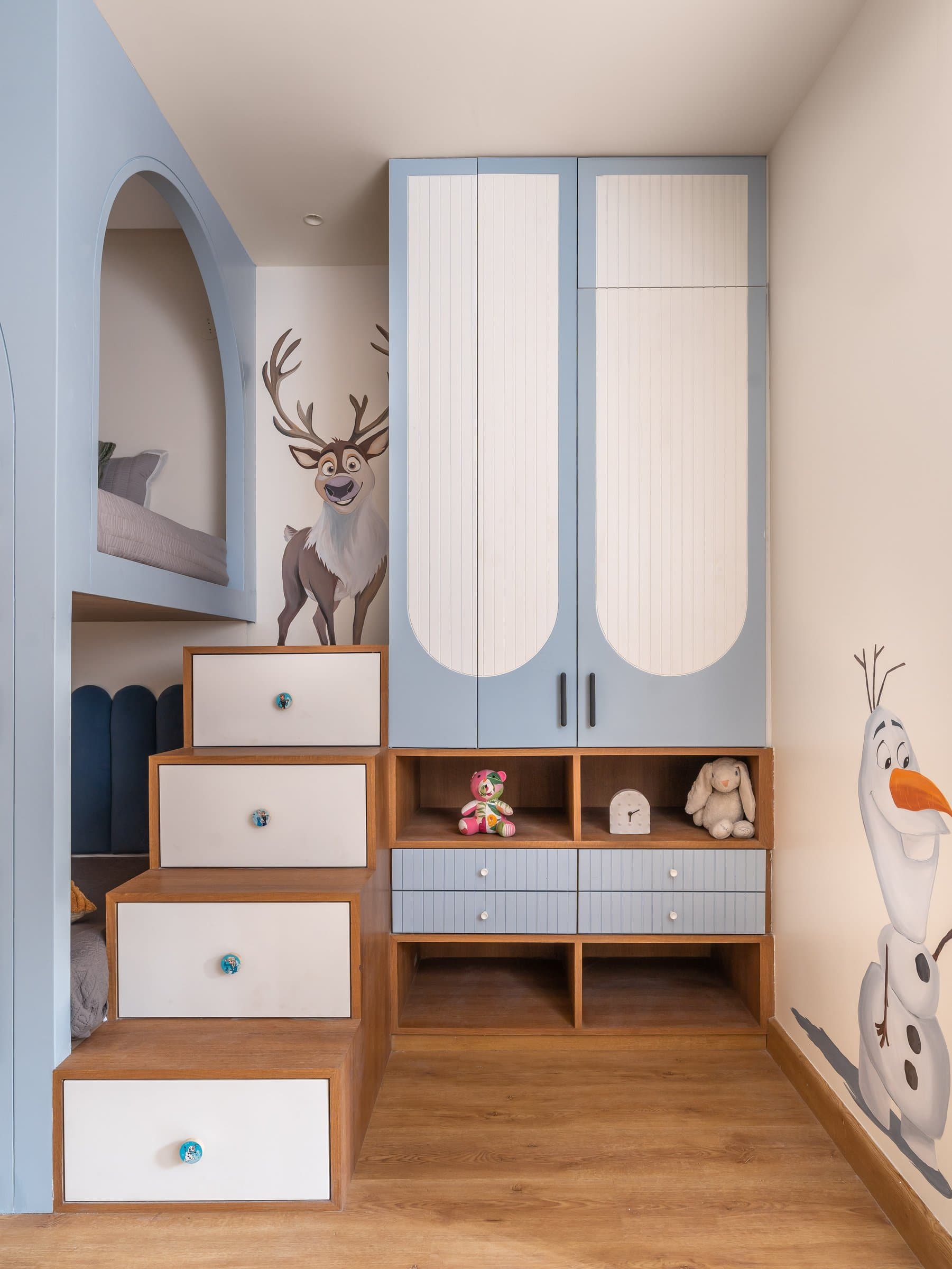
The detail of the storage stair, with its plain white drawer fronts and ribbed wardrobe doors and small character-printed knobs, shows how seriously the studio took the brief. Built-ins for children are usually compromises; here, the joinery is as considered as anything in the master suite.
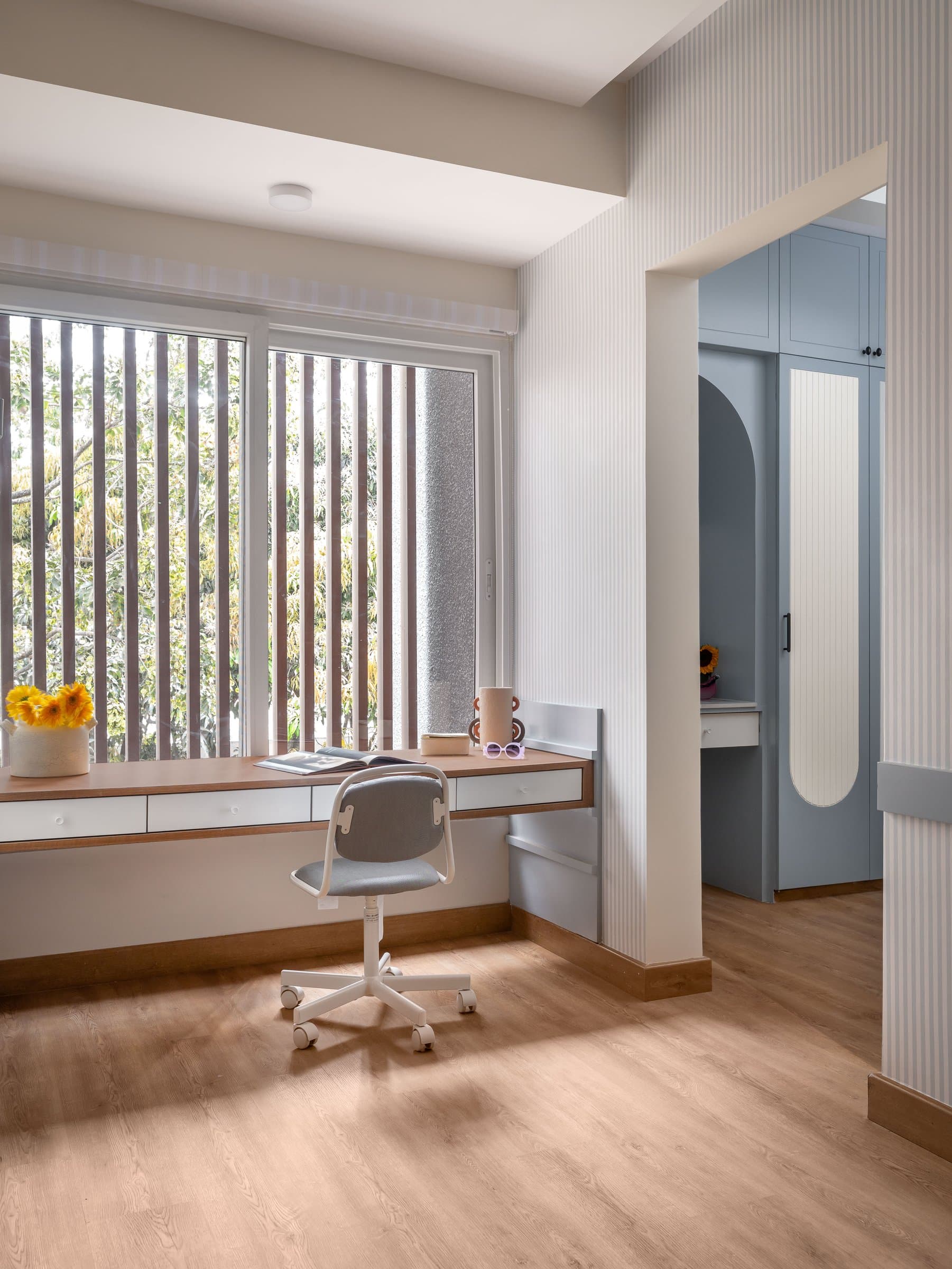
An adjoining study nook completes the children’s zone. A long wooden desk runs beneath a slatted-screen window, the floor switches to a warmer wood plank, and a soft-blue wardrobe peeks through the doorway, holding the colour story of the bunk room at a quieter pitch.
A reading bay at the far end of the home returns to wood as the dominant material. A grooved wooden surround frames a window seat in muted sage upholstery, paired with a small terrazzo side table and a Japanese-style botanical print. The room is small enough to be incidental and considered enough to suggest it is anything but.
The Rowhouse sits within a Bengaluru tradition that has long absorbed many influences, colonial mouldings, South Indian terracotta floors, encaustic cement tiles, contemporary built-ins, and processed them into something domestic rather than referential. Studio Kaarigars works comfortably within that lineage, treating each room as a discrete proposition while letting the city’s plural sensibility hold the whole together.
What lingers, after the tour, is the willingness of the home to be many things. The discipline of the project lies not in a single material gesture but in knowing when to release one room from the rules of the next, and trusting that a family is more than capable of inhabiting a house that speaks in several voices.