There is a particular confidence required to build a home around the things you already own and love, rather than the things a designer tells you to acquire. It is a confidence that resists the clean-slate impulse of contemporary interiors, where personal history is often the first casualty of a renovation. In Unnati, a compact apartment in Pune designed by Studio BiDi and principal architect Shreesha Bidkar, that confidence is the entire premise: a home shaped not by trend but by the accumulated texture of a life lived with intention.
The project name itself, meaning progress or upliftment, signals an approach rooted in growth rather than erasure. The brief, as the spaces reveal, was to design around a family’s existing collection of solid timber furniture, traditional textiles, and classical instruments, giving each piece a considered context rather than replacing it with something more photogenic. What Bidkar has achieved is a layered interior where blue-toned plaster walls, carved wood, and hand-painted art coexist without competing for attention.
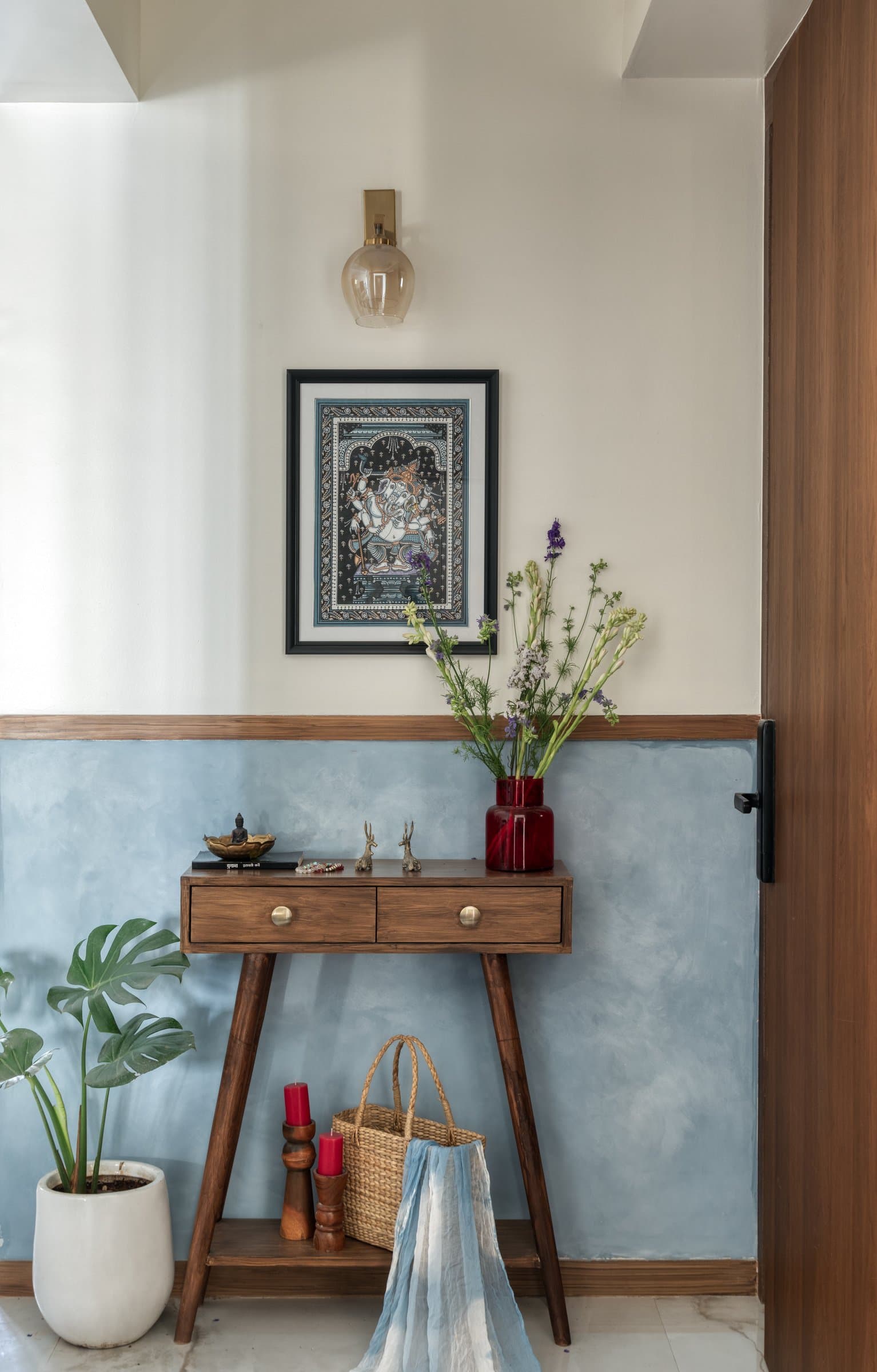
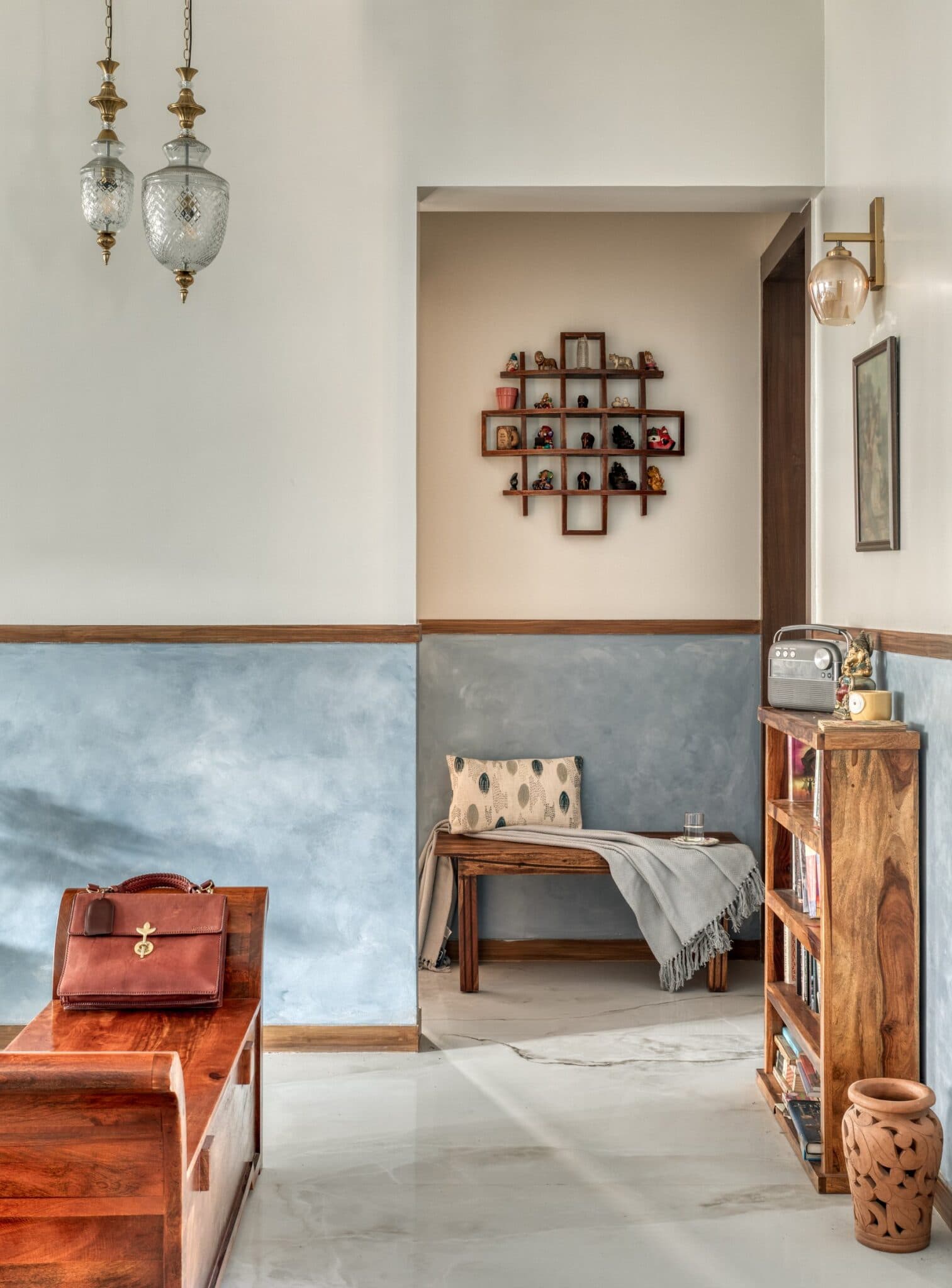
The entry sets the tonal contract immediately. A soft blue limewash runs along the lower half of the wall, divided from the white above by a slim timber trim, and this two-tone treatment becomes the home’s recurring spatial signature. It is a simple gesture, but it does substantial work: grounding the vertical proportions, warming the light, and giving every room a visual datum that connects it to the next.
Moving deeper into the foyer zone, the blue plaster continues alongside a timber bench, a curio shelf filled with collected figurines, and a pair of ornate glass-and-brass pendant lanterns. The space functions as both welcome and preview, announcing that this is a home where objects carry biographical weight.
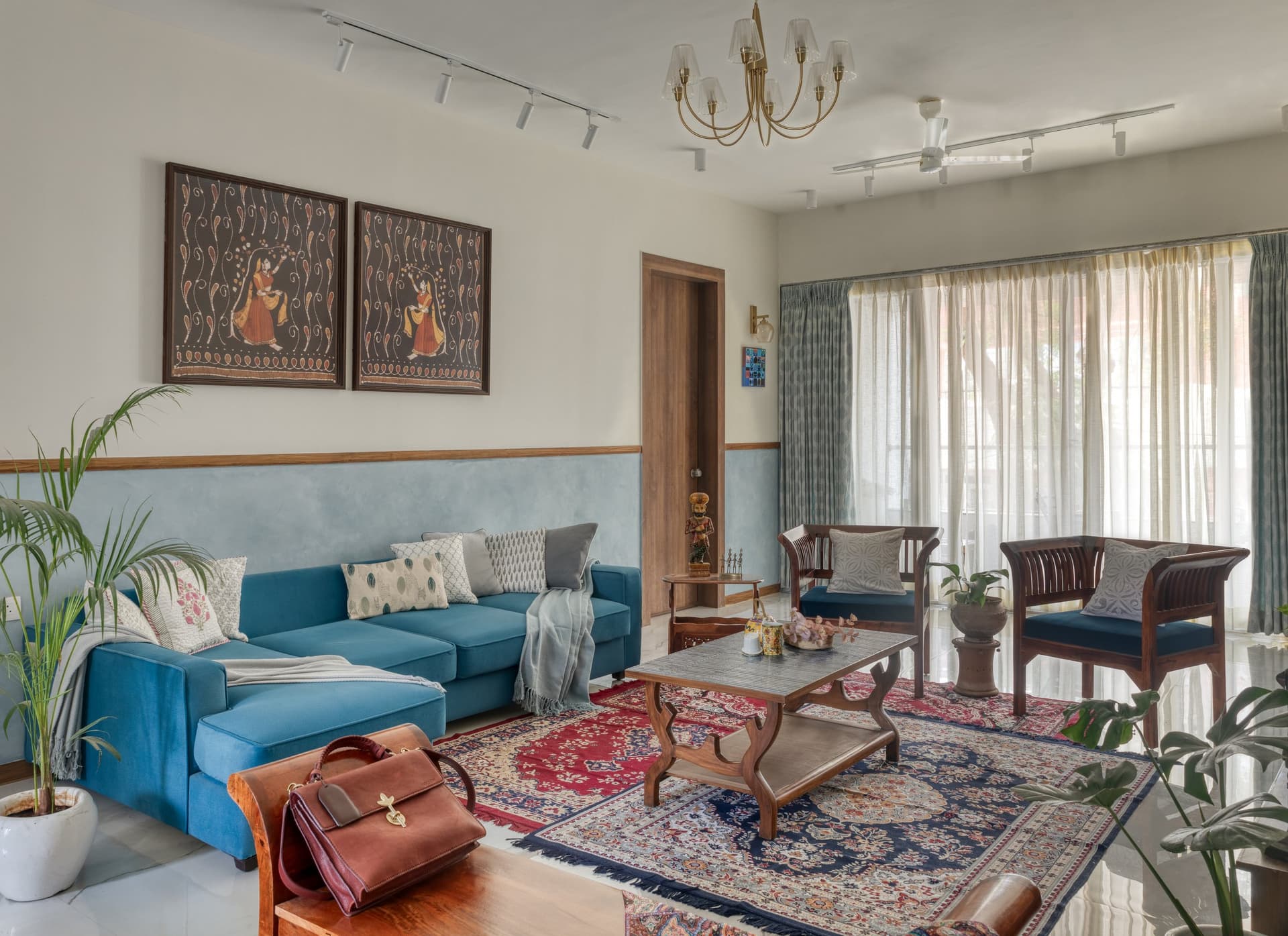
The living room opens generously around a teal sectional sofa and a rich Persian-pattern rug that anchors the entire composition. What makes the room work is the dialogue between the inherited and the designed: timber-framed armchairs with blue cushions and a timber coffee table with a stone top sit alongside the contemporary sofa without friction, because the blue plaster wainscoting and the pair of traditional paintings above unify everything under a single chromatic argument.
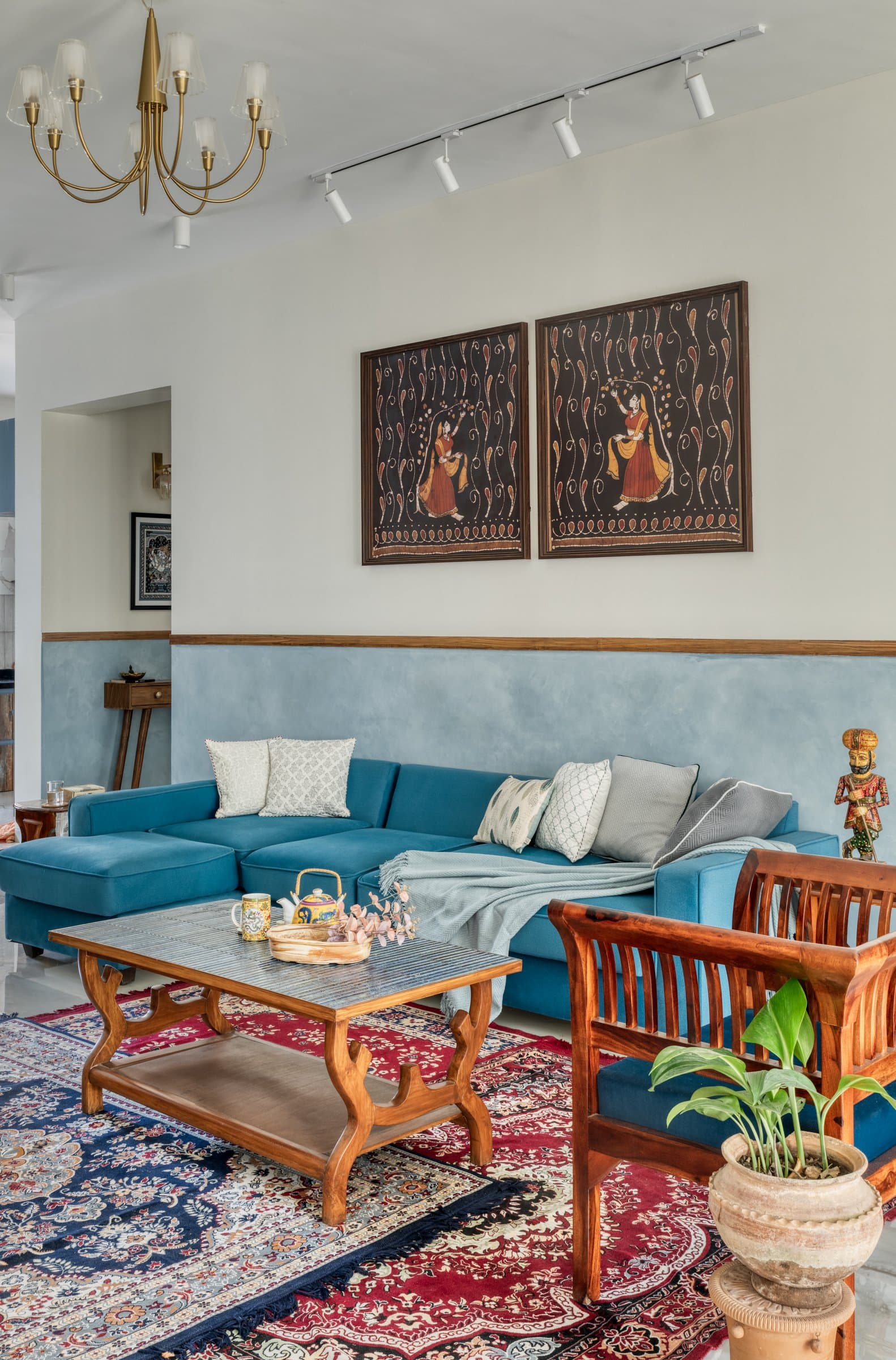
Track lighting and a brass chandelier share the ceiling without redundancy, the former for directed illumination, the latter for warmth. The paintings, depicting classical figures amid curving botanical forms, echo the room’s own logic of organic detail within structured space.
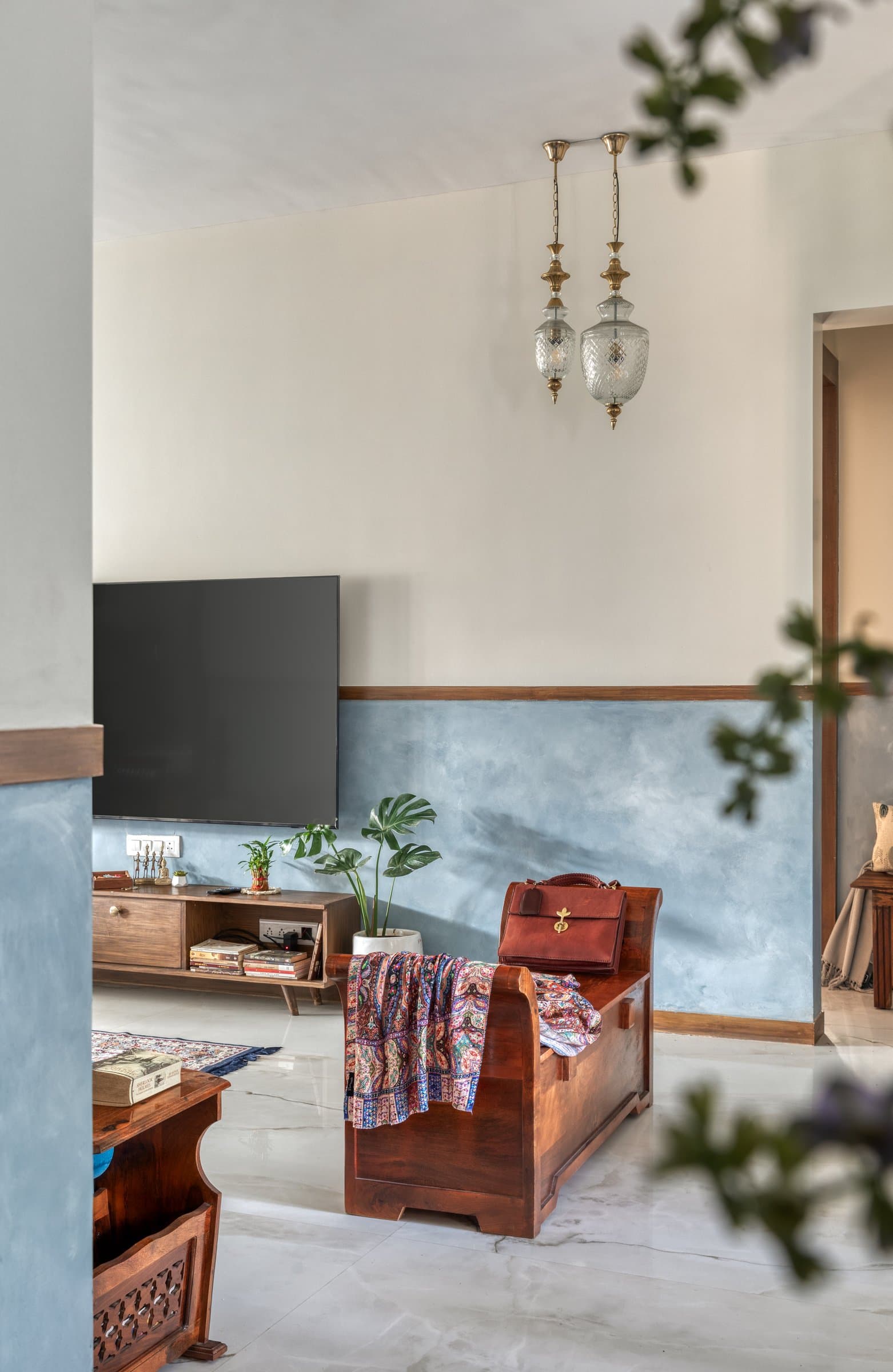
The opposite wall introduces a solid timber storage bench and a low media unit, both in the same dark sheesham as the coffee table. The cut-glass pendant lanterns reappear here, creating a gentle symmetry with the foyer beyond. Rather than treating the living room as one unified volume, Bidkar has layered it into distinct zones of rest and display, each oriented by furniture the family already cherished.
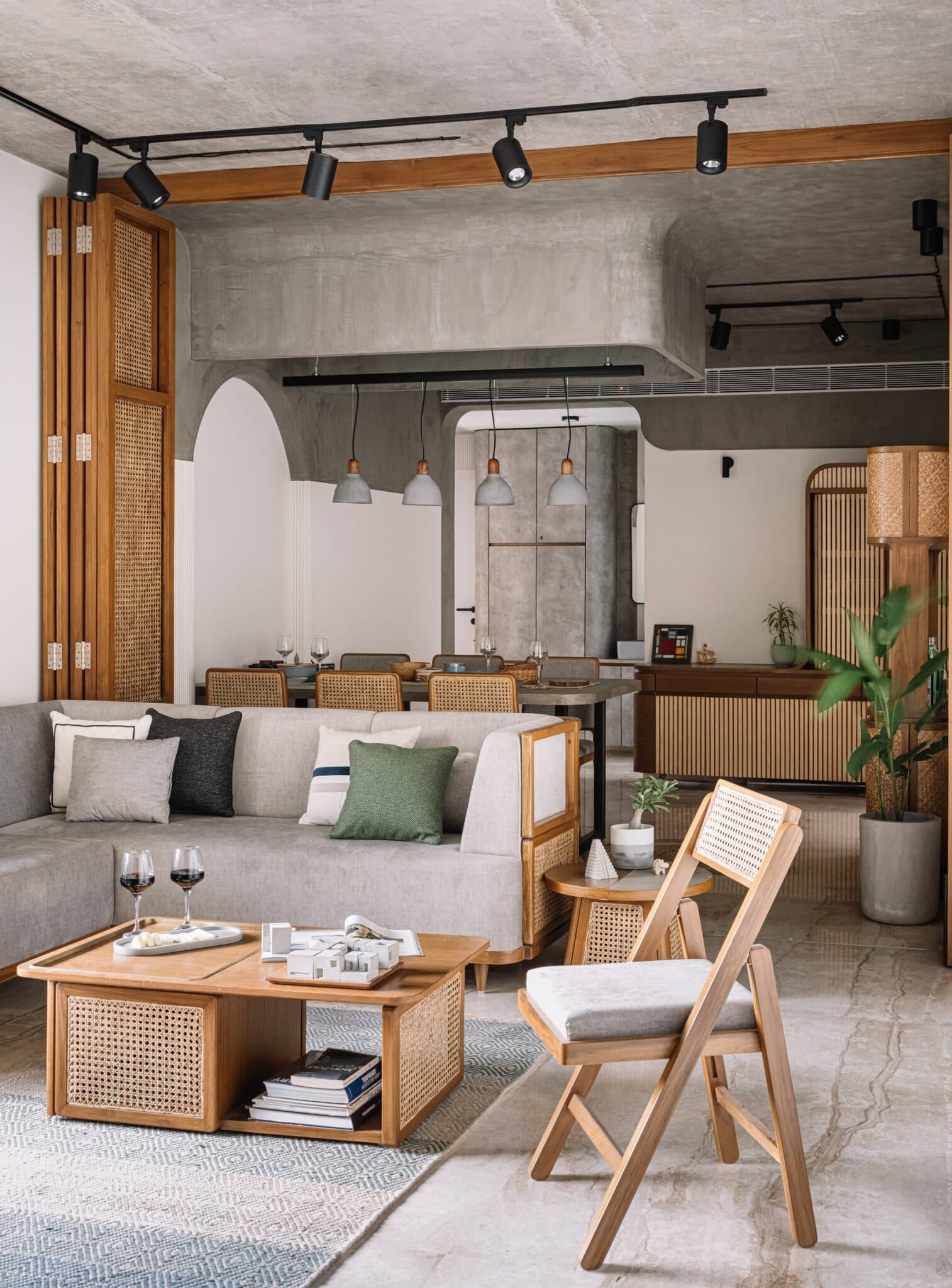
A wider view reveals how the living, dining, and pooja zones flow into one another within the apartment’s compact footprint. A carved wooden temple frame houses the pooja area beside the dining zone, given prominence without consuming floor space. The bookshelf near the wooden settle, filled and well-used, reads as another quiet declaration that this is a home of readers and collectors, not curators of emptiness.
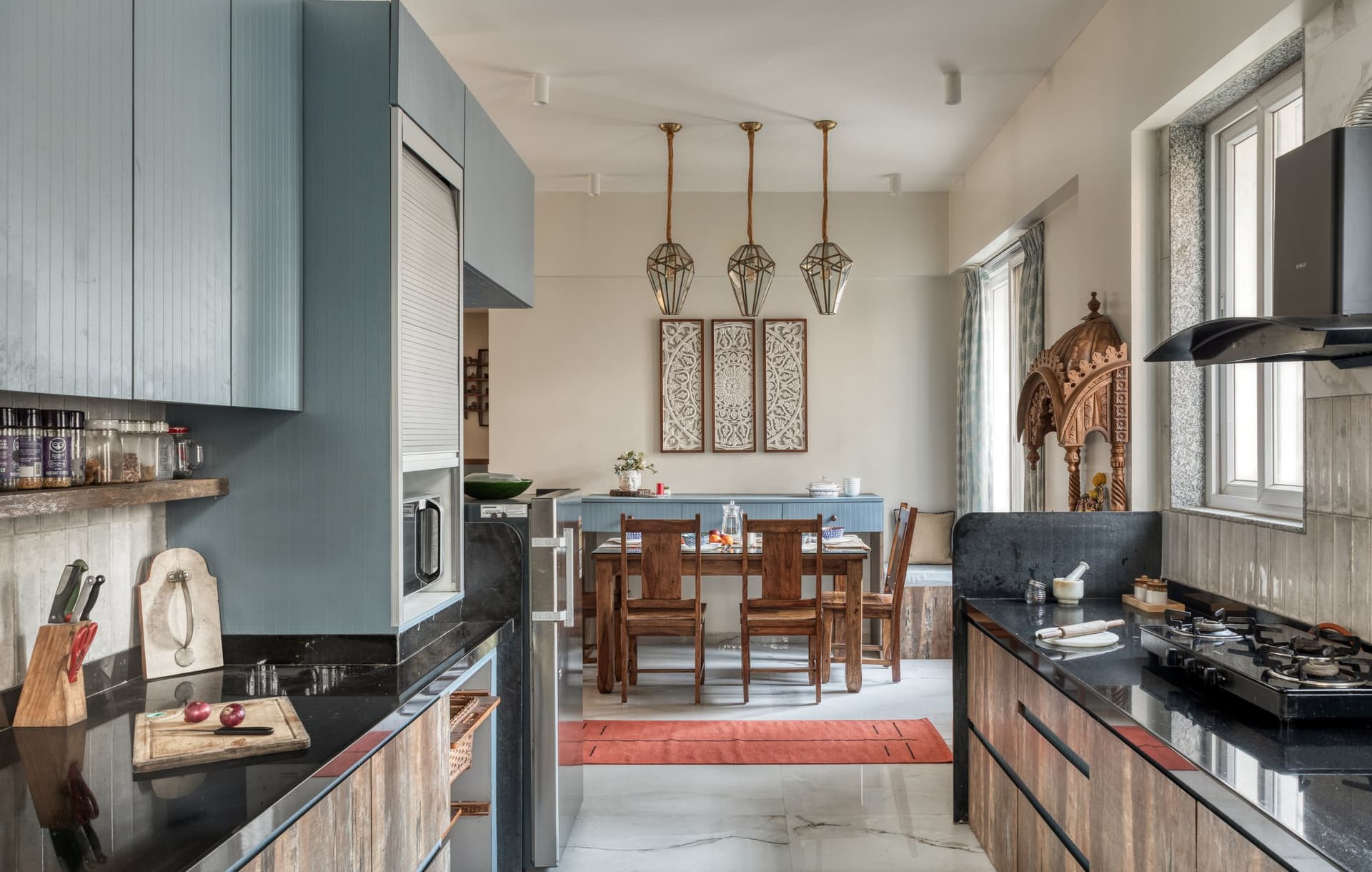
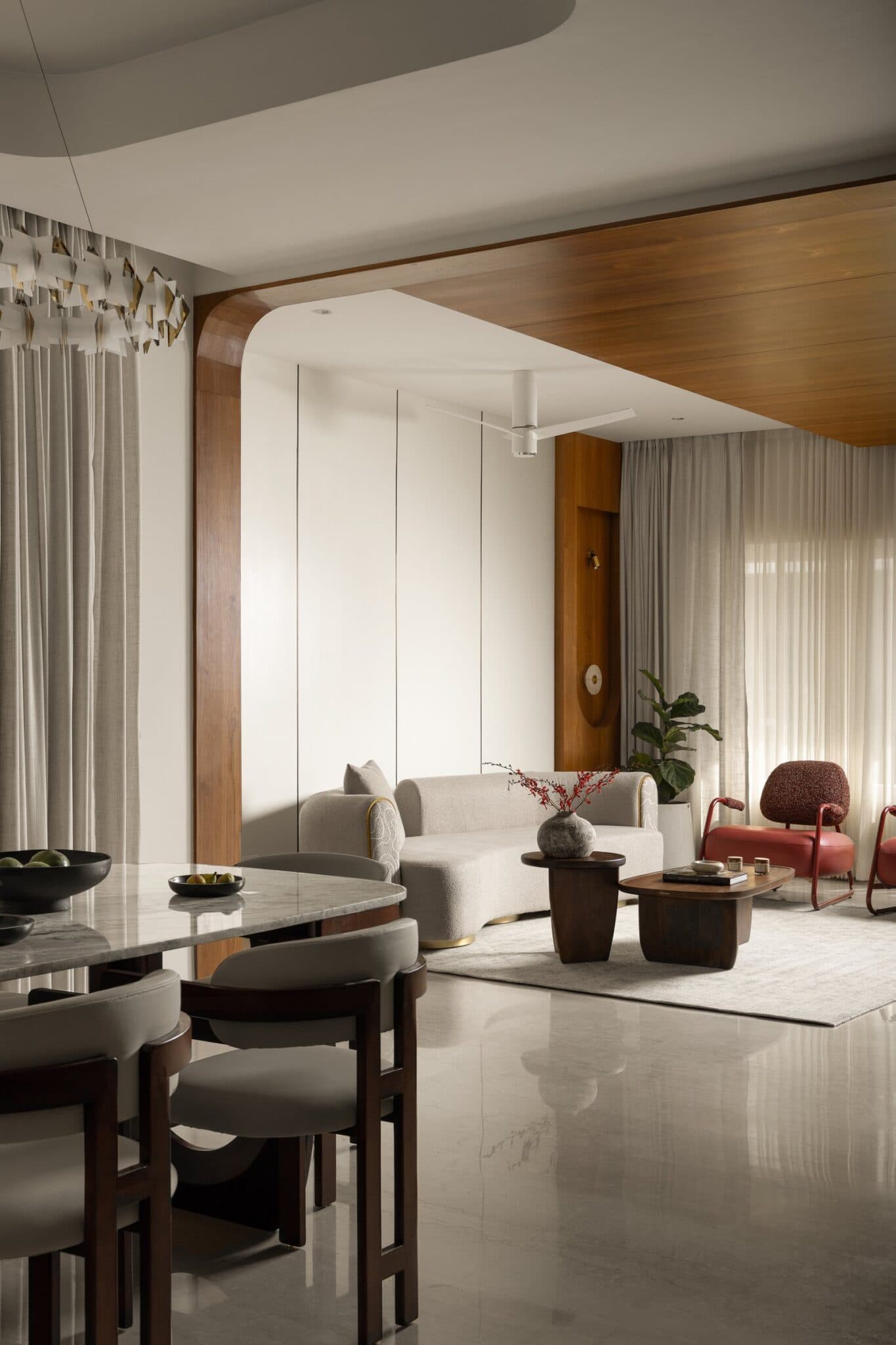
The kitchen and dining area share an open volume, and the design language shifts here without breaking continuity. Soft blue cabinetry in the kitchen picks up the plaster tone from the living areas, while the lower cabinets in a darker, timber-adjacent laminate introduce visual weight at the base. Four geometric brass pendant lights hang above the dining table, drawing the eye through the galley kitchen and into the dining zone as a single composed sightline.
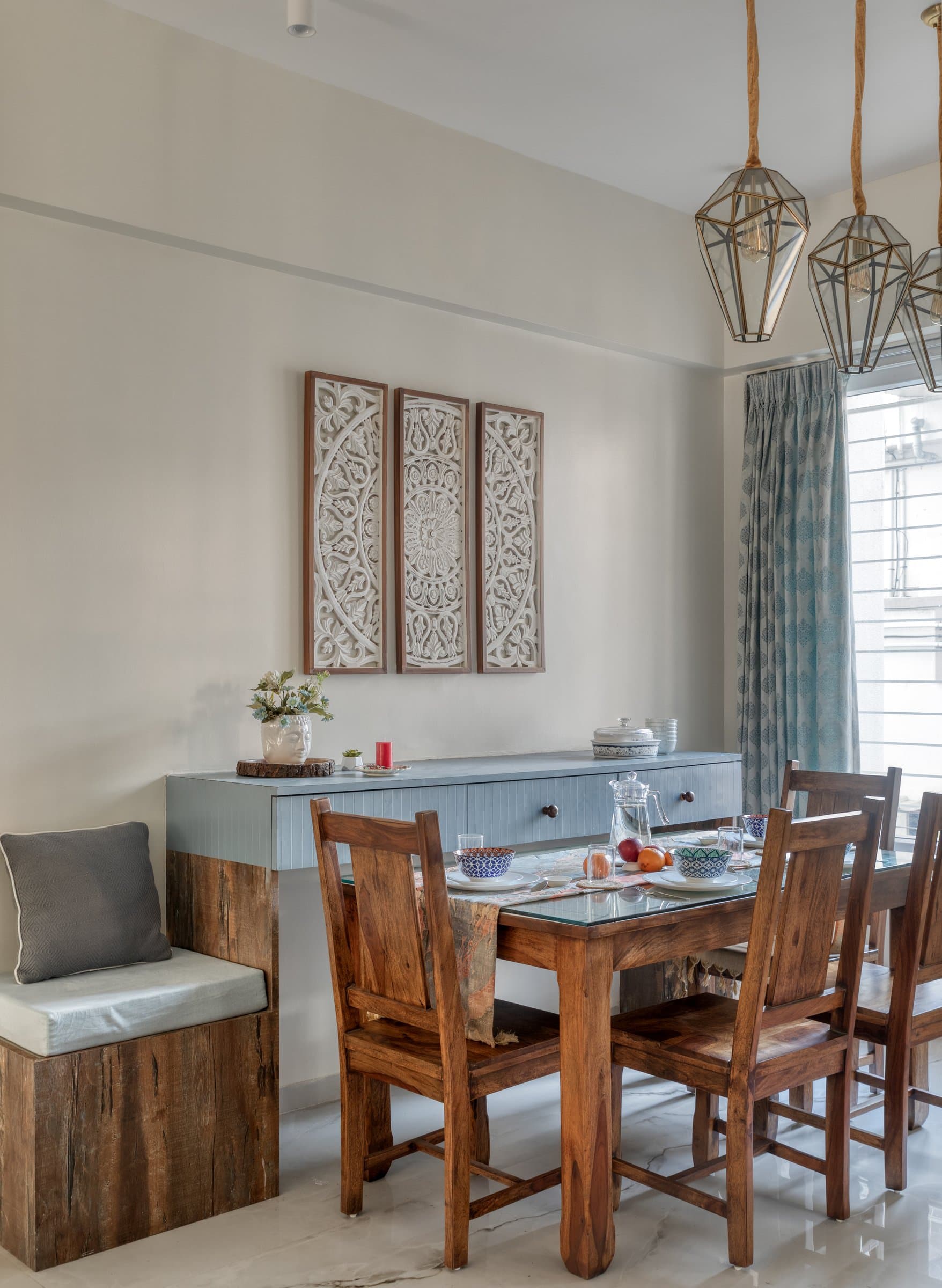
At the dining table itself, the material argument resolves into warmth. Solid sheesham chairs surround a glass-topped timber table, and a bench seat with a rustic timber base provides a fourth side. Three carved triptych panels on the wall behind the sideboard carry the craft vocabulary from the living room forward, reinforcing the sense that every zone of this home participates in the same conversation about handmade detail and inherited beauty.
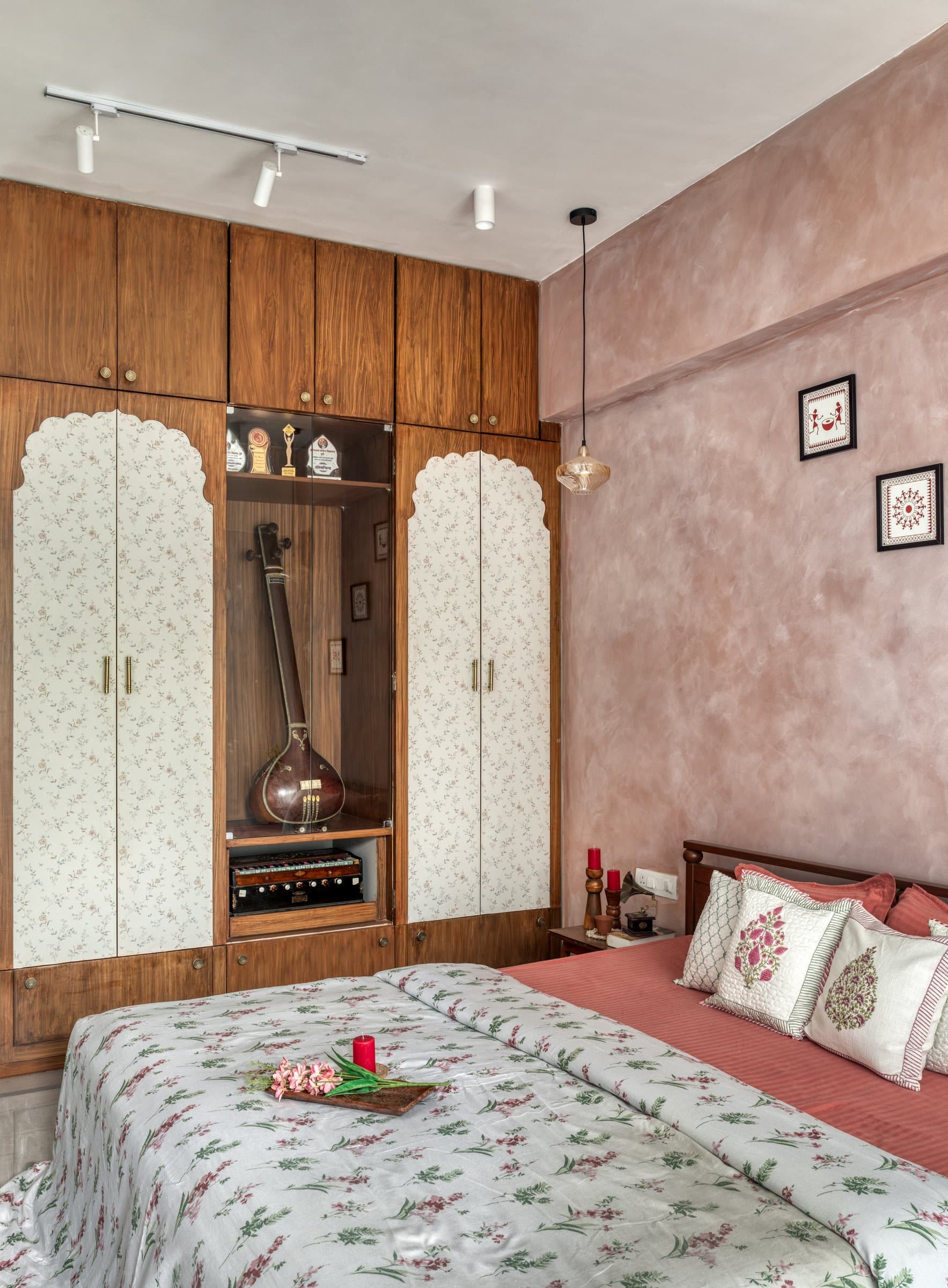
The master bedroom shifts the palette decisively, trading blue for a dusky rose limewash that wraps the headboard wall and returns along the ceiling soffit. The wardrobe is the room’s centrepiece: full-height timber joinery with scalloped-arch panel inserts in a delicate floral print, and at its centre, a glass vitrine housing a sitar and a harmonium. It is a storage unit that doubles as a portrait of its owner’s passions, and it elevates the room from resting space to something more personal.
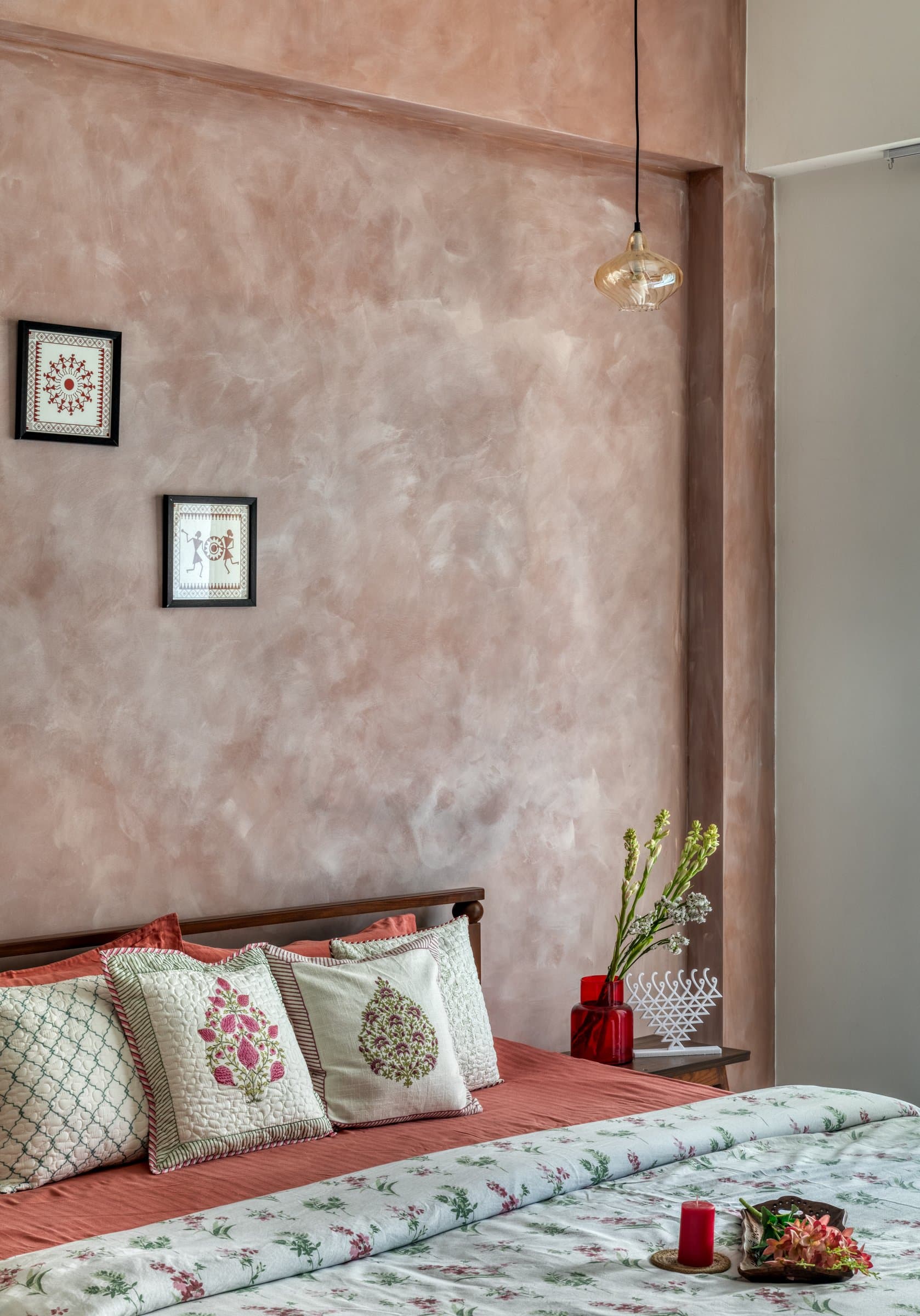
The rose-toned plaster reads differently at closer range, its surface mottled and alive with tonal variation in a way that flat paint could never achieve. Small framed Warli-style prints sit quietly on this surface, their geometric clarity a counterpoint to the plaster’s organic movement. The bedroom settles into a pace that encourages stillness.
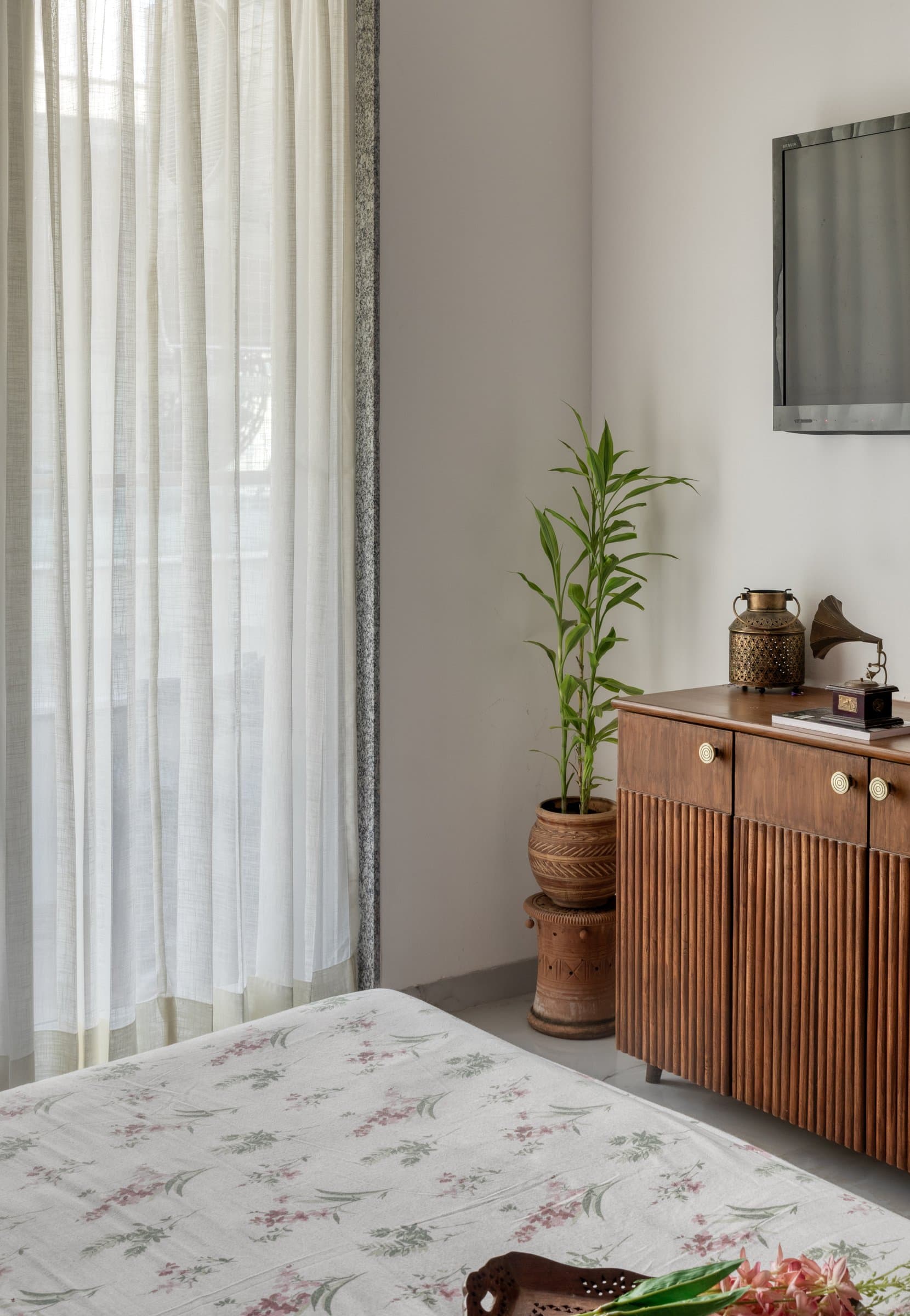
Across from the bed, a fluted timber console and sheer curtains complete the room. The restraint on this wall is deliberate: after the intensity of the wardrobe and plaster, the bedroom needed a visual exhale, and the filtered natural light through the sheers provides it.
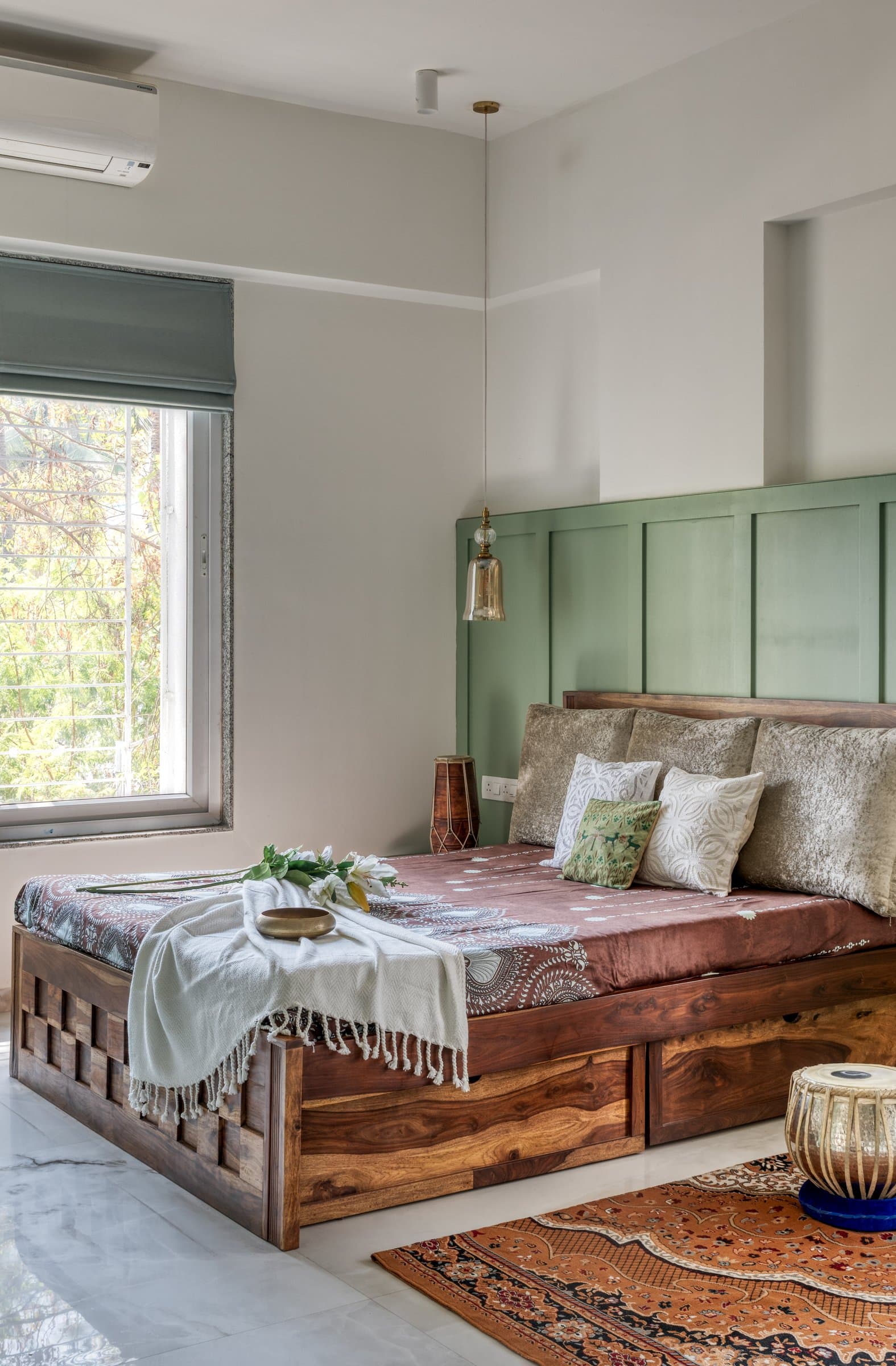
The second bedroom announces itself through colour with equal conviction, this time in sage green. A panelled headboard wall in muted green frames a solid sheesham bed with geometric lattice detailing on its footboard.
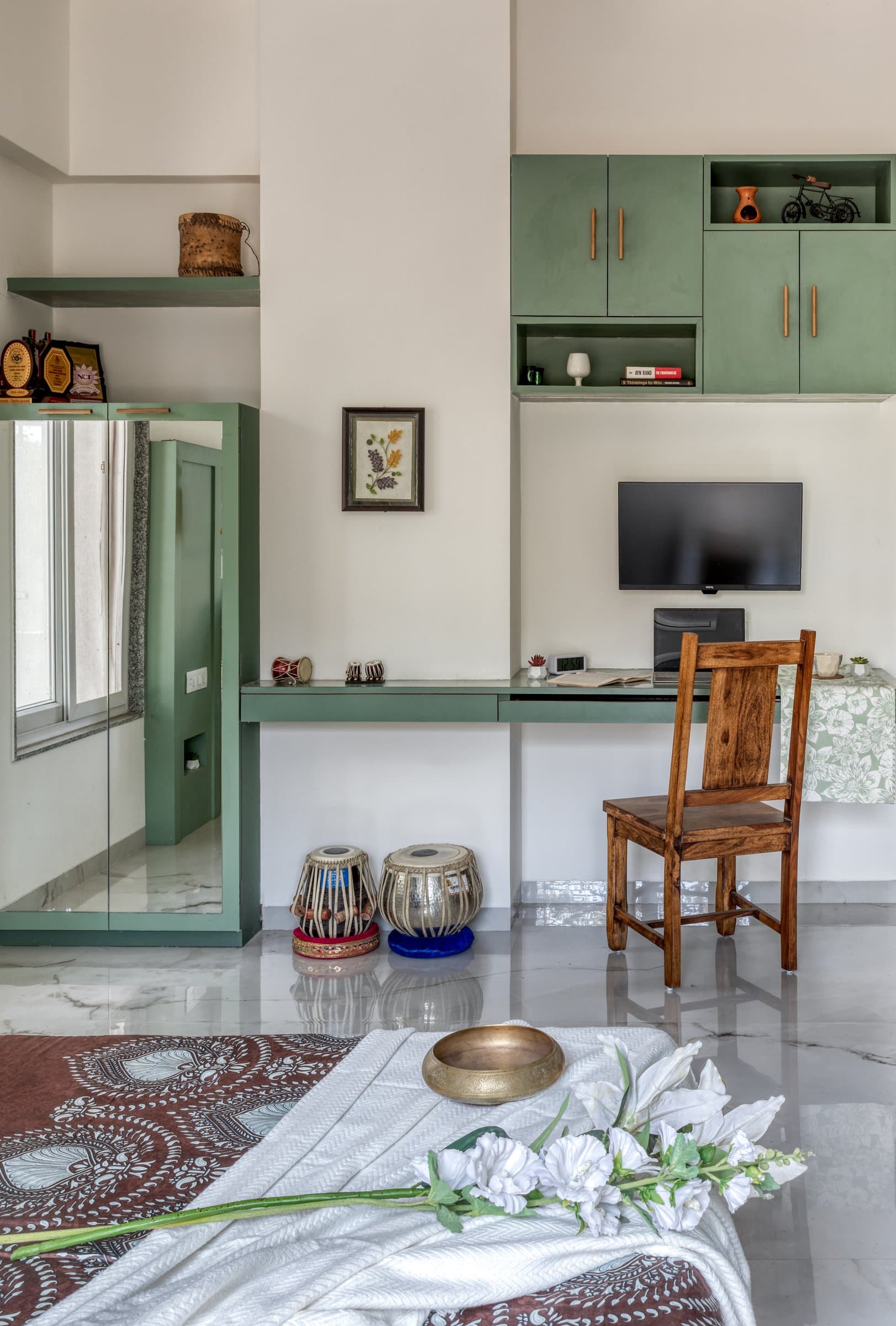
The study corner within this bedroom continues the green palette across a floating desk, overhead storage, and a mirrored wardrobe surround. It is a compact arrangement that manages to feel purposeful rather than cramped, partly because the colour consistency prevents the eye from fragmenting the room into separate functional pieces.
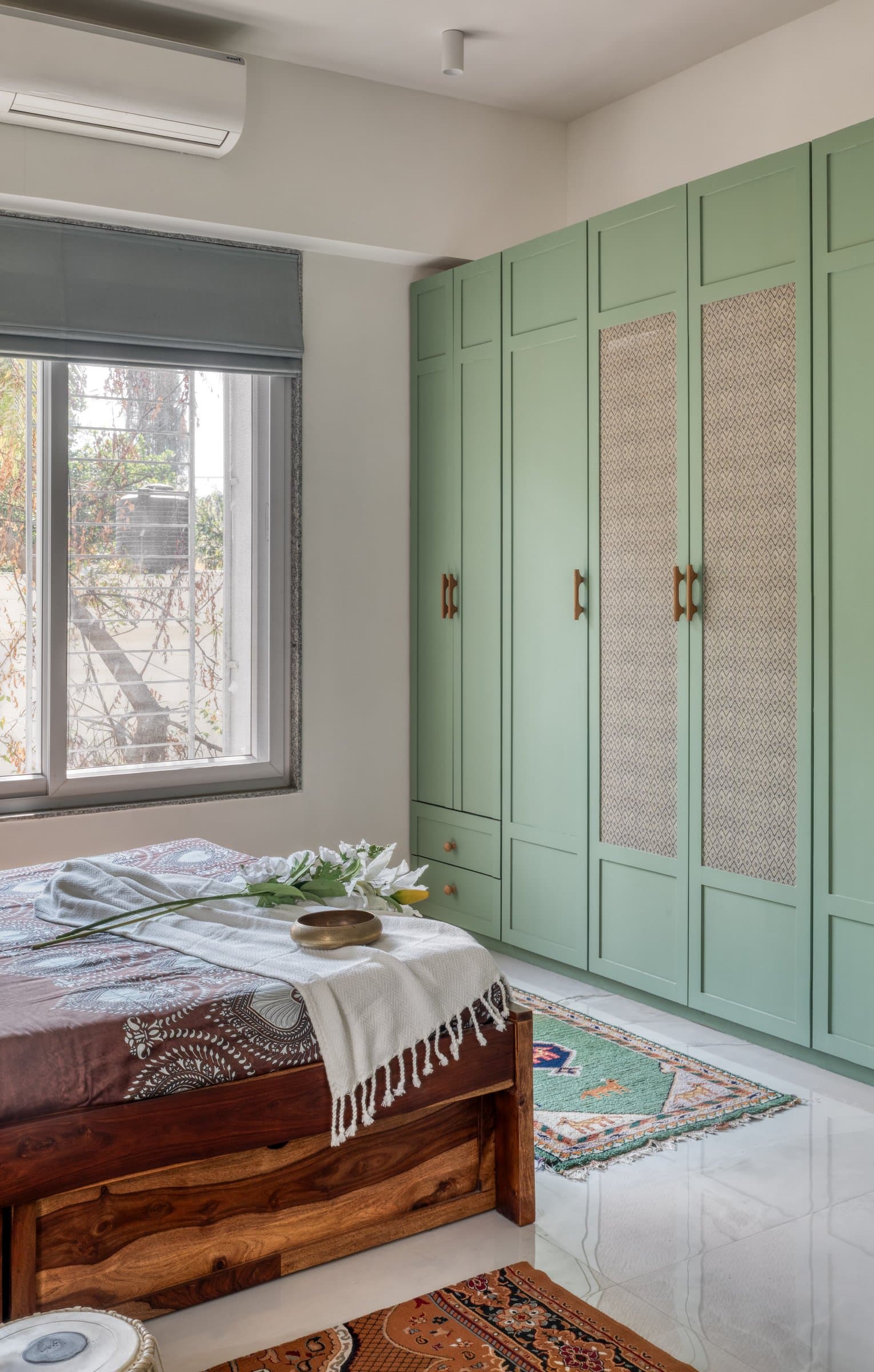
The wardrobe wall offers a closer look at Bidkar’s approach to joinery throughout Unnati. Sage green panelled doors with woven-texture inserts and brass handles demonstrate a commitment to giving even storage elements a craft dimension. The wardrobe is a room-defining presence, not a background utility.
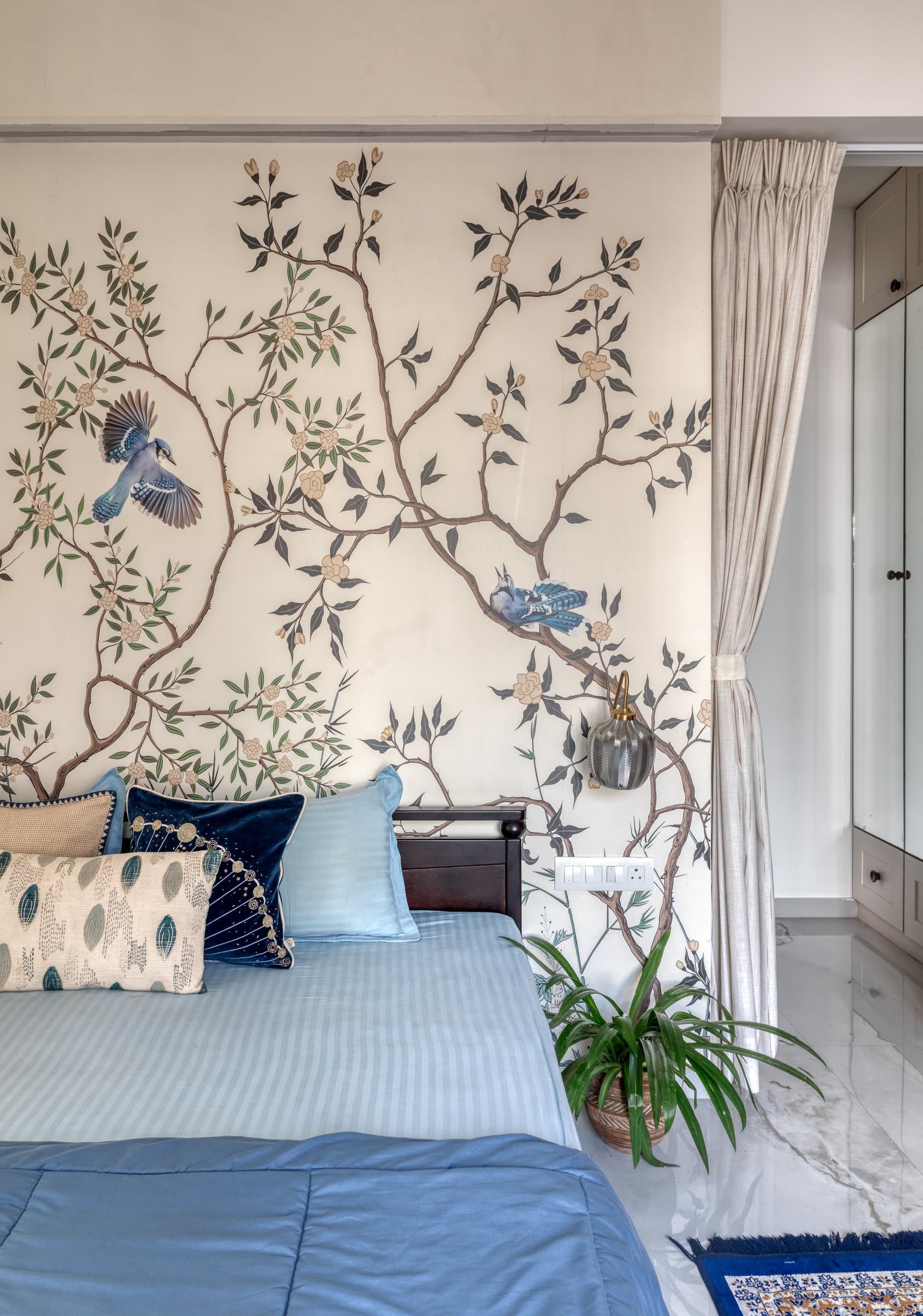
A third sleeping space takes a quieter, more illustrative approach. A full-wall botanical mural of flowering branches and birds in flight replaces plaster or paint as the defining surface, creating a room that feels lighter and more narrative in character. The blue bedding and cushions connect it chromatically to the living spaces, ensuring that even this more whimsical room belongs to the same home.
The final bedroom opts for the calmest register of all: cream panelled wardrobes, a built-in window seat, a natural linen Roman blind on the window, and sheer white curtains by the balcony door. After the rose, the sage, and the botanical mural, this room’s restraint feels earned, a deliberate decision to let daylight and proportion carry the atmosphere with only a traditional blue-and-rust patterned rug and soft blue textiles as accents.
In a city where new apartments often arrive as blank slates demanding a complete lifestyle purchase, Unnati proposes something less fashionable and more honest. It asks whether good design can begin not with a mood board but with a sitar, a bookshelf, and a set of chairs that have already travelled with a family through years of use.
The answer, as Bidkar and Studio BiDi demonstrate here, is that it can, provided the designer is willing to listen to the objects as carefully as they listen to the client. The limewash walls, the considered colour shifts from room to room, the joinery that accommodates instruments and art rather than concealing them: these are not decorative flourishes but acts of spatial generosity, and they give Unnati a character that no amount of sourcing from a catalogue could replicate.