There is a particular discipline required to design a home that feels warm without ever reaching for ornamentation. It demands that every surface, every proportion, every junction between wall and ceiling carry enough conviction to hold the room together on its own terms. In Bangalore’s expanding residential fabric, where villas increasingly default to either maximal eclecticism or a sparse, gallery-like minimalism, Villa One stakes out a quieter, more exacting position: a house where material consistency and spatial proportion do all the work that decoration typically claims.
Designed by Ara Urban Studio under the direction of principal architect Ar. Ayesha Sadaf, this 3,600-square-foot, four-bedroom villa was conceived for a family of three who wanted a contemporary home entirely free of stylistic references. The brief called for calm, clarity, and a sense of continuity from room to room, a house structured through material relationships rather than applied style.
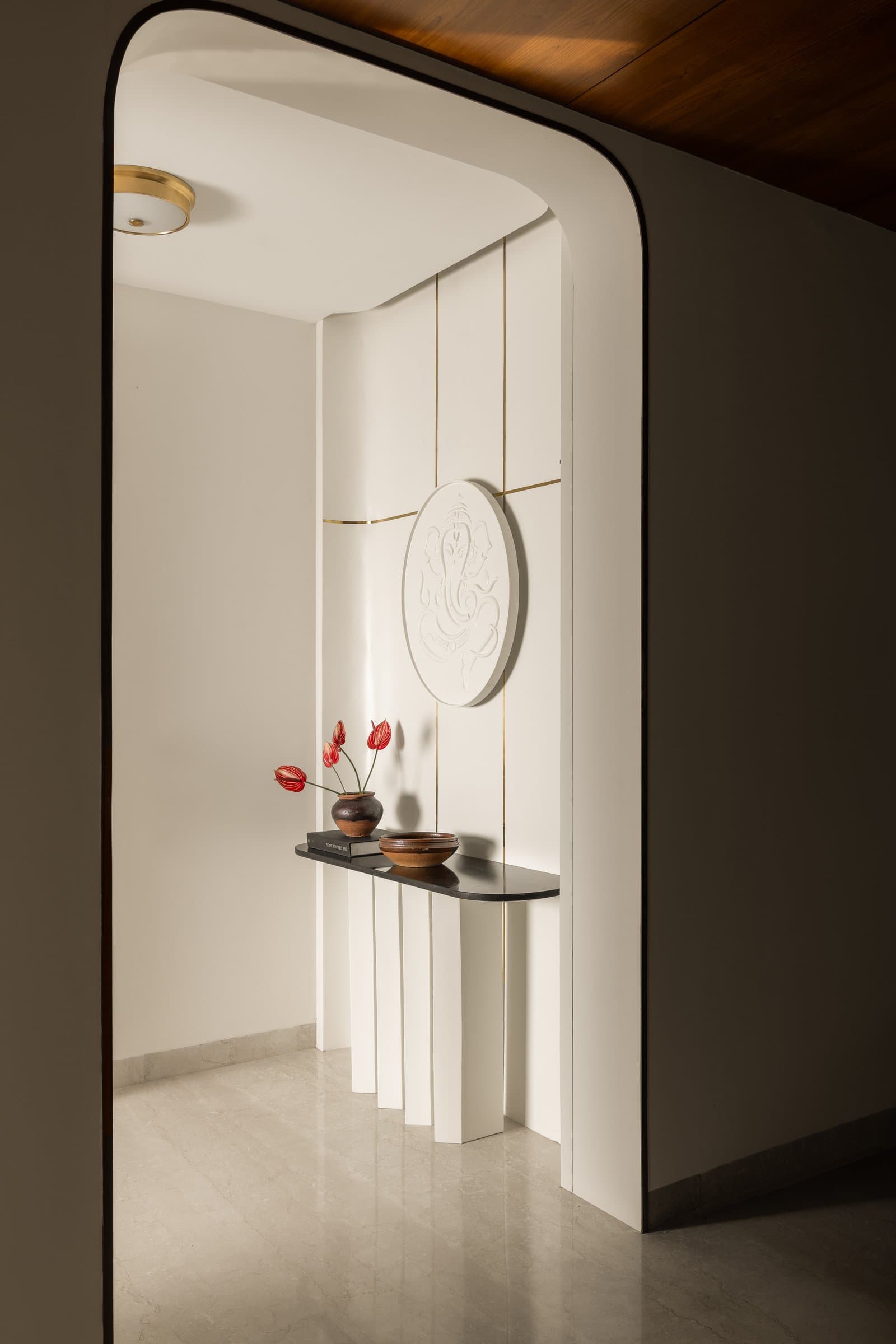
The entry sets the villa’s terms with precision. A softly arched threshold, its edge lined in a dark profile, frames a white-panelled niche with fine brass grooves and a carved relief medallion. The composition is deliberately restrained, signalling that this is a home where every gesture has been considered and earned.
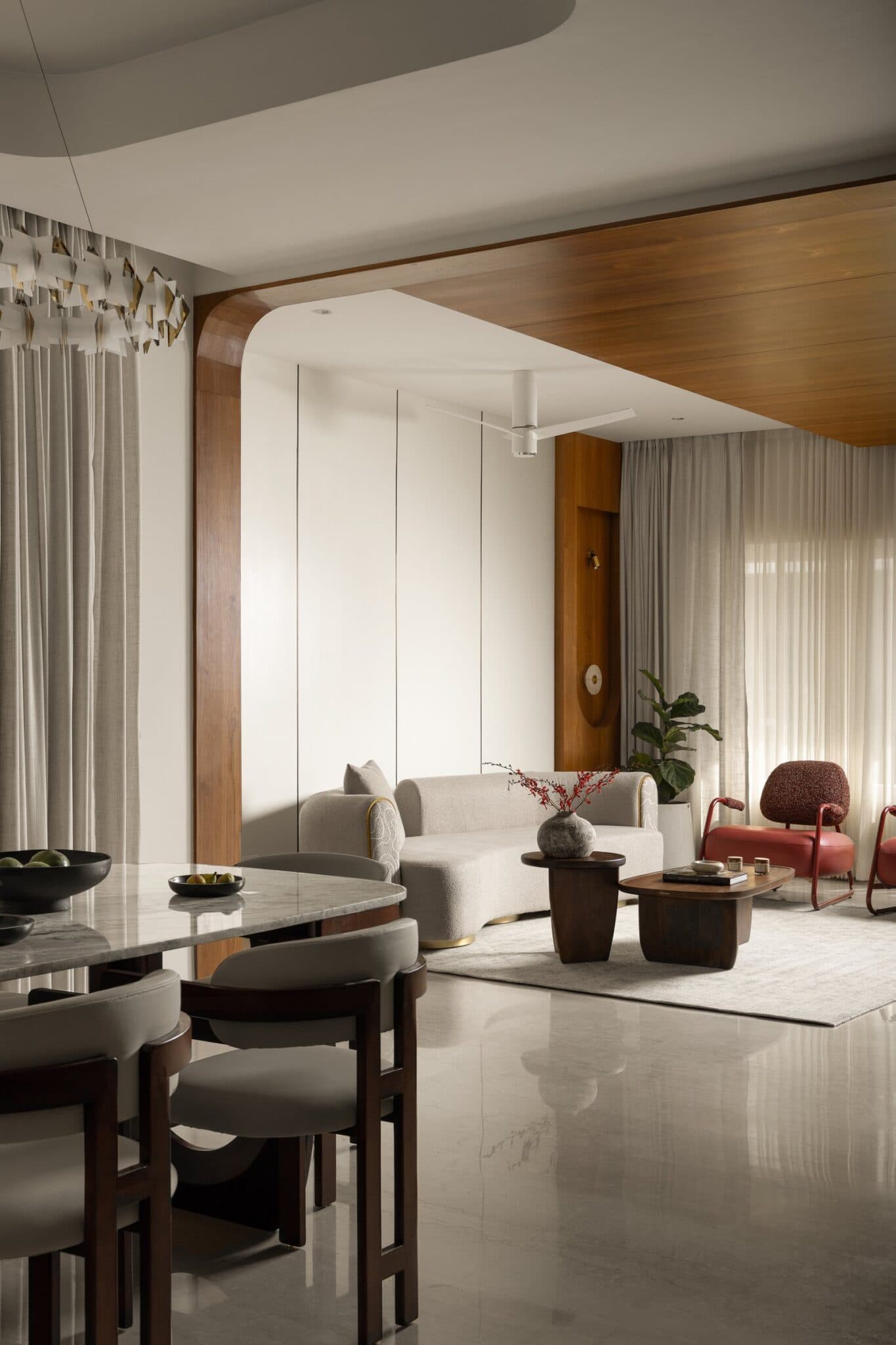
The formal living and dining zone opens as a single, generous volume where a warm timber ceiling plane defines the living area and a white plaster ceiling distinguishes the dining alcove. The shift between the two surfaces is subtle but effective, creating a sense of two rooms within one open floor plate without the need for a partition wall.
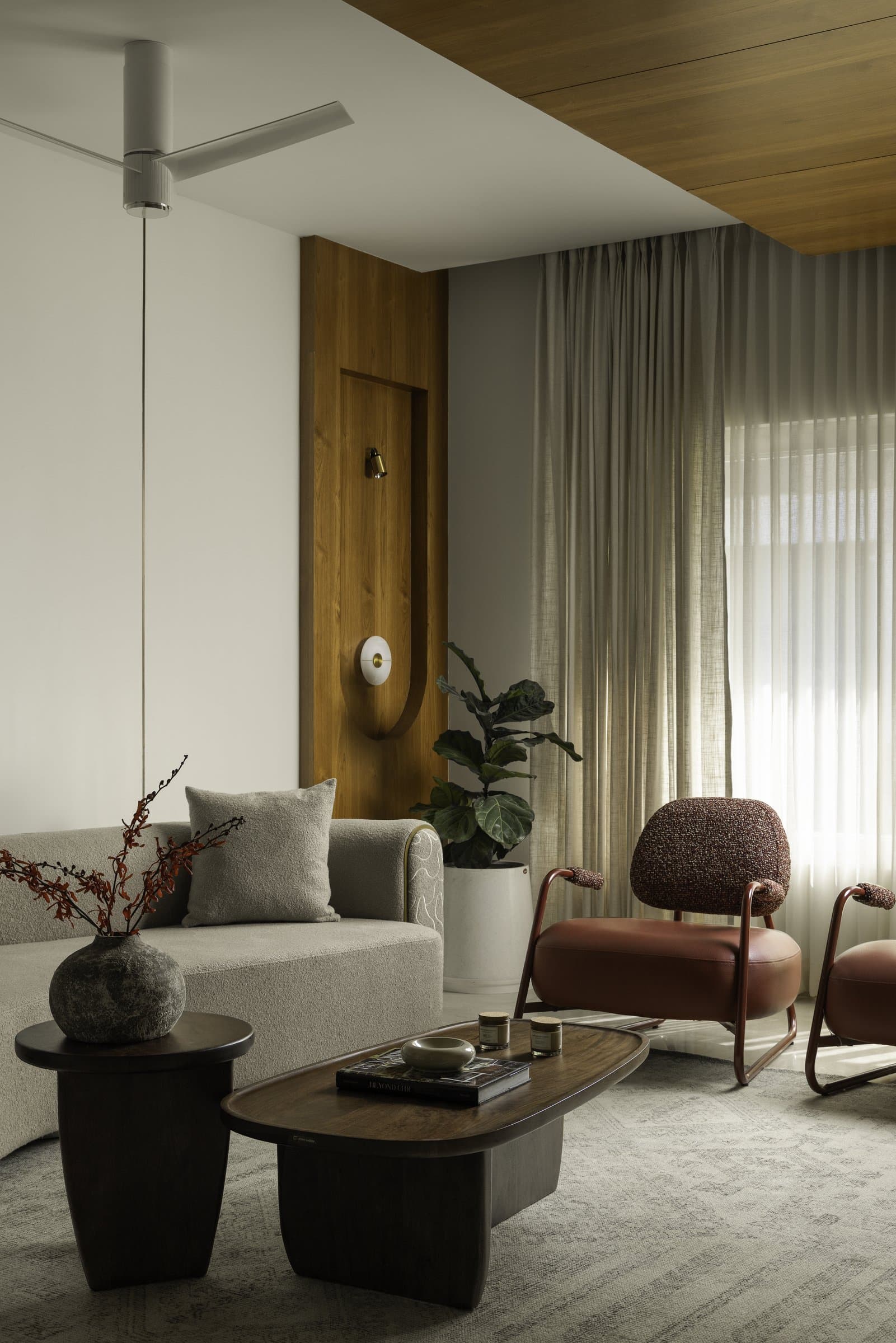
Within the living area, the seating arrangement favours quiet tonal contrast over colour. A pair of rust-toned accent chairs, their curved metal frames with leather-clad seats and textured bouclé backs catching light from the sheer curtains, sit opposite a neutral sofa, and the conversation between the two palettes gives the room its energy. A timber-clad panel behind the sofa, with a circular wall-mounted sconce set within a routed rounded channel, acts as the room’s subtle architectural anchor.
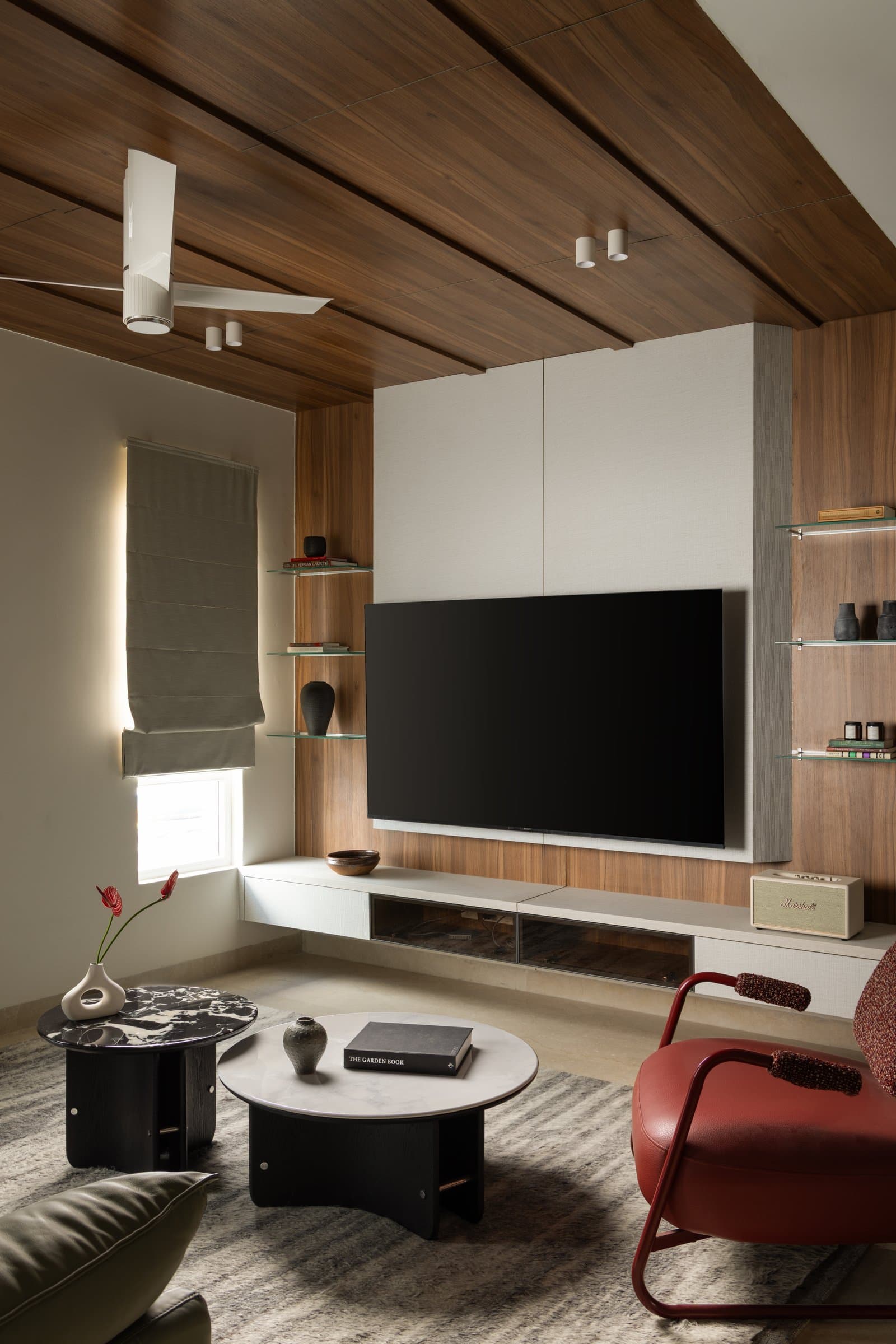
The informal living room, by contrast, leans further into the warmth of wood, with a panelled ceiling that wraps down and across the entertainment wall. The effect is immersive without being heavy; white-textured panels flanking the screen and a pair of glass display shelves prevent the timber from dominating, maintaining the discipline of contrast that runs through the entire villa.
““The design approach prioritizes clarity of planning, controlled proportions, and material discipline, allowing the architecture to emerge through deliberate decisions rather than decorative gestures.””
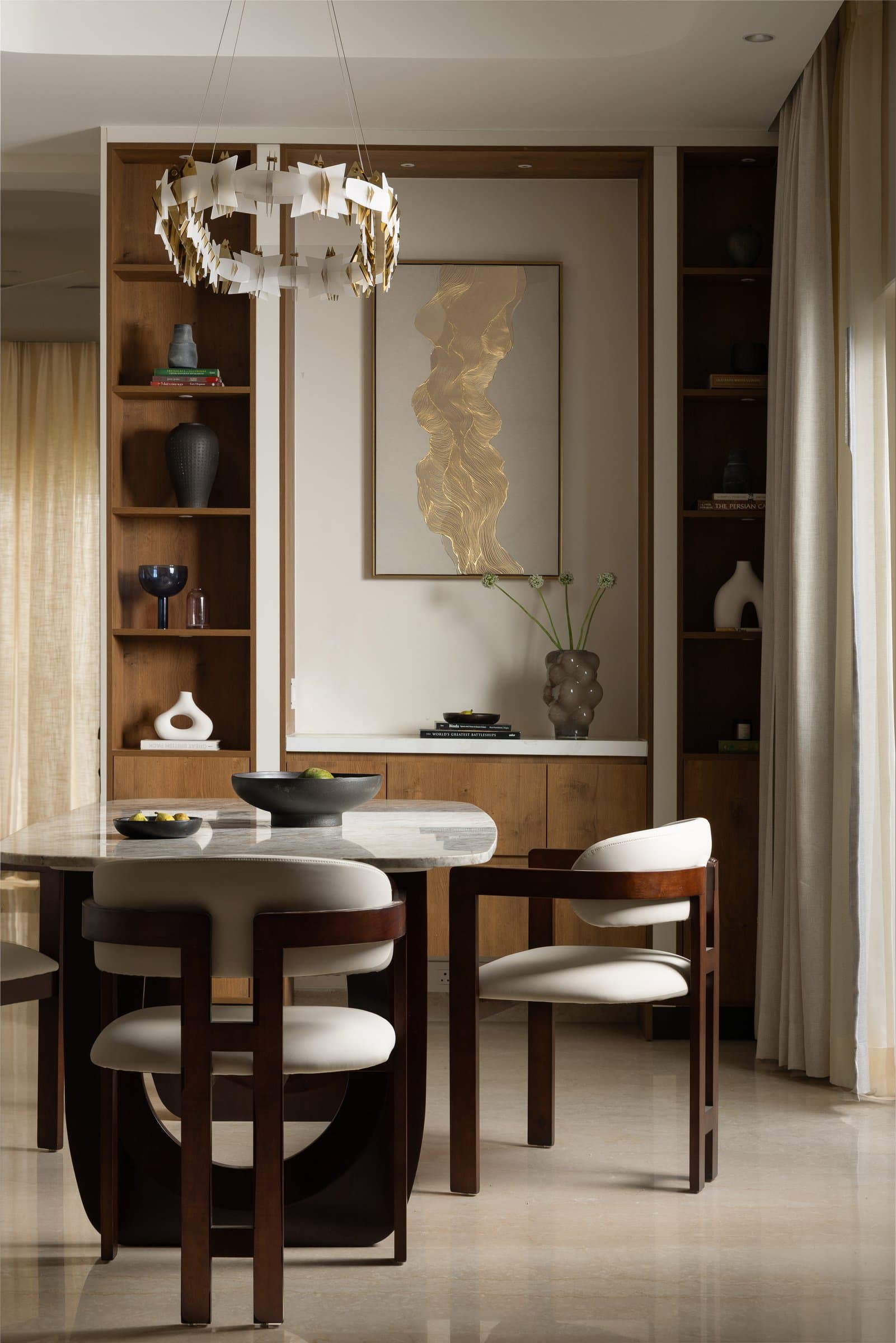
The dining area occupies the zone adjacent to the living room, its identity established by a sculptural white-and-gold pendant chandelier that hovers above a stone-topped table. The wall behind is framed by timber cabinetry with open shelving flanking a recessed niche, and a large abstract artwork in gold tones provides the room’s single moment of visual luxury.
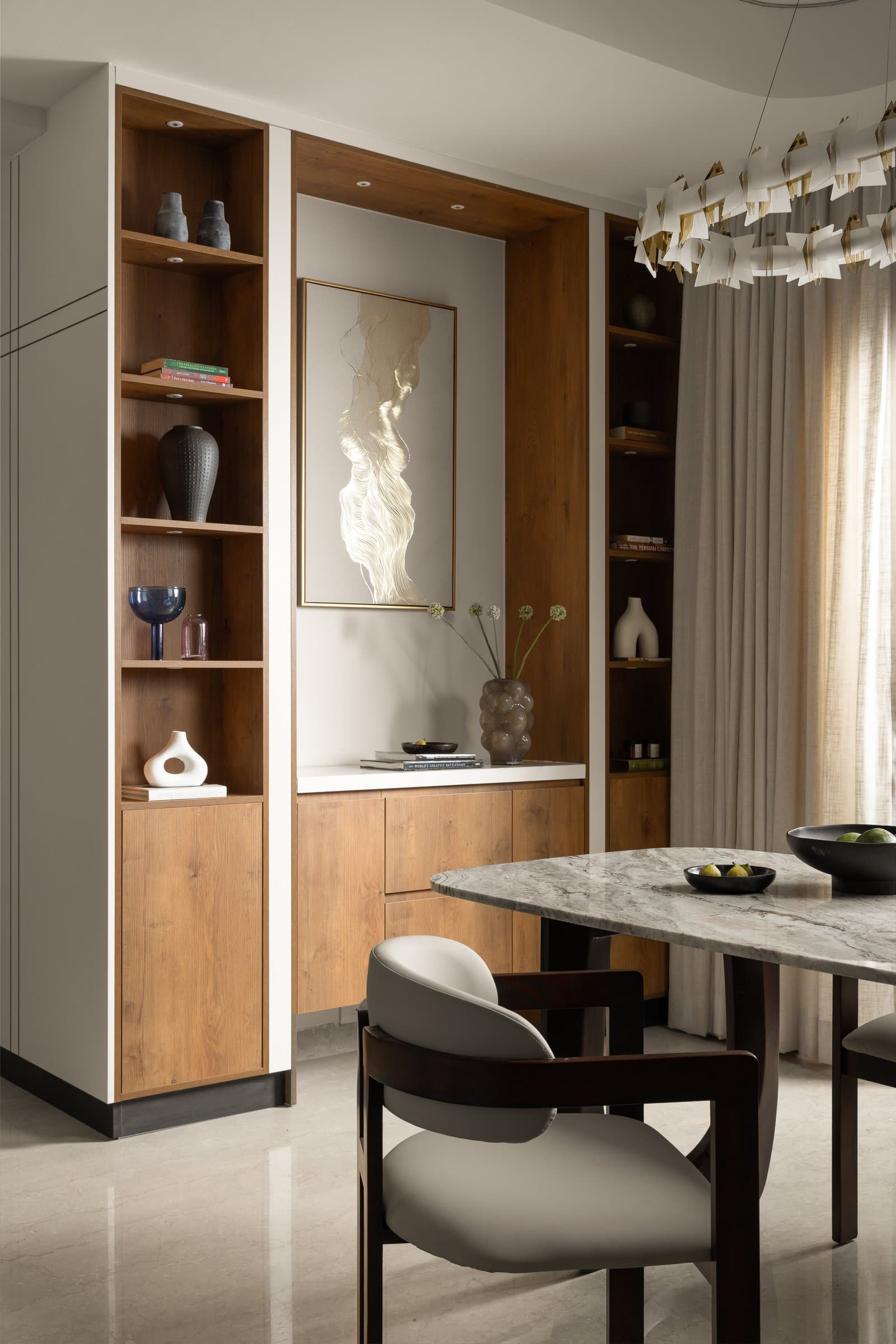
From a different angle, the relationship between the dining wall unit and the rest of the open plan becomes clear. The cabinetry mediates between the dining and living zones, its timber tone forming a warm backdrop to the dining area, while the chairs, with their generous curved backs, reinforce the softened geometries that recur throughout the villa.
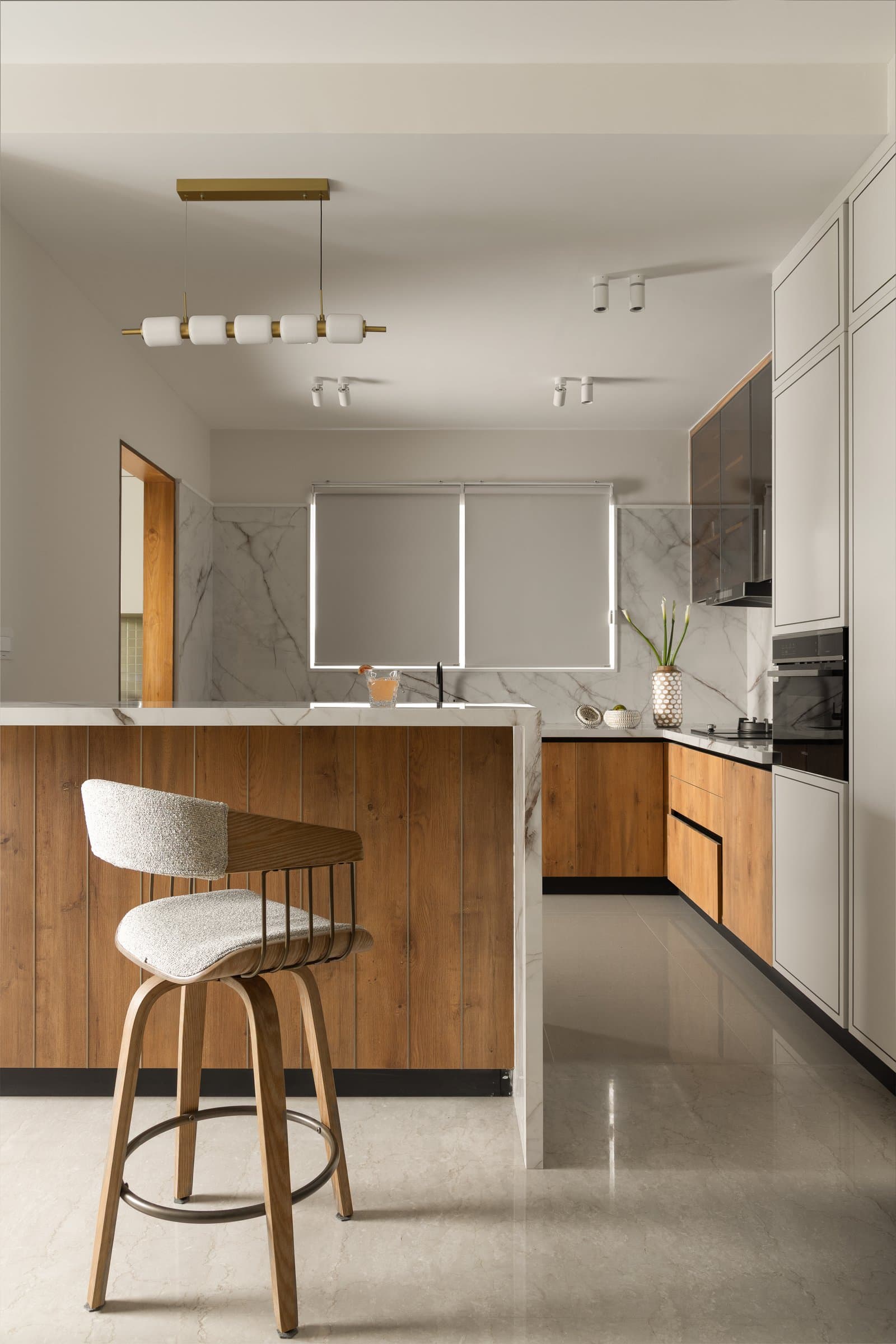
The dry kitchen reads as both workspace and visual anchor for the ground floor. A quartz-topped island with a timber-clad base draws the living zone’s material language into a functional setting, and the decision to derive cabinetry proportions directly from the selected stone gives the kitchen an internal logic that feels resolved rather than assembled.
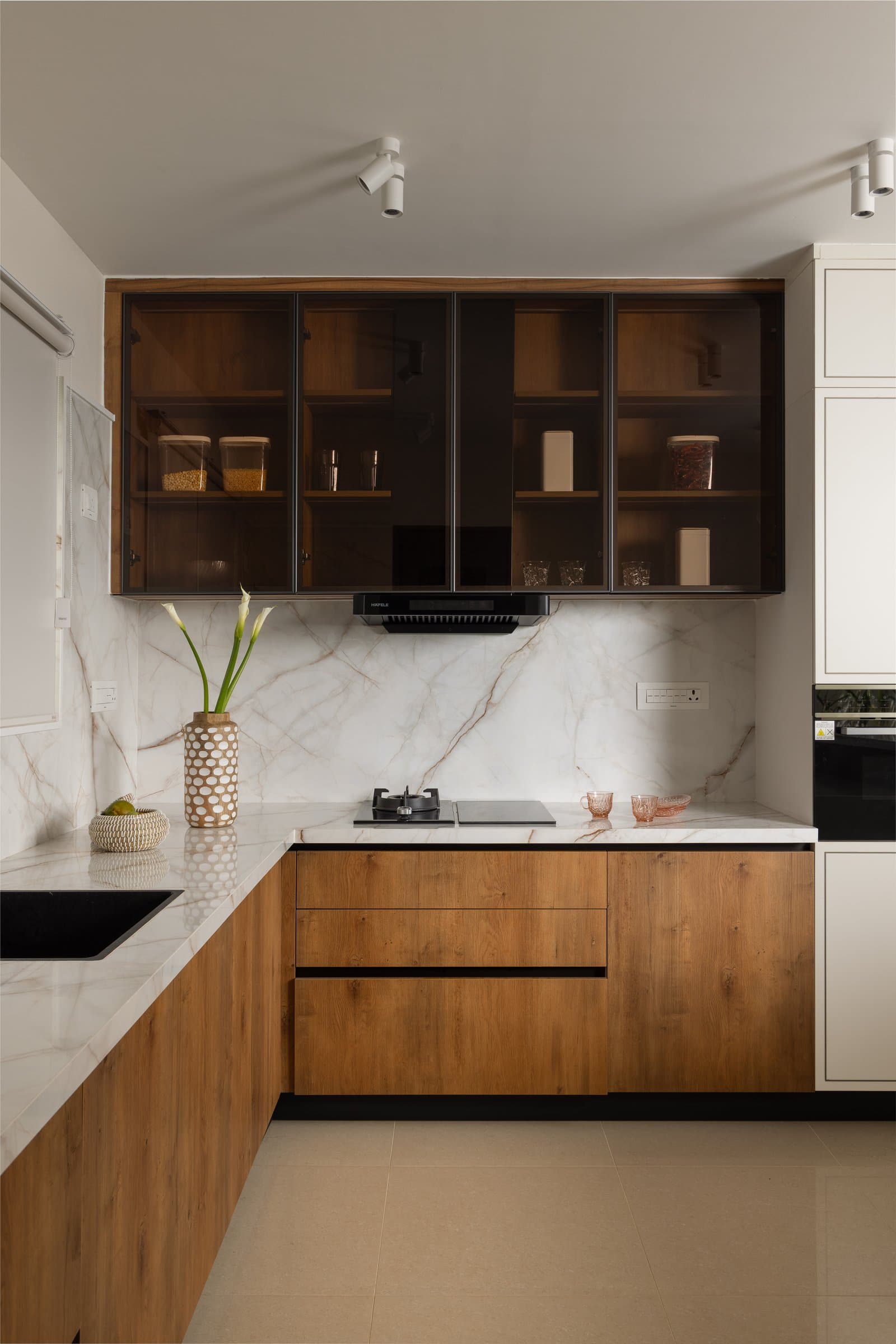
The wet kitchen beyond continues the oak-and-quartz pairing with darker overhead cabinets in smoked glass. The backsplash, a veined quartz that extends from counter to ceiling, lends the room a sense of generosity that belies its compact footprint.
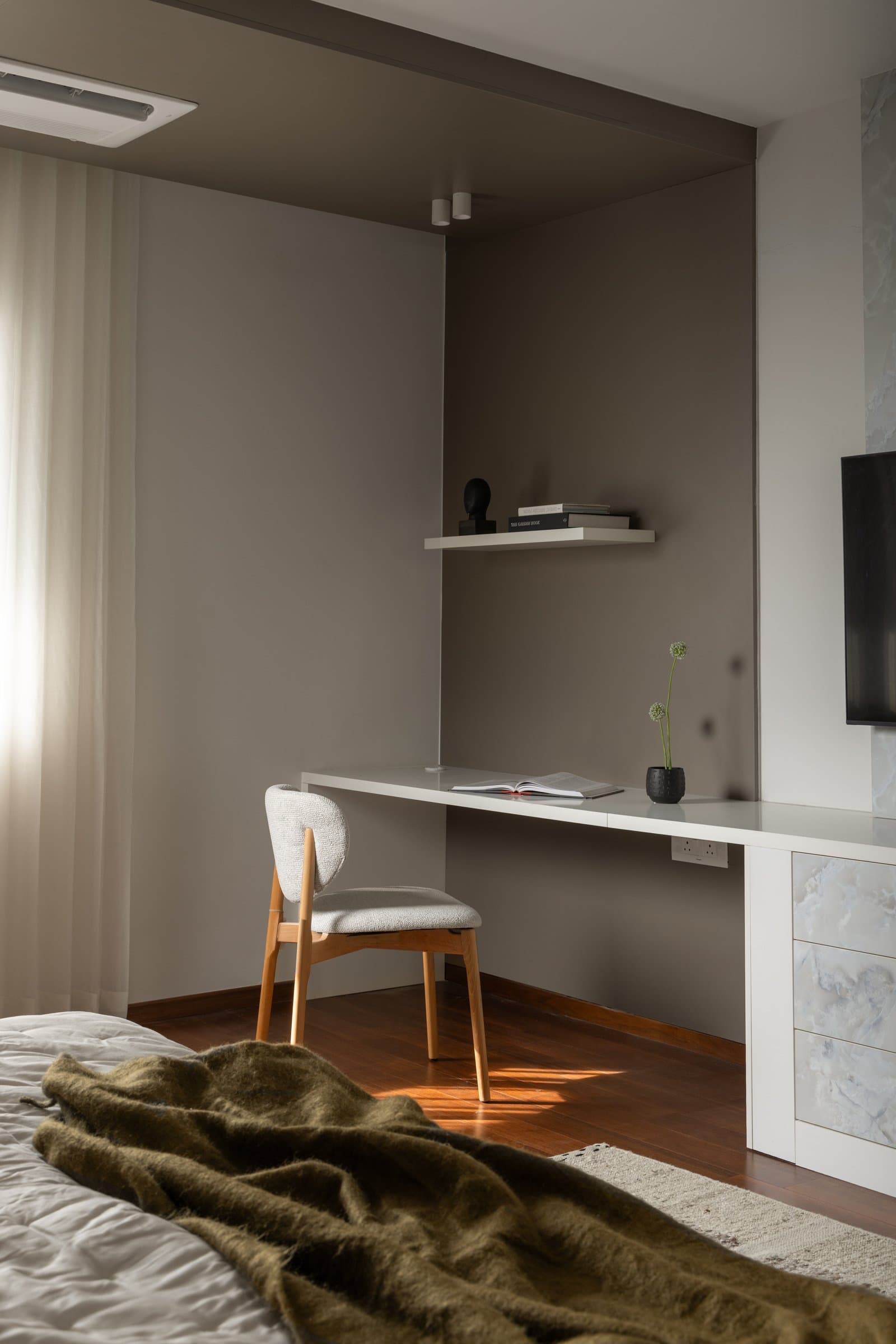
The master bedroom shifts the palette to taupe walls with an olive throw on the bed, with a wall-to-wall desk that extends into a TV console. The room’s material restraint is immediately apparent: wooden flooring underfoot, muted taupe wall planes overhead, and a single floating shelf that anchors the study nook with just enough presence to feel intentional.
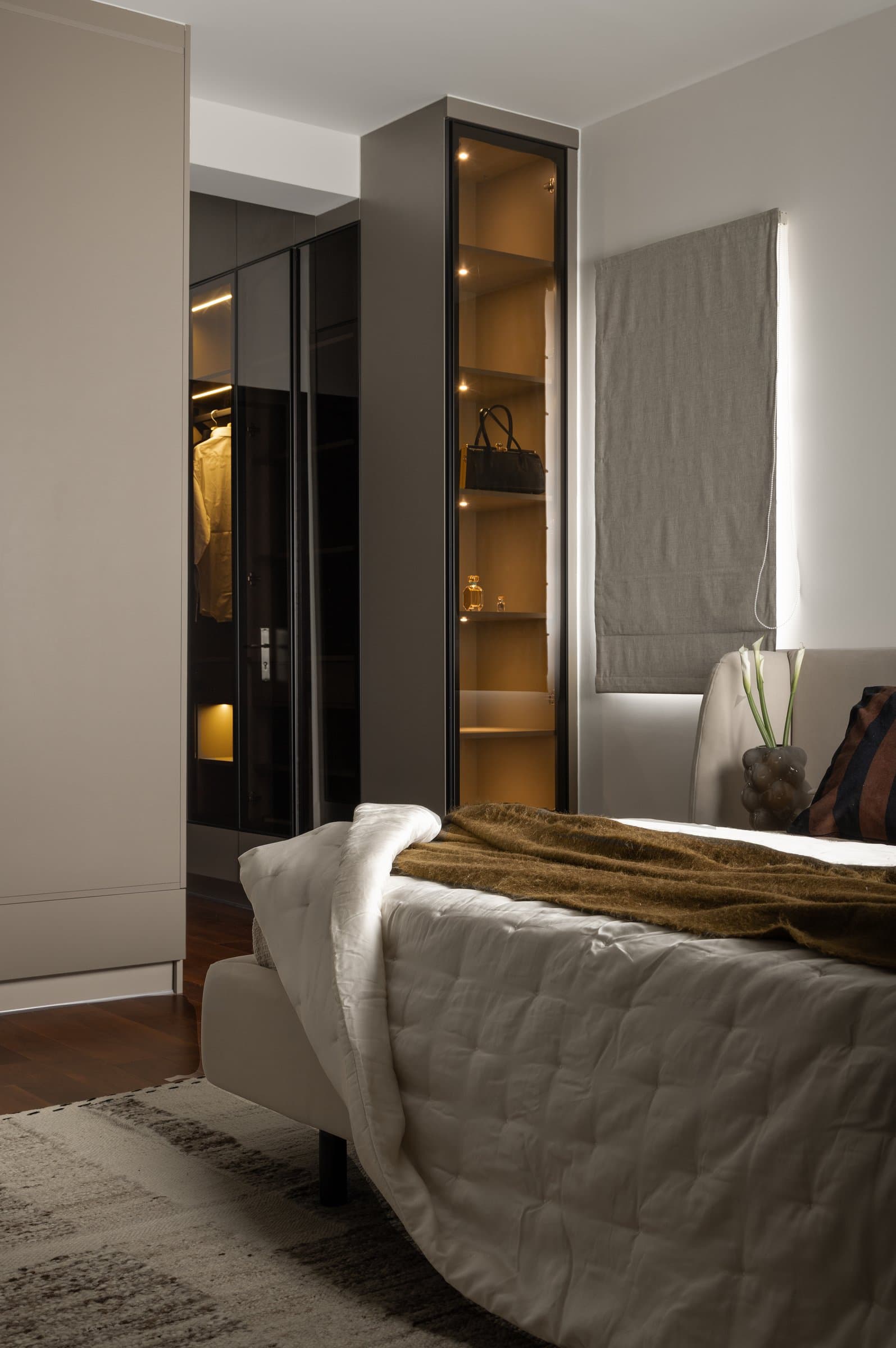
Glass-fronted wardrobes replace solid shutters in this room, a decision that reduces the visual mass of storage and allows the warm glow of internally lit shelving to become a part of the room’s evening atmosphere. The effect is closer to a boutique dressing room than a conventional bedroom wardrobe wall.
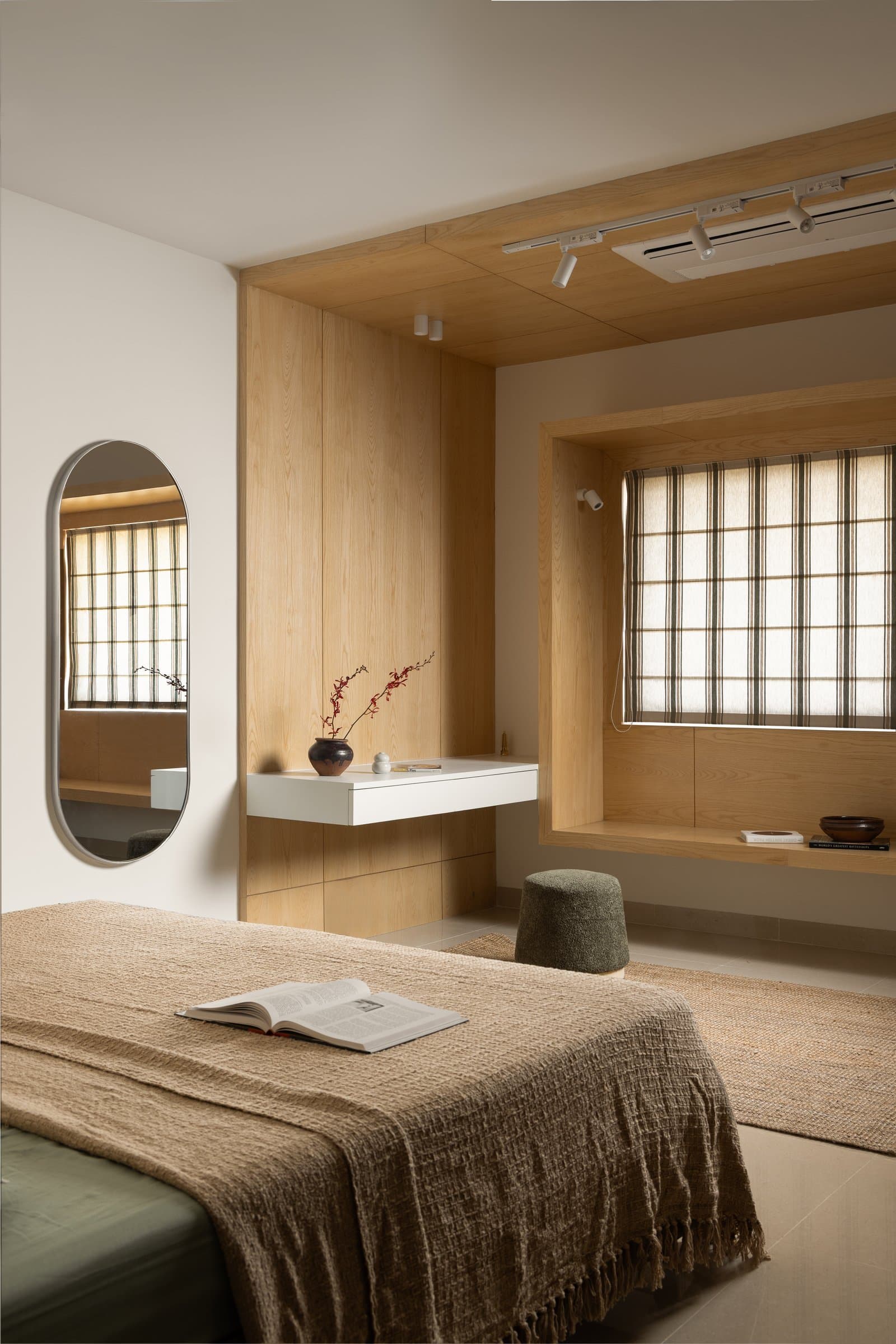
The daughter’s bedroom is organised around a custom bay window finished in light oak that doubles as a study nook. The timber wraps from wall to ceiling in a continuous envelope, creating a room-within-a-room that feels generous despite the modest footprint, and a small stool tucked into the bay suggests exactly how the space is used.
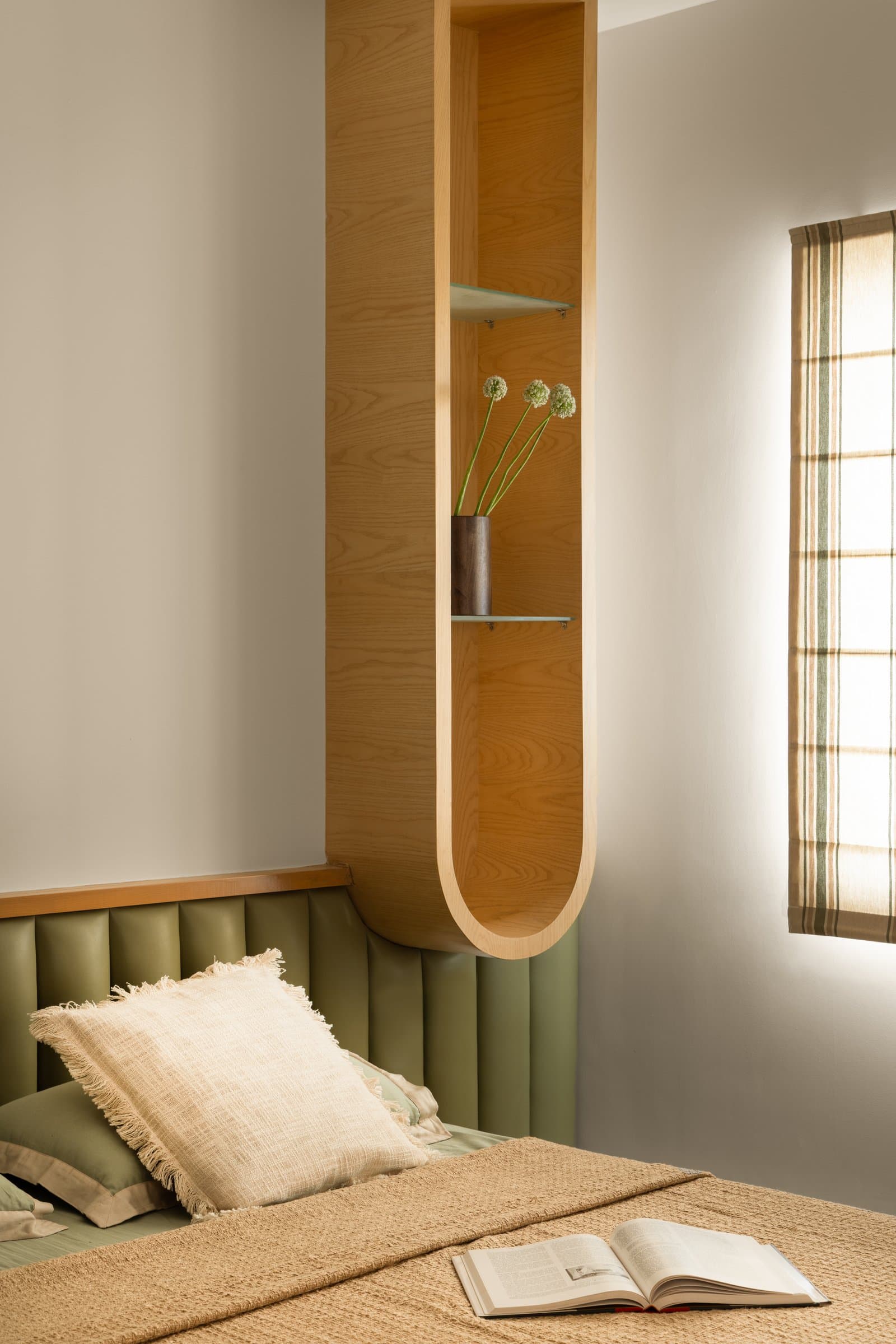
A detail at the bedside reveals a tall, rounded-bottom niche in the same oak, functioning as a combined shelf and headboard element. The craftsmanship here is quietly impressive: the curve of the niche, the olive-toned upholstered headboard, and the light grain of the wood combine to give a child’s bedroom the same material seriousness as the rest of the villa.
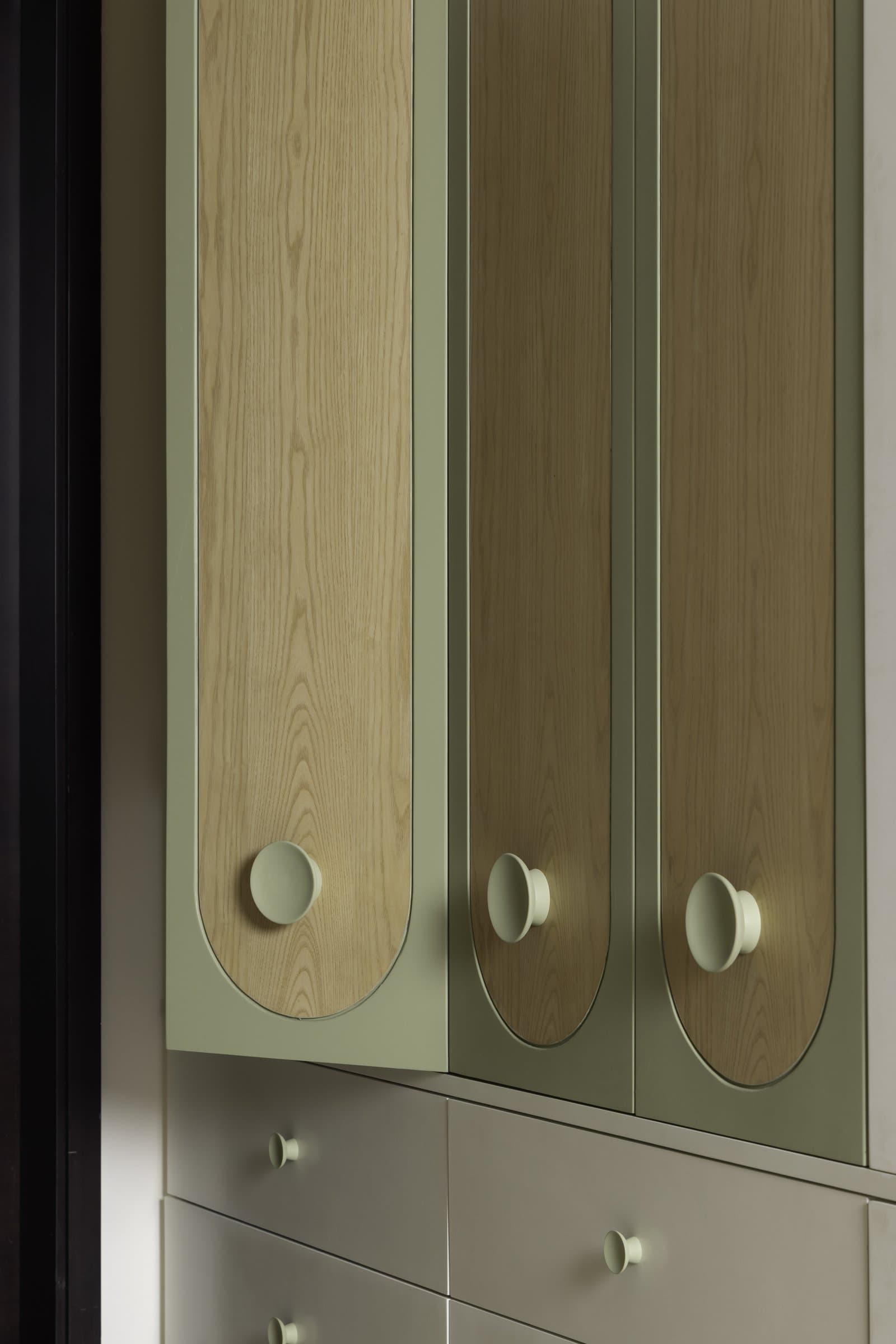
Wardrobes in this room combine oak panels with a muted sage-green finish, their rounded inset handles adding a playful dimension without breaking the design language. The detail is precisely the kind of calibrated gesture that distinguishes considered design from the merely decorative.
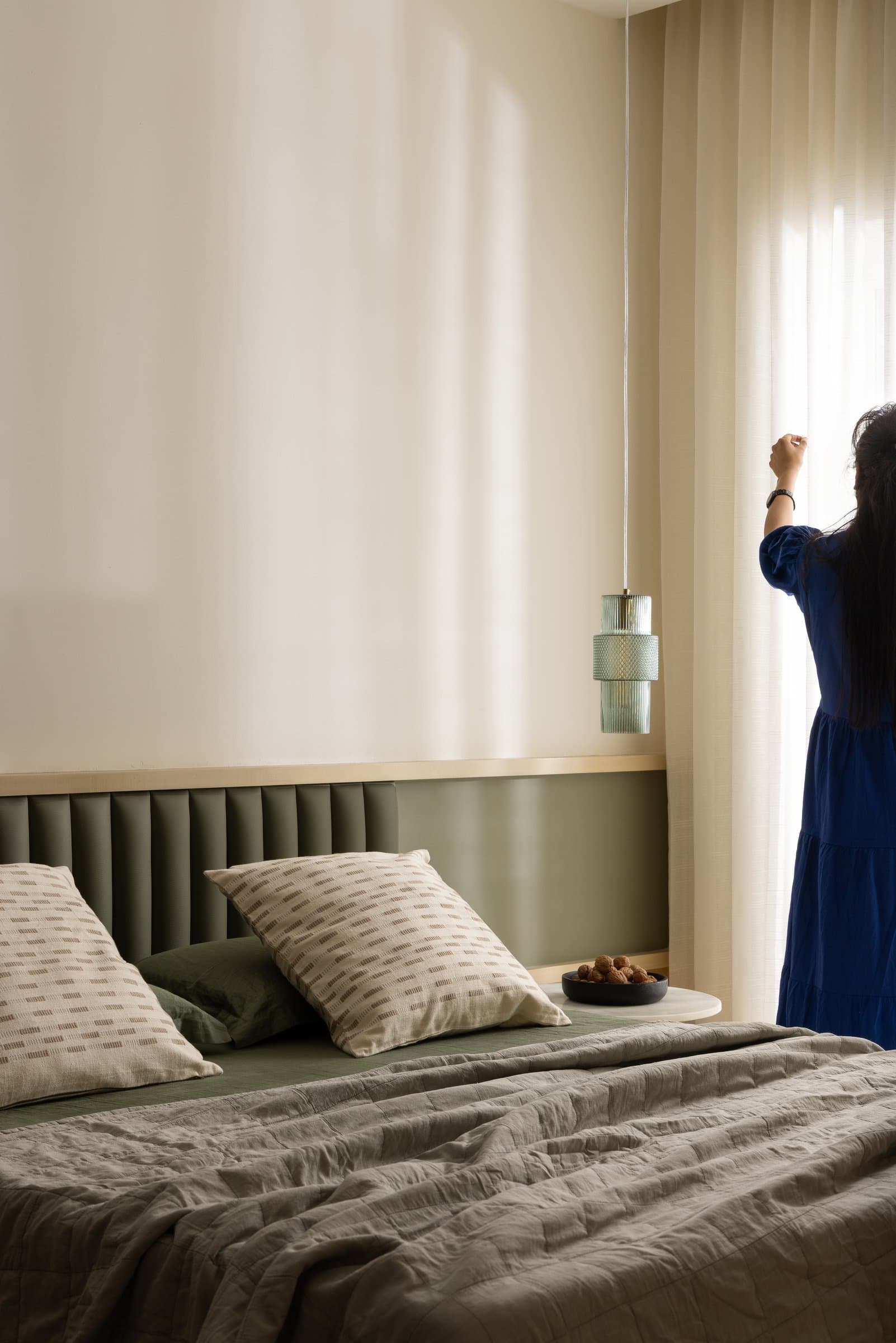
A guest bedroom takes the olive green further, with a channelled upholstered headboard and linen-toned bedding that establish a palette of restful, muted warmth. Here, the room’s success lies not in any single statement piece but in the consistency of tone across every surface.
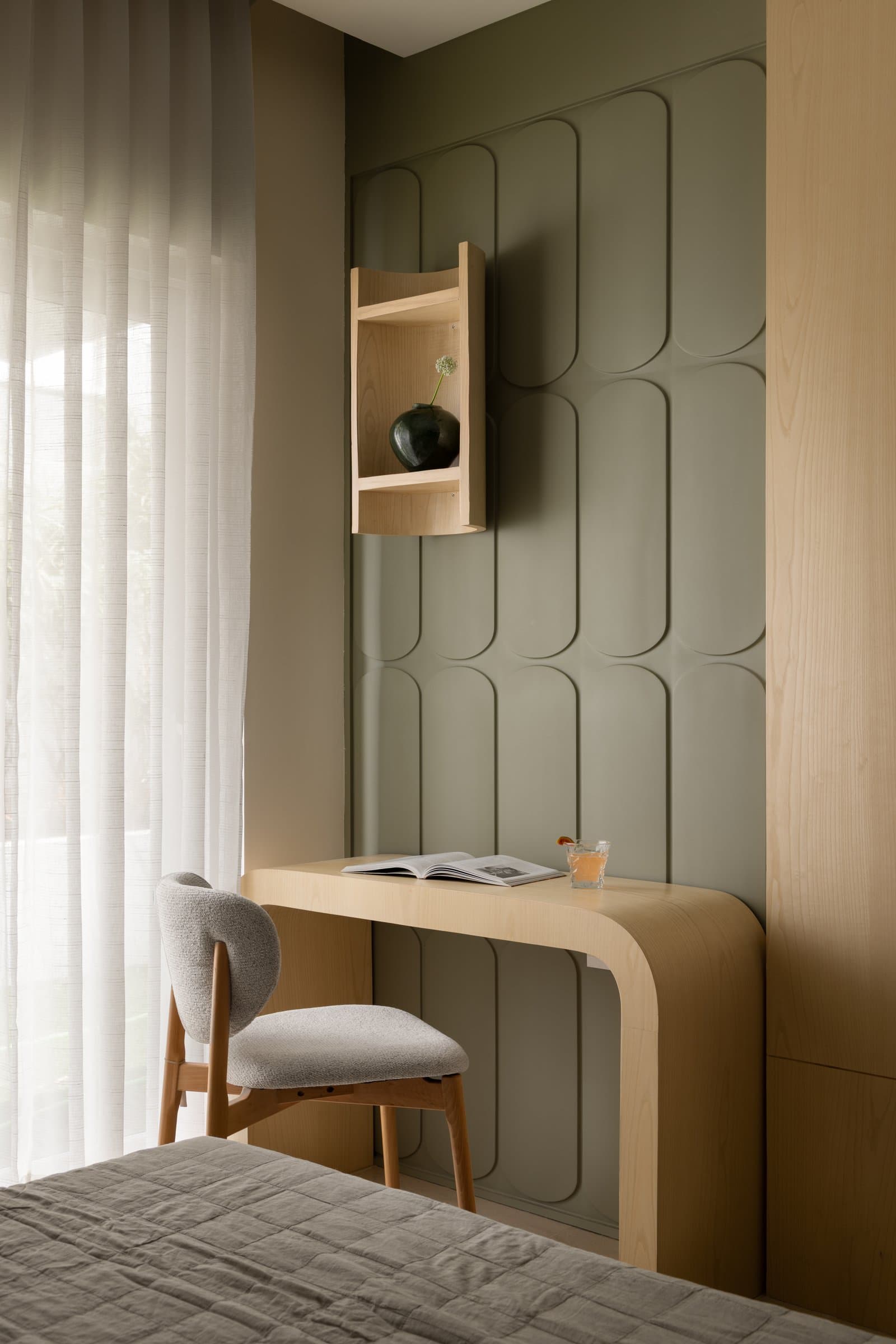
The study corner of the guest room is defined by a sculpted wall panel in the same sage green, its repeated rounded forms creating a textural depth that reads as architectural rather than decorative. A curved timber desk extends from the panelled surface with a seamlessness that suggests it was always part of the wall.
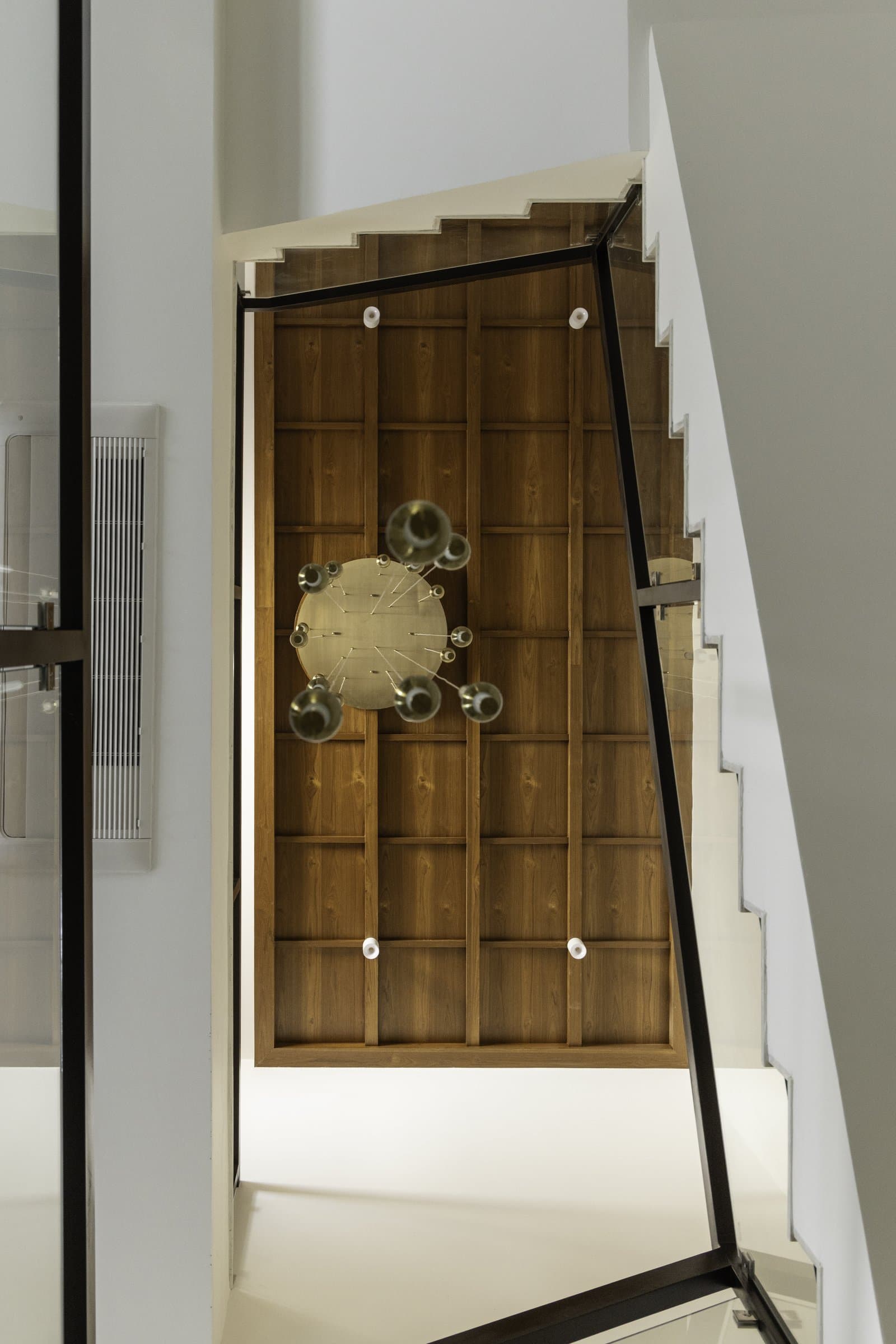
The staircase, often treated as purely transitional, is elevated here through a veneer-grid ceiling with a suspended brass-and-glass chandelier visible from below. The timber gridwork overhead transforms the vertical circulation into a considered spatial moment, reinforcing the villa’s argument that every zone, however brief, deserves the same material attention as the primary rooms.
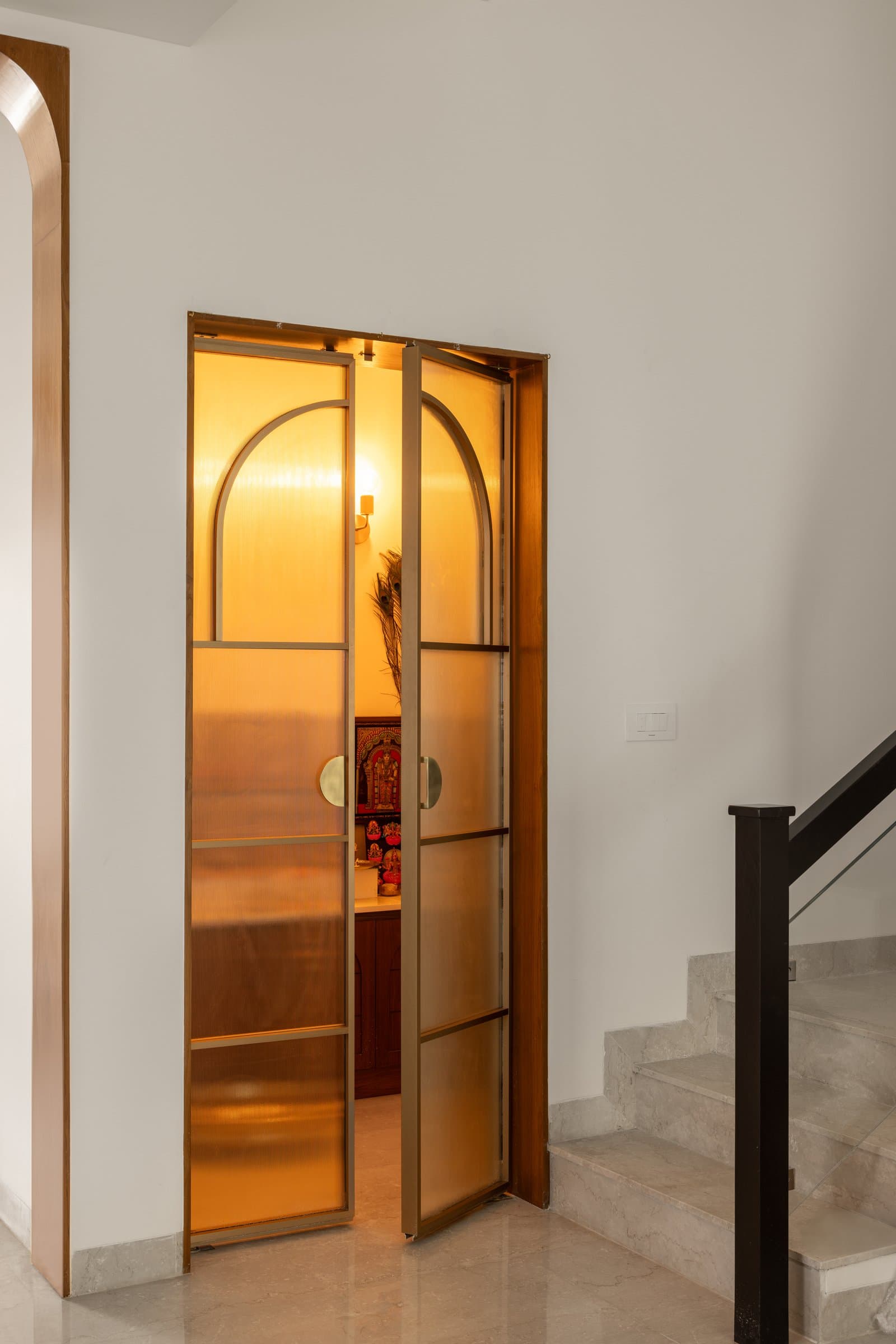
Adjacent to the staircase, the pooja room is enclosed by arched glass-and-metal doors in a warm amber tone. The doors filter light from within, lending the threshold a quiet reverence that distinguishes the sacred space from the rest of the villa without separating it entirely.
Bangalore’s villa landscape is increasingly defined by speed and replicability, with interiors assembled from catalogues rather than composed through genuine spatial thinking. Villa One resists that tendency with a methodical approach to material continuity, where each room is a variation on a shared tonal language rather than a standalone exercise in mood-making.
What distinguishes this project, and what makes it worth studying, is the rigour with which it follows through on a simple premise. Every room resolves the same tension between warmth and restraint, and the cumulative effect is a home that feels composed, lived-in, and notably free of excess.