Some homes are built to impress on entry; others are built to slow the body down. House of EN belongs decisively to the second category, an apartment that treats domestic life as a quiet practice rather than a stage, and design as the careful arrangement of pauses between rooms.
Designed by Studiio Realm for a Mumbai resident whose name marks the threshold itself, the home rests within a compact urban footprint and draws openly from Japanese spatial sensibility, plastered walls, blond hardwood, and a measured palette of cream, ochre, and walnut. The brief was not for a showpiece but for a sanctuary, and the studio responded with surfaces that absorb rather than announce.
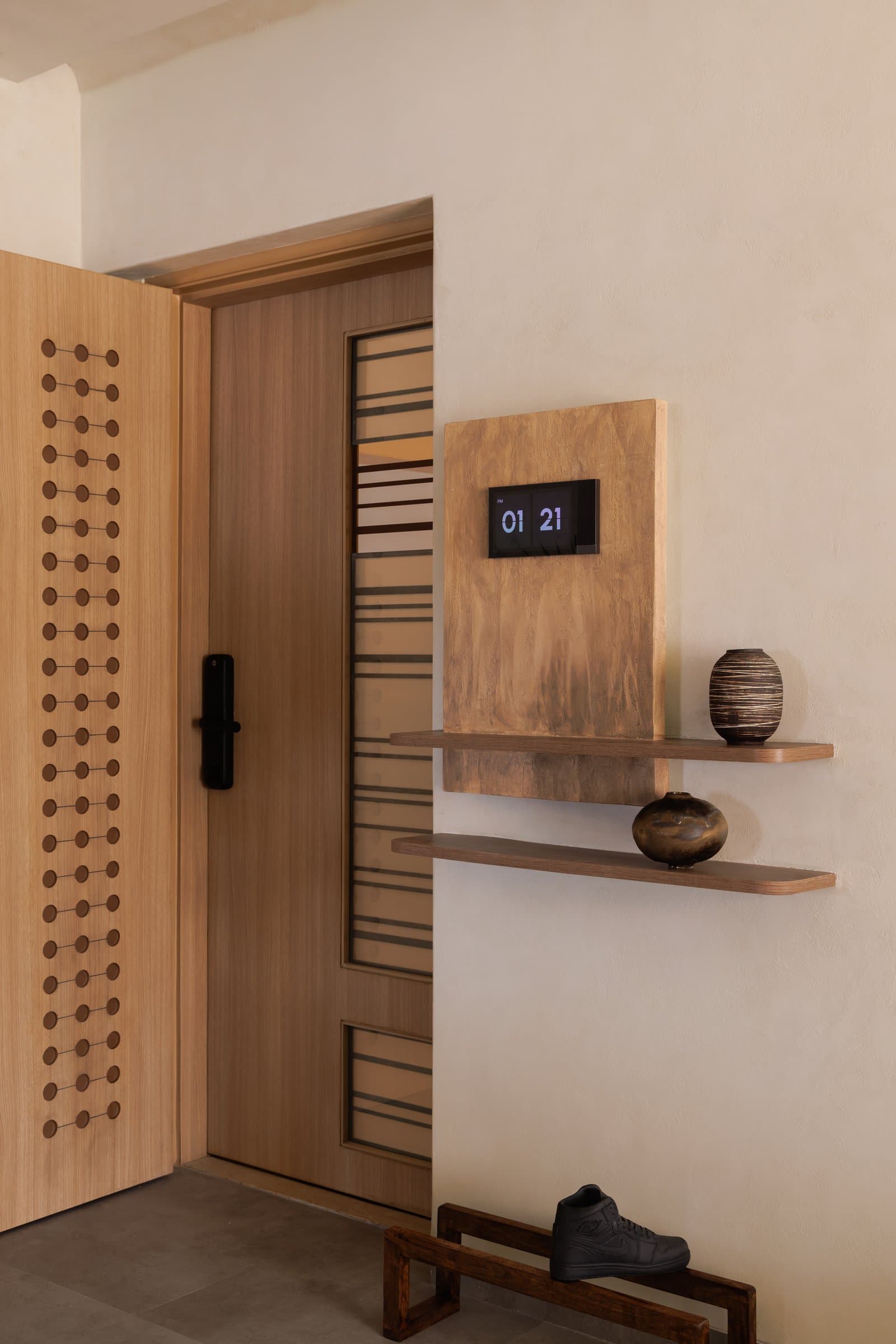
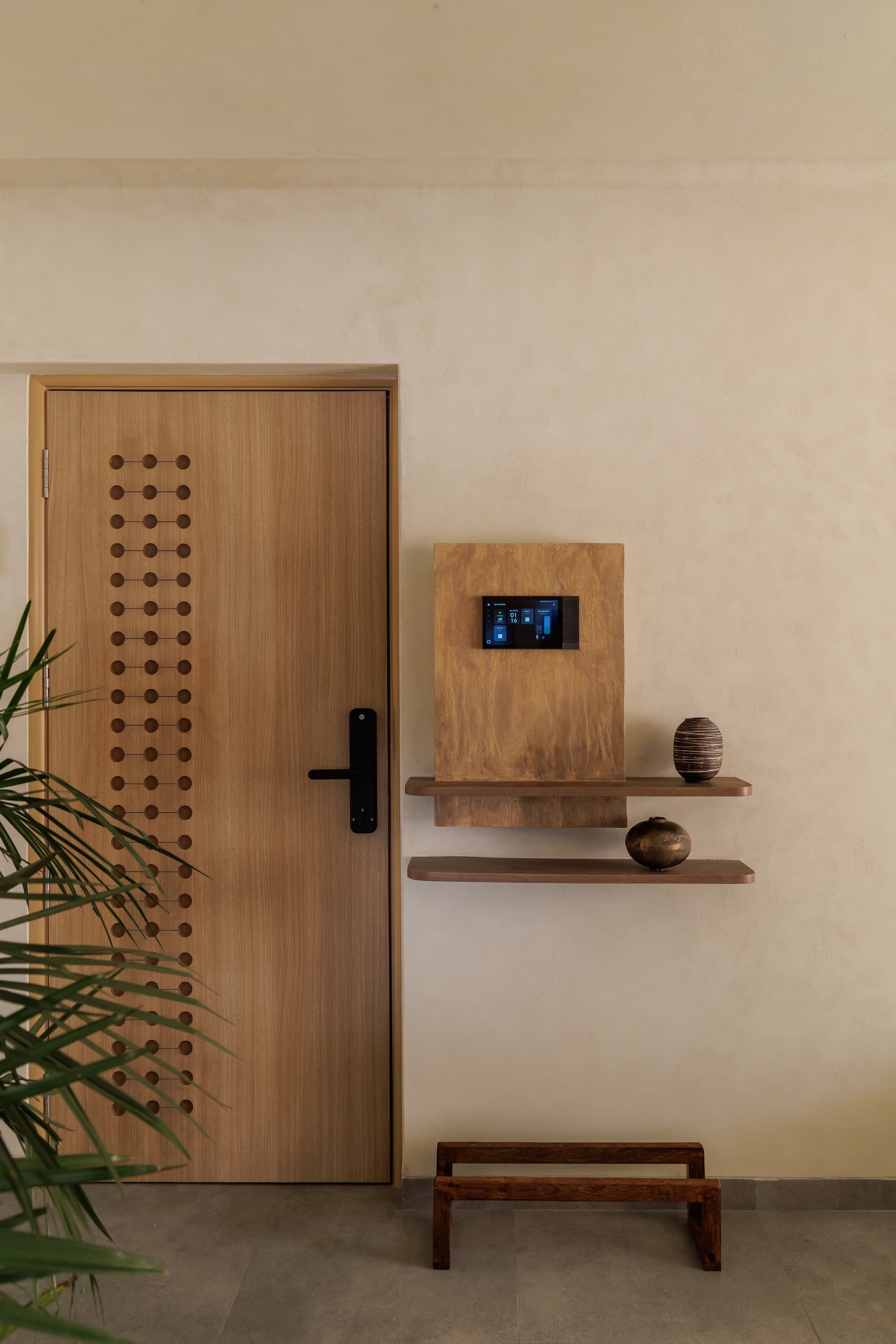
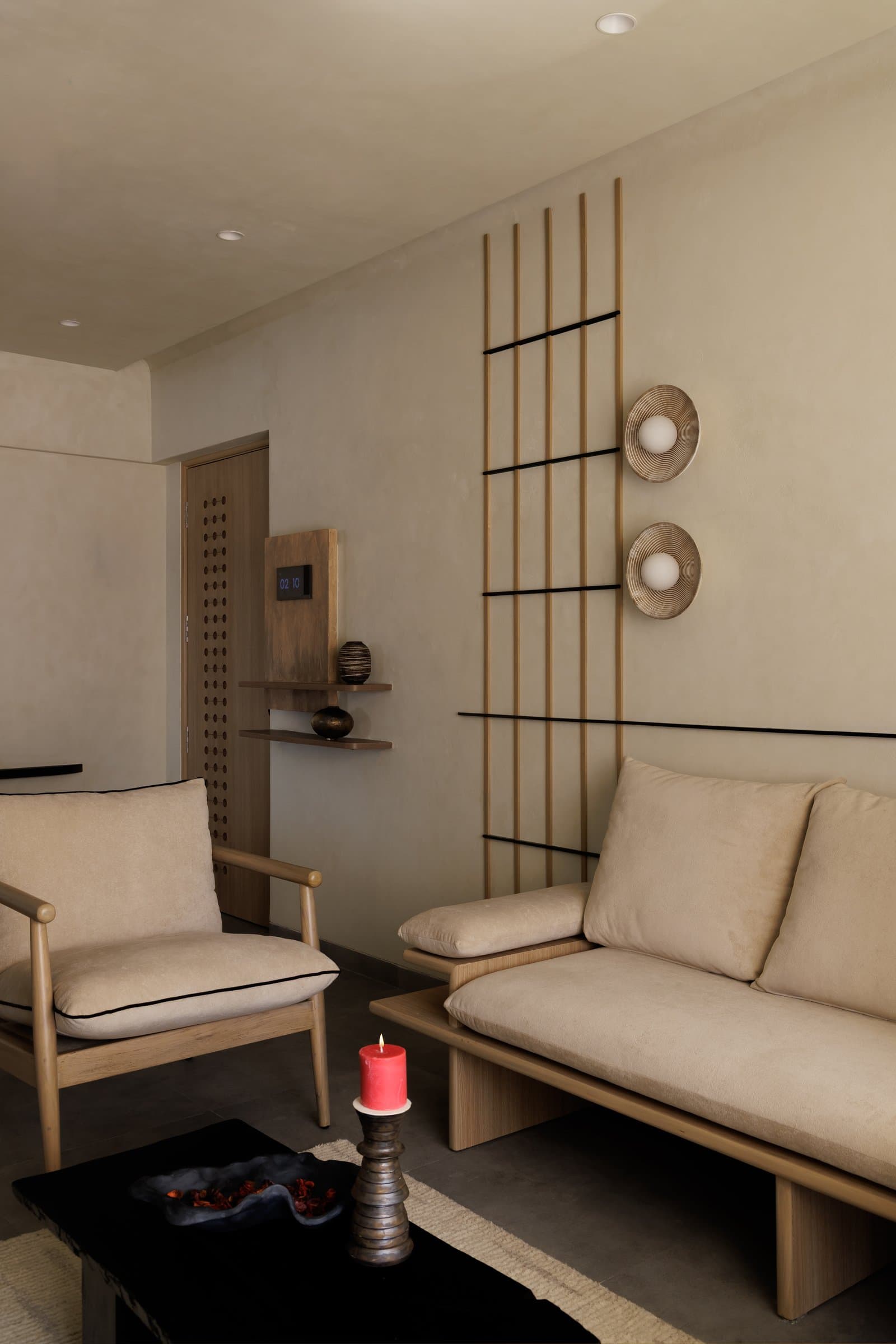
The entry sets the grammar before the home truly begins. A perforated wood door faces a low pair of floating shelves and a small wood-mounted flip clock, the kind of object that asks the visitor to register time as something tactile rather than digital.
The apartment reveals itself as a sequence rather than a spread. A brass nameplate marked sits on the inner face of the door, and beyond, a slatted wooden screen frames the dining area like a viewfinder.
The patterned floor tile reads almost as a tatami mat in stone, anchoring the threshold and signalling that the home will be navigated by texture as much as by plan.
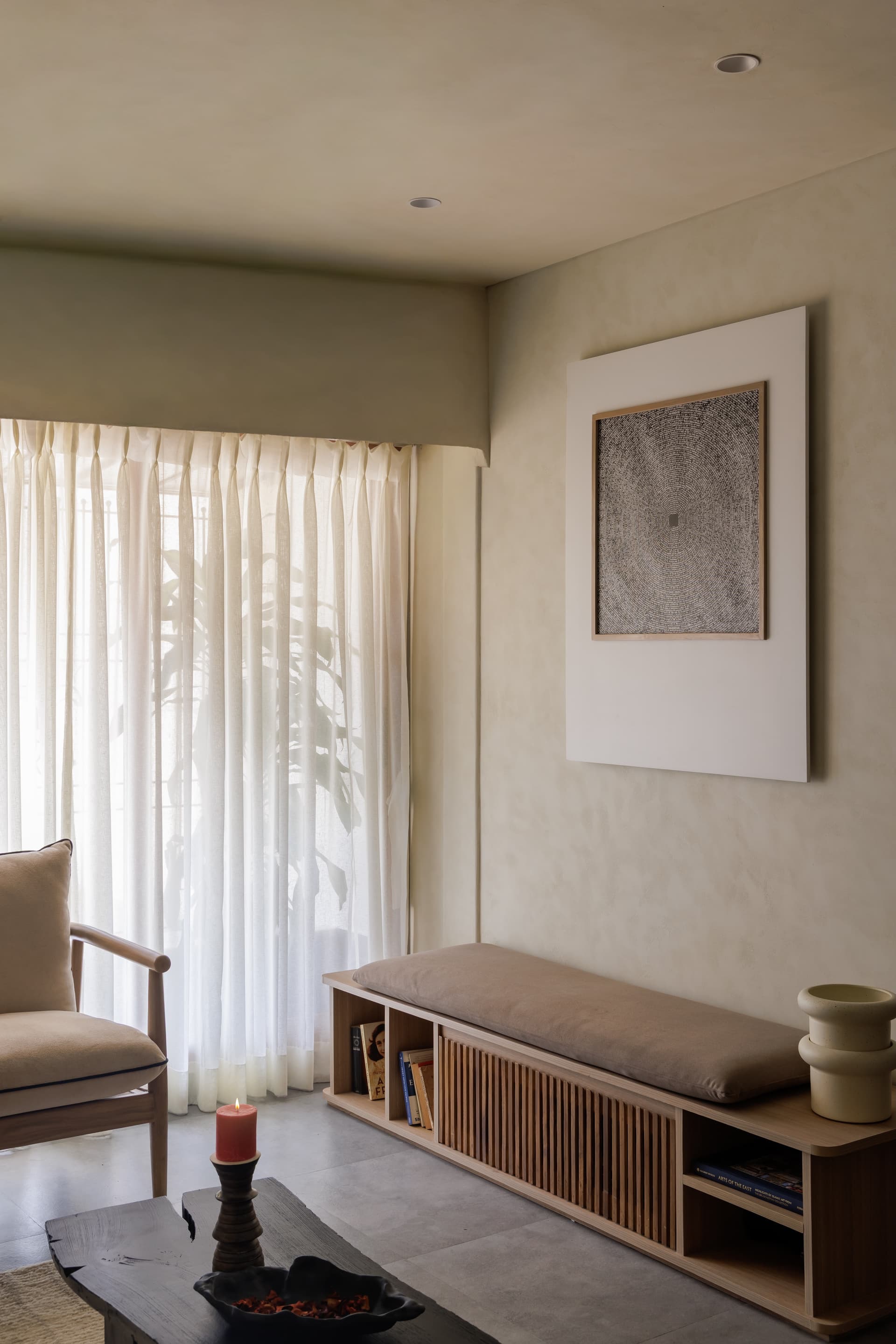
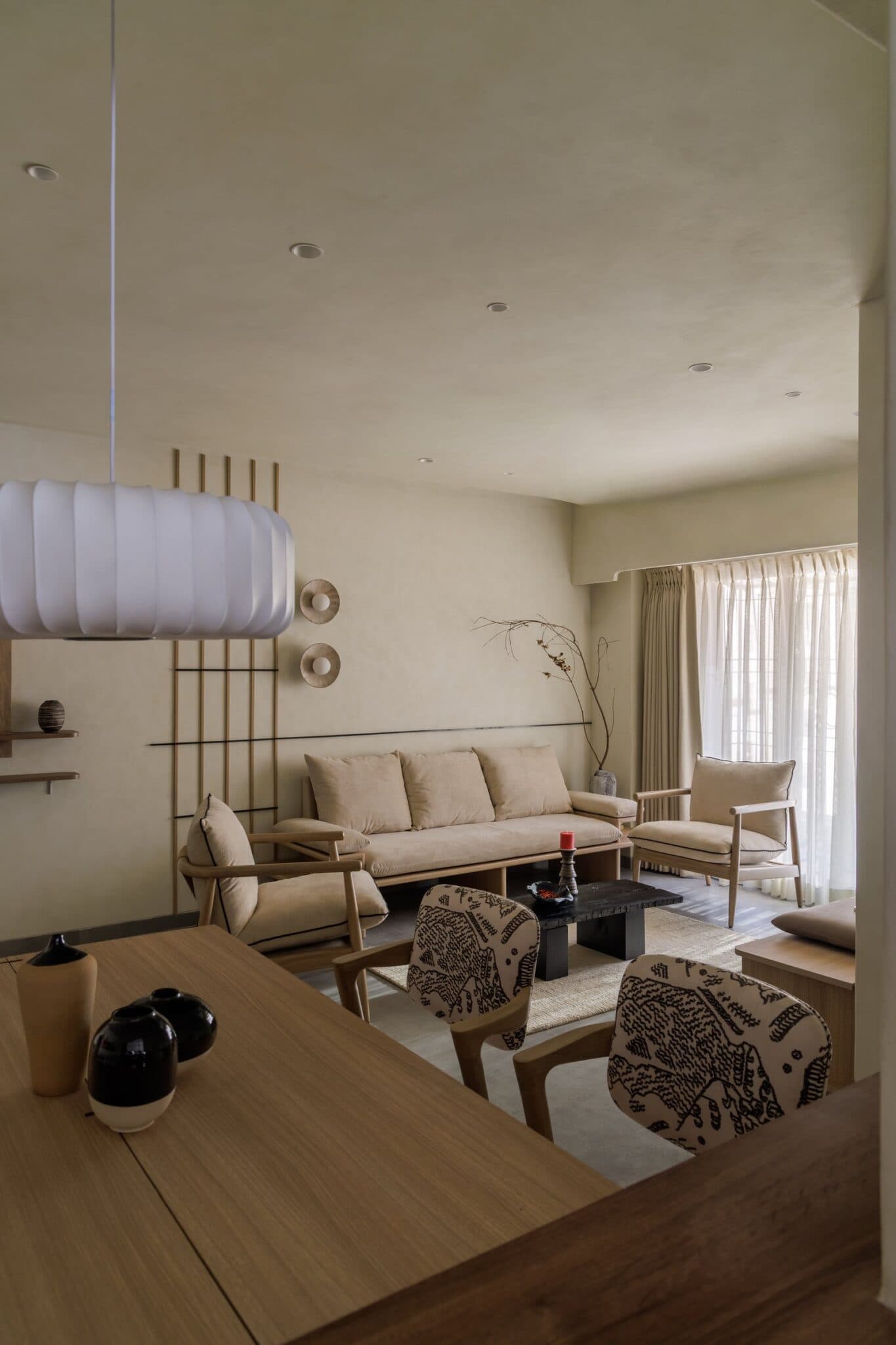
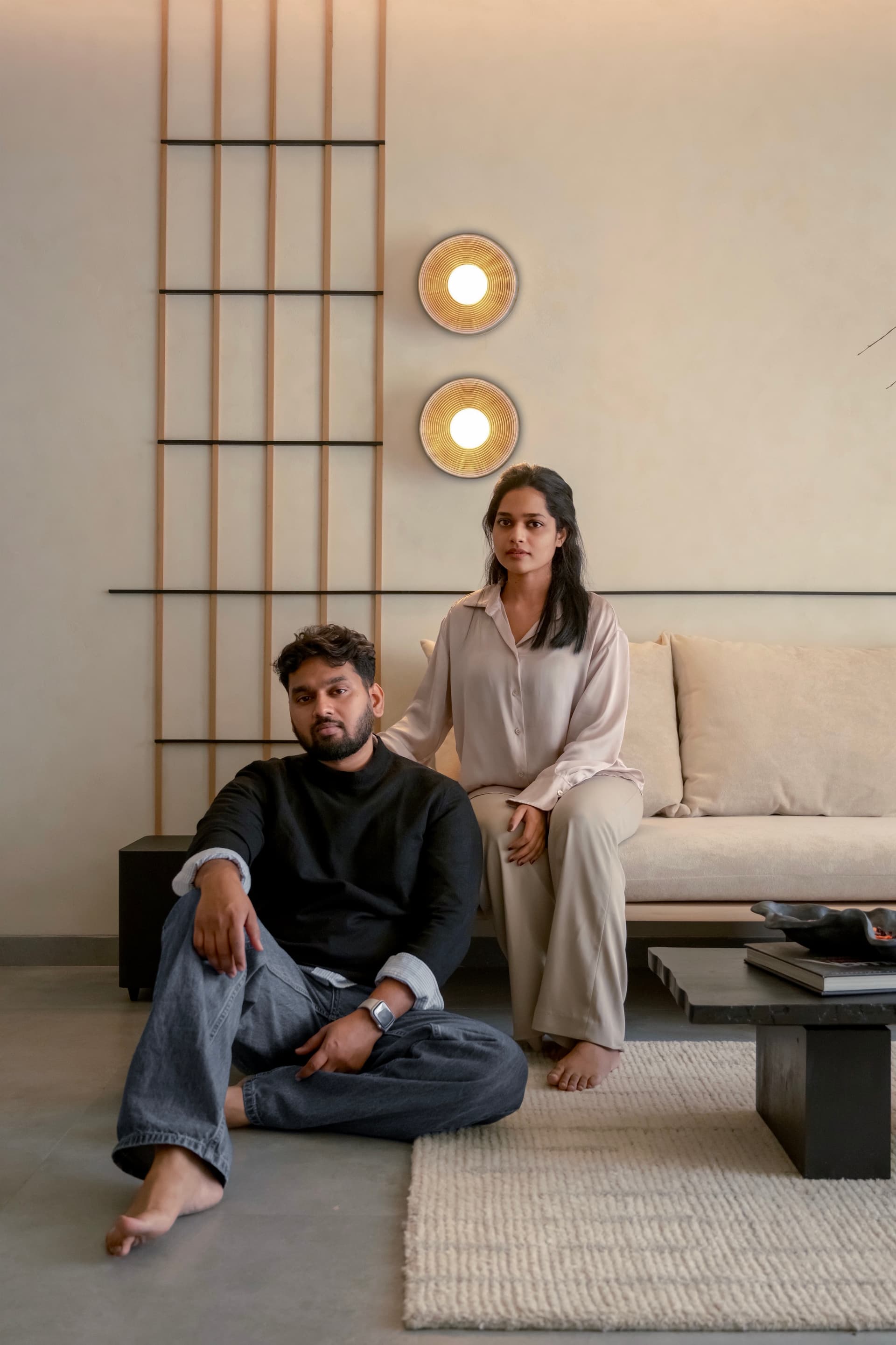
The living room continues the studio’s argument that warmth need not come from saturation. Slim wooden battens climb a plastered wall beside a low-slung sofa, interrupted by two disc-shaped sconces that read as objects more than fixtures.
““We wanted the home to feel held, not decorated, the kind of space where the walls do most of the speaking and the furniture knows when to be quiet.””
The seating arrangement is built around a single black plinth-table at its centre, with patterned ikat-print chairs from the dining zone turning inward to complete the circle. The room reads as one continuous social space, the dining and living areas sharing air without sharing function.
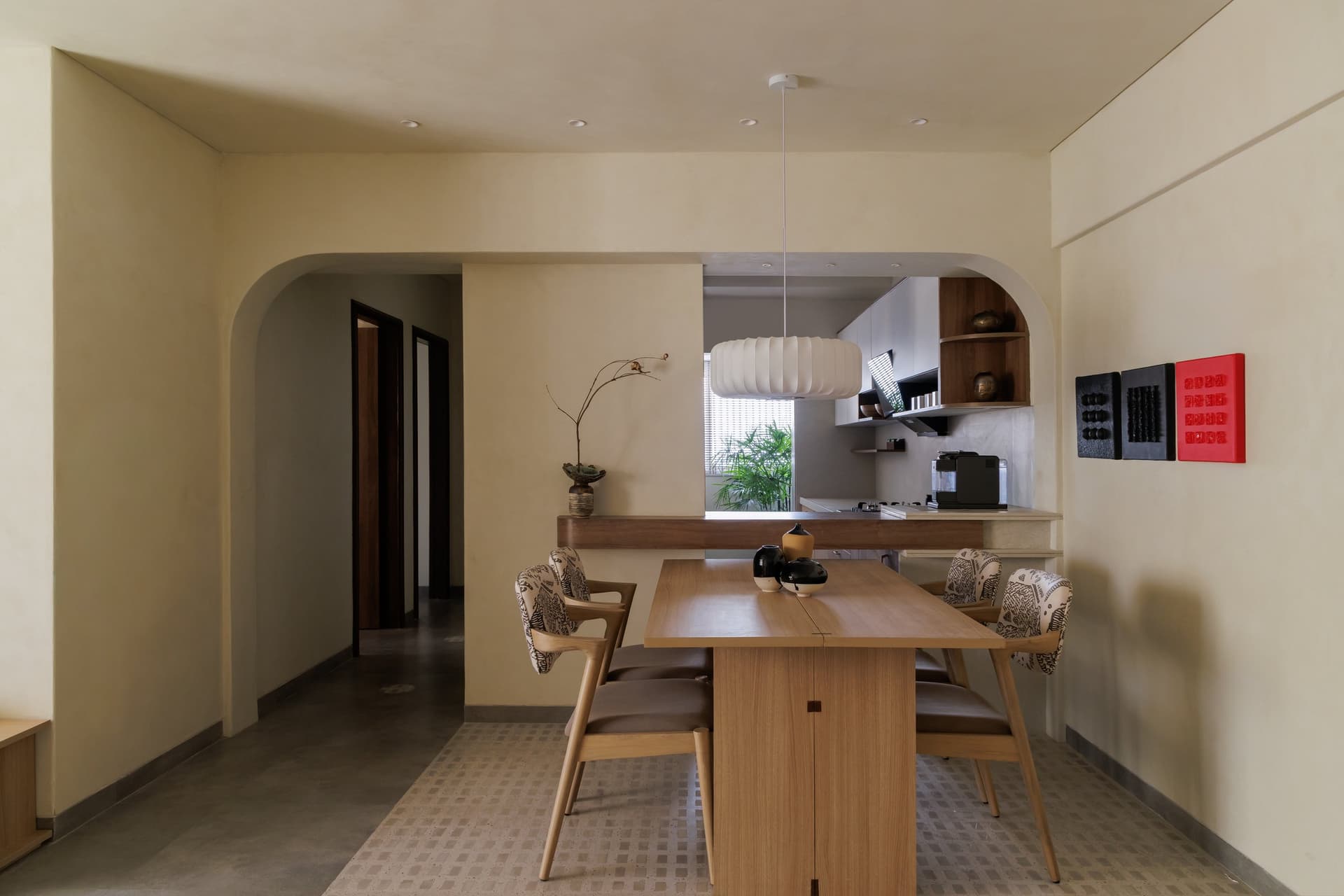
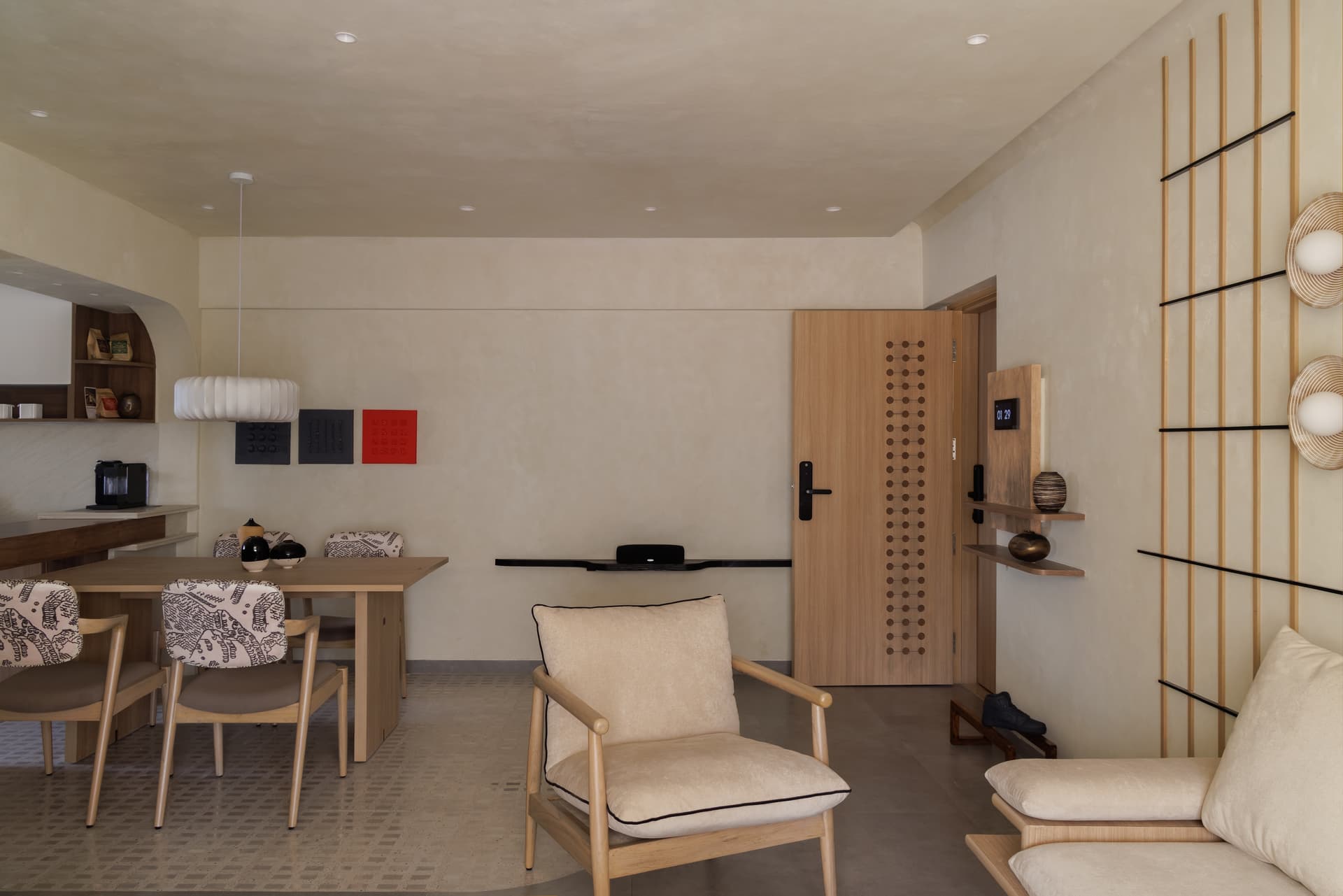
The dining area unfolds beneath a soft arched opening that frames the kitchen pass-through, a single architectural gesture that does the work of a wall without the weight of one. A ribbed paper-lantern pendant hangs above a clean-lined oak table, while a pair of small framed reliefs in red and black on the side wall introduces the home’s only deliberate jolt of colour.
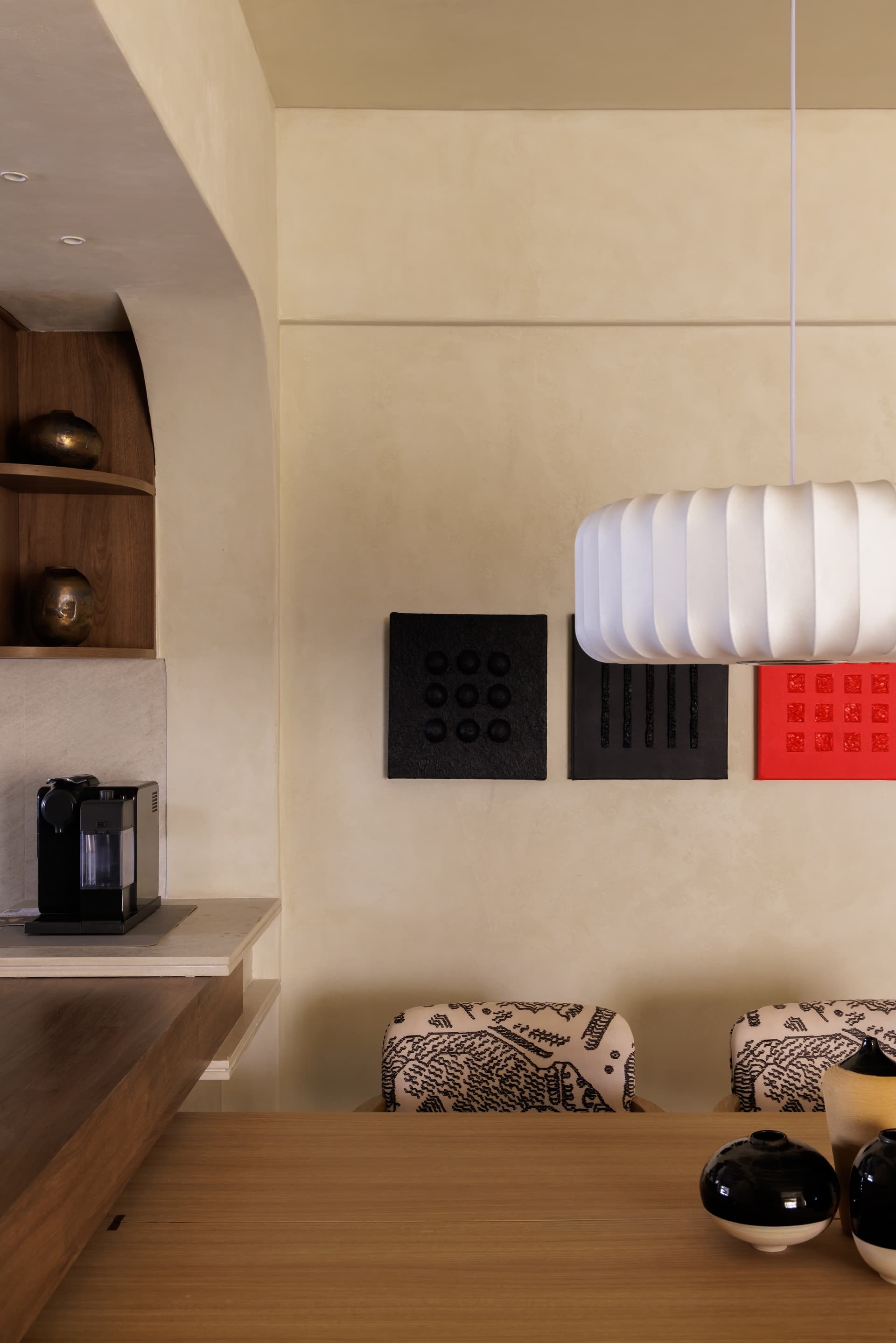
From the dining table, the kitchen counter reads as both threshold and shelf, a horizontal plane in walnut that holds the visual weight of the room. The patterned floor returns here, its grid catching the warm pendant light in a way that softens the geometry into something nearly woven.
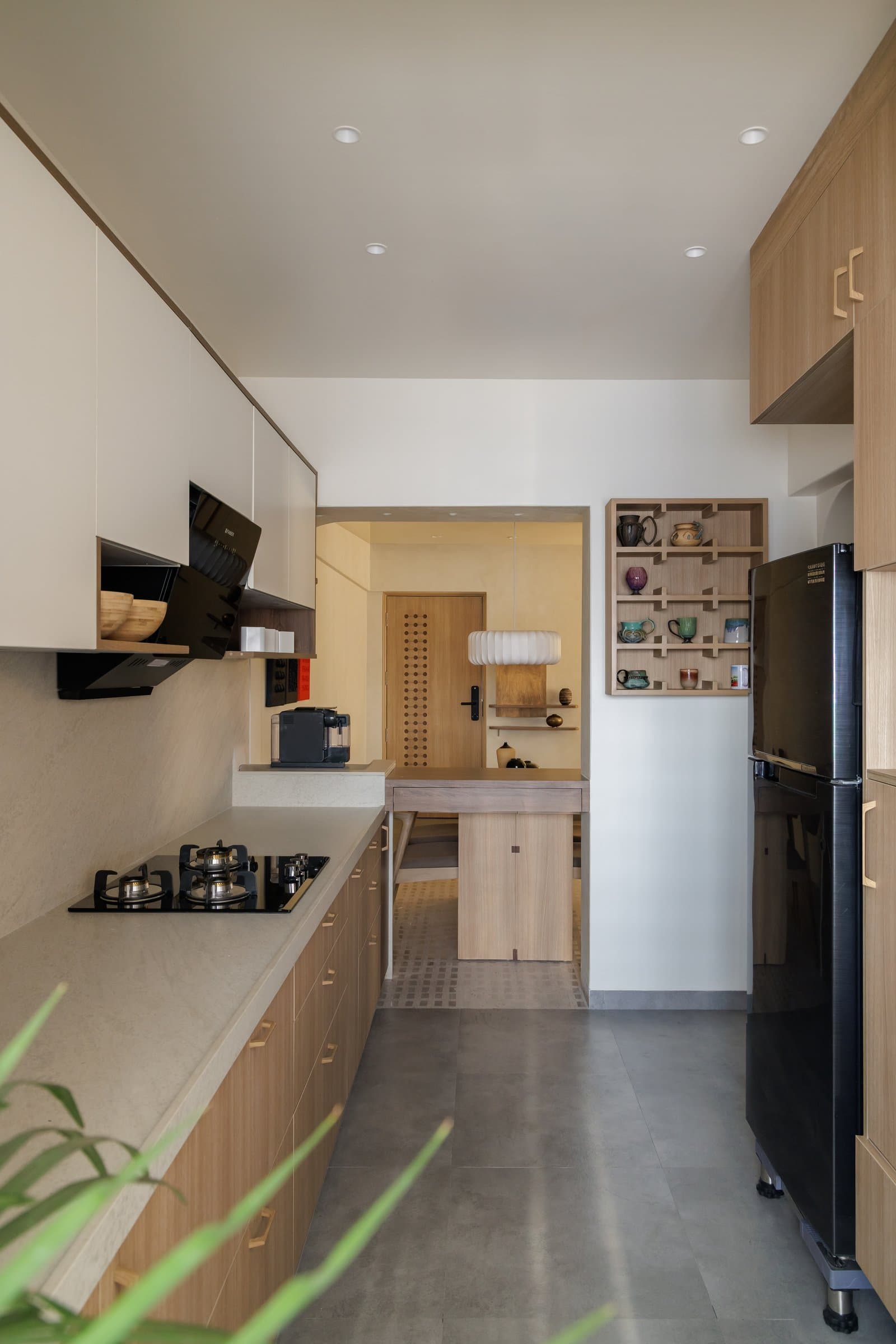
The galley kitchen itself is treated with the same restraint as the rest of the home. Pale upper cabinets and oak-fronted lowers flank a corridor that ends, deliberately, at a view of the perforated entry door, an interior axis that quietly stitches the home together.
A small grid-shelved unit beside the refrigerator holds the family’s collection of ceramic mugs, the closest the apartment comes to display, and even here the gesture is one of use rather than exhibition.
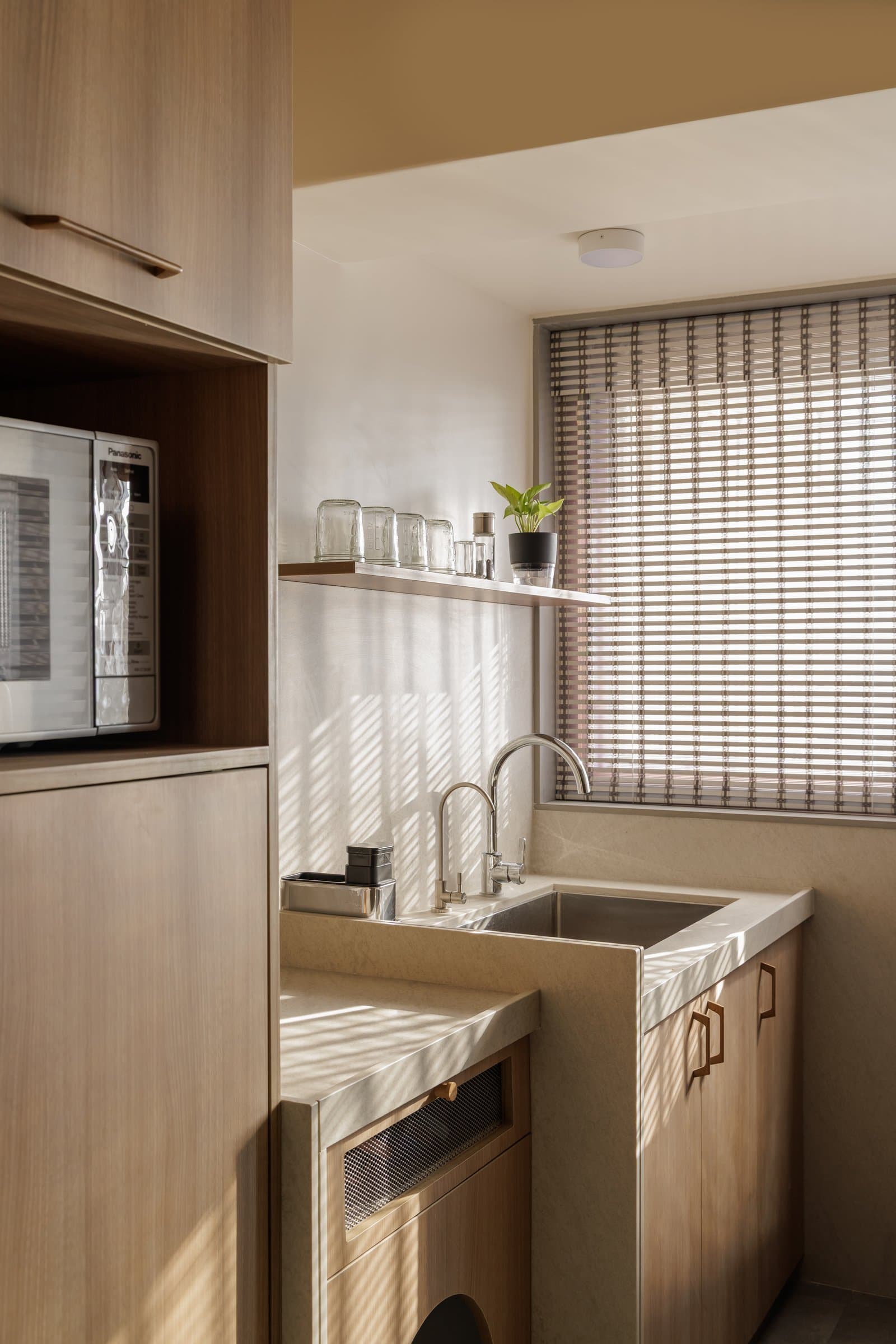
The utility corner is a study in how peripheral spaces can carry the same care as primary ones.
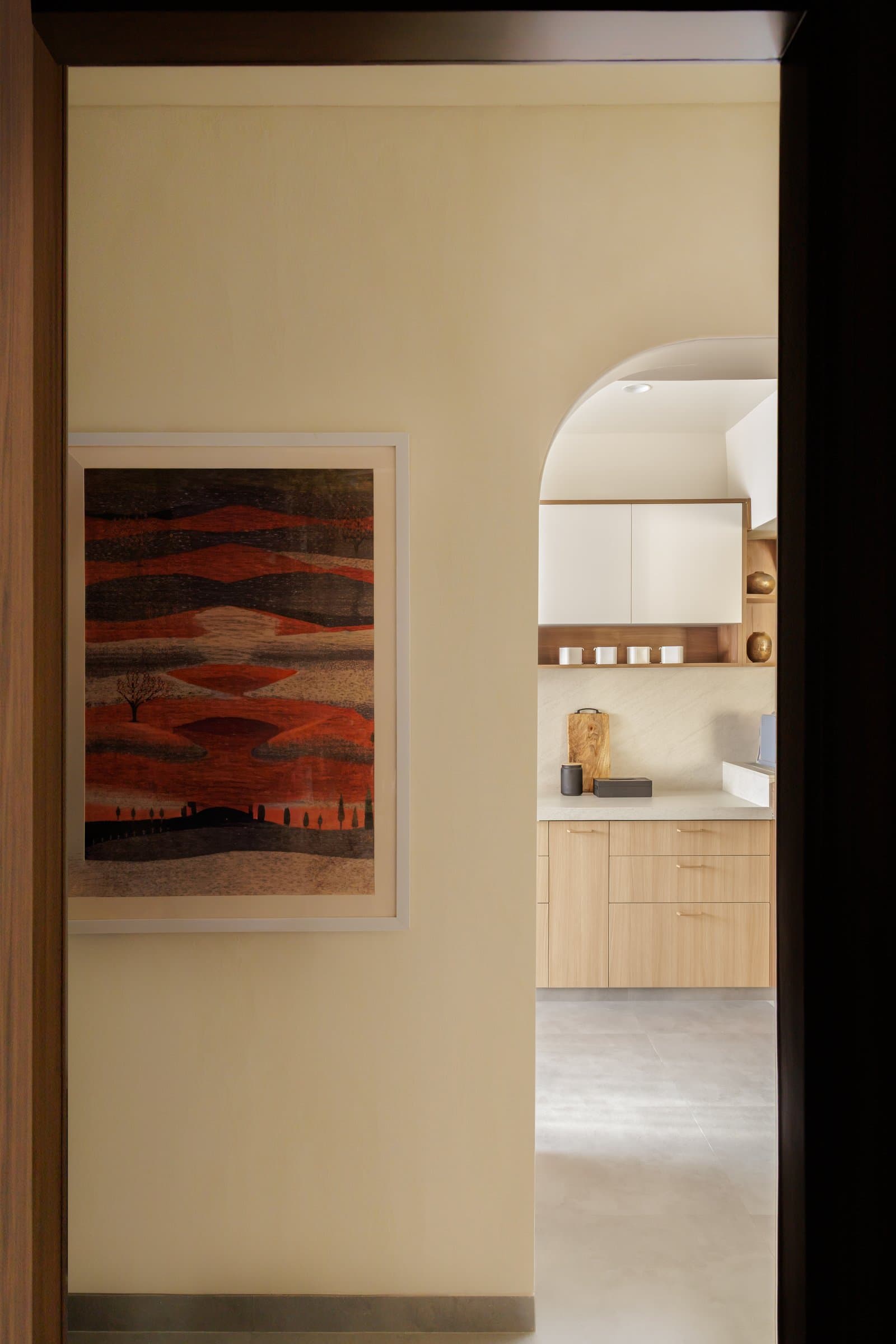
A passage moment, framed between the bedroom doorway and the kitchen, holds a single piece of art, a landscape in deep reds and blacks, against a cream wall. The arched opening to the kitchen beyond keeps the eye travelling, and the painting becomes a hinge between the home’s quieter zones.
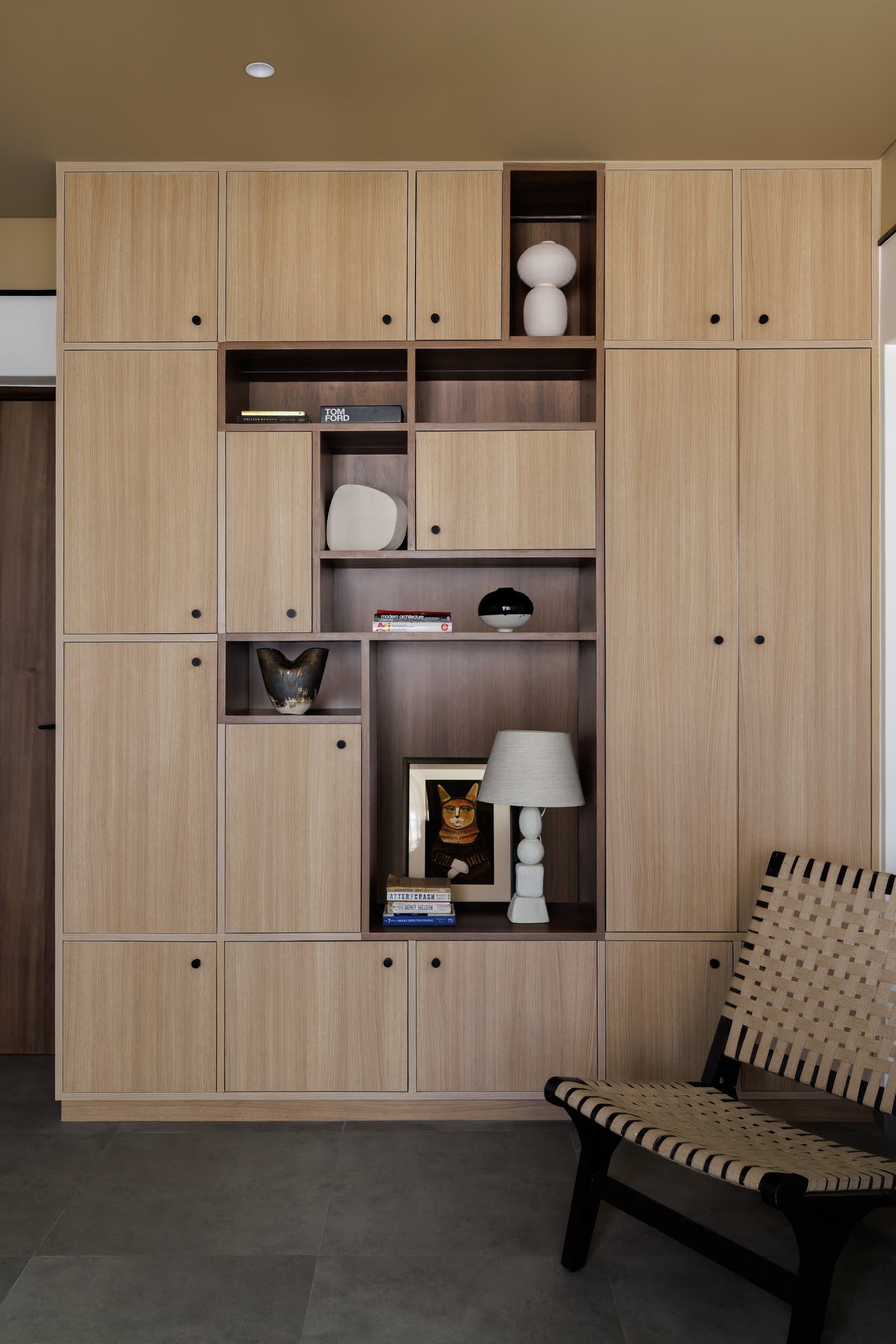
A built-in display wall in pale oak, treated with the geometric logic of a Mondrian grid, holds the books, ceramics, and small artworks in a composition that feels curated rather than crowded. A woven lounger with a black frame sits to one side, the only piece in the room that introduces a contrasting black, and the cabinet becomes a kind of visual library, an index of how the family lives.
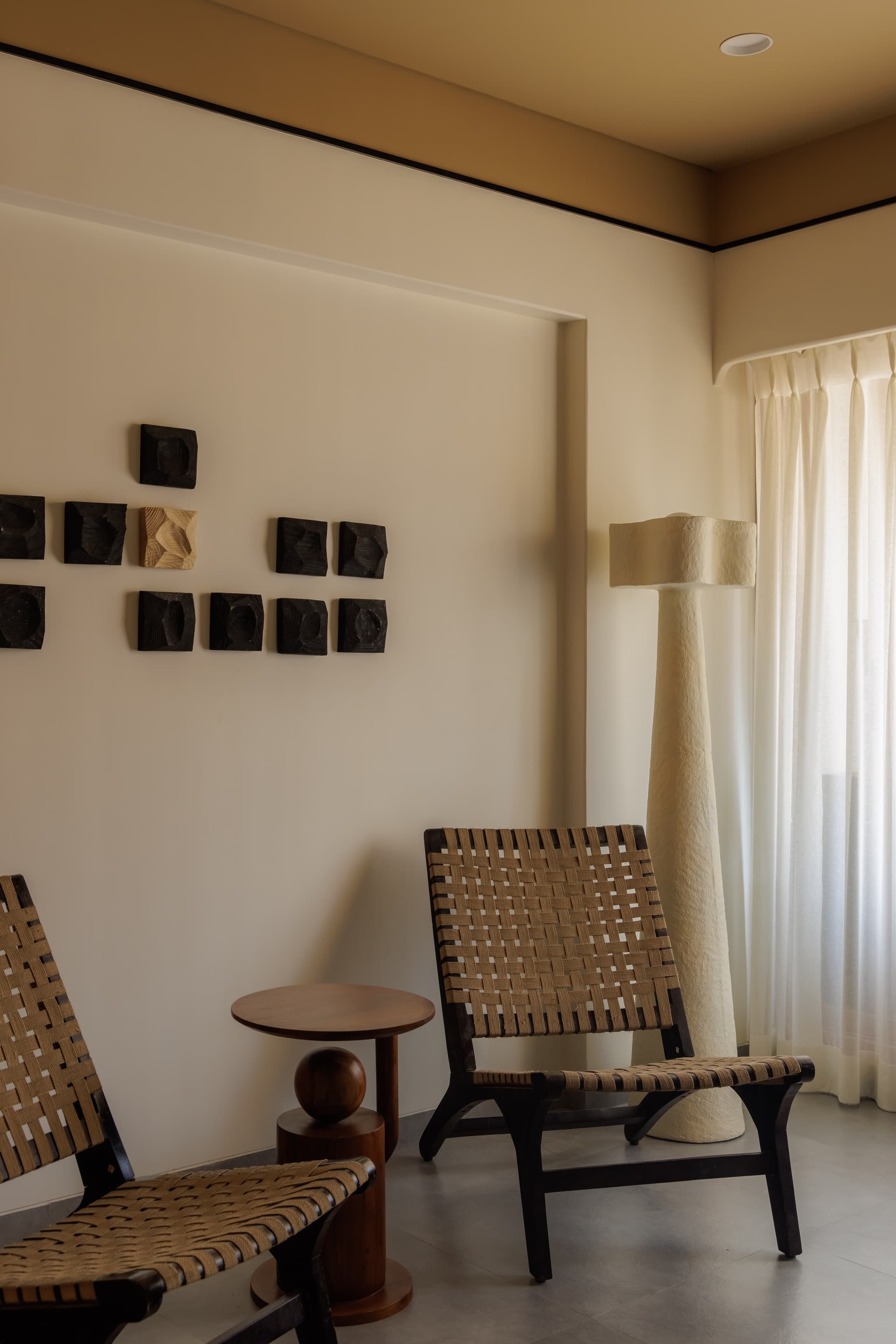
A small reading corner pairs two woven-strap loungers around a turned wooden side table, with a tall, sculptural plaster-textured floor lamp anchoring the composition. A grid of small carved wood reliefs, eight in charcoal and one in raw oak, hangs on the wall like a quiet sentence in a language the home keeps to itself.
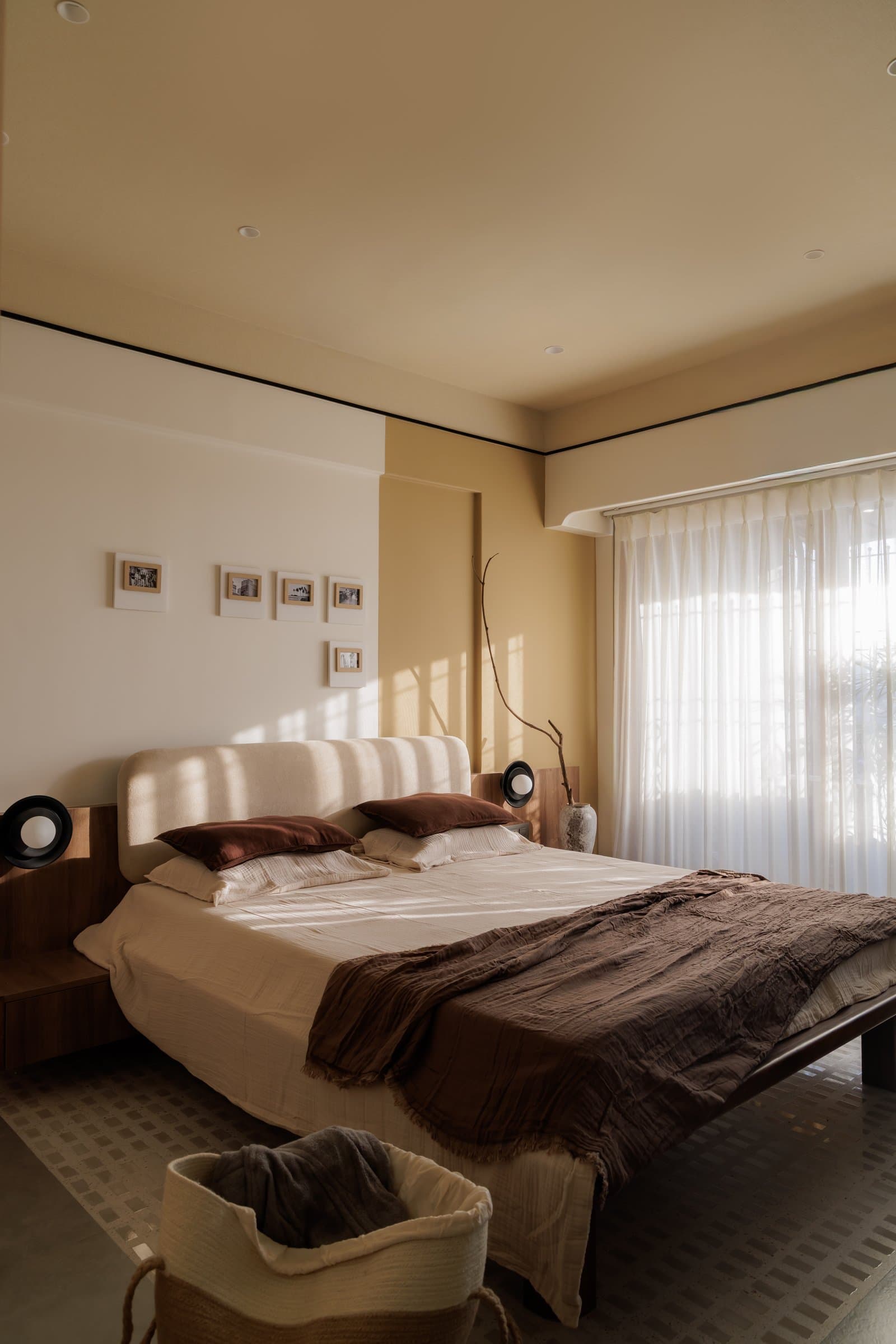
The master bedroom is the home’s most generous room and also its most disciplined. A pale boucle headboard runs the width of the bed, flanked by walnut side panels that hold two black porthole sconces, and a single dried branch in a stone urn substitutes for the conventional bedside flourish.
The wall behind is divided into a panel of cream and a panel of soft ochre, an architectural decision rather than a decorative one, and the gallery of small framed photographs above the bed reads as memory carefully edited rather than displayed.
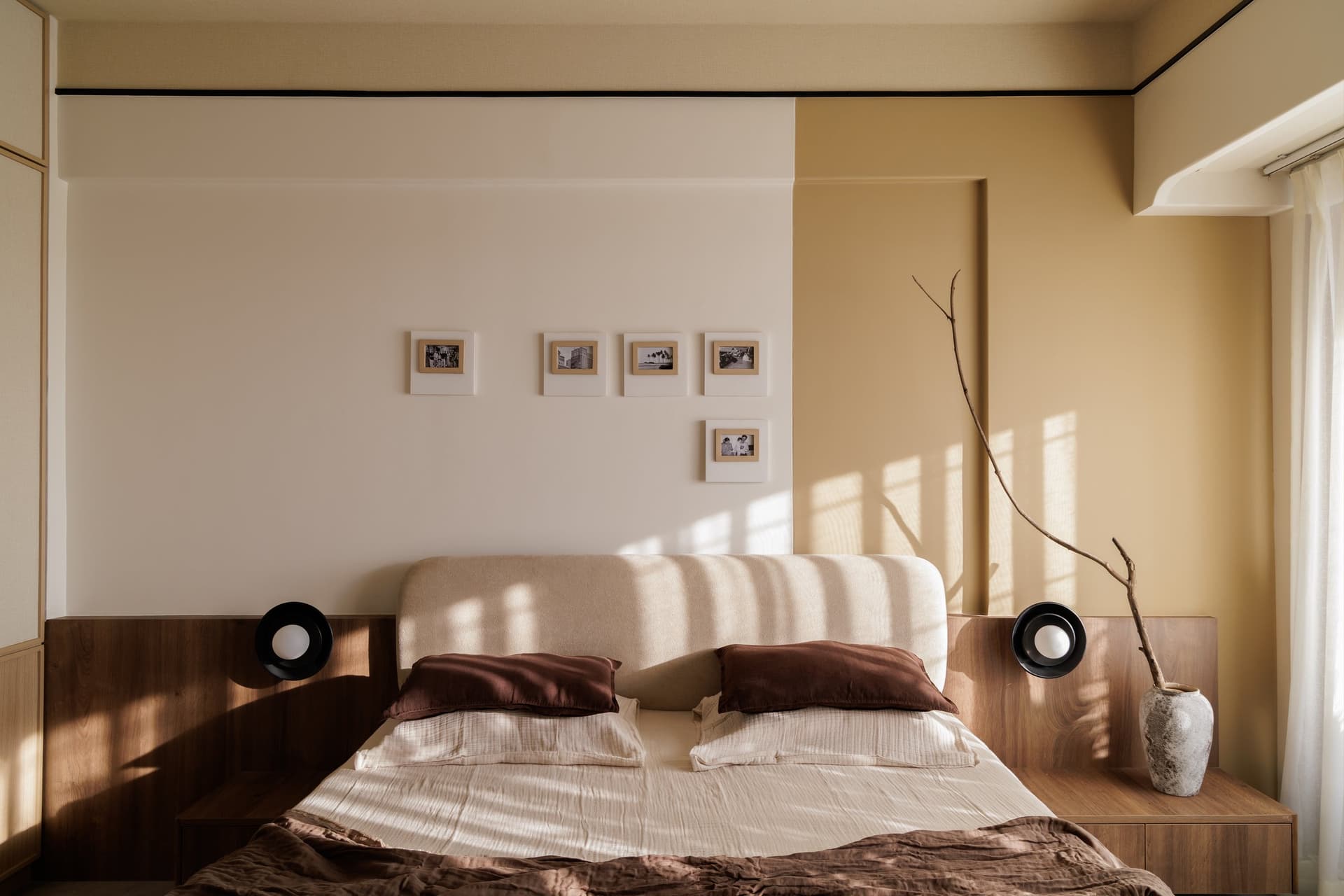
Seen straight-on, the bed becomes the spine of an almost graphic composition. The headboard’s gentle curve plays against the strict horizontal of the wall trim, and the porthole lamps act as visual punctuation, two small dark notes in an otherwise hushed field.
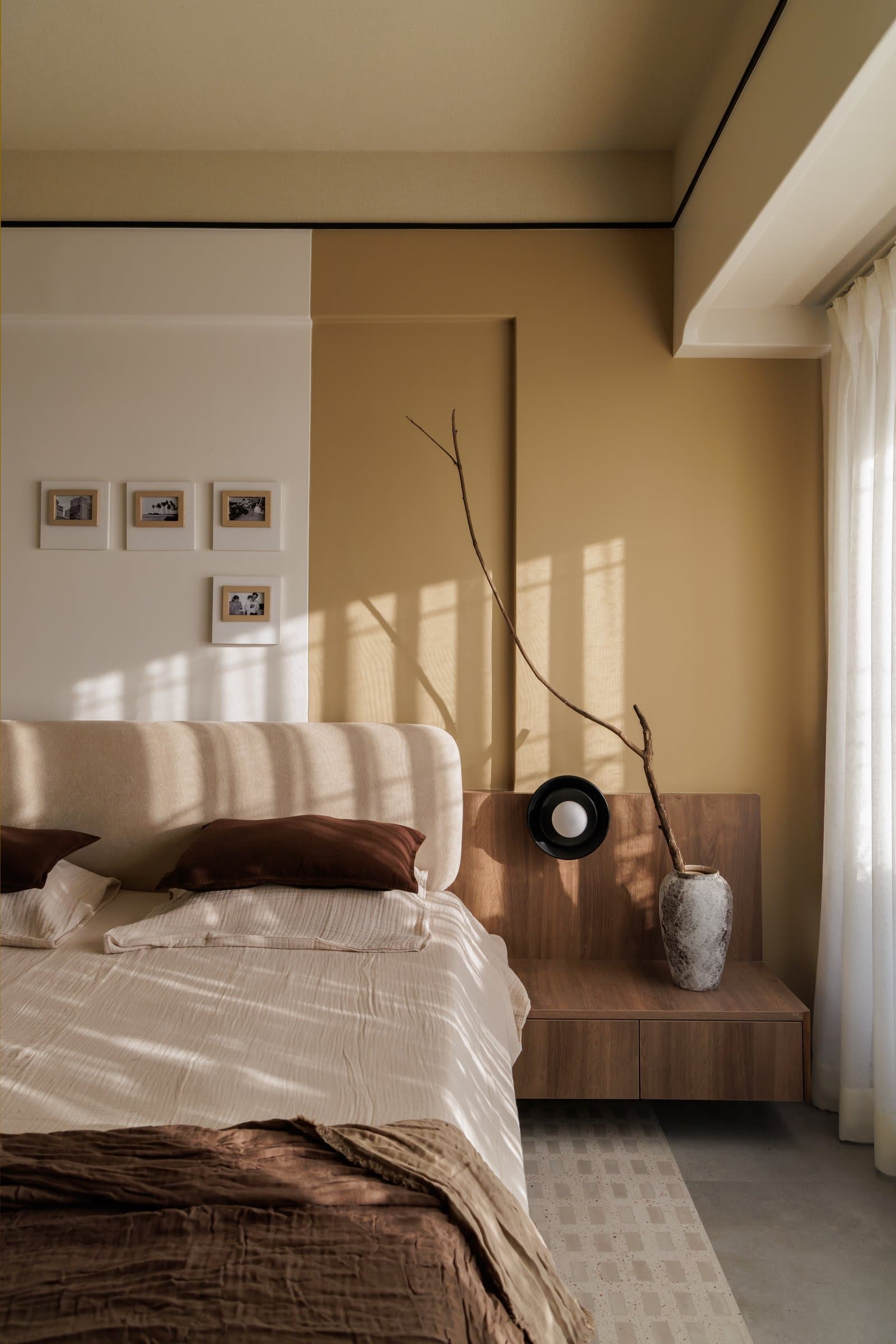
A second view of the same room shows the headboard from an oblique angle, where the cream wall holds the gallery of photographs in an asymmetric drift and the patterned stone floor returns underfoot. The room’s warmth comes not from accumulation but from a few well-considered elements allowed to breathe.
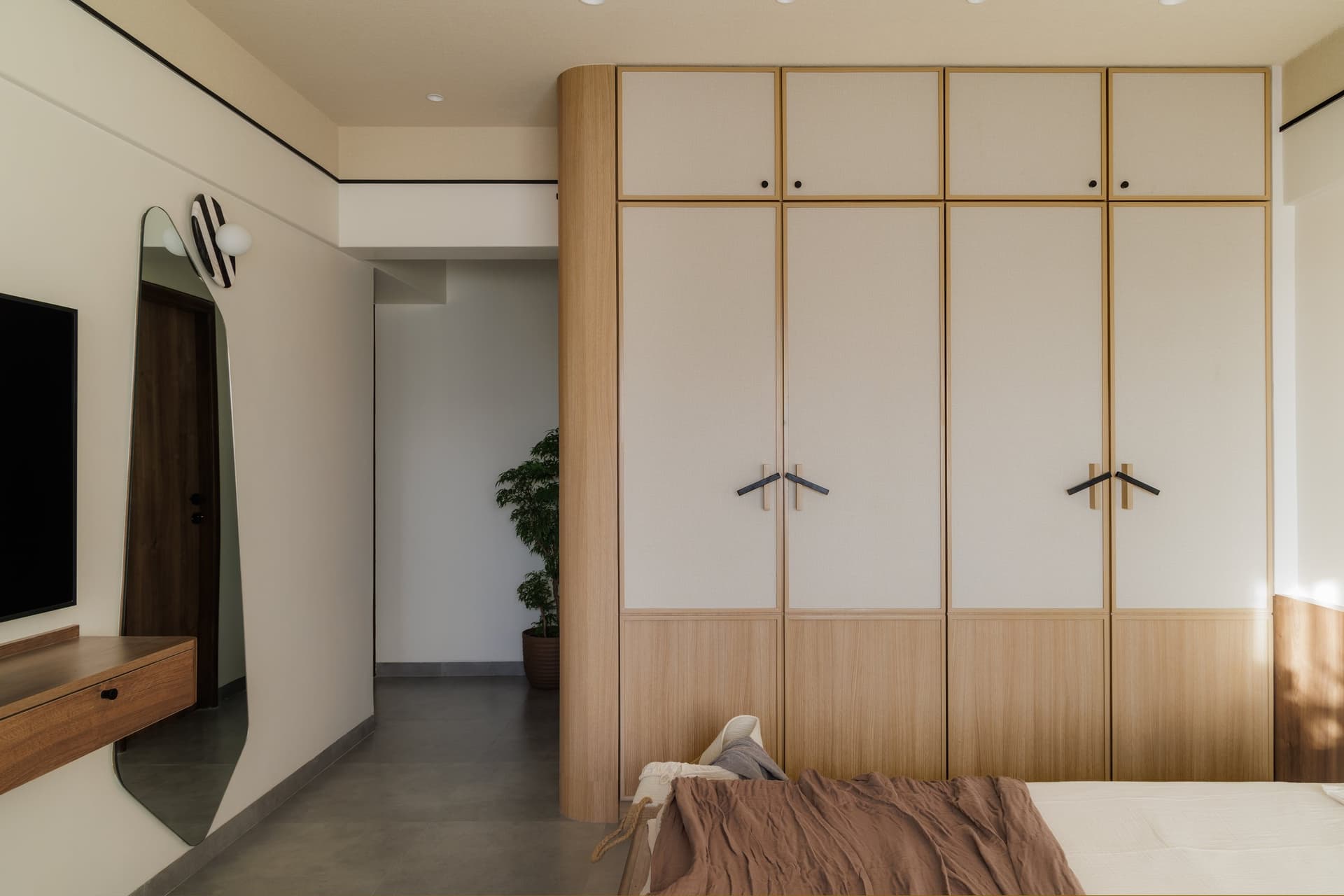
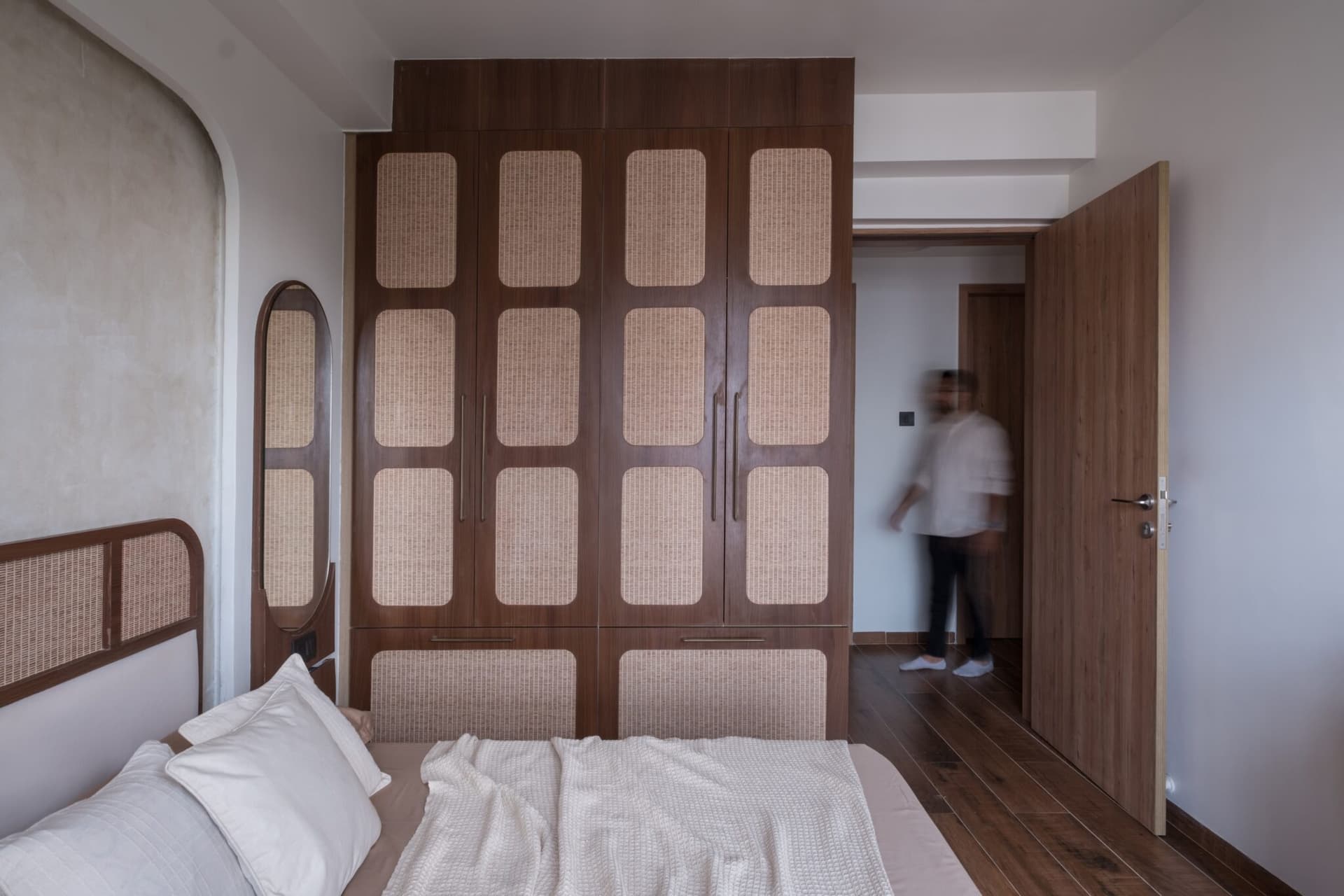
The dressing zone of the bedroom is handled with the same architectural calm. A floor-length irregular mirror is mounted on the wall, paired with a slim walnut console that holds a single drawer, and a tall wardrobe with fabric-panelled doors and a fluted wood base runs the full height of the room.
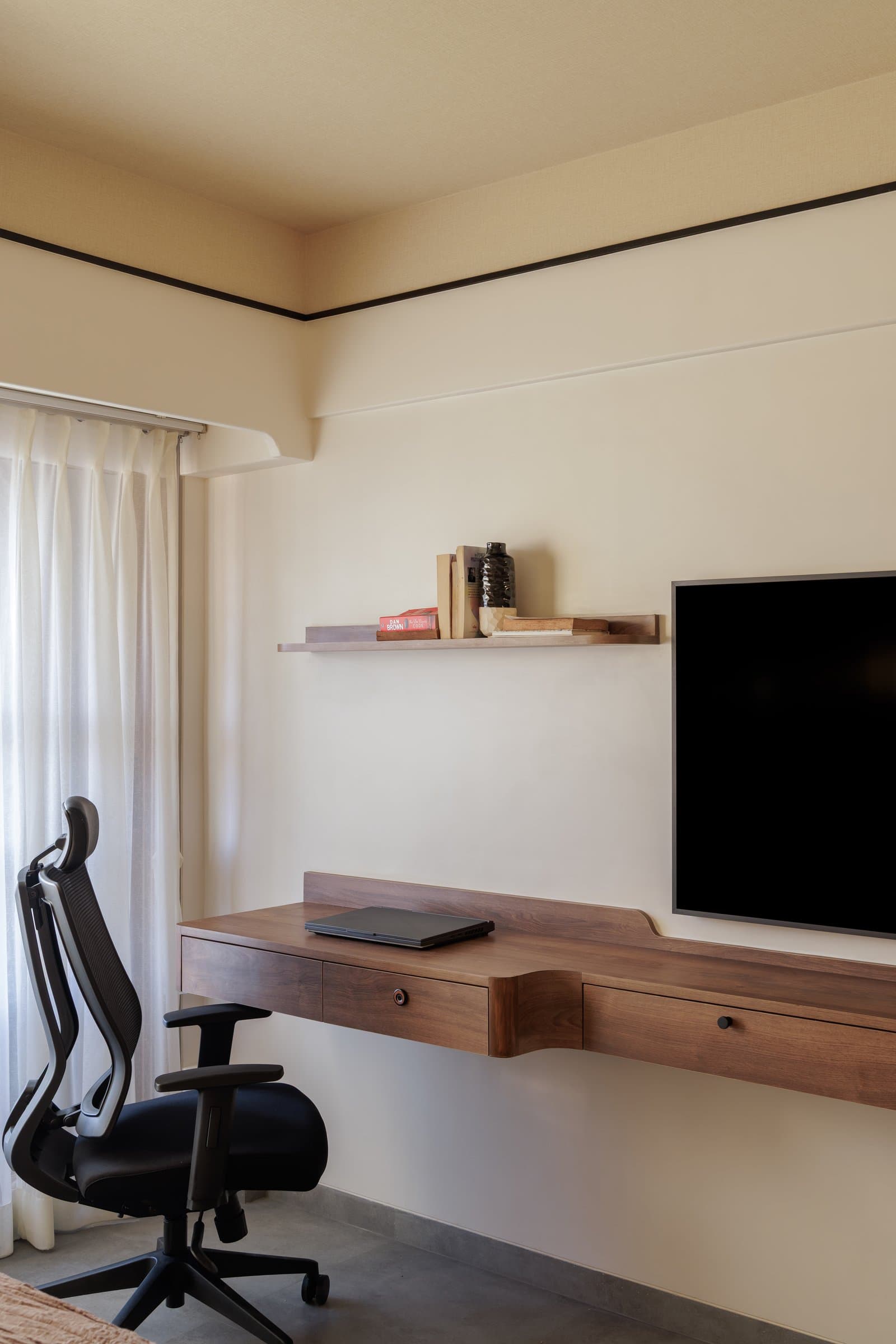
A study niche tucked into the bedroom holds a wall-mounted television and a custom walnut desk that steps gently to accommodate a wall-mounted screen. A floating shelf above carries a small collection of books, and the corner becomes a working space without ever announcing itself as one.
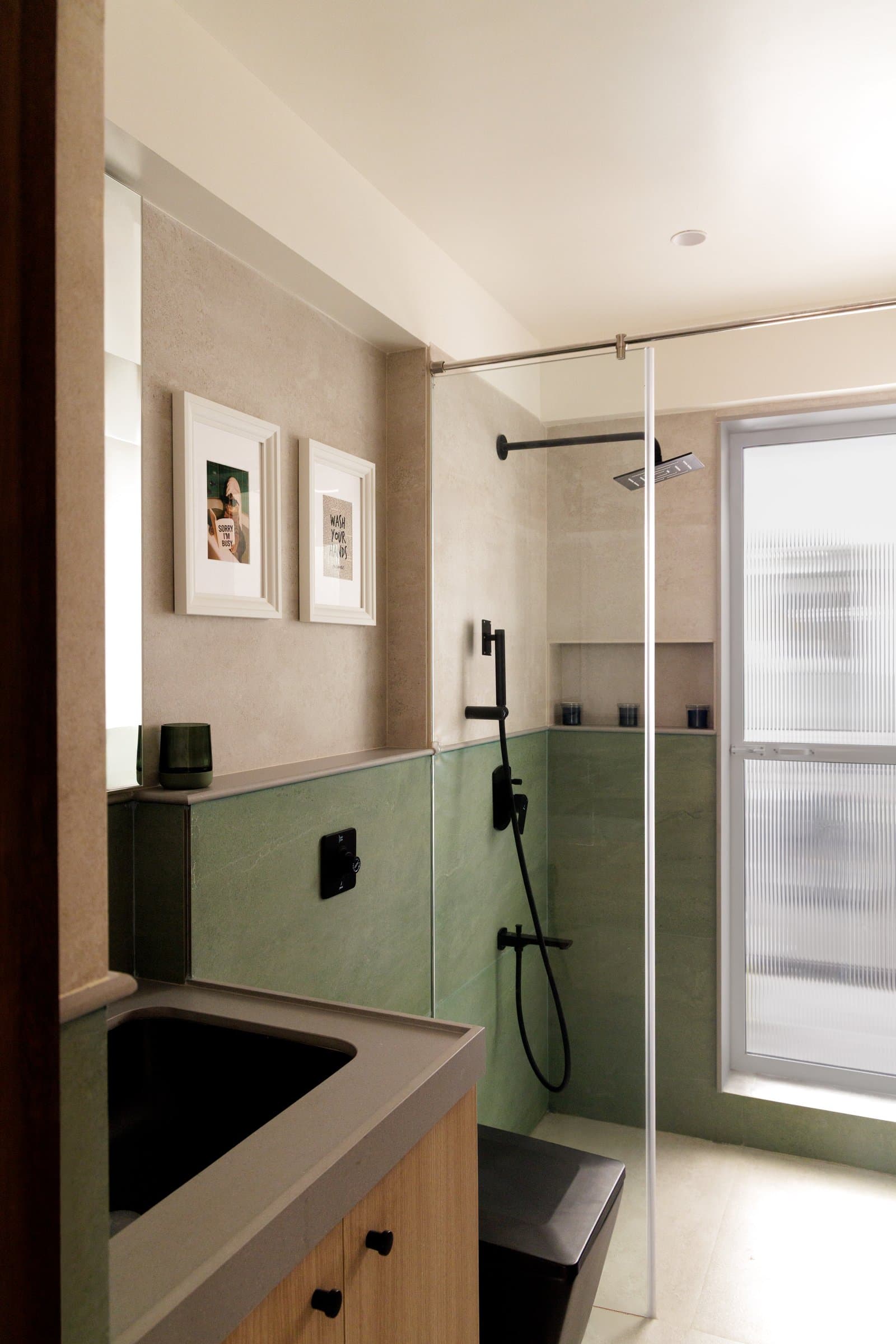
The first bathroom takes a quiet risk with colour. Sage-green tile rises to dado height around the wet zone, paired with a stone counter and matte black fittings, and a pair of small framed prints above the basin keeps the room from tipping into severity.
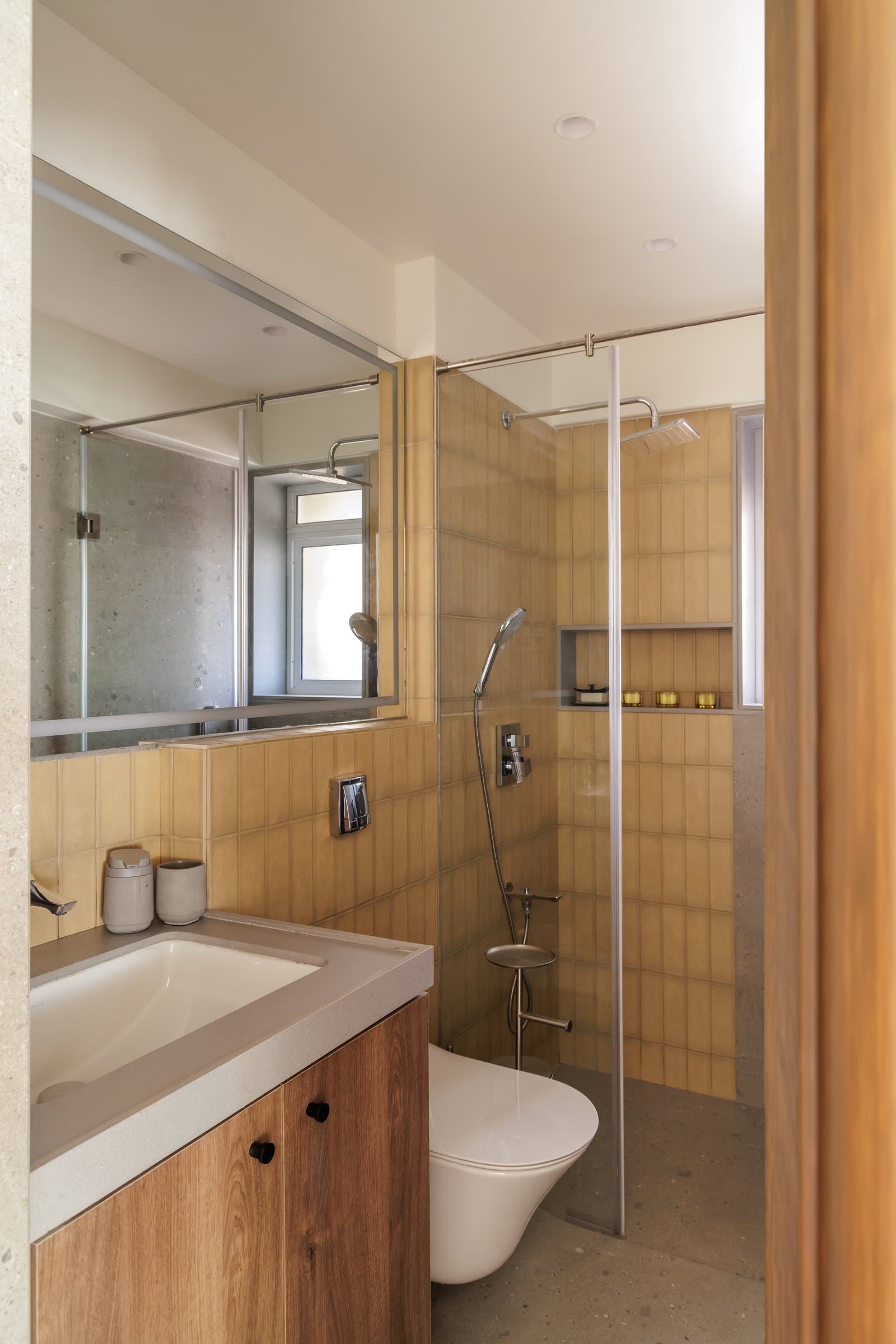
The second bathroom moves in the opposite direction, lined floor-to-ceiling in stacked ochre tile that reads almost terracotta in warm light. A simple stone counter and oak vanity ground the warmth, and the room becomes a small chromatic experiment within a home that otherwise speaks in low tones.
What distinguishes House of EN within the current Mumbai residential landscape is its refusal to chase visual identity through accumulation. The studio has drawn from Japanese spatial discipline without flattening it into pastiche, and the result is a home that feels neither imported nor self-consciously local, but simply considered.
In a city where apartments are increasingly asked to perform maximalism, this one practices a quieter art, the art of leaving room. The home’s argument is made not in any single gesture but in the cumulative weight of restraint, and that, in the end, is what makes it worth returning to.