There are homes that perform their surroundings, and there are homes that quietly submit to them. Along the northern Egyptian coast, where the elemental language of sea, sand, and wind writes the ambient script, this residence by Yasmina Makram chooses submission, not as a passive gesture, but as a considered design position. The palette of handmade terracotta, travertine, and Rosa Portugal marble is less a selection than an argument: that atmosphere, not architecture alone, shapes how a home is inhabited.
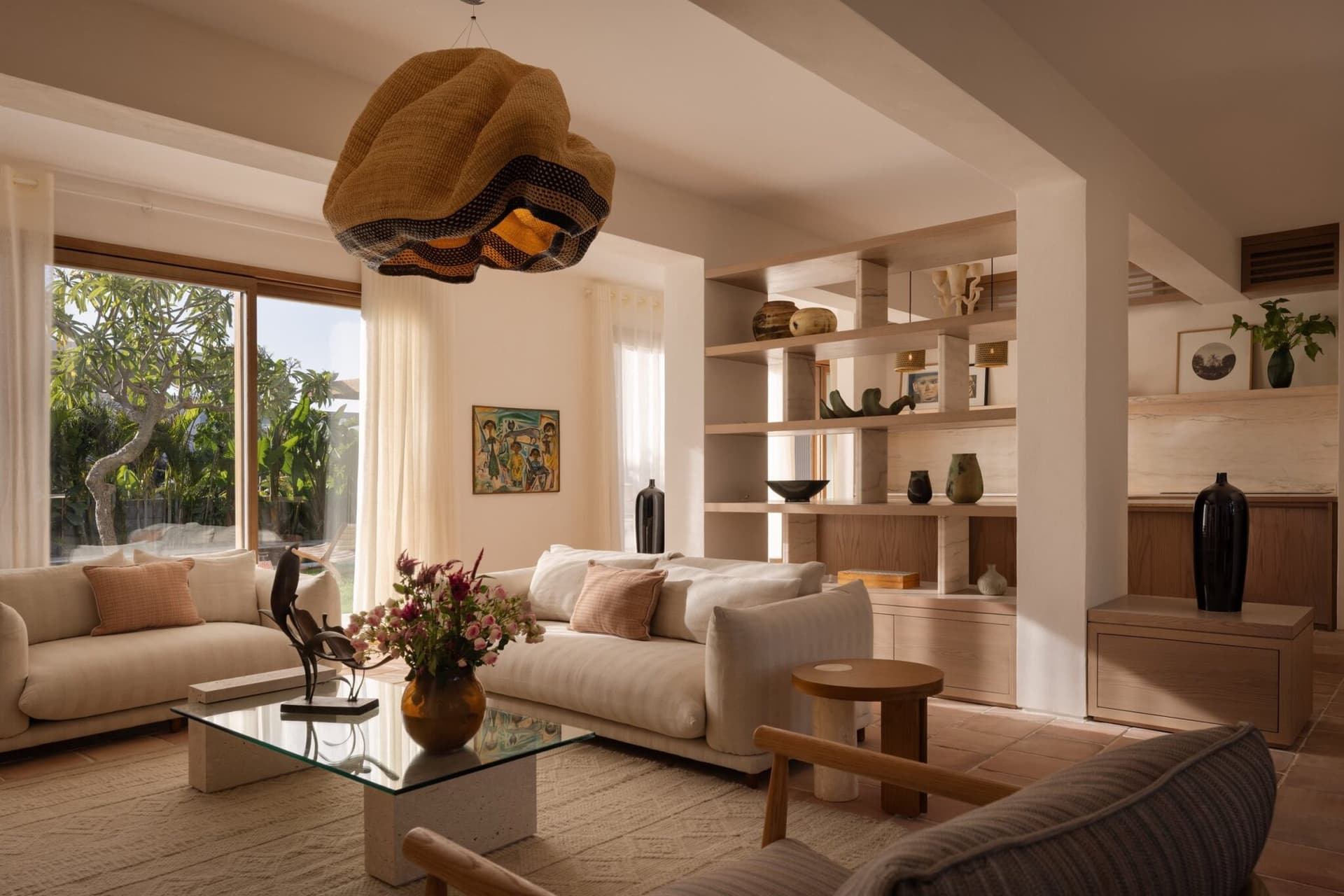
The living room resolves itself around a low glass coffee table set on a honed stone base, its transparency allowing the terracotta floor to remain the room’s tonal anchor. Two cream sofas face each other beneath a hand-woven pendant whose scale is generous but never assertive, and a light oak shelving unit performs the quiet work of division without enclosure. Sliding glass doors open the room to a leafy garden, and the afternoon light does the rest, warm, unhurried, allowed to fill the space on its own terms.
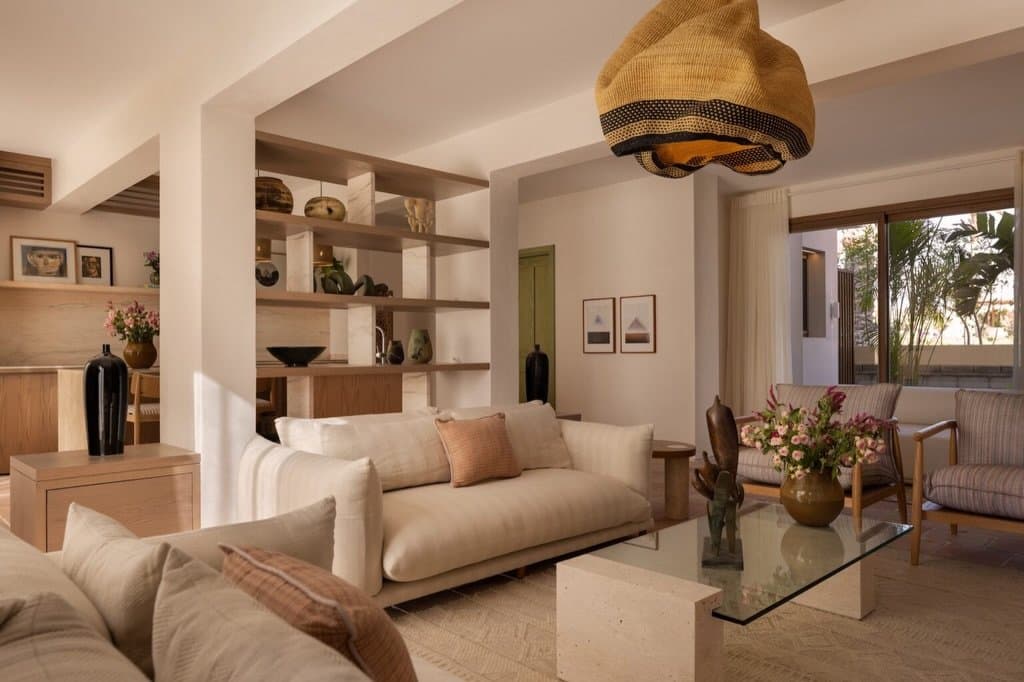
Seen from another angle, the same seating arrangement reveals its layered intelligence. Rust-toned cushions and patterned textiles introduce warmth without disturbing the room’s tonal calm, while the shelving unit, holding ceramics and small sculptural objects, reads as an inhabited threshold rather than a piece of furniture. The rattan pendant grounds the composition from above, its tactility a deliberate counterpoint to the smoothness of plastered walls. Nothing insists on being noticed, yet everything holds its place with quiet conviction.
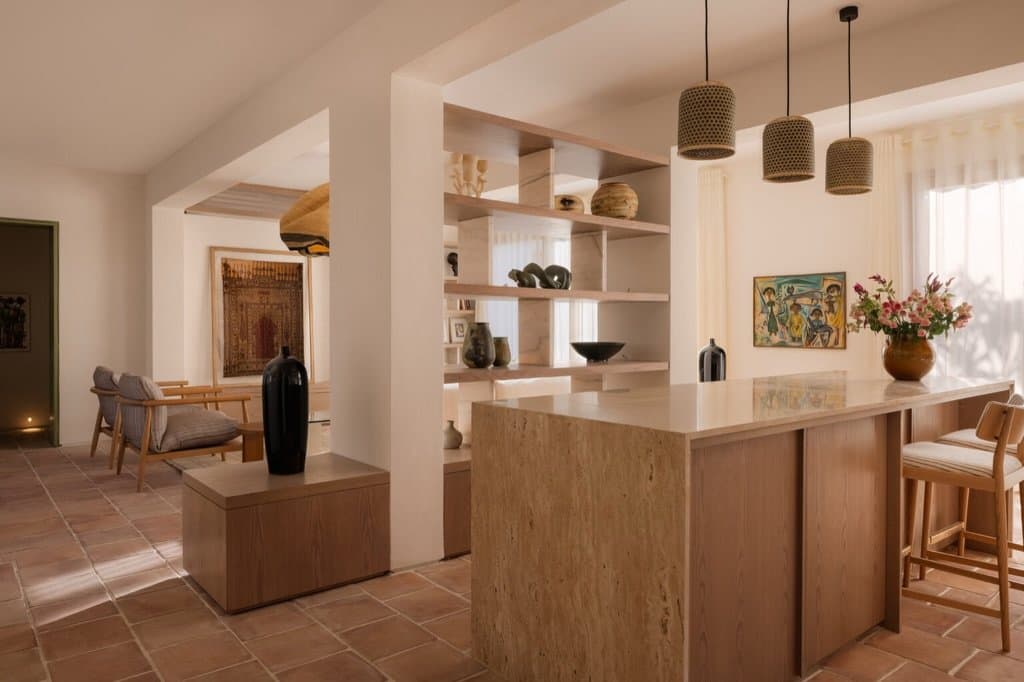
In the kitchen, a travertine-clad island anchors an open plan that bleeds seamlessly into the dining and living zones, all unified by the handmade terracotta underfoot. The rough-textured stone base pairs with a smoother pale countertop, and three cane pendants hang low over bar stools in a rhythm that feels instinctive rather than staged. Behind, a floating shelving unit filled with Fayoum ceramic vessels operates as a soft divider, a gesture that lets the eye travel while still articulating spatial boundaries with restraint.
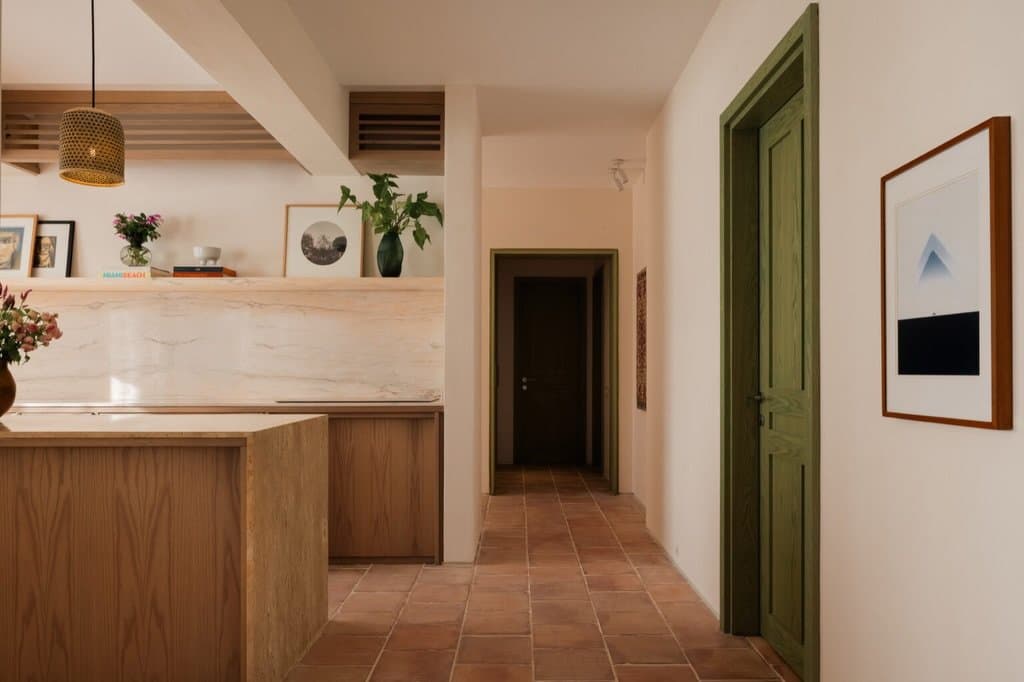
A corridor floored in handmade terracotta draws the eye past a kitchen island with a travertine-veined backsplash and toward a dark door at the far end. On the right wall, a bright green painted door interrupts the neutral palette, the same recurring gesture, appearing again as a subtle marker of memory. Soft daylight washes the space evenly, and the interplay of terracotta warmth, honed travertine, and the linear grain of wood cabinetry captures the home’s material thesis in a single, uncluttered frame.
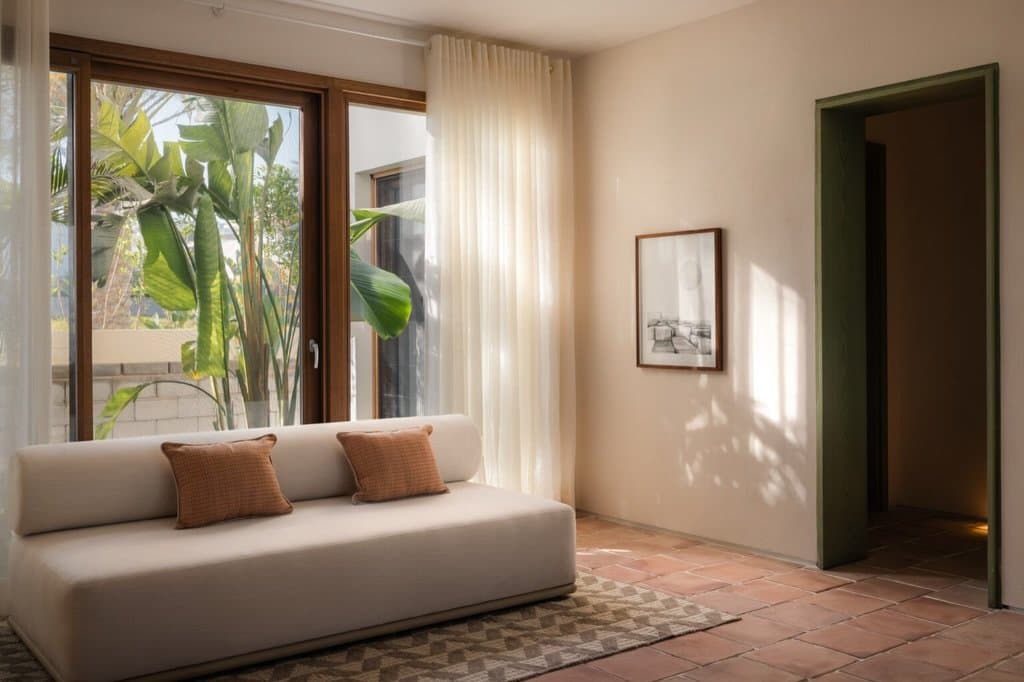
A quieter corner extends the home’s grammar of stillness. A low upholstered daybed, dressed in rust-toned pillows, sits against a timber-framed window through which sheer curtains diffuse the light into soft striped shadows across the plaster and terracotta. Beside an open doorway, painted a deep olive green, hangs a single small photograph, an unforced note of memory in an otherwise neutral field. It is here that the recurring green doors, drawn from traditional Egyptian homes, begin to speak most clearly: as markers of nostalgia, reinterpreted with contemporary economy.
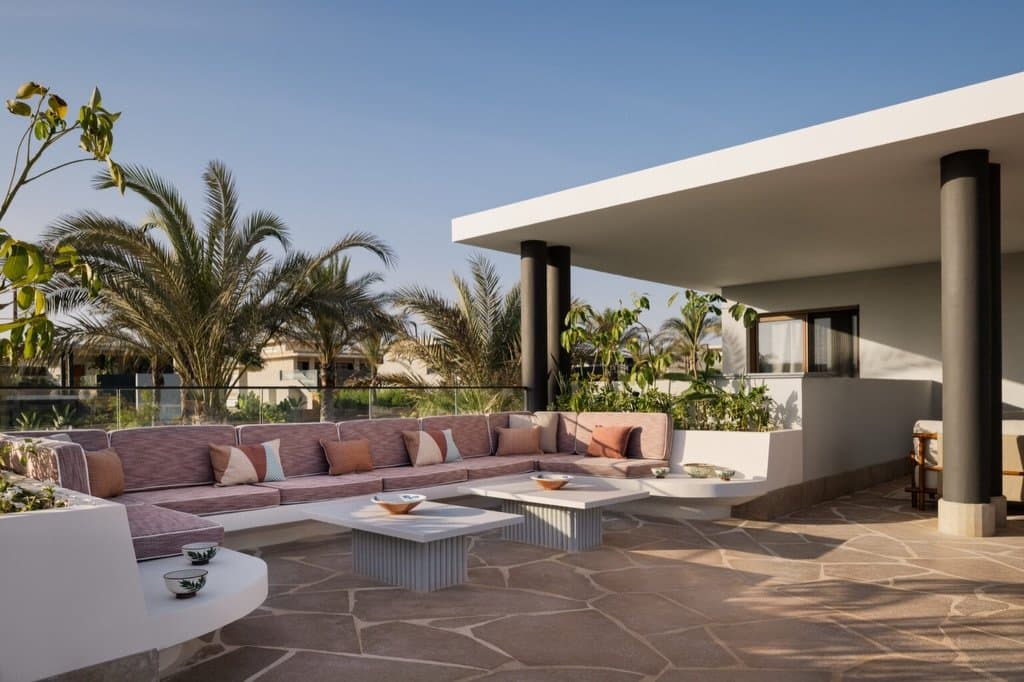
Upstairs, a covered rooftop terrace opens onto a long perimeter sectional in dusty rose, arranged around a pair of low rectangular fluted tables. Slender black columns support a crisp white overhang, framing palm fronds and a glass balustrade beyond, while irregular flagstone underfoot carries the tactile logic of the interiors into open air. Late-day sun rakes across the space, casting long architectural shadows, and the softness of the upholstery against the geometry of the columns produces a calibrated balance of ease and structure.
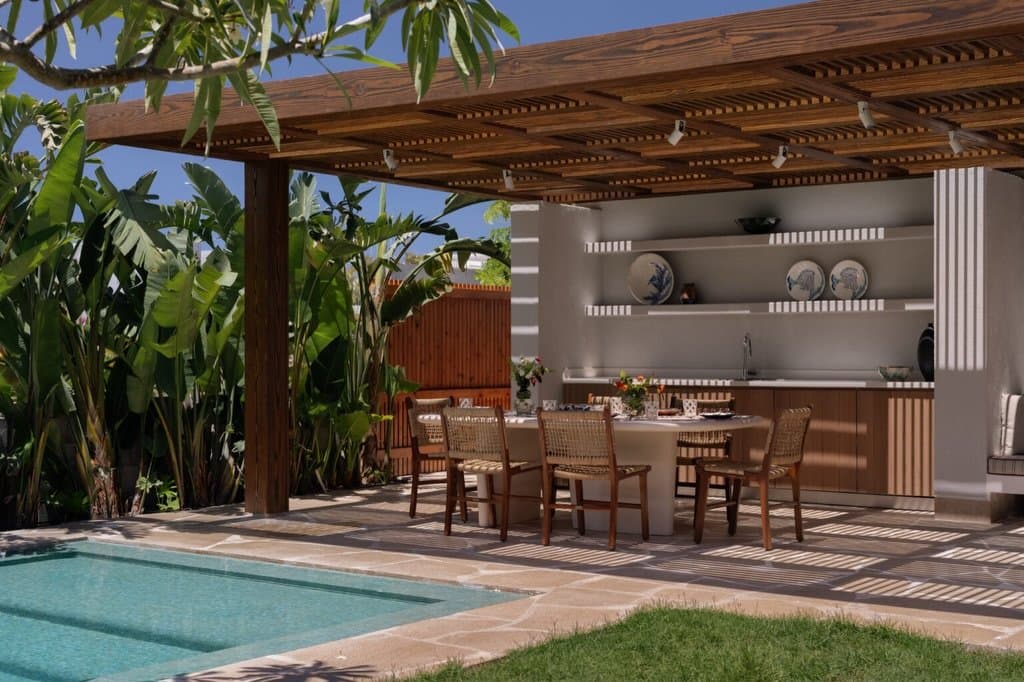
Beside the pool, a slatted timber pergola stretches across an outdoor dining and kitchen area, filtering the sun into rhythmic linear shadows over the stone floor. A round dining table set with plates and greenery is flanked by rattan-backed chairs, with an open display of ceramics behind, a domestic still life carried outdoors. Tropical foliage frames one edge, the turquoise pool the other, and the composition holds the same tonal discipline as the rooms within: warmth and green and stone in quiet, unforced conversation.
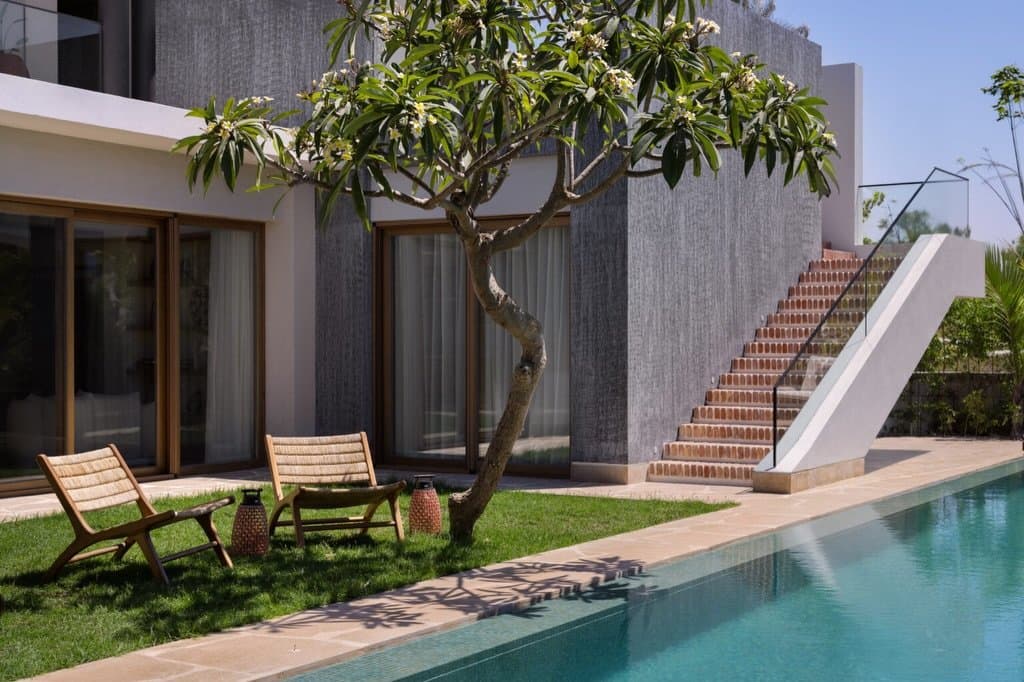
From the garden, the architecture reveals its material intent. A textured grey facade rises behind a narrow lap pool, punctuated by a terracotta-tiled staircase angling toward an upper terrace, a small procession that ties the vertical volumes to the earthiness of the interiors. In the foreground, two wooden lounge chairs rest on a strip of lawn beneath a mature frangipani in bloom. The composition balances hard geometry against organic form, and the tree, in its slow seasonal rhythm, becomes as much a design element as the ribbed stone behind it.
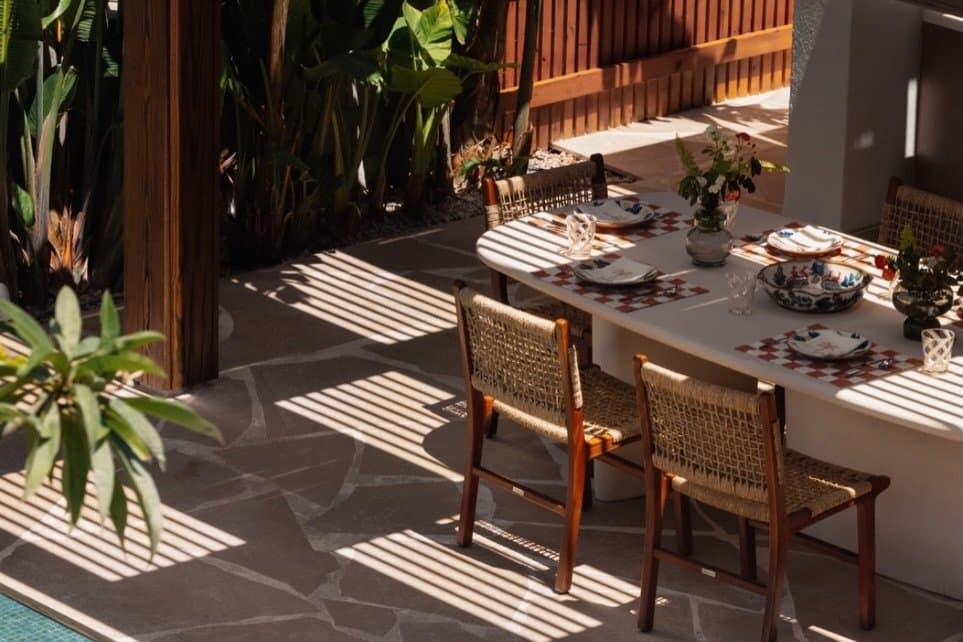
The dining terrace closes the sequence with a scene of quiet ceremony. A long white-topped table is set with patterned ceramic plates, glassware, and small floral arrangements, its Akhmim-woven surroundings and cane-seated chairs registering as inheritances rather than embellishments. Overhead, the wooden pergola stripes the midday sun across irregular flagstone; foliage crowds one edge of the frame. What lingers is not the object list but the atmosphere, a residence that draws from sea, sand, and craft to arrive at a sense of place both contemporary and unmistakably its own.