AThe contemporary Indian bungalow often finds itself caught between two impulses. One looks outward, towards a global language of clean lines and open plans; the other remains tied to older ways of living that continue to shape family life long after the forms themselves have disappeared. In smaller Maharashtrian cities, where memory and daily routine still carry considerable architectural weight, the most successful houses are rarely those that reject tradition, but those that understand how to reinterpret it.
Swasti Sudeep, a 2,000 square foot residence in Satara designed by Kshitij Mahajani Architects, belongs firmly to the latter category. Completed in 2026, the house takes cues from the spatial logic of the Maharashtrian wada, borrowing its sense of inwardness, its hierarchy of gathering spaces, and its finely calibrated relationship between privacy and community. Elements such as the central courtyard, turned timber columns, and devali niches appear not as decorative quotations but as part of a broader architectural continuity. The result is a home that feels unmistakably contemporary while remaining anchored to the cultural and climatic realities of its setting, a reminder that regional architecture need not choose between memory and modernity.
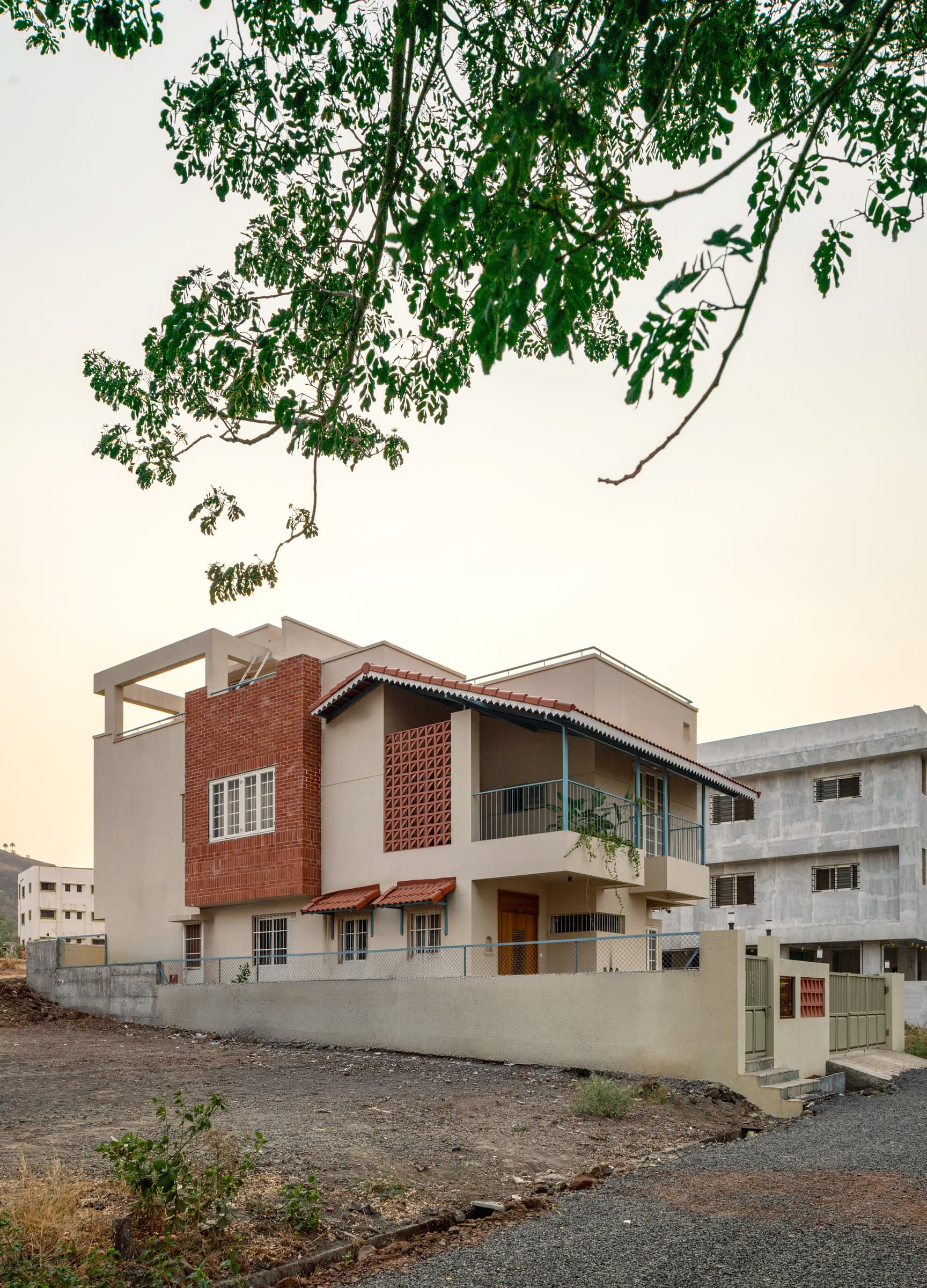
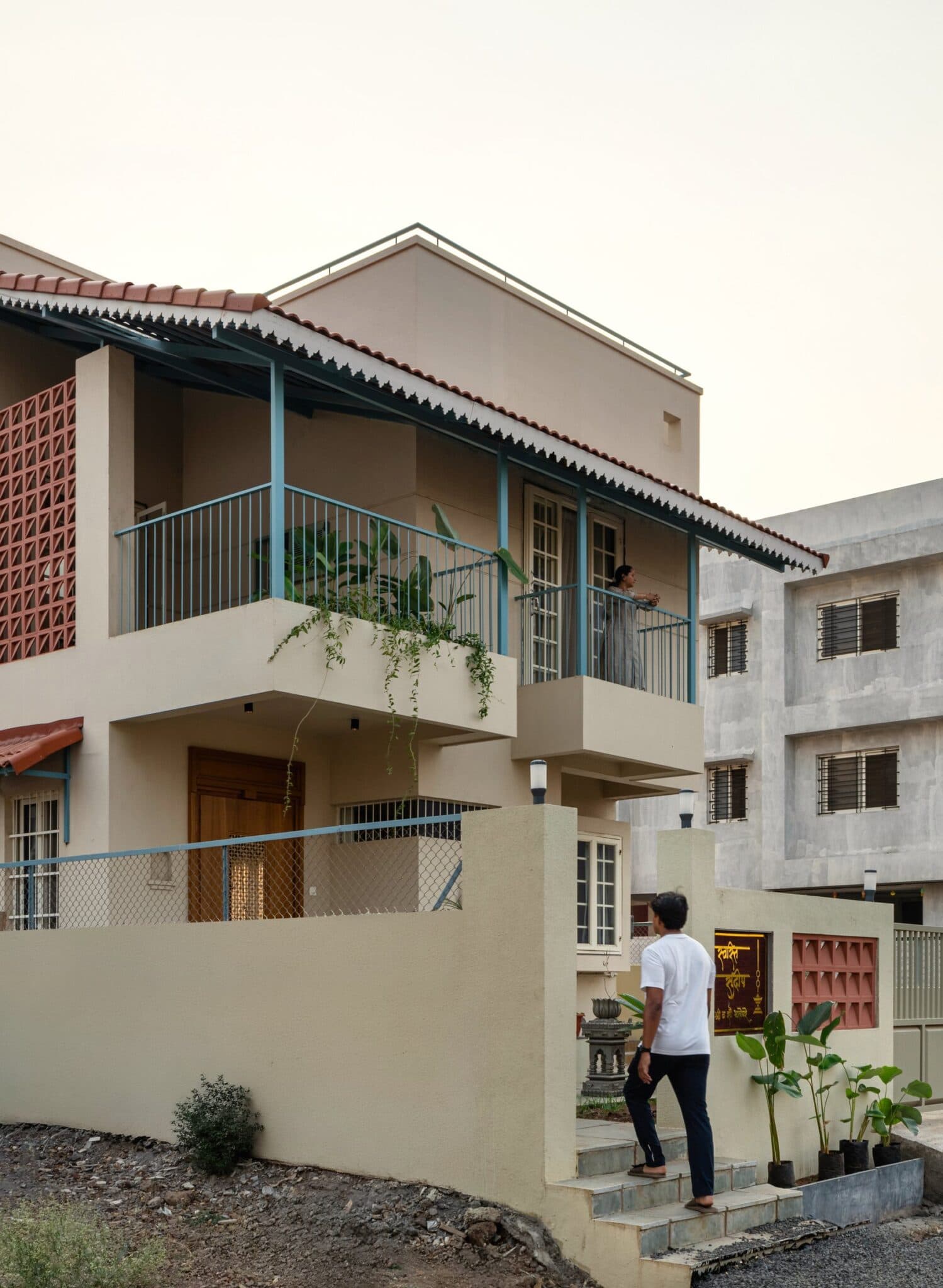
From the street, the bungalow presents itself as a measured dialogue between past and present. A composition of cream stucco volumes is anchored by a tall brick element and softened by a perforated terracotta jaali that casts shifting patterns of light and shadow across the upper floor. The architecture avoids overt gestures, relying instead on proportion, material contrast, and carefully framed openings to establish its presence. The pitched Mangalore-tile awning, supported by teal-painted steel members, offers the project’s most direct reference to the region’s architectural lineage, grounding an otherwise contemporary composition in the familiar language of Maharashtrian domestic architecture.
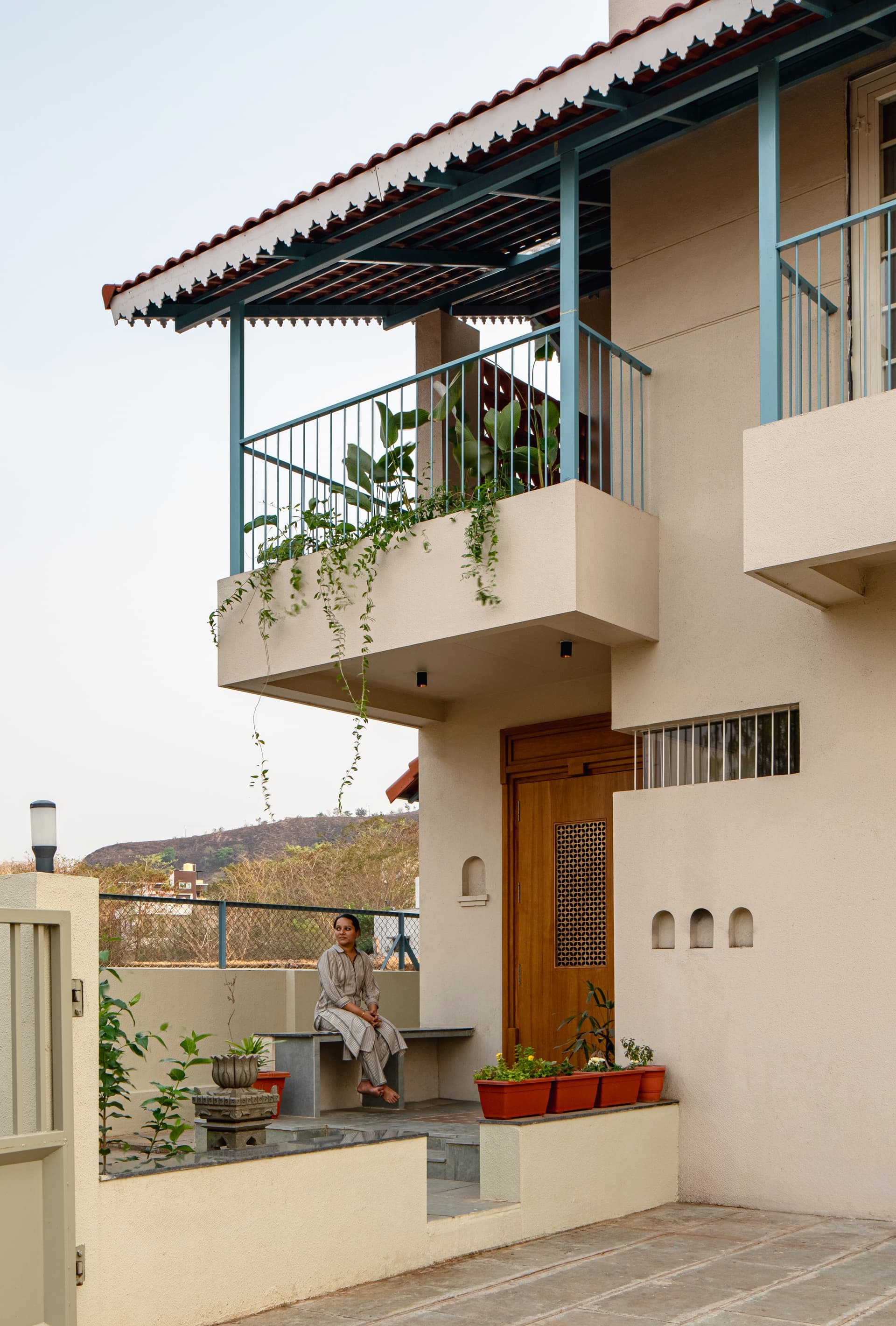
The approach sequence is unhurried: a low compound wall, a small landscaped strip, a brass-lettered nameplate set into a panel of the same terracotta grid that punctuates the façade. The house does not perform arrival; it simply makes room for it.
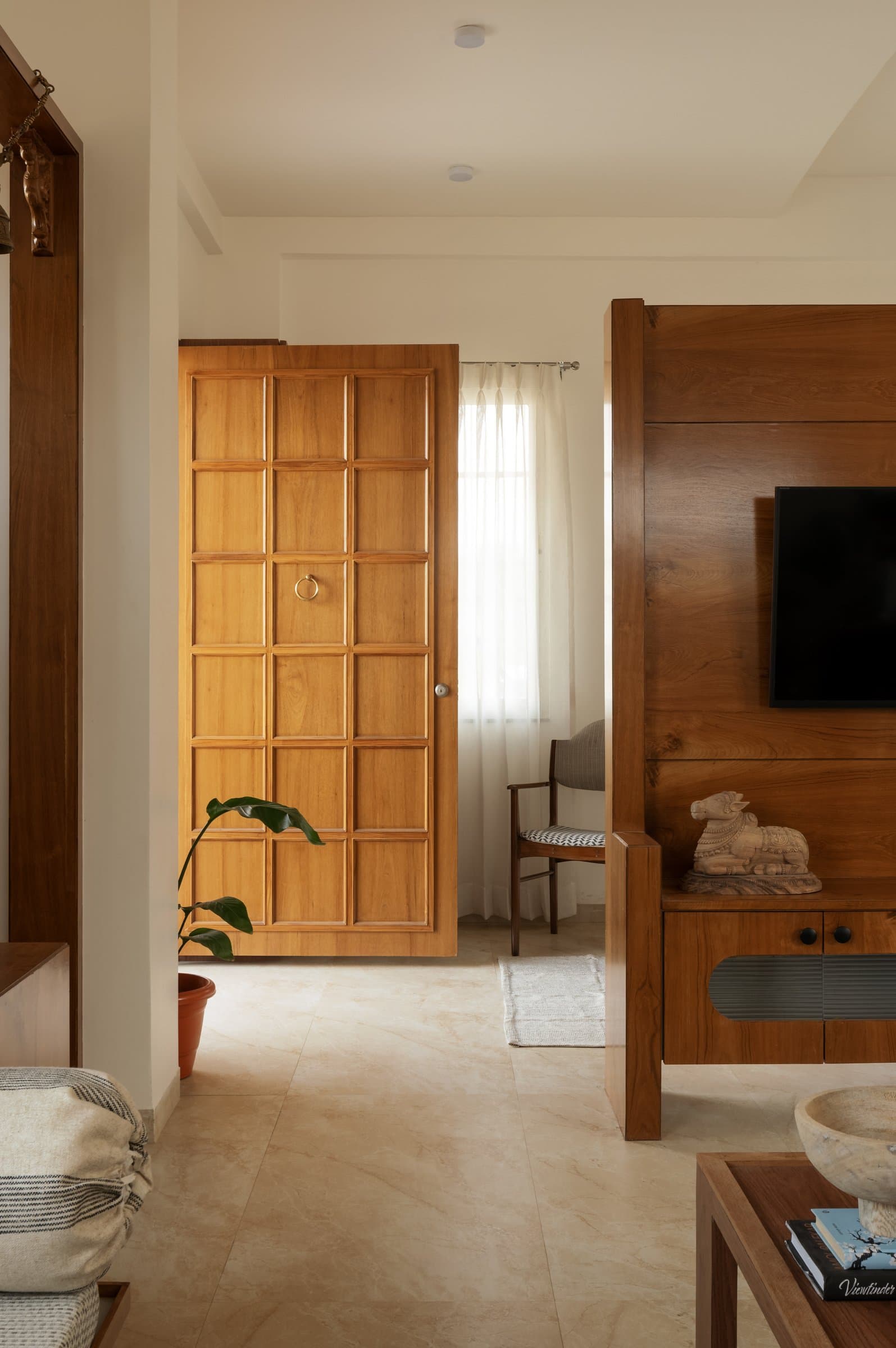
The foyer introduces the home’s design language with quiet clarity. A coffered timber entrance door, its recessed panel detailing recalling the weight and craftsmanship of traditional Maharashtrian homes, opens onto a restrained palette of pale stone and warm wood. Opposite, a low timber console topped with a small Nandi sculpture serves as a subtle cultural marker rather than a decorative statement.
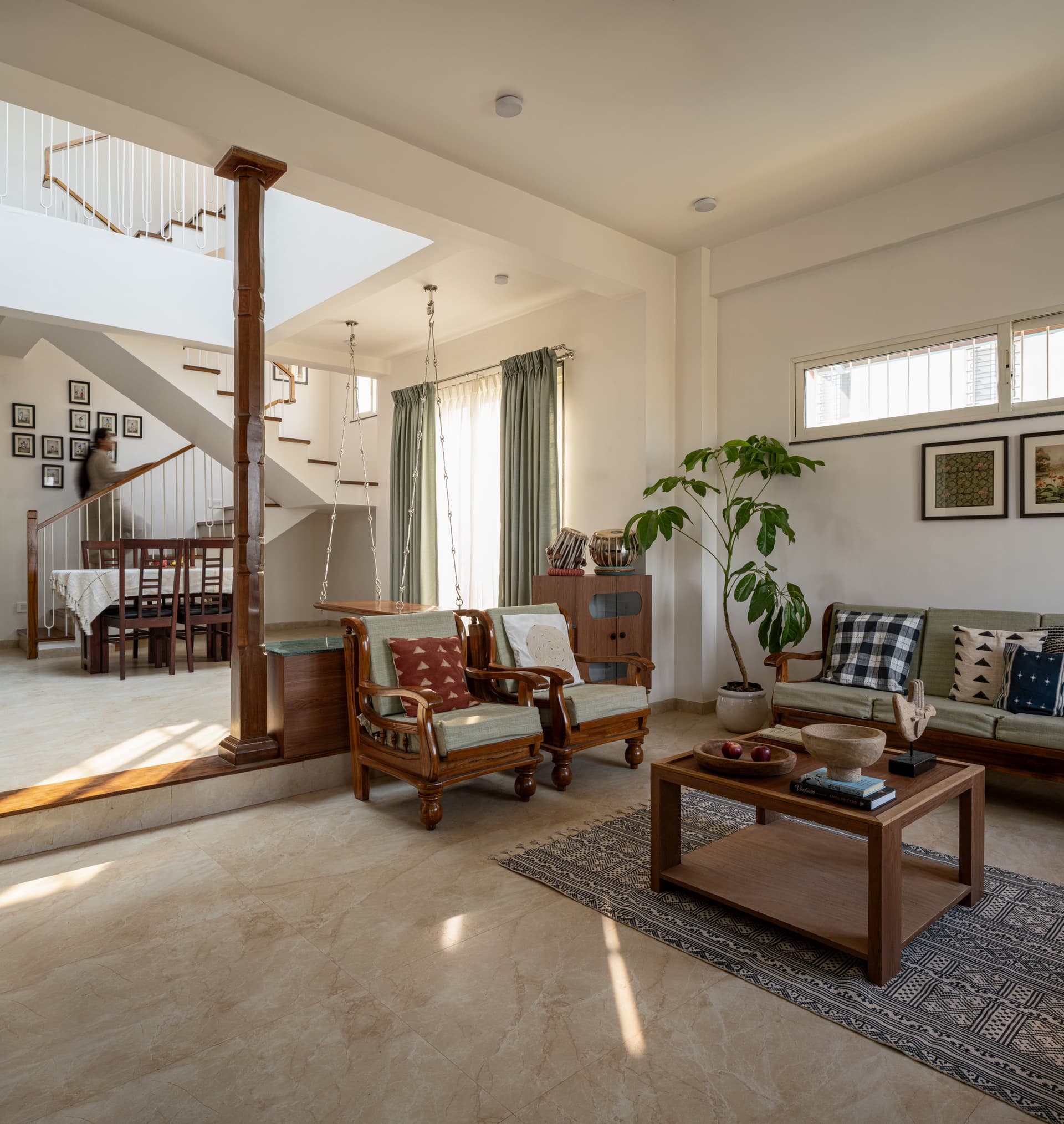
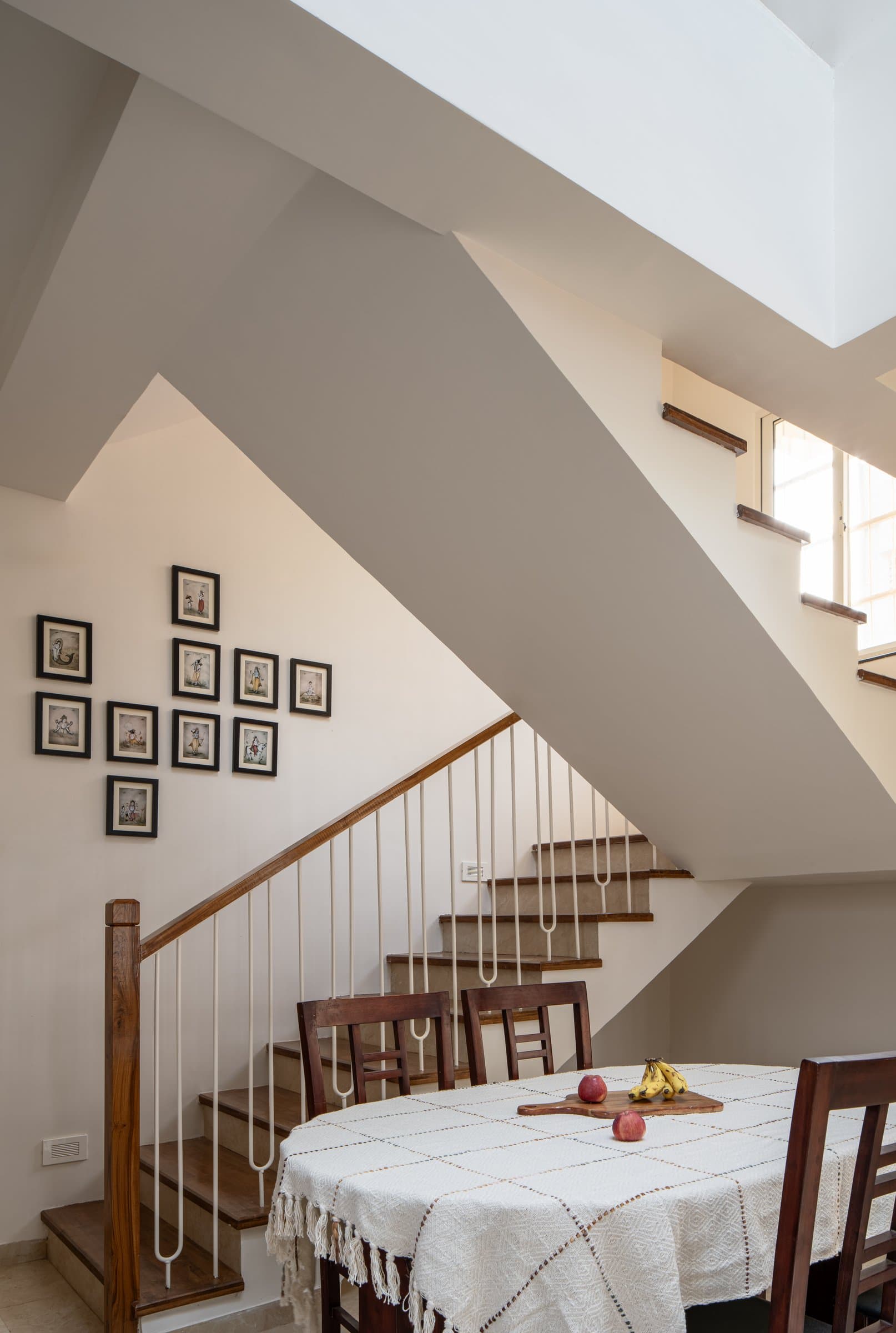
The living room is the home’s central social statement, and its anchor is the turned wooden column that holds the double-height volume above. Around it, the studio has assembled a room of distinctly Indian sit-down comfort: a low wooden swing suspended on chains, a pair of wooden armchairs with sage cushions, a longer sofa against the wall, and a framed gallery climbing the staircase beyond.
What the room refuses is the contemporary instinct toward upholstered bulk. Every seat has visible wooden structure; the cushions are restrained, the rug graphic but quiet.
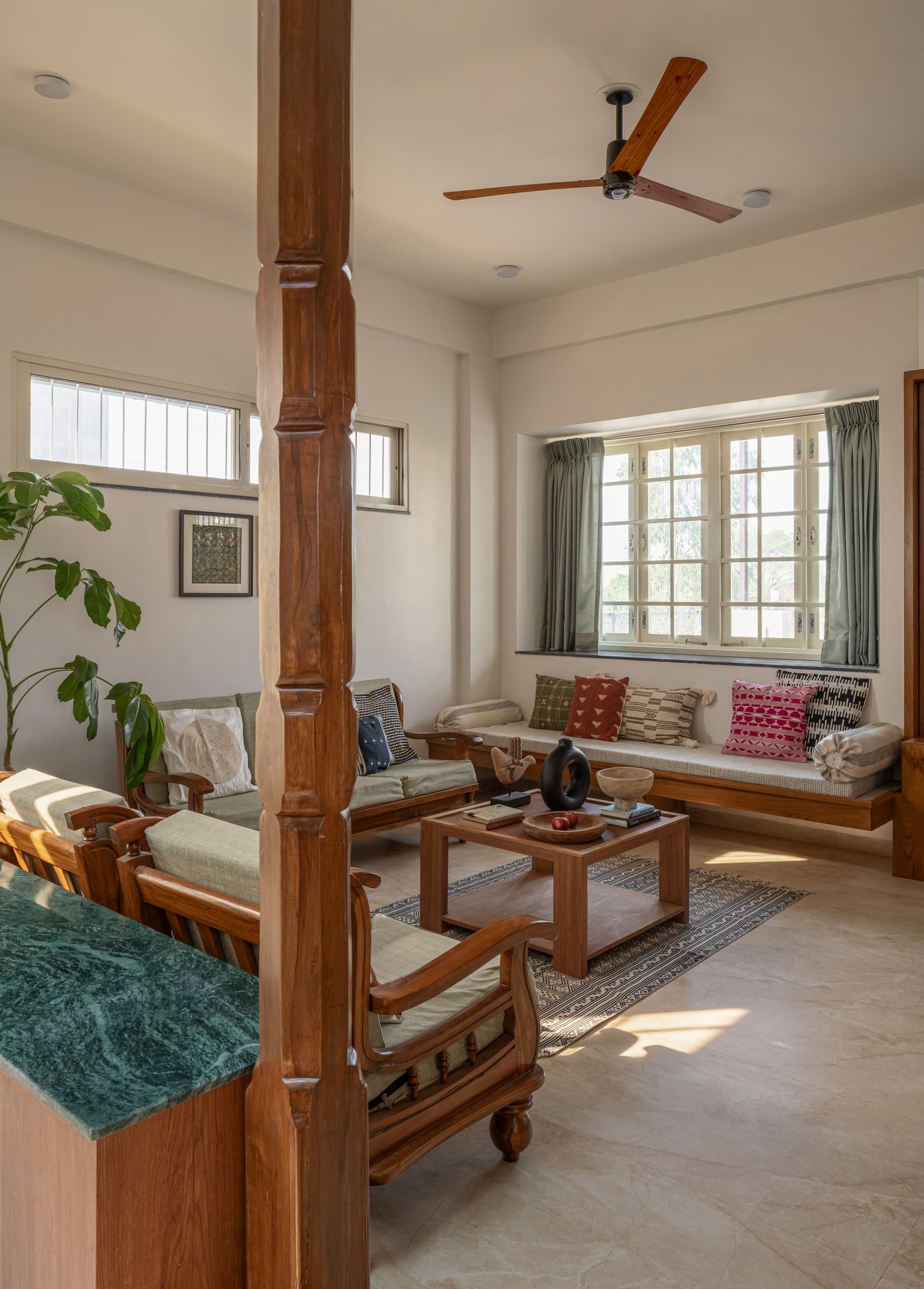
Viewed from the opposite end, the room reveals the home’s spatial thinking with greater clarity. A built in window seat set beneath a broad divided light window captures the gentlest light of the day, creating an informal corner for reading, conversation, or simply watching the street beyond. The cushions layered across it in shades of cream, cherry, and charcoal introduce a restrained yet distinctly Indian note of colour, one that quietly enriches the otherwise muted palette.
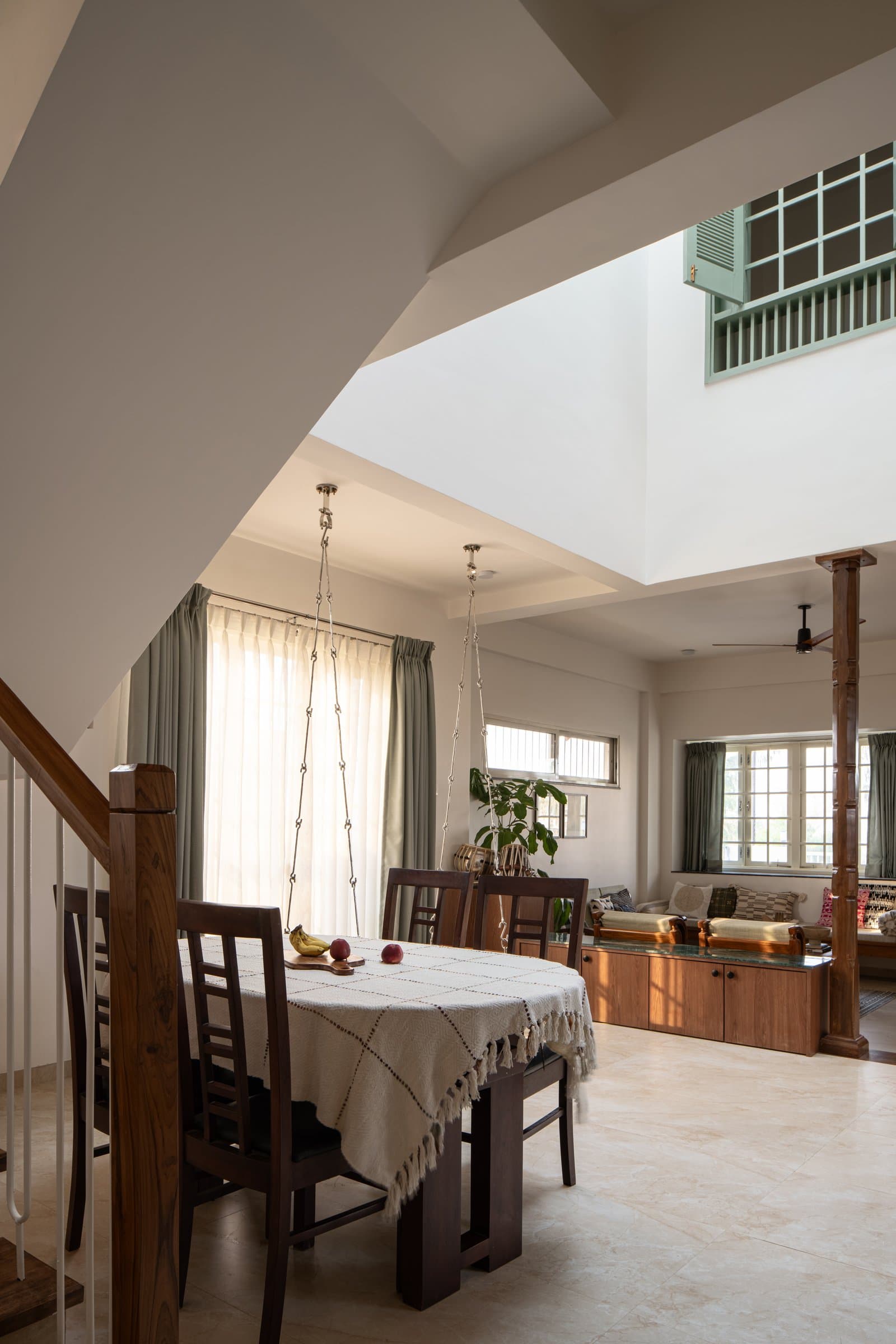
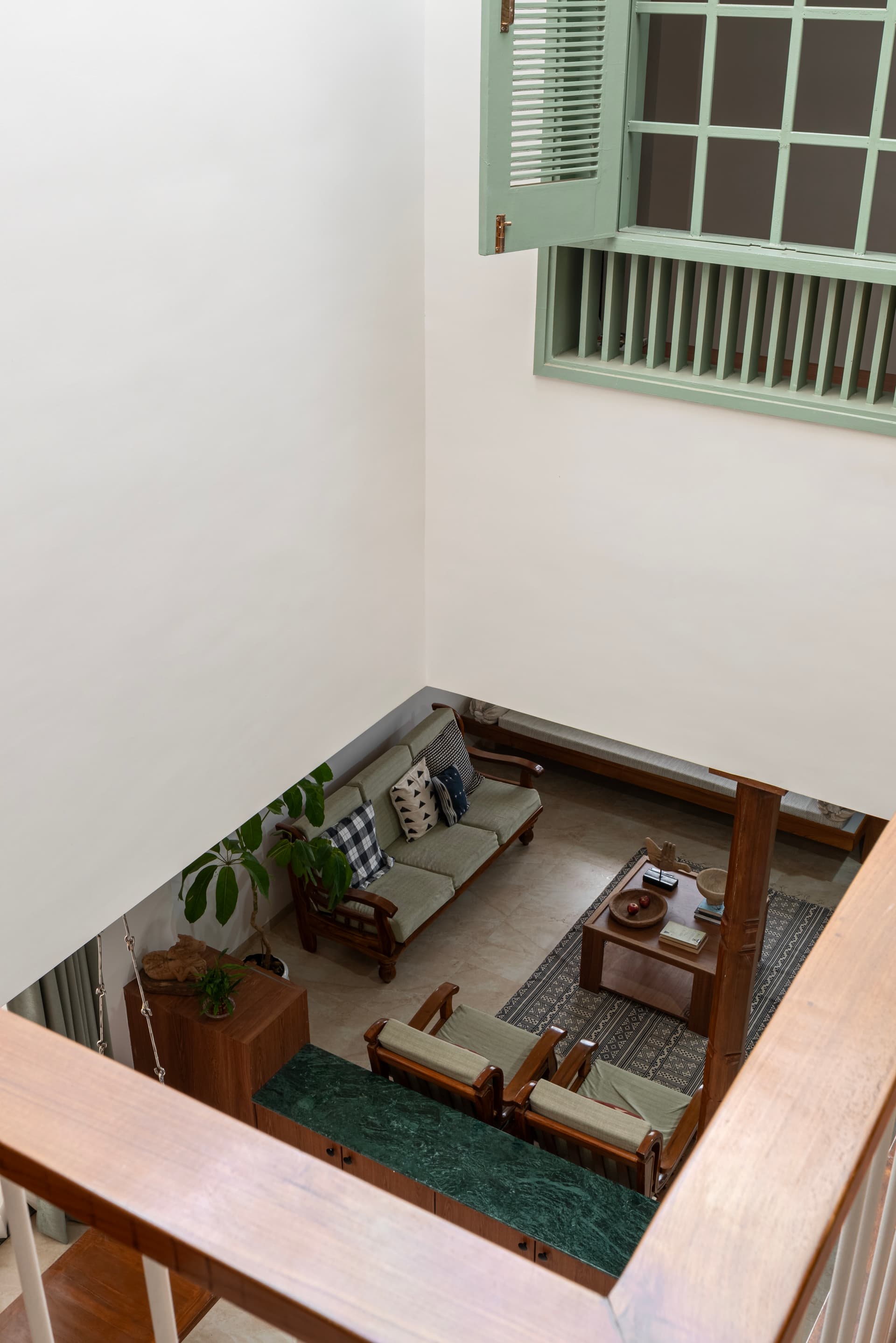
A gentle change in level signals the transition from the living area to the dining space, where the architecture begins to open vertically. Here, the ceiling rises into a double height volume anchored by a skylight above, drawing daylight deep into the centre of the house. The dining table occupies this luminous core, while a traditional swing suspended alongside introduces a sense of informality and movement to the space.
Overlooking the void, an internal window fitted with mint green louvred shutters creates a visual connection between floors, recalling the layered spatial relationships of older Maharashtrian homes. Together, the skylight, swing, and overlooking window transform the dining area into more than a place for meals, establishing it as the social and architectural centre of the house.
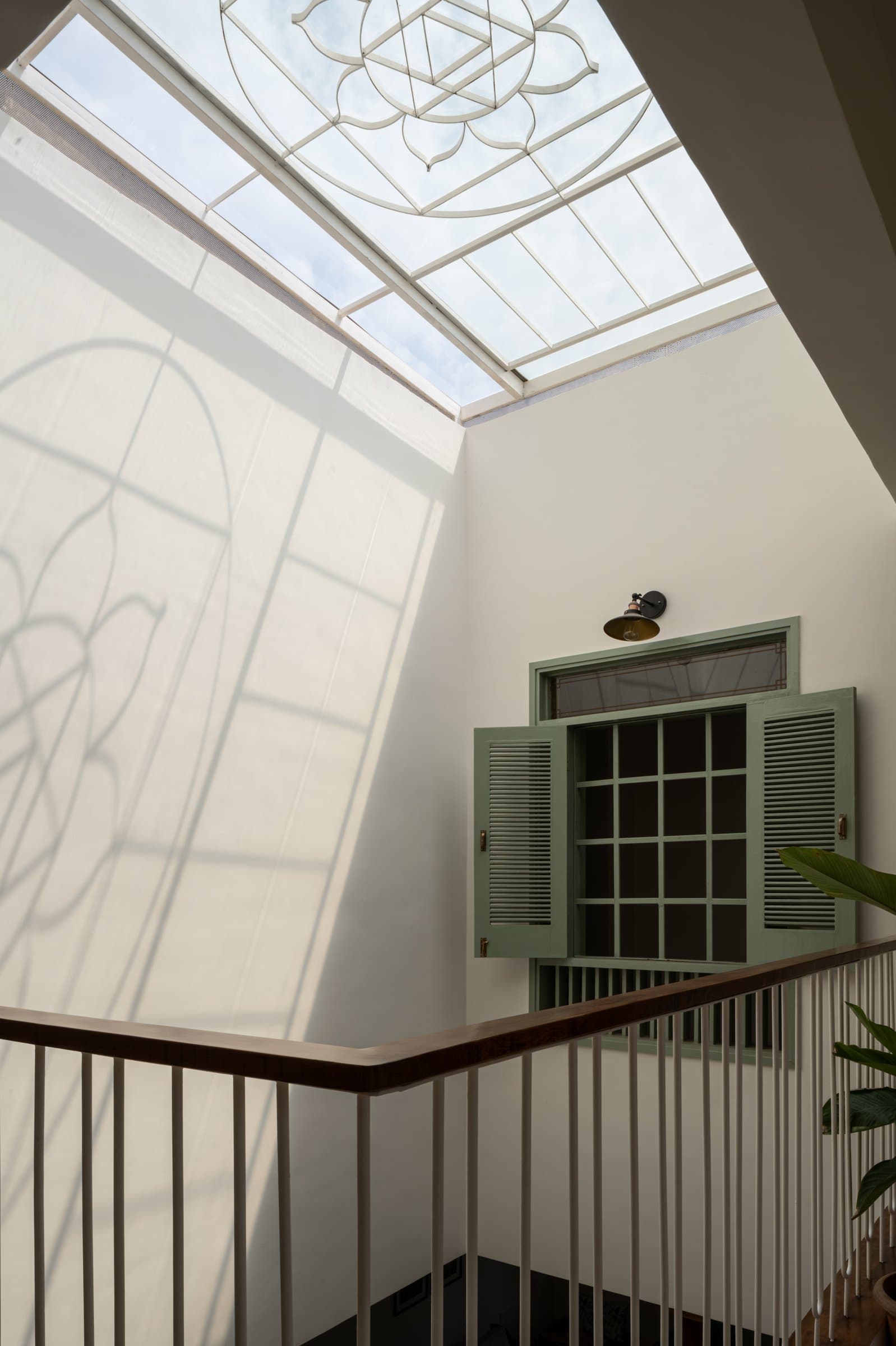
““The dining area is crowned by a skylight with a geometric fabrication pattern; as sunlight filters through, it creates ever-changing patterns of light and shadow.””

Viewed from the upper landing, the window reveals one of the project’s most distinctive details. Its custom metal screen incorporates a lotus and yantra inspired motif, translating familiar devotional geometry into a contemporary architectural element. More than an ornamental feature, the screen becomes an active participant in the life of the house.
As sunlight passes through it, the pattern is cast onto the walls and floor below, creating a shifting composition that changes with the movement of the day. It is perhaps the home’s most expressive intervention, a moment where craftsmanship, symbolism, and contemporary fabrication converge to produce an architecture that is as experiential as it is referential.
From the first floor, the organising logic of the house becomes fully apparent. A mint green louvred window opens from the bedroom onto the double height void below, establishing a visual and social connection between levels. The gesture recalls the inward looking verandahs and overlooking galleries of the traditional wada, reinterpreted here with a lighter, more contemporary sensibility.
The shutters allow the relationship to remain flexible. Open, they invite conversation and participation in the life of the house below; closed, they restore privacy without severing the flow of light. Above, a brass trimmed transom ensures daylight continues to travel between spaces, reinforcing the project’s recurring theme of connection without exposure. It is a detail that speaks to the home’s broader ambition: to adapt the social intelligence of historic domestic architecture to the expectations of contemporary family life.
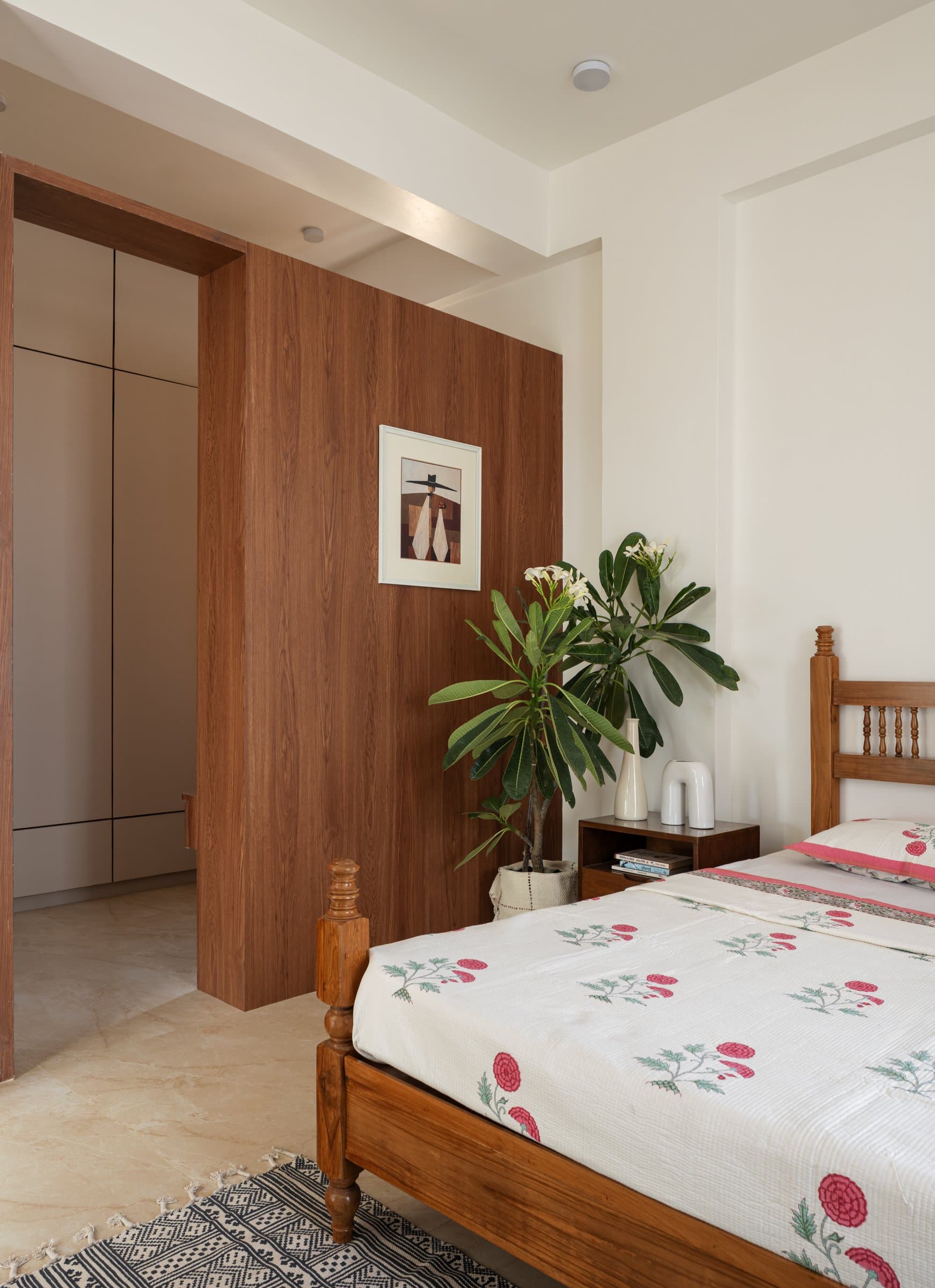
The first bedroom continues the home’s conversation between craftsmanship and restraint. A teak bed with delicately turned posts echoes the timber column that anchors the living spaces below, creating a subtle thread of continuity across floors. Behind it, a wall of warm walnut veneer serves a dual purpose, lending the room a sense of material richness while discreetly concealing the entrance to the dressing area beyond.
As elsewhere in the house, the room relies less on accumulation and more on careful placement, allowing a handful of objects to carry both character and memory.
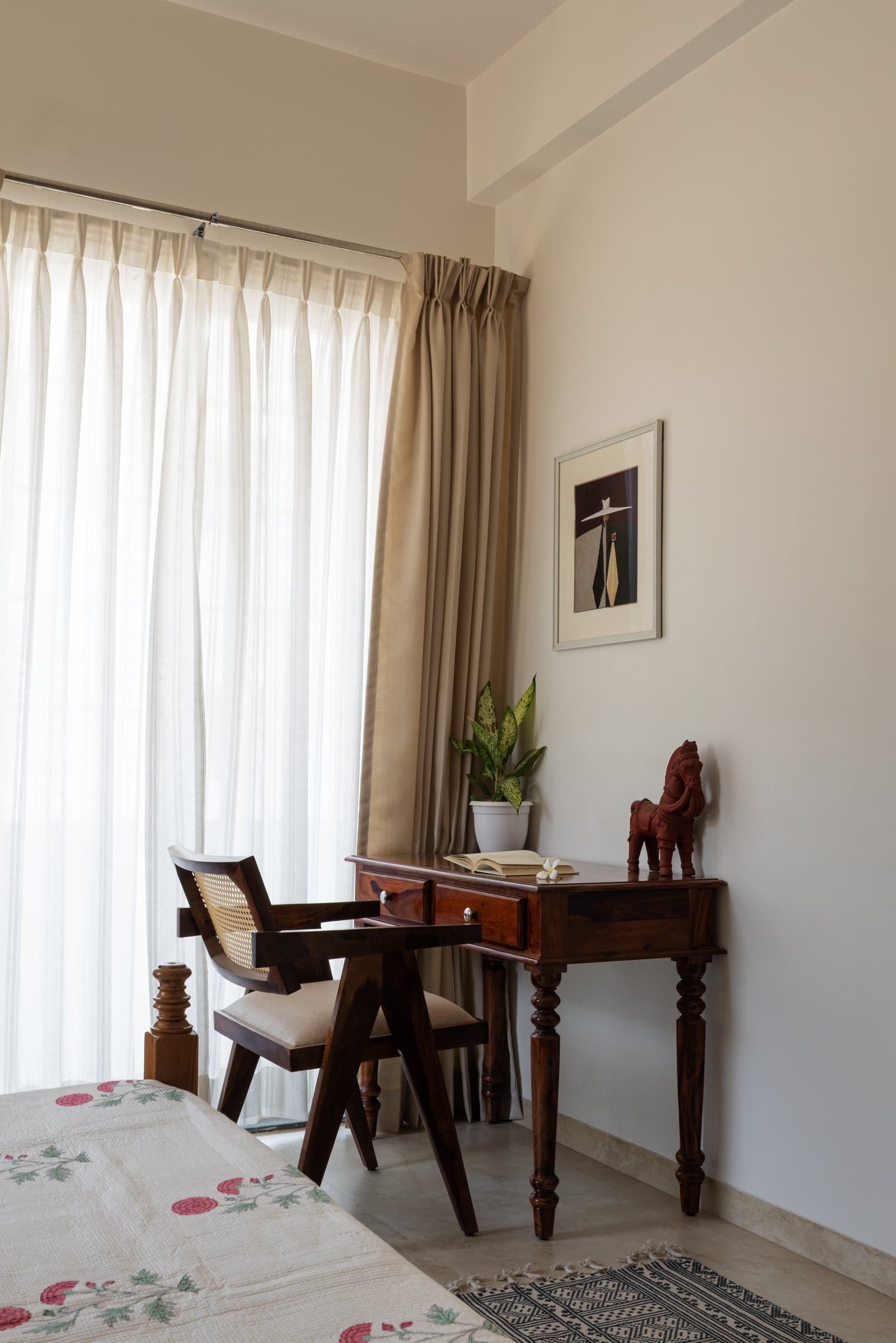
A small writing corner within the same room shows how the studio has handled scale. A carved-leg wooden desk, a caned chair drawn from the Chandigarh institutional vocabulary, a slim curtain of unbleached linen, a terracotta horse: the corner does the work of a study without claiming a separate room. Within a 2,000-square-foot footprint, this kind of overlap is not a compromise but a discipline.
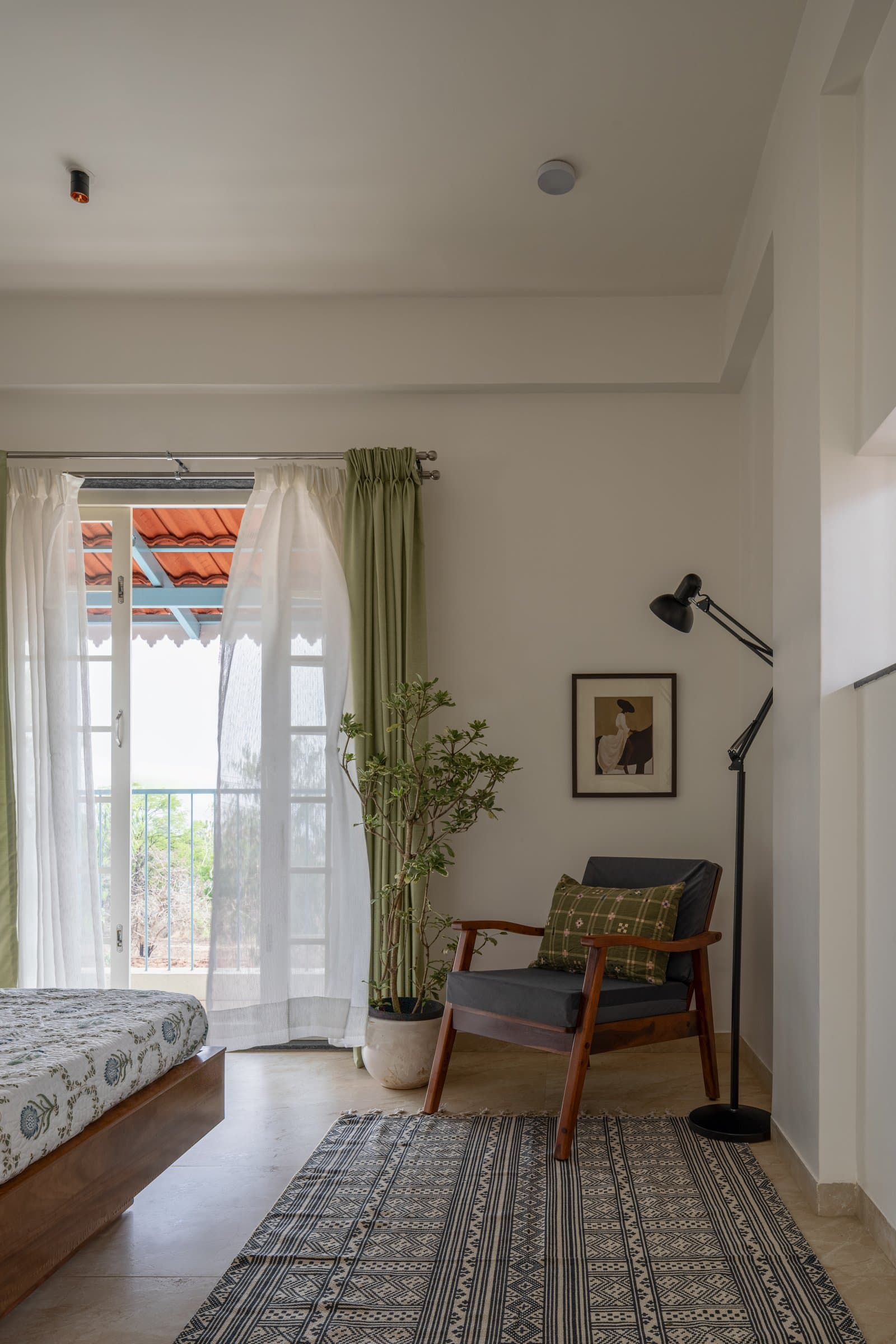
A second bedroom opens directly onto a balcony framed by the Mangalore-tile awning and its blue-painted steel structure. The room itself is pared back to a single armchair, a floor lamp and a framed print; the design lets the view of the tiled roof, and the breeze it modulates, do most of the work.
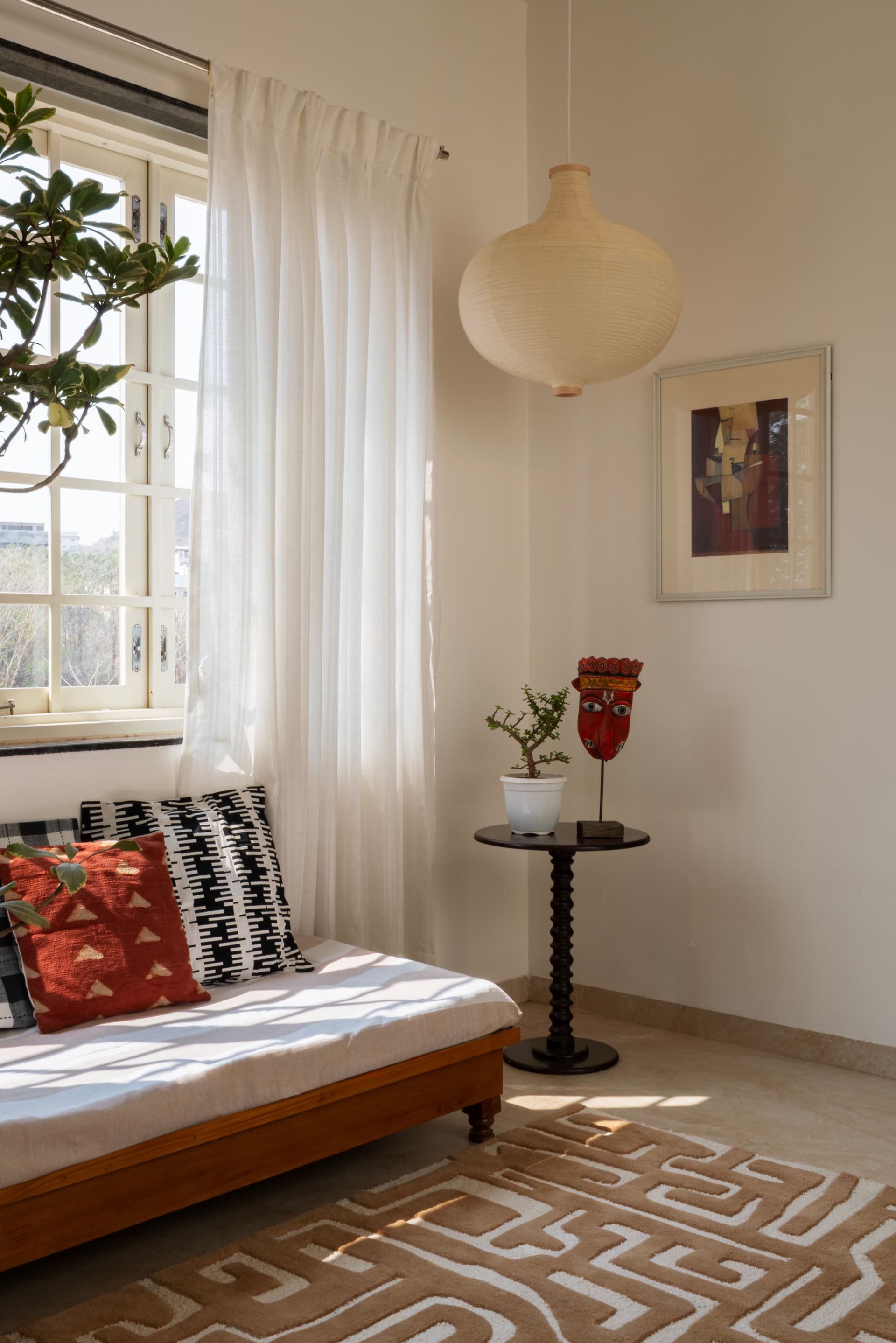
Elsewhere on the first floor, a daybed under a tall casement window shows the home at its most quietly confident. A rice-paper pendant in a gourd profile hangs beside a small framed work and a painted Rajasthani mask on a turned wooden stand. The composition is sparse, the references are unmistakeably Indian, and nothing is asked to perform beyond its weight.
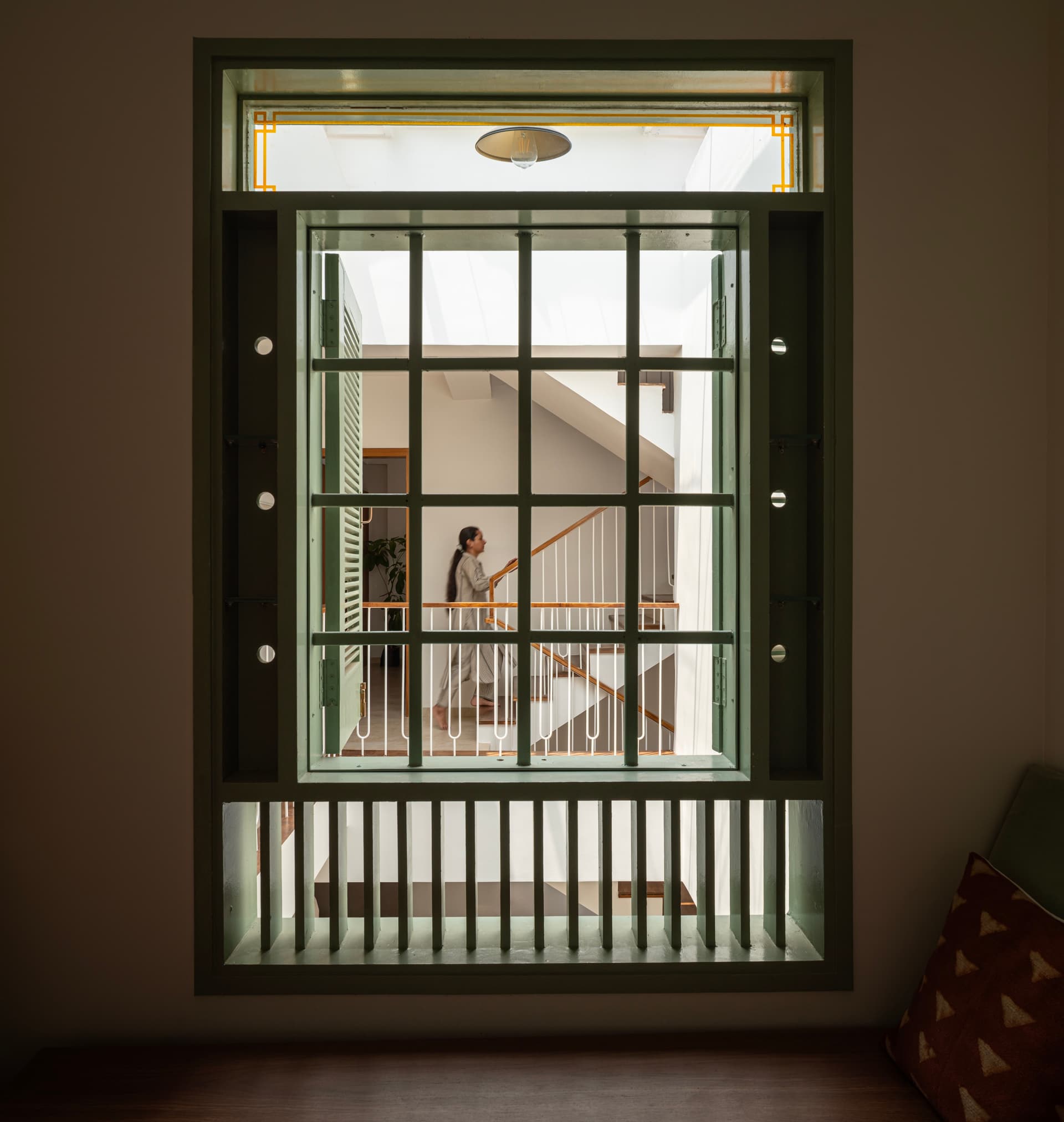
A view from one of the bedrooms back into the stairwell, through a green-painted internal window with louvred shutters, captures what the wada reference actually means here.
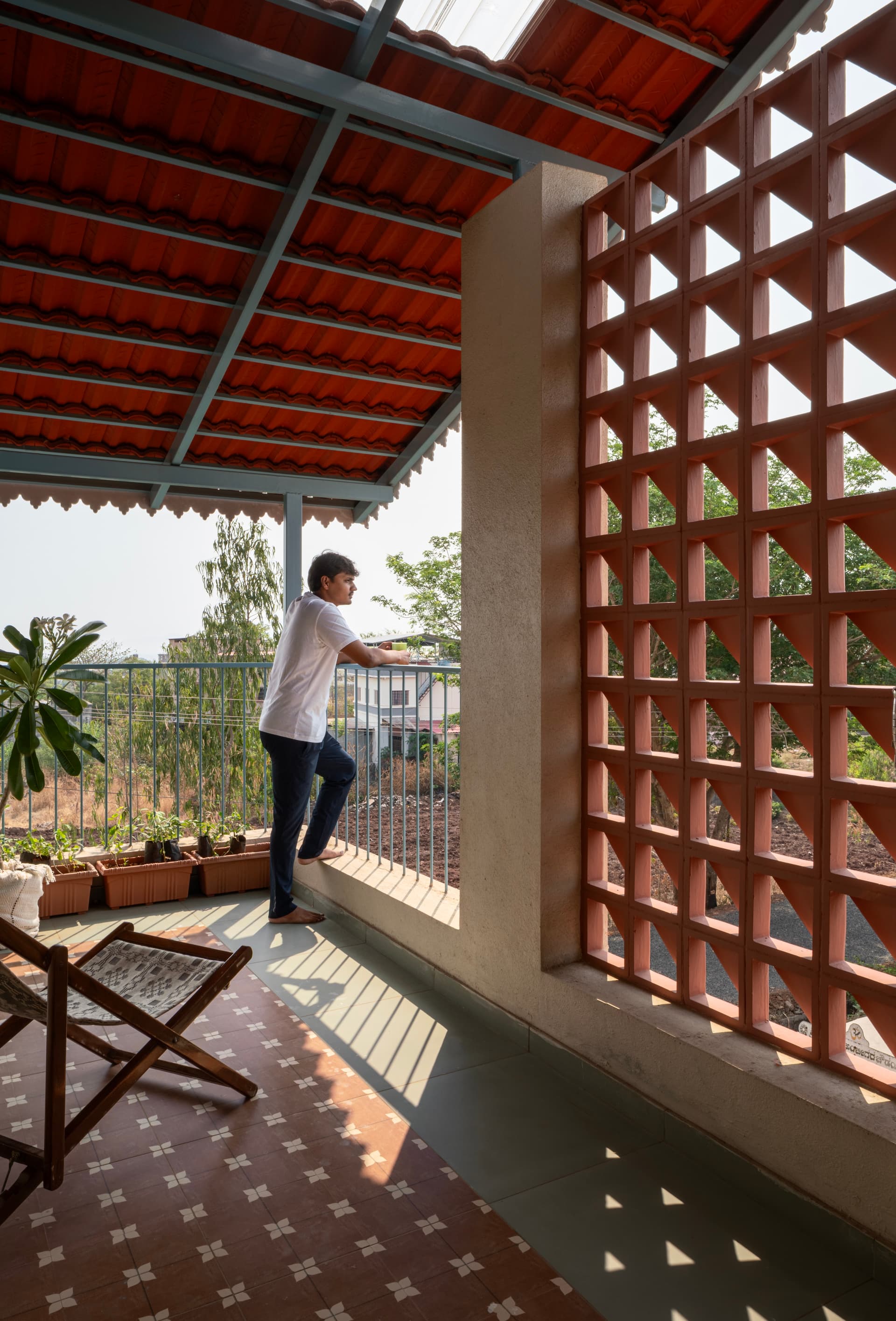
The terrace brings the house’s climatic and architectural logic into sharp focus. Sheltered beneath a pitched Mangalore tile roof supported by a slender steel framework, the space is defined by patterned cement tiles underfoot and a terracotta jaali wall that mediates light, air, and privacy. Read from within, the jaali takes on a different role from its street facing presence, filtering the harsh western sun while allowing the terrace to remain naturally ventilated throughout the day.
Here, the project’s engagement with tradition moves beyond symbolism and into performance. The Mangalore tiles help regulate heat gain and respond effectively to the demands of the monsoon, demonstrating why such building systems have endured across generations. Rather than treating regional architecture as a source of visual references, the house draws from its underlying intelligence, recognising that the most enduring traditions are often those shaped by climate, comfort, and everyday use.
What distinguishes Swasti Sudeep within the contemporary bungalow landscape is the precision with which it engages tradition. Kshitij Mahajani Architects have resisted the temptation to treat the Maharashtrian wada as a catalogue of recognisable motifs. Instead, its lessons are absorbed at the level of space, climate, and social behaviour. The central void brings light and family life to the centre of the plan; the internal windows maintain visual connections across floors; the devali niches, louvred shutters, timber columns, and Mangalore tiles are retained not as decorative references, but because they continue to perform the roles they were originally designed for.
The result is a house that feels contemporary without severing its relationship to place. It argues that regional architecture is more than a collection of forms to be replicated or abandoned, and that its enduring value lies in the intelligence embedded within it. In a city where residential architecture often swings between anonymous modernity and nostalgic imitation, Swasti Sudeep occupies a rarer middle ground: confident in its present, informed by its past, and grounded in the realities of how people continue to live.