Surat expands in straight lines. The city’s newest residential belt is all geometric certainty: uniform plots, predictable grids, corridors extending outward with methodical precision. To design within that pattern is to either accept its logic or to push back, gently, against it.
Arco, a residence in Surat designed by House of Forms under principal architects Paridhi Mittal and Vatsal Mistry, chooses the second path. Conceived for a family of three, all musicians, artists and serious readers, the home was shaped by a deceptively simple brief: minimal interiors that feel warm, exposed concrete surfaces, and enough quiet storage to absorb a library, an instrument collection and full wardrobes without the apartment reading like a closet showroom. The studio’s response began with a single curved wall and let it argue against the grid.
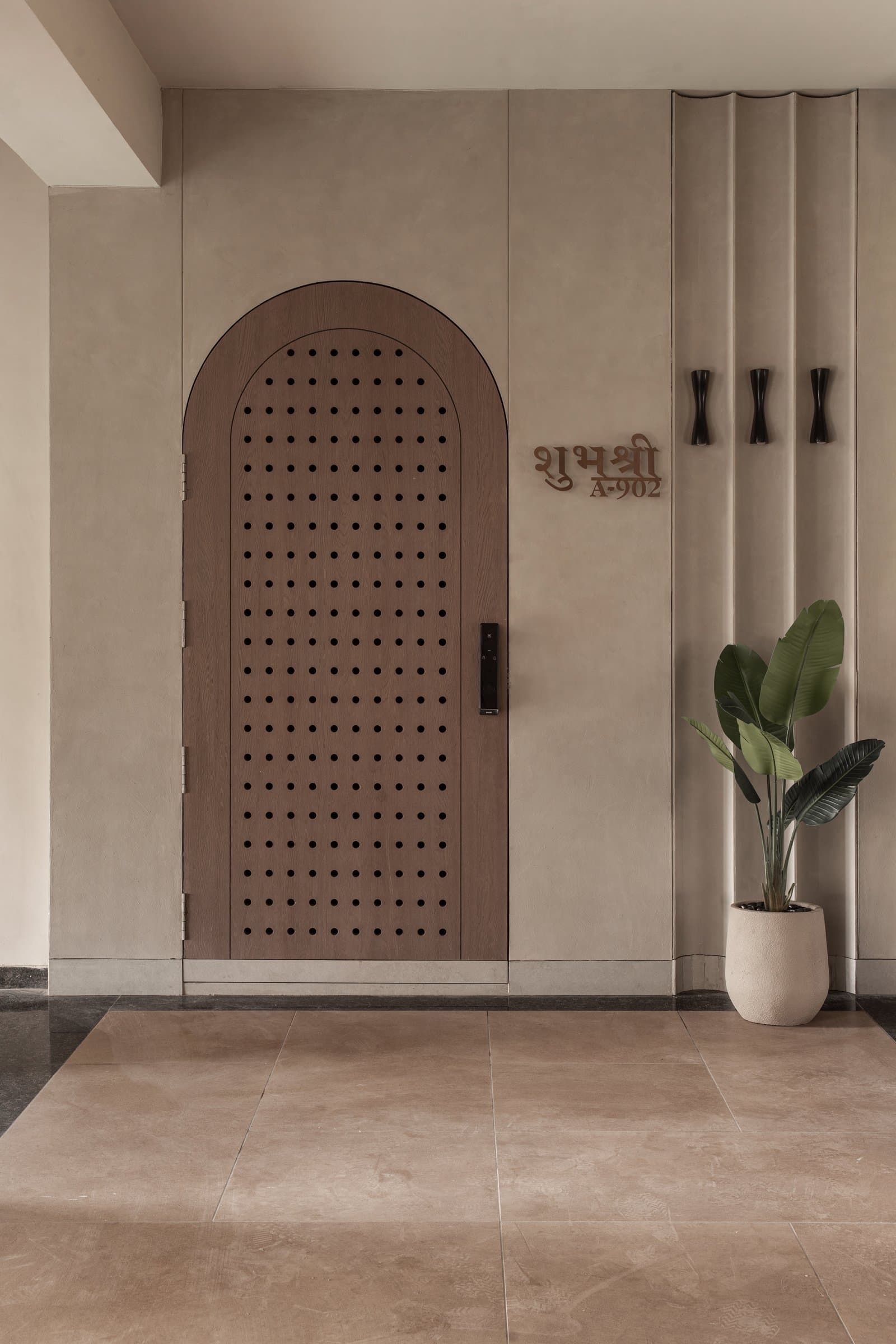
The threshold sets the tone before the apartment fully begins. An arched wooden door, perforated with a precise grid of openings, sits within a softly plastered wall whose adjoining panel is gathered into three vertical flutes. The Devanagari nameplate, the slim wall sconces, the unhurried beige of the floor: the entry refuses any of the visual loudness that the building’s exterior corridor invites.
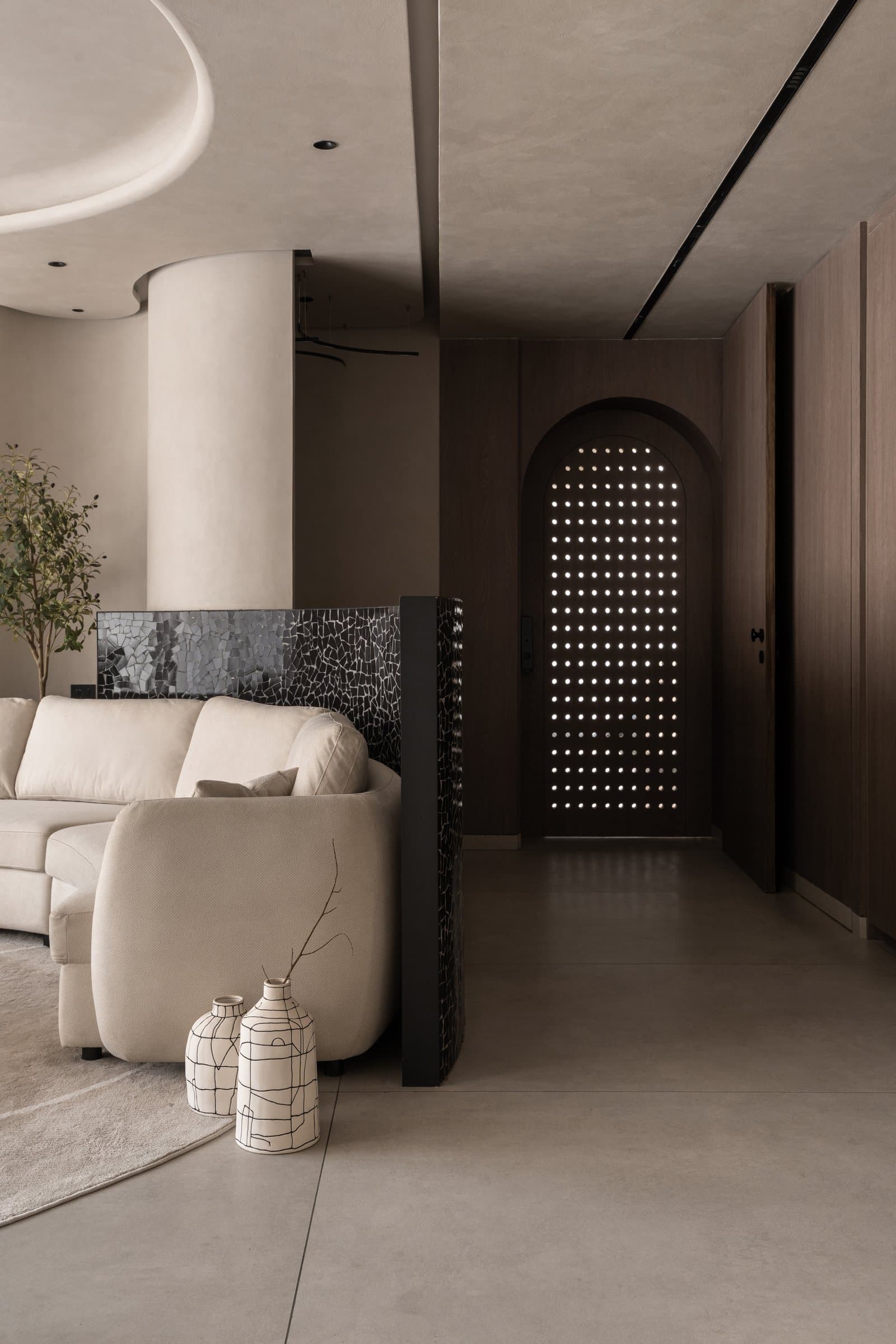
Step inside and the perforated door reads in reverse, its dotted geometry now backlit and luminous against the darker wood-clad foyer. The arc that defines the project announces itself overhead in the rounded soffit and curved column, while a screen of fragmented dark mosaic introduces the home’s one note of grit. Movement through this threshold is choreographed without being signposted.
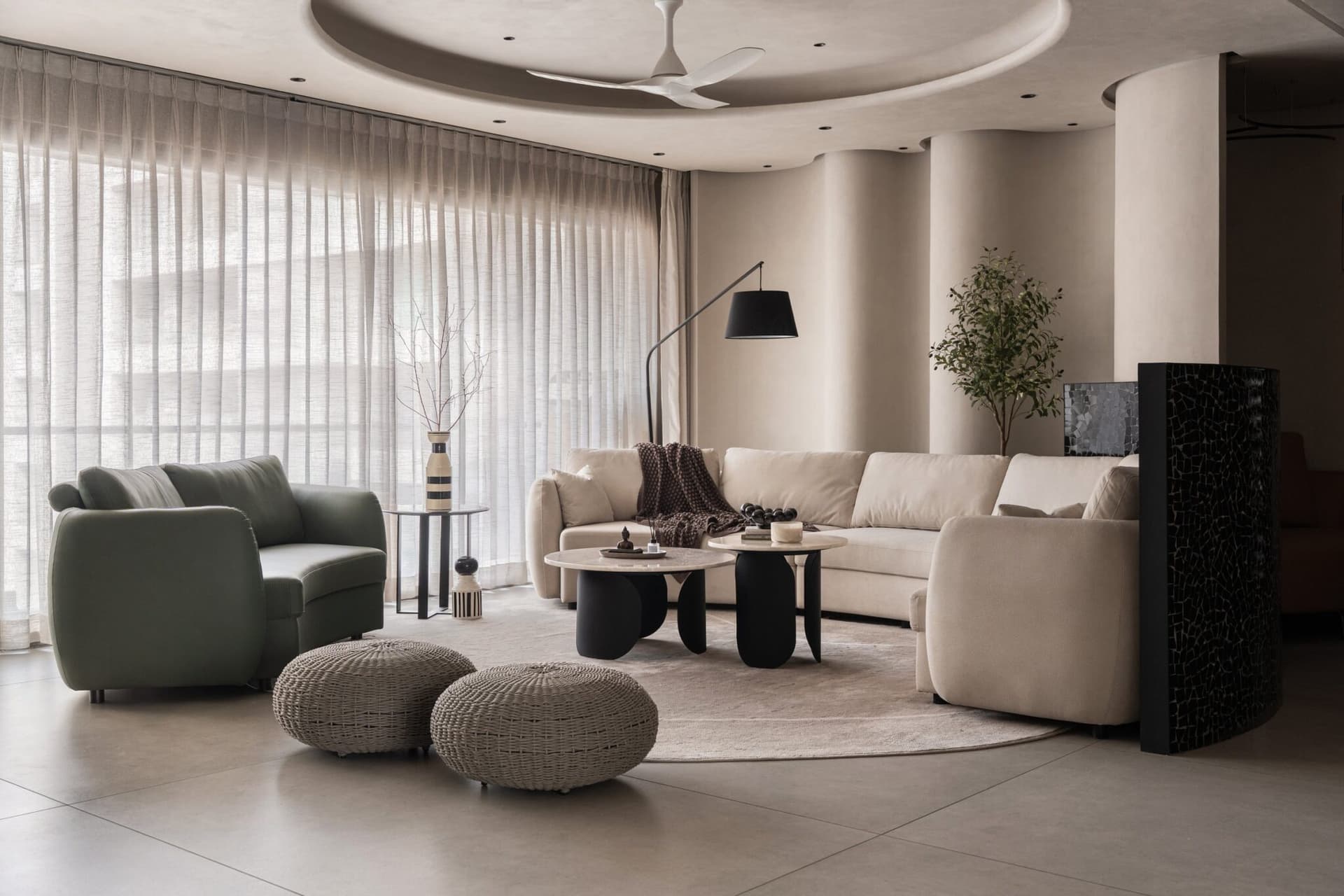
The living room is where the curve does its real work. Rather than a single decorative gesture, the arc continues from wall to ceiling and back into the furniture plan, organising a sectional sofa that follows the geometry rather than fighting it.
What this produces is a room that reads as one continuous spatial event rather than an assembly of pieces. The circular ceiling medallion, the rounded rug, the low slung coffee tables on sculpted black bases: the geometry is consistent enough that the eye stops looking for edges and starts reading the room as volume.
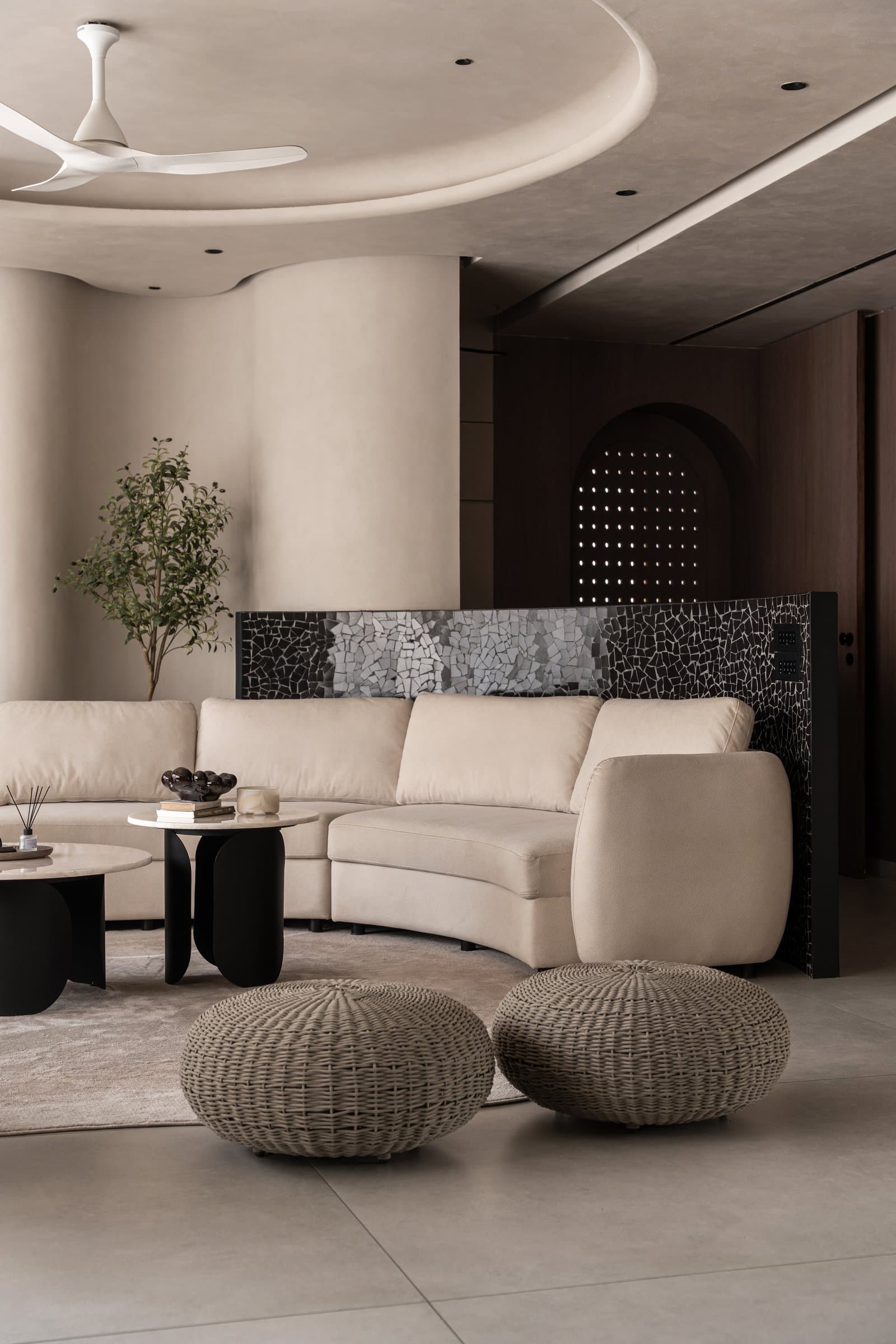
The mosaic screen behind the sectional is the room’s calculated counterpoint. Against an interior where almost everything has been smoothed, plastered or upholstered into softness, the broken-tile surface reintroduces friction. It is the one place the family’s collector instinct is allowed to surface in the public room.
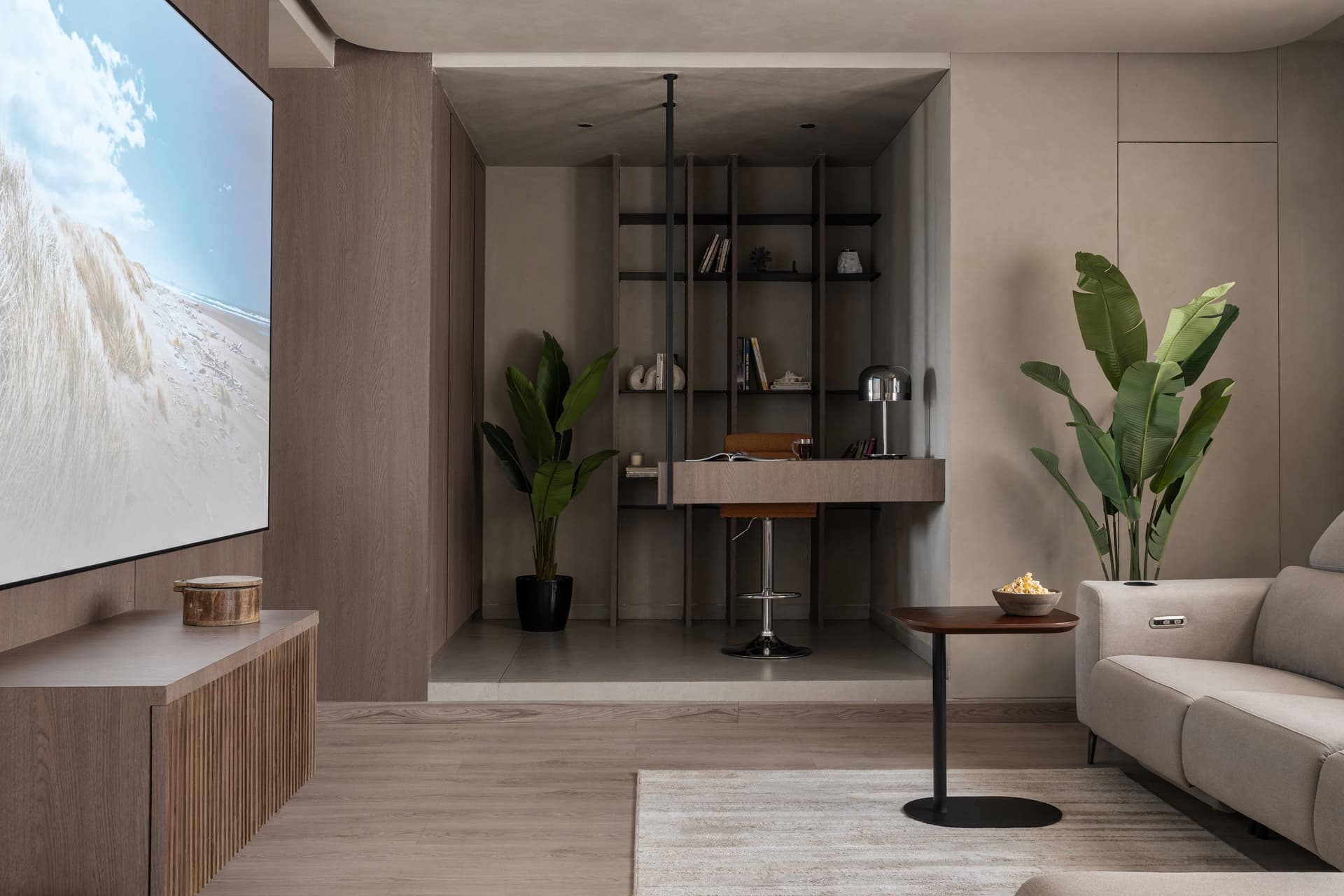
Across from the sofa, a raised alcove holds a compact home theatre and a slim study desk tucked beneath a steel-and-wood shelving frame. This is the spatial centre the brief insisted on, the home theatre as the actual location of daily life rather than aspirational furniture, and the studio has handled it without theatre. The platform shift, the change in flooring from oak-toned planks to a stone-toned tile on the platform, the small pool of light from the desk lamp: each move is doing structural work while staying quiet.
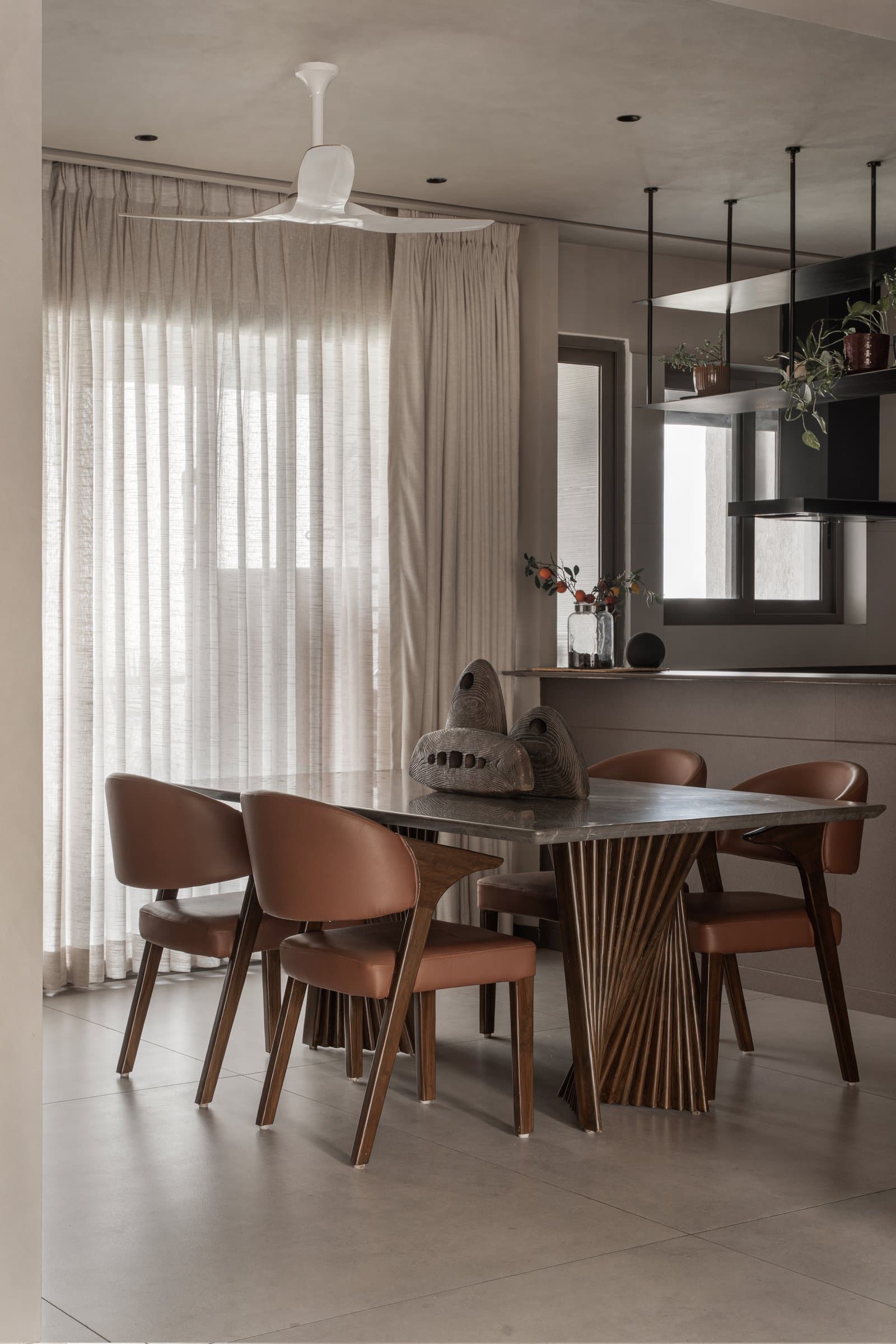
The dining area is calibrated more sharply. A stone-topped table on a fan-pleated wooden base sits against sheer floor-to-ceiling drapes, with four leather-upholstered chairs in a saddle tone that warms the otherwise tonal palette.
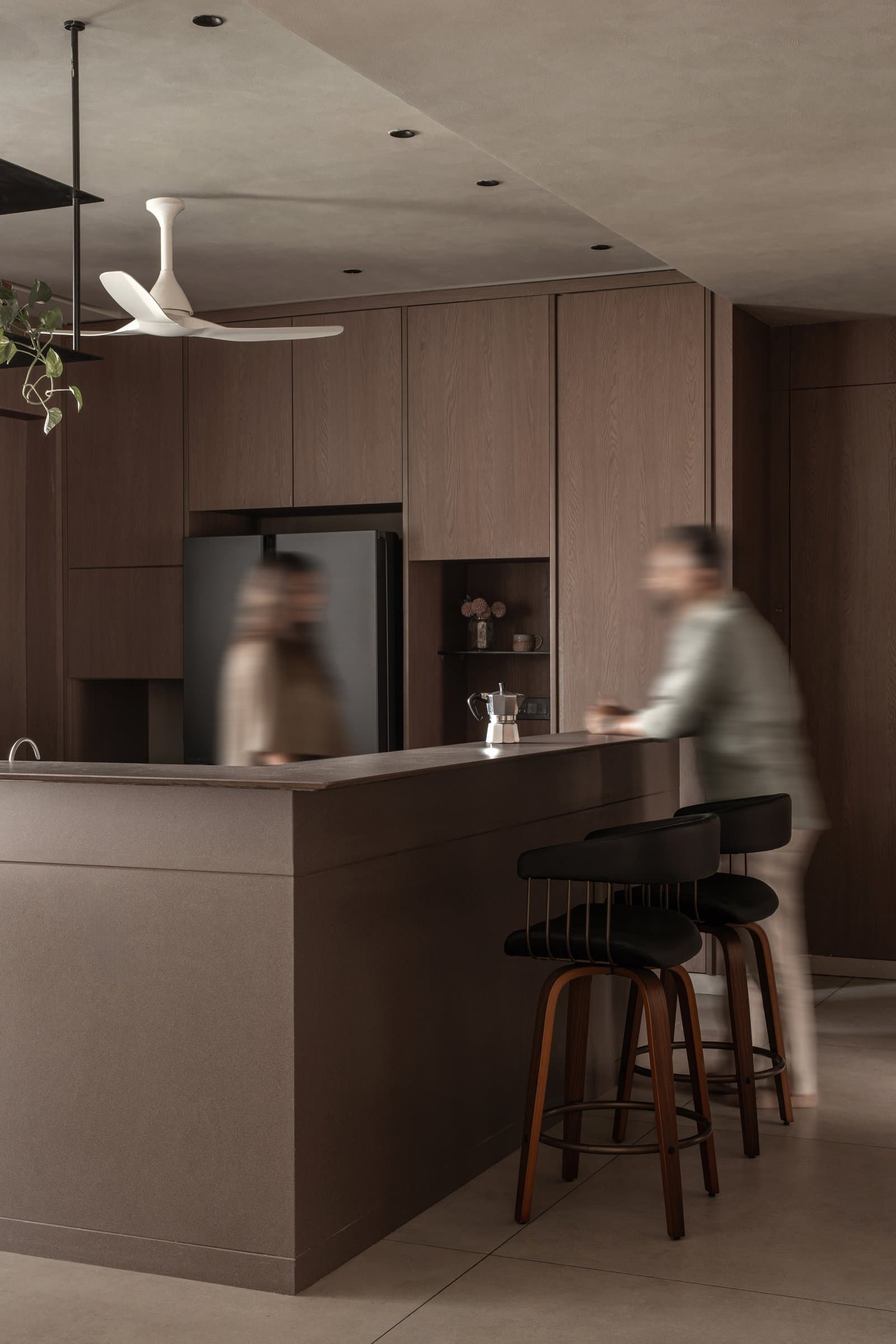
The kitchen reads as one of the project’s most disciplined moments. Flush wood paneling wraps the room from floor to ceiling, absorbing the refrigerator, the pantry, the appliance garage and the service zones into a single continuous surface. The seams are there if you know where to look; most visitors will not. A compact island with two upholstered bar stools holds the social edge, and the room becomes less a kitchen than a quiet wooden volume that happens to cook.
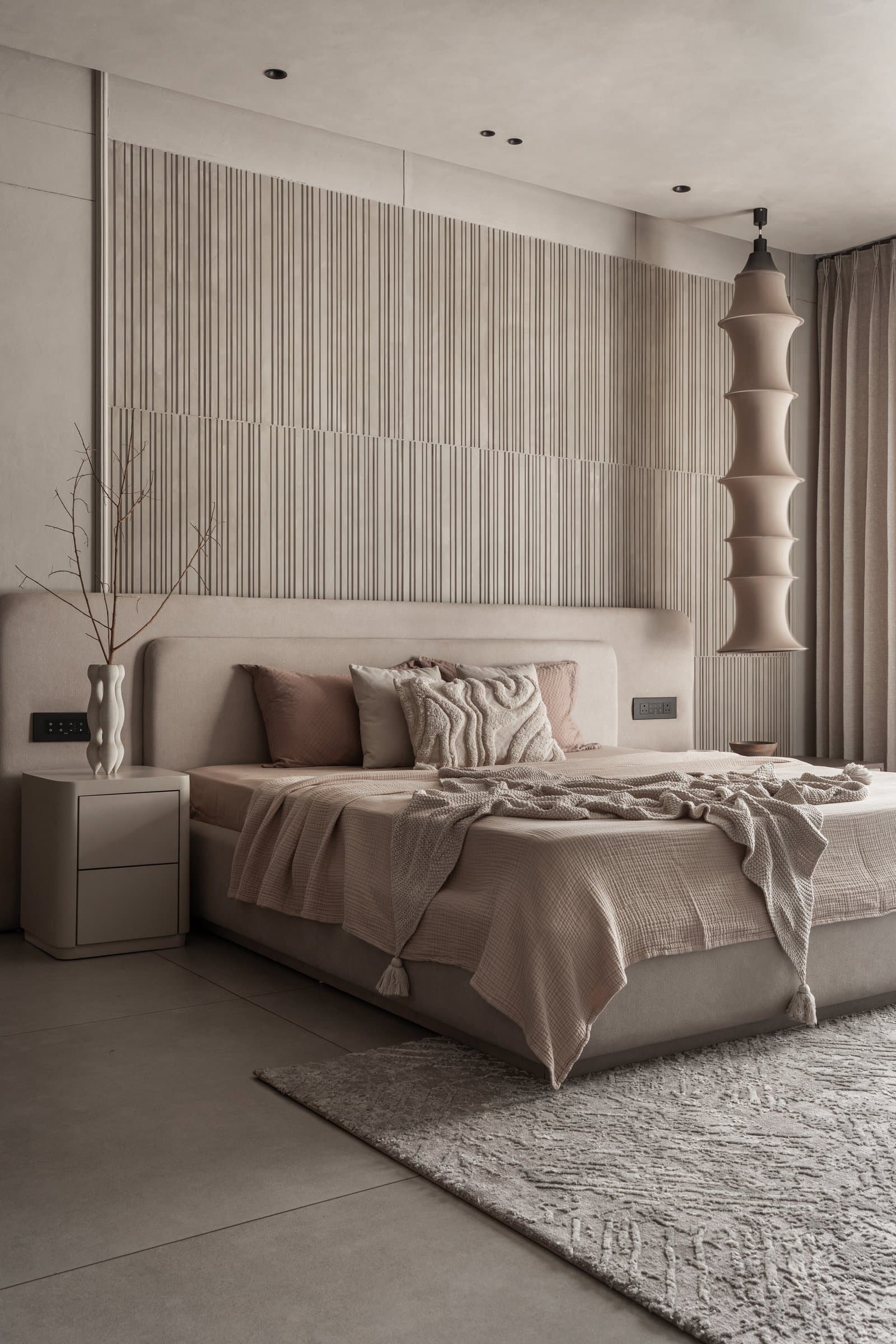
The master bedroom moves the curve into a more intimate register. The wall behind the bed is fluted in fine vertical reeding that runs from floor to ceiling, broken by a single horizontal band that introduces proportion without ornament.
The bed itself, low and softly upholstered in a putty tone, is staged against a palette of dusty rose, oatmeal and the faint blush of textured throws. The room argues for restfulness without staging it; domesticity is felt rather than performed.
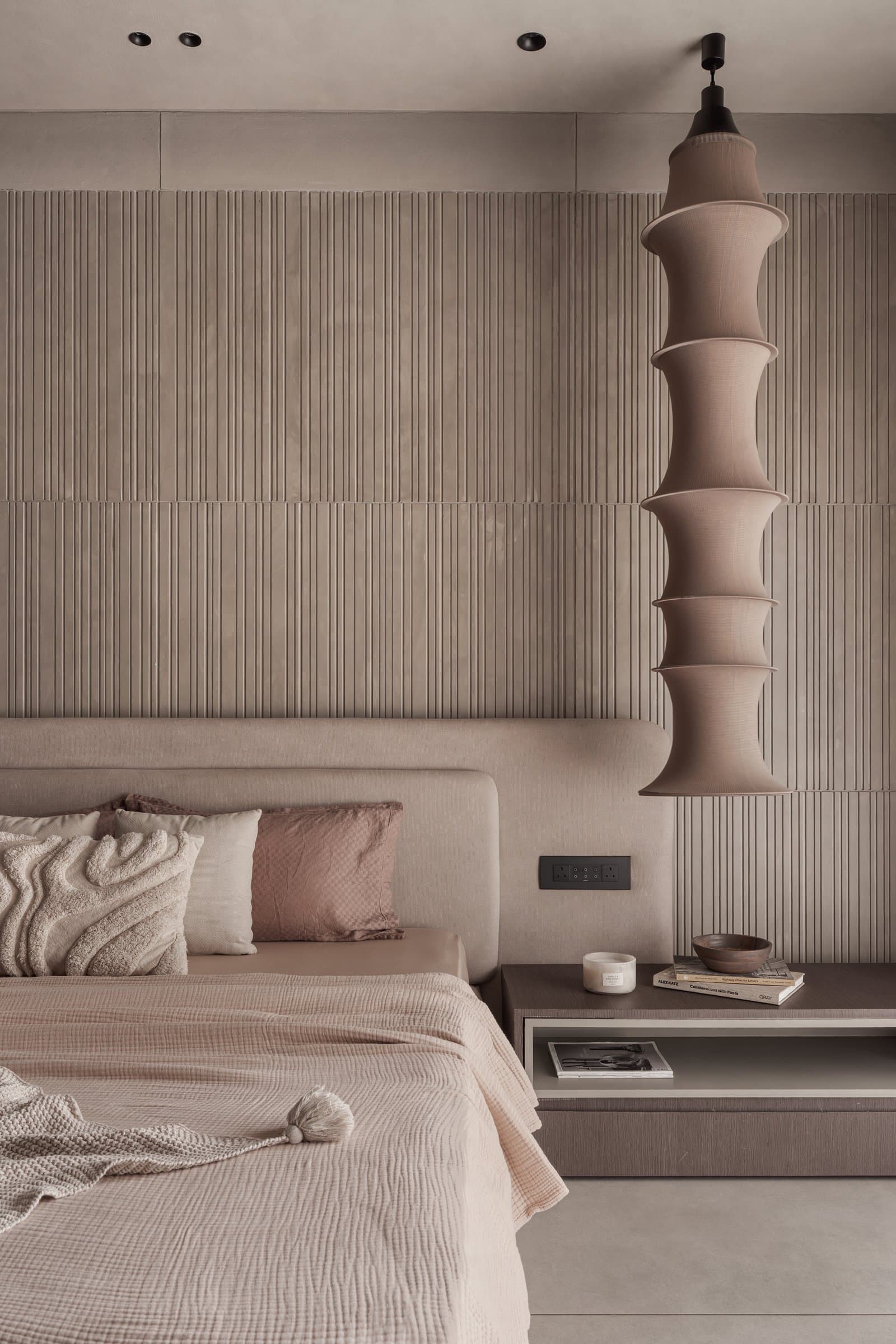
Suspended beside the headboard is a tiered fabric pendant whose stacked silhouette echoes the vertical reeding behind it. It is the room’s one piece of theatre, and earns its presence precisely because everything else in the room is so deliberately quiet.
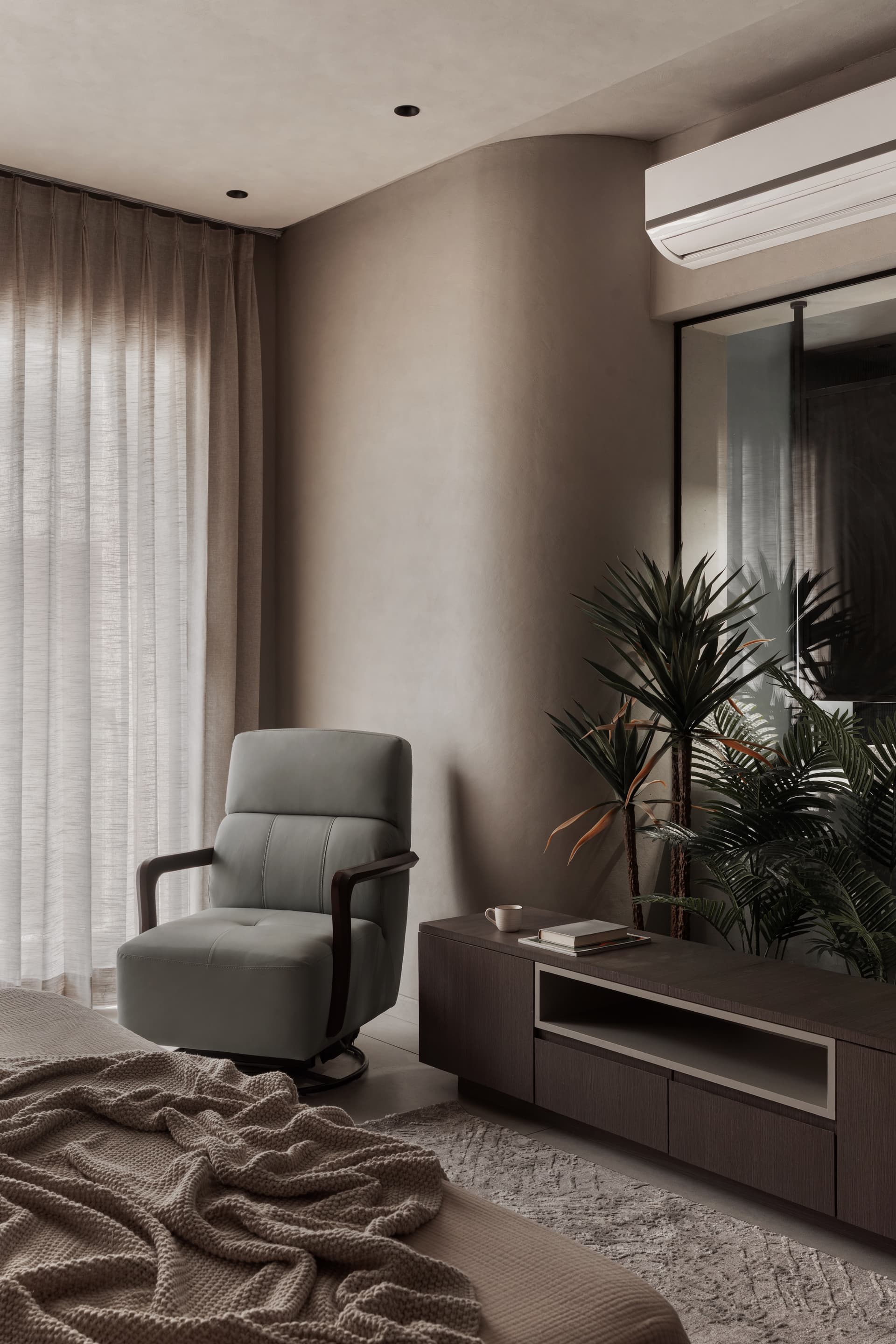
Across from the bed, a swivel armchair in soft sage leather sits beside a low media console, with a cluster of palms breaking the line of the curtain. This corner is where the room’s curved wall returns into view overhead, the soffit easing the meeting of two planes that would otherwise meet bluntly.
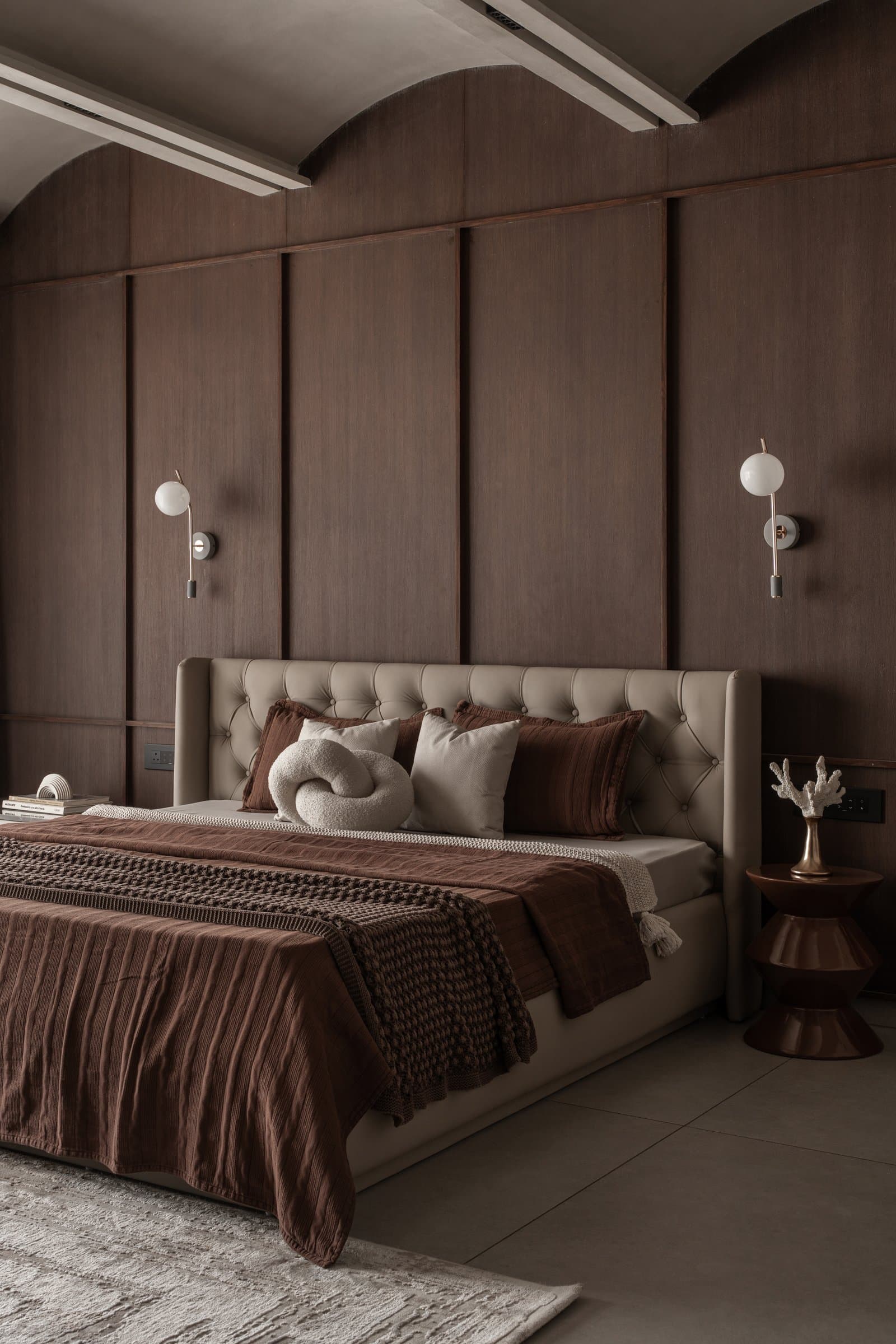
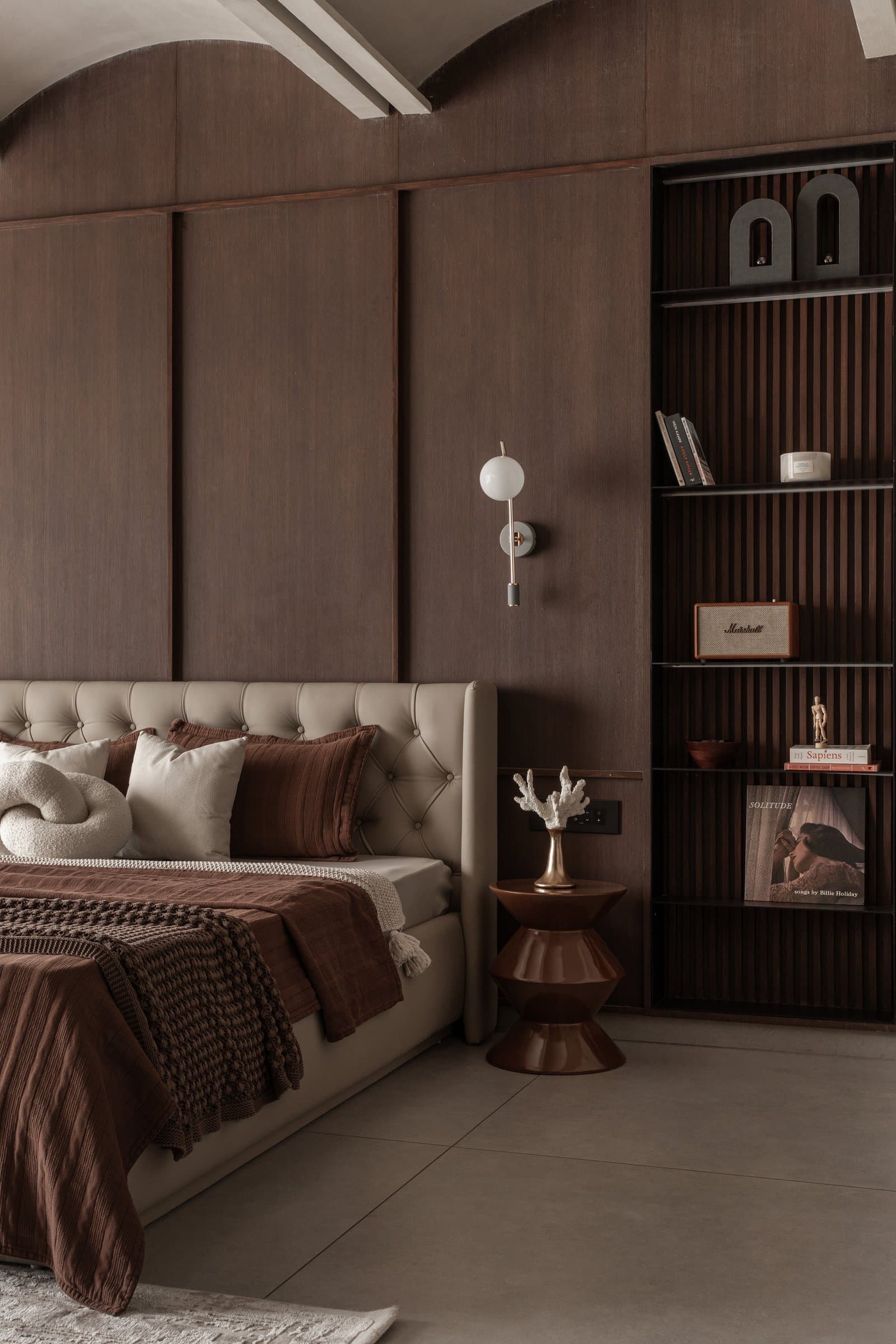
The second bedroom takes the home in a markedly different direction. A vaulted ceiling with three shallow plaster arches sits above a wall of dark upholstered wall panels, and the bed, a tufted upholstered headboard in a warm taupe, is dressed in deep cocoa and ochre tones.
The arches are doing more than decorative work. They give the room a sense of enclosure and ceremony that the rest of the apartment deliberately avoids, and they make the case that within a single home, restraint and richness can coexist if the geometry holds them together. The wood paneling, divided into tall vertical bays with slim reveals, has the calm rigour of a library wall without announcing itself as one.
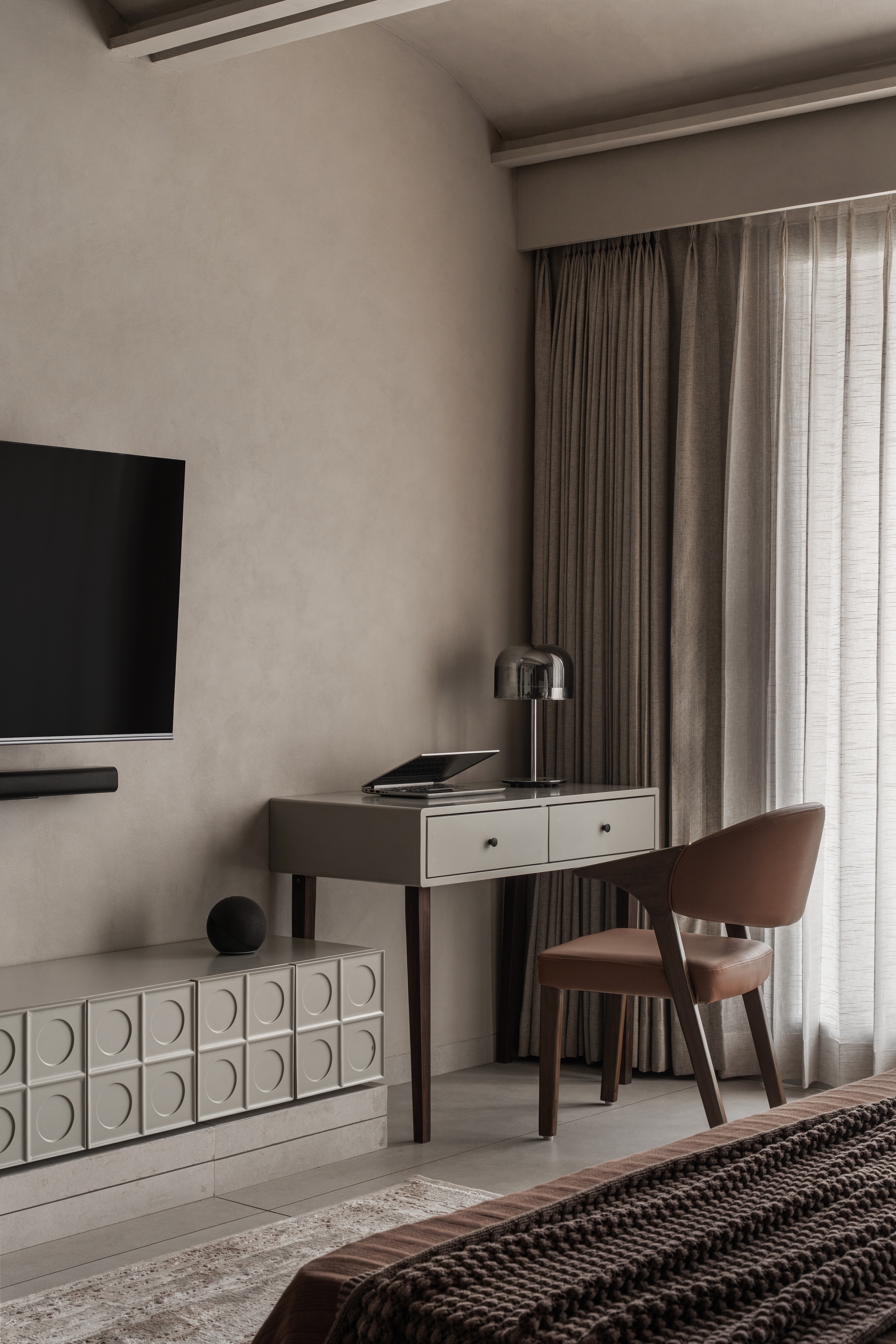
A separate wall holds a slim writing desk with a low console with circular relief panelling alongside, a quieter space for the reading and writing the family had specifically asked the home to accommodate. The studio’s restraint here is telling: no built-in library wall, no statement bookshelf, just a working surface that shares the wall with a mounted television and slim soundbar above the panelled console.
What Arco accomplishes is unusual for a Surat residential context that tends to default toward either ornamental excess or generic minimalism. The studio has resisted both, choosing instead a single architectural idea, the curve, and letting it organise plan, ceiling, furniture and threshold across the entire apartment. The result is a home that feels coherent without feeling uniform.
The distinction of the project lies in this commitment to one gesture done well. The arc softens the grid the building sits within, conceals the storage the family needed, and gives the apartment a rhythm that the family’s books, instruments and quiet evenings can settle into without friction.