Some homes are designed to impress; others are designed to remember. Ojas belongs firmly to the second category, a residence shaped less by aspiration than by inheritance, where every material gesture is a quiet act of return.
Conceived for a young Oriya family who had settled in Bengaluru’s JP Nagar, the apartment was entrusted to Innches Studio, led by Meenakshi Rohilla and Prathap Kumar. The brief, as the clients put it, was for a home that would feel like art in itself, warm and grounding in the middle of a busy city, and one their daughter could grow into without losing the thread of where she came from. That single sentence, more than any moodboard, set the project’s terms.
The lady of the house is an artist, a collector with a deep affection for Pattachitra and Ikat, and the design responds by making her sensibility structural rather than decorative. Limewashed walls, Kota flooring with ikat skirting, brick cladding and rattan furniture from Alankaram form the base palette; the storytelling layers in afterwards, never the other way round.
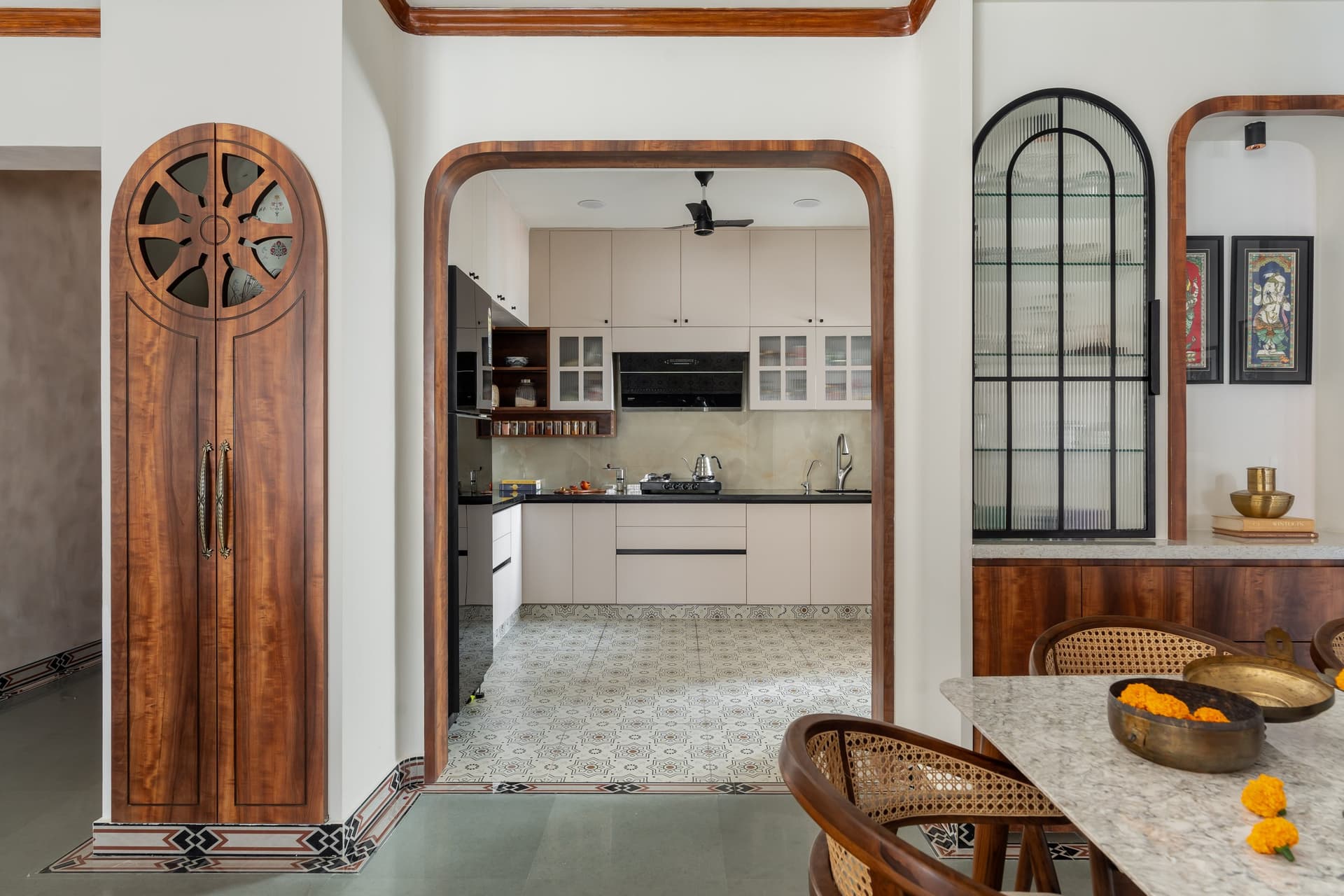
The threshold between dining and kitchen is the home’s clearest thesis statement. A teakwood archway with rounded shoulders frames the kitchen beyond, while a tall arched cabinet, its upper panel cut into a Konark Chakra motif, stands sentinel beside it. The patterned cement skirting underfoot continues the story without needing to announce it.
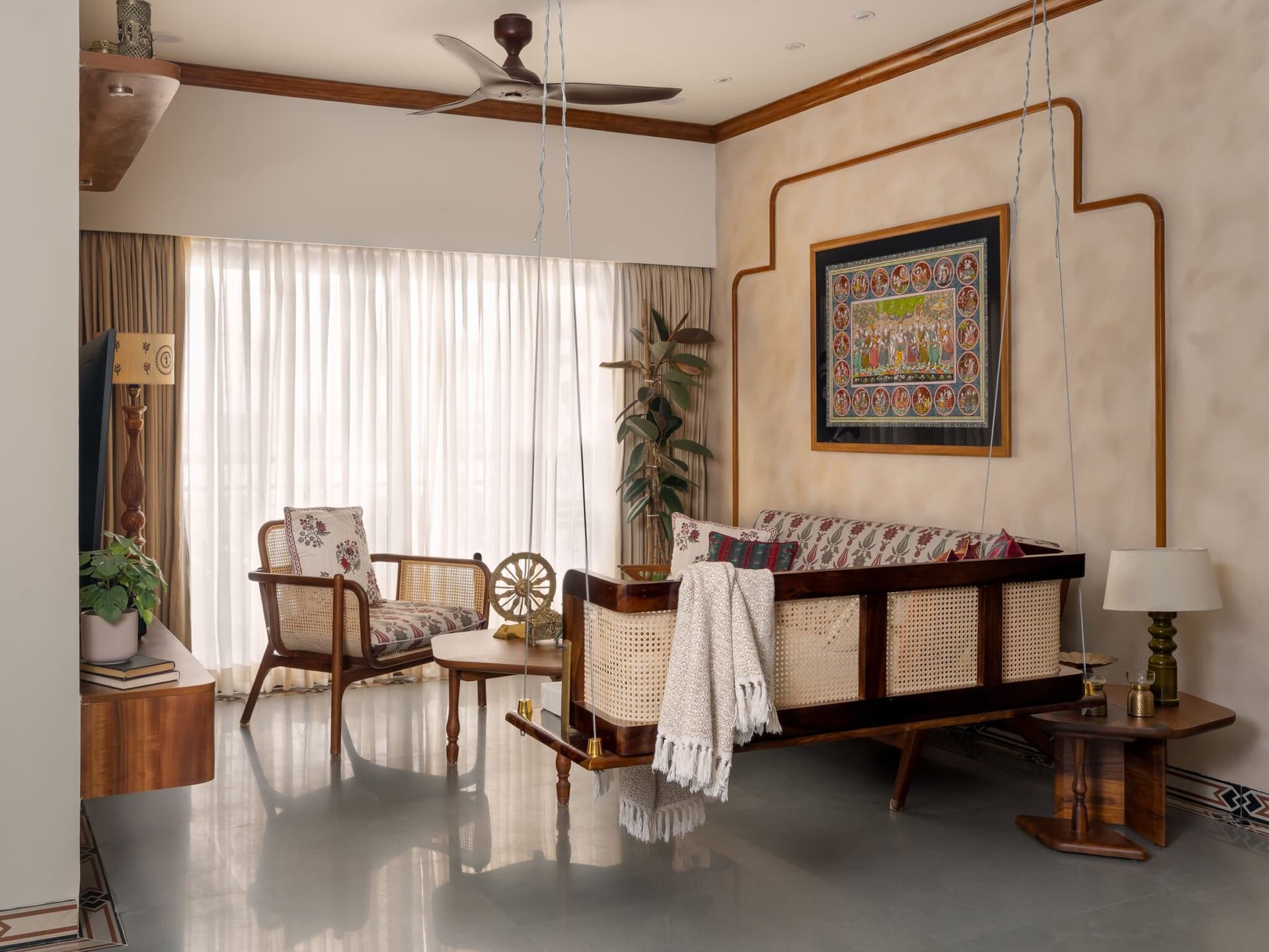
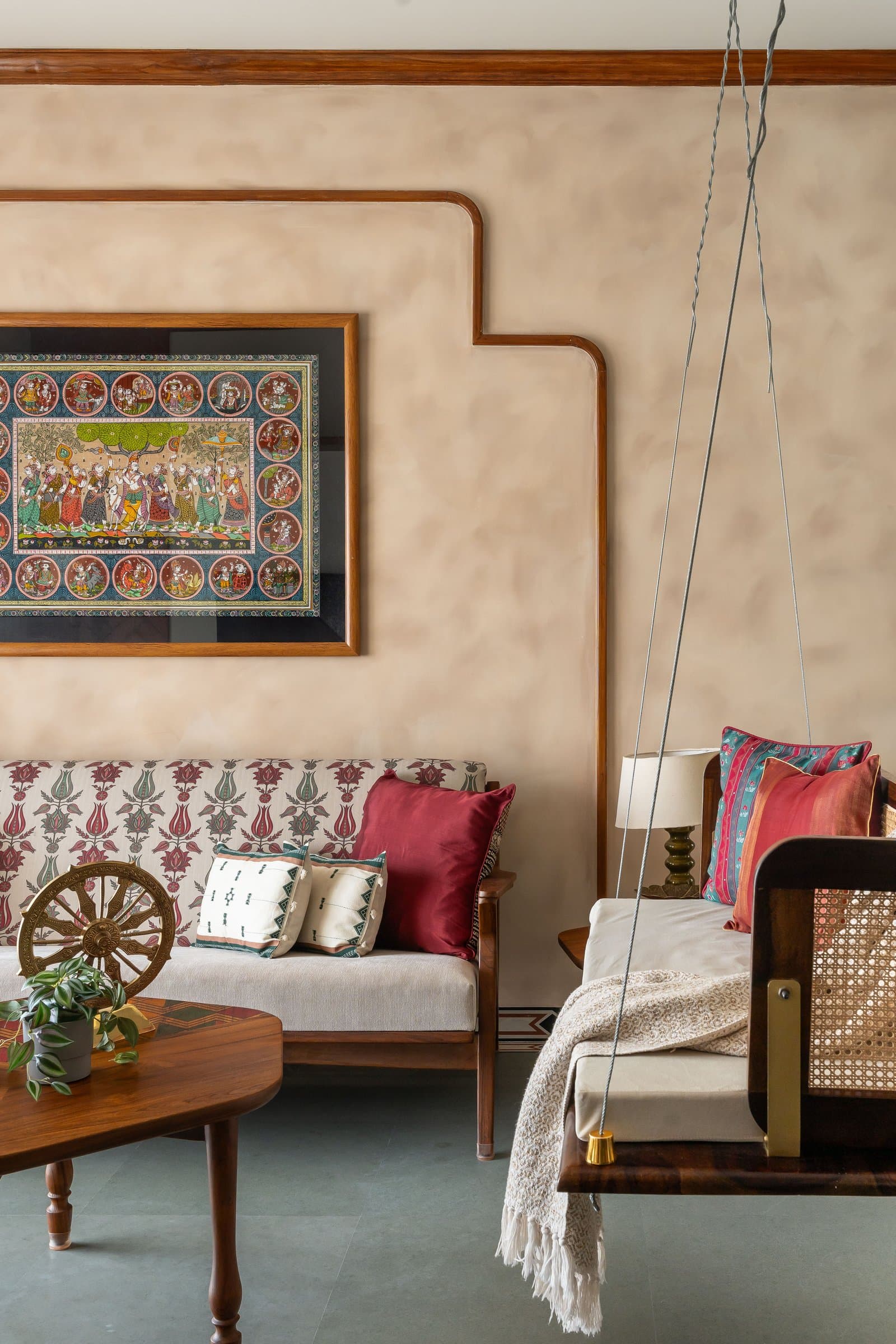
The living room opens with restraint. A cane-and-wood swing, suspended from copper-toned conduits that trace a shouldered profile across the limewashed wall, anchors one end of the room; a framed Pattachitra hangs within that profile as though the wall itself were built to hold it.
The argument here is unhurried. Rather than treating the artwork as an accent, the design constructs a frame around the frame, lending the painting the gravity of an altarpiece without the formality of one.
““A reminder of our roots. A home that feels like art in itself. Warm, grounding in the middle of a busy city. Something our daughter can grow up in and still feel connected to where we come from.””
Closer in, the Pattachitra reveals its detail: concentric vignettes of mythological figures rendered in earth pigments, set against a limewashed wall whose mottled finish reads almost like aged parchment. The settee below, upholstered in a tulip-motif block print, picks up the painting’s reds and greens without imitating them.
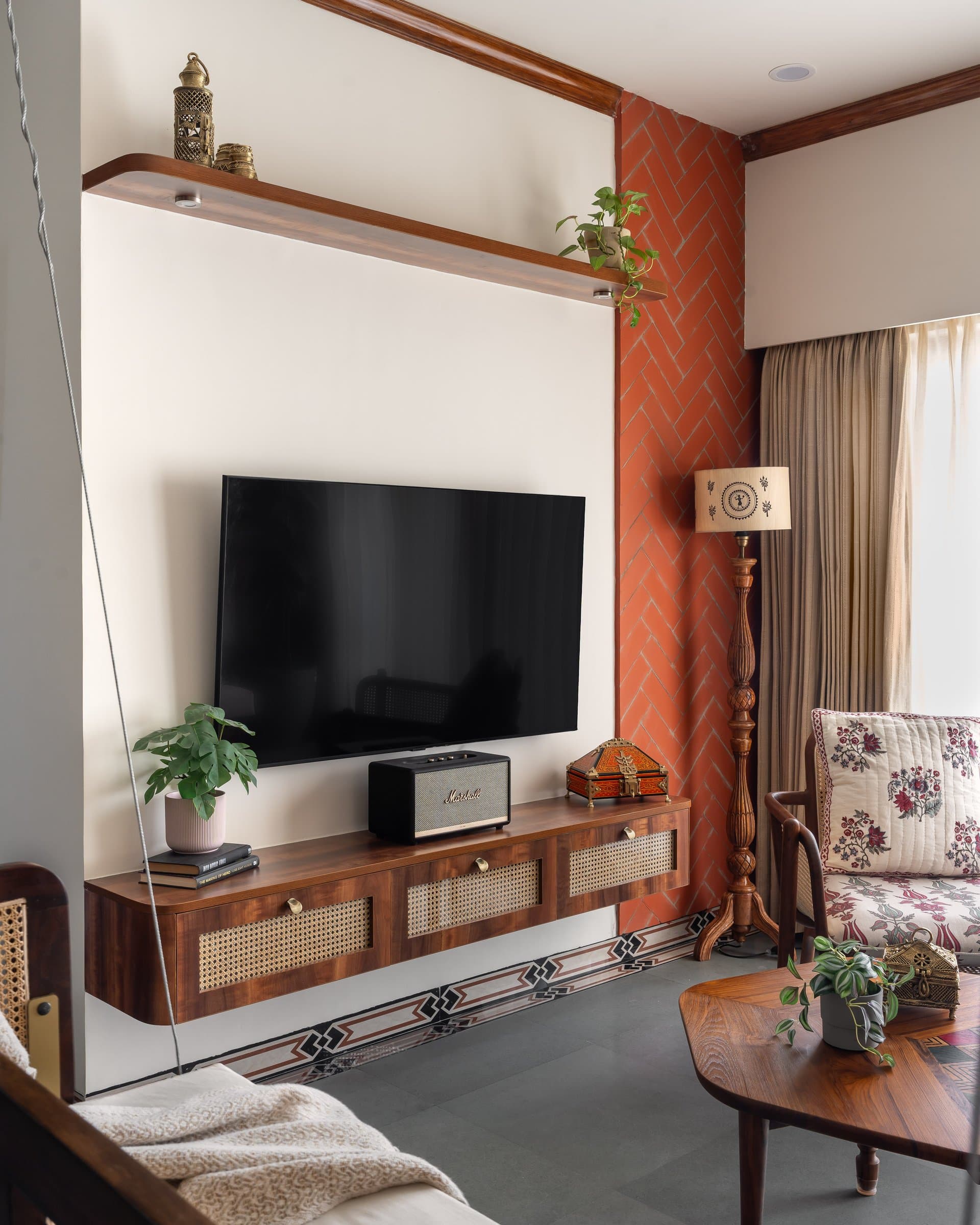
Across the room, a herringbone-laid brick column in terracotta breaks the otherwise quiet wall plane. The media console below, cane-fronted and detailed in walnut-toned wood, sits on a band of patterned cement tile that runs as a skirting through the home, an ikat-inflected line that ties every room to the next.
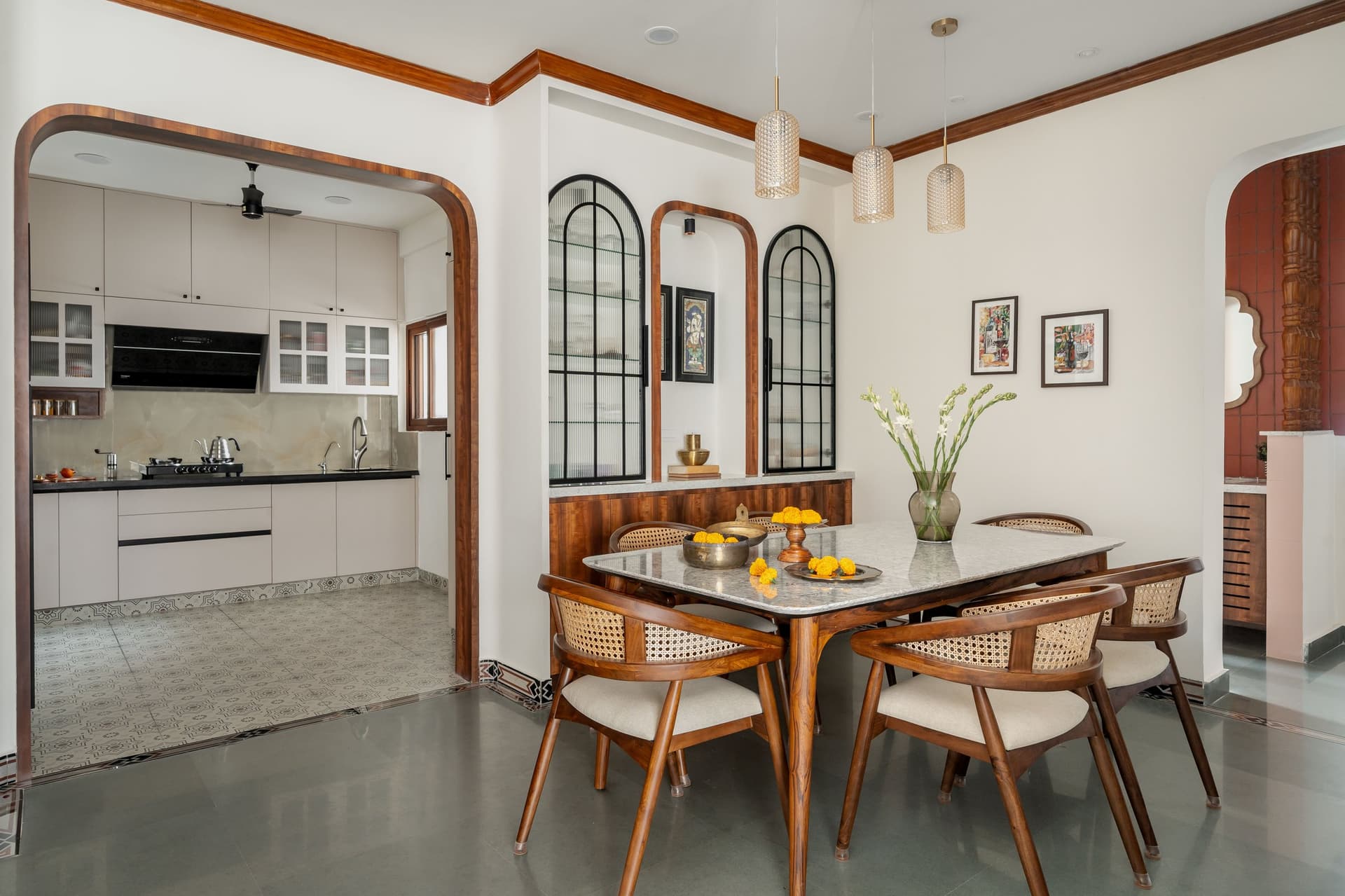
The dining area sits between kitchen and living, and its job is to mediate. A cane-and-wood six-seater under a trio of textured pendants does the social work; behind it, twin arched niches with reeded glass and black metal grilles hold crockery as though it were museum collection.
The Pattachitra miniatures tucked between the niches are easy to miss on first pass, which is precisely the point. Art here does not demand attention; it rewards it.
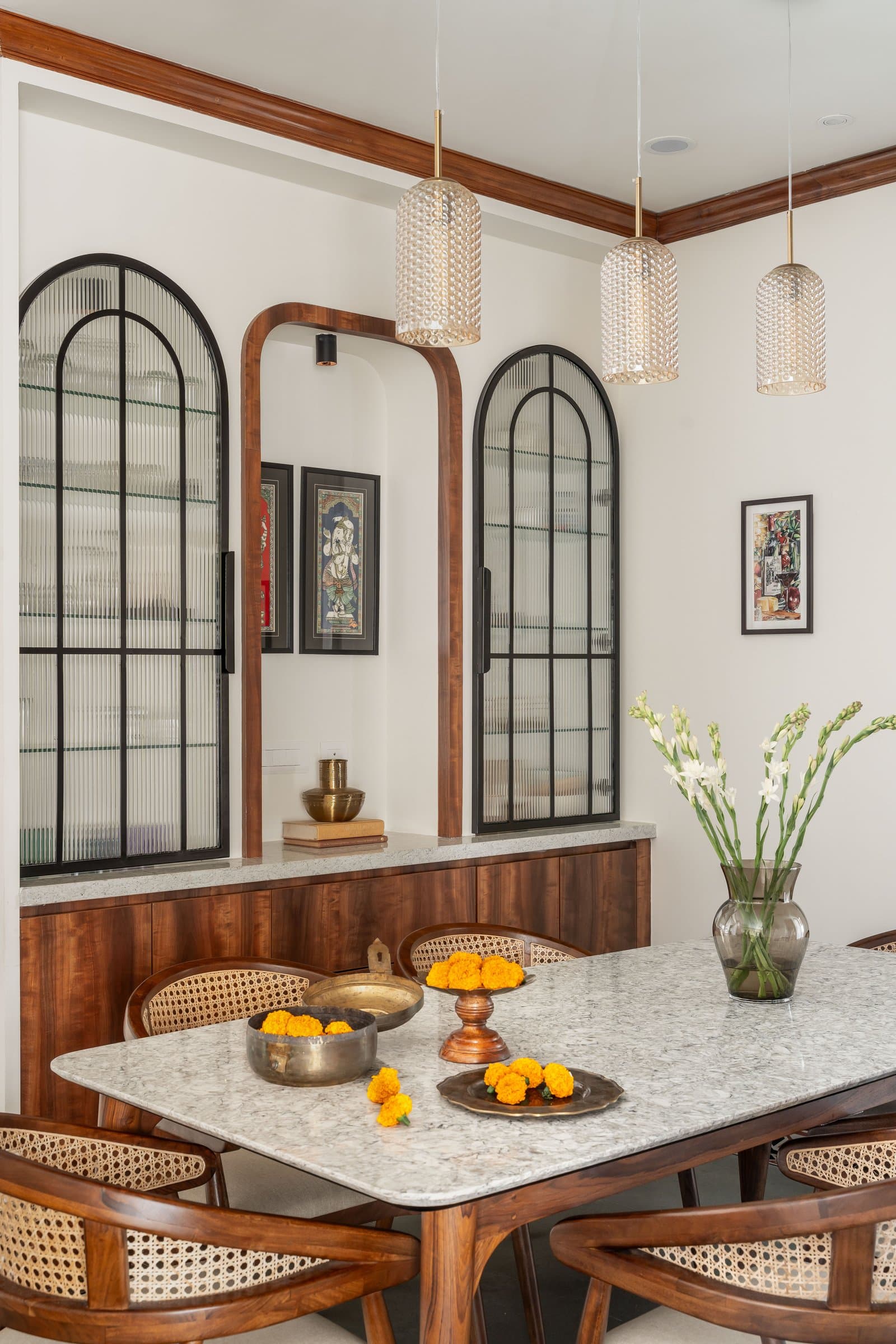
A closer look at the dining wall reveals how carefully the references have been edited. The arched fluted-glass cabinets echo Indo-Saracenic glazing without quoting it directly, and the central teakwood arched mirror, which anchors the composition between them, repeats the rounded shoulder seen at the kitchen threshold. Repetition becomes grammar.
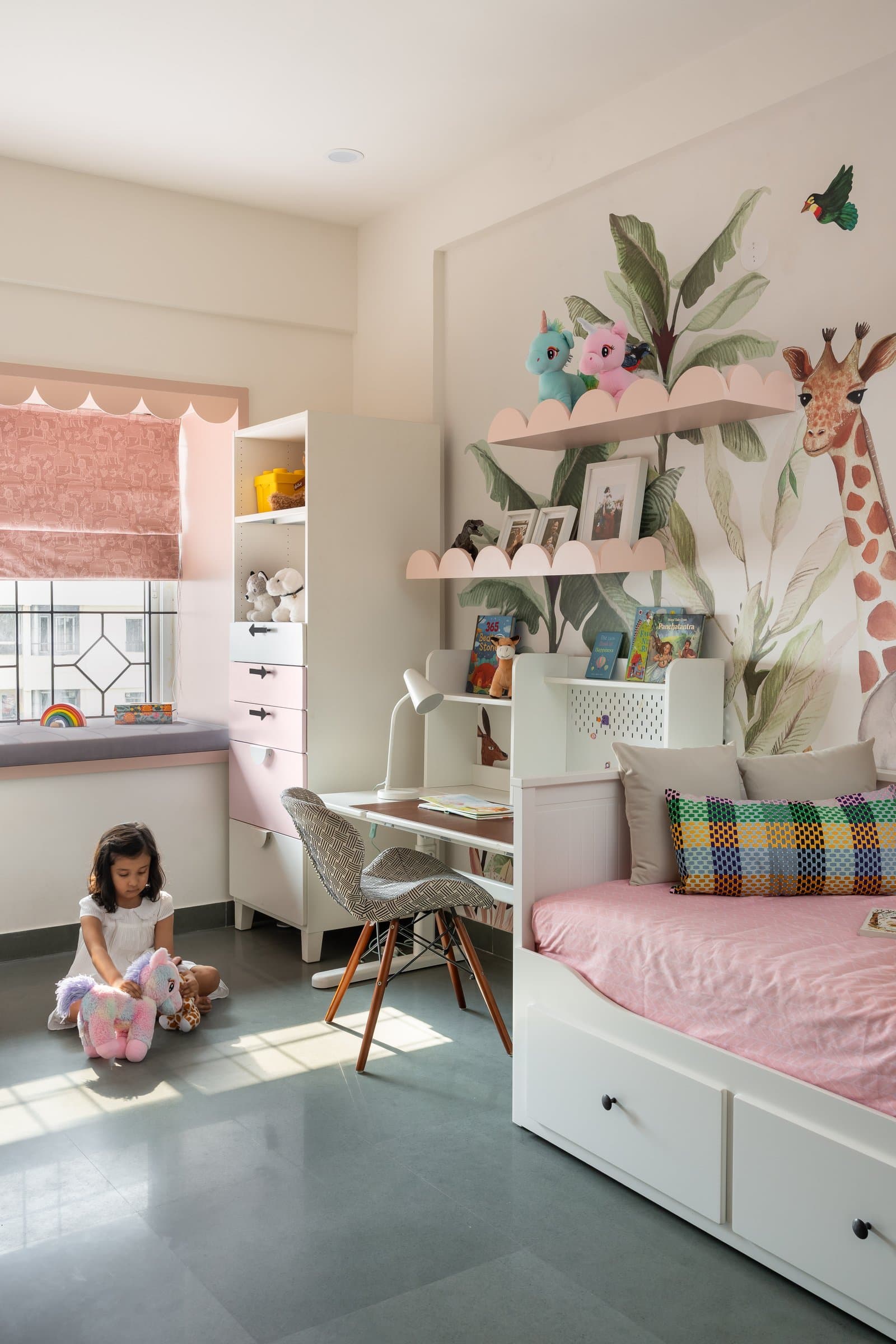
The daughter’s room is the home’s most exuberant chapter, and rightly so. A hand-painted jungle mural anchors the bed wall, scalloped pink shelves trace a soft horizon along it, and a window seat in dusty rose offers the kind of perch every six-year-old should grow up with.
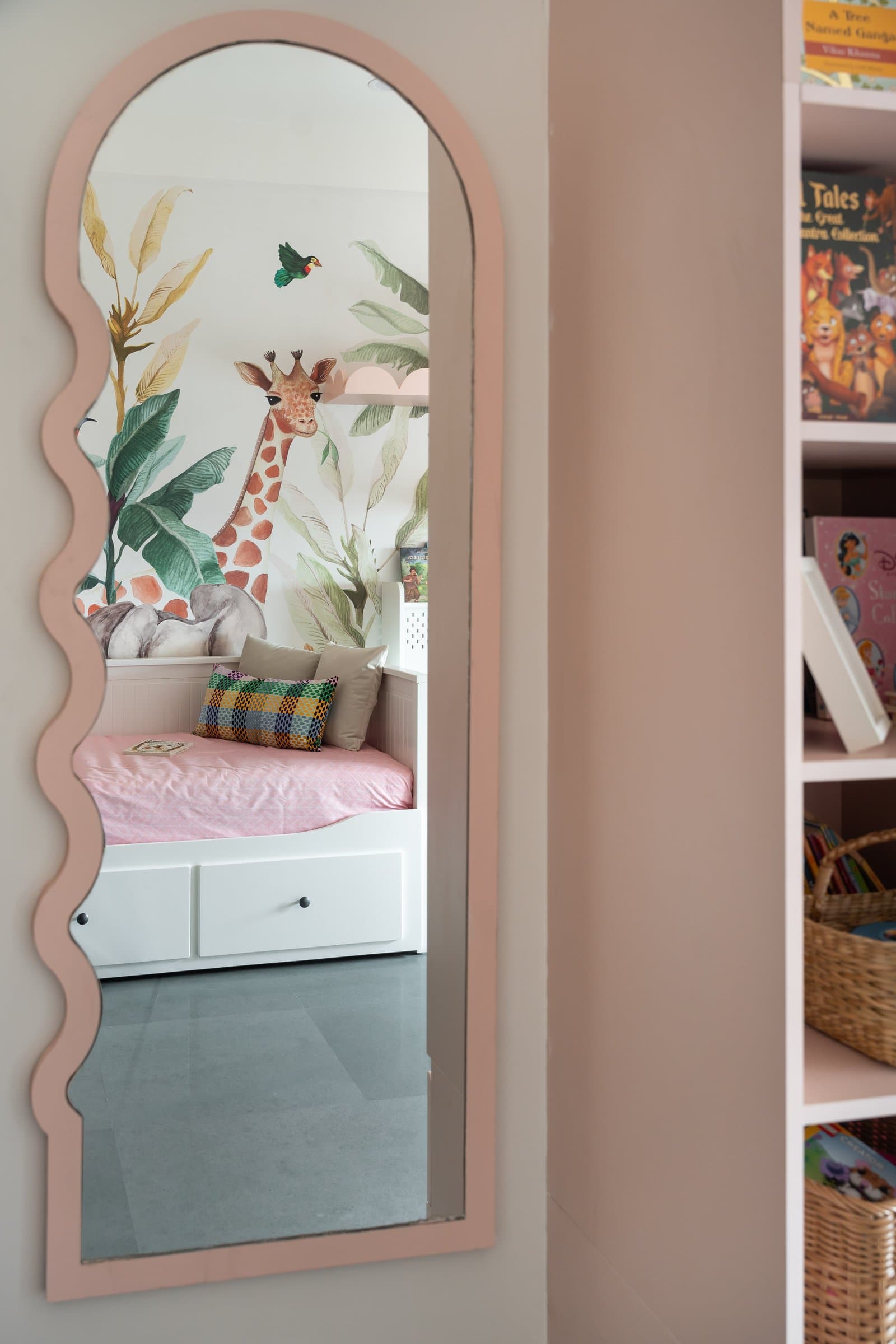
A wave-edged mirror in pale pink, set into the adjoining wall, reflects the mural back into the room and doubles its scale. The detail belongs to the same family of curves used elsewhere in the home, scaled down and softened for its smallest occupant.
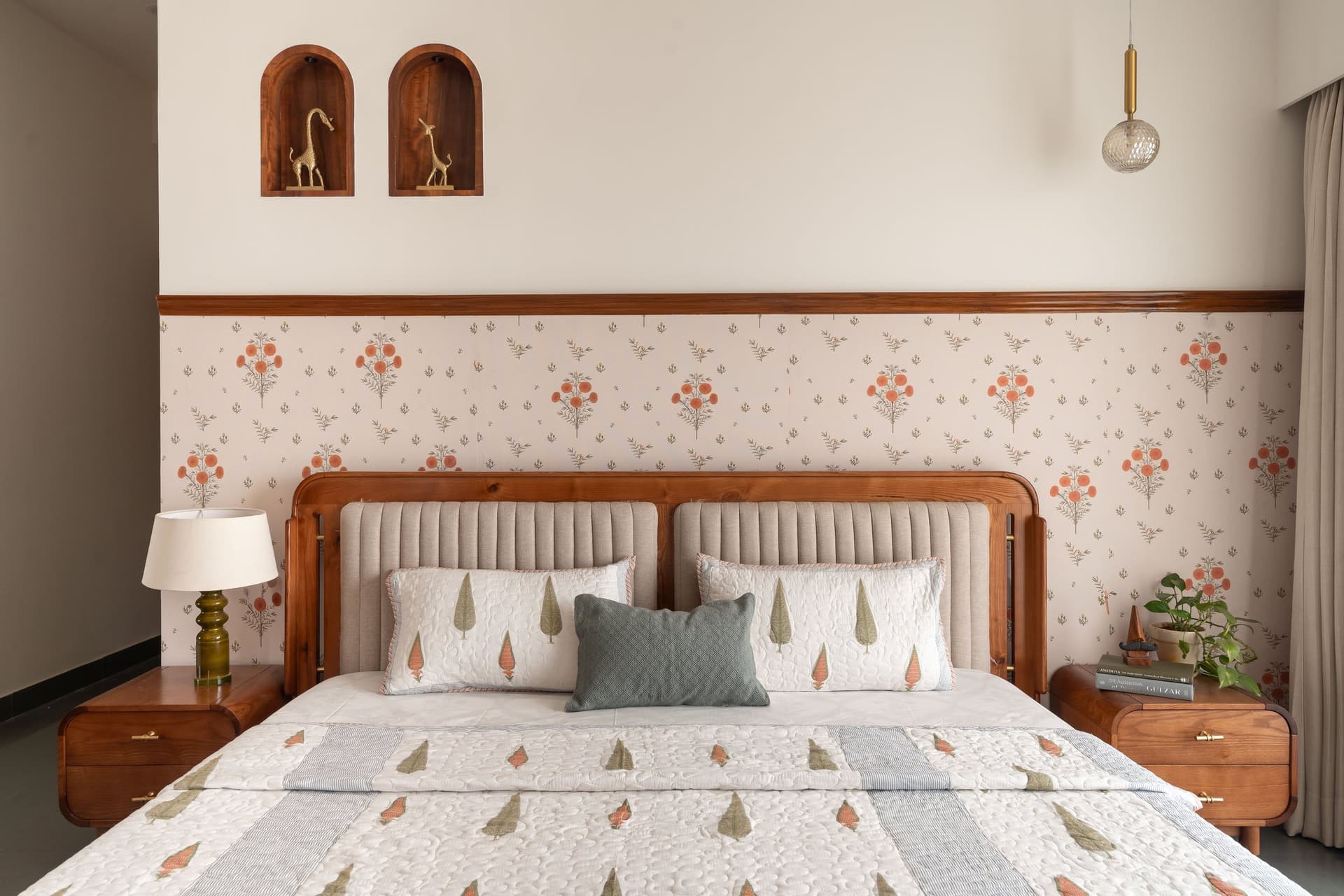
The master bedroom turns the volume down. A sheesham bed with a fluted upholstered headboard sits against a half-wall of orange-blossom wallpaper, capped with a teak dado rail; above, two arched niches in solid wood hold a pair of brass giraffes, a quiet nod to the daughter’s room next door.
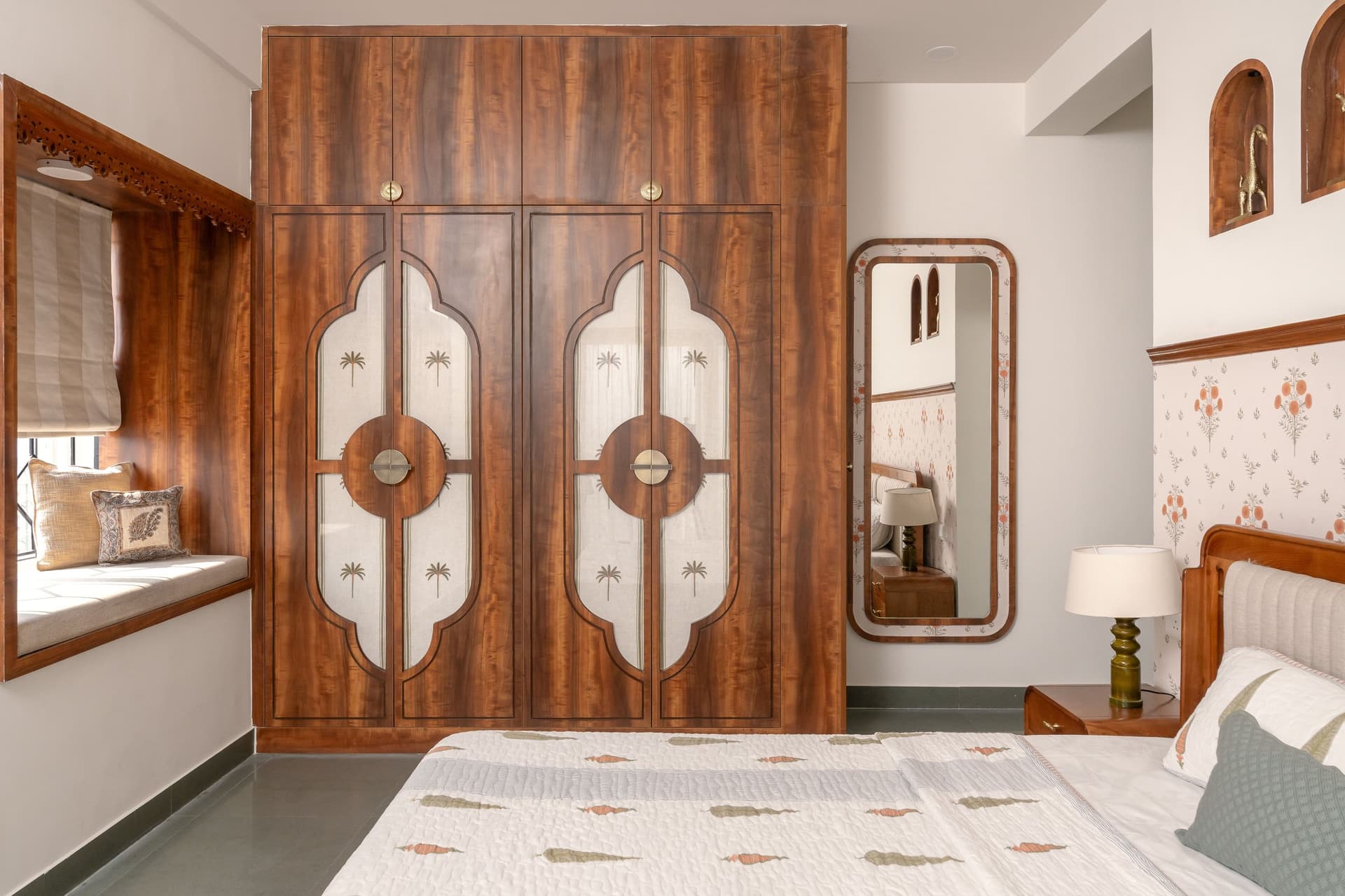
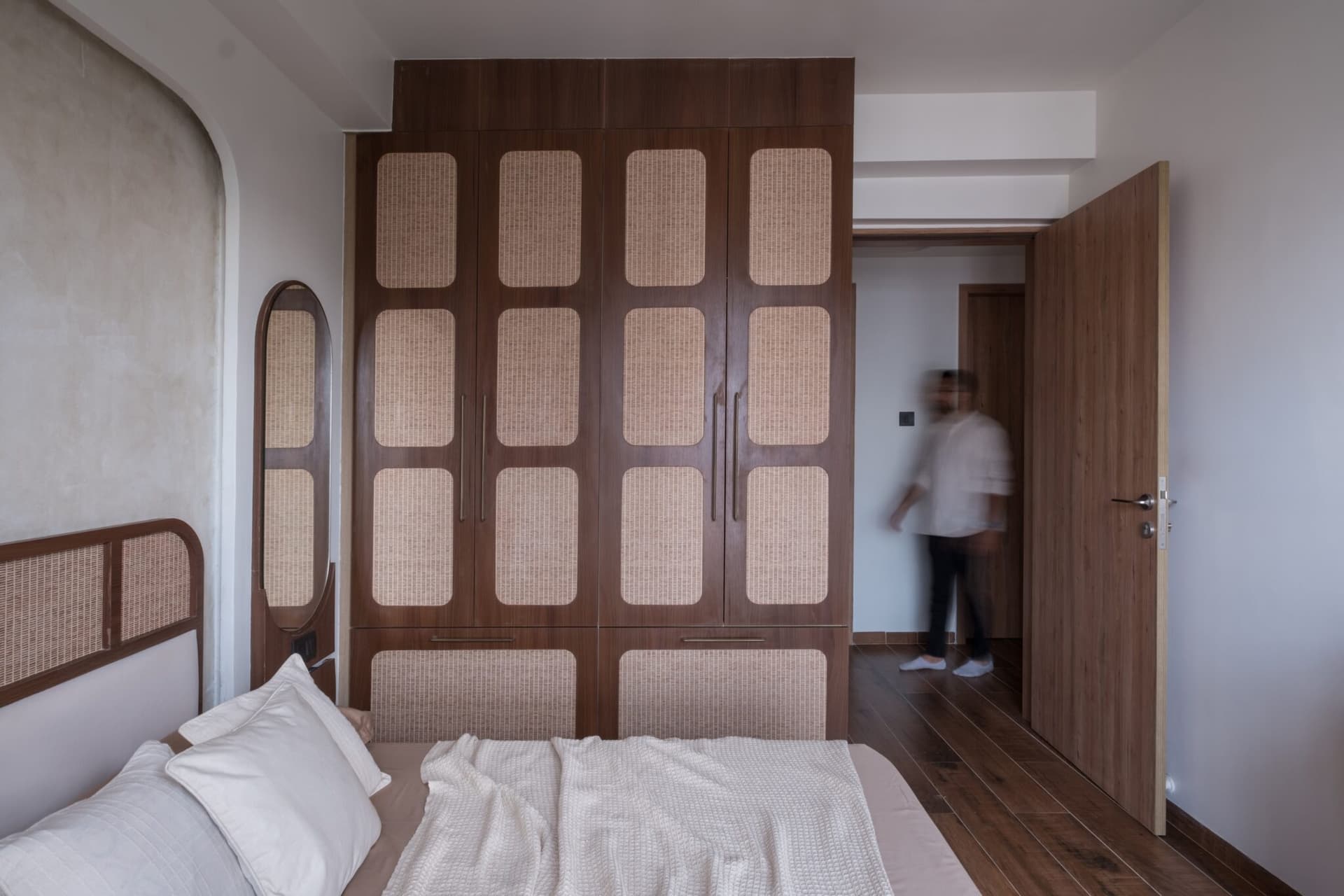
Opposite the bed, a tall four-door wardrobe in figured wood does most of the heavy lifting. Its central panels, framed in cusped Mughal-style arches and inlaid with linen sleeves stencilled with palm motifs, give a piece of bedroom storage the dignity of a cabinet of curiosities.
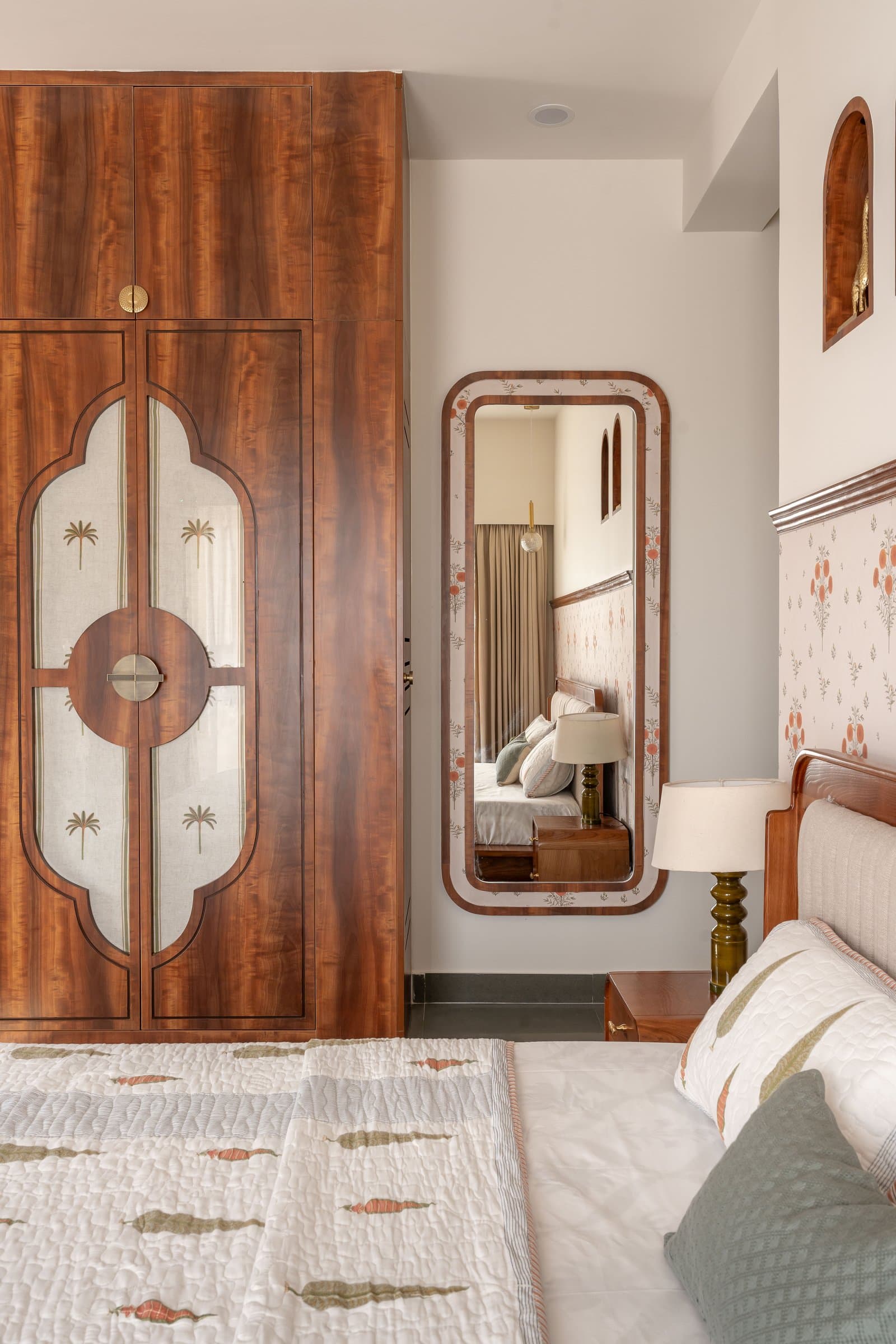
A floor mirror with a softly rounded wood frame and floral inlay completes the dressing corner. The reflection it offers, of bed, niches, wallpaper and pendant globe, is itself a small composition, the kind a painter would notice before anyone else.
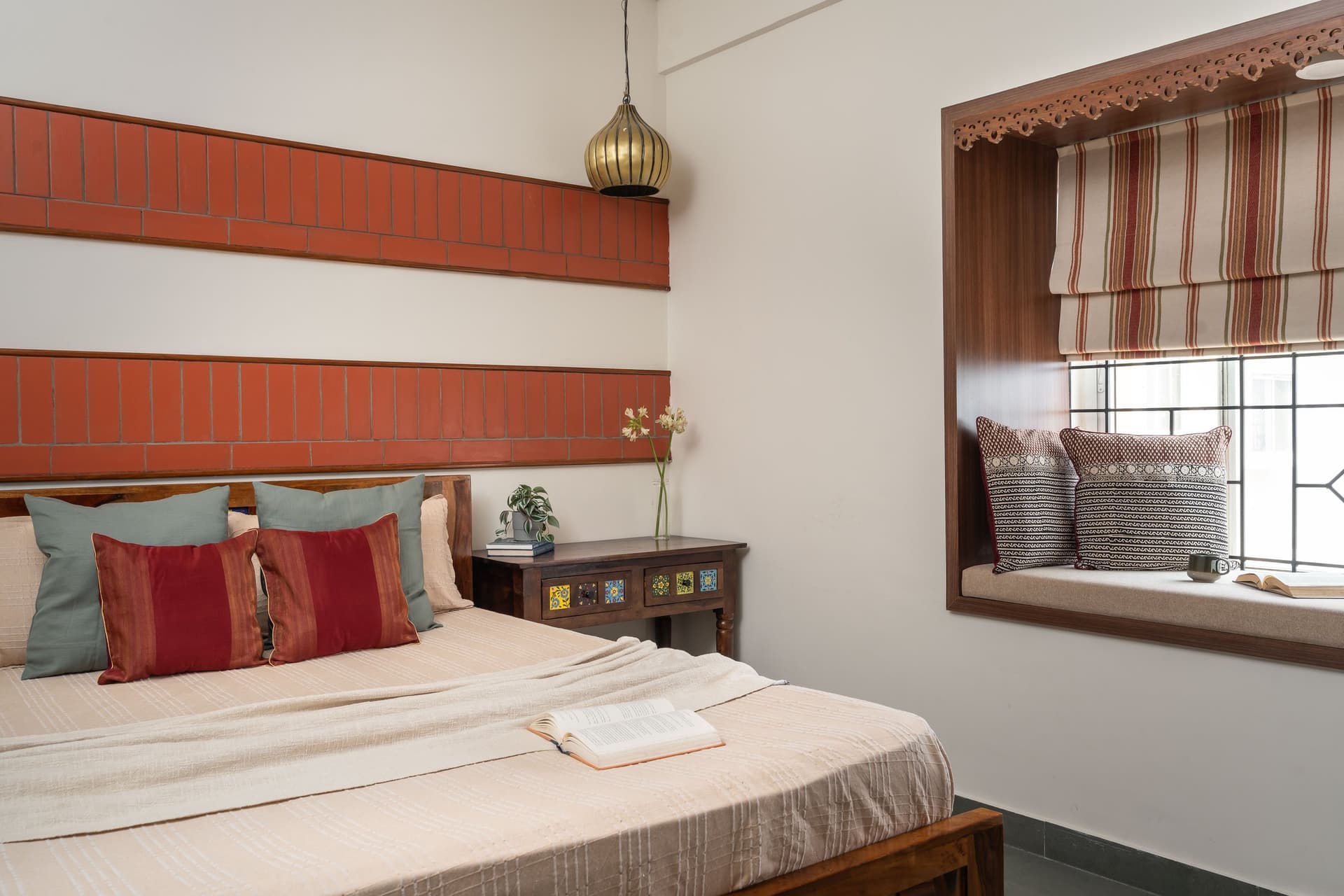
The guest bedroom takes a sharper turn. Two horizontal bands of vertically laid terracotta brick run across the wall behind the bed, and a brass pendant in a turnip silhouette hangs over the bedside, where a sheesham console with painted ceramic-tile drawers nods to old Gujarati and Rajasthani furniture vocabularies.
The window seat, recessed and crowned with a fretwork pelmet in dark wood, gives the room its second centre of gravity. It is a guest room that wants its guest to stay a while.
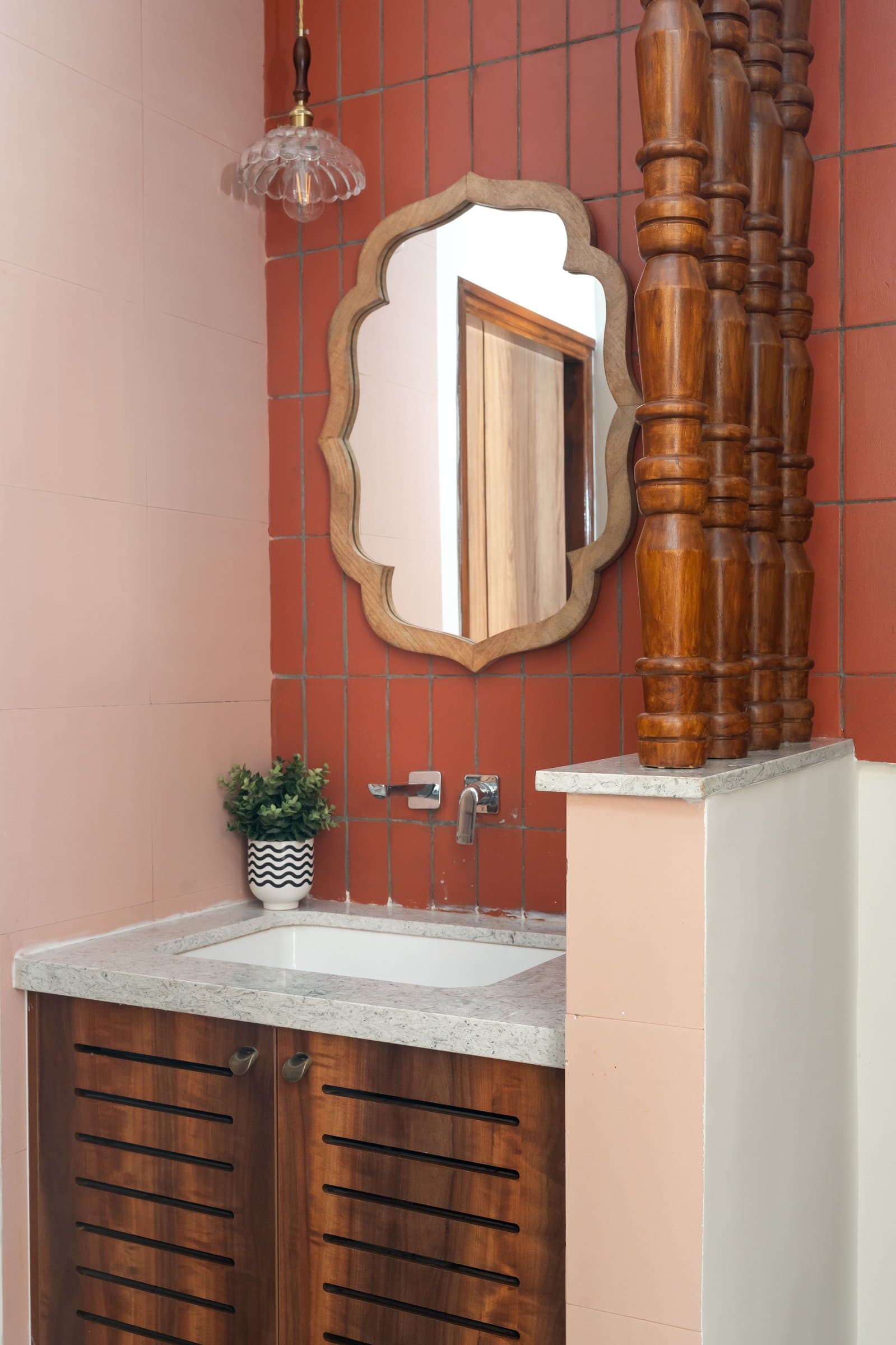
The powder room is small but unembarrassed about its own ambition. Terracotta wall tiles laid in a vertical stack meet a soft-pink lower band, and a scalloped wooden mirror floats between the two. A cluster of turned-wood balusters, repurposed as a sculptural object on a stone plinth, brings the temple lexicon quietly into the bathroom.
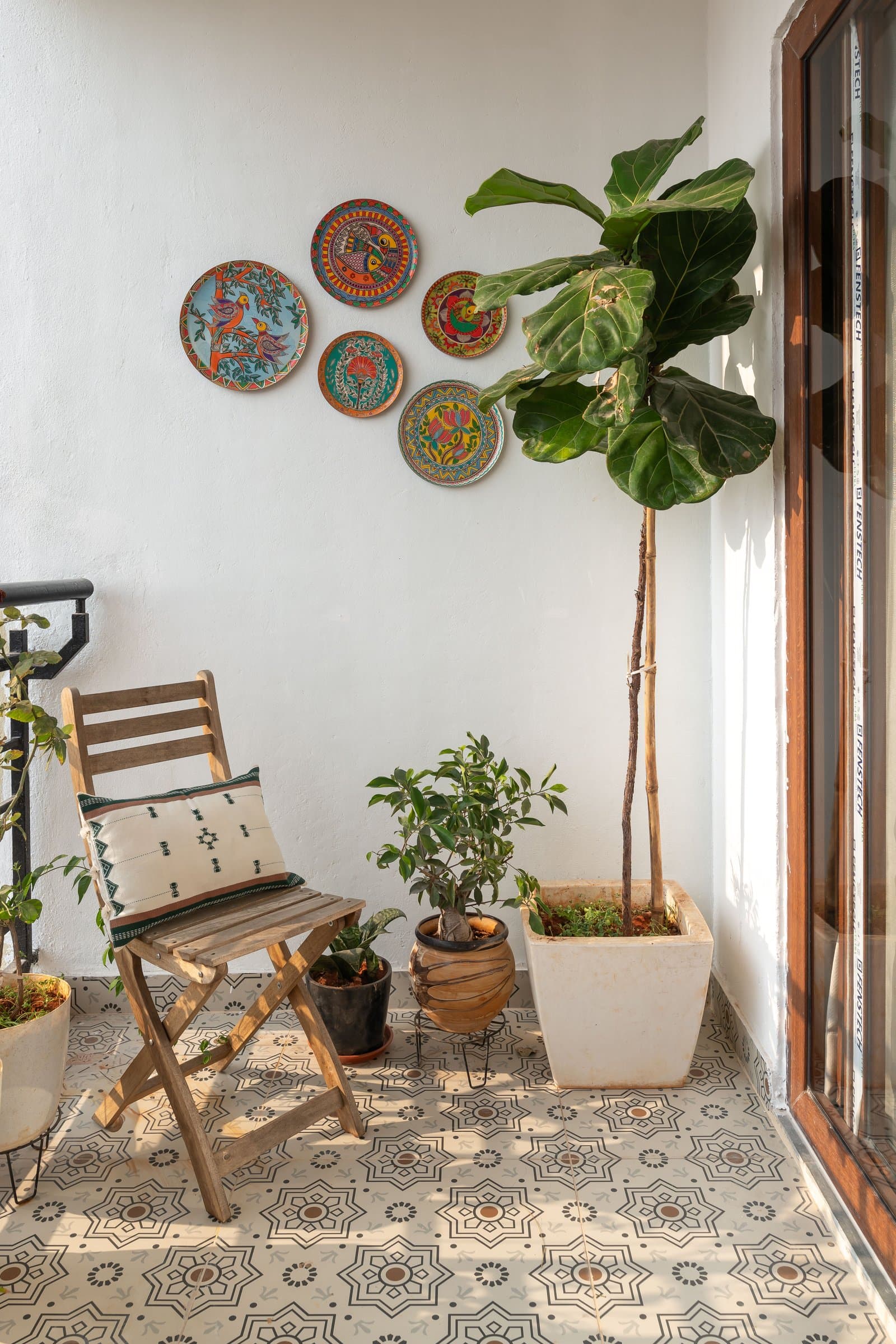
The balcony reads like a coda. Patterned cement tile underfoot, a cluster of Madhubani-painted plates on the wall, a folding teak chair, a fiddle-leaf fig reaching toward the window. The folk vocabulary that runs through the apartment surfaces here in its most relaxed form, stripped of architecture, set out in the open air.
What Ojas offers, beyond its specific catalogue of references, is a way of bringing a regional identity into a metropolitan apartment without resorting to either pastiche or restraint-as-virtue. Pattachitra, Ikat, Konark, Kota, terracotta brick: these are not sampled here, they are inhabited. The home reads as an argument that craft traditions can be lived with rather than displayed, that they belong in the daily fabric of a young family’s routine rather than behind glass.
What lingers, finally, is the feeling that the home has been written rather than decorated. Ojas is patient with its references, generous with its colour, and confident enough to let small details, an ikat skirting, a Pattachitra in a copper-rod frame, a terracotta dado, do the cultural work that lesser projects ask of a single hero wall.