There is a kind of home that resists the gravitational pull of beige minimalism without ever raising its voice. It commits to colour, but quietly. It embraces decoration, but with discipline. Ashton Park Villa belongs to this rarer category, where softness is not a mood but a structural decision, carried through ribbed walls, arched headboards, and a palette that hovers between blush, sand, and honeyed wood.
Designed by Safa Tanveen Design Studio, the villa sits within Ashton Park, a residential pocket of Dubai whose Mediterranean-styled facades make the restraint inside feel almost like a counter-argument. The clients, a young family with two children, asked for a home that could hold both the formality of entertaining and the gentler rituals of daily life. The result is a project where every room is tuned to a different register, but the underlying grammar of fluted surfaces, rounded edges, and warm neutrals never breaks.
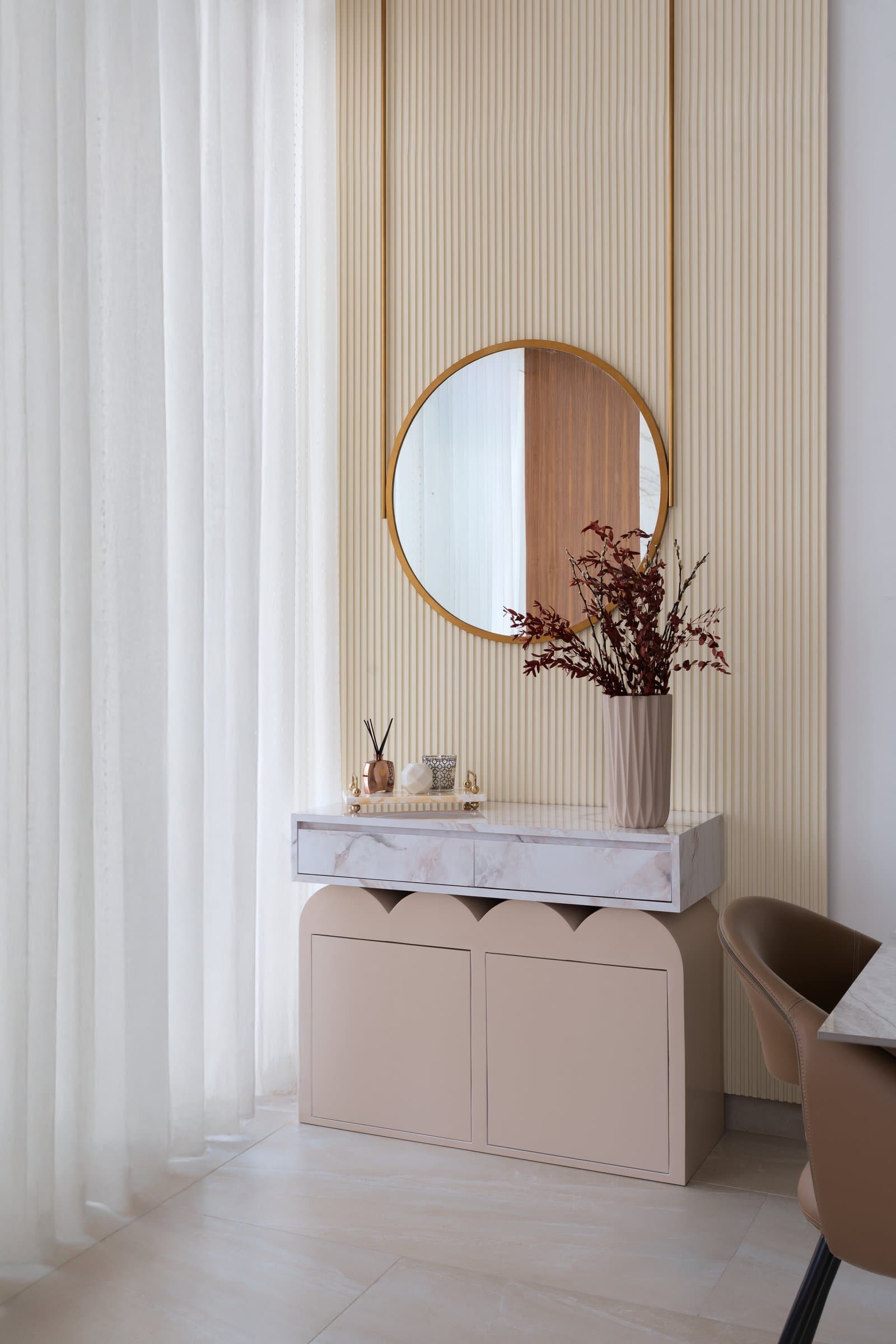
The entry sets the thesis before any larger room has a chance to. A ribbed ivory wall climbs the full height of the foyer, broken only by a brass-framed circular mirror and a slim brass inlay that draws the eye upward. Below, a blush console with a scalloped silhouette and a softly veined stone top introduces the home’s central idea: that decoration, handled with precision, can feel architectural rather than ornamental.
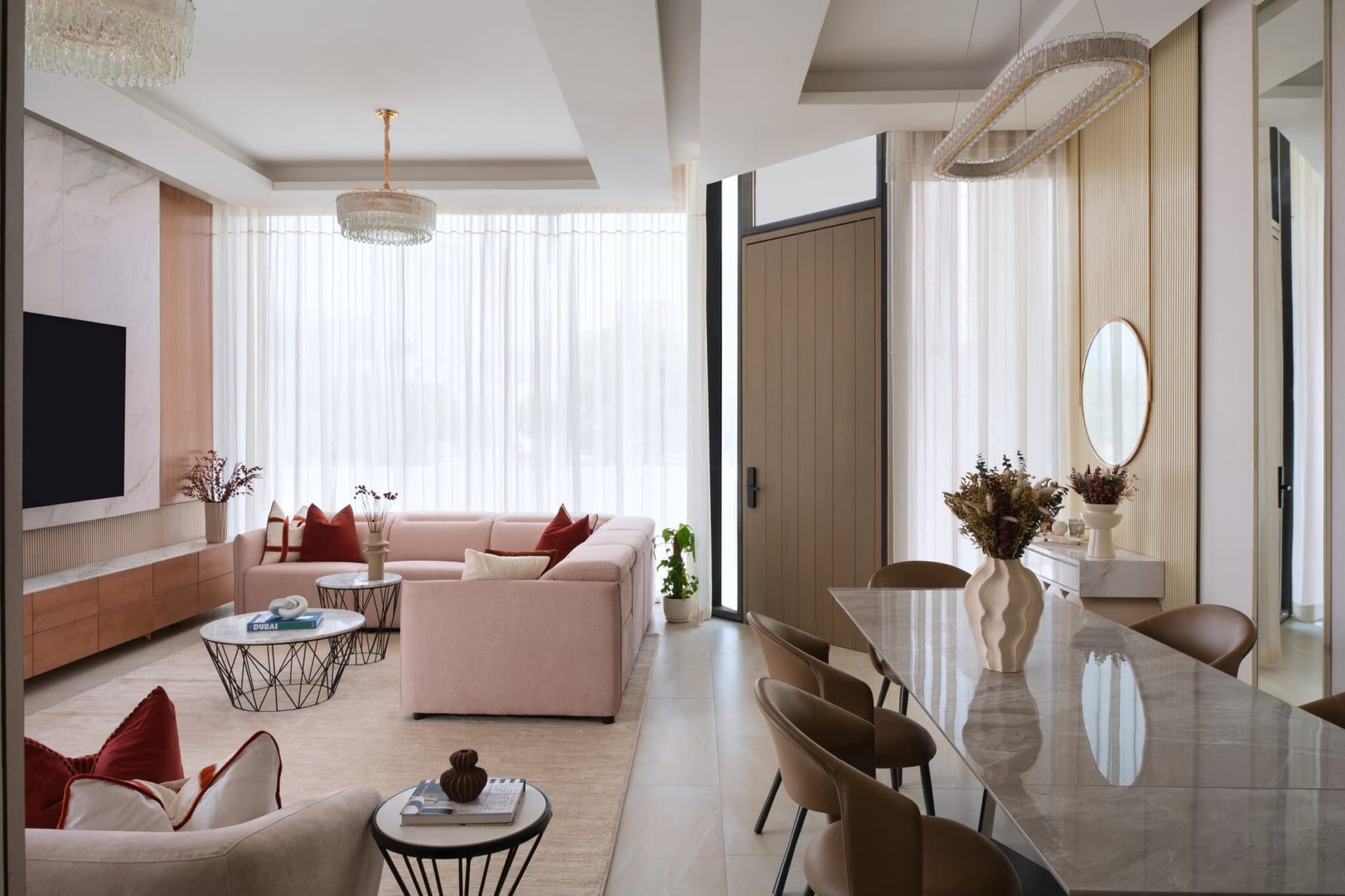
Beyond the foyer, the main living volume opens as a single, generously proportioned room where the lounge and dining area share light from a wall of sheer-curtained glazing. A blush sectional anchors one half, a stone-topped dining table the other, and two distinct light fixtures, a tiered crystal pendant and a long oval chandelier, mark the zones without partitioning them.
What gives the room its confidence is not the furniture but the way the architecture quietly choreographs it. The ceiling drops in low coffers above each seating cluster, the floor reads as one continuous plane, and the walls alternate between fluted timber and pale stone in long, deliberate stretches.
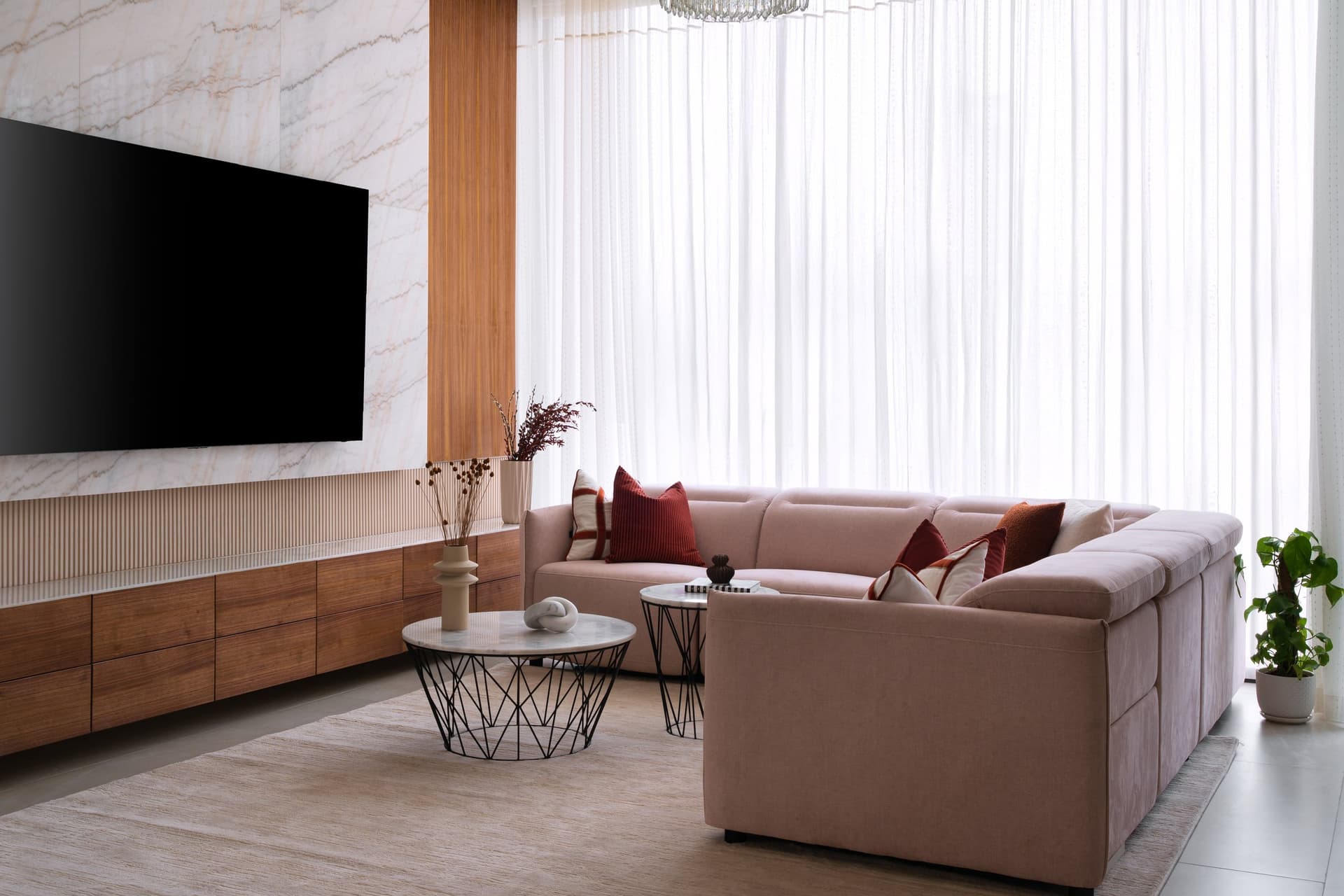
The television wall is the room’s most considered surface. A slab of softly veined quartzite runs the full width behind the screen, paired with a low walnut media console whose ribbed inset echoes the foyer’s wall treatment. The pairing of veined stone and warm wood-grain is now a familiar move in Dubai interiors, but here it earns its place by being quiet, the veining subtle, the cabinetry flush, the visual weight kept low.
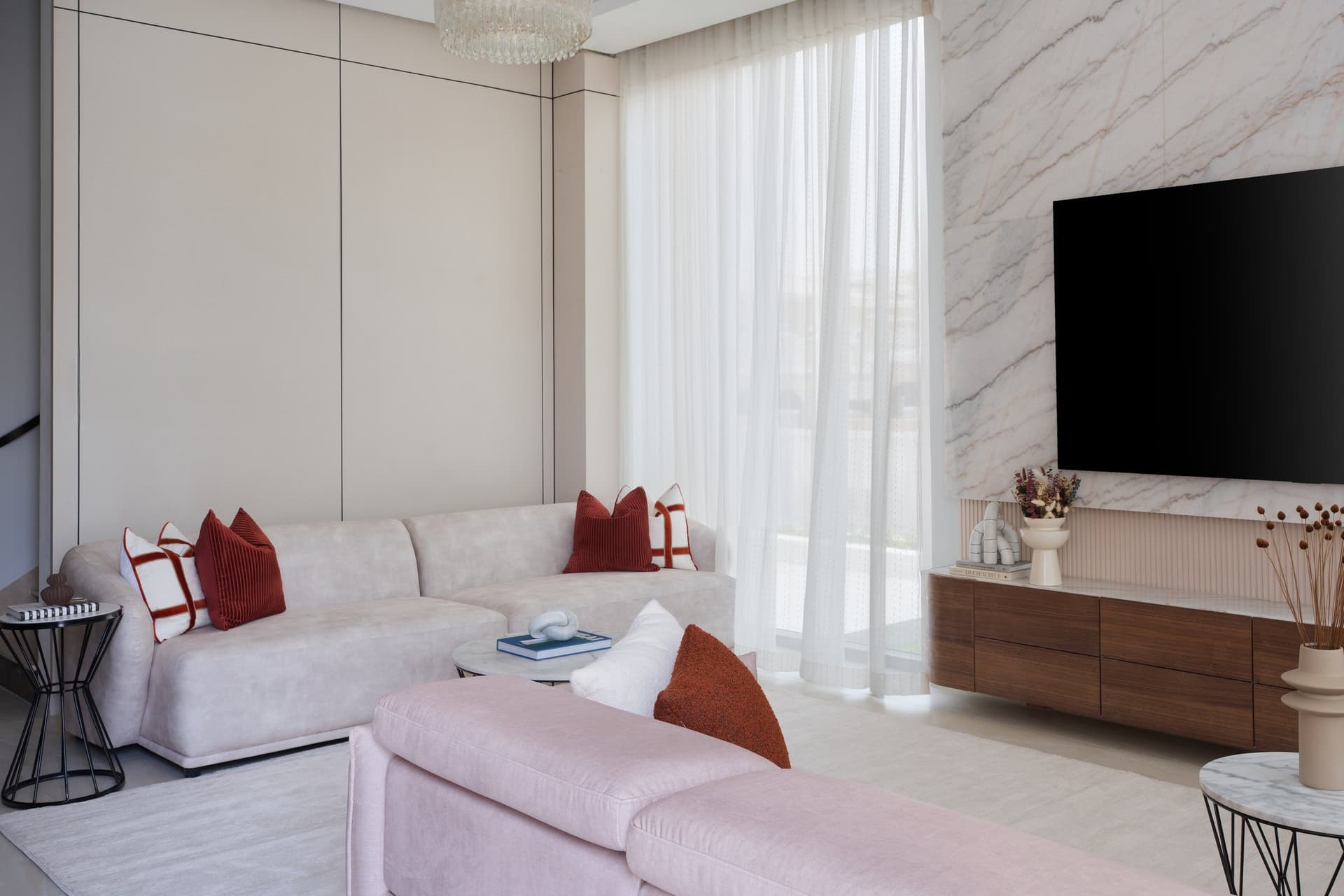
From the opposite angle, the room reveals its second seating arrangement: a cream sectional pulled against a wall of tall recessed panels, with the pink sofa visible in the foreground. The two sofas, in complementary soft tones, are a small but telling decision. The room is generous enough to host more than one social mode, and the design recognises this rather than forcing a single focal point.
““We wanted softness to feel like a structural choice, not a styling one,” the studio notes of the project.”
Closer in, the blush sectional reads as the room’s most committed gesture. The colour is unusual for a primary sofa in a family home, and yet the styling, terracotta-striped cushions, a single sculptural vase of dried stems, marble-topped wire side tables, keeps it from drifting into sweetness. The room holds its softness without surrendering to it.
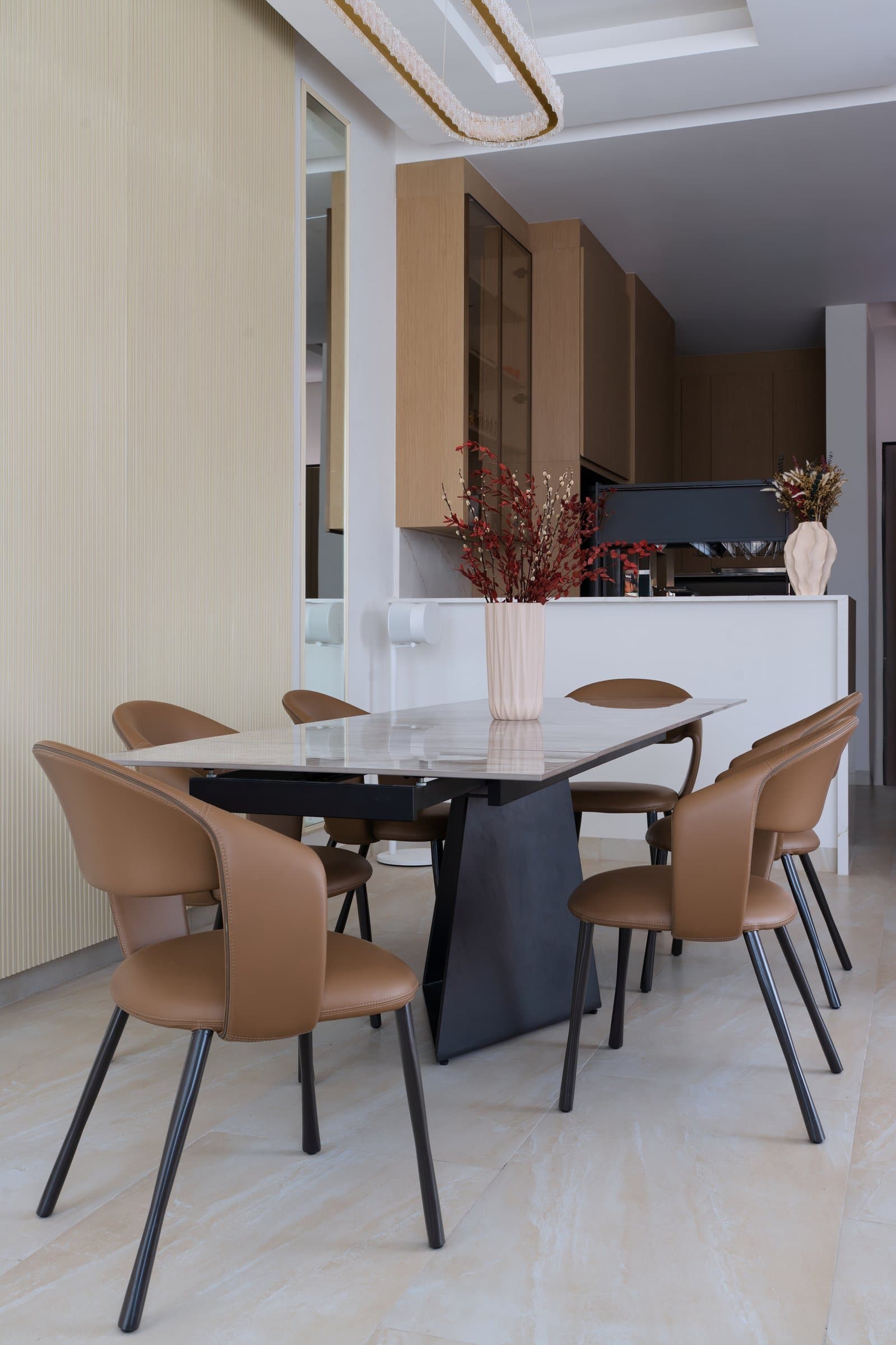
The dining area sits adjacent to the open kitchen, separated only by a low counter that doubles as a service edge. A stone-topped extendable table with a sculptural black base is paired with caramel leather chairs whose curved backs and slim black legs feel almost mid-century in profile. The kitchen behind, in pale oak with glazed upper cabinets, is deliberately understated, ceding the visual weight to the dining setting in front of it.
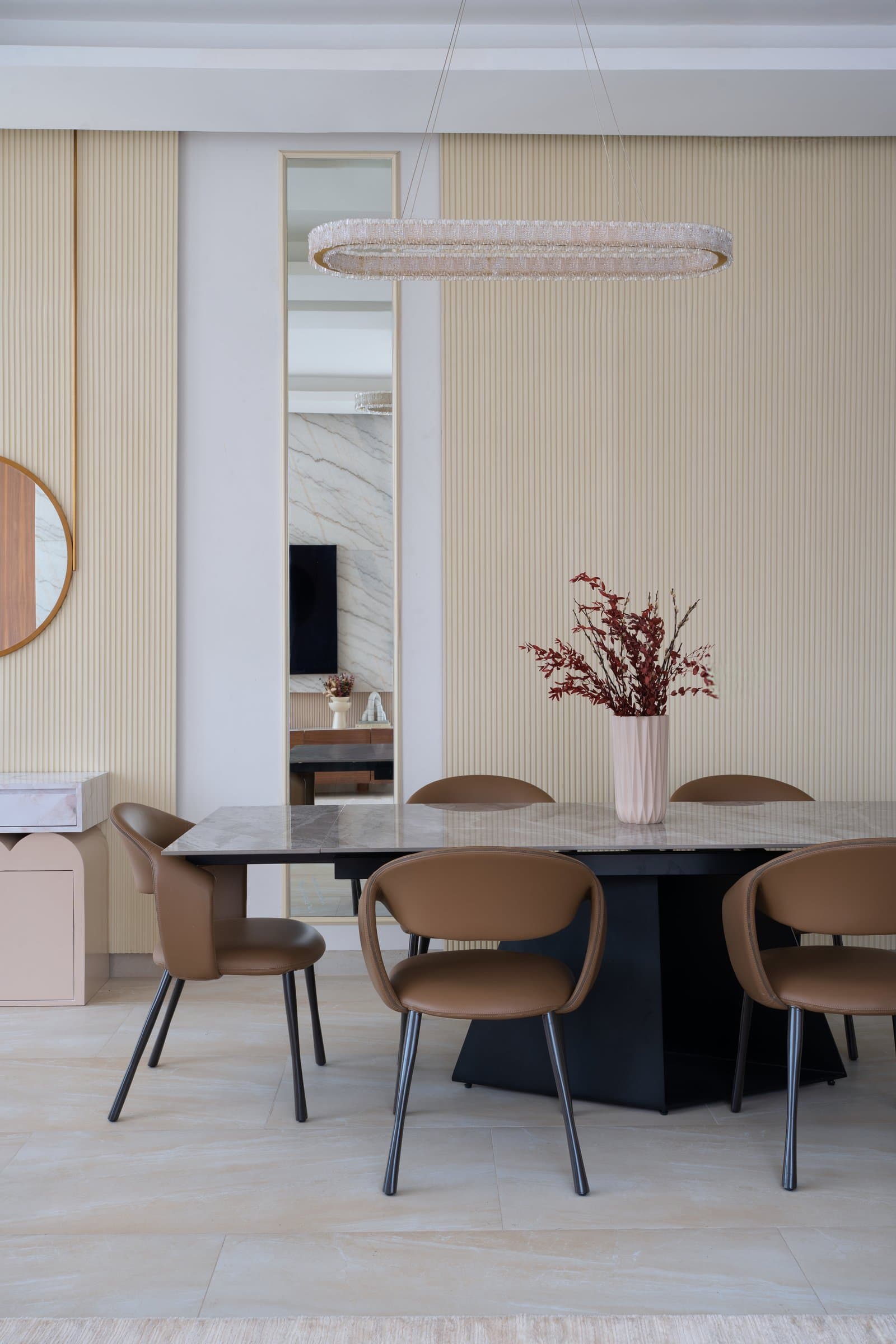
Seen straight on, the dining wall becomes the room’s quiet showpiece. A full-height ribbed panel in cream runs floor to ceiling, framed by a slim mirrored insert that catches a glimpse of the living room beyond. The oval crystal chandelier hovers above the table at exactly the right scale, generous enough to register, restrained enough not to compete with the wall behind it.
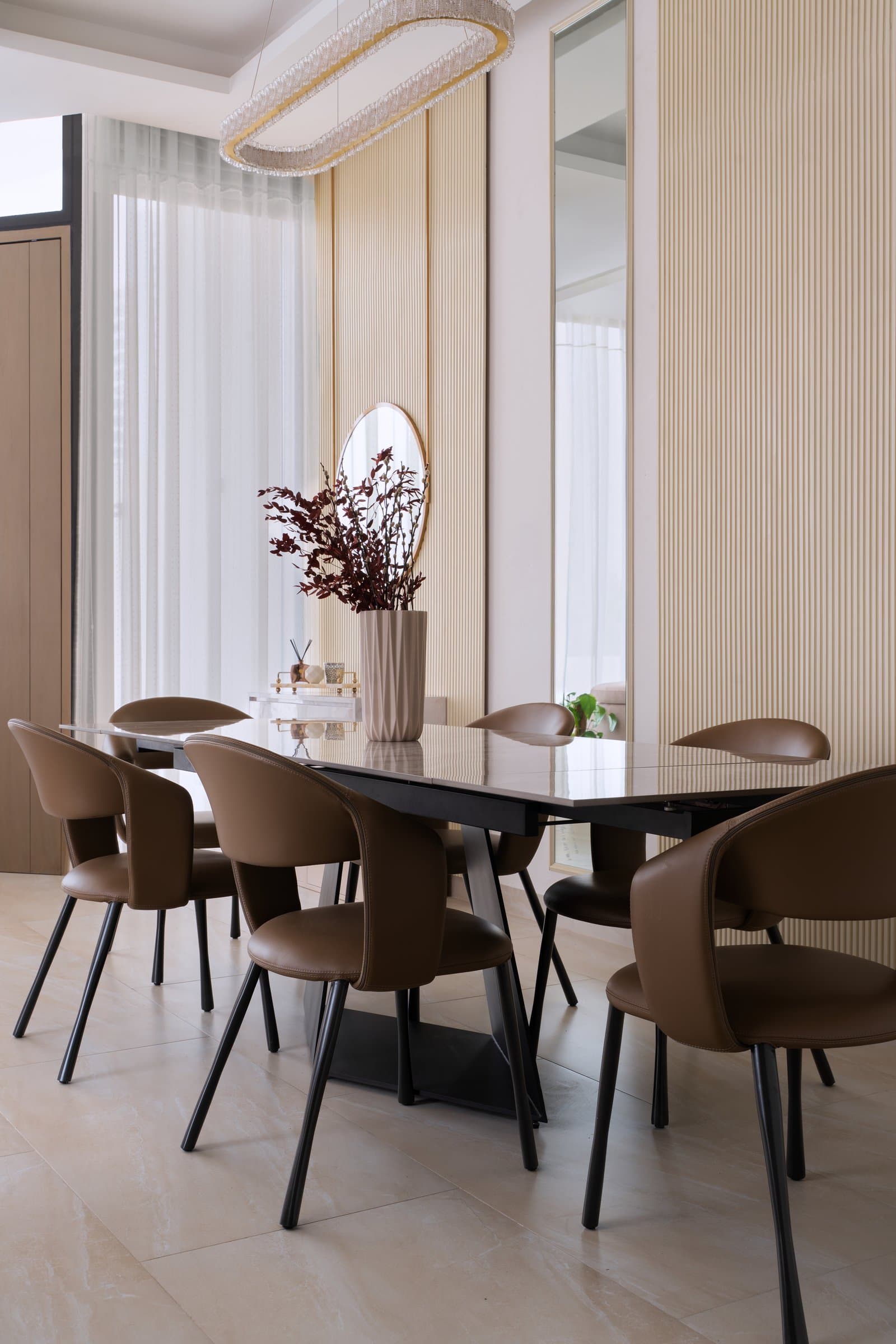
The detail view of the dining setting reveals how carefully the studio has calibrated the texture story. Ribbed cream walls, a small oval mirror, a fluted vase, and the leather of the chairs all share a palette that sits within half a tonal step of each other. Decoration here is achieved through surface, not colour, which is why the room feels composed rather than busy.
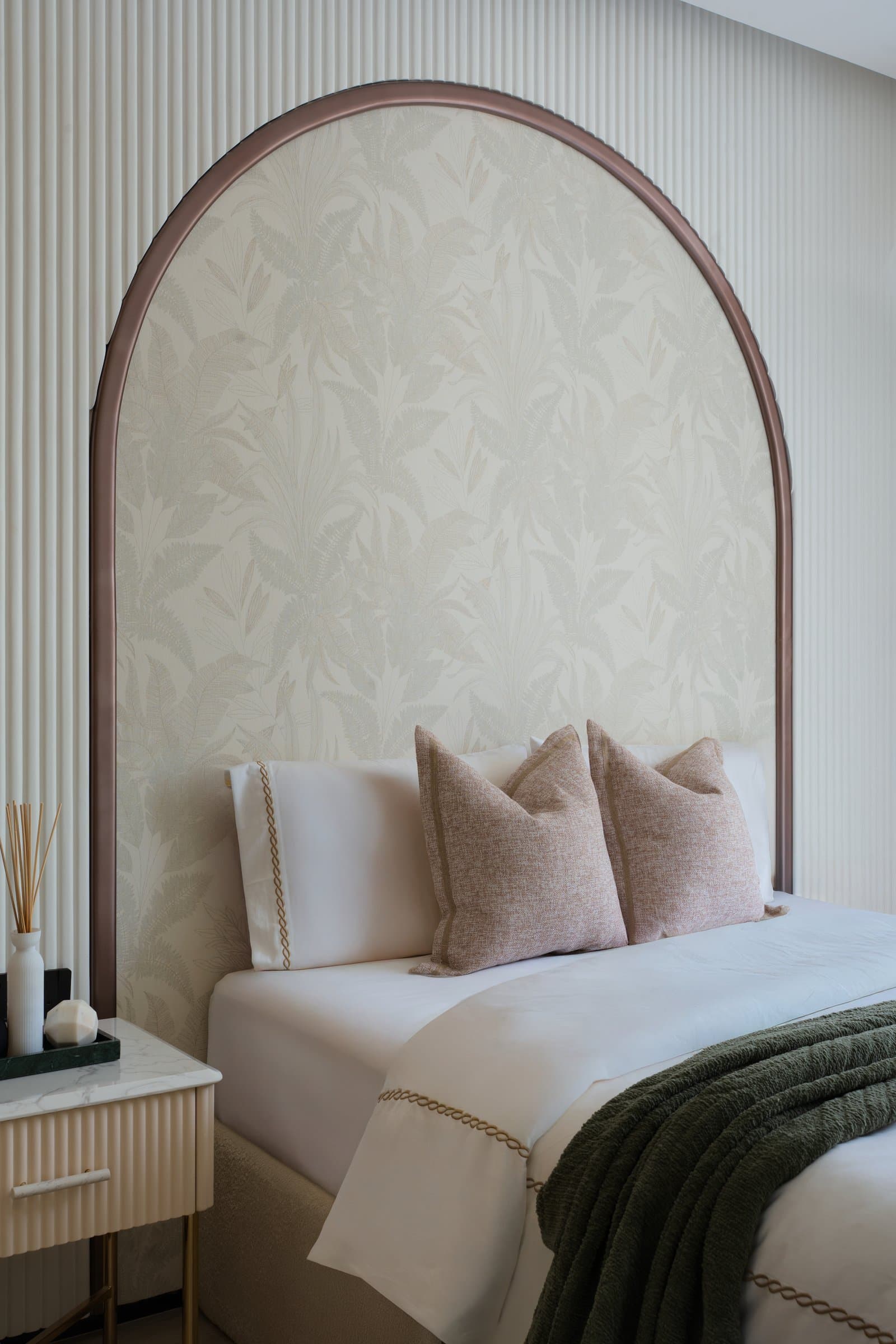
Upstairs, the guest bedroom announces a different vocabulary. An arched headboard wall wrapped in a soft botanical print is framed by a slim copper-toned moulding, set against fluted ivory panels that continue the home’s signature texture. The bed itself is dressed in white linens with subtle gold embroidery, accented by blush cushions and a single olive throw, the only cool note in an otherwise warm room.
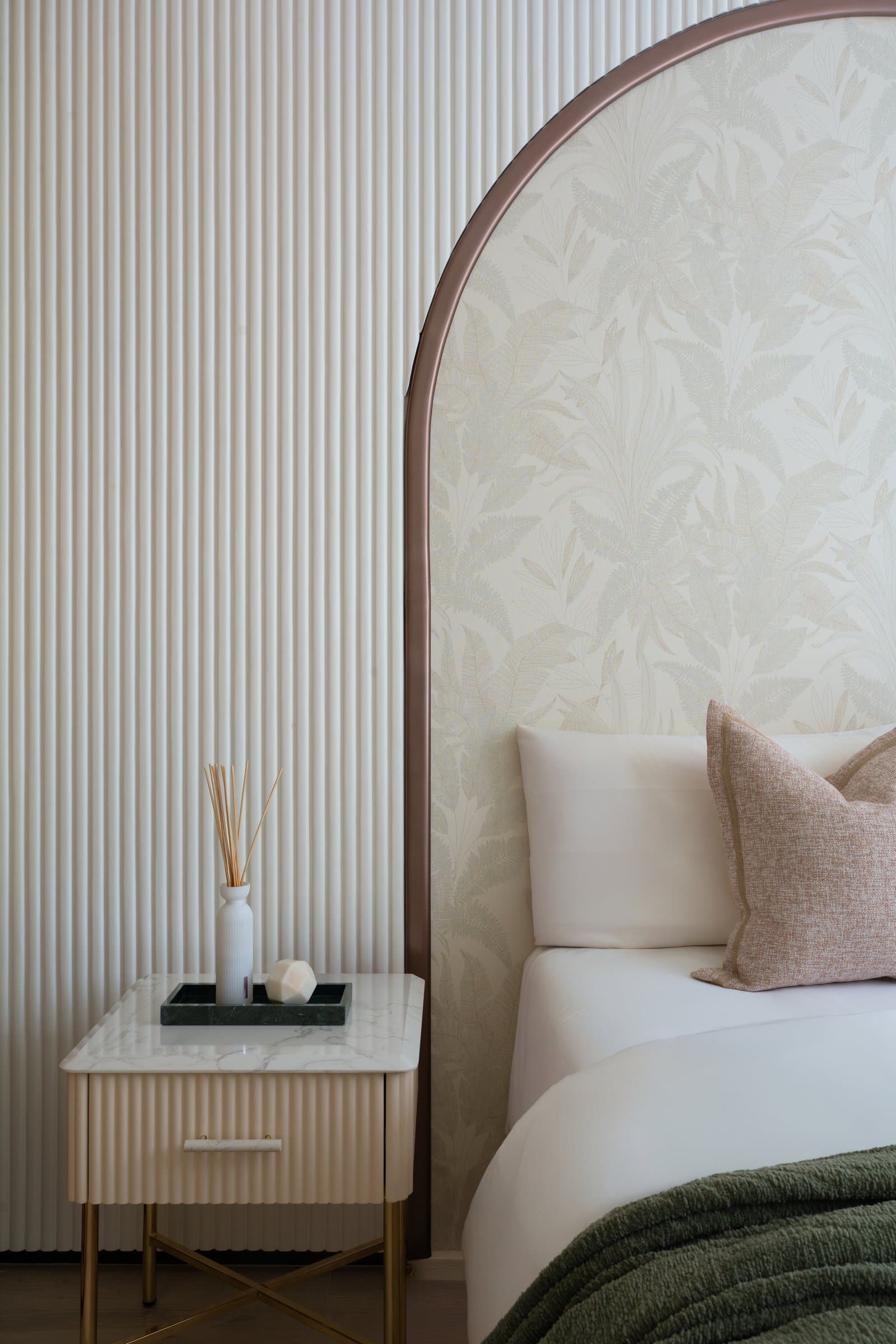
A closer view shows how the arch resolves against the fluted wall behind it. The botanical wallpaper, leafy and tonal rather than graphic, sits inside the copper frame like a piece of art, while a slim bedside cabinet in fluted cream stone, with brass-finished legs, completes the composition. It is a room that understands the difference between a feature wall and an architectural gesture.
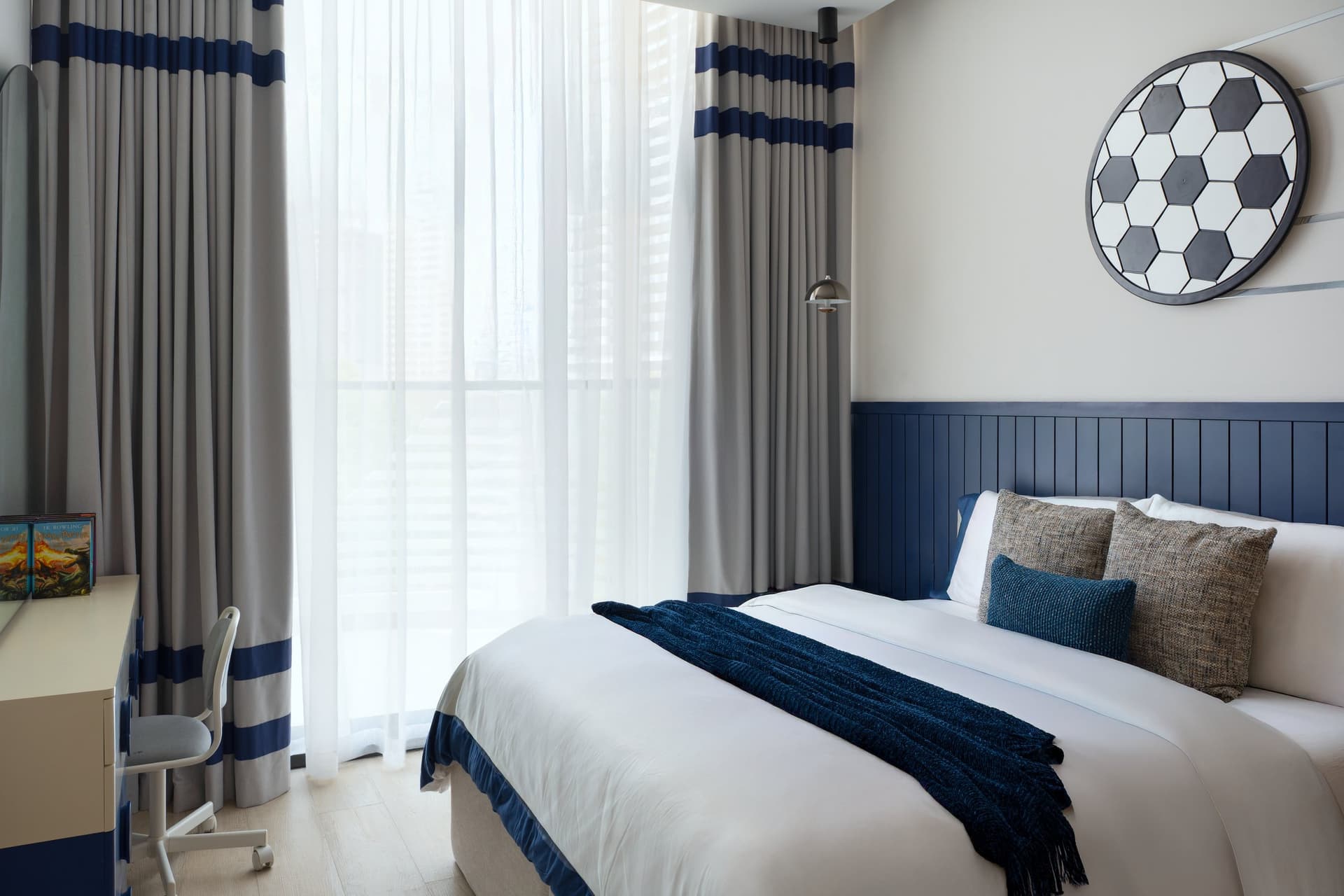
The children’s room shifts register entirely. A navy panelled wainscot runs along the bed wall, paired with crisp white above and a circular soccer-ball mirror that signals the occupant’s interests without overplaying them. Striped curtains in grey and navy add a graphic note, and a small desk by the window keeps the room functional without crowding it.
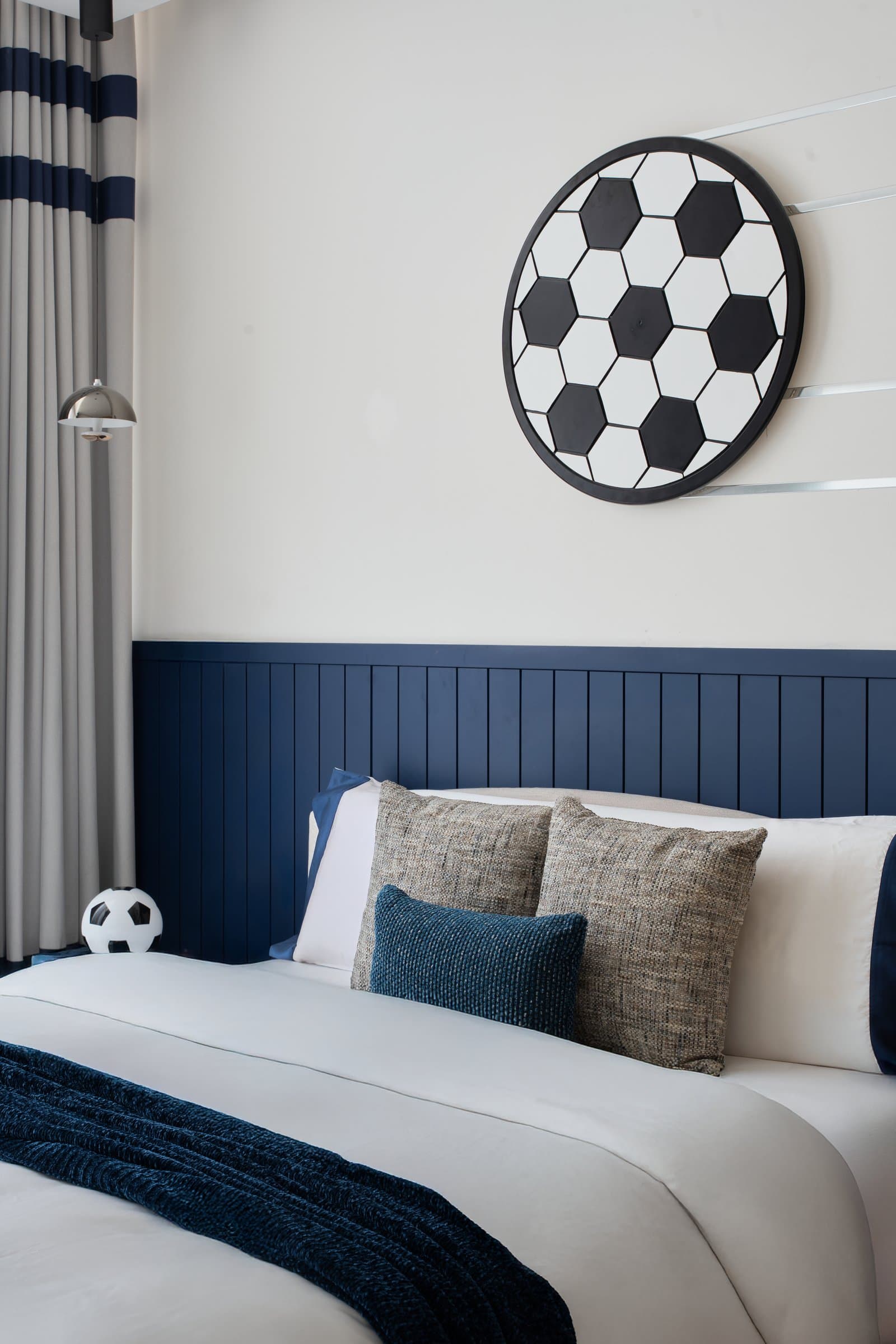
The headboard wall, seen in detail, is a small lesson in how to design a child’s room without infantilising it. The navy panelling could belong in a study; the soccer-ball mirror reads as graphic art rather than merchandise; the cushions in tweed and indigo keep the palette adult-adjacent. The room will age with its occupant, which is the point.
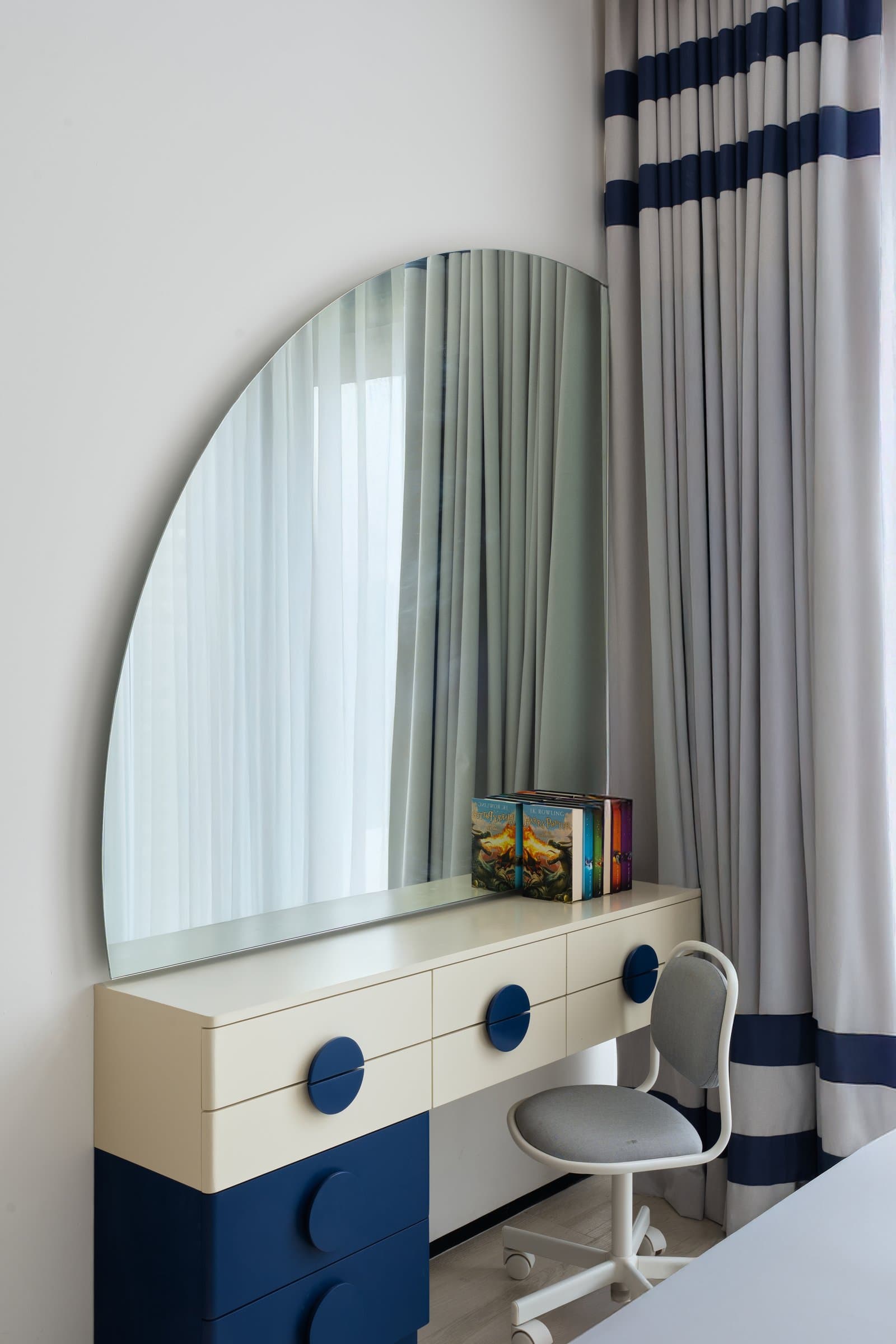
A custom vanity in cream and cobalt, with oversized circular pulls and a half-moon mirror, anchors the room’s working wall. It is one of the few pieces in the villa that genuinely plays, the proportions exaggerated, the colour-blocking unapologetic, and it earns its place by being the one moment in the home where decoration is permitted to be loud.
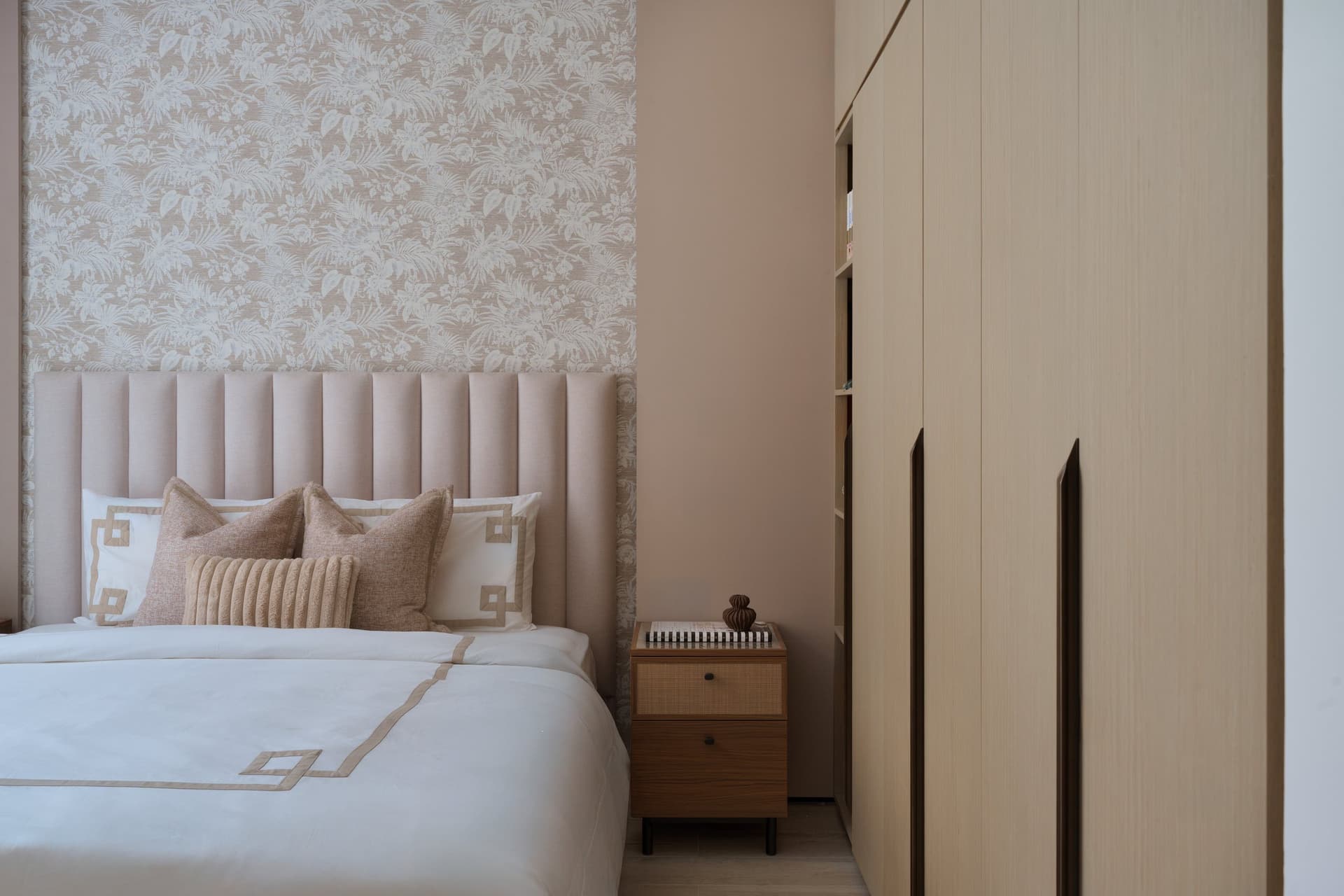
The second bedroom returns to the softer palette. A channel-tufted blush headboard sits against a tonal botanical wallpaper, with built-in wardrobes in pale oak running the length of the adjoining wall. The integration of joinery and decoration is the room’s quiet achievement: the wardrobes disappear into the wall plane, leaving the headboard to do the visual work.
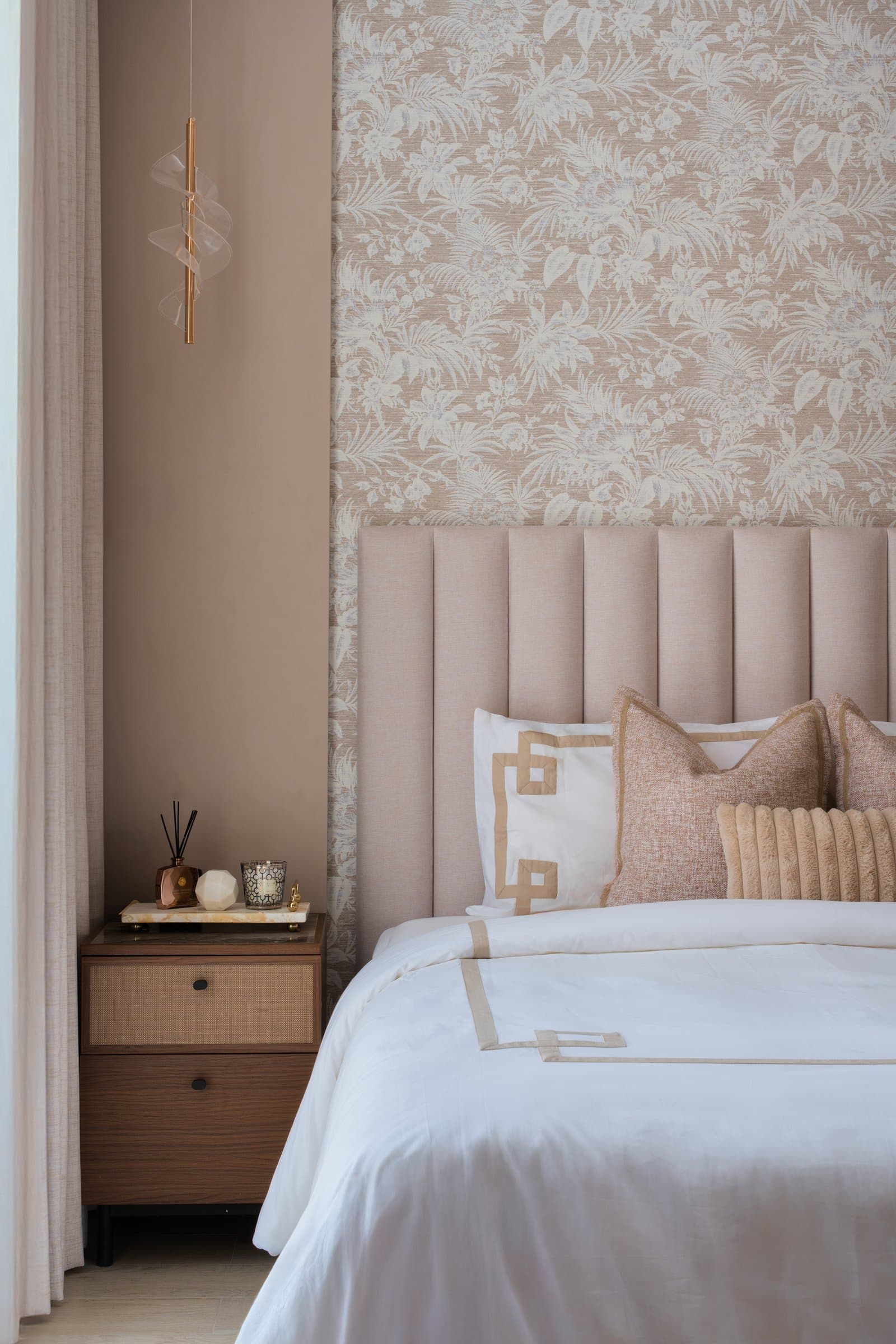
A closer view shows the wallpaper’s restraint, an oversized botanical motif in cream on a dusty pink ground, paired with a cane-fronted bedside cabinet and a slim hanging pendant in brass and frosted glass. The room is unmistakably feminine, but its femininity is achieved through texture and proportion rather than through colour alone.
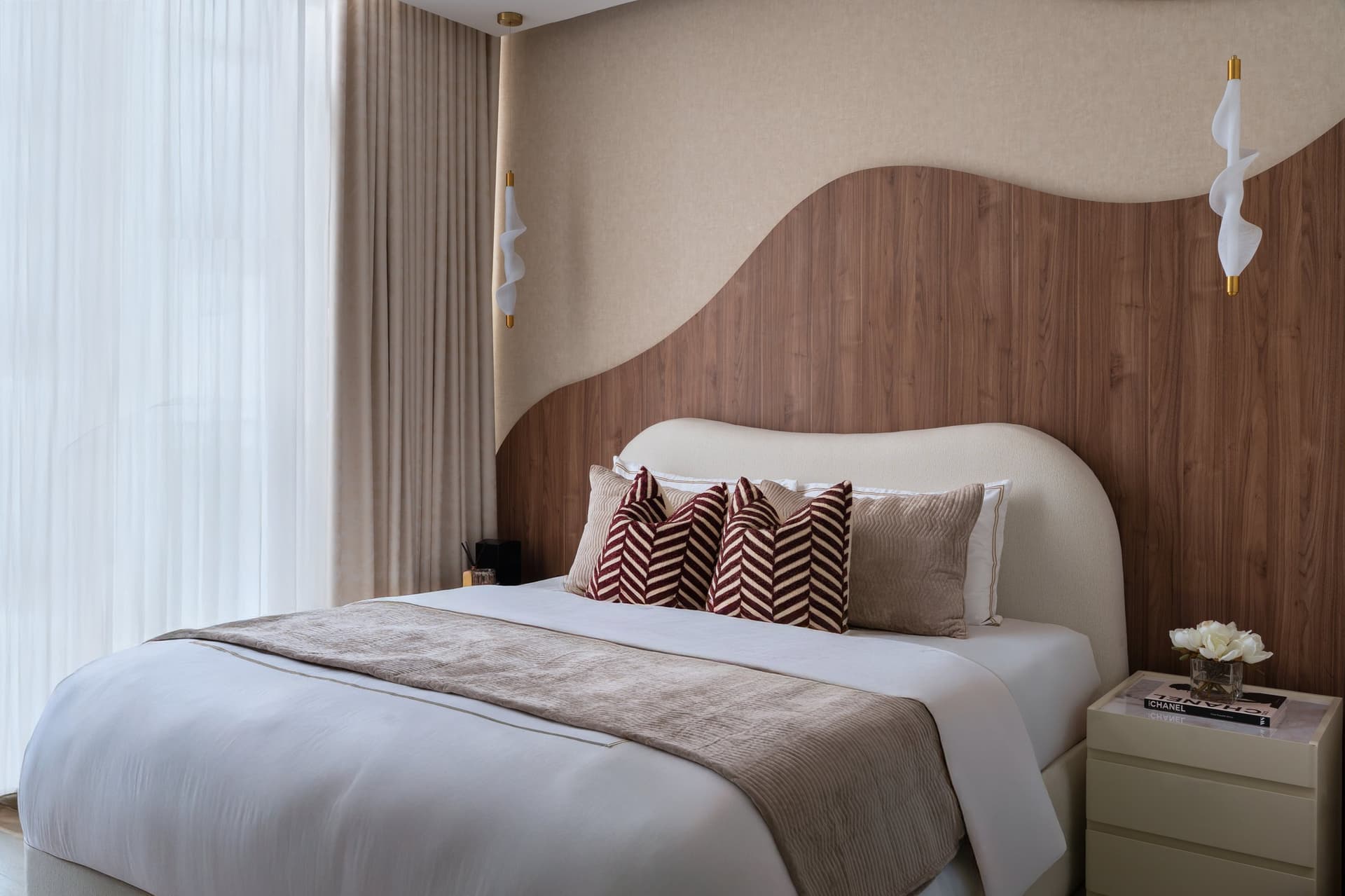
The master bedroom is the villa’s most architecturally ambitious room. The headboard wall is a single composition of walnut and upholstered linen, the two materials carved into wave-like forms that meet behind a curved cream headboard. Two ribbon-form pendant lights in white and brass flank the bed, suspended from the ceiling rather than mounted on the wall.
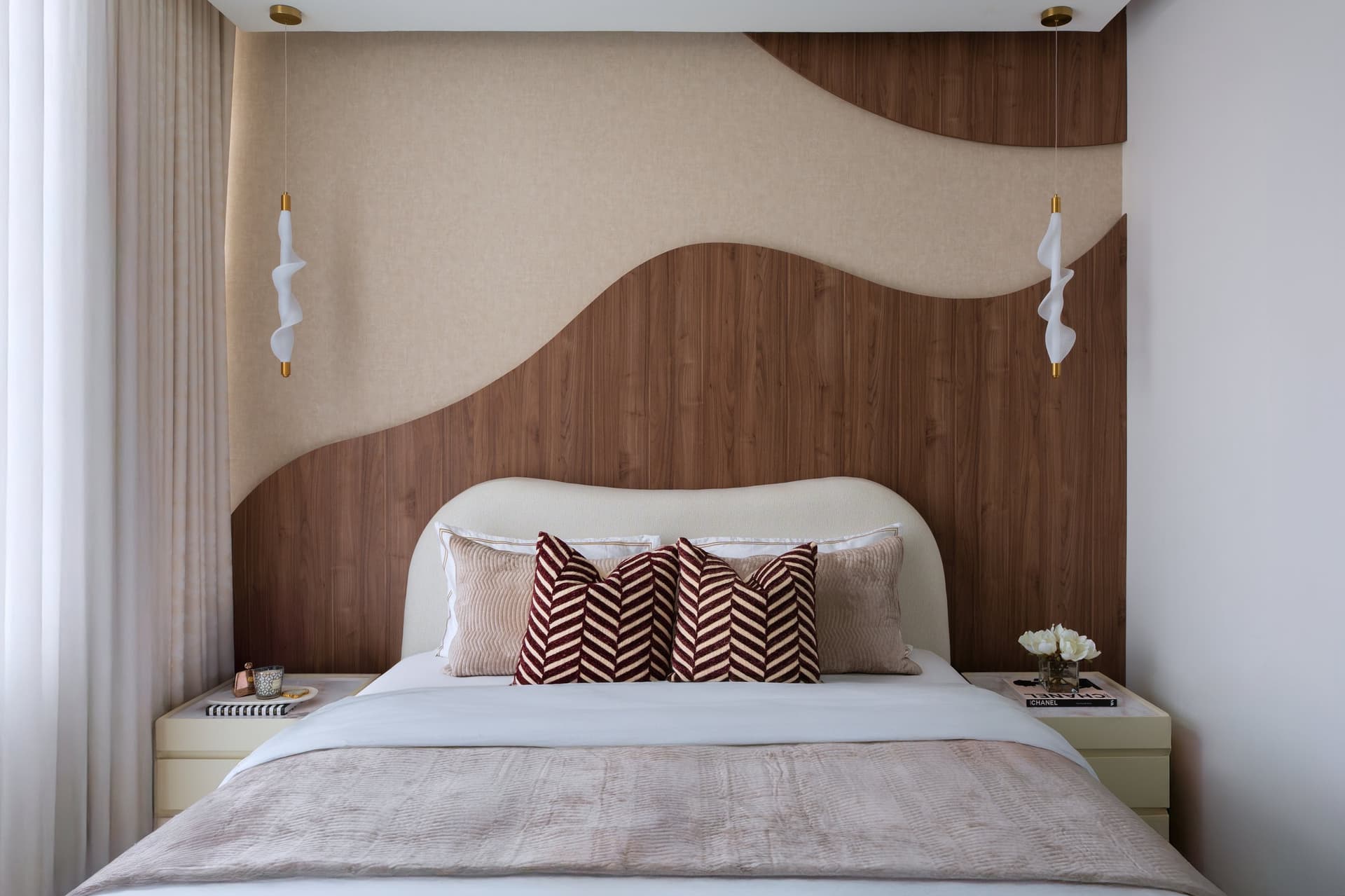
Seen head-on, the wall reads almost like a relief sculpture, the timber and upholstery exchanging positions across the surface in a way that turns the headboard into the room’s primary artwork. It is the rare bedroom that argues for design as a form of sculpture.
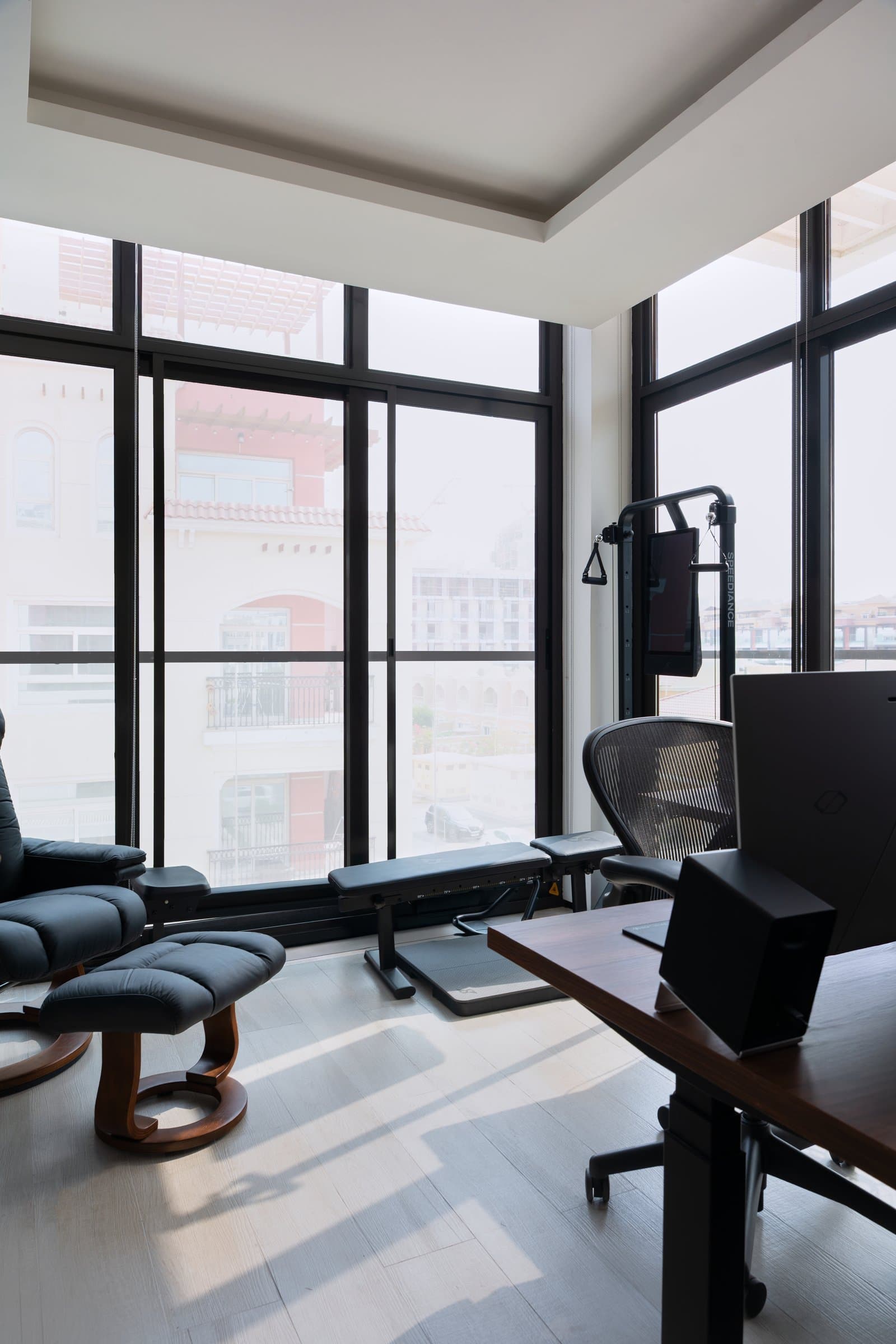
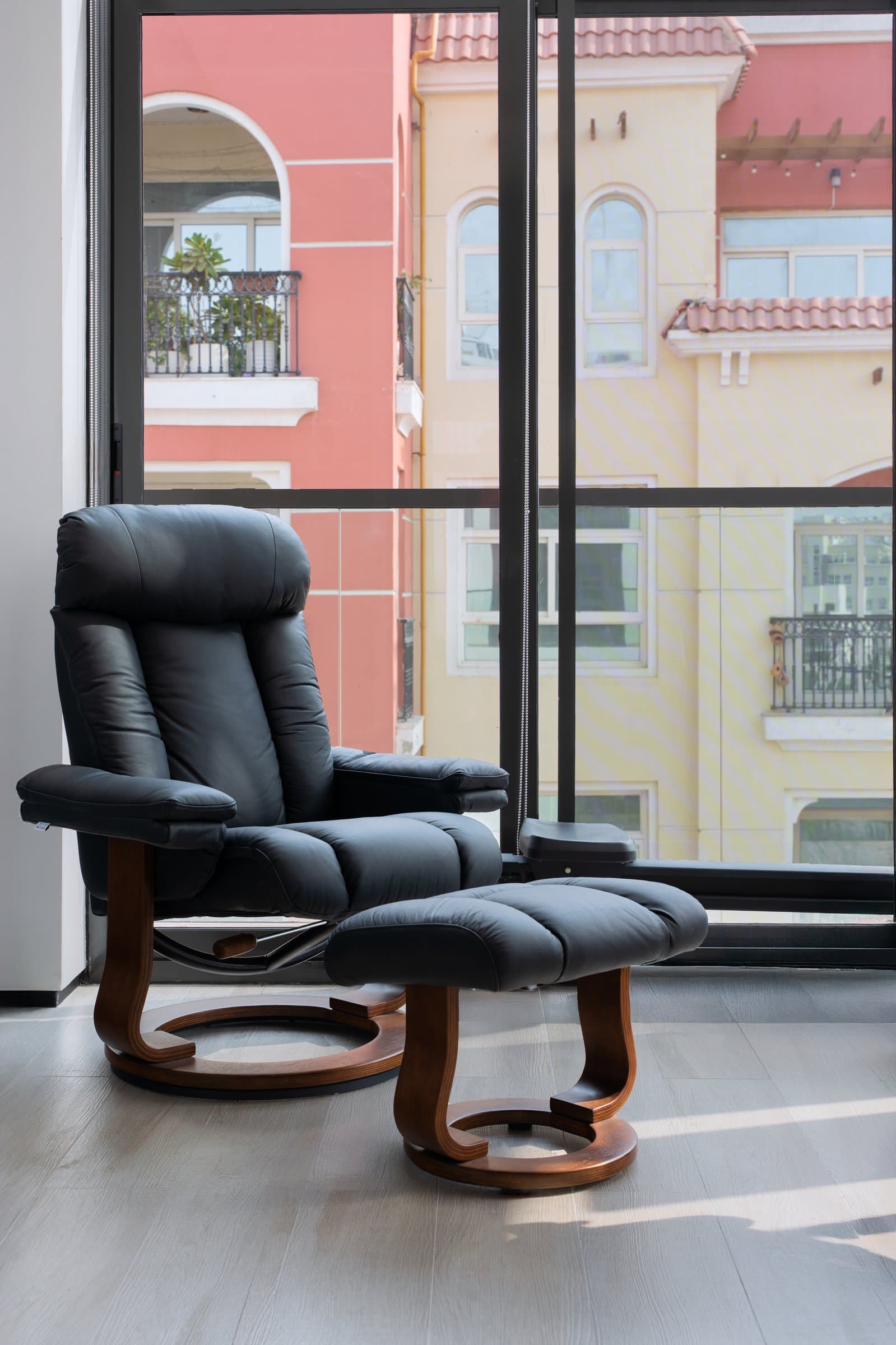
Adjacent to the master suite, a corner home office and gym makes use of the villa’s tallest glazing. A black weight machine, a Stressless recliner with ottoman, and a height-adjustable desk share a room flooded with light from two walls of windows. The space is multifunctional without feeling compromised, each zone given enough room to operate on its own terms.
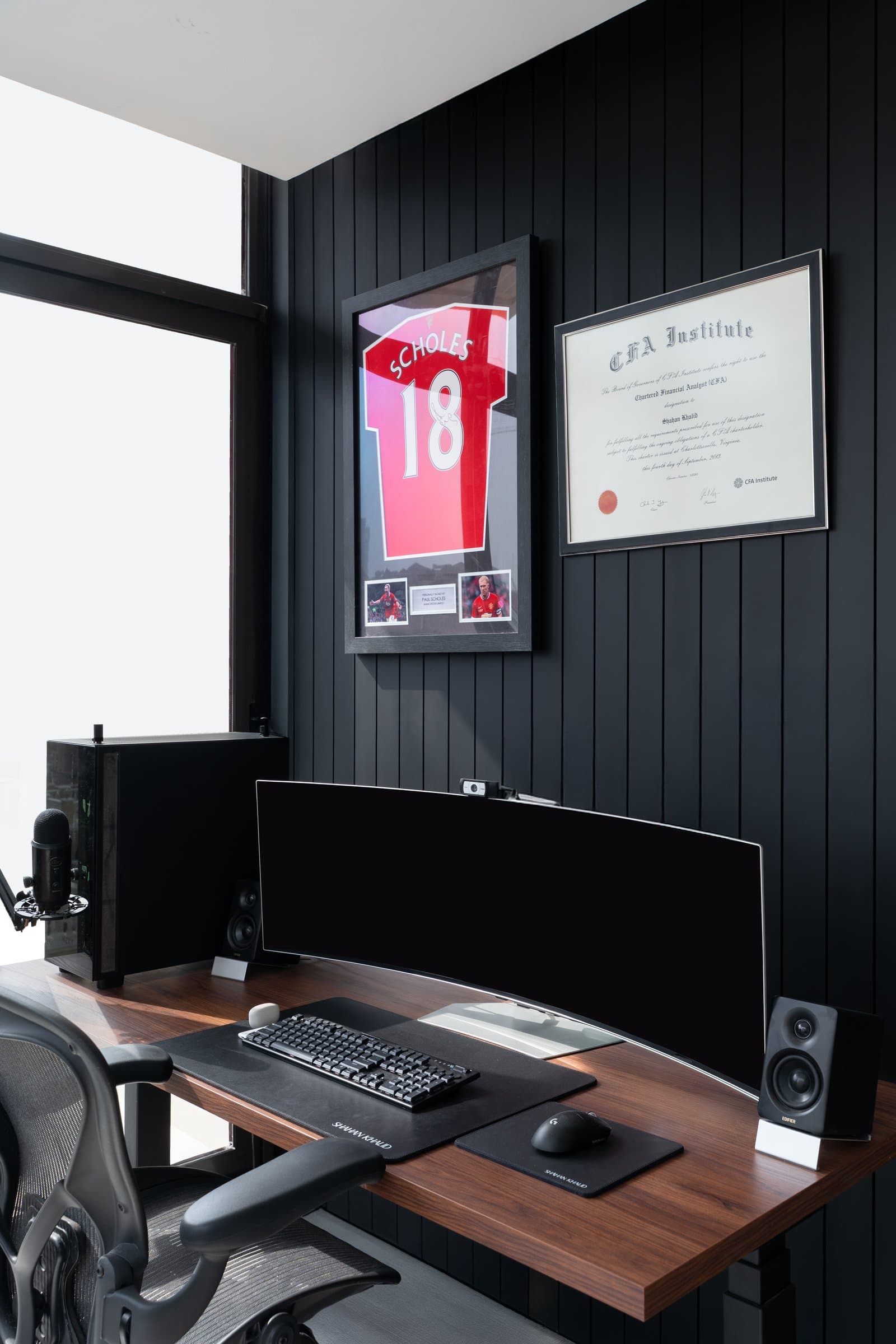
The desk wall is treated in dark vertical panelling, a deliberate counterpoint to the home’s prevailing softness. A framed Scholes football jersey and a CFA Institute charter hang above the workstation, personal markers that ground the room in the occupant’s biography rather than in any generic notion of a study.
In Dubai’s residential landscape, where villa interiors often default to either grand classicism or aggressive minimalism, Ashton Park proposes a third option. It is committed to decoration but disciplined about it, generous with colour but never careless, and architecturally legible from foyer to master suite. The villa makes a case for a softer, more textural register in a city that often rewards louder ones.
The lasting impression is of a home designed by someone who understands that warmth is not a finish but a logic. Safa Tanveen’s studio has produced an interior in which the ribbed wall, the arched headboard, and the blush sofa are not three separate decisions but a single sustained argument, carried through every room with quiet conviction.