Most homes in Mumbai are built in the present tense. They speak the language of newness, of recent acquisition, of a city that rewards velocity over memory. This 950-square-foot apartment in Cuffe Parade does the opposite. It was conceived as a slow conversation between a young couple and the inherited objects that arrived with them, and its premise is almost contrarian for the city it sits in: that a home need not announce itself to feel complete.
Designed by Pill Design Studio under principal architect Rishab Manghwani, Vineyard 161 was envisioned for a lawyer and a yoga teacher, the husband bringing with him a lineage of Parsi furniture and objects accumulated across generations. The brief was uncomplicated in intent and demanding in execution: a colonial-inspired apartment where vintage pieces could live alongside contemporary life without either feeling staged. No false ceilings, no decorative panelling, no concealed services. The home was to age honestly and remain entirely legible to the people living in it.
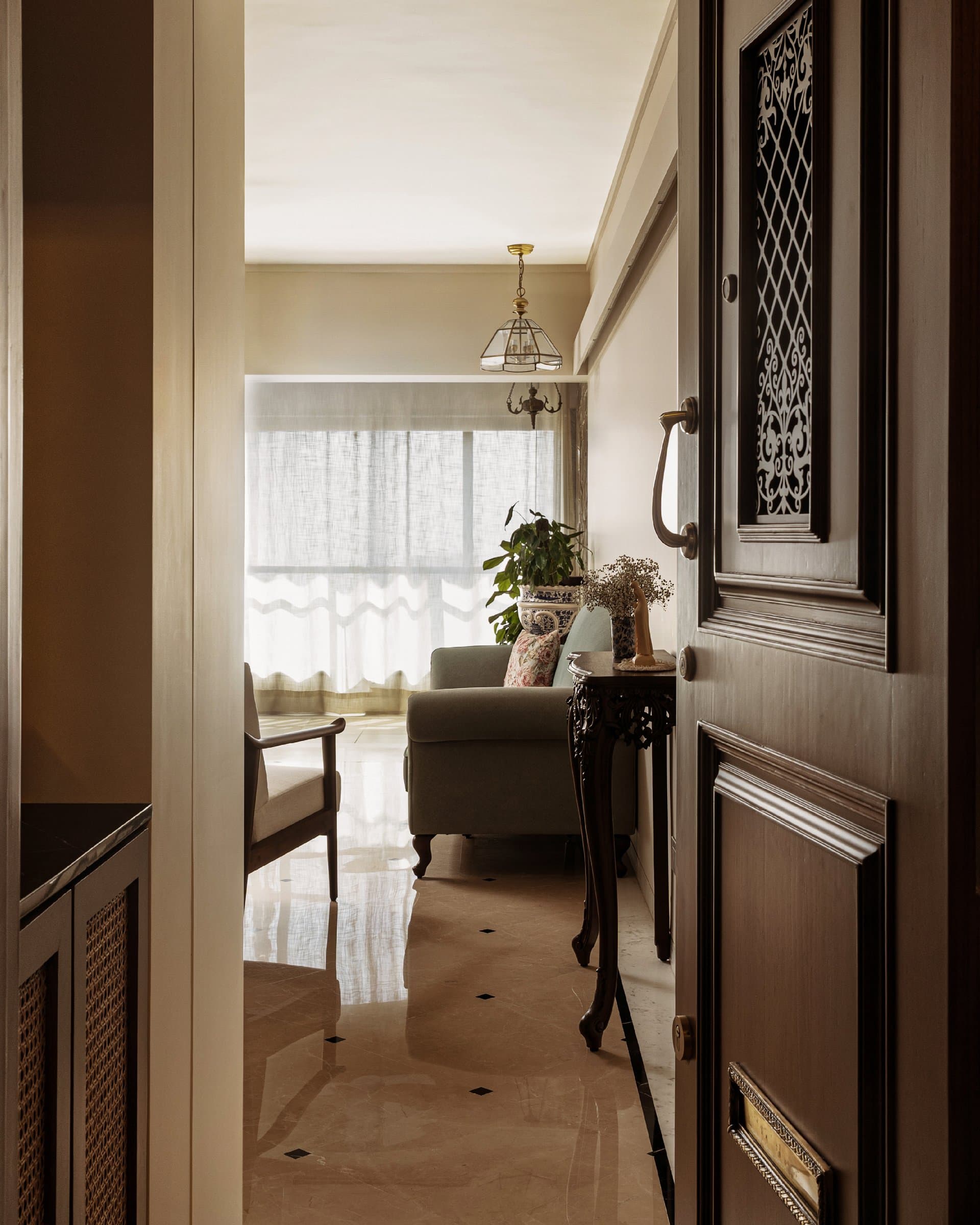
The entry sets the tone before the apartment fully reveals itself. A heavy wood door, inset with a wrought-iron grille panel, opens onto a glimpse of the living room: a glass pendant on a brass chain, a sage upholstered sofa, a carved console. The diamond inlay running through the warm beige marble floor is one of the few overtly decorative moves in the project, and it does most of the work of orienting the visitor to the home’s vintage register.
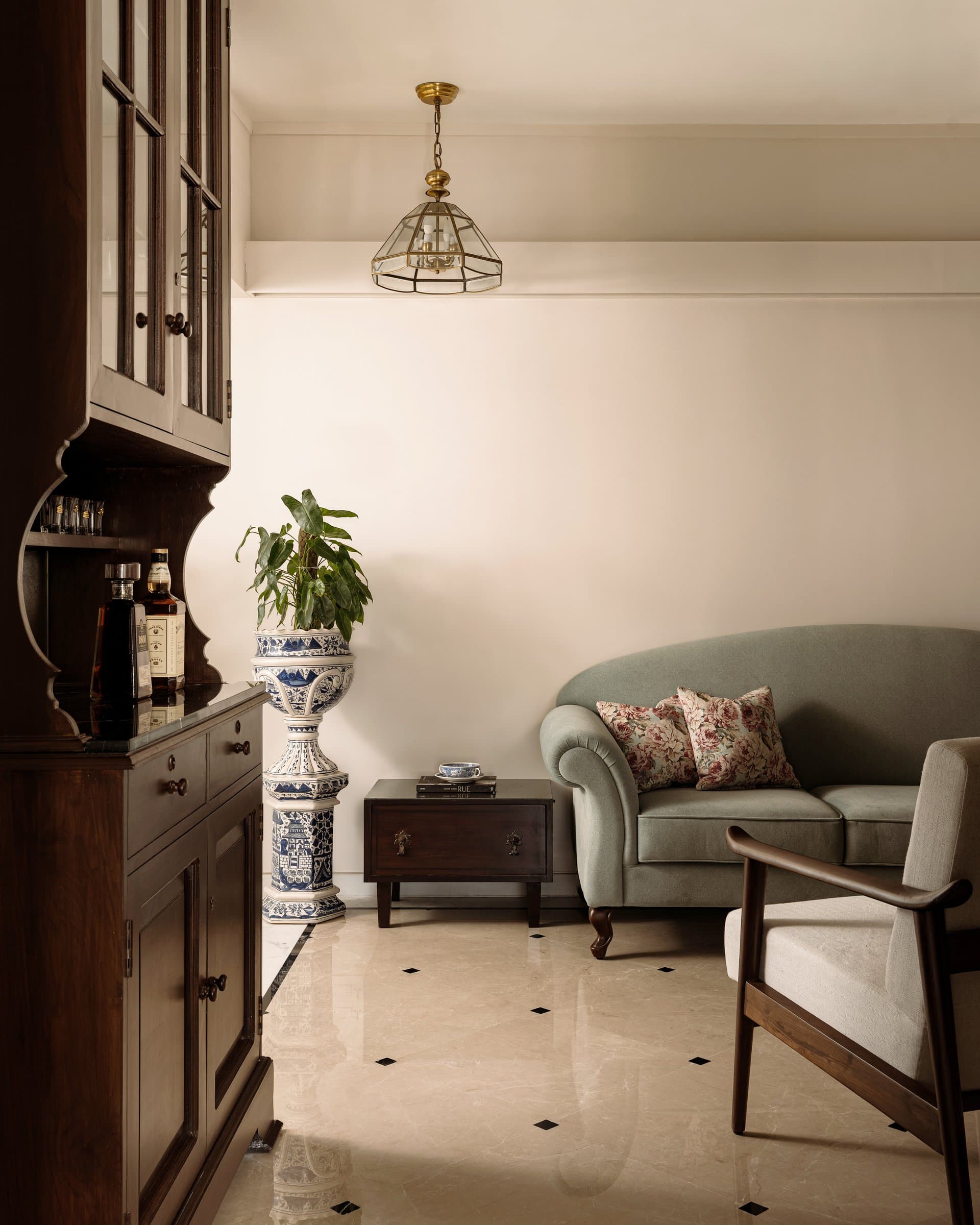
In the living room itself, restraint reads as confidence rather than reticence. A dark wood display cabinet anchors one end, with glazed upper doors , while the curved sage sofa and floral cushions soften the room without sweetening it. The blue-and-white ceramic pedestal planter, set between cabinet and sofa, is the kind of inherited object ; it earns its place by being exactly what it is.
““The intention was to create a simple, functional colonial-inspired space where old and new could coexist effortlessly, retaining the charm and familiarity of vintage elements while still feeling relevant to the couple’s contemporary lifestyle.””
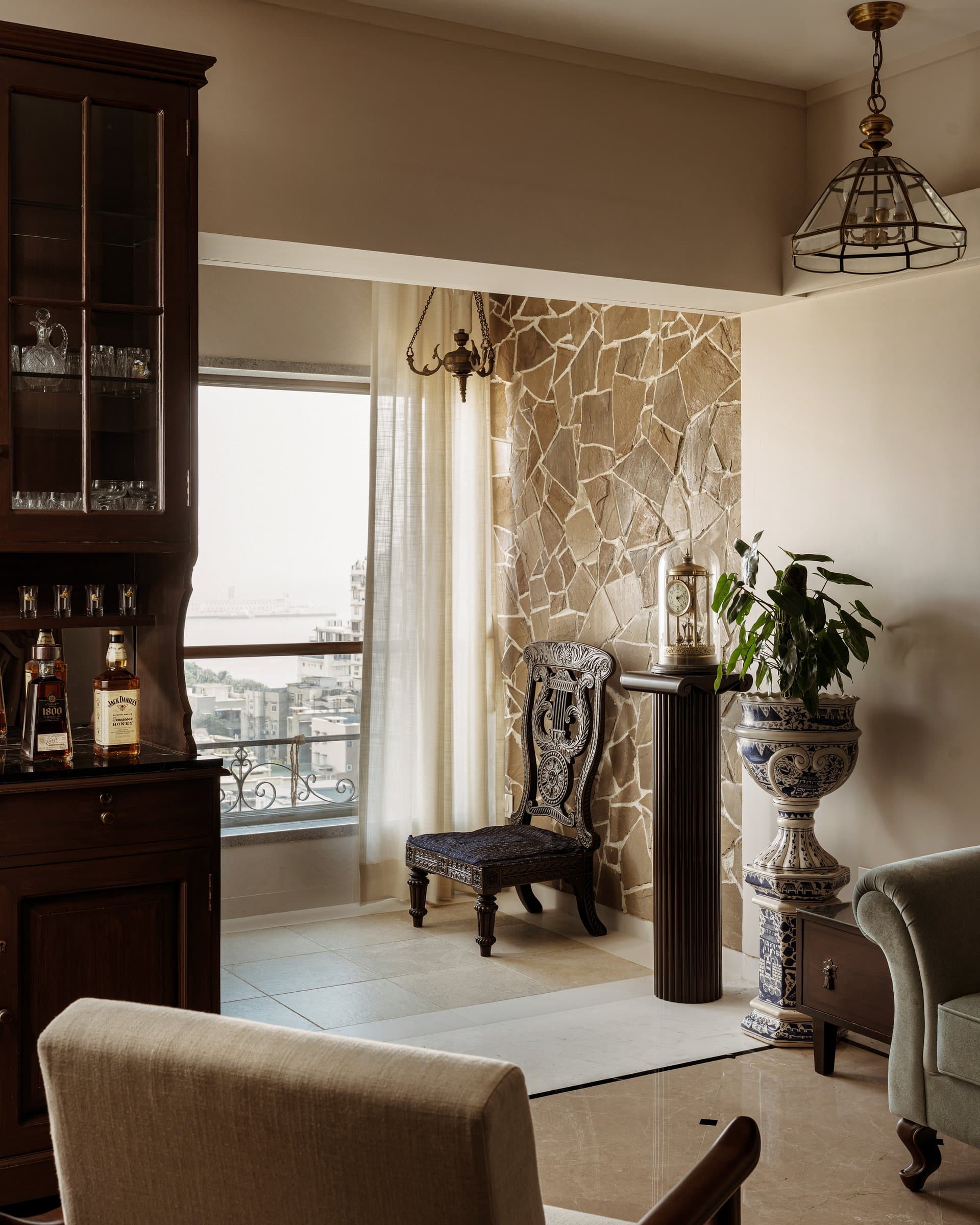
A corner of the same room makes the project’s material argument explicit. A wall of irregular, hand-laid stone meets a sheer curtain and a glimpse of the Mumbai skyline beyond, with a carved heritage chair and a fluted pedestal holding a small domed clock between them. The composition is not nostalgic so much as continuous, as if the room has simply absorbed what was given to it and arranged it without ceremony.
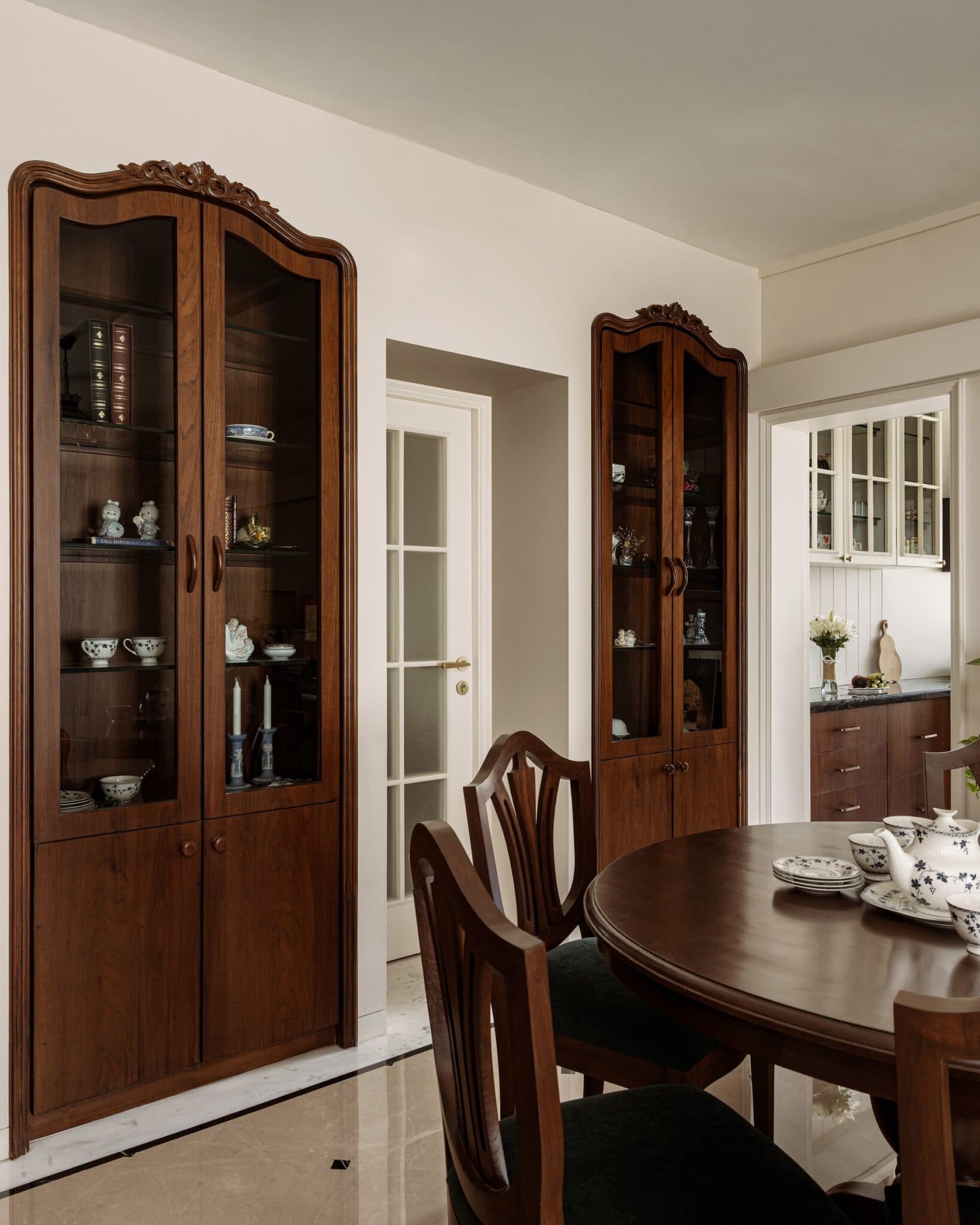
The dining area inherits the same logic but tightens it. Two tall display cabinets in dark wood, their arched and carved crowns referencing French provincial joinery, flank a central doorway and frame the round dining table with its shield-back chairs. The cabinets are working objects, holding the china and the keepsakes that get used, and the glimpse of the kitchen beyond confirms the home’s refusal to compartmentalise daily life.
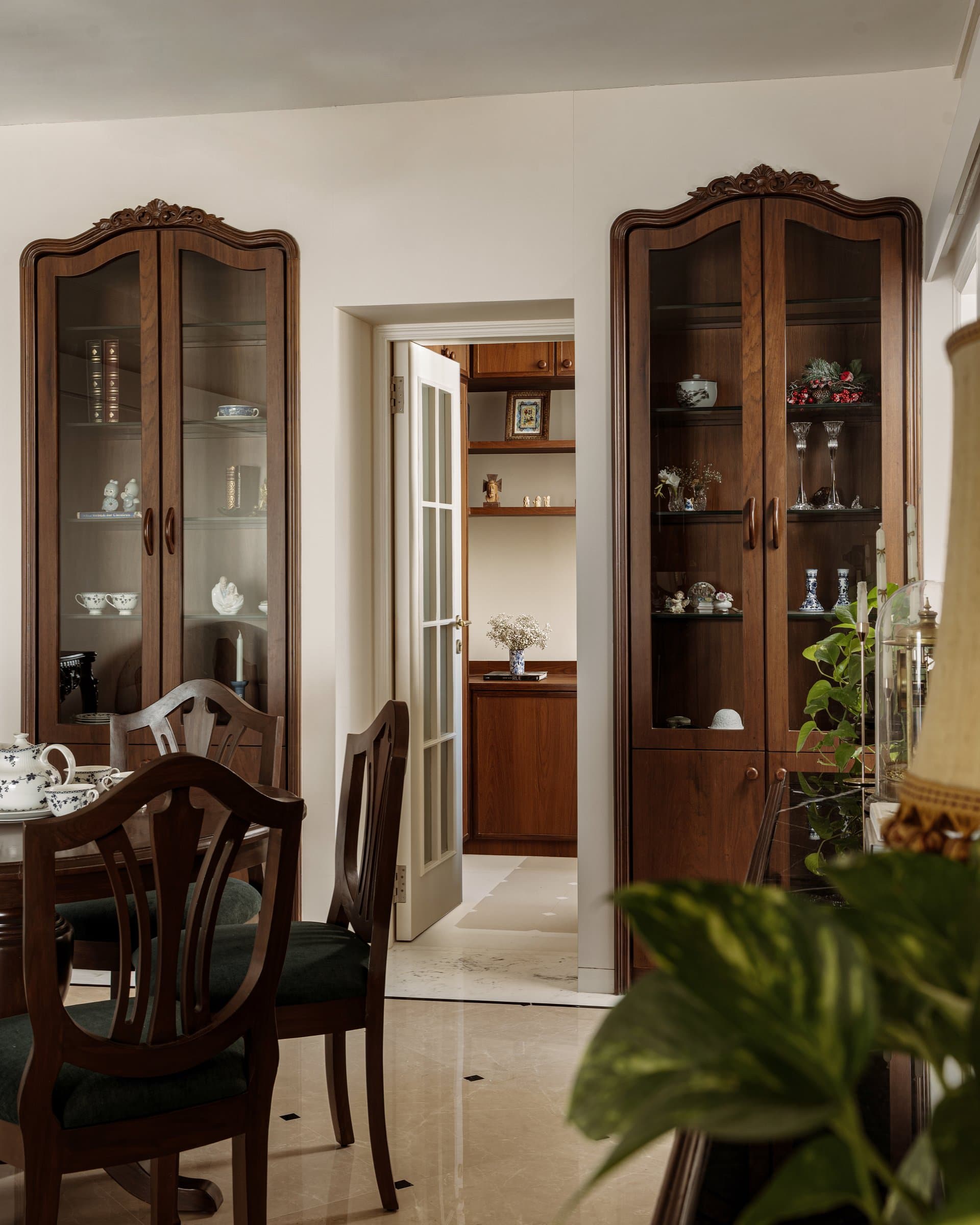
Seen from the opposite angle, the dining room reveals how carefully the apartment has been planned for sightlines. The pair of cabinets bookend a passage that opens onto a quiet inner zone, while a second doorway leads to the kitchen. The room functions as both destination and connector, which is the kind of spatial economy a 950-square-foot plan demands and rarely achieves with this much grace.
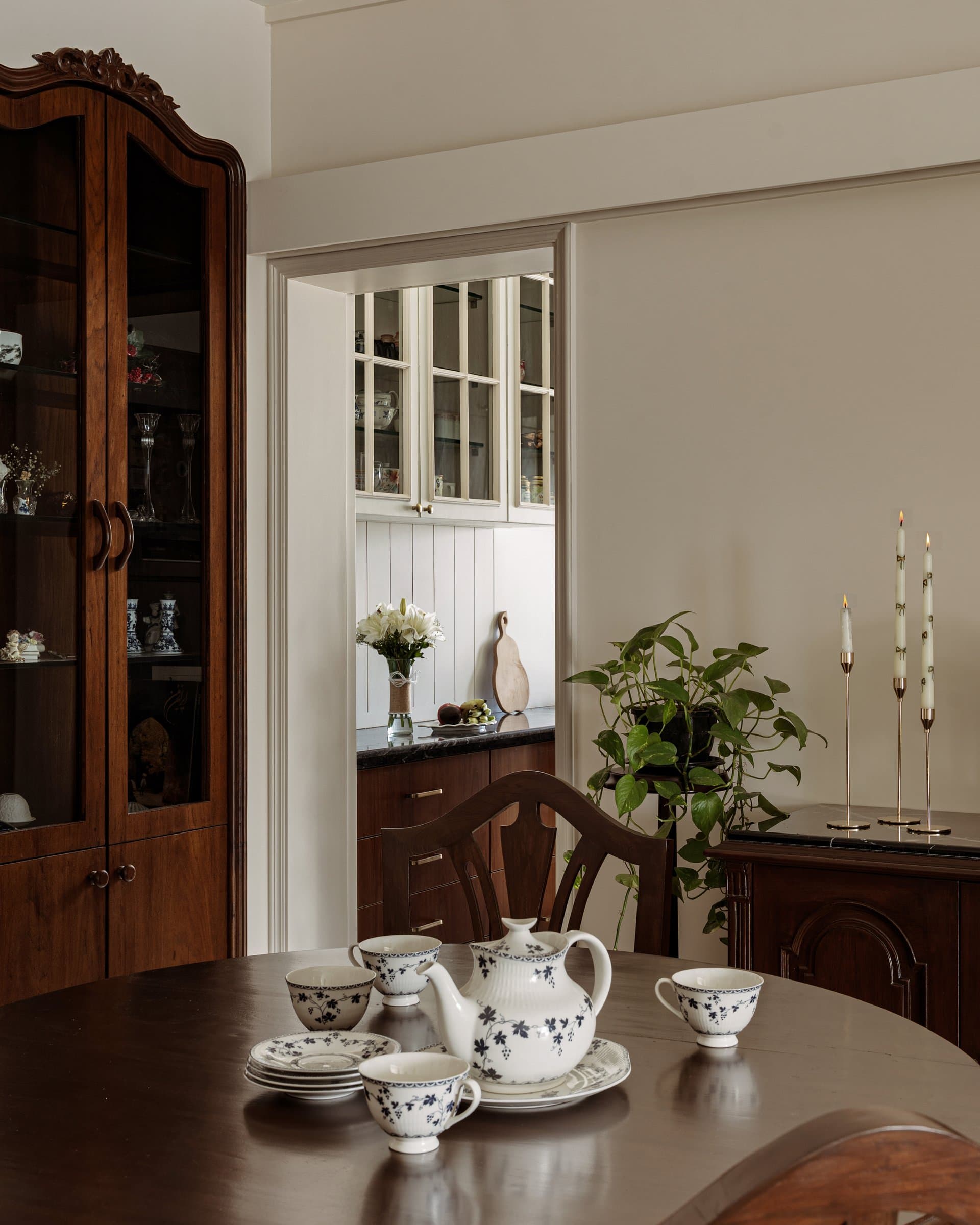
Behind, the kitchen reads through a framed opening: glass-fronted upper cabinets in cream, dark wood lowers, a black stone counter holding a small vase of white lilies. The two rooms speak to each other without either having to raise its voice.
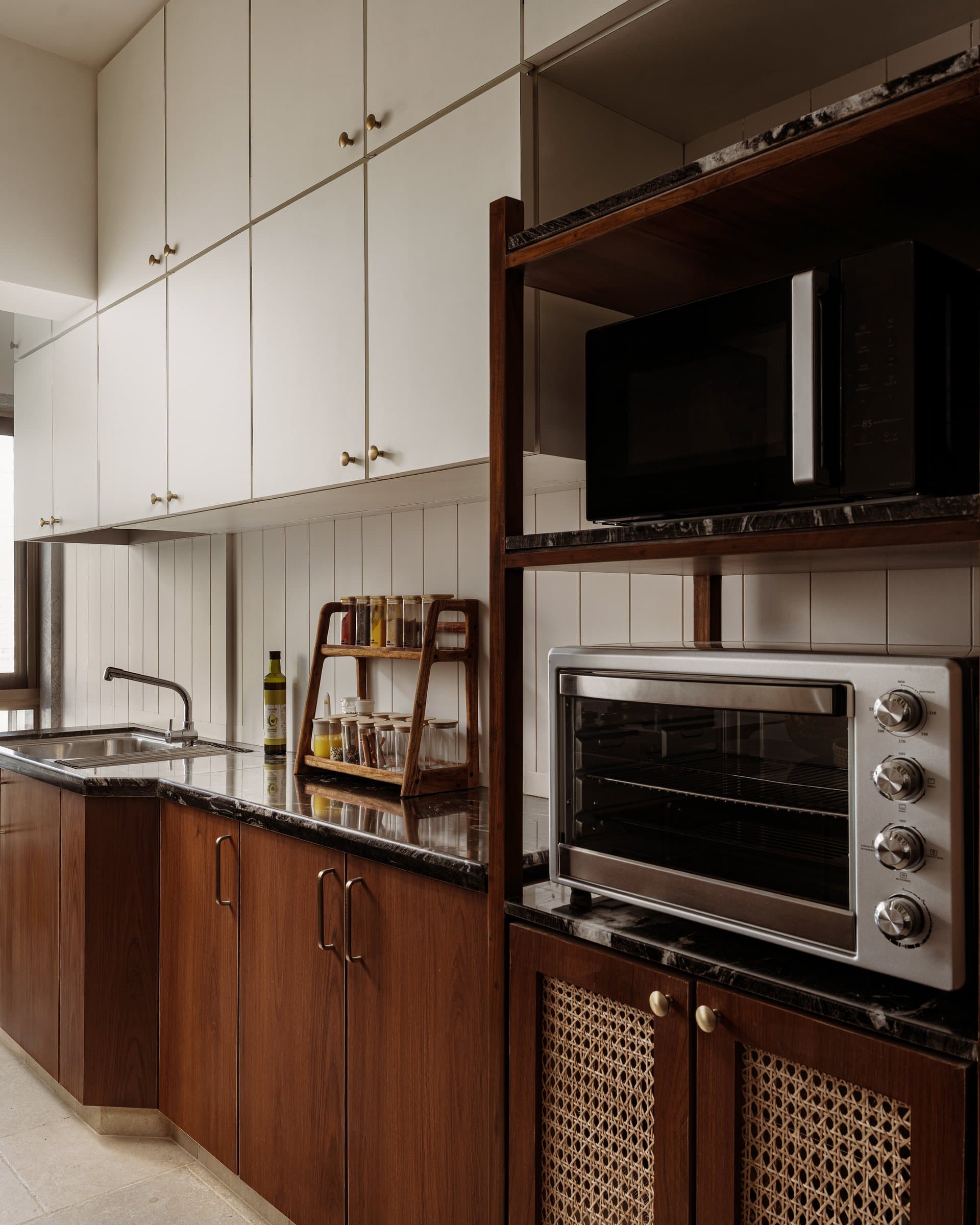
Inside the kitchen, the colonial vocabulary loosens into something more practical. Cream upper cabinets with small brass knobs sit above a vertical panelled backsplash, while the dark wood lowers carry a veined black stone counter. The cane-fronted cabinet doors below the appliance shelf are the single most quietly contemporary gesture in the apartment, a Parsi-adjacent material handled with restraint rather than ornament.
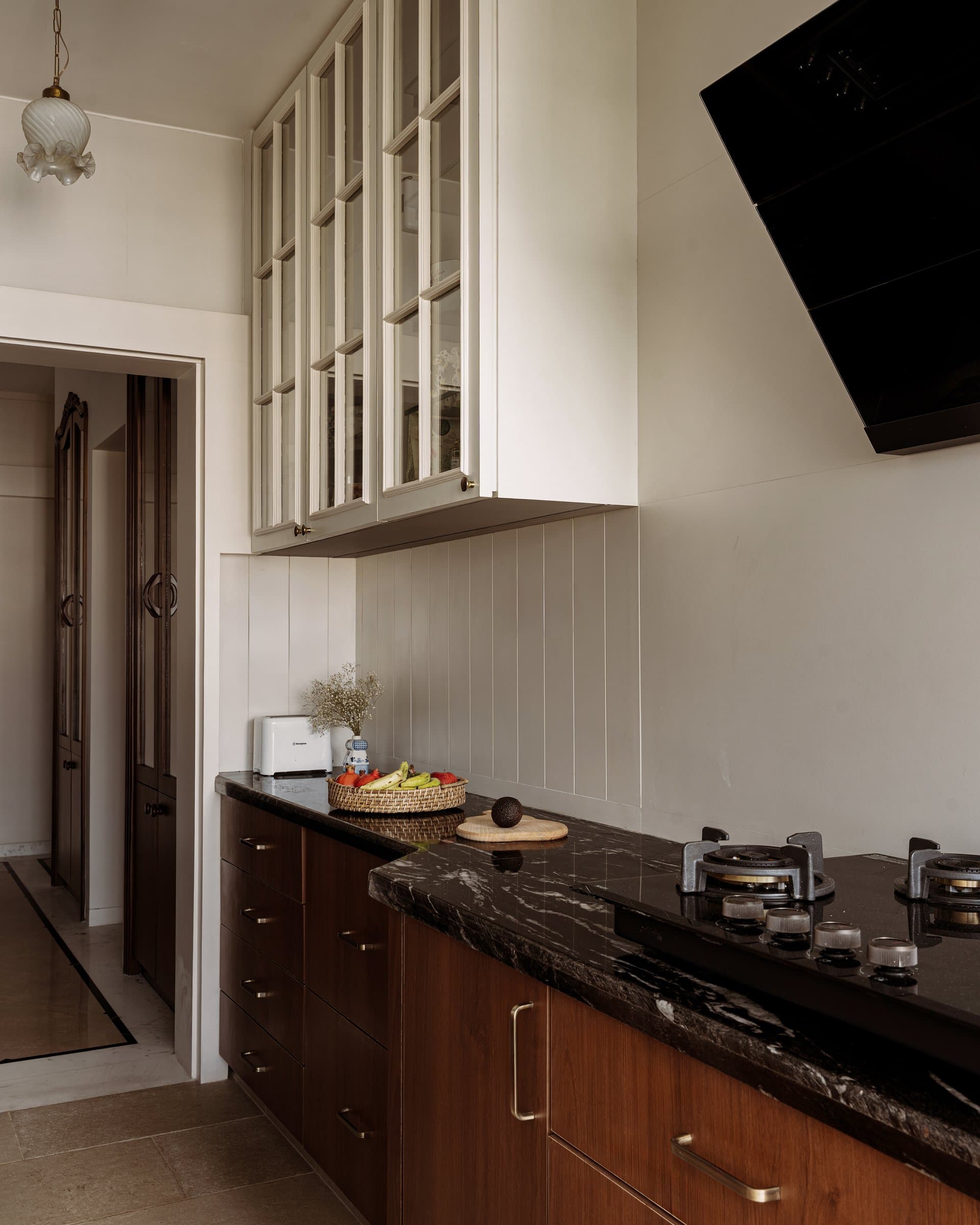
The cooking run continues with the same discipline. Glass-fronted upper cabinets with delicate muntin grids hold serveware in view, the panelled backsplash carries through, and the dark wood lowers anchor a black stone counter with a sweep of pale veining. A doorway at the far end frames the carved cabinetry of the corridor beyond, reminding the eye that the kitchen is not a service appendage but a continuous part of the home.
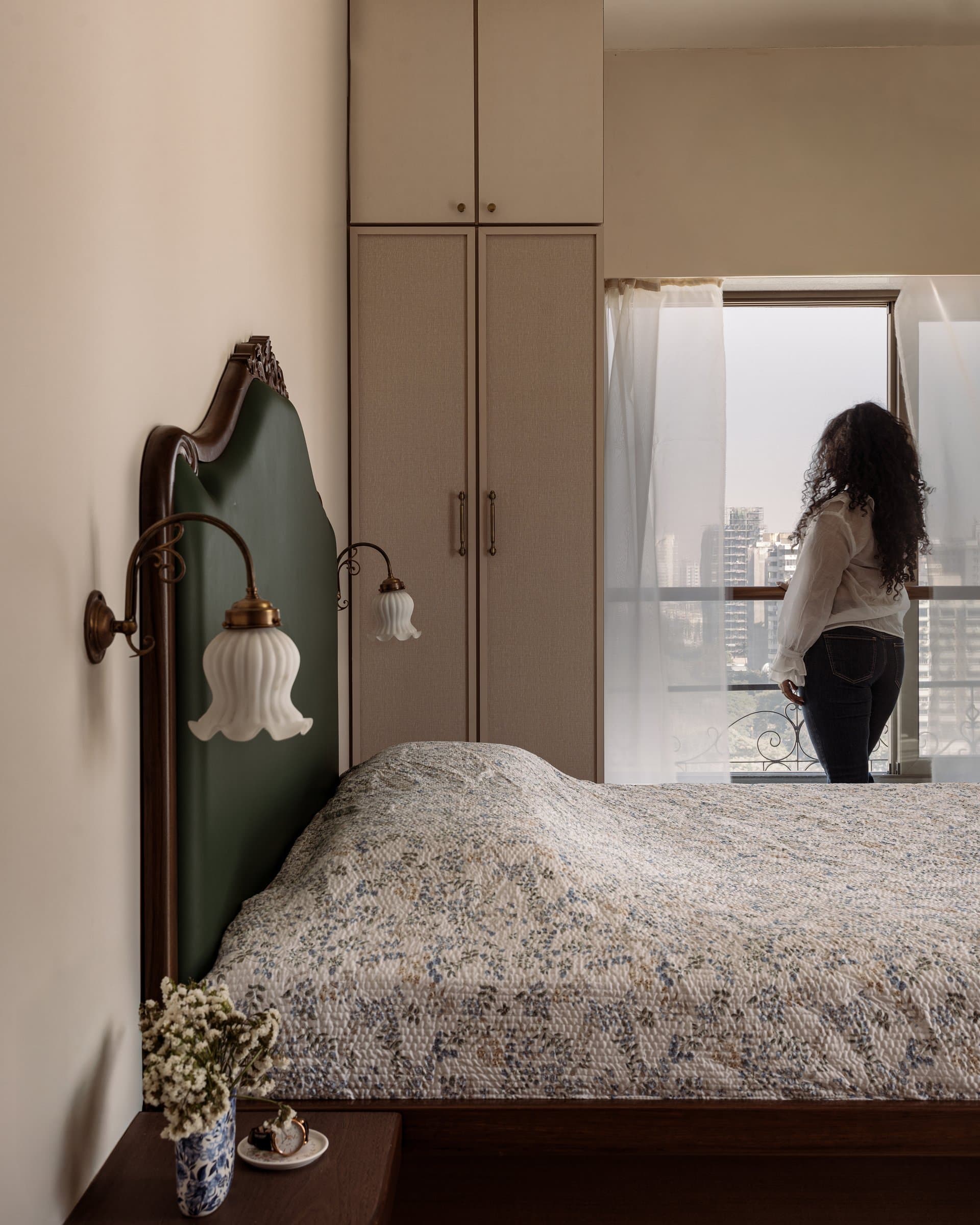
The bedroom carries the project’s most considered single gesture: a tall headboard upholstered in deep forest green, framed in a carved wood crown, flanked by brass wall sconces with tulip-shaped frosted shades. The wardrobe beside it is fabric-fronted in a muted oat tone with slim brass pulls, and the window frames a wrought-iron Juliet balustrade against the city skyline. The room understands that vintage furniture works best when it is given air to breathe.
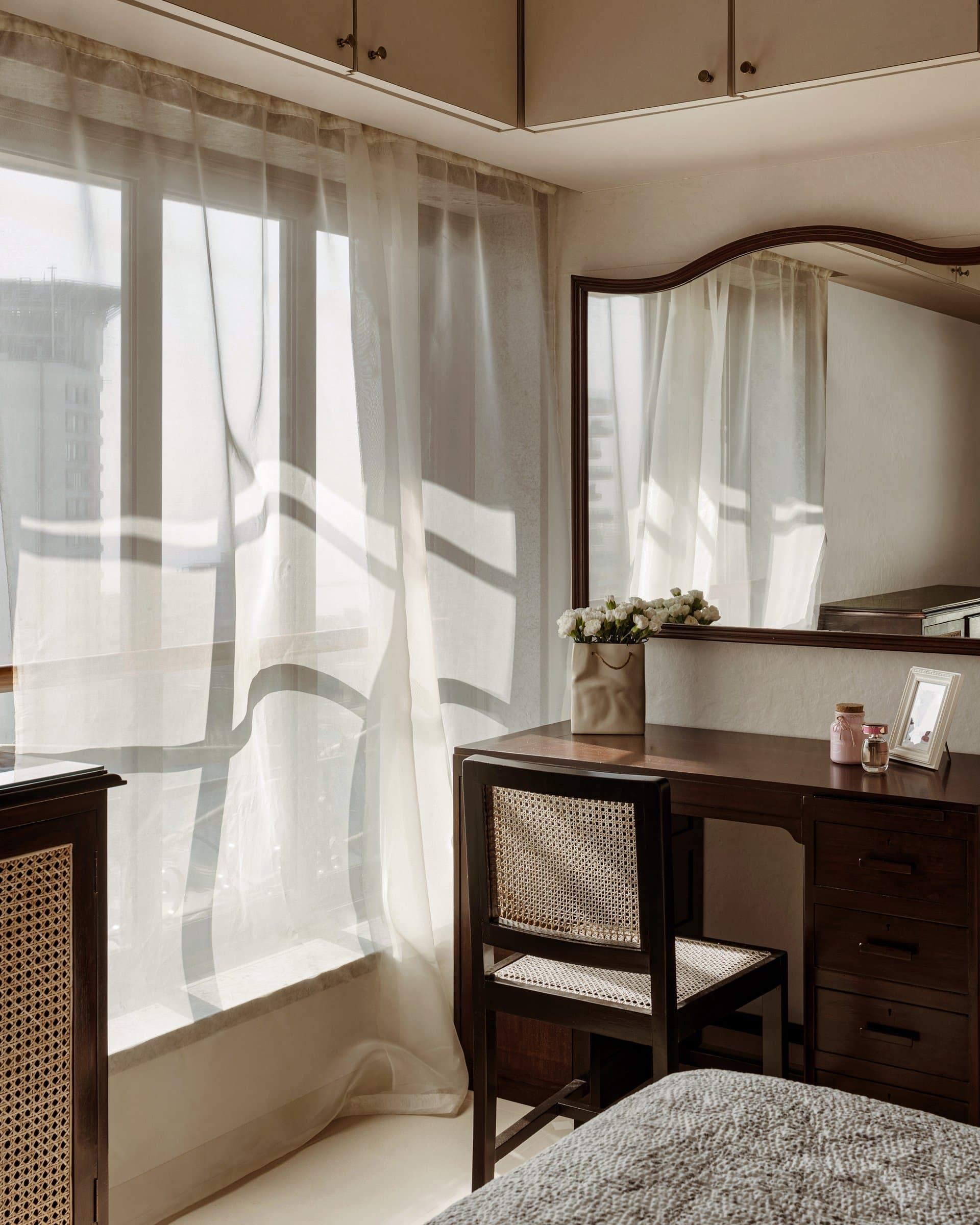
Across the same room, a dressing corner shows how the apartment treats utility as an opportunity for stillness. A dark wood writing desk with an arched mirror sits against a sheer-curtained window, the cane-backed chair pulled in at an angle, late light dissolving across the floor. The dressing zone is not separated by joinery or partition; it simply occupies the quietest corner of the room and is allowed to remain there.
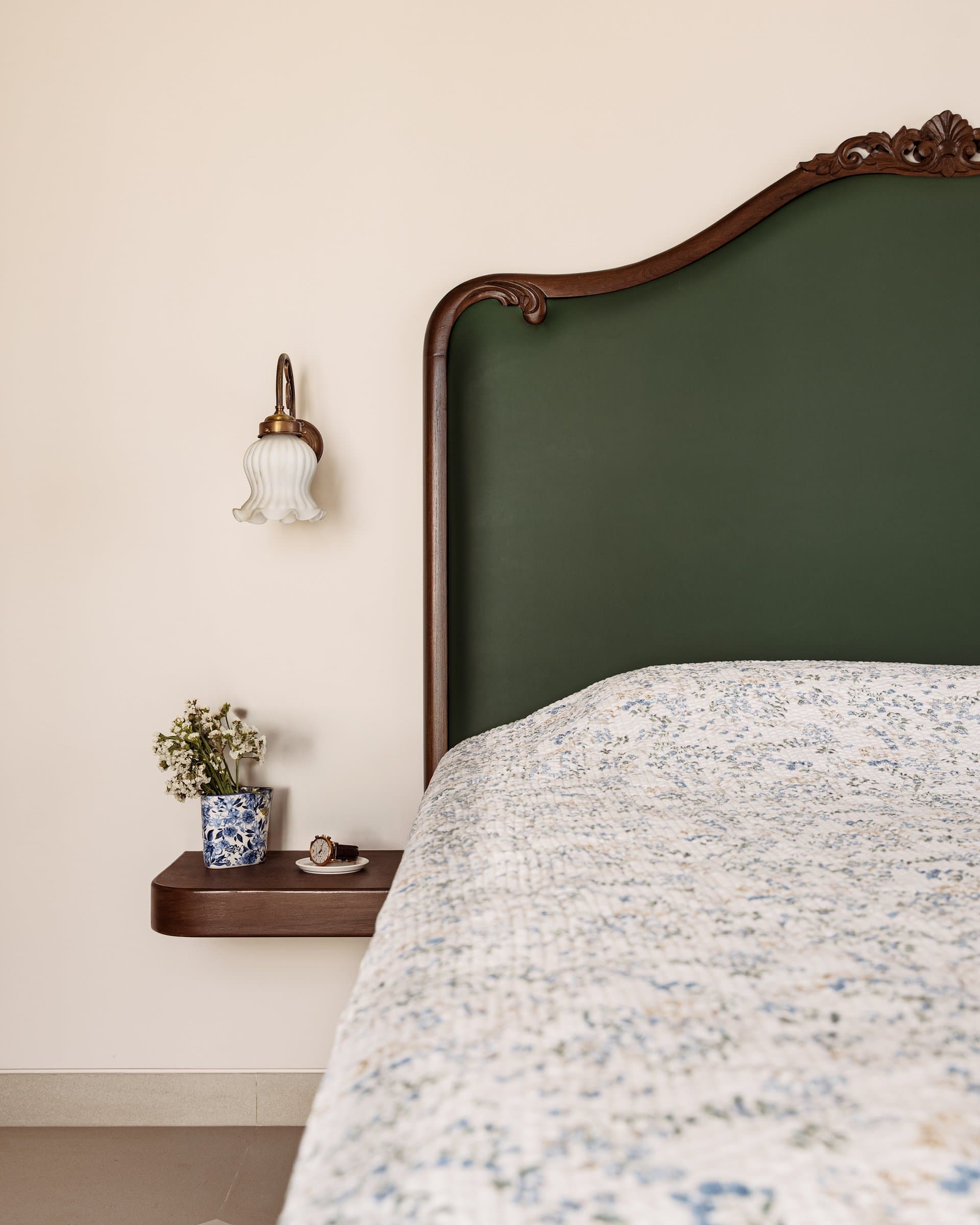
A closer reading of the headboard wall confirms how much weight the smaller decisions carry. The carved crown of the headboard, the single tulip sconce in brass and frosted glass, the floating wood ledge : these are the rituals of a slow morning, made architectural.
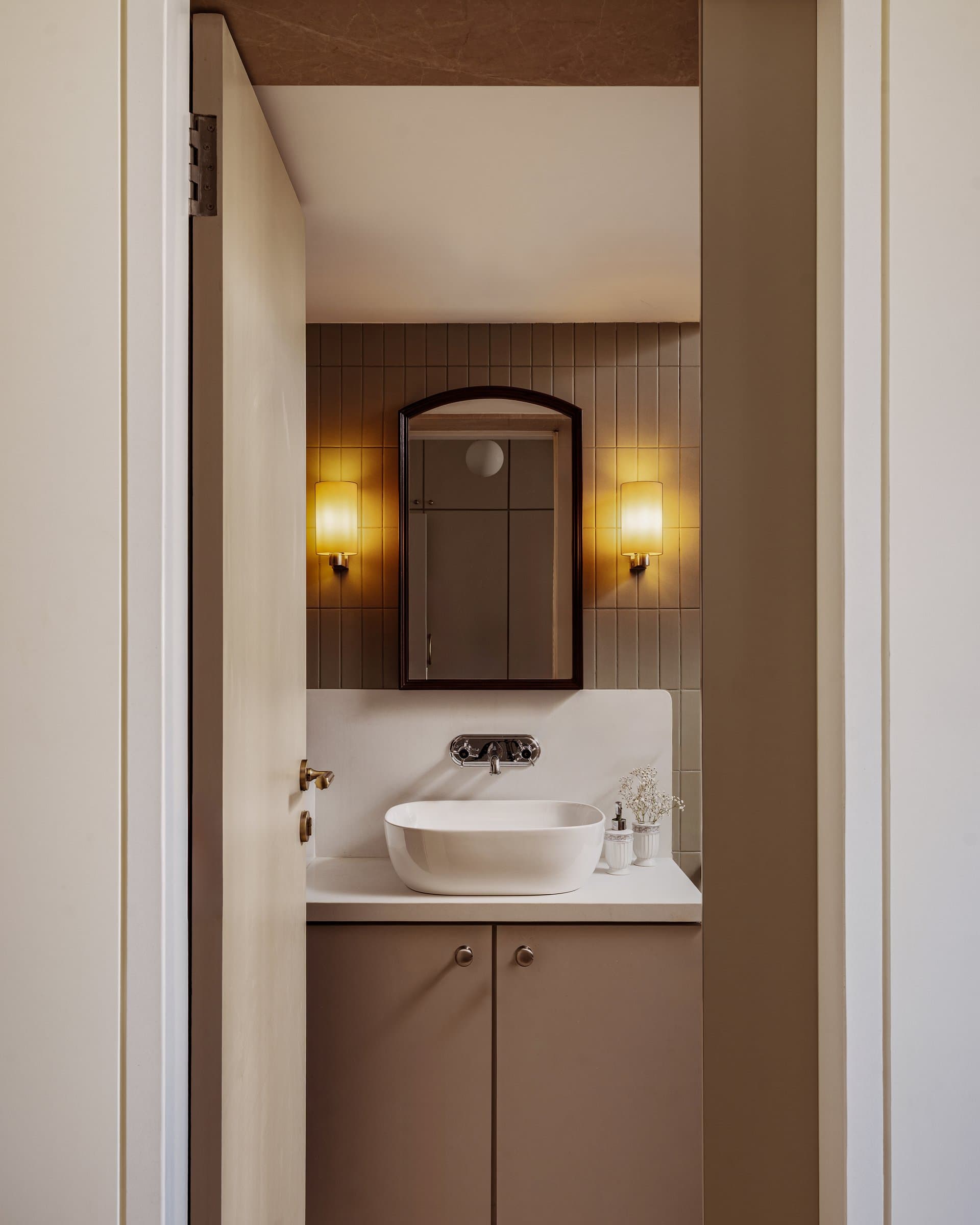
The bathroom closes the project on a precise note. Olive-toned vertical tiles meet a wall-mounted faucet and a vessel basin in soft white, the cabinet below in a quiet mauve-grey, the arched mirror referencing the curves found elsewhere in the home. Two wall sconces with cylindrical shades cast a warm pool of light that feels closer to a hotel suite than a city bathroom, which is precisely the unhurriedness the brief asked for.
What Vineyard 161 quietly proposes is a different relationship with inheritance in urban Indian homes. So much of contemporary Mumbai interior design treats heirloom furniture as a single accent piece, a token gesture in an otherwise reinvented room. This apartment reverses the ratio: the inherited pieces set the grammar, and the new interventions, the cane-fronted cabinetry, the panelled backsplashes, the upholstered headboard, learn to speak that language fluently.
In a city that rewards reinvention, the project’s deepest decision is its refusal of it. The home does not try to look new, nor does it stage its age. It holds the objects, rituals, and small repairs of two lives in progress, and lets them be the design. That, in the end, is the rarer thing.