A house can be built around walls or it can be built around weather. The distinction matters more than it sounds, because once a residence accepts climate as its primary collaborator, every subsequent decision, the depth of an overhang, the placement of a window, the porosity of a threshold, becomes an act of listening rather than imposing.
The Ashwin-Deva Residence in Bengaluru, a built renovation by ID+AS Architects under the direction of Ar. Asad Khan, takes that listening seriously. Conceived less as an object set upon a site and more as an atmosphere coaxed out of one, the home dissolves the conventional armature of enclosure into something looser: fluid thresholds, soft gradients, planted pockets that pull greenery deep into the plan. It is a residence shaped by the quiet generosity of the tropics, where shade, breath, and light do most of the heavy structural work.
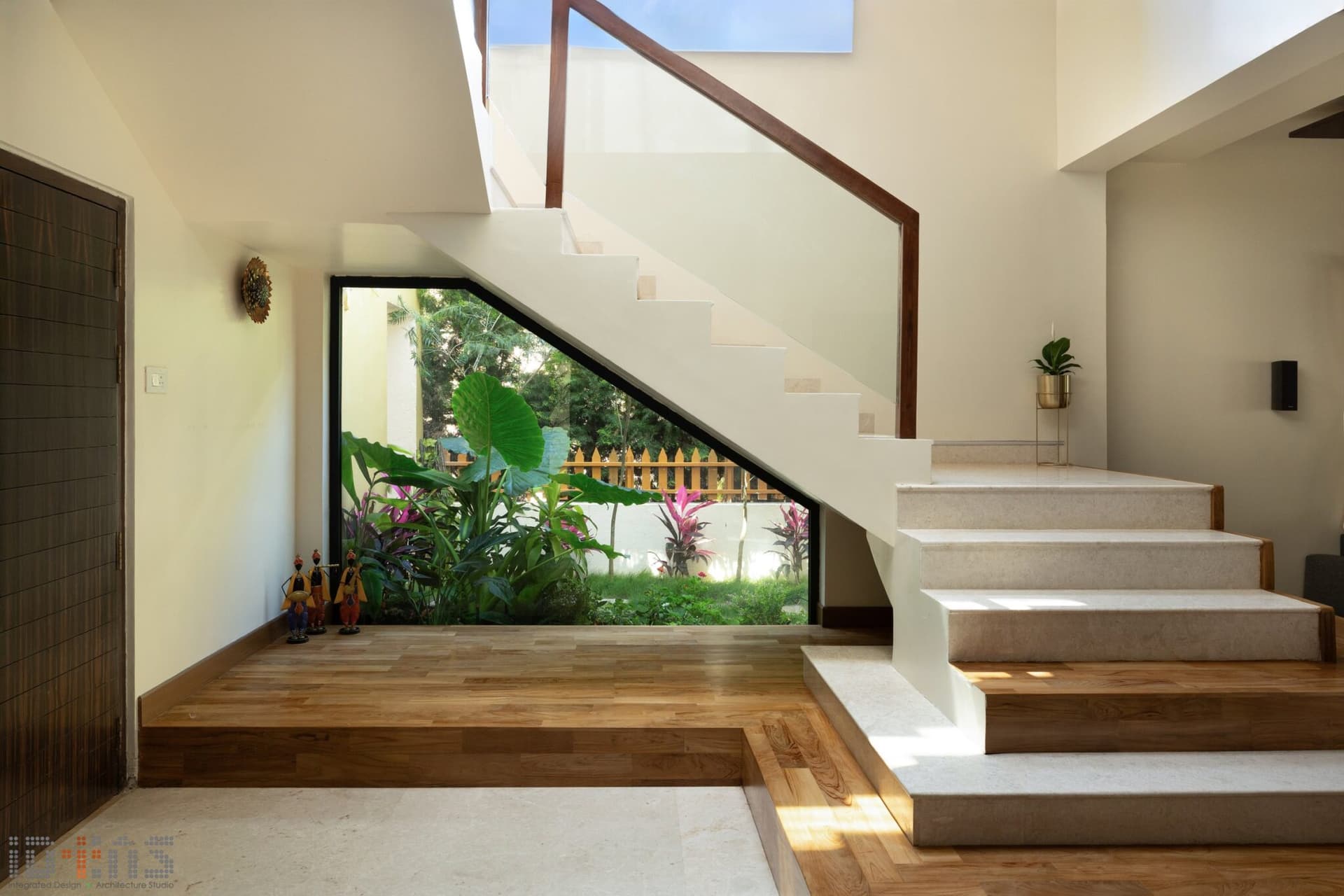
Entry happens not as an arrival but as a gentle descent into greenery. A picture window cut beneath the staircase frames a small garden court at eye level, so the first thing the house offers is not a wall or a console but a view of foliage held against the sky.
The staircase itself, white risers wrapped in a warm wood ribbon at the base, becomes the home’s first lesson in how it intends to behave: structure as something soft, geometry as something that bends toward the landscape rather than away from it. The threshold reads as a continuation of the garden, not a defence against it.
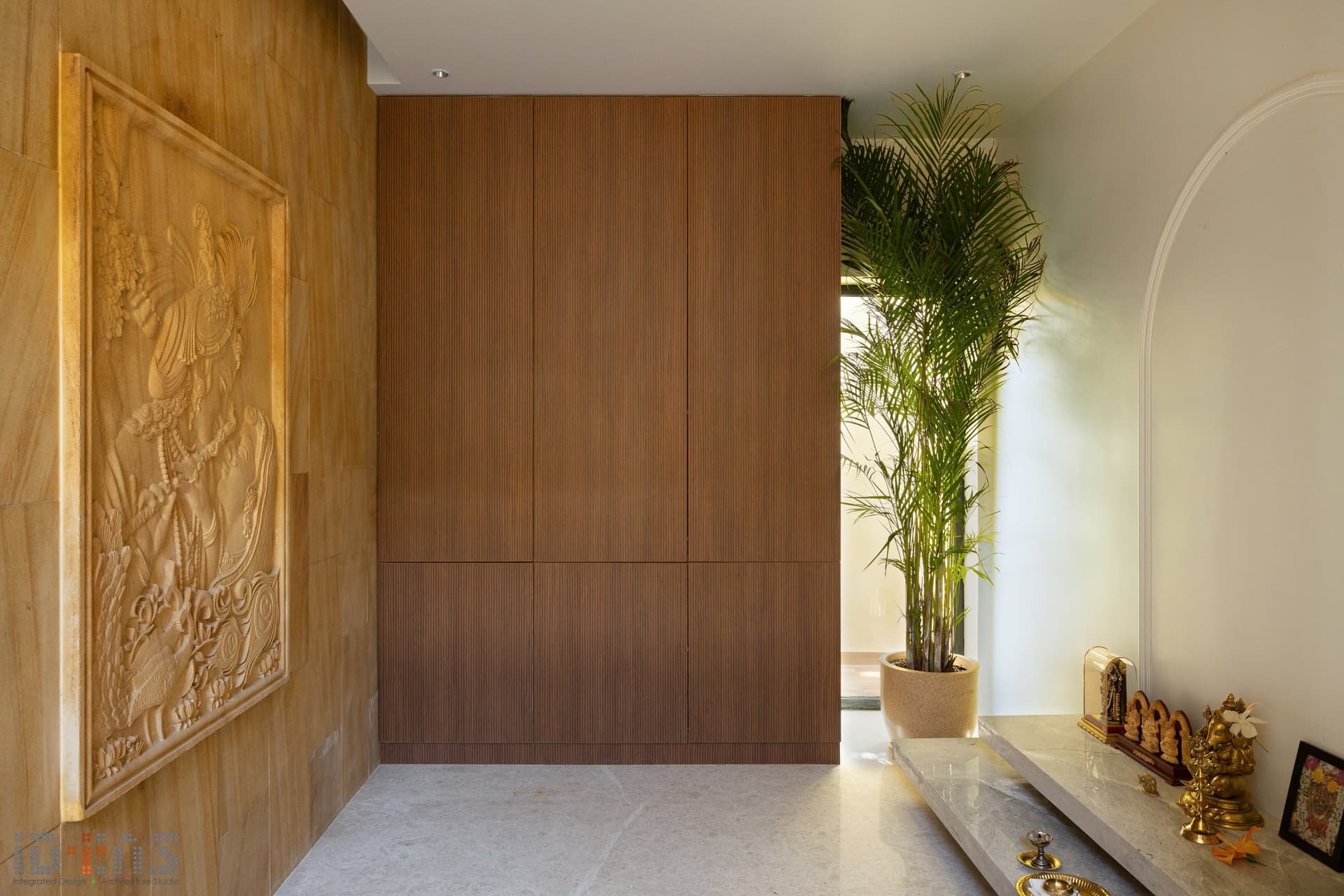
Beyond the entry, a quieter ritual space holds its own. A carved relief panel in honeyed sandstone leans against a tall plane of fluted teak, and a small puja niche tucked into a recessed arch keeps the home’s sacred geometry visible without ceremony. The arrangement makes its argument without raising its voice: tradition is not a feature here, it is a fold in the architecture.
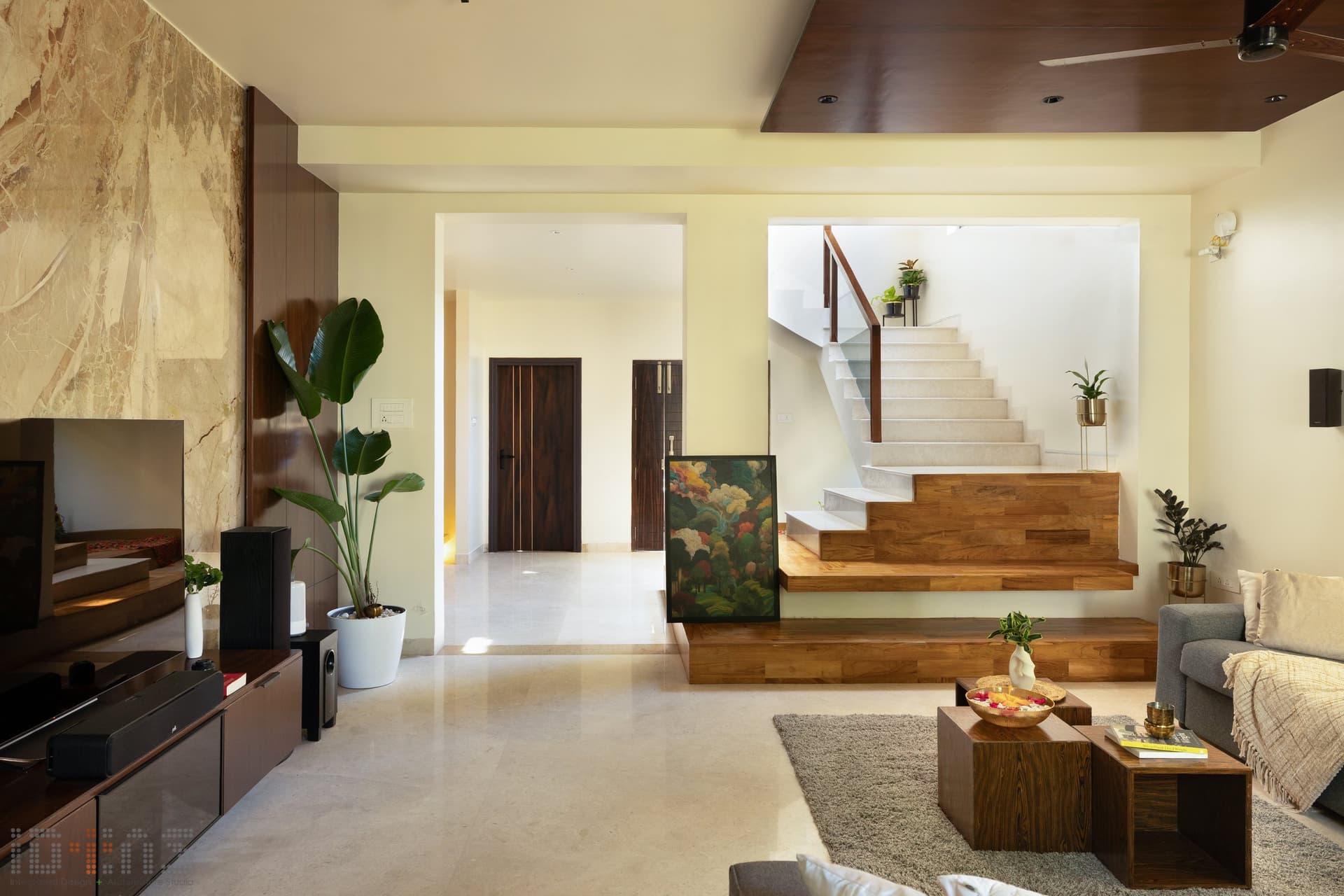
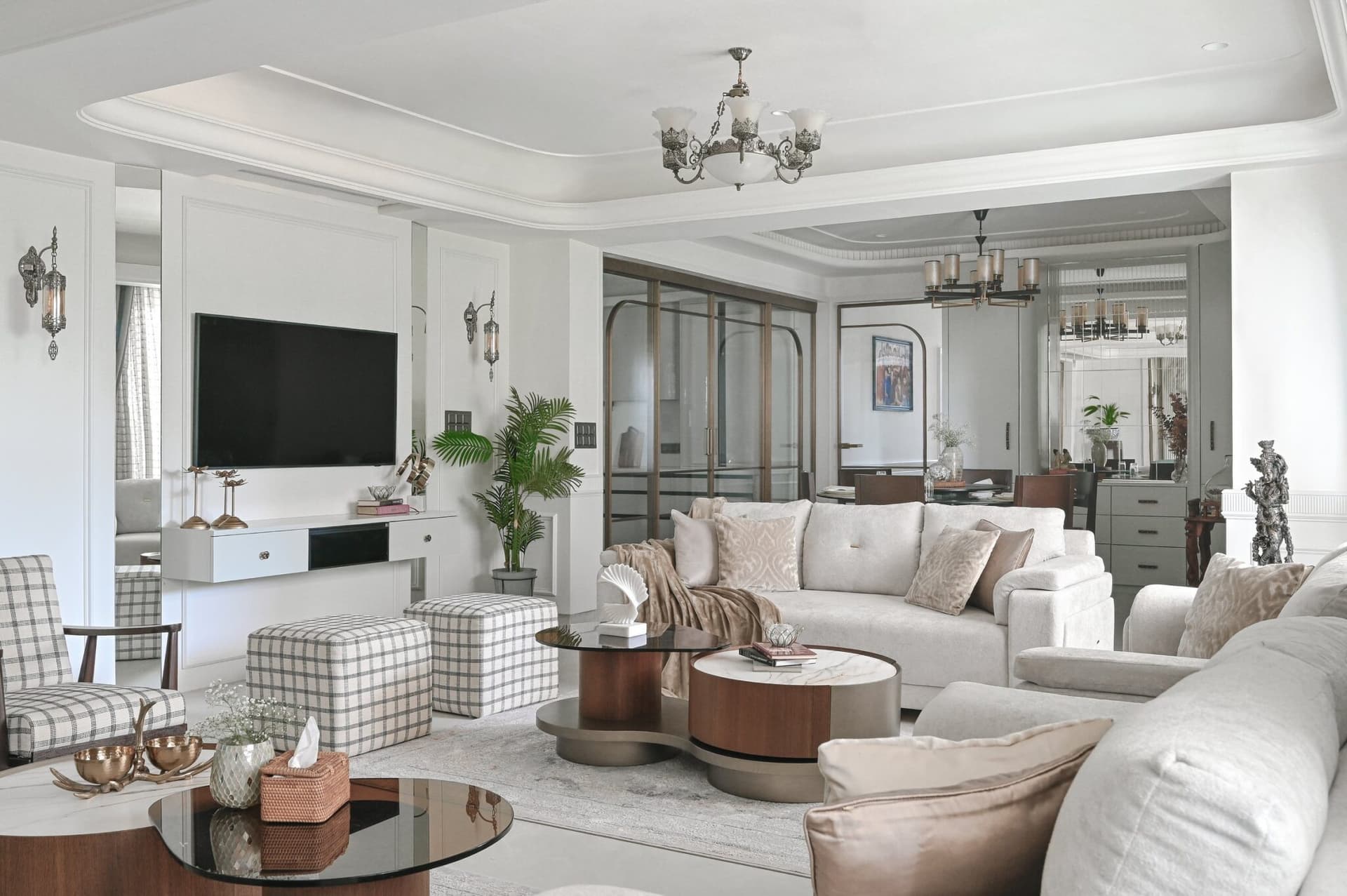
The living room opens with a deliberate looseness, its volume broken gently by a stepped wood-and-stone platform that doubles as informal seating and a transition to the upper floor. A veined marble feature wall anchors the media zone, while the rest of the room remains pale and unfussy, content to let the staircase and a single framed canvas do the speaking.
““Each room establishes a sensory connection with nature; the landscape is not treated as a secondary element or visual backdrop, rather, it acts as the central organizing spine of the project.””
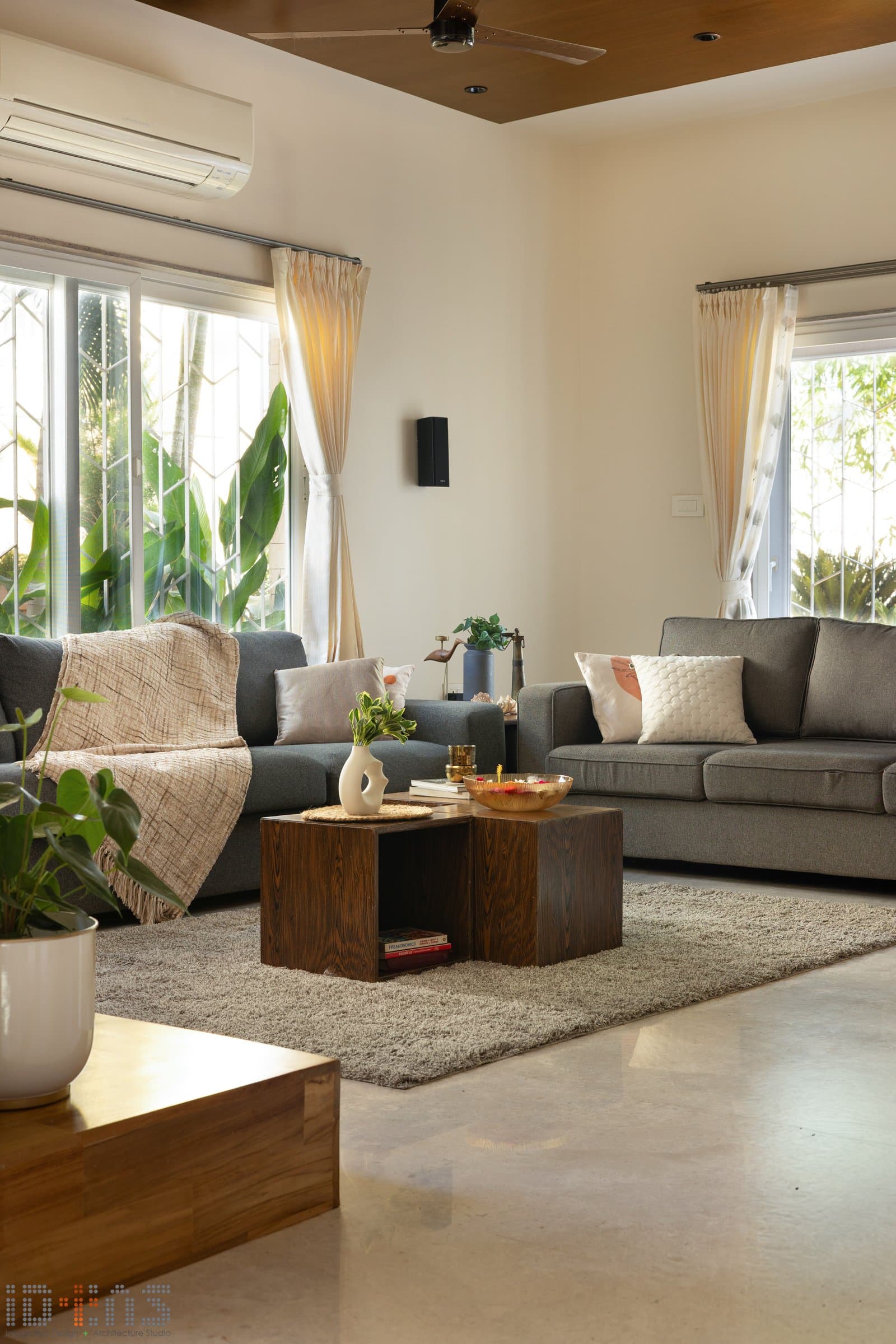
What carries the room is not the furniture but the light: filtered through the leaf patterns at the windows, it shifts across the polished stone floor through the day, doing the decorative work that nothing else has been asked to do.
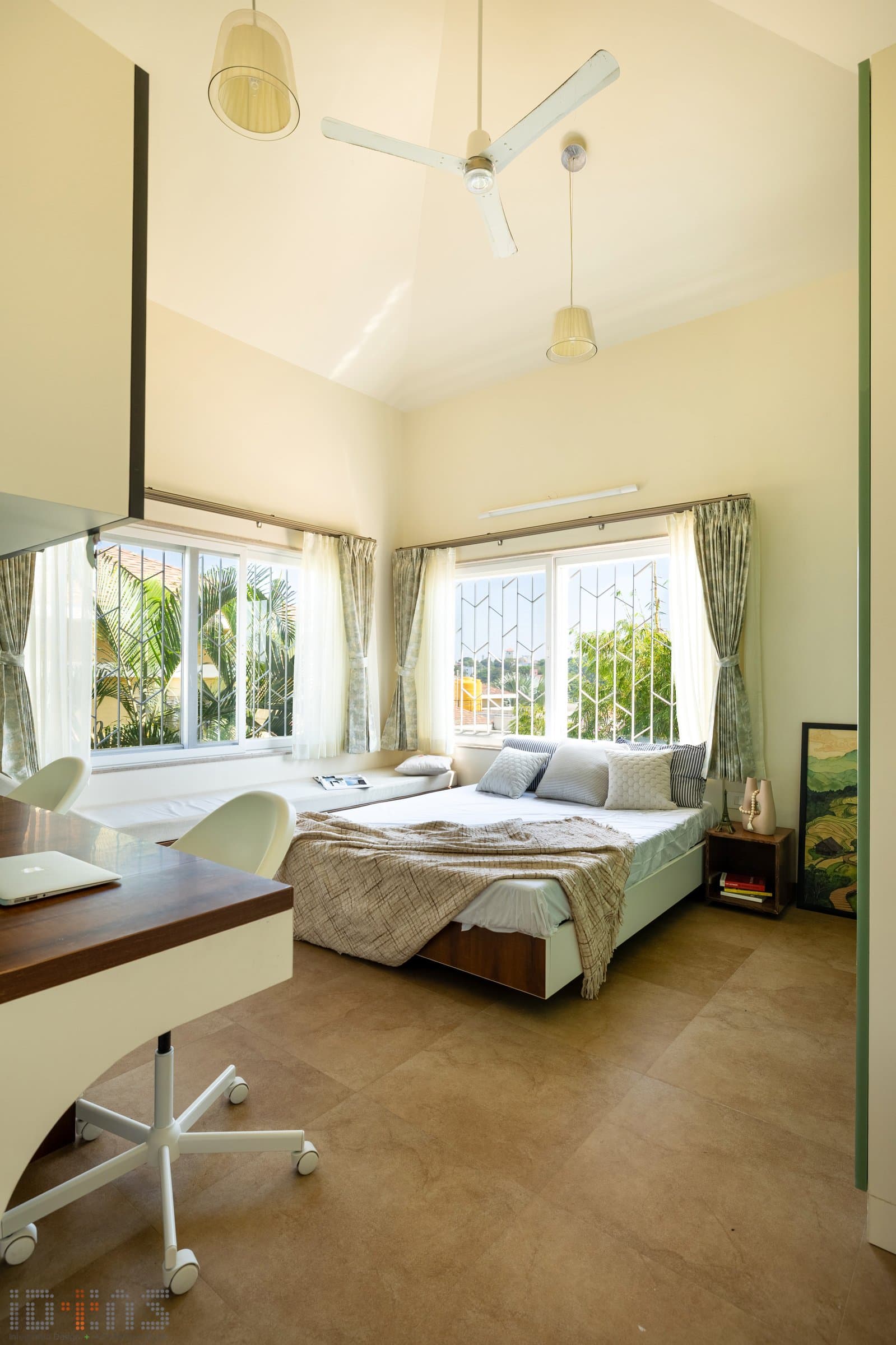
The first of the upper-floor bedrooms takes the home’s vaulted geometry and makes it personal. A double-height ceiling rises to a soft apex, paired with a window seat that runs the length of the wall and a writing desk that floats beside it.
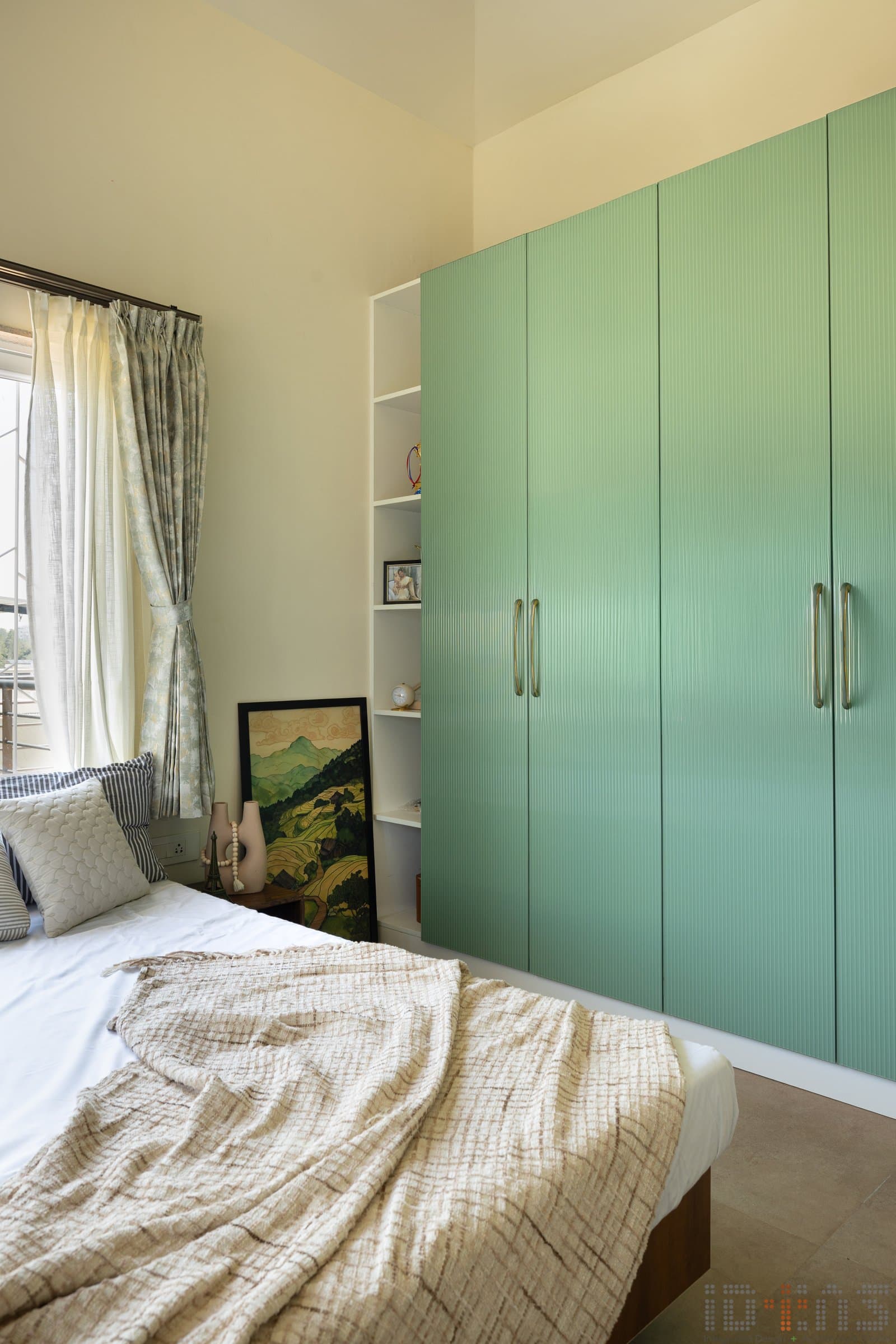
Across from the bed, a tall wardrobe in fluted sage-green lacquer becomes the room’s only declarative gesture. The colour is unexpected without being theatrical, a pale, dusty green that picks up the curtain pattern and the framed landscape leaning against the open shelving niche, tying the room’s quieter elements into a single chord.
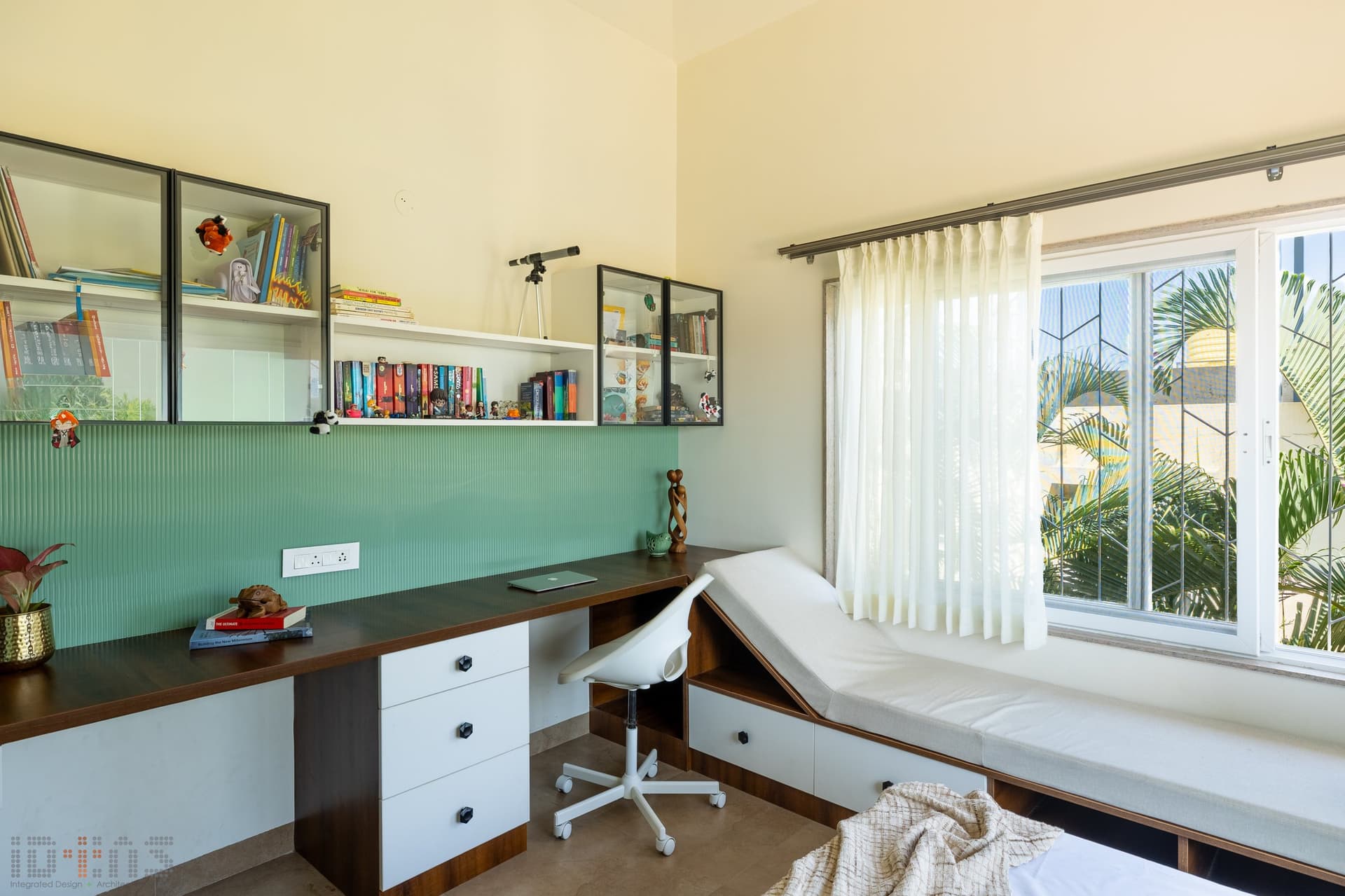
A study corner within the same room continues the green thread, this time as a fluted backsplash above a long wood desk. A built-in window daybed runs alongside it, generous enough to read on, narrow enough to keep the room legible as a bedroom rather than an office.
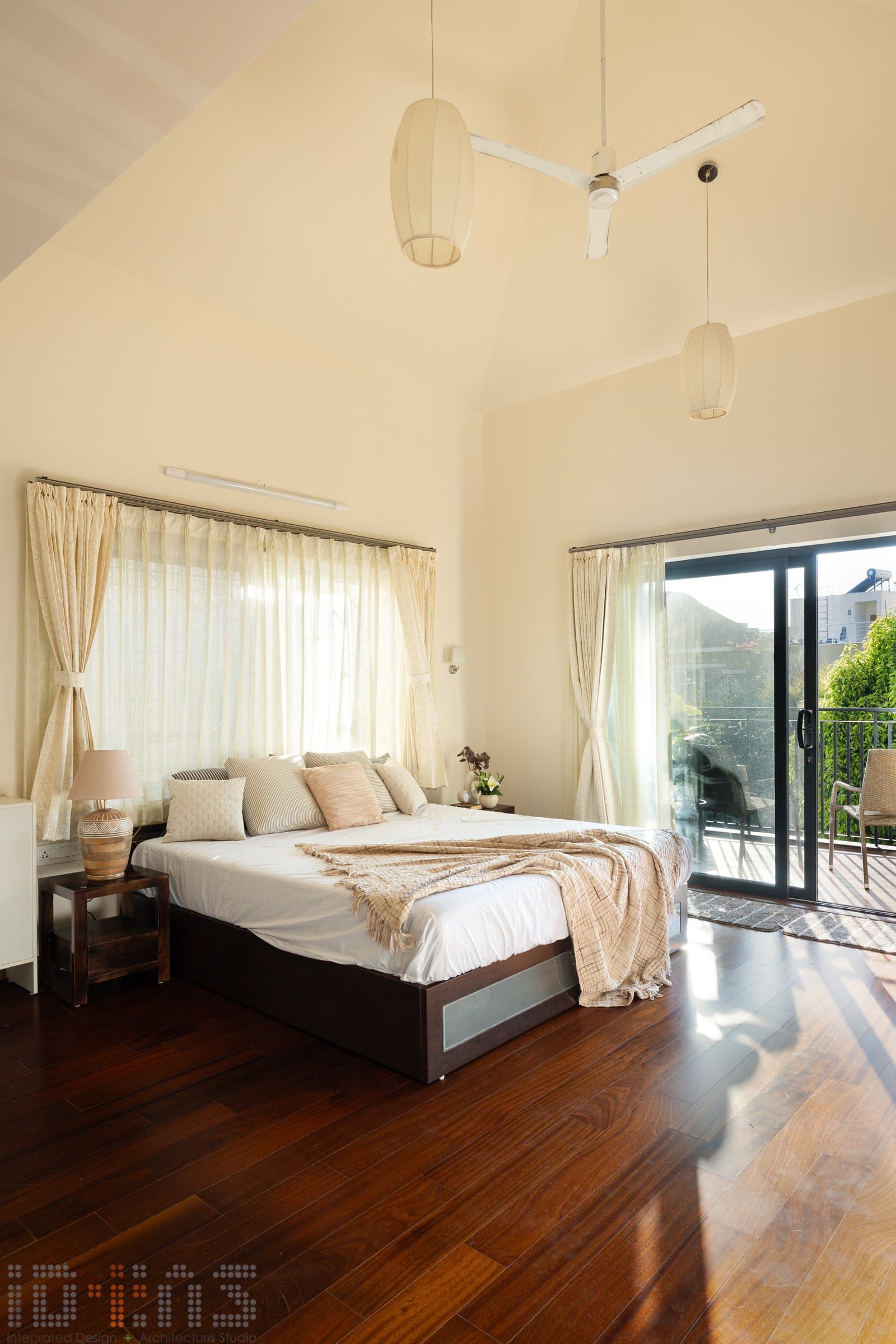
The principal bedroom is calmer and more horizontal in its instincts. A sliding glass door to a private balcony floods one end of the room with afternoon light, while the dark hardwood floor, lacquered to a gentle sheen, gives the otherwise pale palette a low, grounded register.
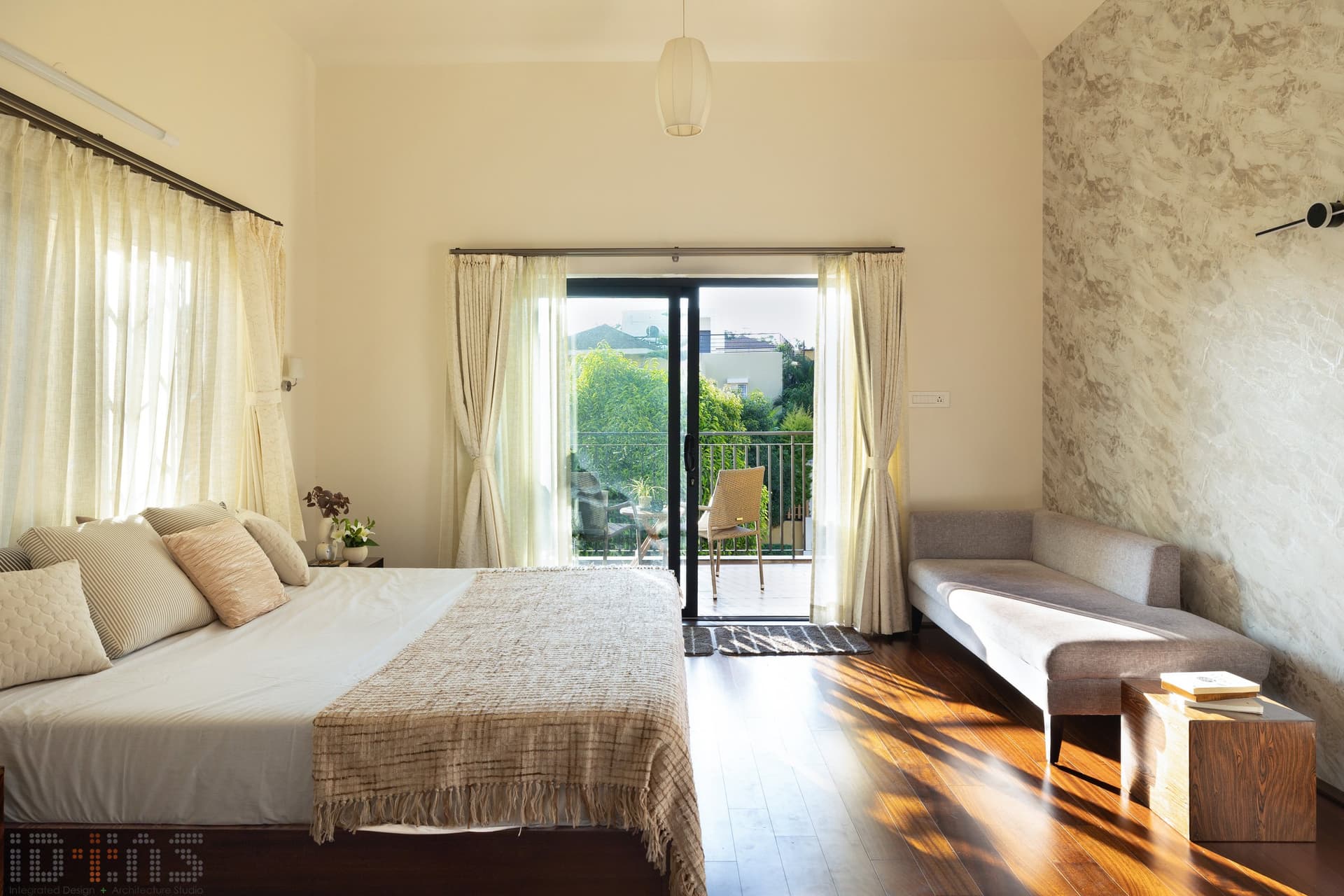
Opposite the bed, a textured plaster accent wall and a pale linen daybed soften the room’s rectilinear bones. The pendant light overhead is deliberately modest, a paper lantern rather than a chandelier, in keeping with the house’s broader refusal of decorative spectacle. Stillness, here, is not a mood; it is the room’s working condition.
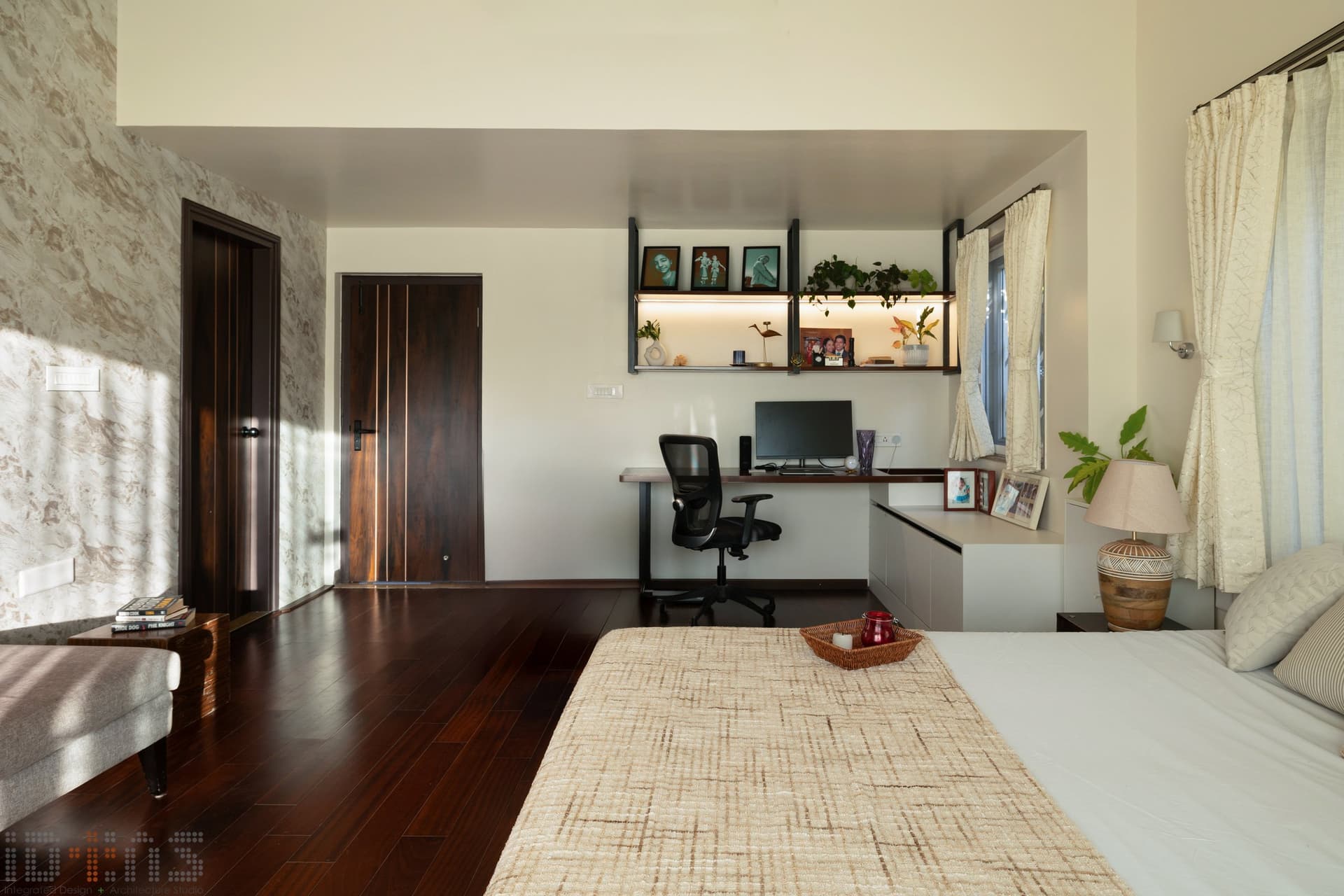
A built-in study desk at the foot of the bed brings the same restraint to the working corner. A floating shelf above holds family photographs and small ceramics, lit from within so that even the most private wall in the house has its own quiet evening register. The textured stone wall carries through, holding the room together as a single, considered volume.
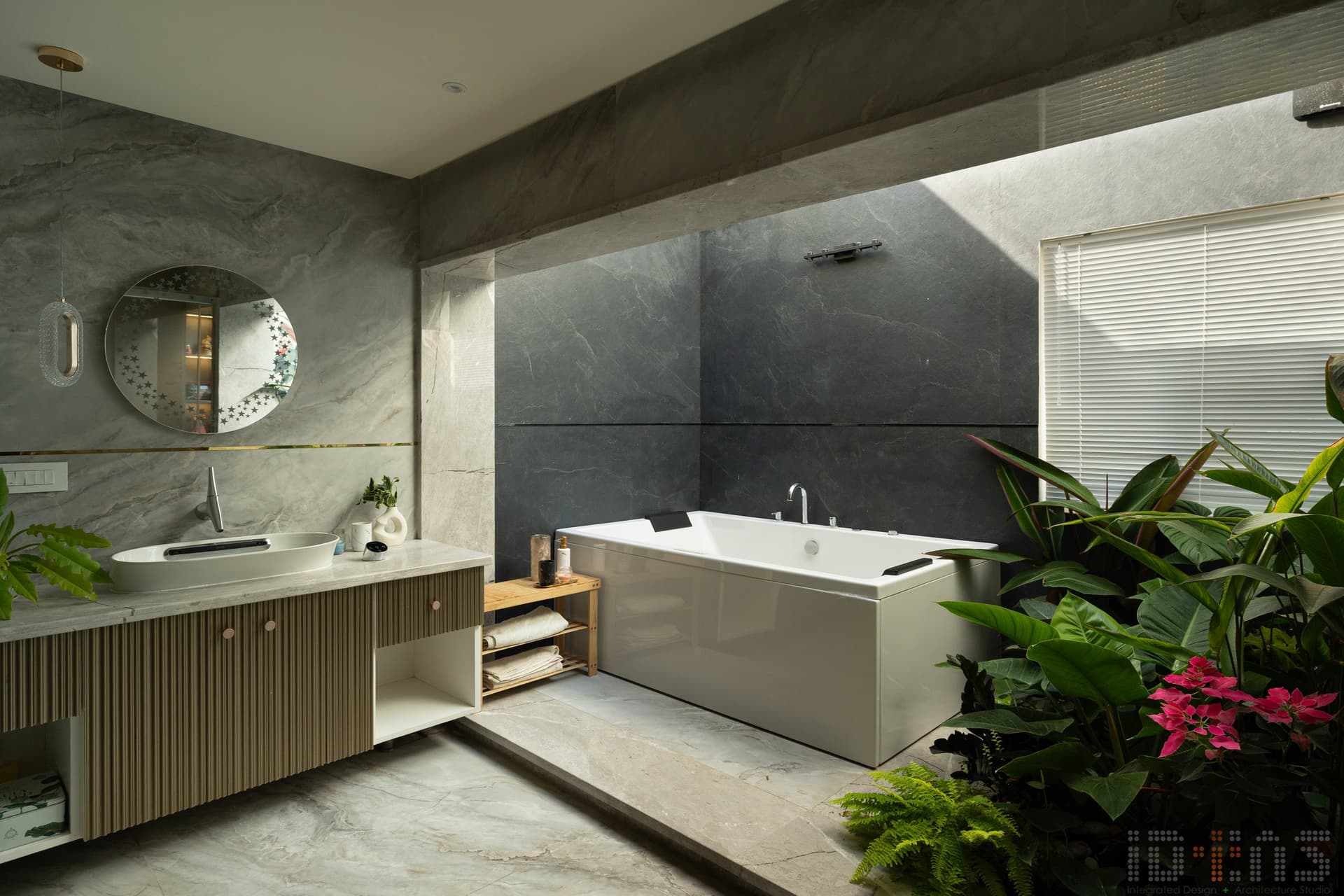
The principal bathroom is where the house’s tropical thesis becomes most explicit. A long picture window along one edge opens onto a planted bed inside the bathroom envelope, ferns, philodendrons, a single burst of magenta, so that the bath sits not against a tiled wall but against a small, curated jungle. Slate-toned stone wraps the wet zone; the planting does the rest.
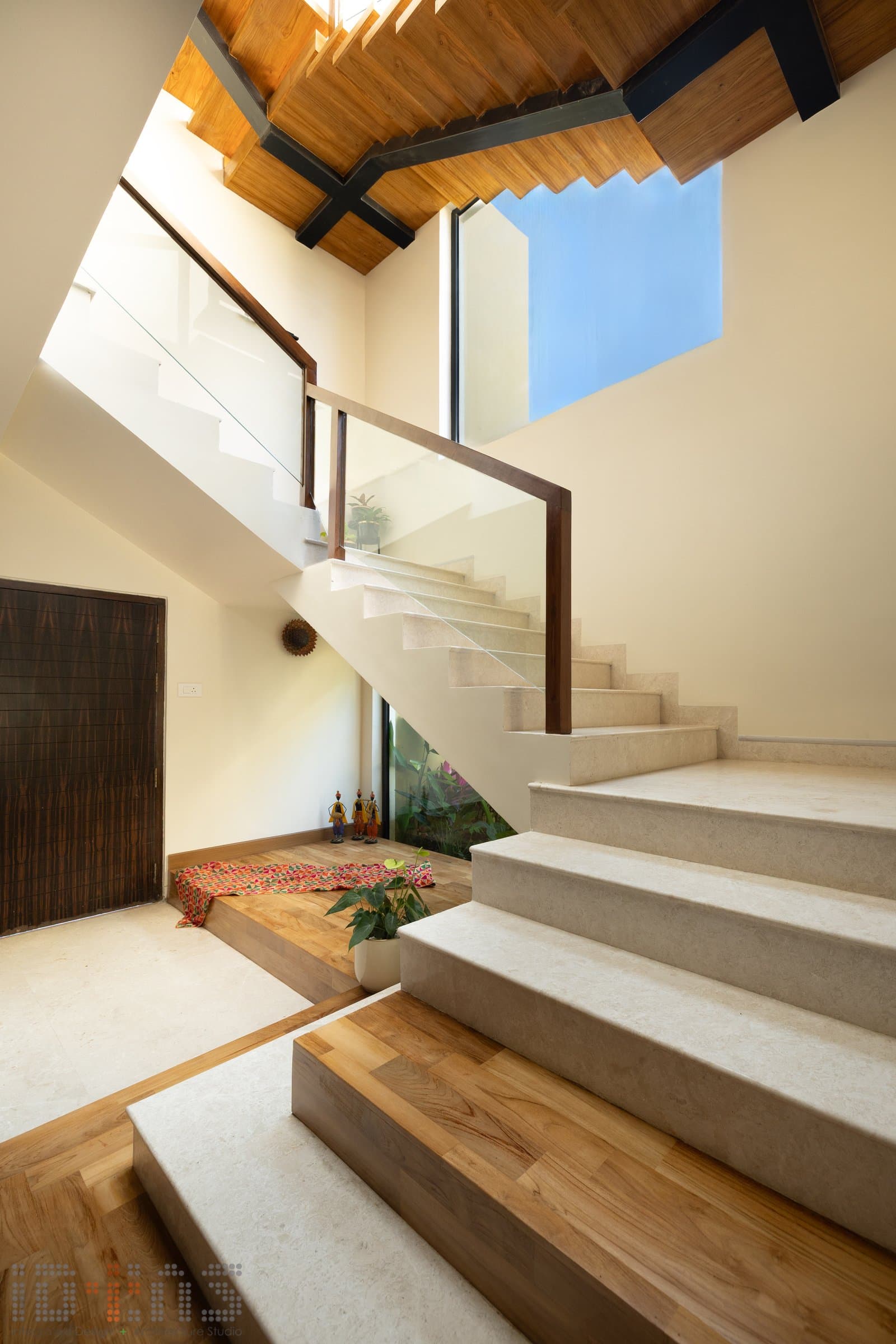
The internal staircase, seen from below, reveals the home’s most architectural moment. A pitched ceiling clad in tongue-and-groove wood with exposed black steel rafters opens above the stairwell, and a square skylight pulls a clean rectangle of sky into the volume. Pale stone treads rise toward the upper floor, while a small landing at the base holds a folk-art tableau, a trio of figurines on a textile runner, like a quiet welcome at the foot of the climb.
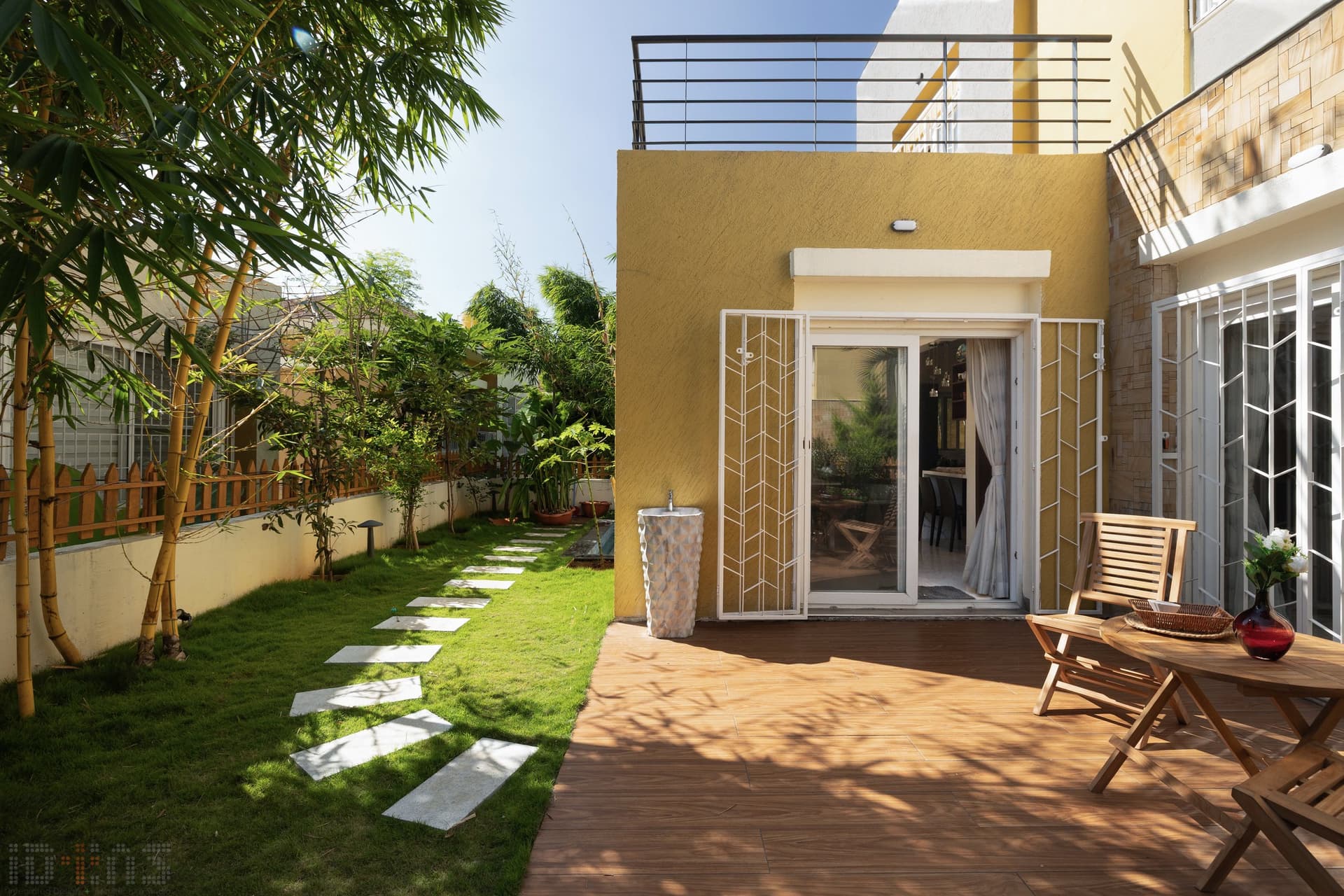
Outside, the rear garden makes the home’s relationship to landscape literal. A wood-decked verandah extends the dining room into the open, a path of stone pavers cuts a soft line through the lawn, and a stand of bamboo holds the boundary loosely rather than walling it off. The yellow-ochre façade picks up the late light without competing with the foliage.
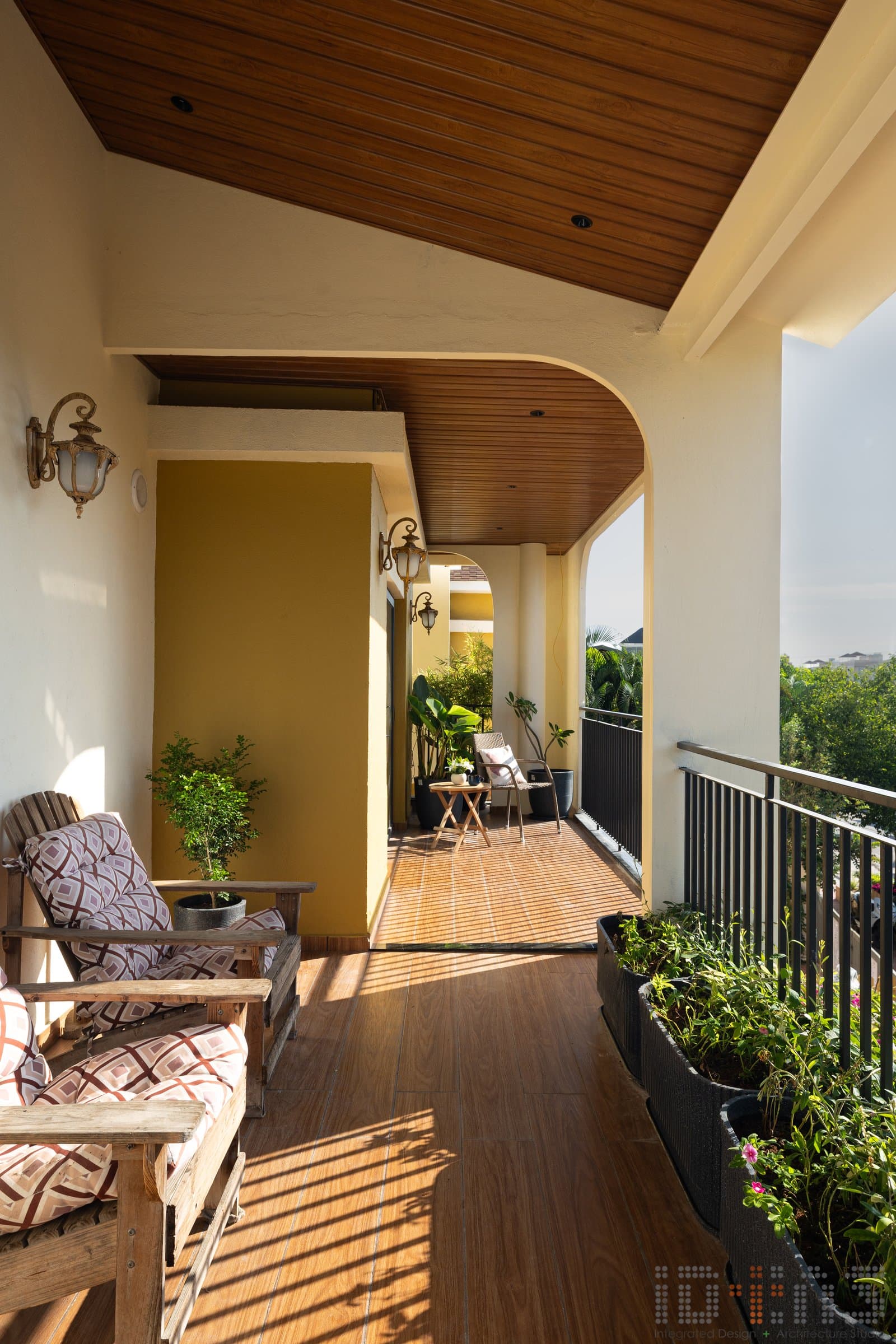
The first-floor balcony, deep and wood-clad above, runs the length of the principal bedrooms and turns into a long outdoor room of its own. Curved soffits, traditional wall-mounted lanterns, a small table-and-chair arrangement at one end, the verandah does what the brief asked the architecture to do throughout, blur the line between living inside and living outside.
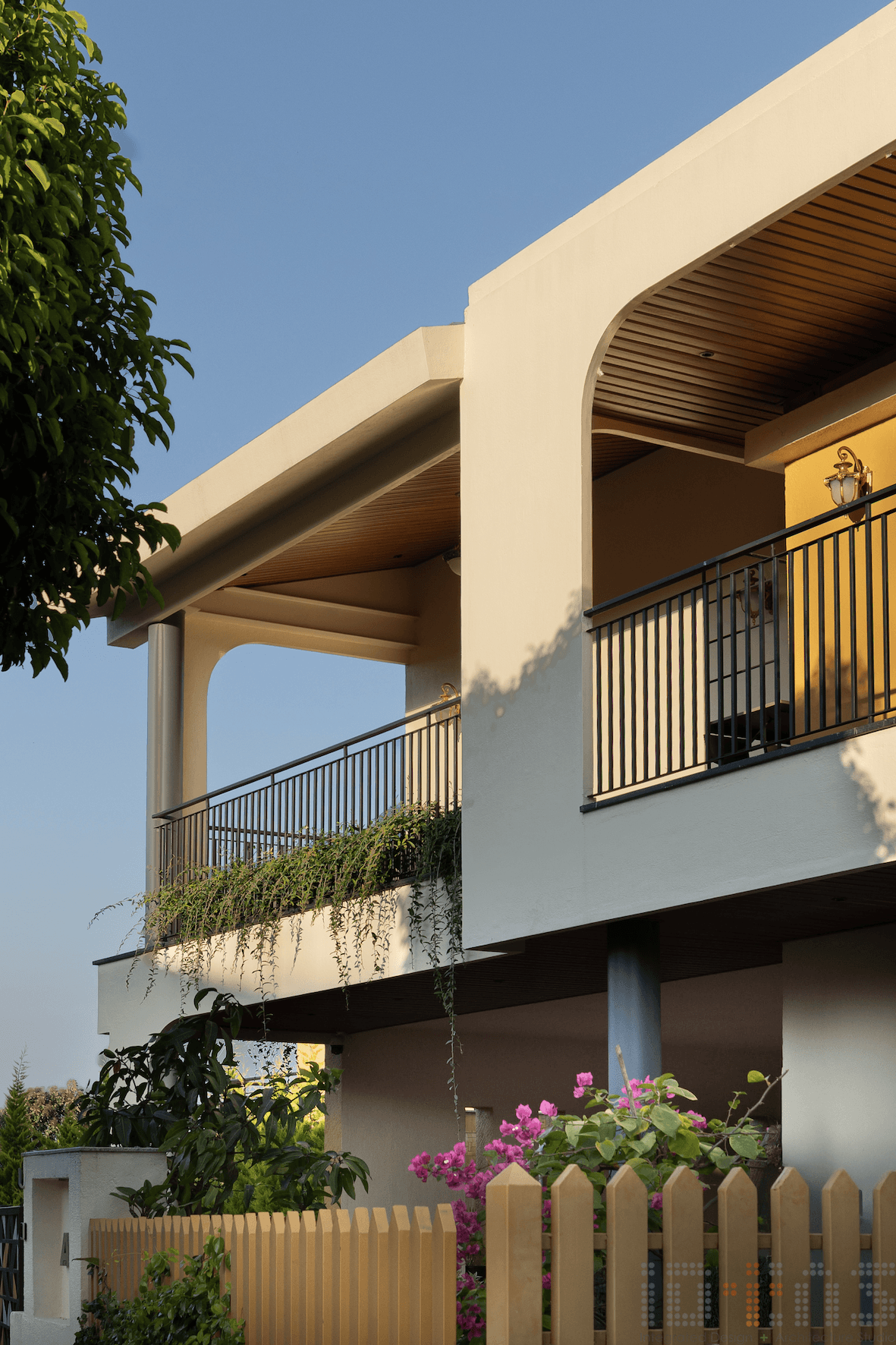
A second balcony off the upper floor extends the same idea toward a longer view. The wood ceiling continues, the curved arch repeats, and a pair of teak armchairs face an open horizon of treetops and tiled neighbouring roofs, a reminder that the house, despite its quiet introversion, knows exactly where it is.
A small side deck completes the home’s outdoor inventory. Walls clad in a patchwork of warm sandstone tiles meet a planted edge of palms and flowering shrubs, and a teak bistro setting waits for morning coffee. It is the kind of space that does not appear on plans but defines a home’s daily rhythm.
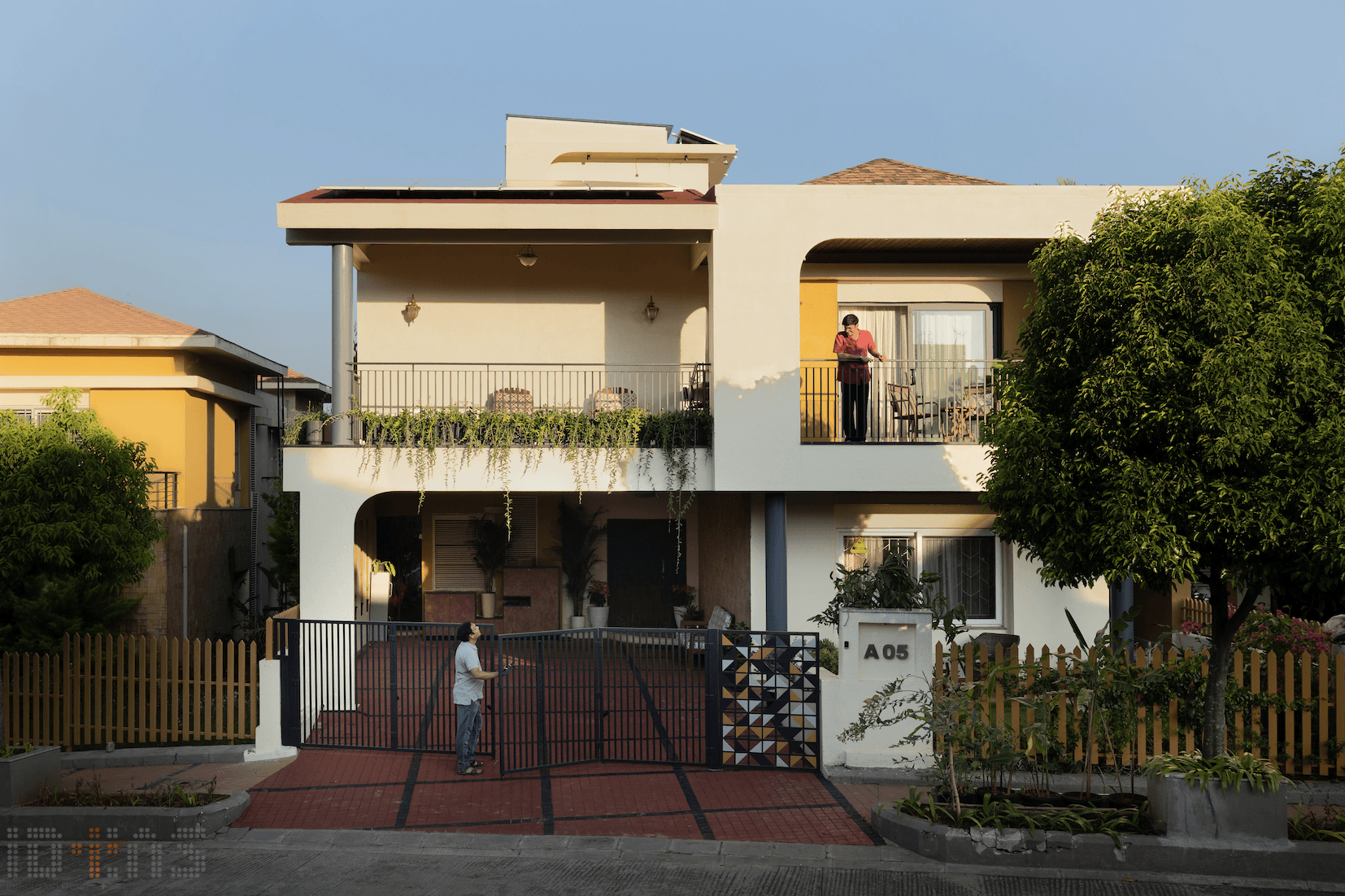
Read from the street, the residence reveals its renovation logic. Curved balconies and deep horizontal overhangs soften what was once a more conventional mass; the cream-and-ochre palette is composed but inviting; cascading greenery falls from the first-floor edge in a deliberate gesture of softening. The house does not announce itself, it settles in.
The arches and overhangs are calibrated to read as residential rather than monumental, and the building’s relationship to its neighbours is one of continuity rather than contrast. It is a home that has chosen to belong to its street as carefully as it belongs to its garden.
Within Bengaluru’s contemporary residential landscape, where a generation of homes has been quick to adopt either glass-box minimalism or maximalist pastiche, the Ashwin-Deva Residence proposes a third path. Tropical modernism, recalibrated for a tighter urban plot, with greenery treated not as garnish but as structure. The references are familiar from Sri Lankan and South Indian traditions, the deep verandah, the planted bath, the porous threshold, but the assembly here is its own.
What the project gets right, in the end, is its sense of pace. The home does not rush the visitor through its spaces or stage them for a particular sequence of admiration. It allows light, air, and foliage to do the work of orientation, and trusts that a life lived inside it will take on the same unhurried rhythm. In that quiet trust lies the project’s most considered argument.