There is a particular kind of confidence that belongs to people who have made and unmade homes many times over. They no longer chase a single defining style; they understand instead that a home is a vessel for accumulated life, and that the best interiors are the ones generous enough to hold both the objects and the rituals one refuses to leave behind. This apartment was conceived for precisely such a couple, and the design responds with neither nostalgia nor reinvention but with a calibrated marriage of the two.
Designed by Muskan Khan, Principal Designer of her design firm – Saffron House for clients who have, by their own count, set up eighteen homes across cities and countries, the residence is a study in editorial restraint. The brief was not about aesthetic novelty but about resolution: how to translate decades of taste, travel, and devotion into a single, coherent interior that feels neither over-curated nor freshly minted. The result is a home that looks lived-in from the moment of completion, classical in its bones and quietly contemporary in its details.
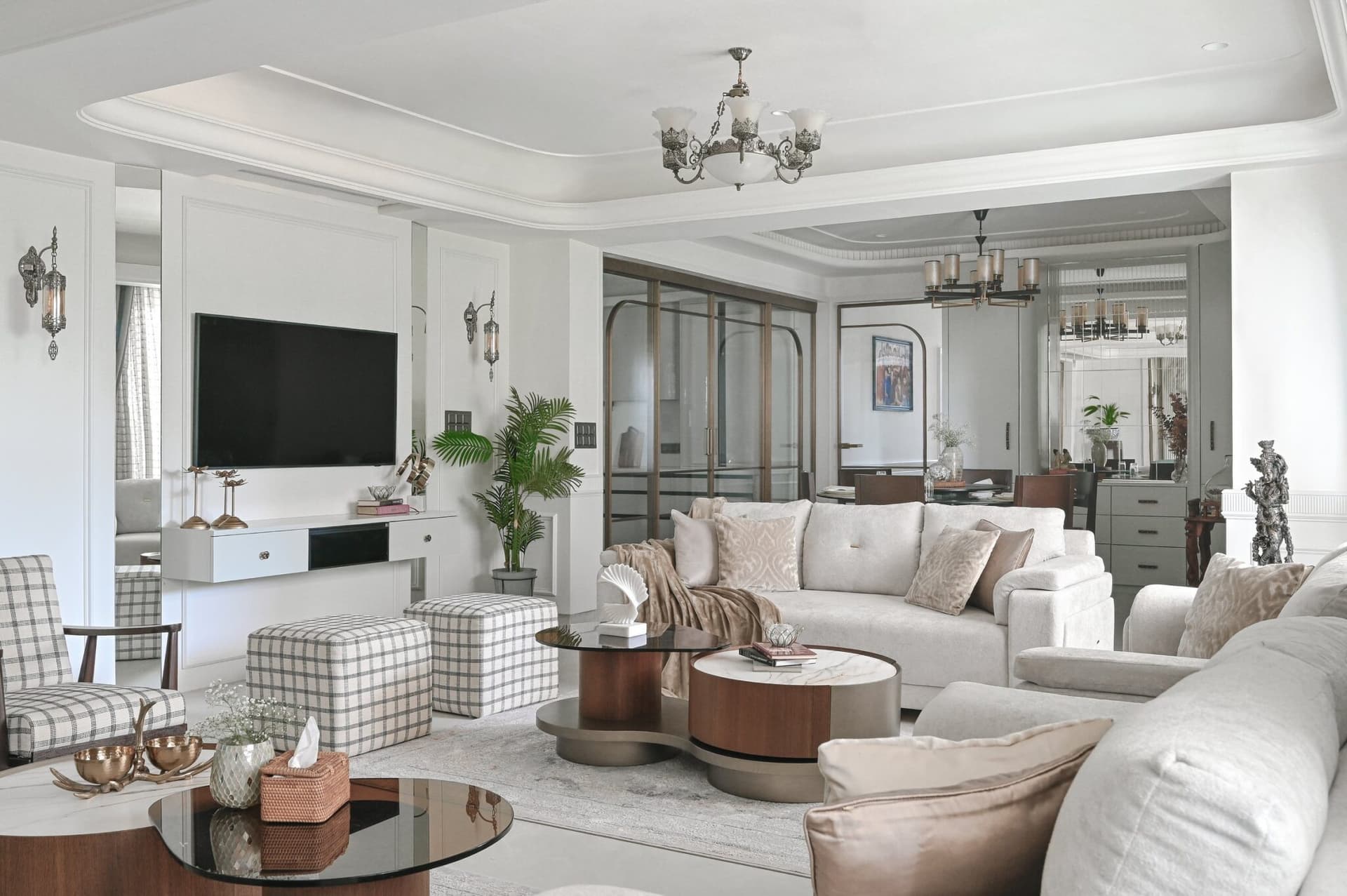
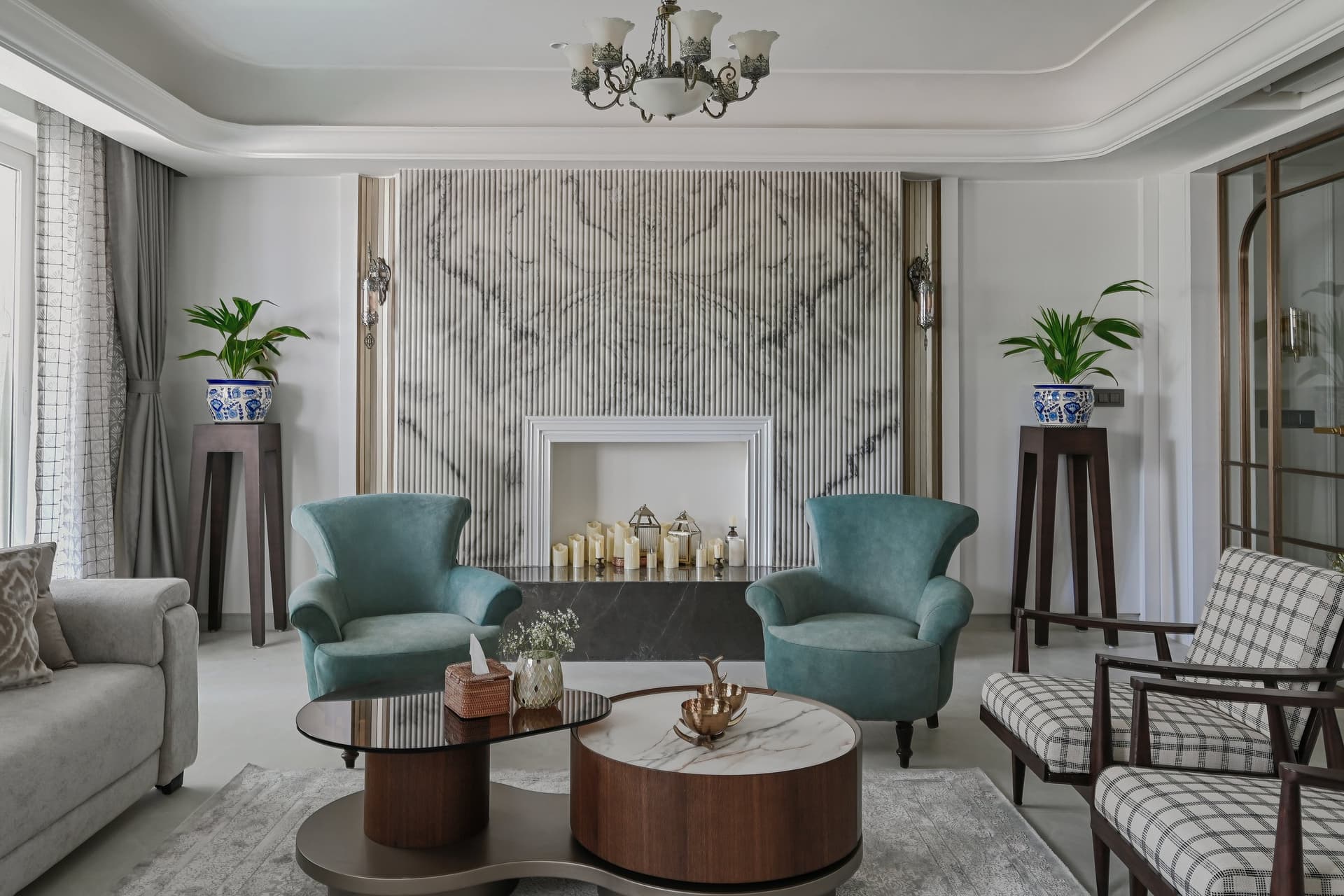
The living room is the home’s central social statement, and it carries the weight of that role with composure. Wall mouldings and a recessed tray ceiling establish a classical grammar, while the furniture beneath operates in a softer, more contemporary register, a pale ivory three-seater paired with checked club chairs and a sculptural cluster of round tables in walnut and pale stone.
What holds the room together is the discipline of its palette. Cream, soft grey, and the warm patina of brass repeat across sconces, lamps, and the slim bronze frame of the partition that opens toward the dining room. Nothing competes; everything converses.
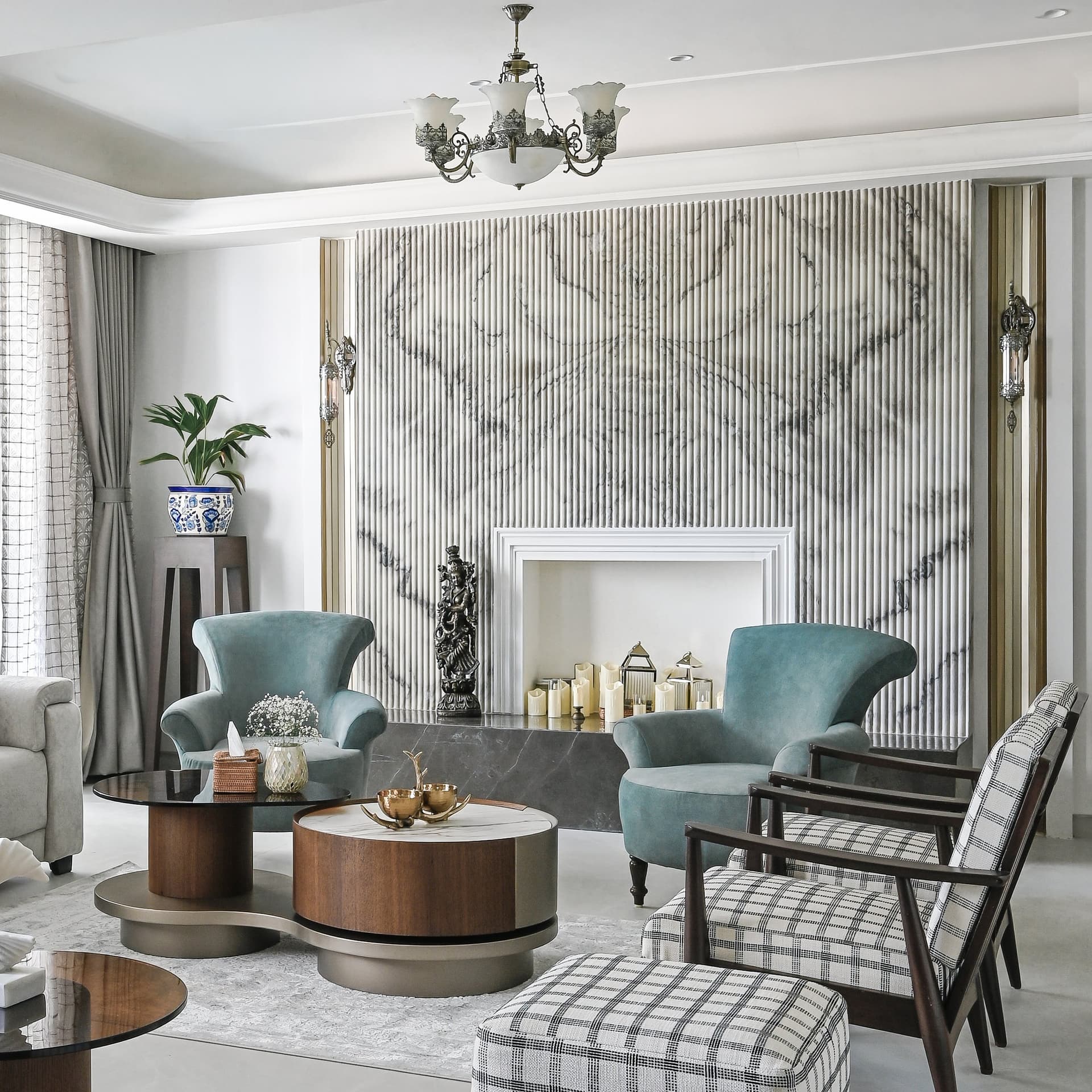
At the far end of the living room, the design makes its single theatrical gesture: a fluted marble feature wall in veined grey, framed by reeded brass-and-wood pilasters, with a sculpted moulded mantel at its centre.
The two teal velvet armchairs that face this wall are the room’s most decisive editorial choice. In a palette this disciplined, a saturated colour acts as punctuation, pulling the eye across the room and giving the seating arrangement a focal point that the neutral upholstery elsewhere deliberately refuses to provide.
““After eighteen homes, you stop designing for yourself and start designing for the rituals you’ve collected along the way.””
Seen from the opposite end, the living room reveals its real spatial intelligence: a layered choreography of seating, low tables, and the slim brass-framed glass partition that frames the space beyond in soft focus. The checked ottomans, repeated from the lounge chairs, are a small but telling detail; pattern is allowed in only when it has somewhere else to belong.
The room is generous without being grand, and that generosity comes from how the furniture is spaced rather than how much of it there is. The cluster of nesting tables in walnut and stone, with their soft-cornered footprint, lets traffic move through the room rather than around it.
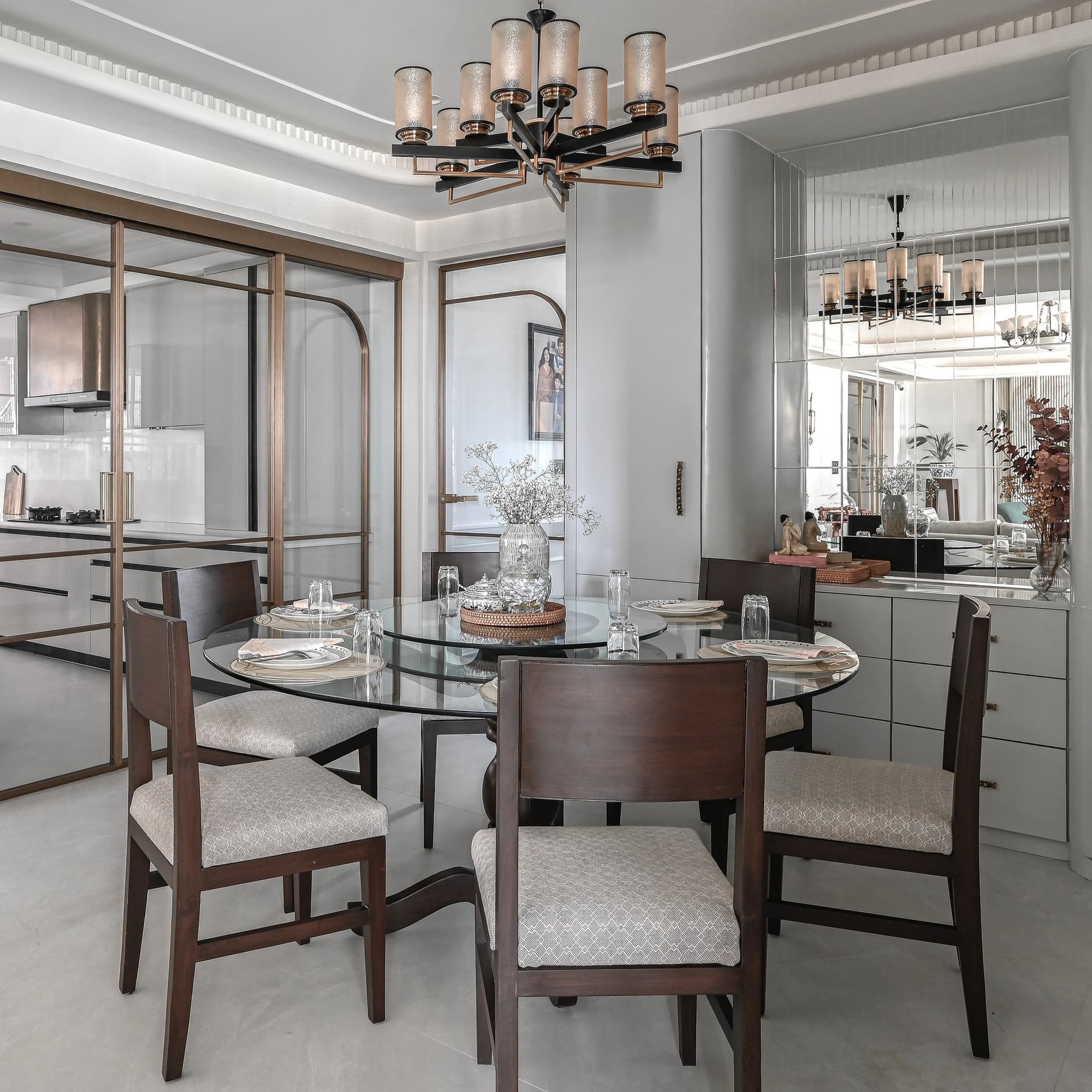
The dining room sits behind a brass-and-glass partition that reads, at first, like a screen and resolves, on closer reading, as a piece of architecture. The arched glazing references colonial-era cabinetry without imitating it, and the slim metal frames keep the gesture light enough to feel current.
A round glass table on a turned wooden pedestal anchors the room, surrounded by chairs in dark-stained wood and a quiet patterned upholstery. The cylindrical chandelier above, in blackened metal and amber glass, is the rare overhead light that does not try to compete with the architecture; it simply marks the centre of gravity for the table below.
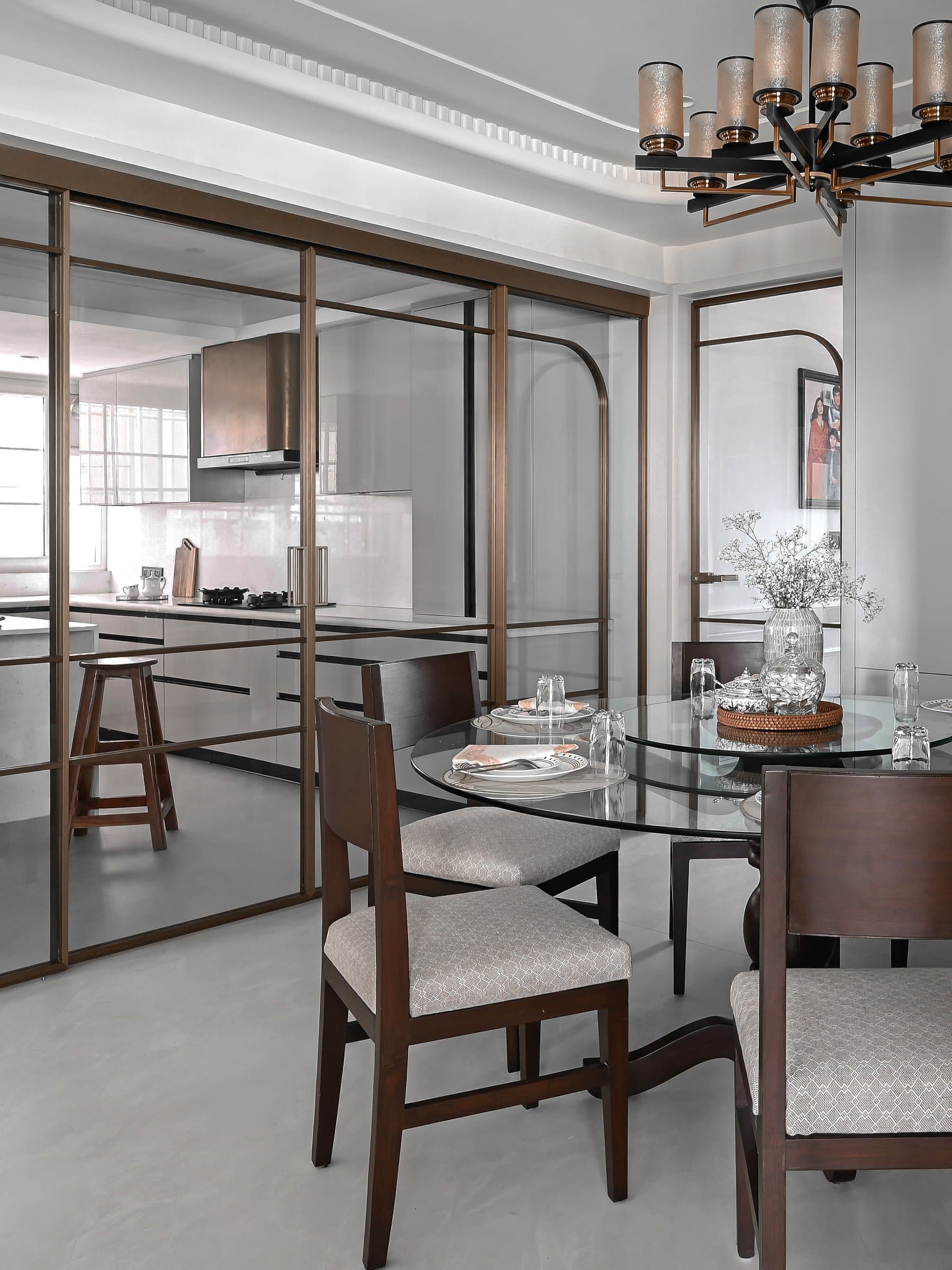
From the dining side, the partition’s role becomes legible: it lets the kitchen breathe visually into the rest of the home without surrendering its working identity. Glimpses of the kitchen’s white cabinetry and copper-toned hood are framed like vignettes, present but composed.
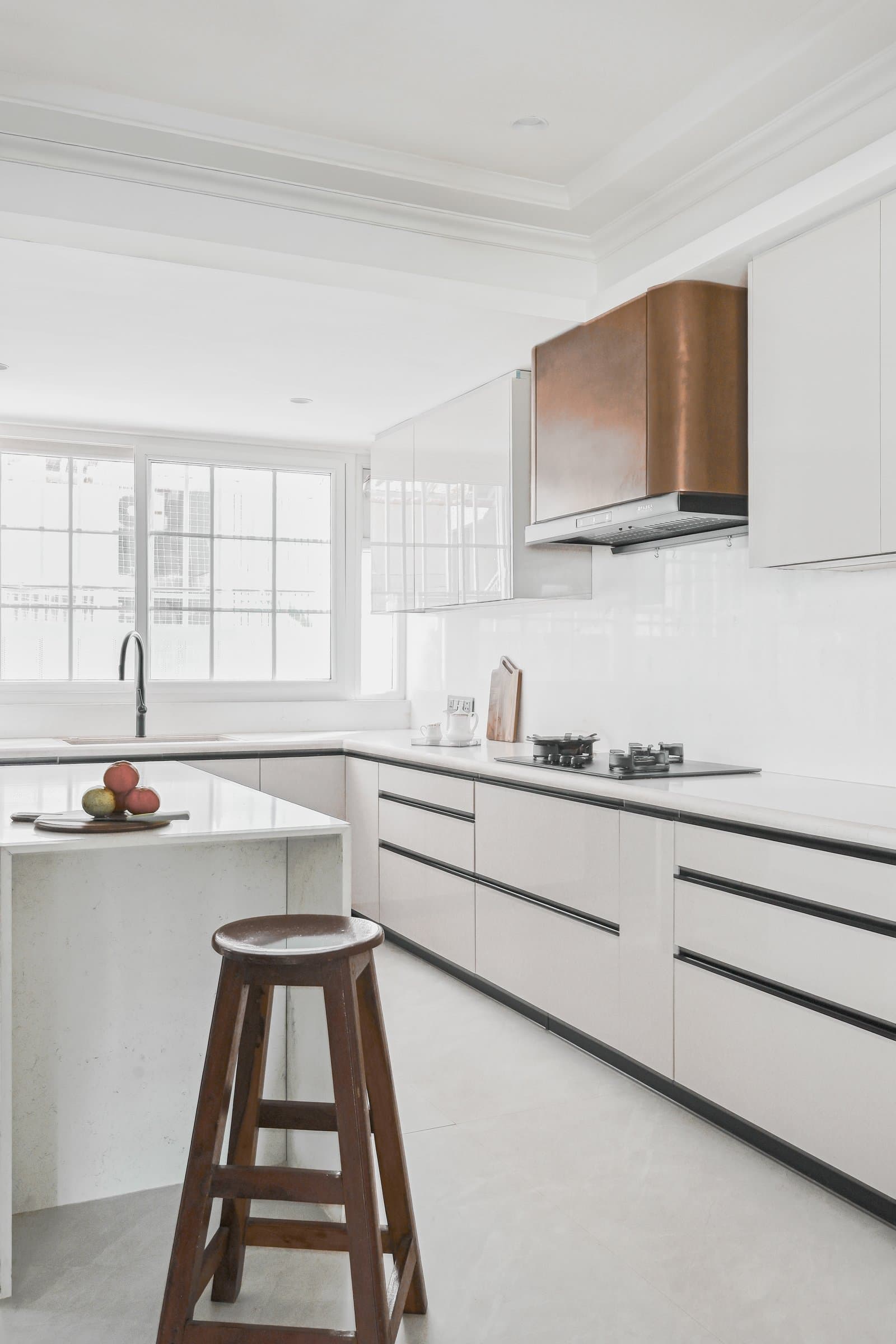
The kitchen itself is the project’s quietest room, and possibly its most disciplined. Glossy white cabinetry runs in clean horizontal bands, interrupted only by slim black recessed handles, and a copper-clad chimney hood lifts the entire composition into something unmistakably crafted.
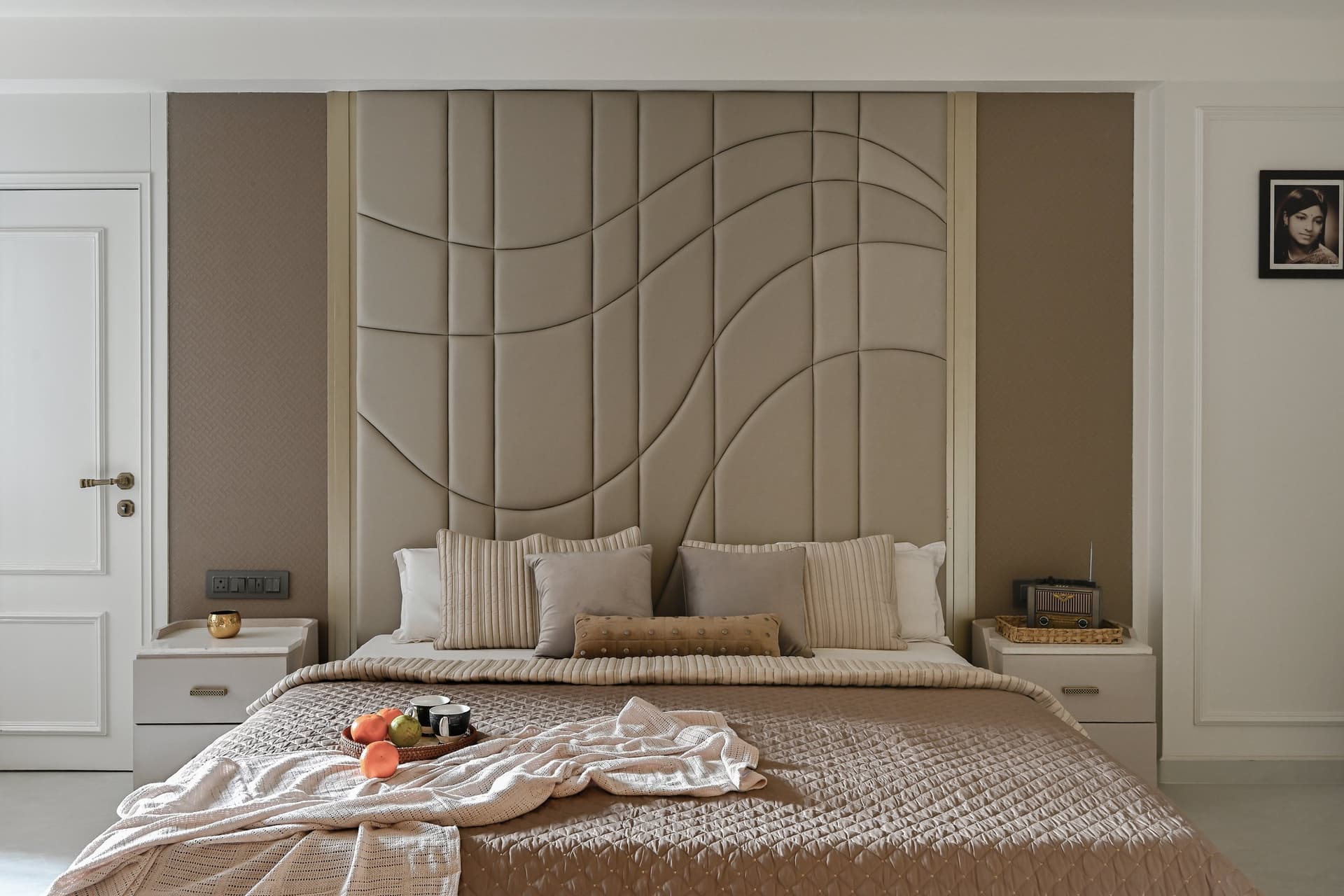
The master bedroom announces itself through a single architectural gesture: a fully upholstered headboard wall in soft taupe, its panels carved into a wave that travels diagonally across the surface. It is the project’s most contemporary moment, and it earns its place because everything around it, the textured wallpaper flanking it, the ivory side tables, the slim brass reveals, is held in a quieter register.
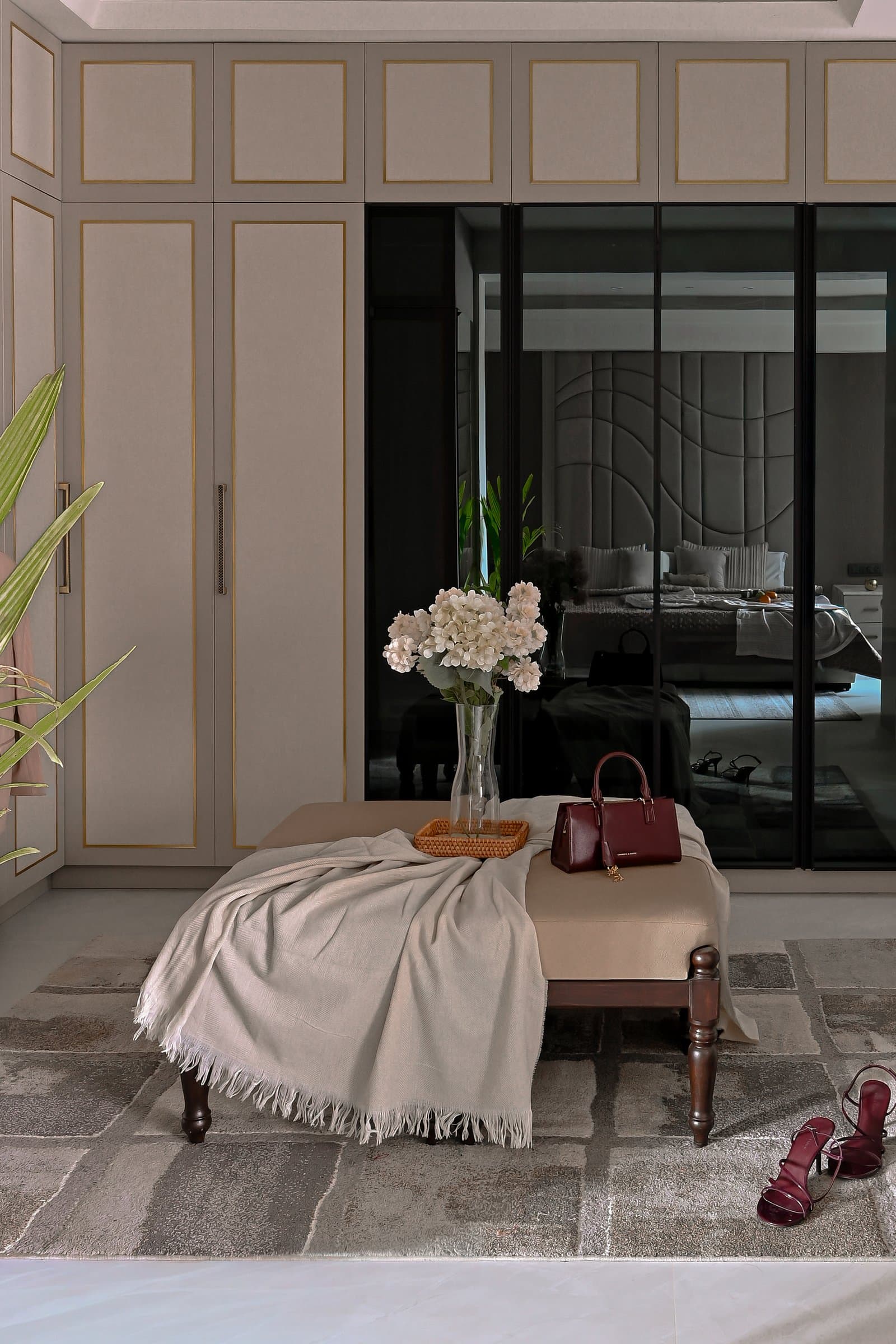
The dressing area, opening directly off the master bedroom, is treated as an extension of the room’s emotional register rather than a utility annexe. Tall wardrobes in dove grey with slim gold-edged panel detailing line one wall, and a smoked glass partition on the other reflects the bedroom in low-key chiaroscuro.
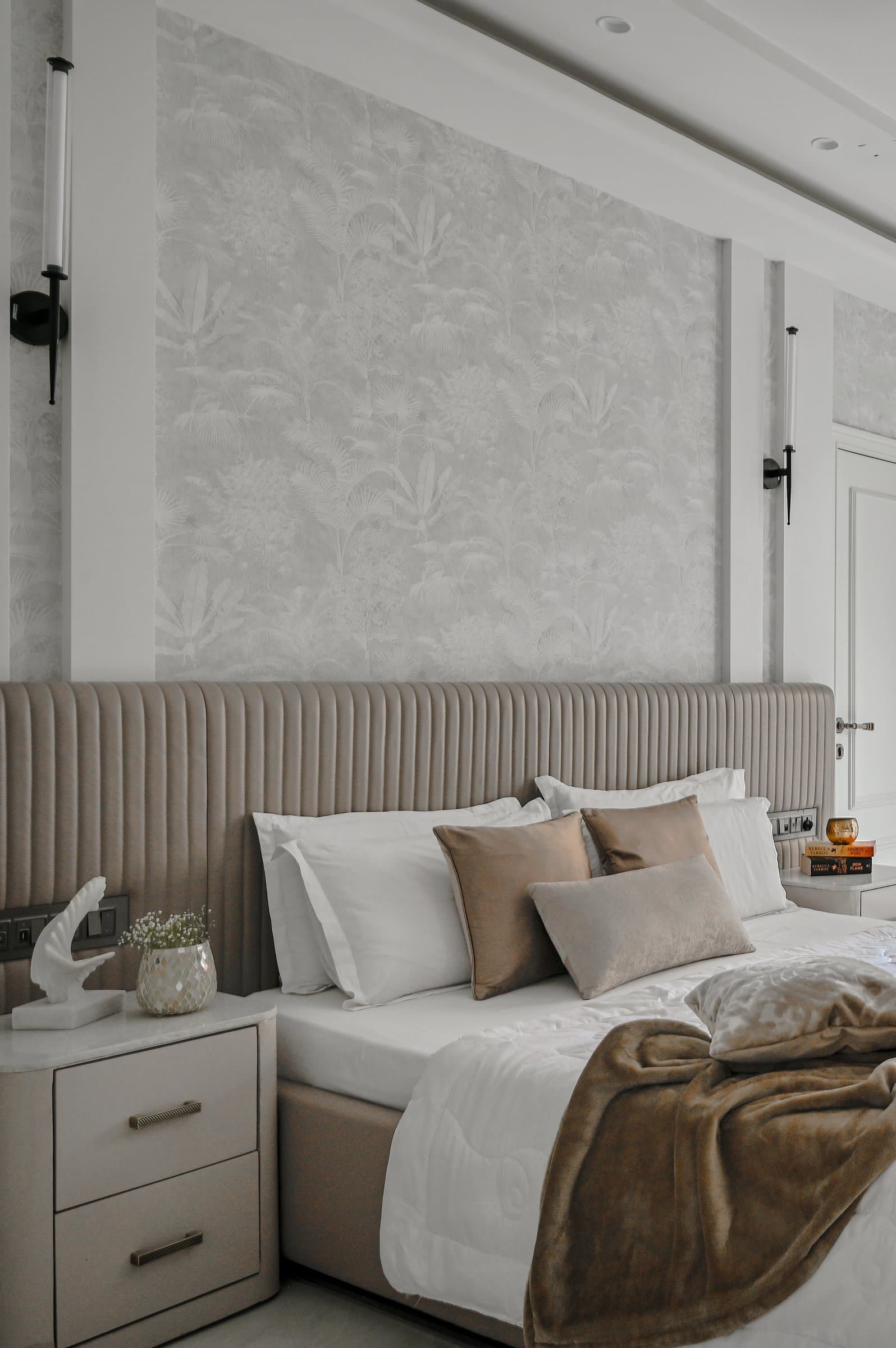
The second bedroom takes a more atmospheric approach. A pale botanical wallpaper in greys and whites runs the full height of the wall, and a fluted upholstered headboard in soft champagne stretches almost the full width of the bed, flanked by slim black-and-glass wall sconces.
The palette here is warmer than the master, leaning into honeyed bronze and cream rather than taupe and grey. It is a quieter, more romantic room, designed for slowness rather than statement.
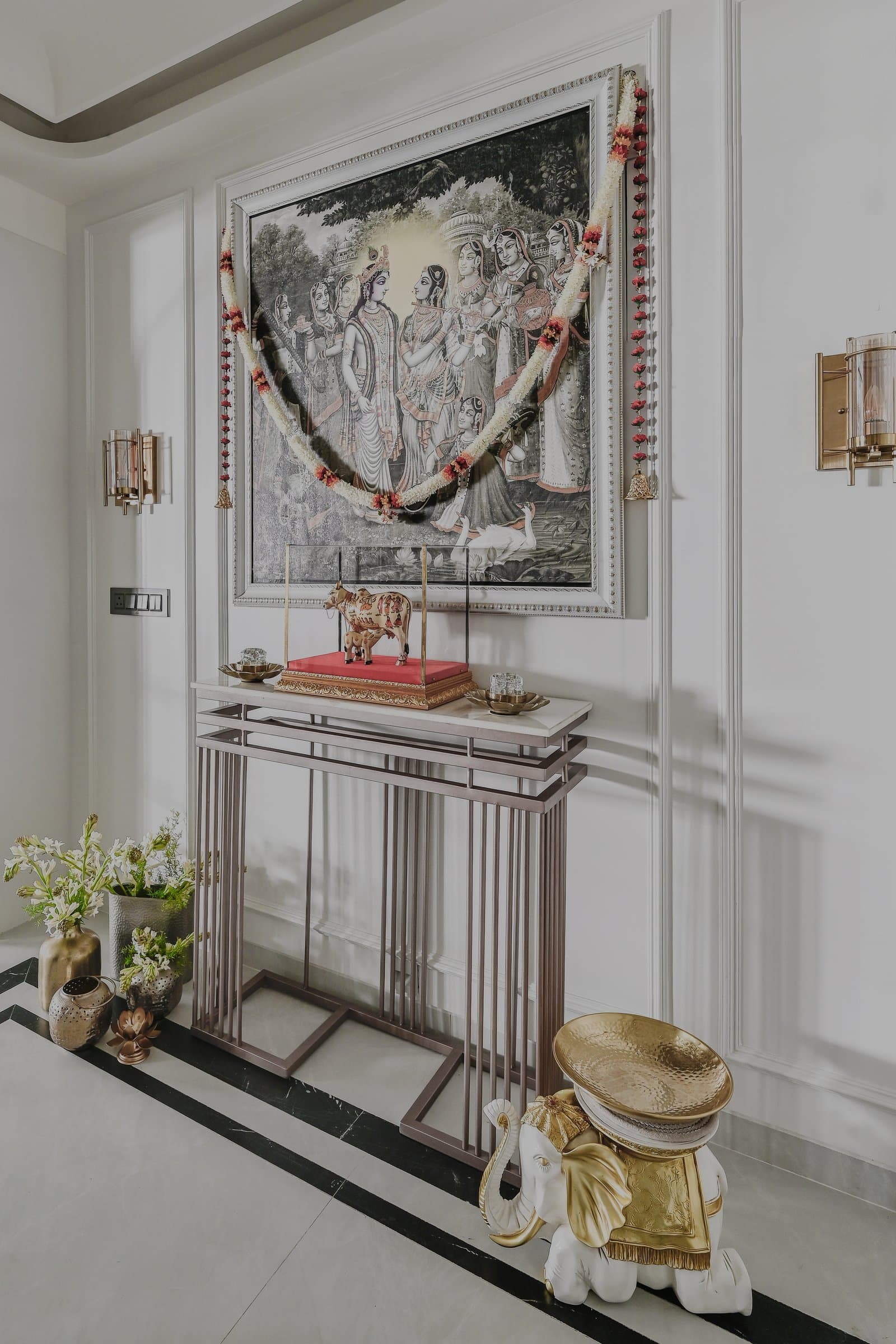
What this apartment offers, finally, is a particular argument about Indian residential design at the upper end of the market: that classicism and contemporaneity need not be staged as opposing camps, and that the most resolved interiors are often the ones designed for clients who have stopped asking their homes to perform a single identity. Muskan Khan’s work here is the work of an editor as much as a designer, choosing what to amplify, what to hush, and what to let stand on its own.
For a couple on their eighteenth home, this is perhaps the closest thing to an arrival. Not a final statement, but a confident one, a residence that holds the weight of accumulated life without bending under it.