Mylapore is a neighbourhood that does not let you forget where you are. Its temple gopurams, its agraharam streets, its slow Sunday mornings and brass-laden interiors form a cultural register that contemporary apartment design often struggles to honour without slipping into pastiche. Aram, conceived as a sanctuary of slow living, takes the harder route: it embeds the vocabulary of the traditional South Indian home into a 1700-square-foot apartment without dressing it up as nostalgia.
The clients, a young couple running their own law practice, came to Studio One By Zero with a brief that was as much emotional as aesthetic. After hours that demand precision and adrenaline, they wanted a home that asked nothing of them. The studio’s response, led by Kavya Rajendra and Deepak Sundaram, draws on the rustic and the traditional with restraint, treating cultural reference as structure rather than ornament.
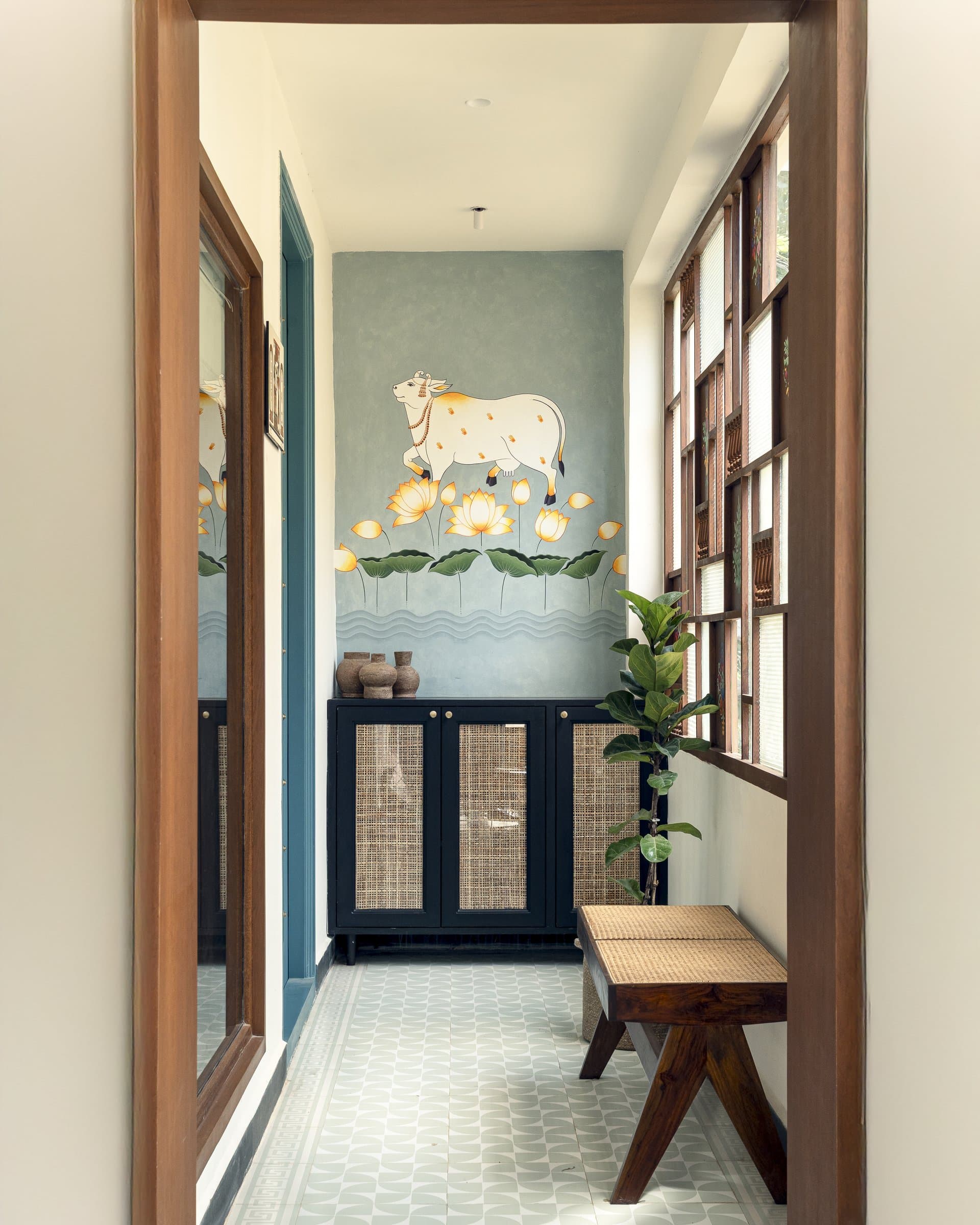
The foyer announces the home’s grammar before a single room reveals itself. A hand-painted Pichwai mural, the sacred cow stepping through a pond of lotuses, occupies a soft slate-blue wall, anchored below by a black cabinet with cane-fronted doors and a low Pierre Jeanneret-style stool in teak. Geometric cement tiles ground the floor in old-world Madras tradition, while the timber-and-glass jaali along one side filters daylight into the passage.
It is an opening that does what good thresholds do, slowing the body and resetting attention. The Pichwai is not a decorative gesture but a statement of intent: the home will speak in a regional dialect, and it will do so quietly.
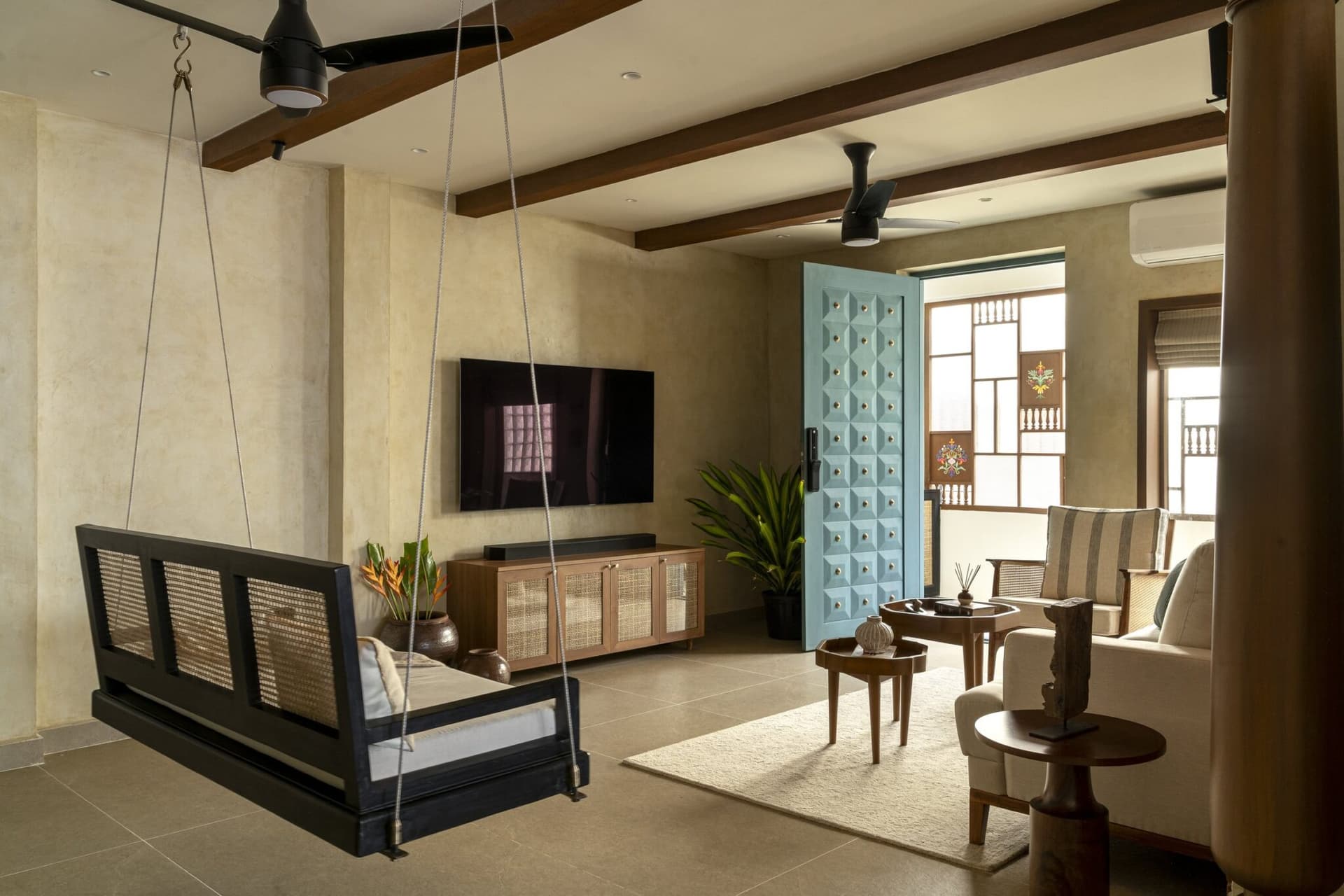
Beyond the foyer, the living room opens around its most striking object, a custom black swing with cane-panelled sides, suspended from exposed wooden rafters. Lime-washed walls in a pale ochre absorb the light without reflecting it back, lending the room the unhurried atmosphere of a courtyard verandah translated indoors.
The blue door visible at the back of the living room is the home’s exterior threshold, an ornate panelled piece with brass studwork that the studio describes as the grand first impression. Seen from inside, it reads almost as a sculptural object, the only piece of saturated colour in a room otherwise composed of earth and shadow.
““Their main criteria was to come back home to a calm and cozy space which could let them unwind after a long day.””
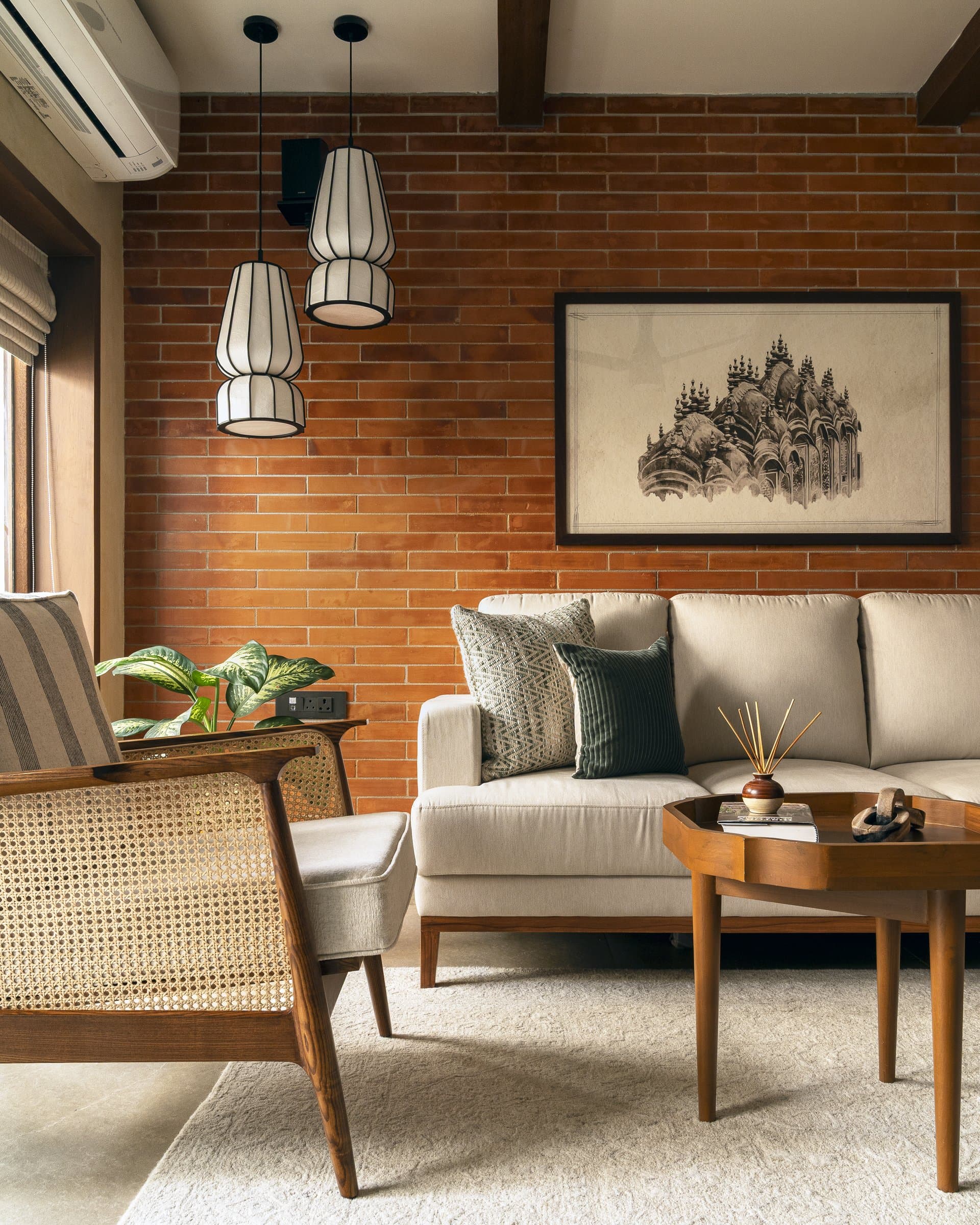
The seating arrangement gathers around a brick-clad accent wall sourced from Nuvocotto, its warm tonality carrying the weight of the room. A linen sofa in oatmeal sits beside a cane-and-teak armchair, while two slim fabric pendants in vertical stripes hang in a loose cluster, their proportions deliberately undersized so they punctuate rather than dominate.
Above the sofa, a monochrome architectural print of temple shikharas operates as the room’s intellectual anchor, a quiet acknowledgement of the heritage just outside the apartment’s walls. The brick is not styling. It is the room’s structural argument.
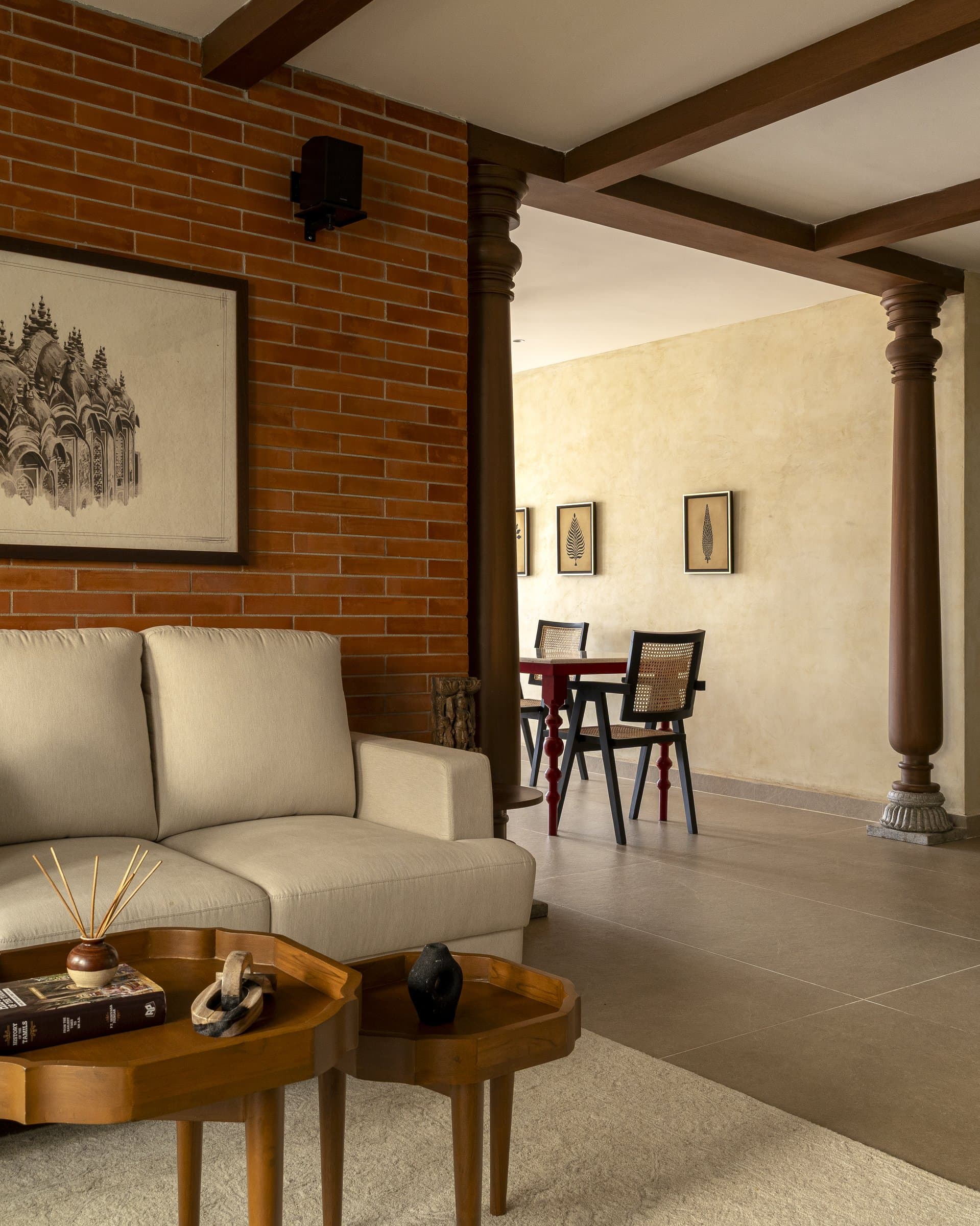
Two solid wood columns with carved stone bases mark the threshold between living and dining, a gesture lifted directly from the traditional Tamil home and reset here without irony. The dark exposed beams overhead extend the architectural language of the older South Indian house, where structure was always visible and always honoured.
What works is the proportion. The columns are full-scale, not decorative miniatures, and they earn their presence by genuinely framing the spatial transition rather than performing it.
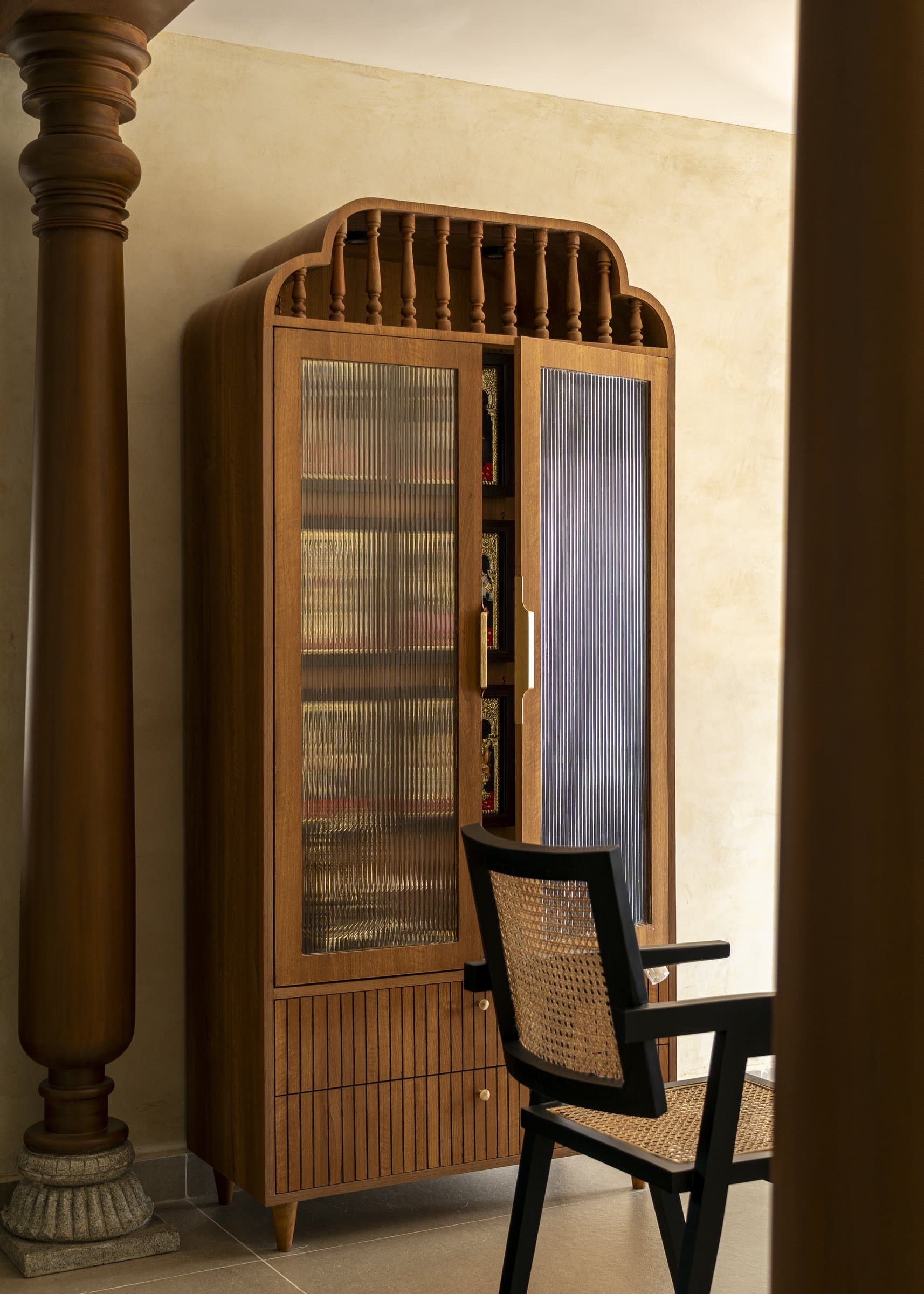
Tucked against the dining wall, a bespoke pooja cabinet in honeyed teak rises with a softly arched profile and a row of turned wooden balusters along its crown. Reeded glass doors filter glimpses of the deities and brass within, a contemporary update on the traditional puja almirah.
The cabinet is one of the project’s most accomplished pieces of joinery, marrying the silhouette of an older almirah with proportions calibrated for an apartment ceiling. It does the work of devotion without demanding a separate room for it.
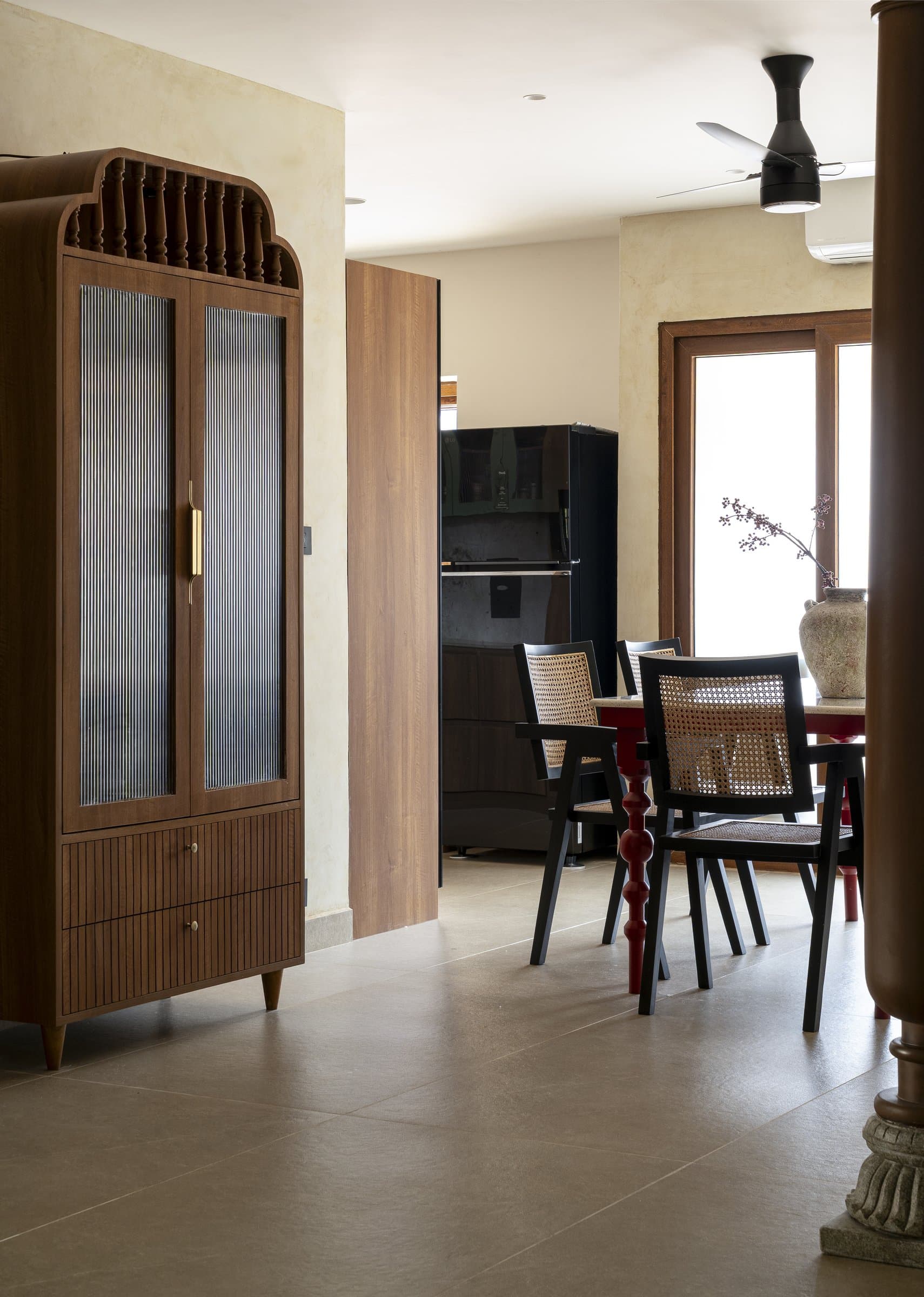
The dining area sits in the warm wash of lime plaster, the same ochre that flows through the public zones, with the kitchen’s dark cabinetry visible just beyond. Black cane-back chairs in the Chandigarh idiom surround a slim table whose carved legs are lacquered in a deep scarlet duco, the home’s single most theatrical decision.
The red is not loud so much as confident. It carries the visual weight of traditional temple woodwork, the kind painted in vermilion and black, but stripped of literalism.
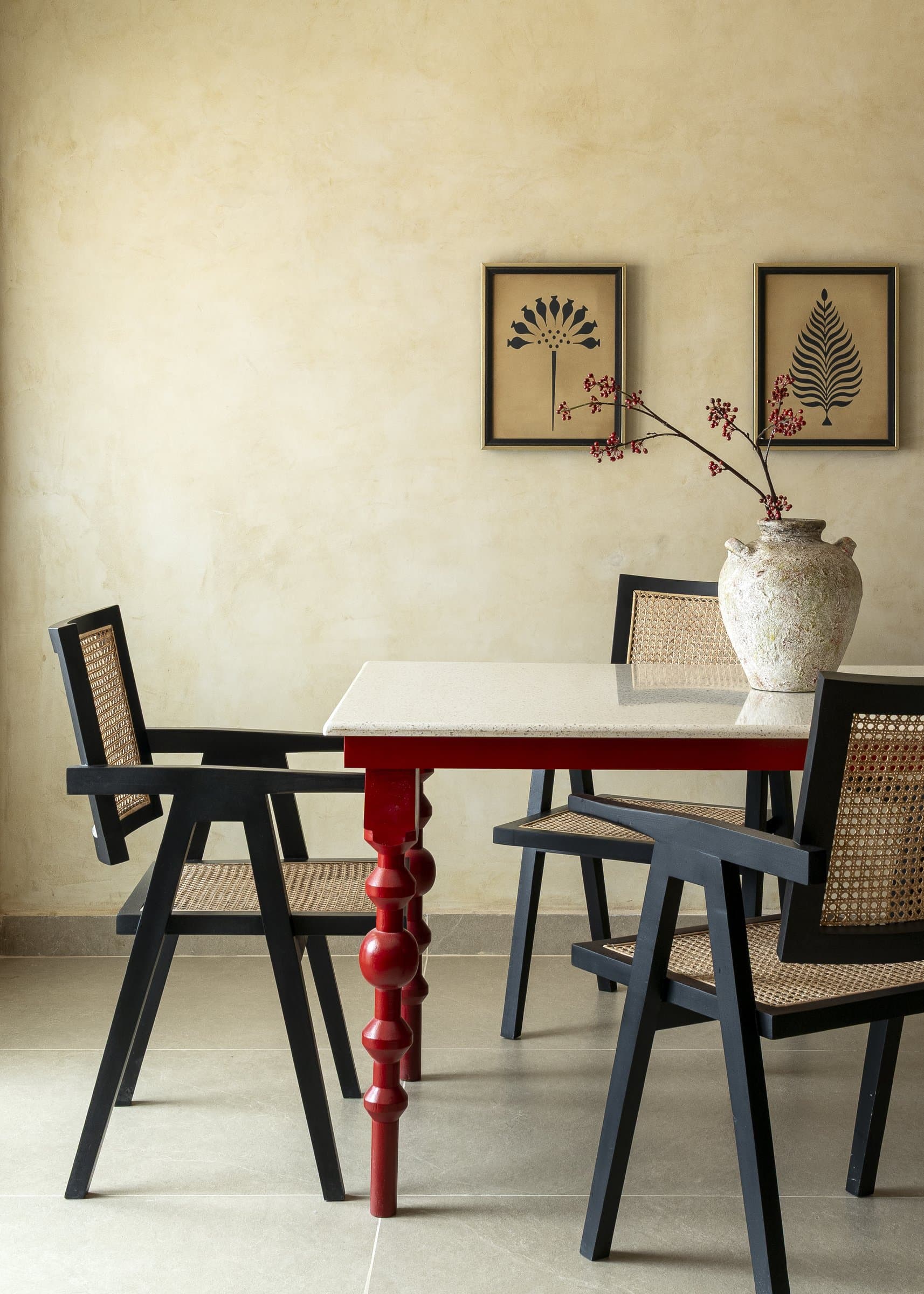
Seen closer, the dining table reads as the studio’s clearest articulation of its thesis: a turned, almost balustrade-like leg in scarlet, paired with a pale terrazzo top and a weathered terracotta urn holding a sprig of red berries. Two small framed botanical prints in black-on-cream complete the wall.
This is where the brief, a blend of rustic and traditional Indian interiors, finds its sharpest expression. Tradition supplies the silhouette; restraint supplies the modernity.
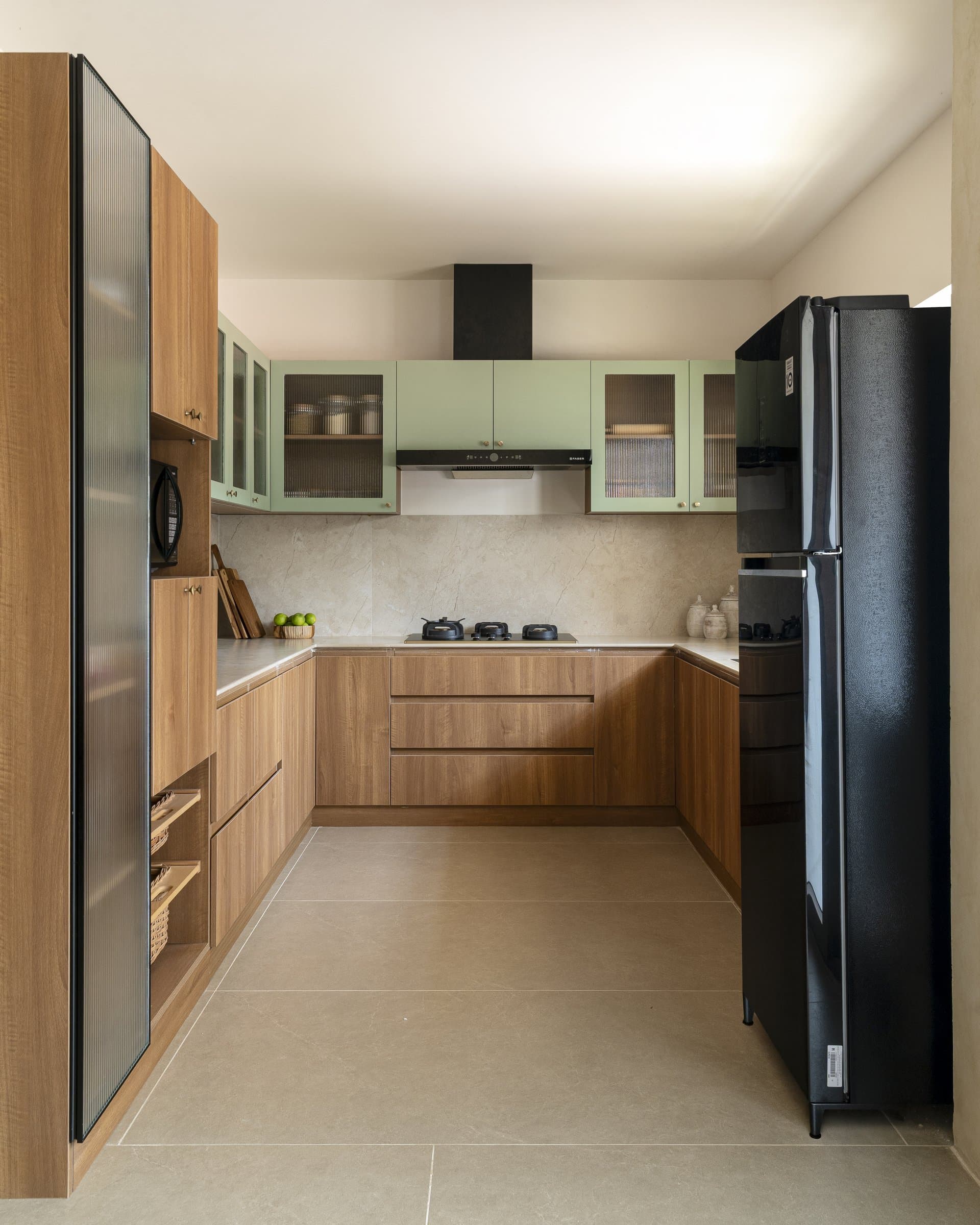
The kitchen retreats from the home’s expressive register and chooses instead to be quietly functional. Sage-green upper cabinets with reeded glass inserts sit above wood-grain lowers, with a marble-look backsplash carrying the eye between them.
It is a working kitchen for two people who will not always have the energy to perform their home, and the design respects that. Calm, contained, and easy on the body at the end of a long courtroom day.
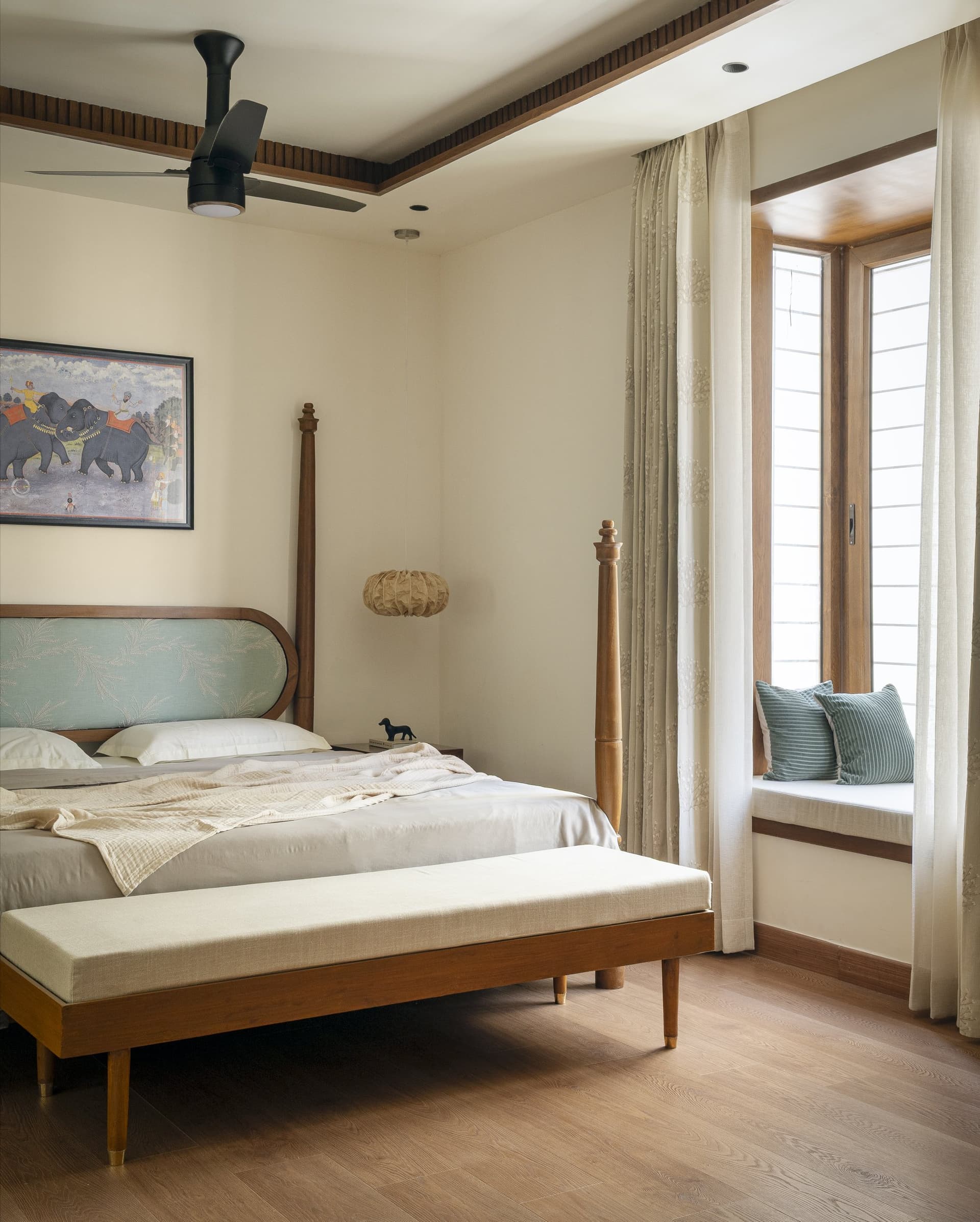
The master bedroom shifts the palette into something gentler. A four-poster bed in warm wood, its turned posts referencing the same tradition as the living room columns, anchors the room with a headboard upholstered in a soft sage-and-ivory botanical print. A Mughal-style miniature painting of elephants hangs alongside.
The bay window seat is the room’s quiet luxury, a built-in bench with sheer drapery and a pair of striped sea-glass cushions that catch the light all morning. Wooden flooring underfoot completes the warmth.
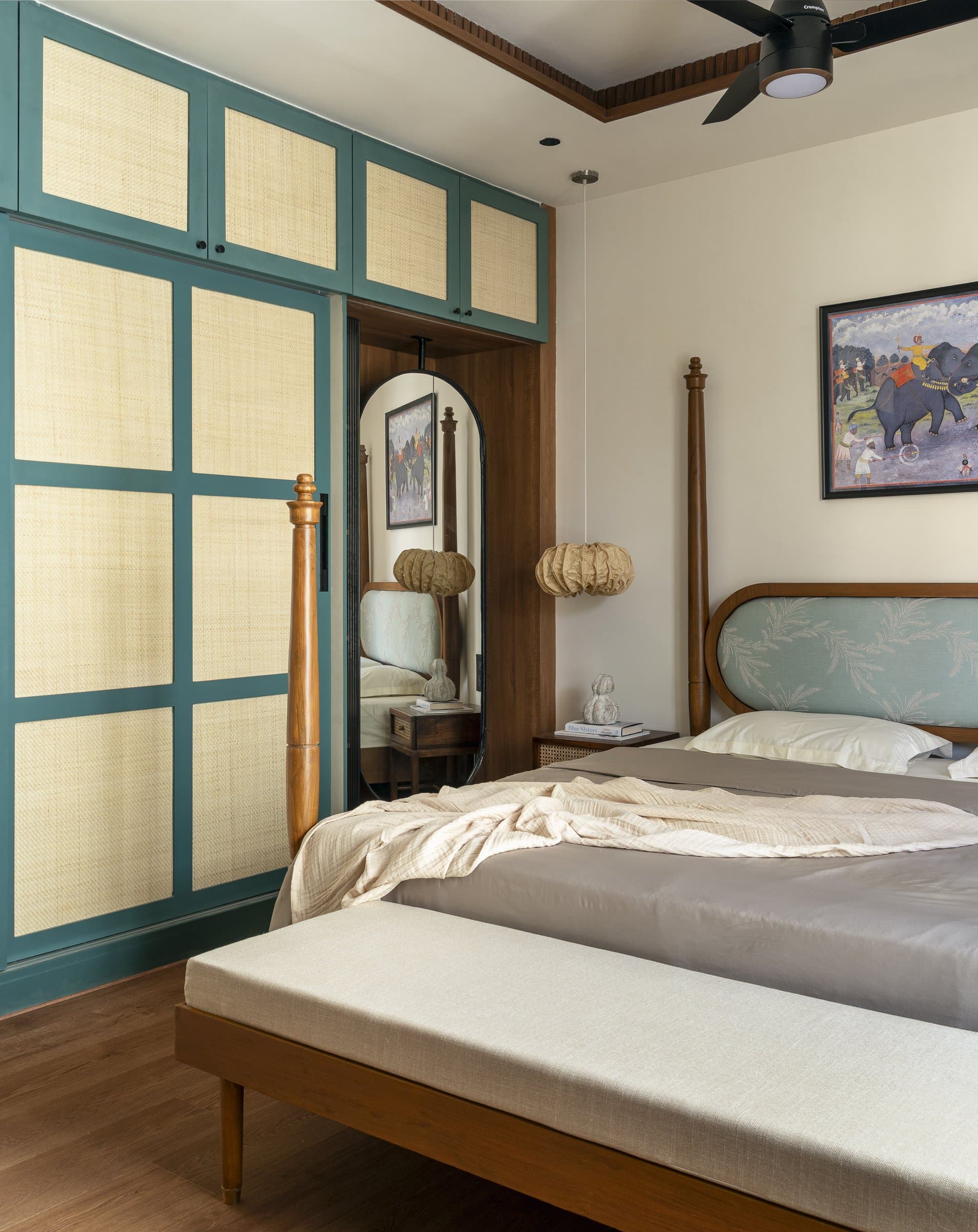
Opposite the bed, the wardrobe carries the room’s strongest colour decision: bluish-green frames around panels of woven rattan, a contemporary refit of the cane-fronted almirahs once common in old Madras homes. A floor-length arched mirror is set into the wardrobe’s joinery, framed in the same wood as the bed posts.
The detail that makes the room is restraint at the ceiling, where a fluted wood border traces the false ceiling’s perimeter, a louvred trim that does the work of a cornice without the formality of one.
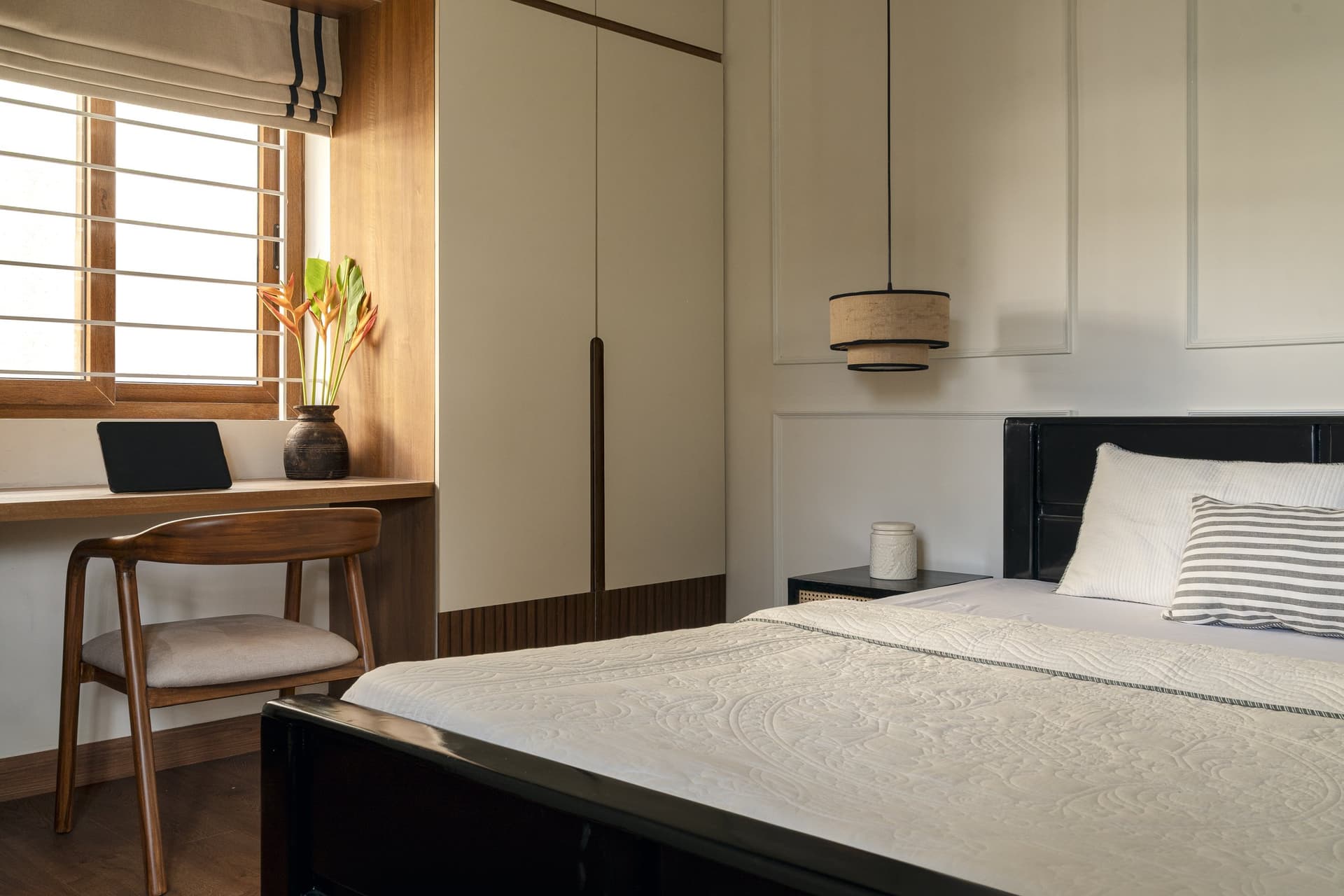
The guest bedroom takes a quieter, more contemporary line. The bed, repurposed and finished in a sleek black stain, sits against a wainscoted wall in chalk white, with a jute-and-rattan pendant dropping low beside it. A built-in study nook, with its desk slotted into a niche framed in warm wood, breaks the long run of beige wardrobes.
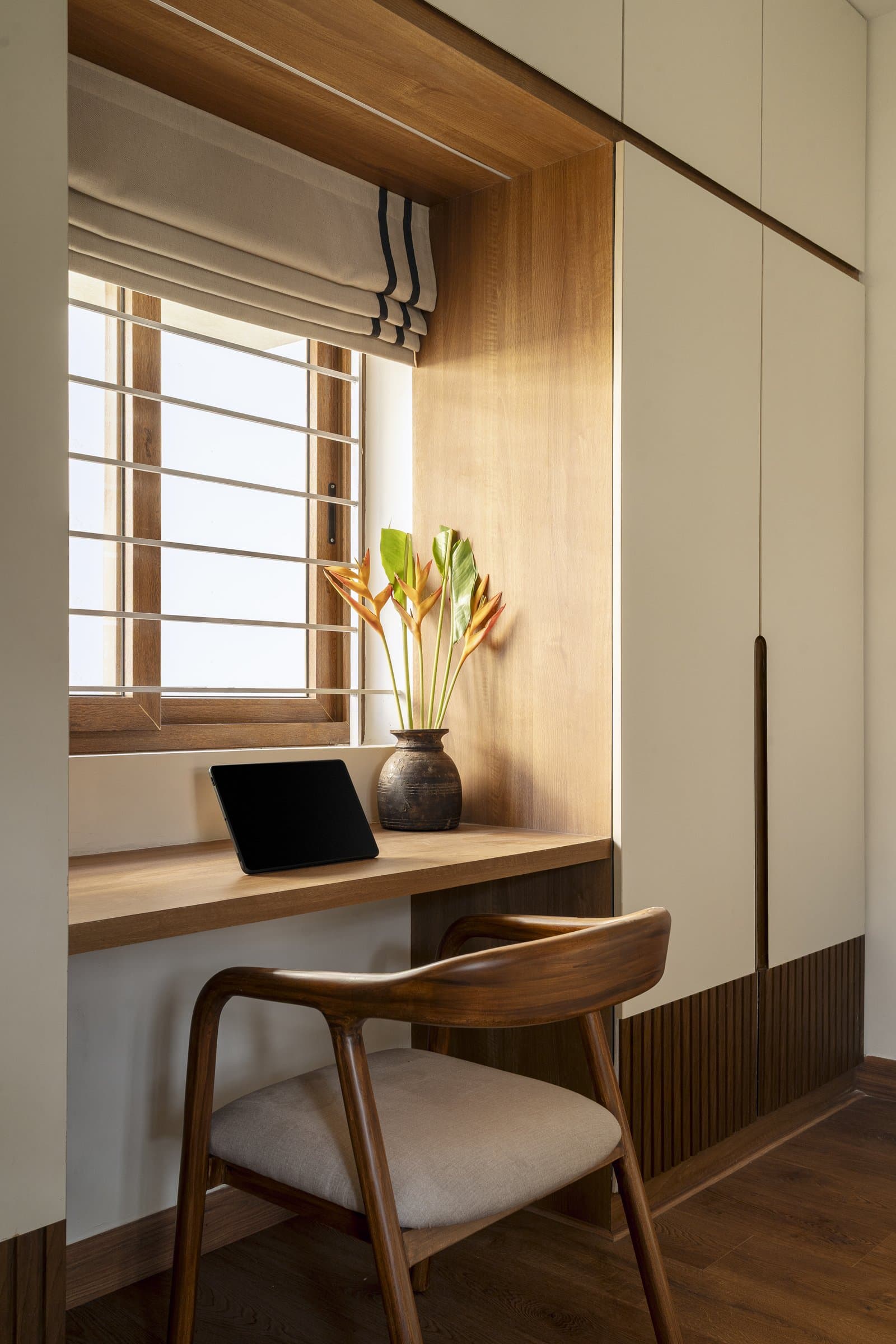
That study nook is one of the project’s most efficient design moves. The desk is cantilevered into a wood-lined alcove beneath the window, with a Roman blind in striped linen above and a sculptor’s chair pulled up to it. The wardrobe panels alongside, finished in a putty cream with a slim fluted-wood plinth at their base, recede so completely that the niche reads as a small, self-contained study within the bedroom.
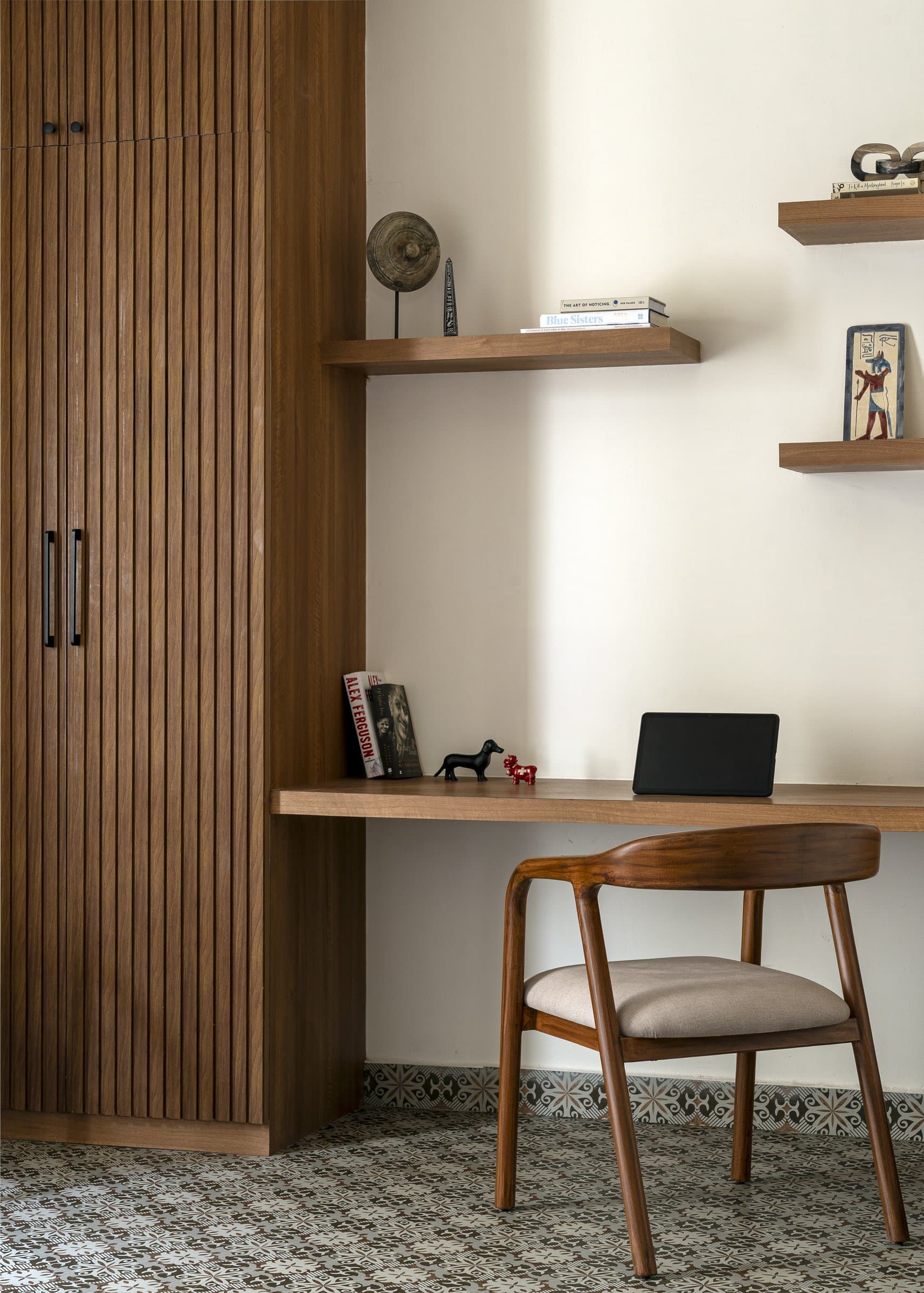
The dedicated study takes the home’s old-world register and concentrates it. Geometric cement tiles return underfoot, this time in a denser pattern of greens and creams, lending the floor the immediate atmosphere of a heritage Madras flat. Floating wood shelves run along one wall, while a fluted wardrobe in warm wood-grain meets the desk at a clean right angle.
It is an unfussy room that takes its character from the floor, the way many Mylapore houses still do.
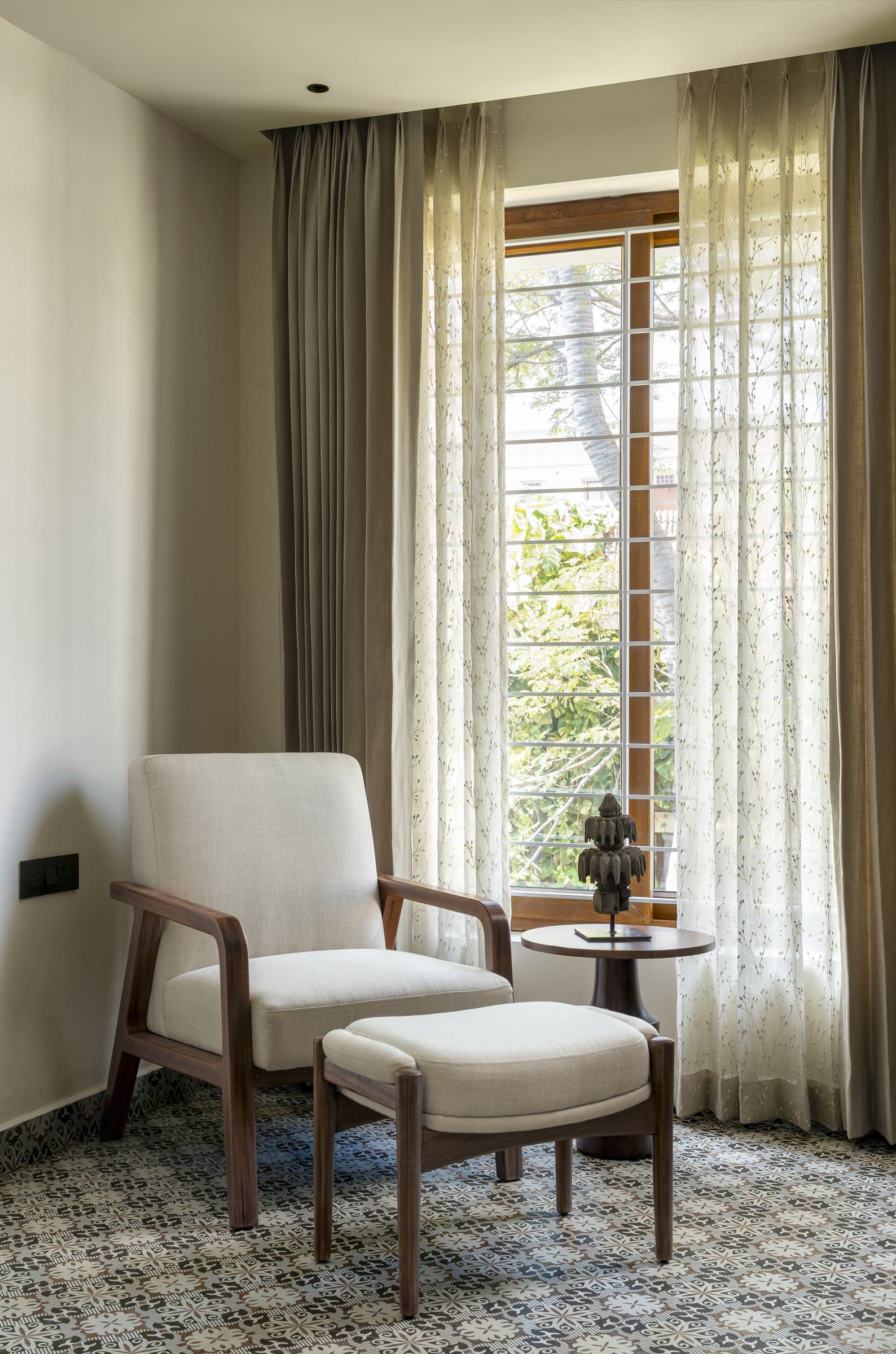
By the study’s window, a lounge chair and ottoman in pale linen sit beside a small round side table in dark wood, framed by sheer printed drapery and a heavier curtain in dust grey. The cement-tile floor extends underneath, lending even this small reading corner the gravitas of an older home.
This is where the couple’s brief, a place to come back to, finds its most literal answer.
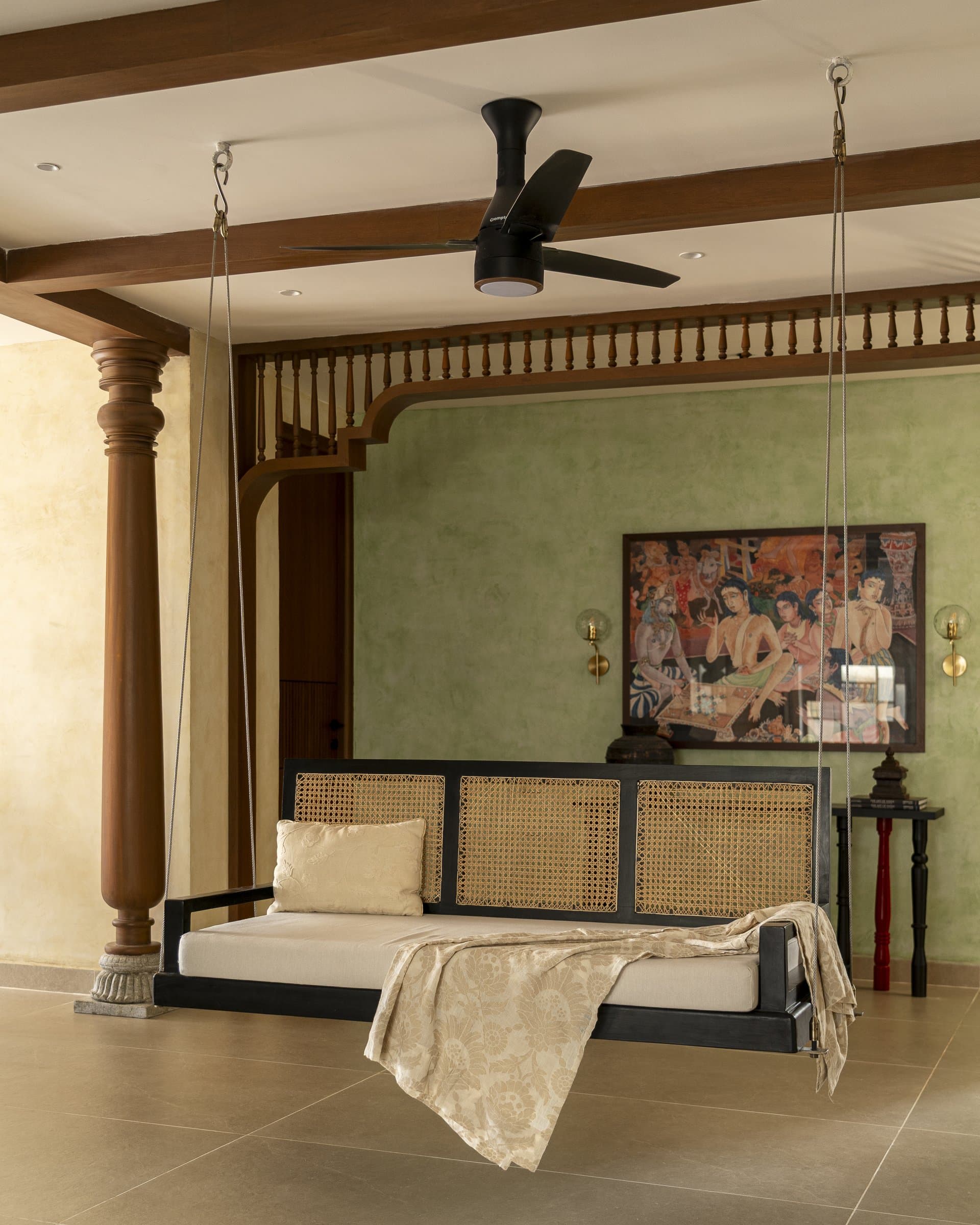
The home’s most cinematic moment is reserved for a second swing, set against a wall washed in mossy green plaster with a Tanjore-inspired figurative painting hung above a small console. A turned wooden column with a stone base flanks the swing, while a carved baluster valance crowns the alcove behind it.
The swing, or oonjal, is a fixture of the South Indian home, traditionally placed where guests are received and conversations linger. Here it is no longer a relic but a working piece of furniture, the room arranged around its slow rhythm.
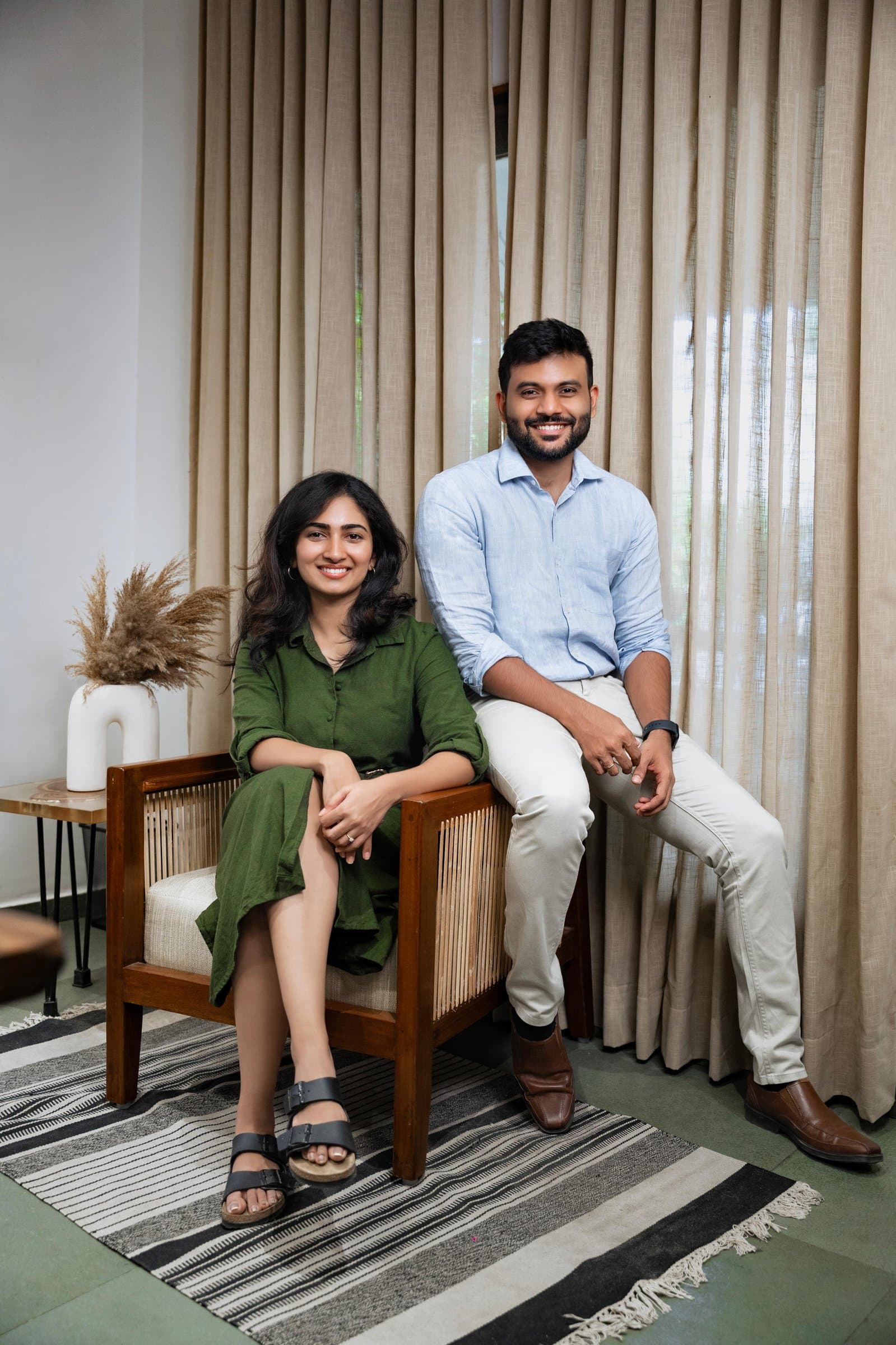
Aram arrives at a moment when Chennai’s residential design is increasingly torn between two extremes: the heavy traditionalism of older homes and the flat internationalism of new construction. Studio One By Zero has refused both. What they have built instead is a home that takes its cultural inheritance seriously enough to translate, not transcribe.
The result is a project that earns its title. Aram, the Tamil word for virtue and ethical living, sits well on a home that asks its occupants only to slow down, and gives them the architecture to do so.