There is a particular discipline required when the landscape is this generous. At the banks of Pawna Dam, where the Sahyadri range meets still water and the silhouettes of Tung and Tikona forts shift with the hour, the temptation is to let the view do all the work. The more interesting architectural question, and the one that Story of Walls Design Studio chose to answer with The Magnolia, is what happens when a house decides not merely to frame its setting but to internalise it, to bring the logic of water, earth, and flowering trees into the very grammar of its rooms.
Situated in Thakursai village near Lonavala, Maharashtra, this 4,500-square-foot weekend villa was designed for a private family seeking a counterpoint to the pace of city life. The structure is built entirely in steel rather than conventional RCC, a decision that grants the interiors a lightness and openness that concrete rarely permits. Every room across both storeys is oriented toward the reservoir, and the lake-facing facade dissolves into large sliding glass panels. The architecture, interiors, landscape, and construction were all managed by the same studio, a continuity of vision that shows.
The living room is where the design argument becomes most legible. An inlay of glossy white tiles traces a sinuous, stream-like form across the matte dark grey floor, and the precise shape of this pattern is echoed in a recessed cove-lit depression in the ceiling above. Floor and ceiling speak the same curvilinear language, turning the room into a spatial response to the water beyond the glass.
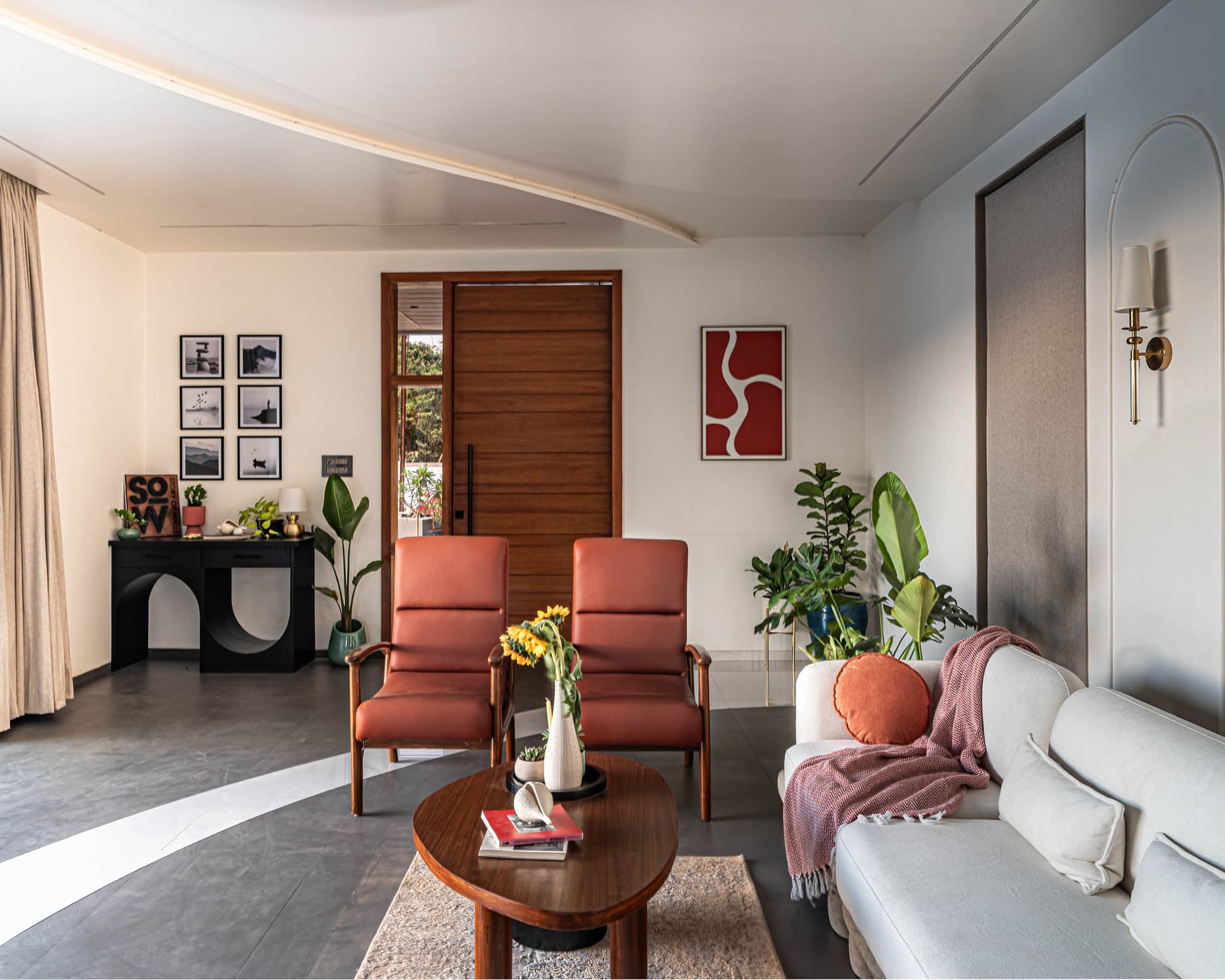
The furniture arrangement reinforces this idea of gentle flow rather than rigid formality. Terracotta-toned leather armchairs and a cream sofa are arranged around a central coffee table in a conversational grouping, and the arched wall moulding beside the seating area adds a soft architectural rhythm that prevents the white walls from reading as stark.
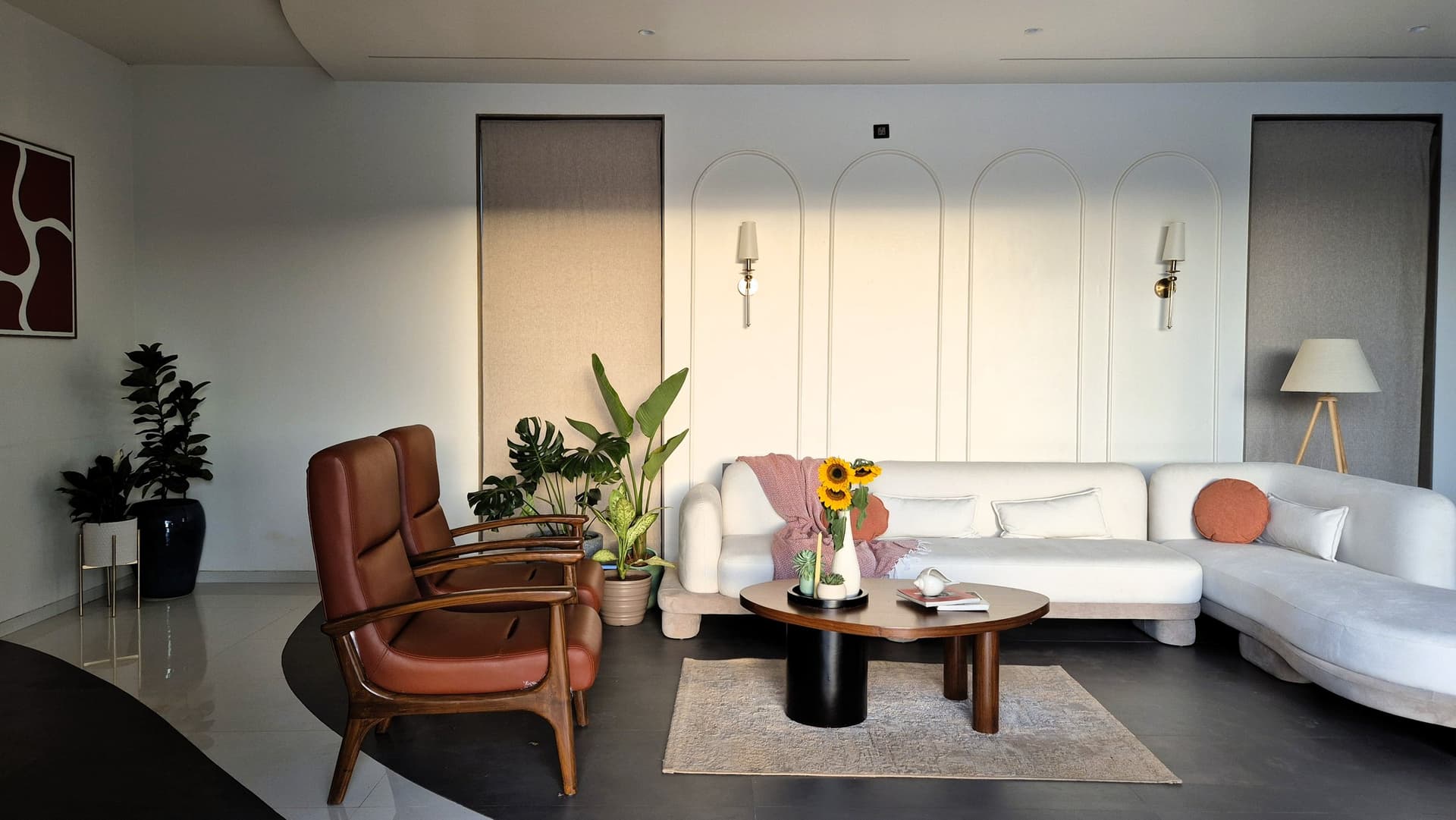
Seen from the opposite angle, the living room reveals its full proportions: a generous curved sectional sofa wraps the space, and the arched panelling behind it introduces a quiet classicism. Terracotta accents, drawn from the laterite hues of the Sahyadri, appear in the leather armchairs and a single round cushion as a deliberate colour strategy, grounding the white, wood, and dark-floored palette in its geography.
““The brief was uncomplicated in aspiration but demanding in execution: create a home where the family could truly exhale.””
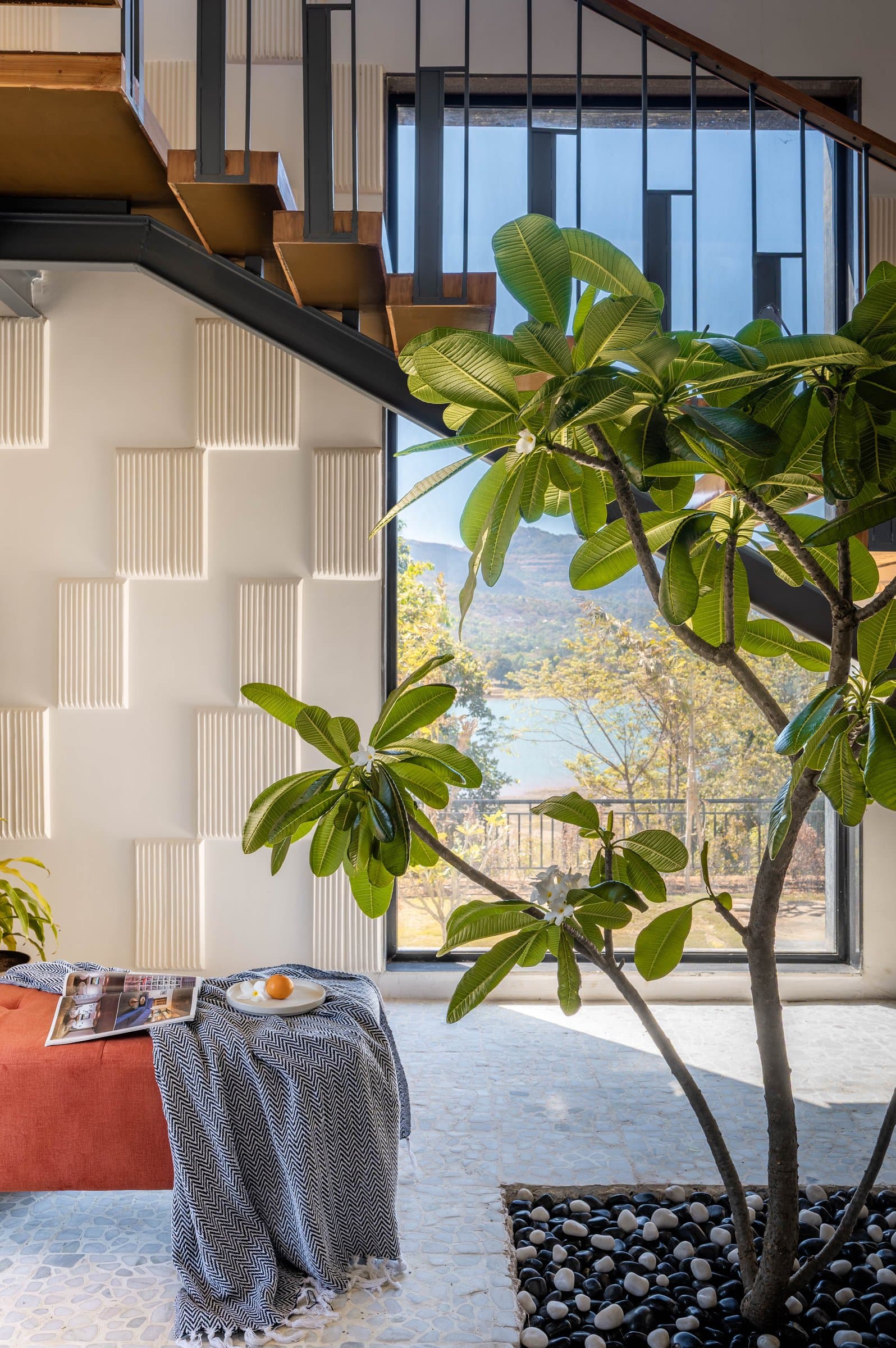
Perhaps the most compelling gesture in the villa is the plumeria tree growing inside the built volume, rooted in a bed of river pebbles beside the staircase. It is from this act of bringing the outside in, of making nature not a view but a co-inhabitant, that the project takes its name. The tree’s white blossoms carry the same spirit as the plumeria planted throughout the garden outside.
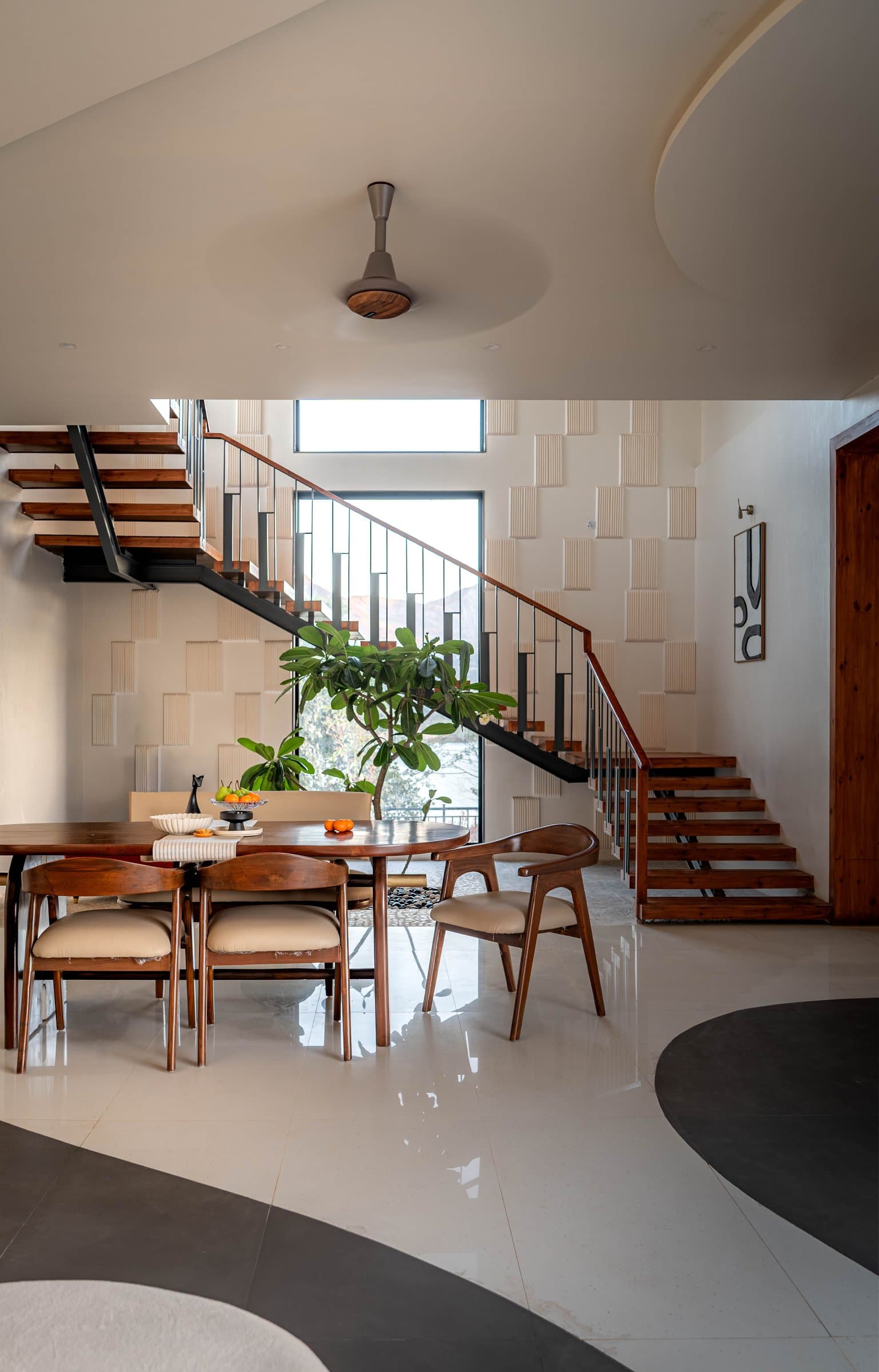
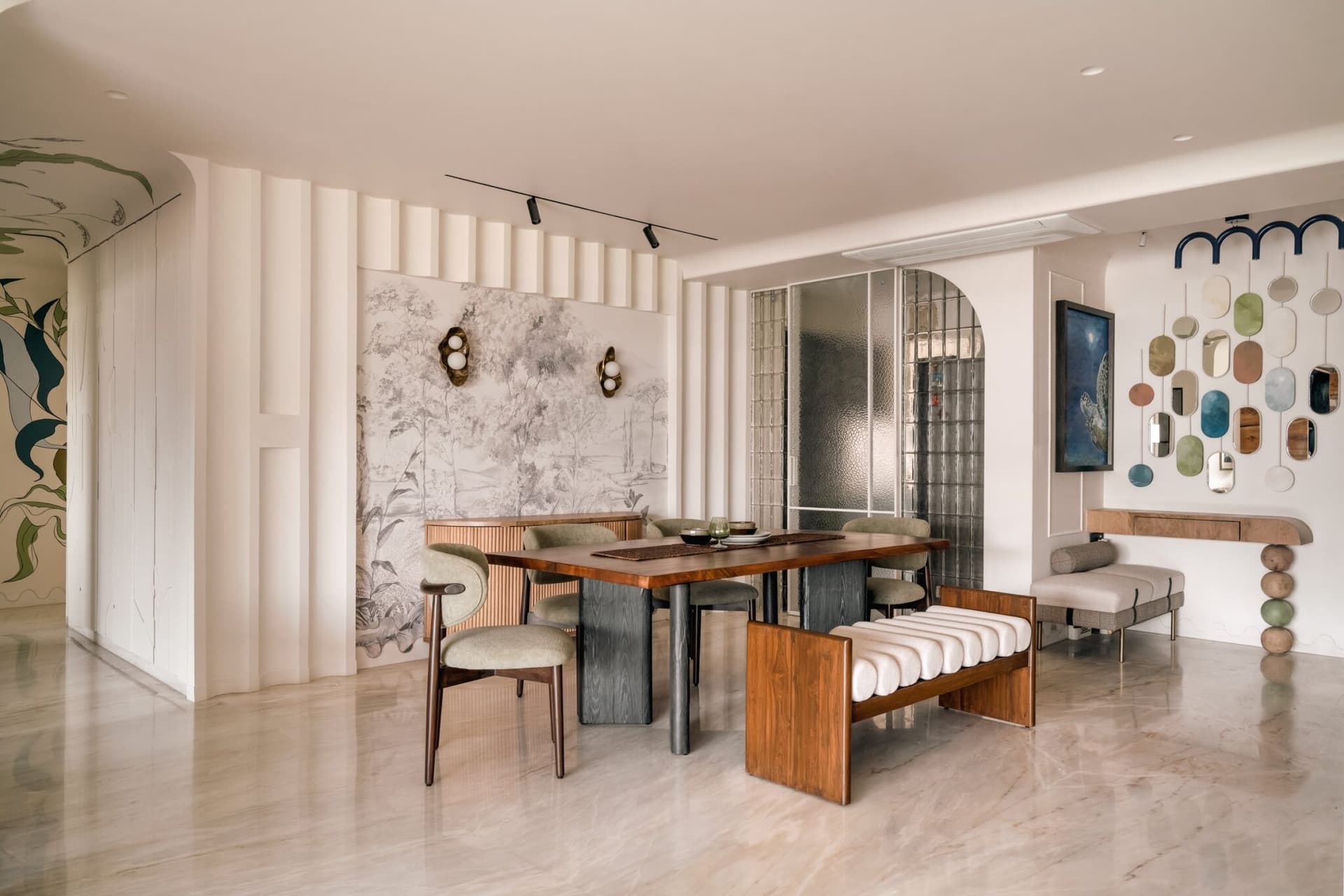
The dining area sits beneath the open stairwell, where a textured wall of rhythmic raised panels in cream provides a tactile counterpoint to the steel-and-timber staircase ascending beside it. Solid teak furniture anchors this zone, and the double-height glazing behind the stair landing floods the space with daylight filtered through the Sahyadri foothills.
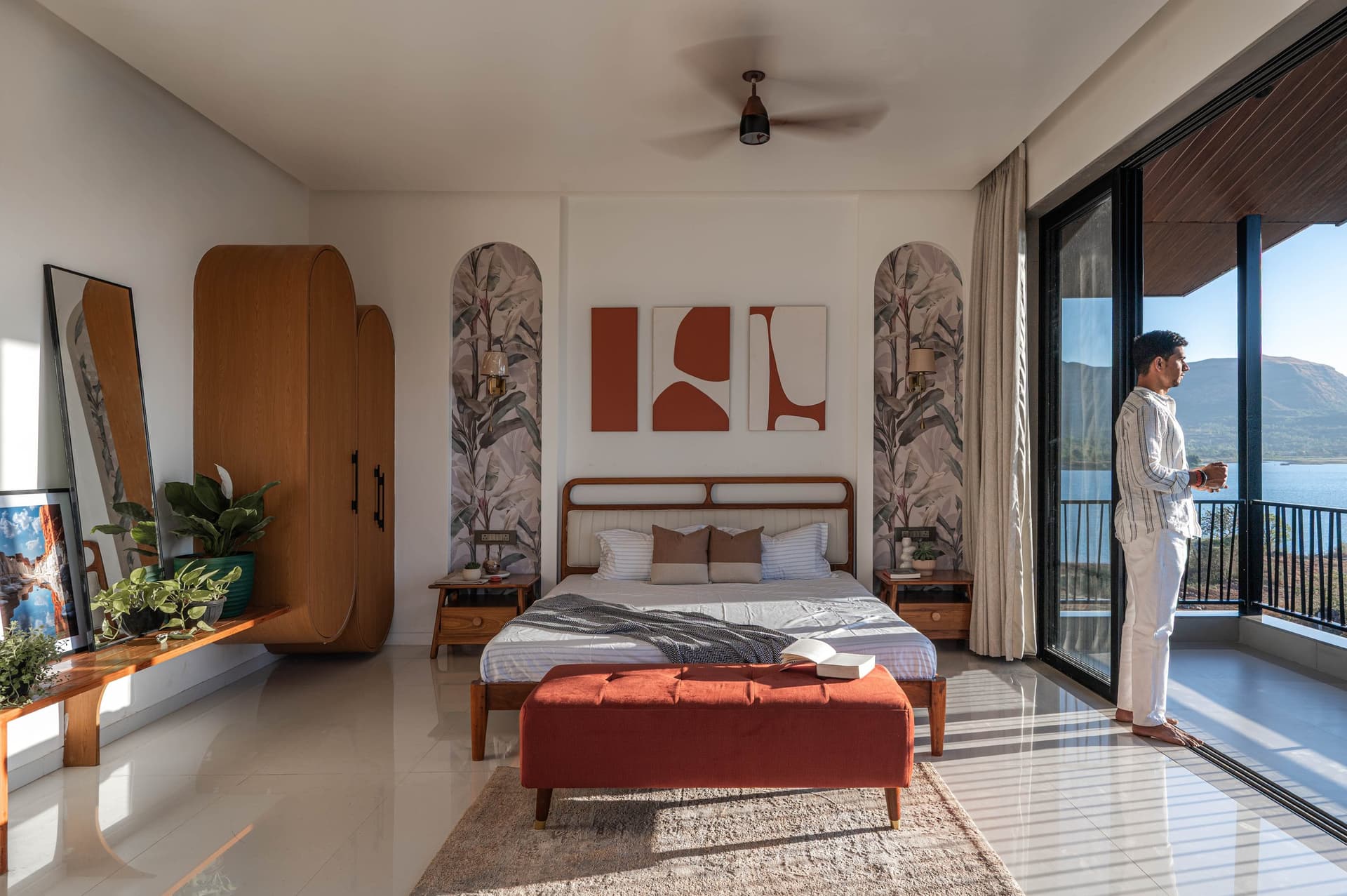
Upstairs, the master bedroom opens to lake views through floor-to-ceiling sliding glass doors leading to a balcony. Arched wallpaper niches flanking the bed introduce botanical motifs that echo the garden below, while a rust-upholstered bench at the foot of the bed continues the villa’s accent palette. The room is generous but unhurried, designed around the ritual of waking to water and mountain.
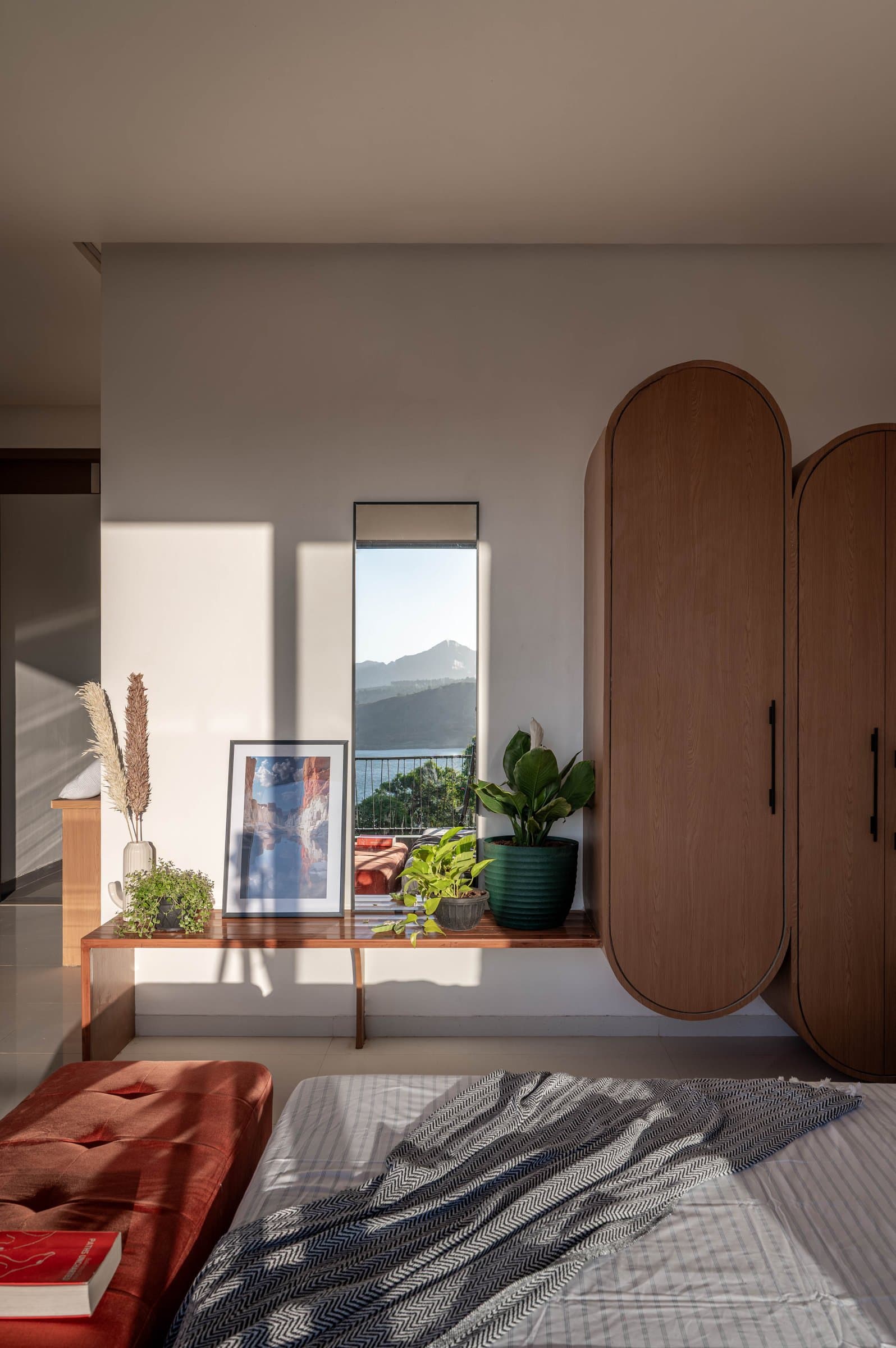
A detail from the master bedroom reveals the arched teak wardrobe and a low timber shelf set against a narrow vertical mirror that frames the distant mountains like a painting. Afternoon light enters at a steep angle here, drawing long shadows across the wall and floor and giving the room a quality of shifting, contemplative stillness.
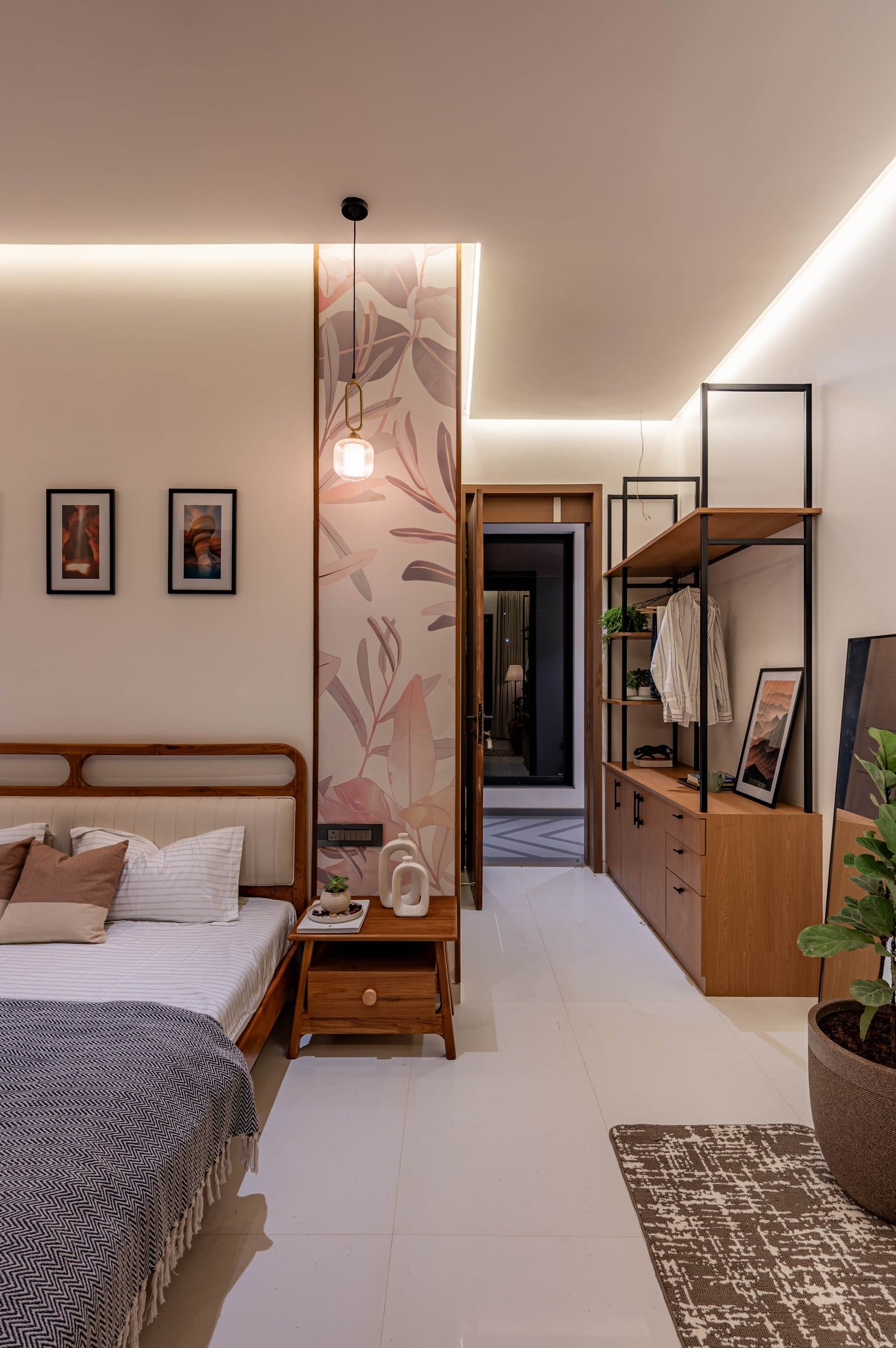
A second bedroom on the upper floor shifts to a softer register. A botanical-print accent wall divides the sleeping zone from an open wardrobe unit in steel and timber, and the cove lighting around the ceiling lends the room a warm, cocooning atmosphere. The palette moves from terracotta to blush, but the material logic of teak and white walls remains consistent.
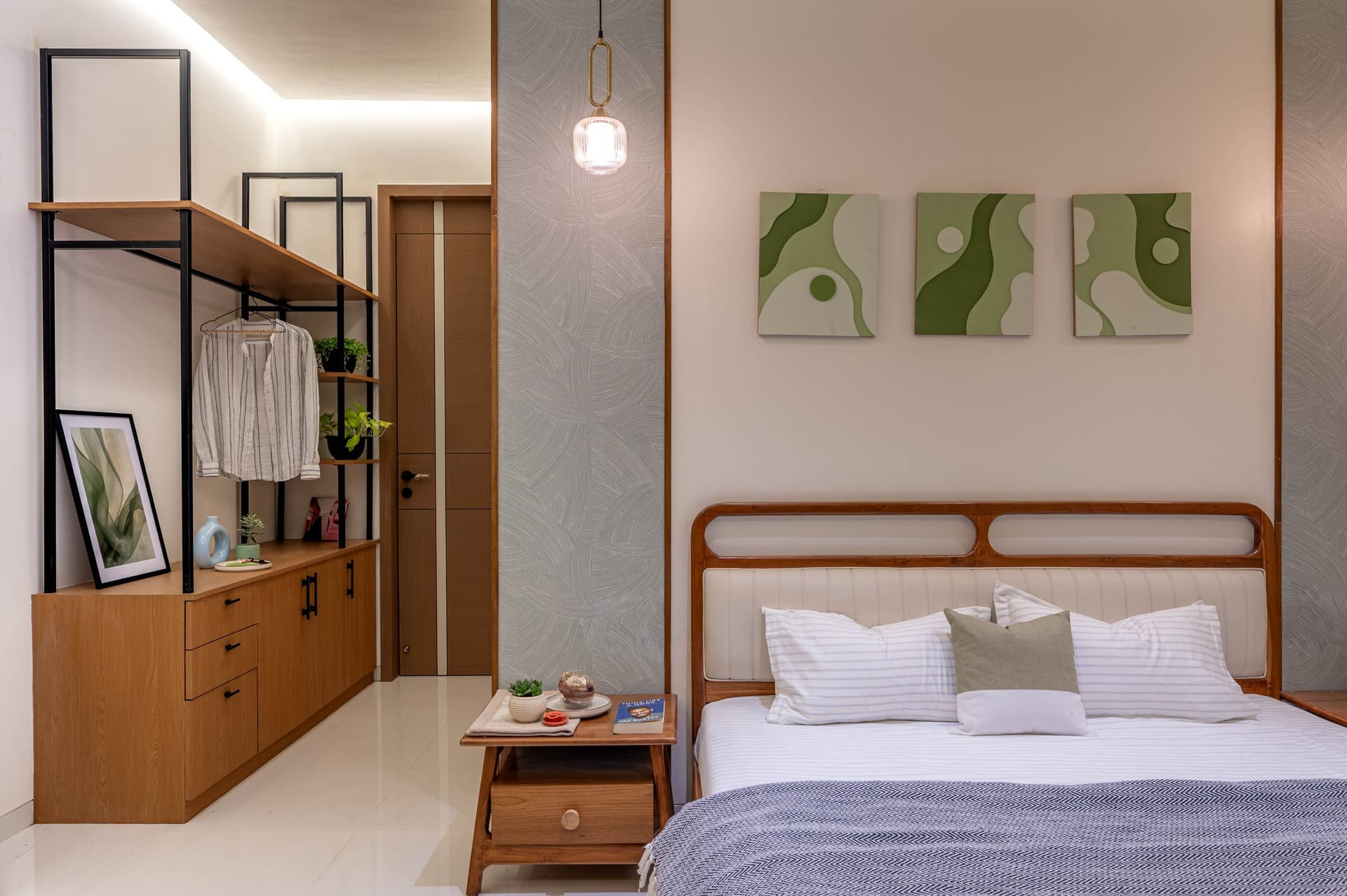
A third bedroom adopts muted green as its accent, visible in the art above the headboard and the throw pillows on the bed, while grey-toned textured wallpaper flanks the sleeping area. The open shelving unit reappears here in the same teak-and-black-steel vocabulary, lending continuity across the private rooms while allowing each to assert its own chromatic identity.
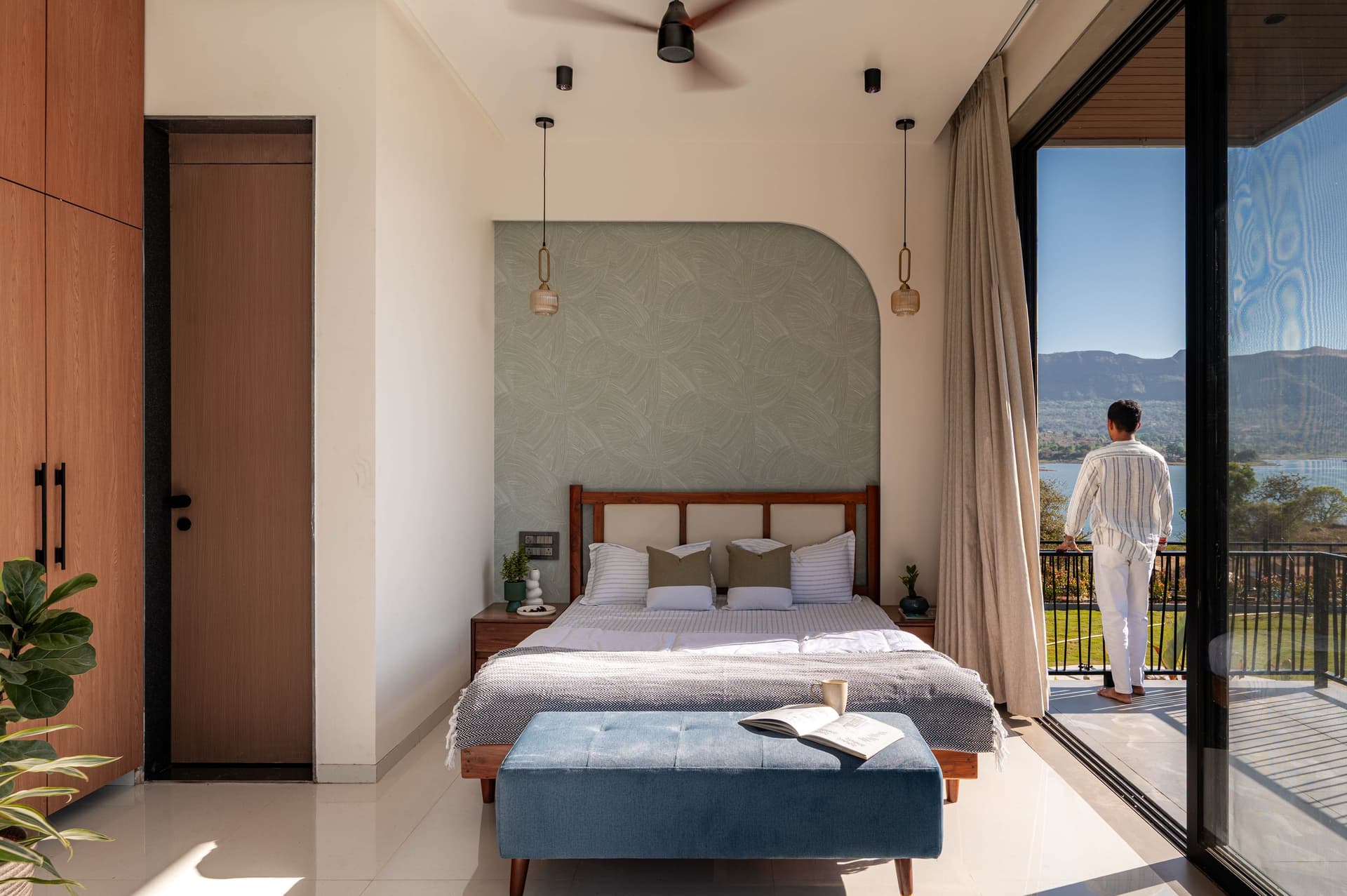
The final bedroom, distinguished by a sage-toned arched headboard panel and a blue bench, demonstrates the villa’s commitment to orienting every sleeping space toward the reservoir. Each bedroom reads as a variation on the same theme: warm timber, white walls, one considered colour accent, and large sliding glass doors opening to the Sahyadri.
This view underscores the point most emphatically. The sliding glass opens partially, bridging the boundary between bedroom and balcony, between the interior and the lake stretching to the hills beyond. The architecture is at its most articulate when it steps back and lets the landscape occupy the room.
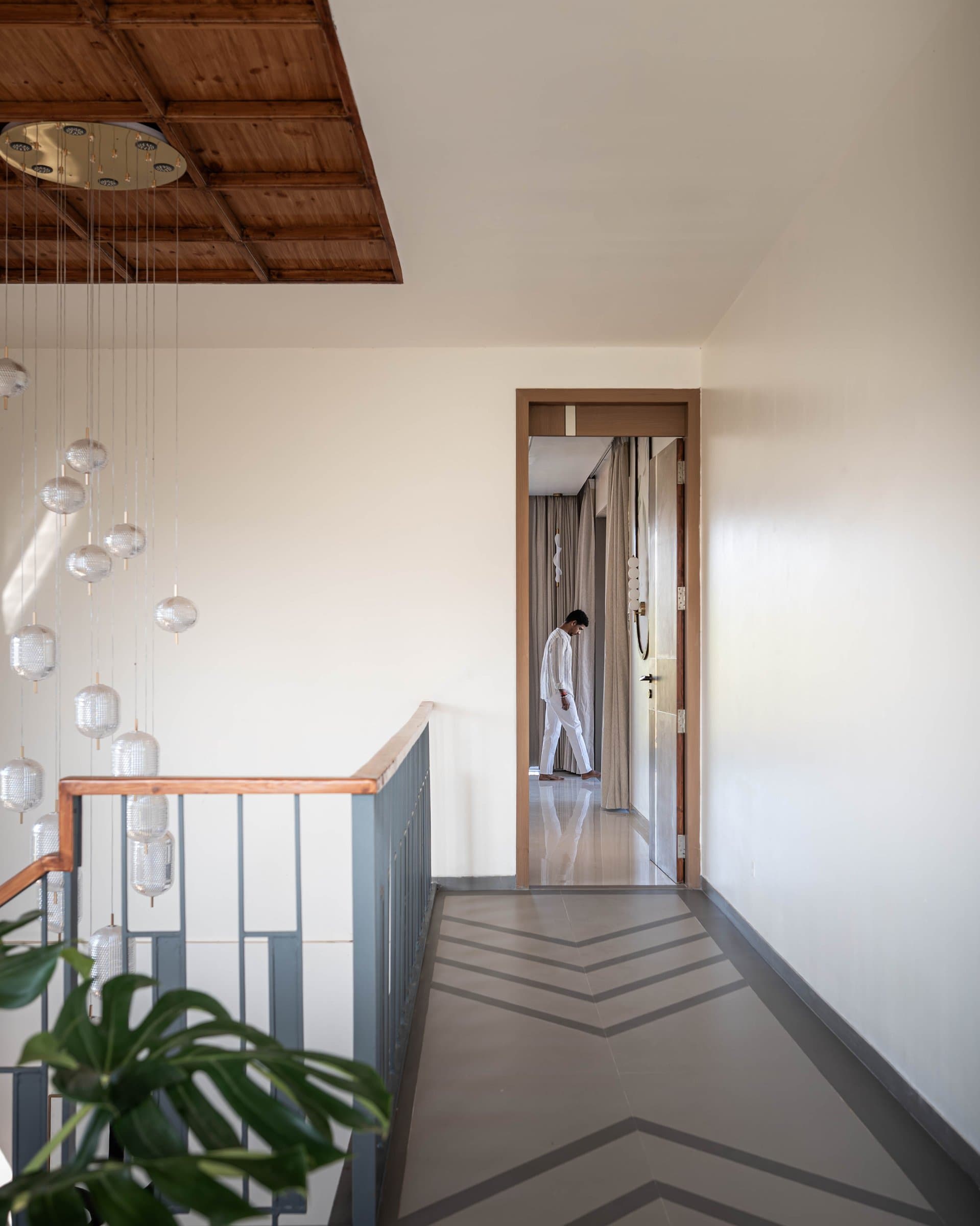
The upper-floor corridor is a spatial experience of its own, with chevron-patterned flooring in grey and white leading past a cascading glass-globe chandelier that drops through the double-height stairwell. An exposed timber-panelled ceiling over the stairwell adds warmth, while the corridor itself is capped by a plain white ceiling that keeps the passage light and airy.
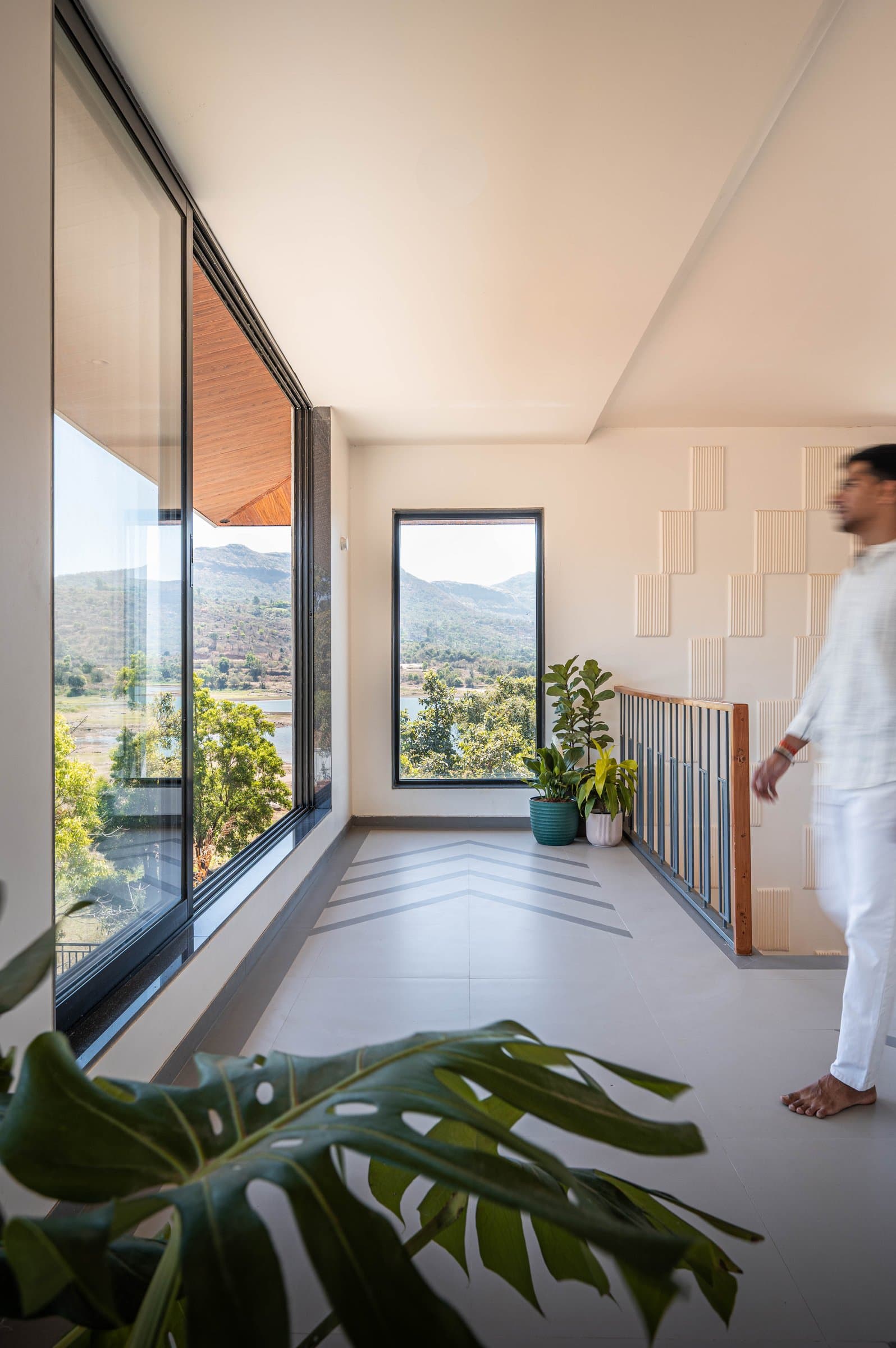
At the top of the stair, a landing opens to corner-meeting glazing that offers an uninterrupted panorama of the hills and reservoir. The textured wall panels visible throughout the villa reappear here, and the chevron floor pattern guides movement toward the bedrooms. It is a transitional space treated with the same spatial generosity as the rooms it connects.
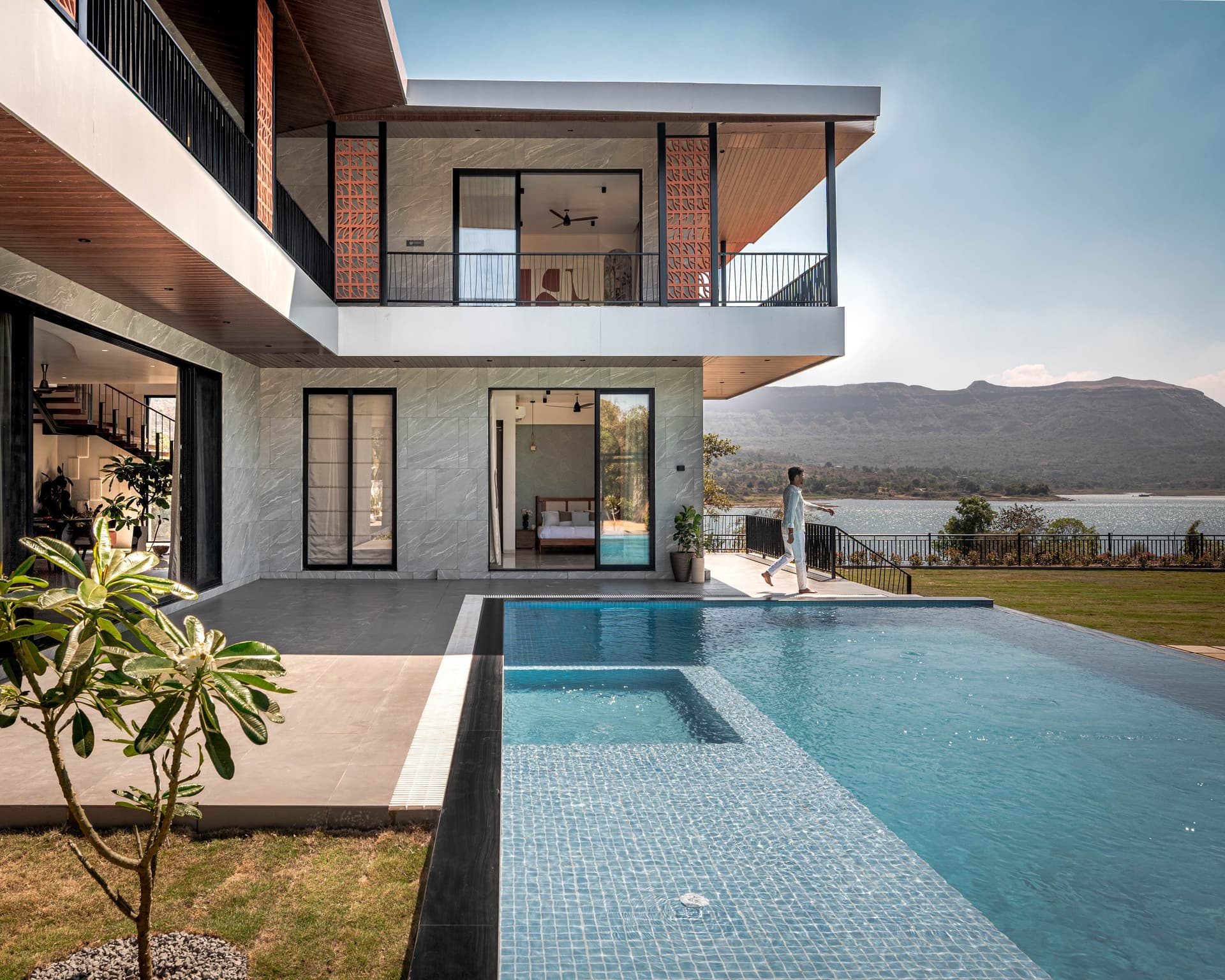
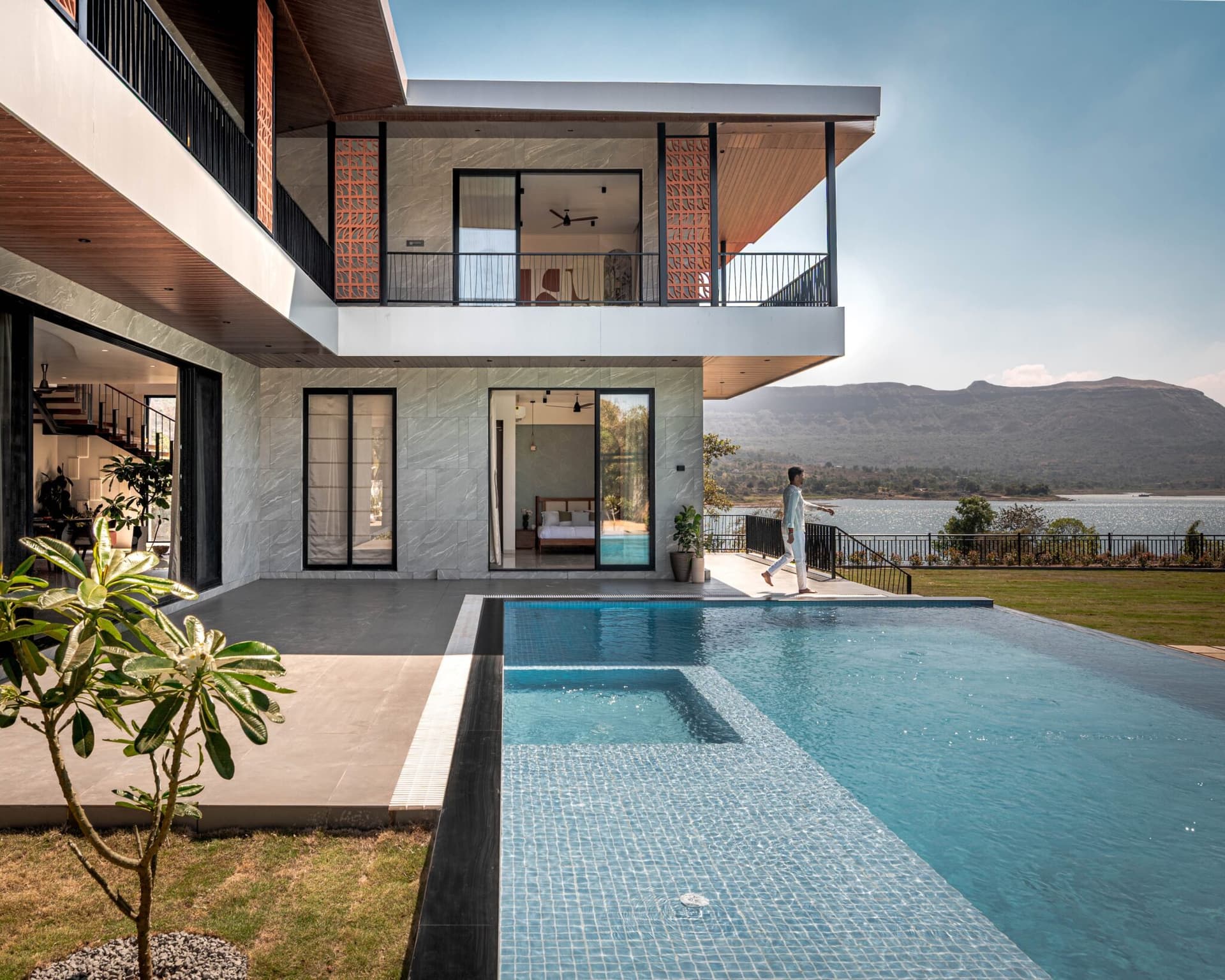
Viewed from the garden, the villa’s double-storey steel frame, stone-clad facade, and terracotta jaali screens become legible as a single architectural composition. The pool extends from the deck toward the reservoir, creating a secondary horizon line that completes the triptych of water, land, and sky. Plumeria trees punctuate the garden, their blossoms linking the cultivated landscape to the tree growing within.
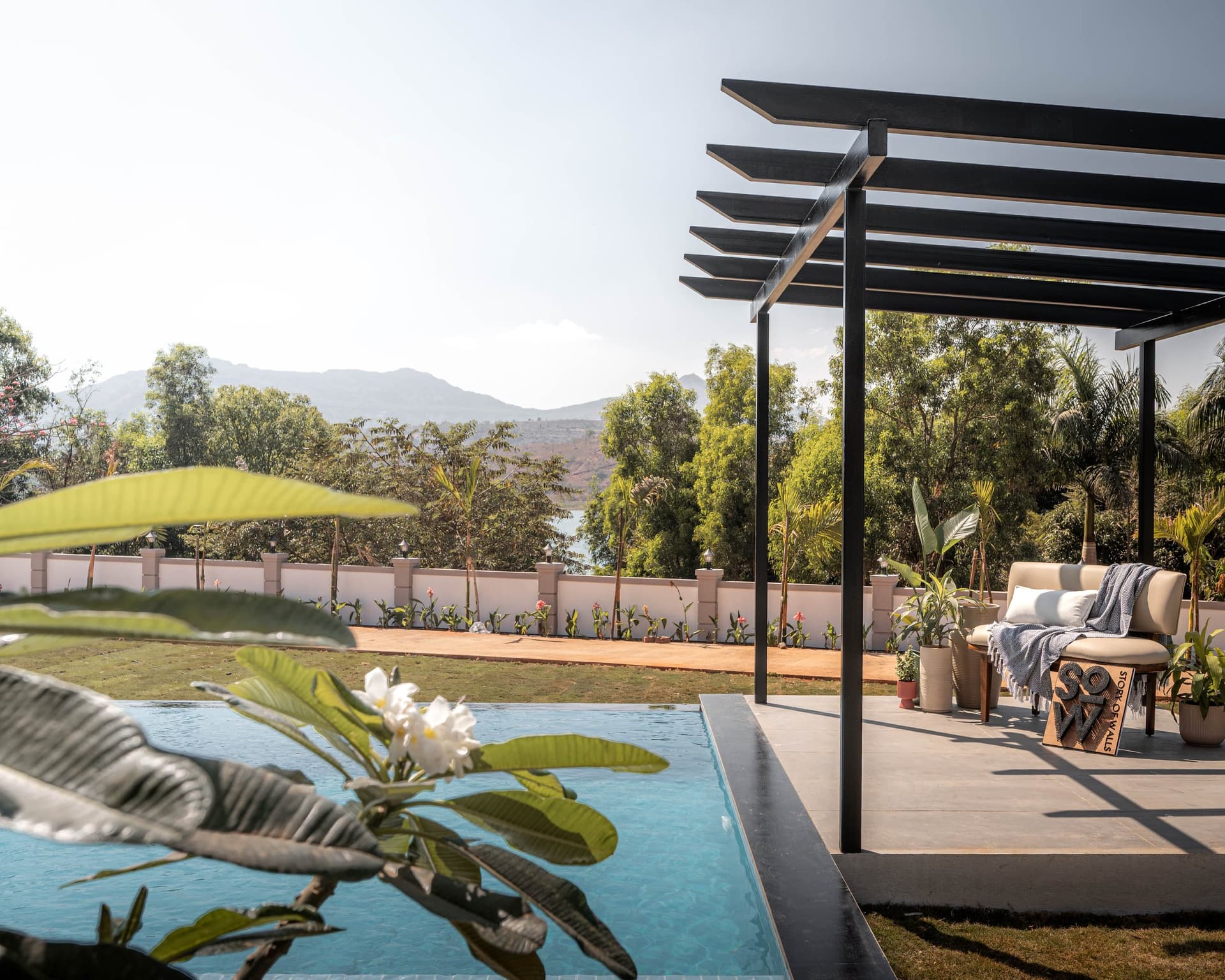
The poolside pergola, shaded by a steel pergola with open rafters, provides a threshold between the built and the natural. From here, the Sahyadri hills and the lake surface are visible through the garden’s tree canopy, and the plumeria blossoms at the pool’s edge carry the same fragrance as the tree inside the living room.
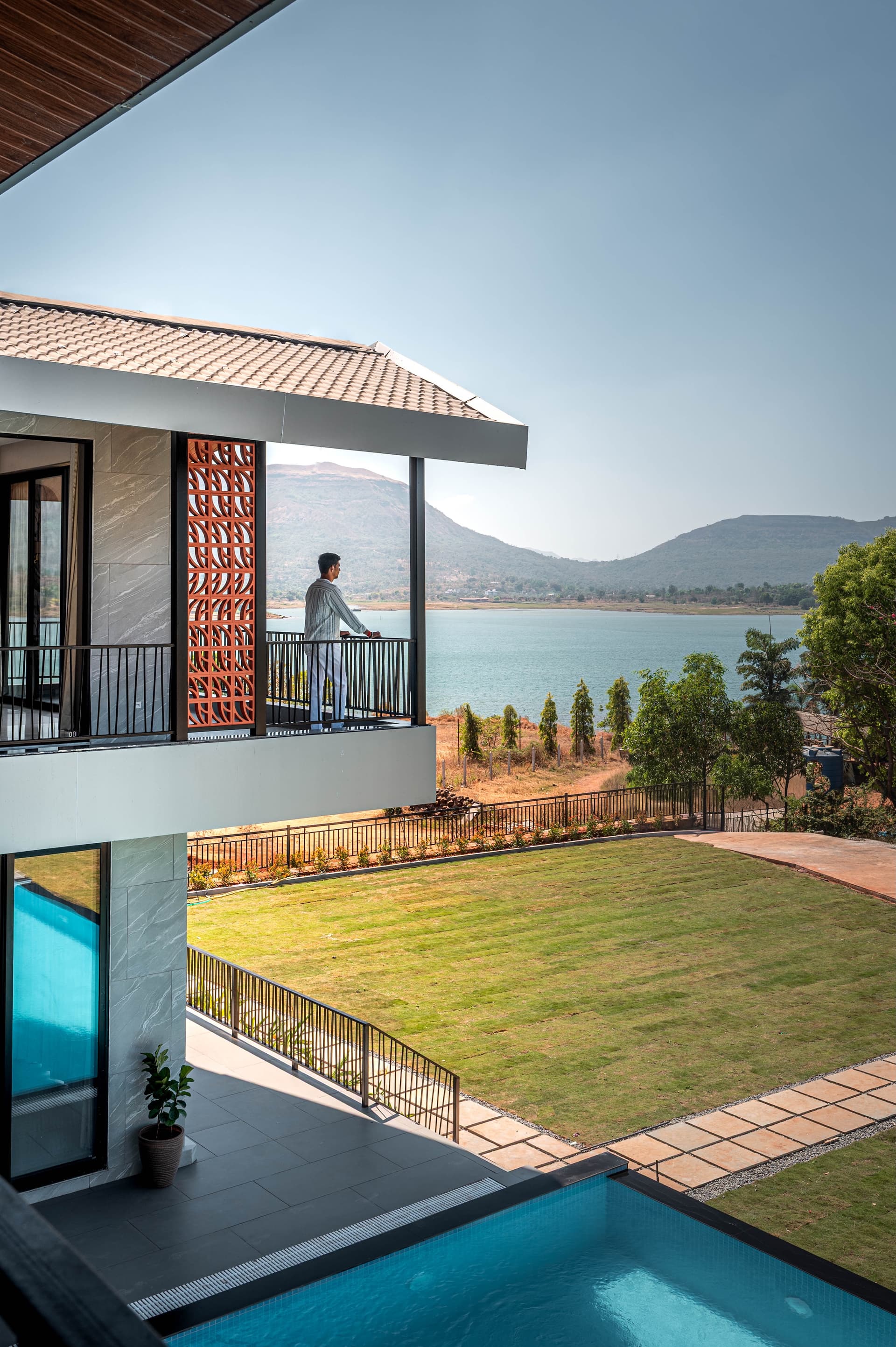
From the upper balcony, the full relationship between house and site becomes clear: the terracotta screens filter light and views, the pool sits below the balcony level, with the reservoir visible beyond, and the lawn extends toward the property boundary, with the reservoir visible beyond the perimeter fence. The villa’s structure, crowned by a traditional pitched tile roof and supported by slender columns, allows for the expansive overhangs and deep balconies that make this kind of indoor-outdoor continuity possible.
In the growing landscape of weekend homes along the Western Ghats, where many projects default to either rustic nostalgia or a borrowed minimalism that ignores its setting, The Magnolia offers a considered alternative. It takes its cues from the site itself, from the movement of water and the colours of the laterite earth, and embeds them into architectural decisions rather than decorative gestures.
That the same studio conceived the architecture, the interiors, the landscape, and the construction is not incidental; it is what gives the project its coherence. The Magnolia is a house that knows precisely where it stands, and that quiet confidence, carried from the water-patterned floor to the plumeria at the stairwell, is what makes the stillness feel earned rather than staged.