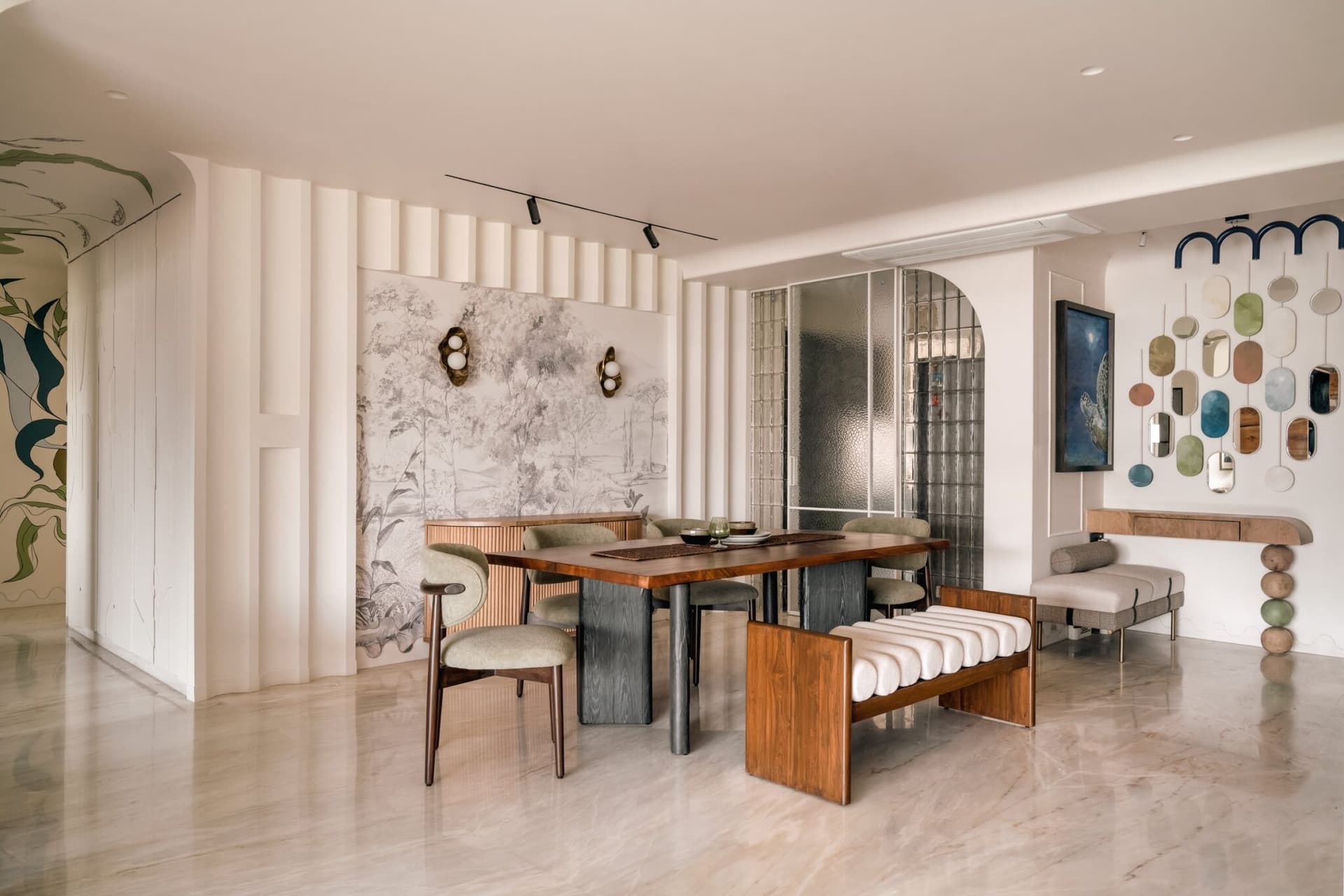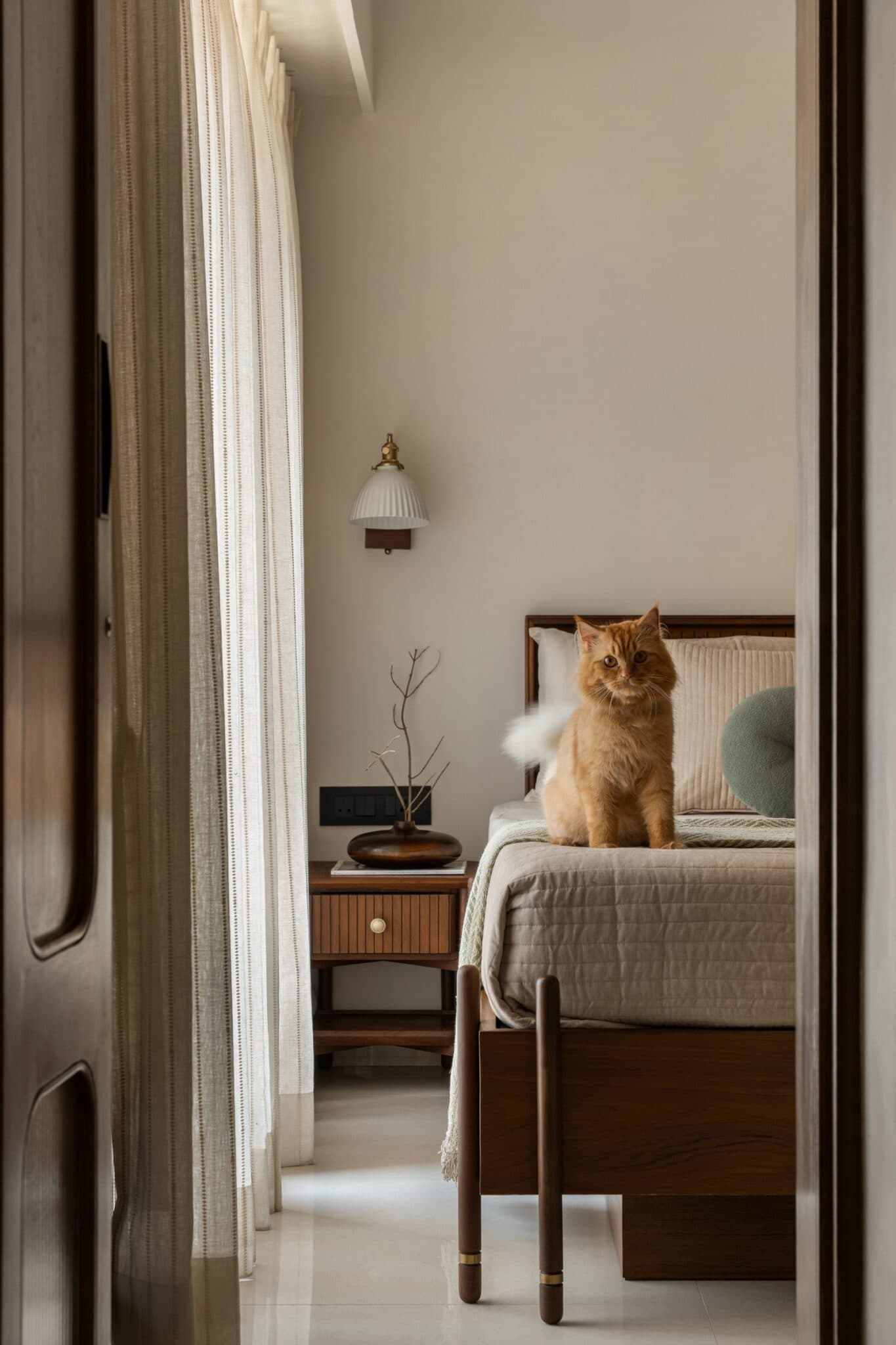
A family home in a high-rise tower is, almost by default, a negotiation. Square footage is finite, and the temptation to make every room shout its own design language is constant. The Cohesive Home, as its name proposes, argues for the opposite, that a residence can hold four distinct personalities and still read as a single, considered idea.
Designed by One21 Design, the apartment in Mumbai was conceived for a family of four whose tastes diverged in the way most families’ do, the parents inclined toward classical restraint, the children toward something more playful and contemporary. The brief, then, was less about reconciling differences and more about finding a connective grammar, a palette of forms, a tonal logic, and a recurring vocabulary of curves that could move room to room without ever feeling repetitive.
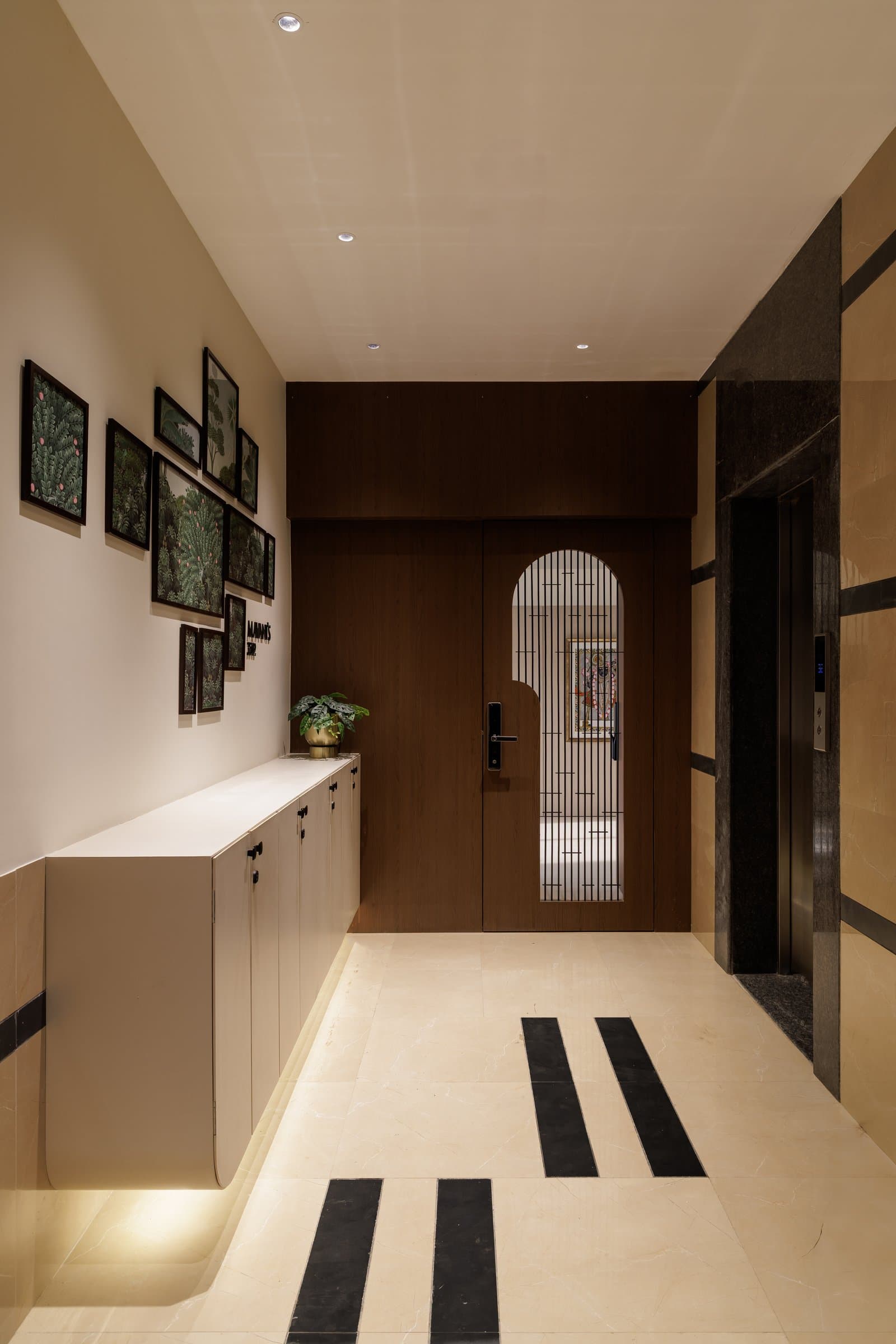
The foyer establishes the rules before the home truly begins. A run of low cream cabinetry floats off the floor on a recessed plinth, lit from beneath, while the marble flooring is interrupted by inset black bands that operate as a graphic threshold. On the left, a cluster of botanical prints in slim black frames; ahead, a tall arched door with a vertical metal grille that frames the interior like a proscenium.
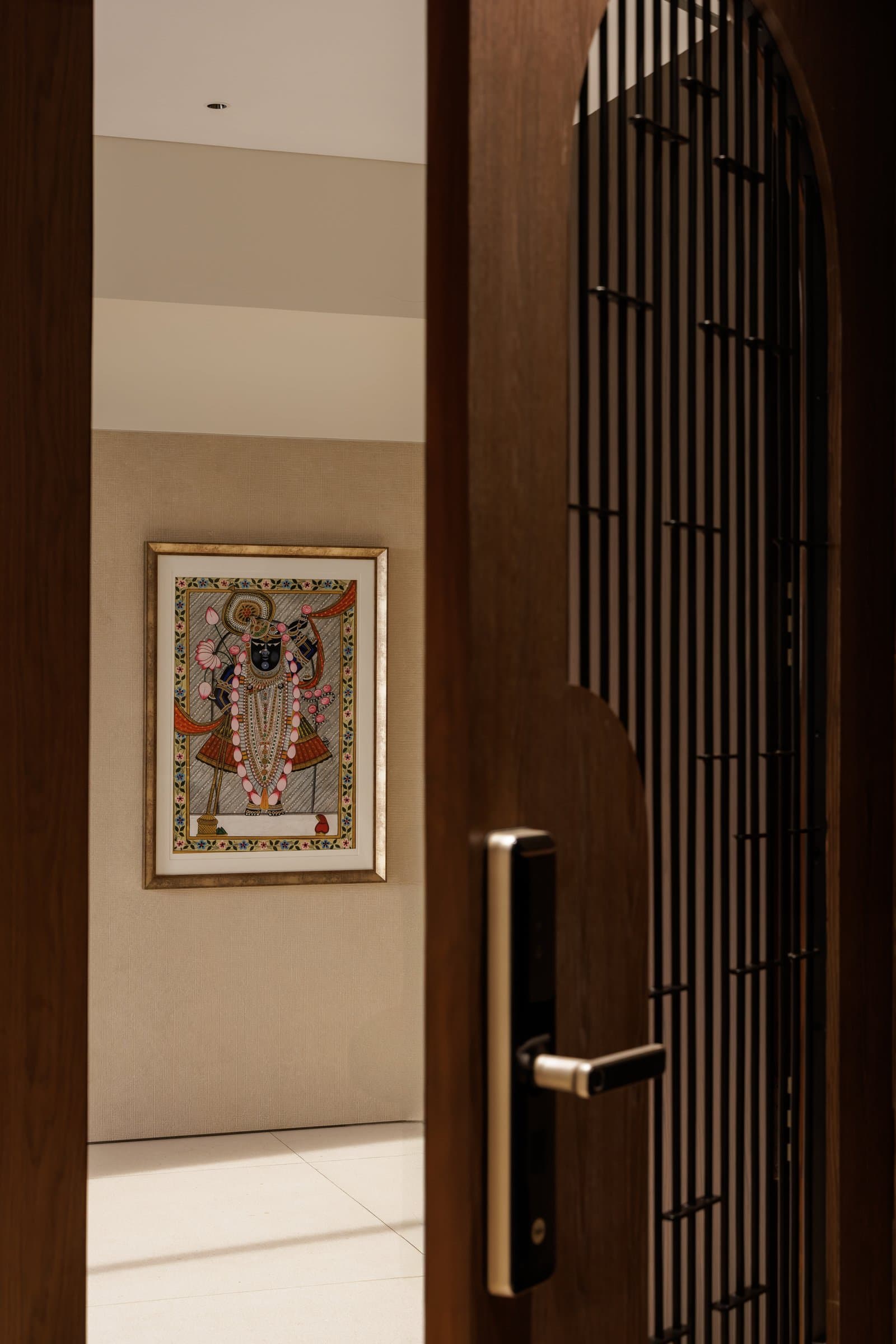
That arched grille reveals its first reward as the door opens. A framed Shrinathji pichhwai, hung against a softly textured neutral wall, anchors the inner foyer with a moment of devotional stillness. It is a quiet declaration: the home will be contemporary in its forms, but rooted in something older and more personal.
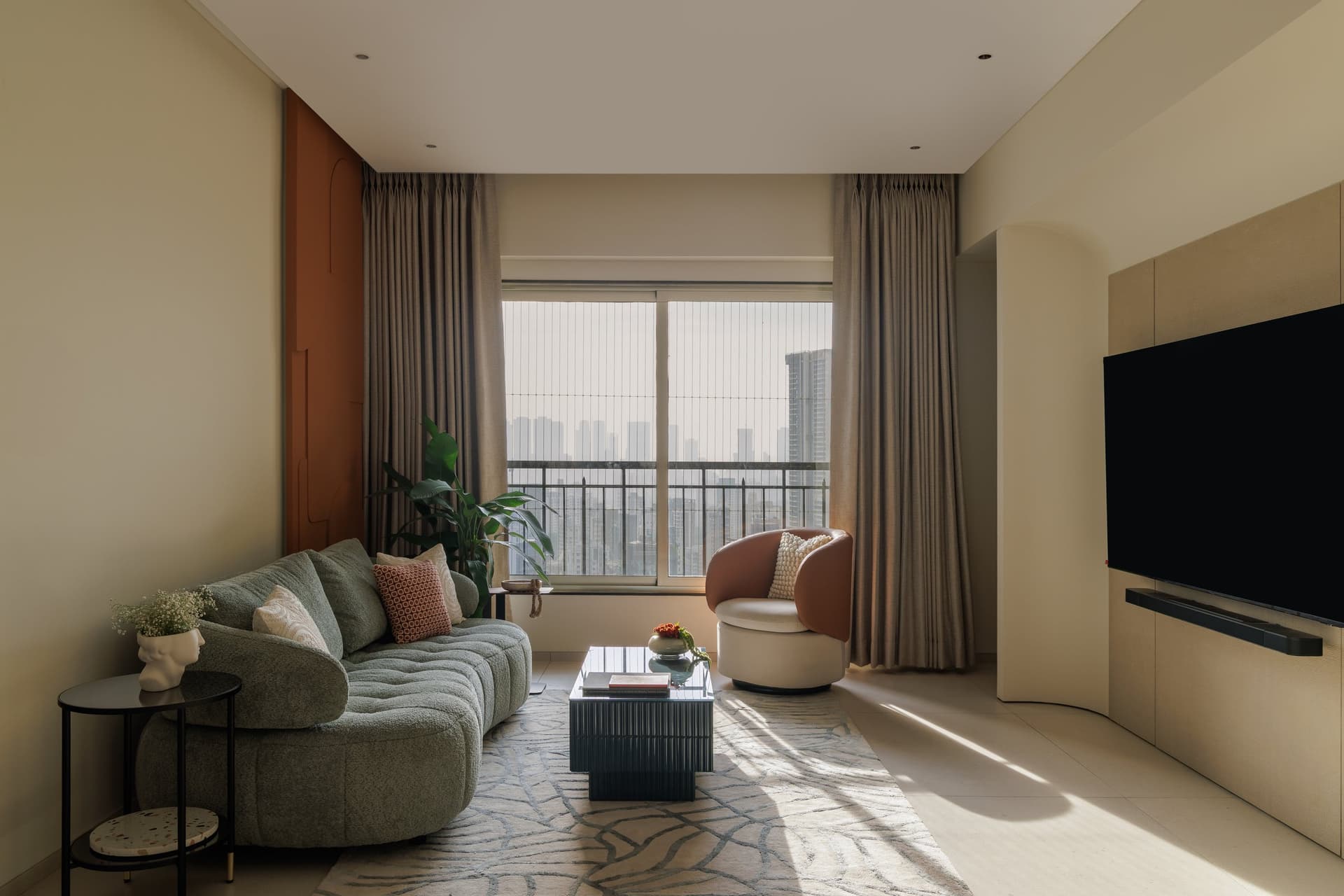
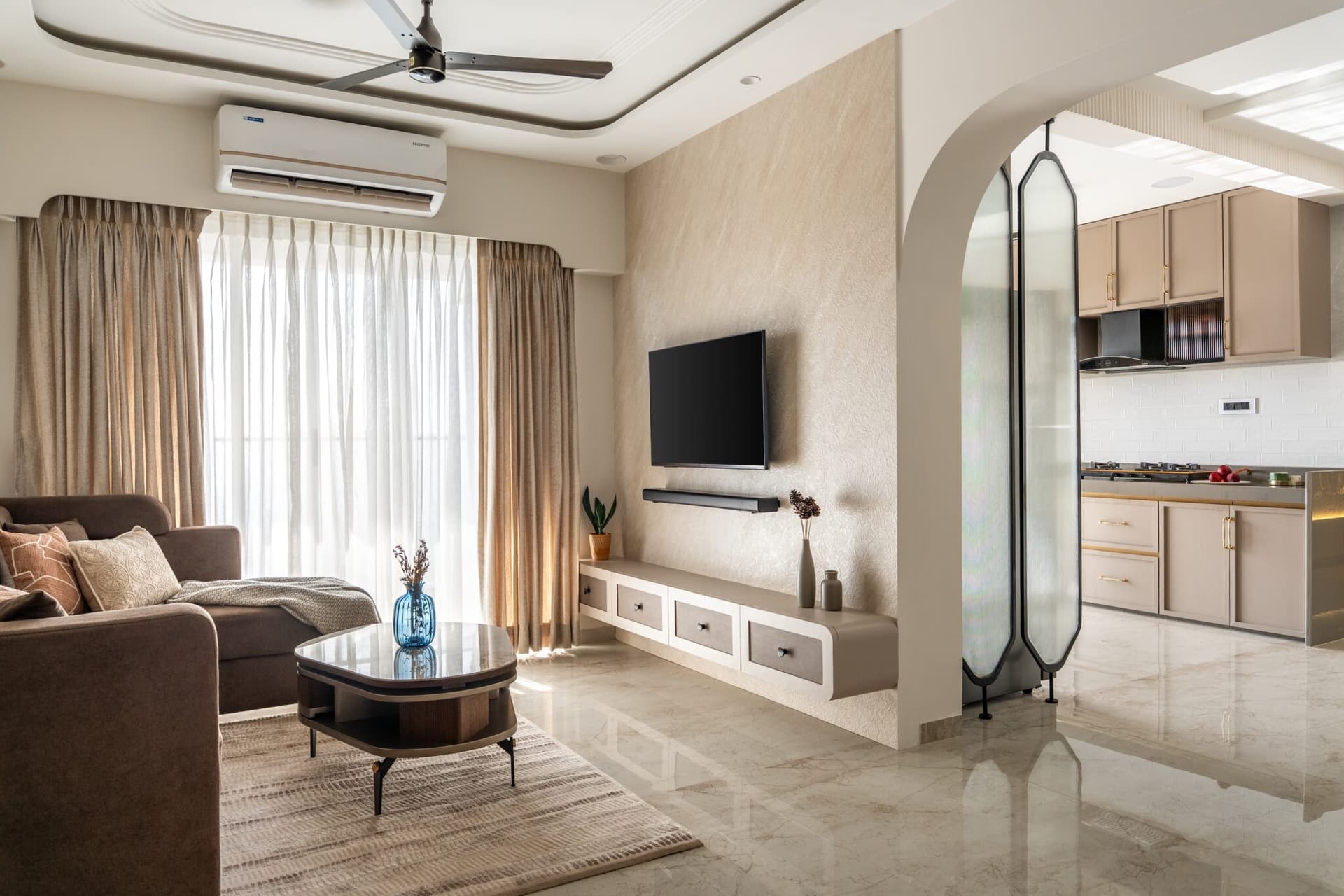
The living room opens with light as its first material. A curved boucle sofa in sage anchors the room against a cream TV unit wall, while a burnt sienna accent panel beside the window adds a quiet counterweight, the contrast between these surfaces doing the work that an accent wall usually fails to do, holding the eye without exhausting it.
A swivel chair in tan and ivory occupies the corner by the window, while a ribbed coffee table in deep teal sits at the centre of a patterned rug. The room is small by the standards of a Mumbai living room, but it does not feel compressed; the curves of every piece, sofa, chair, coffee table, dissolve the orthogonal logic of the apartment shell.
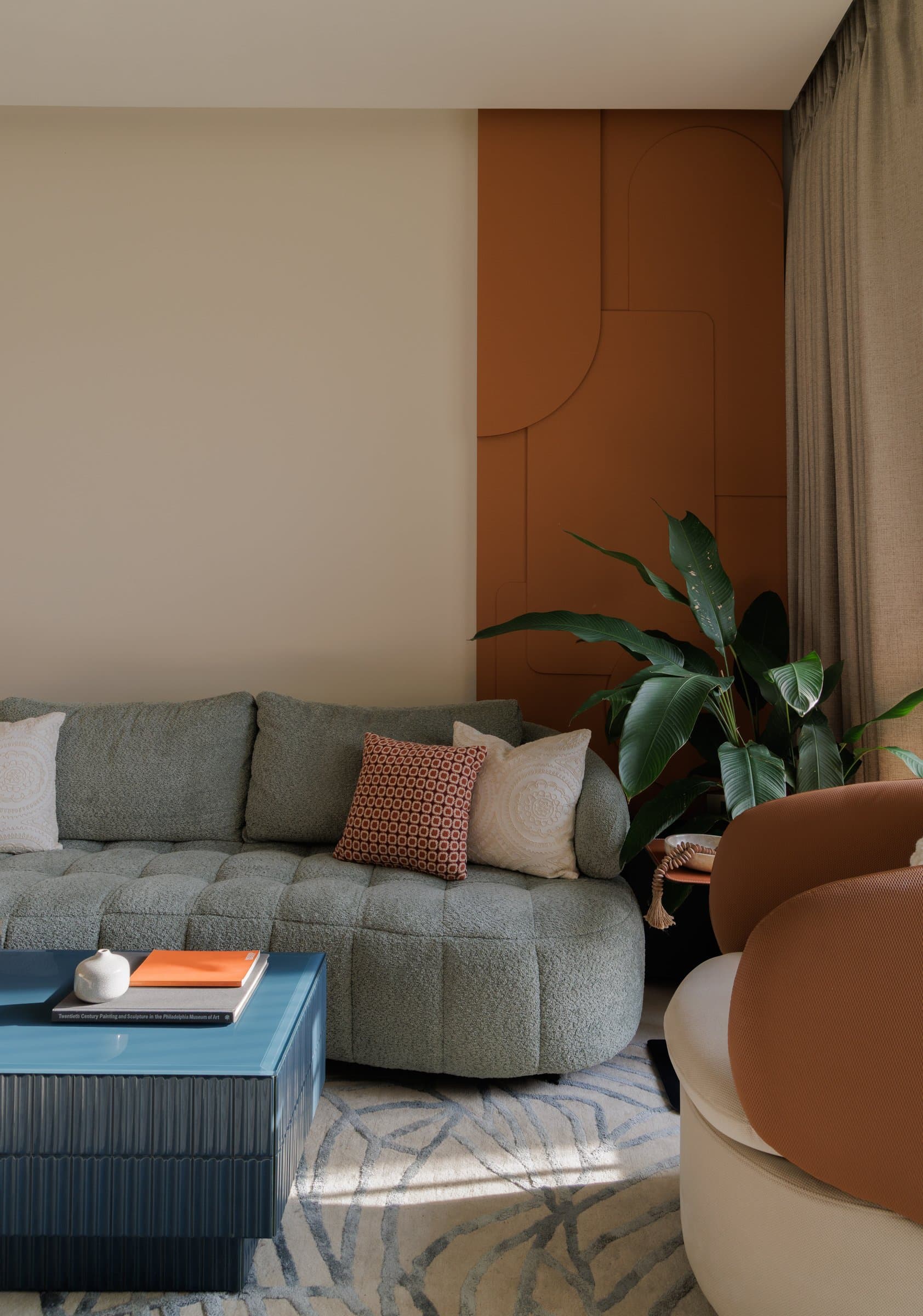
Closer in, the sienna panel reveals itself as a composition of overlapping geometric reliefs, arches, circles, soft rectangles, raised slightly off the surface. It is the home’s clearest design thesis: shapes that recur, in different scales and tones, across every room.
““The idea was a single design language, expressed four different ways. The arches in the foyer, the curves in the living room, the rounded headboards in the bedrooms, they are all the same conversation.””
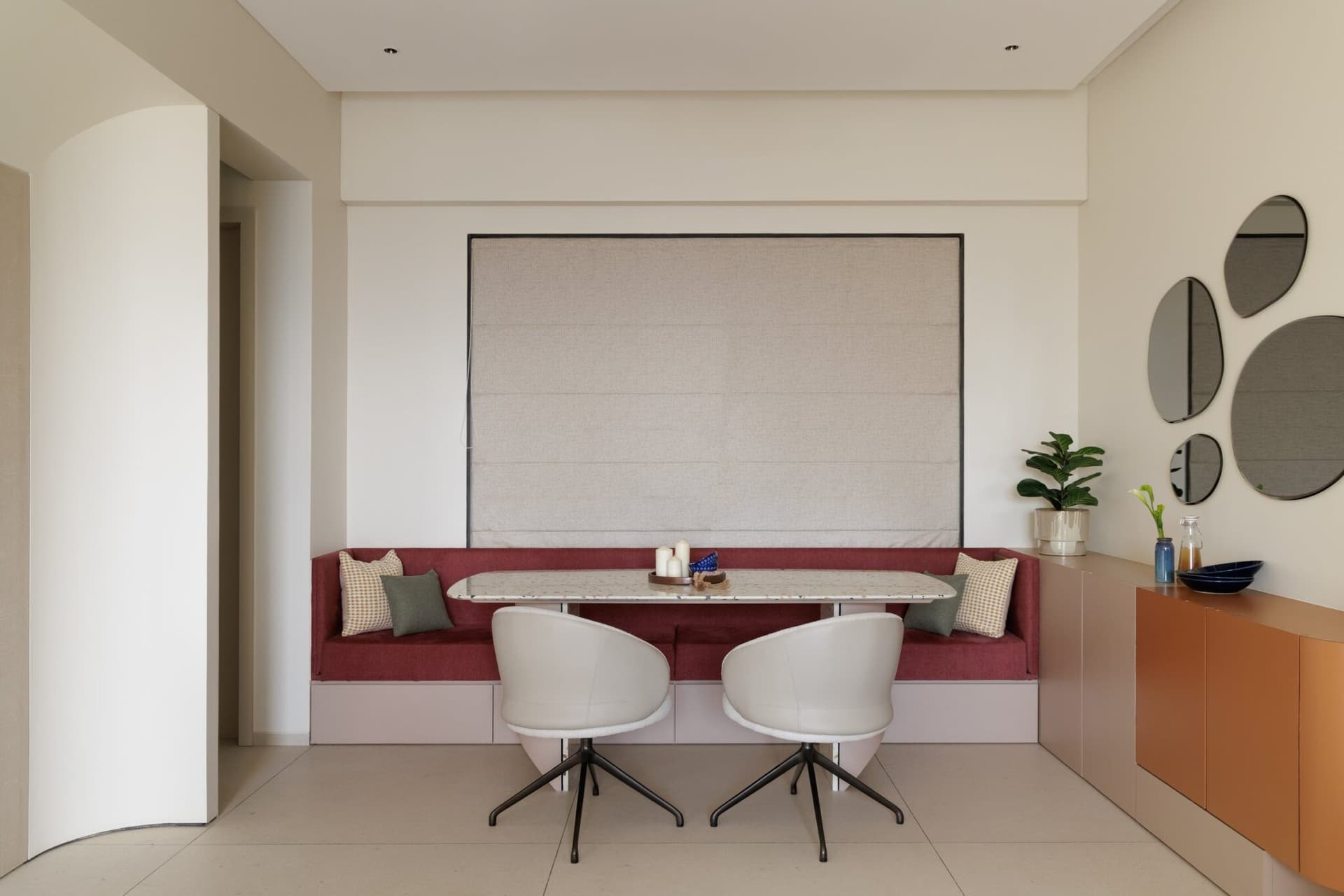
The dining area takes that same vocabulary and translates it into something more intimate. A built-in banquette upholstered in deep rose tucks against the wall, paired with two swivelling tub chairs in cream. The terrazzo-topped table, its speckled surface stretched long and lean above a slim supporting base, becomes the room’s small piece of architectural sculpture.
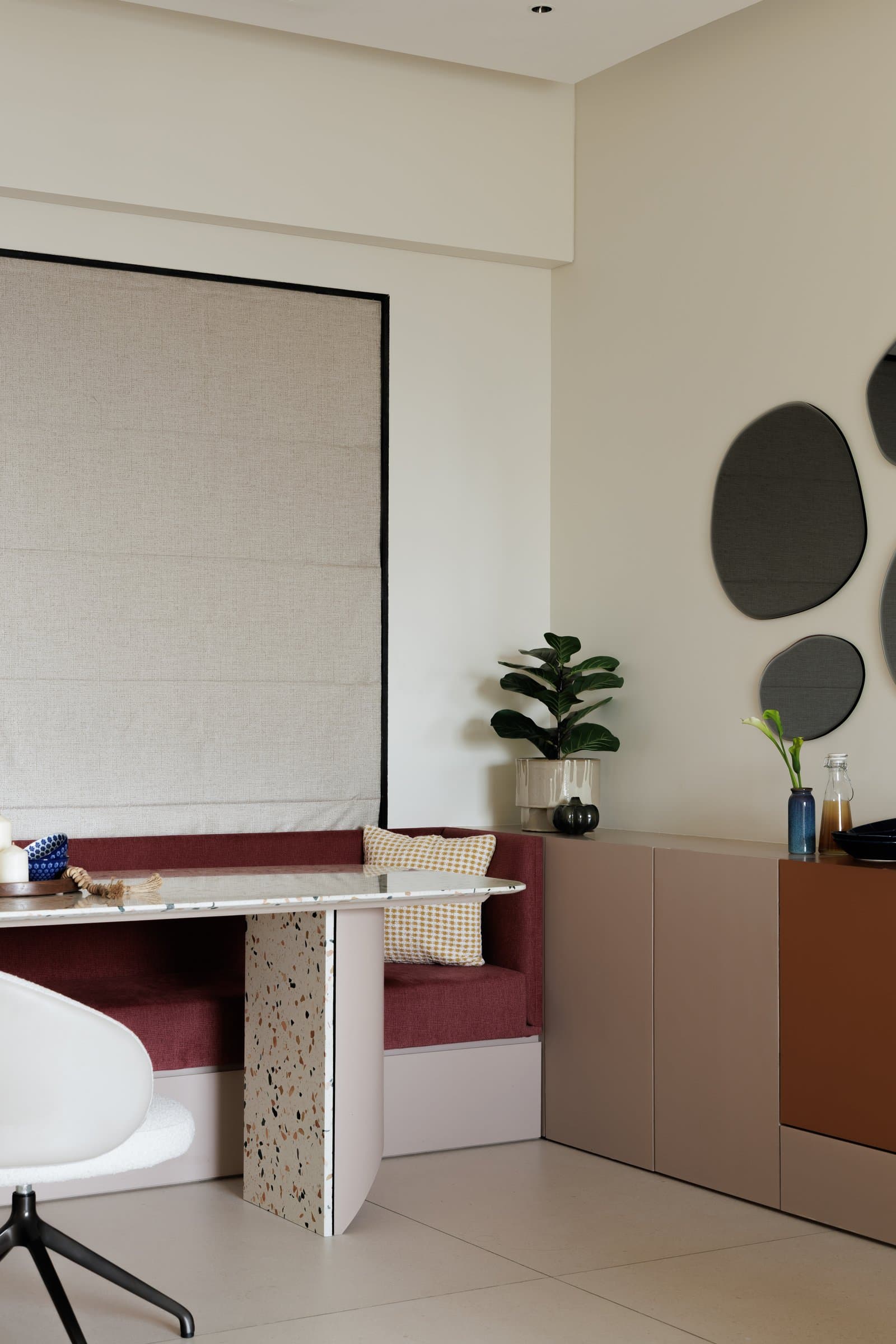
To the right, a low credenza in graduated tones of dusty rose, mauve, and burnt orange runs along the wall, its colour-blocked doors reading almost as a Rothko in cabinetry. A cluster of dark pebble-shaped mirrors hovers above it, picking up the soft organic geometry that the rest of the home keeps returning to.
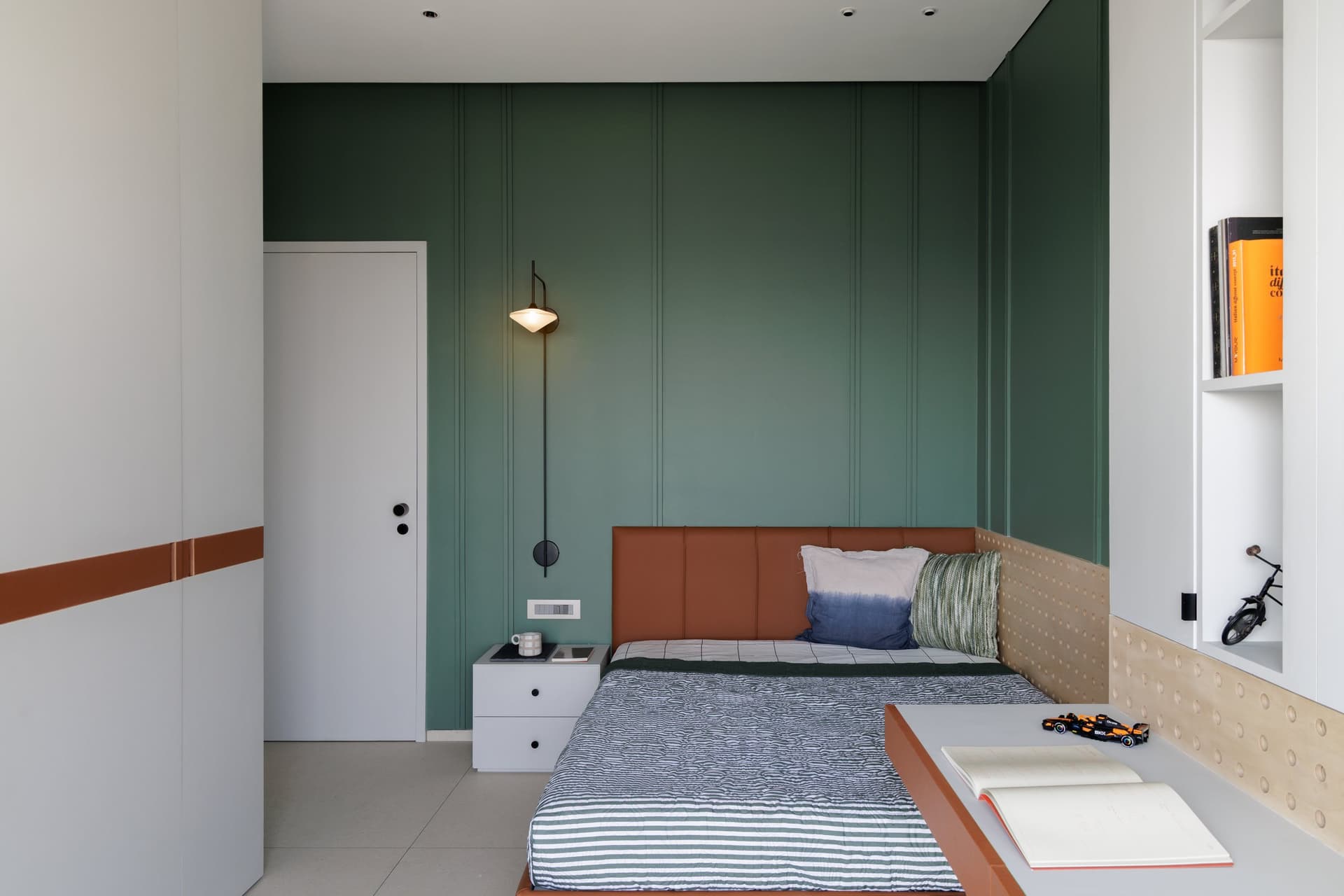
The son’s bedroom takes the home’s curve-and-colour grammar and pushes it toward something sharper. A panelled wall in deep forest green provides the bed’s backdrop, while the headboard, a wide rectangle of tan leather, sits flush against it like a graphic block. The wardrobe to the left, in cream with a single horizontal band of tan, picks up the same colour pairing in a quieter register.
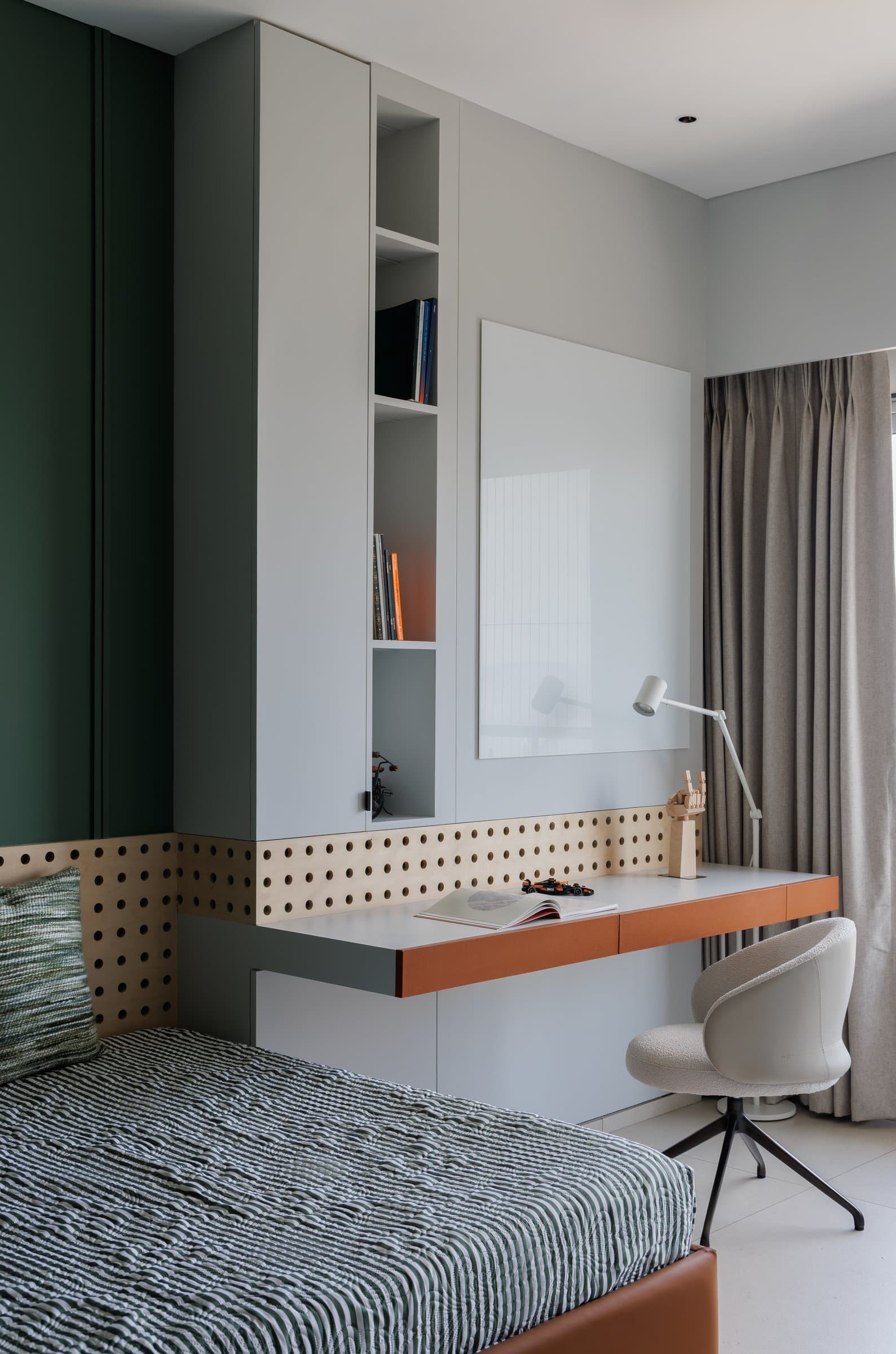
Opposite the bed, the room reveals its working half. A floating desk in pale grey with an orange front edge runs the length of the wall, with a perforated birch pegboard strip running behind it and a large whiteboard mounted above. A slim task lamp and a boucle swivel chair complete the setup, the room balanced equally between rest and study.
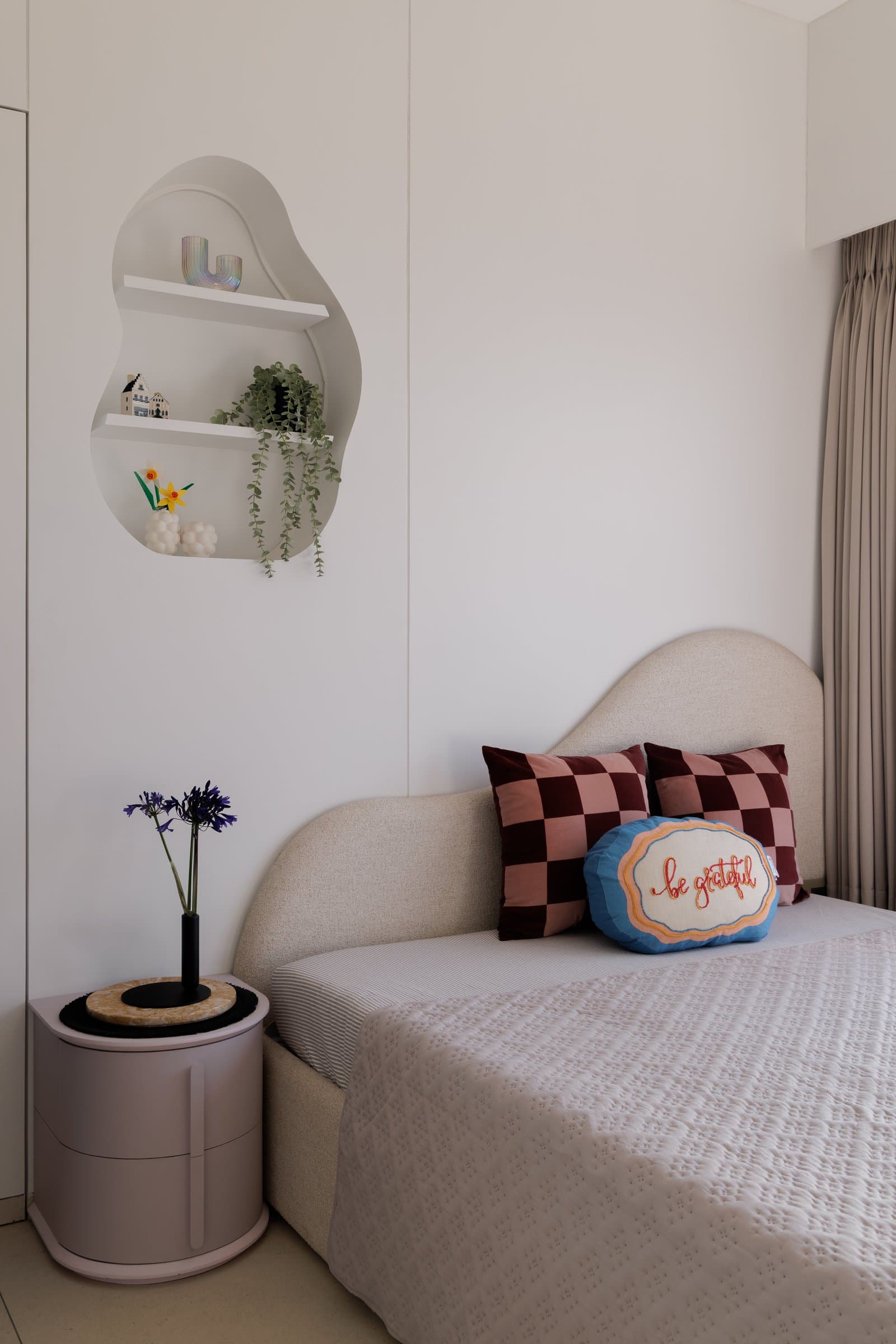
The daughter’s bedroom is more lyrical, more romantic. A curved upholstered headboard in oatmeal sits against a pale wall, accompanied by a circular nightstand in dusty mauve. Above, an irregularly shaped white wall shelf, like a softened pebble, holds a tiny vignette of objects, an iridescent vase, a miniature house, trailing greenery.
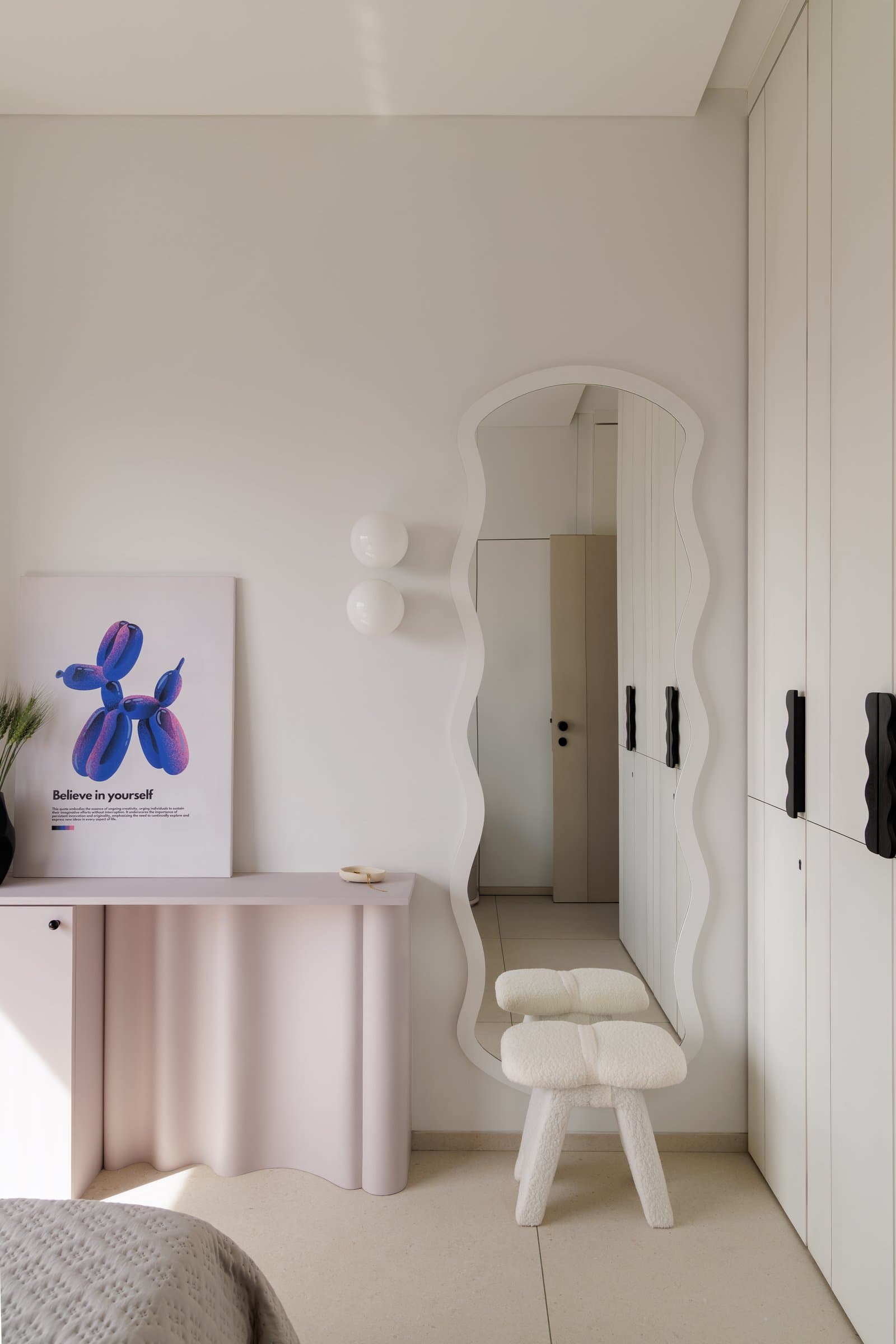
Across the room, a wavy-edged mirror leans tall against the wardrobe, paired with a console in the same blush tone, its base undulating like a fluid curtain frozen in place. A boucle stool shaped like a tiny cloud sits before it. The room is unapologetically feminine, but its restraint, the limited palette, the singular gesture per wall, keeps it from tipping into preciousness.
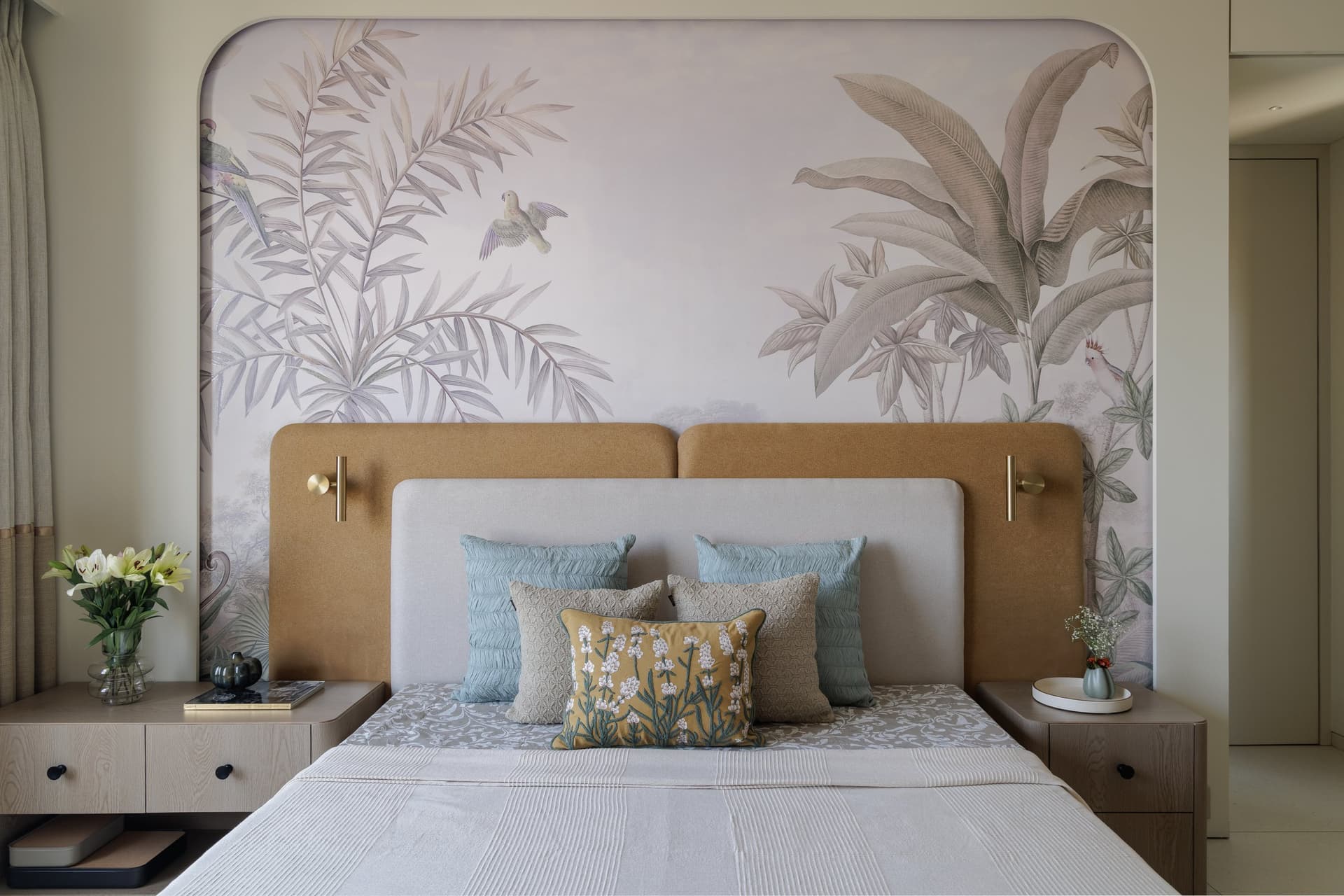
The master bedroom takes the curve and elevates it into a full architectural arch. The headboard wall is dominated by a hand-painted mural of pale palms, banana leaves, and perching birds, contained within an arched outline that seems to rise out of the bed itself. In front, a tan upholstered backrest sits behind a softer ivory headboard, the two planes overlapping like layered cards.
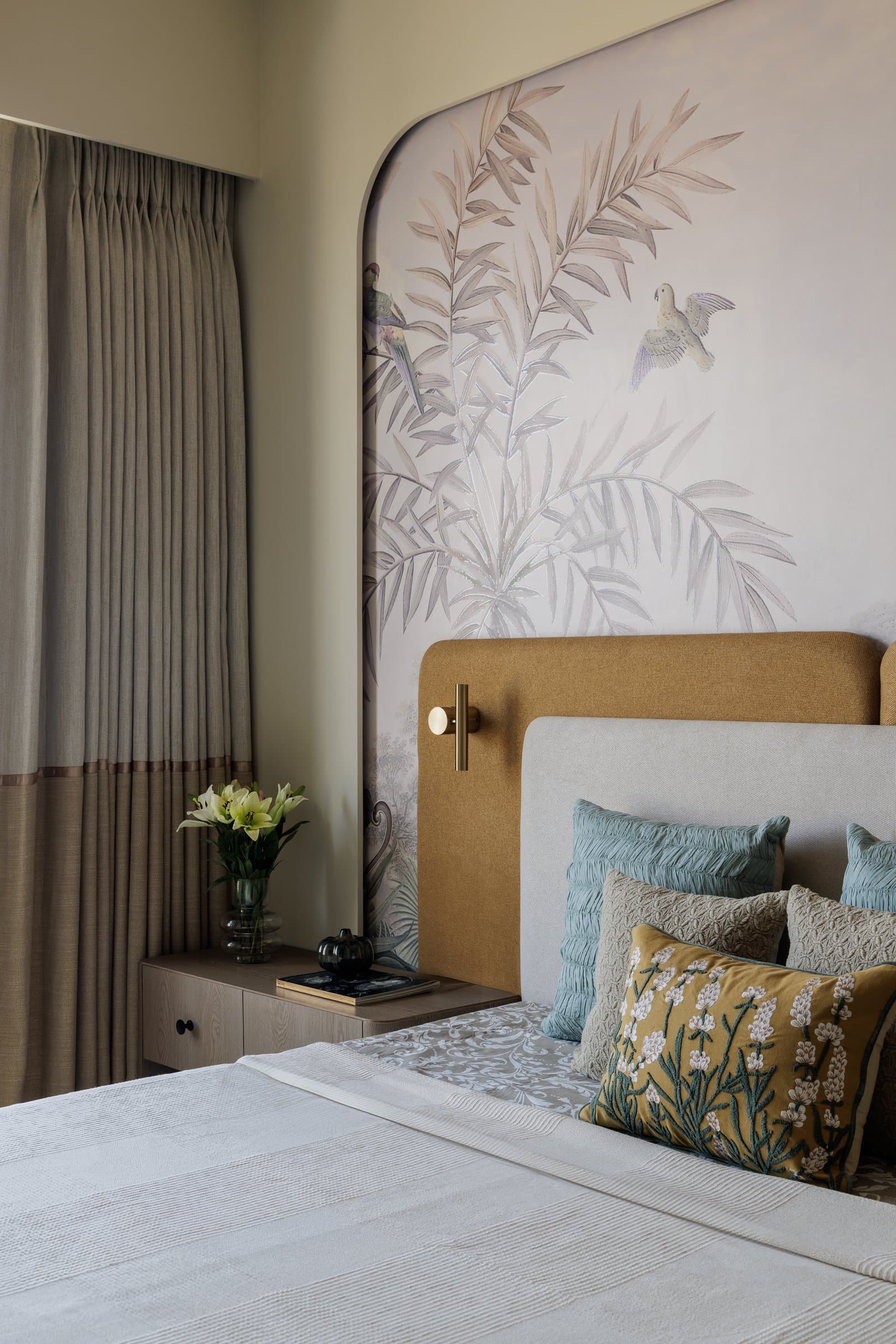
Seen from the side, the depth of the gesture reveals itself. The tan backrest extends upward to meet the curve of the arch, brass sconces mounted directly onto its surface like jewellery on fabric. The wallpaper behind reads almost as botanical illustration, refined and atmospheric, and the bedside detail, a slim ash console, a vase of lilies, sets a quieter pace.
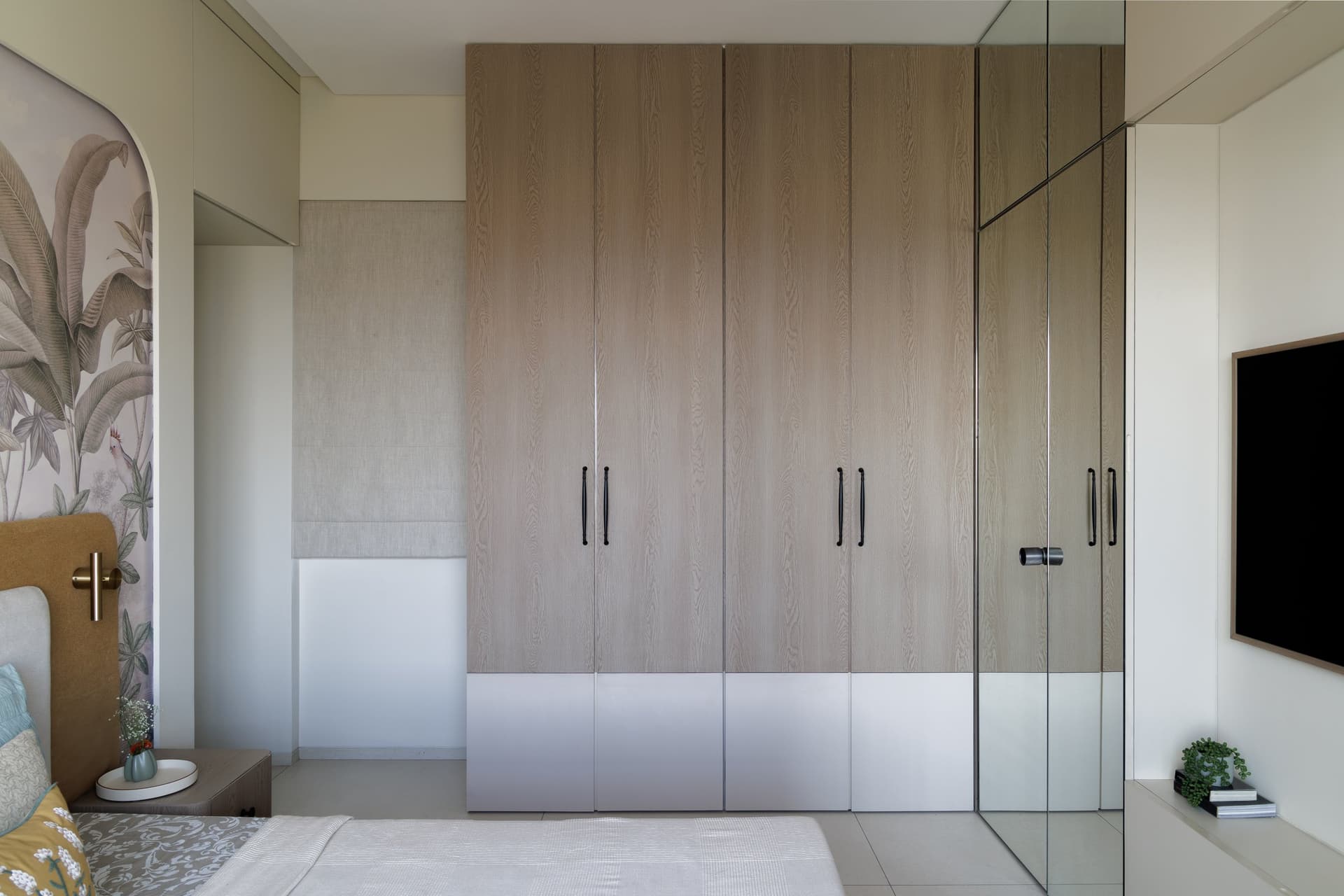
The opposite wall holds a tall run of wardrobes in pale-grain oak, their full-height doors broken only by a band of brushed metal at the base. The restraint of this elevation is deliberate, the mural-and-headboard composition is the room’s single dramatic gesture, and everything else recedes.
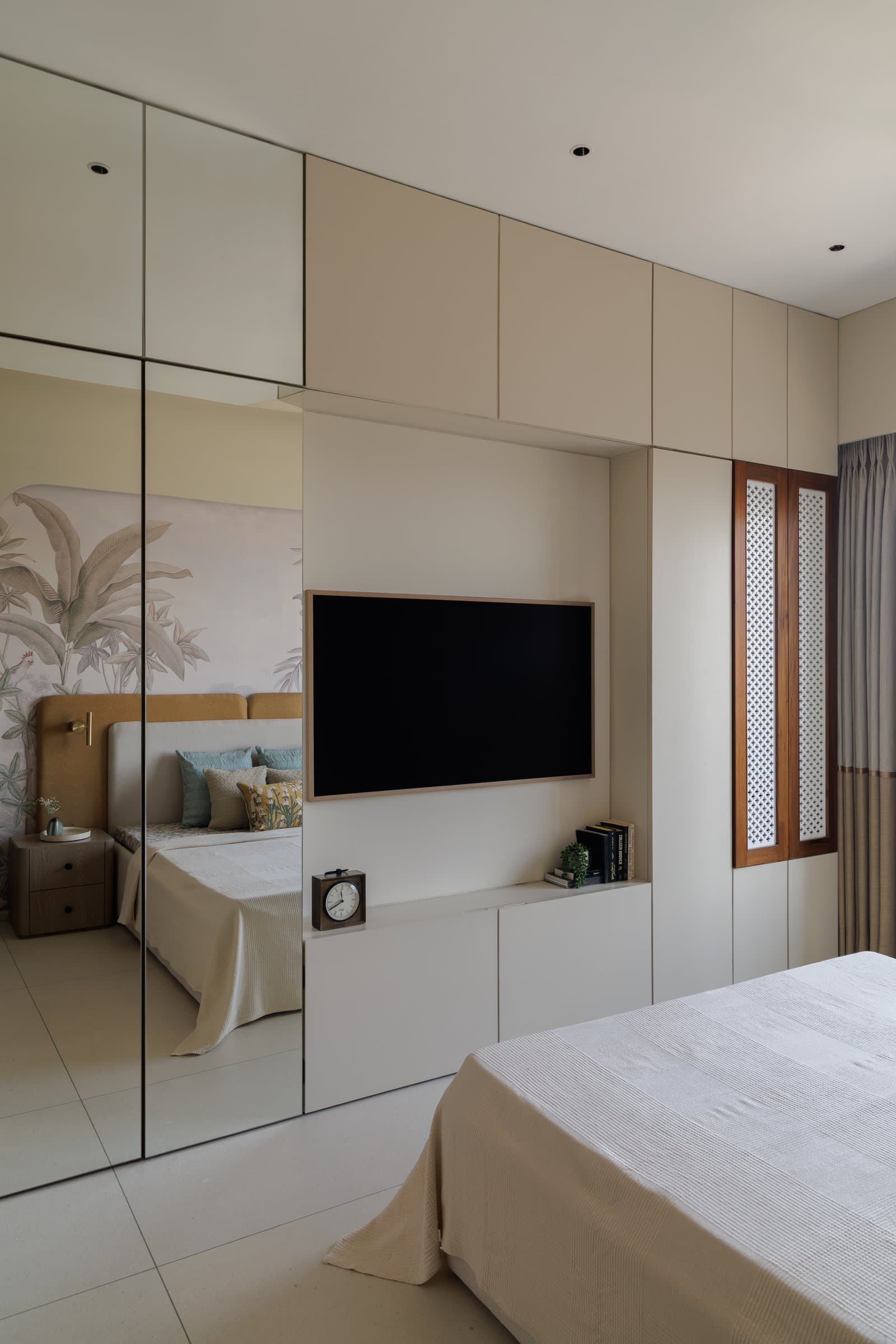
The television wall continues that logic. Floor-to-ceiling cream cabinetry conceals storage, broken by a single inset panel of fretwork shutters in warm wood, a small acknowledgement of older Indian carpentry detail inside an otherwise contemporary composition. A mirrored panel on the left reflects the bed and mural, doubling the room visually without competing for attention.
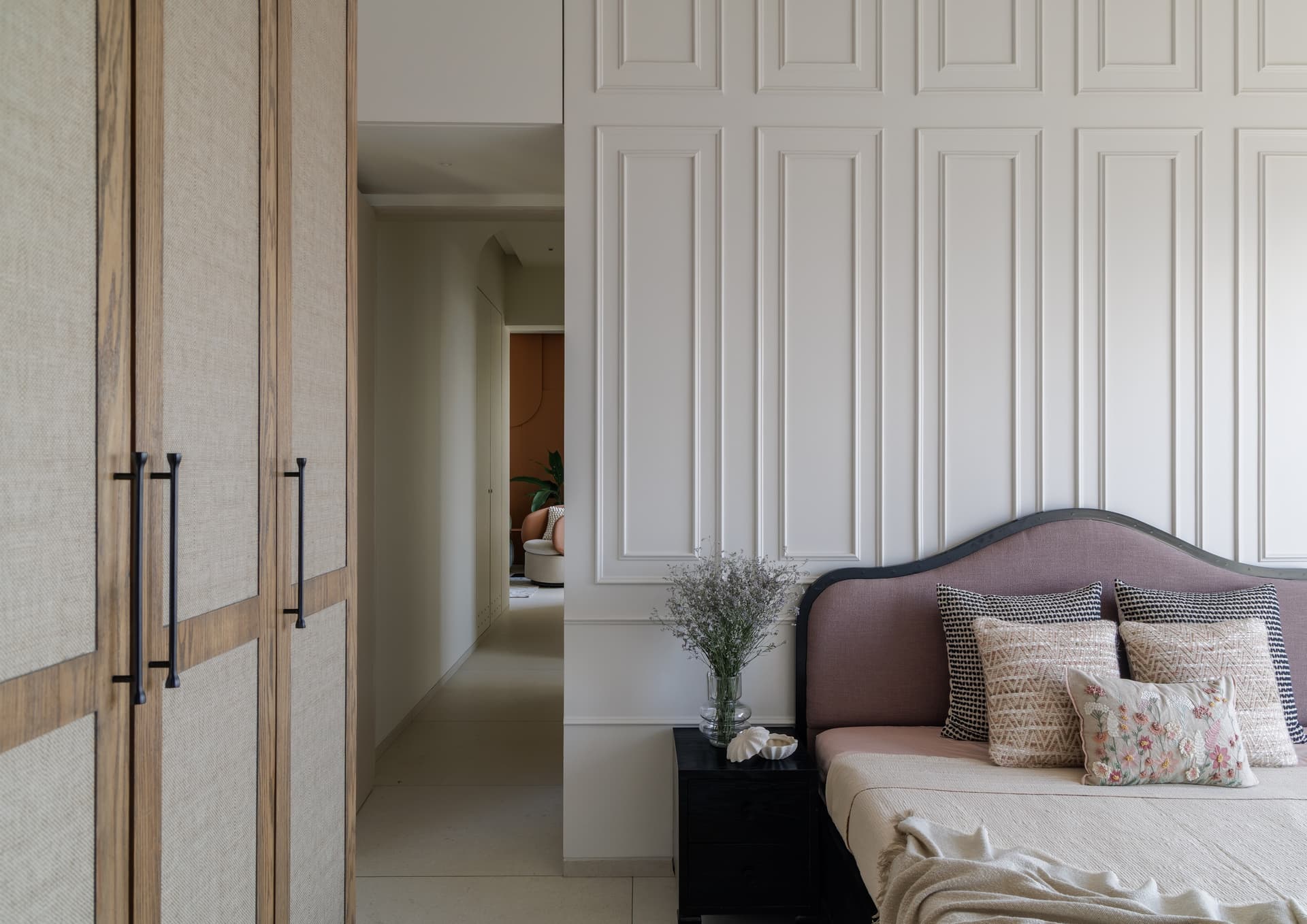
The parents’ bedroom, by contrast, departs from the home’s softer modernism and steps into something more classical. A wainscoted wall in cream provides a backdrop of recessed panel mouldings, while the curved headboard in muted mauve, framed in slim black trim, holds the room’s central gesture. Two vertical still-life prints anchor the wall above.
The detail rewards a closer look. The panel mouldings carry the eye upward, the upholstered window seat to the right with its nail-head trim picks up the classical register, and the bed dressing, embroidered florals, textured weaves, a soft throw, completes a room that is unmistakably traditional in spirit. Within the larger home’s vocabulary of curves and colour, this room reads as the quietest and most personal.
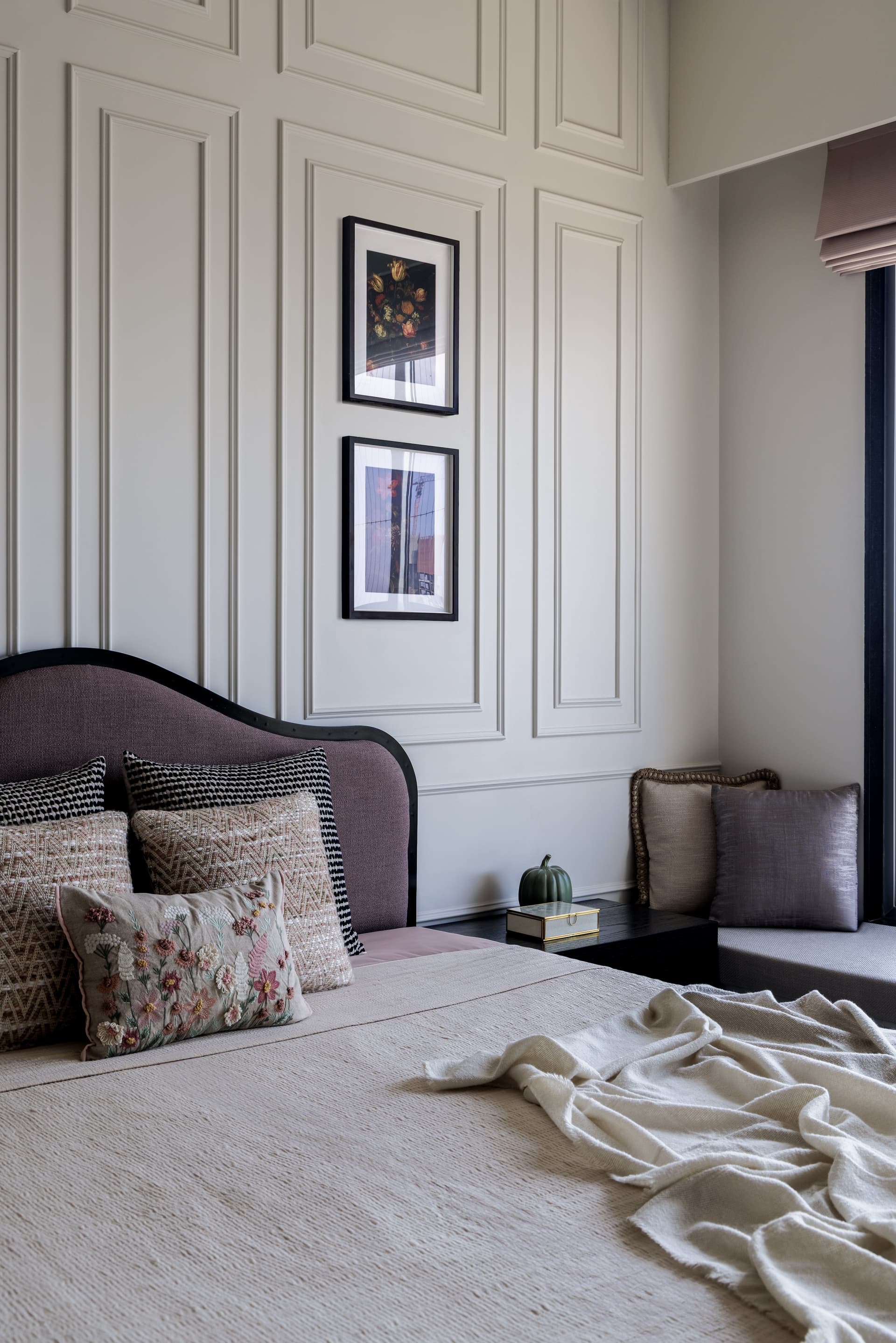
Tucked against the window, a built-in seat takes advantage of the apartment’s height. The view stretches across the Mumbai skyline; the wall beside it is finished in a soft, hand-troweled plaster that catches the afternoon light unevenly. It is the kind of corner that justifies itself, a magazine, a cup of tea, the city held safely behind a balustrade.
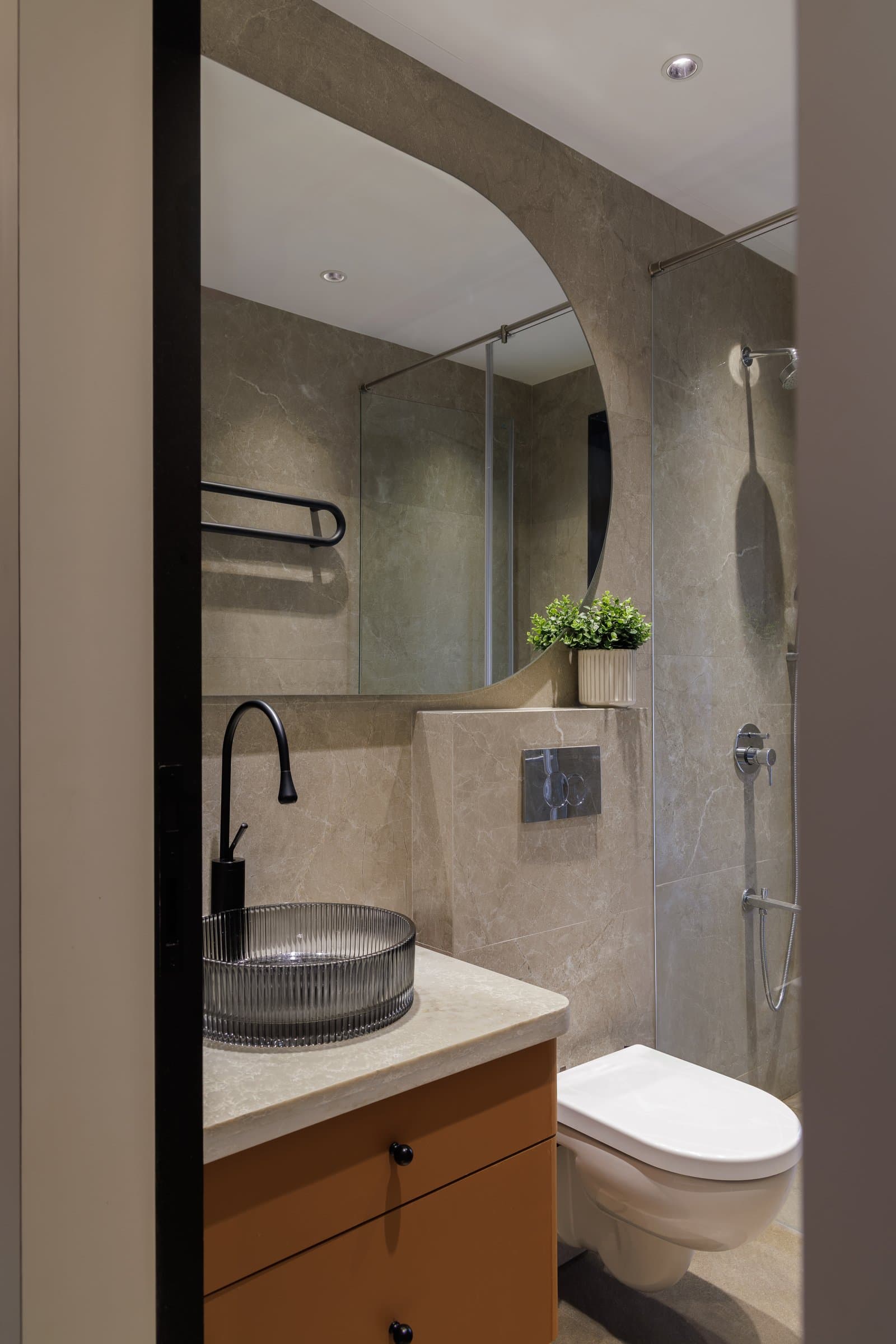
The bathrooms continue the colour-coding logic of the bedrooms they attach to. In the son’s bath, an arched mirror cut into a wall of taupe stone sits above a vanity in burnt orange, its ribbed glass basin and matte black tap completing a composition that is graphic without being austere.
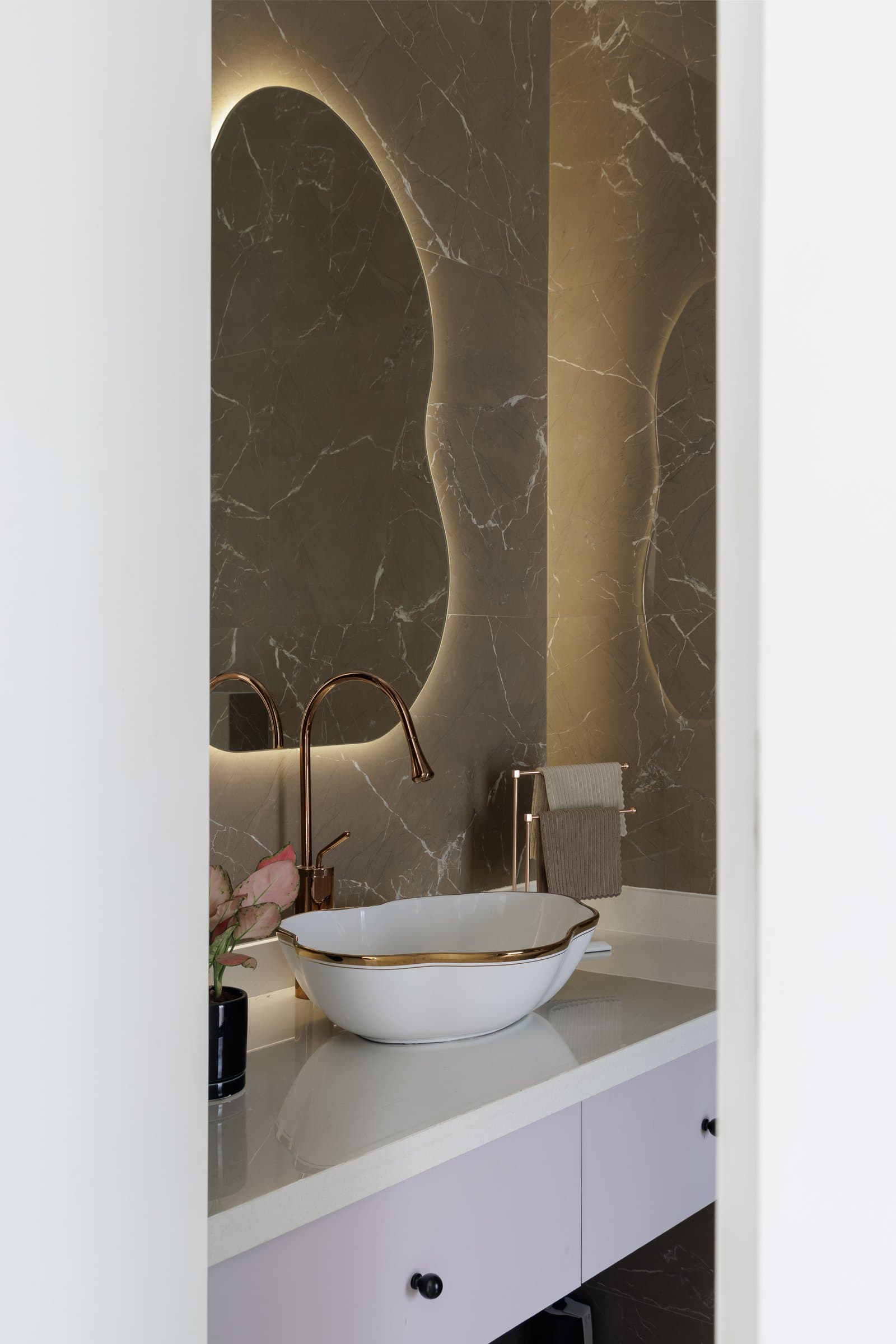
The daughter’s powder room takes the opposite tonal turn. A pebble-shaped mirror, backlit, floats against a slab of veined marble, while the basin, a scalloped ceramic vessel rimmed in gold, sits on a counter above a vanity in pale lilac. Rose-gold taps catch the warm cove light. It is the home’s most decorative room, and it earns the indulgence by being small.
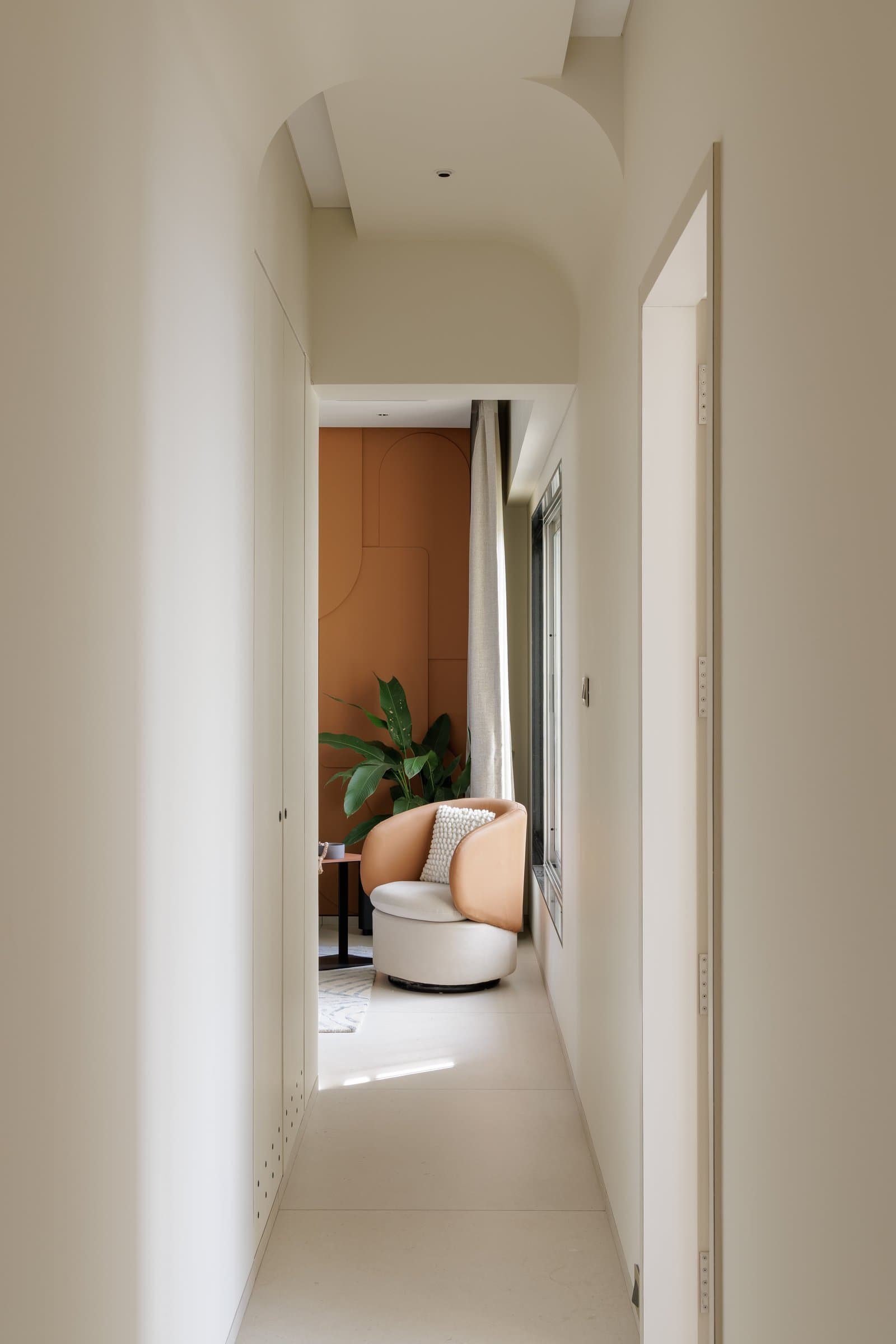
Connecting all of it is a corridor that does more work than corridors usually do. Curved ceiling soffits soften the geometry overhead, and at the far end, the sienna relief panel and a swivel chair come back into view, the living room reasserting itself as the home’s anchor.
What One21 Design has achieved here is the resolution of a tension every multi-generational home in urban India faces, how to hold the parents’ classical sensibility and the children’s contemporary energy in the same plan without resorting to compartmentalisation. The answer, in this apartment, lies in a shared vocabulary applied at different volumes, a curve in cream here, a curve in mauve there, an arch in burnt sienna, an arch in painted palm leaves.
The Cohesive Home is, ultimately, well named. It does not insist on uniformity; it proposes a quieter idea, that a family can live with its differences intact, as long as the space they share is built on a single, well-articulated language.