Stark minimalism, for all its discipline, often forgets that a home is meant to be lived in rather than admired from a distance. The more interesting proposition, the one that requires real conviction, is a quieter language that still holds depth, character, and a sense of rhythm.
This is the argument Muted Rhythm makes, with confidence and without raising its voice. Designed by Switchover Studio, led by Disha Shah and Ratica Multani, the 2,400-square-foot apartment in Juhu, Mumbai is built around a neutral palette deepened by teak, woven cane, textured laminates and stone. Fluted panels, arched openings and gently curved edges run through the home as a continuous, unhurried beat.
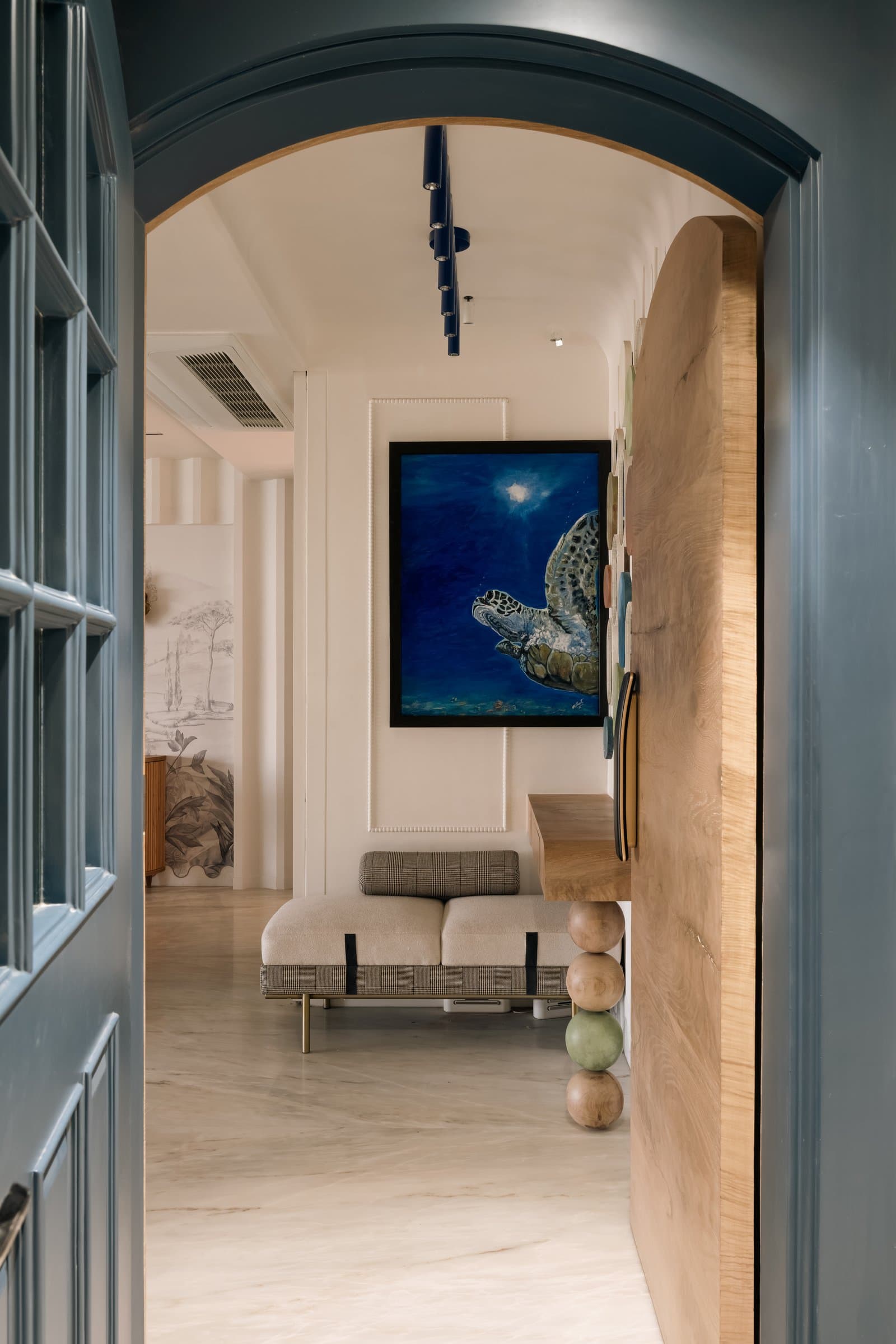
The entry sets the tone with a deliberate piece of theatre. A deep teal arched doorway frames the first view of the home: a marble-floored foyer with a slim wooden console supported by stacked spherical legs in cream, sage and natural wood, an upholstered bench below a moody underwater painting of a sea turtle, and beyond it, the faintest suggestion of a hand-painted mural on the far wall.
The drama here is not in volume but in compression. The arch narrows the gaze, then releases it into softer, lighter territory, the kind of spatial pacing that asks you to slow down before you have even taken your shoes off.
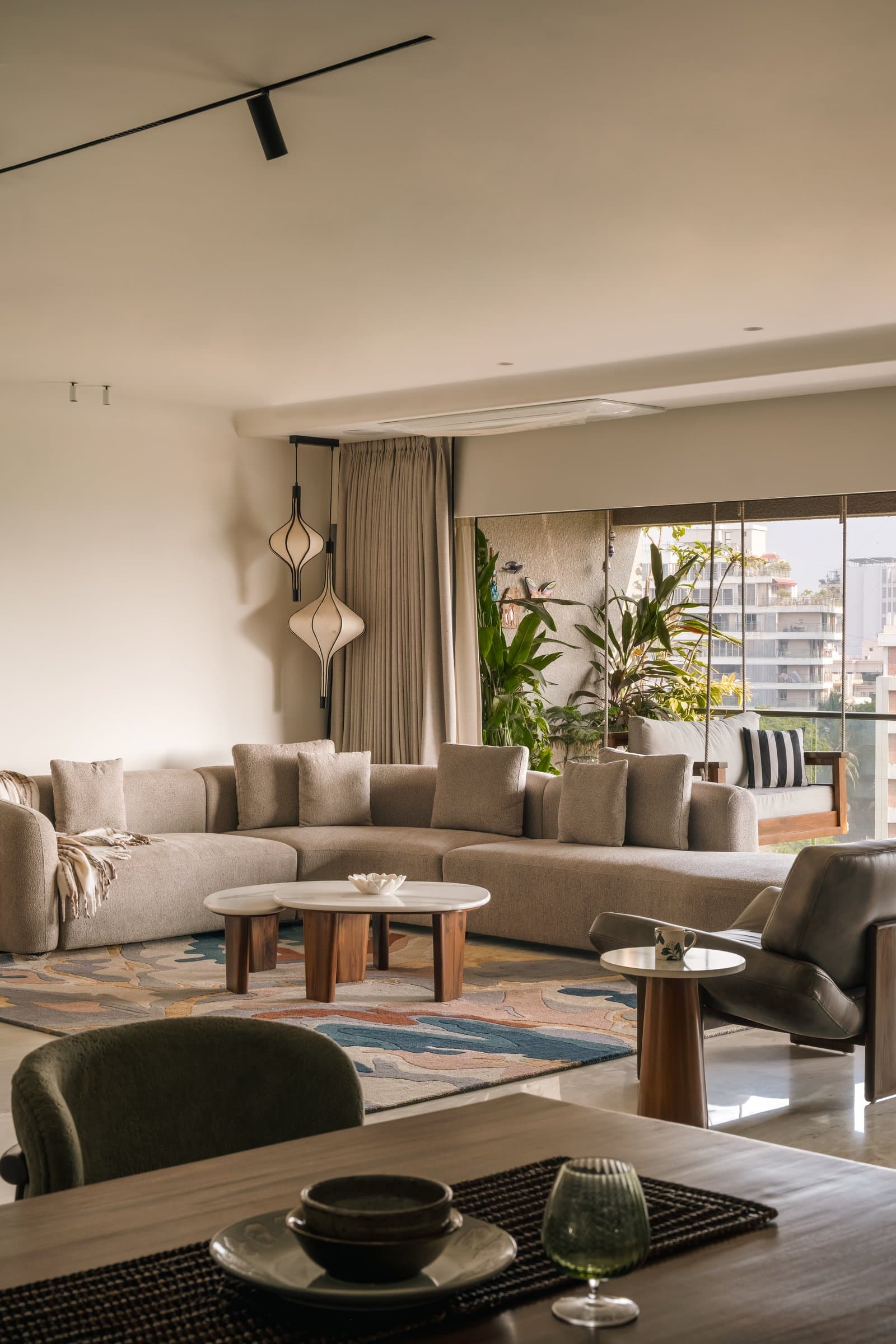
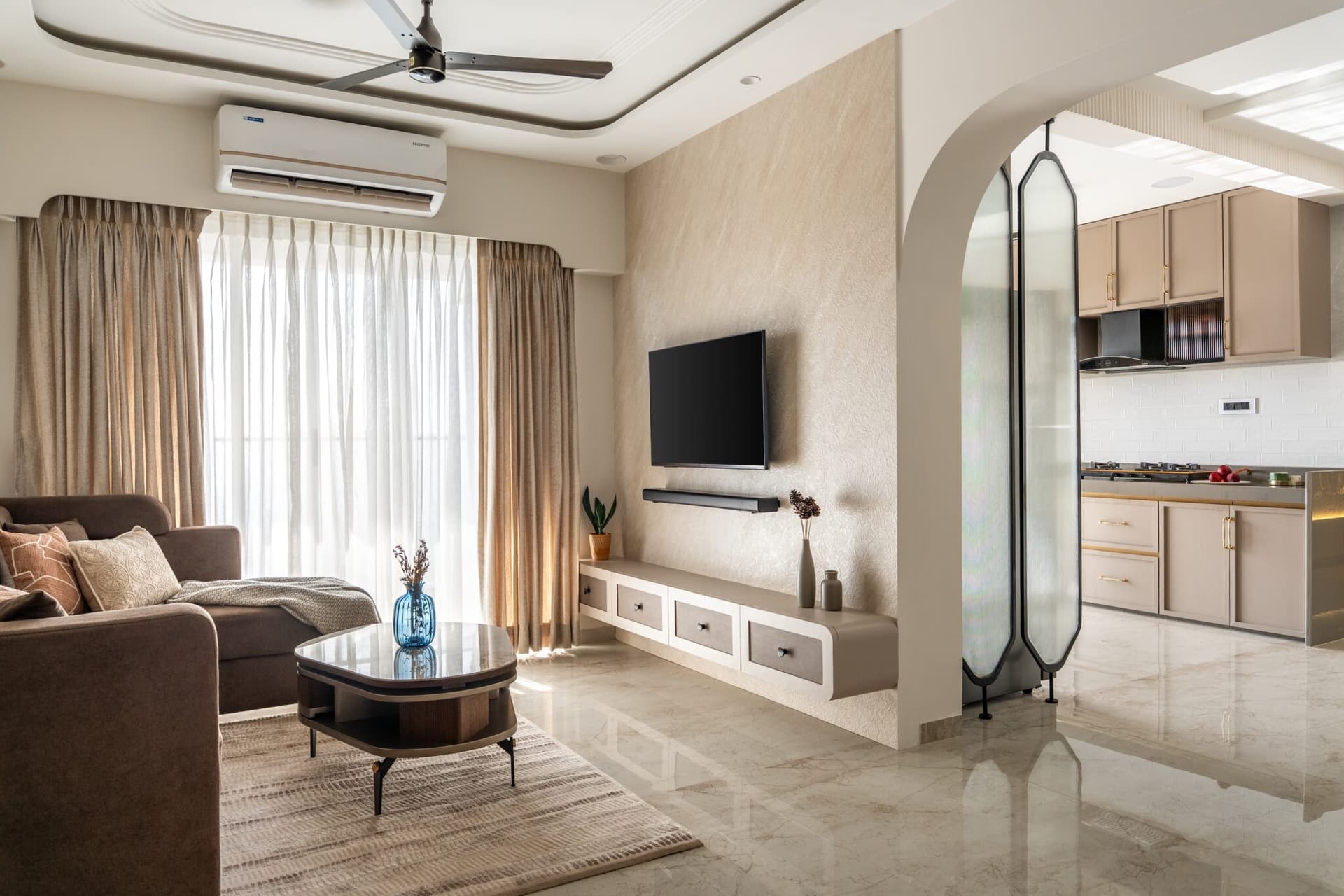
The living room opens out as a single, generous gesture: a sprawling sectional in muted oatmeal anchors the room, paired with a darker leather lounge chair that introduces just enough contrast to keep the palette from settling into uniformity. A pair of sculptural pendant lights in onion-bulb silhouettes hang against a sheer curtain, and beyond, the balcony’s foliage reads as another piece of the composition.
““The design builds depth through a considered mix of natural teak wood, woven cane, textured laminates, and stone.””
What holds the room together is the rug, a hand-tufted piece whose abstract pools of terracotta, slate blue and ochre absorb the room’s quietness and give it a centre. Around it, the furniture is restrained enough to let the rug do the work, an inversion of the usual hierarchy where seating dominates and accessories follow.
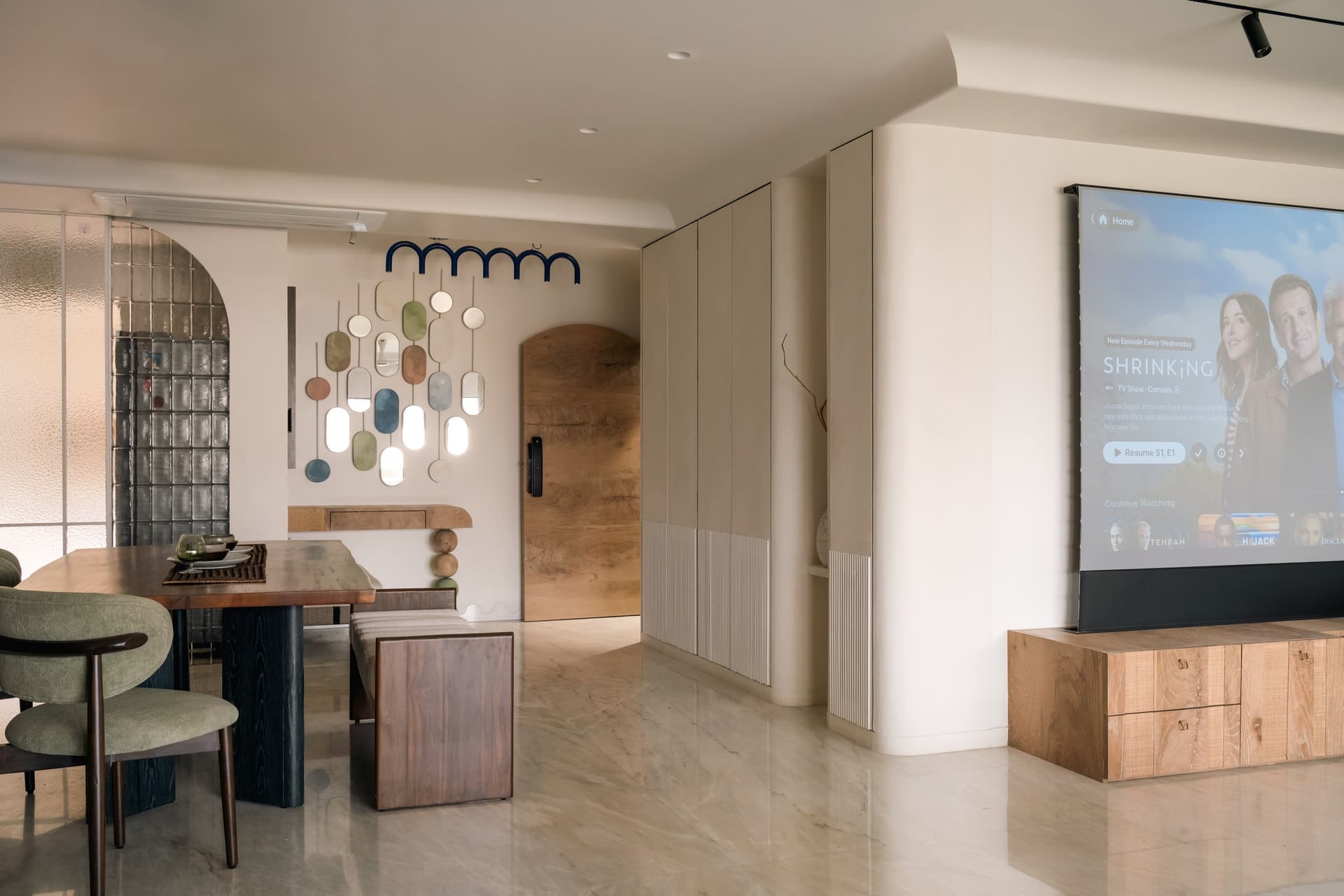
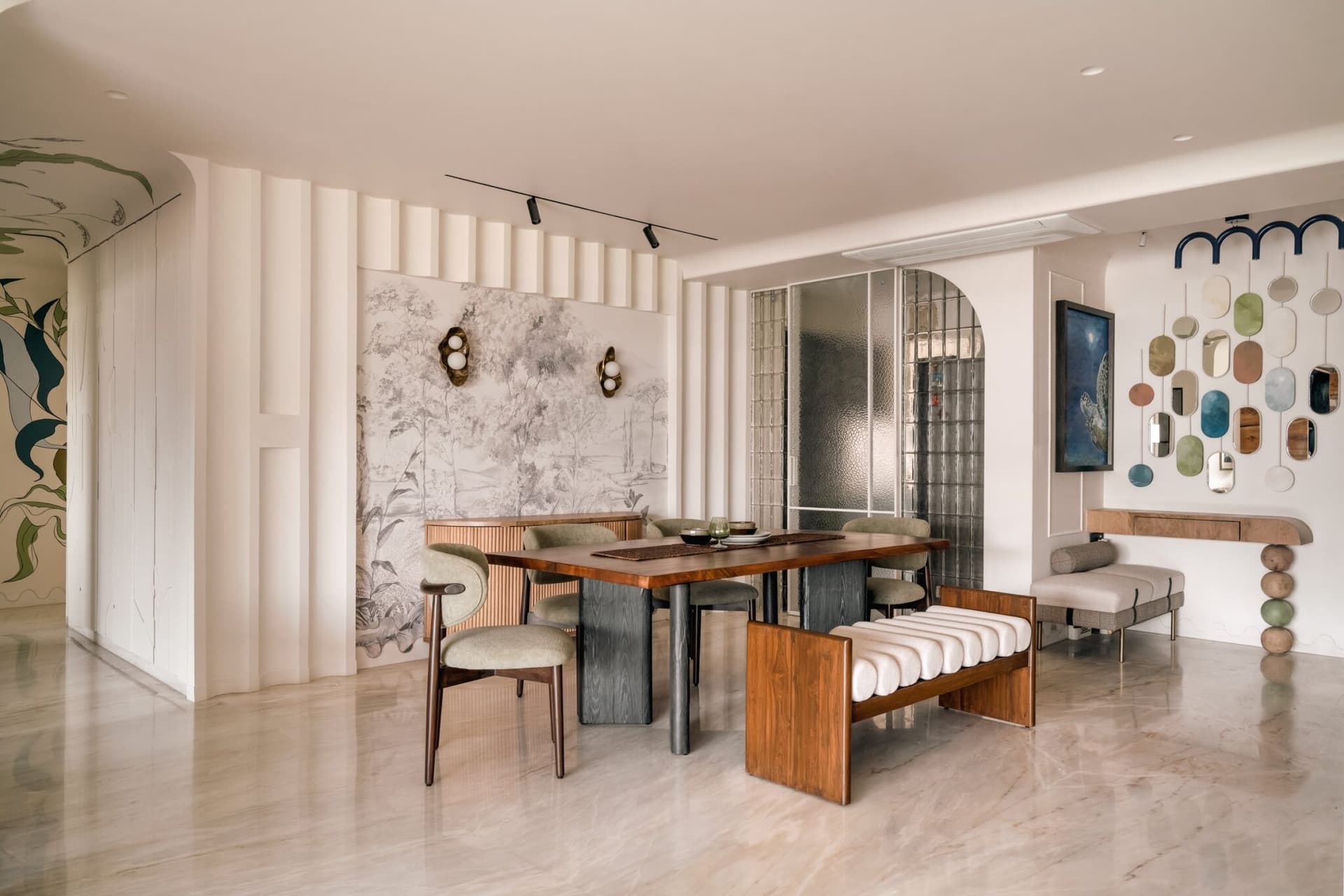
Turn into the main living-dining volume and the home’s vocabulary becomes visible all at once: a wall of pale, almost monastic cabinetry with discreet fluting at its base, an arched solid-wood door that reads as joinery and sculpture in equal measure, and a glass-block partition that lets light pass without giving anything away.
Above the wooden console, a composition of suspended oval mirrors and discs in dusty greens, blues and terracotta hangs beneath a small painted arch motif. It is the most decorative gesture in the home, and yet it remains tonally aligned, ornament absorbed into the palette rather than imposed upon it.
The dining area is where the home’s craft conversation becomes most articulate. A solid wood table on dark stained legs is flanked by sage-upholstered armchairs and a generous boucle-cushioned bench in a teak frame, each piece a different note in the same chord.
The wall behind, painted with a soft monochrome landscape mural and punctuated by two sculptural sconces, gives the dining a backdrop that feels closer to a private gallery than a feature wall. The fluted plaster columns above frame the mural as if it were always meant to be there.
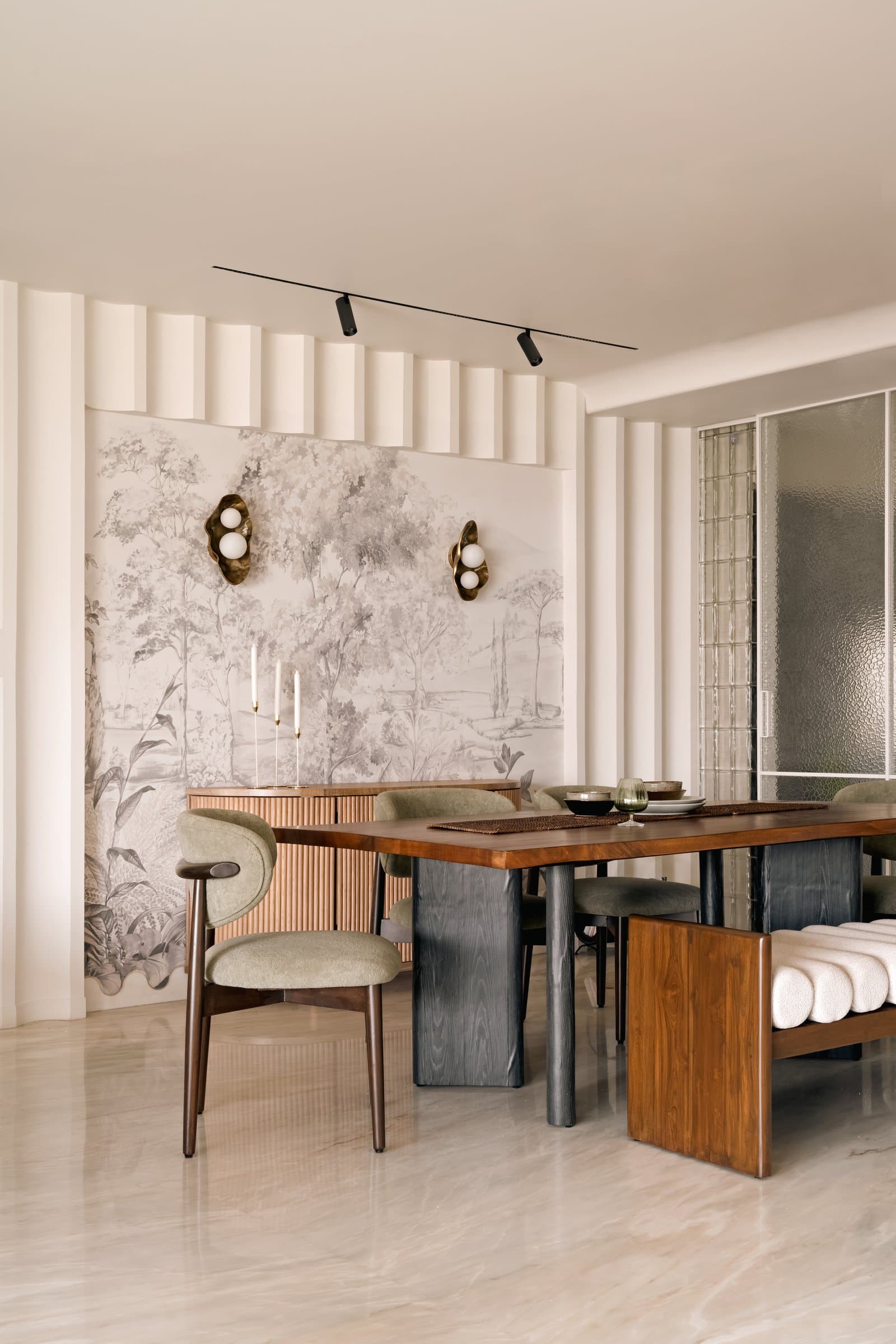
Pulled closer, the dining vignette reveals its smaller decisions. The credenza tucked behind the bench, the brass-and-glass sconces that read as small organic forms, and the table’s seam where warm wood meets blackened base are all moments of restraint rewarded by attention.
This is the kind of room that does not announce its craftsmanship; it simply waits to be noticed.
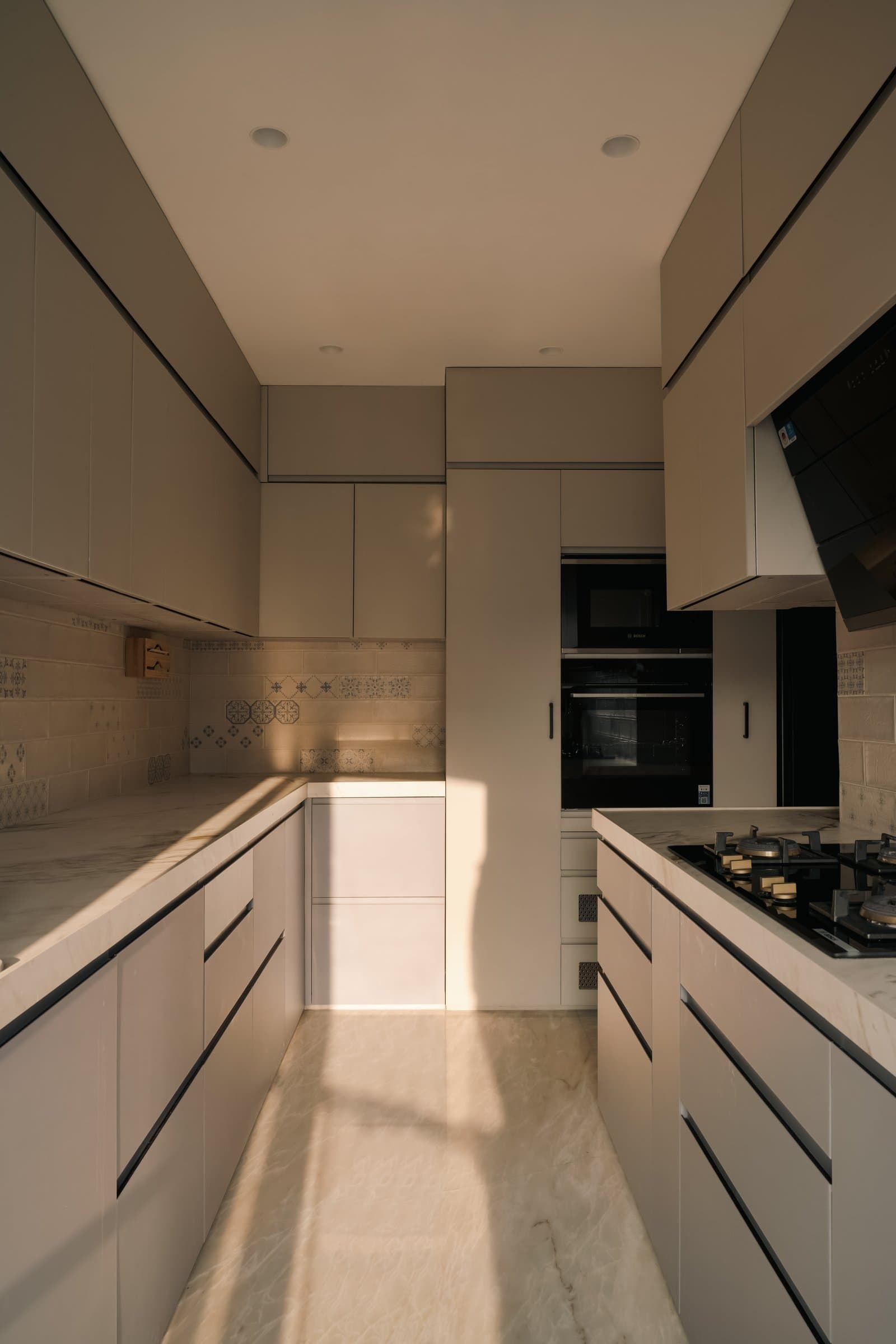
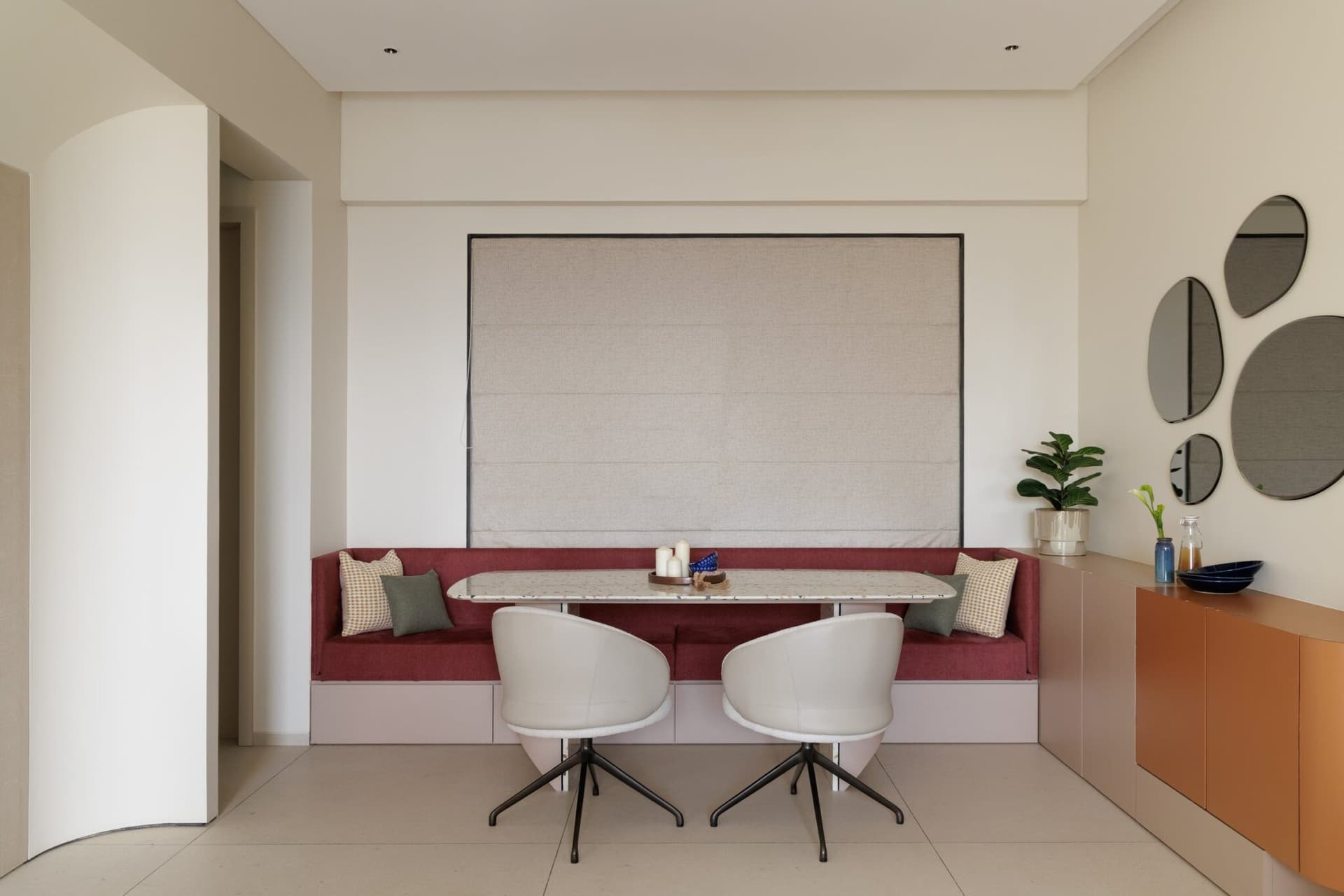
The kitchen is the most pragmatic room in the home and treats that brief seriously. Handleless cabinetry in a soft mushroom tone wraps the galley, paired with a veined stone counter and a backsplash of patterned tiles that introduce the only ornamental note in the space.
Late light cuts across the floor in a single bright band, and the room reveals itself as a working kitchen first, a designed one second, which is exactly the right priority.
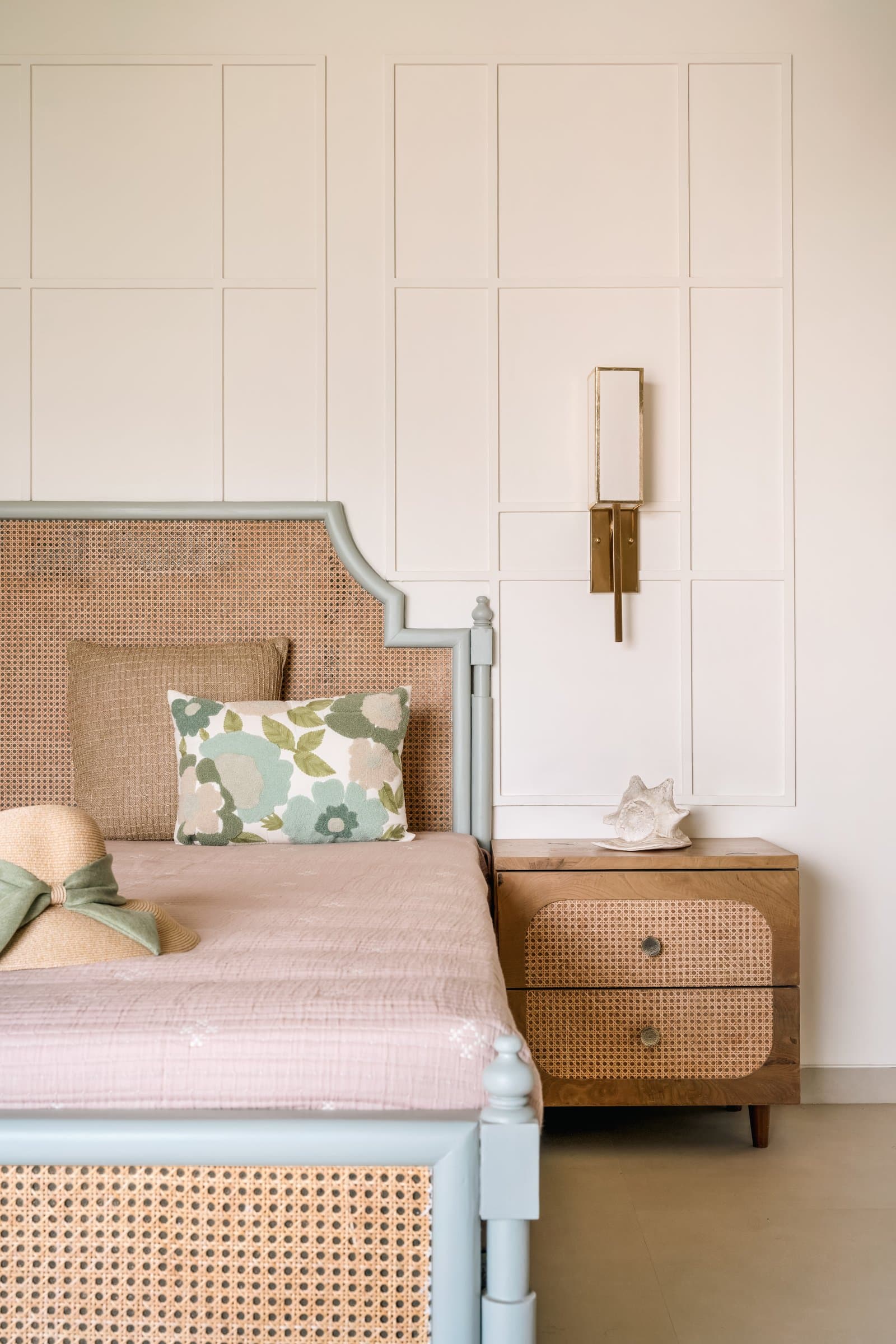
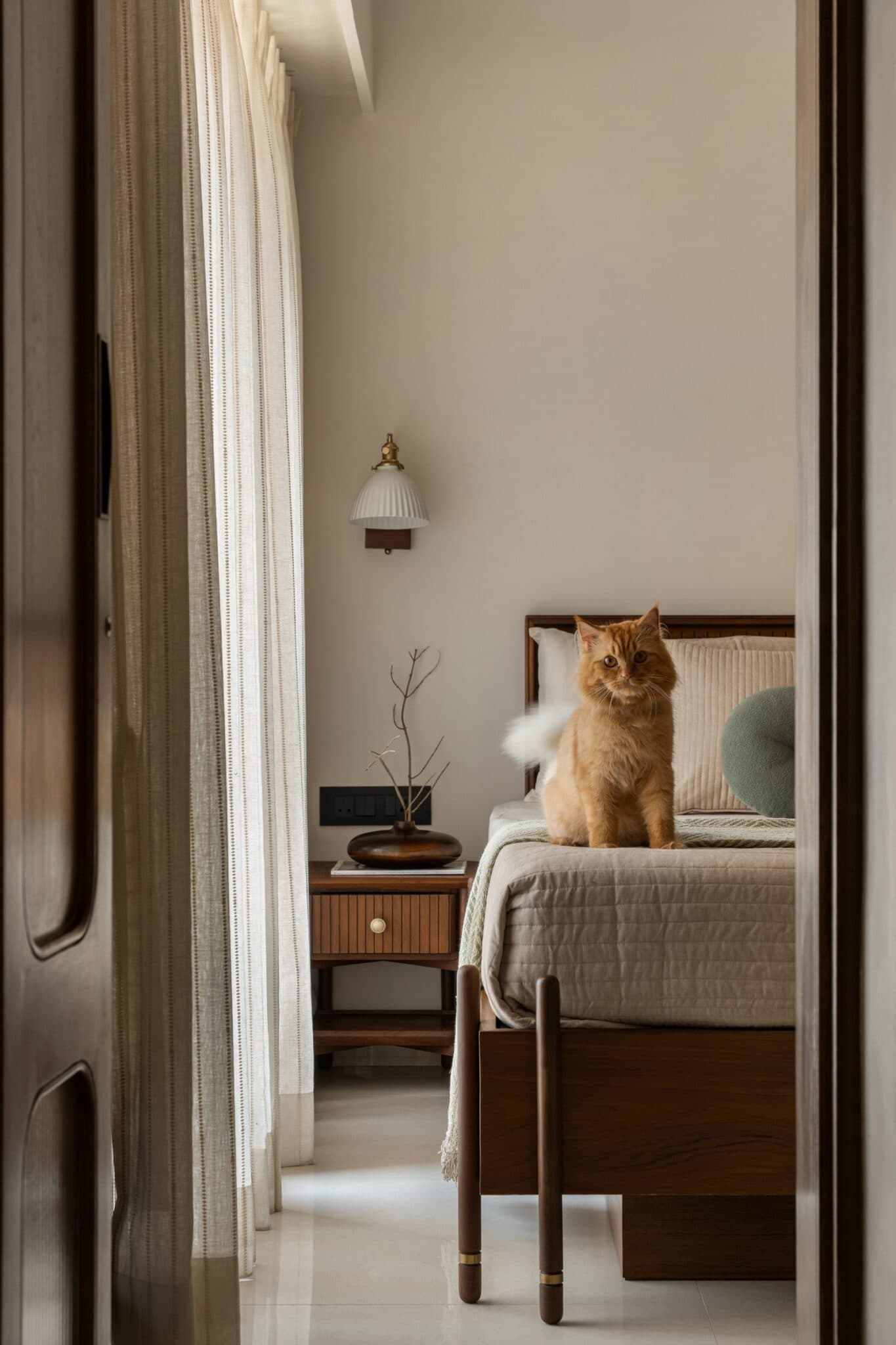
One of the daughters’ rooms takes the home’s quiet palette and lets it lift into something more playful. A pale blue-painted bed frame with a cane-inset headboard sits against a wall of full-height panelled moulding in soft cream, with a small brass sconce as its companion.
The bedside chest, in warm wood with a cane drawer face, finishes the gesture. There is a softness here that reads as childlike without resorting to cliché.
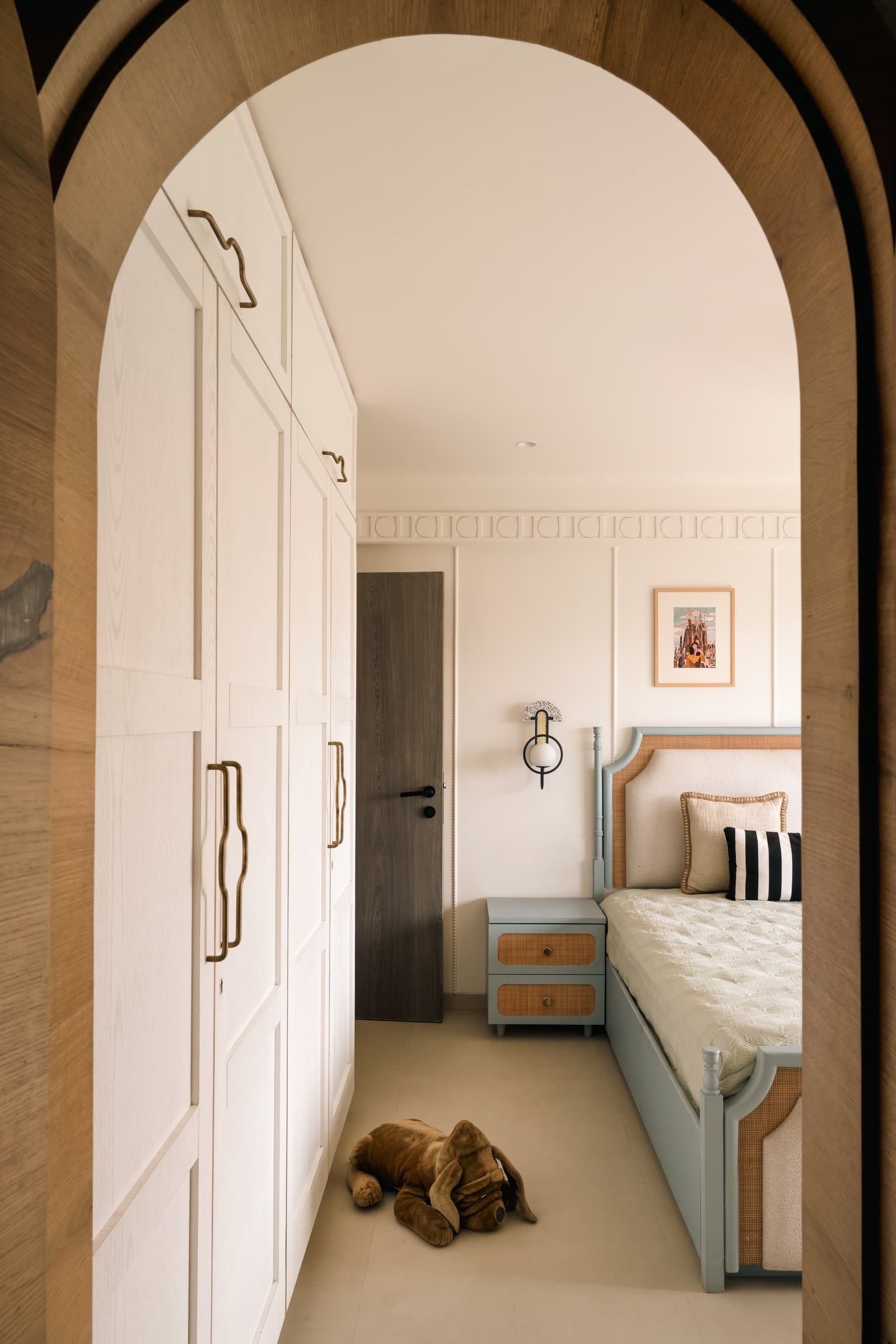
Viewed through the archway, the second daughter’s room reads as a more grown-up extension of the same idea: cream wardrobes with custom cut-out handles, a decorative cornice band running along the upper wall, and the cane-headboard bed in dusty blue echoing its companion room. The arched threshold itself becomes part of the design, a recurring motif that ties the private wing to the home’s larger grammar.
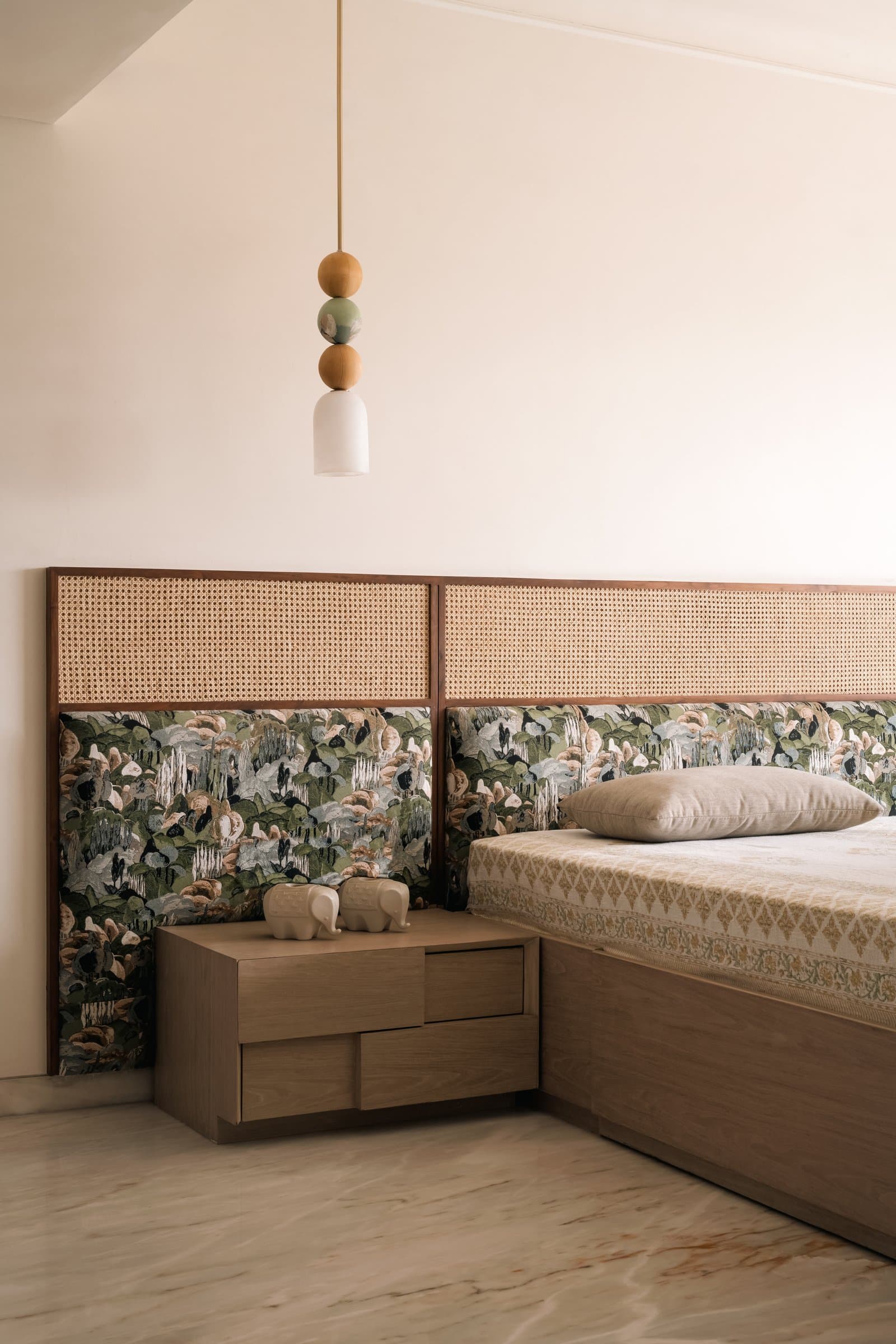
The master bedroom shifts register entirely. Here, a custom headboard pairs woven cane above a printed panel of layered greens, ochres and inky botanical forms, the most patterned surface in the home and the only one allowed to be loud.
A small spherical pendant in cream, sage and wood drops beside it, scaled like jewellery. The room asserts that quietness elsewhere has been a choice, not a default.
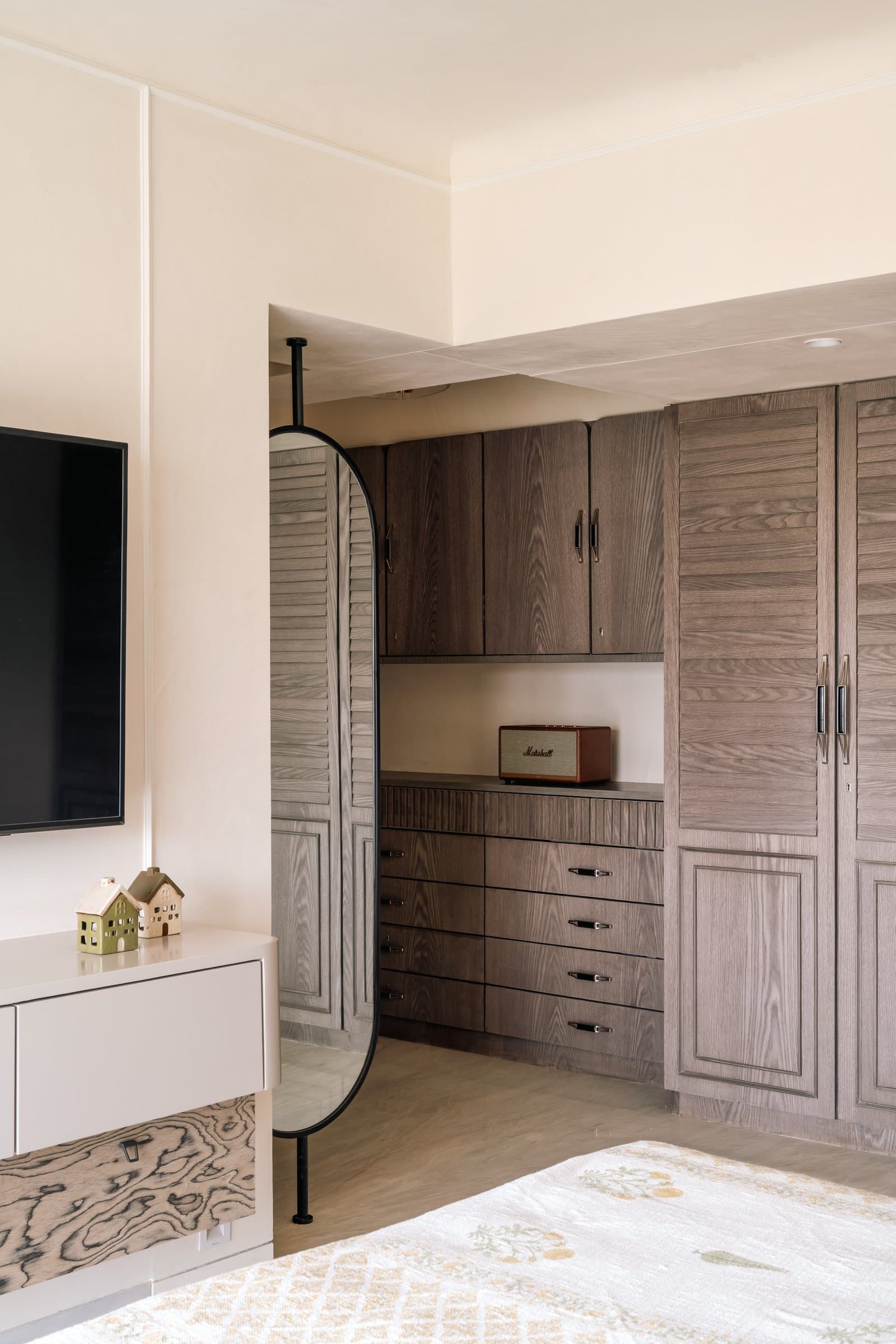
Across from the bed, the master’s storage wall reads as furniture rather than built-in joinery: louvred and panelled doors in a fumed grey-brown wood, fluted drawer fronts in the centre, an oval freestanding mirror on a slim black armature.
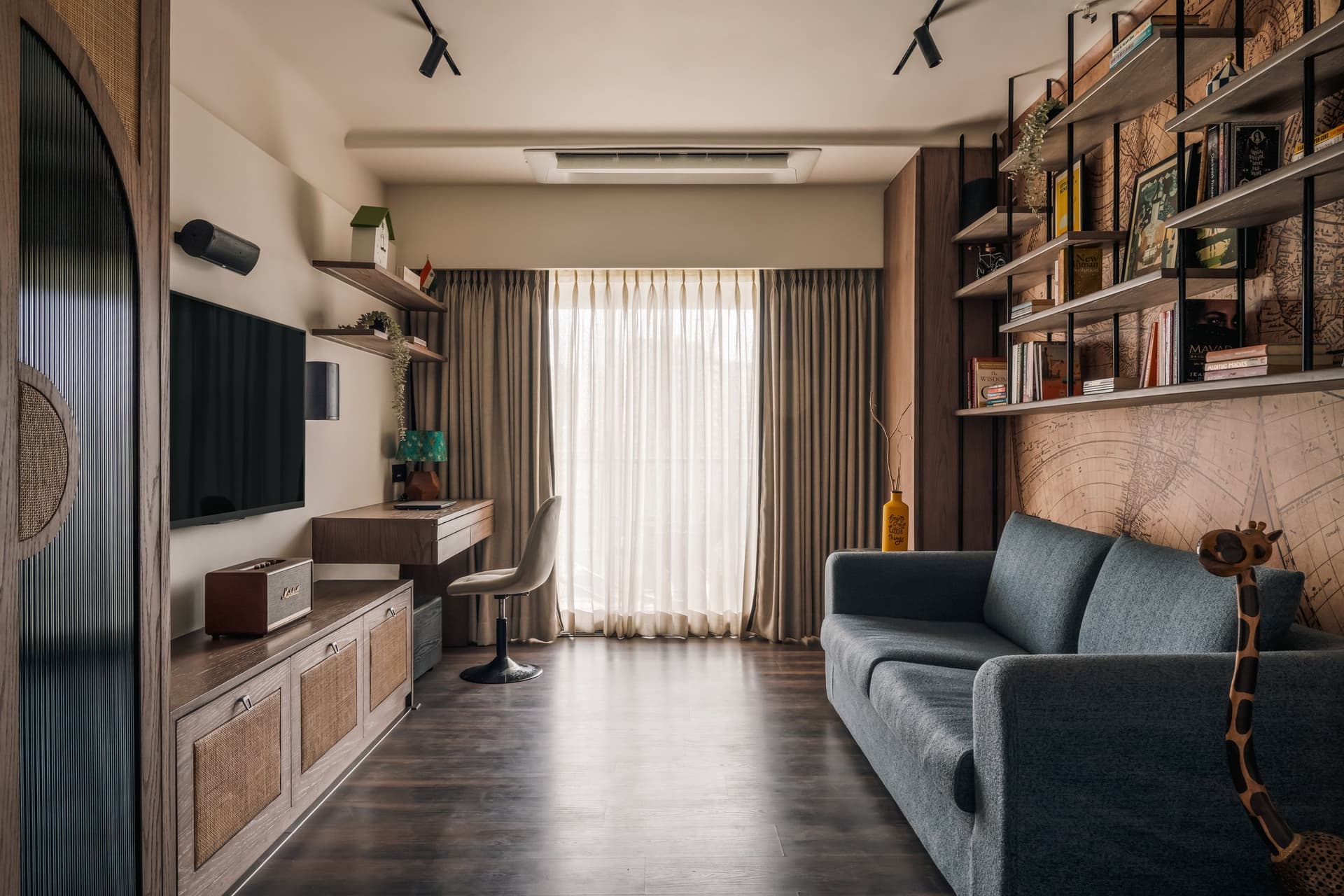
The study is the home’s most personal room and looks it. A wall-mounted television sits above a cane-fronted media unit; opposite, a deep slate-blue sofa anchors the seating side, with an open metal-and-wood shelving system climbing the entire wall behind it.
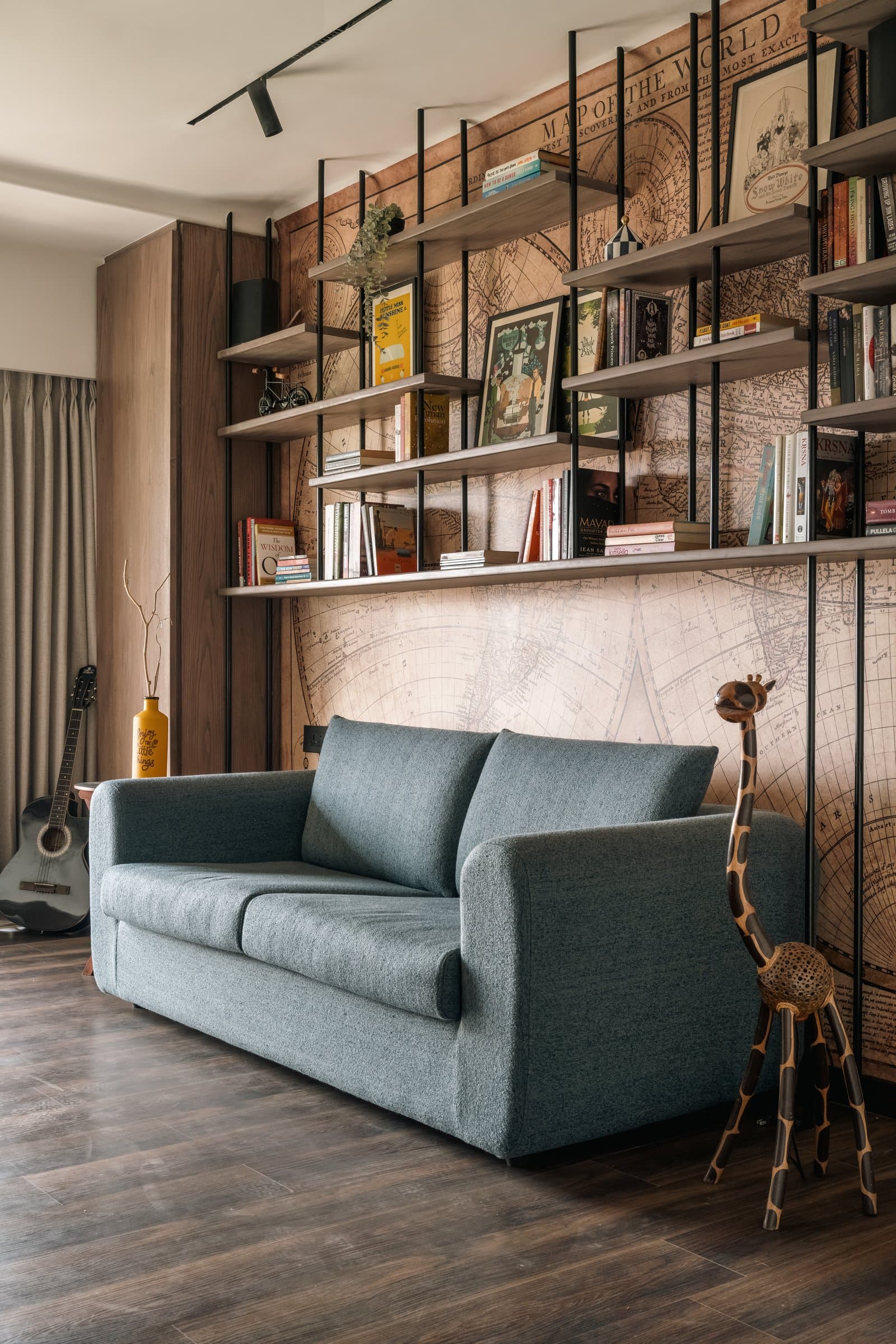
Closer in, the bookshelf wall reveals its quietest indulgence: a wallpaper of an antique world map running floor to ceiling behind the open shelving. It is the kind of decision that risks theme-park literalism in less careful hands but here, dimmed in tone and partially obscured by books, it reads as atmosphere rather than statement.
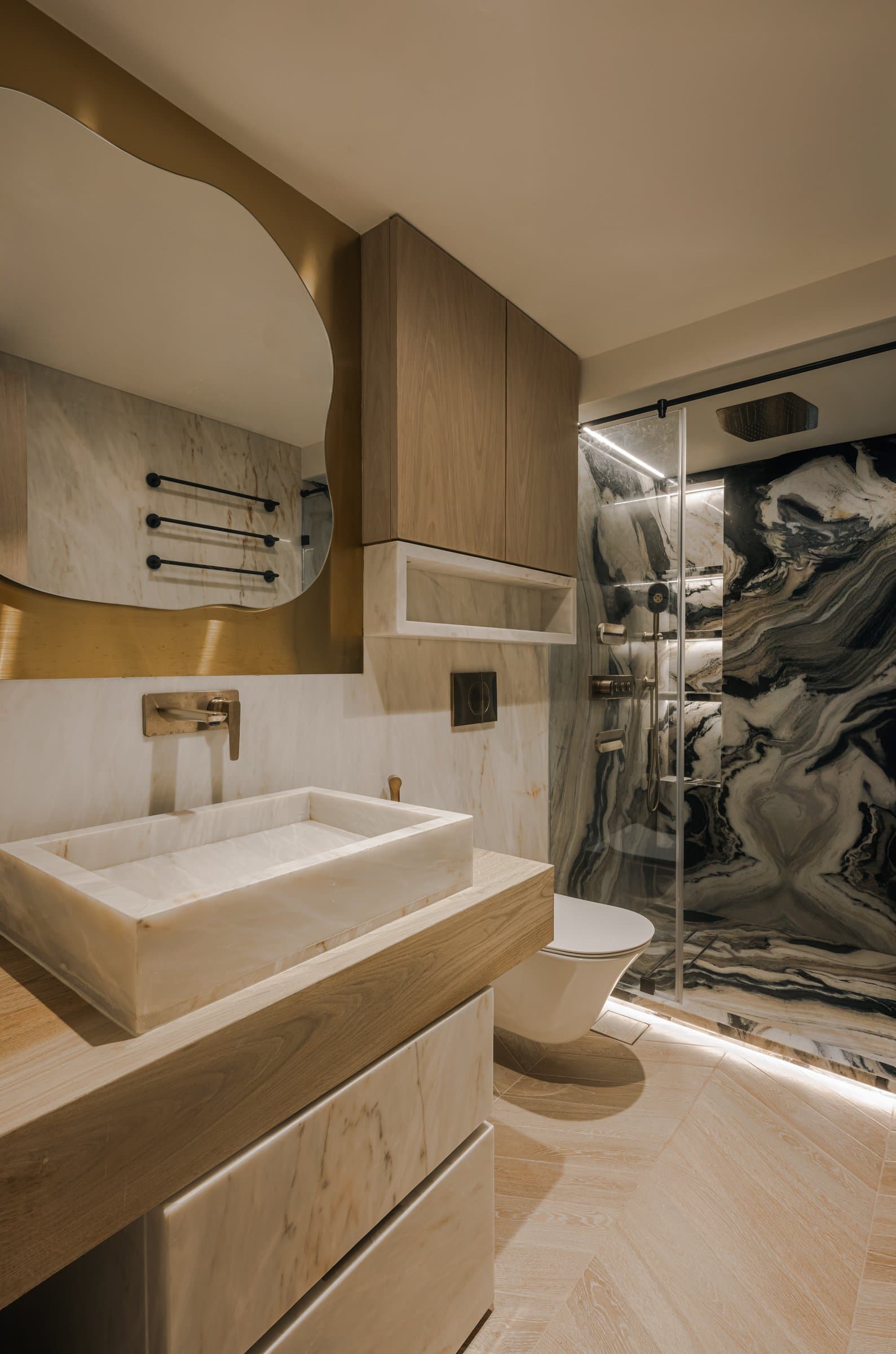
The master bathroom is where the home permits itself a moment of sculptural ambition. A dramatically veined black-and-white stone slab clads the shower wall, set against quieter cream marble and warm wood vanity joinery. A wavy-edged mirror floats above a stone trough basin, brushed brass fittings catching the warm light.
It is the only room in the home that announces itself with this much volume, and the contrast is the point.
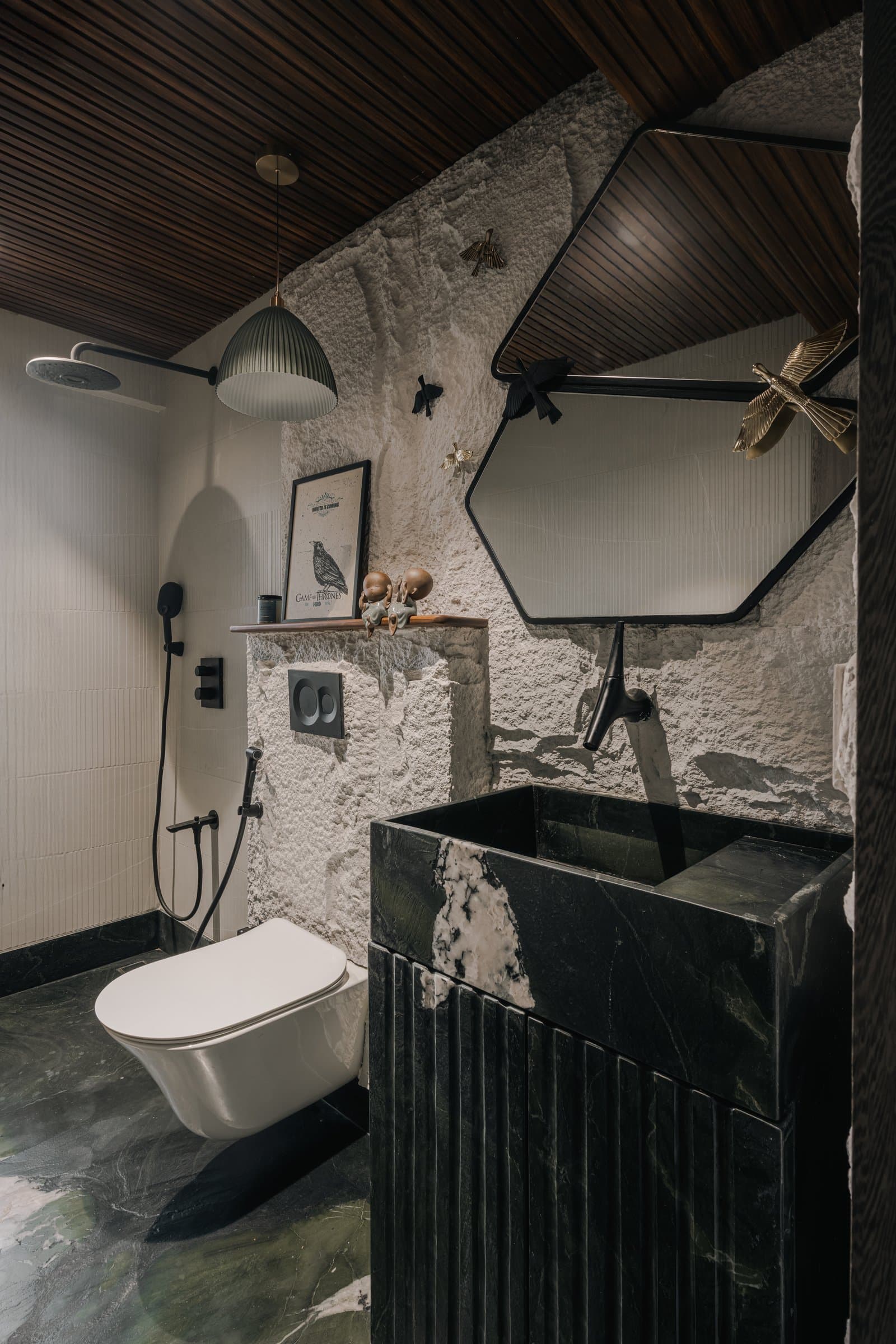
The powder room takes the opposite extreme. A rough-hewn white stone wall, a wood-slatted ceiling and a dark green marble basin with fluted detailing turn the smallest room in the home into its most tactile.
Black fittings, a hexagonal mirror and a few small brass objects on the ledge complete the scene. The room is a reminder that the same studio capable of restraint elsewhere is also capable of texture as theatre.
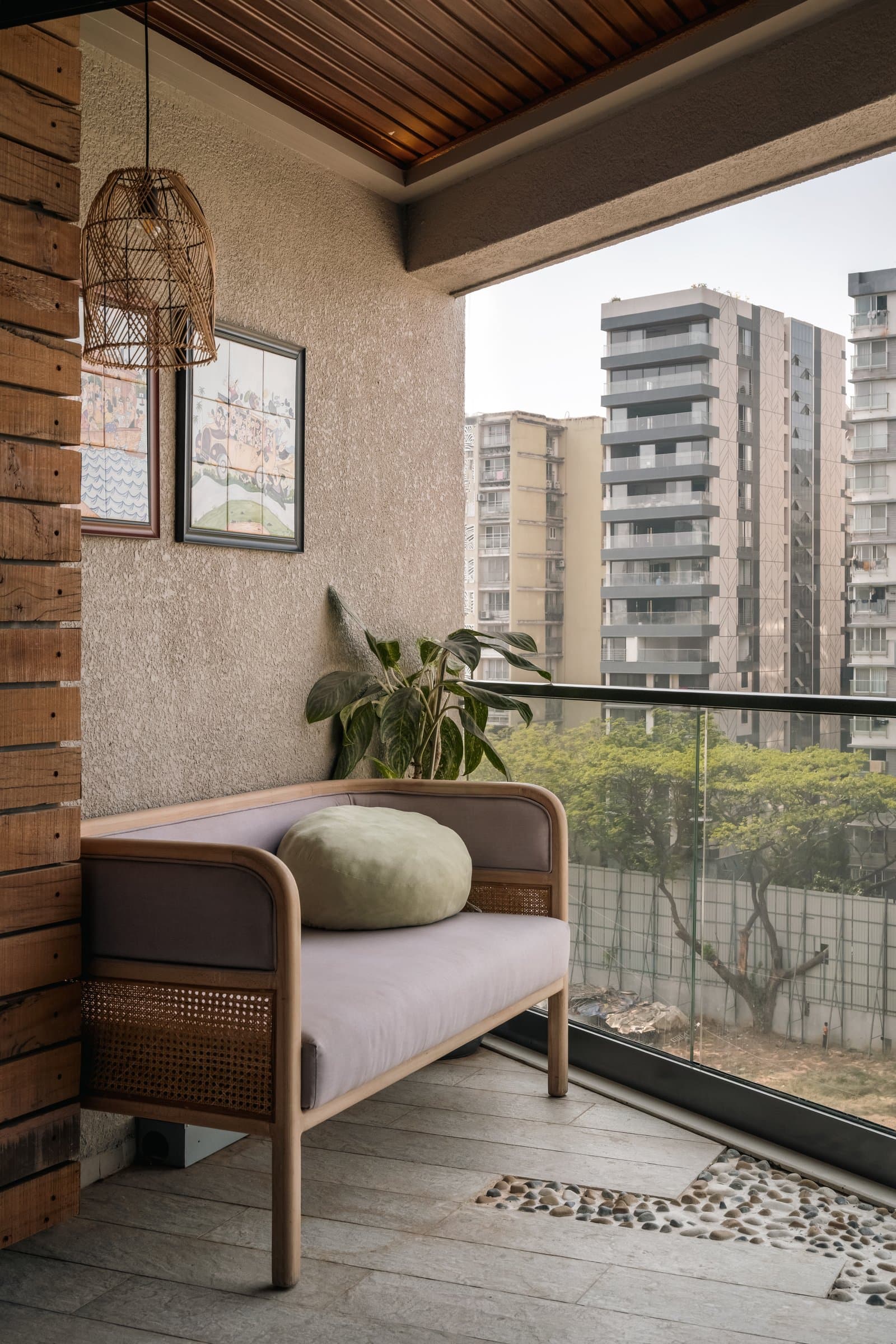
The balcony is treated as a proper room rather than a leftover edge. A cane-and-wood loveseat with dusty mauve upholstery sits beneath a rattan pendant, a small framed pichwai-style artwork on the textured wall behind. Wooden cladding to one side, a river-pebble inlay in the floor, and a planter softening the threshold to the railing turn what could have been an afterthought into a genuine pause point in the home.
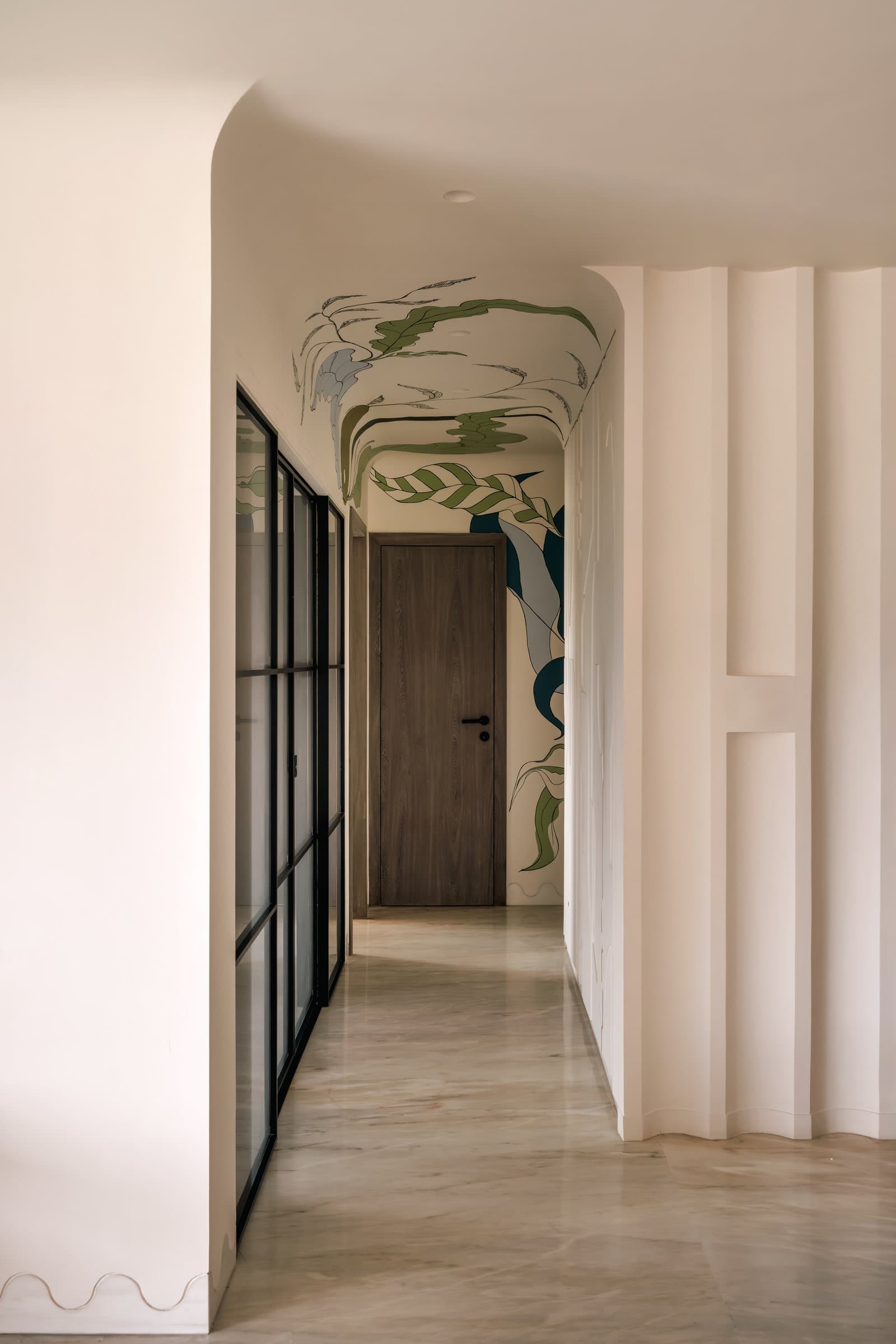
The passage connecting the public and private wings is the home’s most graceful spatial moment. A curved ceiling carries a hand-painted mural of green and grey botanical forms that trails overhead like vines, while one wall holds the home’s signature fluted plaster columns and the other a steel-and-glass partition that filters light without enclosing it.
It is a corridor that refuses to be merely functional, and it explains, in a single view, what Switchover Studio means by rhythm.
For a city where apartments often default either to glossy maximalism or to a kind of safe, palette-driven neutrality, Muted Rhythm proposes a third register. It is warm without being nostalgic, layered without being busy, and contemporary without ever feeling cold, a vocabulary that draws on craft traditions but does not signal them too loudly.
What lingers, after the rooms have been catalogued and the materials named, is the home’s tempo. The design proposes that softness can be a form of confidence, that ornament can be absorbed rather than displayed, and that a home is best measured not by what it shows but by the rhythm at which it asks to be lived in.