A home shaped by sand dunes does not announce itself in landscape; it announces itself in line. Curves replace corners, surfaces lift into low ridges, and the architecture borrows the patient geometry of wind on dune rather than the hard grammar of urban apartments. This is what Casa Dune proposes from its first wall: that softness is structural, not decorative.
Designed by Enliven Studio for a family in Palghar on the outer edge of Mumbai’s metropolitan fabric, the apartment treats its compact footprint as an opportunity rather than a constraint. The brief asked for warmth, individuality, and a sense of escape from the dense building grid outside, and the studio answered with a palette of dune-beige, terracotta and walnut, set against a recurring vocabulary of arches, ovals and ripples. Every room is a variation on the same single idea, returned to and reworked.
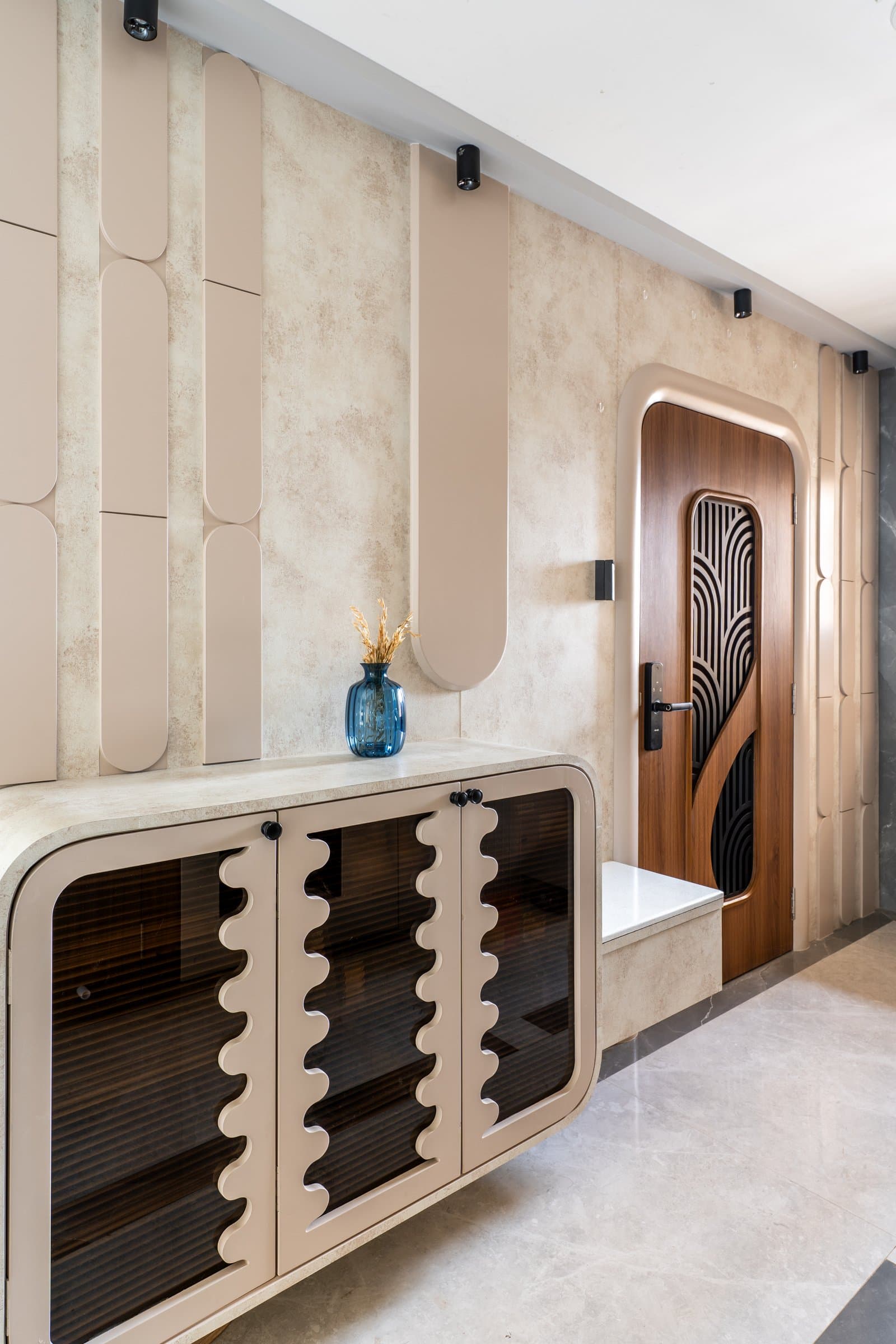
The foyer sets the grammar before the home fully begins. A floating console with wave-edged fronts in glass and beige lacquer sits against a wall of textured plaster, where elongated capsule-shaped panels rise and fall in soft relief. The entry door, with its arched timber inlay and curvilinear cut-outs, reads more like a sculptural object than a threshold.
The argument here is one of repetition without redundancy. The same dune motif appears in three different scales, the wall panels, the console fronts, the door insert, and the eye reads them as a single conversation rather than a checklist of features. Restraint in palette allows the geometry to do the work.
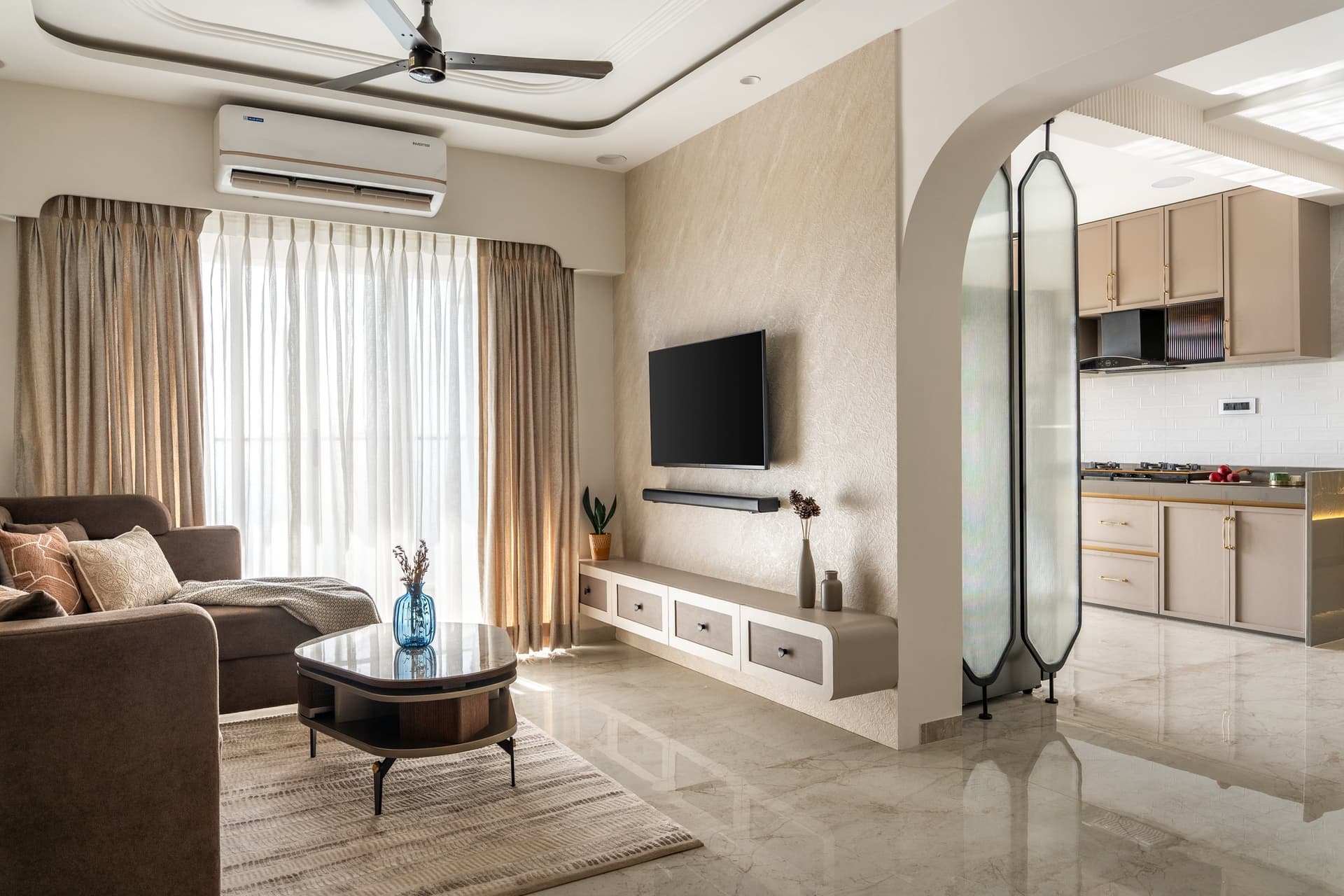
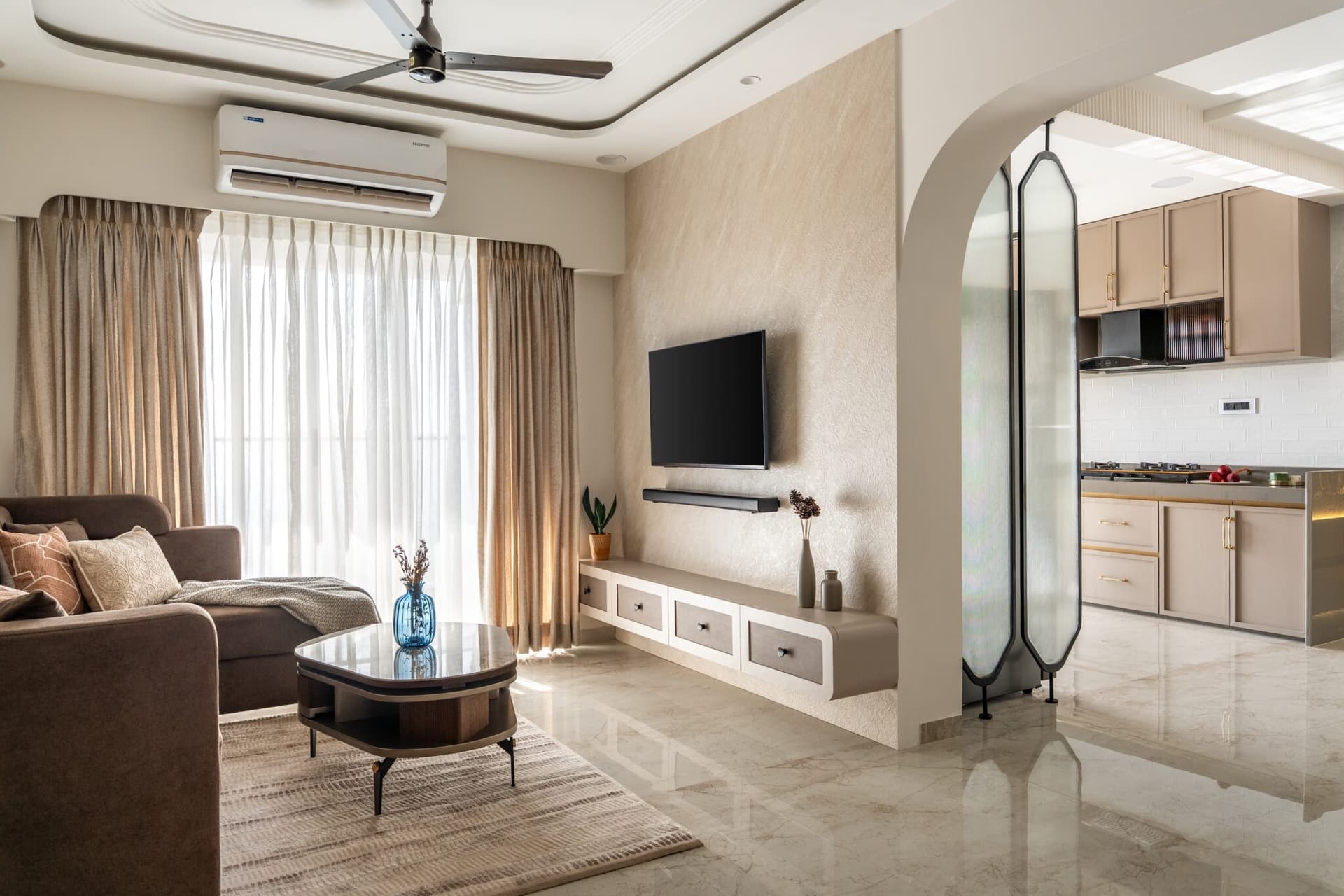
The living room opens with an arched plaster opening with a freestanding glass screen that frames the kitchen beyond without sealing it off, a quiet spatial generosity in an apartment where every metre is accounted for. A textured plaster wall holds the television, while a low console with a curved profile and plain drawer fronts with rounded ends grounds the composition.
The room is small but resolved with patience. Light from the wide window slides across the marble floor and hits the cane-toned upholstery at exactly the angle that makes the space feel larger than it is.
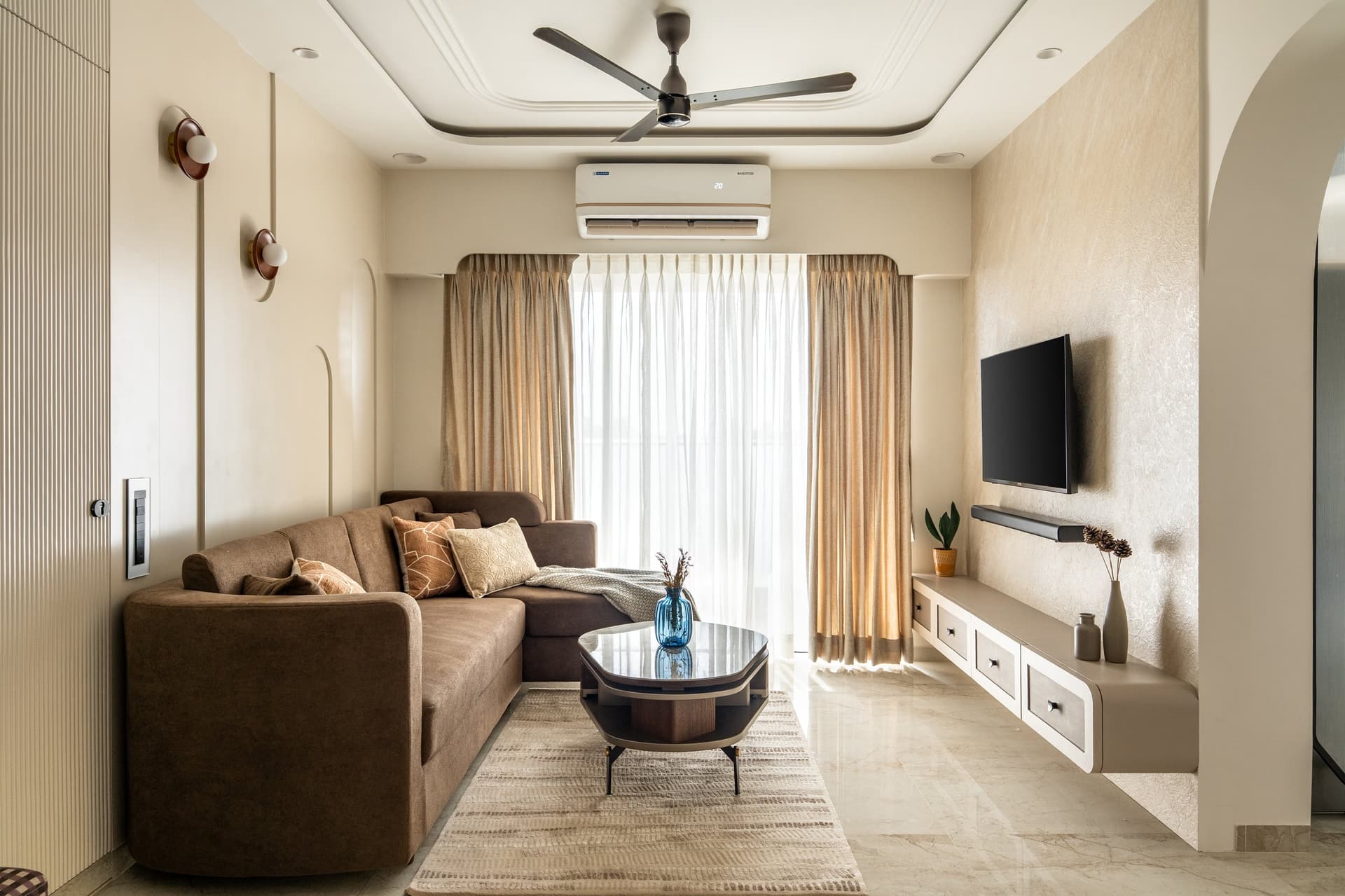
From a tighter angle, the living room reveals its full furniture geometry. The sectional sofa in deep cocoa upholstery anchors the room, paired with an oval coffee table whose two-tier construction in wood and stone reads as a single sculptural gesture. Wall sconces with circular wooden rings climb the fluted side wall in a vertical procession.
““The dunes do not move in straight lines, and we did not want this home to either.””
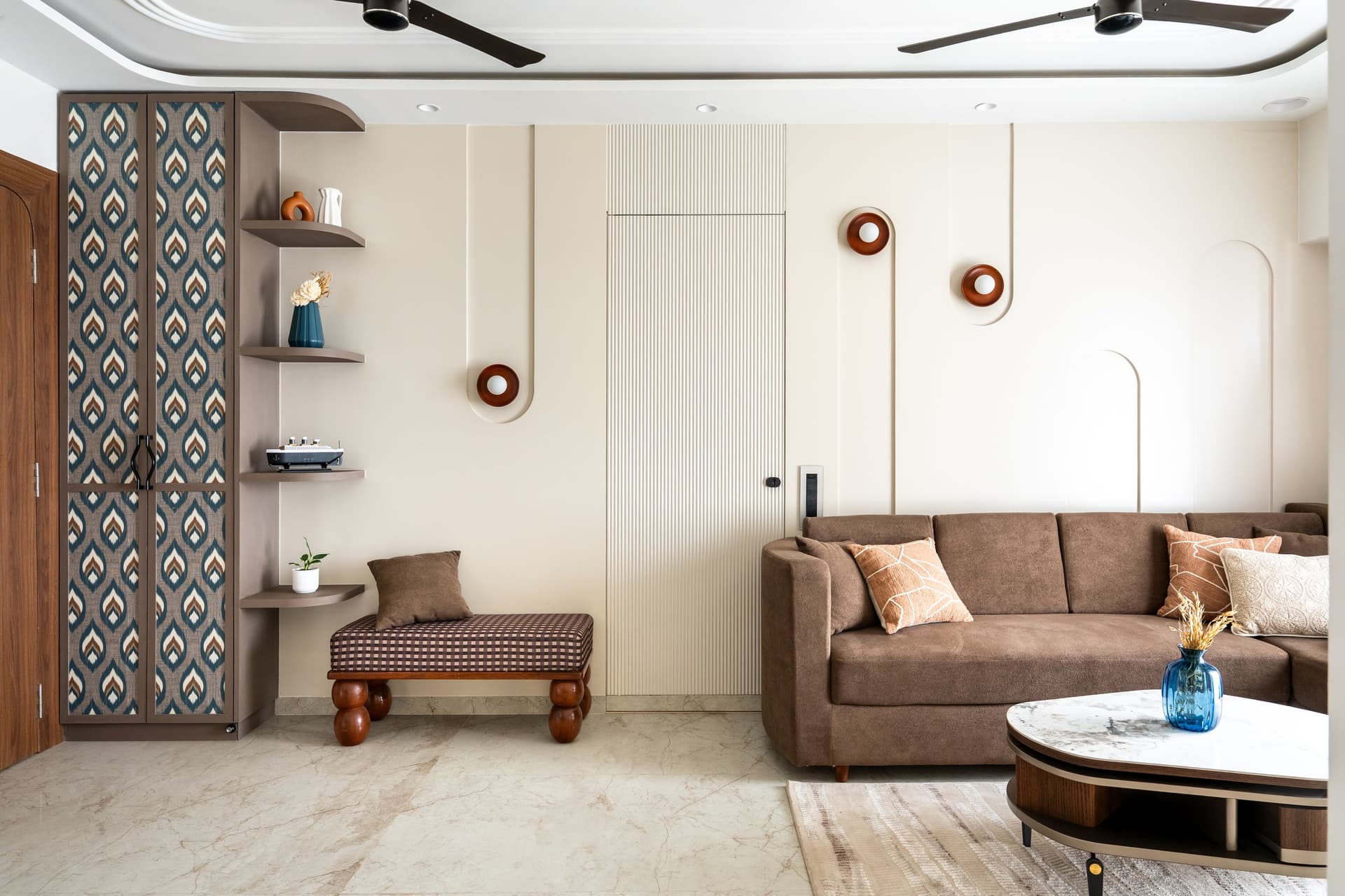
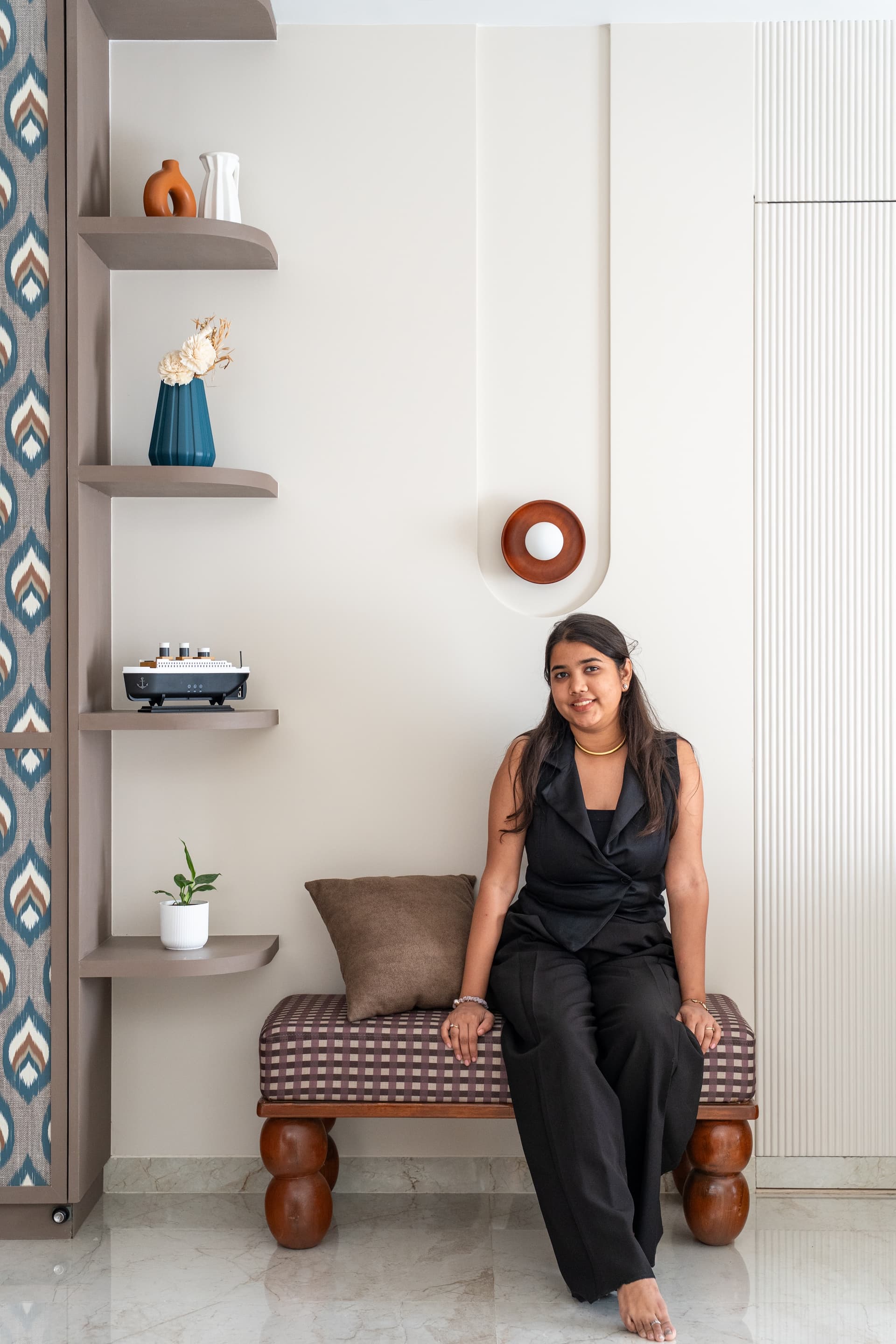
Across from the seating, a tall storage unit faced in an ikat-pattern panel in indigo and brown introduces the home’s one moment of overt pattern. Beside it, a slim shelving column carries small objects, while a low checkered ottoman on turned spherical legs sits in front as a punctuation mark.
This is where the apartment quietly reveals its hand. The ikat is not heritage citation but rhythmic relief, set against fields of plain plaster so that the eye reads it as music rather than decoration. The wall opposite carries three circular sconces mounted on raised plaster tracks that loop downward, drawing the dune motif into the lighting itself.
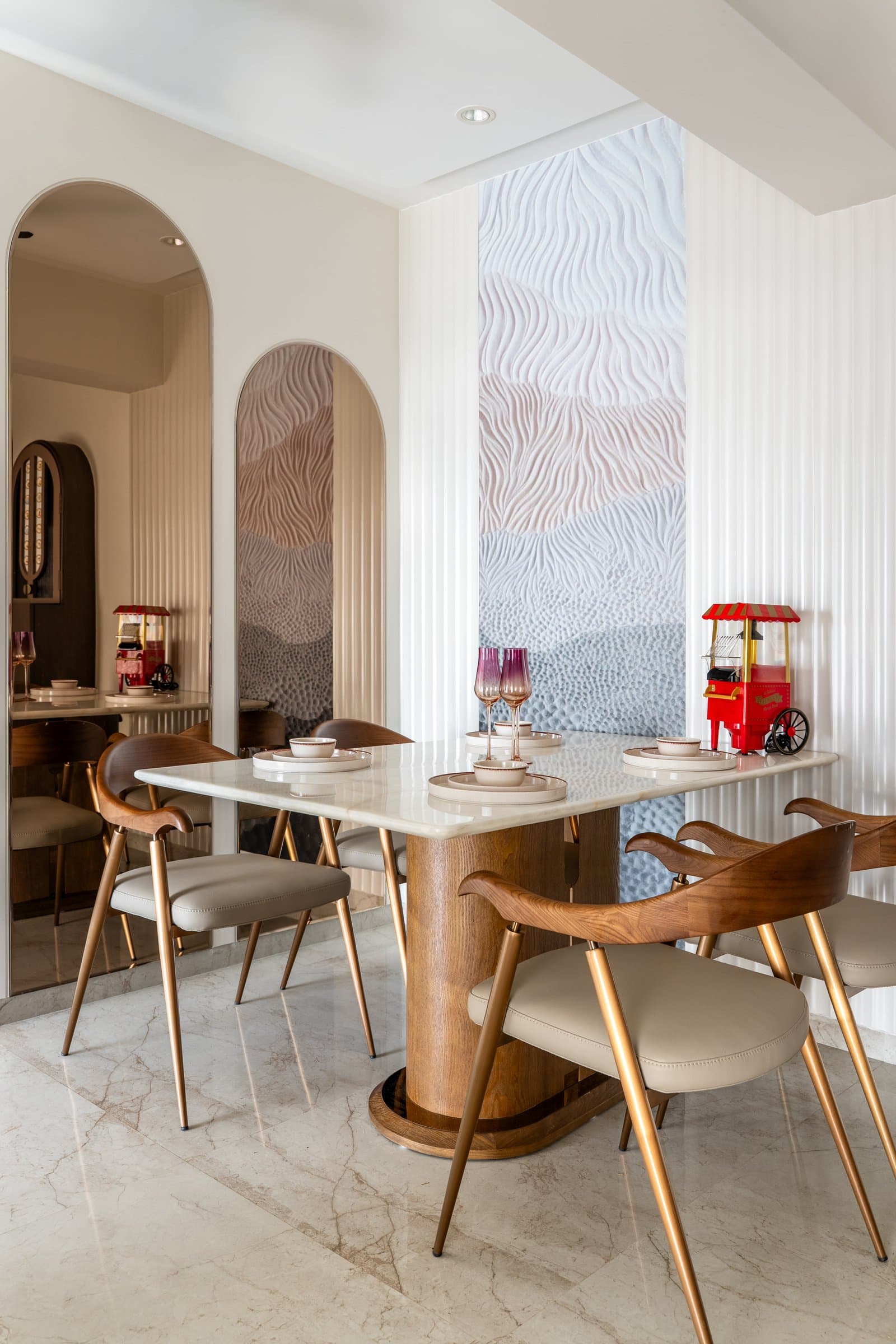
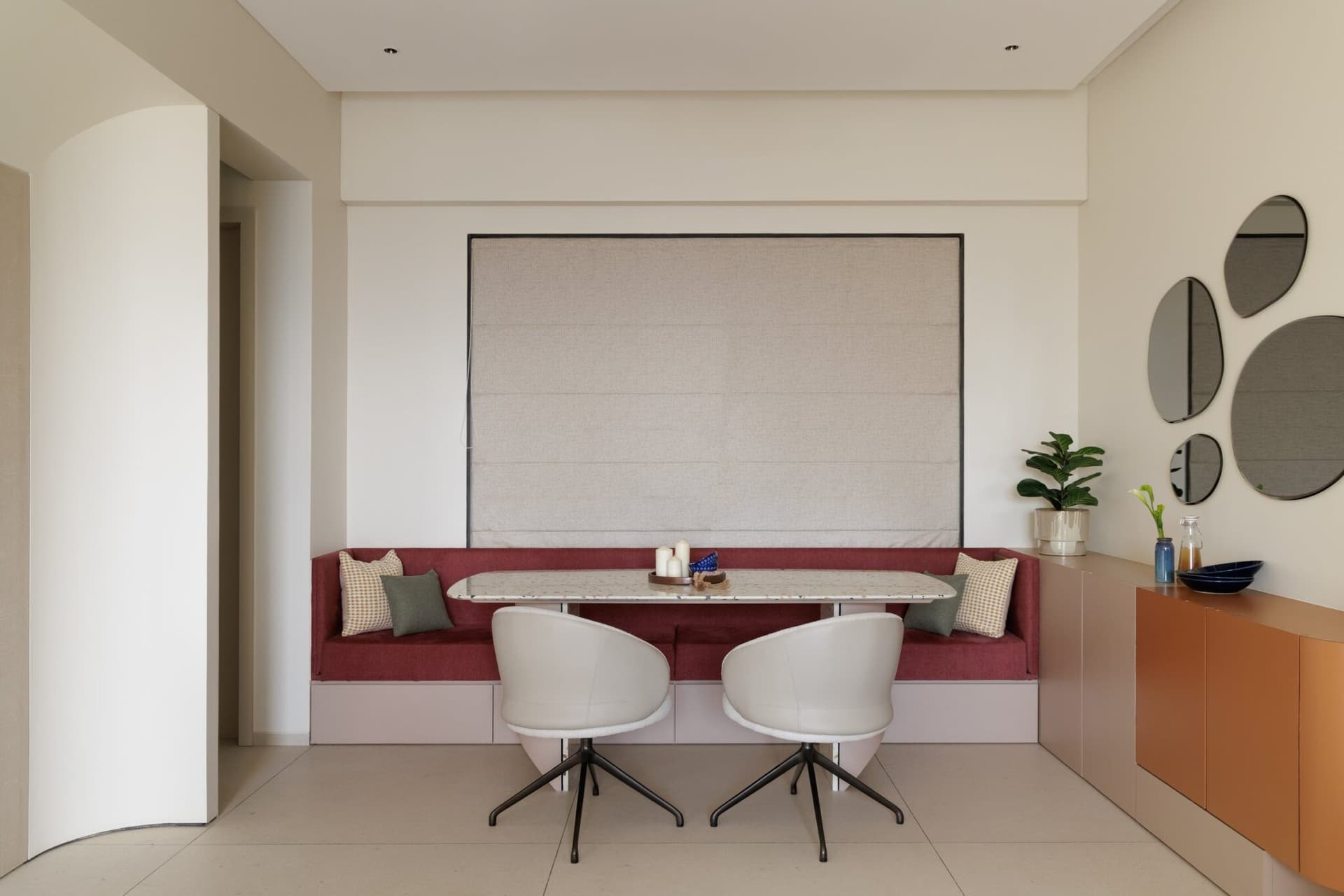
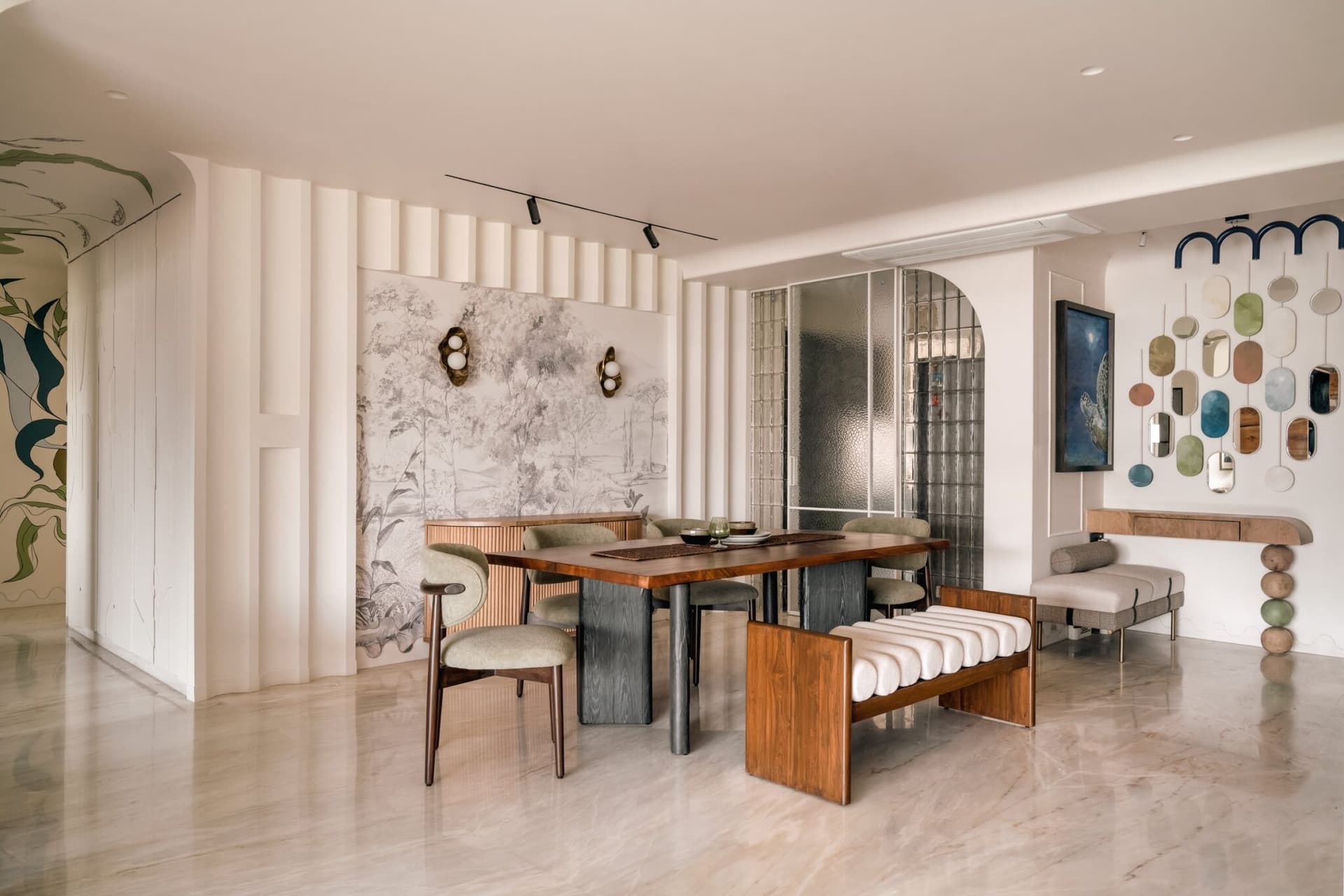
The dining area is the home’s most overt expression of the dune idea. A textured wall panel rendered in pale ripples sits between two slim fluted columns, flanked by a tall arched mirror that doubles the depth of the space. The dining table itself rests on a sculpted wooden pedestal, paired with chairs whose curved walnut backs echo the silhouette of a wave breaking.
This is the room where the metaphor becomes literal, and the studio knows it. The ripple panel could easily have tipped into theme-park territory; what saves it is the discipline of palette, soft cream and rose-blush against warm wood, and the refusal to repeat the motif anywhere else in the dining zone.
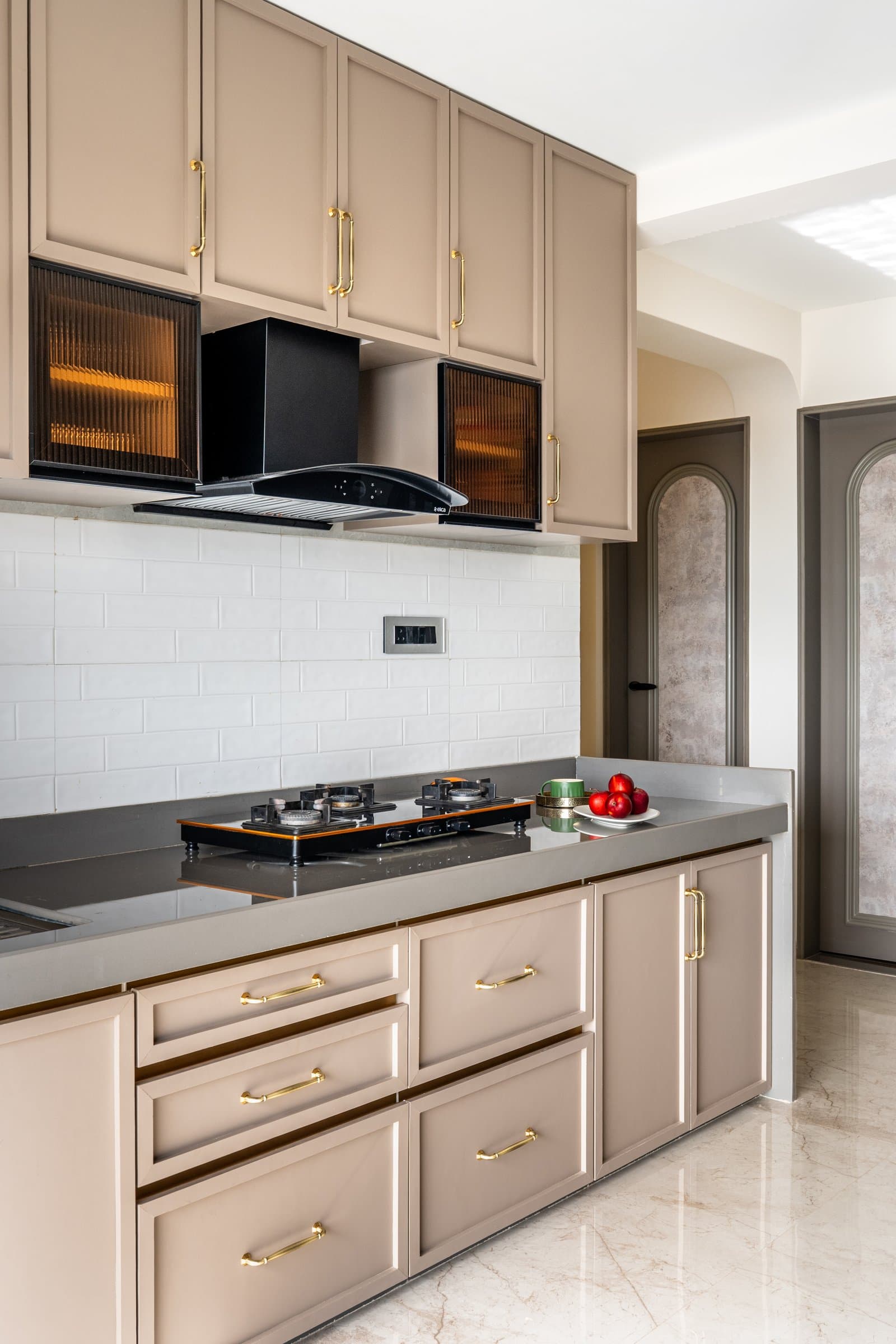
The kitchen turns the dune palette into something more practical. Cabinetry in matte dune-beige with slim brass pull handles wraps a grey quartz counter, while a white subway-tile backsplash introduces the only purely orthogonal surface in the apartment. Two upper glass cabinets in reeded amber glass with black frames sit beside a sculptural hood.
The choice of brass over chrome is deliberate. It warms a working surface that could otherwise have read as clinical, and it pulls the kitchen into the same tonal family as the living room beyond.
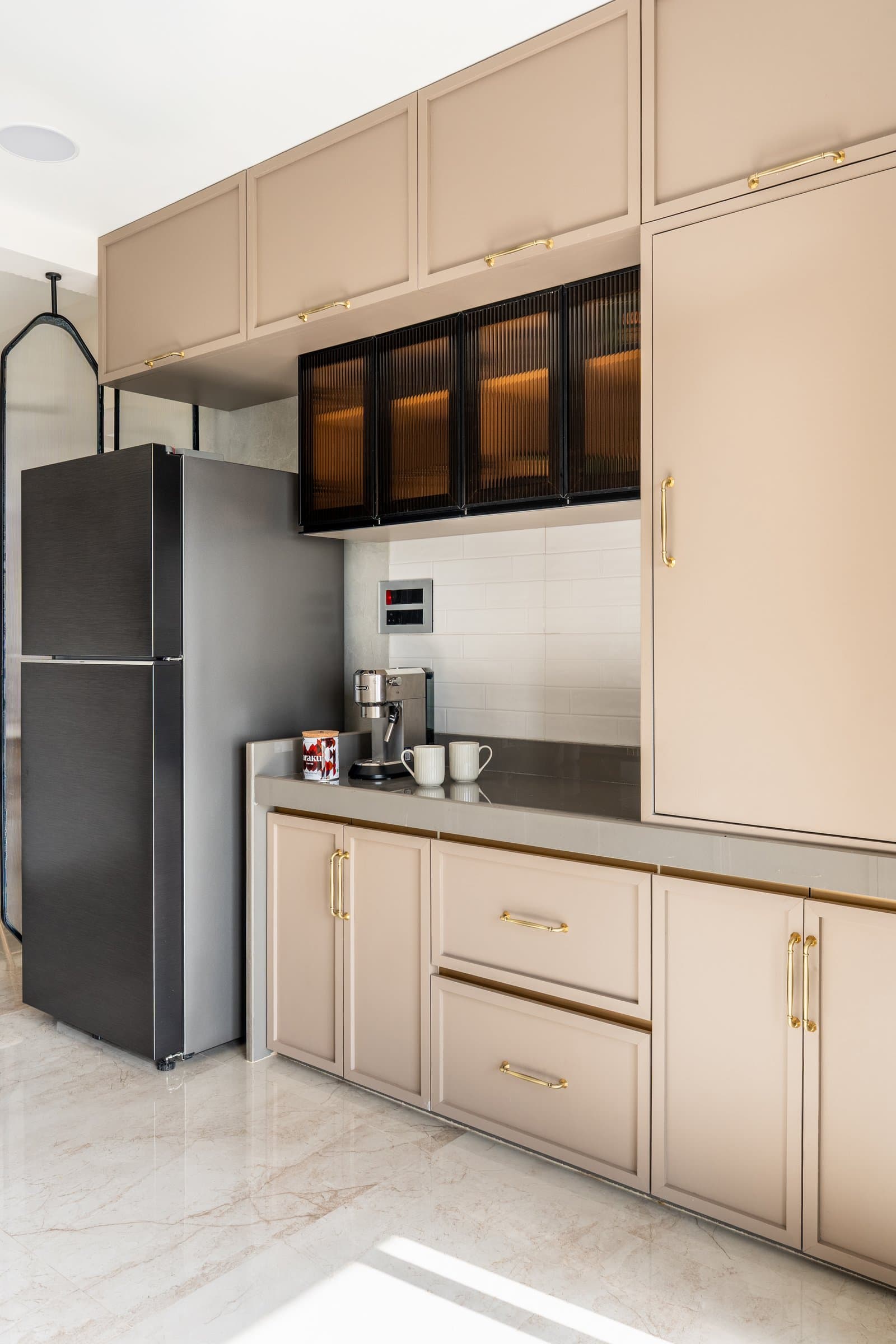
A second view of the kitchen captures its tall pantry wall, where the fridge sits flush against floor-to-ceiling cabinetry and a coffee station occupies a generous niche of counter. The reeded amber glass returns here as a horizontal band of upper cabinets, an architectural beat that ties the two sides of the kitchen together.
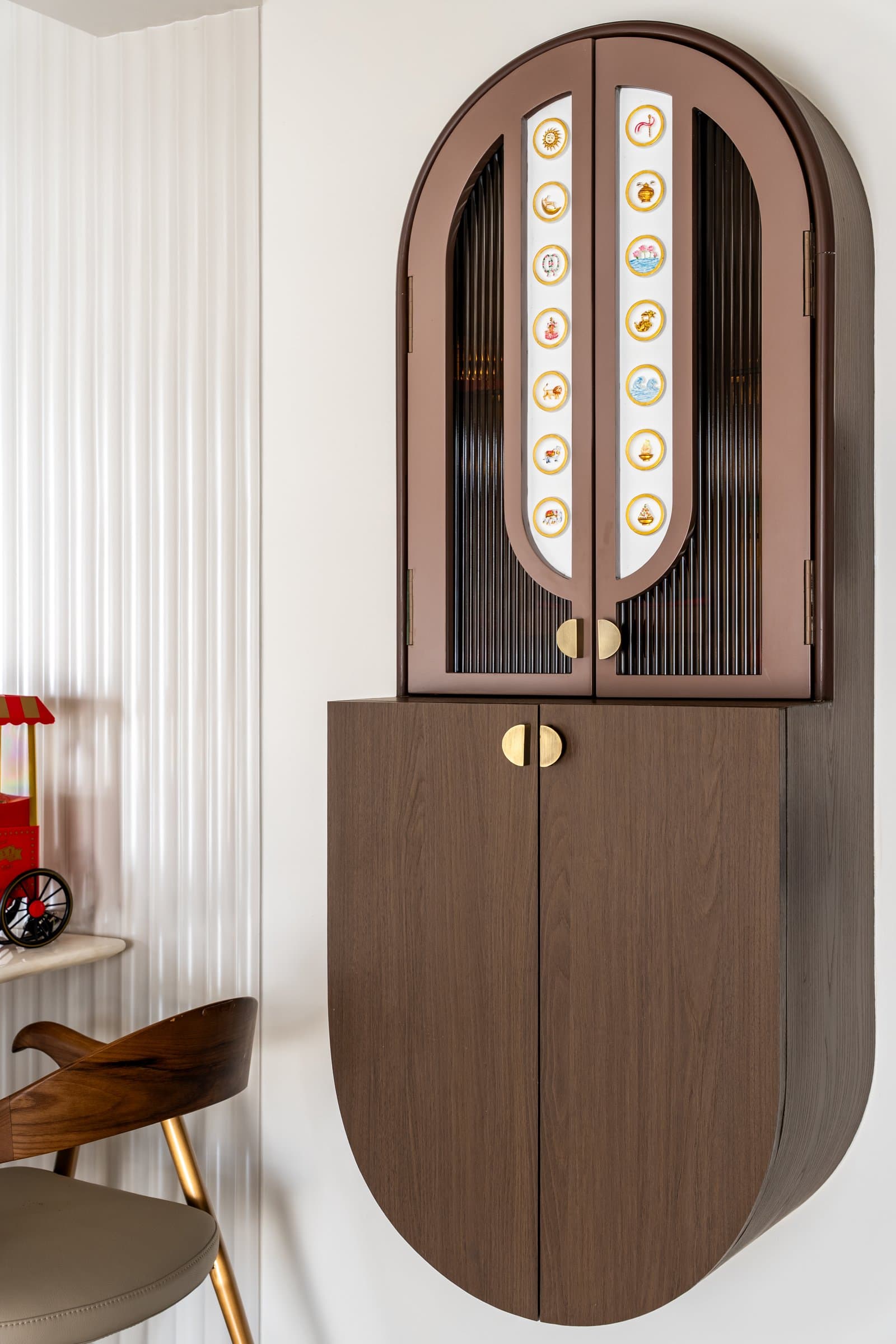
Just beyond the dining area, a wall-mounted mandir cabinet operates as the home’s most overtly personal object. Its arched upper section in reeded glass and a warm brown painted frame frames a vertical band of small painted medallions, each one carrying a small motif. The arched upper doors meet at two brass half-moon pulls, while the rounded walnut cabinet below carries a single circular brass pull.
The piece is unapologetically individual, a kind of personal storytelling embedded in cabinetry. In a home governed by a quiet palette, this is the studio’s allowance for narrative.
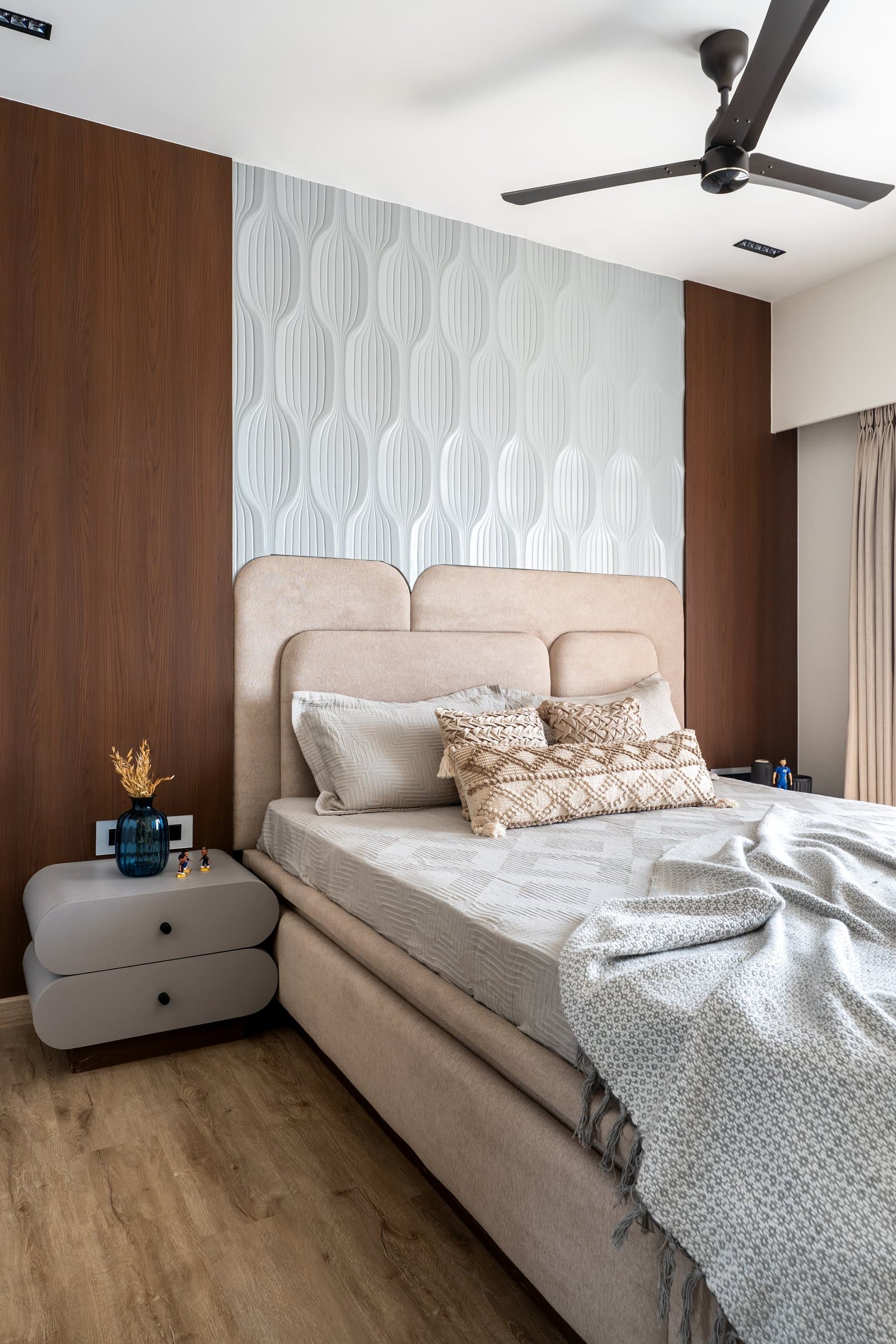
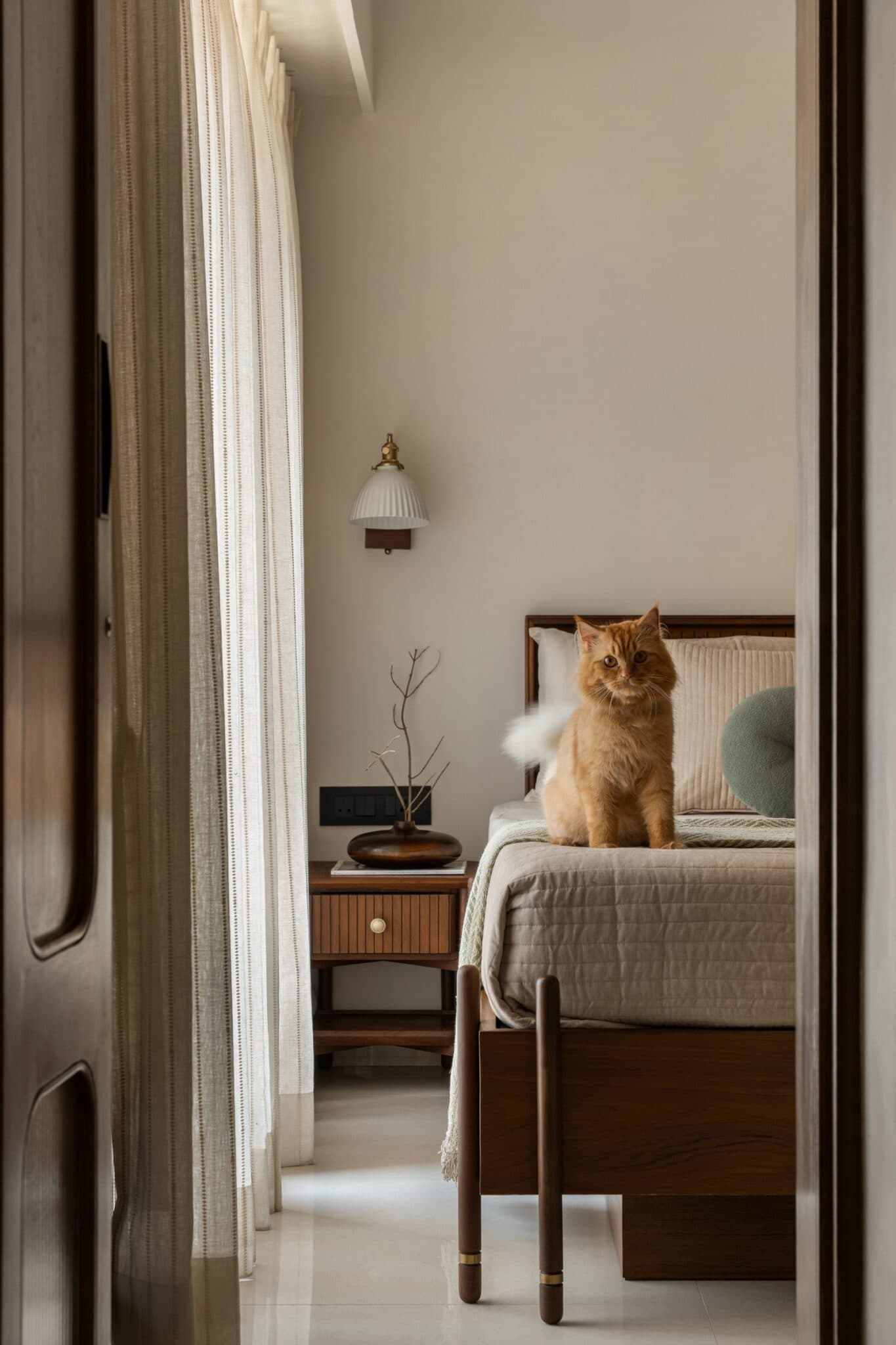
The first bedroom takes the dune language and rotates it toward rest. Tall walnut-veneer flanking panels frame a central wall of pale textured pod-motif panelling, with a tall upholstered headboard in beige suede sitting below. The bedside unit, a rounded two-drawer pebble on a slim base, reads as a small sculpture beside the bed.
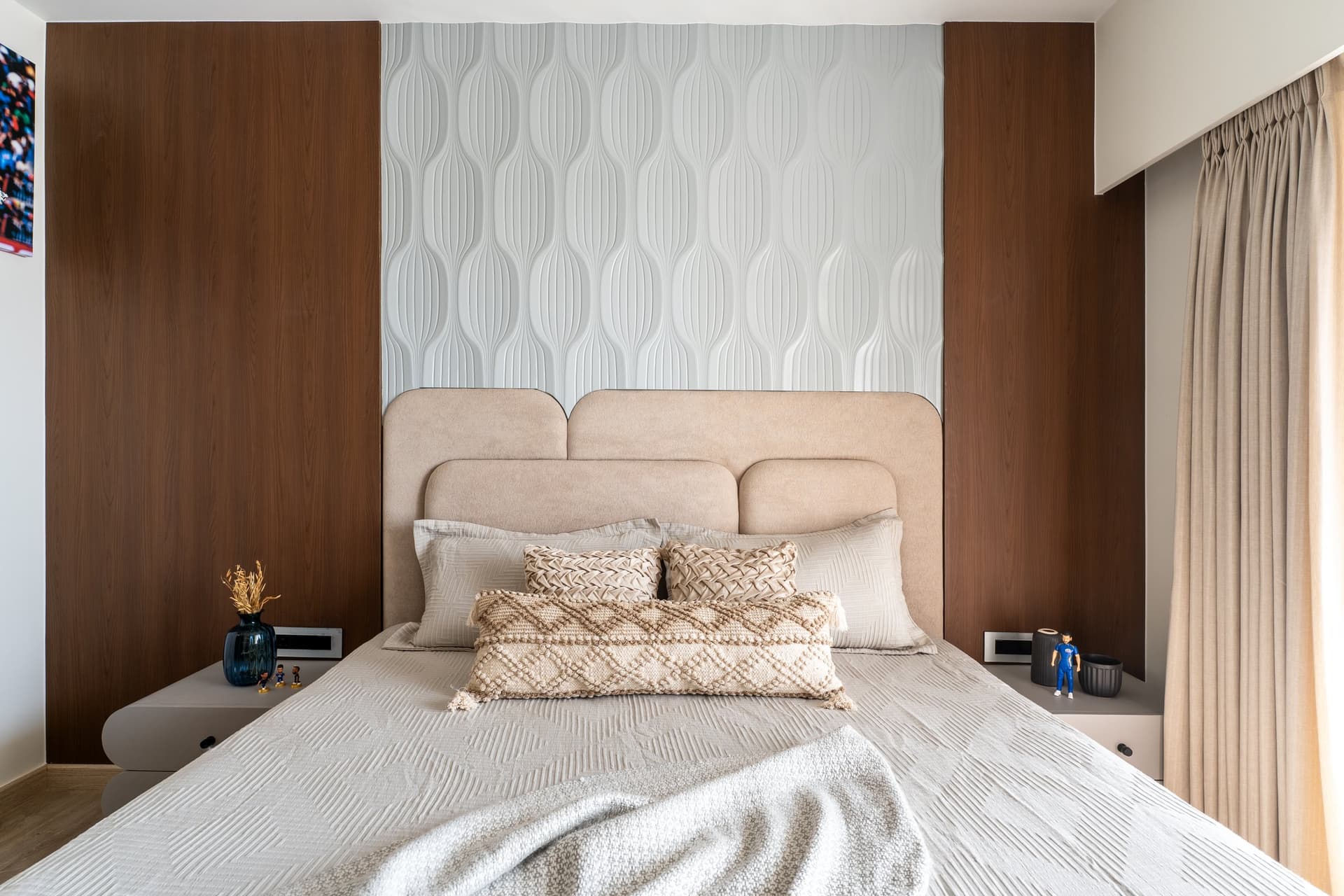
A straight-on view reveals the symmetry the room is built around. The headboard’s twin curved profiles are mirrored by matching pebble-form bedside tables, the warm walnut framing the cooler central wallpaper. Domesticity is not staged here, but simply and confidently arranged.
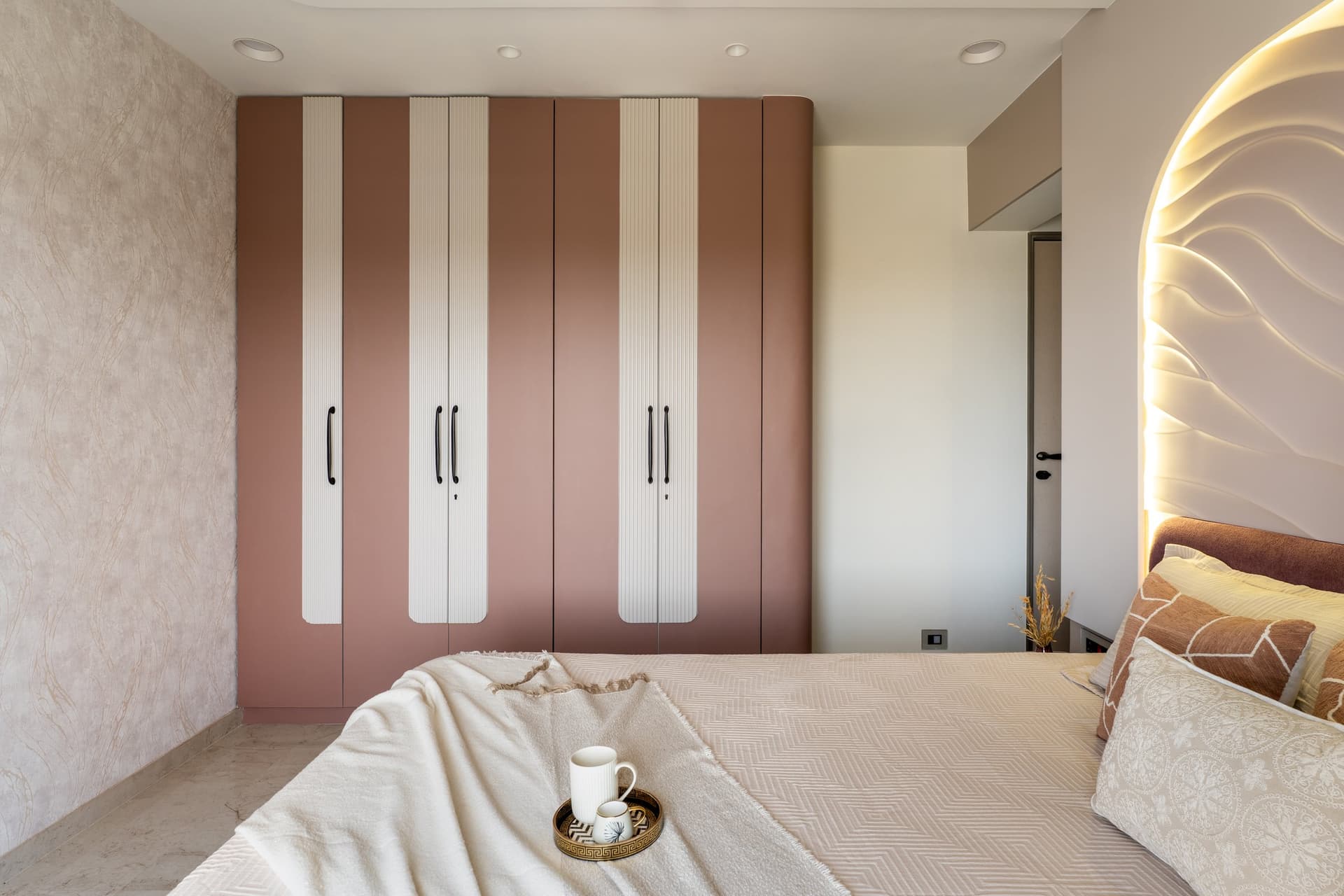
Opposite the bed, the wardrobe wall holds the room’s other major design move. Tall doors in matte terracotta-rose are interrupted by slim fluted ivory panels that run vertically like inlaid columns, the brass-handled junction reading as a soft architectural rhythm.
The terracotta is the kind of colour that could have overpowered the room, but it is held in check by the cream walls on one side and the plaster headboard on the other. The wardrobe becomes a coloured field, not a coloured object.
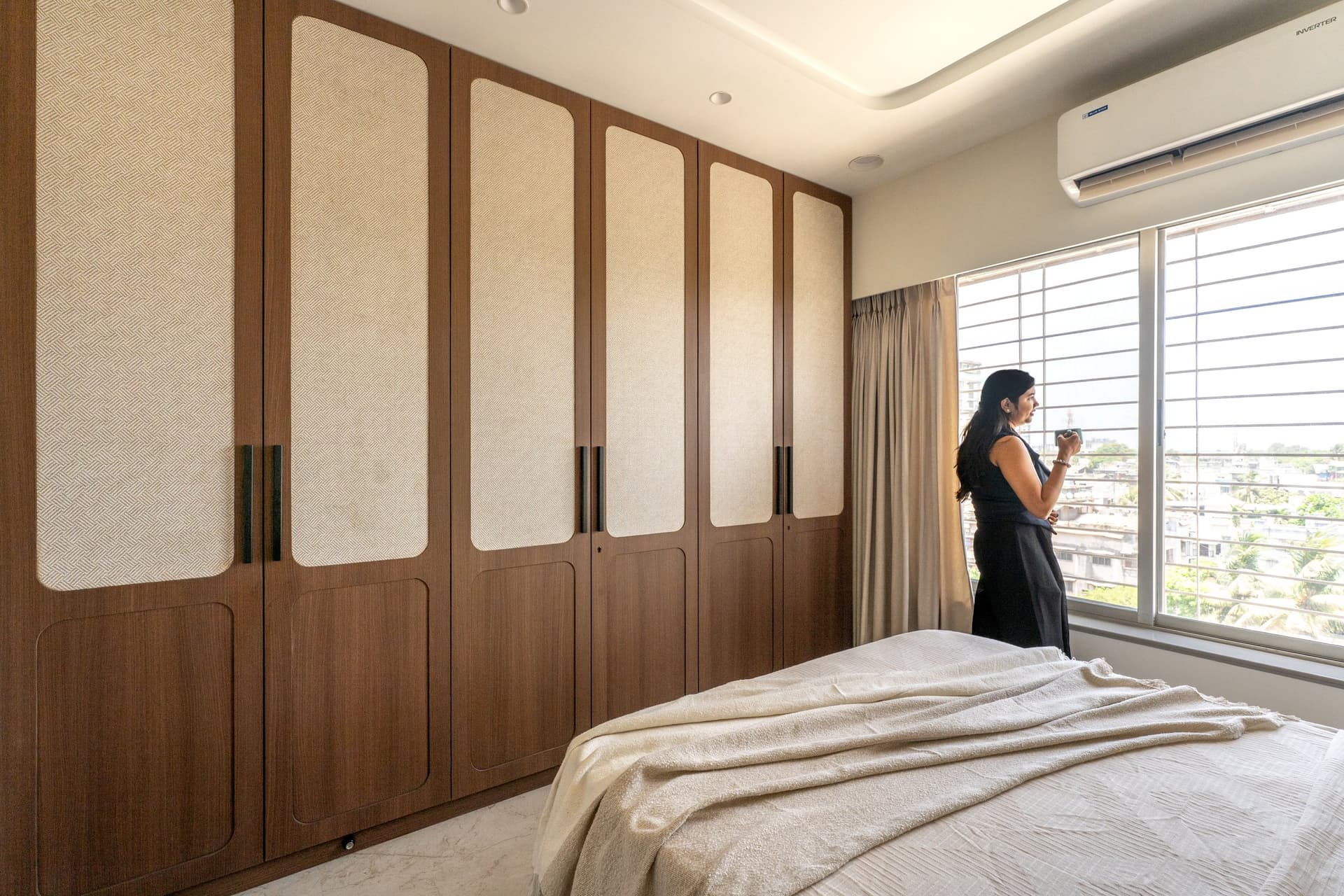
A second bedroom takes a more restrained turn. A wall of full-height walnut wardrobes carries inset panels of woven cane-textured fabric, framed within rounded routed borders. A wide window admits city light over the rooftops of Palghar.
Casa Dune sits within a particular moment in Indian residential design, where apartments at the edges of the metro are being asked to carry the same ambition as homes at the centre. Studios working in these geographies are increasingly willing to commit to a single strong idea and follow it through every surface, rather than diluting the concept into generic luxury.
What Enliven Studio achieves here is consistency without monotony. The dune is not a logo applied to walls; it is a way of thinking about line, light and softness that informs everything from a door handle to a headboard. In a compact home, that kind of disciplined repetition is what separates an apartment from an interior.