Small homes are often described in terms of what they cannot do. The more interesting question is what a constrained footprint forces a designer to abandon, and what survives that editing. The answer, when the work is honest, is usually a sharper home than a larger budget might have produced.
Set on the outskirts of Navi Mumbai, Swaalay is a 400-square-foot studio apartment designed by Ikshhana Design Studio for a young working woman who shares it with her two cats. The brief, articulated by lead architect Devansshi H. Shrof and her team, was a counterpoint to a demanding work life: a retreat measured in warmth rather than square footage. The vocabulary is consistent throughout – teak, brass, gentle curves, fluted glass, and the result is a home that treats its smallness as a discipline, not a limitation.
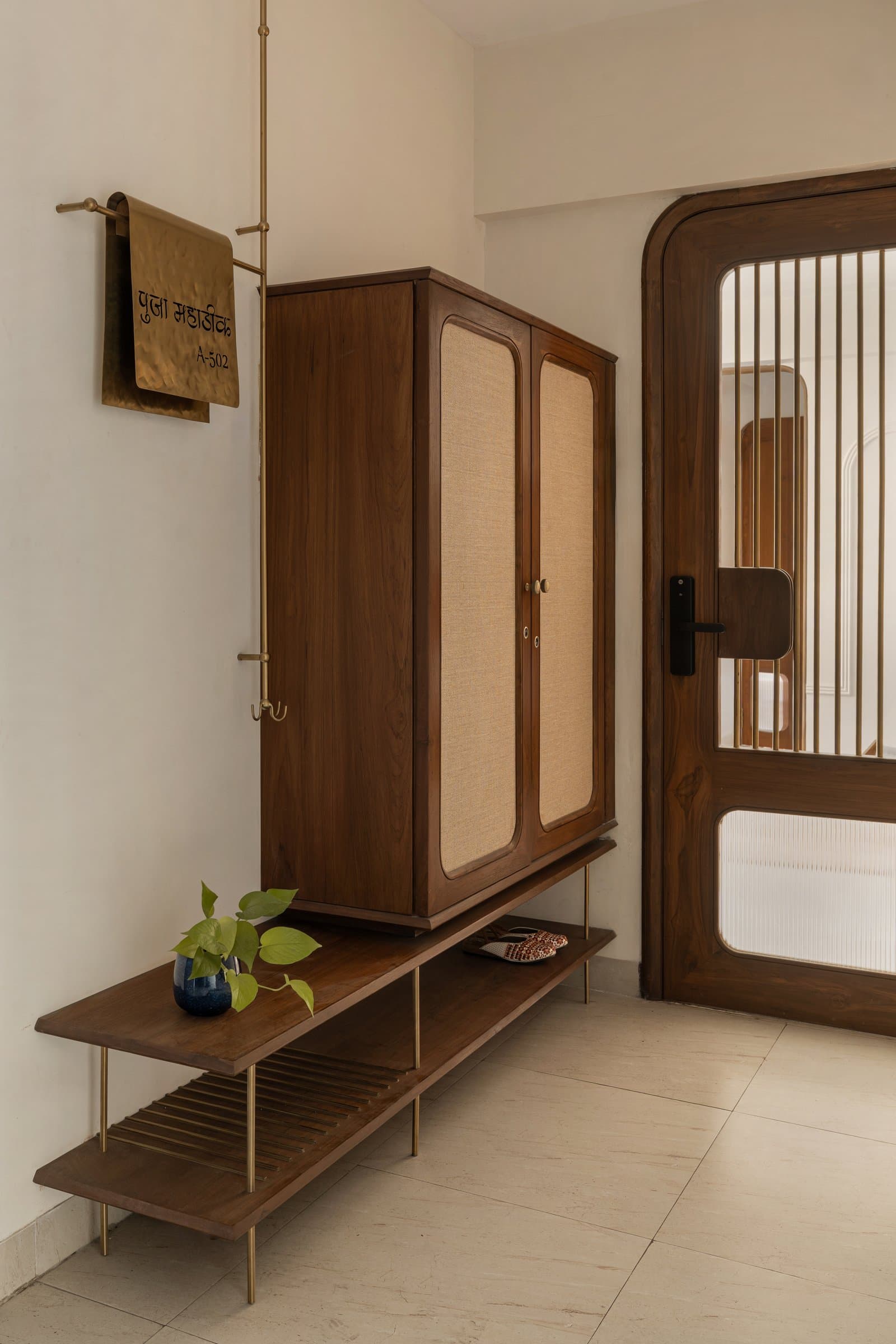
The threshold sets the entire grammar. A teak console with a slatted lower shelf runs along the wall, its slim brass legs lifting the volume off the floor so the foyer reads as more generous than it is. Above, a tall cabinet with cane-panelled doors absorbs the visual bulk of storage, while a hammered brass nameplate inscribed in Devanagari hangs from a slender rod fitted with hooks for bags and parcels.
It is a small gesture with a large idea inside it. The threshold is treated as a room of its own, not a leftover corridor, and the arched main door with its fluted glass insert begins the home’s argument about privacy and porousness before one has fully stepped inside.
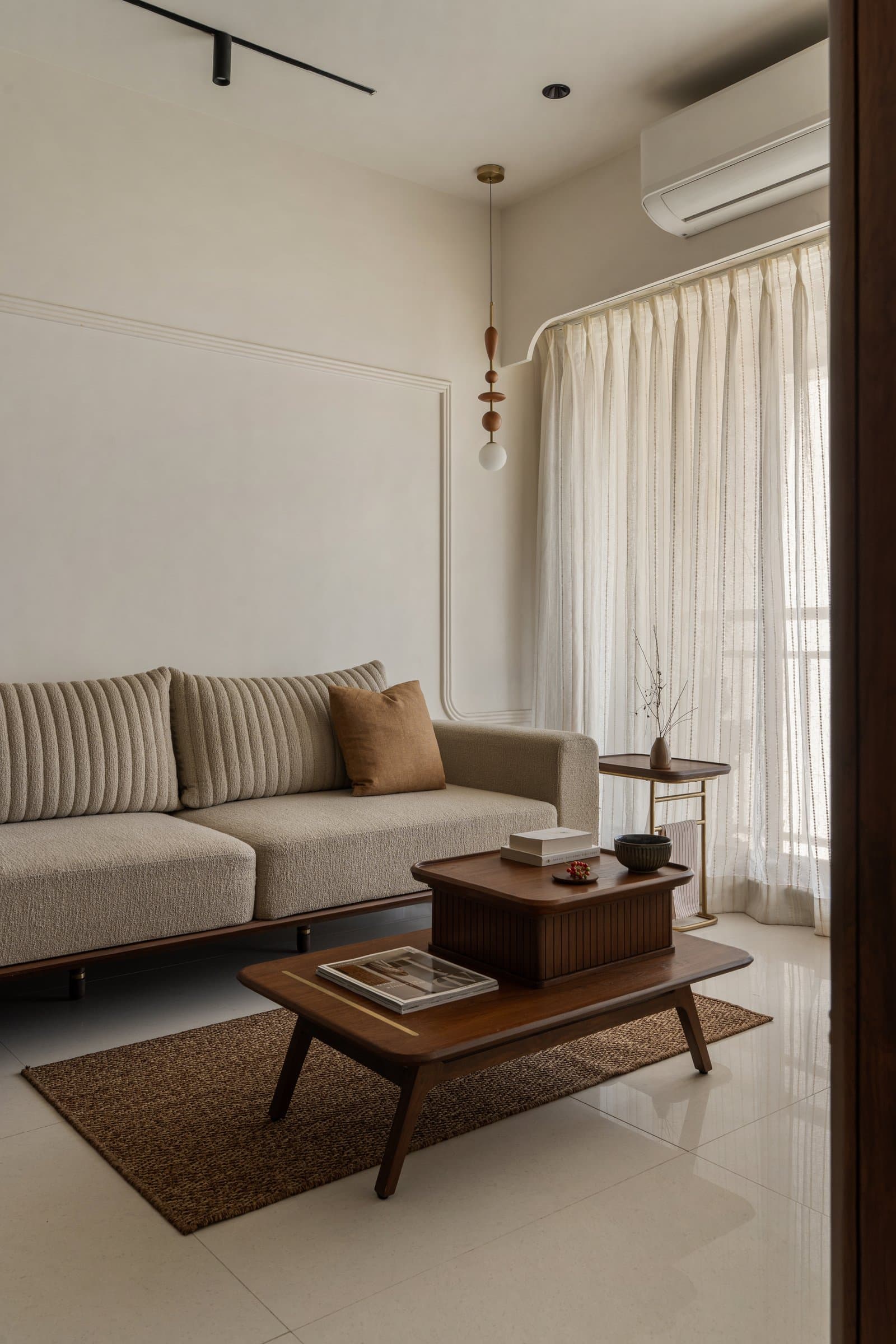
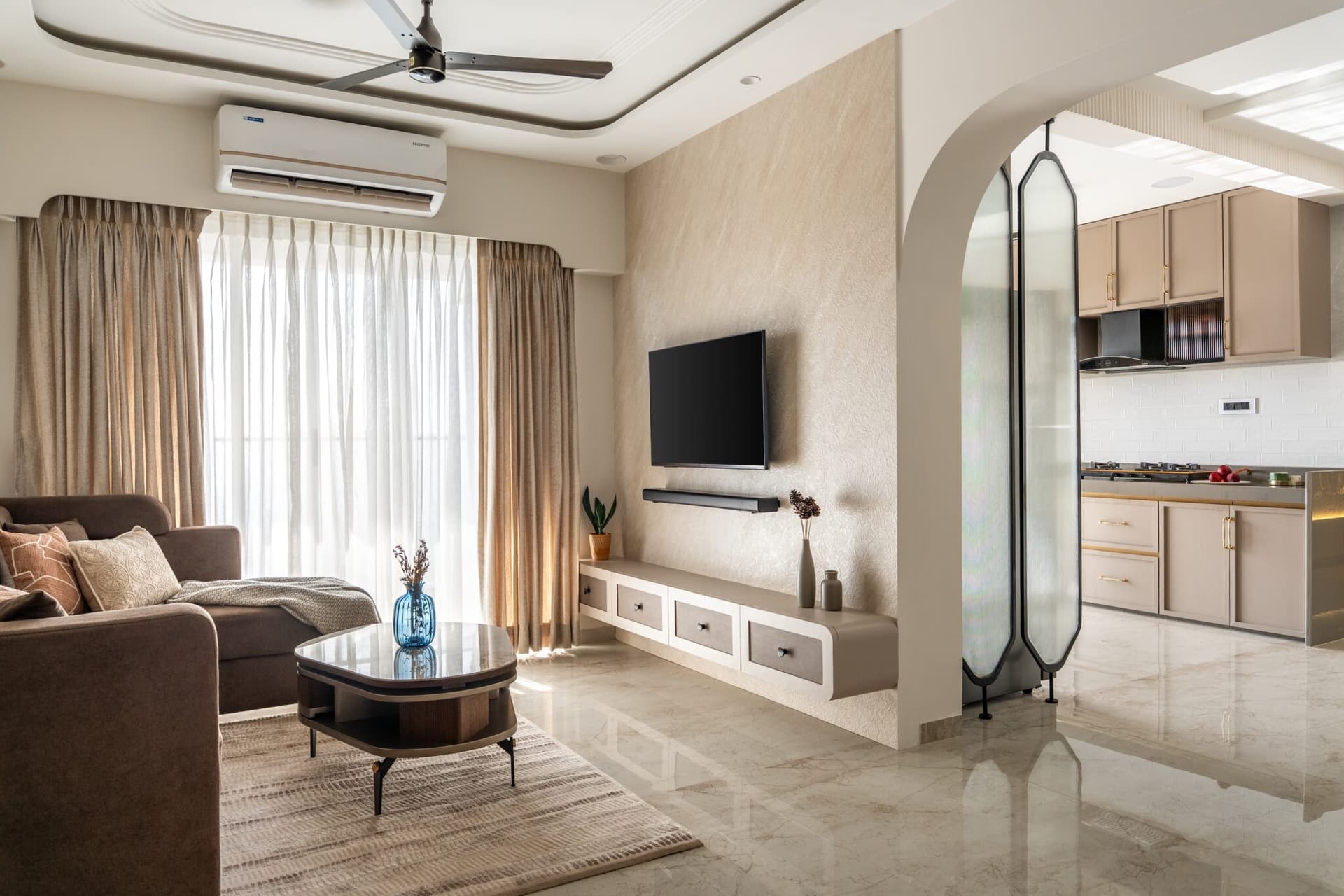
The living room is where the project’s restraint pays its largest dividend. Continuous monotone wall mouldings draw a low frame around the room, and a boucle sofa in oatmeal sits against the wall without competing with it. A pendant of stacked wooden beads ending in a small glass globe hangs beside sheer curtains that filter the light into something almost powdered.
““The living area is designed as a cohesive, hugging space. Continuous monotone wall mouldings run across surfaces, creating a sense of oneness without adding visual clutter.””
Anchoring the floor is the project’s clearest piece of multitasking: two nesting tables in dark teak, the lower one wide and low enough to function as a dining surface, the upper one compact with a fluted apron and a brass inlay catching the light. A jute rug beneath softens the porcelain floor and quietly stitches the seating together.
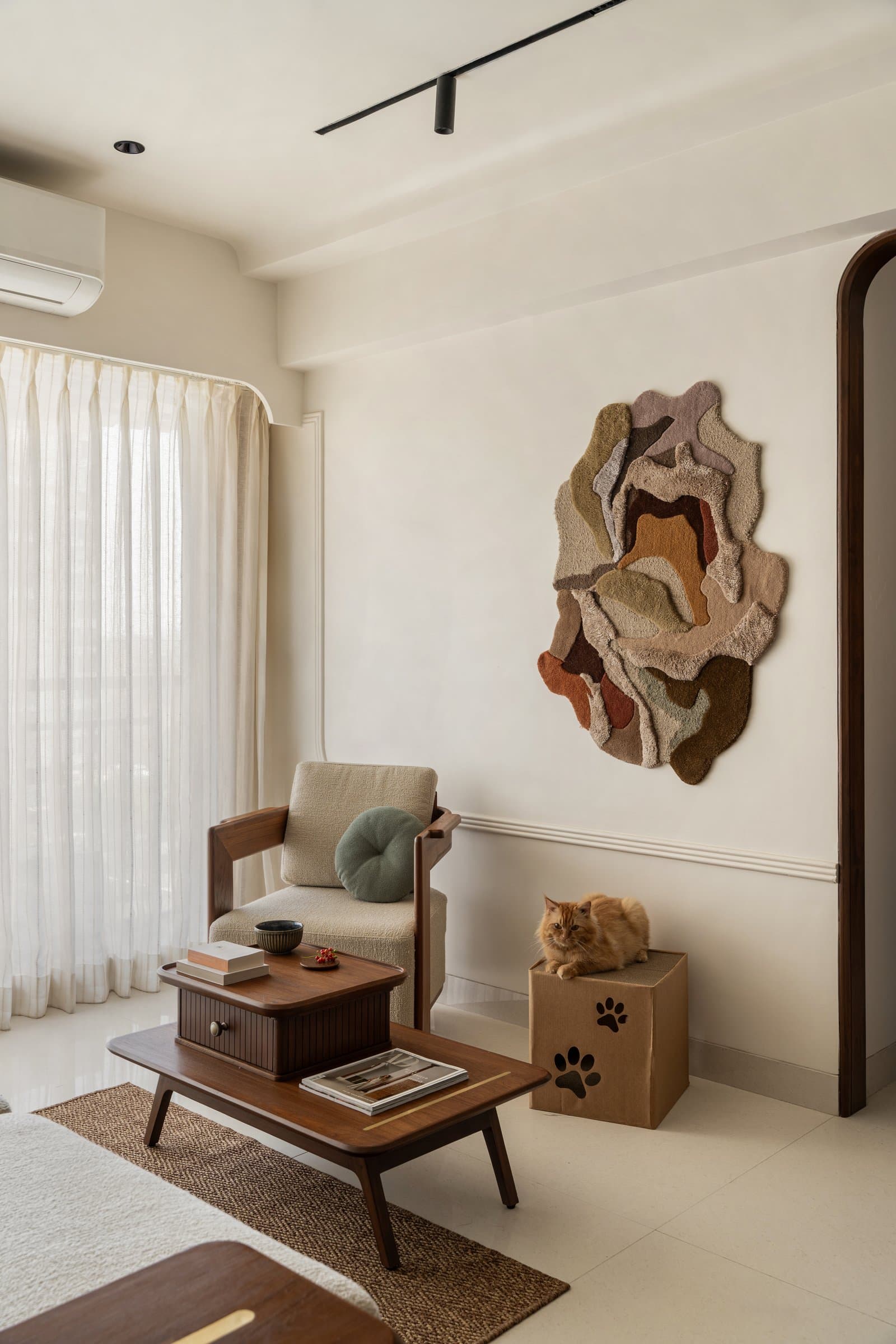
Across the room, a bespoke wall rug becomes the home’s most expressive surface. Crafted in varying pile heights and earthy pigments – ochre, terracotta, moss, dusty rose, it doubles as art and acoustic softening, the kind of object that earns its scale because it is the only decorative gesture in the room. A teak armchair with a boucle seat sits beside it, and one of the resident cats has claimed a cardboard perch nearby.
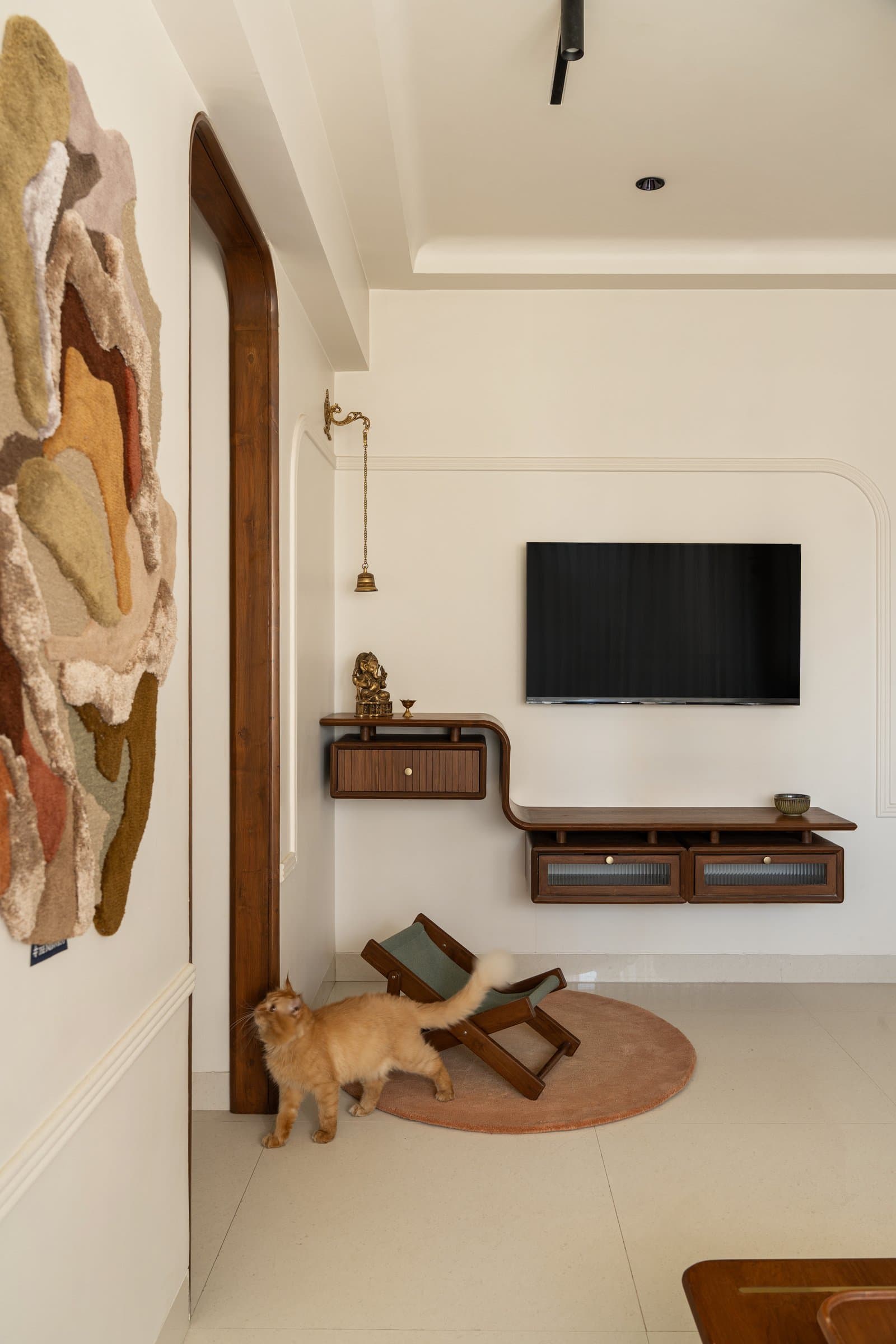
The opposite wall holds the television unit, which folds a small temple into its joinery with a brass bell and a Ganesha figurine on a curved teak shelf. The unit’s lower volume runs in dark wood with fluted glass shutters, the curve picking up the arched doorway beside it. Domesticity here is not staged; the cat moves through the frame, the temple sits within reach, and the design accommodates both without ceremony.
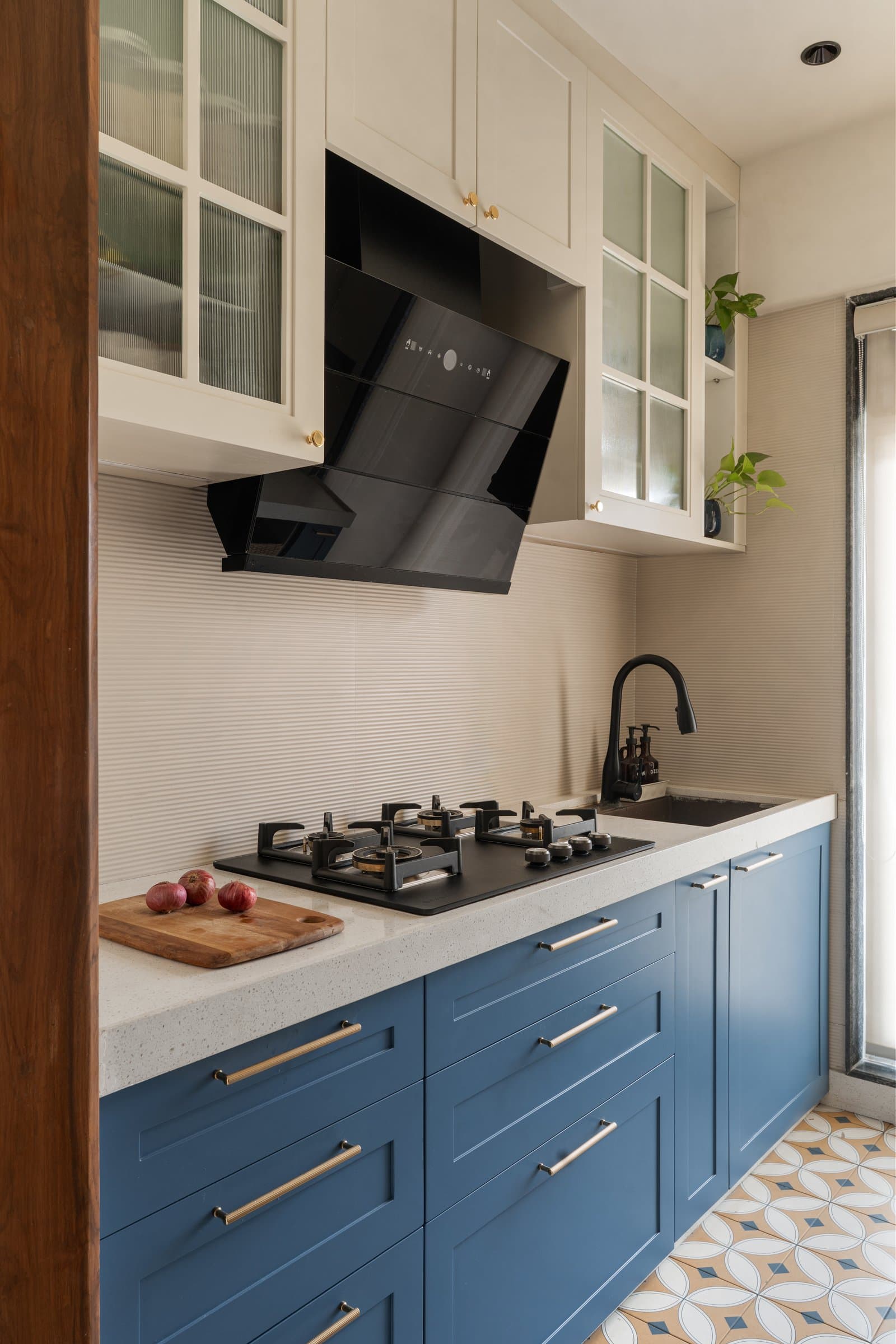
A deliberate material shift announces the kitchen. The lower cabinetry is painted a confident cobalt blue with brushed brass pulls, while upper cabinets in cream carry glazed glass fronts that lighten the corridor and reflect the patterned cement-tile floor below.
The decision to introduce colour only in the kitchen is a sound one. It enlivens the home’s tonal palette without disturbing it, and the patterned floor, a circular motif in ochre, blue, and cream adds a layer of craft that a small galley kitchen rarely earns. A quartz countertop and a matte black tap keep the surfaces working hard.
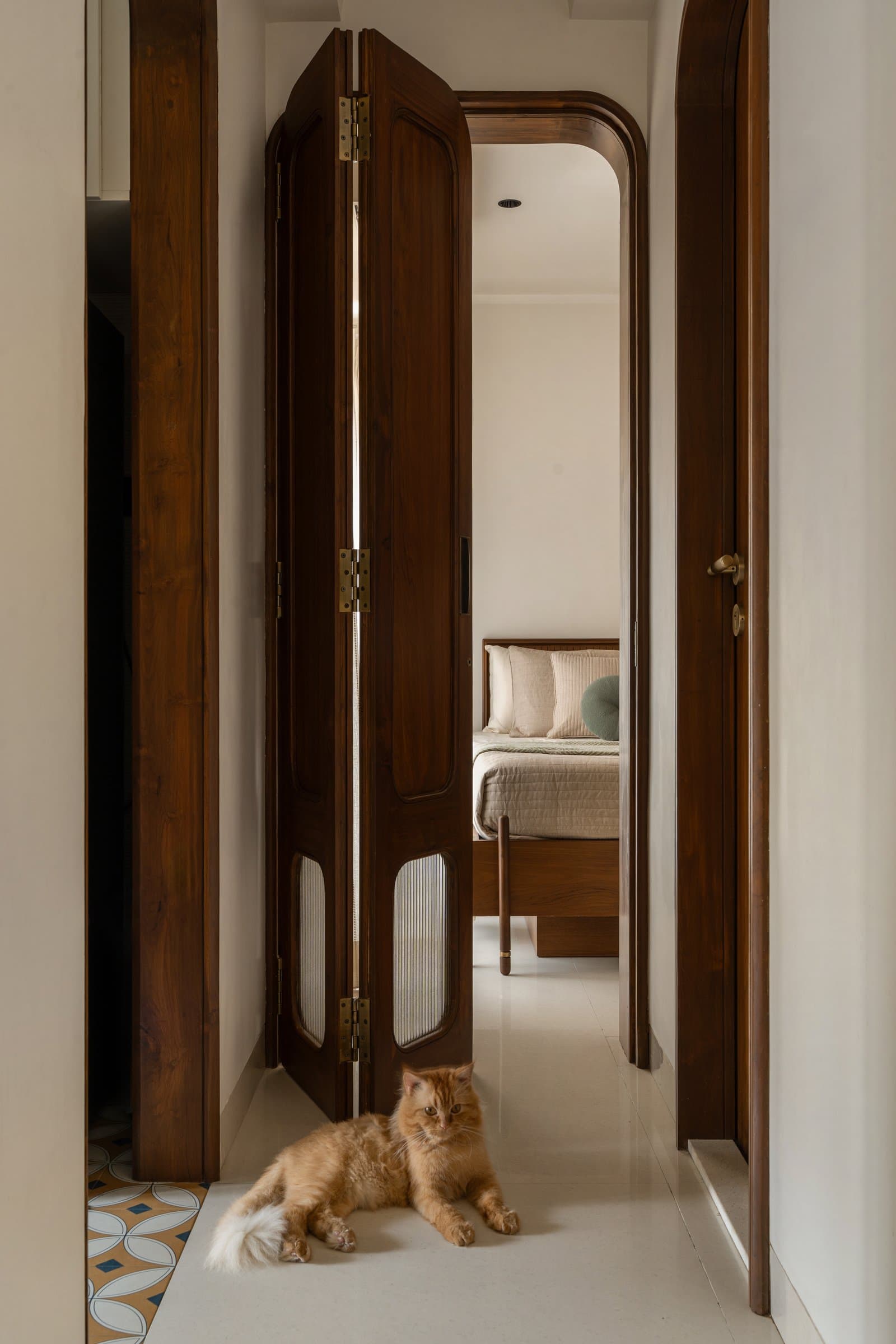
Between living and bedroom, a bifold door in teak with fluted glass inserts opens to widen the perception of scale. The arched timber threshold echoes the curve of the main door, and the patterned tile from the kitchen reads at the edge of the frame, stitching the two material worlds together.
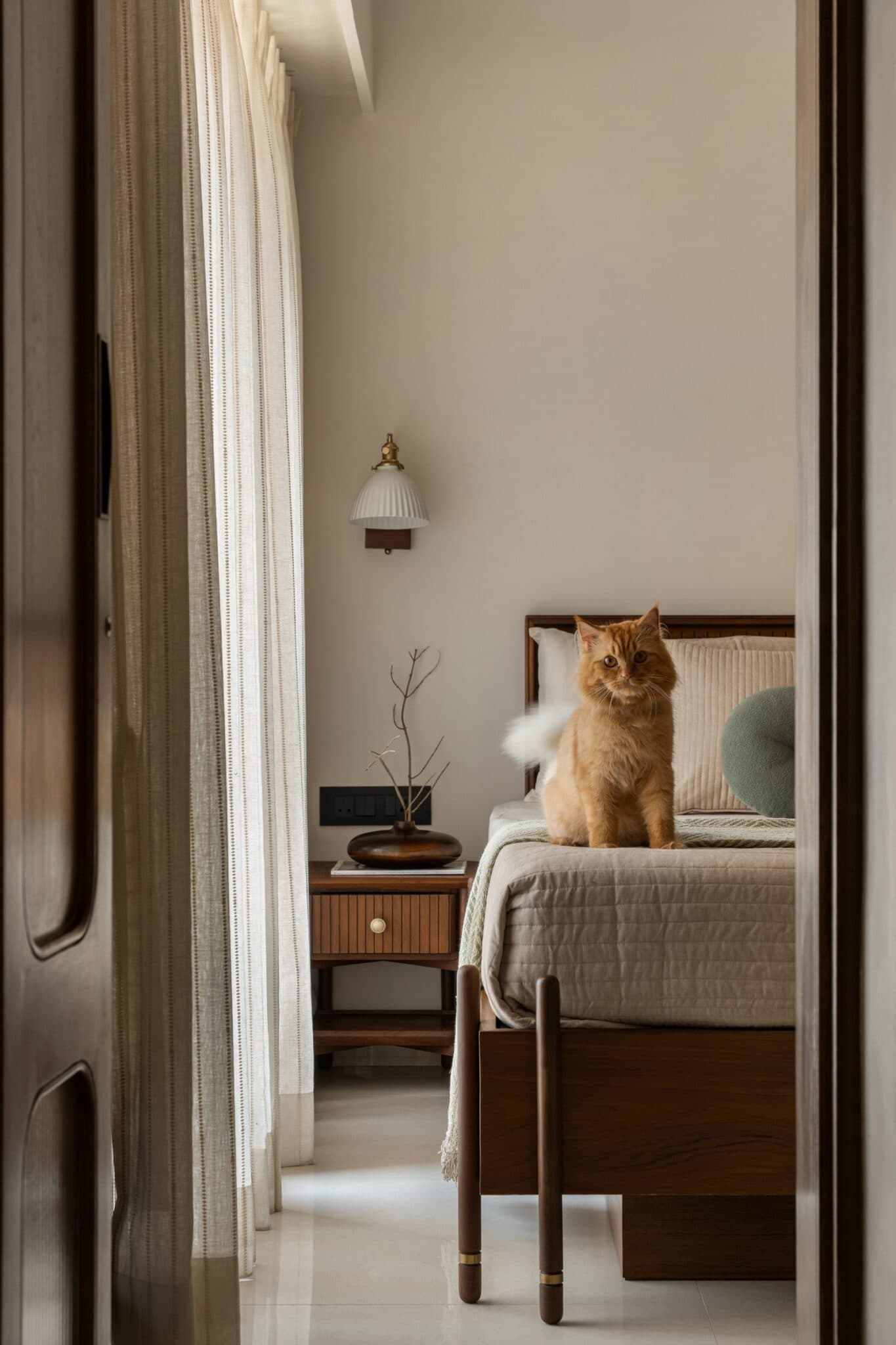
The bedroom continues the home’s warm register. A teak bed with a ribbed upholstered headboard sits against a quiet plaster wall, flanked by a slim side table with a fluted drawer face and a ceramic wall sconce that reads almost like a piece of pottery. Sheer striped curtains soften the daylight without dimming it.
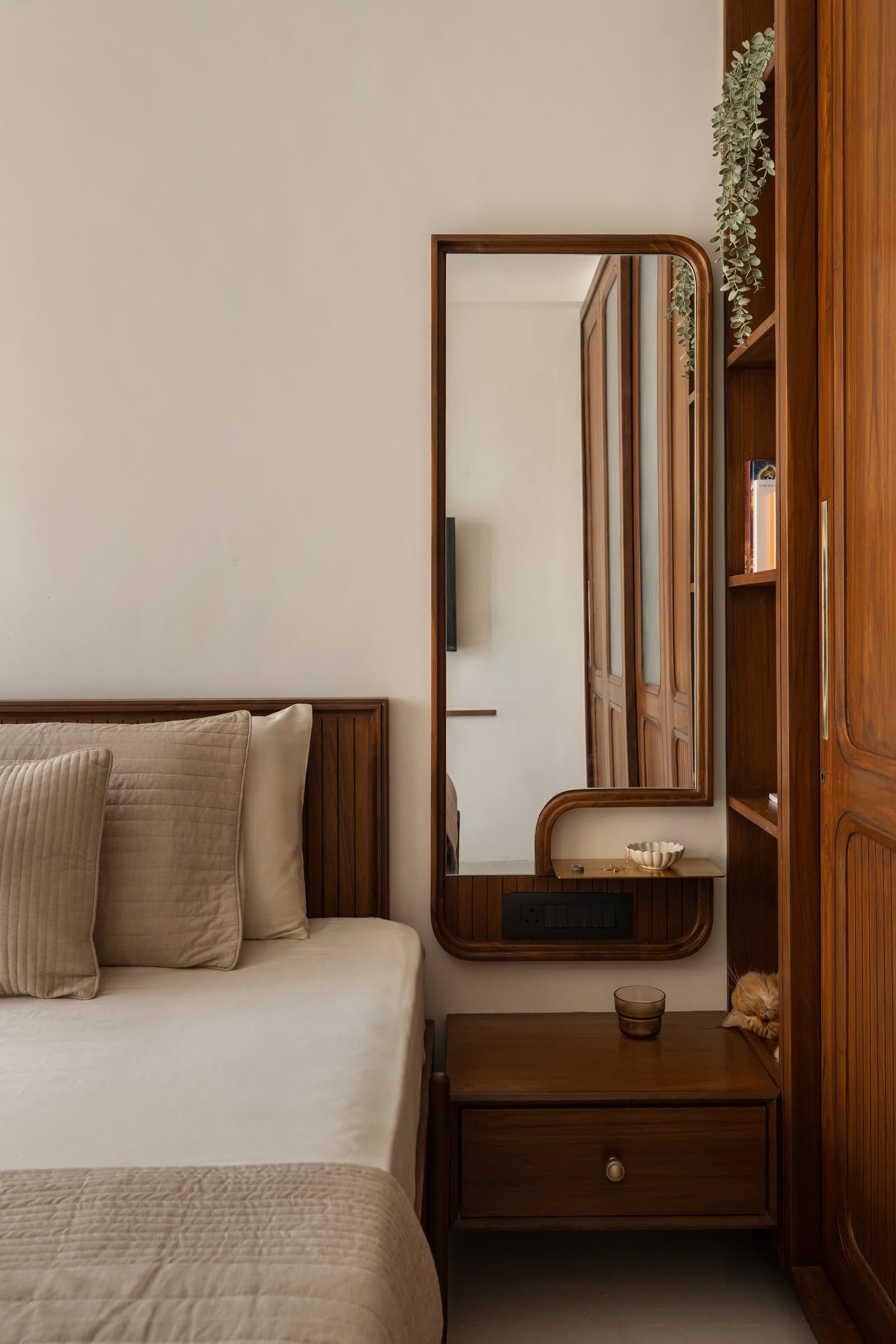
Against the adjacent wall, a full-length mirror with a softly rounded teak frame sits above a teak bedside cabinet with a single drawer, its frame extended by a small integrated shelf holding a fluted dish. The mirror is positioned at an abstract height, neither centred nor symmetrical, and the placement is what makes it feel considered rather than dutiful. Beside it, the wardrobe rises in panelled teak with reeded detailing, becoming joinery and architecture at once.
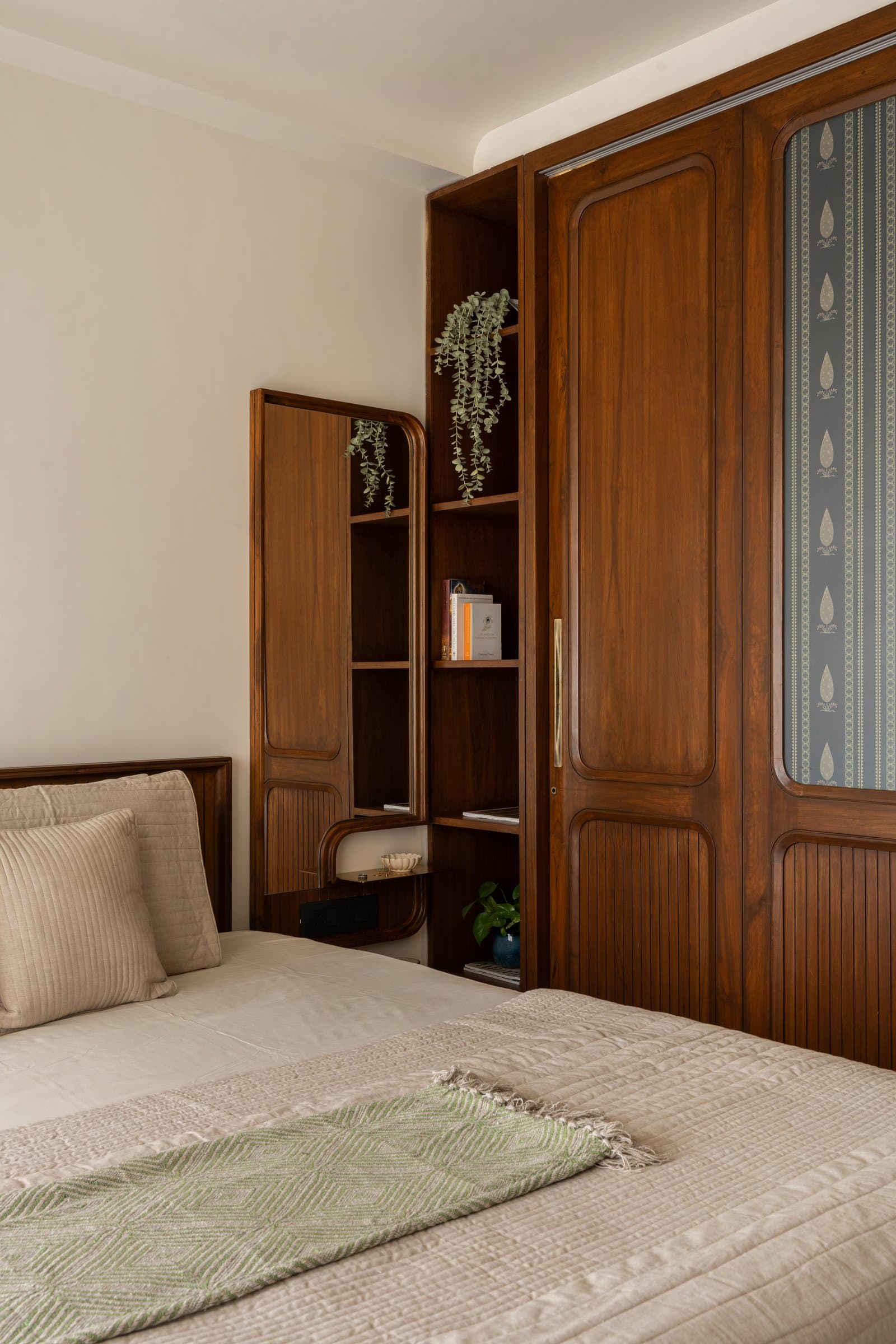
The wardrobe shutters carry a subtle paisley wallpaper insert framed within the teak panelling – a quiet decorative gesture that gives the room its second register. In a bedroom with little wall surface to spare for art, the wardrobe doubles as the decorative event, and the open shelving beside it holds books, a trailing plant, and a small dressing nook without crowding.
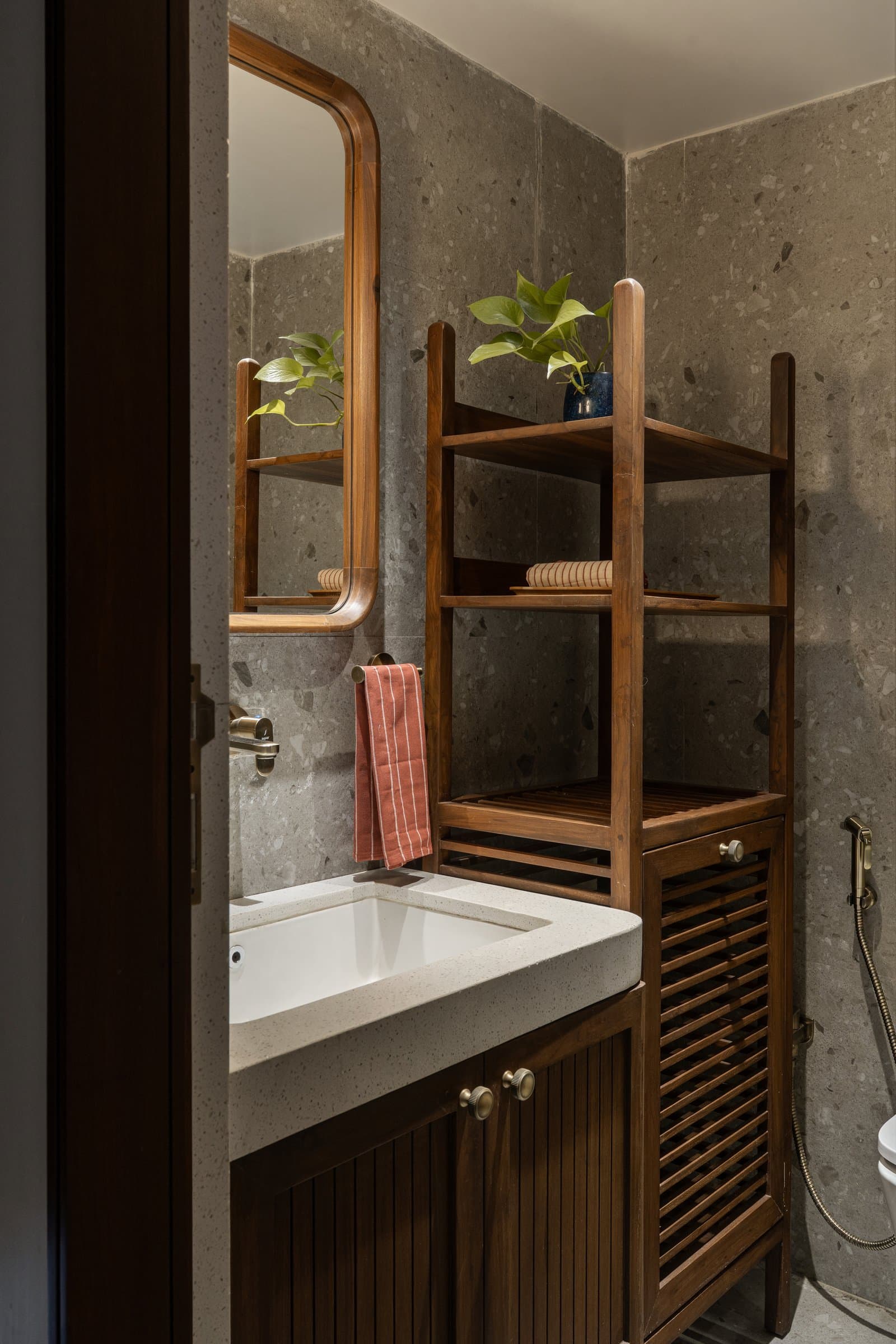
The bathroom collapses shower and powder area into a single grey-terrazzo volume. A slatted teak shelving tower rises beside the basin, its open shelves holding a potted pothos and small accessories, while the teak mirror with softly rounded corners picks up the curve language used elsewhere in the home. It is a compact room that refuses to feel utilitarian.
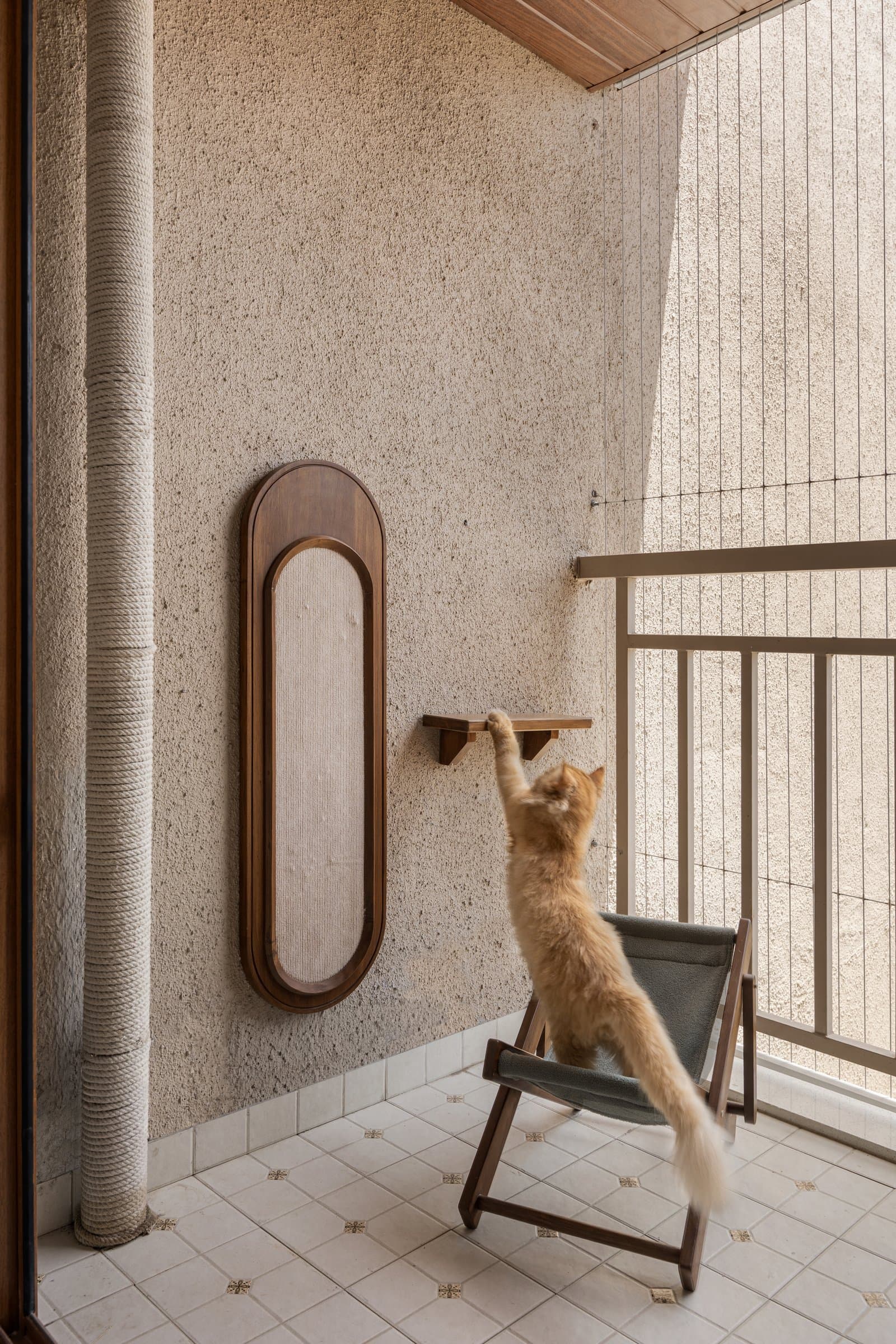
The balcony, reimagined as a pet-friendly extension, is where the brief becomes most specific to its inhabitants. A utility pipe wrapped in jute rope serves as a climbing post, a small teak ledge cantilevers off the textured wall for perching, and a framed scratch pad sits at cat-height within a rounded wooden surround. A boucle sling chair occupies one corner; the floor is laid in patterned tile.
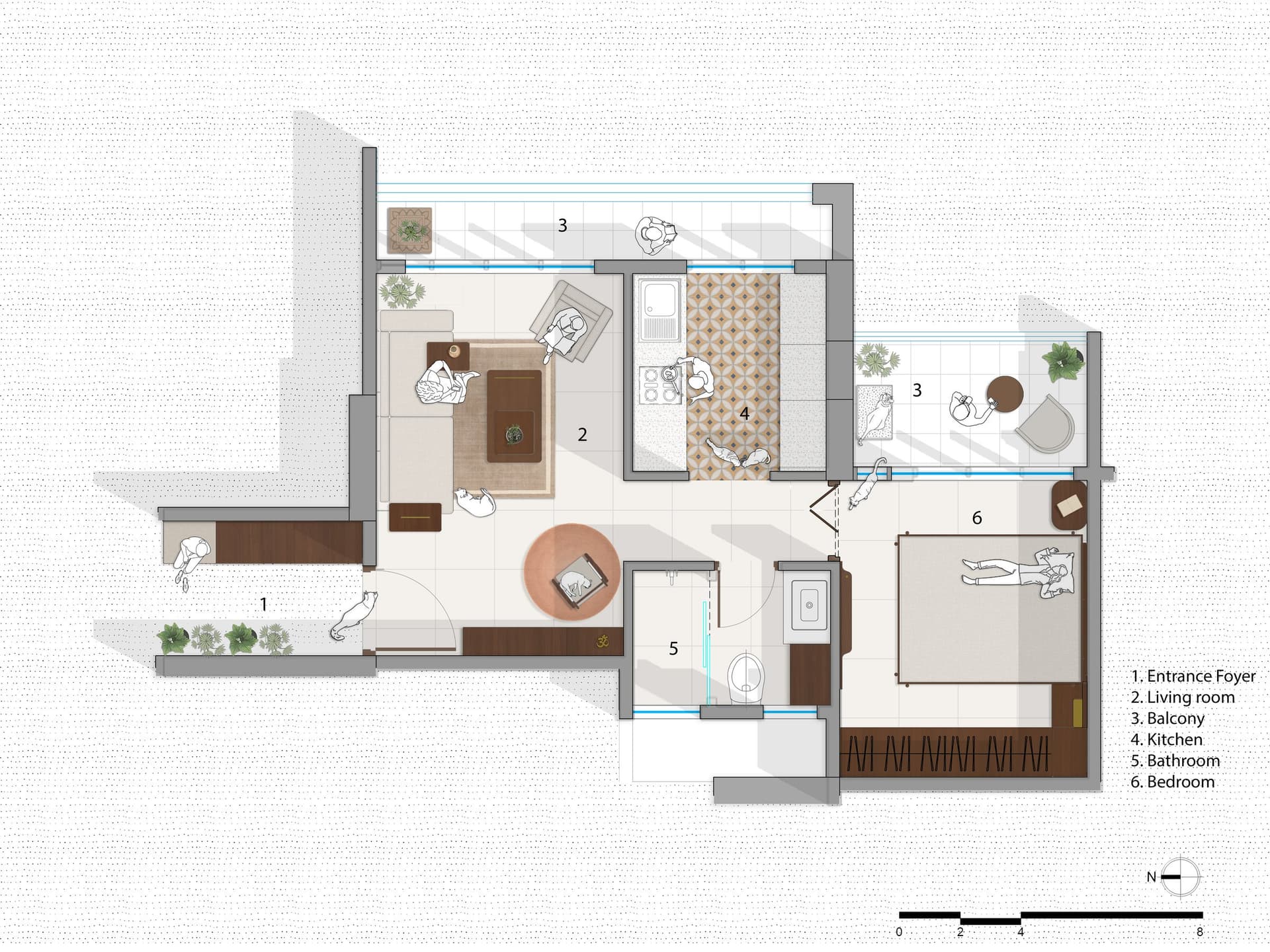
What the plan makes clear is how tightly the studio is choreographed. Entry, living, kitchen, bedroom, and the two balconies are arranged in a continuous loop, and the cats appear in nearly every zone of the drawing, marking the apartment as much theirs as their owner’s. The architecture is small. The thinking inside it is not.
In a city where 400 square feet is a common starting point and rarely a celebrated one, Swaalay makes a quiet case for what compact urban living can become when it is treated as a design problem worth solving rather than a constraint to be apologised for. The studio’s restraint is the project’s most generous gesture, and the consistency of its material vocabulary – teak, brass, fluted glass, gentle curves, gives the home a coherence that larger apartments often fail to find.
Swaalay does not pretend to be larger than it is. It is composed instead with the conviction that a small home, designed with care, can hold an entire life with room to spare.