A villa is rarely measured by its scale alone. The more interesting measure is what the architecture chooses to do with that scale, whether it fills the volume with spectacle or holds the volume open as a kind of generosity. Shashvat Villa belongs firmly to the second school of thought, a residence that uses its considerable footprint not to impress but to slow the eye down.
Conceived and designed by Harsh Boghani of The Crossboundaries, the home rises across two storeys on a generous plot in Vadodara, framed by mature trees and a long horizon of garden. The architectural language is restrained: clean horizontal lines, deep cantilevered overhangs, and a palette of stone, glass, and graphite that lets the landscape do most of the talking. What unfolds inside is a sequence of rooms organised around an idea of quiet luxury, where every surface, every line of light, has been calibrated to support the way the family actually lives.
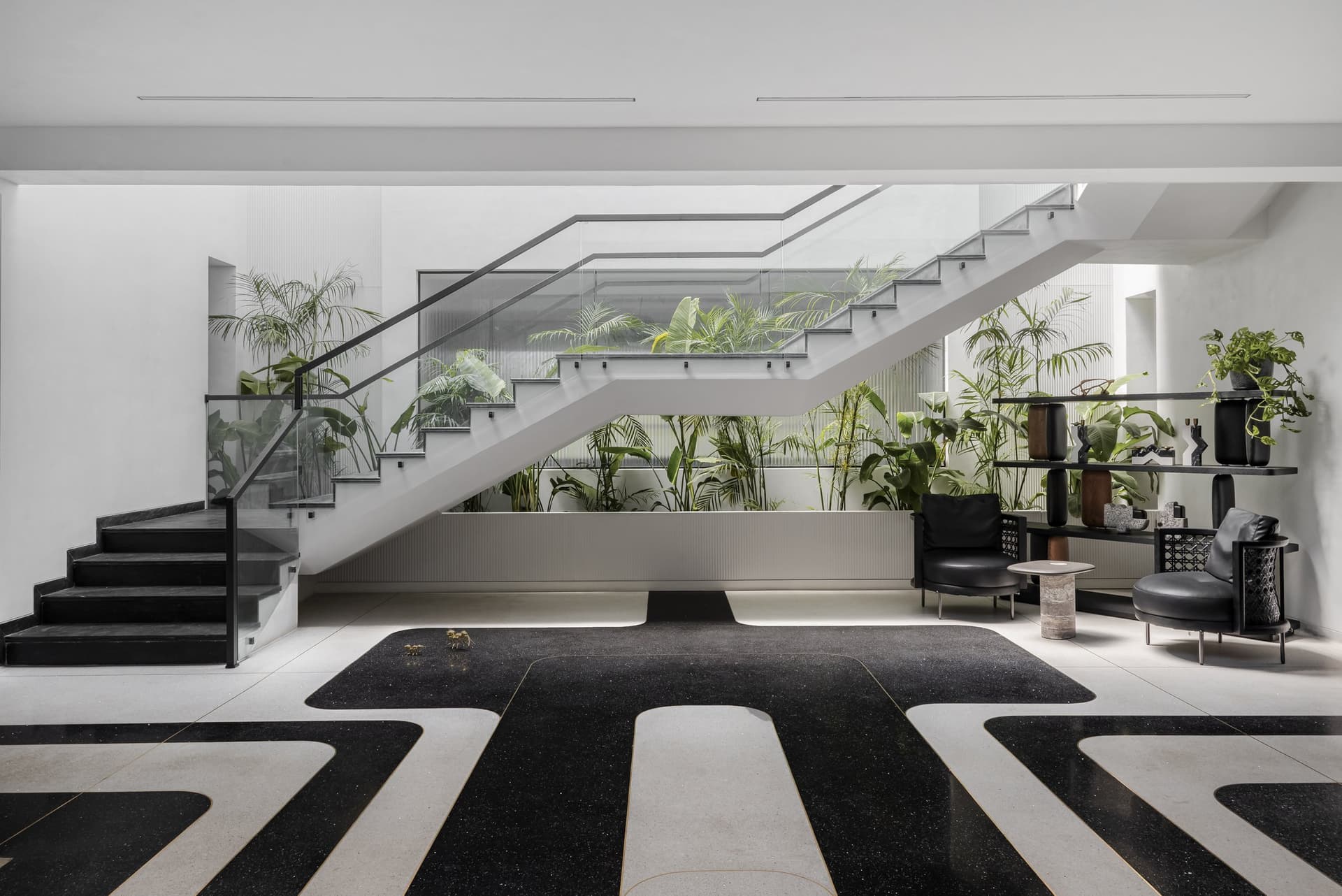
The double-height foyer is the home’s opening argument, a volume in which the architecture states its terms before any room has been entered. A glass-balustered staircase folds across the back wall in two crisp flights, its steps in dark stone reading almost graphic against the white shell. Behind it, an inset planter of palms and tropical foliage operates as a living screen, softening what could have been a purely architectural gesture.
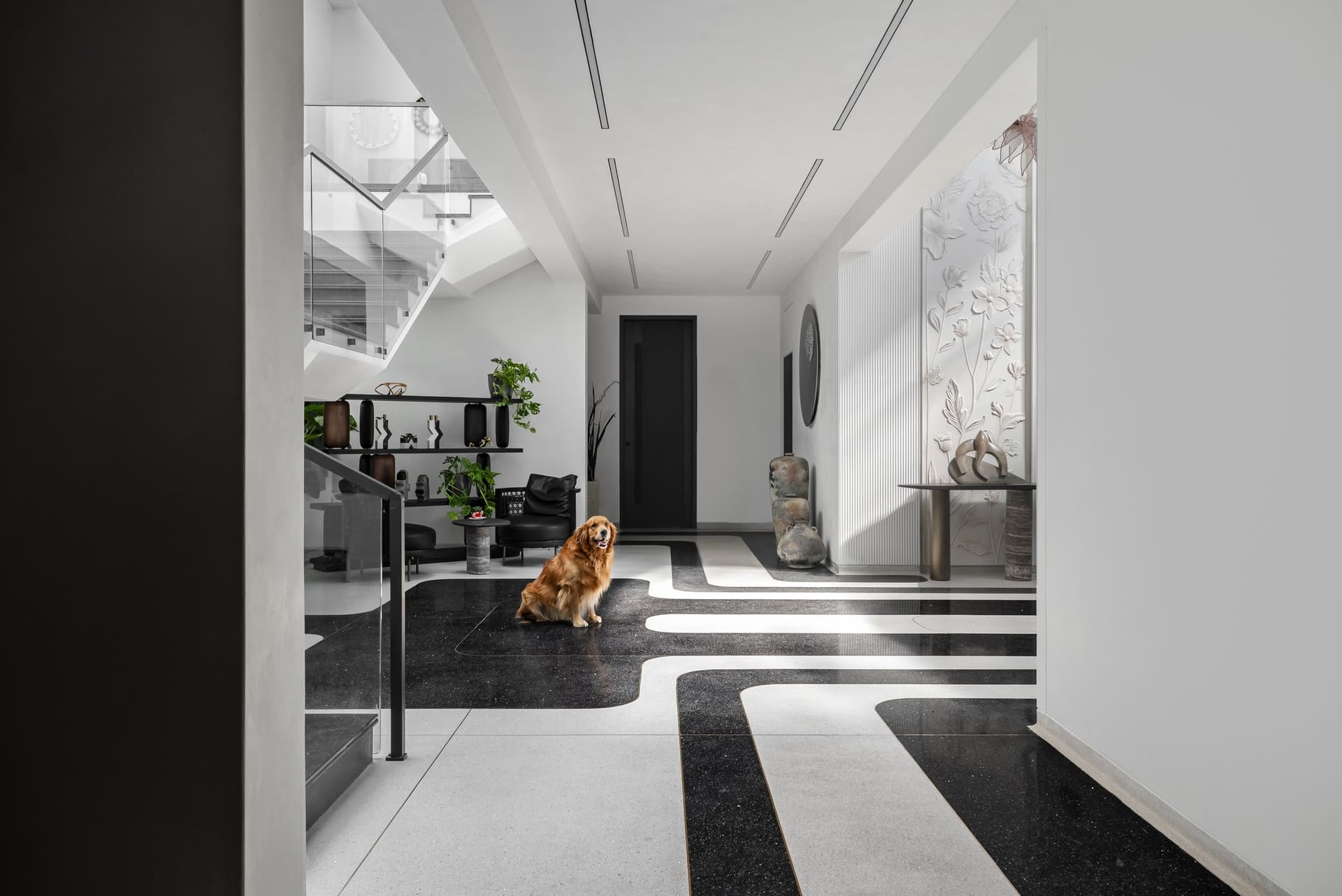
The floor pattern is the room’s signature: long bands of black stone slip into curving, almost calligraphic forms across a pale terrazzo ground, drawing the eye from threshold to staircase in a single continuous gesture. To the right, a sculptural display unit holds a careful arrangement of ceramic vessels and plants, a slow inventory of objects that anchors the volume without crowding it.
Beside it, a low-slung lounge chair and a small stone-topped side table offer the foyer a moment of pause, less a waiting area than an acknowledgement that even an entry deserves a place to sit. The room is, in the truest sense, a foyer that performs as a room.
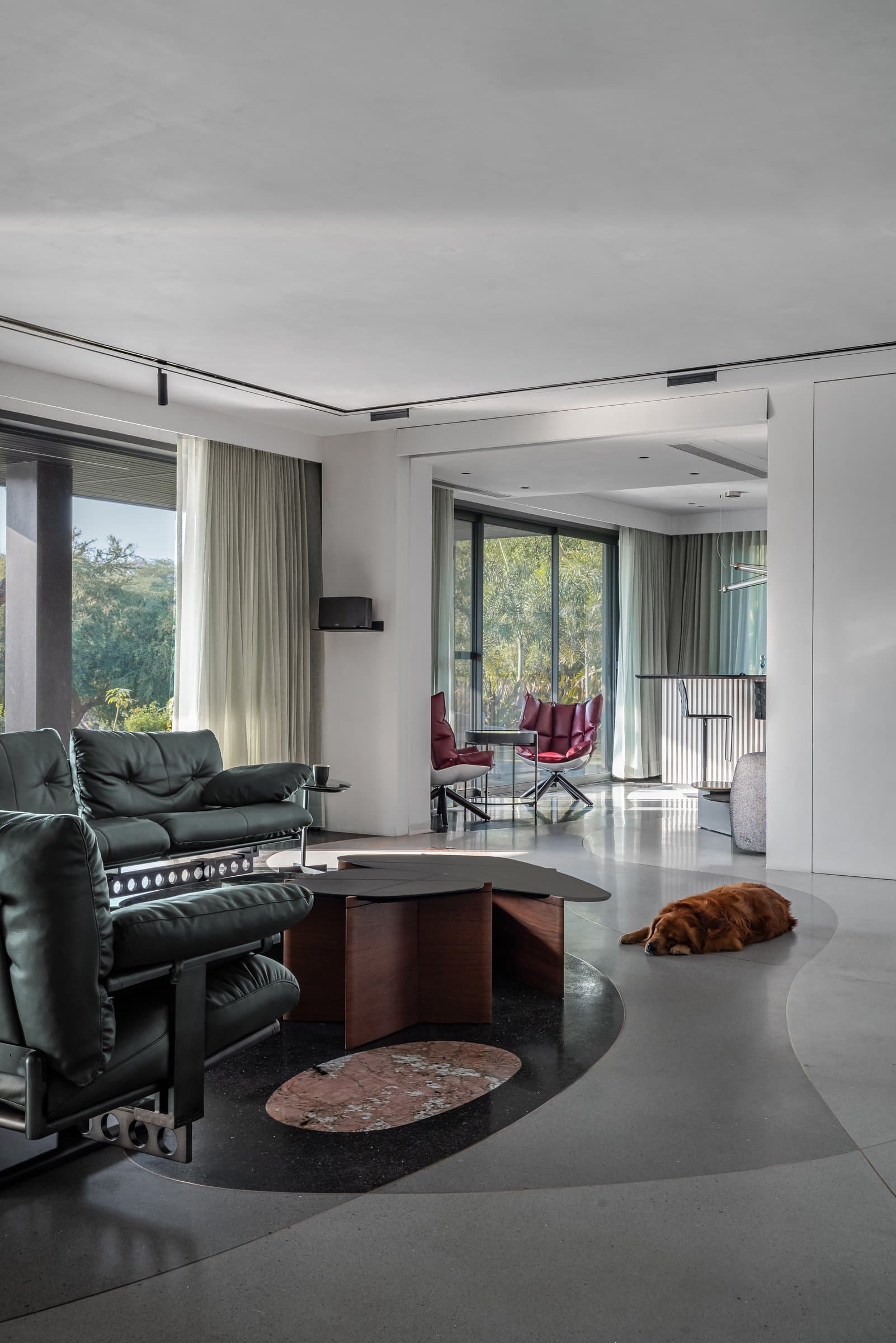
The living room opens off the foyer with a deliberate change of register. Where the entry is graphic and high-contrast, the living area shifts into softer tonal territory: deep green-grey leather seating, a sculptural wooden coffee table, and floor-to-ceiling glazing that pulls the garden into the room almost continuously. The curved inlay in the floor, a darker terrazzo arc set into a paler ground, choreographs the seating arrangement without the need for a rug.
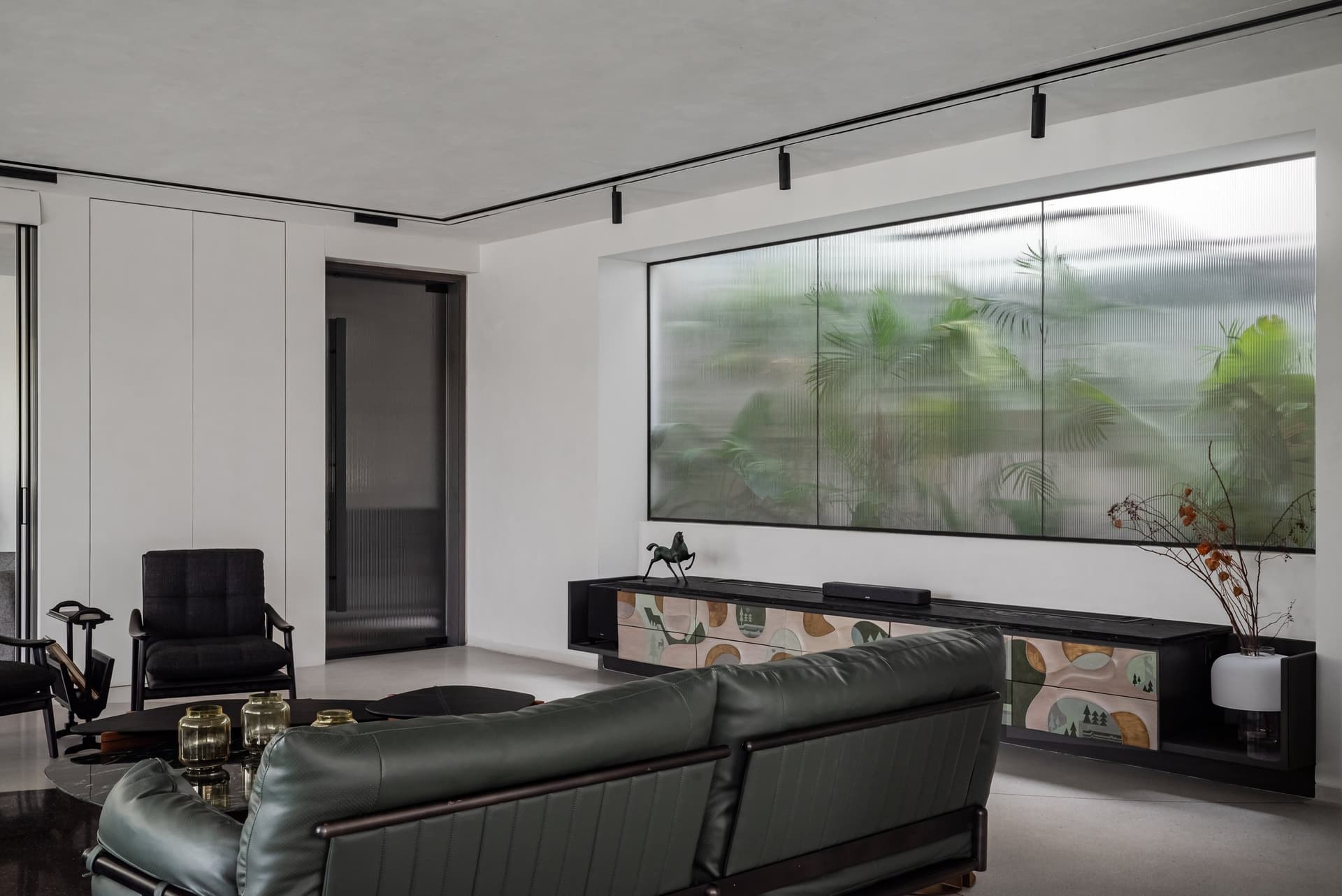
Looking back across the living room, a long low console runs beneath a fluted glass aperture that frames the planted courtyard beyond, its surfaces rendered as soft green abstractions. The console itself, with its painted landscape panels, is the room’s one moment of pictorial warmth, set against an otherwise disciplined palette of off-white walls and dark seating. It is the kind of detail that rewards a second look, which is precisely what restrained interiors are designed to do.
““Shashvat Villa is a contemporary residence defined by clean lines, open spaces, and a seamless indoor-outdoor connection.””
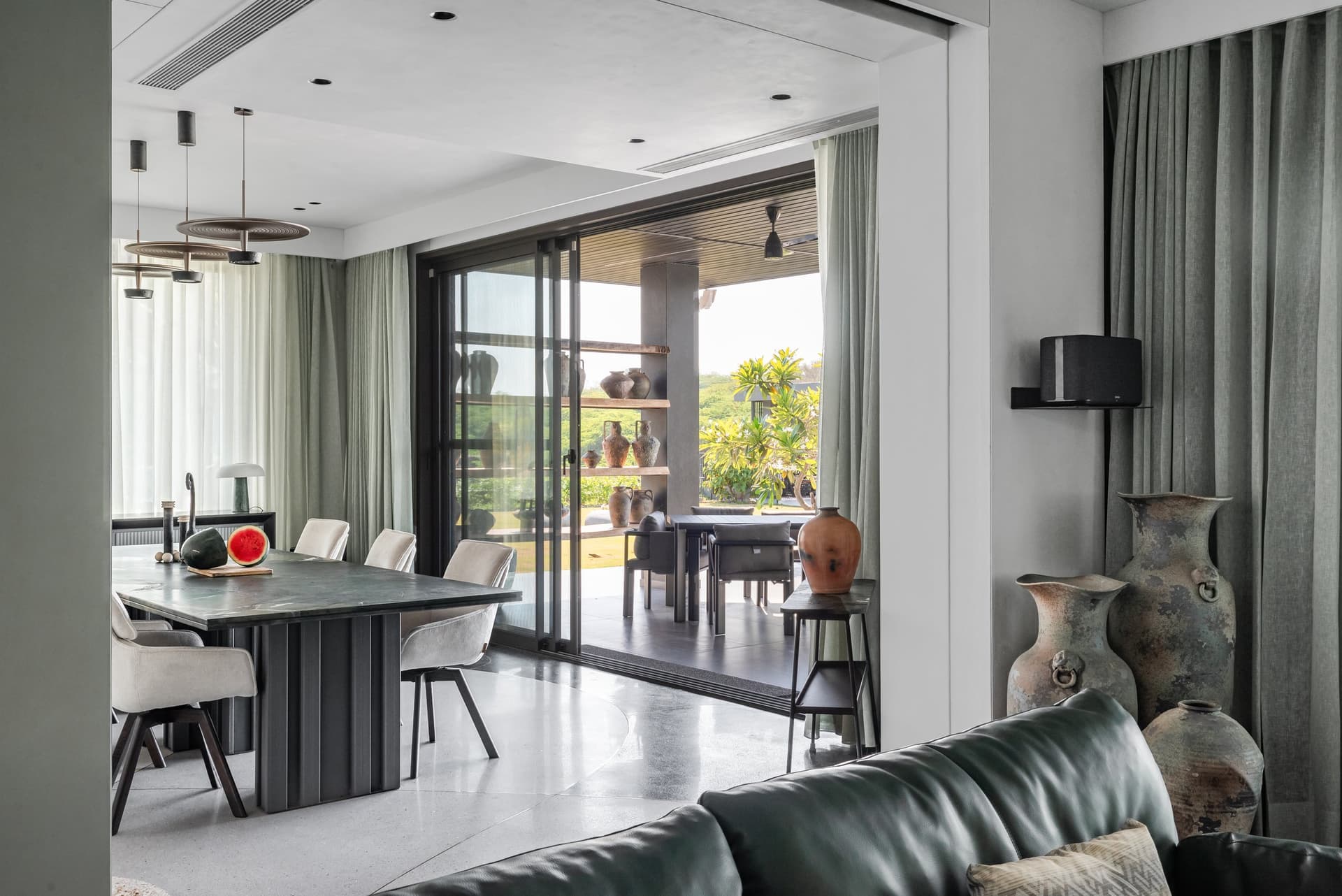
The living and dining zones are held in a continuous flow, separated less by walls than by a shift in furniture and ceiling treatment. A dark stone dining table with sculptural fluted base anchors one end, paired with upholstered swivel chairs in a soft pale tone, while sliding glass doors open onto a covered outdoor dining terrace beyond. A cluster of weathered terracotta vessels in the foreground, set against a heavy grey drape, gives the transition a quietly tactile pause.
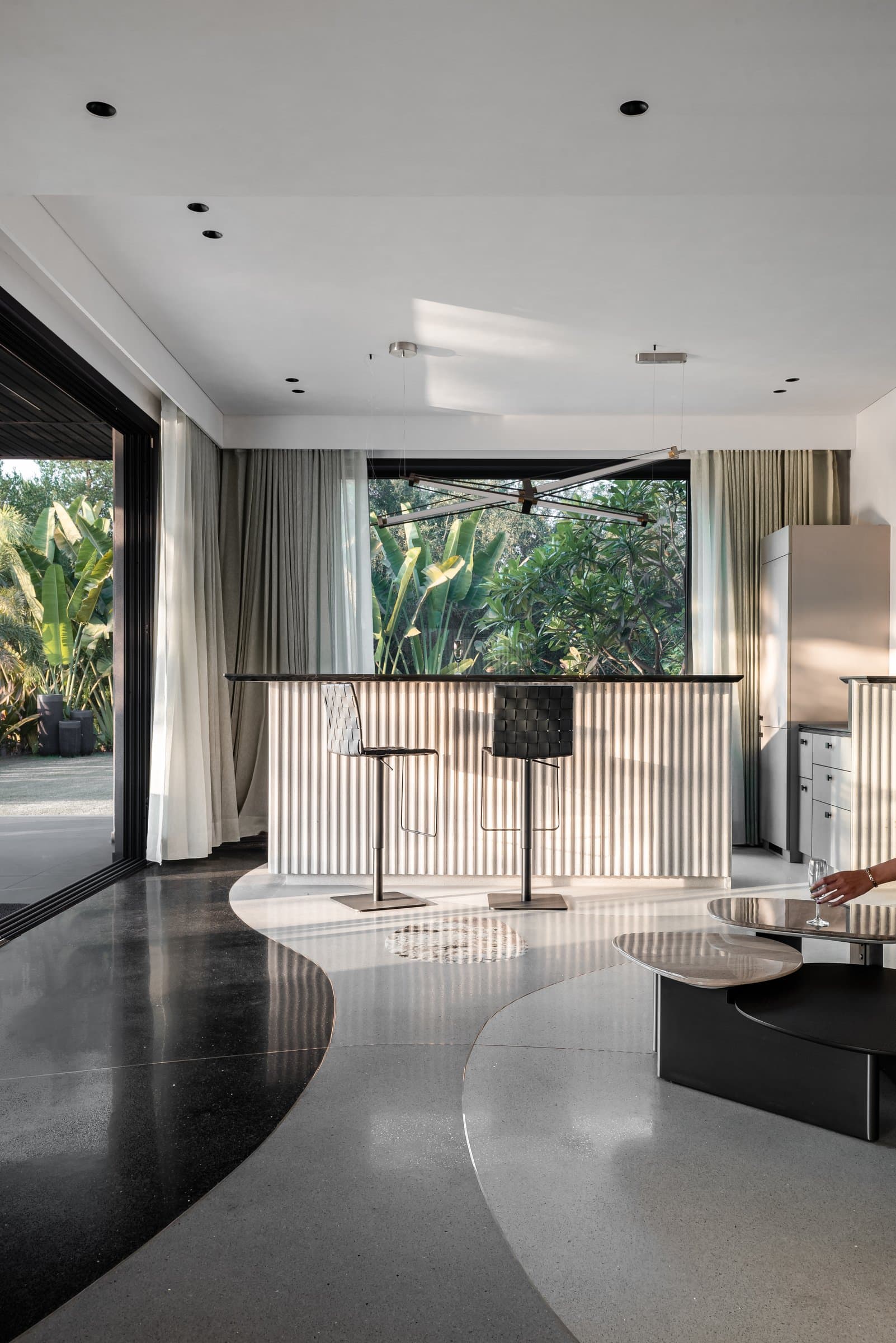
Beyond the dining room, a bar counter clad in fluted, backlit panelling sits against another wall of glazing, the planted garden pressing close behind it. Two slim stools in woven leather and metal face the counter; behind, the floor pattern repeats its now-familiar curving inlay, a motif that quietly stitches the public rooms together.
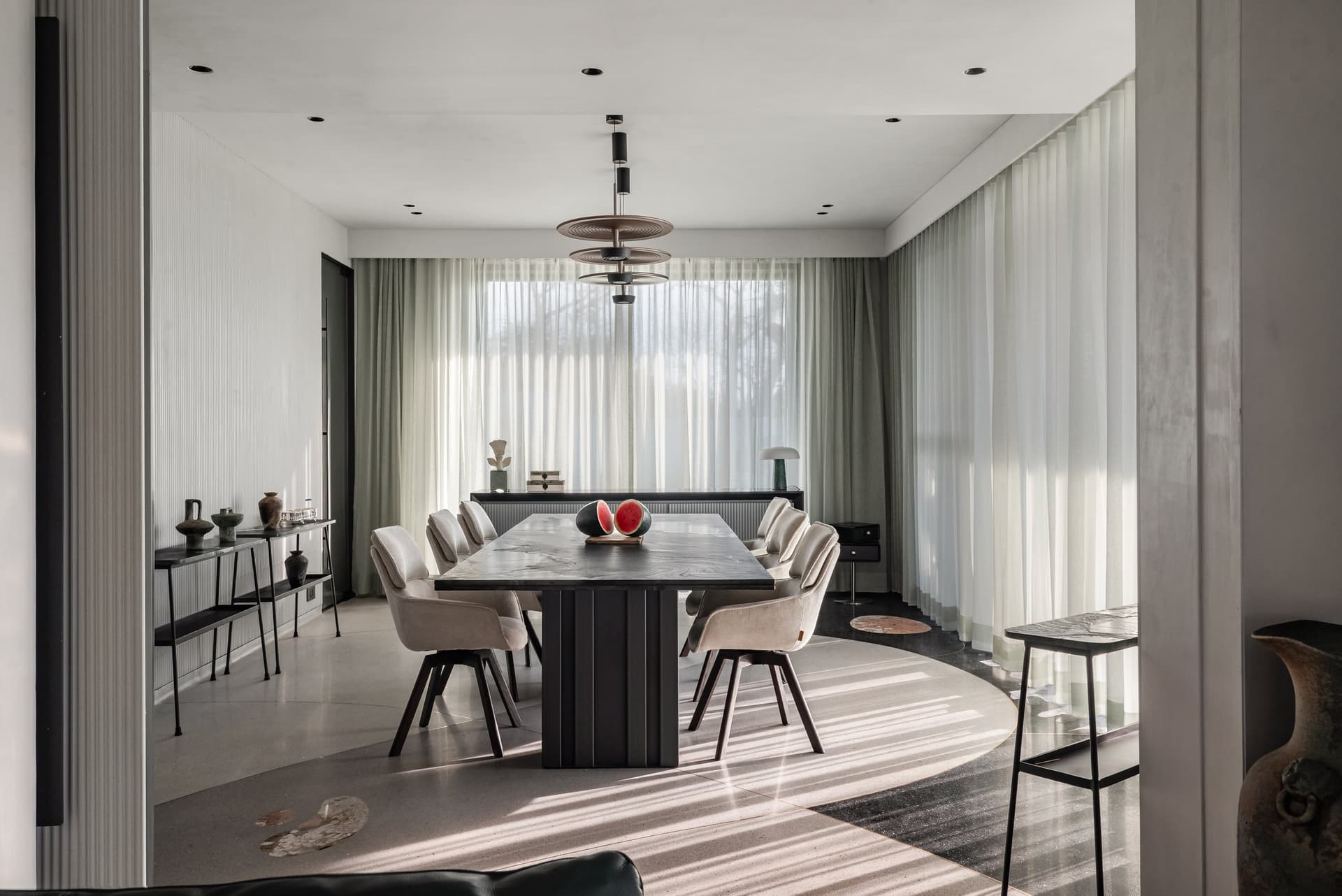
Seen straight on, the dining room reveals its full geometry: a long dark table, six upholstered chairs in a muted neutral tone, and a sculptural tiered pendant suspended at its centre. Sheer drapes filter the afternoon into long horizontal bands of light across the floor, a daily piece of theatre the architecture clearly anticipated.
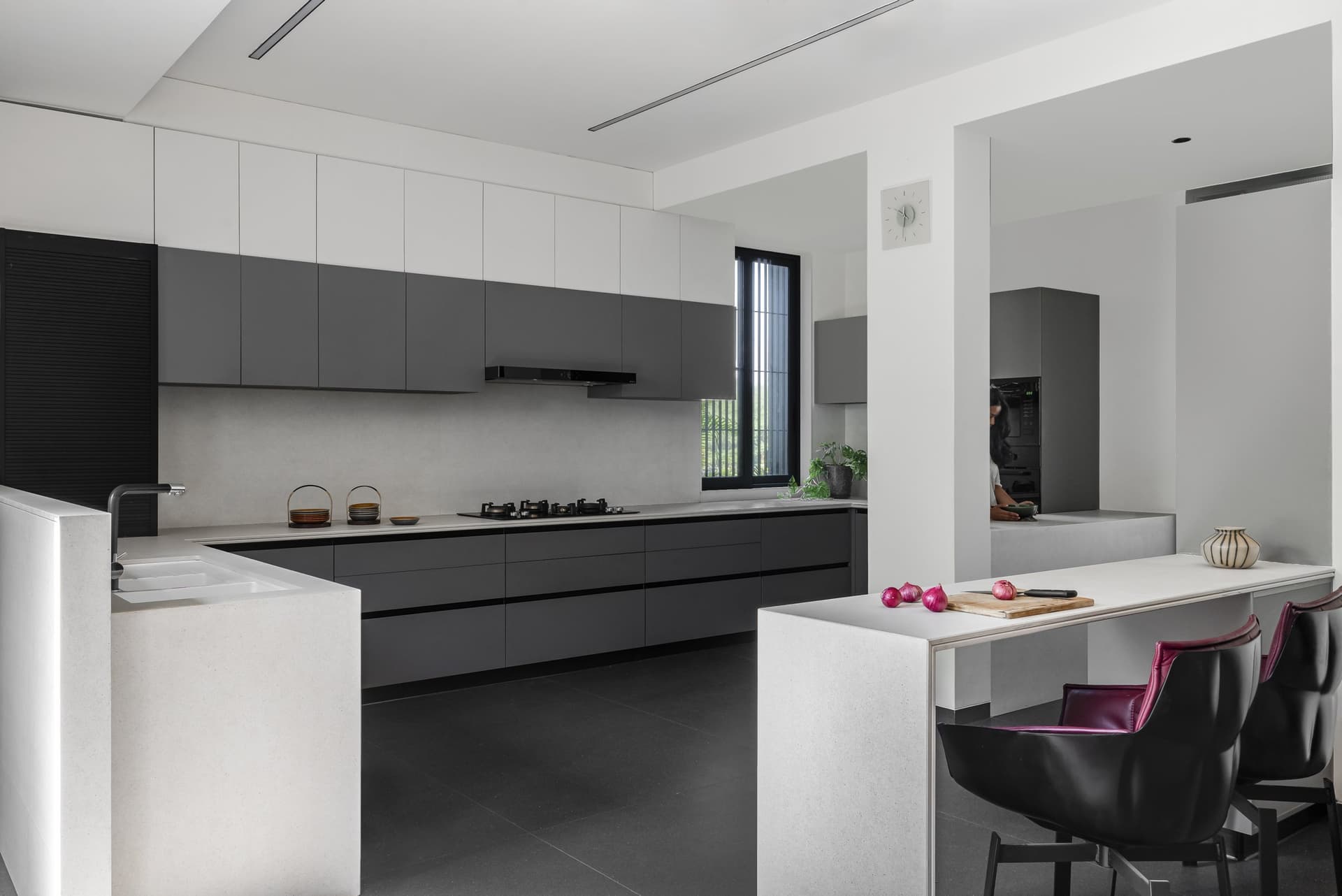
The kitchen reads as the home’s most pragmatic room, and is the better for it. Two-toned cabinetry, deep graphite below and matte white above, runs along one wall in an uninterrupted line; a stone-topped breakfast counter with leather-upholstered chairs extends the workspace outward, and a low service window opens through to the dining beyond. The room earns its restraint by refusing decorative gestures it does not need.
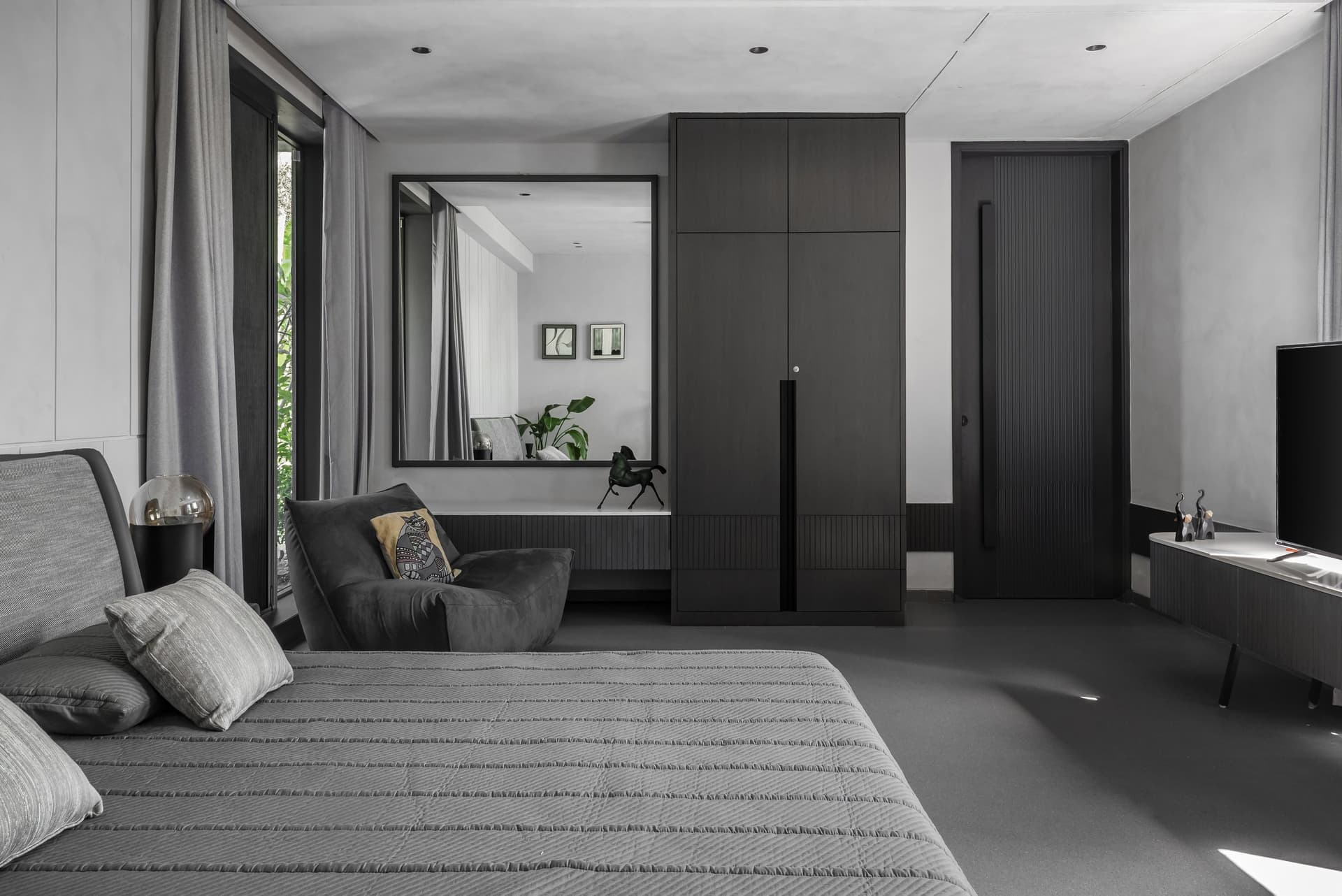
Upstairs, the master bedroom takes the home’s tonal palette into deeper, quieter territory. Pale grey walls paired with dark panelled joinery, a dark panelled wardrobe, and a built-in window seat finished in ribbed dark wood create a room that feels enclosed without feeling heavy, the kind of muted, tonal interior that reads as a deliberate retreat from the bright public floor below. A velvet lounge chair and a large rectangular mirror catch what light the curtains allow.
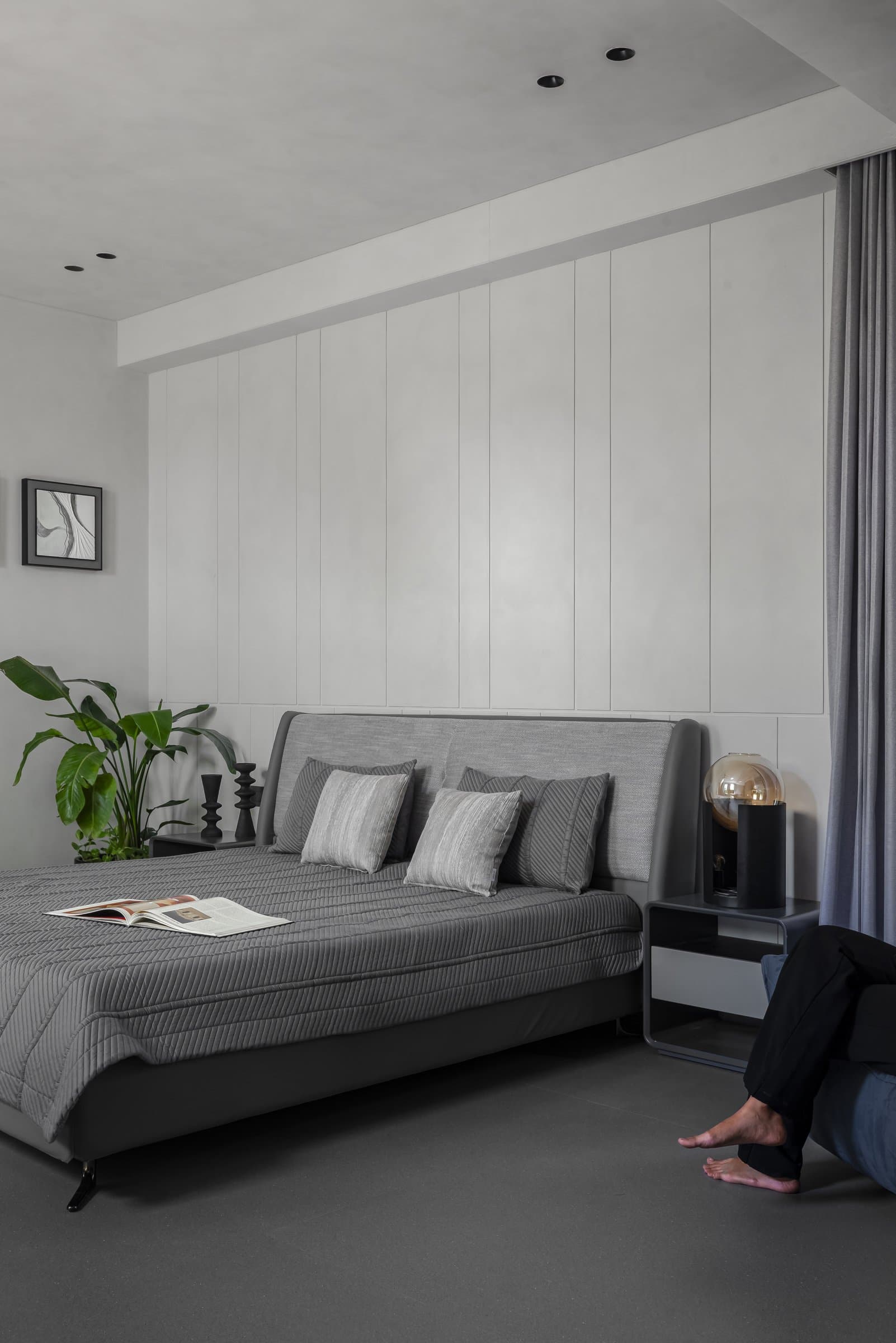
A second bedroom takes the opposite approach, lighter, calmer, more open. A panelled feature wall in pale plaster runs the full width behind the bed, its vertical reveals giving the surface a quiet rhythm. The grey upholstered headboard and tonal textiles let a single framed artwork and a potted bird-of-paradise carry the room’s small notes of contrast.
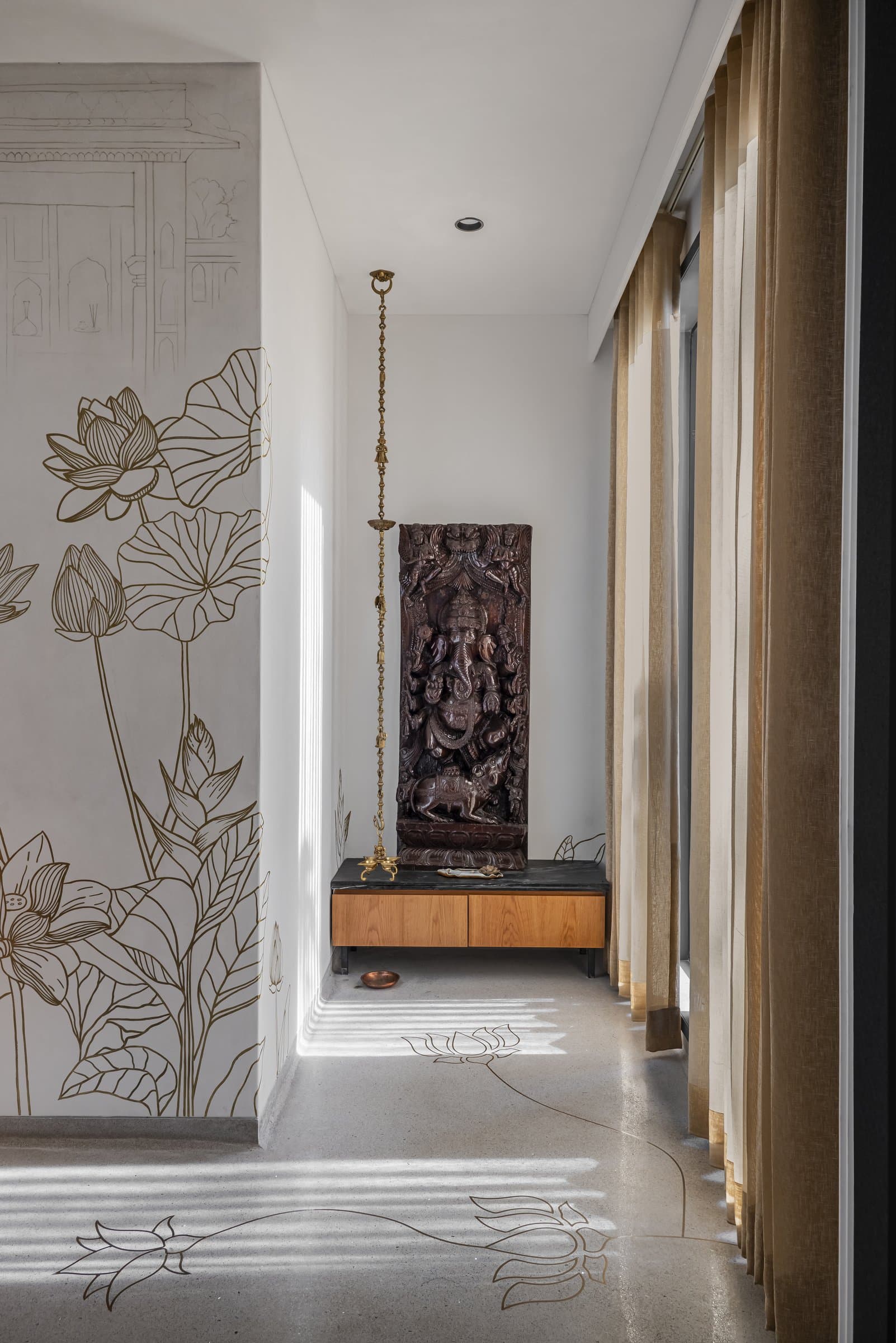
The home’s pooja niche is one of its most considered moments. A carved wooden Ganesh panel stands against a wall finished in a subtle hand-drawn floral mural, with a brass bell-chain descending from the ceiling and a lotus motif inlaid into the stone floor.
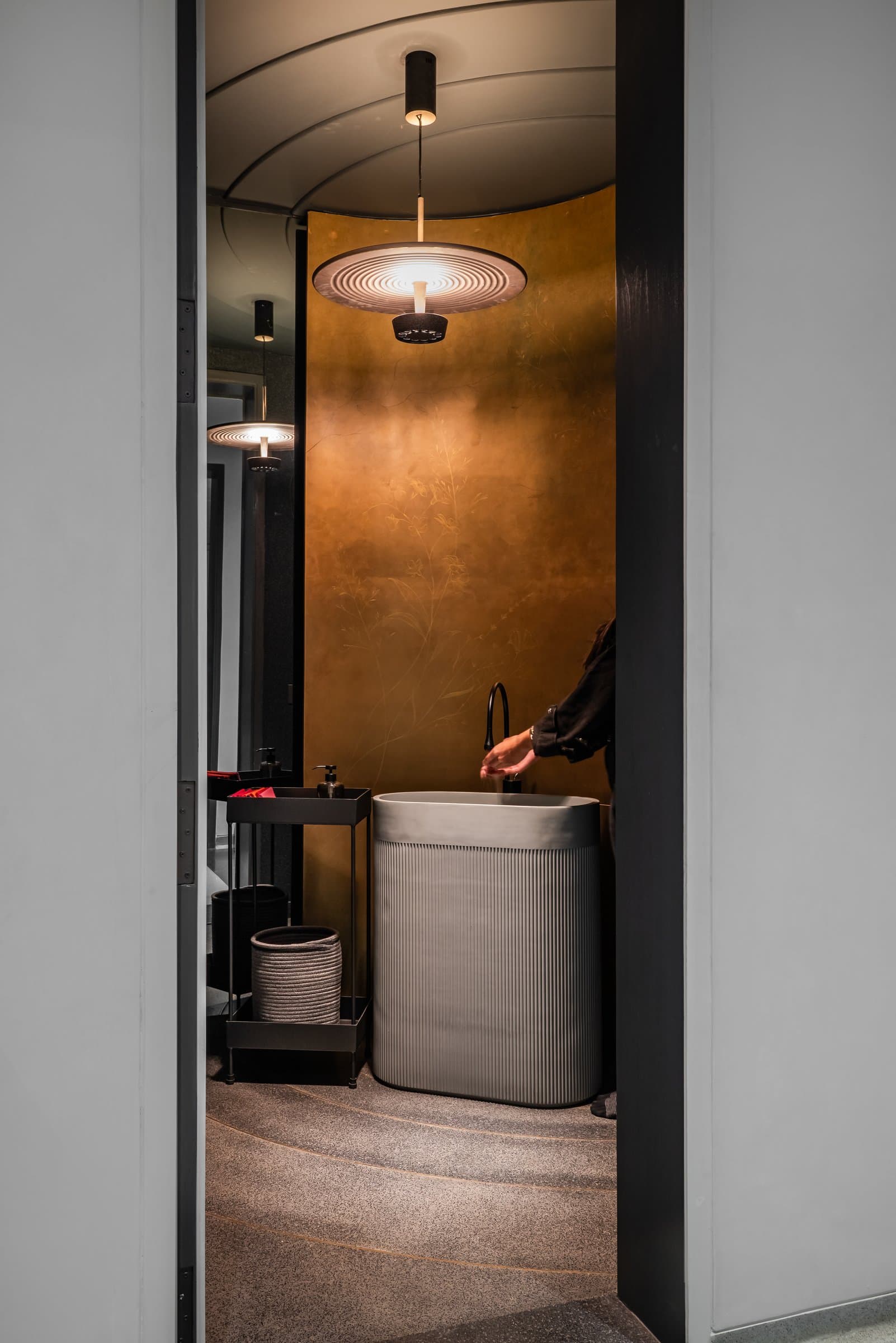
Tucked off a circulation spine, a powder room shows the studio at its most playful. A curved metallic-bronze backdrop wraps a freestanding ribbed basin in pale stone, lit from above by a single ringed pendant; the curved ceiling, the curved wall, the curved vessel all conspire to make the smallest room in the house its most surprising.
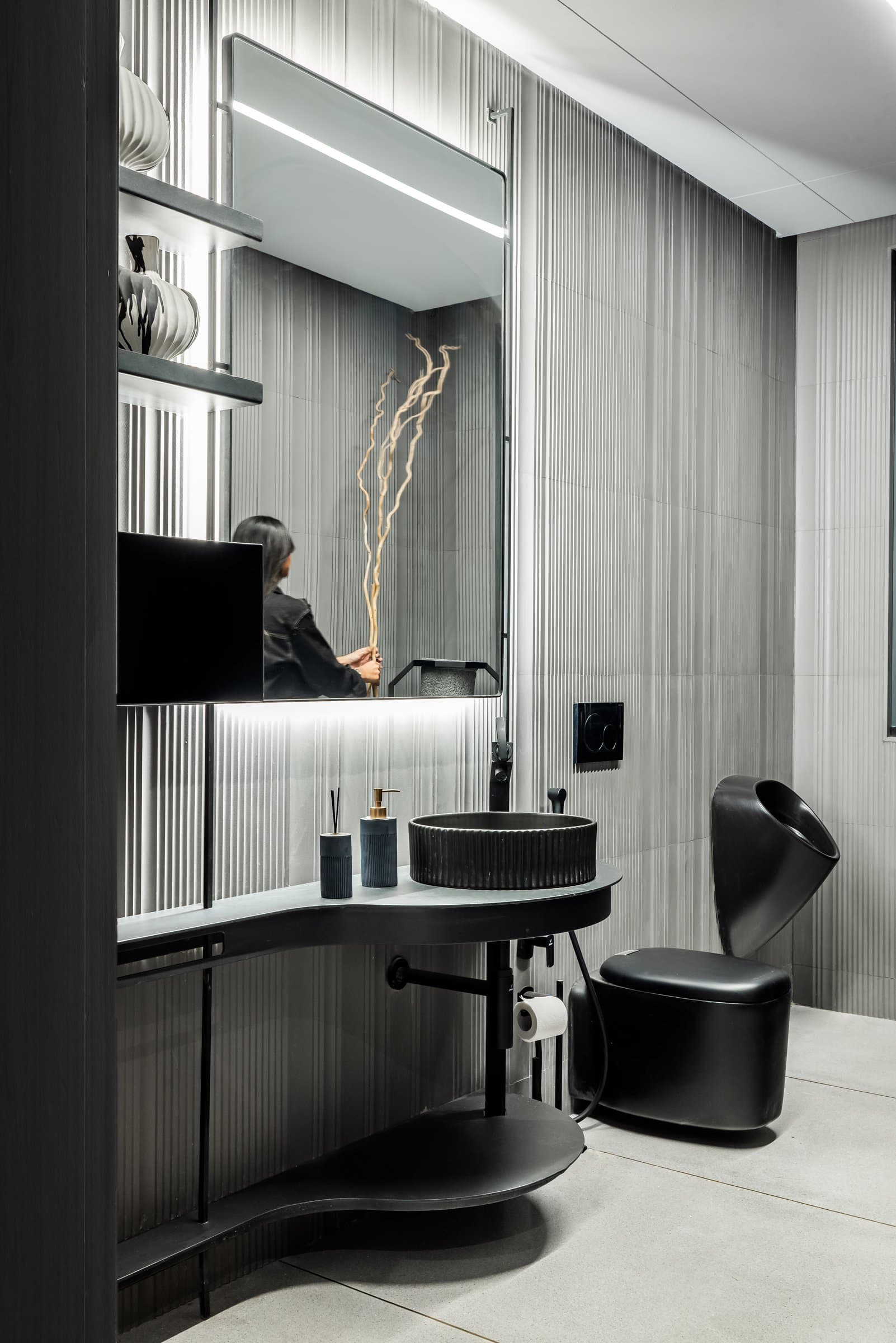
A second bathroom moves in the opposite direction, all cool grey fluted tile and dark fittings, with a sculptural ribbed basin set on a curved black vanity. A backlit mirror floats above; an organic black stool and a sculptural toilet seat complete a room that reads almost as an installation, every element drawn from the same disciplined vocabulary.
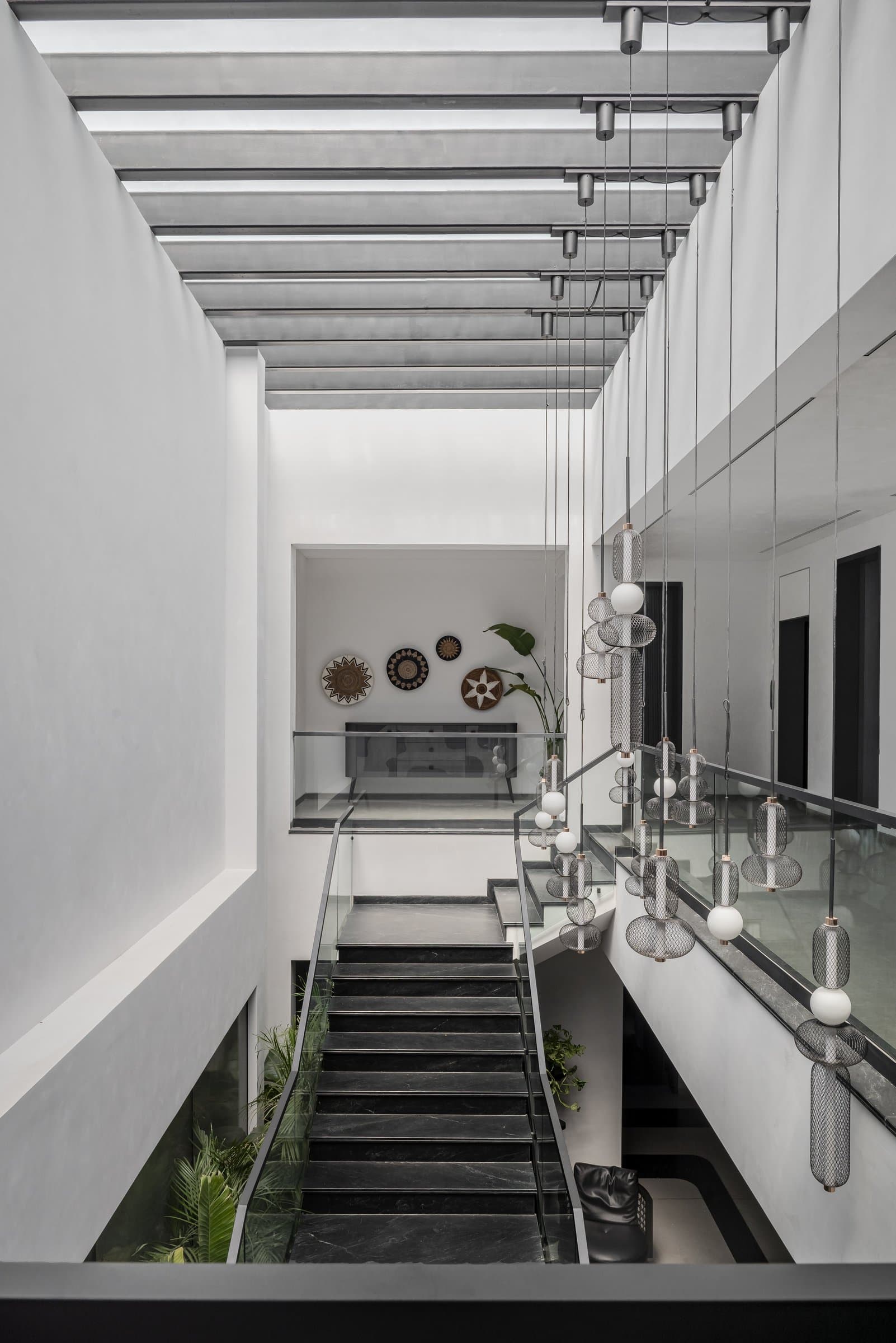
Connecting the two floors is the home’s most theatrical vertical move: a dark stone stair flanked by a double-height void hung with a cascade of mesh-and-globe pendants. The exposed steel ceiling structure above, painted in a deep matte grey, doubles as both ceiling and lighting armature, while a vignette of woven African baskets on the far wall provides the eye with a destination at the top of the climb.
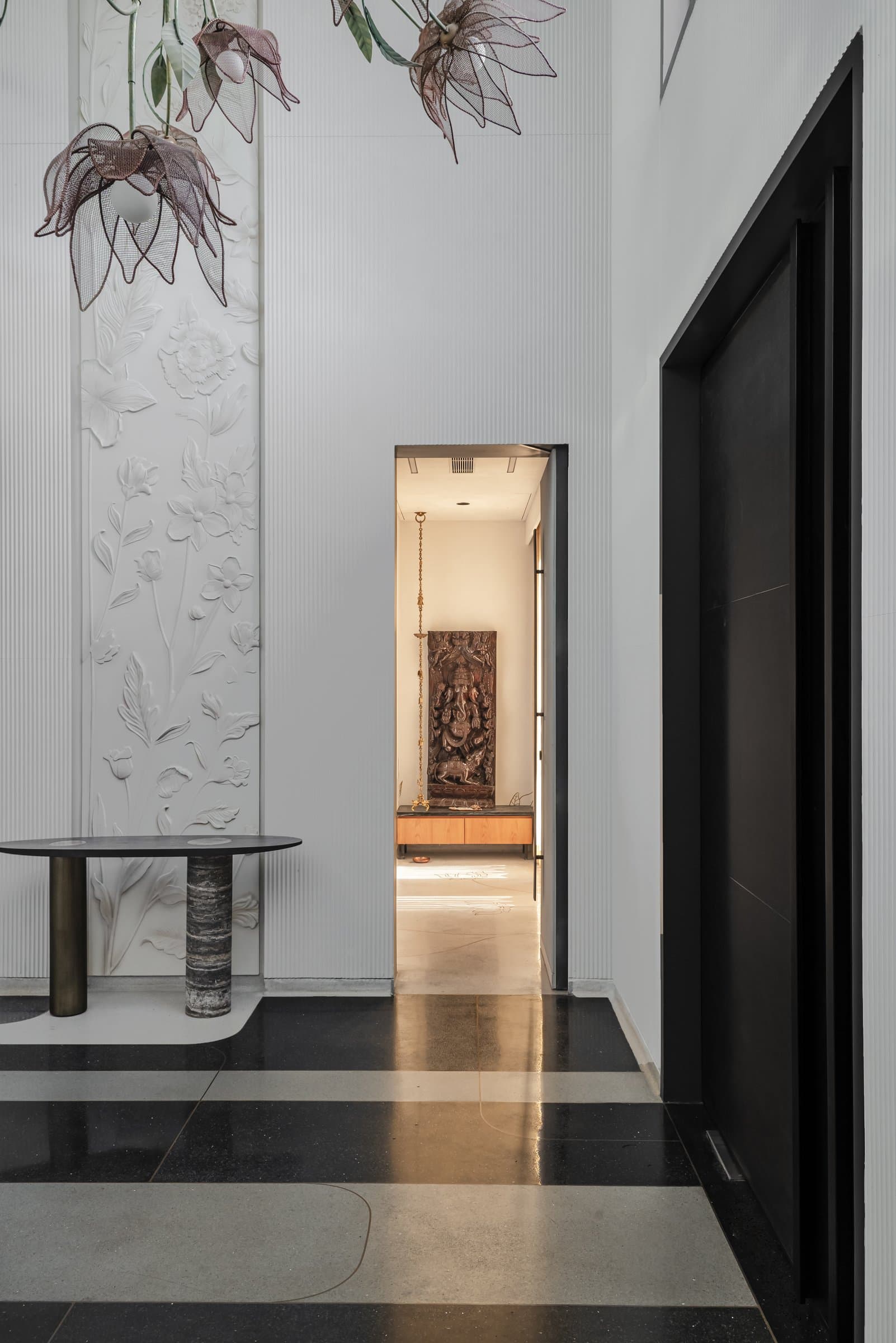
Looking back toward the entry from the inner corridor, the home’s spatial layering becomes clearer: fluted walls flanking a floral bas-relief panel, a low oval console with a stone pedestal, and a series of pendant lights shaped like mesh lotus blooms that hover overhead. Through the doorway in the distance, the pooja shrine glows softly, a quiet visual anchor at the end of the sightline.
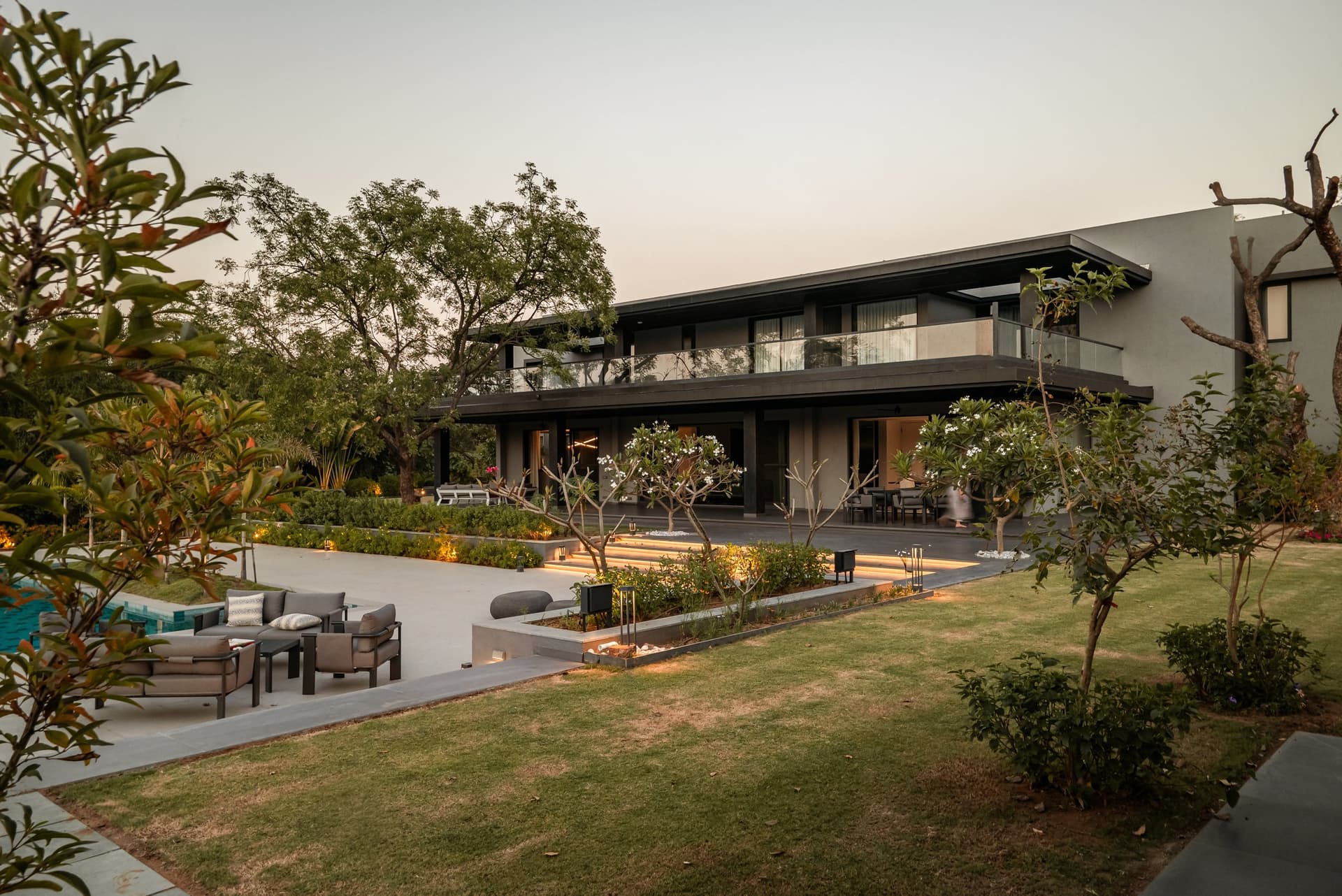
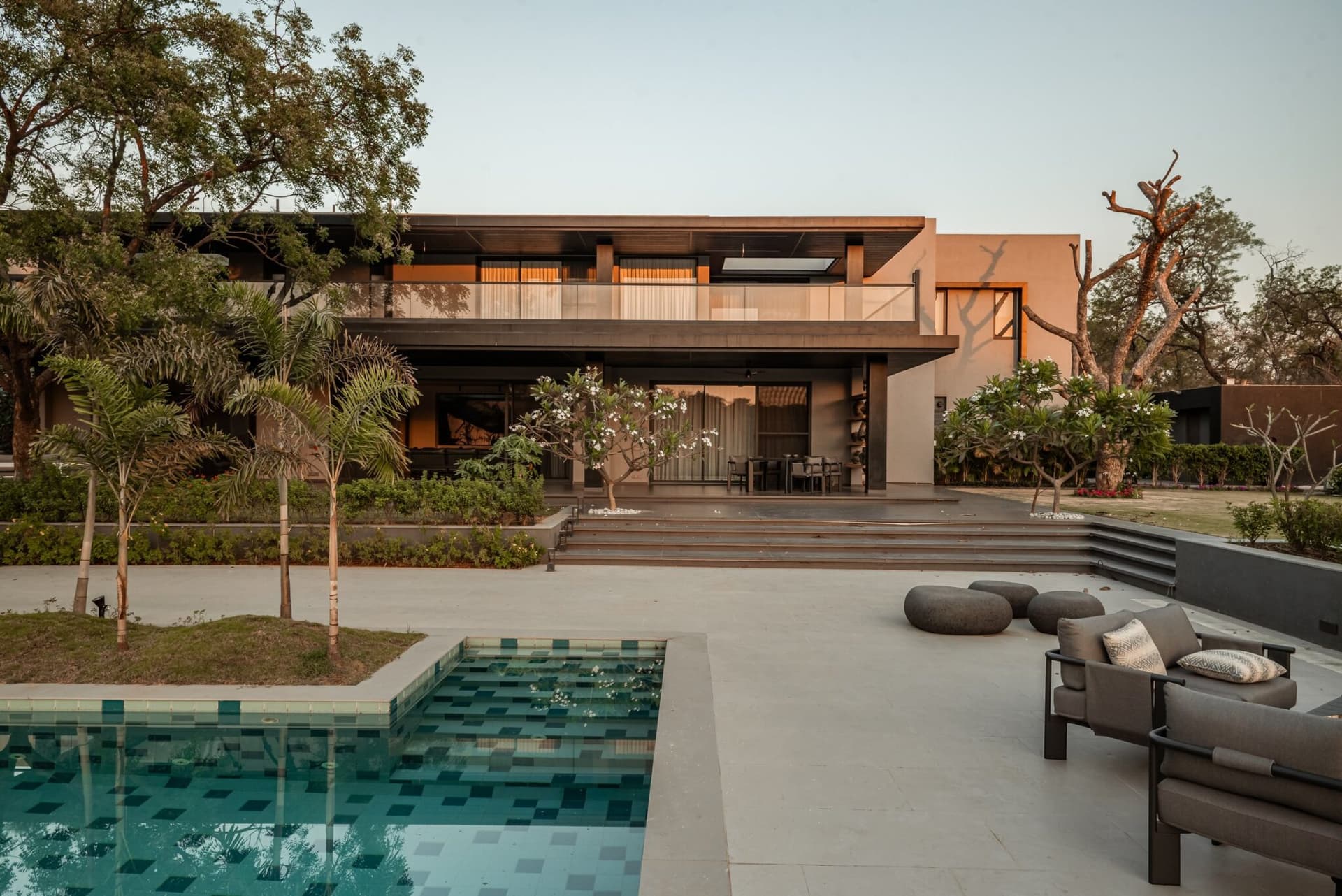
From the rear garden at dusk, the house reveals its full architectural argument. A long horizontal volume sits low on the land, its upper floor cantilevered over a deep covered verandah that runs almost the full width of the elevation. Recessed strip lighting picks out the stepped plinth, while a poolside lounge in the foreground frames the home against a softening sky.
Seen from a different angle, the architecture’s relationship with the existing landscape becomes the story. A mature, leafless tree rises in the foreground, its branching silhouette set against the warm-toned upper volume of the house, while frangipani trees in slow bloom soften the line where building meets ground. The house has been built around the trees, not in spite of them.
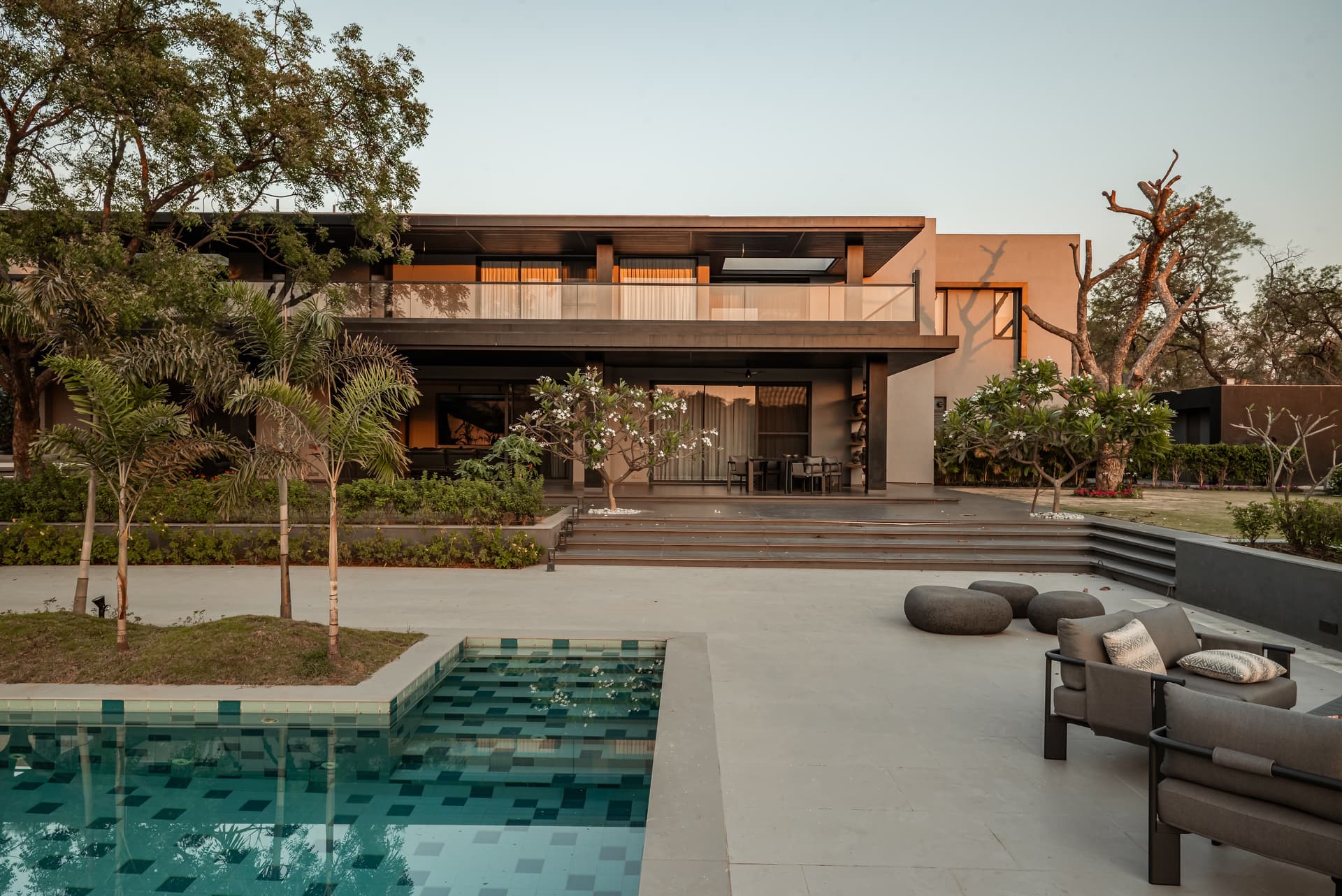
From the pool deck, the home reads as a series of clean horizontal planes, the upper terrace pulled back to create a deep loggia at ground level, the lower volume opening fully through sliding glass to the outdoors. A swimming pool in checkered teal and green tile picks up the planting and the evening sky, while sculptural pebble-like seating sits on the deck nearby.
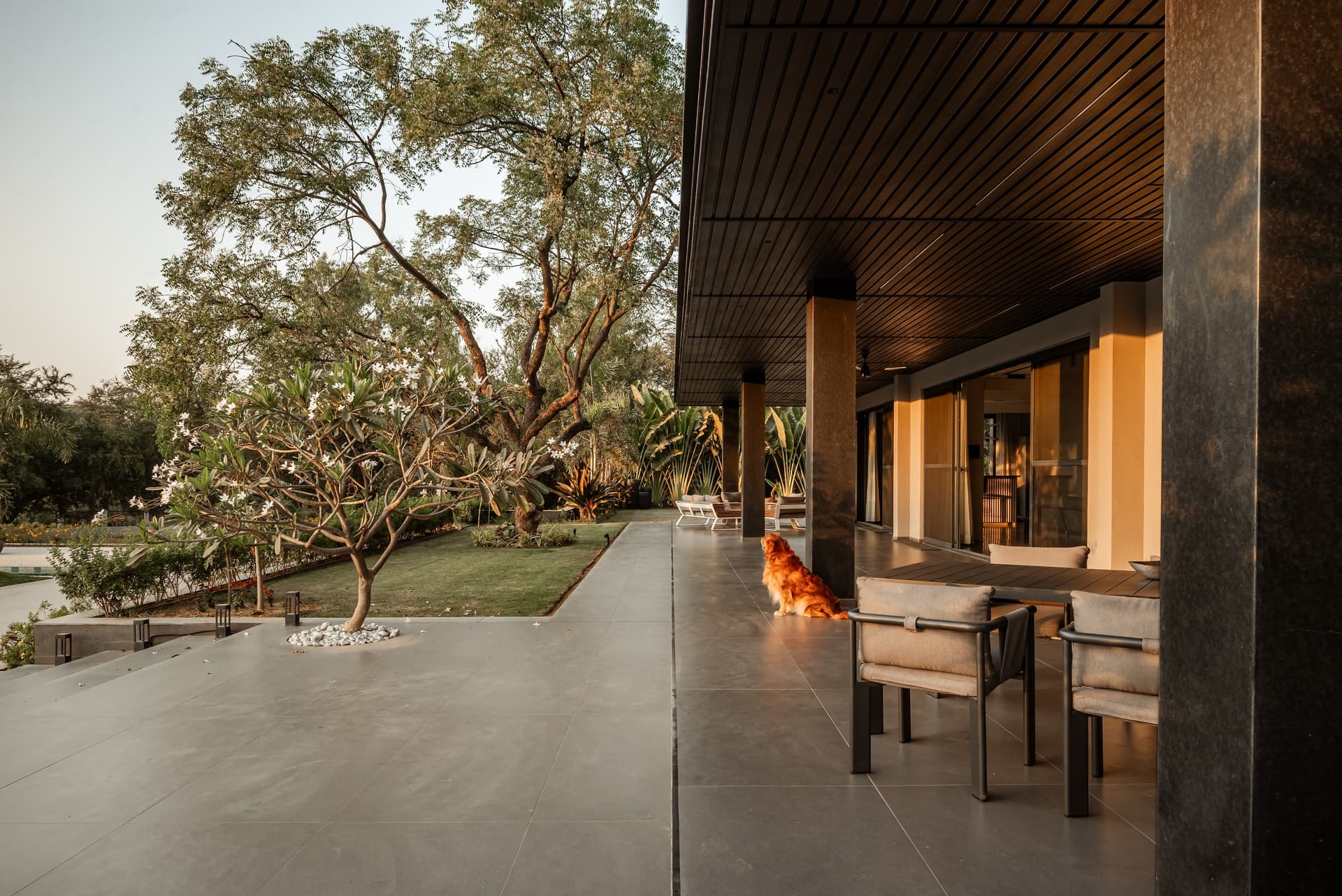
The covered verandah is, in many ways, the home’s true living room. A slatted dark ceiling runs the full depth of the overhang, its parallel lines drawing the eye outward toward the garden and the pool beyond. A pair of cushioned outdoor chairs sits near a dining set; the family’s golden retriever has, as it does in most images of this house, claimed the best seat.
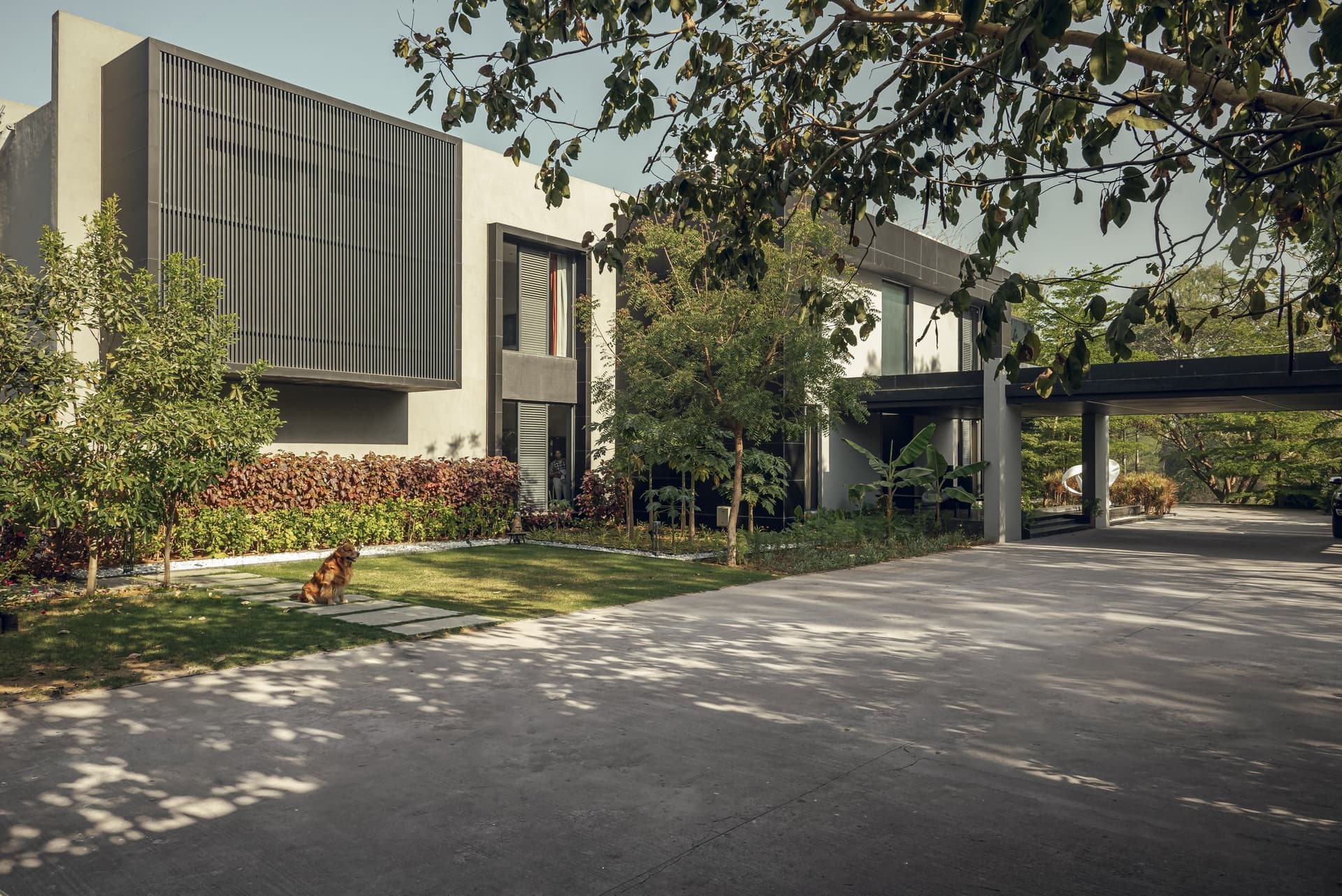
From the approach, the architecture’s most public face emerges. A louvred screen volume floats above a recessed entry, the cantilevered carport extending to the right and a hedge of copper-leafed shrubs softening the plinth line. The composition is contemporary without being austere, generous without being grand, which is, finally, the project’s most consistent thesis.
What The Crossboundaries has built in Vadodara is a residence that resists the contemporary impulse to perform. There are no statement walls demanding the camera, no over-curated material moments, no decorative shortcuts to memorability. Instead the home accumulates, room by room, into a quiet argument for restraint as a form of generosity, the discipline to leave space empty so that light and family and the slow business of living can fill it.
In this lies the project’s quiet distinction: not in the materials it gathers, but in the way it organises stillness into something that feels like home.